• No se han encontrado resultados

Accepted Manuscript

N/A
N/A
Protected

Academic year: 2020

Share "Accepted Manuscript"

Copied!
77
0
0

Texto completo

(1)

Protein diagenesis in Patella shells: implications for amino acid racemisation dating

José E. Ortiz, Igor Gutiérrez-Zugasti, Trinidad Torres, Manuel González-Morales,

Yolanda Sánchez-Palencia

PII:

S1871-1014(15)00021-7

DOI:

10.1016/j.quageo.2015.02.008

Reference:

QUAGEO 634

To appear in:

Quaternary Geochronology

Received Date: 22 July 2014

Revised Date: 31 January 2015

Accepted Date: 8 February 2015

Please cite this article as: Ortiz, J.E., Gutiérrez-Zugasti, I., Torres, T., González-Morales, M.,

Sánchez-Palencia, Y., Protein diagenesis in Patella shells: implications for amino acid racemisation dating,

Quaternary Geochronology

(2015), doi: 10.1016/j.quageo.2015.02.008.

This is a PDF file of an unedited manuscript that has been accepted for publication. As a service to

our customers we are providing this early version of the manuscript. The manuscript will undergo

copyediting, typesetting, and review of the resulting proof before it is published in its final form. Please

note that during the production process errors may be discovered which could affect the content, and all

legal disclaimers that apply to the journal pertain.

(2)

M

AN

US

CR

IP

T

AC

CE

PT

ED

1

Protein diagenesis in Patella shells: implications for amino acid racemisation dating

1

2

José E. Ortiz

a*

, Igor Gutiérrez-Zugasti

b

, Trinidad Torres

a

, Manuel González-Morales

b

,

3

Yolanda Sánchez-Palencia

a

4

5

a

Laboratory of Biomolecular Stratigraphy, E.T.S.I. Minas, Universidad Politécnica de

6

Madrid. C/ Ríos Rosas 21, Madrid 28003 (Spain)

7

b

Instituto Internacional de Investigaciones Prehistóricas de Cantabria. Facultad de

8

Filosofía. Universidad de Cantabria. Avda de los Castros s/n 39005 Santander (Spain)

9

* corresponding author. Tel. +34 913366970; Email address: [email protected]

10

11

Abstract

12

13

14

The inter- and intra-crystalline fractions of Patella vulgata limpets recovered from

15

archaeological sites in Northern Spain (covering Neolithic, Mesolithic, Magdalenian,

16

Solutrean, and Aurignacian periods) were examined for amino acid composition and

17

racemisation over time. The calcitic apex and rim areas of the shells were found to probably

18

be composed of similar proteins, as the D/L values and amino acids were comparable and

19

varied in the same way with increasing age; however, the mineral structures present in these

20

areas differed. The aragonitic intermediate part of the shell showed a distinctly different

(3)

M

AN

US

CR

IP

T

AC

CE

PT

ED

2

amino acid composition and mineral structure. The main protein leaching from the

inter-22

crystalline fraction occurred within the first 6,000 yr after the death of the organism. In

23

contrast, the intra-crystalline fraction — comprised of a different protein composition than

24

the inter-crystalline fraction — appeared to behave as a closed system for at least 34 ka, as

25

reflected by the lack of a significant decrease in the amino acid content; however, changes in

26

the amino acid percentages occurred during this period. The concentration of aspartic acid

27

remained almost constant with age both in inter- and intra-crystalline proteins, and its

28

contribution to the total amino acid content increased with age at the expense of other amino

29

acids such as glutamic acid, serine, glycine and alanine. Temperature is thought to play a key

30

role in the amino acid racemisation of P. vulgata and could explain why in the localities

31

belonging to the Gravettian and Solutrean period, which formed during relatively cold

32

conditions, D/L values were similar to those detected in shells from sites formed during the

33

Magdalenian.

34

35

Key-words: Patella vulgata, inter- and intra-crystalline proteins, amino acids,

36

microstructure, archaeology

37

38

Highlights:

39

40

-

The calcitic apex and rim of P. vulgata shells are probably made of similar proteins

41

-

The aragonitic intermediate area has a different amino acid composition

42

-

The main protein leaching in the inter-crystalline fraction occurs in the first 6 ka

(4)

M

AN

US

CR

IP

T

AC

CE

PT

ED

3

-

Asp content remained constant up to 34 ka in inter- and intra-crystalline fractions

44

-

The percentage of aspartic acid increased with age (over ca. 34 ka)

45

46

1. Introduction

47

48

49

The first attempts to establish the chronology of shell middens using amino acid

50

racemisation/epimerisation date back to the 1970s when Masters and Bada (1977) and

51

Wehmiller (1977) analysed marine bivalve molluscs (Chione) from California. Several

52

studies have demonstrated that amino acid racemisation (AAR) is a satisfactory tool for

53

dating palaeontological and archaeological sites, including the use of limpets recovered from

54

Palaeolithic and Mesolithic anthropogenic shell middens (Bateman, 2008; Ortiz et al., 2009a;

55

Demarchi et al., 2011). Shell middens often accumulate relatively rapidly but they are

56

subject to complex taphonomy. Consequently, large sample sizes for dating are required to

57

resolve issues of intra-site chronology (e.g. Glover et al., 1990; Stein and Deo, 2003).The

58

number of samples commonly used for the age calculation of a single level through AAR

59

allows not only the rejection of anomalous results, but also an understanding of

time-60

averaging and the time over which a certain site formed.

61

Some uncertainties regarding the protein diagenesis of limpet shells remain. Further research

62

is therefore required to clarify the processes of protein preservation and degradation and the

63

concomitant success of AAR for dating archaeological localities. Recent studies of modern

64

limpets performed by Demarchi et al. (2011, 2013a,b) showed the potential of

intra-65

crystalline proteins in Patella shells for AAR geochronology. In these studies, artificial

(5)

M

AN

US

CR

IP

T

AC

CE

PT

ED

4

diagenesis was induced in proteins (both inter- and intra-crystalline protein fractions, and the

67

isolated intra-crystalline fraction) of modern Patella shells through high-temperature

68

experiments (80º, 110º, and 140ºC) over a range of times (0 to 5738 h). The protein

69

breakdown was quantified by measuring the extent and racemisation of various amino acids.

70

This provided data on protein diagenesis in modern limpets; however, it is pertinent to reveal

71

the circumstances of protein degradation in fossil representatives. In this regard, here we

72

examined the amino acid content and D/L values in limpets (Patella vulgata) collected from

73

several archaeological sites of known ages (dated by

14

C) covering the Aurignacian (ca. 34

74

cal. ka BP), Gravettian (ca. 27.5 cal. ka BP), Solutrean (ca. 26.5-20.5 ka cal. BP), Lower,

75

Middle and Upper Magdalenian (20.5-12.0 cal. ka BP), Azilian (ca. 12.0-10.8 cal. ka BP),

76

Mesolithic-Asturian (10.8-6.3 cal. ka BP), and Neolithic (ca. 6.3-5.8 cal. ka BP) periods. P.

77

vulgata was chosen because this limpet is the most common species in shell middens in

78

Northern Spain (González-Morales, 1982; Bailey and Craighead, 2003; Gutiérrez-Zugasti,

79

2009, 2011; Álvarez-Fernández, 2011). We examined the behaviour of the whole protein

80

content (inter- and intra-crystalline proteins) and the intra-crystalline fraction separately, the

81

latter by bleaching prior to analysis.

82

Several studies (Haugen and Sejrup, 1992; Wehmiller, 1993; Torres et al., 1999) have

83

reported intra-shell variation of D/L values depending on the part of the carapace from which

84

the sample is recovered. We therefore also studied the amino acid content and D/L values of

85

two parts of the shell (apex and rim) in samples of various ages.

86

87

2. Material and methods

(6)

M

AN

US

CR

IP

T

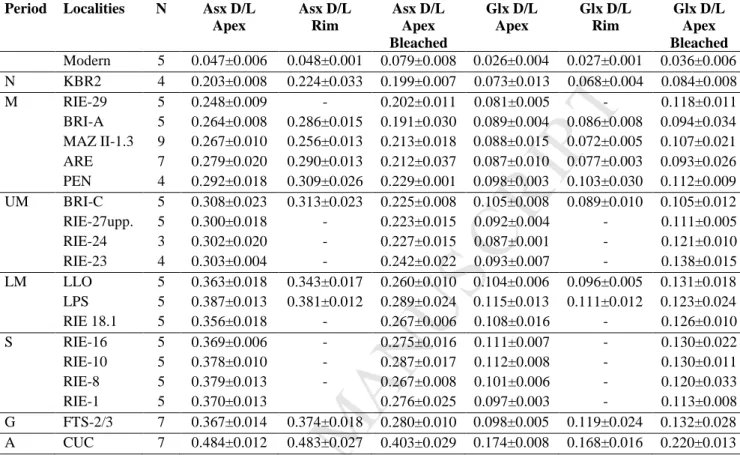
AC

CE

PT

ED

5

89

The samples were collected from 12 sites in the regions of Asturias and Cantabria (Northern

90

Spain) previously excavated in archaeological campaigns (Fig. 1). Permission was obtained

91

for sampling the limpets. Once collected, the shells were stored at the “Museo Arqueológico

92

de Asturias”, the “Museo de Prehistoria y Arqueología de Cantabria”, and the “Museo y

93

Centro de Investigación de Altamira”. Limpets were cleaned with water after their collection

94

and stored in boxes at room temperature (15ºC) in the museums. The coordinates of the

95

localities are reported in Table 1 (Fig. 1), together with the time period of the archaeological

96

level sampled.

97

P. vulgata shells from the levels belonging to the Upper Palaeolithic (Aurignacian,

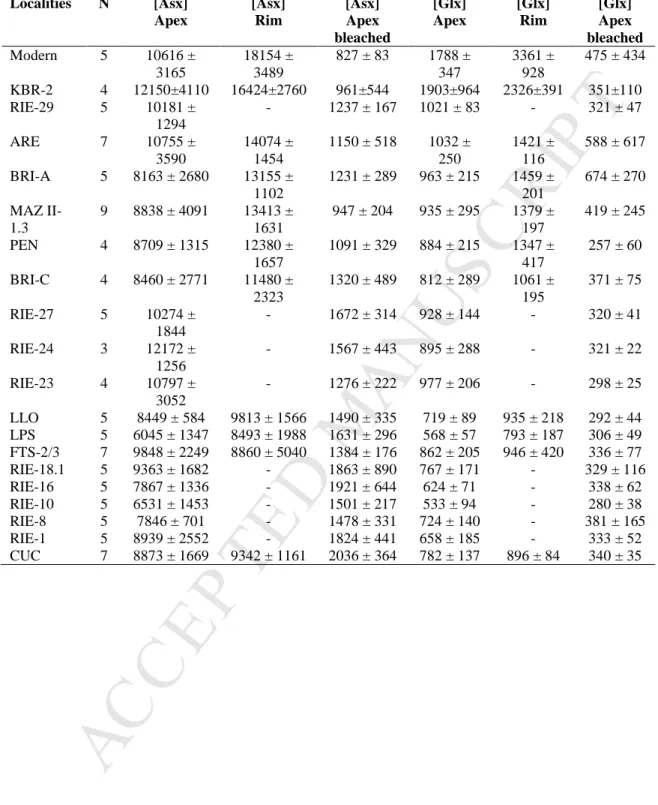
98

Gravettian, Solutrean, Magdalenian, Azilian), Mesolithic (Asturian) and Neolithic (Table 1)

99

periods were analysed for AAR. For comparitive purposes, modern specimens were

100

recovered from Cue beach (Asturias), located close to the archaeological localities (Fig. 1).

101

102

2.1 Petrographic analysis

103

104

Selected P. vulgata shells from modern individuals were cut into thin sections along their

105

major axis and placed on microscope slides. To determine the distribution of minerals and the

106

organic matrix, the sections were submerged in Feigl´s and Mutvei´s solutions for 5 min and

107

observed under a Nikon microscope.

108

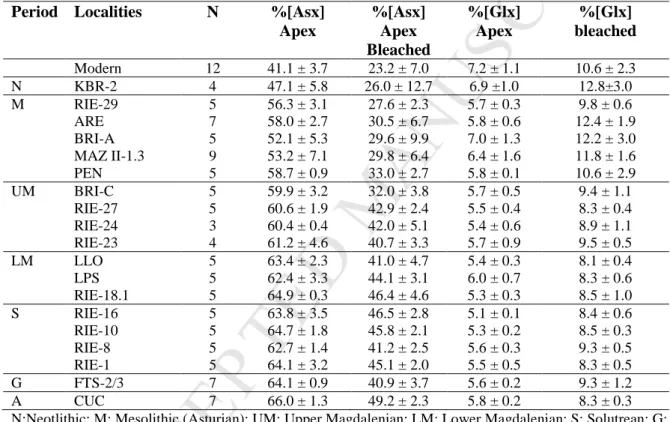
To distinguish between the two calcium carbonate polymorphs that mollusc shells generally

109

form, we applied Feigl´s solution, which was prepared following Feigl (1937, in Friedman

110

1959). This procedure stained aragonite crystals black, while calcite ones remain unstained.

(7)

M

AN

US

CR

IP

T

AC

CE

PT

ED

6

To highlight the organisation of the organic matrix and the crystal arrangement, we used

112

Mutvei’s solution (Mutvei et al. 1994), following the modifications described by Schöne et

113

al. (2005): one litre of Mutvei's solution consists of 500 ml 1% acetic acid, 500 ml 25%

114

glutaraldehyde and ca. 5 to 10 g Alcian blue powder. The use of Mutvei’s solution facilitates

115

the identification of micro-growth structures in carbonates of biogenic origin by staining

116

organic matrix laminae and crystal envelopes in shades of blue.

117

118

2.2 Amino acid racemisation

119

120

Between 4 and 11 P. vulgata shells (analytical samples) from each archaeological level were

121

analysed for amino acids. The use of monospecific or monogeneric samples reduces

122

taxonomically-controlled variability in D/L values (Murray-Wallace, 1995; Murray-Wallace

123

and Goede, 1995). In the laboratory, shells were carefully sonicated and cleaned with water

124

to remove sediment. Peripheral parts, approximately 20–30%, were removed after chemical

125

cleaning of the sample with 2 N HCl.

126

For all samples, we drilled a small disc in the apex of the shells, which has been shown to

127

reduce variability (cf. Murray-Wallace, 1995). This selection was also based on the results

128

from the petrographic analysis, which showed that the apex was made of calcite (cf.

129

MacClintock, 1967; Fenger et al., 2007, Ortiz et al., 2009a; Demarchi et al., 2013a). In

130

addition, we sampled the rim, also made of calcite, in the same limpets (with the exception of

131

those from La Riera cave) in order t test intra-shell variation. The intermediate part of the

132

shell was also sampled, but only in modern limpets. ca. 5–20 mg of apex and rim areas was

133

subjected to AAR analysis of the total protein content (inter- and intra-crystalline proteins).

(8)

M

AN

US

CR

IP

T

AC

CE

PT

ED

7

Samples from the apex were also used to measure the amino acids in the intra-crystalline

135

fraction after bleaching.

136

137

2.2.1 Bleaching

138

139

Powdered shell samples from the apex of the same limpets used to analyse the total protein

140

content were used for the isolation of intra-crystalline proteins. The shell particles measured

141

less than 500 µm, following Demarchi et al. (2013a), a size for which bleaching is most

142

effective. In this regard, we exposed these powdered samples to 10% sodium hypochlorite

143

(NaOCl), an effective oxidising agent for this purpose (Penkman et al., 2008; Demarchi et al.,

144

2013a). Samples were exposed to NaOCl for 48 h, a time reported to be the optimal bleaching

145

period for P. vulgata (Demarchi et al., 2013a), although they used a NaOCl concentration of

146

12%.

147

For each fraction, 50 µL of NaOCl per mg of powdered shell was added to accurately

148

weighed subsamples at room temperature. To ensure the complete penetration of the

149

oxidising agent, the vials containing the powders and the bleach were shaken every 24 h. The

150

bleach was then removed, and the powders were rinsed five times in ultrapure water and once

151

in HPLC-grade methanol, with centrifugation or 4 min. between each rinse to minimise the

152

removal of powder. Finally, the samples were air-dried overnight.

153

154

2.2.2 Amino acid analysis

155

156

(9)

M

AN

US

CR

IP

T

AC

CE

PT

ED

8

Amino acid concentrations and racemisation/epimerisation ratios were quantified using a

157

HPLC, following the sample preparation protocol described in Kaufman and Manley (1998)

158

and Kaufman (2000). This procedure involves hydrolysis, which was performed under an N

2

159

atmosphere in 20 µL/mg of 7 M HCl for 20 h at 100ºC. The hydrolysates were evaporated to

160

dryness in vacuo and then rehydrated in 10 µL/mg of 0.01 M HCl with 1.5 mM sodium azide

161

and 0.03 mM L-homo-arginine (internal standard).

162

Samples were injected into an Agilent HPLC-1100 equipped with a fluorescence detector.

163

Excitation and emission wavelengths were programmed at 335 nm and 445, respectively. A

164

Hypersil BDS C18 reverse-phase column (5 µm; 250 x 4 mm i.d.) was used for the analysis.

165

Derivatisation was achieved before injection by mixing the sample (2 µl) with the pre-column

166

derivatisation reagent (2.2 µl), which comprised 260 mM isobutyryl-L-cysteine (chiral thiol)

167

and 170 mM o-phtaldialdehyde, dissolved in a 1.0 M potassium borate buffer solution at pH

168

10.4. Eluent A consisted of 23 mM sodium acetate with 1.5 mM sodium azide and 1.3 mM

169

EDTA, adjusted to pH 6.00 with 10 M sodium hydroxide and 10% acetic acid. Eluent B was

170

HPLC-grade methanol, and eluent C consisted of HPLC-grade acetonitrile. A linear gradient

171

was performed at 1.0 mL/min and 25ºC, from 95% eluent A and 5% eluent B upon injection

172

to 76.6% eluent A, 23% eluent B, and 0.4% eluent C at min 31; and then with a progressive

173

gradient at 1.07 mL/min and the following percentages: 46.2% eluent A, 48.8% eluent B, and

174

5.0% eluent C at min 95. As a laboratory routine, we separated the D and L peaks of the

175

following amino acids (Fig. 1-Supplementary Data): aspartic acid and asparagine (Asx),

176

glutamic acid and glutamine (Glx), serine (Ser), alanine (Ala), valine (Val), phenylalanine

177

(Phe), isoleucine (Ile), leucine (Leu), threonine (Thr), arginine (Arg), and tyrosine (Tyr),

178

together with the abundance of glycine (Gly).

(10)

M

AN

US

CR

IP

T

AC

CE

PT

ED

9

Asx and Glx D/L values obtained by means of HPLC are comparable with those measured

180

with GC as similarities have been reported in inter-laboratory comparison exercises (cf.

181

Wehmiller, 1984; Torres et al., 1997; Wehmiller et al., 2010) and between several samples

182

analyzed by GC and HPLC in our laboratory (cf. Ortiz et al., 2009b, p. 955, see Fig.

2-183

Supplementary Data).

184

185

2.2.3 Data screening of the AAR analyses

186

187

A total of 121 powdered samples taken from the apex of P. vulgata shells were analysed for

188

amino acid content. The same 121 samples were also used for the bleaching experiment. Rim

189

samples of 76 of these limpets were also used to determine their amino acid composition

190

(samples from the levels of La Riera Cave were not used because we obtained permission to

191

take samples only from the apex).

192

Of these, 14 results (11.6% of the data- 1 in Kobaederra, 3 in Arenillas, 2 in Mazaculos II, 1

193

in El Penicial, 1 in Bricia-B, 3 in El Cuco, 2 in level 24 of La Riera, and 1 in level 23 of La

194

Riera 5) were excluded due to Asx and Glx D/L values that fall off the covarience trend (cf.

195

Kaufman, 2003, 2006; Laabs and Kaufman, 2003) (Figs. 3-5 Appendix) and/or because of

196

abnormally high D/L values, characterised by Asx D/L and Glx D/L values falling outside the

197

2σ range of the group (cf. Hearty et al., 2004; Kosnik and Kaufman, 2008). These samples

198

also showed a low amino acid content. 12.4% of the data from bleached apex samples, and

199

11.8% from unbleached rim samples were also excluded, coinciding in most cases with

200

outliers from unbleached apex. It is possible that these samples with high D/L values were

201

anthropogenically-heated. Each result and the samples rejected are shown in the

(11)

M

AN

US

CR

IP

T

AC

CE

PT

ED

10

Appendix.The data used in the following sections is only from the screened samples, not

203

including outliers.

204

205

2.3 Temperature within the sediment of archaeological sites

206

207

As AAR is a temperature-dependent process, we attempted to observe the influence of

208

atmospheric temperature inside the archaeological sites. For this purpose, permission was

209

obtained from the Communities of Asturias and Cantabria to bury Hobo UA-001-64 digital

210

thermometers between 10 and 15 centimetres inside the sediment at the entrance to some of

211

the caves where the remains were collected (El Cuco, Arenillas, El Perro, Mazaculos II, La

212

Riera, Bricia, El Penicial, and La Lloseta). These devices were programmed to register

213

temperature at 4-h intervals and data was collected over 1 year (January to December 2013)..

214

215

3. Intrashell variations

216

217

3.1 Petrographic analysis

218

219

As observed previously (MacClintock, 1967; Fenger et al., 2007; Ortiz et al., 2009a;

220

Demarchi et al. 2013a), calcite was the main component of the apex and rim of modern and

221

archaeological representatives. These shell areas remained unstained after submerging the

222

thin sections in the Feigl dye (Figs. 2A, B), which corresponded to layers M+3, M+2 and

(12)

M

AN

US

CR

IP

T

AC

CE

PT

ED

11

2 according to the terminology of MacClintock (1967), M being the myostracum (muscle

224

attachment site). In contrast, the intermediate area (layers M+1, M, M-1) was stained black,

225

indicating that it was made of aragonite (Figs. 2A, B). Similar to the findings of MacClintock

226

(1967) and Demarchi et al (2013a), we found that the outer aragonite layer did not occupy a

227

significant portion of the shell.

228

Of note, the boundary between the calcitic M-2 layer and the aragonitic M-1 layer was not

229

straight but showed an interfingering relationship between the two layers (Fig. 2A). This

230

relationship was also observed when the shells were stained with Mutvei’s solution (Fig. 2C).

231

This dye revealed major and minor growth lines of biogenic carbonate, both in the calcitic

232

and aragonitic dominions, which were parallel to the shell surface. Major growth lines in the

233

cross-sections were identified as thicker, more pronounced lines, and these were more clearly

234

observed in layers M+1, M-1 and M-2 (Fig. 2C, D). Minor growth lines, representing

235

semidiurnal and lunar growth increments (Fenger et al., 2007), were extremely fine and

236

detected only at high magnification (Fig. 2E).

237

Mutvei’s solution also showed an irregular distribution of organic matter through the shell

238

section, as revealed by a strong stain in the calcitic apex (M-2) and rim (M+3, M+2), thus

239

indicating stripes rich in organic matter. In contrast, aragonitic intermediate parts (M+1, M-1)

240

were a brownish colour. In most cases, the outermost M+3 and M+2 layers were not clearly

241

distinguishable, as also reported in Forli et al. (2004).

242

The myostracum was very thin and showed a prismatic structure with large crystals oriented

243

perpendicular to the shell surface (Fig. 2D). In the closest interior and external areas to the

244

myostracum (M-1, M+1 respectively), namely the aragonitic intermediate part, we observed a

245

complex crossed-lamellar structure consisting of complicated hierarchical structural (first-,

(13)

M

AN

US

CR

IP

T

AC

CE

PT

ED

12

second- and third-order lamellar structures) features with a feather-like pattern, in which the

247

fibres are oriented perpendicular to the surface of the shell (Fig. 2E, G). Consistent with

248

observations by MacClintock (1967) and Cohen and Branch (1992), we found that the

249

aragonitic M-1 layer was very thin (Fig. 2D, E).

250

In contrast, the microstructure of the rim (M+3, M+2 layers) showed a concentric

crossed-251

lamellar pattern with crystal aggregates arranged parallel to the shell margin, although in

252

these layers (M+2 and M+3) they then became gradually oblique to the outer surface, with a

253

progressive twist to 90º of first order lamella (Fig. 2D, E, F, H), although columnar in

254

appearance. The apex, which was occupied by layer M-2, showed a microstructure with an

255

irregular to radial crossed-lamellar pattern (Fig. 2C).

256

In agreement with Watabe (1984) and Cohen and Branch (1992), the complex

crossed-257

lamellar layers (M-1, M+1) consisted of aragonite, whereas the concentric crossed-lamellar

258

layers (M+3, M+2, M-2) were made of calcite.

259

In brief, layers M+3, M+2 and M-2 were made of calcite and rich in organic matter, although

260

showed different microstructural patterns. In contrast, M+1, M and M-1 layers consisted of

261

aragonite and contain less organic matter. For AAR we analysed the M-2 layer (apex), and

262

M+3 and M+2 layers (rim). In modern representatives we also analysed the M+1 and M-1

263

layers located in the intermediate area.

264

265

3.2 Amino acid D/L values

266

267

3.2.1 Apex and rim - unbleached

(14)

M

AN

US

CR

IP

T

AC

CE

PT

ED

13

269

The mean Asx and Glx D/L values in the rim and apex of 105 bleached and unbleached P.

270

vulgata shells from the archaeological levels (after the rejection of samples with abnormally

271

high D/L values) are shown in Fig. 3. We selected Asx and Glx because they account for a

272

considerable percentage of the amino acid content in modern shells, as shown by Demarchi et

273

al. (2013a).

274

The individual Asx D/L values in modern limpets were similar in the apex and rim (Fig.

6-275

Supplementary Data) corresponding with Demarchi et al. (2013a). A similar pattern was

276

obtained for Asx D/L values in these two areas of the shells from the archaeological

277

localities. Similarly, the mean Glx D/L values in the apex and rim of shells from each site

278

were equivalent (Fig. 3, Fig. 7-Supplementary Data, Table 2- Supplementary Data).

279

In modern limpets we also analysed the amino acids in the intermediate part of the shell,

280

observing that Asx and Glx D/L values were higher than in the apex and rim (Table 2).

281

282

3.2.2 Apex - bleached

283

284

Asx D/L values were lower in bleached than in unbleached samples for the same individual

285

shell (Fig. 3). In contrast, Glx D/L values were higher in bleached samples than in

286

unbleached ones for modern and archaeological localities.

287

288

3.3 Amino acid concentrations

(15)

M

AN

US

CR

IP

T

AC

CE

PT

ED

14

290

3.3.1 Apex and rim-unbleached

291

292

The mean of the total amino acid concentration in unbleached P. vulgata shells was higher in

293

the rim than in the apex, at least in modern, Neolithic, and Mesolithic limpets (Fig. 4). In

294

contrast, in Palaeolithic limpets the concentration of amino acids in these areas was more

295

similar to each other. Likewise, there was variability in the amount of amino acids present in

296

shells within the same level.

297

Similar results were observed for the individual concentrations of Asx ([Asx]) and Glx

298

([Glx]) (Fig. 5, 6), two of the most abundant amino acids in limpet shells. Of note, the

299

percentage of each amino acid was similar in the apex and rim areas (Fig. 7).

300

In modern representatives, the total amino acid content, [Asx], and [Glx] were lower in the

301

intermediate parts of shells than in the apex and rim (Table 2). Nevertheless, the percentages

302

of [Asx] and [Glx] in modern specimens were similar to those found in the apex and rim,

303

although the proportion of other amino acids differed (Fig. 8), i.e. %Ser and %Gly were

304

lower in the intermediate part than in the apex and rim areas, while %Ala, %Val and %Leu

305

were higher.

306

307

3.3.2 Apex - bleached

308

309

(16)

M

AN

US

CR

IP

T

AC

CE

PT

ED

15

The apex intra-crystalline fraction accounted for around 15% of the total proteins within a

310

modern limpet shell (Fig. 4). The amino acid composition of inter- and intra-crystalline

311

proteins in the apex of modern and archaeological limpets also differed, as the percentage of

312

[Asx] was higher in unbleached (40%) than in bleached samples (20–25%) (Table 3), the

313

percentages of [Glx] and [Gly] being higher in the latter. Similar [Asx] percentages were

314

reported by Demarchi et al. (2013a) for bleached and unbleached modern representatives.

315

However, in some other mollusc shells, the percentage of [Asx] has been reported to increase

316

after bleaching (Penkman et al., 2008).

317

318

3.4 Interpretation of intrashell variations

319

320

3.4.1 Inter-crystalline fraction

321

322

Here we observed similar Asx D/L values in the unbleached rim and apex sub-samples of

323

modern limpets and archaeological sites (Fig. 3). This observation is reinforced by the

324

finding that the percentage of each amino acid was similar in the apex and the rim, even with

325

increasing age (Fig. 7). This finding indicates that the proteins comprising these regions are

326

probably similar, both areas being made of calcite (cf. MacClintock, 1967; Fenger et al.,

327

2007, Ortiz et al., 2009a; Demarchi et al., 2013a). It must be highlighted that the acidic amino

328

acids (Asx and Glx) accounted for more than half the content of Patella shells. This

329

observation could be associated with the presence of acidic and Asp-rich proteins, which are

330

usually found linked to calcitic structures (Gotliv et al., 2005; Marin et al., 2012). However,

331

we found that the total amino acid content and also the individual concentrations of the two

(17)

M

AN

US

CR

IP

T

AC

CE

PT

ED

16

main amino acids (Asx and Glx) in P. vulgata shells were higher in the unbleached rim than

333

in the unbleached apex, at least in modern, Neolithic, and Mesolithic limpets (Fig. 4). These

334

results could be attributable to the different mineral structure observed (Fig. 2). Similarly,

335

differential leaching from the unbleached samples may have produced these differences (cf.

336

Penkman et al., 2007, 2008). Likewise, Demarchi et al. (2013a) reported slightly higher

337

concentrations of amino acids in the unbleached rim of modern representatives when

338

compared with the unbleached bulk samples (rim + apex). Our findings imply that in spite of

339

sampling different parts of the P. vulgata shells (apex, rim), there is no significant intra-shell

340

variation of D/L values from the inter-crystalline fraction.

341

The total concentration of amino acids present in P. vulgata shells was variable within the

342

same archaeological level. This observation has also been made in other molluscs (Penkman

343

et al., 2008; Torres et al., 2013) and can be attributed to diverse factors related to the

344

depositional environment, including taphonomical processes such as chemical dissolution,

345

mechanical fragmentation, and bioerosion (Davies et al., 1989; Meldahl et al., 1997; Kidwell,

346

1998; Carroll et al., 2003; Kidwell et al., 2005), all of which can directly influence the

347

skeletal preservation of shells. Nevertheless, a considerable part of the organic matrix was

348

conserved, thereby reinforcing the notion proposed by Wehmiller (1990) that approximately

349

30-60% of the original amino acid concentration remains in carbonate Quaternary fossils.

350

Asx and Glx D/L values in the aragonitic intermediate part of the modern limpet shells

351

(comprising mostly M-1, M, and M+1 layers) were higher than in the apex and rim (Table 2),

352

which are made of calcite (Fig. 2). Also, the percentages of each amino acid differed slightly,

353

as %[Ser] and %[Gly] were lower, whereas %[Ala], %[Val] and %[Leu] were higher than in

354

the apex and rim, thus indicating that other proteins were present, or were represented in

355

differing proportions. These differences were confirmed by the different stain produced in

(18)

M

AN

US

CR

IP

T

AC

CE

PT

ED

17

these layers after submerging the shell cross-sections in Mutvei´s dye, showing that the

357

calcitic M-2, M+2 and M+3 layers were richer in organic matter than the aragonitic M-1 and

358

M+1 layers. According to Marie et al. (2013), Asp-rich proteins, which are more abundant in

359

calcium structures (Sarashina and Endo, 2001; Marin and Luquet, 2004; Gotliv et al., 2005;

360

Marie et al., 2013) are strongly stained with Alcian blue, while other proteins do not show

361

such colouration.

362

Although differences in the amino acid composition (abundance and percentages) were

363

observed between the aragonitic intermediate part (M+1, M, M-1) and the calcitic apex (M-2)

364

and rim areas (M+2, M+3), there was a high content of acidic amino acids (predominantly

365

Asx) in the whole shell (Fig. 8).

366

367

3.4.2 Intra-crystalline fraction

368

369

The intra-crystalline proteins represented a small fraction with respect to the total proteins in

370

modern Patella shells (ca. 15%) (Fig. 4) in agreement with Demarchi et al. (2013a), who

371

observed that they represented 10% in modern shells. Similar to that observed in the

inter-372

crystalline matrix, acidic amino acids were also abundant in the intra-crystalline fraction,

373

representing 30–35%, vs 45-50% in the inter-crystalline fraction (Table 3). This observation

374

indicates that the inter- and intra-crystalline protein compositions differ, at least in the apex

375

area, thus potentially affecting the AAR rates (Fig. 3). Asx and Glx D/L values were indeed

376

higher in the intra-crystalline fraction of modern limpets.

377

378

(19)

M

AN

US

CR

IP

T

AC

CE

PT

ED

18

4. Protein degradation with age

379

380

4.1 Amino acid concentrations vs. age

381

382

4.1.1 Apex and rim - unbleached

383

384

The total amino acid concentration in the apex and rim of unbleached limpet shells

385

(representing the amino acids that comprise inter- and intra-crystalline proteins) was higher in

386

modern specimens than in archaeological ones (Fig. 4); the total amino acid content in the

387

apex decreased by around 40% from modern to Mesolithic limpets. However, the

388

concentrations were similar in archaeological limpets of diverse ages, even in the oldest

389

samples analysed in this study, with the exception of Les Pedroses cave, in which slightly

390

lower concentrations were detected. Limpets from Kobaederra (Neolithic) showed a large

391

standard deviation, mainly as a result of two samples with amino acid concentrations

392

exceeding 30,000 pmol/mg.

393

The decrease of the amino acid concentration was especially noticeable in samples taken

394

from the rim area, in which values fell by ~30% in the Neolithic site and ~50% in Mesolithic

395

localities with respect to those of modern specimens. A decrease in the amino acid content in

396

the rim was observed from Mesolithic material to Palaeolithic shells, while this content

397

remained stable in shells from Magdalenian, Solutrean, Gravettian, and Aurignacian sites.

398

Regarding the concentration of amino acids, [Asx] in the rim and [Glx] in the apex and rim

399

were higher in modern and Neolithic limpets, while they were similar in pre-Neolithic

(20)

M

AN

US

CR

IP

T

AC

CE

PT

ED

19

samples (Figs. 4, 5), although [Asx] content in the apex area did not vary significantly with

401

age.

402

Similar percentages were obtained for apex and rim sub-samples for all amino acids

403

(considering [Asx], [Glx], [Ser], [Ile], [Leu], [Phe], [Val], [Ala], Gly], [Arg] and [Thr])

404

However, the percentage of each amino acid varied in a different way with age (Fig. 7). The

405

percentage of Asx increased progressively with age (Fig. 7), i.e. for modern specimens it was

406

around 40%, whereas for the Neolithic ones (Kobaederra) it was 47%, for Mesolithic ones ca.

407

55%, and for Magdalenian, Solutrean, Gravettian and Aurignacian ones 65%. In this regard,

408

samples older than ca. 12,500 cal. yr BP (Upper Magdalenian) and up to ca. 34,000 cal. yr BP

409

showed similar proportions of [Asx]. In contrast, the percentages of Glx, Ala, Phe, Gly and

410

Ile showed a sharp decrease in limpets from modern to the Mesolithic age, after which the

411

percentage of these amino acids remained almost constant in Palaeolithic samples.

412

A rapid decrease was observed in the percentage of [Ser], [Thr], and [Arg] from modern

413

limpets to those of the Mesolithic period, after which the content of these amino acids

414

decreased steadily until ca. 30 ka. This was especially significant in [Ser] (from 10% in

415

modern shells to 2% in Solutrean ones). It should be noted that the percentages of [Val] and

416

[Leu] remained almost the same.

417

418

4.1.2 Apex - bleached

419

420

The concentration of amino acids in the apex of bleached limpets (representing the amino

421

acids that comprise only intra-crystalline proteins) was similar for modern and archaeological

(21)

M

AN

US

CR

IP

T

AC

CE

PT

ED

20

representatives of different ages (Fig. 4). The same results were obtained for [Asx] and [Glx]

423

(Figs. 5, 6).

424

425

4.2 Interpretation of amino acid concentration trends

426

427

4.2.1 Inter-crystalline amino acids

428

429

Significant protein leaching is likely to have occurred from the inter-crystalline fraction

430

during the ca. 6,000 cal. yr after the death of the limpets, as the total amino acid content

431

decreased over this time, and then stabilised. After this decrease, the amino acid content in

432

limpets of Mesolithic and Palaeolithic ages (up to ca. 34 cal. ka BP) remained almost the

433

same (Fig. 4), whereas the contribution of each amino acid to the total content differed (Fig.

434

7). However, [Asx] in the apex area of archaeological shells did not differ significantly with

435

respect to modern ones.

436

Also, there was an increase in the percentage of [Asx] in both apex and rim areas with age.

437

The percentages of other amino acids such as Glx, Ala, Phe, Gly and Ile decreased with age.

438

This observation might be explained by the position of each amino acid in the protein chains,

439

thus producing different degradation rates (Kriausakul and Mitterer, 1980; Mitterer and

440

Kriausakul, 1984; Wehmiller, 1980, 1993).

441

442

4.2.2 Intra-crystalline amino acids

(22)

M

AN

US

CR

IP

T

AC

CE

PT

ED

21

444

The intra-crystalline proteins represented around 15% with respect to the total proteins in

445

modern Patella shells (Fig. 4). This percentage increased with age (up to 20–30% over 34

446

ka), in spite of the apparently limited degradation of the proteins in this fraction (the

447

concentration of amino acids remained constant with age in the bleached samples), indicating

448

that there was a preferential break-down and loss of inter-crystalline proteins. Similarly [Asx]

449

and [Glx] also remained constant with age. This finding coincides with reports by Penkman

450

et al. (2008), who observed that the proportion of intra-crystalline amino acids within the

451

whole shell increases as the sample ages.

452

Of note, acidic amino acids represent a high proportion of the fraction with age, as reflected

453

by the increase in the relative percentages of Asx from modern to Palaeolithic shells (Table

454

3).

455

It is also remarkable that while Asx and Glx D/L values differed in the two inter- and

intra-456

crystalline fractions of archaeological limpets, in this case Asx D/L values in intra-crystalline

457

proteins were lower and Glx D/L values were higher than in the inter-crystalline ones (Fig.

458

3), which could be attributable to the removal of certain proteins and amino acids from the

459

inter-crystalline matrix of the shells when bleaching (cf. Penkman et al., 2007, 2008). In this

460

sense, the higher concentration of free amino acids within the intra-crystalline fraction (which

461

are the most highly racemised), may explain the lower Glx D/L values obtained in the

inter-462

crystalline fraction. However, other processes may have to be taken into account, i.e.,

463

different amino acids contribute to the proteins entrapped within the biomineral, which

464

undergo racemisation at different rates (cf. Penkman et al., 2008), and the position of each

465

amino acid in the protein chains can produce different degradation rates (Kriausakul and

466

Mitterer, 1980; Mitterer and Kriausakul, 1984; Wehmiller, 1980, 1993). As evidence here,

(23)

M

AN

US

CR

IP

T

AC

CE

PT

ED

22

the percentage of amino acids differed in bleached and unbleached samples (Table 3).

468

Likewise, partial leaching of the inter-crystalline matrix of proteins may have influenced in

469

the Asx D/L values.

470

The differences found in the concentration and composition of amino acids and D/L values

471

between inter- and intra-crystalline proteins are in agreement with Sykes et al. (1995) and

472

Penkman et al. (2007, 2008), who observed distinct racemisation rates in these fractions in a

473

variety of mollusc shells. In leaching experiments (140ºC for 24 h to 240 h) on unbleached

474

and bleached Bithynia and Patella shells, Penkman et al. (2008) and Demarchi et al. (2013a)

475

observed that only a small percentage (1–4%) of the total amino acid content leached from

476

the intra-crystalline fraction, in contrast to a higher percentage (ca. 40%) leached from

477

unbleached shells under the same conditions. While inter-crystalline proteins are more

478

susceptible to decomposition or leaching, the intra-crystalline fraction has been found to

479

approximate a closed system in various mollusc shells. Amino acids within the crystals are

480

apparently effectively isolated from variable external factors, although Orem and Kaufman

481

(2011) observed that the intra-crystalline fraction

in the bivalve Margaritifera is not a closed

482

system under certain conditions.

483

484

5 Aminochronology of limpet shells

485

486

5.1 Asx and Glx D/L values vs. age

487

488

5.1.1 Apex-unbleached

489

490

(24)

M

AN

US

CR

IP

T

AC

CE

PT

ED

23

In general, limpet shells from archaeological sites showed Asx and Glx D/L values consistent

491

with their age (Fig. 3), i.e. in the Neolithic site (Kobaederra) shells had the lowest Asx and

492

Glx D/L values, followed by those belonging to the Mesolithic (level 29 of La Riera, level

493

1.3 of Mazaculos II, El Penicial, Bricia-A and Arenillas), Azilian/Magdalenian (level 27 of

494

La Riera), Magdalenian (levels 24, 23 and 18.1 of La Riera, Bricia-C, La Lloseta and Les

495

Pedroses), and Aurignacian (El Cuco) periods. However, some exceptions were detected: in

496

level 2/3 of Fuente del Salín (Gravettian), D/L values were similar to those of the Lower

497

Magdalenian sites. Likewise, Solutrean (levels 16, 10 and 8 of La Riera) and Pre-Solutrean

498

(level 1 from La Riera) sites showed lower Asx D/L values than those expected.

499

500

5.1.2 Apex-bleached

501

502

As with Asx and Glx D/L values of unbleached apex samples, D/Ls also increased with age

503

in the bleached fraction (Fig. 3). Asx D/L values were higher in the unbleached samples, and

504

a strong correspondence (r

2

= 0.92) was observed between Asx D/L values of both fractions

505

(Fig. 9). Glx D/L values were slightly higher in bleached Neolithic, Mesolithic, and Upper

506

Palaeolithic shells than those of unbleached samples, being clearly higher in shells from older

507

levels (Fig. 3). Also, a strong correspondence (r

2

= 0.85) was found between Glx D/L values

508

of both fractions (Fig. 9).

509

510

5.2 Temperature measurement inside the sediment

511

512

Fig. 10 shows a plot of the temperature registered at 4-h intervals in the sediment of selected

513

archaeological localities in northern Spain over the course of a year (2013), together with

(25)

M

AN

US

CR

IP

T

AC

CE

PT

ED

24

atmospheric temperature obtained from the meteorological station of Llanes. The monthly

515

and annual mean temperatures measured in the sediment of selected localities during 2013

516

are shown in Table 4.

517

Two main considerations are interpreted from the data recorded: 1) atmospheric temperature

518

affects all localities, although its effect is less marked inside the sediment (10-15 cm deep) at

519

the entrance of the caves (no more than 3 m far from the entrance), and variations are

520

attenuated; and 2) temperature within the sediment differs between caves. The archaeological

521

remains of Mazaculos II, La Riera, Bricia, El Penicial and La Lloseta are currently preserved

522

at lower temperatures than at other sites, while at El Cuco, temperatures are significantly

523

higher than at the other sites, probably because it is oriented to the south.

524

525

5.3 Aminochronological considerations

526

527

A general increase between Asx D/L values and radiocarbon ages was observed (Fig. 3) up to

528

18 cal. ka. We propose that the palaeoclimatic variations occurred after the accumulation of

529

the archaeological remains affected the amino acid racemization rate of P. vulgata- shells, as

530

it was observed that atmospheric temperature affects sediments bearing the limpets in the

531

entrance of the caves. Levels belonging to the Solutrean (levels 16 to 1 of La Riera) and

532

Gravettian (level 2/3 of Fuente Salín) periods showed lower Asx D/L values than expected,

533

but similar values to those typical of Magdalenian localities (Fig. 3). During the Last Glacial

534

Maximum (LGM), temperatures in the sediment would have been lower than during the

535

Holocene, i.e., according to Bard (2002) and Peck et al. (2008), sea surface temperature in the

536

North Atlantic during the LGM was 5-6ºC lower than during the Holocene, thus decreasing

537

the racemisation rate. This is especially noticeable at La Riera, where Asx D/L values of

(26)

M

AN

US

CR

IP

T

AC

CE

PT

ED

25

shells in the Asturian, Azilian/Magdalenian, Magdalenian levels were in agreement with

539

calibrated

14

C ages and the periods to which they belong (Fig. 3). In contrast, limpets in the

540

Solutrean and Pre-Solutrean levels showed lower Asx D/L values than expected (Fig. 3), and

541

probably those of Lower Magdalenian as well. As we observed, the main leaching of

open-542

system proteins occurred during the first 6,000 yr after the death of the limpets (Fig. 4). As

543

temperature influences the racemisation rates of amino acids, the low temperatures that

544

occurred during the Last Glaciation appears to have slowed the racemisation of limpets from

545

27,000 cal. yr BP to at least 18,000 cal. yr BP, after which they followed a similar rate to that

546

of shells in Magdalenian levels (18,000-12,000 cal. yr BP). This explanation could account

547

for the observation that limpets from the Solutrean and Gravettian levels showed lower Asx

548

D/L values than those expected, with an apparent decrease in racemisation between 18-27 cal

549

ka BP i.e, both in unbleached and bleached apex of limpets (Fig. 3).

550

It is noticeable that the El Cuco samples, deposited under cold conditions, showed

551

significantly higher Asx and Glx D/L values than levels belonging to Solutrean and

552

Gravettian. This may be explained by the orientation of the entrance of this site (to the south),

553

increasing the solar radiation received in comparison with other localities. In support of this,

554

higher temperatures were measured by the loggers (Table 4, Fig. 10), indicating that this site

555

may have not been as affected by the decrease in rates due to cold conditions as the other

556

sites. Nevertheless, other explanations are possible, including that the

14

C ages for the El

557

Cuco remains may be in error; it is planned to perform new radiometric dating.

558

The climate amelioration that occurred from the start of the Late-Glacial and throughout the

559

Holocene explains the general agreement between radiocarbon ages and the

560

aminostratigraphy of Magdalenian, Azilian, Mesolithic and Neolithic levels. However, in

(27)

M

AN

US

CR

IP

T

AC

CE

PT

ED

26

some cases there was a discordance, which may be explained by the taphonomical conditions

562

that affected these sites.

563

Of note, level A of Bricia Cave and the shell midden of La Riera (level 29) were dated by

14

C

564

at 7,375 ± 185 cal. yr BP and 7,680 ± 150 cal. yr BP (Clark, 1976), respectively, but they

565

showed different mean Asx D/L values (0.264±0.008 for level A of Bricia, and 0.248±0.009

566

for La Riera shell midden-level 29). Although these two caves are less than 100 m apart and

567

positioned on the same karstic massif, they also showed different mean annual temperatures

568

over the year recorded. La Riera Cave experienced lower temperatures, especially noticeable

569

during the summer months, in which a mean difference of 3ºC was observed, whereas during

570

winter, temperatures differed by less than 1ºC. Glx D/L values were only slightly higher in

571

BRI-A (0.089±0.004) than in RIE-29 (0.081±0.005), which is explained by the lower

572

racemisation rate of Glx in comparison with that of Asx.

573

Likewise, the mean Asx D/L value in Arenillas rock-shelter was higher than expected, as the

574

shell midden remains were dated at 6,385±70 cal. yr BP (Bohígas and Muñoz, 2002). In this

575

case, the mean annual temperature was observed to be higher (3-4ºC) than in other localities

576

of similar age (Fig. 10), explaining the Asx D/L values. In addition, recent radiocarbon dating

577

has indicated that these deposits accumulated ca. 7,800 cal. yr BP (unpublished data).

578

However, the effects of other factors in elevating the D/Ls cannot be ruled out.

579

This study indicates that Asx D/L and Glx D/L provide a useful method for dating limpets

580

from archaeological levels younger than ca. 18 cal. ka BP in this region. For older sites (at

581

least those belonging to the Gravettian and Solutrean which were formed under cold

582

climates), past temperatures are likely to have decreased racemisation rates, and extrapolation

583

of Asx D/L values to age should therefore take this into account. Likewise, taphonomical and

584

environmental conditions must be considered in all sites for accurate age estimation.

(28)

M

AN

US

CR

IP

T

AC

CE

PT

ED

27

586

6. Conclusions

587

588

In summary:

589

1.-Amino acid D/L values in the apex (M+3 and M+2 layers) and rim (M-2 layer) areas of

590

unbleached P. vulgata shells are comparable and can therefore both be used for the age

591

calculation of archaeological localities. These zones are made of the same polymorph of

592

calcium carbonate (calcite). In contrast, D/L values in the aragonitic intermediate area (M+1,

593

M and M-1 layers) are higher.

594

2.-Proteins in rim and apex areas are probably similar, as the percentages of amino acids

595

within them contribute the same percentage to the total amino acid content and vary in the

596

same way with increasing age. Nevertheless, higher amounts of amino acids were found in

597

the rim of modern limpet shells than in the apex, although in archaeological ones, similar

598

concentrations were observed.

599

3.-The main leaching of open-system proteins in P. vulgata shells (at least the

inter-600

crystalline fraction) occurred within the first 6,000 cal. yr BP after the death of the organism.

601

This is evidenced by the considerable decrease in the total amino acid content in Mesolithic

602

samples with respect to modern and Neolithic ones. However, leaching may be faster, as

603

limpets from the Neolithic Kobaederra-2 site showed high variability in the concentrations

604

and percentages of amino acids with respect to those of modern ones. However, the total

605

amount of amino acids in the intra-crystalline fraction remained virtually intact for at least 34

606

ka.

Figure

Table  1.    Geographical  location  of  the  archaeological  levels  studied  and  the  periods
Table 2. Mean total amino acid, Asx, and Glx concentrations (pmol/mg), and Asx D/L
Table 4. Mean monthly and annual temperature (in degrees Celsius) record in the sediment of some archaeological localities (measured  at 4-h intervals)
Table  1-Supplementary  Data.  Radiocarbon  ages  (yr  BP)  of  the  archaeological  levels  and  calibrated  ages  (cal  yr)  converted  using  the  Radiocarbon  Calibration  Program  7.0  (CALIB  7.0)  (Stuiver  et  al.,  2014)  with  the  calibration  d
+3

Referencias

Documento similar

Very high concentrations of pro-anthocyanidins have been found in Artemisia afra (1990 mg/100 g) [92] and in A. A study from Algeria compared the total extractable tannin content

Ancestral sequence reconstruction (ASR) and resurrection (i.e. functional expression in a heterologous host) allows enzymes with different properties to be disclosed while its

In this study we examined tissue levels of dopamine (DA) and serotonin (5-hydroxytryptamine, 5-HT) and their metabolites, of noradrenaline (NA) and of the amino acid

This manuscript undertakes a review of the effects resulting from the intake of proteins and/or amino acids administered in carbohydrate drinks as well as whey protein and

Experimental values of selected variables: ( r A ) global is the mean overall rate of acetic acid formation in the two-bioreactor system, P m the total acetic acid production in

Since such powers frequently exist outside the institutional framework, and/or exercise their influence through channels exempt (or simply out of reach) from any political

The study uses concentrations of pharmaceuticals, illicit drugs, alcohol, nicotine and caffeine in wastewater samples from different European cities and compares these with

Figure 8: 29 Si and 27 Al MAS NMR spectra of the FEBEX samples taken from the concrete interface in the in situ experiment (above) and produced during the reaction of