www.elsevier.es/ejfb
EUROPEAN
JOURNAL
OF
FAMILY
BUSINESS
RESEARCH
PAPER
How
has
the
family
firm
literature
addressed
its
heterogeneity
through
classification
systems?
An
integrated
analysis
Remedios
Hernández-Linares
a,
Soumodip
Sarkar
b,
M
aConcepción
López-Fernández
c,∗aCentroUniversitariodeMérida,UniversityofExtremadura,Avda.SantaTeresadeJornet.38,06800Mérida(Badajoz),Spain bCEFAGE-UEandDepartmentofManagement,UniversityofÉvora,PaláciodoVimioso(Gab.224),LargoMarquêsdeMarialva,8,
7000-809Évora,Portugal
cFacultaddeCC,EconómicasyEmpresariales,UniversityofCantabria,Avda.delosCastros,54,39005Santander(Cantabria),
Spain
Received12May2017;accepted28June2017 Availableonline22July2017
JEL CLASSIFICATION M14; M19; M21 KEYWORDS Familybusiness heterogeneity; Familyfirmtypology; Familybusiness classification; Co-wordanalysis; Taxonomy
Abstract Extant literaturerecognizes bothfamilybusiness heterogeneityandthe need to identify relevant definitionalcriteria to distinguish familyfirms, leading to the emergence of typologies, taxonomiesand classification schemes.This paperpresents acomprehensive reviewofexistingclassifications,whichwe thecompare withthecoreconceptualelements embedded in258 familybusiness definitions. Our analyses enables anidentification ofthe characteristicsoftheentitiesbeingclassified,andthenweproceedtoreflectontheirusefulness andeffectivenessforclassifyingfamilyfirms.Basedontheintegratedanalysis,wethenpropose somerecommendationsandfutureresearchlinesinordertodevelopaworkableclassification offamilyfirms.
©2017EuropeanJournalofFamilyBusiness.PublishedbyElsevierEspa˜na,S.L.U.Thisisan openaccessarticleundertheCCBY-NC-NDlicense( http://creativecommons.org/licenses/by-nc-nd/4.0/).
CÓDIGOSJEL M14;
M19; M21
¿Cómohaabordadolaliteraturadelaempresafamiliarsuheterogeneidadatravés desistemasdeclasificación?Unanálisisintegrado
Resumen Laliteraturasobreempresafamiliarestáponiendounénfasiscrecienteenla het-erogeneidaddelasmismasyenla necesidaddeidentificarloscriterios másadecuadospara clasificarlasentipologíasotaxonomías.Elpresenteartículorealizaunaexhaustivarevisiónde
∗Correspondingauthor.
E-mailaddress:[email protected](M.C.López-Fernández). http://dx.doi.org/10.1016/j.ejfb.2017.06.003
2444-877X/©2017EuropeanJournalofFamilyBusiness.PublishedbyElsevierEspa˜na,S.L.U.ThisisanopenaccessarticleundertheCC BY-NC-NDlicense(http://creativecommons.org/licenses/by-nc-nd/4.0/).
PALABRASCLAVE Heterogeneidaddela empresafamiliar; Tipologíade empresasfamiliares; Clasificaciónde empresasfamiliares; Análisisde co-palabras; Taxonomía
lasclasificacionesidentificadasenlaliteratura.Igualmente,analizaconmétodosbibliométricos 258definicionesdeempresafamiliaridentificadas enlaliteraturaparaidentificarlas carac-terísticasmásrelevantesdeunaempresaparaserconsideradafamiliar.Lacomparacióndelos criteriosdeclasificaciónempleadosconloselementosmásrelevantesdelasdefiniciones per-miteanalizarlautilidadyefectividaddelossistemasdeclasificaciónidentificados.Apartirde esteanálisiscomparativoseproponenunaseriederecomendacionesyfuturaslíneasde inves-tigaciónquepermitanavanzarenlaelaboracióndesistemasdeclasificacióndelasempresas familiaresrelevantesyoperativos.
©2017EuropeanJournalofFamilyBusiness.PublicadoporElsevierEspa˜na,S.L.U.Esteesun art´ıculoOpenAccessbajolalicenciaCCBY-NC-ND( http://creativecommons.org/licenses/by-nc-nd/4.0/).
Introduction
Familyfirms as an area of research has been plagued by atleastonenaggingquestionhamperingitsgrowth---what reallyisafamilybusiness?Foroverhalfacenturyscholars havemade numerousattempts totake upthisconceptual challenge,with a majority establishing dichotomous defi-nitions, by differentiating between familyand non-family firms (e.g., Chua, Chrisman, and Sharma, 1999). While homogeneityamongfamilybusinessesdoesnotexist(Chua, Chrisman, Steier, and Rau, 2012; The Economist, 2015), therehasbeenatendencytodownplayfamilyfirm hetero-geneity(Nordqvist,Sharma,andChirico,2014),eventhough ‘‘atheoryofthefamilyfirmmustbeabletodifferentiate familyfirmsfromnonfamilyfirmsaswellasexplain varia-tionsamongfamilybusinesses’’(Chrisman,Chua,Pearson, and Barnett, 2012, p. 267). Responding to a recognition that family firms need to be compared with each other (Massis,Kotlar,Chua,andChrisman,2014),important con-tributions have been made over the last twenty years to establishcategoriesor typologiesof familybusiness(e.g.,
Astrachan,Klein,andSmyrnios,2002;Dyer, 2006;Shanker andAstrachan,1996;WestheadandHoworth,2007).
These classificationsystemshave contributed to bring-inggreaterclaritytothefield,andhaveintroducedgreater nuancesinourunderstandingofwhatafamilybusinessis. However,forresearcherstotapaccumulatedknowledgeand forpractitionerstoknowwhichoftheresearchfindingsmost applytothem,itisnecessarytoreflectonthe heterogene-ityofthefamilybusinessconcept(Chrisman,Sharma,Steier, andChua,2013;Chuaetal.,2012;).Similarly,itisnecessary to identify essential definitional criteria that help schol-arstofindeffectivewaystoclassifytheseubiquitousfirms (SharmaandNordqvist,2008),whichalsowouldhelp the-orytoadvance,bymakingboththenecessary replications (Eden,2002)andthecomparisonsamongstudies easierto perform.
Ourresearchisaresponsetothisgrowingchorus demand-ingtocovertheseneeds,andconsequently isborn witha twofoldobjective.First,consideringthataneffective clas-sificationsystemmustbebasedonthecharacteristicsofthe entitiesbeingclassified(Darwin,1859),ourfirstobjectiveis toidentifyandcomprehensivelyreviewextantclassification systemsoffamilyfirmsbyanalyzingwhethersuchsystems
arebasedonthecharacteristics ofthistypeoffirms. Sec-ondly,ourobjectiveistostudywhethersuchclassification systems have been later applied empirically, and to ana-lyzewhethertheyconstituteoperative andeffective ways toclassifyfamilyfirms.Toreachtheseresearchobjectives, firstwecriticallyreviewclassificationsystemsfoundinthe literature,and,then,wecomparetheseclassificationswith majorconceptualelementsin familyfirmdefinition, iden-tified by employing quantitative methods. Such methods enable the aggregation of large amounts of bibliographic data, andaredeemed tobe objective(Vogel andGüttel, 2013).Finally,consideringtheresultsofsuchcomparisons, as well as characteristics and empirical replication of all classificationsystemsidentified,weproposethatthemain elementsofthedefinitionalnetworkshouldbeemployedto buildafamilyfirmtaxonomy.
This article makes at least three contributions to the literature.First,ourintegrativeanalysispermitsagreater reflectiononthedebatebetweenfamilybusinessand non-family business,on the onehand, andthe categorization offamilybusinessesontheotherhand.Second,wereview classificationsystemsoffamilyfirmsaswellasdefinitions whichappearintheacademicliterature,bysystematizing themorerelevant publicationsdealingwithclassifications of family firms.Thatis, we provide an integrative guide, which mayhelpscholars toquicklyidentifyboth thecore elementsrequiredtodefineafamilyfirm,andtheliterature relevantontheclassificationsofthesetypeoffirms.Third,
weidentifythekeyattributesorcoreconceptualelements for developing an optimal classification system and we propose future research lines that enable researchers to reconcile inconsistent and conflicting research findings.
Thispaperisstructuredasfollows.Afterthis introduc-tion, we briefly explain the evolution of the family firm literature, from a dichotomist view, and we then move towardstherecognitionoftheheterogeneityoffamilyfirm. Wethenproceedtoexplainthemethodologyusedin select-ingthe classificationsystemsanalyzed,andfor extracting the core conceptual elementsfrommore than250 defini-tionsof familyfirm. Next,wediscussthemainfindings of ourintegratedanalysis.Thelastsectionpresentsthemain conclusionsandsummarizesthelimitationsaswellas point-ingtowardsfutureareasofwork.
Family
businesses:
from
dichotomy
to
categorization
Sinceitsinception,scholarsofthefamilybusinessfieldhave struggled todefine its boundaries and layout the source of the field’sdistinctiveness (Zahraand Sharma, 2004). A review oftheliteraturereveals thatthefieldhasevolved fromanearlier proclivityofcomparingfamilyversus non-family firms by emphasizing the commonalities, towards an acceptancethat homogeneity amongfamilyfirmsdoes not exist (Chua et al., 2012). Consequently, we find two strandsintheliterature,onetendingtowardsthe compar-ison between family and non-family firms, and the other emphasizingthedifferentiationamongtypesoffamilyfirms. In the first strand, some scholars have defined fam-ily businesses based on a single criterion, while others employedtwoor morecriteria. Intheformer, albeitwith certainnuances,twomaindefinitionaldimensionsemerge: ‘‘ownership’’ and ‘‘management’’. Among scholars who havegonebeyondthemono-criteriondefinitions,anumber ofthem havealsosuggesting combining‘‘ownership’’and ‘‘management’’dimensions (e.g.,Choi,Zahra,Yoshikawa, and Han, 2015). However some have relied on,or added onto,othercriteria,suchasthenumberofgenerationsof familyowners(e.g.,Kellermanns, Eddleston,Sarathy, and Murphy,2012);intentionstotransferthebusinesstothenext generation(e.g.,MillerandLeBreton-Miller,2003); employ-mentoffamilymembersinthebusiness(e.g.,Westheadand Howorth,2006);ortheself-perceptionofthecompanyasa familybusiness(Casillas,Moreno,andBarbero,2010).
Scholars employing multiple criteria for distinguishing family fromnon-family businesses, explicitly or implicitly acknowledge the existence of heterogeneity among fam-ily enterprises. Variety necessitates a way of classifying the objects of study (Davis, 2009) and finding ways to distinguish between different categories of family firms remains an important research gap (Chrisman and Patel, 2012;Chrisman, Sharma,andTaggar, 2007).Itis precisely the need to embrace such heterogeneity that has led to the creation of differentclassification systems in the lit-erature(e.g.,Astrachan etal.,2002; Dyer, 2006;Shanker andAstrachan,1996;WestheadandHoworth,2007). There-fore,areviewofthemainfindingsofthisresearchstream becomesnecessary in ordertoanswer the threeresearch questions:Arethe existingclassificationsystemsbasedon the main characteristics of the family firms? Have previ-ousclassificationsystemsoffamilyfirmsbeenreplicatedin ordertoaccumulate evidence?Are the existing classifica-tionsystemsoperativeandeffectivewaystoclassifyfamily firms? To be able to answer these research questions we first identifythe main classification systemsdeveloped in academicliterature,includingnotonlytaxonomiesor clas-sificationschemesthatcategorizefamilyfirmsinmutually exclusiveandexhaustivesets(Chrisman,Hofer,andBoulton, 1988; Doty and Glick, 1994), but any typology or classifi-cation system developed for capturing the heterogeneity of familyfirms.Then we proceed toidentifythe concep-tualelementsinthefamilyfirmdefinitionandwecompare the classification systems identified with the conceptual elementextracted. Finallywe discussthethreequestions above.
Methods
Identificationofclassificationsystemsoffamily firms
The first step of our work involved the identification of the classification systems of family firms. We chose SSCI
database as a starting point due to the reliability of its selectionsstandards andits diffusion withinthe scientific community(Perri and Peruffo, 2016). Fromthese results, in a second phase,we reviewed both the articles includ-inganyclassificationsystems,aswellasarticlesthatcited these works. In a third phase, and considering that the two specific journals specialized in family business liter-ature have been included in the SSCI database recently (FamilyBusinessReviewin2007andJournalofFamily Busi-ness Strategy in 2014), a complementary search in those journalswasalsoperformed.Asimilarprocesswascarried outwiththejournalEntrepreneurshipTheoryandPractice,
sinceitisthesecondjournalafterFamilyBusinessReview
thathaspublishedthemostpapersrelatedtofamily busi-ness,atagreatdistancefromthethird(Benavides-Velasco, Quintana-García, and Guzmán-Parra, 2013). In short, our workincludes exclusivelythoseclassificationsystemsthat have been published in journalsasthe basis for analysis, sincearticlesarethesourceofthemostup-to-date knowl-edge (López-Fernández, Serrano-Bedia, and Pérez-Pérez, 2016).Weidentified15classificationsystemsinfamily busi-nessliteraturethatwewilldiscusslateronthispaper. Identificationofthecoreconceptualelements infamilyfirmdefinitions
In orderto identify the core elements in the family firm concept,webasedourstudyonasetofdefinitionsemployed bypreviousresearch(Hernández-Linares,Sarkar,andCobo, 2014; Sarkar, Hernández-Linares, and Cobo, 2014). This definitional database included 258 definitions published between1964 and2014 withacitationfrequency greater orequaltoonecitationby year.Weproceededtoextract theconceptualelementsfromthedefinitions,usingcontent analysis,a technique lying at the intersection of qualita-tiveandquantitativetraditions(Duriau,Reger,andPfarrer, 2007).Contentanalysispermitsthereductionofalargebody ofqualitativeinformationtoa smallerandmore manage-ableformofrepresentation(Smith,2000).The underlying principleisthatwordsofatextcanbeclassifiedintofewer contentcategories,whereeachcategoryconsistsofoneor manysimilarwordsorwordphrases,andthateachwordor phraseoccurrencecanbecountedandthecountscompared analytically(Kothari,Li,andShort,2009).Thisprocessfirst involvedbreakingdownthedefinitionsintokeyterms,and thenaggregating liketerms toobtain the conceptual ele-ments.
Deconstructingthedefinitions
Webrokedownthe258definitionsaccordingtothe follow-ing process: (1) review of extracted definitions and then joiningthosewordsthatappearedtogethertoconstitutea singleconcept,suchasfamily-business,board-of-directors
orchief-executive-officeretc.;(2)detectionofduplicated andmisspelleditems,suchasthoserepresentingthesame objector concept butexpressed differently,for instance, CEOandchief-executive-officer;(3)exclusionofwordsnot to be taken into account in subsequent analyses, such asdeterminants, prepositions, conjunctionsor words and groups of words that have no meaning in themselves or that contribute little or nothing to understanding of the familybusinessconcept,technicallytermed‘‘stopwords’’; and (4) exclusion of the three groups of words: ‘‘family-business’’, which constitutes the term defined; ‘‘family’’ and‘‘company’’,sincethesegroupsofwordsdonot consti-tutedefinitionalcriteriaassuch.
Once our database was processed, definitions were loadedintoanopensourcesciencemappingsoftwaretool called SciMAT (Science Mapping Analysis Software Tool),
whichincorporatesalgorithmsandmeasuresforallthe pro-cessesinvolvedinsciencemapping,andallowsonetocarry outstudies based onseveral bibliometric networks, using different normalization and similarity measures with the data, or several clustering algorithms to cut up the data (Cobo,López-Herrera,Herrera-Viedma,andHerrera,2012).
Extractingtheconceptualelements
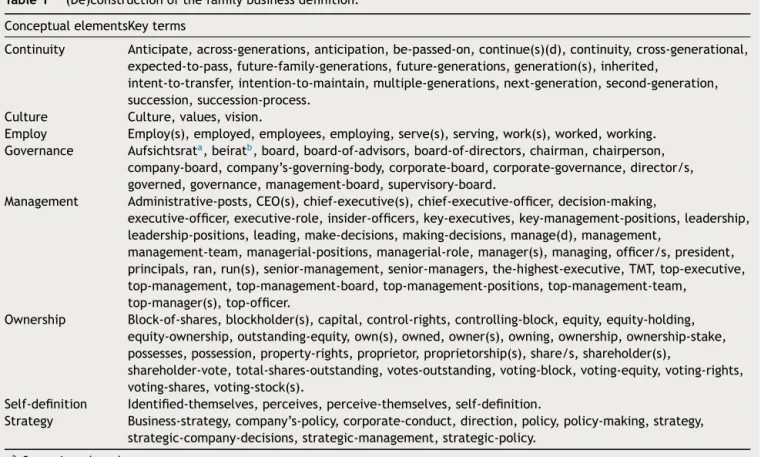
The key terms that emerged from the deconstruction process were then grouped into conceptual elements (Nag, Hambrick, and Chen, 2007), the majorconcepts or dimensions underpinning the definitions. In creating the conceptualelementswetookintoaccountthefollowing cri-teria--- a search for words and terms which couldclearly be grouped into one category (for instance, ‘‘employ’’, ‘‘serve’’ or ‘‘work’’), and the context in which these words were used. The latter was relevant since some-times the context determines inclusion in one category oranother(‘‘anticipate’’or ‘‘anticipation’’,for instance, wereincludedwithintheconceptualelement‘‘continuity’’ becausethesekeytermsreferredtoanticipationofwhich familywouldmanagethecompanyinthefuture,i.e., refer-ringtotheintra-family successionintention).Thisprocess was carried out by each of the three authors indepen-dently,afterwhichthe(three)classificationsproposedwere comparedandinthecasesofdiscrepancies,discussion fol-lowed, until consensus was reached. Based on these key terms, the consultation process yielded eight conceptual elements(Table1)thatwe explainbelowfollowing alpha-beticalorder:
- Continuity:Referstothesuccessfultransferofabusiness acrossgenerationsofthefamily(intra-familysuccession) ortotransgenerationalintentionsforthefuture.
- Culture:Reflects the concernfor capturingthespirit of thefamilybusiness,takingintoaccountintrinsicfactors such astheexistence of a sharedvision, or valuesthat distinguishfamilyfirmsfromotherformsoforganizations. - Employ:Referstotheemploymentoffamilymembersin thebusinessandincludesallwords referringto employ-ment,serviceorwork.
- Governance:Referstotheprocessesofgoverningorthe governmentbodiesofthefirm.
- Management: Refers to the family (members’) involve-mentastheperson/sthatadoptthedecisionsfor accom-plishingthefirm’sgoalsbyusingavailableresources. - Ownership:Referstothecontrolofthecompany’scapital
bythefamily.
- Self-definition: Refers to businesses identifying them-selves as family firms, which captures much of the ‘‘essence’’ofwhatitmeanstobeafamilybusiness. - Strategy:Referstotheinfluenceof familyonthepolicy
ordirectionofthecompany.
Havingobtainedeightconceptualelementsthatunderpin the field’s definitions, and with the objective of analyz-ingwhatof theseconceptualelements werekeytermsor coreconceptual elements,weemployedco-wordand net-workanalysis,twobibliometricmethodsthatareexplained below.
Co-word analysis. Co-word analysisis an effective tech-nique tomap thestrength of relationships amongtextual data (Ritzhaupt, Stewart, Smith, and Barron, 2010). Its methodological foundation rests onthe idea that the co-occurrence of key words describes the contents of the documentsinafile(Callon,Courtial,andLaville,1991),or in ourcase, the co-occurrenceof conceptual elements of thedefinitions.
Methodologically,wecomputedtheco-occurrencematrix by assuming that the co-occurrence frequency of two conceptual elementsis extractedfromthecorpus of defi-nitionsbycountingthenumberofdefinitionsinwhichtwo key-terms appear together. Based on frequencies of key-terms co-occurrences, we carried out the calculation of similarities between items. To do this, we proceeded to normalizetheco-occurrencedegree,relativizing the rela-tionshipby givingmore importancetothoseterms witha lowerfrequencybutahighco-occurrencevalueversusthose termswithhigherfrequencyandlowco-occurrencevalue. Among thedifferentsimilarity measures usedin the liter-ature, we optedfor theequivalence index(Callon etal., 1991) for normalizing words’ co-occurrence frequencies. Whentheconceptualelementsalwaysappeartogether,the equivalence index equals unity,and when theyare never associated,itequalszero.Oncetheequivalenceindexwas calculated and the co-occurrence matrix built, we used socialnetworkanalysistechniques.
Socialnetworkanalysis. Consideringanetworktobemade ofnodesandlinksthatconnectthesenodes,weusedsocial network analysis techniques to determine the degree of centralityofeach key-term.Amongthedifferenttypes of centralitymetricsthatquantifytheimportanceofthenodes in thenetwork, andtaking intoaccountthatour network isundirected,weemployedtheclosenesscentralityindex. Thisfocusesonhowcloseanodeistoalltheothernodesin thenetworkbeyondtheoneswithwhichitisdirectly con-nected(Kim,Choi,Yan,&Dooley,2011),anditiscalculated astheinverseofthetotaldistance. Anode ofhigh close-nesscentralityisconsideredstructurallyimportant,because it can easily reach or be reached by others (Brandesand Pich,2007).Thustheclosenesscentralitycanbeconsidered ameasureoftheimportanceofthenode(conceptual ele-ment)withinthewholenetwork(familybusinessconcept).
Table1 (De)constructionofthefamilybusinessdefinition. ConceptualelementsKeyterms
Continuity Anticipate,across-generations,anticipation,be-passed-on,continue(s)(d),continuity,cross-generational, expected-to-pass,future-family-generations,future-generations,generation(s),inherited,
intent-to-transfer,intention-to-maintain,multiple-generations,next-generation,second-generation, succession,succession-process.
Culture Culture,values,vision.
Employ Employ(s),employed,employees,employing,serve(s),serving,work(s),worked,working. Governance Aufsichtsrata,beiratb,board,board-of-advisors,board-of-directors,chairman,chairperson,
company-board,company’s-governing-body,corporate-board,corporate-governance,director/s, governed,governance,management-board,supervisory-board.
Management Administrative-posts,CEO(s),chief-executive(s),chief-executive-officer,decision-making,
executive-officer,executive-role,insider-officers,key-executives,key-management-positions,leadership, leadership-positions,leading,make-decisions,making-decisions,manage(d),management,
management-team,managerial-positions,managerial-role,manager(s),managing,officer/s,president, principals,ran,run(s),senior-management,senior-managers,the-highest-executive,TMT,top-executive, top-management,top-management-board,top-management-positions,top-management-team,
top-manager(s),top-officer.
Ownership Block-of-shares,blockholder(s),capital,control-rights,controlling-block,equity,equity-holding, equity-ownership,outstanding-equity,own(s),owned,owner(s),owning,ownership,ownership-stake, possesses,possession,property-rights,proprietor,proprietorship(s),share/s,shareholder(s),
shareholder-vote,total-shares-outstanding,votes-outstanding,voting-block,voting-equity,voting-rights, voting-shares,voting-stock(s).
Self-definition Identified-themselves,perceives,perceive-themselves,self-definition.
Strategy Business-strategy,company’s-policy,corporate-conduct,direction,policy,policy-making,strategy, strategic-company-decisions,strategic-management,strategic-policy.
a Supervisoryboard. b Advisoryboard.
Inordertomeasure theclosenesscentrality andvisualize thenetwork,theopensourcesoftwaretoolGephi1wasused.
Results
and
discussion
Usingtheabovemulti-stagemethodology,wefinallyidentify 15classificationssystems(typologies,taxonomies, classifi-cationschemesoranyotherclassificationsystemsincluded), summarized in Table 2. These classifications have been groupedintotwogroups.Thefirstincludesthoseworksthat have proposed a continuous index for reflecting the het-erogeneityoffamilyfirms(Astrachanetal.,2002;Uhlaner, 2005).These aremultidimensionalclassifications that can beutilizedwithout necessarily usingan explicitdefinition offamilyfirm,withthescaleitselfusedtodemonstratethe degree to which a familyis involved in or influences the business.Thesecondgroupcomprisesallclassification sys-temsthathave categorizedfamilyfirms,withthenumber of categories ranging fromthree (Bascoand Pérez,2009; Birley,Ng,andGodfrey,1999;Labaki,Michael-Tsabari,and Zachary,2013;ShankerandAstrachan,1996)tothirty-two categories(García-CastroandSharma,2011).
This second group adopted very different approaches. First,there aretwoworks (ShankerandAstrachan, 1996; WestheadandCowling,1998)that,byemployingdifferent definitions of family business, empirically research the
1https://gephi.org/.
impact of different definitions employed by scholars on the statistics related to the family business contribution toeconomy,in turn leadingtowards thereflection of the heterogeneityofthistypeoffirms.Second,consideringthat performance is a central theme in businessand manage-mentstudies(KimandGao,2013),numerousscholarshave researchediffamilyfirmsandnon-familyfirmsperform dif-ferently,findingthattherearenosignificantdifferencesin businessperformancebetweenbothtypesoffirms(Carney, Van Essen, Gedajlovic, and Heugens, 2015). Instead, this meta-analysisconfirmedthatfamilyfirmsbehavedifferent fromnon-familyfirmsintermsoffewerRandDinvestment, lowerlevelofdebtorlessinternationaldiversificationand theysuggestthatfamilyfirmsareabletocompensatethese deficiencies by a more efficient transformation of inputs inoutputs (Carneyet al.,2015). In this line, Dyer (2006)
had suggested that the question about whether family businesses perform better, must be replaced by another question: what type of family business leads to higher performance?To answerthisquestion,different classifica-tionsystems have been proposed in the literature (Basco andPérez, 2009; Diéguez-Soto, López-Delgado, and Rojo-Ramírez,2015;Dyer,2006;García-CastroandSharma,2011; Miller,Minichilli, and Corbetta, 2013). Within this second approach,thepioneeringworkisthatofDyer (2006),who basedhis study onagency theories and a resource-based viewtoexploretherelationshipsbetweenfamilyandfirm performance.Heconcludedthatthereareseveraldifferent typesoffamilyfirms,andthatsomeof themhaveunique assetsthatallowthemtocompetesuccessfully,whileothers
Table2 Maintypologiesoffamilybusiness.
Definitionalcriteria Typologiesoffamilyfirms Classificationsystemsemployingcontinuousindex
Astrachan,Kleinand Smyrnios(2002) 1Power: •Ownership •Governance •Management 2.Experience: •Generationofownership
•Generationactiveinmanagement •Generationactiveonthegovernance board
•Numberofcontributingfamilymembers 3.Culture:
•Overlapbetweenfamilyvaluesand businessvalues
•Familybusinesscommitment
Continuousscale
Uhlaner(2005) 1.Familyownership
2.Representationoffamilyinmanagement 3.Familyproportionofmanagementteam 4.Familydeterminesstrategy
5.Planstotransfer
Ordinalscale
Classificationsystems thatestablishcategories
Corbetta(1995) 1.Ownershipmodelofthebusinesscapital 2.Presenceoffamilymembersonthe governinganddirectivebodies 3.Numberofemployees
1.Domesticfamilybusiness 2.Traditionalfamilybusiness 3.Extendedfamilybusiness 4.Openfamilybusiness
ShankerandAstrachan (1996)
1.Votingcontrol
2.Poweroverstrategicdirection 3.Intendedtoremaininfamily 4.Involvementofmultiplegenerations 5.Activemanagementbyfamilymembers
1.Broaddefinition 2.Middledefinition 3.Narrowdefinition
WestheadandCowling (1998)
1.Self-perceptionasafamilyfirm 2.Ownership
3.Management 4.Succession
1.Firmperceivedasafamilyfirm
2.Largestsinglefamilygroupownsover50%of ordinaryvotingshares
3.Requirementsofdefinitions1and2 4.Definition3andoneormoreofthe
managementteamwasdrawnfromtheowning family
5.Definition3and51%ormoreofthe
managementteamwasdrawnfromtheowning family
6.Definition4andthecompanywasownedby second-generationormorefamilymembers 7.Definition5andtheenterpriseisownedby second-generationormorefamilymembers
Birley,NgandGodfrey (1999)
Attitudesofowner-managerstothe conflictingpressuresoffamilyandbusiness
1.Familyrules 2.Familyout
3.Family-businessjugglers
Dyer(2006) 1.Agencycosts 2.Familyassets 3.Familyliabilities
1.Clanfamilyfirm 2.Professionalfamilyfirm 3.Momandpopfamilyfirm 4.Self-interestedfamilyfirm
Table2 (Continued)
Definitionalcriteria Typologiesoffamilyfirms
Westheadand Howorth(2007)
1.Management 2.Ownership
3.Companyobjectives
1.Cousinconsortiumfamilyfirms 2.Largeopenfamilyfirms
3.Entrenchedaveragefamilyfirms 4.Multi-generationopenfamilyfirms 5.Professionalfamilyfirms.
6.Averagefamilyfirms
7.Multi-generationaveragefamilyfirms
BascoandPérez(2009) 1.Strategy
2.Boardofdirectors 3.Humanresources 4.Succession
1.Immaturefamilyenterprises 2.Familyenterprisefirst Businessfirst García-Castroand Sharma(2011) 1.Ownership 2.Governance 3.Management 4.Succession 32possibleconfigurations Dekker,Lybaert, Steijvers,Depaireand Mercken(2012)
1.Financialcontrolsystems
2.Nonfamilyinvolvementingovernance systems
3.Humanresourcescontrolsystems 4.Descentralizationofauthority 5.Top-levelactiveness 1.Autocracy 2.Domesticconfiguration 3.Administrativehybrid 4.Clenchhybrid Labaki, Michael-Tsabariand Zachary(2013) 1.Emotionaldimension
2.Stagesofthefamilybusinessevolution (distributionofownership)
1.EnmeshedFamilyBusiness 2.BalancedFamilyBusiness 3.DisengagedFamilyBusiness
Miller,Minichilliand Corbetta(2013)
1.Ownership 2.Firmsize
1.Smallsize,concentratedownership 2.Smallsize,diffuseownership 3.Largesize,concentratedownership 4.Largesize,diffuseownership
Nordqvist,Sharmaand Chirico(2014)
1.Ownership 2.Management
1.Controllingowner-familyoperator 2.Siblingpartners-familyoperator/s 3.Cousinconsortium-familyoperator/s 4.Controllingowner-familysupervisor 5.Siblingpartners-familysupervisor 6.Cousin-consortium-familysupervisor 7.Controllingowner-familyinvestor 8.Siblingpartners-familyinvestor 9.Cousinconsortium-familyinvestor
Diéguez-Soto, López-Delgadoand Rojo-Ramírez(2015)
1.Legalnatureofthefirm
2.Lone-founderorfamilyinvolvementin ownership,managementandgovernance 3.Ownershipconcentration
1,2and3.Firmsofnon-familycharacter 4.Entrepreneurialfirms
5.Co-preneurialFB 6.IndependentFB 7.ProfessionalFB 8.Solelyfamily-runFB
incur insignificant agencycost,which maycausethemto falterinthemarketplace.Threeofthefiveresearchoutputs included in this second approach have classified family firms exclusively, whereas Diéguez-Soto, López-Delgado, and Rojo-Ramírez (2015), and García-Castro and Sharma (2011) classified both family and non-family firms. Third, we findagroupof authors(Bascoand Pérez,2009;Birley etal.,1999;Labakietal.,2013)thatincludesintheir clas-sification systems emotional or affective factors. Fourth,
Dekker, Lybaert, Steijvers, Depaire and Mercken (2012), andNordqvist etal.(2014) establishedtheir classification systemsinordertostudytheprofessionalizationconstruct,
renderingitsapplicationdifficultwithotherresearchaims. Finally,Corbetta(1995)employshisclassificationofItalian familyfirmstoanalyzeitsdevelopment.
An analysisfromthe definitionsretrievedfrom the lit-erature yields eight conceptual elements, which help in definingafirmasbeingfamily:continuity,culture,employ, governance, management, ownership, self-definition, and strategy. Given that any workabletaxonomy or classifica-tionsystemshouldbebuiltwiththefewestnumberoftaxa without sacrificing the essential classification attributes (Chrisman et al., 1988), and that most scholars have to workwithsurveys,we considerthattheinclusionof eight
Figure1 Structure ofthe definition ofthefamilybusiness concept.
conceptualelementswouldimplyinclusionofasignificant numberofitemsinthequestionnairetoclassifyfamilyfirms, requiringtheinclusionofmanyfirmsinthesample.Thatis, theinclusionoftheseeightconceptualelementswouldadd anunnecessarycomplexity,renderinganytaxonomydifficult toapply.
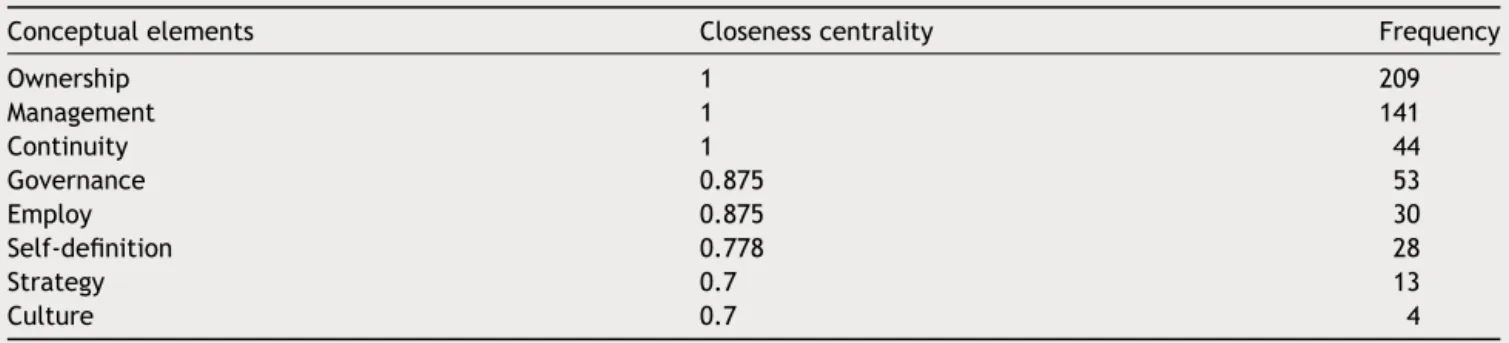
Fig. 1 reveals the network structure of the definition of the family business concept and Table 3 orders all conceptual elements according to their centrality index. ConsideringthatinFig.1,thesizeandvariationinthe ver-texcolourarerelatedtothepositioninthenetwork(darker colours imply a higher degree of centrality), we identify threeconceptual elements that canbe considered asthe basisforthecreationandtheriseofthetheoreticalcorpus ofthefamilybusinessfieldorascoreconceptualelements, namely‘‘ownership’’,‘‘management’’,and‘‘continuity’’. Inaddition,thesecoreconceptualelementshavethe max-imumcentrality within the network (Table 3), confirming that,overall,researchersconsiderthesethreecore concep-tualelements asnecessary conditionstodefinea business asfamily. To employ ‘‘ownership’’, ‘‘management’’,and ‘‘continuity’’todistinguishbetweenfamilyandnon-family firmsallowsscholarstoincludeintheirfamilyfirmdefinition elementsofboththeinvolvementapproachandtheessence approach(Chrisman,Chua,&Sharma,2005).
Comparing these core conceptual elements with the extant typologies (see Table 4), we can answer our first question: Are the existing classificationsystems based on themaincharacteristicsofthefamilyfirms?Sixof the fif-teen classificationsystems (Astrachan et al., 2002; Birley etal.,1999;García-CastroandSharma,2011;Shankerand Astrachan, 1996; Uhlaner, 2005; Westhead and Cowling, 1998) jointly included, at least, the three core con-ceptual elements that have maximum centrality in the definitional network (‘‘ownership’’, ‘‘management’’ and ‘‘continuity’’). But in all these cases, authors include morecriteriafor establishingtheirclassifications systems, addingcomplexityForinstance,Astrachanetal.(2002)and
Uhlaner(2005)addedtothethreecentralcoreconceptual elements,‘‘strategy’’asafourthdefinitionalcriteria. Fur-thermore,‘‘ownership’’and‘‘management’’weretheonly twocentralcoreconceptualelementsincludedinotherfour
works(Corbetta,1995;Diéguez-Sotoetal.,2015;Nordqvist etal.,2014; WestheadandHoworth, 2007).WhileDekker andcolleagues’classification(2012),andBascoandPerez’ (2009)studyemployonlyacentralcoreconceptualelement: ‘‘management’’and‘‘continuity’’respectively.
Othersconceptual elements broadly considered by the classificationsystemsoffamilyfirmsare‘‘strategy’’(Basco and Pérez,2009; Dekker,Lybaert, Steijvers, Depaire, and Mercken, 2012; Shanker and Astrachan, 1996; Uhlaner, 2005; Westhead and Howorth, 2007) and ‘‘governance’’ (Astrachan etal.,2002;Bascoand Pérez,2009; Corbetta, 1995;Dekkeretal.,2012;García-CastroandSharma,2011), twoelementsthatcan beconsideredasexpressionof the family control onthe company. The rest of the elements included in thenetwork (Fig. 1) have only been included or considered in a testimonial way. In fact, we find two taxonomies that do not employ any of the eight concep-tual elements identified from the analyses of definitions, andinsteadfocusonemotionalaspectslinkedtothefamily (Dyer,2006;Labakietal.,2013),componentsofthetandem ‘‘family-firm’’thathavebeenscantlyresearched,perhaps due tomany scholars of thefield having abackground in businessormanagement.
In short, the three core conceptual elements with a higherdegreeofcentralitywithinthedefinitionalnetwork have been the more used criteria for classifying family firms. However,thereare twohighly usedcriteriawith a lowerlevelofcentrality,(‘‘governance’’and‘‘strategy’’), which meansthat researchersproposingclassification sys-temshavedecidedthattheyarerelevantformanyreasons that range from the availability of data to relevance as long as theyreflect effective power/control of the com-pany.Thethreeremainingconceptualelements(‘‘employ’’, ‘‘self-definition,and‘‘culture’’)havebeen onlyresidually employedby theclassifications reviewed.The scant pres-ence of ‘‘self-definition’’ is especially curious since this criterion has an important role in definitions as long as it reflects theheterogeneity of feelings,vision, or famili-nessoffamilyfirmscollectedbythe‘‘essenceapproach’’ in defining family firms. The scant presence of ‘‘self-definition’’ (onlya 10%of classificationsystemsidentified have takenintoaccountthis criteria), acriterionwithan importantroleindefinitionsaslongasitreflects the het-erogeneityoffeelings,vision,orfamiliness offamilyfirms collected by the ‘‘essence approach’’ may be explained becauseismoreorientedtowardstheidentificationoffamily firmsvsnon-familyfirms,butitisconsideredless appropri-ateforaddressingitsheterogeneity.
Oncewehavestudiedthecriteriaordimensions consid-ered by the extant classification systems and considering that ‘‘replication is a key criterion by which to judge the robustness of an instrument’’ (Klein, Astrachan, and Smyrnios,2005,p.323),weinvestigatedwhichoftheextant classification systems have been applied by other schol-ars,thus,addressingoursecondquestion.Afterareviewof thosearticlesthatcitedeachtaxonomy,itseemsclearthat theclassificationsystemmostemployedbyscholars isthe F-PECscale (Astrachan etal.,2002), which hasbeen val-idatedby severalresearchers(e.g.,Holt, Rutherford,and Kuratko,2010;Kleinetal.,2005;Rutherford,Kuratko,and Holt, 2008),butmostlywiththemainpurposeof examin-ingthevalidityandreliabilityoftheF-PECscale, andnot
Table3 Centralityoftheconceptualelements.
Conceptualelements Closenesscentrality Frequency
Ownership 1 209 Management 1 141 Continuity 1 44 Governance 0.875 53 Employ 0.875 30 Self-definition 0.778 28 Strategy 0.7 13 Culture 0.7 4
foranalyzingotherissues.TheF-PECscaleisa multidimen-sionalconstructthathasbeenvalidatedandusedinstudies, allowing ‘‘theestablishment ofmore nuanceddifferences atthecostofaddedcomplexity’’(WrightandKellermanns, 2011, p. 188). It alsoavoids theuse of a Boolean yes/no typedefinitionofthefamilyfirmbydevelopingaseriesof instruments allowingresearcherstopositionfirms accord-ingtothreekey variables:power, experienceandculture (Anderson,Jack,andDood,2005).However,theF-PECscale alsohassomeweaknesses.Ontheonehand,thereappear tobe ambiguousitems in the culture subscalethat could beomitted(CliffandJennings,2005).On theotherhand, theF-PECscalefailstocapturetheessenceoffamily busi-nesses(Rutherfordetal.,2008).Finally,whilesomescholars (Andersonetal.,2005)affirmthattheF-PECscalepermits robustcomparisonsacrossstudiesandsamples.Incontrast tothesescholars,weconsider,inlinewithChrismanetal. (1988,p.417),thatoneguidingprinciplethathastofollow anytypologytobecome agoodclassificationisparsimony, where‘‘researchersareabletogroupsimilarentitiesand differentiatethemfromdissimilarentitieswiththefewest number of taxa possible without undue sacrifice of other essentialclassificationattributes’’.Therefore,weconsider thattheF-PECscale,aswellastheothercontinuousscale (Uhlaner,2005),doesnotrespecttheparsimonyprinciple, renderingcomparisonsacrossstudiesdifficult.
Others scales have been empirically used,but only in limited contexts and intermittently (Diéguez-Soto et al., 2015; García-Castroand Sharma, 2011).The Diéguez-Soto et al.’s (2015) classification was empirically validated by their authors,andlater wasslightly modified andapplied by López-Delgado and Diéguez-Soto (2015), in both cases withSpanishfirms.The firstofthesescales(Diéguez-Soto et al., 2015) takes advantage of the Spanish custom of giving children twosurnames, one from each parent;but since this custom is not followed in other countries (for exampleinEnglish-speakingcountries),thereisalimitation foritsapplicationsinother contexts.Consequentlyitalso constitutes a handicap for the replication of the scale, because common factors emerging when heterogeneous samples (for example, from different regions) are used to develop measures tend to provide a more complete understanding of any phenomenon (Sutton, 1987). The
García-Castro andSharma’s (2011)classification waslater applied by García-Castro and Aguilera (2014). Although this scale (García-Castro and Sharma, 2011) proposed 32 possible configurations of family firms, both
García-Castro and Sharma (2011), and García-Castro andAguilera (2014)usedadataset of6611 publicly listed andmajorunlistedcompaniesfrom46countries,andthey only found 24 of these configurations with at least one observation,whilethenumberofcombinationsfoundwith atleast1%ofcasesinthesample(66firms)decreasesto11. Inourview,andinlinewiththeideaofparsimonyexpressed by Chrisman et al. (1988), the definitions or categories differingonlyslightlymakeitdifficultnotonlytocompare across research, but also to integrate theory (Astrachan et al., 2002). Hence we consider that the taxonomy of
García-Castro and Sharma (2011) is difficult to applyand replicate, and therefore, makes knowledge accumulation difficult.
Regarding the classification of Shanker and Astrachan (1996), called the ‘‘bull’s eye model’’ and using demo-graphic parameters, we have only found one particular developmentofthisclassificationsystem(Andersonetal., 2005),thatconsistedinextending thebull’s-eyemodel to incorporate Birley et al.’s typology (1999). None of the remaining scales identified has been employed in later studies rendering the accumulation of knowledge a very challengingtask.Insummary,mostofthescaleshavebeen neveremployedbyotherscholars,whiletheremainingone hasbeenonlyscarcelyreplicatedpreventingthe accumula-tionofknowledge.
Foraccumulatingknowledgeitisimportanttofind effec-tive ways to classify family firms (Sharma and Nordqvist, 2008) and in addressing the third research question, our reviewshows that, hithertonone of the extant classifica-tionsystemsappearingintheliteraturehasbeenaccepted orusedbythescientificcommunity,withtheonlyexception beingF-PEC(Astrachanetal.,2002).However,ourresearch reflectsthatfamilyfirmscholarshavenotfoundanoptimal classificationsystemyet,despitethefactthatsuchasystem seemstobemoreandmorenecessary,sincesomeof incon-sistenciesfoundinthefamilyfirmresearchcouldbejustified byitsheterogeneity.Therefore,withamindtowardsaiding researchersitisnecessarytosimplifythenumberoftypes offamilyfirms(Davis,2009;Dekkeretal.,2012)inorderto harnessthemainstrengthofthecategorization:its simplic-ity(Snyder,Witell,Gustafsson,Fombelle, andKristensson, 2016).Giventhattheexistingclassificationsystemsdonot seemtobeoperative andeffectivewaystoclassifyfamily firms,weencouragescholarstoundertakefurtherresearch alongtheselinesbecausedevelopingandusing categoriza-tions allow for useful heuristics and provide a systematic
10
R.
Hernández-Linares
et
al.
Table4 Conceptualelementsemployedbyfamilybusinessestaxonomies.
NofCE Management Ownership Continuity Governance Employ Self-definition
Strategy Culture Other criteria
Astrachan,KleinandSmyrnios (2002)
6a x x x x x x
Uhlaner(2005) 4a x x x x
ShankerandAstrachan(1996) 4a x x x x
WestheadandCowling(1998) 4a x x x x
Birley,NgandGodfrey(1999) 4a x x x x x
García-CastroandSharma (2011)
4a x x x x
Corbetta(1995) 3 x x x x
WestheadandHoworth(2007) 3a x x x
BascoandPérez(2009) 3a x x x x
Dekker,Lybaert,Steijvers, DepaireandMercken(2012)
3a x x x x
Diéguez-Soto,López-Delgado andRojo-Ramírez(2015)
3a x x x
Nordqvist,SharmaandChirico (2014)
2 x x x
Miller,MinichilliandCorbetta (2013)
1 x x
Dyer(2006) 0 x
Labaki,Michael-Tsabariand Zachary(2013)
0 x
Numberoftimesthatthe definitionalcriterionhas beenusedbytaxonomies
11 11 7 6 1 1 6 1 8
NofCE=numberofconceptualelementsemployedintheclassificationsystem.
basis for comparisonand operationalization (Smith,2002; Snyderetal.,2016).
Conclusions
and
future
directions
Since its inception, the family business field has tried to arrive atsome sort ofconsensusonwhatdefines or char-acterizes a family firm, by comparing family businesses withnon-family businesses. However,in recent years,the academiccommunityhasincreasingly movedfromviewing familyfirmsas homogeneousentitiestoconsidering them asheterogeneous(e.g.,Dekkeretal.,2012;Westheadand Howorth, 2007). This heterogeneity of family businesses (e.g.,Chuaetal.,2012;Nordqvistetal.,2014)hasrendered it necessary to compare family firms among themselves (WestheadandHoworth,2007).Consequently,researchers havetriedtoidentifydifferentcategoriesortypesof fam-ily firms (De Massis, Kotlar, Chua, and Chrisman, 2014; WestheadandHoworth,2007).
It hasbeenheld thattherecognition andutilizationof the types of family firms provides fresh and contextual-izedinsightsintothemulti-facetedfamilyfirmphenomenon (Howorth, Rose, Hamilton, and Westhead, 2010), requir-ing an identification of all the important dimensions by which they may vary from each other (Chrisman, Chua, and Sharma, 2003). What emerges from our analysis of 258 definitions appearing in the literature ( Hernández-Linares et al., 2014; Sarkar et al., 2014), is a necessary conditionfordistinguishingafamilyfromanon-family busi-ness implied by the triad ‘‘ownership’’, ‘‘management’’, and‘‘continuity’’.However,ifwecomparethisresultwith existingtypologies,wefindthatwhilesixclassifications sys-temsincludedthesethreecoreconceptualelements,none havetakenintoaccountthistriadforestablishingthe dif-ferencebetweenfamilyfirmsandnon-familyfirms.Inthis sense,Dyer (2003)arguedthat regardlessofwhich defini-tion is chosen, researchers should clearly set up what a familyfirmisandusemultipledefinitionstodetermine vary-ingdegrees offamiliness. In line withhim, weencourage scholarstoestablishacleardefinitionofthefamilyfirmas the first stepfor an optimal anduseful classification sys-tem,andmoreconcretelytoestablishthis definitionover the basis of the core conceptual elements ‘‘ownership’’, ‘‘management’’and‘‘continuity’’.
From ouranalysiseightconceptual elements emerged, but notall ofthem need tobeconsidered for developing an optimal classificationsystem along the linessuggested byChrisman etal.(1988). Yet,whileDekkeretal. (2012)
statedthatitisnotpossibletoencompassallfamily firm-related dimensions into a single and workable typology, we believethat is possible toencompass allmain dimen-sions (in the formof the threecore conceptual elements thatouranalysisidentified:‘‘ownership’’,‘‘management’’, and‘‘continuity’’)intoaworkabletaxonomy,andthatthis shouldbebasedonthekeycharacteristicscapturedbythe field’sdefinitions.
Wealsoconsider,alongthelinesofBock(1973,p.379), thatanyclassificationsystemhastoprovidethefoundation for all comparative studies, with ‘‘the best classification being the one that permits the most useful comparative investigation’’.Thusoneguidingprincipleforanytaxonomy
to become a useful classification is parsimony (Chrisman etal.,1988),anddefinitionsorcategoriesthatdifferonly slightly make it difficult to integrate theory (Astrachan etal.,2002).Therefore,toget auseful classification,we would recommend futuretaxonomies establish a reduced number of categories by using a hierarchical structure, sincethistypeoftaxonomyfacilitatesinformationretrieval, makingthe classifications system easy touse, facilitating comparativeresearchbecausegeneralizationcanbe devel-opedabouteachcategoricallevel(Chrismanetal.,1988).
Finally, we consider that a useful classification system of familyfirms should be established witha general pur-pose, oriented to the study of a specific topic within of thefield(e.g.,professionalization),inordertomake com-parisonamongstudies easier. With thepurpose of finding ageneralclassificationoffamilyfirmsthatcanbeapplied toallcontexts,weencouragefutureclassificationsystems toadvancetheinclusionofthemissingvariableofthe tan-dem‘‘familyfirm’’(Dyer, 2003):thefamily;optingfor an inclusivedefinition, applicable toanynational or cultural context.Specifically,wesuggestthatthedefinitionoffamily beadoptedfromtheself-perceptionperspective, consider-ingas‘‘family’’thegroupofpeoplethatperceivesitselfas afamily,insteadas‘‘agrouplinkedbybloodormarriage’’ (ChrismanandPatel,2012;VillalongaandAmit,2006). Addi-tionally,consideringthatthescarcityofinvestigationonthe familysideofthefamily-firmmaybeduetothefactthat mostoftheresearchersofthisfieldhaveabusinessor mana-gementbackground,wecallforincreasingmulti-disciplinary studiesinthisarea,aswellasforincludinginfamilyfirm researchmorescholarswithdifferentbackgrounds,suchas psychologyorsociology,amongothers.
Ourworkisnotexemptfromsomelimitations.First,we haveselecteddefinitionsincludedinthisanalysisbasedto therelevanceofthestudiesinwhichdefinitionsappeared, whichwasmeasuredbythecitationindexperyear.However, thisquantitativeapproachdoes not capture theintention the authors had in referring to other works and, hence, citationcannotbeconsideredasynonymforimportanceor relevance(VogelandGüttel,2013).Second,ourstudyallows theinspectionofthenatureandstructureofrelationships amongtheconceptualelements,butitisdifficulttomake detailedinferencesfromit.
Despite these limitations, our investigation provides opportunitiesforfutureresearch.Studiescomparingresults oftheuseofdifferentcategoriesof familyfirmswillhelp transformresearchresultsintotangibleanddirectly applica-blepracticesforpolicy-makersandprofessionaldealingwith thesefirms.Therefore,weencouragescholarstobuilda tax-onomyorclassificationoffamilybusinessbasedonthekey characteristicsoftheentitiesclassified,creatingageneral, parsimoniousand hierarchical classification, and not spe-cifictoanycertaintimeperiod.Forthat,wefirstlypropose establishinga clear distinctionbetween family businesses andnon-familybusiness,andthentoclassifyfamilyfirmsin areducednumberofcategories,consideringalldefinitional criteriaidentifiedinthisresearch.
Conflicts
of
interest
Acknowledgements
We express our gratitude to the support provided by the Banco Santander Chair in Family Firm (University of Cantabria), and we also express our thanks to Franz W. Kellermannsfor hiscarefulreview ofan earlierversionof thispaper.
References
Anderson,A.R.,Jack,S.L.,&Dodd,S.D.(2005).Theroleoffamily membersinentrepreneurialnetworks:Beyondtheboundariesof thefamilyfirm.FamilyBusinessReview,18(2),135---154. Astrachan,J.H.,Klein,S.B.,&Smyrnios,K.X.(2002).TheF-PEC
scaleoffamilyinfluence:Aproposalforsolvingthefamily busi-nessdefinitionproblem.FamilyBusinessReview,8(2),45---58. Basco,R.,& Pérez, M.J.(2009). Studyingthe familyenterprise
holisticallyevidenceforintegratedfamilyandbusinesssystems. FamilyBusinessReview,22(1),82---95.
Benavides-Velasco,C.A., Quintana-García,C.,& Guzmán-Parra, V.F.(2013).Trendsinfamilybusinessresearch.SmallBusiness Economics,40(1),41---57.
Birley,S.,Ng,D.,&Godfrey,A.(1999).Thefamilyandthebusiness. LongRangePlanning,32(6),598---608.
Bock,W.J.(1973).Philosophicalfoundationsofclassical evolution-aryclassification.SystematicBiology,22(4),375---392. Brandes,U.,&Pich,C.(2007).Centralityestimationinlarge
net-works.InternationalJournalofBifurcationandChaos,17(07), 2303---2318.
Callon,M.,Courtial,J. P.,& Laville,F.(1991). Co-wordanalysis asa toolfor describing thenetworkofinteractions between basicandtechnologicalresearch-thecaseofpolymerchemistry. Scientometrics,22,155---205.
Carney,M.,VanEssen,M.,Gedajlovic,E.R.,&Heugens,P.P.(2015). Whatdoweknowaboutprivatefamilyfirms?Ametaanalytical review.EntrepreneurshipTheoryandPractice,39(3),513---544. Casillas,J.C.,Moreno,A.M.,&Barbero,J.L.(2010).A configu-rationalapproachoftherelationshipbetweenentrepreneurial orientationandgrowthoffamilyfirms.FamilyBusinessReview, 23(1),27---44.
Choi,Y.R.,Zahra,S.A.,Yoshikawa,T.,&Han,B.H.(2015).Family ownership and RandDinvestment: Therole ofgrowth oppor-tunitiesand business group membership. Journal of Business Research,68(5),1053---1061.
Chrisman,J.J.,Chua,J.H.,Pearson,A.W.,&Barnett,T.(2012). Familyinvolvement,familyinfluence,andfamily-centered non-economic goals in small firms. Entrepreneurship Theory and Practice,36(2),267---293.
Chrisman,J.J.,Chua,J.H.,&Sharma,P.(2003).Currenttrends andfuture directionsinfamily businessmanagementstudies: Towardatheoryofthefamilyfirm.ColemanWhitePaperSeries, 4,1---63.
Chrisman,J.J.,Chua,J.H.,&Sharma,P.(2005).Trendsand direc-tionsinthedevelompmentofastrategicmanagementtheoryof thefamilyfirm.EntrepreneurshipTheoryandPractice,29(5), 555---576.
Chrisman,J.J.,Hofer,C.W.,&Boulton,W.B.(1988).Towarda sys-temforclassifyingbusinessstrategies.AcademyofManagement Review,13(3),413---428.
Chrisman,J.J.,&Patel,P.C.(2012).VariationsinRandD invest-mentsof family and nonfamily firms:Behavioral agency and myopic loss aversion perspectives. Academy of Management Journal,55(4),976---997.
Chrisman,J.J.,Sharma,P.,&Taggar,S.(2007).Familyinfluences onfirms:Anintroduction.JournalofBusinessResearch,60(10), 1005---1011.
Chrisman,J. J., Sharma,P., Steier,L. P., & Chua,J. H. (2013). The influence of family goals, governance, and resources on firmoutcomes.EntrepreneurshipTheory and Practice, 37(6), 1249---1261.
Chua,J.H.,Chrisman,J.J.,&Sharma,P.(1999).Definingthe fam-ilybusinessbybehavior.EntrepreneurshipTheoryandPractice, 23(4),19---39.
Chua,J.H.,Chrisman,J.J.,Steier,L.P.,&Rau,S.B.(2012).Sources ofheterogeneityinfamilyfirms:Anintroduction. Entrepreneur-shipTheoryandPractice,36(6),1103---1113.
Cliff,J.E.,&Jennings,P.D.(2005).Commentaryonthe multidi-mensionaldegreeoffamilyinfluenceconstructandtheF-PEC measurementinstrument.Entrepreneurship Theoryand Prac-tice,29(3),341---347.
Cobo,M.J.,López-Herrera,A.G.,Herrera-Viedma,E.,&Herrera, F.(2012).SciMAT:Anewsciencemappinganalysissoftwaretool. Journal ofthe AmericanSocietyforInformationScienceand Technology,63(8),1609---1630.
Corbetta,G.(1995).Patternsofdevelopmentoffamilybusinesses inItaly.FamilyBusinessReview,8(4),255---265.
Darwin,C.(1859).Ontheoriginsofspeciesbymeansofnatural selection.London:Murray.
Davis,J.A.(2009).Towardatypologyoffamilybusinesssystems. InJ.Tàpies,&J.L.Ward(Eds.),Familyvaluesandvalue cre-ation: The fosteringof enduring valueswithin family-owned businesses(pp.127---154).Hampshire,England:Palgrave Macmil-lan.
DeMassis, A.,Kotlar,J., Chua,J. H.,& Chrisman,J.J. (2014). Ability and willingness as sufficiency conditions for family-oriented particularistic behavior: Implicationsfor theoryand empiricalstudies.JournalofSmallBusinessManagement,52(2), 344---364.
Dekker,J.C.,Lybaert,N.,Steijvers,T.,Depaire,B.,& Mercken, R. (2012).Family firmtypesbasedon theprofessionalization construct:Exploratoryresearch.FamilyBusinessReview,26(1), 81---99.
Diéguez-Soto, J., López-Delgado, P., & Rojo-Ramírez,A. (2015). Identifyingandclassifyingfamilybusinesses.Reviewof Manage-rialScience,9(3),603---634.
Doty,D.H.,&Glick,W.H.(1994).Typologiesasauniqueformof theorybuilding:Towardimprovedunderstandingandmodeling. AcademyofManagementReview,19(2),230---251.
Duriau,V.J.,Reger,R.K.,&Pfarrer,M.D.(2007).Acontent anal-ysisofthecontentanalysisliteratureinorganization studies: Research themes, data sources, and methodological refine-ments.OrganizationalResearchMethods,10(1),5---34. Dyer,W.G. (2003).Thefamily:Themissingvariablein
organiza-tionalresearch.EntrepreneurshipTheory andPractice,27(4), 401---416.
Dyer,W.G.(2006).Examiningthe‘‘familyeffect’’onfirm perfor-mance.FamilyBusinessReview,19(4),253---273.
Eden, D. (2002). Replication, meta-analysis, scientific progress, andAMJ’spublicationpolicy.AcademyofManagementJournal, 45(5),841---846.
Garcia-Castro, R.,& Aguilera, R. V.(2014). Family involvement in business and financial performance: A set-theoretic cross-national inquiry. Journal of Family Business Strategy, 5(1), 85---96.
Garcia-Castro, R., & Sharma,P.(2011). Family involvement-firm performance link: Winning configurations revealed by set-theoreticmethods.UniversiaBusinessReview,32,54---68. Hernández-Linares, R., Sarkar, S.,& Cobo, M. J. (2014, June).
Passing the definition of family business through the sieve. A bibliometric analysis of its evolution Paper presented at IFERAAnnualConference.TheInternational FamilyEnterprise ResearchAcademy,Lappeenranta,Finland.
Holt,D.T.,Rutherford,M.W.,&Kuratko,D.F.(2010).Advancing the field of family business research: Further testing the
measurementpropertiesoftheF-PEC.FamilyBusinessReview, 23(1),76---88.
Kellermanns, F.W., Eddleston, K. A., Sarathy, R., & Murphy, F. (2012).Innovativenessinfamilyfirms.Afamilyinfluence per-spective.SmallBusinessEconomics,38(1),85---101.
Kim,Y.,Choi,T.Y.,Yan,T.,&Dooley,K.(2011).Structural investi-gationofsupplynetworks:Asocialnetworkanalysisapproach. JournalofOperationsManagement,29(3),194---211.
Kim, Y., & Gao, F. Y. (2013). Does family involvement increase businessperformance?Family-longevitygoals’moderatingrole inChinese family firms. Journal ofBusiness Research, 66(2), 265---274.
Klein,S.B.,Astrachan,J.H.,&Smyrnios,K.X.(2005).TheF-PEC scaleoffamilyinfluence:Construction,validation,andfurther implicationfortheory.EntrepreneurshipTheoryandPractice, 29(3),321---339.
Kothari,S.P.,Li,X.,&Short,J.E.(2009).Theeffectofdisclosures bymanagement,analysts,andbusinesspressoncostofcapital, returnvolatility,andanalystforecasts: Astudyusingcontent analysis.TheAccountingReview,84(5),1639---1670.
Labaki,R.,Michael-Tsabari, N., &Zachary, R.K. (2013). Explor-ingtheemotionalnexusincogentfamilybusinessarchetypes. EntrepreneurshipResearchJournal,3(3),301---330.
López-Delgado,P.,&Diéguez-Soto,J.(2015).Lonefounders,types ofprivatefamilybusinessesand firmperformance.Journalof FamilyBusinessStrategy,6(2),73---85.
López-Fernández, M. C., Serrano-Bedia, A., & Pérez-Pérez, M. (2016). Entrepreneurship and family firm research: A biblio-metricanalysisofanemergingfield.JournalofSmallBusiness Management,54(2),622---639.
Miller,D.,&LeBreton-Miller,I.(2003).Challengeversusadvantage infamilybusiness.StrategicOrganization,1(1),127---134. Miller,D.,Minichilli,A.,& Corbetta,G.(2013).Is family
leader-ship alwaysbeneficial?StrategicManagement Journal, 34(5), 553---571.
Nag,R.,Hambrick,D.C.,&Chen,M.J.(2007).Whatisstrategic management,really?Inductivederivationofaconsensus defini-tionofthefield.StrategicManagementJournal,28(9),935---955. Nordqvist,M.,Sharma,P.,&Chirico,F.(2014).Familyfirm hetero-geneityandgovernance:Aconfigurationapproach.Journalof SmallBusinessManagement,52(2),192---209.
Perri, A., & Peruffo, E. (2016). Knowledge spillovers from FDI: Acriticalreviewfrom theinternationalbusinessperspective. InternationalJournalofManagementReviews,18(1),3---27. Ritzhaupt,A.D.,Stewart,M.,Smith,P.,&Barron,A.E.(2010).An
investigationofdistanceeducationinNorthAmericanresearch literatureusingco-wordanalysis.TheInternationalReviewof ResearchinOpenandDistanceLearning,11(1),37---60. Rutherford,M.W.,Kuratko,D.F.,&Holt,D.T.(2008).Examining
thelinkbetween‘‘familiness’’andperformance:CantheF-PEC untanglethefamily businesstheory jungle?Entrepreneurship TheoryandPractice,32(6),1089---1109.
Sarkar,S.,Hernández-Linares,R.,&Cobo,M.J.(2014,January). Winnowing wheat from thechaff: Theevolution of the fam-ily business concept. Academy of Management Proceedings, 2014(1),14200.
Shanker,M.C.,&Astrachan,J.H.(1996).Mythsandrealities: Fam-ily businesses’contribution tothe US Economy. Aframework forassessingfamilybusinessstatistics.FamilyBusinessReview, 9(2),107---123.
Sharma,P.,&Nordqvist,M.(2008).Aclassificationschemefor fam-ily firms:From family valuestoeffective governance to firm performance.InJ.Tapies,&J.L.Ward(Eds.),Familyvaluesand valuecreation:Howdofamilyownedbusinessesfosterenduring values(pp.71---101).NewYork,NY:PalgraveMacmillan. Smith,C.P.(2000).Contentanalysisandnarrativeanalysis.InH.
T.Reis,&C.M.Judd(Eds.),Handbookofresearchmethodsin socialandpersonalitypsychology.(pp.313---335).NewYork,NY: CambridgeUniversityPress.
Smith,K. B.(2002). Typologies,taxonomies, andthebenefitsof policyclassification.PolicyStudiesJournal,30(3),379---395. Snyder,H.,Witell,L.,Gustafsson,A.,Fombelle,P.,&Kristensson,
P.(2016).Identifyingcategoriesofserviceinnovation:Areview and synthesisoftheliterature.JournalofBusinessResearch, 69(7),2401---2408.
Sutton,R.I.(1987).Theprocessoforganizationaldeath: Disband-ingandreconnecting.AdministrativeScienceQuarterly,32(4), 542---569.
TheEconomist(2015): http://www.economist.com/news/special- report/21648169-four-main-types-family-business-united-diversity(accessed16.07.07).
Uhlaner,L.M.(2005).TheuseoftheGuttmanscaleindevelopment ofafamilyorientationindexforsmall-to-medium-sizedfirms. FamilyBusinessReview,18(1),41---56.
Villalonga,B.,&Amit,R.(2006).Howdofamilyownership, con-trol and management affect firmvalue? Journal of Financial Economics,80(2),385---417.
Vogel,R., & Güttel,W. H. (2013). The dynamiccapabilityview instrategicmanagement:Abibliometricreview.International JournalofManagementReviews,15(4),426---446.
Westhead, P., & Cowling, M. (1998). Family firm research: The needforamethodologicalrethink.EntrepreneurshipTheoryand Practice,23(1),31---56.
Westhead,P.,&Howorth,C.(2007).‘Types’ofprivatefamilyfirms: Anexploratoryconceptualandempiricalanalysis. Entrepreneur-shipandRegionalDevelopment,19(5),405---431.
Westhead,P.,&Howorth,C.(2006).Ownershipandmanagement issues associated withfamily firmperformance and company objectives.FamilyBusinessReview,19(4),301---316.
Wright,M.,&Kellermanns,F.W.(2011).Familyfirms:Aresearch agendaandpublicationguide.JournalofFamilyBusiness Strat-egy,2(4),187---198.
Zahra,S.A.,&Sharma,P.(2004).Familybusinessresearch:A strate-gicreflection.FamilyBusinessReview,17(4),331---346.