DOI:10.1051/0004-6361/201628763 c
ESO 2016
Astronomy
&
Astrophysics
Constraining dust extinction properties via the VVV survey
D. Majaess
1,2, D. Turner
2, I. Dékány
3, D. Minniti
4,5,6, and W. Gieren
4,71 Mount Saint Vincent University, Halifax, NS B3M 2J6, Canada e-mail:[email protected]
2 Department of Astronomy & Physics, Saint Mary’s University, Halifax, NS B3H 3C3, Canada
3 Astronomisches Rechen-Institut, Zentrum für Astronomie der Universität Heidelberg, Mönchhofstr. 12-14, 69120 Heidelberg, Germany
4 The Millennium Institute of Astrophysics (MAS), 36-D Santiago, Chile
5 Departamento de Ciencias Físicas, Universidad Andrés Bello, Campus La Casona, Fernández Concha 700, Santiago, Chile 6 Vatican Observatory, V00120 Vatican City State, Italy
7 Universidad de Concepción, Departamento de Astronomía, Casilla 160-C, Concepción, Chile
Received 21 April 2016/Accepted 28 July 2016
ABSTRACT
Near-infrared color-excess and extinction ratios are essential for establishing the cosmic distance scale and probing the Galaxy, particularly when analyzing targets attenuated by significant dust. A robust determination of those ratios followed from leveraging new infrared observations from the VVV survey, wherein numerous bulge RR Lyrae and Type II Cepheids were discovered, in addition to BV JHKs(3.4 → 22)µm data for classical Cepheids and O stars occupying the broader Galaxy. The apparent optical color-excess ratios vary significantly with Galactic longitude (`), whereas the near-infrared results are comparatively constant with` and Galactocentric distance (hE(J−3.5µm)/E(J−Ks)i = 1.28 ± 0.03). The results derived imply that classical Cepheids and O stars display separate optical trends (RV,BV) with`, which appear to disfavor theories advocating a strict and marked decrease in dust size with increasing Galactocentric distance. The classical Cepheid, Type II Cepheid, and RR Lyrae variables are characterized by
hAJ/E(J−Ks)i=hRJ,JKsi=1.49±0.05 (hAKs/AJi=0.33±0.02), whereas the O stars are expectedly impacted by emission beyond
3.6µm. The mean optical ratios characterizing classical Cepheids and O stars are approximatelyhRV,BVi ∼3.1 andhRV,BVi ∼3.3, respectively.
Key words. dust, extinction
1. Introduction
Applying corrections for dust extinction is a ubiquitous task exe-cuted in disciplines throughout astronomy, yet key concerns per-sist regarding the topic. Cited color-excess and total-to-selective extinction ratios are contested (Turner 2012;Nataf et al. 2016), and a debate continues regarding the compositional nature of dust and the source(s) behind diffuse interstellar absorption lines. The matter is exacerbated by the dependence of certain extinction ratios (AV/E(B −V) = RV,BV) on Galactic longi-tude`(Schlafly et al. 2016), as exemplified by observations of the young cluster Westerlund 2 (` ∼ 280◦, R
V,BV ∼ 4 versus hRV,BVi ∼ 3.11, Carraro et al. 2013). Yet the challenge inher-ent in determining those ratios often requires the adoption of results tied to separate sight lines and stellar populations, with a potential penalty being the propagation of systematic uncer-tainties. Caution is likewise warranted when aiming to subvert such difficulties by assuming a linear relationship between red-dening and distance, since numerous sight lines are character-ized by non-linear trends (Neckel et al. 1980). More broadly, Pejcha & Kochanek (2012) and Nataf et al.(2016) argued that extinction laws adopted in surveys aiming to constrain cosmo-logical models should be revisited (e.g.,Riess et al. 2011), and
1 Tian et al.(2014) obtainedhR
V,BVi=2.40±1.05 from high latitude SDSS BHB stars, whereasTurner(1976) determinedhRV,BVi ∼3.1 from open clusters.
there exist optimal passband combinations displaying less sys-tematic and random scatter (see alsoNgeow 2012).
As a result of the aforementioned uncertainties, infrared ob-servations are of particular importance when establishing the cosmic distance scale, as the wavelength regime exhibits a re-duced sensitivity to dust obscuration relative to optical data (i.e., Aλ ∼ λ−β). Therefore, potential and often unconstrained varia-tions in the extinction law are less onerous on the uncertainty budget (e.g., ∆µ0). Spitzerobservations of Cepheids
through-out the Local Group exemplify that advantage (Scowcroft et al. 2011; Majaess et al. 2013), in concert with infrared monitor-ing of star clusters (Chené et al. 2012;Moni Bidin et al. 2014). For example, uncertainties associated with the reddening of the Large Magellanic Cloud, a pertinent anchor of the cosmic distance scale, are comparatively marginal in the mid-infrared where hA3.6µm/E(B −V)i ∼ 0.18 (Majaess et al. 2013). An
added advantage of infrared observations is the mitigated im-pact of compositional differences between calibrating and target standard candles when establishing distances, as line blanketing may affect opticalBV observations (Caldwell & Coulson 1985; Majaess et al. 2009).
In this study, reddening and total-to-selective extinction ra-tios (e.g.,AJ/E(J−Ks)) are inferred from a diverse stellar
de-mographic. That was accomplished by examining newJHKs
0 1 2 3 4 5 6
(J-H)
XJKs,JH=0.66
0 2 4 6 8
(J-Ks)
0 2 4 6 8
(J-S
1
)
XJKs,JS1=1.25
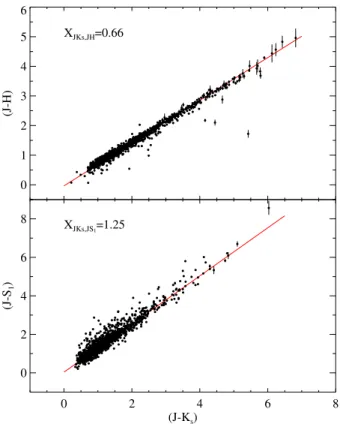
Fig. 1. Apparent color ratios for Type II Cepheids (top panel) and RR Lyrae (lower panel) variables identified in the VVV and GLIMPSE surveys (S1 ' 3.6µm). The stars are key for establishing a sizable Galactocentric baseline to evaluate reputed extinction ratio variations. For clarity purposes, only uncertainties along the ordinate are displayed.
in tandem with multiband infrared (e.g., Spitzer3.6 µm) and optical data for O stars and classical Cepheids throughout the Galaxy. The analysis aims to provide key insight regarding ex-tinction, and assess whether the data corroborate findings im-plying a potential link between the Galactocentric distance and dust size, as indicated by red clump stars (Zasowski et al. 2009; Gontcharov 2013, discussion and references therein).
2. Analysis
2.1. Determining color-excess and total extinction ratios
The desired extinction ratios can be determined via differing ap-proaches. A comparison of E(J−λ)/E(J−Ks) andλ−1 yields
RJ,JKs = AJ/E(J−Ks) as λ → ∞, thus providing the
coef-ficient linking the color-excess to the total extinction (Figs. 1 and 2). That coefficient may be determined from the appar-ent stellar colors to bypass potappar-entially uncertain intrinsic colors (e.g.,E(J−Ks)=(J−Ks)−(J−Ks)0).
E(J−λ)/E(J−Ks)=XJλ,JKs
(J−λ)−(J−λ)0
(J−Ks)−(J−Ks)0 =
XJλ,JKs
(J−λ)−(J−λ)0=XJλ,JKs(J−Ks)−XJλ,JKs(J−Ks)0 (1)
(J−λ)=XJλ,JKs(J−Ks)+β. (2)
Where X is the color-excess ratio, and β is constant for stars sharing common intrinsic colors. Color-excesses with extended baselines should be selected (e.g., J−Ks) to foster diminished
uncertainties.
0.0 0.1 0.2 0.3 0.4 0.5 0.6
λ-1 (
µm)
0.6 0.8 1.0 1.2 1.4 1.6 1.8
E(J-λ
)/E(J-K
s
)
Fig. 2. Mean color-excess ratios for the classical Cepheid, Type II Cepheid, and RR Lyrae variables analyzed. The mean near-infrared total-to-selective extinction ratio determined is hRJ,JKsi = 1.49 ±
0.05, and convergence is apparent beyond 3.4µm. The bracketing fits represent±1σ.
O stars are lucrative targets given their small intrinsic color spread (e.g., (B−V)0,Turner 1994), and are bright along with
their longer-period classical Cepheid counterparts. Yet excess in-frared emission endemic to O stars and their ambient environ-ment may bias mid-infrared colors (e.g., W4 ∼ 22 µm), and
hence determinations of the desired extinction ratios. The an-gular resolution associated with longer-wavelength mid-infrared photometry is likewise too coarse for dense nascent regions, although Spitzerobservations are preferred owing to their im-proved resolution relative to WISE. Indeed, theW2(4.6µm)
red-dening ratio cited in Table1for O stars is systematically larger than inferred from the bracketingSpitzerphotometry (S2,S3),
which hints at the onset of contamination.
Intrinsic colors for RR Lyrae and Cepheid variables are linked to the pulsation period (i.e., Mλ1−Mλ2 ∼ αlogP+β).
However, the expression is an approximation, especially for op-tical passbands where the instability strip exhibits sizable width (i.e., a temperature spread) and a metallicity term may be signif-icant. Rotation may likewise play a role (Anderson et al. 2014). Therefore, variables with similar pulsation periods may fea-ture different absolute optical magnitudes. Yet at infrared wave-lengths the effect is relatively marginal since the observations primarily track radius changes, rather than those tied to the tem-perature. For certain variable classes, Eq. (1) may consequently be recast as:
(J−λ)=XJλ,JKs(J−Ks)−XJλ,JKs(J−Ks)0+(J−λ)0
(J−λ)=XJλ,JKs(J−Ks)−XJλ,JKs(αlogP+β)+(γlogP+δ)
(J−λ)=XJλ,JKs(J−Ks)+logP(−XJλ,JKsα+γ)−XJλ,JKsβ+δ
(J−λ)=XJλ,JKs(J−Ks)+ζlogP+η. (3)
Table 1.Color-excess ratios.
hE(J−λ)/E(J−Ks)i λ(µm) Demographic
0 J(1.2) –
0.66±0.05 H(1.7) Type II Cepheids 0.67±0.01 H(1.7) RR Lyrae 0.70±0.01 H(1.7) classical Cepheids 0.63±0.01 H(1.7) O stars
1 Ks(2.2) –
1.28±0.04 W1(3.4) classical Cepheids
1.25±0.02 W1(3.4) Type II Cepheids
1.31±0.05 W1(3.4) RR Lyrae
1.33±0.02 W1(3.4) O stars
1.27±0.01 S1(3.6) Type II Cepheids
1.25±0.02 S1(3.6) RR Lyrae
1.28±0.01 S1(3.6) O stars
1.33±0.02 S2(4.5) RR Lyrae
1.37±0.09 S2(4.5) O stars
∗1.54±0.01 W2(4.6) O stars
1.35±0.01 S3(5.8) Type II Cepheids
1.30±0.02 S3(5.8) RR Lyrae
1.48±0.06 S3(5.8) O stars
1.46±0.06 W4(22) classical Cepheids
hE(V−λ)/E(B−V)i
2.26±0.03 J(1.2) O stars 2.24±0.09 J(1.2) classical Cepheids 2.58±0.04 H(1.7) O stars 2.54±0.06 H(1.7) classical Cepheids 2.77±0.06 Ks(2.2) O stars
2.70±0.06 Ks(2.2) classical Cepheids
2.94±0.06 W1(3.4) O stars
2.74±0.02 W1(3.4) classical Cepheids
3.04±0.05 S1(3.6) O stars
3.13±0.01 S2(4.5) O stars
2.98±0.04 W2(4.6) O stars
3.24±0.06 S3(5.8) O stars
3.10±0.26 W4(22) classical Cepheids
Notes. Near-infrared observations are on the 2MASS system, andSx
and Wx signify Spitzer and WISE data, respectively. Contamination from the environment encircling O stars is probable beyondJ−5.8µm, and the lower-resolutionJ−4.6µm (W2) passband relative to the brack-etingSpitzerfilters (S1,S2). The uncertainties cited reflect the spread between the fitting algorithms (see Sect.2.2).
of CO absorption and dissociation (Hackwell & Gehrz 1974; Scowcroft et al. 2011). RR Lyrae variables are significantly hot-ter than classical or Type II Cepheids, and likely immune to that effect. The pulsation term may be negligible for infrared passbands owing to the aforementioned reduced temperature de-pendence (Rayleigh-Jeans tail of the Planck function).
The following total extinction ratio may now be evaluated from the total-to-selective extinction ratio derived via Eq. (2) (or (3)).
AKs/AJ = 1−RJ,JKs
−1. (4)
Separate total extinction ratios (Aλ1/Aλ2) may be established
once one is known (Eq. (4)), and by making use of the expression
described by Eqs. (2) or (3).
Aλ/AJ=(−1/RJ,JKs)
(J−λ)−β (J−Ks)
+1 (5)
=(AKS/AJ−1)
E(J−λ) E(J−Ks)
+1
=AJAKs−AλAKs−A
2
J+AλAJ+A2J−AJAKs
AJ(AJ−AKs)
=Aλ/AJ.
The final method employed here to assess the total-to-selective extinction ratio involves exploiting a sample at a common dis-tance. RR Lyrae and Cepheids present an advantage since their intrinsic color and magnitude may be estimated from their pulsa-tion period (i.e.,Mλ∼αlogP+β), and contamination by AGB and red giant stars is less problematic. A disadvantage is that those variables are not as ubiquitous as red clump stars.
Ks−MKs−AKs =µ0
Ks−(αlogP+β)−RKs,JKs((J−Ks)−(J−Ks)0)=µ0
Ks−αlogP−β−RKs,JKs(J−Ks)−RKs,JKs(γlogP+δ)=µ0
Ks=RKs,JKs(J−Ks)+ζlogP+η.
(6) Sizable samples can be binned as a function of the pulsation pe-riod (e.g., bulge RR Lyrae variables), and consequently Eq. (6) may be transformed to:
Ks=RKs,JKs(J−Ks)+τ. (7)
The common distance approach warrants caution when applied to targets along certain bulge sight lines, where significant sub-structure, a rich stellar field, and sizable extinction prevail. Smith et al.(2007) note that stellar distances along such sight lines can be biased by blending, and linked parameters would be compromised (see alsoMajaess 2010).
2.2. O stars and the variable star demographic
Majaess et al. (2013) utilized O stars to ascertain an approx-imate relation between the optical and mid-infrared color-excess and total-to-selective extinction ratios (i.e., E(3.6µm− 4.5µm)/E(B−V) andA3.6µm/E(B−V)). That analysis is now
expanded to the broader Galaxy and other stellar populations, namely ∼300 O stars and classical Cepheids, and ∼1.5×10³
Type II Cepheids and RR Lyrae variables.
Data from release v1.1 of the Galactic O-star spectroscopic survey (Maíz-Apellániz et al. 2004;Sota et al. 2011,2014) were correlated with 2MASS, GLIMPSE, and WISE observations (e.g.,Wright et al. 2010). The CDS X-Match Service was em-ployed to match the data, typically using r < 1.500. Appar-ent colors (J − λ) were compared to (J − Ks), where λ =
JHKsW1S1S2W2S3 (see Table 1). The S4 (8 µm) and W3
(12µm) passbands were ignored to circumvent a significant ab-sorption profile putatively associated with silicate.
for reasons described above (i.e., CO and the broad silicate ab-sorption profile). Conversely, the baseline was extended to W4
(22µm) as contributions from dust (re)emission appear benign relative to the situation for O stars.
A search was undertaken for RR Lyrae variables and Type II Cepheids in the DRV4 release of the VVV survey. The observa-tions provide a critical extension of the Galactocentric baseline, thereby permitting key trends to be identified. The VVV survey is a near-infrared, wide-field, multi-epoch, and high-resolution campaign monitoring stars in the Galactic bulge, and an adja-cent region of the disk (Minniti et al. 2010; Saito et al. 2012). The survey, which was carried out from the VISTA 4-m tele-scope (Paranal), strived to extend existing near-infrared surveys beyond their faint limit by∼3−6 mag. Preliminary analyses of the wifield campaign, which covers nearly 520 square grees, indicate that in excess of a billion celestial targets were de-tected. To identify the variable stars sought, lightcurve (Fourier) templates were inferred from RR Lyrae and Type II Cepheids discovered by the OGLE survey (Soszy´nski et al. 2011a,b), and observed by the VVV survey. The templates were then used to identify variables throughout the broader region where the surveys lack overlap. The GLS2 period-search algorithm was employed (Zechmeister & Kurster 2009), and detections were screened against the templates via a χ2 scheme. Type II
Cepheids and classical Cepheids display similar lightcurves, and a clean separation of the populations amid photometric uncer-tainties is challenging. However, the two populations share sim-ilar colors, making their differentiation in this instance rela-tively unimportant as the broader trends are sought, and the population II class dominates within the bulge (Dékány et al. 2015). A broader discussion concerning the topic is deferred to Hajdu et al. (in prep.). Aperture photometry for the RR Lyrae and Type II Cepheid variables were adopted verbatim from the CASU pipeline (Minniti et al. 2010), which include photometric zero-points tied to extinction estimates. Those extinction correc-tions are potentially sizable for shorter wavelength VVVZand Yphotometry, which are not investigated here, and are compara-tively small forJ,H, andKsbands. The study’s broader
conclu-sions are relatively unaffected owing to such small corrections being incorporated into color ratios. The CASU data were subse-quently tied to 2MASS using secondary standards, and the trans-formation coefficients were near unity as the filter sets are simi-lar. The principle (systematic) uncertainty is likely attributable to the nature of the aperture photometry utilized (Sect.3). Certain brighter Type II Cepheids are saturated in the VVV survey, and possess inaccurate photometry. Indeed, saturation occurs for the longer-period and least obscured Type II Cepheids throughout the bulge, and variables at the structure’s forefront. A final cat-alog of variables detected in the VVV survey will be published in a separate study, where a rigorous discussion of complete-ness is provided (e.g., accounting for biases toward obscured regions and areas with limited multi-epoch sampling, Dékány et al., in prep.).
Aσ-clip (generally 3σ) approach was adopted to mitigate spurious data, in concert with fitting algorithms that avert out-liers (e.g., robust fitting). Photometric color uncertainties from separate surveys are inhomogeneous, and may bias fits toward brighter and less-reddened objects. Indeed, the apparent color ra-tios of the latter stars exhibit sizable uncertainties, and may skew results toward higher ratios. Thus establishing a broad color baseline assumed priority, and sizable statistics ensured that the formal random uncertainties were often dominated by systemat-ics linked to the fitting algorithms. Uncertainties cited in Table1 are tied to the spread in the latter.
3. Results
The results stemming from infrared photometry of such di-verse populations point toward certain similar color-excess ra-tios (Table1), although the O-star ratios digress rapidly beyond 3.6µm, likely owing to infrared excess and contamination from the ambient young environment surrounding the targets. Band-width effects may likewise offset the ratios determined (for a dis-cussion on divergent interpretations seeBerdnikov et al. 1996). Bandpasses are not infinitesimally small, and hence differential extinction presumably occurs across the filter. The impact partly depends on the stellar energy distribution and dust attenuation.
Optical ratios (E(V−λ)/E(B−V)) diverge significantly as a function of`, and the bulk trends differ between the classical Cepheid and O-star populations (Fig.3). Conversely, relatively slight deviations ofE(J−3.5µm)/E(J−Ks) are observed as a
function of`. The results were subsequently binned to reduce uncertainties. Furthermore, the residuals tied to AJ/E(J−Ks)
are not readily correlated with a pseudo2 determination of the
Galactocentric distance (Figs.3and4). The Galactocentric dis-tance was computed according to the following expression,RG=
p
d2cosb−2R
0dcosbcos`+R02, whereR0 is the distance to
the Galactic center anddis the classical Cepheid distance. The distance was evaluated after examining new near-infrared obser-vations of LMC classical Cepheids byMacri et al.(2015), from which the following first-order absolute period-Wesenheit rela-tion was established:WJ,JKs −W0,J,JKs = J−RJ,JKs(J−Ks)−
(−3.18 logP−2.67) =µ0 (assuming µ0,LMC = 18.45, see also Gieren et al. 2015). That Wesenheit function (reddening-free, Madore 1982) was adopted sinceRJ,JKs appears relatively
con-stant across the Galaxy to within the uncertainties, thus mitigat-ing uncertainties associated with color-excess estimates. A sim-ilar exercise was not carried out for the O stars granted their absolute magnitudes are acutely sensitive to the spectral classifi-cations assigned, in stark contrast to their intrinsic colors (Turner 1994).
The mean near-infrared total-to-selective extinction ratio for classical Cepheids, Type II Cepheids, and RR Lyrae variables is hAJ/E(J −Ks)i = hRJ,JKsi = 1.49 ±0.05, which implies
hAKs/AJi = 0.33±0.02 via Eq. (4). The total-to-selective
ex-tinction ratio was derived from a polynomial fit with preferen-tial weighting towards the longest-wavelength passband. Sight lines (`) projected along the Galactic bulge are not characterized by highly anomalous near-infrared color-excess ratios, while op-tical data for O stars adhere to larger ratios relative to the mean (ultimately, multiepoch and multiband PSF photometry with in-creased sample resolution is preferable for the bulge). However, the common distance approach described by Eqs. (6) and (7) yielded a discrepant finding relative to the apparent color ap-proach, namely thatRJ,JKs ∼1 characterizes the bulge RR Lyrae
variables. The former requires strict constraints on the sample analyzed, and bulge substructure further complicates the anal-ysis. Majaess (2010) noted there is a bias for smaller R0
be-cause stars are preferentially sampled toward the near side of the bulge owing to extinction, and an uncertainty in characterizing how a mean distance to the group relates toR0. Furthermore, it
was remarked that values ofR0may be biased by blending, and
classical Cepheids
2.5 2.6 2.7 2.8
X
BV,VW1
/S1
240 300 0 60 120
l (o)
1.0 1.1 1.2 1.3 1.4
X
JKs,JW
1
/S1
O-stars
2.0 2.5 3.0 3.5 4.0 4.5 5.0
X
BV,VW1
/S1
240 300 0 60 120
l (o
) 0.5
1.0 1.5 2.0 2.5
X
JKs,JW
1
/S1
Fig. 3.Optical color-excess ratios vary as a function of the Galactic sight line (top panels), in relative contrast to those tied solely to in-frared photometry (e.g.,E(J−3.5µm)/E(J−Ks),bottom panels). Clas-sical Cepheids and O stars display different optical trends with extrema along separate sight lines. The binned results were overlaid with arbi-trary (running mean and polynomial) fits to highlight the variations.
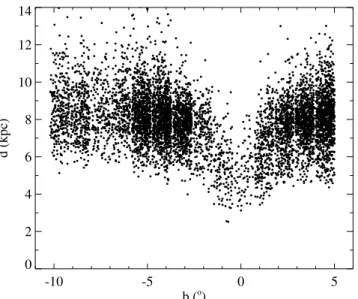
emerges when assessing the computed RR Lyrae distances as a function of|b|(Fig.5). Distance offsets become readily appar-ent for variables near the Galactic cappar-enter, as RR Lyrae become brighter because of contaminating flux from neighboring stars. The aperture photometry utilized is particularly sensitive to that
6 8 10 12 14 16
Rg (kpc)
2.5 2.6 2.7 2.8 2.9 3.0
0.2 0.0 [Fe/H]-0.2 -0.4
X
BV,VW1
6 8 10 12 14 16
Rg (kpc)
1.0 1.1 1.2 1.3 1.4 1.5
0.2 0.0 [Fe/H]-0.2 -0.4
X
JKs,JW
1
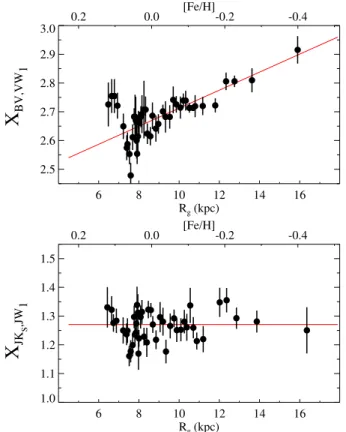
Fig. 4. Optical color-excess ratios (binned) inferred from classical Cepheids exhibit a dependence on the pseudo Galactocentric distance or metallicity (likely largely stellar in origin). That contrasts the re-sults tied solely to the infrared photometry analyzed (e.g.,bottom panel,
E(J−3.4µm)/E(J−Ks)). In concert with the trend delineated by O stars (Fig.3), the findings contradict a paradigm linking a strict and marked decreasing dust grain size with increasing Galactocentric distance. The Luck et al.(2011) metallicity gradient is conveyed.
effect. A similar trend is present for RR Lyrae variables near the bright and crowded centers of globular clusters (Majaess et al. 2012a,b). The value of R required to resolve the problem is inconsistent with the results implied by the stellar colors. The distances were computed usingKs andJ period-magnitude
re-lations inferred from LMC and nearby RR Lyrae stars (e.g., Borissova et al. 2009).
The optical reddening and total-to-selective extinction ratios correlate with`. For the O stars examined, a maximumRV,BV is observed along the` ∼290◦sight line, and minima are located
-10 -5 0 5
Fig. 5.Caution is warranted when applying the common distance ap-proach (Eq. (7)) to infer extinction properties for stars along the Galactic center sight line, where extinction and blending are acute (`,b→0◦
). Proximate distances observed for bulge RR Lyrae are likely linked to flux introduced by neighboring stars.
disfavor the interpretation that classical Cepheid and O-star op-tical colors convey that markedly smaller grains dominate at increasing Galactocentric distance, as indicated by certain red clump infrared analyses. Dust extinction is a complex phe-nomenon sensitive to a suite of variables (size, density, chem-ical composition, environment, etc.). Admittedly, if the Cepheid metallicity (BV) effect described is significantly larger than model predictions then the trend in Fig.4 could potentially in-vert, and thus support red clump predictions. Yet, the infrared-based Cepheid results would remain unchanged, and in con-cert with the O-star findings are irreconcilable with that theory. The mean optical total-to-reddening ratios arehAV/E(B−V)i= hRV,BVi ∼3.1 (classical Cepheids) andhRV,BVi ∼ 3.3 (O stars). Those values are tied to the longest-wavelength passband and are cited as approximate means owing to the acute dependence on`. Caution is warranted with regards to the O-star estimate since emission is a concern beyond>3.6µm, however, the stars probe key nascent regions and the young disk.
The O-star trends with Galactic longitude are consistent with the results of Whittet (1979) and Patriarchi et al. (2003). Yet Whittet(1979) argued that local dust reputedly associated with Gould’s Belt was responsible, and that is not supported by the Neckel et al.(1980) analysis, which implies that the bulk of the extinction occurs beyond the Belt’s extent. Moreover, the present O-star results contradict theories advocating that a sizable frac-tion of young star forming regions should universally exhibit sig-nificantly highRV. The O-star and Cepheid findings likewise dis-favor hypotheses that spiral arms (forefront or trailing sections) easily explain the Galactic longitude trends (e.g., Crézé 1972), as the aforementioned stellar populations may be interspersed within the arms and local structure exists (e.g., spur) possibly extending into Puppis (Majaess et al. 2009;Carraro et al. 2015). A fine-tuned ad hoc explanation may be required for that theory to explain the suite of Galactic longitude trends (O-star, classical Cepheid, and red clump). Lastly, the recentSchlafly et al.(2016, their Fig. 17) results for the inner Galactic plane are broadly similar to the Galactocentric trend delineated by the classical Cepheids, however, as argued earlier the optical (BV) variations
observed for those Cepheids are thought to stem mainly from metallicity-dependent stellar colors.
4. Conclusion
New near-infrared observations from the VVV survey were em-ployed to help establish color-excess and total extinction ratios across the Galaxy. To that end, Type II Cepheids and RR Lyrae variables were identified throughout the bulge and an adjacent region of the disk. The VVV observations were paired with mid-infrared observations, and used to determine the desired ratios via apparent stellar colors (Sect.2.1). The ensuing results were compared to color-excess ratios inferred from O stars and classi-cal Cepheids occupying the broader Milky Way. In sum, a strict paradigm linking smaller dust grains with increasing Galacto-centric distance, as inferred from infrared data for red clump stars, is not supported by the results.
The optical analysis indicates that O stars exhibit a max-imum ratio (RV,BV) along the ` ∼ 290◦ sight line, and min-ima are located toward` ∼ 133◦ and` ∼ 78◦ (Fig.3). Con-versely, the classical Cepheid optical data display extrema along the anti-center and ` ∼ 30◦ sight lines. Yet the infrared col-ors imply a ratio (hE(J−3.5µm)/E(J−Ks)i = 1.28±0.03σ)
that is relatively constant in comparison to optical determina-tions (Figs.3and4). The O-star color-excess ratios are particu-larly affected by emission beyond 3.6µm, however, the classical Cepheid, Type II Cepheid, and RR Lyrae variables may be char-acterized by hRJ,JKsi = 1.49 ± 0.05 (Fig. 2), which implies
hAKs/AJi=0.33±0.02. The common distance approach yielded
inconsistent (lower) results relative to those inferred from stel-lar colors for the bulge population. The former procedure is rather sensitive to the sample’s distribution, and may be partially skewed by heavy extinction and blending (Fig. 5). The mean optical total-to-selective extinction ratios are sensitive to`, but are approximately hAV/E(B−V)i = hRV,BVi = 3.1 (classical Cepheids) andhRV,BVi=3.3 (O stars). The ratios are consistent with theBerdnikov et al.(1996) andPejcha & Kochanek(2012) findings, and larger than the mean determined by Tian et al. (2014,RV,BV =2.40±1.05, from highbSDSS BHB stars). Yet ultimately the J,JKs passband combination, and certain others
(Ngeow 2012; Nataf et al. 2016), present desirable advantages when establishing cosmic distances to Cepheids, which are used to constrain the Hubble constant, the Universe’s age, and cos-mological models (Freedman & Madore 1996;Riess et al. 2011; Ngeow et al. 2014).
Acknowledgements. D. Majaess is grateful to the following individuals and con-sortia whose efforts, advice, or encouragement enabled the research: 2MASS, WISE, GLIMPSE (Spitzer), L. Berdnikov, OGLE (A. Udalski, I. Soszynski), J. Maíz-Apellániz, N. Walborn, C. Ngeow, L. Macri, D. Balam, B. Skiff, G. Carraro, CDS (F. Ochsenbein, T. Boch, P. Fernique), arXiv, and NASA ADS. D. Minniti is supported by FONDECYT Regular No. 1130196, the BASAL CATA Center for Astrophysics and Associated Technologies PFB-06, and the Ministry for the Economy, Development, and Tourism’s Programa Iniciativa Científica Milenio IC120009, awarded to the Millennium Institute of Astro-physics (MAS). W.G. gratefully acknowledges financial support for this work from the BASAL Centro de Astrofisica y Tecnologias Afines (CATA) PFB-06, and from the Millennium Institute of Astrophysics (MAS) of the Iniciativa Mile-nio del Ministerio de Economia, Fomento y Turismo de Chile, grant IC120009.
References
Anderson, R. I., Ekström, S., Georgy, C., et al. 2014,A&A, 564, A100
Berdnikov, L. N., Vozyakova, O. V., & Dambis, A. K. 1996,Astron. Lett., 22, 334
Borissova, J., Rejkuba, M., Minniti, D., Catelan, M., & Ivanov, V. D. 2009,A&A, 502, 505
Caldwell, J. A. R., & Coulson, I. M. 1985,MNRAS, 212, 879
Carraro, G., Turner, D., Majaess, D., & Baume, G. 2013,A&A, 555, A5
Carraro, G., Vázquez, R. A., Costa, E., Ahumada, J. A., & Giorgi, E. E. 2015,
AJ, 149, 12
Chené, A.-N., Borissova, J., Clarke, J. R. A., et al. 2012,A&A, 545, A54
Crézé, M. 1972,A&A, 21, 85
Dékány, I., Minniti, D., Majaess, D., et al. 2015,ApJ, 812, L29
Freedman, W. L., & Madore, B. F. 1996,in Clusters, Lensing, and the Future of the Universe, ASP Conf. Proc., 88, 9
Gieren, W., Pilecki, B., Pietrzy´nski, G., et al. 2015,ApJ, 815, 28
Gontcharov, G. A. 2013,Astron. Lett., 39, 83
Hackwell, J. A., & Gehrz, R. D. 1974,ApJ, 194, 49
Luck, R. E., Andrievsky, S. M., Kovtyukh, V. V., Gieren, W., & Graczyk, D. 2011,AJ, 142, 51
Macri, L. M., Ngeow, C.-C., Kanbur, S. M., Mahzooni, S., & Smitka, M. T. 2015,
AJ, 149, 117
Madore, B. F. 1982,ApJ, 253, 575
Maíz-Apellániz, J., Walborn, N. R., Galué, H. Á., & Wei, L. H. 2004,ApJS, 151, 103
Majaess, D. 2010,Acta Astron., 60, 55
Majaess, D., Turner, D., & Lane, D. 2009,Acta Astron., 59, 403
Majaess, D., Turner, D., Gieren, W., & Lane, D. 2012a,ApJ, 752, L10
Majaess, D., Turner, D., & Gieren, W. 2012b,PASP, 124, 1035
Majaess, D., Turner, D. G., & Gieren, W. 2013,ApJ, 772, 130
Minniti, D., Lucas, P. W., Emerson, J. P., et al. 2010,New Astron., 15, 433
Moni Bidin, C., Majaess, D., Bonatto, C., et al. 2014,A&A, 561, A119
Nataf, D. M., Gonzalez, O. A., Casagrande, L., et al. 2016,MNRAS, 456, 2692
Neckel, T., Klare, G., & Sarcander, M. 1980,A&AS, 42, 251
Ngeow, C.-C. 2012,ApJ, 747, 50
Ngeow, C.-C., Gieren, W., & Klein, C. 2014,IAU Symp., 301, 123
Patriarchi, P., Morbidelli, L., & Perinotto, M. 2003,A&A, 410, 905
Pejcha, O., & Kochanek, C. S. 2012,ApJ, 748, 107
Riess, A. G., Macri, L., Casertano, S., et al. 2011,ApJ, 730, 119
Saito, R. K., Hempel, M., Minniti, D., et al. 2012,A&A, 537, A107
Schlafly, E. F., Meisner, A. M., Stutz, A. M., et al. 2016,ApJ, 821, 78
Scowcroft, V., Freedman, W. L., Madore, B. F., et al. 2011,ApJ, 743, 76
Smith, M. C., Wo´zniak, P., Mao, S., & Sumi, T. 2007,MNRAS, 380, 805
Sota, A., Maíz Apellániz, J., Walborn, N. R., et al. 2011,ApJS, 193, 24
Sota, A., Maíz Apellániz, J., Morrell, N. I., et al. 2014,ApJS, 211, 10
Soszy´nski, I., Udalski, A., Pietrukowicz, P., et al. 2011a,Acta Astron., 61, 285
Soszy´nski, I., Dziembowski, W. A., Udalski, A., et al. 2011b,Acta Astron., 61, 1
Tian, H.-J., Liu, C., Hu, J.-Y., Xu, Y., & Chen, X.-L. 2014,A&A, 561, A142
Turner, D. G. 1976,AJ, 81,1125
Turner, D. G. 1994,J. Roy. Astron. Soc. Can., 88, 176
Turner, D. G. 2012,Ap&SS, 337, 303
Whittet, D. C. B. 1979,A&A, 72, 370
Wright, E. L., Eisenhardt, P. R. M., Mainzer, A. K., et al. 2010,AJ, 140, 1868
Zasowski, G., Majewski, S. R., Indebetouw, R., et al. 2009,ApJ, 707, 510