
Metacognitive learning strategies: their influences on vocabulary learning through a webquest
87
0
0
Texto completo
(2) Running head: WEBQUEST: RAISING METACOGNITION FOR VOCABULARY LEARNING. Metacognitive learning strategies: their influences on vocabulary learning through a webquest Cristina Barón y Magda L. Martínez Universidad de la Sabana, Colombia. AUTHORS NOTE Research Report submitted in partial fulfillment of the requirements for the degree of Master in English Language Teaching for self-directed learning, Universidad de la Sabana.. Directed by Claudia Patricia Alvarez Ayure Department of Foreign Languages and Cultures Universidad de La Sabana Chía, Colombia May, 2013.
(3) WEBQUEST: RAISING METACOGNITION FOR VOCABULARY LEARNING.
(4) i WEBQUEST: RAISING METACOGNITION FOR VOCABULARY LEARNING. Acknowledgements We would like to express our gratitude and appreciation, first and foremost, to our counselor Professor Patricia Alvarez, who guided us during the development of this study and offered valuable suggestions while this report was in progress. Our thanks to all the teachers that have taught us at Universidad de la Sabana and Anaheim University for their inspirational lectures in class, by which we have been motivated to explore this interesting issue about the use of metacognitive strategies for vocabulary learning through a webquest. We owe a debt of thanks to some friends, who have been encouraging us and without their support this Master (MA) study would be hard to accomplish. Last but not least, we would like to give our immense gratitude to our families, without their support this dream of pursuing this MA would not have been possible..
(5) ii WEBQUEST: RAISING METACOGNITION FOR VOCABULARY LEARNING. Abstract This action research study examined how the use of metacognitive strategies, through a webquest called “The world in our hands” in which students carried out tasks complementary to classroom instruction, influenced vocabulary learning. Thirty students at level A1 on the Common European Framework of Reference (CEFR) from eighth grade in two public Colombian schools, who were trained on the use of metacognitive and vocabulary strategies, participated in this study. Six interventions were designed and implemented following both the Content and Academic Language Learning Approach (CALLA) and the Computer Assisted Language Learning (CALL) model. The data suggested that the use of metacognitive strategies in a CALL environment was likely to influence vocabulary learning positively since it promoted the participants’ awareness and autonomy. Findings also indicated that such strategies helped students get better results in their learning process as they became aware of what practices to follow in order to learn new words effectively. At the end of the interventions learners were able to plan, monitor and evaluate their word knowledge progress, which led them to achieve most of the learning goals and enhance their lexical competence. Key words: Metacognitive strategies, vocabulary learning, webquest, autonomy, CALLA, CALL, learning awareness..
(6) iii WEBQUEST: RAISING METACOGNITION FOR VOCABULARY LEARNING. Resumen Esta investigación-acción examinó cómo el uso de estrategias metacognitivas, a través de la webquest llamada "El mundo en nuestras manos" en la cual los estudiantes desarrollaron tareas complementarias a la instrucción de clase, influenciaron el aprendizaje de vocabulario. Treinta estudiantes con nivel A1 según el Marco Común Europeo de Referencia para las Lenguas (MCERL) de octavo grado de dos colegios públicos colombianos quienes fueron entrenados en el uso de las estrategias metacognitivas y de vocabulario, participaron en este estudio. Seis intervenciones fueron diseñadas e implementadas siguiendo el modelo de Aprendizaje de Lenguaje Académico y de Contenido (CALLA) – y Aprendizaje de una Lengua Asistido por Computador (CALL). Los datos recolectados sugirieron que el uso de las estrategias metacognitivas en ambientes CALL influenció positivamente el aprendizaje de vocabulario, ya que promovieron la conciencia y autonomía de los participantes. Los hallazgos además indicaron que dichas estrategias ayudaron a obtener mejores resultados en su proceso de aprendizaje, ya que ellos adquirieron conciencia de cuáles prácticas seguir para aprender palabras nuevas efectivamente. Cuando los estudiantes planearon, monitorearon y evaluaron su progreso en el conocimiento de palabras, ellos alcanzaron la mayoría de sus objetivos y fortalecieron su competencia léxica. Palabras clave: Estrategias meta-cognitivas, aprendizaje de vocabulario, webquest, autonomía, CALLA, CALL, conciencia en el aprendizaje..
(7) iv WEBQUEST: RAISING METACOGNITION FOR VOCABULARY LEARNING. TABLE OF CONTENTS Acknowledgements…………………………………………………………………….i Abstract………………………………………………………………………………...ii Resumen………………………………………………………………………………..iii Tables of Figures……………………………………………………………………….viii Table of Tables…………………………………………………………………………ix Table of Abbreviations………………………………………………………………....x Chapter One: Introduction……………………………………………………………...1 General objectives ……………………………………………………………….....2 Specific objectives…………………………………………………………………..2 Chapter Two: Theoretical Framework…………………………………………………3 Vocabulary learning………………………………………………………………...4 Learning strategies……………………………………………………………..5 Vocabulary learning strategies…………………………………………………5 Metacognitive strategies……………………………………………………………6 Planning………………………………………………………………………..6 Monitoring……………………………………………………………………...7 Evaluating………………………………………………………………………7 Computer assisted language learning…………………………………………………..8 Webquest……………………………………………………………………………8.
(8) v WEBQUEST: RAISING METACOGNITION FOR VOCABULARY LEARNING. Chapter Three: Research Design..……………………………………………………...10 Context………………………………………………………………………………10 Participants…………………………………………………………………………..11 Research instruments………………………………………………………………..12 Need analysis questionnaire…………………………………………………….12 Students’ learning logs………………………………………………………….12 Blog……………………………………………………………………………..12 Semi-structured interview………………………………………………………13 Mind map……………………………………………………………………….13 Data analysis procedure……………………………………………………………..13 Chapter Four: Pedagogical Interventions………………………………………………15 Phase one: pre-interventions………………………………………………………..15 Phase two: interventions…………………………………………………………….16 Activating background knowledge……………………………………………..16 Searching for particular information……………………………………………16 Recycling vocabulary…………………………………………………………...16 Drafting the final product……………………………………………………….17 Designing and presenting the final product…………………………………….17 Self-assessing goals achievement………………………………………………17.
(9) vi WEBQUEST: RAISING METACOGNITION FOR VOCABULARY LEARNING. Evaluating the project…………………………………………………………..17 Phase three: post-interventions……………………………………………………...17 Chapter Five: Data Analysis and Findings……………………………………………..18 Category one: awareness in the use of MS and VLS………………………………..18 Category two: Impact of MS in learners’ autonomy towards VL…………………..21 Category three: affective factors involved in the incorporation of MS and VLS to the learning process……………………………………………………………………..24 Beliefs…………………………………………………………………………..24 Attitudes………………………………………………………………………...25 Motivation……………………………………………………………………...25 Expectations…………………………………………………………………….25 Chapter Six: Conclusions and Pedagogical Implications………………………………27 Pedagogical implication……………………………………………………………..28 Limitation of this study……………………………………………………………...29 Further Research……………………………………………………………………..30 References……………………………………………………………………………....32 Appendix A……………………………………………………………………………..38 Appendix B……………………………………………………………………………..39 Appendix C……………………………………………………………………………..40 Appendix D……………………………………………………………………………..43.
(10) vii WEBQUEST: RAISING METACOGNITION FOR VOCABULARY LEARNING. Appendix E………………………………………………………………………………44 Appendix F………………………………………………………………………………46 Appendix G………………………………………………………………………………49 Appendix H………………………………………………………………………………51 Appendix I……………………………………………………………………………….52 Appendix J……………………………………………………………………………….53 Appendix K………………………………………………………………………….......58 Appendix L………………………………………………………………………………62 Appendix M…………………………………………………………………………......63 Appendix N……………………………………………………………………………...64 Appendix O……………………………………………………………………………...67 Appendix P………………………………………………………………………………68 Appendix Q……………………………………………………………………………...69.
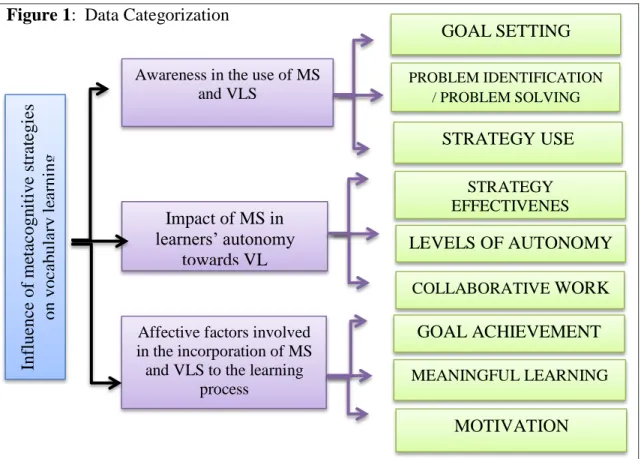
(11) viii WEBQUEST: RAISING METACOGNITION FOR VOCABULARY LEARNING. Table of Figures Figure 1 Data categorization…………………………………………………………...18.
(12) ix WEBQUEST: RAISING METACOGNITION FOR VOCABULARY LEARNING. Table of Tables Table 1 Percentage of Students’ Frequency Use of each Strategy……………………..19 Table 2 Final need analysis-metacognitive strategies results…………………….........20 Table 3 Word selection and use of strategies………………………………………......22 Table 4 Levels of learners’ Autonomy……………………………………………........23 Table 5 Percentage of students who reported having good technological skills……....25.
(13) x WEBQUEST: RAISING METACOGNITION FOR VOCABULARY LEARNING. Table of Abbreviations Bl…………….……………………….Blog, CALL………………………………...Computer Assisted Language Learning CALLA………………………............Content and Academic Language Learning Approach CEF…………………………………..Common European Framework CEFR ………………………………..Common European Framework of Reference Ch…………………………………….KWLH Chart CLIL………………………… ………Content Language Integrated Learning EFL…………………………………...English Foreign Language ESL…………………………………...English as a Second Language FL……………………………………..Foreign Language INT……………………………………Interview KWLH………………………………..Know, Want to know, Learned, How learned LLS…………………………………...Language Learning Strategies Log……………………………………Learning Log LS………………………………….....Language Strategies Ma………………………………..…...Master MC……………………………………Monitoring Checklist MCERL………………………………Marco Común Europeo de Referencia para las Lenguas MS……………………………………Metacognitive strategies NA ……………………………………Needs Analysis NA1 …………………………………..Needs Analysis 1 NA2 …………………………………..Needs Analysis 2 S1………………………………….......School1 S2……………………………………...School 2.
(14) xi WEBQUEST: RAISING METACOGNITION FOR VOCABULARY LEARNING. VL…………………………………….Vocabulary Learning VL…………………………………….Vocabulary Learning.
(15) WEBQUEST: RAISING METACOGNITION FOR VOCABULARY LEARNING. 1. Chapter One: Introduction Language is a means of communication among people all over the world and this is considered one of its major functions. Words are the vehicles for expressing thoughts and feelings in any language. In this way, they are vital to have an effective communication. In this light, vocabulary plays an essential role in the learning of English as a foreign language (EFL) in that word knowledge allows learners comprehend messages and communicate their own ideas (Schmitt 2008). Therefore, learning new words implies in addition to knowing what words to use to convey an idea, the ability to use metacognitive and vocabulary strategies that enable the user to be better equipped for effective learning and to gradually enlarge their vocabulary repertoire to benefit fluency. Throughout researchers’ teaching practices and class observations, interest in researching about vocabulary learning was risen because eighth-graders at Colegio República Dominicana and Institución Técnica Empresarial “El Jardín” were observed to lack awareness on how vocabulary is learnt and what strategies are effective for them (Hedge, 2000). A preliminary analysis applied to the participants of this study indicated that a high percentage of students frequently had difficulties recalling and retaining new words in the Foreign Language (FL), even if they were in constant exposure to new and recycled vocabulary. Some of the factors causing this problem which impedes them to adequately communicate in the FL were: (1) A low number of direct instructions to acquire vocabulary. (2) An absence of interdisciplinary knowledge. (3) An absence of meaningful contexts, other than the classroom, where students can learn and practice the FL. (4) A lack of awareness towards the importance of learning English nowadays. (5) A minimum level of awareness in relation to the strategies that may be more effective for them to learn new words. In this respect, Nation (1990) argues that learners often feel that their difficulties in English.
(16) 2 WEBQUEST: RAISING METACOGNITION FOR VOCABULARY LEARNING. learning result from a limited repertoire which might be solved by the creation of constant exposure and explicit vocabulary teaching in order to retrieve the new word (Tang & Nesi, 2003). Considering the emerged problem and factors above mentioned, the following research question was stated: Does the use of metacognitive learning strategies through a webquest influence on eighth graders’ learning of land pollution vocabulary in two Colombian public schools environments?” If so, in what ways?” In light of this question, this study aimed to train participants on the use of vocabulary learning strategies and metacognitive strategies through the use of a webquest outside the classroom, which would benefit students through the achievement of the following goals: General Objective To foster lexical competence in students through the use of metacognitive strategies to learn vocabulary during the implementation of a webquest. Specific Objectives 1. To promote the use of English outside the classroom by using a webquest. 2. To raise students’ awareness of the use of strategies to learn vocabulary. 3. To facilitate vocabulary learning through the use of planning, monitoring and evaluating strategies. This study discusses the benefits of raising students’ awareness towards their process of learning new words and the challenges that teachers must face when guiding students to autonomous learning..
(17) 3 WEBQUEST: RAISING METACOGNITION FOR VOCABULARY LEARNING. Chapter Two: Theoretical Framework To address the objectives of this study, three main theoretical areas were discussed. Vocabulary learning, Metacognitive learning strategies and Computer Assisted Language Learning (CALL), which are interrelated as an alternative to train students in the use of learning strategies to retain new words in EFL. Some decades ago, a widespread teaching approach was related to the fact that students learned vocabulary incidentally through the development of communicative tasks, involving any of the four skills -reading, writing, listening and speaking- (Moir & Nation, 2008). In consequence, most English teachers spent little time to teach vocabulary explicitly (Richards 1974; Zimmerman 1994). In contrast, research has shown that nowadays vocabulary is taught explicitly with the intention to assess learners in the selection of appropriate strategies to foster word recalling and retention which would impact positively the improvement of the four skills in EFL (Laufer, 2005; Schmitt et al., 2008) as well as the comprehension and production in target language (Mukoroli, 2011). Hedge et al. (2000) assert that many studies on vocabulary learning and teaching typically have focused on the strategies learners use to acquire vocabulary. However, focusing on vocabulary learning is insufficient if students are not given opportunities to execute strategies independently which might be achieved through the use of CALL outside the classroom. Later, in 2002, Hedge argues that vocabulary learning strategies “can be either cognitive –direct, mental operations to understand and store new words- or meta-cognitive indirect strategies that facilitate the conscious efforts to remember new words-” (as cited in Alemi, M. & Tayebi, A., 2011). Nation (2001) indicates that “learners differ in the range of strategies they use and in the effectiveness with which these are applied”. For that reason, the orchestration of multiple strategies is necessary given that having students combine.
(18) 4 WEBQUEST: RAISING METACOGNITION FOR VOCABULARY LEARNING. metacognitive strategies with cognitive strategies is likely to be a positive factor in their acquisition of new words. Vocabulary Learning (VL). In 2000, Nagy and Scott claim that words are learned gradually through multiple uses in a variety of contexts. It was also noted that there is great improvement in vocabulary when students encounter new words often (National Reading Panel, 2000). Later in 2005 Stahl et al define VL as the learning of words meanings, how they fit into the world and how such learning takes place. In the views of these authors, students probably have to see a word more than once in order to store it firmly in their longterm memories. Word knowledge is complex because many words have multiple meanings and different functions in different sentences. Moreover, the understanding of one word connects to the knowledge of other words, consequently, to comprehension, understanding and expression of thoughts and feelings. When students lack lexical competence they might be frustrated because of their low level of comprehension and their difficulty in communicating their ideas. In this light, learners need to be guided in a VL process where they are provided with opportunities to encounter words repeatedly and in different situations and get prepared to both learn words in a progression from the simpler to the more complex ones, and use them properly (Beck, 2002). In this study, the use of a webquest may provide students with lots of opportunities to learn new and unfamiliar words about a specific topic. In addition to this, giving students access to this resource may also benefit vocabulary instruction since it facilitates the teaching and learning of words within a context, providing students with meaningful word exposure, and allowing students multiple, authentic experiences with using words in spoken and written language (Beck, McKeown, & Kucan, 2002; Graves, 2006). Furthermore, learners have been explicitly taught both specific words and word-learning strategies and have been given a number of opportunities to monitor and evaluate their effectiveness..
(19) 5 WEBQUEST: RAISING METACOGNITION FOR VOCABULARY LEARNING. Learning strategies (LS). These ways of approaching learning have been defined by Oxford and Burry-Stock (1995) as the thoughts and actions that learners use to achieve a learning goal. LS have gained importance as a tool to improve EF learning since, as Oxford argues, “strategies are tools for the self-directed necessary involvement for developing communicative ability” (1992/1993, p. 18). Such ability is likely to be achieved when students consciously and independently choose effective strategies that enable them to increase their repertoire of words. According to Oxford et al. (1992), there is a more specific set of strategies called Language Learning Strategies (LLS) which “are specific actions, behaviors, steps, or techniques that students (often intentionally) use to improve their progress in developing L2 skills” (Oxford et al., 1992). This set of strategies might be strongly related to students’ learning success in FL if students learn when and how to use it as well as its purpose in learning. Although learning strategies are tools that are implicit in goalachievement, some learners are not aware of their usefulness and are not able to choose the ones that are effective for them. Consequently, the level of awareness learners have about the use of LS influences how effective they are.. Vocabulary learning strategies (VLS). Different taxonomies on VLS have been proposed to address this particular type of strategies to learn a language. While Oxford (1990) includes a list of six major categories of strategies: memory, cognitive, compensation, metacognitive, affective and social, Schmitt (1997) only adopted four groups: Social, Memory, Cognitive, and Metacognitive. Cook and Mayer (1983) classified VLS into “Determination strategies” and “Consolidation strategies”. The former consists of how learners discover the meaning of a word using their knowledge of the language, contextual clues or reference materials, figuring out the new meaning and asking someone else the word’s meaning. The latter consists of how they remember the meaning of a word using social, memory and metacognitive strategies. For the purpose of this study, Cook and.
(20) 6 WEBQUEST: RAISING METACOGNITION FOR VOCABULARY LEARNING. Mayer’s et al. (1983) taxonomy of vocabulary learning strategies will be taken into account as a reference to train students in the conscious use of VLS as these strategies can be easily understood and used by the students. This taxonomy would benefit students’ lexical competence since it is focused on the main aspects of vocabulary learning: knowing the meaning of a word and storing it in the long-term memory.. Metacognitive Strategies (MS) are one of the core strategies that have taken an important role in VL and relate to how students control their learning process and deal with tasks. These strategies include planning, monitoring, and evaluating both language use and language learning-key elements in developing autonomy (Harris, 2003a). It has been argued that students need to be trained and examined on how to set goals, monitor the development of the task and evaluate learning achievement (Halpern 1998, 2003b; Luckey 2003; Swartz 2003). Anderson (2002a, p.1) defines metacognition as “thinking about thinking” and proposes five main components of metacognition: (1) setting goals for learning and defining the way to accomplish them, (2) selecting and using LS by making conscious decisions about when and how to use them, (3) checking whether the use of those strategies is effective or not, (4) being aware of how to use various strategies at the same time and (5) evaluating strategies use and learning. In this respect, it is worth mentioning that during the implementation of this study, learners repeatedly took action in these five components as they are considered powerful tools for achieving academic success -learning a set of words-. Furthermore, affective factors were examined since “the way students feel about themselves and their capabilities can either facilitate or impede their learning” and the proper use of MS and VLS (Arnold & Brown, 1999). Planning. These activities include those aimed at the determination of procedures that direct thinking and the selection of adequate strategies. As planning enable students to set.
(21) 7 WEBQUEST: RAISING METACOGNITION FOR VOCABULARY LEARNING. clear and achievable goals and select appropriate strategies to accomplish them, during the pre-intervention stage of this study, participants were trained on how to select a set of words to be learned by autonomously choosing the ones they considered important and which consolidation strategies they would use for their purpose. Monitoring. During this stage, participants were exposed to an ongoing awareness of task comprehension (Schraw, 1989). According to Luckey et al. (2003) and Swartz et al. (2003), monitoring activities include checking task information to validate comprehension and focusing attention on important vocabulary necessary to understand main ideas. The use of this strategy led students to identify problems towards VL and solve them consciously through the use of VLS. This phase required of collaborative work during the use of the webquest which facilitated teacher and peers’ assistance. Evaluating. Facione (1990) claims that evaluating involves the examination and correction of one’s cognitive processes. These include evaluating one’s reasoning, goals and conclusions (Schraw et al., 1989), as well as making revisions when necessary. Along the implementations, learners were asked to evaluate the achievement of the goals by reflecting on their learning logs and assessing specific aspects in a checklist containing clear criteria. In conclusion, MS might direct students to learn how to master information and to solve problems independently. According to Nunan (1990), they allow learners get focused on their learning process and help them manage: (1) themselves as learners, (2) the general learning process, and (3) specific learning tasks. Despite of the benefits that MS offer to students, affective factors play an important role in VL, since those who are not motivated towards their learning process would be reluctant to use them. For that reason, a topic related to the students’ real lives was presented to the participants of the study. In this way, MS for VL may take students beyond rote memorization and may lead them to adopt strategies for the purpose of improving vocabulary retention and usage (Nation, 2005)..
(22) 8 WEBQUEST: RAISING METACOGNITION FOR VOCABULARY LEARNING. Computer Assisted Language Learning (CALL) is defined as any process in which a learner uses a computer and, as a result, improves his or her language (Beatty, 2003, p. 7). It becomes an alternative for teachers to promote VL and the use of MS and VLS in their students. Goodfellow (1994) proposes that CALL involves (1) the learners’ need to build a L2 mental lexicon, (2) the practice of new words which enhances a deeper learning and (3) the generation of a record data on learning approaches and outcomes. These benefits of the CALL approach might be exploited through the use of web-based technology, which is rich in authentic and non-authentic materials related (videos, readings, different tasks) that guide learners to the target vocabulary about the studied topic and offer learners the opportunity to recall and recycle words. This study intended to implement a webquest, which might facilitate the process of learning vocabulary as a result of the autonomous use of different technological tools, while using MLS to acquire knowledge about land pollution. Webquest. This web tool consists of inquiry-oriented activities that allow learners’ interaction with different web 2.0 tools from internet, including sections like: (a) Introduction, (b) Task, (c) Process, (d) Evaluation, and (e) Conclusion (Dodge, 1995). According to Dodge (1997) and March (1998), this framework permits the role of the teacher/trainers as a facilitator who scaffolds learning within a constructivist environment. Furthermore, it requires both individual and collaborative work necessary to learn to access new information, including the use of MS and VLS, and acquire expertise in its use. This leads students to use their critical thinking skills for a better understanding. As a result they become aware and responsible for their own VL (March, 2003). A webquest called “The world in our hands”, aimed at being completed in a period of three months was designed under the principles of the CALLA model (O’Malley & Chamot et al., 1996) in order to facilitate VL and the practice of MLS and VLS within its instructional sequence: (1) activate prior knowledge, (2) present MS and VLS, making them explicit to.
(23) 9 WEBQUEST: RAISING METACOGNITION FOR VOCABULARY LEARNING. learners, (3) practice strategies while using a specific set of words during the development of meaningful tasks, (4) evaluate the strategies and their effectiveness, content and use of vocabulary, (5) transfer strategies to a different context or task. The topic land pollution was chosen considering the principles of Content Language Integrated Learning (CLIL) which might be very successful in enhancing the learning of any language through academic content while developing within the learners a positive ‘can do’ attitude about themselves as language learners (Marsh, 2000). In this study learners were taught through the FL with two different aims: content –land pollution-, and language – vocabulary learning – (Marsh, 1994). A combination of CALLA, CALL and CLIL approaches is likely to impact positively students’ VL as it offers them opportunities to (1) use MS inside and outside the classroom in order to develop awareness towards VL and VLS, (2) develop autonomy towards VL, (3) work collaboratively as the first step to gain confidence in the use of VLS and MS, (4) put words in context to learn them in a meaningful way (5) relate words to real life problems that help students associate vocabulary to everyday situations..
(24) 10 WEBQUEST: RAISING METACOGNITION FOR VOCABULARY LEARNING. Chapter Three: Research Design In the previous chapter, the benefits of using MS and VLS while developing tasks autonomously through a webquest were discussed. From this insight, parameters for designing materials and instruments were determined. Chapter Three is divided into five sections. Research design and participants description sections provide general information about the study. The next three parts: instruments, interventions and data analysis are described in detail. This action research study analyzed and described the influence of MS instruction on students’ VL allowed the teachers/researchers to (1) identify the phenomena -difficulties with retaining new vocabulary-; (2) plan actions to address the problem -training students on the use of MS and VLS -; (3) carry out the action -the use of MS and VLS throughout a webquest-; (4) observe and reflect on the outcomes -consciousness raising in VL as a consequence of the frequent use of MS (Nunan & Bailey, 2009 p-227)-. This approach also required the researcher to play a dual role of participants and researchers. As participants (teachers), they were in charge of designing lessons, materials and instruments. As researchers, they carried out the interventions, data collection and data analysis in order to answer the research question. Context This research was carried out in two Colombian public schools: República Dominicana I.E.D from Bogotá (school 1) and Institución Educativa Técnica Empresarial “El Jardín” from Ibagué (school 2). Both institutions offer instruction to about 1500 students per shift from kindergarten to eleventh grade and had few technological resources available that were necessary for the development of the project. Most of students’ families belong to strata 1 and 2, an under privileged population with some specific social and affective characteristics: in school 1 a large number of students.
(25) 11 WEBQUEST: RAISING METACOGNITION FOR VOCABULARY LEARNING. have been sequestered from their hometowns, and many of them belong to dysfunctional families where children spend a lot of time alone. In school 2, the majority of students are raised by their grandparents in their step or extended families; due to their low incomes, some students work with their parents or grandparents in informal jobs such as street sellers, packers at supermarkets and bricklayer or mechanic’s helpers. Informal talks with students, class observations and teachers’ reflections carried out prior to this study showed that students’ low motivation and interest towards learning English may derive from their current living conditions as they do not consider the future possibility of communicating in English in their daily life. In both schools, students attended 3 hours of English lessons per week that were structured in two sessions: one of 55 minutes and another of 110 minutes. Before starting this study, instruction and class work usually focused on individual activities about grammar, reading and writing. Participants A number of 30 eighth-graders (15 out of a class of 40 students from each school, which represented the 37% of the population) who had access to a computer with internet connection outside the classroom and had evidenced difficulty to retain new vocabulary during English lessons participated in this study with the consent of the schools’ principals (see Appendix A) and their legal parents (see Appendix B). Participants were aged between 12 and 15, with an average proficiency level A1 according to the Common European Framework of Reference (CEFR). This group of learners was asked to answer a needs analysis questionnaire which results indicated that: (1) learners lacked awareness of the ample range of VLS. In contrast, their repertoire was limited to asking the teacher, looking up the word in the dictionary and repeating it, (2) as students’ awareness towards their learning process was low, they occasionally used metacognitive strategies unconsciously and (3) the.
(26) 12 WEBQUEST: RAISING METACOGNITION FOR VOCABULARY LEARNING. average time spent by learners to surf the net was 1-3 hours a day and this time was limited to leisure activities. Research Instruments A number of five data collection instruments were applied during the stages of the intervention. In some cases, students were allowed to use Spanish to answer questions that involved reflection on the use of strategies this facilitated the retrieval of valid and reliable data that accounted for evidences of students’ awareness in the use of MS and VLS. 1. A needs analysis questionnaire (see Appendix C). This instrument which served as a point of departure for the pedagogical intervention (Cekada, 2011), was structured in three sections: (1) The use of VLS, (2) the use of MS and (3) the use of technology for educational purposes. It was implemented both at the beginning and at the end of the process in order to gather information related to the VLS and MS that students actually used, their level of awareness and their beliefs about VL. The results gathered gave researchers insights about the. possible factors influencing VL and the effectiveness of the webquest as a mean to learn English in the students’ specific context. 2. Students’ learning logs (see appendix D). In the views of Friesner and Hart (2005), these represented an assessment tool for encouraging learners to reflect on their VL process. Participants filled-in the logs along the whole intervention process to help learners jot down their insights on their learning process reflect and for the researchers to assess the number of words they learned during each step of the intervention and identify problems and solutions towards the use of VLS and MS. As a data collection tool, the logs provided researchers with rich information that helped deepen the analysis of the usefulness of MS for VL. 3. A blog (see appendix E). This instrument was designed to keep track of students’ progress in every step of the webquest. Each learner posted on it their reflections (Dieu,.
(27) 13 WEBQUEST: RAISING METACOGNITION FOR VOCABULARY LEARNING. 2004), ideas and opinions about the topic, the use of MS and the webquest effectiveness in VL. It is available http://theworldinourhands2012.blogspot.com/ 4. A semi-structured interview (see appendix F). This kind of interview required the design of a questionnaire prior to the talk sessions. During its administration new questions were included in order to get detailed answers (Nunan & Bailey et al., 2009). Additionally, this follow-up interview allowed researchers to corroborate and triangulate the data gathered by means of other instruments. 5. A mind map (see appendix G). This instrument allowed participants to visualize the repertoire of vocabulary related to land pollution before the intervention with the words they were able to recall about the topic and was expanded at the end of the process with the vocabulary learned during the project. These results became the main evidence of results in this study. Data analysis procedures Data analysis was framed under the approach of Grounded Theory that aims to develop theories progressively as the study proceeds by collecting information and comparing it to the emerging theory (Glasser & Straus, 1990). MacLean and Mohr’s (1999) proposal that consists of comparing, triangulating, sorting and coding, ordering data and stating theories was used to interpret data. Data analysis was based on a mixed approach (Creswell, 2003), in which quantitative data were collected to support qualitative data. The former was collected by means of needs analysis questionnaires and self-assessment checklists, which provided the researchers with statistics that evidenced students use of MS and VLS, as well as their effectiveness. The later was collected by means of interviews, posts in the blog, learning logs that informed researchers about learners’ reflections and opinions towards MS and VLS. Such information was collected in an ongoing process, typed and organized in two different Excel matrices (see.
(28) 14 WEBQUEST: RAISING METACOGNITION FOR VOCABULARY LEARNING. Appendix H) a qualitative data matrix created to visualize collected data both, per participant and instrument and quantitative data created to analyze data statistically. For this purpose codes were assigned in the following way: (1) Researchers referred schools as (S1) and (S2), (2) a number was assigned to each participant for ethical reasons in order to protect their real identities and (3) an acronym was given to each instrument in the following way: interview (Int), blog (Bl), KWLH Chart (Ch), Monitoring checklist (MC), Learning Log (Log) and Needs Analysis (NA). Triangulation that nurtured the analysis and made it valid was derived from the constant comparison between quantitative and qualitative data and between data and theory based on: (1) Important evidence of changes in relation to the usage of MS for VL, (2) common patterns in data collected and (3) differences in students’ opinions towards the benefits of using a webquest to practice MS for VL. Data were divided into different meaningful units and as similarities among them were found, a color was assigned to each emerging code, which was also labeled with a name depending on the ideas developed. Each code was reapplied as new segments were encountered. During the sorting and coding of information a hierarchical category system was built through a mind map supported with participants’ excerpts. This allowed researchers identify patterns that were subsequently reduced to the most relevant themes in a second mind map (See Appendix I) for the purpose of establishing specific categories that enclosed main themes from this study..
(29) 15 WEBQUEST: RAISING METACOGNITION FOR VOCABULARY LEARNING. Chapter Four: Pedagogical Intervention This section describes the process carried out for 3 months (see Appendix J). The steps followed consisted of three phases (pre-intervention, intervention and post-intervention), which will be described in depth in the following lines. Phase One: Pre-intervention This stage required the administration of a needs analysis questionnaire focused in the problem. Based on its results a lesson plan (see Appendix K), following the CALLA approach, was designed and implemented for training students in the use of MS and VLS. Along the two training sessions researchers (1) introduced students to the topic of land pollution, promoting reflection and analysis towards the importance of learning about it, (2) carried out a reading workshop related to the topic prompting students to focus on VL, VLS and the correct use of templates (learning log, vocabulary inventory, and learning contract), (3) presented students a variety of VLS -discovery (cognates and context) and consolidation (mental images, vocabulary banks, personal dictionaries, etc.)-, (4) drove them to identify prior word knowledge, VLS frequently used and learning problems related to vocabulary (5) guided them in the use of MS (planning, monitoring and evaluating) and reflection on their effectiveness, and (6) trained them in the selection of appropriate VLS to solve VL problems. Additionally, researchers guided learners on the exploration of the webquest (see appendix L) called “The world in our hands”, available at http://www.zunal.com/process.php?w=60584 with 3 purposes: (1) raising consciousness. towards its usefulness in VL, (2) identifying students strengths and weaknesses when working in CALL environments and (3) training students in the correct use of both, the links and the blog, in order to avoid problems during the intervention phase. Besides probable issues with the webquest, researchers anticipated problems that could occur during the interventions, such as students’ low comprehension of the proper use of MS.
(30) 16 WEBQUEST: RAISING METACOGNITION FOR VOCABULARY LEARNING. and unclear instructions in both, the webquest and the instruments. In this respect, some steps of the webquest were clarified, additional information on how to fill in learning logs and vocabulary inventories was provided, and MS -planning, monitoring and evaluating- were frequently modeled by the teachers. Phase Two: Intervention This stage required students to employ the webquest “The world in our Hands” outside the classroom, which permitted them to recycle words and recall information in context by continuously using MS and VLS. Moreover, it gave them broader ideas about strategies effectiveness and some expertise in their use. The instructional sequence proposed along the webquest as a way to scaffold learners in the achievement of their goals included: 1. Activating background knowledge. Students filled-in the first two columns of a Know, Want to know, Learned, How learned (KWLH) Chart (see Appendix M), which was the first step to setting goals and planning how to achieve them. This chart was completed later on in the process. 2. Searching for particular information. Students visited different websites that contained old and new vocabulary. During this phase, learners used discovery and consolidation strategies for VL and monitored the number of words they learned as well as the effectiveness of MS. Furthermore, students registered their reflections about problems with recalling and retaining new words in the learning logs, as well as their plan to solve them by examining the strategies used and the ones that might be more effective. 3. Recycling vocabulary. As students searched for information and worked on the final product design, they used a vocabulary inventory (see Appendix N) to register new words with some features that they considered important to learn (a drawing, a synonym, a.
(31) 17 WEBQUEST: RAISING METACOGNITION FOR VOCABULARY LEARNING. sentence containing the word, a definition), including the date in which they learned them. This strategy somehow helped them to monitor VL. 4. Drafting the final product. The students’ output served as evidence of how much information they were able to express in English about “Land Pollution” by using the words that they had actually studied and learned during the process. This helped to foster lexical competence. 5. Designing and presenting the final product. This afforded students an opportunity to recall information and demonstrate they were able to communicate using the words learned. 6. Self–assessing goals achievement. This step carried out during and at the end of the process through a self-assessment checklist (see Appendix O) and the follow-up interview allowed students to draw conclusions on the effectiveness and benefits of MS and CALL. 7. Evaluating the project. During the follow-up interview students gave feedback that permitted the teachers/researchers to identify possible improvements for further implementations. Along the interventions students kept a weekly register of the words learned during the development of individual or collaborative assignments both at home and in the classroom. Phase Three: Post–Intervention In this phase, students (1) wrote short paragraphs or sentences expressing what they learned about the topic, (2) expanded their mind maps and filled in the needs analysis questionnaire for the second time in order to identify changes with respect to the first one, (3) filled-in the last two columns of the KWLH chart (see Appendix P) and, (4) participated in a follow-up interview..
(32) 18 WEBQUEST: RAISING METACOGNITION FOR VOCABULARY LEARNING. Chapter Five: Data Analysis and Findings This project attempted to describe how the use of MS through the implementation of a webquest about land pollution influenced VL. In this chapter the results and findings of the study are presented. Three main categories emerged during the process of data analysis and reduction (see Figure 1), which are described and explained below and supported with excerpts of students’ insights and statistics. Such analysis revealed that MS through the use of a webquest may influence positively VL since they promote awareness and autonomy in the process of learning.. Figure 1: Data Categorization. Influence of metacognitive strategies on vocabulary learning. Awareness in the use of MS and VLS. GOAL SETTING PROBLEM IDENTIFICATION / PROBLEM SOLVING. STRATEGY USE. Impact of MS in learners’ autonomy towards VL. STRATEGY EFFECTIVENES. LEVELS OF AUTONOMY COLLABORATIVE WORK. Affective factors involved in the incorporation of MS and VLS to the learning process. GOAL ACHIEVEMENT MEANINGFUL LEARNING. MOTIVATION. Category One: Awareness in the Use of MS and VLS Metacognition is closely related to autonomy. In this light, being aware of the use of MS for VL leads students to adopt strategies for the purpose of improving vocabulary retention and usage (Nation et al., 2005). The study provided participants with direct.
(33) 19 WEBQUEST: RAISING METACOGNITION FOR VOCABULARY LEARNING. instruction on the use of VLS aimed at making them aware of this. Along the interventions, researchers observed that the more aware students were of their learning process, the more they were able to self-direct it. In order to promote strategies awareness, students were guided into a cyclic process where they had to plan, monitor and evaluate repeatedly how to learn new words. Data in this study demonstrated that making vocabulary and strategies explicit to learners helped them retain and recall words in an easy manner (Taylor, 1990), as they became aware of the strategies they could use and were able to choose the ones that could facilitate their learning. Data collected through the final Needs Analysis questionnaire showed an increase in the percentage of students who explored other VL strategies (see Table 1) such as using synonyms (20%), creating a visual image of the word (43%), writing sentences containing it (50%), remembering the place where it was seen (44%) and drawing it (43%), these strategies involving both, the use of visuals and the use of the words in context. Table 1 Percentage of Students’ Frequency Use of each Strategy Strategy. Mental image of the word Association Synonyms Making groups of words Following the rhythm of a song Remembering the place where it was seen first Make sentences with the word Writing the word several times Repeating the word several times Drawing the word. School 1. School 2. NA 1. NA 2. NA 1. NA 2. 27% 27% 20% 20% 33%. 40% 46% 40% 20% 46%. 20% 7% 27% 0% 13%. 47% 13% 7% 0% 20%. 40% 33% 40% 53% 27%. 47% 66% 47% 67% 40%. 20% 13% 33% 73% 20%. 40% 33% 27% 53% 47%. Throughout this process, awareness towards the use of MS and VLS increased slightly (see Table 2). Data collected through the learning logs and the vocabulary inventory.
(34) 20 WEBQUEST: RAISING METACOGNITION FOR VOCABULARY LEARNING. highlighted that: (1) the setting of goals was achieved by 34% of participants. These learners were able to choose, throughout different stages of the webquest, a set of words and the strategies they considered adequate to learn them. (2) 40% of participants claimed to have focused their attention on vocabulary learning during the development of tasks. (3) 47% of participants evaluated the number of words learned at the end of a task (see Appendix Q1). Table 2 Final Need Analysis-Metacognitive Strategies Results. Metacognitive strategy. School 1 School 2. Planning Setting goals Planning Self-motivation. 53% 40 % 33 %. 13% 40% 60%. Monitoring Use of strategies Attention Learning. 60% 53% 46%. 20% 27% 27%. Evaluating Goal achievement Vocabulary learned Strategy Effectiveness. 60% 66% 40%. 7% 27% 27%. Training learners in the use of MS benefited students when setting goals, following procedures, monitoring tasks and evaluating goals’ achievement (Halpern et al.,1998, 2003b; Luckey et al., 2003; Swartz et al., 2003). As Nunan et al. (1990) states, using MS allowed learners some grade of awareness that permitted them get focused on their learning process which was demonstrated in the continuous questioning, problem identification , problem solving and the use of different VLS (see Appendix Q2). Such instruction was facilitated by the use of the webquest that allowed students multiple, authentic experiences with using words in spoken and written language within a meaningful context (Beck, McKeown, & Kucan et al., 2002; Graves et al., 2006). The.
(35) 21 WEBQUEST: RAISING METACOGNITION FOR VOCABULARY LEARNING. conscious use of MS and VLS outside the classroom demonstrated that learners found in the webquest opportunities to plan, monitor and evaluate their process of learning vocabulary (see Appendix Q3). In a more detailed way, MS promoted awareness towards VL because: (1) setting goals when planning focused learners in their learning process, which requires of consciously selecting a set of words and VLS to effectively recall them when needed, (2) monitoring gave them an ongoing awareness of task comprehension (Schraw et al., 1989) that led them identify problems with their VL process and select the adequate strategies to solve them, and (3) evaluating the effectiveness of VLS when recalling words that were planned to learn (Schraw et al., 1989) encouraged them to continue using the ones they found effective to achieve their goals (see Appendix Q 4 - 6). Students who did not get acquainted of MS found it difficult to plan, monitor and evaluate VL and limited the use of VLS to the ones that they were accustomed to use (like repetition) which had been ineffective for them. Consequently, their results in terms of VL during the study were poor (see appendix Q7). Category Two: Impact of MS in Learners’ Autonomy towards VL Autonomy is “the ability to take charge of one’s own learning” (Holec, 1981). Even though achieving autonomy in the use of MS and VLS is a complex process, it was found that autonomy results from doing actions iteratively until they become habits. For that reason, students were guided into a cyclic process, where they had to plan, monitor and evaluate how to learn new words outside the classroom, without the teacher’s assistance, by means of the webquest. This constant following of procedures led students to consciously use MS to make choices (see Appendix Q8) on the VLS that best fit with their own learning style, learning purposes and linguistic needs for learning facility and, consequently, with academic success (see Appendix Q9). The fact that along the use of the webquest (1) 30% of students planned.
(36) 22 WEBQUEST: RAISING METACOGNITION FOR VOCABULARY LEARNING. which words to learn independently and 43% selected strategies to learn new words , (2) 52% took effective action through the strategies needed to learn vocabulary, (3) 52% found VLS effective, (4) 54% were able to remember words and (5) 57% solved problems by looking for peers or teacher’s collaboration (see Table 3), showed that the use of MS through the use of the webquest enhances students’ ability to act independently in order to acquire new vocabulary (Harris et al., 2003). Table 3 Word selection and use of strategies School 1 Always. Sometimes. School 2 Never. Always. Sometimes. Never. Word selection. 46%. 46%. 8%. 13%. 67%. 26%. Word retention. 68%. 24%. 8%. 40%. 53%. 7%. Strategies selection. 38%. 38%. 4%. 47%. 47%. 6%. Strategies effective use. 52%. 24%. 24%. 53%. 40%. 7%. Collaborative work. 64%. 0%. 36%. 53%. 0%. 47%. Results presented above also support the idea that participants reached different grades of independence in the use of MS. Those who achieved high levels of autonomy were likely to learn more words than those who faced difficulties with taking control over their process of learning and the use of the webquest. This illustrates the fact that autonomy is a process that emerges in different levels (Nunan, 2000) which reveals that introducing new VLS into the learning process is an action that requires an internalization of new strategies knowledge (see Appendix Q10). In this study, participants in both schools reached different levels of autonomy (see Table 4) in the use of MS and VLS that were classified in the following way:.
(37) 23 WEBQUEST: RAISING METACOGNITION FOR VOCABULARY LEARNING. Table 4 Learnes' level of autonomy in the use of MS and VLS Learner’s level Level 1: Dependent learners. Level 2: Dependent learners who are able to choose VLS. Level 3: Learners towards autonomy achievement. Level 4 Independent learners. Characteristic These students lack intrinsic motivation. Different affective factors do not allow them achieving autonomy. They do not show interest in their learning process and although they have been trained in the use of MS and VLS they continue using the same strategies that they have always used, even if they are ineffective there is no evidence of self-regulation since they partially completed the tasks in the web-quest. Some of them recognize that students who used MS had better results (See Appendix Q11). These students are somehow aware of their learning needs and goals. Although, they find it difficult to follow processes. They partially used MS and difficult completed the webquest steps. However, they looked for teacher or peers’ assistance in order to understand how the webquest and MS are used. The fact that they look for assistance demonstrates their interest in learning and how to achieve learning goals (See Appendix Q12). These students are able to act independently although sometimes awareness is not enough to identify learning problems and look for possible solutions. They are able to choose VLS and plan how to accomplish the different tasks in the web-quest while learning, but during the process they are usually unable to consciously monitor whether or not the selected strategies are being effective. Students who used MS and found them useful reached some level of independency. However, these students require more practice and teacher assistance in the correct use of MS (see Appendix Q13). Students reached this level with difficulty. In some cases, students were able to control their own learning achieving their goals in terms of VL. However, this group of learners has a tendency to be independent during all their lives. Autonomy might be a personality feature that is present in some learners since the moment when they are born (See Appendix Q14).. Taking into consideration that guiding students to autonomy means taking them from dependent to independent learning, the collaborative work derived from the webquest task requirements resulted to be paramount as a scaffold in this study. Hence, peers and teachers.
(38) 24 WEBQUEST: RAISING METACOGNITION FOR VOCABULARY LEARNING. played an important role in the development of autonomy (see Appendix Q15). Data in this research demonstrated that peers’ collaboration was a means that permitted learners to gain some autonomy in the planning, monitoring and evaluating of VL as they solved inquiries collaboratively and learned from each other. Moreover, this study revealed that the role of the teacher as facilitator was very important, mainly with very dependent learners. Students who constantly received feedback and who repeatedly were monitored by the teacher as well as assessed in the use of VLS and MS gained self-confidence to use them frequently throughout the process. Category Three: Affective Factors Involved in the incorporation of MS and VLS to the Learning Process Affect is closely related to learning (McLeod, 1992). It refers to the emotions, feelings and attitudes that individuals bring to the learning experience and the role these play in motivation (Dörnyei, 2001; Hurd, 2008). Throughout this study, it was found that the way students perceived the use of MS and VLS to learn new words and the way they acted towards it impacted their performance and goal achievement strongly. The factors presented below, proposed by Sims and Sims (1995) gave origin to this category since they were observed as the implementation took place: Beliefs. Data in this study showed that the use of MS was influenced by students’ beliefs towards VL. Hence, two different types of students were identified: (1) those who considered that using MS and VLS was not necessary and (2) those who believed that using such strategies could help them achieve their learning goals (see Appendix Q16). Attitudes. At the end of the study, it was demonstrated that each student reacted differently to the incorporation of new methodologies, like the implementation of CALL and the use of the webquest, and learned new vocabulary at a different pace, for which reason.
(39) 25 WEBQUEST: RAISING METACOGNITION FOR VOCABULARY LEARNING. students were guided to set VL goals individually, depending on their grade of autonomy and awareness. With regard to this, attitudes like laziness, willingness to learn, reluctance to changes and confidence in others when incorporating the explicit use of strategies to VL were factors affecting autonomy and awareness in the use of MS for VL (see Appendix Q17). Motivation. Results illustrated that engagement in the tasks was the consequence of intrinsic motivation that led learners to act positively towards their VL process. Part of such engagement came from the webquest due to its innovative methodology, real-context topics and tasks were attractive for students. In this regard, students reported an increase in technological skills as a result of CALL, such as uploading/ attaching files, sending e-mails, browsing, selecting information and participating on blogs, which percentage are presented in the table 5, that supported academic skills used during the webquest development: reading texts online, watching videos, researching and inquiring about a real-life topic at home; these events may have contributed to the promotion of meaningful learning and constant information recalling. During the interviews and in their posts on the blog, learners claimed to have found in such process opportunities to monitor new and recycled words and face learning problems both, independently and collaboratively inside and outside the classroom. Table 5 Percentage of students who reported having good technological skills. Technological skills Send messages via e-mail Attach files to e-mail messages Play music or videos in internet Read e-books Use search engines Evaluate the relevance of information found in Internet Upload photos or videos. School 1 NA 1 NA 2. School 2 NA 1 NA 2. 60 % 53% 80 % 53 % 66 %. 73 % 93 % 93 % 60 % 80 %. 53% 33% 93% 33% 80%. 67% 47% 87% 20% 93%. 40 % 80 %. 53 % 86 %. 53% 80%. 40% 87%.
(40) 26 WEBQUEST: RAISING METACOGNITION FOR VOCABULARY LEARNING. Select information from web sites Use power point Post in blogs Participate in forums on line Download files to the PC. 33 % 73 % 40 % 46 % 86 %. 73 % 66 % 60 % 40 % 73 %. 60% 33% 20% 13% 73%. 60% 47% 47% 13% 60%. Participants expressed that they might use knowledge acquired through this updated topic to improve the environmental conditions around them (see Appendix Q18). It was found in this study that the use of MS was effective when learners were highly motivated and that such motivation might have appeared when the learner experienced success instead of frustration (see Appendix Q19). Expectations. At the end of the current study, it was found that those students who set achievable goals and related new knowledge with their real lives were likely to use MS more frequently. Thus, it is remarkable that meaningful learning led by the web-quest was a process in which new information was related to an existing relevant aspect of the individual’s knowledge structure (Novak, 1998) and was necessary to have learners’ engagement. Students who got engaged in a task became interested in participating actively and acquired knowledge and vocabulary necessary to achieve their goals (see Appendix Q20)..
Figure
Documento similar
In relation to the learning strategies scales, EMI students have better learning strategies due to metacognitive self- regulation, time study management and effort regulation
Taking into account the level of teachers’ language proficiency, it seems reasonable that in the Spanish-delivered classes, where lecturers mediate learning through their
When considering inadequacies in working memory as a source of learning difficulties, the focus is not on the structure of ideas held by students in their memory, but on the
The goal of this study was assisting the learners in the writing class to enhance their metacognitive awareness and consider its impact on the writing skill and intrinsic motivation
motivation and interest; to encourage their active participation in learning experiences; to explore a constructivist approach in which students build their own learning
The objectives of this study were, first, to develop a questionnaire allowing, first, to assess the kind of messages through which students self-regulate their learning on the
The data for learning self-regulation (higher values in this variable mean that the students used more strategies oriented to learning goals) is coming from the
Busuu; (2) fieldwork, to observe learners’ learning experience in the two online communi- ties selected for the study; (3) online survey, submitted to learners to find out about their
