
Movies’ songs based on children’s rights to develop oral interaction skills
93
0
0
Texto completo
(2) Movies’ Songs Based on Children’s Rights to Develop Oral Interaction Skills.. NOTE OF ACCEPTANCE ______________________________ ______________________________ ______________________________ ______________________________ ______________________________ ______________________________ ______________________________ ______________________________.
(3) FORMATO RESUMEN ANALÍTICO EN EDUCACIÓN - RAE Código: FOR020GIB. Versión: 01. Fecha de Aprobación: 10-10-2012. Página 3 de 93. 1. Información General Tipo de documento. TRABAJO DE GRADO.. Acceso al documento. Universidad Pedagógica Nacional. Biblioteca Central. Titulo del documento. MOVIES’ SONGS BASED ON CHILDREN’S RIGHTS TO DEVELOP ORAL INTERACTION SKILLS (CANCIONES DE PELÍCULAS BASADAS EN LOS DERECHOS DE LOS NIÑOS PARA DESARROLLAR HABILIDADES DE INTERACCIÓN ORAL). Autor(es). GARZÓN SÁENZ John Reminton. Director. ROJAS LÓPEZ Ronald Andrés. Publicación. Bogotá. Universidad Pedagógica Nacional, 2019.. Unidad Patrocinante. Universidad Pedagógica Nacional. Palabras Claves. ORAL INTERACTION SKILLS, INTERACTION EFFECT, NEGOTIATION OF MEANING, VOCABULARY KNOWLEDGE, SONGS AS PEDAGOGICAL TOOL, CHILDREN RIGHTS.. 2. Descripción El siguiente documento describe de manera breve y clara una investigación-acción de tipo cualitativo llevada a cabo en un grupo de estudiantes de grado cuarto de primaria quienes presentan bajo nivel en sus habilidades comunicativas en lengua inglesa, principalmente en la habilidad oral. Para determinar el objeto de estudio fue necesario realizar un diagnostico que reveló las dificultades de los educandos para expresar oralmente sus ideas y a su vez comprender el contenido de los mensajes en inglés. Por consiguiente, se usaron canciones de películas infantiles basadas en los derechos de los niños, las cuales fueron el insumo para proponer actividades comunicativas que promovieron el desarrollo de las habilidades orales en inglés de los estudiantes. Para evaluar el desarrollo de la propuesta pedagógica se realizaron una serie de observaciones, encuestas y grabaciones que avalaron el progreso de los aprendices durante la intervención.. 3. Fuentes Acuesta C. & Galarza M. (2007). The English Communicative Performance in 3rd grade at Simón Rodríguez through the use of traditional songs. Universidad Pedagógica Nacional. Aguirre, D., Bustinza, D., & Garvich, M. (2016). Influence of songs in primary school students' motivation for learning English in Lima, Peru. Al Hosni, S. (2014). Speaking difficulties encountered by young EFL learners. International Journal on Studies in English Language and Literature (IJSELL), 2(6), 22-30. Broughton, G., Brumfit, C., Pincas, A., & Wilde, R. D. (2002). Teaching English as a foreign language. Routledge..
(4) FORMATO RESUMEN ANALÍTICO EN EDUCACIÓN - RAE Código: FOR020GIB. Versión: 01. Fecha de Aprobación: 10-10-2012. Página 4 de 93. Brown, H. (1994). Teaching by Principles: An Interactive Approach to Language Pedagogy. White Plains, NY: Pearson Education. Brown, H. D. (1994). Teaching by Principles: Interactive language teaching methodology. Prentice-Hall Regents. New York Brown, H. D. (2007). Principles of language learning and teaching. Pearson Education, New York. Burns, A. (1999). Collaborative action research for English language teachers. Cambridge: Cambridge University Press. Burns, A. (2010). Doing Action Research in English Language Teaching. A Guide for Practitioners. Routledge: New York Bygate, M. (1999). Speaking. Oxford University Press. Castañeda Pulgarín, M. F., & Pereira Mestra, M. A. (2018). Planning and implementation of activities for the improvement of oral comprehension and production intended for students of the foreign language pilot program at Universidad del Valle: the song's club experience [recurso electrónico] (Doctoral dissertation). Chisaka, B. C. (2013). Action Research: Some Practical Ideas for Educational Practice. Zimbabwe: Save the Children. Retrieved from: http://resourcecentre.savethechildren.se/sites/default/files/document/action_research Delibegović, N. (2002). The Effect of Using Songs on Young Learners and Their Motivation for Learning English. University of Tuzla. Bosnia Dewey, J. (1998). Experience and education. Kappa Delta Pi. Driscoll, D. L. (2011). Introduction to Primary Research: Observations, Surveys, and Interviews. Lowe, C. & Zemliansky, P.(eds.) Ellis,R. & Barkhuizen, G. (2005), Analyzing Learner Language, Oxford: Oxford University Press. Escobar, E. Y. del Socorro Gómez, M., & Arboleda, A. (2011). La música pop en el desarrollo de las habilidades de escucha y producción oral en inglés. Universidad Del Valle. Feldman, J. (2001) “Songs for Teaching: Using Songs to Promote Teaching”. Cambridge: Cambridge University Press. Flick, U. (2018). An introduction to qualitative research. Sage Publications Limited. Folse, K. S. (2006). The art of teaching speaking: Research and pedagogy for the ESL/EFL classroom. Michigan. United States. Glaser, B. G. (1992). Emergence vs forcing: Basics of grounded theory analysis.Sociology Press. Gómez A. & Torres D. (2006). The role of songs in second grade students, oral skill development in the foreign language. Universidad Pedagógica Nacional. Harmer, J. (2001). The practice of English language teaching. 3 rd ed. Longman. London Holtgraves, T. M. (2013). Language as social action: Social psychology and language use. Psychology Press. Hughes, R. (2013). Teaching and researching: speaking. Routledge. Johnson Keith (2005), Expertise in Second Language Learning and Teaching, United Kingdom. Jorda, M. D. P. S. (2002). Oral skills: Resources and proposals for the classroom (Vol. 10). Publicacions de la Universitat Jaume I. Kihoro, M. F. (2018). One, two, sing! How preschool teachers utilize music activities in the classroom: A case of Kiambu County, Kenya. European Journal of Education Studies. Knutson, S. (2003). Experiential learning in second-language classrooms. TESL Canada Journal, 52-64. Lenka, O. (2011). The Use of Pop Songs in the EFL Classroom. diplom. D.E. McCowan, T. (2012) Human Rights within Education: Assessing the Justifications, Cambridge Journal of Education. McGrath, I. (2013). Teaching materials and the roles of EFL/ESL teachers: Practice and theory. A&C Black. Medina Mira, Y. A. (2018). Let's Play It! Improving First Graders' Oral and Listening Skills through Songs.
(5) FORMATO RESUMEN ANALÍTICO EN EDUCACIÓN - RAE Código: FOR020GIB. Versión: 01. Fecha de Aprobación: 10-10-2012. Página 5 de 93. and Videos. Universidad de Antioquia. Murphey, T. 1992. Music and Songs. Oxford: Oxford University Press. Nation, I. S., & Newton, J. (2008). Teaching ESL/EFL listening and speaking. Routledge. Nunan, D., & Carter, R. (Eds.). (2001). The Cambridge guide to teaching English to speakers of other languages. Ernst Klett Sprachen. Oxford, R. L., Lavine, R. Z., & Crookall, D. (1989). Language learning strategies, the Communicative Approach, and their classroom implications. Foreign Language Annals. USA. Palacios Mena, N., & Chapetón, C. M. (2014). The use of English songs with social content as a situated literacy practice: Factors that influence student participation in the EFL classroom. Folios, (40), 125138. Phillips, D. K., & Carr, K. (2014). Becoming a teacher through action research: Process, context, and selfstudy. Routledge. Philip, J., Oliver, R., & Mackey, A. (Eds.). (2008). Second language acquisition and the younger learner: Child's play? (Vol. 23). John Benjamins Publishing. Rahman, M. M. (2010). Teaching oral communication skills: A task-based approach. ESP world, 9(1), 1-11. Rao, V. J. (2003). Problems of Continuing Education. Discovery Publishing House. Richards, J. (2006). Communicative Language Teaching Today. Cambridge University Press. Avenue of the Americas, New York. Rickard, N. S., Toukhsati, S. R., & Field, S. E. (2005). The effect of music on cognitive performance: Insight from neurobiological and animal studies. Behavioral and Cognitive Neuroscience Reviews, 4(4), 235-261. Silverman, D. (2004). Doing qualitative research: A practical handbook (2nd ed.). London: Sage. Stephanou, A. (2009). Experiential language learning: second language learning as cooperative learner education. Cambridge University Press. Stryker, S. B., & Leaver, B. L. (Eds.). (2007). Content-based instruction in foreign language education: Models and methods. Georgetown University Press. Tedick, D. J., Christian, D., & Fortune, T. W. (Eds.). (2011). Immersion education: Practices, policies, possibilities (Vol. 83). Multilingual Matters. Thornbury, S. (2005). How to teach speaking. Pearson Longman. New York. Tudor, I. (2001). The dynamics of the language classroom. Ernst Klett Sprachen. UNICEF. (1999). Human rights for children and women: How UNICEF helps make them a reality. UNICEF. UNICEF. (2012) Human Rights Education, Literature Review for UNICEF PFP, Dublin: Centre for Human Rights and Citizenship Education (CHRCE). United Nations. (2005). Global Human Rights Education Program. New York. Wang, I. K. H. (2018). Learning Vocabulary Strategically in a Study-Abroad Context. In Learning Vocabulary Strategically in a Study Abroad Context (pp. 231-268). Palgrave Macmillan, Cham. Webb, S., & Nation, P. (2017). How vocabulary is learned. Oxford University Press. Vygotsky, L. S., & Kozulin, A. (1920). Pensamiento y lenguaje (pp. 97-115). Barcelona: Paidós.. 4. Contenidos Capítulo 1: En esta sección se presenta la introducción de la investigación en términos de caracterización de los participantes, diagnóstico, descripción del problema, antecedentes de los estudios realizados en esta área, justificación del presente estudio y los objetivos planteados. Capítulo 2: En este capítulo se expone el marco teórico que sustenta la propuesta de investigación a la.
(6) FORMATO RESUMEN ANALÍTICO EN EDUCACIÓN - RAE Código: FOR020GIB. Versión: 01. Fecha de Aprobación: 10-10-2012. Página 6 de 93. luz de los conceptos actuales en materia de habilidades orales en lengua inglesa y se relacionan con el contexto y la situación de los estudiantes. Capitulo 3: En este apartado se indica la metodología de la investigación y se establecen las categorías de análisis. Asimismo se definen los instrumentos de recolección de datos y el correspondiente procedimiento de aplicación; finalmente se aclaran las cuestiones éticas del estudio. Capitulo 4: En este capítulo se describe la propuesta pedagógica teniendo en cuenta el número de ciclos requeridos para la intervención y sus correspondientes etapas para alcanzar los objetivos previstos. Capitulo 5: En esta sección se realiza el análisis de los datos recolectados a través de los instrumentos seleccionados para tal fin (diarios de campo, encuestas y grabaciones de audio). En ese sentido, se valida la información y se presentan ejemplos de los hallazgos durante la intervención pedagógica, los cuales respaldan el análisis por categoría. Capítulo 6: En este capítulo se explican en términos generales los efectos de la intervención pedagógica a través de un resumen de resultados. Además se presentan las conclusiones del estudio y finalmente se hacen unas recomendaciones para contribuir a próximos estudios en esta área.. 5. Metodología La metodología usada para este estudio de investigación fue la investigación cualitativa puesto que se basó en explicar la influencia de las canciones en las actividades comunicativas como recurso en el desarrollo de las habilidades orales en inglés. El tipo de estudio se enmarca en investigación-acción participativa teniendo en cuenta que el investigador hace parte de la población estudiada.. 6. Conclusiones En las conclusiones es posible evidenciar que los estudiantes lograron expresar algunas de sus ideas a través de oraciones simples en inglés gracias al uso de las canciones de películas infantiles y la participación en las actividades comunicativas orales. Además se resalta la importancia del apoyo del maestro durante el proceso.. Elaborado por:. John Reminton Garzón Sáenz. Revisado por:. Ronald Andrés Rojas López. Fecha de elaboración del Resumen:. 05. 06. 2019.
(7) Movies’ Songs Based on Children’s Rights to Develop Oral Interaction Skills.. DEDICATION. This research study is dedicated to my parents and especially to my brother Nicolás who has been my unconditional support.. Also, I would like to dedicate it to my friends Edith Zorro and Yenny Pérez since their words were essential during this process..
(8) Movies’ Songs Based on Children’s Rights to Develop Oral Interaction Skills.. ACKNOWLEDGEMENTS. I would like to thank my thesis director Ronald Andrés Rojas for his patience and support during this arduous process and also to Prado Veraniego School for giving me the opportunity to carry out this research proposal. Finally, I want to thank the Universidad Pedagógica Nacional for being my home and provide me with the necessary tools to implement this research..
(9) Movies’ Songs Based on Children’s Rights to Develop Oral Interaction Skills.. TABLE OF CONTENT CHAPTER 1: INTRODUCTION…………..………………………………………………….…1 Characterization of students……………………………………………………………………….1 Participants…………………………………………………………………………………3 Diagnosis…………………………………………………………………………………..4 Problem Statement……………………………………………………………………………….. 9 Rationale of the study …………………………………………………………………………. 10 Justification……………………………………………………………………………… 16 Research Question and Objectives …………………………………………………………….. 17. CHAPTER 2: THEORETICAL FRAMEWORK ……………………………………………. 19 Vision of teaching in EFL …………………………………………………………………….. 19 Oral Interaction Skill…………………………………………………………………………… 20 The Interaction effect…………………………………………………………………… 22 Negotiation of meaning………………………………………………………………… 24 Communicative practice……………………………………………………………..…. 25 Vocabulary knowledge inside speaking proficiency…………………………………… 26 Songs as a pedagogical tool……………………………………………………………….……. 27 Children’s rights………………………………………………………………………………… 29. CHAPTER 3: RESEARCH METHODOLOGY…………………………………………….… 30 Type of research……………………………………………………………………………..… 30 Research method………………………………………………………………………..………. 31.
(10) Movies’ Songs Based on Children’s Rights to Develop Oral Interaction Skills.. Analysis method………………………………………………………………………..……… 32 Data collection instruments……………………………………………………………………..33 Field notes……………………………………………………………………………….34 Surveys……………………………………………………………………………….…34 Audio recordings………………………………………………………………………. 35 Analysis categories…………………………………………………………………………….. 35 Participants…………………………………………………………………………….. 36 Ethical Issues…………………………………………………………………………… 36. CHAPTER 4: PEDAGOGICAL INTERVENTION………………………………………….. 38 Pedagogical approach………………………………………………………………………….. 38 Vision of language………………………………………………………………………………39 Vision of learning ……………………………………………………………………………… 40 Intervention period………………………………………………………………………………41 Stages of intervention……………………………………………………………………41 CHAPTER 5: DATA ANALYSIS .…………………………………………………………… 45 Findings……………………………………………………………………………………….... 46 The Interaction effect…………………………………………………………………… 47 Negotiation of meaning……………………………………………………………….... 53 Vocabulary knowledge inside speaking proficiency…………………………………… 57 CHAPTER 6: RESULTS AND CONCLUSIONS……………………………………………..62 Conclusions…………………………………………………………………………….. 64 REFERENCES………………………………………………………………………………….66.
(11) Movies’ Songs Based on Children’s Rights to Develop Oral Interaction Skills.. TABLE OF ANNEXES. Appendix 1 ………………………………………………………………………………………71 Appendix 2……………………………………………………………………………………… 73 Appendix 3 ………………………………………………………………………………..……. 75 Appendix 4 …………………………………………………………………..…………………. 77 Appendix 5 ……………………………………………………………………………………... 78 Appendix 6……………………………………………………………………………………….81 Appendix 7……………………………………………………………………………………... 83.
(12) 1. Movies’ Songs Based on Children’s Rights to Develop Oral Interaction Skills.. Chapter 1: Introduction This first chapter shows a description about the most relevant characteristics of the population taking into account the local context and its influence on the cultural, socio-affective, cognitive and linguistic issues that identify the learners. Besides, the section expounds a state of the art based on several research studies related to the pedagogical proposal. Lastly, it presents the justification of the project, the rationale of the study, the problem statement, its research question and the general and specific objectives of the research. Characterization of students group 401 (2018) The I.E.D. Prado Veraniego Elementary School was the institution where the EFL (English as a Foreign Language) research was conducted. It is thus necessary to start with a characterization of the population to know the psycho-social, cultural, economic, and academic conditions of the students. This characterization was the result of an interview with the head teacher, a survey administered to children and the field notes made from February to May 2018 in group 401. Through the data provided, it was possible to identify the needs of the students and even find a learning problem that could be solved during the action-research. The I.E.D. Prado Veraniego is a public school located on Carrera 53 A 128-51 of the Prado Veraniego neighborhood. The socioeconomic stratum of the sector is level 3 owing to the commercial activities in this neighborhood. Around the school there is a hospital, a church and a small recycling industry. The school has a building with twelve classrooms, four bathrooms, four offices and a playground for students. Unfortunately the school does not have a library and there.
(13) 2. Movies’ Songs Based on Children’s Rights to Develop Oral Interaction Skills.. is no green area or trees. Although the building has two levels, the space is small; for this reason each classroom has a maximum capacity to serve 35 students. The Institutional Educational Project (PEI - 2018) of this institution was "Quality communication towards human development" which was the basis of school's emphasis too. In that perspective, the I.E.D. Prado Veraniego promoted an effective communication among students through technology to educate competitive human beings. In fact, each classroom had a computer with internet access as well as a video and sound player to generate interactive spaces in the different classes, where students had the possibility to learn in a playful way. For the school it was important to maintain an efficient communication to form a society with values and principles. According to the school coordinator, elementary students received an emphasis on communication based on human rights. Regarding the institutional mission, Prado Veraniego School developed and strengthened cognitive, social, and practical processes in its students to educate competent human beings through communication with quality and values for a healthy coexistence. In this sense, the institution promoted scenarios for dialogue as a tool to improve the educational environment. On the other hand, about its vision, Prado Veraniego School aspired to be a public institution at the local, district and national level in 2020 since it prepared people to be committed to their human development and academic training for the construction of a better country. In this situation, the school developed activities with students based on doing and knowing. I.E.D. Prado Veraniego applied the pedagogical model based on Vigotsky's paradigm, where context is essential during the learning process. So, the school encouraged students to learn through social interaction to achieve comprehensive development. The school followed this.
(14) 3. Movies’ Songs Based on Children’s Rights to Develop Oral Interaction Skills.. model because children acquire their knowledge from their relationships with their parents, teachers and classmates; therefore, “cooperative work is a form of learning for students because it develops not only their cognitive processes, but also their communicative skills” (Vigotsky, 1920, p.37). Participants According to the survey (Appendix 2) administered to children of group 401 at May 2018, the results showed the following patterns: The group consisted of 33 students, 19 of them were boys and 14 were girls. Regarding age, 72% of students were 9 years old, 22% of them were 10 years old and the remaining 6% were 8 years old. About family composition, 15% of students' families were monoparental, 60% of them belonged to regular families and 25% lived with extended families. This distribution was related to the accompaniment of the students in their school activities since generally the parents were who helped the children in their tasks. On the other hand, 85% of students went to school walking since they lived in the neighborhood Prado Veraniego, while 15% of them went to school by bicycle or bus because they lived in neighborhoods near the school, such as: Ciudad Jardín, Alcalá, Spring, Prado Pinzón and San Jorge. In that sense, the teacher stated that kids arrived to class just in time because they lived near the school. The entrance to the school was at 6:20 a.m. but classes started at 6:30 a.m. and ended at noon. In academic terms, 35% of children liked the arts class, 40% physical education and sports, 15% preferred Spanish and only 10% of them expressed interest in English. Apparently, children preferred sports and visual activities since 40% liked television programs on channels such as.
(15) 4. Movies’ Songs Based on Children’s Rights to Develop Oral Interaction Skills.. Disney and Cartoon Network; 24% of them practiced sports like soccer and basketball and the remaining 36% visited websites to play. Taking into account the results of the survey, students had not interest in English. However, 75% of children showed a preference for learning English through games, songs and videos, while 25% showed rejection for English because they did not understand what the teacher wrote or said. Diagnosis Characterizing the context of the school provided information about the learning environment of the students; however it was necessary to know their cognitive abilities regarding English language proficiency. For this reason, the diagnostic test (Appendix 1) was designed according to the English language standards of the Ministry of Education. In this case, the test was designed in five sections: reading, writing, listening, speaking and grammar; of course, taking into account the level that fourth grade students should have. Before beginning the test it was necessary to clarify to the students that the diagnostic test would not have a grade, since the titular teacher considered this exercise like an evaluation to verify what she had taught, so the students solved calmly the test. The estimated time for the test was one hour and 30 minutes but the teacher only authorized one hour because apparently she had to do an activity with the kids. In that sense, the first part of the test was the reading section. It seemed that the students were surprised since they did not expect a text in English; in fact some of them disagreed with the test. When they started the test, children found that the instructions were in Spanish; perhaps that was useful to answer the questions. The reading section consisted of five statements of type "false and true" according with the information in the text. To avoid correct answers through trial and error, students had to.
(16) 5. Movies’ Songs Based on Children’s Rights to Develop Oral Interaction Skills.. write the correct statement when the option was "false" but it was not necessary to write the answer literally. Due to the time changes, children had to answer this section in 20 minutes. Some students underlined words in the reading, possibly those words helped them to understand the general idea of the text. Although they identified several words, the results showed the following situation: No student was able to obtain the five correct answers. Only 12% of them got three correct answers (four students). 15% got two answers (five students) and 30% got just one (ten students). The remaining 43% of the population did not succeed in any of the options taking into account that all the questions had the same structure. Besides, there were tests with blots in the responses; this indicates that the children hesitated at the time of resolving the test. The writing section was designed to make a brief description about a specific place. The students had two options which were the school or their home. Then, they had to choose a place and write the most relevant characteristics, such as location, size and accessories. Additionally, the instruction requested a description of at least four lines. For that section the children took 15 minutes to write, however some of them expressed that the time had not been enough. During the test, the students whispered among themselves and asked how to write a certain word in English. In this case, there were more blots since the children were not sure about what they were writing. Although the children wrote some sentences and finished the exercise, 15% of them had grammar mistakes, for instance "my school have a big door”; 24% of students wrote words in Spanish and English, and there were also invented terms to make sense of a sentence like "tablereichon" or "rapideishon”. Finally 61% wrote the description in Spanish, maybe the children who wrote in Spanish were guided by the instruction that was in Spanish too. Regardless.
(17) 6. Movies’ Songs Based on Children’s Rights to Develop Oral Interaction Skills.. of the level of English, it was possible to find shortcomings in the handwriting of some children because there were unknown graphemes or in some cases the word was not completely written. On the other hand the writings lacked coherence because the ideas were disconnected and disorganized, which meant that children had difficulties regarding writing habits. According to observations in class students had learned grammar in the activities proposed by the head teacher. For this reason the test contained a grammar section to know the level of the students in terms of the structure in English. For this exercise, there was a conversation between two friends in a real situation and the children had to read and fill in the blanks with the correct answers. For this purpose, kids had to find the answers inside a set of possibilities; for that activity they had 15 minutes. Apparently, students were more related to this kind of test because English classes were only focused on grammar. In fact, some of them finished earlier than expected because they believed to know the grammatical structures. The students obtained the following results: taking into account that the test had five blank spaces, none of the children answered correctly in each one of them. However, 45% achieved four correct answers and 36% were able to respond in three spaces; while the remaining 22% only answered two of the answers correctly. In spite of that the results of this test were not the best; it seemed that kids had learned only the basic grammatical structures such as, the verb to be and the simple present tense owing to the English class methodology. Nevertheless, they had some confusion about the use of the grammatical tenses that they had studied (Annex B). Regarding the listening section, the test consisted in recognizing relevant information from a brief description about a situation. In this case, kids had yes/no questions which were answered in the audio since they could listen and respond simultaneously. The estimated time for this section.
(18) 7. Movies’ Songs Based on Children’s Rights to Develop Oral Interaction Skills.. was 10 minutes and the children had three opportunities to listen to the recording. Some of them were confused and others were not interested in the exercise because apparently they did not understand the audio content. It is important to clarify that the conditions to listen to the recording were optimal since the room has a good audiovisual system. In this part of test, it was found that the activity was difficult for the children because they were not accustomed to hearing audios in English during the classes. This is evident in the results since only 6% of the population obtained two correct answers while 73% failed in all the answers. Besides, 21% of the students did not even mark the answers and gave back the activity blank. Despite kids listened the recording several times, they were not able to connect what they were listening with the test questions. Perhaps the children couldn't relate the sounds with the words they read or wrote and for this reason it was weird for them an activity of this kind. Owing to the fact that time was not enough, the speaking session was developed the next day with the permission of the teacher. In this part of the test the students had to answer questions about their likes, preferences in music, movies, food, sports and hobbies. To take advantage of the time, the children made groups of three people and while I was with a group applying the test, the others had to paint a drawing. Each group chose a representative who took one of the cards that were in a small box. Of course the back of each card had two questions that the three children had to answer. In addition, there were also drawings on the cards to guide the student. It seems like this part of the test was the most complex for the students, since none of them answered the questions. In percentage terms, 100% of the population had problems in speaking skill because children did not practice in class spontaneously. Unfortunately they only repeated what the teacher said, therefore it was important to encourage them to speak in English given that.
(19) 8. Movies’ Songs Based on Children’s Rights to Develop Oral Interaction Skills.. they had abilities to express what they thought and felt in this language. During the test, the students were shy, they did not want to talk and some of them said honestly that they did not know how to speak in English. There were also cases where some children were scared and blushed because they could not express the ideas. Although it is true, the main weakness of the students is the inability to speak in English according to the results of the test. Possibly they had not had permanent contact with the English language for reasons beyond the control of the teacher. However, there are activities that promote learning in a playful and interesting way for children. In that sense, the role of the teacher is very important in the process because it is not enough to give content to students, it is necessary to find strategies to motivate them to learn a new language, in this case English .In addition, during the observations it was possible to identify that some children wanted to learn to speak in English because they said spontaneously some words or phrases to participate in class. In summary, the diagnostic test showed not only the level of English of the students but also the aspects to improve in the different communicative skills. On the other hand, children needed activities to encourage them to learn and develop their cognitive abilities since knowledge in English language was very low. Despite kids recognized several words in English; they did not know how to use them in a real situation. Perhaps one of the reasons for children obtained these results was the way they learnt English. For instance, classes were based only on grammatical structures without taking into account the communicative function. Finally, there was evidence of a lack of interest in some students due to the apathetic attitude during the test..
(20) 9. Movies’ Songs Based on Children’s Rights to Develop Oral Interaction Skills.. Problem statement Learning a foreign language is an adaptation process that requires motivation and dedication. For this reason, the context and needs of students were essential to find an adequate teaching strategy that provides them several communicative experiences in real situations. From this perspective, children of the 401 course at the Prado Veraniego elementary school presented a minimum development of their communicative skills in English, mainly in speaking. According to the observations made at the beginning of the year 2018, the English class had become a boring routine for children since the activities were mechanical and repetitive. For this reason, some of them did not show interest in learning or participating in classes. During the observations, it was found that the English class was a space to draw and paint because the teacher was an Art teacher. In this sense, students only wrote words and associated the meaning with drawings or pictures, but they did not really practice what they had learnt in class. Children had not experienced other forms of learning beyond art and copying. Although art is a powerful learning resource, it was necessary to explore other techniques to develop cognitive and communicative skills. The idea was not to judge the teaching method of the teacher because that was not ethical; the idea was motivate students to discover new ways of learning in English and to encourage them to speak, taking into account the information obtained in the field notes and the survey. The learning experiences in the English classes had not been valuable for the students because they only did what the teacher asked but did not internalize the class contents. Unfortunately some children had accepted the idea that they did not know English because it was difficult to learn and they did not understand anything. Therefore they did not like English and preferred to.
(21) 10. Movies’ Songs Based on Children’s Rights to Develop Oral Interaction Skills.. keep distance on the subject. In other words, the students were unmotivated and it did not allow them an optimal learning of the English language. It did not matter if the time for class increased, what really mattered were encourage the student to learn and practice English through playful activities. Evidently the students learned with their English teacher some knowledge reinforcing reading and writing skills, however they did not have some kind of oral experience to communicate an idea. For this reason it is pertinent to emphasize the importance of developing speaking skills in learning a foreign language such as English. Although some teachers believe in the importance of teaching speaking, they do not spend enough time for that because in terms of time the class is short and the priority is given to the coverage of the textbook topics, which determine teaching reading and writing rather than speaking (Al Hosni, S. 2014, p.28). Clearly, the children in the 401 group had the need to speak English despite of they usually worked their reading and writing skills in class. However, it was not just that children learn grammatical structures correctly or specific vocabulary, it was also important that they express their experiences and thoughts orally. As it is mentioned by Hughes (2013, p.5) "they need to be able to do so in the socially appropriate manner at the time of speaking, this skill is referred to as communicative or interactional competence". Rationale of the study The following section presents a review of the research background related to the use of songs as a pedagogical strategy when working with oral communication skills. This review provides a broad understanding of the main aims that guide this research. Some of these studies consulted.
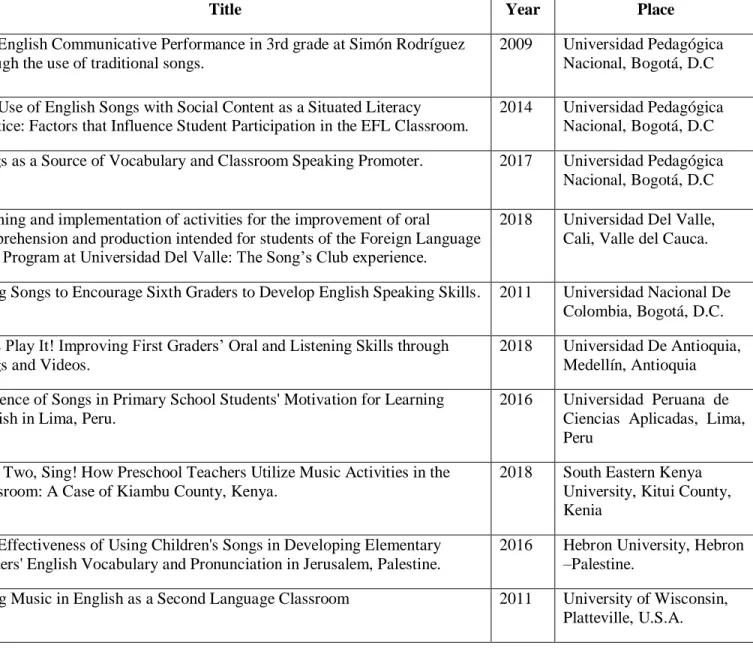
(22) 11. Movies’ Songs Based on Children’s Rights to Develop Oral Interaction Skills.. were carried out at the Universidad Pedagógica Nacional, others at national universities and finally at international institutions. Through these investigations it was possible to know the advances made in this matter and in this way present an innovative and different proposal for the development of speaking skills within the teaching of EFL. As a result of this process, the following chart shows all the relevant information I gathered. Table 1 Reviewed Researches of the State of the Art Title. Year. Place. The English Communicative Performance in 3rd grade at Simón Rodríguez through the use of traditional songs.. 2009. Universidad Pedagógica Nacional, Bogotá, D.C. The Use of English Songs with Social Content as a Situated Literacy Practice: Factors that Influence Student Participation in the EFL Classroom.. 2014. Universidad Pedagógica Nacional, Bogotá, D.C. Songs as a Source of Vocabulary and Classroom Speaking Promoter.. 2017. Universidad Pedagógica Nacional, Bogotá, D.C. Planning and implementation of activities for the improvement of oral comprehension and production intended for students of the Foreign Language Pilot Program at Universidad Del Valle: The Song’s Club experience.. 2018. Universidad Del Valle, Cali, Valle del Cauca.. Using Songs to Encourage Sixth Graders to Develop English Speaking Skills.. 2011. Universidad Nacional De Colombia, Bogotá, D.C.. Let’s Play It! Improving First Graders’ Oral and Listening Skills through Songs and Videos.. 2018. Universidad De Antioquia, Medellín, Antioquia. Influence of Songs in Primary School Students' Motivation for Learning English in Lima, Peru.. 2016. Universidad Peruana de Ciencias Aplicadas, Lima, Peru. One, Two, Sing! How Preschool Teachers Utilize Music Activities in the Classroom: A Case of Kiambu County, Kenya.. 2018. South Eastern Kenya University, Kitui County, Kenia. The Effectiveness of Using Children's Songs in Developing Elementary Graders' English Vocabulary and Pronunciation in Jerusalem, Palestine.. 2016. Hebron University, Hebron –Palestine.. Using Music in English as a Second Language Classroom. 2011. University of Wisconsin, Platteville, U.S.A..
(23) 12. Movies’ Songs Based on Children’s Rights to Develop Oral Interaction Skills.. The first project was developed in Universidad Pedagógica Nacional by Camilo Acuesta, Mónica Galarza, Eliana Herrera and Iván Páez (2009). The authors in their research project analyzed the influence of traditional songs in young learners to promote their communicative skills in English. Through the proposed school activities, they determined that songs had a positive impact on children's performance in terms of English language learning. During the process, children learned vocabulary and related it to images, in this way they could easily remember the words. This project was relevant to this research because it exposed the advantages of songs and their content within the learning English as a foreign language to generate students' interest. On the second project, Nilsen Palacios and Marcela Chapetón (2014) aimed at using English songs with social content as a situated literacy practice. In this research study they demonstrated that songs may motivate students to learn English and reflect about their social reality. The researchers considered the songs as texts that could be read by anyone from their life experiences. Besides, the students showed their preference for learning English when they were singing the songs because it was a fun methodology. This article was useful for the development of this pedagogical proposal owing to it provides valid arguments for choosing songs as an EFL teaching resource. Regarding the third project, Hector Mejorano (2017) argued that activities and games based on English songs promote the learners' oral abilities in the classroom. The research study was conducted in children between 7 and 9 years old who learned English vocabulary through songs which were selected taking into account the preferences of the students. During the process, the researcher used posters, videos and images so that participants to memorize the words and apply.
(24) 13. Movies’ Songs Based on Children’s Rights to Develop Oral Interaction Skills.. them to the proposed games or in their oral speech. This academic document was important for the project since it provided clues about the positive effects of songs in the speaking skills development of kids. Other studies consulted in universities nationwide showed the advantages of using English songs as a resource to improve oral production. To begin with, Manuela Castañeda and Mayra Pereira from Universidad Del Valle in 2018 presented the results of an investigation about the influence of English song's club on university students to improve their listening and speaking skills. They found that the music provided linguistic elements and also it had relaxing benefits in the English language learning process. According to the authors, thanks to the songs the learners managed to understand the use of grammar in different contexts, thus they could practice autonomously. This research work contributed to the creation of activities that promoted oral production spaces in English. In 2012, Mónica Duarte, Luz Mery Tinjacá and Marilú Carrero published an article explaining the results about a pedagogic intervention in a public school in Bogotá. The participants were sixth grade students who were afraid to speak in English, so they were not interested in learning this language. Hence, they decided to use songs to generate a friendly space in the class and motivate them to communicate orally without any fear. The students' reaction was positive since they acquired vocabulary and adopted simple grammatical structures, besides these activities aroused in the participants a desire to learn and speak in English. Thanks to this article, educational strategies appeared in this project to achieve a comfortable space for children and to avoid all kinds of worry and discomfort..
(25) 14. Movies’ Songs Based on Children’s Rights to Develop Oral Interaction Skills.. In relation to this research field, at the Universidad De Antioquia, Yeison Medina (2018) developed a project with young learners in a public school of Medellin city, where it was possible to improve their listening and speaking skills through songs and videos. The researcher affirmed that songs provided not only vocabulary to the children; they also improved the pronunciation since they imitated what singers were expressing on the song. Furthermore, the videos helped them to associate the images with the sound of the words, in this way they could understand the message of each song. This research gave clues to use the videos as a didactic resource that transmits linguistic and cultural information from a specific context about a song. In the international academic world there are studies related to the influence of songs within learning of EFL, for instance the exercise carried out in Lima - Perú by researchers Diego Aguirre, Daisy Bustinza and Mijail Garvich in 2016. They decided to work with a primary group from a private Catholic school where they found that songs and background music in the classroom had positive effects on learning English. In fact, their study was influenced by Failoni (1993) who stipulated that “songs in the foreign language classroom as teaching method may be a way to focus student attention, and produces more committed learner". The results showed that kids repeated their favorite songs spontaneously when they were doing another activity. So, this study contributed in the effective search of songs that motivated the children to speak in English. On the other hand, Muya Francis Kihoro (2018) expressed in an academic article the benefits of using English songs in the classroom. Kihoro designed activities with children music to generate pleasant spaces for learning since his study was based on the theory of multiple intelligences by Gardner (1983). In addition, the author considered that musical activities were useful resources to develop listening, speaking and reading skills because children were more.
(26) 15. Movies’ Songs Based on Children’s Rights to Develop Oral Interaction Skills.. receptive and they could control their behavior. The contribution of this text was significant for the research proposal due to the importance of the classroom and its learning environment. Another relevant research study was developed by Iman Shehadeh and Mohammed Farrah (2016) who discussed the use of songs in the learning process of EFL in Jerusalem - Palestine. In this case, the participants were fourth grade students who only spoke Arabic language, thus, the researchers did activities where they integrated the songs in class to promote an effective learning of English. The findings were positive because students acquired vocabulary and achieved correct pronunciation; likewise the class was interesting and fun. According to the researchers, songs also provided cultural and grammatical elements which were indispensable for the learners to strengthen their communication skills in all areas (listening, speaking, writing and reading). Hence, the study confirmed that songs keep students active owing to they know a cultural context where they may participate using English as a language different from their own. The last article that guided this research was supported by Liu Yang (2011) in a pedagogic intervention to teach English through songs. The researcher found that music is a powerful tool to develop multiple intelligences in children taking into account the Gardner's theory (1993). Indeed, kids were willing to learn English and even they memorized words; however the study also revealed it was not enough to learn the song or only words since the learners could not communicate naturally. The author concluded that teacher should create other activities that may complement the song to develop the students' skills. This reading was essential to design communicative activities and develop oral skills where students could express their opinions and points of view naturally..
(27) 16. Movies’ Songs Based on Children’s Rights to Develop Oral Interaction Skills.. The review and reading of each study related to this research project was an enriching process because it was an opportunity to think about a different proposal that would solve the participants' problem. Thanks to several points of view of the authors, it was possible to take into account the children's context, their likes, and some variables that could affect the pedagogic intervention. Finally, there was a reflection about the teacher's role within the research process to develop the oral skills of students in English language. As a conclusion it could mention in general terms that students may relate the songs to their life experiences and it is a good strategy to learn English because they not only learn concepts, but also they live the language as a practice of recognition and reflection of their actions. Justification Several investigations have revealed that learning a foreign language is an exercise that develops cognitive processes in the human being and also it is a social need within the cultural exchange. During the school period children have the opportunity to develop communicative skills in their mother tongue in several ways, however, from the observations at school it is possible to affirm that English class promotes activities to improve the writing skill and perhaps reading skill. In that sense, speaking as a communicative skill has received less priority than the others, taking into account that it is necessary to express feelings, thoughts, opinions or ideas orally to achieve good English language proficiency. Bearing in mind that the Colombian National Government has implemented since 2004 the PNB (National Bilingualism Program) in order to provide better opportunities for primary and secondary students, it is essential to involve students in activities where they can participate spontaneously. It stands to reason that English class is a space where students may learn a.
(28) 17. Movies’ Songs Based on Children’s Rights to Develop Oral Interaction Skills.. different language and culture, but it is not productive if children remain quiet and the teacher speaks all the time. Evidently young learners need a stimulus that encourages them to speak in English because perhaps they may feel fear to speak in public and more if it is in a foreign language. This project intended to offer oral participation scenarios through communicative activities taking as a resource the movies songs based on children's rights. Therefore it was important to generate oral interaction situations to know what kids thought about a specific topic and even strengthen their social relationships as classmates. Of course there was also interest in transforming the classroom environment for the students, where they could feel comfortable and willing to speak without restrictions. It should be clarified that the added value in this pedagogical intervention was also to empower children in their rights so that they are better human beings and avoid any type of abuse. In fact, some participants lived in difficult context which affected their academic process and learning English could help them to face their situation. Research question and objectives In this research project, the teacher researcher decided to answer for the next question: How may fourth grade students of Prado Veraniego primary school develop their oral interaction skills when recognizing their rights through children’s movies songs in communicative activities?.
(29) 18. Movies’ Songs Based on Children’s Rights to Develop Oral Interaction Skills.. General objective: . To analyze the fourth grade children of Prado Veraniego primary school EFL oral interaction skills development when they recognize their rights through children’s movies songs in communicative activities.. Specific objectives: . To describe the EFL students' oral communicative performance when they participate in activities based on children's movies songs focused on the importance of children's rights.. . To examine the influence of children's movies songs based on children rights over EFL students' oral interaction skills..
(30) 19. Movies’ Songs Based on Children’s Rights to Develop Oral Interaction Skills.. Chapter 2: Theoretical Framework Vision of Teaching in EFL Teaching English as a foreign language is considered as transmission of a new knowledge based on linguistic codes and signs different from those contained in the mother tongue of a country (Nation & Newton, 2008), but also, the possibility of knowing about a culture, in this case the English culture. Although students use the mother tongue for their daily activities, it is necessary to involve them in class within an immersion context in order to have a close contact with the English language. In this case, teacher should foment communicative situations where "students may live the language and express what they feel about the world around them" (Tedick, Christian & Fortune, 2011, p.25). In this way it could be easier for learners to acquire and practice English. Nowadays, the international curricula seek to promote the communication in a foreign language from the own voice of the learner, this means that repetition as a language teaching method has lost relevance. So, the main purpose of teaching EFL is to achieve an authentic learning in all students taking into account the current social and economic challenges (Broughton & Brumfit, 2002). Hence, learning English has become a requirement to obtain some benefit, for instance, a trip, a job or a scholarship. Besides, teaching English from a real situation brings as consequence natural learning language and new thinking and it implies the communicative skills development (reading, listening, speaking and writing) taking the grammar as a transverse element in each of them..
(31) 20. Movies’ Songs Based on Children’s Rights to Develop Oral Interaction Skills.. Oral Interaction Skill In general terms, speaking is one of the four linguistic skills involved in communicative competence development. Bygate (1999) referred that oral interaction is "the skill of using knowledge and basic motor-perception skills to achieve communication"(p. 6). In this manner, some factors intervene in the communicative process, such as: the movements, the intention and the tone of the speaker in a given context. It also implies the language proficiency since obtaining a spontaneous and natural reaction by the speaker is ideal within an oral communicative situation. Obviously this is possible if there is a suitable environment for students (Rahman, 2010), a positive space that provides confidence to speak and learning opportunities. It is necessary to mention that young learners use oral skills in their mother tongue most of the time in school, so it is appropriate to promote this activity but in English. This proposal is supported by Johnson (2005) from his pedagogical experience and he considered important the oral interaction because kids may process and deliver instructions, make requests, ask questions, receive new information, and interact with their peers. Thereupon, oral ability development is given by the experiences and communicative situations that allow the learner participation in a natural way. Even though syntax is a fundamental element in oral speech, McGrath (2013) asserted that learners can forget the correct syntactic structure when express the message and it is normal since it is part of their learning process. In that event, the teacher can make appropriate recommendations without interrupting the students' speech to avoid any fear reaction. When the teacher transmits confidence and tranquility during oral activities proposed students are willing and interested to speak in English and participate without any pressure..
(32) 21. Movies’ Songs Based on Children’s Rights to Develop Oral Interaction Skills.. Oral skills do not only imply the production or emission of sounds with a specific information without any objective, as Bygate (1999) argued, there must be a close relationship between listener and speaker to generate communicative interaction. Young learners share anecdotes and talk among themselves easily depending on the topic of their interest, which is positive because it is the opportunity to do it in English too. So, the language teacher must take actual situations or current events to incite students to speak in English in a conversation, forums or communicative activities where they express an opinion about a topic. On the other hand, pronunciation is a decisive factor in oral skills development in kids since "often, it’s not what they say; it’s how they say it that can lead to misunderstanding of motives and attitudes in the message" (Jorda, 2002, p. 53). From the first contact with English language the young learner must differentiate the sounds with the teacher's support to express effectively any idea. For example singing songs, imitating movie scenes or repeating tongue twisters are useful exercises for students (Hughes, 2013) because they might improve their pronunciation and even the intonation of words in their speech. Additionally, training oral interaction skills includes categories such as the interaction effect, negotiation of meaning and vocabulary knowledge inside speaking proficiency to achieve a progressive development in this area. In the classroom, it was possible to identify that 401 students group expressed their ideas orally in their mother tongue (Spanish) all the time. Generally their speeches were accompanied with movements, signs and gestures which helped to understand the intention of their message. However, it was found some kids liked to communicate their opinions through simple sentences in English when they were interested in a topic or to express their doubts when they did not comprehend something. It was a good sign to work on their oral skills in the English language..
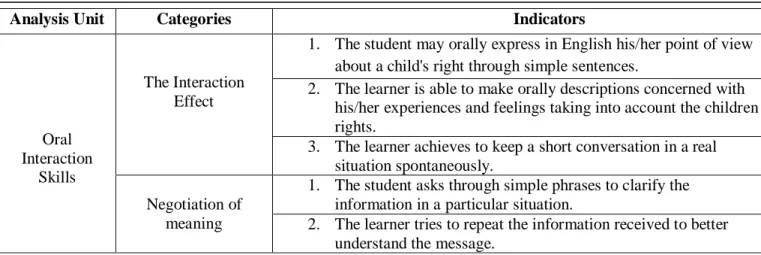
(33) 22. Movies’ Songs Based on Children’s Rights to Develop Oral Interaction Skills.. The Interaction Effect Firstly, Brown (1994) stated that “Interaction is the collaborative exchange of thoughts, feelings or ideas between two or more people, resulting in a reciprocal effect on each other.”(p.90). In that sense, students may express their opinions and emotions spontaneously when there is no pressure in the class. As it is known, the interaction occurs in a specific situation and it is better when focal attention is on meanings and messages and not on grammar and other linguistic form. Hence, learners need to speak in the foreign language if they want to carry out communicative social transactions such as: rules, agreements, points of view or plans inside the community. According to Brown (2007) through conversation speakers not only develop communicative skills, but also they achieve building their identity and ideology. So, the classroom is the space where students and the teacher maintain bonds thanks to the use of language, mainly in oral speech. In fact, “sometimes students do not feel confident enough to express themselves for different reasons. This might be due to lack of confidence, limited language or vocabulary knowledge” (Folse, 2006, p.34). Therefore, English class must provide activities that contain linguistic knowledge to foment speaking abilities and generate good relationships among the students. If students feel confident and comfortable when they are speaking, they will be able to interact better in daily real situations. Harmer (2001) said that when students do communicative activities and they involve themselves in fluency, teachers should not interrupt students to point out a grammatical, lexical, or pronunciation error, because it can stop the communication. On this matter, it is important that student feels the teacher's support without highlighting the mistakes during the speech since the.
(34) 23. Movies’ Songs Based on Children’s Rights to Develop Oral Interaction Skills.. oral expression would not be free and spontaneous. On the other hand, Thornbury (2005) suggests that classroom interaction consists of two types: non-verbal interaction and verbal interaction. Non-verbal interaction is related to behavioral responses in class. It means students might interact through their movements such as head nodding, hand raising, body gestures, and eye contact. The interactive effect appears when “students interact with others by speaking in class, answering and asking questions, making comments, and taking part in discussions” (Thornbury, 2005, p.47). It is a process in which its form and meaning depend on the context where it occurs and takes into account different elements such as the participants, their experiences, the internal and external contexts, the physical environment and the purpose of speaking. In this sense Interaction is interpersonal because it can occur face-to-face, in which case it usually takes place through the oral medium (Ellis, 1999). Nevertheless, learners not only express their ideas orally, they also transmit emotions through their reactions or attitudes about any situation at school. The teacher's role is vital to initiate the first oral interactions of the young learners thanks to his/her pedagogical activities, which may invite them to take the first step to speak in English or otherwise these may retract them (Brown, 2007). If a teacher is empathetic and uses kind phrases with simple vocabulary, students will participate and tell their experiences or opinions naturally. Moreover, as Professor Harmer (2001) indicated, the classroom environment determines the quality of verbal interaction among learners when they work in peers or groups to discuss an idea. Thus, a pleasant space can allow greater remembrance in kids about their oral communication practice in English..
(35) 24. Movies’ Songs Based on Children’s Rights to Develop Oral Interaction Skills.. Oral participation in the classroom is another communicative demonstration between the teacher and the students, who interact and exchange specific information. That concept was developed by Carter and Nunan (2001); they concluded that “Oral participation is the cognitive and socio-linguistic communication developed in the classroom interaction considering the input, nature and conditions of speech” (p.17). For this reason, learners decide to speak in English when the classes activities are dynamic and learning environment include them as protagonists. In this oral expression exercise they use and reproduce the knowledge obtained thanks to the resources presented as input. Evidently the 401students group did not have speaking experiences in their English classes. Although they had good interpersonal relationships, their communicative interactions were in Spanish; hence the students felt some fear to speak in English, taking into account that they had little knowledge in English language. In this sense, it was necessary to create pleasant learning spaces to promote communicative situations where children could interact and work as a team. Of course, the teacher's support was indispensable since learners improved their mistakes through feedback about their performance. Negotiation of meaning Ellis and Barkhuizen (2005) defined negotiation of meaning as the verbal exchanges that occur when the speakers try to prevent the breakdown of the communication. Having said that, the negotiation of meaning is a way of checking the message’s content through repetition. “When learners participate in a conversation or a communication activity with native or non-native speakers, they employ a set of prompts such as a: clarification request” (Ellis & Barkhuizen, 2005, p.51). This happens when students encounter a word or a phrase for the first time, or when.
(36) 25. Movies’ Songs Based on Children’s Rights to Develop Oral Interaction Skills.. a word may have multiple meanings or shades of meaning, and they are not sure which of the possible meanings the speaker intends to convey. Indeed, children begin their first English oral interactions at classroom, but during this exchange of information some words are confusing for them. Perhaps, the terms have a similar sound and generate doubts or these terms are definitely unknown to the listener who does not understand the message. In that regard, Philp, Oliver, & Mackey (2008) explained the negotiation of meaning like an alert to avoid breaking the communication and comprehend the interlocutor's intention in a request. As a strategy, the beginner speaker uses confirmation questions to verify the information and continue within conversation. According to the authors, in primary school young children may also negotiate meaning through gestures or movements that reflect the incomprehensibility of a word or phrase; even they repeat what they do not understand in order to find a meaning. In addition, this negotiation event contributes to English language learning and improve speaking skills since it works as a feedback where students recognize their weaknesses. The result of this activity is evident in students' participation in class who are more attentive to what they hear and response. Communicative practice Richards (2006) explains the communicative practice as all activities where language may be used within a real communicative context, where real information is exchanged, and where the language is not totally predictable. In other words, communicative activities are focused on students inside several real situations. Besides, learners to improve their language from their life experiences rather than just learning English grammar rules and word lists. As one can see, the.
(37) 26. Movies’ Songs Based on Children’s Rights to Develop Oral Interaction Skills.. teacher must give a rich variety of communication opportunities to foster an environment which naturally encourages students to communicate among themselves (Oxford et al, 1989). The results of these activities will be evident in the creativity, cooperation and behavior of students in class. Having said that, speaking English as a foreign language is not an exercise based only in the repetition of structures without a real application. For this reason it is essential to promote learning situations through the students' experiences (Johnson, 2005) and in this way the linguistic knowledge will last over time. It is not possible to ignore that a foreign language also represents a different culture where learners have the opportunity to compare their habits or routines with other foreign customs and traditions. Vocabulary Knowledge inside Speaking Proficiency Learning vocabulary is a fundamental part to develop oral skills and even more in a foreign language such as English. Webb & Nation professors (2017) considered "lexical knowledge as a resource that provides useful information to develop communicative skills" (p. 28). However, this knowledge depends on the frequent use of words in a speaker's speech; for instance in daily activities, routines or in thoughts of a specific issue. Despite each word has a unique meaning; it only makes sense when it is part of an idea or expression within a real situation. From the point of view of Wang (2018), the building vocabulary is possible through communicative interaction in different contexts. In other words, kids learn and express new terms when they live experiences with other people such as their classmates, teacher or family members. On the other hand, the author also demonstrated that children associate what they see.
Figure
Documento similar
Through this project we have sought to respond to the question: ‘How can a FabLab empower marginalised communities?’ The case of FabLab La Campana in Monterrey, Mexico has shown
The broad research question this thesis aims to answer is what the examination of situated activities and language use in a state immigration office can tell us with regard to
In order to answer research question number 5, that is to say, to what extent students with higher productive vocabulary knowledge acquire more vocabulary than those with
The main research question of this paper was to investigate whether standardization in purchasing, operationalized as standardization of materials and purchasing procedures, had
These situations include showing knowledge of the answer of a question by students if they do not know how to say it in the second language or using the mother tongue to
These facts give an affirmative answer to the research question: Is it possible to improve the efficiency in TWC by using content created by other students in relation with
Based on the investigation of the research questions, the findings attempt to provide an understanding of the three bilingual teacher programs whose primary goals are to
Because it is a paradigm of the British situation after the war. But why these writers were drawn to this particular pattem?°To answer this question is to begin to recognise
