
TítuloFungal biodegradation of a pinene in gas phase biofilter
7
0
0
Texto completo
(2) 322. Y. JIN, M. C. VEIGA AND C. KENNES. gas to the biological aqueous phase is realized. This allows a faster uptake of hydrophobic compounds than in flat aqueous bacterial biofilms. Furthermore, fungi are generally tolerant to low water activities and a low pH, so that these parameters do not need to be strictly monitored in the biofilters (Kennes and Veiga, 2004). Some researchers have isolated microorganisms that grow with Į-pinene as sole carbon source. Most of them are bacteria such as Pseudomonas strain PL, Pseudomonas fluorescens NCIMB 11671, Pseudomonas PX1 (NCIMB 10684), Pseudomonas putida PIN11, Nocardia P18.3, Pseudomonas PL and PIN 18 (NCIMB 10687) (Trudgill, 1990). Most of the research work done with these bacterial strains was focused on the degradation pathway of Į-pinene. Recently, Savithiry et al. (1998) reported that a thermophilic Bacillus strain, Bacillus pallidus BR425, was isolated from an Į-pinene enrichment culture (Savithiry et al., 1998). Farooq et al. (2002) isolated a plant pathogenic fungus, Botrytis cinerea that could biotransform Į-pinene into 3ȕ-hydroxy-()-ȕ-pinene, 9-hydroxy-(-)-Į-pinene, 4ȕ-hydroxy-(-)-Į-pinene-6-one, and verbenone. Agrawal and Joseph (2000) also isolated an Aspergillus niger stain that converts Įpinene into verbenone. Until now there is not any bioreactor inoculated with fungal cultures treating waste gases polluted with Į-pinene (Table 1). Therefore, the goal of the current work was to obtain fungi capable to metabolize it and verify their efficiency in purifying waste gases in a biofilter. Several experimental runs were carried out in order to investigate the best operational conditions in terms of pollutant concentration and nutrients addition for a good removal efficiency. Table 1. Performance of biofilters treating Į-pinene. Media. Inlet (ppm). EBRT. Performance. (s). -3. Ref.. -1. (g.m .h ). Perlite; Expanded clay granules; Polyurethane foam cubes; Compost. 71. 18-36. 24; 33; 38; 24. Proprietary wood waste. 1-100. 120. 6. BIOSCRUB RBC. 25-35. 13-24. 2.7-4.2. Aspen wood chips. 6-451. 20.8-30.2 min. 3.9. Celite R-635. 15. 11; 18 min. 3.5. Wood, compost, and perlite mixture. 30-35. 50. 10-12. Wood chips. 38-109. 20; 60. 14.6-44.6. van Groenestijn and Liu, 2002 Lee and Apel, 1996 Mohseni et al., 1998 Kleinheinz and Bagley, 1997 Kleinheinz et al., 1999 Mohseni and Allen, 1999 Mohseni and Allen, 2000. 2 MATERIALS AND METHODS 2.1 Media composition Batch experiments were undertaken with an aqueous culture medium containing (per liter) (Estévez et al., 2005): 4.5 g KH2PO4, 0.5 g K2HPO4, 2.0 g NH4Cl and 0.1 g.
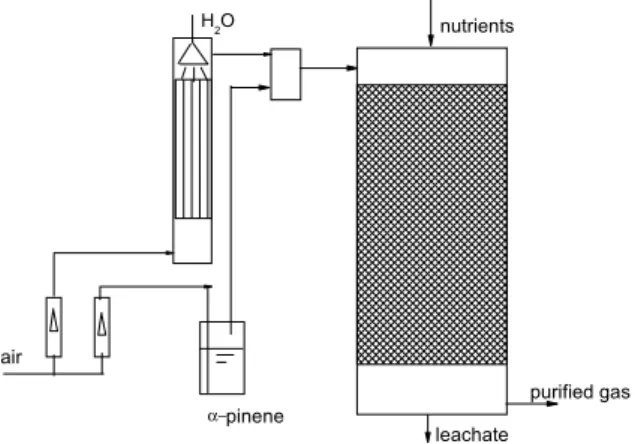
(3) FUNGAL BIODEGRADATION OF α-PINENE IN GAS-PHASE BIOFILTER. 323. MgSO4.H2O. The culture medium was autoclaved at 120 °C for 20 min before adding filter-sterilized solutions of vitamins and trace minerals. The composition of the vitamins solution was (per liter): 0.2 g thiamine·HCl, 0.1 g riboflavin, 1.0 g nicotinic acid, 2.0 g Ca-pantothenate, 0.1 g biotin, 0.1 g thioctic acid, 0.1 g folic acid and 0.25 g pyridoxine HCl. The composition of the trace minerals solution was (per liter): 120 mg FeCl3, 50 mg H3BO3, 10 mg CuSO4.5H2O, 10 mg KI, 45 mg MnSO4.H2O, 20 mg Na2MoO4.2H2O, 75 mg ZnSO4.7H2O, 50 mg CoCl2.6H2O, 20 mg KAl(SO4)2.12H2O, 13.25 mg CaCl2.2H2O and 10,000 mg NaCl. The original pH of that medium was 5.9. Stock cultures of the fungus were maintained on petri dishes or on slants using either Potato Dextrose Agar (PDA) or the same mineral medium as described above supplemented with 16 g agar.l-1. When using the mineral medium, the plates were incubated in a tank or desiccator at 30 °C, in the presence of Į-pinene vapors as carbon source. Stock cultures on PDA were stored in a refrigerator at 4 °C. 2.2 Enrichment and isolation of Į -pinene degrader The Į-pinene degrading fungus used in this study was obtained from the leachate of a biofilter treating toluene. 10 ml of the liquid was suspended in 90 ml mineral medium as described elsewhere (Estévez et al., 2005). Į-Pinene was added as the only source of carbon and energy. Erlenmeyer flasks with a 5:1 headspace/liquid ratio were closed with teflon wrapped rubber stoppers and were incubated in a rotary shaker (150 rpm) at 35 °C. The flasks were aerated daily, and Į-pinene was added as needed. After several serial transfers, stable microbial consortia developed. Individual members of the consortia were isolated by streaking on mineral agar medium and incubation under solvent vapor. The isolated strain was sent to the Centraal Bureau voor Schimmelcultures (The Netherlands) for identification.. H2O. nutrients. air purified gas α−pinene. leachate. Figure 1. Schematic of the laboratory scale biofilter.. 2.3 Experimental setup The schematic of the biofilter used in this study is shown in Figure 1. It is a cylindrical packed bed reactor made of glass, 75 mm in diameter and 700 mm in height. The active height of packing column, filled with lava rock, is 250 mm. The cylindrical glass column contained four equidistant sampling ports. All fittings, connections and tubings were made of teflon. A large stream of compressed air was humidified up to 97%.
(4) 324. Y. JIN, M. C. VEIGA AND C. KENNES. relative humidity by passing it through a packing tower humidified with water. A small stream of air was bubbled through a vial containing pure Į-pinene and was mixed with the larger humidified gas stream. Gas phase Į-pinene concentrations ranging from 0 to 460 ppm were obtained by changing the relative flow rates of the gas streams. The resulting synthetic waste gas was introduced through the top of the column (co-current flow). An aqueous mineral medium was recirculated over the packed bed once a week in order to add fresh nutrients and remove the accumulated metabolite compounds. The pH of the leachate was measured. 2.4 Analytical methods Gas phase concentrations of Į-pinene in the biofilters were measured by gas chromatography using a Hewlett-Packard 5890 series II chromatograph. The GC was equipped with a flame ionization detector (FID). The flow rates were 30 mL/min for H2 and 300 mL.min-1 for air. The inlet and outlet streams were sampled, as well as air aliquots taken at different reactor heights. The GC was equipped with a 50 m TRACER column (TR-WAX, internal diameter 0.32 mm, film thickness 1.2 µm) and Helium was used as the carrier gas (flow rate 2.0 mL.min-1). The Į-pinene concentration was determined at an oven temperature of 120 °C and using a FID at 250 °C. Similarly, CO2 concentrations were measured on another Hewlett-Packard 5890 series II GC equipped with a thermal conductivity detector (TCD). The CO2 concentrations were determined at an injection temperature of 90 °C, an oven temperature of 25 °C and using a TCD at 100 °C. 3 RESULTS AND DISCUSSION 3.1 Microorganism identification and biofilter performance The organism was identified as Ophiostoma species. This organism formed a filamentous network when grown in packed-bed reactors such as the gas-phase biofilter used in this work (Figure 2). This is an interesting characteristic, since it has been suggested that the growth of filamentous organisms enhances the mass transfer of hydrophobic pollutants from the gas to the biocatalyst.. Figure 2. SEM picture of a filter-bed sample from a gas-phase packed-bed bioreactor colonized by a culture of Ophiostoma species..
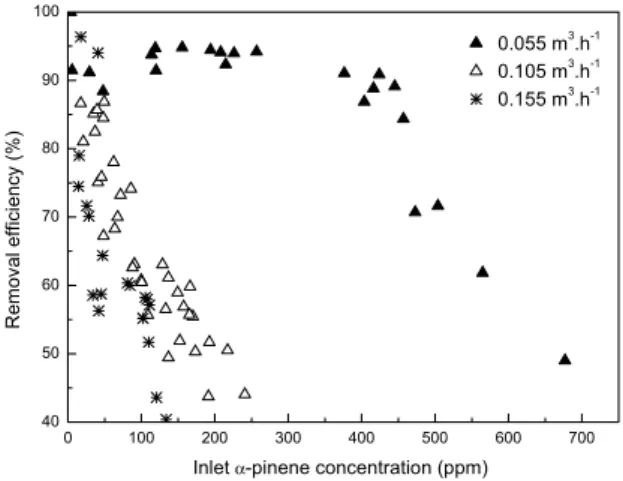
(5) FUNGAL BIODEGRADATION OF α-PINENE IN GAS-PHASE BIOFILTER. 325. Figure 3 shows the removal efficiencies as a function of the Į-pinene concentration and the volumetric flow of the gas stream. A gradual decrease in efficiency was observed as the gas concentrations increased, observing a higher elimination efficiency under conditions of lower flow rates. The biofilter reached a removal efficiency of 95% when fed 100 ppm of Į-pinene and at an air flow rate of 0.055 m3.h-1. When the inlet concentration of Į-pinene was increased, the removal efficiency of Į-pinene decreased, reaching 65 and 57 g.m-3.h-1, at air flow rates of 0.105 and 0.155 m3.h-1, respectively.. 100 3. Removal efficiency (%). -1. 0.055 m .h 3 -1 0.105 m .h 3 -1 0.155 m .h. 90. 80. 70. 60. 50. 40. 0. 100. 200. 300. 400. 500. 600. 700. Inlet α-pinene concentration (ppm). Figure 3. Removal efficiency of the biofilter as a function of the inlet concentration of Į-pinene, at different flow rates of the gas stream.. 3.2 pH evolution and pressure drop The assimilation of ammonium nitrogen (NH4+-N) results in the release of protons and results in a decrease of the pH of the medium. If the medium can neutralize the protons resulting from the assimilation of the nitrogen source, the pH will be relatively constant. Otherwise, acidification of the filter bed will occur. The pH of the nutrient liquid drained from the biofilter following the regular nutrient addition procedure was around 5.0. However, inside the biofilter, the fungi still grow at this pH value during the periods between the weekly nutrient additions. For the fungal biofilter used in this research, the pH drop did never exhibit any apparent adverse impact on the reactor's performance. Compared to bacterial systems, the filamentous fungi may cause some higher head loss due to the fact that the filamentous fungal biomass quickly fills the pore spaces of the packing media. This may eventually lead to channelling and clogging problems in the biofilter, which ends up in a reduced efficiency. For the fungal biofilter treating Įpinene, the pressure drop was only around 6 mm H2O/m packing after six months operation. This is almost the same as the measured value when starting the biofilter operation. 3.3 Carbon dioxide production analysis In the biofiltration process, Į-pinene is biodegraded under aerobic conditions to carbon dioxide, water, and biomass. Hence, monitoring the carbon dioxide concentration in the.
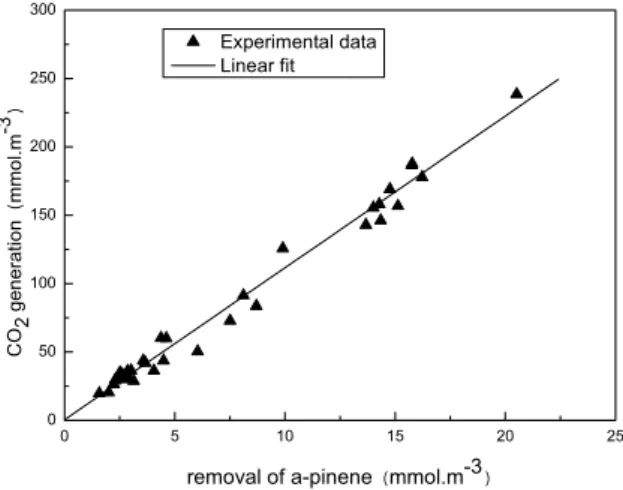
(6) 326. Y. JIN, M. C. VEIGA AND C. KENNES. gas phase can provide valuable information on the operation of the biofilter. The ratio of daily measurements of the carbon dioxide production and removal of Į-pinene are presented in Figure 4. The measurements presented in Figure 4 show that the ratio is rather constant. Experimental data reveal that the variation of RCO2 versus RC10H16 is sensibly linear. The equation of the line shown in Figure 4 is y=11x. The slope of this line is 11 indicating that the average ratio of the measured RCO2 to RC10H16 was equal to 11 with a correlation coefficient of 0.99. The theoretical number of moles of carbon dioxide that should be produced per mole of Į-pinene eliminated is approximately equal to 10 whenever neglecting biomass growth. However, the experimental value is somewhat higher than 10. The discrepancy between these two ratios may be caused by the following reasons: (1) there is some carbonate of the lava rock packing that was dissolved by the acid generated from NH4+ assimilation and this reaction causes some additional CO2 emission, (2) even when no Į-pinene was added to the reactor, there was still some CO2 emission generated by endogenous respiration. The difference between the complete chemical oxidation based ratio and the experimental ratio indicates that removed Į-pinene is eliminated by biodegradation rather than by any other physical or chemical process such as adsorption. Į-Pinene was basically completely transformed into CO2. Batch assays are being performed to confirm these data. 300. Experimental data Linear fit. -3 CO2 generation (mmol.m ). 250. 200. 150. 100. 50. 0. 0. 5. 10. 15. 20. 25. removal of a-pinene (mmol.m-3). Figure 4. Carbon dioxide produced versus the elimination capacity of Į-pinene.. 4 CONCLUSIONS Batch studies and laboratory scale biofilter experiments conducted with a pure strain of a Ophiostoma species confirmed that the fungus is able to use Į-pinene as a sole carbon and energy source in both the liquid and vapor phase. The fungal biofilter inoculated with the Ophiostoma species was found to be more efficient than bacterial bioreactors treating Į-pinene contaminated air streams, achieving a maximum elimination capacity of 143 g.m-3.h-1 to be compared to elimination capacities never exceeding 45 g.m-3.h-1 in the best case in bacterial biofilters (Table 1). Further studies are being carried out in order to optimize operational parameters, such as pH, humidity, nitrogen source, and temperature..
(7) FUNGAL BIODEGRADATION OF α-PINENE IN GAS-PHASE BIOFILTER. 327. 5 ACKNOWLEDGEMENTS The present research is financed by the Spanish Ministry of Education and Science (Project CTM2004-00437). The Ph.D. research of Yaomin Jin is financially supported by the Agencia Española de Cooperación Internacional (AECI) and the Spanish Ministry of Foreign Affairs. 6 REFERENCES Agrawal, R. and Joseph, R. (2000) Bioconversion of alpha pinene to verbenone by resting cells of Aspergillus niger. Appl. Microbiol. Biotechnol. 53(3): 335-337. Dirk-Faitakis, C. and Allen, D.G. (2005) Development and simulation studies of an unsteady state biofilter model for the treatment of cyclic air emissions of an alpha-pinene gas stream. J. Chem. Technol. Biotechnol. 80(7): 737-745. Estévez, E., Veiga, M.C. and Kennes, C. (2005) Biofiltration of waste gases with the fungi Exophiala oligosperma and Paecilomyces variotii. Appl. Microbiol. Biotechnol. 67(4): 563-568. Farooq, A., Tahara, S., Choudhary, M.I., Atta-ur-Rahman, Ahmed, Z., Baúer, K.H.C. and Demirci, F. (2002) Biotransformation of (-)-Į-pinene by Botrytis cinerea. Z. Naturforsch.(C) 57c(3-4): 303-306. Kennes, C. and Thalasso, F. (1998) Waste gas biotreatment technology. J. Chem. Technol. Biotechnol. 72(4): 303-319. Kennes, C. and Veiga, M.C. (2001) Bioreactors for waste gas treatment. Kluwer Academic Publishers, Dordrecht, The Netherlands. Kennes, C. and Veiga, M.C. (2004) Fungal biocatalysts in the biofiltration of VOC-polluted air. J. Biotechnol. 113(1-3): 305-319. Kleinheinz, G.T. and Bagley, S.T. (1997) A filter-plate method for the recovery and cultivation of microorganisms utilizing volatile organic compounds. J. Microbiol. Methods. 29(2): 139-144. Kleinheinz, G.T., Bagley, S.T., St John, W.P., Rughani, J.R. and McGinnis, G.D. (1999) Characterization of alpha-pinene-degrading microorganisms and application to a benchscale biofiltration system for VOC degradation. Arch. Environ. Contam. Toxicol. 37(2): 151-157. Lee, B.D. and Apel, W.A. Effect of bed medium moisture on Į-pinene removal by biofilters. Proceedings of the USC-TRG 1996 Conference on Biofiltration, Los Angeles, California. October 24-25, 1996. p. 214-222. Mohseni, M., Allen, D.G. and Nichols, K.M. (1998) Biofiltration of alpha-pinene and its application to the treatment of pulp and paper air emissions. TAPPI J. 81(8): 205-211. Mohseni, M. and Allen, D.G. (1999) Transient performance of biofilters treating mixtures of hydrophilic and hydrophobic volatile organic compounds. J. Air Waste Manage. Assoc. 49(12): 1434-1441. Mohseni, M. and Allen, D.G. (2000) Biofiltration of mixtures of hydrophilic and hydrophobic volatile organic compounds. Chem. Eng. Sci. 55(9): 1545-1558. Savithiry, N., Gage, D., Fu, W. and Oriel, P. (1998) Degradation of pinene by Bacillus pallidus BR425. Biodegradation. 9(5): 337-341. Trudgill, P.W. (1990) Microbial metabolism of monoterpenes—recent developments. Biodegradation. 1(2-3): 93-105. van Groenestijn, J.W. and Liu, J.X. (2002) Removal of alpha-pinene from gases using biofilters containing fungi. Atmos. Environ. 36(35): 5501-5508..
(8)
Figure


+2
Documento similar
