
A strategy to reduce oral language anxiety in a levels students at EOI Castelló
38
0
0
Texto completo
(2) Table of contents ABSTRACT....................................................................................................................3 1. INTRODUCTION ......................................................................................................5. 1.1 The Educational Context...................................................................5 1.1.1 The school.....................................................................................................5 1.1.2 The students...................................................................................................6 2 Theoretical Framework.................................................................................................7. 2.1 The derivational power of language..................................................7 2.2 Language anxiety.............................................................................10 3 Teaching Proposal.......................................................................................................13. 3.1 Purpose and rationale.......................................................................13 3.2 Method.............................................................................................15 3.2.1 Setting and subjects of the study.................................................................15 3.2.2 Instruments/materials used to collect data...................................................16 3.2.3 Procedure.....................................................................................................16 4 Assessment..................................................................................................................19. 4.1 Analysis of data: The FLCAS tests..................................................20 4.2 Analysis of data: Pronunciation and intonation...............................24 4.2.1 Treatment groups.........................................................................................24 4.2.2 Control group..............................................................................................25. 4.3 Analysis of data: Program evaluation..............................................25 4.4 Discussion........................................................................................27 4.5 Further action...................................................................................29 References......................................................................................................................30 Appendix 1.....................................................................................................................33 Appendix 2.....................................................................................................................37. 2.
(3) ABSTRACT Learning a second language is a really tough work for most people. Apart from the social constraints that the learner may encounter, in the form of lack of time or resources, there are some others which range from physiological to psychological. At Castelló Escola Oficial d’Idiomes, the students that begin A levels of English are mostly people who have never had any contact with any kind of language-learning, which is a difficulty for them, but also most of them are over 25 years old, which makes it even more difficult for them to achieve success. In our school we follow the guidelines of the Common European Framework of Reference for Languages and work the five skills for language 3.
(4) reception (listening and reading) and language production (writing, spoken production and spoken interaction). We have noticed that the most difficult skills for our students at this level are those related with speaking: spoken production and spoken interaction. One fact that we teachers have identified is classroom language anxiety, which our students suffer in different degrees, from adding some difficulty to speak to completely impeding it. Teachers deploy a number of strategies to try to avoid or at least to reduce the impact of language anxiety on our students, but it always depends on how successful the teacher is with a given group of students. We have identified that there are some causes for classroom language anxiety and we have tried to reduce as much as possible the influence of one of the causes of language anxiety on our students. For that we have designed a study that consists in eliminating a negative stimulus in order to also eliminate its response: our students experience fear to make mistakes when speaking English in the classroom and that fear makes them be over concentrated on what they say in such a way that they forget about pronunciation and intonation, with the result of a very poor performance in these two aspects. The strategy studied consists in convincing our students that what they say is correct so that they only have to pay attention to how they say their messages.. 4.
(5) 1. INTRODUCTION. 1.1 The Educational Context. 1.1.1 The school EOIs (State Language Schools) are centers specialized in language learning and teaching. This is not compulsory education but voluntary. At EOI Castelló, ten languages can be learned: Spanish, Catalan, English, French, German, Italian, Russian, Portuguese, Arabic and Chinese. The great majority of students are learning English, and many of them also learn other languages at the same time. Students are used to languages and are conscious that this school is demanding. Apart from formal learning during the courses, there are compulsory certification examinations every year in order to pass levels (A2, B1, B2, C1 and C2). This means that students in the upper levels should be used to taking those exams and should not suffer from much language anxiety, but that is not generally the case. Also, A2 level students face their first official certification exams and that fact usually brings stress to their courses. Even when teachers insist on separating learning from certification, as the latter is essential to pass levels, students tend to focus more on passing the exams than on their own learning processes. The result is that the levels of perceived anxiety seem to soar, although that is just an impression.. 5.
(6) 1.1.2 The students According to Spanish educational regulations, students who have finished their Bachillerato studies gain admission directly to B levels, so the students in A levels at EOI Castelló have a very basic command of the language as for many of them these courses are the first time they have any contact with the new language. English language learning is their first language learning experience for most of them, although some have learned French at Primary and Secondary schools. Also, there is a variable number of immigrant students that have had some language learning experience in their countries of origin. The age range is very ample, from 18 years old to over 50. The time they have of in-school learning is 4 hours per week in two 2-hour sessions.. 6.
(7) 2 Theoretical Framework. In this study we will give an account of a strategy to reduce language anxiety in order to see how it can affect our students’ performance regarding pronunciation and intonation. In the first place, we identify one crucial factor that produces anxiety and then we take action to try to eliminate it. For this study, we take a Relational Frame perspective, combining the symbolizing and generative qualities of language.. 2.1 The derivational power of language In their article “The Faculty of Language” (2001), Mark D. Hauser, an evolutionary biologist and researcher on animal cognition and human behavior, Noam Chomsky, a linguist, philosopher and cognitive scientist, and W. Tecumseh Fitch, an evolutionary biologist and cognitive scientist, concluded that to understand the faculty of language we must study how the sensory-motor system, the conceptual-intentional system, and the computational mechanisms for recursion provide humans with the capacity to generate an infinite range of expressions from a finite set of elements. It is, again, the concept of generating grammar although seen from different angles and one of them is psycholinguistics. Then, the notion of recursion is key to build this argument. Language anxiety is a fact, at least for those like us who can see every day how students suffer an alteration of their state when they have to engage in language productive skills. We are not paying attention to whether anxiety is a trait or a state, as in this immediate experience, all our students suffer from it, obviously with different. 7.
(8) intensity, when they have to speak in public. Having this into account, we can infer that there is a stimulus followed by a response: the already known antecedent, behavior, response flow. We are going back to Pavlov (1897) and his experiments with dogs: when he gave food to a dog, it started salivating; if he rang a bell simultaneously to showing the food, the dog also salivated; with repetition, just by ringing the bell, and without showing the food, the dog started to salivate. If we extrapolate this experiment to what happens in our classrooms, we can think that if public speaking develops a feeling of anxiety, in order to eliminate that feeling we must eliminate its stimulus or antecedent. But this cannot be of immediate use for us, because our students need to speak: they do want to speak, so we need to investigate what mechanisms produce anxiety in order to try to mitigate it. Barnes-Holmes, Hayes & Dymond (2001) defined the aim of the Relational Frame Theory as giving an answer to how language is acquired by means of interactions with the environment, instead of explaining language by treating ideas, information, meaning and messages as elements that are processed and stored. It is also unquestionable that the environment plays a fundamental part in language anxiety. Relational Frame Theory (RFT) combines the, until that moment, irreconcilable worlds of Skinnerian behaviorism and Chomskian nativism (Chomsky, 1959). RFT advocates consider that language has two key features: symbolism and generativity. Symbolism means that words stand for or refer to other things, although words often refer to their own meaning, and generativity means that an infinite number of sentences can be created and understood. Also, understanding language and cognition is key to understand human behavior. Going back to the stimulus/response set, and using the example of dogs and food, if we always utter the word “cookie” before we give our pet a cookie, we know that 8.
(9) our clever pet will associate the utterance “cookie” with a tasty piece of food. If we reverse the order of happenings: in the first place we give our pet a cookie and then we utter the word “cookie”, obviously, there is no association by the dog of that utterance with food, because stimulus -> response is just one-directional. Compare what would happen if we did the same with humans: we immediately learn that cookie means tasty food and that tasty food means cookie; so there is a bidirectional relation. That is what RFT calls frames: the capacity of deriving. Let's see the following example: “John is Peter's father and Tom is Peter's bother”, we can derive that most probably John is also Tom's father. Or the example: “A cat is faster than a mouse, but slower than a dog”, we can derive that a mouse is also slower than a dog. We are deriving, and that is excellent for human beings, as we can generate infinite knowledge; that is the essence of creativity: imagination. Deriving family relationships is an example of frame, and also deriving how fast subjects are is another example of frame. But deriving can also have non-desired consequences. Imagine that you do not like injections and it is a real pain every time you have to be given one. The only mention of the word needle makes you sweat. You can try imagining a pleasant experience to counteract that feeling: you imagine you are eating your mother's special dessert. The problem now is that we are bidirectional and every time you hear about your mother's dessert you may (or may not) experience a disgusting feeling associated to injections. Wilson et al. (2001: 215) summarized this other consequence of the capacity of language to derive: “Thus comes the paradox that a species that has by far the fewest contacts with direct sources of pain… through language is able to suffer with a degree of intensity, constancy and pervasiveness that is literally unimaginable in the nonhuman world. Because of [bi-directionality], we can judge ourselves and find ourselves to be wanting; we can imagine ideals and find the present to be unacceptable by comparison; we can 9.
(10) reconstruct the past; we can worry about imagined futures; we can suffer with the knowledge that we will die.” So, according to RFT, deriving relations among stimuli and events is the essence of human language and cognition. Language is really powerful, but it is also impossible to control to the extent that it can provoke a kind of pain that no other living beings suffer. Anxiety, and also language anxiety, of course, are examples of this. After having dived into the psycho-biological processes that can provoke language anxiety, it is time to analyze what it is made up of.. 2.2 Language anxiety The role of anxiety on language performance has been studied for a long time, but there is no agreement on whether it is positive or negative (Scovel, 1991), as it can motivate learners when facing a new task on the one hand, and it can demotivate them on the other, depending on the learner's personality, as some of them get activated when challenged, and others get terrified when they experience it. We will concentrate on the one that can bring problems to learners: the cases in which language anxiety is demotivating. Horwitz, Horwitz and Cope (1986) established three types of language anxiety: communication apprehension, test anxiety, and fear of negative evaluation. The first one is defined by Hortwitz et al. as “a type of shyness characterized by fear or anxiety about communicating with people” (1986: 128). Also, Daly (1991) defends that there are both a genetic disposition that causes that language learners experience 10.
(11) apprehension to speak in public, i.e. an individual trait, and also that the exposure to positive interactive communication models from childhood reduces its incidence. Shams (2006) claims that fear of group work and oral presentation common in present communicative classes exacerbate communication apprehension. Test anxiety is defined by Horwitz et al. (1986: 127) as “a type of performance anxiety stemming from a fear of failure” and thus it is always present in language learning as students are constantly being evaluated by the teacher and they obviously perceive it, and those oral tests provoke both communication anxiety and test anxiety. The third factor, fear of negative evaluation, can be considered a consequence of test anxiety and it may occur in any social situation in which the speaker is evaluated, for example in a job interview or a classroom speaking task. Having these factors into account, another relevant issue in language anxiety is self-perceptions and according to Horwitz et al. (1986: 128) “the importance of the disparity between the ‘true’ or ‘actual’ self as known to the language learner and the more limited self as can be presented at any given moment in the foreign language would seem to distinguish foreign language anxiety from other academic anxieties such as those associated with mathematics or science”. Krashen (1981) believes that self-esteem is also crucial in language learning as much as student's beliefs about language learning. In the same line, Young (1991b) states that students' erroneous beliefs have a great influence on achievement and performance in second languagelearning. Teachers' beliefs about language learning can also provoke anxiety, especially teachers' conception that their main role is to correct students' mistakes. Young (1991b: 429) states that what students see as a problem is “not necessarily error correction but the manner of error correction – when, how often, and most importantly, how errors are corrected”. There is also the fear by teachers of losing control over the group if 11.
(12) they promote pair work or group work in the classroom, and thus teachers promote situations in which their authority is not questioned, and as a result they contribute to learners' anxiety. Koch and Terrell (1991, cited in Horwitz, 2001) found that giving a presentation in the class, oral skits and discussion in large groups were the most anxiety-producing activities, and that students felt more relaxed in pairs with a classmate or in small groups of three to six. Horwitz (1986) and Young (1991b) found that a great majority of the students felt less anxious when they did not have to speak in front of the class. We will study how language anxiety affects language performance. There have been previous studies in Spain on the incidence of language anxiety on language performance, although not specifically about oral performance. Hernández, Horrilo and Pico (1992) reported a negative correlation between language classroom anxiety and language proficiency. Alcantara (1992) also studied anxiety levels with two different groups of students, one of which received suggestopedic training, but reported no significant differences. In this study we investigate the relationship between the mitigation of one of the factors of language anxiety and the improvement in pronunciation and intonation of A-level students of English.. 12.
(13) 3 Teaching Proposal. 3.1 Purpose and rationale From the literature reviewed before, we know that language anxiety really exists, and we feel that it is necessary to control it in order to help our students. Most of our students in A-levels (Starter-Elementary Levels) feel some kind of fear when facing an oral task, especially if we compare their in-class performance before their classmates with their home recordings. In both cases students do speak, but in their home recordings they are both speakers and audience and the fear of being evaluated is not present. In some cases, anxiety is so important that they make really important language mistakes, but above all students are very difficult to understand as their pronunciation is really deficient and their intonation clearly Spanish-like. Our first aim is trying to reduce the impact of language anxiety on those learners and, finally, we will see whether that fact affects their oral performance regarding pronunciation and intonation. To evaluate the effect of language anxiety on students' oral performance, we have designed a process aimed at reducing fear of making language mistakes in their oral tasks. As explained before, we have tried to eliminate what provokes that students derive this fear: we have tried to eliminate the cause or the negative stimulus. We think that we have managed to achieve it by convincing students that what they had prepared was completely correct, that no language mistakes were present in their work. The program of activities designed consisted of devoting a quarter of their class time along the whole course (1 hour a week out of 4) to oral activities: preparation and presentation. So, every week some of them presented orally before their classmates.. 13.
(14) There was a list of activities that they could prepare and present along the year. They took the turns voluntarily for the presentation, when they felt they were ready. We have been also studying the impact of reading aloud as a technique to improve pronunciation and intonation, and although we have no definitive results, we have noticed that the vast majority of our students perform a lot better when speaking naturally than when reading a text to express any kind of idea or meaning, but we have also found that when they read to act out and rehearse their pronunciation and intonation improve dramatically, and that is so because in these cases they concentrate specifically on how they do it: they are acting. In order to convince our students that they would not make any language mistakes, in the first place they had to write a script of their monologues and dialogues that the teacher checked. After their texts were checked, students knew there were no mistakes and everything was correct English. Now they could concentrate on how to perform before their mates. We insisted that their performance was the really important part. Obviously, we needed to measure the initial state of our students and, in one session, we gave them some ideas on possible language anxiety situations and asked them if they had experienced any of them. They were also working with the ePEL (electronic European Language Portfolio), which has a section called Learning to learn that deals with how to control one's emotions and fears in language learning, so they were conscious that what they felt was already known and identified and that it had been studied, so they could feel confident that anxiety could be controlled somehow. Thus, they provided their answers after a period of reflection, after having been introduced the topics. The fears that registered the greater incidence with A level students were: making language mistakes, getting lost for words and making pronunciation mistakes; and the main consequence they felt these fears had was an inability to concentrate on what 14.
(15) they were saying, resulting in a perceived poor oral performance. Another interesting fact is that when they were asked which aspect of their language performance they considered as the most important and the one they would like to achieve above all the others, almost unanimously they answered good pronunciation. They all thought that good pronunciation makes the quality difference. Taking all these things into account, our aim was checking if there was correlation between a reduction of language anxiety and an improvement in oral performance. So, our research question was stated as follows: “Does the absence of fear of making language mistakes improve pronunciation and intonation in A2 level L2 students?”. 3.2 Method. 3.2.1 Setting and subjects of the study The study took place at the Escola Oficial d'Idiomes de Castelló with 41 voluntary students in three groups of A2 level of English. The groups were heterogeneous in age, education, nationality, etc. The voluntary students in two of the groups received treatment and those in the third group were the control. Only voluntary students were studied as we considered it essential the fact of avoiding any extra stress or anxiety that a compulsory task would produce in students.. 15.
(16) 3.2.2 Instruments/materials used to collect data All the voluntary students have been given the Foreign Language Classroom Anxiety Scale (FLCAS) designed in 1986 by Horwitz et al. (Appendix 1) in web-form format two times in order to check whether there was an evolution in their level of language anxiety: at the beginning and at the end of the study. FLCAS consists of 33 questions, each of which is answered on a five-point Likert scale: Strongly agree, Agree, Neither agree nor disagree, Disagree and Strongly disagree. Although students answered the 33 questions, we will analyze only 14 of them, as they deal with oral performance directly. This test has been thoroughly evaluated up to the present, being highly rated and considered both valuable and consistent. As regards pronunciation and intonation, the teacher filled another form recording their evolution during the study (Appendix 2), based on the one designed by Samosir & Ling (2000) and Jenkins's “Pronunciation Focus” table (2002). We took special attention to pairs of sounds (both consonants and vowels) that can be confusing for Spanish students, and also to linking and intonation. All oral performances were recorded digitally. Also, individual results of the study were shown and commented by the teacher to the treatment students for a final evaluation with a set of questions for them to give their opinion. The answer to two simple questions were also recorded for analysis.. 3.2.3 Procedure Our students had 4 hours of instruction per week, and speaking activities were integrated in the course, as well as writing, reading and listening activities. One of these 4 hours was devoted explicitly to speaking skills. In that hour, the students had to 16.
(17) prepare a series of oral activities, monologues and dialogues (spoken production and spoken interaction), to present in class before the other members of the course. The study consisted in comparing the students' improvement or lack of improvement in their pronunciation and intonation skills when they are certain that their language was correct (the teacher had checked their scripts or outlines in advance), i.e. whether the elimination of fear of language mistakes helped them improve their level or not. There was a control group of students that had had to carry out the same activities but had not received any checking and correcting along the same period. To measure the impact of language anxiety, all students were given the Foreign Language Classroom Anxiety Scale test (Appendix 1) at the beginning and at the end of the study, which has given us the data for contrasting whether the treatment has proved to be valuable or not, i.e. whether or not the real decrease/increase of language anxiety is a consequence of the natural development of the course. The treatment with the two groups took place from January 2014 to the end of the course in May. The students were provided with help at the beginning, and freedom when they felt confident. The students in the control group prepared the same activities but their scripts and drafts were not corrected by the teacher. The teacher offered the students a blog (for free and centralised access reasons) where the auxiliary tools for their oral tasks are contained. All the students were provided with two tools to rehearse their pronunciation before their performance and thus gain confidence. One is an online recorder (http://www.vocaroo.com) and the other is a text to speech processing program (http://www.acapela-group.com).. 17.
(18) Figure 1: Vocaroo recording tool The basic technique consists, in the first place, in students comparing their performance (after reading their scripts, rehearsing, acting out their parts, etc.), recorded by means of Vocaroo, with the output they get from the Acapela text to speech processing program. Both tools are available online, and students just needed to use a web browser with a Flash® player.. Figure 2: Acapela tool. 18.
(19) Also they are both free software, so students are able to have access to them from the same platform and with no cost. They just have to visit the course blog at http://basiceoics.blogspot.com, and select the language learning tools page.. 4 Assessment. The FLCAS consists of 33 questions on classroom language anxiety and our students took the whole test twice, but for this study we are only concentrating on 14 of them that relate directly to oral production anxiety. In order to measure the students' perceived levels of anxiety, we have taken into account only the first two options at both ends of the scale. In the positively worded questions we have considered only the “Strongly agree” and “Agree” options, as they indicate that the students feel they experience anxiety, and in the negative worded questions only the “Strongly disagree” and “Disagree” options have been taken into account, as they denote absence of anxiety by students. We consider that students that marked “Neither agree nor disagree” or the two options at the other end of the scale did not perceive anxiety. As this is descriptive analysis, the total amount of answers is considered 100% and the partial amounts are stated also as percentages. In order to visualize any possible changes in the levels of anxiety, the two ends of the scale have been added up. Then we have compared the sums of the initial and the final applications of the tests.. 19.
(20) 4.1 Analysis of data: The FLCAS tests In Question 1, “I never feel quite sure of myself when I am speaking in my foreign language class”, 62.5% of the treatment students agreed or strongly agreed in the initial test while after the final test was applied the level of perceived anxiety was 43.75%, that is 18.75% decrement in the perceived level of anxiety. With regard to the students in the control group, they showed the same percentage of language anxiety in the initial and in the final tests, so there was no increase or decrease in their perceived levels of anxiety. The second question studied, (number 2: “I don't worry about making mistakes in language class”) showed a decrease in the levels of anxiety of 12.5% in the treatment students (37.5% in the initial test and 25% in the final test), whereas in the control group there was also a decrement, but only 2%, from 36% to 34%. In question 3, “I tremble when I know that I'm going to be called on in language class”, 56.25% of the treatment students reported some anxiety in the initial test and 50% of them also reported anxiety, so there is a decrease of 6.25%. Regarding the control students, 56% of them reported anxiety in the initial test and 54% of them in the final test, with a 4% decrease of perceived anxiety. The next question that we analyzed is number 9, “I start to panic when I have to speak without preparation in language class”. In this one, the students in the treatment group averaged very high levels of anxiety: 93.75% in the initial test and a decrease of 43.75% in the final test: 50% of them continued feeling anxiety. In the control group, 92% of the subjects felt anxiety in the initial test and only 60% of them perceived it in the final test, with a decrease of 32%.. 20.
(21) Figure 3: Anxiety evolution in Treatment group. Question 12 in the FLCAS, “In language class, I can get so nervous I forget things I know”, showed that 75% of the treatment students reported some anxiety in the initial test, decreasing to 43.75% in the final test; that is 31.25% decrease. With regard to students in the control group, they reported 76% of perceived anxiety in the initial test that decayed to 48% in the final test: a decrease of 28%. In question 16, “Even if I am well prepared for language class, I feel anxious about it”, 75% of the treatment students showed anxiety, while just half of them, 37.5%, experienced it in the final test. Eighty percent of the students in the control group showed anxiety in the initial test, and 60% of them continued experiencing it in the final test, showing a decrease of 20%. Question 18, “I feel confident when I speak in foreign language class”, showed that only 37.5% of the students in the treatment groups experienced anxiety in the initial test and 25% of them still experienced it in the final test, with a decrease of 12.5%. Regarding the students in the control group, 36% of them felt anxiety in the initial test and 34% continued experiencing it in the final test, with a decrease of just 2%. 21.
(22) For question 19, “I am afraid that my language teacher is ready to correct every mistake I make”, 81.25 % of the students in the treatment group experienced anxiety in the initial test whereas just 12.5% declared to feel it in the final test, with a remarkable decrement of 68.75%. In the case of the students in the control group, 80% of them experienced anxiety in the initial test and only 24% of them experienced it in the final test, showing a decrease of 56%.. Figure 4: Anxiety evolution in Control group The results for question 20, stated as “I can feel my heart pounding when I'm going to be called on in language class”, showed that 50% of the treatment students felt anxiety in the initial test, with a decrease of 6.25% in the final test to 43.75% of the subjects. There was no difference in the anxiety levels between the initial and the final tests in the control students, averaging 48%. Question 24, “I feel very self-conscious about speaking the foreign language in front of other students”, showed that 62.5% of the treatment subjects experienced anxiety in the initial test and 50% of them continued experiencing it in the final test, with a decrease of 12.5%. Control students declared 60% of perceived anxiety in the initial test and 64% in the final test, being the only case in which the levels of anxiety 22.
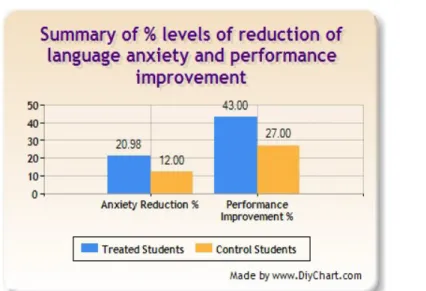
(23) increased (4%) from the initial test to the final one. Regarding question 27, “I get nervous and confused when I am speaking in my language class”, there was a decrement of 12.5% in the treatment students, from 68.75% in the initial test to 56.25% in the final test, whereas the students in the control group declared a decrease of just 4%, from 68% to 64%. Question 31,“ I am afraid that the other students will laugh at me when I speak the foreign language” showed a level of anxiety of 62.5% in the initial test and a level of 43.75 in the final test for the treatment students, that is, a decrease of 18.75%. The students in the control group declared a level of anxiety of 60% in the initial test and 56% in the final test, with a decrement of just 4%. Finally, question 33, “I get nervous when the language teacher asks questions which I haven't prepared in advance”, indicated that the students in the treatment group experienced a level of anxiety of 93.75% in the initial test and 81.25% in the final test, with a decrease of 12.5%. The students in the control group showed a level of anxiety of 92% in the initial test and 72% in the final test, I. e. a decrement of 20%. The overall average reduction in the level of perceived anxiety amounts to 20.98% in the two treatment groups and to 12% in the control group, so there is a difference of 8.98%.. 23.
(24) Figure 5: Sumary of total anxiety levels. 4.2 Analysis of data: Pronunciation and intonation Oral performance of the students in all groups has been assessed by means of another web form containing the checklist in Appendix 2. The relevant aspect we paid attention to were pairs of sounds that can be confusing for Spanish students, and also linking and intonation. Obviously, the normal progression of the course means that there will be a difference in the students' oral performance levels appreciated at the beginning and the end of the study. There were only three options for every item in the checklist: Always, that means that the subject has no problems with that particular item; Never, that means that they are not able to produce a satisfactory answer; and Sometimes, which reflects that the subjects are able to produce that item satisfactorily, but they also make frequent mistakes. The same items are assessed along the study, so that we are able to see any possible evolution. The overall results are as follows:. 4.2.1 Treatment groups In their first task, the students in these groups achieved Always in just 12% of the items, so they were successful at only 12% of the items considered for the course.. 24.
(25) They achieved 32% in Sometimes and 56% in Never. At the end of the study, these students achieved 55% Always, 38% Sometimes, and 7% Never. The positive difference (improvement) from the first assessment to the final one accounted for 43%. Then there was a difference in Sometimes from 32% to 38%, equaling 6%. Regarding Never, the results accounted for -49%, which is the sum of Always and Sometimes.. 4.2.2 Control group The students in the control group achieved 8% Always in their first assessment, 28% Sometimes, and 64% Never, which means that they had a lower level at speaking than the treatment students (8%). In their final assessment, they achieved 35% Always, 41% Sometimes, and 24% Never. This means that the improvement accounted for 27% Always, 13% Sometimes, and -40% Never, which is the sum of both Always and Sometimes percentages.. 4.3 Analysis of data: Program evaluation All students had a personal report on their performance both with the FLCAS and with the Pronunciation and Intonation assessment system. They were asked three questions: 1. Are you happy with your overall performance? 2. Were you conscious of your improvement? 3. Were you conscious of the fact that your level of anxiety has decreased?. 25.
(26) Nearly 83% of the students were happy with their overall performance, 73.2% were conscious of their improvement, and 53.65% were conscious of the decrease in their level of anxiety.. Figure 6: Anxiety reduction and performance improvement. 26.
(27) 4.4 Discussion. From the data collected (Figure 6), we can see that the students who received the treatment have reduced their levels of perceived anxiety in nearly 21% and their oral performance has improved from 12% to 55%, and that is a gain of 43%. Regarding the control group their levels of perceived anxiety have had a decrease of 12% and their oral performance has improved from 8% to 35%, that is, an improvement of 27%. As this is a descriptive account and the data have not been statistically processed, we cannot consider these conclusions as definitive, but there are several facts that we do consider relevant. In the first place, the students in general were not conscious of their progress and that may be explained because they are in a language course in which some progress is natural, so they did not relate their oral improvement with their decrease of classroom language anxiety. Regarding how conscious they were of the decrease in anxiety that they had experienced, the students in the treatment groups reported that being sure of the fact that they had not made language mistakes helped them improve their pronunciation and their intonation. The students in the control group reported that they felt more confident as they gathered more practice. From the results we can see that they suffer more from anxiety than the students in the treatment groups. From these facts, we could conclude that the elimination of the stimulus also eliminates the response from the individual, i.e., when our students do not experience fear of making language mistakes they can concentrate on how they communicate and thus improve their intonation and pronunciation skills. Similarly, Elaine M. Philips 27.
(28) (1992), in her study on the effects of anxiety on oral performance, reported that students who felt frightened by oral evaluation exhibited negative attitudes towards language class. Thus, the results of this study agree with those obtained by MacIntyre and Gardner (1991, 1994), that established negative correlation between high levels of language anxiety and poor oral performance. Even if the results of this study suggest that the strategy proposed works effectively, new questions appear. For example, we do not know which the standard levels of language anxiety for A levels in our school are and we do not know what degree of improvement in pronunciation and intonation is normal along these courses, so we cannot compare these results in order to see their relevance. If we consider, for example, the results of question 19 (“I am afraid that my language teacher is ready to correct every mistake I make”), we can see that there is a difference of 68.75% from the initial test to the final one, but we cannot measure the importance of the teacher's attitude towards those students and how it can affect the fact that they feel more or less anxious. Young (1991a) studied research on the sources of classroom language anxiety and suggested strategies to help reduce its effects on learners, among which were the avoidance of unnatural classroom methods, which is the teacher’s responsibility. So, we have not measured the role of teachers, when they are essential in the evaluation process as students see them as the ones judging their performance and so, they are seen as a source of anxiety or the opposite. Also, we have not considered the role that motivation can play in this decrease of anxiety, as the students in the treatment groups seemed more motivated (maybe because their teacher corrected their scripts and notes) than the students in the control group. It is true that when the teacher has devoted some time to help every student individually with their work, they can feel they are paid personal attention and their level of motivation increases while their level of anxiety (fear of examination) can also decrease correspondingly. In the same line, Tóth (2007) studied different predictors of foreign language anxiety and concluded that there is a close relationship between learners’ self-perceptions and the amount of anxiety that 28.
(29) they suffer than between language anxiety and learners’ performance. Apart from these, also there are several other variables that at the moment we cannot control so as to elevate these conclusions to definitive. All in all, this study has been useful to conclude that our students suffer classroom language anxiety, that the causes of that may be our capacity of deriving, of generating not only language or knowledge, but also fears and anxiety. We can also conclude that, at least with these students, we have been able to reduce their levels of anxiety when they had to present their oral work. This study has been very helpful and gratifying for the teacher as he has been able to improve his understanding of what students experience in their language learning processes in order to help them and also in order to feel that his efforts have a reason.. 4.5 Further action There is some logical future action to take having into account the conclusions of this study. In the first place, it is necessary to measure the levels of classroom language anxiety that our students along the years suffer, as this is the study of just one year. The FLCAS has proved to be a good instrument for it and it should be applied to all students in the level. Secondly, it is also necessary to measure the progress in their oral performance that our students experience along the years in order to establish a benchmark. Other variables, such as motivation and the teacher's role should also be taken into account. Once we know to what extent classroom language anxiety affects our students and what effect it has on our students' oral performance, we will be able to devise activities to control it. One example is the one presented in this study. 29.
(30) References Alcántara, D. F. (1992): «La ansiedad en la adquisición de la L2: Su expresión por medio de la escala F.L.C.A.S.» en Etxeberria, F. y Arzamendi, J. (eds.): Bilingüismo y Adquisición de Lenguas. Actas del IX Congreso Nacional de AESLA, Bilbao, Servicio editorial Universidad del País Vasco, pp. 109-119. Barnes-Holmes, D., Hayes, S.C. & Dymond, S. (2001). In. S.C. Hayes, D. BarnesHolmes & B. Roche (Eds.), Relational frame theory: A post-Skinnerian account of language and cognition. New York: Plenum Press. Chomsky, N. (1959). A review of BF Skinner's Verbal Behavior. Language, 35(1), 2658. Daly, J. (1991). Understanding Communication Apprehension: An Introduction for Language Educators, in Horwitz, E. K., & Young, D.J. (Eds.) Language Anxiety: From Theory and Research to Classroom Implications. Englewood Cliffs, NJ: Prentice Hall, pp. 3-14. Hauser, M. D., Chomsky, N., & Fitch, W. T. (2002). The faculty of language: What is it, who has it, and how did it evolve?. Science, 298(5598), 1569-1579. Hernández, M., Horrillo, P., & Pico, E. (1992). Variables Afectivas de la Adquisición de la Segunda Lengua, in Etxebarria, F. and Arzamendi, J. (Eds.) Bilingüismo y Adquisición de Lenguas. Actas del IX Congreso Nacional de A.E.S.L.A. Bilbao. Servicio Editorial Universidad del País Vasco, pp. 305-314. Horwitz, E. K., Horwitz, M. B., & Cope, J. A. (1986). Foreign Language Classroom Anxiety, The Modern Language Journal, 70 (2), 125-132. 30.
(31) Horwitz, E. K. (2001). Language Anxiety and Achievement, Annual Review of Applied Linguistics, 21, 112-126. Jenkins, J. (2002). A sociolinguistically based, empirically researched pronunciation syllabus for English as an International Language. Applied Linguistics, 23(1), 87-103. MacIntyre, P. D., & Gardner, R. C. (1991). Investigating language class anxiety using the focused essay technique. The Modern Language Journal, 75(3), 296-304. MacIntyre, P. D., & Gardner, R. C. (1994). The subtle effects of language anxiety on cognitive processing in the second language. Language learning, 44(2), 283-305. Krashen, S. D. (1981). Second Language Acquisition and Second Language Learning. Oxford: Pergamon. Pavlov, I. P. (1897). Lectures on the work of the principal digestive glands. St. Petersburg: Kushnereff. Phillips, E. M. (1992). The effects of language anxiety on students' oral test performance and attitudes. The modern language journal, 76(1), 14-26. Scovel, T. (1991). The Effect of Affect on Foreign Language Learning: A Review of the Anxiety Research, in Horwitz, E.K., & Young, D. J. (Eds.) Language Anxiety: From Theory and Research to Classroom Implications. Englewood Cliffs, NJ: Prentice Hall, pp. 15-24 Shams, A. (2006). The Use of Computerized Pronunciation Practice in the Reduction of Foreign Language Classroom Anxiety. Unpublished Ph.D. Thesis, The Florida State University. 31.
(32) Tóth, Z. (2007). Predictors of foreign-language anxiety: Examining the relationship between anxiety and other individual learner variables. UPRT 2007: Empirical Studies in English Applied Linguistics, 123. Young, D. J. (1991a). Creating a Low‐Anxiety Classroom Environment: What Does Language Anxiety Research Suggest?. The Modern Language Journal, 75(4), 426-437. Young, D. J. (1991b). The Relationship Between Anxiety and Foreign Language Oral Proficiency Ratings, in Horwitz, E.K., & Young, D. J. (Eds.) Language Anxiety: From Theory and Research to Classroom Implications. Englewood Cliffs, NJ: Prentice Hall, pp. 57-64. Wilson, K.G., Hayes, S.C., Gregg, J., & Zettle, R. (2001). Psychopathology and psychotherapy. In Hayes, S.C., Barnes-Holmes, D., & Roche, B. (Eds.) Relational Frame Theory: A Post-Skinnerian Account of Human Language and Cognition. New York: Plenum Publishers. pp. 211-237. 32.
(33) Appendix 1 Foreign Language Classroom Anxiety Scale (Horwitz et al, 1986) 1. I never feel quite sure of myself when I am speaking in my foreign language class. Strongly agree [ ]. Agree [ ]. Neither agree nor disagree [ ]. Disagree [ ]. Strongly disagree [ ]. 2. I don't worry about making mistakes in language class. Strongly agree [ ]. Agree [ ]. Neither agree nor disagree [ ]. Disagree [ ]. Strongly disagree [ ]. 3. I tremble when I know that I'm going to be called on in language class. Strongly agree [ ]. Agree [ ]. Neither agree nor disagree [ ]. Disagree [ ]. Strongly disagree [ ]. 4. It frightens me when I don't understand what the teacher is saying in the foreign language. Strongly agree [ ]. Agree [ ]. Neither agree nor disagree [ ]. Disagree [ ]. Strongly disagree [ ]. 5. It wouldn't bother me at all to take more foreign language classes. Strongly agree [ ]. Agree [ ]. Neither agree nor disagree [ ]. Disagree [ ]. Strongly disagree [ ]. 6. During language class, I find myself thinking about things that have nothing to do with the course. Strongly agree [ ]. Agree [ ]. Neither agree nor disagree [ ]. Disagree [ ]. Strongly disagree [ ]. 7. I keep thinking that the other students are better at languages than I am. Strongly agree [ ]. Agree [ ]. Neither agree nor disagree [ ]. Disagree [ ]. Strongly disagree [ ]. 8. I am usually at ease during tests in my language class. Strongly agree [ ]. Agree [ ]. Neither agree nor disagree [ ]. Disagree [ ]. Strongly disagree [ ]. 9. I start to panic when I have to speak without preparation in language class. Strongly agree [ ]. 33. Agree [ ]. Neither agree nor disagree [ ]. Disagree [ ]. Strongly disagree [ ].
(34) 10. I worry about the consequences of failing my foreign language class. Strongly agree [ ]. Agree [ ]. Neither agree nor disagree [ ]. Disagree [ ]. Strongly disagree [ ]. 11. I don't understand why some people get so upset over foreign language classes. Strongly agree [ ]. Agree [ ]. Neither agree nor disagree [ ]. Disagree [ ]. Strongly disagree [ ]. 12. In language class, I can get so nervous I forget things I know. Strongly agree [ ]. Agree [ ]. Neither agree nor disagree [ ]. Disagree [ ]. Strongly disagree [ ]. 13. It embarrasses me to volunteer answers in my language class. Strongly agree [ ]. Agree [ ]. Neither agree nor disagree [ ]. Disagree [ ]. Strongly disagree [ ]. 14. I would not be nervous speaking the foreign language with native speakers. Strongly agree [ ]. Agree [ ]. Neither agree nor disagree [ ]. Disagree [ ]. Strongly disagree [ ]. 15. I get upset when I don't understand what the teacher is correcting. Strongly agree [ ]. Agree [ ]. Neither agree nor disagree [ ]. Disagree [ ]. Strongly disagree [ ]. 16. Even if I am well prepared for language class, I feel anxious about it. Strongly agree [ ]. Agree [ ]. Neither agree nor disagree [ ]. Disagree [ ]. Strongly disagree [ ]. Disagree [ ]. Strongly disagree [ ]. 17. I often feel like not going to my language class. Strongly agree [ ]. Agree [ ]. Neither agree nor disagree [ ]. 18. I feel confident when I speak in foreign language class. Strongly agree [ ]. Agree [ ]. Neither agree nor disagree [ ]. Disagree [ ]. Strongly disagree [ ]. 19. I am afraid that my language teacher is ready to correct every mistake I make. Strongly agree [ ]. 34. Agree [ ]. Neither agree nor disagree [ ]. Disagree [ ]. Strongly disagree [ ].
(35) 20. I can feel my heart pounding when I'm going to be called on in language class. Strongly agree [ ]. Agree [ ]. Neither agree nor disagree [ ]. Disagree [ ]. Strongly disagree [ ]. 21. The more I study for a language test, the more confused I get. Strongly agree [ ]. Agree [ ]. Neither agree nor disagree [ ]. Disagree [ ]. Strongly disagree [ ]. 22. I don't feel pressure to prepare very well for language class. Strongly agree [ ]. Agree [ ]. Neither agree nor disagree [ ]. Disagree [ ]. Strongly disagree [ ]. 23. I always feel that the other students speak the foreign language better than I do. Strongly agree [ ]. Agree [ ]. Neither agree nor disagree [ ]. Disagree [ ]. Strongly disagree [ ]. 24. I feel very self‐conscious about speaking the foreign language in front of other students. Strongly agree [ ]. Agree [ ]. Neither agree nor disagree [ ]. Disagree [ ]. Strongly disagree [ ]. 25. Language class moves so quickly I worry about getting left behind. Strongly agree [ ]. Agree [ ]. Neither agree nor disagree [ ]. Disagree [ ]. Strongly disagree [ ]. 26. I feel more tense and nervous in my language class than in my other classes. Strongly agree [ ]. Agree [ ]. Neither agree nor disagree [ ]. Disagree [ ]. Strongly disagree [ ]. 27. I get nervous and confused when I am speaking in my language class. Strongly agree [ ]. Agree [ ]. Neither agree nor disagree [ ]. Disagree [ ]. Strongly disagree [ ]. 28. When I'm on my way to language class, I feel very sure and relaxed. Strongly agree [ ]. Agree [ ]. Neither agree nor disagree [ ]. Disagree [ ]. Strongly disagree [ ]. 29. I get nervous when I don't understand every word the language teacher says. Strongly agree [ ]. 35. Agree [ ]. Neither agree nor disagree [ ]. Disagree [ ]. Strongly disagree [ ].
(36) 30. I feel overwhelmed by the number of rules you have to learn to speak a foreign language. Strongly agree [ ]. Agree [ ]. Neither agree nor disagree [ ]. Disagree [ ]. Strongly disagree [ ]. 31. I am afraid that the other students will laugh at me when I speak the foreign language. Strongly agree [ ]. Agree [ ]. Neither agree nor disagree [ ]. Disagree [ ]. Strongly disagree [ ]. 32. I would probably feel comfortable around native speakers of the foreign language. Strongly agree [ ]. Agree [ ]. Neither agree nor disagree [ ]. Disagree [ ]. Strongly disagree [ ]. 33. I get nervous when the language teacher asks questions which I haven't prepared in advance. Strongly agree [ ]. 36. Agree [ ]. Neither agree nor disagree [ ]. Disagree [ ]. Strongly disagree [ ].
(37) Appendix 2 Pronunciation checklist. Adapted from Nora Samosir & Low Ee Ling (2000) and Jenkins (2002). Pronunciation Mark “x” where applicable, according to frequency of error. Consonants th (e.g., thin—not[t/s]) th (e.g., then—not[d]) s & z (e.g., sue vs. zoo) /tʃ/ & /dʒ/ (e.g. pith vs. bridge) /ʃ/ & /ʒ/ (e.g. nation vs. vision) Aspiration after /p/,/t/, /k/ Preservation of consonant clusters word initially (e.g., stop), medially (e.g., sister) and finally (e.g. apt) Final consonants Voiceless, voiced (e.g.,nip . nib; seat vs. seed; lock vs. log; larch vs. large) final l (e.g., final, little, sell) final s (e.g., pupils, writes, schools) ed suffix to mark past tense. Vowel variation hill vs. heel cut vs. cart cot vs. caught pen vs. pan Intonation Use of rising intonation: yes/no questions (e.g., Are you coming?) Use of falling intonation: statements (e.g., Yes, I am coming); wh questions (e.g., What are you doing?) Word stress (e.g., project/project, object/object) Sentence stress (e.g., My sister bought a new dress; dress is the most important piece of information, so it carries the most stress) Voice Mark “x” where applicable, according to frequency of error Audibility level Too loud Too soft Fading out at end of statements Pitch and range Monotonous. 37. Always. Sometimes. Never.
(38) 38.
(39)
Figure




+2
Documento similar
In the case of speaking, researcher shows that a rich variety of activities might be done to promote this particular language skill in the language
My main concern in this paper is to reflect on the pedagogical possibilities that technology may offer to autonomous language teaching-learning procedures, that is: in which ways
My ambition is to contribute to our understanding of terrorism by revealing that, in the Greek language which is the language of concepts and philosophy, the term terrorism is
The results obtained from students’ responses to the questionnaire used in this research study indicate that the academic trajectory of students in the Language Teaching program at
And secondly, how students’ logs can be used to automate the assessment of different skills such as the ability to explain terms in a foreign language or to assess definitions
The essential question that students of language origins deal with is not that of the origin of the medium of language, but language conceived as a method of communication..
a) To determine the influence of the “freely talking” Program, based on the Communicative Approach, in reducing anxiety when speaking in the dimension “Confidence in the use of a
The objective of this FMP is to research the affordances of the online tool Flip to help Baccalaureate students cope with their speaking anxiety when delivering oral presentations in
