
The eastern Pacific species of Bathygobius (Perciformes: Gobiidae)
16
0
0
Texto completo
(2) 142. R E V I S TA DE BIOLOGIA T R O P I C A L. additional criteria (Akihito & Meguro 1980, Miller & Smith 1989, and present observation) to the essentially meristic and morphometric ones employed by that author. In particular, the systematic status of Bathygobius from the eastern Pacific islands has been addressed. The work is based on study of available type-material in conjunction with collections from the Los Angeles County Museum and new material from Clipperton Island. METHODS AND ABBREVIATIONS Meristics. A, anal fin; C, caudal fin; D1, D2, first and second dorsal fins; LL, scales in lateral series (from axilla along lateral midline, excluding scales over origin of C if present); P, pectoral fin; Pd, predorsal scales (Pd along dorsal midline forwards from origin of D1); Tr, scales in transverse series (from origin of A obliquely upwards and rearwards to base of D2); V, pelvic disc. Last bifid ray of D2 and A counted as one. Morphometrics (Tables 1, 2, 4, 5). Ab, anal fin base; Ad and Aw, body depth and width at anal fin origin; Cl, caudal fin length; Chd, cheek depth (lower border of eye to level of angle of jaws); Cp and Cpd, caudal peduncle length (end of A base to origin of C) and depth (minimum); D1b and D2b, first and second dorsal fin bases; E, eye diameter; E/Pdsc(length of postorbital unscaled nape along oculoscapular groove); H, Hw, Hd, head length (snout to midline opposite upper origin of opercle), width (between upper origin of opercles), depth (at latter position); I, interorbital width; Pl, pectoral fin length; Po, postorbital length; Sl, standard length; Sn, snout length; Sn/A and Sn/An, distance from snout to vertical of anal fin origin and anus; Sn/D1 and Sn/D2, distance from snout to origin of first and second dorsal fins; Sn/V, distance from snout to vertical of pelvic spinous ray origin; Ujl, upper jaw length (midline to lateral end); V/An, distance from origin of pelvic spinous ray (V I) to opposite anus; Vd, body depth at origin of V I; Vl, distance from. V I origin to tip of longest pelvic ray. Lateral-line system (Fig. 1). Terminology of sensory papillae (free neuromast) series and rows, and of head canal pores, as Miller and Smith (1989). Sensory papillae and pores are minute in Bathygobius. Under lowpower binocular microscope, oblique lighting from a narrow (1 mm) fibre-optic light guide is often sufficient to reveal these structures, but iron tannate staining, differentiating with 1% nitric acid (De Buen 1923), may be necessary in some cases. Counts of papillae are not given, but numbers shown in Fig. 1 are approximately as found in the specimen drawn. Collections. Abbreviations for collections are those of Leviton et al. (1985). GENERIC IDENTIFICATION Bathygobius was introduced by Bleeker (1878) for the Indo-Pacific Gobius petrophilus Bleeker and G. nebulopunctatus Valenciennes in a species-list without designation of type-species or diagnosis of the genus. According to Koumans (1931), Meek & Hildebrand (1928) designated G. nebulop unctatus as the type-species, a form now synonymised with G. fuscus Rüppell (Akihito & Meguro 1980). Mapo Smitt (type-species Gobius soporator Valenciennes) and Chlamy des Jenkins (type-species Ch. laticeps Jenkins = G. cotticeps Steindachner) have long been incorporated into Bathygobius (Meek & Hildebrand 1928, Akihito & Meguro 1980), as have, more recently, the monotypic western Indian Ocean Pyosices (type-species P. niger Smith) and Koumansiasis (type-species K. macrocephalus Rao) (Hoese & Winterbottom 1979). Bathygobius is a circumtropical gobioid genus characterised by the goby-grade features of a fused pelvic disc and in the skeleton by (i) five branchiostegal rays, (ii) endopterygoid absent; (iii) urohyal lacking lateral ridges; (iv) pectoral girdle with hypercoracoid (scapula) reduced, deeply notched from below; (v) hypocoracoid (coracoid) small,.
(3) I N T E R N AT I O N A L J O U R N A L OF T R O P I C A L B I O L O G Y AND CONSERVAT I O N. 143. Fig. 1. Head lateral-line sensory papillae and canal pores (Greek letters) of Bathygobius ramosus , male, 61 + 15 mm (LACM 30108-9, part), Guancastre Province, Costa Rica, in (A) lateral and (B) dorsal views, and (C) mental region (enlarged). AN, PN, anterior and posterior nostrils; D, “deltoid” configuration of infraorbital row c; UL, LL, upper and lower lips; MF, mental fold; other abbreviations as Miller & Smith (1989)..
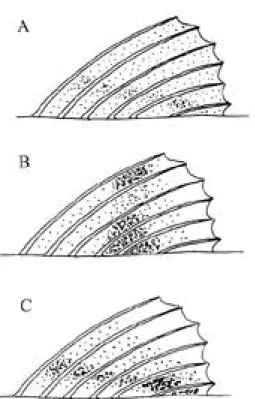
(4) 144. R E V I S TA DE BIOLOGIA T R O P I C A L. Fig. 2. Diagrams of free fin-ray branching in uppermost six pectoral rays (1-6) in (A) Bathygobius ramosus, based on male, 70 + 17.5 mm, Montuosa Island, Gulf of Chirique, and (b) B. andrei , based on female, 67 + 18 mm, Guatemala.. opposite lower corner of fourth radial (Miller & Smith 1989). Among goby-grade gobioids, Bathygobius belongs in an extensive group of Old World genera (including Amoya Herre, Arenigobius Whitley, Cabillus Smith, Cryto centroides Popta, Gobiopsis Steindachner, Istigobius Whitley, Parkraemeria Whitley, Porogobius Bleeker and Silhouettea Smith) with (i) longitudinal infraorbital papillae rows a and c, former around eye, and neither with transverse proliferation; (ii) delta configuration of papillae at anterior end of row c; (iii) well developed ancillary infraorbital row cp; (iv) transverse rows r and s3, (v) a longitudinal row s;(vi) row f a single transverse row behind rear edge of mental flap; (vii) longitudinal row n; (viii) single anterior interorbital pore lambda; (ix) pore beta present; and in skeleton (x) first dorsal fin pterygiophore sequence of 22110, (xi) one epural; (xii) postmaxillary crest on premaxilla; and (xiii) fanshaped glossohyal (Miller & Smith 1989, McKay & Miller 1997). Bathygobius itself may be characterised by the combination of (i) lateral preorbital protuberance enclosed by papillae rows c and. d; (ii) lower cheek groove housing anterior section of row c, which is joined caudad by row cp; (iii) trapeziform transverse mental flap, bordered posteriorly by transverse row f; and (iv) branched free upper pectoral rays; (v) 10 + 17 vertebrae (Akihito & Meguro 1980, Miller & Smith 1989). Bathygobius has most affinity with the exclusively Indo-West Pacific Istigobius (type-species Gobius ornatus Rüppell 1830) in the symplesiomorphy of a shortened hyomandibular row b. The two genera both possess free pectoral rays, at least in the type species of Istigobius (Murdy & Hoese 1985), and the latter shows incipient cheek grooving. The osteology of Bathygobius and Istigobius is also similar (Peters 1983, Murdy 1985, Miller & Smith 1989). However, Istigobius differs from Bathygobius in (i) larger head scales; (ii) more convex snout profile; (iii) a merely bulb-like mental protuberance, and (v) only 10 + 16 vertebrae (Murdy & Hoese 1985). The Eastern Pacific species examined in the present work all possess the diagnostic features of Bathygobius noted above, and have the following features in common: (i) cheek naked; (ii) anterior nasal opening short, erect, tubular, without a short process from rear rim; and (iii) lower jaw with inner row of about 4-5 enlarged lateral caniniform teeth. The head lateral-line system (as illustrated in Fig. 1 for B. ramosus) has (i) anterior and posterior oculoscapular canals separate, and (ii) interorbital part of anterior oculoscapular canal with well separated single pores lambda and kappa, all canal pores being very small. Meristic characters include an almost invariable count of second dorsal rays I/9 and anal rays A I/8 (Table 3 and text). Coloration is variable, with three oblique dark bands across body and more or less evident longitudinal pale striae corresponding to the focal axis of scales; head with dark oculoscapular blotches and a scapular blotch at the upper origin of the pectoral fin..
(5) I N T E R N AT I O N A L J O U R N A L OF T R O P I C A L B I O L O G Y AND CONSERVAT I O N. 145. Key to Eastern Pacific species of Bathygobius 1a.. Pectoral free rays, typically the first and invariably the remaining four, branched at least twice (Fig 2A); first dorsal fin distinctly pigmented to distal edge (Fig. 3A); postorbital dark blotches on oculoscapular groove large, elongate medially (Fig 4C); pelvic disc more or less rounded, with large lateral lobes, sometimes attenuate, and disc length about two-thirds to four-fifths abdomen (Fig. 5C); pectoral rays 19-20 (18-21); scales in lateral series 34-36 (32-38). Baja California to Peru, Revillagigedos and Cocos Island . . . . . . . . . . . . . . . . . . . . . . . . . . . . . .ramosus. 1b.. Pectoral free rays only bifid (Fig. 2B); first dorsal with at least distal periphery pale (Fig. 3B,C); postorbital dark blotches on oculoscapular groove small, not produced medially (Fig. 4A,B); pelvic disc usually more or less elliptical, sometimes circular, lateral lobes not attenuate and disc length at least four-fifths abdomen . . . . . . . . . . . .2.. 2a.. First dorsal fin with oblique dark band, most intense at upper anterior and lower posterior areas of fin (Fig. 3B); opercle typically with small patch of scales in upper anterior corner; pelvic disc not reaching anus, lateral lobes variable (Fig. 5B); pectoral rays 21-22 (20-22); scales in lateral series 34-36 (33-36); Guatemala to Ecuador . .andrei. 2b.. First dorsal fin with horizontal markings, proximal dark lines more intense posteriorly, and an upper clear distal edge (Fig. 3C); opercle typically without scales (present or absent in Clipperton examples (Fig. 6); pelvic disc (Fig. 5A) with small lateral lobes, edge of disc often reaching anus; pectoral rays 19-21; scales in lateral series 30-37; Galapagos (lineatus), Clipperton Island ( arundelii) and Lobos de Afuera, Peru (lupinus) . . . . . . . . . . . . . . . . .lineatus. BATHYGOBIUS RAMOSUS GINSBURG 1947 Bathygobius ramosus Ginsburg 1947: 281 (= B. ramosus1 Ginsburg 1947: 281)(Balboa, Panama); Allen & Robertson 1994: 259; Hoese, in Fischer et al. 1995: 1134. Bathygobius ramosus ramosus Ginsburg 1947 (= B. ramosus2 Ginsburg 1947): 282. Bathygobius ramosus micromma Ginsburg 1947 (=B. micromma2 Ginsburg 1947): 282 (Paita, Peru). Bathygobius ramosus longipinnis Ginsburg 1947 (=B. longipinnis 2 Ginsburg, 1947): 282 (Socorro Island, Revillagigedos Islands, Mexico). Material. MEXICO: 10 males, 30 + 8 to 65 + 18, and 18 females, 31 + 7.5 to 75 + 20 mm, Agua Verde Bay, Gulf of California, LACM 20135; three males, 39 + 10 to 51 + 14, four females, 25.5 + 7 to 58 + 15, and two juveniles, 22 + 6 and 27 + 7 mm, Chileno Bay, N. of Cabo San Luca, Gulf of California (LACM 31784-14), 19-20 ii 1971, RV Searcher #59; one female, 31.5 + d mm (USNM 002474, paratype of B. r. curticeps), Baja California; one female, 55.0 + d mm (USNM 002327, paratype of B. r. curticeps), Baja California; three males, 21 + 6.5 to 45 + 13, one female, 54 + 15, and five juveniles, 19 + 5.5 to 21.5 + d mm, Guerrero, 1.5 mi SE Papanoa (17 20 N, 101 01 W), LACM 9044-41; five males, 46 + 12 to 82 + 24.5, and three females, 51 + 15 to 60.5 + 16 mm, Isabella Island, Sinaloa (LACM 20132, as soporator), 2 iv 1937, Velero III; eight males, 40 + 11 to 77 + 22.5, and six females, 40 + 10.5 to 48 + 14 mm (LACM 22194), Tres Marias Island, Magdalena Islands; eleven males, 25 + d to 60 + 16.5, four females, 28.5 + 8. to 38.5 + 10.5, and four unsexed, 21.5 + 6 to 35 + 10 mm (LACM 33546-2), ENE Cape Henslow, Socorro Island, Revillagigedos Islands, 15 ii 1971, RV Searcher; ten males, 28 + 7.5 to 47.5 + 13.5, twelve females, 28 + 7.5 to 67 + 19 , and one juvenile, 20.5 + 6 mm (LACM 22697), Sulphur Bay, Clarión Island, Revillagigedos Islands, 17 iii 1939. ELSALVADOR: seven males, 44 + 11.5 to 80 + 23, and four females, 35 + 9 to 51 + 14 mm (GCRL), C. E. Dawson. COSTA RICA: three males, 48 + 13 to 61.5 + 16, and nine females, 30 + 9 to 47 + 12.5 mm (LACM 30108-9), Playa de Tamarinda de Nicoya, Guancaste prov., 21 i 1964; four males, 42 + 12 to 52.5 + 15.5 mm (LACM 6569-4), Pital, 2 mi S Tarcoles, Puntarenas, 29 xii 1962, W. Bussing and A. Obando; eight males, 28.5 + 8 to 46 + 12, six females, 29 + 8 to 52 + 13.5, and eight juveniles, 10.2 + 2.8 to 22 + 6 mm (LACM 6894-32), Playa del Coco, 13 vii 1964; five males, 32 + 8 to 57 + 17, and eight females, 25.5 + 7 to 44.5 + 11.5 mm (LACM 32257), and one male, 35 + 9.5 mm (CAS 206080), (5 33 20N, 87 02 50W); one male, 34 + 9, and three females, 21.5 + 5.5 to 38.5 + 10 mm (LACM), Chatham Bay, Cocos Island 28 xii 1998, J. E. McCosker. PANAMA: 23 males, 34.5 + 8 to 74.5 + 20.5, and five females, 35 + 9 to 41.5 + 9.5 mm, Montuosa Island, Gulf of Chiriqui, 12 xii 1998, C. R. Robertson; ECUADOR: one male, 37 + 10, and six females, 34 + 9.5 to 63 + 16 mm (LACM 33906-11), Guayas, 37 mi N Santa Elena, 21 v 1970, J. De Weese. PERU: two males, 49.5 + 13 and 81 + 21.5 mm (LACM 33907-6), Piura, 2 mi S Mancora, 37 mi NNW Paita; three males, 45 + 12 to 58 + d, and six females, 41 + d to 48.5 + 14 mm (USNM 143028, paratypes of B. r. micromma), Paita.. Description. Pectoral rays 19-20 (18-21: see Table 3 for meristic values); uppermost.
(6) 146. R E V I S TA DE BIOLOGIA T R O P I C A L. Fig. 3. Diagrams of first dorsal fin pattern in (A) Bathy gobius ramosus, (B) B. andrei, and (C) B. lineatus.. six rays more or less free from membrane (Fig. 2A), first usually branched twice, sometimes merely bifid, second ray branched twice, third and fourth three times, fifth four times, and sixth five times; secondary and subsequent branching evident by standard length of 18 mm. Pelvic disc circular or somewhat elliptical, about two thirds to four fifths length of abdomen (pelvic origin to anus); anterior pelvic membrane with lateral edges typically produced, angular to attenuate, each up to half length of free edge of membrane, which may be convex medially in outline. Scales in lateral series 34-36 (32-38; see Table 3); opercle without scales; predorsal scales (mostly 16-20) extending anteriorly to at least opposite pore beta, with distance thence to edge of orbit 2.7-3.9% SL; breast two-thirds to fully scaled. As %SL, caudal fin 24.2-29.6, pectoral fin length 19.3-26.6, pelvic disc length 16.2-21.1, caudal peduncle depth 11.5-13.8, eye 5.5-9.0, upper jaw. length 8.8-11.4 (see Tables 1 and 2 for descriptive morphometric values); posterior tip of second dorsal extending to above caudal fin base in males, to upper origin of caudal in females. Coloration with large dark postorbital blotches, extending medially from oculoscapular furrow and larger in area then pupil; scapular blotch dark; lateral midline with blotches not markedly extending below lateral midline; first dorsal fin more or less dusky to distal edge, lacking pale band, and with more proximal dark longitudinal band indistinct except as darkening on rear interradial membranes; caudal fin with distinct vertical markings; head with small white ocelli variably evident on lower cheek and opercle. Distribution. As Ginsburg (1947) noted, this species appears to be “the commonest and most widespread species of Bathygobius on the Pacific coast of the American continents” and ranges from southern Baja California to Peru (Ginsburg 1947, Thomson et al. 1979). This extensive distribution embraces both the Mexican and Panamanian provinces of the Eastern Pacific region (Briggs 1974). Bathygobius ramosus also occurs at both nearshore islands (such as the Tres Marias, Mexico and Montuosa Island in the Gulf of Chirique) as well as at the more offshore Revillagigedos (Ginsburg 1947, Ricker 1959), including the most distant Clarión Island, and also Cocos Island (5 o33’N, 86o59’W) (present material). Bathygobius reported from Malpelo Island off Colombia have not been available for study but may be predicted to be this species. Habitat. Reported from intertidal rock-pools (Allen & Robertson 1994). Maximum size to 11.4 cm (Thomson et al. 1979): the largest male in the present material is 82 + 24.5 = 106.5 mm TL and the largest female 75 + 20 = 95 mm TL, both from northern localities (Isabella Island, Tres Marias, and Gulf of California, respectively). Local variation. Ginsburg (1947) distinguished four subspecies of ramosus - ramo sus, curticeps, micromma and longipinnis on the basis of head length, caudal fin, pos-.
(7) I N T E R N AT I O N A L J O U R N A L OF T R O P I C A L B I O L O G Y AND CONSERVAT I O N. Fig. 4. Diagrams of postorbital blotches (pb) in (A B. lin eatus, male, 45 + 11.5 mm (LACM 43689-1, part), Marchena Island, Galapagos; (B) B. andrei, male, 56.5 + 13 mm (USNM 081934, part), and (C) Bathygobius ramosus, male, 62 + 17 mm, Montuosa Island, Gulf of Chirique.. torbital length, eye, nape and upper jaw, lateral scale and pectoral ray counts, and extent of branching of the free pectoral rays. B. r. longipinnis was represented by samples from Mexico and northern South America (Ecuador and Colombia), B. r. ramosus from Panama, B. r. micromma from Peru and B. r. longipinnis from Socorro island in the Revillagigedos. In the present work, limited material does not permit a detailed morphometric. 147. analysis of this species. However, comparison of available measurements for the body proportions noted above (Tables 1, 2) for the Gulf of California, Tres Marias islands and Gulf of Chiriqui suggest significant difference between beween males from Chiriqui and the other localities in upper jaw proportion, and between males of Tres Marias and the other localities in postorbital percentage of standard length. Principal components analysis (Fig. 7) of available body measurements (excluding upper jaw length and head depth) indicate some regional differentiation in ramosus. There is some overlap, but the Tres Marias and Revillagigedos individuals cluster apart from mainland and Montuosa material, where Gulf of California, Costa Rican and Montuosa values form a sequence reflecting their latitudinal distribution. Meristic results (Table 3) also correspond with Ginsburg’s findings that the Revillagigedos populations, from both Socorro and the more distant Clarión Island, show more frequent occurrence of lower pectoral fin-ray counts, with the lowest value of 18 also found in the Tres Marias sample, much nearer the mainland. Geographical variation obviously requires study at the genetic as well as classical morphological level and Ginsbur g’s delimitation of subspecies and present results could provide a starting point for such investigation. At present, there would seem most justification for formal use of the subspecific name longipinnis for the Revillagigedos and the Tres Marias populations on the basis of pectoral counts and morphometry but there is no morphological case for elevating them to separate specific rank. Allen & Robertson (1994) regarded B. arundelii from Clipperton Island as a synonym of B. ramosus but this is not the case (see B. lineatus). BATHYGOBIUS ANDREI (SAUVAGE 1880) Gobius andrei Sauvage 1880: 44 (Rio Guayas, Ecuador). Bathygobius andrei Ginsburg 1947: 282 (= B. andrei 1 Ginsburg, 1947: 282), Allen & Robertson 1994: 258; Hoese, in Fischer et al. 1995: 1134..
(8) 148. R E V I S TA DE BIOLOGIA T R O P I C A L. and 117 + 31 mm (NMW 30812-3). COLUMBIA: one male, 39.5 + 10 mm (LACM 21976), Gorgonia Island, 24 ii 1938, Velero III.. Fig. 5. Pelvic disc in ventral view of (A) Bathygobius lin eatus, male, 78 + 17.5 mm (LACM 4369-1, part), Marchena Island, Galapagos. (B) B. andrei, 92 + 21 mm, female, Guatemala, and (C) B. ramosus. a, anus; an, anal fin; am, anterior membrane; g, urogenital papilla; ll, lateral lobes of anterior membrane; pd, bowl of pelvic disc. Bathygobius andrei andrei Ginsburg 1947: 283 (= B. andrei2 Ginsburg 1947: 283). Bathygobius andrei heteropoma Ginsburg 1947: 283 (= B. heteropoma2 Ginsburg 1947: 283) (Chame Point, Panama). Bathygobius andraei Eschmeyer 1998: 98 [Eschmeyer (1998) states that andraei is the original spelling of this name but reference to Sauvage’s text indicates andrei]. Material. GUATEMALA: Five males, 45 + 13.5 to 118 + 35 mm, and six females, 54 + 14.5 to 89 + 25 mm (GCRL 1451,1458,1461,1463,1469), Esquintla, 1984, C. E. Dawson. PANAMA: two males, 62 + 16 and 96 + 17.7 (USNM 082207, paratypes of Bathygobius andrei heteropoma), Chame Point, Tweedie; two males, 47 + 12 and 75 + 16, and two females, 56.5 +13 and 60.5 + 14.5 mm (USNM 081934, paratypes of Bathygobius andrei heteropoma), Chame Point, Tweedie; two, 90 + 22. Description. Pectoral rays 21-22 (20:1, 21:24, 22:9); uppermost six rays more or less free from membrane, first to fourth branched only once (Fig. 2B). Pelvic disc (Fig. 5B) circular to somewhat elliptical, four fifths to nine-tenths length of abdomen; anterior pelvic membrane with lateral edges more or less angular, up to half length of free edge of membrane but typically less pronounced, and latter without median convexity in outline. Scales in lateral series 34-36 (33-36; 33:1, 34:10, 35:4, 36:7); opercle with a varying triangular patch of small scales in upper anterior corner, sometimes absent; predorsal scales 19-25, extending anteriorly to at least opposite pore beta, with distance thence to edge of orbit 1.6-4.8% SL; breast scaled. As %SL, caudal fin 18.4-30, pectoral fin 16.8-25.1, pelvic disc length 18-22.6, caudal peduncle depth 11.8-16.8, eye 6.1-9.6, upper jaw length 9.2-12.3 (see Table 4 for descriptive morphometric values); posterior tip of second dorsal extending to upper origin of caudal fin in males, not reaching upper origin of caudal in females. Coloration as Allen & Robertson (1994); postorbital blotches small, not extending medially; scapular blotch dark; lateral midline with blotches not markedly extending below lateral midline; first dorsal fin with oblique dark band, most intense on distal part of I/II and II/III membrane and around origins of IV-VI, and upper posterior area of fin pale; second dorsal and anal fin dark, with pale rim; caudal fin dark but markings indistinct in larger fish; head usually without pale ocelli. Distribution. A seemingly mainland species, recorded from Guatemala (Esquitla) to Ecuador (Guayaquil) (Ginsburg 1947, Allen & Robertson 1994, present material), and thus apparently restricted to the Panamanian province of Briggs (1974). So far, this goby has not been reported from those offshore islands where B. ramosus is found..
(9) I N T E R N AT I O N A L J O U R N A L OF T R O P I C A L B I O L O G Y AND CONSERVAT I O N. 149. 29 and 20-23 for the two forms respectively. It is also evident that male heteropoma have shorter caudal fins and probably pelvic discs (Table 4). However all the material examined here displays a similar pattern of first dorsal fin pigmentation, as far as can be judged after preservation, and the subspecific status assigned by Ginsburg could be retained. There is obviously a need for ecological investigation of this morphological species. The specimen from Colombia has no opercular scales, an extreme of variation noted by Ginsburg, but was identified here as andrei by first dorsal coloration. Fig. 6. Opercular scales (op) and associated structures (sensory papillae and canal pores) in holotype of Gobius arundelii, male, 59 + 18 mm (MCZ 28289), Clipperton Island. Other lettering as Fig. 1.. Habitat. The type was collected from brackish water (Sauvage 1880), and the species is also reported from both tidepools and sublittoral areas (Ginsburg 1947). A male of 118 + 35 mm among the present material from Guatemala exceeds the maximum size of about 10 cm suggested by Allen & Robertson (1994). Local variation. Ginsburg (1947) believed that this species could be divided into two sympatric subspecies, the typical form from intertidal habitats and B. a. het eropoma which was regarded as probably derived from deeper water, given the methods used by Robert Tweedlie, who collected the type series (Meek & Hildebrand 1923). The subspecies were distinguished by relative abundance of opercular scales and by length of pectoral fin. In the present material, opercular scales have been noted but condition of the specimens has not permitted precise counting. However, pectoral fin measurements, as percentages of standard length, agree closely with Ginsburg’s findings, being 22.1-25.1 (males) and 22.8-24.8 (females) for andrei other than heteopoma syntypes, whose pectoral fins are 16.8-21.9 (males) and 19.6 and 23.5 (two females), Ginsburg citing 22-. BATHYGOBIUS LINEATUS (JENYNS 1842) Gobius lineatus Jenyns 1842: 95, pl. 19 (fig. 2,2a) (off San Cristóbal [Chatham] Island). Gobius arundelii Garman 1899: 63 (Clipperton Island, Eastern Pacific) Bathygobius arundelii (Garman): Ginsburg 1947, Allen & Robertson 1984: 259, Hoese, in Fischer at al. 1995: 1134. Bathygobius lineatus lineatus (Jenyns) (= Bathy gobius lineatus 2 (Jenyns)): Ginsburg 1947: 281, 284. Bathygobius lineatus lupinus (=Bathygobius lupi nus 2) Ginsburg 1947: 281, 284. Bathygobius lineatus (Jenyns): Allen & Robertson 1994: 259, Hoese, in Fischer et al. 1995: 1134; Grove & Lavenberg, 1997: 552, 675, 695. Material. ECUADOR: San Cristobal [Chatham] Island, Galapagos: one female, 97 + 23 mm, (BMNH 1917.7.14.53, holotype of Gobius lineatus); Marchena [Bindloe] Island, Galpagos: sixteen males, 33.5 + 8.5 to 78 + 19 mm, and fifteen females, 29 + 7.5 to 56 + 14 mm (LACM 43689-1), SW side, tide-pool, 18 v 1984, coll. GAL84-32. Isabela [Albemarle] Island, Galapagos, three females, 23 + d to 38.5 + 10 mm and two juveniles, 18 + 5 and 18 + d mm (LACM 21969), 22 I 1938. PERU: two males, 53 + 13.5 and 68 + 18 mm (USNM 077561, paratypes of B. l. lupinus), Lobos de Afuera Island. CLIPPERTON ISLAND: one male, 59 + 18 mm (MCZ 28289, holotype of Gobius arundelii), J. Arundel, 1898; seven males, 35 + 10.5 to 65 + 20 mm, and three females, 38 + 10 to 45 + 11.5 mm (USNM 334096); two males, 43 + d and 57 + 16.5 mm, 30 iv 1998, R. Robertson.. Description. Pectoral rays 19-21 (19:18, 20:49, 21:18); uppermost five rays more or less free from membrane (as Fig. 2B), first to fourth branching only once. Pelvic disc (Fig. 5A) elliptical, reaching at least four-fifths to.
(10) 150. R E V I S TA DE BIOLOGIA T R O P I C A L. Fig. 7. Plot of scores for factors 2 and 5 from principal components analysis of body proportions in six samples of Bathygobius ramosus, from localities indicated by symbols. Measurements as described in Methods and Abbreviations. Solid line encloses specimens from Tres Marias Islands and Revillagigedos, broken line those from mainland and Gulf of Chirique (Montuosa Island) localities.. entire distance to anus; anterior pelvic membrane with lateral lobes one seventh to twofifths width of free edge, which is concave in outline. Scales in lateral series 30-37 (see Local Variation); opercle with or without a patch of small scales in upper anterior corner; predorsal scales 18-21, extending anteriorly to between pores beta and alpha, with distance thence to edge of orbit 2.0-3.58% SL; breast scaled. As %SL, caudal fin 22.2-27.9, pectoral fin 22.6-26.3, pelvic disc length 2022.8, caudal peduncle depth 11.8-14.0, eye 6.6-8.9, upper jaw length 8.17-10.3 (see Table 5 for descriptive morphometric values); posterior tip of second dorsal not extending beyond upper origin of caudal fin. Coloration as Allen & Robertson (1994) and Grove & Lavenberg (1997); postorbital dark blotches small, not extending medially; scapular blotch prominent, more or less bluish; head with numerous small white ocelli on lower cheek and opercle; first dorsal fin with proximal pale band at base, two longitudinal dark lines, lower and wider more intense on V/VI membrane and postdorsal membrane; upper. part of fin pale; second dorsal fin with dark and pale bands; anal fin dusky, with with dark line proximal to white distal edge; caudal fin with dark markings more or less defined. Distribution. An insular form, not only from the Galapagos province of the Eastern Pacific region (Briggs 1974) but also from Clipperton Island, an isolated atoll at 10°18’N, 109°13’W, and Lobos de Afuera (6°57’S, 80°43’W), small islands about 40 mi off northern Peru (Ginsburg 1947, Allen & Robertson 1994). At the Galpagos, the species is recorded throughout the archipelago (at Baltra, Bartolomé, Fernandina, Floreana, Gardner, Isabela, Marchena, Santa Cruz, Santiago, San Cristóbal, Tower and Wolf) (Grove & Lavenberg 1997) Habitat. Collected from intertidal rock-pools (Allen & Robertson 1994), where the species is said to dominate the shallow tidepool habitat (Grove & Lavenberg, 1997). Local variation. If coloration of the first dorsal fin (Fig. 3) is used as the prime character for distinguishing morphological species and putatively of biological significance, rather than morphometric and meristic values, and the apparently variable opercular scales, then the eastern Pacific Bathygobius fall clearly into three forms - ramosus, andrei and lineatus. Within lineatus, Garman’s species arundelii from Clipperton Island, maintained as such by Ginsburg (1947), must be regarded as a morphological subspecies of lineatus because the first dorsal pattern agrees with that of the Galapagos lineatus. The Bathygobius material now examined from Clipperton Island includes the holotype, which has opercular scales (Ginsburg 1947, and shown here in Fig. 6), and a more recent collection of fish among which no opercular scales could be detected. In other respects, these individuals closely resemble the holotype. Most display an iridescent blue scapular blotch which is not evident in the latter which has been about a century longer in preservative. The Clipperton Island specimens differ in number of scales in lateral series (30-34; 30:2, 31:3, 32:2, 33:3, 34:1) from the Galapa-.
(11) I N T E R N AT I O N A L J O U R N A L OF T R O P I C A L B I O L O G Y AND CONSERVAT I O N. 151. TABLE 1 Body proportions of male Bathygobius ramosus, from Agua Verde Bay (Gulf of California), Tres Marias Islands and Montuosa Island (Gulf of Chirique), and Clarion Island (Revillagigedos), as percentage of standard length.. Area SL(mm) N H Sn/D1 Sn/D2 Sn/AN Sn/A Sn/V V/An Cp D1b D2b Ab Cl Pl Vl Vd Ad Aw Cpd Hw Hd Sn E Po Ujl Chd E/Pdsc I %V/An, V. Agua Verde 41-65 6 24.4-27.7 (26.2,1.15) 33.6-36.9 (35.0,1.16) 53.8-63.8 (56.7,3.76) 51.2-53.1 (52.3,0.63) 56.0-58.5 (57.2,0.96) 26.3-28.9 (27.8,0.89) 23.3-25.3 (24.7,0.72) 22.2-24.0 (23.1,0.75) 11.9-13.9 (12.5,0.83) 23.1-25.0 (23.9,0.96) 17.6-18.9 (18.3,0.55) 24.2-27.7 (26.1,1.54) 21.3-24.1 (22.7,1.11) 17.4-20.3 (18.8,1.12) 18.1-19.1 (18.7,0.34) 16.9-19.1 (18.0,0.78) 12.7-14.5 (13.6,0.70) 12.0-13.2 (12.5,0.38) 15.3-16.9 (16.2,0.59) 15.3-18.9 (18.1,1.37) 4.4-7.2 (5.8,0.90) 6.5-8.5 (7.4,0.67) 12.5-13.5 (12.9,0.37) 8.8-10.1 (9.3,0.47) 6.4-7.7 (6.9,0.48) 2.8-3.5 (3.1,0.32) 3.1-4.4 (3.8,0.41). Tres Marias 40-77 8 26.6-29.3 (27.7,0.89) 34.9-37.2 (36.5,0.70) 55.6-57.9 (56.8,0.85) 51.7-57.9 (53.7,2.36) 57.3-62.3 (59.2,1.64) 23.0-30.5 (28.8,2.46) 22.0-28.6 (24.7,2.50) 20.6-26.3 (23.5,1.88) 0.8-13.1 (12.1,0.77) 19.4-24.8 (22.2,1.74) 16.4-19.0 (17.8,1.01) 26.3-29.2 (27.6,1.11) 21.6-26.1 (23.6,1.37) 16.8-18.8 (18.1,0.69) 17.2-20.2 (18.4,1.03) 16.3-18.2 (17.4,0.61) 9.7-11.1 (10.6,0.48) 12.1-13.6 (12.6,0.53) 15.4-16.9 (15.9,0.50) 16.7-17.5 (17.0,0.37) 5.1-8.3 (6.3,0.97) 6.8-8.6 (8.0,0.58) 13.4-14.7 (14.0,0.45) 9.0-10.1 (9.5,0.50) 5.7-8.2 (6.6,0.84) 3.1-3.9 (3.4,0.36) 1.9-3.6 (2.7,0.57). Montuosa Island 49.0-74.5 12 26.0-30.2 (27.9,1.31) 34.2-38.0 (36.0,1.30) 54.8-60.4 (57.0,1.55) 51.0-56.4 (54.3,1.60) 56.7-61.7 (59.4,1.56) 27.9-32.1 (30.3,1.40) 22.3-26.0 (23.8,1.25) 20.0-22.9 (21.4,0.99) 11.5-13.9 (13.0,0.79) 22.2-25.7 (23.7,1.10) 16.6-20.5 (18.7,1.12) 25.8-28.3 (27.1,0.80) 19.3-23.3 (21.6,1.28) 16.3-19.7 (17.5,0.86) 17.3-20.7 (19.3,1.01) 15.7-18.3 (17.7,0.71) 12.2-14.3 (13.3,0.55) 11.9-13.8 (13.0,0.60) 14.7-16.8 (15.9,0.68) 17.5-21.0 (19.0,1.01) 5.4-7.8 (6.7,0.70) 5.5-8.4 (7.4,0.72) 12.5-14.5 (13.3,0.69) 10.1-11.4 (10.5,0.44) 5.4-8.4 (7.2,0.77) 2.9-3.9 (3.3,0.40) 2.9-6.2 (4.2,0.78). Clarion 47.5 1 25.3 33.7 54.7 51.6 54.7 25.7 24.9 21.2 13.1 22.3 20.3 28.4 23.3 18.3 17.9 17.9 10.8 13.4 14.0. 70.6-81.0 (76.3,3.46). 60.8-82.5 (73.7,7.41). 62.5-79.8 73.7,5.09). 73.6. 5.0 6.8 12.9 5.2 3.85. Values are range, and, in parentheses, mean and standard deviation; N, number of observations.. gos and Lobos de Afuera material, which has 34-37 (34:3, 35:10, 36: 12, 37: 7). Ginsburg (1947) distinguished the Lobos de Afuera lin eatus as a separate subspecies - lupinus - on the basis of caudal peduncle depth, percentages of standard length being 11.5-14.5 for Galapagos lineatus and 14.5-15.5 for lupinus. Present measurements for males indicate 12.5-14.0 for the former, and 13.2 and 14.4 for the two male paratypes of lupinus. Otherwise the two localities correspond exactly in meristic and other morphometric values. It is apparent that the Galapagos and Lobos de Afuera populations are much closer in morphology to each other than they are to the. Clipperton Island population, whose apparent variablity in opercular squamation may indicate a more complex systematic situation. In the meantime, the three taxa may be regarded as conspecific morphological subspecies. AFFINITIES Using lateral-line criteria, the genus Bathygobius can be subdivided into three groups : (i) an Indo-West Pacific line of cyclopterus, niger and cotticeps, with continuous oculoscapular canals above the preopercle, and the horizontal hyomandibular row d separate from its anterior supralabial part. These species also show the distinctive.
(12) 152. R E V I S TA DE BIOLOGIA T R O P I C A L. TABLE 2 Body proportions of female Bathygobius ramosus, from Agua Verde (Gulf of California), Tres Marias Islands (Mexico) and Clarion Island (Revillagigedos), as percentage of standard length. Area Sl (mm N H Sn/D1 Sn/D2 Sn/An Sn/A Sn/V V/An Cp D1b D2b Ab Cl Pl V Vd Ad Aw Cpd Hw Hd Sn E Po Ujl Chd E/Pdsc I %V/An, V. Agua Verde 40-48 6 26.2-29.3 (27.5,1.13) 32.7-37.7 (36.0,1.87) 53.8-57.7 (55.9,1.57) 51.6-58.7 (54.7,2.93) 56.1-63.3 (59.7,2.80) 26.2-30.7 (28.1,1.52) 25.2-29.3 (27.5,1.78) 21.6-23.6 (22.6,0.71) 11.8-12.7 (12.4,0.43) 21.7-23.4 (22.9,0.63) 16.0-18.3 (17.0,0.81) 24.2-36.0 (26.7,4.64) 21.1-23.7 (22.3,0.83) 18.1-21.1 (19.4,1.27) 18.5-20.4 (19.3,0.71) 16.8-18.5 (17.8,0.56) 13.1-14.9 (14.5,0.67) 11.9-12.7 (12.4,0.28) 15.9-17.4 (16.6,0.60) 17.7-20.2 (19.3,0.92) 5.2-6.5 (5.9,0.51) 7.1-7.8 (7.5,0.33) 12.9-14.3 (13.5,0.54) 9.0-9.8 (9.6,0.35) 6.3-7.9 (7.2,0.53) 2.8-3.8 (3.2,0.37) 3.4-4.7 (4.2,0.46). Tres Marias 45-75 6 26.2-29.3 (27.5,1.13) 35.5-38.4 (37.1,1.11) 54.4-61.6 (57.7,2.44) 52.3-57.3 (55.0,1.72) 60.0-63.4 (61.2,1.21) 27.3-32.0 (30.1,1.68) 22.1-27.5 (24.5,1.82) 21.4-24.1 (23.1,1.00) 11.7-13.3 (12.2,0.57) 20.8-23.4 (21.8,0.981 15.0-18.5 (16.7,1.27) 24.8-28.5 (26.9,1.33) 23.7-25.7 (24.8,0.82) 16.2-19.0 (17.3,1.09) 18.1-20.2 (19.1,0.76) 16.4-18.6 (17.9,0.82) 9.6-10.9 (10.3,0.46) 11.5-13.0 (12.2,0.62) 15.4-17.8 (16.6,0.87) 17.4-17.9 (17.6,0.35) 5.2-6.6 (5.9,0.44) 8.6-9.0 (8.8,0.21) 13.3-14.7 (14.3,0.59) 8.8-10.9 (9.7,1.12)5.7-11.3 (7.0,2.12) 2.7-3.0 (2.9,0.20) 2.3-3.7 (2.7,0.52). Clarion 45-67 6 26.2-29.3 (27.5,1.13) 35.1-37.3 (35.8,0.89) 55.6-58.2 (57.3,1.06) 52.8-55.6 (54.5,1.46) 55.6-60.0 (58.6,1.77) 27.2-30.2 (28.5,1.16) 24.5-27.1 (25.7,1.11) 20.3-23.2 (21.5,1.07) 13.2-13.7 (13.5,0.23) 21.9-23.9 (22.7,0.83) 18.0-20.0 (19.2,0.74) 27.0-29.6 (28.0,1.01) 22.8-26.6 (24.4,1.53) 16.5-19.4 (17.8,1.16) 17.5-19.7 (18.7,0.97) 17.5-18.1 (17.9,0.29) 9.8-11.9 (10.8,0.91) 12.6-13.6 (13.0,0.36) 14.8-16.5 (15.6,0.74) 5.4-6.8 (6.1,0.58) 7.9-8.6 (8.2,0.29) 12.7-14.1 (13.6,0.57). 62.6-83.2 (71.0,7.15). 64.9-76.2 (71.0,3.89). 62.3-74.7 (69.5,4.60). 5.9-6.9 (6.4,0.38) 2.6-3.5 (3.0,0.4). Values are range, and, in parentheses, mean and standard deviation; N, number of observations.. synapomorphies of a short rounded pelvic disc with lobate anterior membrane and free pectoral rays branching more than once; (ii) the Indo-West Pacific petrophilus with only one, rather than two, interorbital pores; and (iii) several species with the more generalised features of separate anterior and posterior oculoscapular canals and two interorbital pores. All the Atlantic basin and eastern Pacific species fall into the last category in lateralline terms, but ramosus resembles the first group in extent of branching of free pectoral rays and in possessing a circular pelvic disc. However, it lacks the nasal tentacle and head. scales which also characterise the Indo-West Pacific species (Akihito & Meguro 1980). In a numerical analysis of Bathygobius species, Miller & Smith (1989) rooted their most parsimonious Wagner tree to emphasize an apparently monophyletic grouping within Bathygobius, comprising the Indo-Pacific cyclopterus, cotticeps and niger, together with ramosus. It was then suggested that ramosus might be derived from common stock with the former if the Eastern Pacific barrier had been crossed by such stock after the closure of the Central American isthmus (Woodring 1966, Stehli & Webb 1985), or might represent eastern Pacific survival of an.
(13) I N T E R N AT I O N A L J O U R N A L OF T R O P I C A L B I O L O G Y AND CONSERVAT I O N. 153. TABLE 3 Meristic variation in Bathygobius ramosus from Gulf of California to Peru.. D2. 8. 9. 10. N. P. 18. 19. 20. 21. N. Mv Mb Mm Mi Rs Rc Es Cc Pm Ci Pg Pp. 1 -. 25 7 14 10 9 22 9 27 20 13 6 2. 1 1 1 1 -. 25 7 14 10 10 23 9 27 21 14 7 2. Mv Mb Mm Mi Rs Rc Es Cc Pm Ci Pg Pp. 2 3 8 -. 8 5 13 6 17 36 3 4 13 3 2. 39 11 11 14 2 7 45 25 30 10 6. 1 3 7 2 -. 48 16 36 20 20 46 10 52 38 40 12 8. A. 7. 8. 9. N. LL. 32. 33. 34. 35. 36. 37. 38. N. Mv Mb Mm Mi Rs Rc Es Cc Pm Ci Pg Pp. 1 1 1 -. 24 7 13 10 9 22 8 26 20 14 6 2. 1 1 -. 24 7 14 10 9 23 9 26 21 14 7 2. Mv Mb Mm Mi Rs Rc Es Cc Pm Ci Pg Pp. 1 1 1 -. 4 1 1 1 1 2 2 2 -. 12 6 4 3 7 4 1 11 3 1 2 5. 17 5 10 3 6 13 5 11 11 9 4 8. 3 3 7 1 4 7 4 1 2 1 1 2. 1 1 1 -. 1 2 -. 38 15 23 8 18 28 10 26 19 13 7 15. Counts of second dorsal (D2), anal (A), and pectoral (P) rays, and scales in lateral LL) series, in samples from Agua Verde Bay, Gulf of California (Mv); Baja California, Mexico (Mb); Magdalena Island, Tres Marias, Mexico (Mm); Isabella Island, Mexico (Mi); Socorro Island, Revalligigedos (Rs); Clarion Island, Revillagigedos (Rc); El Salvador (Miller & Smith 1989); (Es), Playa del Coco, Costa Rica (Cc); Cocos Island (Ci); Montuosa Island, Gulf of Chirique (Pm); Guayas, Ecuador (Pg); Piura and Paita, Peru (Pp); N, number of observations.. original post-Tethyan circumtropical distribution, whose Atlantic component became extinct after the same event. However, although the putative cyclopterus-ramosus lineage is represented around the Hawaian archipelago by B. cotticeps (Gosline & Brock 1960), it is not known from the Galapagos, whose inshore fish fauna is essentially Eastern Pacific in character, although with IndoWest Pacific elements (McCosker & Rosenblatt 1984), or from other offshore Eastern Pacific islands, where any ability to cross the Pacific by this species-group could be most evident (Greenfield et al. 1970). The Galapagos Islands have been in the appropriate posi-. tion for at least 3-5 million years old (Simkin 1984), with shallows since 5-15 mya (McCosker & Rosenblatt 1984). Alternatively, convergence in extent of pectoral ray branching and shape of the pelvic disc is seen in other intertidal gobiids as distant from Bathygobius, as, for example, some eastern Atlantic-Mediterranean Gobius and Mauligo bius species (Miller 1984, 1986, Brito & Miller in press). These modifications may be of adaptive value in the supposedly extreme intertidal habitat (Horn et al. 1999). The fact that ramosus does not show the other apomorphies, putatively less homoplasious, of the Indo-West Pacific group may support the.
(14) 154. R E V I S TA DE BIOLOGIA T R O P I C A L. TABLE 4 Body proportions of Bathygobius andrei, from Guatemala and Panama (paratypes of B. a. heteropoma), as percentage of standard length. Values are range, and, in parentheses, mean and standard deviation; n, number of observations. Locality Sex SL(mm) n H SN/Dl SN/D2 SN/AN SN/A SN/y V/AN Cl Pl Vl CPd Hw SN E Po Uj1 E/PDsc I. Guatemala males 45-118 5 28.4-32.2 (29.9,1.35) 36.7-38.9 (37.7,0.92) 56.7-57.8 (57.4,0.63) 52.7-55.6 (54.4, 1.56) 57.5-61.1 (59.3,1.30) 28.8-31.1 (30.2,1.18) 22.5-25.3 (24.0,1.07) 25.6-30. 0 (28.1,2.03) 22.1-25.1 (23.4,1.11) 18.0-22.6 (20.8,1.61) 11-8-14.2 (13.3, 0.87) 16.0-17.8 (16.5,0.71) 6-5-7.2 (6.8, 0.25) 6.1-9.6 (7.7,1.48) 14.4-16.8 (15.3,0.94) 9.7-12.3 (10.9,1.00) 3.7-4.8 (4.2,0.44) 1.7-5.1 (3.1,1.17). Panama (heteropoma) males 47-96 4 25.3-30.6 (27.4,2.36) 33.3-37.9 (35.7,1.89) 54.0-57.4 (56.0,1.66) 50.0-54.0 (52.6,1.79) 56.4-58. 9 (57.3,1.09) 27.7-29.3 (28.8,0.77) 22.9-24.8 (23.8,0.77) 18.4-25.8 (22.8,3.54) 16. 8-21.9 (20. 0,2.21) 18.4-20.7 (19.9,1.03) 13.6-15.0 (14.3,0.56) 15.9-17.7 (17.1,0.83) 5.5-7.9 (6.7,1.01) 6.1-8.0 (7.2,0.87) 12.9-15.3 (14.3,1.17) 9.4-10.1 (9.7,0.50) 3.0-3.2 (3.1,0.11) 3.9-6.7 (5.2,1.16). latter view, and ramosus might be an eastern Pacific derivative of western Atlantic sopora tor stock. Like ramosus, B. andrei is a distinctive Eastern Pacific endemic species. The occurrence of scales merely in the upper anterior corner of the opercle, as seen in B. andrei and B. arundelii, is a feature apparently unrecorded among Indo-West Pacific and eastern Atlantic Bathygobius (Akihito & Meguro 1980, Hoese 1986, Miller & Smith 1989). The presence of this character in the Caribbean lepidopoma subspecies of B. cura cao is reported by Ginsburg (1947) and could be viewed as indicating a western Atlantic sister species, but opercular scales appear to be variable in the eastern Pacific species and this peculiar distribution of scales may be of independent origin in each species. Electrophoretic investigation of 26 gene loci in B. soporator, B. andrei and B. ramosus revealed that the two former species were closer genetically than they were to B. ramosus and predicted divergence time between andrei and soporator ancestry agreed well with the rise of the Central American land bridge (Gorman et al. 1976).. Guatemala females 54-89 6 28.7-31.5 (29.6,1.00) 36.5-41.4 (38.3,1.80) 55.9-60.5 (58.1,1.96) 55.1-59.3 (56.6,1.62) .58.8-63.6 (61.4,1.63) 28.4-30.6 (29.9,0.84) 23.7-28.5 (25.8,2.10) 25.0-29.9 (27.6,1.90) 21.8-24.8 (23.5,1.13) 20.3-22.3 (21.5,0.69) 13.3-14.3 (13.8,0.43) 15.3-17.4 (16.5,0.70) 6.6-8.5 (7.3,0.70) 7.3-8.3 (7.8,0.36) 14.4-16.7 (15.6,0.77) 9.9-11.5 (10.4,0.66) 1.6-4.4 (2.9,1.04) 1.8-4.5 (3.0,1.03). Panama (heteropoma) females 47 60.5 1 1 31.9 25.6 41.5 35.5 67 57 63 52.9 33 28.1 28.4 26.1 28.9 22.5 27.7 24 19.6 23.2 22.4 19.6 16.8 13.2 19.6 17.4 7.6 6.1 9.5 7.5 15.9 14.1 11.1 9.2 2.5 3.7 3.6. The three taxa here grouped under linea tus -lineatus from the Galapagos, lineatus lupinus from Lobos de Afuera and arundelii from Clipperton - key out to Indo-West Pacific fuscus or to Atlantic basin soporator, following the characters used by Akihito & Meguro (1980), Hoese (1986) and Miller & Smith (1989). The pigmentation of the first dorsal fin is essentially as in fuscus (Akihito & Meguro 1980) and soporator (Miller & Smith 1989). As a complication, arundelii with opercular scales and also low lateral scale counts does seem close to the Caribbean lepidopoma. These populations may be the remnants of a continuous soporator/fuscus circumtropical ancestral distribution, subsequently extinct on the eastern Pacific mainland coasts, or represent the eastward periphery of Bathygobius dispersal across the Pacific in the equatorial countercurrent (Houvenaghel 1984), perhaps excluded on the continent by established ramosus and andrei. Other Indo-West Pacific fishes are known from the Galapagos province and Clipperton Island (Briggs 1974, Grove & Lavenberg 1997) but do the three subspecies of lineatus represent the products of secondary local dis-.
(15) I N T E R N AT I O N A L J O U R N A L OF T R O P I C A L B I O L O G Y AND CONSERVAT I O N. 155. Table 5 Body proportions of Bathygobius lineatus, from Marchena Island, Galápagos, and Clipperton Island (including holo type of Gobius arundelli), as percentage of standard length. Values are range, and, in parentheses, mean and standard deviantion; n, number of observations Locality Sex N H Sn/D1 Sn/D2 Sn/AN Sn/A Sn/V V/An Cp D1b D2b Ab Cl Pl Vl Vd Ad Aw Cpd Hw Hd Sn E Po Ujl Chd E/Pdsc I %V/An, V. Marchena Island males 6 24.4-27.7 (26.2,1.15) 33.6-36.9 (35.0,1.16) 53.8-63.8 (56.7,3.76) 51.2-53.1 (52.3,0.63) 56.0-58.5 (57.2,0.96) 26.3-28.9 (27.8,0.89) 23.3-25.3 (24.7,0.72) 22.2-24.0 (23.1,0.75) 11.9-13.9 (12.5,0.83) 23.1-25.0 (23.9,0.96) 17.6-18.9 (18.3,0.55) 24.2-27.7 (26.1,1.54) 21.3-24.1 (22.7,1.11) 17.4-20.3 (18.8,1.12) 18.1-19.1 (18.7,0.34) 16.9-19.1 (18.0,0.78) 12.7-14.5 (13.6,0.70) 12.0-13.2 (12.5,0.38) 15.3-16.9 (16.2,0.59) 15.3-18.9 (18.1,1.37) 4.4-7.2 (5.8,0.90) 6.5-8.5 (7.4,0.67) 12.5-13.5 (12.9,0.37) 8.8-10.1 (9.3,0.47) 6.4-7.7 (6.9,0.48) 2.8-3.5 (3.1,0.32) 3.1-4.4 (3.8,0.41). females 8 26.6-29.3 (27.7,0.89) 34.9-37.2 (36.5,0.70) 55.6-57.9 (56.8,0.85) 51.7-57.9 (53.7,2.36) 57.3-62.3 (59.2,1.64) 23.0-30.5 (28.8,2.46) 22.0-28.6 (24.7,2.50) 20.6-26.3 (23.5,1.88) 0.8-13.1 (12.1,0.77) 19.4-24.8 (22.2,1.74) 16.4-19.0 (17.8,1.01) 26.3-29.2 (27.6,1.11) 21.6-26.1 (23.6,1.37) 16.8-18.8 (18.1,0.69) 17.2-20.2 (18.4,1.03) 16.3-18.2 (17.4,0.61) 9.7-11.1 (10.6,0.48) 12.1-13.6 (12.6,0.53) 15.4-16.9 (15.9,0.50) 16.7-17.5 (17.0,0.37) 5.1-8.3 (6.3,0.97) 6.8-8.6 (8.0,0.58) 13.4-14.7 (14.0,0.45) 9.0-10.1 (9.5,0.50) 5.7-8.2 (6.6,0.84) 3.1-3.9 (3.4,0.36) 1.9-3.6 (2.7,0.57). Clipperton Island males 12 26.0-30.2 (27.9,1.31) 34.2-38.0 (36.0,1.30) 54.8-60.4 (57.0,1.55) 51.0-56.4 (54.3,1.60) 56.7-61.7 (59.4,1.56) 27.9-32.1 (30.3,1.40) 22.3-26.0 (23.8,1.25) 20.0-22.9 (21.4,0.99) 11.5-13.9 (13.0,0.79) 22.2-25.7 (23.7,1.10) 16.6-20.5 (18.7,1.12) 25.8-28.3 (27.1,0.80) 19.3-23.3 (21.6,1.28) 16.3-19.7 (17.5,0.86) 17.3-20.7 (19.3,1.01) 15.7-18.3 (17.7,0.71) 12.2-14.3 (13.3,0.55) 11.9-13.8 (13.0,0.60) 14.7-16.8 (15.9,0.68) 17.5-21.0 (19.0,1.01) 5.4-7.8 (6.7,0.70) 5.5-8.4 (7.4,0.72) 12.5-14.5 (13.3,0.69) 10.1-11.4 (10.5,0.44) 5.4-8.4 (7.2,0.77) 2.9-3.9 (3.3,0.40) 2.9-6.2 (4.2,0.78). 70.6-81.0 (76.3,3.46). 60.8-82.5 (73.7,7.41). 62.5-79.8 73.7,5.09). females 1 25.3 33.7 54.7 51.6 54.7 25.7 24.9 21.2 13.1 22.3 20.3 28.4 23.3 18.3 17.9 17.9 10.8 13.4 14.0 5.0 6.8 12.9 5.2 3.85 73.6. Values are range, and, in parentheses, mean and standard deviation; N, number of observations.. persal from an Eastern Pacific centre such as the Galapagos or is the morphological species lineatus actually polyphyletic with some fus cus -type Bathygobius having traversed the Pacific on a number of occasions ? Such questions, and hypotheses of relationship based of necessity on potentially very homoplasious morphology, will be addressed by molecular studies which are now in progress. ACKNOWLEDGMENTS We are grateful to the late C. E. Dawson, K. Hartel, S. Jewett, J. McCosker, R. Robertson, S. Smith, J. van Tassell, and A. C. Wheeler for material, access to collections, and/or information. RESUMEN Se define el género Bathygobius Bleeker y se redescriben tres especies del Pacífico Oriental. Se reconoce las especies B. ramosus Ginsburg 1947 y B. andrei (Sauvage 1880). B. ramosus está en Revillagigedos y Cocos. Se define B. lineatus (Jenyns 1842) y se. ubica B. arundelii (Garman 1899) y B. l. lupinus Ginsburg 1947 como subespecies de lineatus.. REFERENCES Akihito, Prince & K. Meguro. 1980. On the six species of the genus Bathygobius found in Japan. Japan. J. Ichthyol. 27: 215-236. Akihito, Prince, M. Hayashi & T.Yoshino. 1988. Suborder Gobioidei. p. 236-289. In K. Masuda, C. Amaoka, C. Araga, T. Uyeno, & T.Yoshino (eds.). The Fishes of the Japanese Archipelago, 2nd ed. Tokai University Press, Tokyo. Allen, G. R. & D. R. Roberstson. 1994. Fishes of the Tropical Eastern Pacific. University of Hawaii Press, Honolulu, 332 p. Bleeker, P. 1878. Quatrième mémoire sur la faune ichthyologique de la Nouvelle-Guinée. Arch. néerl. Sci. nat. 13: 35-66. Böhlke, J. E. & C. C. G. Chaplin. 1968. Fishes of the Bahamas and Adjacent Tropical Waters. Livingston, Philadelphia, 771 p. Briggs, J. C. 1974. Marine Zoogeography. McGraw-Hill, New York, 475 p. De Buen, F. 1923. Gobius de la Península Ibérica y Baleares. Grupos Lesueurii, Colonianus, Affinis, y Minutus. Mem. Inst. esp. Oceanogr. 3: 121-266..
(16) 156. R E V I S TA DE BIOLOGIA T R O P I C A L. Eschmeyer, W. N. 1998. Catalog of Fishes. 3 vols.: California Academy of Sciences (Special Publications of the Center for Biodiversity Resarch and Information, No. 1), San Francosco, 2905 p. Fischer, W., F. Krupp, M. Schneider, C. Sommer, K. E. Carpenter, & V. H. Niem. 1995. Guía FAO para la Identificación para los Fines de la Pesca. Pacifico Centro-oriental. Vol. 2. Vertebrados - Part 1: 6471200 p. Garman, S. 1899. A species of goby from the shores of Clipperton Island. Proc. New England Zool. Club 5: 63-64. Ginsburg, I. 1947. American species and subspecies of Bathygobius, with a demonstration of a suggested modified system of nomenclature. J. Wash. Acad. Sci. 37: 275-284. Gosline, W. A. & V. E. Brock. 1960. Handbook of Hawaiian Fishes.: University of Hawaii Press, Honolulu. Gorman, G. C., Y. J. Kim & R. Rubinoff. 1976. Genetic relationships of three species of Bathygobius from the Atlantic and Pacific sides of Panama. Copeia 1976, No. 2: 361-364. Greenfield, D. W., D. Hensley, J. W.Wiley & S. T. Ross. 1970. The Isla Jaltembra coral formation and its zoogeographical significance. Copeia 1970, No. 1: 180-181. Grove, J. S. & R. J. Lavenberg. 1997. The Fishes of the Galapagos Islands. Stanford University Press, Stanford, 863 p. Hoese, D. F. 1986. Family No. 240 : Gobiidae, p. 774811. In M. M. Smith & P. Heemstra (eds.). Smiths’ Sea Fishes. Springer, Berlin. Hoese, D. F. & R. Winterbottom. 1979. A new species of Lioteres (Pisces, Gobiidae) from Kwazulu, with a revised checklist of South African gobies and comments on the generic relationships and endemism of western Indian Ocean gobioids. Life Sci. occ. Pap. roy. Ontario Mus., No. 31: 13 p. Horn, M. H., K. L. M. Martin & M. A. Chotkowski (eds.). 1999. Intertidal Fishes/ Life in Two Worlds. Academic Press, San Diego, 399 p. Houvenaghel, G. T. 1984. Oceanographic setting of the Galapagos Islands, p. 133-144. In R. Perry (ed.). Key Environments / Galapagos. Pergamon, Oxford. Jenyns, L. 1842. Fish, p.97-172. In The Zoology of the Voyage of H.M.S. Beagle, Pt. 4. Smith, Elder & Co., London. Koumans, F. P. 1931. A Preliminary Revision of the Genera of the Gobioid Fishes with United Ventral Fins. Imperator, Lisse, 174 p. Leviton, A. E., R. H. Gibbs, A. Heal & C. E. Dawson. 1985. Standards in herpetology and ichthyology: Part I. Standard symbolic codes for institutional resource collections in herpetology and ichthyology. Copeia 1985 (3): 802-832. McKay, S. I. & P. J. Miller. 1997. The affinities of European sand gobies (Teleostei: Gobiidae). J. nat. Hist. 31: 1457-1482.. McCosker, J. E. & R. H. Rosenblatt. 1984. The inshore fish fauna of the Galapagos Islands, p. 133-144. In R. Perry (ed.). Key Environments / Galapagos. Pergamon,Oxford. Meek, S. E. & S. F. Hildebrand. 1923. The marine fishes of Panama. Part I. Publ. Field Mus. nat. Hist. (Zool.) 15 (215): 330 p. Meek, S. E. & S. F. Hildebrand. 1928. The marine fishes of Panama. Part III. Publ. Field Mus. nat. Hist. (Zool.) 15 (249): 709-1045. Miller, P. J. 1984. The gobiid fishes of temperate Macaronesia (eastern Atlantic). J. Zool., Lond. 204: 363-412. Miller, P. J. 1986 . Gobiidae, p. 1019-1085. In P. J. P. Whitehead, M-L. Bauchot, J-C. Hureau, J. Nielsen & E. Tortonese (eds.). Fishes of the North-eastern Atlantic and the Mediterranean, vol 3. UNESCO, Paris, 1015-1473 p. Miller, P. J. & R. McK. Smith. 1989. The West African species of Bathygobius (Teleostei:Gobiidae) and their affinities. J. Zool., Lond. 218: 277-318. Murdy, E. O. 1985. Osteology of Istigobius ornatus. Bull. mar. Sci. 36: 124-138. Murdy, E. O. & D. F. Hoese. 1985. Revision of the gobiid fish genus Istigobius. Indo-Pacific Fish. No. 4: 1-41. Peters, K. M. 1983. Larval and early juvenile development of the frillfin goby, Bathygobius soporator (Perciformes: Gobiidae). Northeast Gulf Sci. 6: 137-153. Ricker, K. E. 1959. Fishes collected from the Revillagigedo Islands during the 1954-58 cruises of the “Marijean”. Mus. Contr. Inst. Fish. Univ. Brit. Columbia No. 4: 1-10. Rubinoff, R. W. & I. Rubinoff. 1971. Geographic and reproductive isolation in Atlantic and Pacific populations of Panamanian Bathygobius. Evolution 25: 88-97. Rüppell, W. P. E. S. 1830. Fische des Rothen Meeres, p. 95-141. In Atlas zu der Reise im nordlichen Africa. Part 3. Frankfurt-am-Main. Sauvage, H. E. 1880. Description des Gobioides nouveaux ou peu connus de la collection du Muséum d’Histoire Naturelle. Bull. Soc. Philomath. Paris (7) 4: 40-58. Simkin, T. 1984. Geology of the Galapagos Islands, p. 133-144. In R. Perry (ed). Key Environments / Galapagos. Pergamon, Oxford. Smitt, F. A. 1900. Preliminary notes on the arrangement of the genus Gobius, with an enumeration of its European species. Ofr. Svensk. Vet. Akad. Forh. 1899: 543-555. Stehli, F. G. & Webb, S. D. (eds.). 1985. The Great American Biotic Interchange. Topics geobiol. 4: 1-532. Thomson, D. A., L. T. Findley & A. N. Kerstitch. 1979. Reef Fishes of the Sea of Cortez. Wiley, New York, 302 p. Woodring, P. W. 1966. The Panama land bridge as a sea barrier. Proc. Amer. Phil. Soc. 110: 425-433..
(17)
Figure



+3

Documento similar
17,18 Contrary to graphene, the band gap in ML-MDS separating the valence and conduction bands is naturally large and due to the absence of inversion symmetry in ML-MDS the
The evolution of the scales and fin rays in Devonian tetrapods is still a rather unexplored aspect of the ‘fish‐tetrapod transition’;
The draft amendments do not operate any more a distinction between different states of emergency; they repeal articles 120, 121and 122 and make it possible for the President to
The majority of the established alien species in the WMED are of Pacific, Indo- Pacific, Indian and/or Red Sea origin, whereas less originate in the tropical
We find that individuals politically aligned to the regional incumbent shift responsibility to the central government upon receiving negative news about the number of contact tracers
At the same time, however, it would also be misleading and simplistic to assume that such Aikido habituses were attained merely through abstracted thought
Cadmium, Lead, Copper, Zinc, and Iron Concentration Patterns in Three Marine Fish Species from Two Different Mining Sites inside the Gulf of California, Mexico..
Relative frequency of Eimeria species in the feces of adult goats during the pre- and post- kidding periods under intensive conditions in Baja California Sur.. Severity 1 ,
