
Orchestrating learning across spaces: Integrating heterogeneous technologies of the existing educational practice
5
0
0
Texto completo
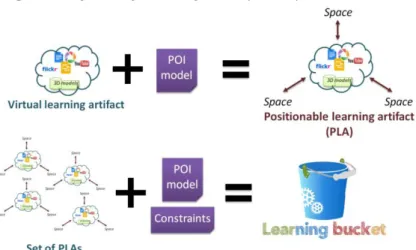
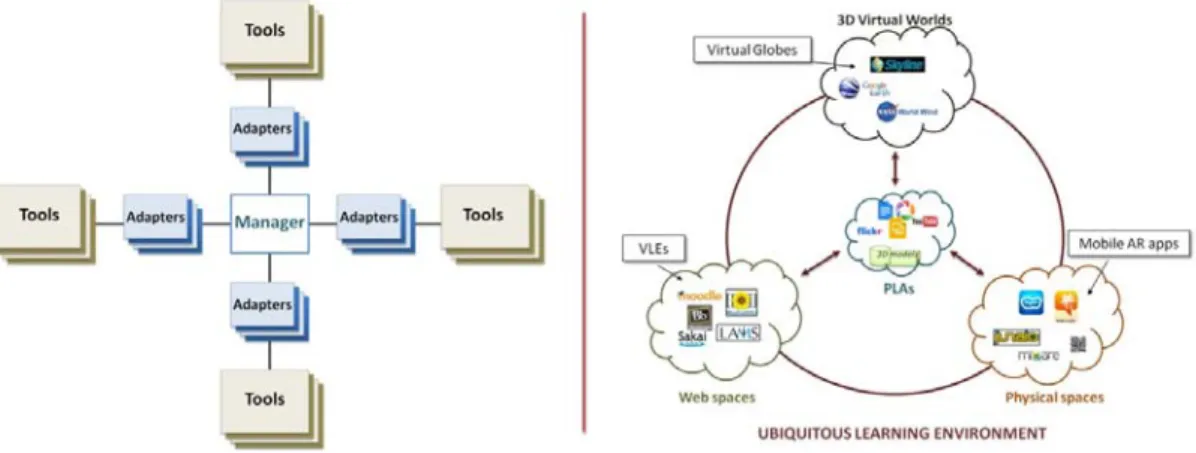
(2) In this regard we proposed two constructs: The Point of Interest (POI) model (Muñoz-Cristóbal et al., 2015), and the notion of learning bucket (Muñoz-Cristóbal et al., 2013). The POI model aims at overcoming one of the main challenges for integrating multiple technologies focused on different spaces: each technology tends to implement a different data model for representing a virtual object positioned in a space. The POI model encompasses a selection of the basic set of attributes included in the different data models, that we considered enough (aiming at simplicity) to represent a learning artifact positioned in a space. As Figure 1 (top) illustrates, common artifacts, such as those of the Web 2.0, can be converted into Positionable Learning Artifacts (PLAs) by means of enriching (tagging) them with the POI model. PLAs can be accessed in different spaces, using multiple existing technologies focused on each space (e.g., VLEs in web spaces, AR apps in physical spaces, Virtual Globes [VGs; Rakshit & Ogneva-Himmelberger, 2008] in 3DVW spaces). Following a similar fashion we proposed the learning bucket notion, which aims to help overcome another common limitation of multiple across-spaces educational systems: typically, they do not provide a teacher-controlled degree of flexibility for enabling students to manage their learning artifacts during the enactment. As Figure 1 (down) illustrates, a learning bucket is a collection of PLAs, which has been enriched with the POI model and with configurable constraints. Such constraints are a set of attributes that the teacher can configure at design time to restrict what students are able to do with learning artifacts during the enactment (e.g., restricting the tools to use, the positioning types, etc.). A bucket can be positioned in a space, and be used (together with the PLAs it contains) by multiple technologies focused on different spaces. A bucket could also transform a system not initially conceived for across-spaces (e.g., a VLE) in an across-spaces system, since using a bucket embedded in such system, the teacher and the students could create and position learning artifacts (PLAs) in different spaces. Thus, enriching the artifacts generated by existing tools (or a set of such artifacts) with additional information regarding the space (vs. proposing new tools focused on specific spaces) enables the efficient access to such artifacts from different spaces using existing technologies likely already available in the classroom.. Figure 1. Converting a virtual artifact into a PLA using the POI model (top), and a set of PLAs into a learning bucket using the POI model and constraints (down).. 2.. To use a multi-to-multi architecture to integrate multiple existing technologies. Instead of adding new educational tools to the already complex technological ecologies of the educational spaces, an alternative can be to leverage existing learning tools to support across-spaces learning situations. A solution for integrating existing technologies of different types and allowing their interoperation is to use a multi-to-multi architecture based on the well-known adapter pattern of software engineering. Figure 2 (left) illustrates such architecture, based on the integration of the multiple systems by means of adapters. Different approaches in this line have been proposed in our GSIC/EMIC research group during the last years for integrating VLEs with third party tools (Alario-Hoyos et al., 2013) and for integrating learning design authoring tools with web-based distributed learning environments composed of VLEs and third party tools (Prieto et al., 2013). In the case of ULEs, we have proposed two systems based on the multi-to-multi architecture: GLUEPSAR, and the Bucket-Server. GLUEPS-AR (Muñoz-Cristóbal, et al., 2015), is a system that integrates multiple learning design authoring tools, mobile AR clients (physical space), Virtual Globes (3DVW space), and VLEs (web space). GLUEPS-AR also enables the access to PLAs of multiple types from the different spaces, thus converting the set of isolated learning spaces in ULEs like the one shown in Figure 2 (right). Using GLUEPS-.
(3) AR, teachers can deploy learning designs created in any of the integrated authoring tools (not necessarily conceived for across-spaces learning) into different ULEs composed of web, physical and 3DVW spaces. In such ULEs, the PLAs can “flow” from one space to another (e.g., a Google Docs document can be accessed by different groups of students from a VLE and afterwards from an AR-enabled physical space).The Bucket-Server is another system with a multi-to-multi architecture, which implements the notion of learning bucket, and enables the integration of buckets in third party applications (e.g., orchestrating systems [such as GLUEPS-AR], VLEs, AR apps and VGs). The buckets can contain artifacts of multiple types, since the Bucket-Server can be also integrated, using adapters, with several artifact providers. We have integrated the learning bucket with GLUEPS-AR, thus enhancing the default flexibility offered by GLUEPS-AR, which was somewhat rigid due to its learning design basis (in which everything is typically predefined at design time). In addition, we have integrated the Bucket-Server with multiple VLEs, mobile AR clients and VGs, enabling also ULEs of the type shown in Figure 2 (right). Thus, learning buckets can be created from a VLE and be embedded in a VLE course, allowing students to create (under the constraints configured by the teacher) PLAs accessible later on from other spaces (e.g., physical ones using any of the integrated AR apps). It is interesting to highlight that the use of webbased or mobile artifacts/tools make this kind of architecture easier to implement by developers and easier to use across spaces by teachers and students.. Figure 2. Multi-to-multi architecture (left) and Ubiquitous learning Environment (right).. 3.. To provide alternatives for different user profiles in order to comply with teachers and institutions’ constraints. Different teachers and institutions may have different constraints, beliefs, and profiles. The proposal of architectures allowing them to choose among a range of technologies of different types could not be sufficient, since the underlying approach might not fit well with some teachers and institution. This is especially important in orchestration technologies, which tend to add a layer of complexity to the already complex educational ecologies of technological resources (Sharples, 2013). Therefore, proposals adaptable to different teachers’ profiles would improve their possibilities of adoption. During the research, following an interpretive research perspective and a responsive evaluation model, we detected that GLUEPS-AR fitted well with some teachers’ profiles (e.g., those planning and designing everything in advance, highly methodical and tending to reuse their designs). However, GLUEPS-AR showed to be not so appropriate for other teachers’ profiles (e.g., those taking several last-minute design decisions, with a certain degree of improvisation, overloaded, and with a high level of innovation in their designs from one year to another). Thus, for the latter, the direct integration of the BucketServer with their usual VLE fitted better than the use of two additional systems (an authoring tool and GLUEPS-AR), even though learning buckets are less suitable that GLUEPS-AR for supporting complex pedagogical settings (e.g., those based on collaborative learning techniques). Thus, as Figure 3 illustrates, we proposed two alternative solutions for enabling teachers to create and orchestrate across-spaces learning situations conducted in ULEs: using learning design authoring tools (GLUEPS-AR), or creating directly the learning situations in their usual VLE (learning buckets)..
(4) Figure 3. Options for deployment of across-spaces learning situations into Ubiquitous Learning Environments.. Conclusions We have presented some guidelines for the integration and orchestration of heterogeneous existing technologies, that we have obtained from the lessons learned during four years of research in the field of across-spaces learning orchestration. However, it is worth highlighting that a distributed architecture based on adapters has also different inherent problems, which we plan to research in the future. Some of them are: the scalability (e.g., towards massive approaches, such as MOOCs); the delays (due to the multiple elements involved in the interactions between systems), the direct communication between applications; the maintenance (since changes in the contracts or APIs imply development in the adapters); and the scope of supported systems (only those with APIs can be integrated). All in all, the results using the guidelines described in this document have been positive, enabling multiple rich educational scenarios with a loosely-coupling of technologies and a simple “flow” of learning artifacts between spaces.. References Alario-Hoyos, C., Bote-Lorenzo, M. L., Gómez-Sánchez, E., Asensio-Pérez, J. I., Vega-Gorgojo, G., & RuizCalleja, A. (2013). GLUE!: An architecture for the integration of external tools in Virtual Learning Environments. Computers & Education, 60(1), 122-137. Dede, C. (2009). Immersive interfaces for engagement and learning. Science, 323(5910), 66-69. Dillenbourg, P., Järvelä, S., & Fischer, F. (2009). The Evolution of Research on Computer-Supported Collaborative Learning. In N. Balacheff, S. Ludvigsen, T. Jong, A. Lazonder & S. Barnes (Eds.), Technology-Enhanced Learning (pp. 3-19): Springer Netherlands. Dyson, L. E., Litchfield, A., Lawrence, E., Raban, R., & Leijdekkers, P. (2009). Advancing the m-learning research agenda for active, experiential learning: Four case studies. Australasian Journal of Educational Technology, 25(2), 250-267. Ibáñez, M. B., Maroto, D., García Rueda, J. J., Leony, D., & Delgado Kloos, C. (2012). Architecture for collaborative learning activities in hybrid learning environments. Journal of Universal Computer Science, 18(15), 2187-2202. Keller, C. (2005). Virtual learning environments: Three implementation perspectives. Learning, Media and Technology, 30(3), 299-311. Li, L., Zheng, Y., Ogata, H., & Yano, Y. (2004, September). A framework of ubiquitous learning environment. Paper presented at the The Fourth International Conference on Computer and Information Technology (CIT 2004), Wuhan, China. Milrad, M., Wong, L.-H., Sharples, M., Hwang, G.-J., Looi, C.-K., & Ogata, H. (2013). Seamless learning: an international perspective on next-generation technology-enhanced learning. In Z. L. Berge & L. Y. Muilenburg (Eds.), Handbook of Mobile Learning (pp. 95-108). Abingdon: Routledge. Muñoz-Cristóbal, J. A., Prieto, L. P., Asensio-Pérez, J. I., Jorrín-Abellán, I. M., Martínez-Monés, A., & Dimitriadis, Y. (2013, September). Sharing the Burden: Introducing Student-Centered Orchestration in Across-Spaces Learning Situations. Paper presented at the Proceedings of the 8th European Conference on Technology Enhanced Learning (EC-TEL), Paphos, Cyprus. Muñoz-Cristóbal, J. A., Prieto, L. P., Asensio-Pérez, J. I., Martínez-Monés, A., Jorrín-Abellán, I. M., & Dimitriadis, Y. (2015). Coming down to Earth: Helping teachers use 3D virtual worlds in across-spaces learning situations. Educational Technology & Society, 18(1), 13-26. Prieto, L. P., Asensio-Pérez, J. I., Muñoz-Cristóbal, J. A., Dimitriadis, Y., Jorrín-Abellán, I. M., & GómezSánchez, E. (2013). Enabling teachers to deploy CSCL designs across multiple Distributed Learning Environments. Transactions on Learning Technologies, 6(4), 324-336..
(5) Prieto, L. P., Wen, Y., Caballero, D., & Dillenbourg, P. (2014). Review of Augmented Paper Systems in Education: An Orchestration Perspective. Journal of Educational Technology & Society, 17(4), 169185. Rakshit, R., & Ogneva-Himmelberger, Y. (2008). Application of Virtual Globes in education. Geography Compass, 2(6), 1995-2010. Sharples, M. (2013). Shared orchestration within and beyond the classroom. Computers & Education, 69, 504506.. Acknowledgments This research has been partially funded by the Spanish Projects TIN2011-28308-C03-02, VA277U14 and the European Project 531262-LLP-2012-ES-KA3-KA3MP. The authors thank the rest of the GSIC/EMIC research team for their ideas and support..
(6)
Figure
Documento similar
The development of digital competencies of both teachers and students contributes to the adoption of new technologies that sup- port the learning process (Blau et al., 2020;
Another notable work in the identification of Academic Rising Stars using machine learning came in Scientometric Indicators and Machine Learning-Based Models for Predict- ing
classON 3 (in-Class Live Analytics for aSSessment and orchestratiON) is a system aimed at supporting teachers in face-to-face activities in the computer lab. Based on learning
Using mobile personal devices to interact with pervasive smart learning objects and services that create contextualized learning ecosystems can enhance both the learning outcomes
Throughout we have illustrated the piece with accounts of practice drawn from the Hartlepool Networked Learning Community and the Bransholme Networked Learning Community,
In addition to two learning modes that are articulated in the literature (learning through incident handling practices, and post-incident reflection), the chapter
In order to allow teachers to organise competitive e-learning activities with little effort and no need of sound technical knowledge in Computer Science, we propose a
This document contributes to enhance the overall interoperability per- spective in current e-learning management systems and on-line learning ob- ject repositories as well as each
