
Natural laboratories as policy instruments for technological learning and institutional capacity building : the case of Chile's astronomy cluster
60
0
0
Texto completo
(2) PONTIFICIA UNIVERSIDAD CATOLICA DE CHILE ESCUELA DE INGENIERIA. Natural. Laboratories. as. Policy. Instruments for Technological Learning and Institutional Capacity Building: The Case of Chile’s Astronomy Cluster. JOSÉ A. GURIDI. Members of the Committee: JULIO PERTUZE S. MICHAEL LEATHERBEE G. SEBASTIAN PFOTENHAUER IGNACIO VARGAS C.. Thesis submitted to the Office of Research and Graduate Studies in partial fulfillment of the requirements for the Degree of Master of Science in Engineering Santiago de Chile, October, 2018.
(3) To my girlfriend Javiera, my family and friends that have been with me through this long road.. ii.
(4) ACKNOWLEDGEMENTS First, I thank my advisor Julio Pertuzé for his guidance and dedication through all this process and to Sebastian Pfotenhauer for his valuable insights and corrections. Second, I thank Alicia Norambuena and Erich Wenderoth for their willingness to answer my questions at all times about astronomy and its ecosystem, and for making possible our visits to Gemini South and the Chajnantor Working Group at ALMA. Third, I thank all the interviewees for making a time in their lives, so I could inquire about their whereabouts in the different organizations, observatories, universities, firms and the government, that made this thesis possible. Fourth, I thank Guiseppe Angeloni and Luca Caggiano for the work carried out together at the beginning of this research. Fifth I thank my friends, specially Carlos Ávila and Antonia Ordóñez, who were always willing to read and comment early versions of this research. Finally, I thank my family and Javiera Rebolledo for their continuous support, no matter how long this took.. iii.
(5) GENERAL INDEX Page DEDICATION ............................................................................................................. ii ACKNOWLEDGEMENTS ........................................................................................ iii TABLES v FIGURES .................................................................................................................... vi ABSTRACT ............................................................................................................... vii RESUMEN ................................................................................................................ viii 1.. INTRODUCTION .............................................................................................. 1. 2.. NATURAL LABORATORIES BETWEEN UNIQUE ASSET, ‘BIG SCIENCE’ AND INTERNATIONAL COLLABORATION ............................................... 4. 3.. METHODOLOGY ........................................................................................... 10. 4.. THE ATACAMA DESERT: A NATURAL LABORATORY FOR ASTRONOMY RESEARCH AND TECHNOLOGY DEVELOPMENT ................................. 13 4.1 History of the Chilean astronomy cluster ................................................. 13 4.2 Local Spillovers from the Chilean astronomy cluster .............................. 18 Institutional Spillovers ............................................................................. 19 Knowledge Spillovers .............................................................................. 21 4.3 A framework for the generation of spillovers in the Chilean Astronomy cluster 31. 5. CONCLUSIONS AND POLICY IMPLICATIONS ........................................ 34. REFERENCES ........................................................................................................... 36 APPENDIXES ........................................................................................................... 48 APENDIX A: CARTA DE INFORMACIÓN Y CONSENTIMIENTO INFORMADO 49.
(6) TABLES Page Table 3-1. Summary of interviews conducted ................................................................. 11 Table 4-1. Observatories operating and being built in Chile ........................................... 15 Table 4-2. Framework for the generation of spillovers in the Chilean Astronomy Cluster .......................................................................................................................................... 31. v.
(7) FIGURES Page Figure 2-1. Examples of exploitation of Natural Laboratories .......................................... 7 Figure 4-1. Observatories' locations. Source: European Southern Observatory. ............. 14 Figure 4-2. Evolution of the astronomy cluster in the Atacama Desert ........................... 17 Figure 4-3. Astronomers in Chile. Self-elaborated with data from the SOCHIAS. Students include undergraduate, MSc. and PhD. ............................................................. 22 Figure 4-4. Percentage of the total publications in Chile of the 8 major scientific areas between 2008-2018. Data collected from CONICYT...................................................... 30. vi.
(8) ABSTRACT ‘Natural Laboratories’ (NLs) have received growing attention as sites for scientific and technological development afforded by unique geographic characteristics. Emerging nations are increasingly seeking to exploit the scientific potential of such NLs and to harness the knowledge, economic, and institutional spillovers they may create. In this paper, we develop a framework for NLs. We argue that when the exploitation of NLs involves ‘big science’ international collaborations, opportunities for capacity-building and technological learning are heightened, thereby constituting a novel science policy instrument relevant for emerging National Innovation Systems. We build upon an indepth case study of one of the world’s prime NLs – the astronomic observatory cluster in the Atacama Desert in Chile, slated to concentrate nearly 70% of the world’s astronomical infrastructure by 2025. We analyze the processes through which institutional, knowledge, economic, and cultural spillovers are generated and captured; including the factors that influence these processes. We find that the generation of spillovers is a complex systemic phenomenon, as feedbacks between various spillovers influence one another. Governments aiming to exploit NLs should thus prioritize certain spillovers– such as human resources or technological infrastructure – over others to benefit from these catalytic effects, and design collaborative frameworks with international partners in a way that strengthens local spillovers. Moreover, a consistent institutional development is key for exploiting the benefits of the unique features of NLs since spillovers generally take significant time to unfold.. Keywords: Natural Laboratories, Spillovers, Big science centers, Innovation policy, International partnerships, National Innovation Systems. vii.
(9) RESUMEN Los Laboratorios Naturales (LNs) han recibido una creciente atención como sitios para el desarrollo científico y tecnológico gracias a sus características geográficas única. La explotación por parte de naciones emergentes que buscan aprovechar el potencial científico de los LNs para cosechar los spillovers de conocimiento, económicos e institucionales provenientes de ellos es cada vez más común. En esta investigación desarrollamos un marco teórico para los LNs. Argumentamos que, cuando la explotación de los LNs involucra big science y colaboraciones internacionales, se potencian las oportunidades para la construcción de capacidad y aprendizaje tecnológico, lo que los constituye como una novedosa herramienta de política pública para el desarrollo de Sistemas Nacionales de Innovación emergentes. Desarrollamos un caso de estudio en profundidad de uno de los mayores LNs del mundo: el clúster astronómico del Desierto de Atacama en Chile, que concentrará cerca del 70% de la infraestructura astronómica del mundo para el 2020. Analizamos los procesos a través del cuales se generan spillovers de institucionales, de conocimiento, económicos y culturales, incluyendo los factores que influyen en ellos. Descubrimos que la generación de spillovers es un fenómeno complejo, ya que tiene feebacks que hacen que se influencien unos a otros. Los gobiernos en busca de explotar sus LNs debería priorizar la captura de ciertos spillovers para beneficiarse de sus efectos catalíticos, y diseñar colaboraciones con socios internacionales que les permita aprovechar los spillovers que se generen. Además, un desarrollo institucional consistente es clave para explotar los beneficios de las características únicas de los LNs, ya que muchas veces toma tiempo en que aparezcan.. Keywords: Laboratorios Naturales, Spillovers, Big Science Centers, Políticas de innovación, colaboración internacional, Sistemas Nacionales de Innovación.. viii.
(10) 1 1.. INTRODUCTION. Over the last years, different countries around the world have increasingly begun to harness Natural Laboratories (NLs) – defined here as sites with unique geographic characteristics that enable the advance of specific types of science and technology – as strategic resources for scientific, technological, and economic development. One example of such NLs is the clear sky of the Atacama Desert in Chile, which is the driest non-polar place in the world, surrounded by two mountain chains located close to the Pacific Ocean. This territory proves ideal for astronomical observations: The dryness prevents absorption of light by water vapor, which is one of the key factors limiting observation; the remote mountaintop locations and the shielding by mountain ranges prevents potential urban light pollution; at high altitude, the air is thinner, reducing atmospheric light distortions further; the cold Humboldt Current of the Pacific Ocean and the Pacific Anticyclone reduce the formation of high clouds, allowing a larger number of clear nights for observation than other locations; and the laminar wind flow from the Pacific Ocean prevents the formation of atmospheric turbulence which leads to lower scintillation and sharper images (lower ‘seeing’). As a consequence of these factors, nearly half of the world’s optical and infrared infrastructure. and. the. largest. millimeter. and. sub-millimeter. radio-astronomy. instrumentation have been deployed in Chile over the past decades. By 2025, the investment in these state of the art facilities will reach about 6 billion dollars. (CONICYT, 2012). Many other NLs exist in the world. Mauna Kea Mountain in Hawaii has unique geographical conditions for astronomical observation in the northern hemisphere. The seismicity of Japan and other countries located near the “ring of fire” enables studies of volcanology and seismic engineering. The South Pole has been used for the detection of neutrinos, providing a unique window to study the nuclear processes in the center of the sun (Abassi, 2010; Achterberg et al., 2006). The auroral zones near the poles are ideal for studying the properties and behavior of the ionosphere (Bertell, 1996; Folkestad, Hagfors, & Westerlund, 1983; Papadopoulus et al., 1990), among many other examples..
(11) 2 Countries embarking on the exploitation of NLs tend to do so with an active participation of their governments, and generally in collaboration with foreign partners, owing the significant investments required (Berger & Cozzens, 2009; Carillo & Papagni, 2014; Martin & Irvine, 1981). Such collaborative “Big Science” projects require the development of novel sophisticated technologies and human capital (Autio, Hameri, & Vuola, 2004; Berger & Cozzens, 2009; Carillo & Papagni, 2014; Martin & Irvine, 1981). Furthermore, strategic international collaborations in science and technology afford unique opportunities for capacity-building in the host country in specialized areas (Pfotenhauer, Wood, Roos, & Newman, 2016). Despite growing interest by policy-makers and scientists, there is at present no conceptualization of NLs that considers the unique geographic features as a strategic factor and opportunity. Theoretical frameworks for Big Science Centers (BSCs) (Autio, 2014; Autio et al., 2004) emphasize the international collaborative nature of these efforts and their potential for spillovers; however, they focus primarily on institution-building that—in principle—also happen elsewhere and does not depend on the natural geography. Others (Hird & Pfotenhauer, 2017; Pfotenhauer et al., 2016) focus on Complex International Science, Technology and Innovation Partnerships (CISTIPS) as strategic capacity-building instruments, including some case where local geographic features were used to frame scientific initiatives. For example, the Masdar Institute – jointly established with MIT as the intended centerpiece of the Masdar City development – was created to develop and test new technologies for energy infrastructures and urban living under desert conditions. Yet, these analyses primarily focus on technology development to address local social problems, not unique scientific opportunities arising from geography. The same is true for the so-called Living Laboratories (LLs) (Salter & White, 2013) and Test beds (TBs) (Engels, Wentland, & Pfotenhauer, 2018), which aim to develop and test new technologies under real-world conditions under lab-like settings. While NLs share some features with the aforementioned scientific endeavors, they differ, as they are a milieu that can host different types of scientific endeavors, not a scientific initiative by itself. In this manuscript, we aim to develop a conceptual framework to explain how NLs can facilitate technological learning and institutional development for the host country. Based on an in-depth case study of the Chilean astronomy cluster, we identified the.
(12) 3 elements and mechanisms that enable the generation, distribution and impact of spillovers stemming from NLs. This paper makes two contributions. First, we characterize NLs as strategic geographical assets, which—in addition to advancing science—can lead to technological learning, institutional development, and economic benefits. Second, we study in detail the institutional, knowledge, economic, and cultural spillovers for one prominent NL case (Chile’s astronomy cluster in the Atacama Desert) and how it can shape National Innovation Systems (NIS) for the host country. Our framework aims to provide a first step in establishing NLs as a strategic science policy instrument particularly relevant for developing countries. This paper is structured as follows: Section 2 develops the theoretical framework of NLs and relates it to the existing literature. Section 3 discusses the empirical material and methodology. Section 4 applies the framework to analyze the Chilean astronomy cluster, how these spillovers are generated and captured in this NL. Section 5 discusses the limitations of our work as well as tentative policy recommendations for how countries endowed with NLs can leverage them as strategic assets to shape their NIS..
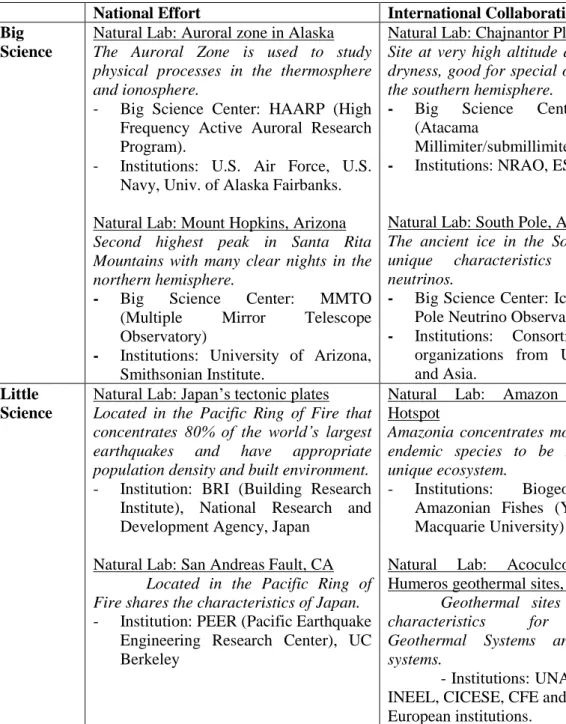
(13) 4 2.. NATURAL LABORATORIES BETWEEN UNIQUE ASSET, ‘BIG SCIENCE’ AND INTERNATIONAL COLLABORATION. For the purposes of this paper, we define Natural Laboratories (NLs) as sites with unique (or hardly-replicable) geographic characteristics that can provide comparative advantages for the study of particular scientific phenomena and the associated development of new technologies. Countries have different reasons for investing in developing and exploiting NLs. The advancement of science might appeal to both local and global actors, but may arguably hold more promise for developed nations with mature science systems and technology transfer opportunities, which might not be the case of the host country. For the host countries, on the other hand, the prime rationale for exploiting NLs may focus more on attracting foreign direct investment, increasing international reputation and cooperation, fostering opportunities for technological learning and capability building, and more long-term economic and social development. In the literature, the question of spillovers and long-term socio-economic development resulting from science initiatives has been discussed from various analytic perspectives. For the purpose of this paper, two analytic distinctions are particular relevant: first, the different effects resulting from ‘big science’ vs. ‘little science’ projects (de Solla Price, 1963; Weinberg, 1967); second, the different opportunities and trade-offs afforded by national vs. international projects. The term ‘Big Science Centers’ (BSCs) refers to large-scale scientific collaborations, usually involving massive infrastructure and large networks of scientists and collaborators (de Solla Price, 1963; Weinberg, 1967). From a technological perspective, BSCs are complex systems that include many technological subsystems with different degrees of modularization (Berger & Cozzens, 2009; Carillo & Papagni, 2014; Chompalov, Genuth, & Shrum, 2002; Jacob & Hallonsten, 2012; Martin & Irvine, 1981; Sussman, Dodder, McConnel, Mostashari, & Sgouridis, 2007). On the other hand, the term ‘Little Science’ is used to refer to individual research conducted at different universities or laboratories, which require small facilities and can be led by a single scientist or small group of researchers (de Solla Price, 1963; Ekers, 2009). Big Science Centers have been.
(14) 5 found to generate spillovers such as increased profits for industrial and technical contractors involved (Schmied, 1977, 1982); technological spin-offs and improved human capital (Martin & Irvine, 1981); and positive economic effects for the host or participating countries (Schmied, 1987). For example, Autio and colleagues (2004) found that industrial contractors of the European Organization for Nuclear Research (CERN) benefited from access to new networks, enhanced learning, improved reputation, and assistance on innovation processes (e.g. uncertainty reduction and complexity management). Also, knowledge production in universities and research centers generates knowledge spillovers that can improve innovative activity, especially in small firms since they do not have their own R&D laboratories (Audretsch & Feldman, 2004; Feldman, 1994; Zoltan, Audretsch, & Feldman, 1994). There remains, however, several gaps in the existing literature on the generation and distribution spillovers from Big Science projects. First, the literature BSCs is still fragmented and lacking coherent underlying theoretical frameworks (Autio, 2014). Second, most of the studies have focused on economic and knowledge spillovers, leaving aside institutional and cultural impacts. Third, from an empirical perspective, CERN has received disproportionate attention from researchers, serving somewhat as a model case for Big Science (cf., (Byckling, Hameri, Pettersson, & Wenninger, 2000; Giudice, 2012; Vuola & Hameri, 2006)). This focus is at present not balanced by similar attention to Big Science efforts elsewhere, especially in developing countries. What is more, as a highly political project from the post-WWII era located between France and Switzerland, CERN is everything but a ‘natural’ laboratory. Finally, the question how host countries from the Global South could mobilize Big Science to shape national innovation systems remains unexplored. In terms of internationalization, many authors have pointed out the increasingly globalized nature of science and technology (Bozeman, 2000; Bozeman, Fay, & Slade, 2013; Lee & Lim, 2001; Wagner, 2005; Wuchty, Jones, & Uzzi, 2007), which has led new organizational forms, benefits and challenges. International linkages provide access to scientific and technical networks and funding to scientists and organizations (Dietz & Bozeman, 2005; Subramanyam, 1983); foster knowledge and technology transfer (Autio et al., 2004; Bozeman, 2000; Bozeman, Rimes, & Youtie, 2015; Reddy & Zhao, 1990); offer.
(15) 6 opportunities for capability building and technological learning (Amsden, 2001; Keller, 1996; Kim, 1997, 1999; Lee & Lim, 2001; Wei, 1995; Pfotenhauer et al. 2016); and can be purposely developed to shape the research focus of scientists and institutions (Hird & Pfotenhauer, 2017). International linkages are particularly important for developing countries, which are frequently forced to rely on capital and knowledge from abroadu (Amin, 2004; Loebis & Schmitz, 2005; Pietrobelli & Rabellotti, 2006). International collaborations are thus a mean to participate in, and eventually overcome, the unequal global geography of research and innovation (Freeman & Hagedoorn, 1994; Keller, 2004; Contreras-Romero, 2018). While scientific and technological activities might be international, spillovers are typically geographically bounded. The economic geography and regional economics literature stress the importance of geographical proximity in the generation of knowledge spillovers (B. Z. J. Acs, Audretsch, & Feldman, 1992; Z. J. Acs, Audretsch, & Feldman, 1994; Audrestch & Feldman, 1996; Audretsch & Feldman, 2004; Feldman & Audretsch, 1999; Jaffe, 1989; Saxenian, 1994; Storper & Harrison, 1991), especially when knowledge is tacit (Dosi, 1988; Polanyi, 1966; Winter, 1987). When scientific endeavors are geographically bound, local factors acquire importance on how spillovers are generated, distributed, and captured. Some of these factors are the level of human capital (Keller, 1996; Mason, 2008), the technological sophistication and absorptive capacity of the firms (Baker, Miner, & Eesley, 2003; Cohen & Levinthal, 1990; Kim, 1997), the presence of technological clusters (Boschma & ter Wal, 2007; Giuliani, 2007; Giuliani & Bell, 2005), presence of government R&D programs and their design (Feldman & Kelley, 2006) and the development level of scientific infrastructure and institutions (Altenburg, 2011; Audretsch & Feldman, 2004; Feldman & Audretsch, 1999; Intarakumnerd & Vang, 2006; Lundvall, Intarakumnerd, & Vang, 2006). In summary, spillovers from NLs might be contingent on the level of development of NIS of the host country. We recognize that the distinctions between ‘big’ and ‘small’ or ‘national’ and ‘international’ can be blurry and may ultimately be somewhat arbitrary. Nevertheless, they provide a useful grid for clustering NL cases in a way that illustrates salient differences in design, scientific rationales, and operational practice. We summarize these differences and some examples in a 2x2 matrix in Figure 2-1..
(16) 7. Big Science. Little Science. National Effort Natural Lab: Auroral zone in Alaska The Auroral Zone is used to study physical processes in the thermosphere and ionosphere. - Big Science Center: HAARP (High Frequency Active Auroral Research Program). - Institutions: U.S. Air Force, U.S. Navy, Univ. of Alaska Fairbanks.. International Collaboration Natural Lab: Chajnantor Plateau, Chile Site at very high altitude and with high dryness, good for special observation in the southern hemisphere. - Big Science Center: ALMA (Atacama Large Millimiter/submillimiter Array) - Institutions: NRAO, ESO, NAOJ. Natural Lab: Mount Hopkins, Arizona Second highest peak in Santa Rita Mountains with many clear nights in the northern hemisphere. - Big Science Center: MMTO (Multiple Mirror Telescope Observatory) - Institutions: University of Arizona, Smithsonian Institute. Natural Lab: Japan’s tectonic plates Located in the Pacific Ring of Fire that concentrates 80% of the world’s largest earthquakes and have appropriate population density and built environment. - Institution: BRI (Building Research Institute), National Research and Development Agency, Japan. Natural Lab: South Pole, Antarctica The ancient ice in the South Pole has unique characteristics to observe neutrinos. - Big Science Center: Ice Cube South Pole Neutrino Observatory - Institutions: Consortium of 49 organizations from USA, Europe and Asia. Natural Lab: Amazon Biodiversity Hotspot Amazonia concentrates more than 1500 endemic species to be studied in a unique ecosystem. - Institutions: Biogeography of Amazonian Fishes (Yale, UFAM, Macquarie University). Natural Lab: San Andreas Fault, CA Located in the Pacific Ring of Fire shares the characteristics of Japan. - Institution: PEER (Pacific Earthquake Engineering Research Center), UC Berkeley. Natural Lab: Acoculco and Los Humeros geothermal sites, Mexico Geothermal sites with unique characteristics for Enhanced Geothermal Systems and super-hot systems. - Institutions: UNAM, UMSNH, INEEL, CICESE, CFE and more than 20 European institutions.. Figure 2-1. Examples of exploitation of Natural Laboratories. The lower left quadrant of Figure 2-1 corresponds to national efforts aimed at exploiting NLs via Small Science projects. Two examples are the Building Research Institute (BRI) of Japan and the Pacific Earthquake Engineering Research Center (PEER) headquartered at the University of California, Berkeley. Both Japan and California are.
(17) 8 located in the Pacific Ring of Fire, which concentrates over 80% of the world’s largest earthquakes (USGS, 2013). While several other countries share this condition, the population density and the built environment of Japan and California make them unique places for advancing seismic engineering. California, for example, concentrates 75% of the seismic risk of the United States (Pacific Earthquake Engineering Research Center, n.d.). Both Japan and California are taking advantage of their NLs, albeit in different manners. The BRI is a government-run institution with more than 70 years of history conducting R&D to improve building and urban development. BRI employs approximately 50 researchers who carry out several research projects in collaboration with local industry and academia. California’s PEER was established as a consortium of nine West Coast Universities in 1996 and gained status as a National Science Foundation Engineering Research Center in 1997. In addition to the eleven core universities, PEER involves six other educational affiliates and about 20 industry partners. PEER conducts research, education, and technology transfer through a range of programs and projects assigned to individual or small groups of researchers. At the lower right hand of Figure 2-1 we can find NLs exploited via international collaborations involving several “little science” projects. One example is the Amazonia biodiversity hotspot, which concentrates more than 1500 endemic species (Marchese, 2015; Mittermeier et al., 2004). The program “Biogeography of Amazonian Fishes” seeks to analyze the evolution and distribution of fish species in the Amazon Basin, and to do so it provides small grants to a network of researchers from several international universities. Other examples are the Acoculco and Los Humeros geothermal sites in Mexico. A team of Mexican and European researchers formed a consortium to develop Enhanced Geothermal Systems (EGS), through eight “little science” work packages (Reinsch et al., 2017; Romojones, Flores-armenta, García, Gutiérrez-negrín, & del Valle, 2017). At the upper left hand of Figure 2-1 we can find national efforts to exploit NLs via Big Science projects. One example is the Auroral Zone in Alaska, which is ideal for studying physical processes in the thermosphere and ionosphere since solar wind particles cross this region (Bertell, 1996; Papadopoulus et al., 1990). To study this phenomenon the U.S. Air Force, Navy, and the University of Alaska at Fairbanks (UAF) built the High Frequency Active Auroral Research Program (HAARP), consisting of 180 high-power,.
(18) 9 high-frequency antennas, which can be classified as “Big Science”. Mount Hopkins in Arizona is another example of a national effort to exploit a NL exploited through a BSC. This site is suited for space exploration since it is the second highest peak in the Santa Rita Mountains; it is a dry and dark site offering many clear nights during the year. During the 1960s, the University of Arizona and the Smithsonian Institute built the Multiple Mirror Telescope (MMT), which demanded heavy technological and scientific efforts and massive investments from a single country to achieve its scientific goals (Beckers et al., 1981). Finally, at the upper right hand of Figure 2-1 we can find examples of NLs exploited via international collaborations involving Big Science projects. One example is the Chajnantor Plateau, in the Atacama Desert in Chile. This site was selected for installing the Atacama Large Millimeter/submillimeter Array (ALMA) consisting of 66 mobile antennas, between 7 and 12-meters of diameter each. ALMA is the largest interferometer ever built, requiring a joint investment of US$1.5 billion from the National Radio Astronomy Observatory (NRAO) of the United States, The European Southern Observatory (ESO), and the National Astronomical Observatory of Japan (NAOJ) (Brown, Wild, & Cunningham, 2004; Wooten & Thompwon, 2009). Another example of a NL hosting an international Big Science Center is Antarctica, where the Ice Cube South Pole Neutrino Observatory was built in 2010. This observatory required US$279 million in funding, involved around 300 engineers and scientists from 49 institutions in 12 countries (IceCube South Pole Neutrino Observatory & University of Wisconsin Madison, n.d.). Our focus in this paper are NLs that involve both Big Science efforts and international collaboration (i.e. upper right quadrant in Figure 2-1). We use the Chilean astronomy cluster as a case study to investigate how such NLs can serve to create local spillovers in a developing country context, emphasizing the challenges and opportunities arising from large scale and internationalization. Section 4 will provide an in-depth historical overview of the development of the cluster..
(19) 10 3.. METHODOLOGY. The goal of this paper is to inductively build a theoretical framework for NLs based on previous literature and frameworks. We use an in depth-case study approach (Yin, 2009; Eisenhardt, 1989) to capture the richness of complex processes involved in the generation of spillovers. Our empirical material consists of 43 semi-structured interviews, document research (e.g. policy reports, strategy documents and media reports), limited scope ethnographic observations, and statistical analysis of data from national and local organizations. For the interviews, we used a theoretical sampling approach (Eisenhardt, 1989) to choose participants, covering the following stakeholder groups: -. Government agencies, which provide the institutional and legal setting, and negotiate international agreements.. -. Observatories in different stages of development, different sizes, belonging to different organizations that conduct both optical, infrared, and radio astronomy.. -. Universities with astronomy departments and laboratories to assess collaborations and spillovers.. -. Firms that have collaborated with astronomical observatories at different technology levels in order to analyze knowledge and technology transfer.. -. Individuals who have worked in astronomy and are currently working in other areas to analyze human flows and training benefits. During the semi-structured interviews, a conversation guide was used to ensure that. all issues of interest were covered while keeping flexibility to tailor questions depending on the interviewee’s responses. The length of the interviews varied between thirty minutes to two hours, and were scheduled in advance, digitally recorded, and transcribed. During the interviews, we additionally took handwritten notes to add information to the transcripts. data were analyzed using two-phase coding techniques (Saldaña, 2009) employing MAXQDA 12 software. Interviews were conducted between 2015 and 2017. Table 3-1 summarizes the number of interviews conducted and the organizations involved. No further detail on interviewees can be given due to confidentiality agreements..
(20) 11. Table 3-1. Summary of interviews conducted. Sector Observatories. Number of Interviews 8. Details of interviewees. Organizations. Heads of observatories, Astronomers, Engineers, Software directors, Human Resources managers. Astronomers, heads of astroengineering laboratories, software and electrical engineers.. ALMA, Gemini South, CTIO, GMT, E-ELT.. Universities. 10. Government. 5. Energy, science and technology and innovation division, Industrial Liaison Office, Atacama Astronomical Park managers, Smart Industries project developers.. Industry. 16. International Organizations. 4. CEO of firms that collaborated with observatories, software engineers that worked in observatories, astronomers working in industry, CEO of firms with astronomers. Head of the organizations, project managers.. Total. 43. Pontificia Universidad Católica de Chile (PUC), Universidad de Chile (UCH), Universidad de Concepción (UdC), Universidad de Antofagasta, Universidad Católica de la Santísima Concepción, Universidad de Valparaíso, Universidad Técnica Federico Santa María (UTFSM) Ministry of Foreign Affairs, Ministry of Economy, Production Development Corporation (CORFO), and National Commission for Scientific and Technological Research (CONICYT). Media Lario, Astaldi, MTMecatrónica, Dimension Data, Metricarts, Arcadis, Spotify, Amazon, DNA CSEM, INRIA, Andes Scientific Instruments. ESO, AURA, National Radio Astronomy Observatory (NRAO).. In addition, data were collected at different gatherings and activities related to the Chilean astronomy ecosystem by limited-scope ethnographic observations. For example, we attended the III Astro-engineering workshop, which brought together universities, observatories and firms to look for collaboration opportunities; and attended the Chajnantor Working Group, an annual meeting between ALMA and other observatories.
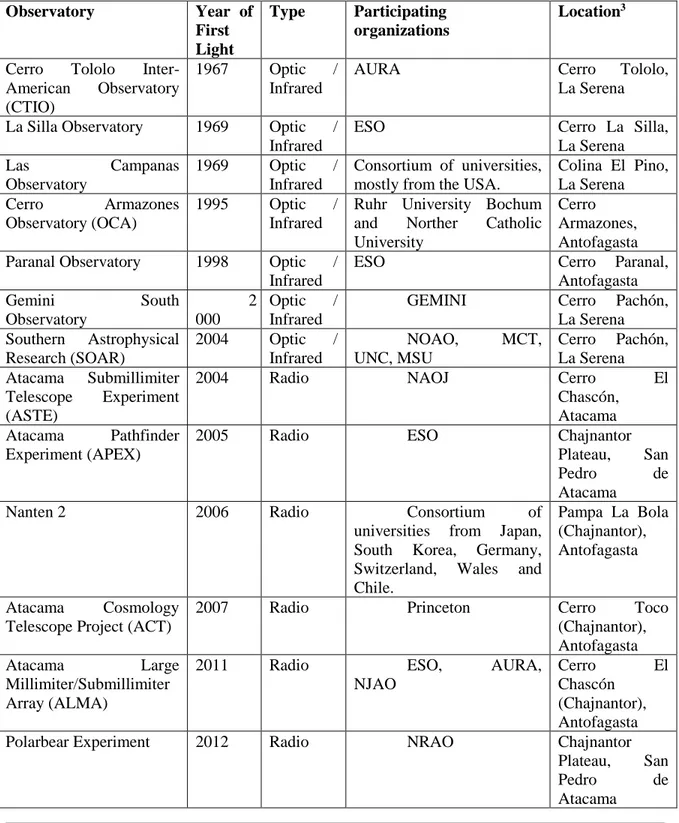
(21) 12 including universities, government and local communities. Field notes were kept and included in coding and analysis for each meeting and conversation. Interviews and observational data were triangulated with documental and statistical data obtained from different sources including public reports from observatories and government organisms. Triangulation was conducted to assure the quality of the qualitative methods used in this study (Eisenhardt, 1989; Roulston, 2010)..
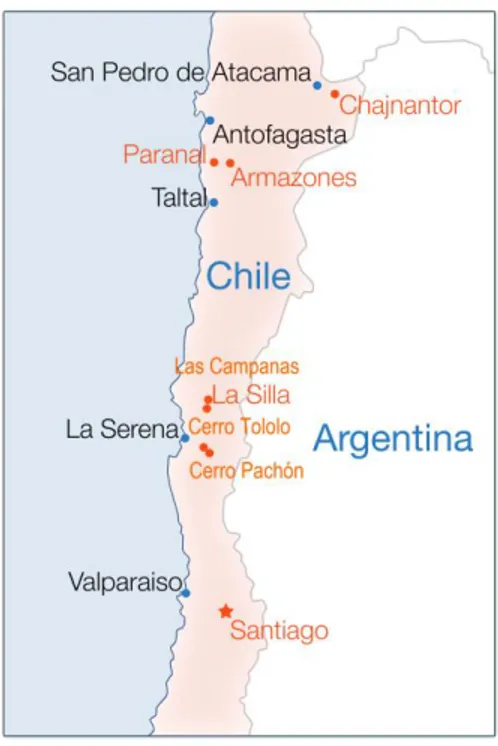
(22) 13 4.. THE ATACAMA DESERT: A NATURAL LABORATORY FOR ASTRONOMY RESEARCH AND TECHNOLOGY DEVELOPMENT. 4.1. History of the Chilean astronomy cluster. In In 1847, an expedition from the United States first brought astronomical instruments to Chile, launching an era of astronomical observations that would shape the nation until the present day. The Chilean government bought those instruments in 1852 and established the National Astronomical Observatory (OAN1) on the mountaintop of the Santa Lucía hill in Santiago, the capital of Chile. In 1927 the OAN was transferred from the Ministry of Public Instruction (currently the Ministry of Education) to Universidad de Chile. In 1965 the OAN became the Astronomy Department in the Universidad de Chile. The optical observations carried out by the OAN were complemented, in 1959, with the first radio telescope in Chile and South America. Federico Rutllant, OAN’s director from 1950 to 1963 acknowledged Chile’s exceptional characteristics for astronomy and invited astronomers from the US and other countries to start an international collaboration and attract larger observatories. In 1967, the Association of Universities for Research in Astronomy (AURA) established the Cerro Tololo Inter American Observatory (CTIO), based on a collaboration between North American and Universidad de Chile, which provided the starting point for Chile’s modern astronomy through several international flagship collaborations. In the late 60s, scientists from the northern hemisphere began to pay increasing attention in the Atacama Desert, located between the northernmost Chilean cities of AricaParinacota and the Coquimbo Region (see Figure 4-1) as a potential prime site for astronomical observations. In 1969, the European Southern Observatory (ESO) established its first so-called “La Silla” observatory in Atacama, in the same manner as the Carnegie Institution for Science (CIS) with the “Las Campanas” Observatory. Ever since the US and European observations began operations in the 60s, the quality of the Chilean skies begun.
(23) 14 to get great reputation by the international community. During the 70’s Chile already hosted the largest telescopes in the southern hemisphere, namely the CTIO 4 meter and the La Silla 3.6 meter telescope. The next generation 8-10 meter class telescopes began to be planned and certainly Chile offered one of the most attractive sites for their installation. A few years had to elapse from the beginning of the operation of the Very Large Telescope (VLT) in 1998 (4 x 8.2 m telescopes) on Cerro Armazones, GEMINI South in 2000 (8.1 m) on Cerro Pachón, and the Magellan telescopes (2 x 6.5 m) on Las Campanas in 2000 and the ALMA millimeter/submillimeter interferometer in 2011. By 2016, there were 18 scientific observatories2 operating or being constructed in Chile, and several new projects were being planned. Table 4-1 summarizes all the observatories, their first light, type, sponsoring organizations, and locations.. Figure 4-1. Observatories' locations. Source: European Southern Observatory.. 1. Observatorio Astronómico Nacional, in Spanish..
(24) 15 Table 4-1. Observatories operating and being built in Chile. Observatory. Year of Type First Light Cerro Tololo Inter- 1967 Optic American Observatory Infrared (CTIO) La Silla Observatory 1969 Optic Infrared Las Campanas 1969 Optic Observatory Infrared Cerro Armazones 1995 Optic Observatory (OCA) Infrared Paranal Observatory Gemini South Observatory Southern Astrophysical Research (SOAR) Atacama Submillimiter Telescope Experiment (ASTE) Atacama Pathfinder Experiment (APEX). 1998. 000 2004 2004. Radio. 2006. Radio. Atacama Cosmology 2007 Telescope Project (ACT). Radio. Atacama Large 2011 Millimiter/Submillimiter Array (ALMA). Radio. Polarbear Experiment. Radio. Nanten 2. 2. 2012. / AURA. Cerro Tololo, La Serena. / ESO. Cerro La Silla, La Serena Colina El Pino, La Serena Cerro Armazones, Antofagasta Cerro Paranal, Antofagasta Cerro Pachón, La Serena Cerro Pachón, La Serena Cerro El Chascón, Atacama Chajnantor Plateau, San Pedro de Atacama Pampa La Bola (Chajnantor), Antofagasta. / Consortium of universities, mostly from the USA. / Ruhr University Bochum and Norther Catholic University / ESO. Optic Infrared 2 Optic / GEMINI Infrared Optic / NOAO, Infrared UNC, MSU Radio NAOJ. 2005. Location3. Participating organizations. ESO. MCT,. Consortium of universities from Japan, South Korea, Germany, Switzerland, Wales and Chile. Princeton Cerro Toco (Chajnantor), Antofagasta ESO, AURA, Cerro El NJAO Chascón (Chajnantor), Antofagasta NRAO Chajnantor Plateau, San Pedro de Atacama. An observatory can host one or more telescopes. For example, Paranal hosts the four VLT telescopes, as well as other several survey telescopes such as the CST and VISTA. 3 The Atacama Desert covers a surface of 105.000 km2 and goes from 18°24’S to 29°55’S, including several administrative regions in Chile..
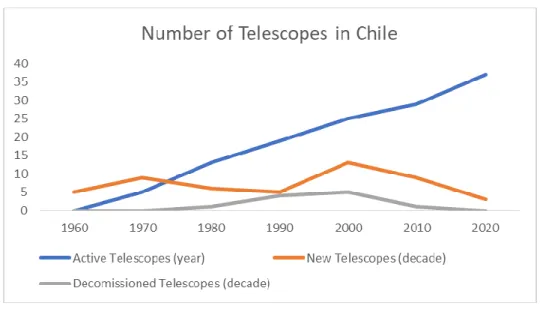
(25) 16 Tokyo Atacama 2018* Observatory (TAO). Optic / Infrared. University of Tokyo Chajnantor Plateau, San Pedro de Atacama Large Synoptic Survey 2019** Optic / AURA Cerro Pachón, Telescope (LSST) Infrared La Serena Giant Magellan 2021** Optic / Consortium of Cerro Las Telescope (GMT) Infrared universities, mostly from Campanas, La the USA. Serena Cornell Caltech Atacama 2021** Radio Consortium of Chajnantor Telescope (CCAT) universities from the USA, Plateau, San Germany and Canada Pedro de Atacama European Extremely 2022** Optic / ESO Cerro Large Telescope (E-ELT) Infrared Armazones, Antofagasta Cherenkov Telescope 2025** Gamma Consortium with Cerro Paranal, Array (CTA) rays more than 200 universities Antofagasta and institutes over 31 countries. * The miniTao, a 1m mirror telescope, is operating in this site since 2009 as a pilot telescope. ** These are estimated years for the first light of the observatory.. The growing number of observatories operating in Chile has led to a global recognition of the Atacama Desert as a unique cluster of telescopes, sophisticated instruments and state-of-the-art technologies, colloquially referred to the “World capital of Astronomy”. Figure 4-2 shows that the number of active telescopes has increased linearly since 1960. The installation of new telescopes happened in two clear peaks: the 1970 and 2000 decades, owing to the time needed to develop the novel technologies required to take the leap to the new large-scale telescopes- In parallel to the new developments, older telescopes were decommissioned..
(26) 17. Figure 4-2. Evolution of the astronomy cluster in the Atacama Desert. Since the beginning of modern astronomy in Chile in the 1960s, Chilean universities began to develop endogenous capacities for astronomical research, in tandem with the growing foreign astronomical activities in the country. In 1965, Universidad de Chile founded the first astronomy department collaborating with the OAN and launched the first local undergraduate degree in astronomy. Several decades later, Universidad Católica de Chile (PUC)4 opened the second undergraduate program in astronomy in 1998. Today, there are nine Chilean universities with undergraduate programs in astronomy, thirteen universities with astronomical centers, and ten research groups developing components for astronomical instruments and observatories. For Chile as an emerging science nation, research related to the observatories has been central in shaping the national agenda and global perception as the capital of astronomy. Research associated with the observatories represented 9.4 percent of the total Chilean scientific output (papers) between 1984 and 2003. Astronomy is the discipline with the highest citation impact in Chile (Contreras, Edwards, & Mizala, 2006). Several major scientific breakthroughs have come from data collected in Chile, and involving Chilean scientists. An eloquent example is the revolutionary discovery in 1998 of the 4. There was an astronomy and astrophysics group in the PUC since 1982, but it was inside the Physics department and the Astronomy specialization was a Master’s degree..
(27) 18 accelerated expansion of the Universe and the dark energy, made by two teams including Chilean, American and European astronomers, and based on data collected with the CTIO Blanco 4m telescope, the CTIO Curtis-Schmidt camera (cf. below), as well as telescopes at La Silla and Paranal in Chile (Knop et al., 2003; Perlmutter et al., 1998, 1999, Riess et al., 1998, 2004; Tonry et al., 2003). This revolutionary discovery led to award in 2011 of the Nobel Prize in Physics to three American Astronomers: Saul Perlmutter, Brian Schmidt and Adam Riess. More recently, a Chilean astronomer became the first to observe the light emitted by the collision between two neutron stars (kilonova) from Las Campanas Observatory, which was an important milestone in providing an additional stringent confirmation for Einstein’s Relativity Theory under extreme conditions (Kilpatrick et al., 2017). Other important breakthroughs involving Chilean astronomers include: the first observation of an exoplanet (Chauvin et al., 2004); the most populated Earth-sized and possibly habitable planetary system (Gillon et al., 2017); the first cosmic temperature measurement (Noterdaeme, Petitjean, Srianand, Ledoux, & López, 2011; Srianand, Noterdaeme, Ledoux, & Petitjean, 2008), the closest habitable exoplanet (Anglada-Escudé et al., 2016), among many others.. 4.2. Local Spillovers from the Chilean astronomy cluster. Our research indicates that the growing cluster of observatories in Chile has generated significant institutional, knowledge, economic, and cultural spillovers over time. Institutional spillovers refer to the establishment of rules and laws, the creation of organizational units, and/or changes in government budgets directly associated with astronomy activities. Knowledge spillovers refer to knowledge creation and transfer, capacity-building, and human resources related to astronomy and telescope infrastructures, including operation and data collection. Economic spillovers are financial impacts arising directly from activities in the astronomical cluster, including foreign direct investment, creation of firms, and creation and retention of high-skilled human capital. Cultural.
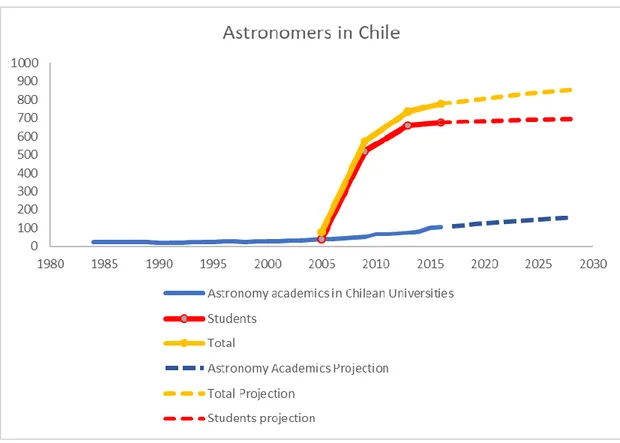
(28) 19 spillovers refer to changes in beliefs, values, and practices both of the population and the scientific community (Guiso, Sapienza, & Zingales, 2006; North, 1990). In this section we detail how these spillovers are intertwined, and how they feedback into each other reinforcing the growth of the observatory cluster. In addition, we will show how spillovers are related to technological learning and institutional development in Chile at large.. Institutional Spillovers. Historically, Chile has used two main policy strategies to attract observatories and take advantage of these massive investments in technology: the ‘10% rule’ and the creation of the Atacama Astronomical Park. The '10% rule’ was an idea of the Universidad de Chile (UCH), which in 1964 negotiated with AURA the conditions for the installation of the Cerro Tololo Interamerican Observatory (CTIO). It states that 10% of the observation time is reserved for local astronomers affiliated to Chilean institutions (regardless of the passport of the researcher) in each telescope of the AURA observatory. In return for this 10% observation time, the government provides other benefits to AURA, such diplomatic status for astronomers and tax-free policies for importing astronomy equipment. It is interesting to note that about the same time, the Chilean government signed a treaty with ESO to allow the installation of the La Silla observatory. The original treaty did not mention a percentage of observing time for local astronomers, which led in 1996 to update the treaty and include an explicit clause (Ministerio de Relaciones Exteriores, 1996). This later amendment shows how Chile began to think more strategically about astronomy as an asset, and how institutions and policies are adapted in response to private agreements between players. Second, the Atacama Astronomical Park is a policy initiative to facilitate the installation of new observatories at the Chajnantor Plateau of Atacama. It aims at providing a fast track for observatories to become operational without all the heavy international negotiations that a full land concession requires. It also allows observatories.
(29) 20 to start their construction and operation while they still negotiate full concessions. Nowadays there are four observatories in the Atacama Astronomical Park. Incentives for observatories provided by Chile, besides exceptional geographical conditions, are tax exemptions, diplomatic status, the granting of land at no cost, and light contamination protection laws. In return to these benefits, the observatories that operate in the Park must contribute 10% of the observing time to local scientists and an annual fee. The latter is for purpose of: (1) sharing the administration costs of the Park, (2) carrying out educational programs in benefit of the local communities, and (3) contribute to the CONICYT fund for the development of astronomy and related technologies. The arrival of more observatories in the 1990s contributed to the evolution of Chile’s national institutional framework and influenced government’s priorities in science. Gradually, the Chilean government began to actively promote initiatives to facilitate coordination among the astronomy community and strengthen the observatory cluster through dedicated institutional and legal developments. Key initiatives included the passing of the Light Pollution Protection Law (1998), the creation of the Division of Energy, Science and Technology (DECYTI) at the Ministry of Foreign Affairs (2006), the creation of an Industrial Liaison Office for Astronomy at the Ministry of Economy (2012), and the creation of an Astroinformatics Program by the Chilean Innovation Agency (2017), among others. Moreover, policy-makers gradually introduced instruments of “forced collaboration” between international and local partners. An interviewee explained about the Atacama Astronomical Park: “Each project must sign a scientific collaboration agreement with some regional university in astronomy or related sciences”. The government also used opportunities for reviewing existing protocols and agreements to derive more benefits for local science. For example, the negotiations with ALMA, Gemini South, ESO and the Chinese Academy of Science led to the establishment of research funds for Chilean astronomers5. As the number of observatories in Chile grew, so did the astronomy community. Growth in human capital generated bottom-up pressure for budget and new regulations.. ALMA – CONICYT Fund for the development of Chilean Astronomy has given USD$ 3.620.000 with an average of USD$ 517.000 per year. GEMINI-CONOCYT fund for the development of astronomy and 5.
(30) 21 For example, the growth of the astro-engineering community led to an expansion of research funds for engineering. In 2012, the Chilean Science and Technology Agency (CONICYT) created the QUIMAL Fund with the specific purpose of developing astronomical instruments, thus enabling steady funding source for astro-engineering, which is independent from the procurement policies of the observatories. The nature of the institutional spillovers also evolved over time in response to the technological advances. For example, the Large Synoptic Survey Telescope (LSST) will take images of the universe every 15 seconds, each one consisting of 3.2 billion pixels (Ivezic et al., 2008), and is committed to grant immediate public access to all the data obtained (Dubois-Felsmann, Ivezic, & Juric, 2018). For survey instruments such as LSST, the 10% observation time for Chilean astronomers does not make sense. The host country is therefore exploring other mechanisms to benefit from survey data6, instead of the traditional ones, such as the creation of a Global Data Observatory (GDO) to store both current and historical observational data. The goal of the GDO is to leverage astronomy as a vehicle to develop domestic capabilities in the field of Big Data.. Knowledge Spillovers. Human resource formation. Knowledge spillovers manifest on various levels. First is the accumulation of the human capital needed to participate in the technological developments. One indication of available specialized human capital is the number of astronomers and students. According to data provided by The Chilean Astronomy Society (SOCHIAS), in 2001 Chile had less than 30 astronomers. Moreover, in 1998, there were only two academic programs offering astronomy and related engineering training. This trend changed dramatically with the related sciences has given USD$ 2.722.230 with an average of USD$ 545.000 without considering three years where data was not available and approximating values with 1$USD = USD$638. 6 According to CORFO’s Astroinformatics Program, the volume of astronomical data produced by observatories in Chile will grow from ∼1 Pb/year today, to ∼20 Pb/year in 2021 (CORFO, 2018).
(31) 22 major developments in the Atacama region since the beginning of operations of the VLT, Gemini and Magellan operations around year 2000, and more recently with ALMA launch in 2011. By 2016 there were 104 astronomers working in 13 universities, and approximately 900 people working directly in astronomy including astronomers, students, postdocs, and researchers. Figure 4-3 shows the evolution in the number of astronomers and students of astronomy in Chile. As shown in this figure, there has been a significant increase in the number of students since 2005. Government and universities’ interviewees, however, mentioned that the growth rate is well above the growth in new academic positions. The limits on the insertion of human capital by the astronomy sector suggest an S-shape curve in the growth of astronomers, as shown in the figure below.. Figure 4-3. Astronomers in Chile. Self-elaborated with data from the SOCHIAS. Students include undergraduate, MSc. and PhD.. Human capital development is catalyzed by three factors: The technological infrastructure of the country (including observatories), which provide work and research.
(32) 23 opportunities; the presence of networks and trust within the astronomy community, which provides access to those opportunities; and increases in science awareness among the population, which increases the flow of students to astronomy. The growth in the number of telescopes is increasing the demand for human capital, accelerating its formation at universities. Since grant allocations and university evaluations depend on publication records, some institutions have opened or expanded their astronomy departments as means of increasing their scientific productivity at a relatively low cost: more observatories mean more observation time and data for Chilean astronomers. Frequently, the formation of human capital is the direct result of people working directly in the operations of observatories receiving training and learning new technologies. ALMA Computing, for example, has been working with faculty and students at Universidad Técnica Federico Santa Maria’s Computer Systems Research Group (CSRG) training new engineers. ALMA not only offers summer internships and thesis guidance to students, but also, provides opportunities for students to work side-by-side with professional engineers. This collaboration is strategic for ALMA as most of its engineering staff are Chileans (Mora et al., 2010). Another example of human capital development induced by observatories is the La Serena Data Science Winter School hosted by CTIO. Each year a group of Chilean and International students is trained in applied tools for astronomy and data-driven sciences, with the support of the National Science Foundation (NSF) and CONICYT (Association of Universities for Research in Astronomy, 2018). Conversely, growth in human capital indirectly benefits the technological capabilities and infrastructures of the region. With the growth of the astronomy cluster and available workforce, the Chilean government has taken steps to leverage astronomy to improve the technological infrastructure of the country. An example is a current effort to build data processing centers for astronomy. ALMA generates around one terabyte of data per day and the LSST is projected to generate around 20 terabytes daily. There are two main initiatives towards this direction: the Chilean Virtual Observatory (ChiVo) and the Global Data Observatory. The goal of these initiatives is to leverage the large amount of data that is being (and will be) produced by astronomy to generate data science capabilities and to attract investments in data storage and processing infrastructure. In this sense, the.
(33) 24 formation of human capital can be self-reinforcing through the creation of novel organizations that in turn contribute to human capital. Second, human resource formation depends on international networks and trust. For example, Arcadis, a Chilean engineering services company began performing small geological studies for ESO. Later, they obtained a larger project with the LSST for assessing the soil in which the observatory will be placed. As confirmed by several interviewees, through this project, the company gained visibility within the LSST network—earning their trust—thanks to which they were later invited to design and construct the building for LSST.. Technology creation and knowledge transfer. The creation of new observatories—or the upgrade of existing ones—involves the development of novel technologies. From a spillover perspective, this technology development is where most of the knowledge creation happens, which in turn may allow countries involved in their development to accumulate expertise and potentially transfer it to other sectors of their national economy. For example, the Chilean firm MetricArts, which specializes in business analytics and data and video analysis for retail, hired astronomers to develop image-processing technology as the algorithms and programming language used by astronomy were similar to their needs. In the words of a manager: “We investigated technologies used for image recognition and discovered that they required GPU processing. We found that the market leader was Nvidia and that they had a framework called CUDA. After some research, we found that astrophysicists were the ones that knew best how to use this technology, which is why we hired them.” In international collaborations such as the ones found in Chile’s astronomy cluster, participating member states demand that part of these technologies be developed in their own countries in return for funding (i.e. a form of industrial return policy), to reap both knowledge and potential economic spillovers. In some cases, only universities and/or firms.
(34) 25 from the countries that fund the observatory can participate in technology procurement processes (i.e. pay-to-play). Up to this point, Chile has generally not been involved in many procurement-driven technological developments, and has not been considered as funding technology development by the international observatories. Noteworthy exceptions exist, however. One is the participation of Universidad de Chile (UCH) in the development of ALMA’s antennas to detect frequencies between 35 to 50 GHz (Band 1)7. While developing this technology, researchers found additional uses. For example, they created a camera that creates a map of the radiation emitted by mobile phones and Wi-Fi/Bluetooth enabled devices, which can help in rescue missions. Another use researchers are exploring is the detection of humidity in wood, important for the logging industry. Other example of Chilean laboratories developing astronomical instrumentation include the Astroengineering Center from Pontificia Universidad Católica de Chile (AIUC), which is developing a Multi Object Optical and Near-infrared Spectrograph (MOONS) for the Very Large Telescope (VLT). University laboratories have been typically formed by Chilean academics and students that that have previously worked with or within an observatory. As described by an interviewee: “Initially we were about five or six [scientists], now we are more than eight, that worked in radio telescopes and perfected our skills to then be transferred to universities and create astro-engineering laboratories [e.g. Laboratories at Universidad Católica de la Santísima Coincepción and Universidad de Concepción]”. Moreover, the technological characteristics of the telescope itself have implications for local technology development and transfer. When telescopes have a modular architecture—i.e. they can change parts or instruments to accomplish different scientific— the possibilities of knowledge spillovers increase as a steady stream of novel cutting-edge instrumentation is being developed throughout the lifetime of the telescope. For example, GEMINI South has already retired ten (modular) instruments since its first light8 and has a plan to decommission and replace additional ones. This has created opportunities both for Chilean engineers and astronomers working on site as well as researchers at universities to. 7. ALMA has 10 frequency bands ranging from the 35 GHz to 950 GHz. Bands 1 and 2 are currently under development. 8 For more information check https://www.gemini.edu/sciops/instruments/.
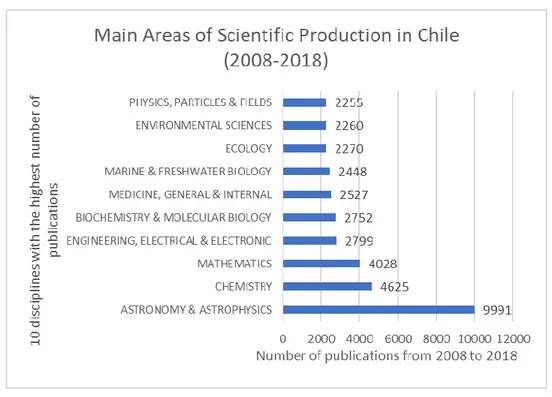
(35) 26 participate in new technology developments. Technological obsolescence, on the other hand, acts as an inhibitor of knowledge spillovers as it reduces the timespan for possible updates. For example, the Cosmic Background Imager (CBI) had short lifespan as it was updated only once before other telescopes and technologies exceeded its capacity to produce frontier-pushing science. After nine years of operation CBI was decommissioned. In this case, opportunities for Chilean researchers to get involved were rather limited once the decision was made to build CBI abroad and retain the same configuration over its lifetime. Knowledge spillovers can be facilitated through the dedicated transfer of knowhow and best practices, e.g. through inter-organizational collaborations. ALMA, for example, required local teams to mount the European antennas. Chilean providers had knowledge from the mining industry in installing large machinery in similar ground conditions; however, they lacked knowledge on high-precision mounting. Therefore, MTMecatronica—a Chilean subsidiary of MT-Mechatronics of Germany—, was created to oversee the assembly, and capture new business opportunities in Chile, and had to train Chilean contractors to meet European standards. Without such dedicated transfer efforts, knowledge spillovers tended to occur in the geographical area where the technology or know-how was developed – which for the most part remains outside Chile. A natural experiment during the development of ALMA’s antennas helps to illustrate this point. Two consortia, one European and one Japanese, were assigned the construction of the same antennas. The Japanese’s antennas were completely built, mounted, and tested in Japan. Assembly and maintenance were also granted to Japanese firms, resulting in no spillovers in Chile. The European consortium, on the other hand, built all parts of the antennas in Europe but decided to assemble them in Chile with local contractors. In this case, we were able to detect technology and know-how transfer to the Chilean industry. Know-how and best practices transfer also depend on knowledge specificity. General-purpose knowledge is more likely to produce spillovers than specific—or niche— knowledge. Project management practices and software development are two generalpurpose knowledge domains likely to generate spillovers to other industries. Laser optics, on the other hand, might have fewer industrial applications. Thus, people working in the.
(36) 27 latter area are less likely to generate spillovers outside the astronomy community. The cases where we noticed people flowing outside the astronomy community were all on software development, data processing and project management. Finally, successful skill and practice transfer also creates new risks for the country in the form of brain drain, which in turn has implications for the retention of knowledge spillovers. If the region lacks a high-tech industry, people working in observatories or capable of developing sophisticated telescope instrumentation either will remain in astronomy or will migrate to other regions. For example, several Chilean software engineers trained at ALMA later migrated to Amazon, Spotify, DeNA and other high-tech companies in North America and Europe. As summarized by an interviewee: “If someone has the fortune of working in ALMA, I believe he will be overqualified for almost everything being done here in Chile. If he realizes how much he can earn in the international market, he would surely leave. The only thing that may tie those persons would be family or friends”. The exploitation of knowledge spillovers, therefore, is contingent on the technological capabilities of the region (i.e. its absorptive capacity).. Economic Spillovers and Industrial Development. Besides indirect effects through the training of high-skilled labor and technology development and transfer, the growth in the number of observatories has also fostered industrial development directly. There are three types of industrial spillovers: high-tech industries, service industries, and related industries. High-tech firms tend to localize where the technology is being developed, which has not occurred yet in Chile. We noticed, however, a nascent services industry that provides engineering and maintenance services to the observatories. For example, MT-Mecatronica after mounting ALMA’s antennas continued providing services to other observatories. Astronomy is also enabling the development of an astro-tourism industry. San Pedro de Atacama, near ALMA, and La Serena near CTIO and GEMINI are two cities where tours and visits to observatories can be arranged. By 2011 there were at least 11 astro-tourism operators and six observatories dedicated exclusively for tourism (Verde, 2013)..
(37) 28 Industrial spillovers are catalyzed by the growth in the observatory cluster; and by the creation of new firms, the diversification of existing firms, and the arrival of international firms related to the observatories. The creation of a high-tech industry in Chile is still in an embryonic stage as we only could observe a handful of high-tech companies related to astronomy. More industrial activity has taken place in engineering services and maintenance such AstroNorte, a company that provides logistics, food, and housing services for observatory personnel. Engineers that worked in observatories from the Chajnantor plateau formed this company. A third way industrial spillovers occur is by firms, which diversify to other high-tech sectors. MT-Mecatronica, for example, in addition to providing engineering services to ALMA, is also working with solar energy firms. In any case, evidence of industrial spillovers is still scant, though government interviewees believe there is potential for a high-tech cluster to emerge in the field of astrodata.. Cultural Spillovers and Social Capital. In his first presidential address, President Sebastian Piñera promised the nation to “enhance the condition of Chile as a country of Natural Laboratories, converting our Northern and Southern regions into the world's astronomical and Antarctic research capitals”9 (Piñera, 2018). This prominent mention of NLs is representative of the degree to which astronomy has become a cornerstone in Chilean science, public discourse, and identity. A government survey done in 2016 showed that 77% of the population was aware that Chile is a privileged place for observatories; 57% were able to correctly name an observatory, and 84% believed Chile is internationally renowned for its skies (Imagen de Chile, 2016)10. The public ranked Chilean skies as the fifth11 most representative element. 9. Data Scientists at Universidad de Chile analyzed the content of more than 500 speeches given by President Piñera (2010-2014 and 2018) and found this was the first time he pronounced the words “Astronomic Research” in an official speech. 10 The study included 6 focus groups in Santiago from three different socio-economic contexts and two different age groups. It also included a survey (n = 604) to people older than 18 in 6 regions randomized over a population of 9000 people. The error estimated is 5,7% with a 95% trust..
(38) 29 of the country—i.e. what first comes to their minds then talking about Chile—ahead of soccer, the country’s most popular sport12. At an international level, 2.8% in 2016 and 2.1% in 2017 of the news regarding Chile were related to science and technology; and from that percentage, 59.7% in 2016 and 55% in 2017 were about astronomy and physics (Imagen de Chile, 2017, 2018). Our research indicates that the consistent arrival of more telescopes and policies like the 10% play a key role in the social awareness of science, an increasing interest for STEM-related careers, and has been perceived to improve Chile’s international image. This is consistent with astronomy’s importance within science, being the area with the largest number of publications in the last 10 years, duplicating the second one that is chemistry, as we can see in Figure 4-4. Moreover, because of its public prominence, there has been a sense of cultural appropriation of astronomy as a decidedly national endeavor. As a government interviewee suggested, “astronomy is an opportunity to educate and attract youngsters to science and we want to make it a cultural good”. The cultural appropriation has been promoted through government-sponsored diffusion programs, including efforts like the Astronomy Day and Imagen de Chile’s campaigns. At present, the government is working with communities to build an astro-tourism cluster around the observatories in San Pedro de Atacama near the Chajnantor Plateau where ALMA is located and La Serena near CTIO and Gemini South, thus positioning Chile’s scientific activities as an attraction for global tourists in Latin America. In the communities themselves, the prominence of astronomy was further aided by scientists through outreach activities and public lectures regarding space exploration.. First is the Andes Cordillera, second is September 18 th Chile’s national day, third is wine, and fourth is Teleton. 12 This is interesting since soccer is a very popular sport in the country and Chile had recently won two America’s coups (2015 and 2016), the most important title that has earned the country in this sport. 11.
(39) 30. Figure 4-4. Percentage of the total publications in Chile of the 8 major scientific areas between 20082018. Data collected from CONICYT.. In our research, we found that public attention to astronomy significantly increased following the ‘first light’, inauguration of new telescopes, both nationally and internationally. For example, when ALMA was inaugurated in 201313 and began making discoveries, ‘science’ temporarily rose to the sixth most mentioned topic regarding Chile in the international press, out of which 67% were astronomy news (Imagen de Chile, 2014). In fact, the government is deliberately using science as a diplomatic tool to enhance Chile’s international image. As stated by high-ranking public official, “what we’ve been doing through the Ministry of Foreign affairs is to include astronomy as part of our international policy”. Observatories provide opportunities to build social capital. Working with observatories therefore provides reputational opportunities and prestige. For example, Arcadis construction company uses its experience in building the LSST for marketing and. 13. ALMA’s first light was in 2011, but its official inauguration was in 2013..
(40) 31 advertising what they did for the LSST to other customers: “even if it is not a very profitable business [astronomy], it gives us prestige”. Social capital spillovers are catalyzed by human capital and technological infrastructure development, the presence of international networks, and the growth of the observatory cluster. The existence of previous networks can give access to new projects that make possible the formation of new networks. Local astro-engineering laboratories, for example, have funded small projects to display their technological capabilities and build trust from the observatories. This social capital is key to be considered for new projects proposals and to participate in international consortia.. 4.3. A framework for the generation of spillovers in the Chilean Astronomy cluster. The systemic nature of spillovers is summarized in Table 4-2 which is organized as follows: First we classify spillovers along four broad categories: institutional, knowledge, economic and cultural (column 1). Each category is divided in different spillover types (column 2). Each category and type of spillover is numbered to show systemic interactions among them. Subsequent columns describe the processes that enable the generation of such spillovers and the drivers that influence their generation (columns 3 and 4). Finally, column 5 lists cases from interviewees as evidence.. Table 4-2. Framework for the generation of spillovers in the Chilean Astronomy Cluster. Category. Spillover Types. Enabling Processes. Drivers. Case Examples. 1.. 1a.- Rules and laws 1b.Bureaucracy 1c.- Budget. -. -. 1a.- 10% observation time 1a.- Light pollution protection law 1b.- Industrial Liaison office at the Ministry of Economy 1b.- Atacama. Institutional spillovers. Negotiation Government Initiatives. -. (2a) Human Capital (4a) Values and Beliefs Observatory Cluster size Technological advancements..
(41) 32. 2.. Knowledge spillovers. 2a.- Human resources formation.. -. -. 2b.Technology creation and knowledge transfer. -. -. Direct: working within or with observatories. Indirect: University education. -. Dedicated transfer of know-how Spin-offs Human capital transfer. -. -. -. -. 2c.Technological Infrastructure. -. -. Top-down: Government initiatives. Bottom-up: Academic entrepreneursh ip.. -. -. 3.. Economic and industrial Developme nt. 3a.- High Tech Industries 3b.- Services industries 3c.- Related Industries. -. -. Creation of new firms Diversification of existing firms Arrival of international firms. -. (2c) Technological infrastructure (4a) Science Awareness of the population (4b) Social Capital: networks and trust. Astronomical Park 1c.- ALMA and Gemini South funds for observation 1c.- QUIMAL fund for instrumentation 2a.- Increase in the number of astronomers. 2a.- Collaboration between UTFSM and ALMA. 2a.- La Serena Data Science Winter School.. (1a, 1b, 1c) Institutional arrangements: procurement policies, funding and government support. (2a) Human resources Technology’s characteristics: modularity and obsolescence Knowledge specificity Absorptive Capacity (1a, 1b, 1c) Institutional arrangements: procurement policies, funding and government support. (2a) Human resources Observatory cluster size. 2b. Metricarts case hiring Astronomers to develop image-processing technology. 2b. Universidad de Chile working in ALMA components and developing spin-offs. 2b. AIUC working in MOONS for the VLT.. (2a) Human resources (2b) Technological infrastructure (4b) Social Capital: networks and trust. Observatory cluster size.. 3b. Mt-Mecatrónica work with solar energy industry. 3b.- AstroNorte basic services for observatories in Chajnantor 3c.- Astro-tourism industry in San Pedro de Atacama and La Serena.. 2c. Government efforts on building a data processing centers for astronomy (Global Data Initiative) 2c. Chilean Virtual Observatory (ChiVO).
(42) 33 4.. Cultural and Social Capital. 4a.- Values and Beliefs. -. Government Initiatives Increased visibility. -. -. 4b.- Social Capital: Networks and Prestige. -. Individual networks. Organizational networks.. -. (1a, 1b, 1c) Institutional arrangements. (2a) Human resources Observatory cluster size. 4a.- Presidential speech mention of Natural Laboratories and Astronomy in 2018. 4a. Imagen de Chile’s survey about astronomy’s renown in Chilean population. 4a.- Presence in international press. 4a.- Government initiatives using astronomy as a cultural good. 4a.- Astronomy positive influence on Chilean international image.. (2a) Human resources (2c) Technological infrastructure. Observatory cluster size.. 4b.- Arcadis use of their work with the LSST as a marketing campaign. 4b.- Enabling of Arcadis to participate on the procurement for the LSST building. 4b.- Access of Universidad de Chile to the procurement for ALMA’s components..
Figure
+3
Documento similar
We study in detail the case of type IIA and IIB N = 1 CY orientifolds and show how for infinite K¨ ahler and/or complex structure moduli towers of domain walls and strings
Economic evolution is not just a (meso) population of dynamics of variation and selection but also involves systematic micro changes in the rules that agents and agencies carry out as
In the case presentation, strengths, weaknesses, threats and opportunities are stressed as the main parameters for students to analyze. Beyond the economic and political
The rest of the paper is structured as follows: in section II the proposed solution (MIRON) is presented in detail, both for the case of a single NEMO and its extension to
The expansionary monetary policy measures have had a negative impact on net interest margins both via the reduction in interest rates and –less powerfully- the flattening of the
Jointly estimate this entry game with several outcome equations (fees/rates, credit limits) for bank accounts, credit cards and lines of credit. Use simulation methods to
In our sample, 2890 deals were issued by less reputable underwriters (i.e. a weighted syndication underwriting reputation share below the share of the 7 th largest underwriter
Least Squares Initialisation (LSI) has the aim of improving the initial conditions of partially initialised systems by utilizing the information from observations of limited
