
Oral language accuracy, corrective feedback and learner uptake in an online EFL course
183
0
0
Texto completo
(2) 2. I dedicate this fruitful and sometimes difficult process to my wife and daughter who were always there, listening..
(3) 3. Biographical sketch I hold a Bachelor’s degree in language teaching (English and French) from Universidad de Antioquia in Medellin, Colombia. During the period of my Bachelor’s degree, I conducted an investigation that focused on the implementation of reading comprehension tasks to foster an appropriate environment for learning as the problem that I identified dealt with inappropriate behavior that hindered the teaching and learning processes. I also hold a Master’s degree in language teaching from Universidad de Caldas in Manizales, Colombia. During this period, I conducted an exploratory ethnographic study that aimed to identify the language learning strategies that the students of seven different languages employed to develop their communicative competence. After I carried out this study, I implemented a language learning strategy program to facilitate language learning. I have been a language teacher for about fifteen years and I have taught English in primary schools, secondary schools, to undergraduates, and in language courses. I have also performed administrative duties in language centers. I have been a teacher of Spanish as a foreign language in the UK where I taught at different levels from high school preparing learners for their GCSE exam and in primary school where I taught kids basic language skills. During this research experience, I have published the following articles, which are derived from the present investigation. • Pineda, J. E. (2016). An analysis of students’ oral discourse in web-based environments: assessing the effects of learning tasks on language accuracy, correction strategies and students’ repairs. Proceedings from EDULEARN16 Conference. Barcelona. • Pineda, J. E. (2017). Learning English at a distance: Exploring the effects of local context on the design, implementation and the learning outcomes of a local experience of learning English. Proceedings from CALL17 Conference: CALL in Context. Berkeley. •. Pineda, J. E. (2017). Development of language accuracy using synchronous and asynchronous learning activities. International Journal of Computer-Assisted Language Learning and Teaching (IJCALLT). 7(4), pages 59-73..
(4) 4. •. Pineda, J. E. (2018). Error correction and repair moves in synchronous learning activities. International Journal of Educational Technology in Higher Education. 15(23), pages 2-17.. •. Winner of the Jaclyn Ng Shi Ing Award for Best PhD student Presentation at the XVIIIth International CALL Research Conference at the University of California Berkeley (7-9 July 2017) with the presentation entitled Learning English at a distance: Exploring the effects of local context on the design, implementation and the learning outcomes of a local experience of learning English. This presentation was derived from this investigation. The XVIIIth International CALL Research Conference was organized by the editorial board of Computer Assisted Language Learning Journal..
(5) 5. Acknowledgments I want to show my appreciation to my advisor for her invaluable feedback and support along this process and also to my family and friends who carefully listened to this story over and over again, showing interest. I also want to thank the contributions from the committee members whose comments really helped me shaped this investigation and my abilities as a researcher. I would like to thank the Universitat Oberta de Catalunya and the eLearn Center because without their innovative approach to teaching, I would not have embarked on this adventure and I would not have acquired the skills that I have learned. Now, I can say that time and geographical distances are not barriers for knowledge. Finally, I would like to thank the Universidad de Antioquia, as without their support, I would never have carried out studies at this level. Now, I feel really committed to share all the skills, knowledge, and abilities with my students and I feel obliged to increase the level of quality in the teaching and learning of languages in Colombia, especially, online learning. I also think that it is possible to take quality education to people, regardless of their location..
(6) 6. Abstract Language teaching is a field in constant evolution and the use of technology has boosted its development. The use of Computer-Mediated Communication (CMC) technologies has broadened the scope of possibilities for teaching and learning languages, offering unprecedented opportunities to learn languages in different settings (face-to-face, blended, or exclusively online), using a variety of pedagogical approaches (task-based language teaching, flipped classroom, technology-enhanced teaching and learning, gamification, etc.). However, this proliferation of technological tools and pedagogical approaches has posed several questions for teachers and researchers, among them how to best integrate technology into teaching (Nguyen & Bower, 2018) and their effects on the learners’ target language development. An equally important concern is the role which teacher feedback has in technology-enhanced language learning (Anthony, 2010; Hauck & Stickler, 2006; Yanguas & Bergin, 2018). In exclusively online language learning settings, such as the one in the present investigation, the question of how to provide corrective feedback becomes particularly relevant due to the asynchronous nature of most learning activities in online language courses. Given that immediate corrective feedback is known to facilitate the acquisition of certain grammatical structures (Arroyo & Yilmaz, 2017; S. Li, Zhu, & Ellis, 2016; Shintani & Aubrey, 2016), and that oral skills are highly neglected and consequently are the most challenging to practice in fully online language courses (Ko, 2012; Volle, 2005), this investigation seeks to identify the most common errors that learners do, the correction strategies that a teacher uses and the reactions from learners in interactions in synchronous sessions called online lessons that aim at developing learners´ oral skills and promoting interaction. This investigation analyzes the errors produced by learners, the correction strategies the teacher uses and the subsequent successful or unsuccessful repair moves learners produce during the synchronous learning activities using the error treatment sequence proposed by Lyster & Ranta (1997). Additionally, the frequency.
(7) 7. and distribution of learners’ uptake (Lyster & Ranta, 1997, p.49) is detailed examining the successive repair moves or lack-of-thereof produced by the learners as a response to their teacher’s correction strategies. This allows to give an account of which correction strategies lead to successful repairs. The participants are six Colombian graduate students enrolled in a 20-week fully-online, low intermediate English language course. The findings will have implications for online language instruction given that previous research has identified that teachers need to develop new teaching skills (Compton, 2009; Hampel & Hauck, 2004; Ko, 2012) that are crucial for teaching online language courses whose objective is communication. This is a qualitative case study with a mixed-methods and a Computer-Mediated Discourse Analysis (CMDA) approach that combines qualitative and quantitative research methods. This study takes a theory-driven approach as theory informs different stages of the study: research design, data collection, analysis, and inference (Creswell & Plano-Clark, 2011; Schrauf, 2018). Data for this study come from the teacher-student interactions in synchronous learning activities in the online course, in in-depth interviews with learners and their teacher, a focus group with the learners, and the grades obtained in the oral assessment activities from the course. In order to analyze the learners’ oral productions, this study is informed by the error-treatment sequence (Lyster & Ranta, 1997) and it uses the clause as a basic unit of analysis. This investigation identifies the number of clauses containing errors, the number of clauses containing correction strategies and the number of clauses containing repair moves to calculate percentages, means and standard deviations. The analysis of the participation in the focus group and the in-depth interviews is also informed by the error-treatment sequence because this study explores the general opinions of the participants and the level of awareness of error production, the use of correction strategies and the selection of repair moves. The results from the analysis of the indepth interviews and the focus group served to broaden the scope of the results from the analysis of the oral performances in the synchronous learning activities. The main findings of this.
(8) 8. investigation show how language accuracy evolves throughout the course. Most learners produced mistakes at a similar rate and the number of mistakes they made dropped towards the end of the course, something which is also reflected in the language accuracy marks their teacher gave. The teacher tended to provide explicit corrective feedback, which nonetheless went mostly unnoticed by the students. When students realized about the mistake, they repaired it by repeating the teacher correction in the majority of the cases. There is a clear correspondence between the most common types of mistakes learners produced and the most common mistakes the teacher corrected. The results of students self-reported perceptions about the course, the errors they made, and the role of their teacher’s feedback reveal that their perceptions regarding the errors they produced coincides with the most common errors they made, and to a large extent also with the type of mistakes and the way their teacher corrected them. According to the learners, taking part in the course, their teacher’s help in making them aware of the errors they made and their own reflections about the repair moves, helped them develop a certain level of language awareness, the ability to occasionally self-diagnose errors, and self-confidence to speak the target language..
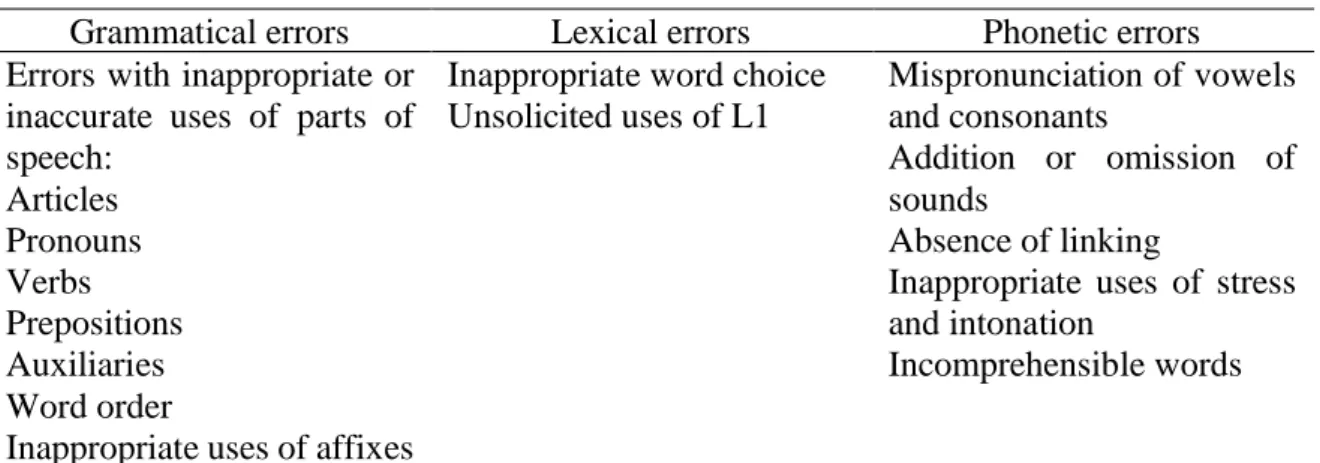
(9) 9. Table of contents. Acknowledgments..................................................................................................................... 5 Abstract ..................................................................................................................................... 6 Table of contents....................................................................................................................... 9 List of tables ............................................................................................................................ 12 List of figures .......................................................................................................................... 13 1. Introduction ........................................................................................................................ 14 2. Literature review ................................................................................................................ 19 2.1 Trends in English language teaching .............................................................................. 20 2.2 Computer-Mediated Communication (CMC): definition and components ............... 26 2.3 Synchronous communication .......................................................................................... 28 2.4 Computer-Mediated Communication (CMC): theoretical basis, related concepts and consequences for teaching ..................................................................................................... 29 2.5 Studies on the use of CMC technologies and discussion of their findings .................. 42 2.6 The use of CMC to teach online: synchronous tools ..................................................... 48 2.7 Error analysis ................................................................................................................... 50 2.7.1 Definition of errors.............................................................................................. 53 2.7.2 Error classification............................................................................................... 54 2.7.3 Classification of errors employed in this study ..................................................... 57 2.7.4 Studies on the analysis of errors in CMC and discussion of their findings .............. 58 2.8 Error treatment ................................................................................................................ 60 2.8.1 Studies on corrective feedback in CMC and discussion on their findings ............... 65 2.9 Repair moves .................................................................................................................... 69 2.91 Definition of repair moves .................................................................................... 70 2.9.2 Classification of repair moves employed in this study .......................................... 71 2.9.3 Studies on repair moves in CMC and discussion on their findings ......................... 74 2.10 The three main areas of L2 proficiency and performance: Complexity, Accuracy and Fluency (CAF) ........................................................................................................................ 77 2.10.1 Measurements of CAF ....................................................................................... 81 2.11 Studies on the development of accuracy and discussion on their findings ............... 82.
(10) 10. 2.1.2 The use of qualitative information to illustrate the analysis of the development of oral skills ................................................................................................................................. 87 2.13 Summary ......................................................................................................................... 92 3. Objectives and research questions .................................................................................... 92 3.1 Research questions ................................................................................................ 94 4. Method................................................................................................................................. 95 4.1 Research design ................................................................................................................ 95 4.1.1 Participants......................................................................................................... 95 4.1.2 The research scenario of the study or the online course employed in this investigation ............................................................................................................... 98 4.1.3 Type of study .................................................................................................... 101 4.1.4 Ethical issues ..................................................................................................... 103 4.2 Data collection ................................................................................................................ 104 4.2.1 Instruments to collect data from oral performances in synchronous learning activities.................................................................................................................... 104 4.2.1.1 Synchronous learning activities (online lessons) ........................................................................... 105 4.2.1.2 Synchronous learning activities (online interviews) ..................................................................... 107 4.2.1.3 Asynchronous online learning activities (podcasts) ...................................................................... 109. 4.2.2 Instruments to collect information from the in-depth interviews and the focusgroup ........................................................................................................................ 112 4.2.2.1 In-depth interviews......................................................................................................................... 112 4.2.2.2 Focus groups ................................................................................................................................... 113. 4.3 Measures for the development of language accuracy and definition of the basic unit of analysis employed in this study ........................................................................................... 114 4.4 Data treatment ................................................................................................................ 115 4.4.1 Coding the errors .............................................................................................. 116 4.4.2 Coding correction strategies and repair moves .................................................. 116 4.5 Data analysis ................................................................................................................... 118 4.5.1 Analysis of the students’ production in the synchronous learning activities ........ 118 4.5.2 Analysis of the in-depth interviews and the focus group .................................... 119 4.6 Triangulation of data in this study ............................................................................... 121 4.7 Summary ......................................................................................................................... 123 5. Results ............................................................................................................................... 124 5.1. Production of errors during the synchronous learning activities ............................. 125.
(11) 11. 5.2 Grades in the assessment activities in the course ........................................................ 129 5.3 Synchronous learning activities, correction strategies and repair moves ................. 130 5.3.1 Examples of error treatment sequences ............................................................ 134 5.4 Learners’ perceptions regarding their linguistic development and the teachers’ correction strategies ............................................................................................................. 136 5.4.1 Perception of the production of errors in the synchronous learning activities..... 137 5.4.2 Perception of the development of language accuracy in the synchronous learning activities.................................................................................................................... 140 5.4.3 Utilization of correction strategies and repair moves ......................................... 143 5.5 Summary of the findings................................................................................................ 148 6. Discussion .......................................................................................................................... 149 6.1 Synchronous learning activities and errors ................................................................. 150 6.2 Synchronous learning activities, correction strategies and repair moves ................. 152 6.3 Summary ......................................................................................................................... 155 7. Conclusions ....................................................................................................................... 156 7.1 Synchronous learning activities and error production ............................................... 156 7.3 Practical consequences for EFL teachers in online environments ............................ 158 7.4 Limitations and strengths of the study ......................................................................... 158 7.5 Suggestion for future research ...................................................................................... 159 7.6 Brief Summary of the research ..................................................................................... 160 References ............................................................................................................................. 162 Appendices ............................................................................................................................ 180.
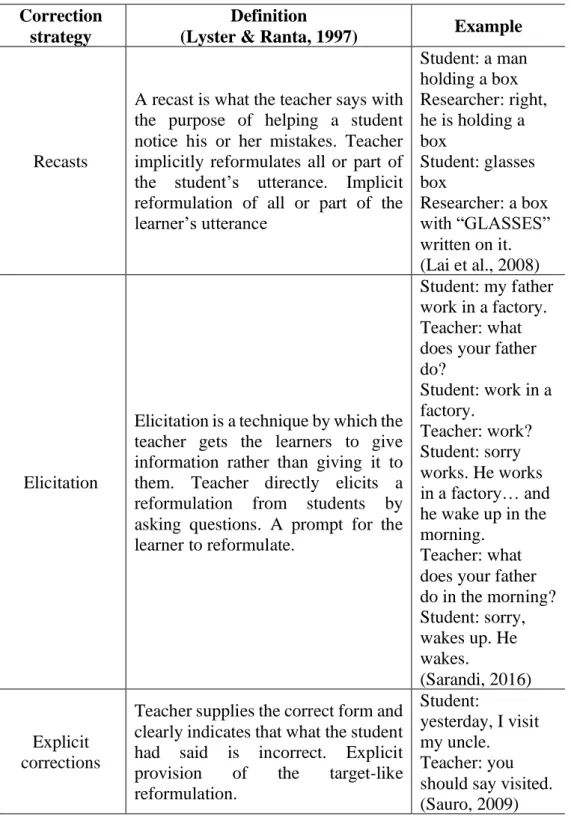
(12) 12. List of tables Table 1. Characteristics and processes of tasks ................................................................... 22 Table 2. Advantages of CMC in promoting communication, interaction, and socialization .................................................................................................................................................. 29 Table 3. Variables employed to investigate the effectiveness of CMC interventions ....... 47 Table 4. Different taxonomies of errors ............................................................................... 54 Table 5. Classification of errors used in the present study................................................. 58 Table 6. Correction strategies, their definitions, and examples ......................................... 64 Table 7. Successful repair moves .......................................................................................... 72 Table 8. Non-successful repair moves .................................................................................. 72 Table 9. Aspects and measures that cognitive approaches have employed to measure fluency, accuracy, and complexity (Skehan, 2003) .............................................................. 82 Table 10. Participants’ information ..................................................................................... 97 Table 11. Characteristics of the DOS course. .................................................................... 100 Table 12. Activities designed for each stage in the online lessons .................................... 106 Table 13. Guidelines for the online interviews .................................................................. 108 Table 14. Instructions to complete the task for the podcast in unit 2.............................. 111 Table 15. Tags for errors, correction strategies and repair moves based on Lyster and Ranta (1997) .......................................................................................................................... 117 Table 16. Clauses with errors in the synchronous learning activities along the course 126 Table 17. Number of clauses and clauses with errors per student .................................. 127 Table 18. Grades the teacher assigned in the assessment activities in the course .......... 130 Table 19. Type of correction strategies employed by the teacher .................................... 132 Table 20. Types of repair moves ......................................................................................... 133 Table 21. Major categories of the effects of synchronous online learning activities ...... 139 Table 22. Effects of online learning activities on the development of language accuracy ................................................................................................................................................ 142 Table 23. Perception of the effects of synchronous learning activities on the utilization and use of correction strategies and repair moves ................................................................... 147.
(13) 13. List of figures Figure 1. Different types of tasks .......................................................................................... 23 Figure 2. Cycle employed to design the lesson and the activities in each stage ................ 24 Figure 3. CMC definition and components .......................................................................... 28 Figure 4. Theoretical perspectives and associated concepts when teaching language online. .................................................................................................................................................. 42 Figure 5. The error-treatment sequence model proposed by Lyster and Ranta (1997) .. 94 Figure 6. Internal components of the DOS course ........................................................... 101 Figure 7. Online lesson interface ......................................................................................... 107 Figure 8. Online interview interface ................................................................................... 109 Figure 9. Features of the recording tool in Moodle ........................................................... 110 Figure 10. Analysis of in-depth interviews and the focus group ...................................... 121 Figure 11. The triangulation design procedure employed in this investigation based on Clark & Creswell (2015) ...................................................................................................... 123 Figure 12. Proportion of grammatical, lexical and phonetic errors. ............................... 128 Figure 13. Types of errors ................................................................................................... 128 Figure 14. Repair moves triggered by correction strategies ............................................ 134 Figure 15. Error production, correction strategy use and repair move selection seen as a loop......................................................................................................................................... 155.
(14) 14. 1. Introduction. This section of the thesis establishes the context and explains the problem addressed by this study. It gives a brief synopsis of the theories that inform the research design, the collection of data, the analysis of information and the explanation of the findings. This chapter describes the study, the research issues, the sources of data and the main findings. This chapter also outlines some theoretical implications associated with the results of previous research. At the end of this chapter, there is an overview of the structure of the thesis. Learning English has become a need in this globalized world and Latin America is not exception where being proficient in English is viewed as an advantage and as an attribute that helps people stand out and provides people with access to different work and study related opportunities (Fandiño-Parra, Bermudez-Jimenez, & Lugo-Vasquez, 2012; Gonzaléz, 2009; Pineda Hoyos, 2017). As consequence, several countries in the region have developed and implemented policies that aim to increase English competence among its citizens with the ultimate goal of enabling people to become proficient in English (Gonzaléz & Llurda, 2016). In Colombia, for example, the Ministry of Education has implemented the National Program of Bilingualism (NPB) whose objective is to have citizens that can communicate in English with internationally comparable standards (Ministerio de Educación Nacional, 2006). The NPB has established teaching and learning agendas for primary and secondary education and higher education that focus on English teachers and students and on pre-service language teaching programs and academic programs in general. These nationwide policies have generated language policies at local levels. For example, the institution where this experience took place, issued a language policy that established that its students have to take 320 hours of English instruction before graduation for undergraduate studies. The policy also states that learners should reach a B1 level at the end of the learning cycle as explained by the Common European Framework of Reference (Council of Europe, 2001). The policy establishes that the courses are.
(15) 15. offered in three modalities: face-to-face, totally online or blended (Universidad de Antioquia, 2014). In addition, the institution seeks to promote pedagogical and educational innovations to align the institution to global and local dynamics that situate it in the forefront of the digital advances (Universidad de Antioquia, 2018). Besides the regional and the institutional policies to promote English language learning and the policies that promote educational innovations, the technological landscape in the region has grown as well. For example, it is estimated that there are about 428 million inhabitants in Latin America and 308 millions of them have access to the internet, which means that internet has a 72% penetration rate in the region, which is higher than the penetration of internet in the rest of the world (52%) (https://www.internetworldstats.com/stats2.htm). In Colombia the landscape is similar, there are almost 50 million inhabitants and as for December 2017, it is estimated that there are 31 million internet users, which is a 63% penetration rate and as for March 2016, it is estimated that there are more than 57 million mobile phone subscription, which is a 117% penetration rate (Departamento Nacional de Planeación, 2018). In addition to that, there have been major developments of Computer-Mediated Communication (CMC) tools that facilitate communication between people via the instrumentality of computers (Hampel, 2014), thanks to the development of synchronous technologies, which use audio and video and favor communication in real time (Oztok, Zingaro, Brett, & Hewitt, 2013) that are not necessarily used for educational purposes (Facebook Live, Google Hangouts, Zoom, Skype). Additionally, synchronous technologies-when used for educational purposes-have proven to provide learners with opportunities to develop reading, listening, and speaking skills and favor communication and language learning from a socioconstructivist perspective (Anderson, 2016), which is the perspective that this experience takes when designing language courses. As the combination of policies that encourage pedagogical innovations in the teaching and learning of English, the favorable technological conditions and the development of CMC.
(16) 16. tools that have stimulated the proliferation of English language learning options that include different approaches, modalities and technologies, research has identified several issues that need special consideration. First, how the use of technology reshapes teachers’ pedagogical practices as a lot of research concentrates on solving problems with the media rather than its pedagogical role (Oztok et al., 2013). In fact, different studies suggest that there is a growing concern about adjusting language pedagogy to the advantages and disadvantages of online environments, as well as a growing concern to design adequate tasks or activities to teach languages online (Anthony, 2010; Hampel, 2006; Rosell-Aguilar, 2005). On top of that, other studies have unveiled several benefits of the use of technology for language teaching and learning. For example, technologically-mediated communicative tasks produce more talking time (Gleason & Suvorov, 2011), they stimulate communication (Offir, Lev, & Bezalel, 2008), they develop skills that go beyond the command of language structures, such as, the development of language awareness and the ability to self-diagnose errors (Yilmaz, 2011). Second, the mediating role of technology in the development of oral proficiency and the development of linguistic features of learner’s speech (Hirotani, 2009), the type of responses of learners and teachers when language errors appear, and the type and quality of feedback (AbuSeileek & Qatawneh, 2013). Apart from that, research has highlighted that communicative focus on form in online settings needs to be further explored (Anthony, 2010). As a matter of fact, research suggests that corrective feedback should be utilized in a social context (Blake, 2009; Nassaji, 2007) as error correction is often the result of a dialogical interaction between learners or between learners and the teacher. Third, research has identified a need to deepen into expanding the scope of understanding how syntactic complexity, lexical range, accuracy, fluency and the provision of feedback occur when teaching and learning English online (Lin, 2014; Ortega, 1997)..
(17) 17. The difficulty of analyzing all these issues in one single study, together with a growing need to analyze the development of language accuracy (Ahmadian & Tavakoli, 2011; Vinagre & Munoz, 2011) justifies taking the use of corrective feedback and the development of language accuracy in an online setting to the forefront in the present research. Based on Lyster & Ranta's (1997) model developed in the error-treatment sequence, this study seeks to identify the type of errors that learners produce, the type of correction strategies that the teacher employs and provides an account of the learners’ production of repair moves these strategies prompt during synchronous learning activities. Moreover, the study aims to describe the development of language accuracy in the oral speech of learners of English as a foreign language. To explore these issues, this investigation follows a case study with a mixed methods and a ComputerMediated Discourse Analysis (CMDA) approach that combine both quantitative and qualitative research methods. The research data in this study are drawn from three main sources: (1) recordings of the synchronous learning activities (online lessons and online interviews), (2) a focus group and in-depth interviews with learners and the teacher, and (3) the participants’ grades obtained in the oral assessment activities in the online course. In order to analyze error production in the synchronous learning activities, the study uses the clause, understood as an utterance that contains a finite verb, as the basic unit of analysis. This research uses the number of clauses containing errors, the number of clauses containing correction strategies, and the number of clauses containing repair moves as measures of accuracy. Those measures are calculated looking for percentages, means and standard deviations. With the purpose of expanding the scope of understanding of the production of errors, correction strategies and repair moves and also informed by the error-treatment sequence, the present study analyzes the insights from the participants in in-depth interviews and a focus group looking for general and specific themes that emerge from them and it incorporates the.
(18) 18. participants’ grades by examining their performance in the assessment activities in the online course, calculating means and standard deviations. The main results of this investigation describe the improvement in accuracy levels of most learners, evidenced in the decreasing number of mistakes learners made towards the end of the course and in the steady increase of language accuracy marks their teacher assigned along the course. Learners’ language accuracy developed in part due to the teacher’s provision of explicit corrective feedback. A closer analysis of the most common mistakes learners produced reveals an expected correspondence between these and the most common mistakes the teacher corrected. Participants self-report the development of certain level of language awareness, the ability to self-diagnose errors, and the self-confidence to speak. The synchronous learning activities provide instances to correct errors as soon as they appear, as well as provide opportunities to communicate with the teacher and peers, whereas the utilization of correction strategies and the use of repair moves are regarded as positive because they help to notice and correct errors. The context of this investigation is an online course of English that is framed on an institutional initiative to comply with national language policies and whose objective is to develop particularly oral skills. The course is designed for students who have an elementary level of English (A2 to B1 according to the Common European Framework (Council of Europe, 2001)), it has online learning activities that are mediated by synchronous and asynchronous communication technologies, but this investigation focuses on the synchronous learning activities. The online learning activities in the course contain tasks or activities that the students have to carry out orally. Additionally, the online learning activities are equipped with tutorials, guidelines and other resources designed to help participants navigate them. Although the course was not originally designed for this investigation as it was part of an institutional language.
(19) 19. learning offering, its characteristics and elements motivated the analysis of the development of oral language accuracy and the role of corrective feedback. This thesis is composed of seven sections. Section one introduces the study — it includes the problem addressed, the research issues to be explored, the nature and structure of the study, a brief synopsis of the main concepts in this study, and a short summary of the findings. Section two explores the review of literature, which includes the main concepts that inform this investigation and also explores and discusses the recent studies on the use of CMC technologies to teach languages. Section three mentions the research questions and objectives. Section four explains the methodology employed in the study including the research design, the data collection procedure, the data treatment, and the analysis of the data. Section five explores the results of the investigation. Sections six covers the explanation of the results, and section seven deals with the conclusions of the study as well as the limitations and the possibilities for future research. 2. Literature review The previous chapter explained that research has surfaced the need to carry out studies that describe the development of language accuracy in synchronous learning activities. It also showed that there is an emerging need to explore the use of corrective feedback when teaching languages online. At the end of the section, there is an explanation of the nature and structure of this thesis. This section incorporates the analysis, synthesis, and significance of the main concepts and theoretical approaches that frame this study. From a critical perspective, this section provides evidence from other studies that shows how these concepts have been explored and what conclusions have been drawn from them..
(20) 20. 2.1 Trends in English language teaching In order to understand the reasons that motivated this investigation, it is necessary to explore different trends in English language teaching that inform the design of the research scenario of this study. The online course of English that is the research scenario of the present investigation shows the tension that has been present in English language teaching for a long time between the desirability of communicative use of the language and felt need for a linguistic focus in language learning (Lightbown & Spada, 1990; Long, 1991). This course broadens the scope and updates the tension as it includes the aspect of focus on form in communicative courses in online settings and this tension becomes the motivation to analyze the development of language accuracy, corrective feedback and learner uptake (Arroyo & Yilmaz, 2018). Although there is a clear distinction between the research scenario and the methodological research design of the present study, an exploration of the origins and the theoretical basis of the research scenario is worth mentioning to understand how the course influences and motivates the study. This section explores the influence of Second Language Acquisition (SLA) research on language teaching, the early attempts to find the method for teaching and learning English, going from the direct method to communicative methods. This section explores the concept of Task-Based Language Teaching (TBLT) as that is the approach on which the course that is the research scenario of this investigation is based. And at the end, this section explores Content-Based Language Teaching (CBLT) and Content and Language Integrated Learning (CLIL) as approaches that emerge from TBLT. English language teaching has been greatly influenced by Second Language Acquisition (SLA) research. According to Long (2012) SLA includes non-native and native language development by children or adults in natural settings or in settings of formal instruction. Long claims that SLA encompasses different learning situation such as learning in groups or individually, second language, foreign language or lingua franca. He suggests that the “Second”.
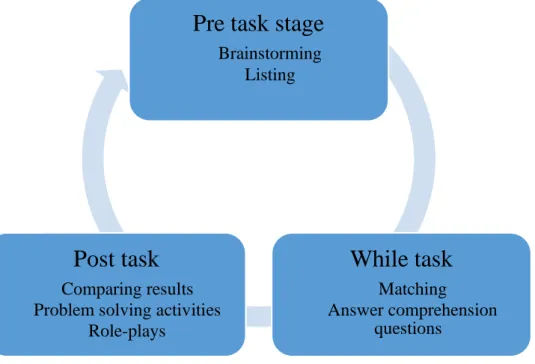
(21) 21. in SLA includes a third, a fourth or more languages, , “Language” includes dialects or teaching specific languages such as English language teaching and “Acquisition” includes learning, attrition and loss. Historically, based on results from SLA research, English language teaching has searched for the method to teach English and several methods have emerged such as the Direct Method, the Audiolingual Method, the Cognitive-Code Learning Method and in the seventies, Community Language Learning, the Silent way, Suggestopedia and the Total Physical Response (TPR) (Brown, 2002). But English language teaching scholars and practitioners concluded that there was and probably never will be a perfect method and the focus has changed to classroom tasks and activities (Nunan, 1989). That realization marked a new era in English language teaching research and in the profession and a number of studies have investigated tasks and the concept of tasks has evolved over time. Research has defined tasks as a piece of work undertaken for oneself or others, work plans, a piece of classroom work that involves learners in comprehending, producing and interacting in the target language and its attention is primarily focused on meaning rather than form. Tasks are goal oriented activities in which learners use the language to achieve a real outcome (Ellis, 2003; Hismanoglu & Hismanoglu, 2011). Research has also unveiled different characteristics of tasks. Tasks should contain natural language, the activities inserted in tasks should be related to meaning rather than form, instructions should be learner-centered and tasks should provide opportunities for students to focus on certain linguistic components, tasks should have a positive impact on learners and they should be practical for teachers (Hampel, 2006). However, tasks can be focused on form. Mennim (2003) draws our attention to the following processes when focusing tasks on form. (1) tasks encourage learners to attend to the language forms that they are using or are exposed to, (2) tasks help learners notice ways in which their interlanguage differs from the target.
(22) 22. language, (3) tasks help learners rethink their own hypothesis about the target language and (4) tasks help learners, subsequently, modify their output in a target-like direction. Table 1 summarizes the characteristics and processes of tasks. Characteristics and processes of tasks ● Natural or naturalistic language ● The activities should be related to meaning rather than form ● Instruction should be learner centered rather than teacher centered ● Provide opportunities for students to focus attention to certain linguistic components as they appear in lessons (swan, 2005 in Wang & Winstead, 2016) ● Have a positive impact on learners and it should be practical for teachers (chappelle, 1998) (as cited in Hampel, 2006) ● Interactive and include reporting back of the communicative outcome (Skehan, 2003) ● Collaborative, interesting, rewarding and challenging (Meskill, 1999) ● Meaningful and engaging (Oxford, 1990) ● Provide opportunities to produce the target language (Chapell, 1998) ● Make use of authentic material (Little, 1997) ● Be appropriate to the medium used (Furstenberg, 1997) (as cited in Rosell-Aguilar, 2005) Processes involved in tasks when focused on form: 1. Encourage learners to attend to the language forms that they are using or are exposed to. 2. Tasks help learners notice ways in which their interlanguage differs from the target language. 3. Tasks help learners rethink their own hypothesis about the target language 4. Tasks help learners modify their output in a targetlike direction (Mennim, 2003) Table 1. Characteristics and processes of tasks Tasks are divided into categories; information-gap tasks, reasoning gap tasks, opinion gap tasks. There are tasks in which students have to list or brainstorm information, order or sort items, match, compare or find similarities among items. There are other tasks in which participants have to solve problems, share personal experiences or tell a story. (Hismanoglu &.
(23) 23. Hismanoglu, 2011; Lai, Chun; Goufang, 2011). Figure 1 shows the different types of tasks.. information-gap tasks. reasoning gap tasks. opinion gap tasks. brainstorming tasks. ordering tasks. matching tasks. comparing tasks. involve the transfer of inforrmation. involve deriving information through inference. involve identifying and articulating a preference, feeling or attitude. involve listing people, places, thing, etc. involve sequencing, ranking or classifying. involve putting together two or more things. involve finding similarities and differences. Figure 1. Different types of tasks. Ellis (2003) points out that many designs have been proposed to implement tasks in English language teaching, but they all have in common the following components, which are the same components that the synchronous sessions, that are the research scenario of this investigation have: (1) a pre-task stage that refers to the activities that take place before the task. For example, listing, brainstorming for ideas, ordering or sorting elements. This stage is suitable for introducing vocabulary that may be unknown and that would appear in the following stage. This stage can also be used to introduce a topic, to activate background knowledge and to introduce vocabulary or structures that can be difficult and to give time and elements to plan the performance of the task. (2) a during task or while task stage that centers on the task itself and includes numerous activities such as matching captions, texts, pictures, expressions, answer comprehension questions, etc. This stage has to do with doing something with the information from a reading, an audio or a video text. This phase includes aspects such as time pressure to perform (3) a post-task stage that involves procedures of following up performance. This stage has to do with doing something with the information from the other two stages. This stage includes activities such as comparing results, problem-solving tasks, role-plays and more.
(24) 24. complex activities such as arguing, giving opinions or sharing personal information. Although, in the lessons based on tasks only the while task phase is mandatory, the online lessons (synchronous sessions) designed for this study contain activities for the three stages because they play a crucial role in ensuring that the task performance is maximally effective to develop language accuracy and the effects on correction strategies and repair moves is greater. Figure 2 illustrates the task cycle employed to design the online lessons in this study and the type of activities that they contain.. Pre task stage Brainstorming Listing. Post task Comparing results Problem solving activities Role-plays. While task Matching Answer comprehension questions. Figure 2. Cycle employed to design the lesson and the activities in each stage. The focus on tasks and activities and the focus on meaning rather than form have played a central role in English language teaching that have generated other approaches to teach English. One of those approaches is Content-Based Language Teaching (CBLT). This approach states that language can be best learned through subject content. It includes various models to implement content-based instruction: theme-based language instruction, shelter content instruction and adjunct content instruction. Some of the benefits of CBLT is that it aims at eliminating the artificial separation between language instruction and subject matter classes..
(25) 25. CBLT also furthers the goals of language teaching by offering context for language and CBLT bring together both subject and language learning as simultaneous processes, but with distinct concern for both subject and language learning aims (Creese, 2006; Jalilzadeh & Tahmasebi, 2014; Shabani & Ghasemi, 2014). Another approach to English language teaching and learning where teaching content, teaching language and tasks can go together is Content and Language Integrated Learning (CLIL). CLIL refers to educational settings where a language other than the students’ mother tongue is used as a medium of instruction. CLIL is expected to give a communicative purpose to the use of the foreign language. The advocates of CLIL claim that both foreign language and content capacities develop more efficiently and effectively, while the opponents of CLIL argue that whether the foreign language development enhances, while the content does not or vice versa. The adoption of CLIL pedagogies has seen an increase in Europe and Latin America because it represents to move from monolingual education systems to bilingual ones, or from bilingual systems into multilingual ones (Bruton, 2013; Martínez Agudo, 2019; Pérez Cañado, 2018). The previous approaches to teach English highlight meaning over form. They show that tasks can be combined with other approaches. In conclusion, the approach to language learning and teaching that this study has is the socio cultural approach as it prioritizes language use in context, contrary to traditional cognitive approaches that focus on modelling language structures (Xiao, 2017). An example of the use of tasks for the development of language skills is this study by Yanguas (2018) where he explores if task type has an effect on the number, focus and outcome of language-related episodes (LRE) in synchronous communication (video and audio). In his investigation, 78 intermediate Spanish learners participate. His study focuses on jigsaw and dictogloss tasks. His findings show that the tasks and oral modes produce no significant differences in the number of LREs produced by learners and both type of tasks (jigsaw and.
(26) 26. dictogloss) in either mode (video or audio) led learners to produce a similar number of LRE. His findings also reveal that learners’ main concern is vocabulary when performing jigsaw and dictogloss tasks. In his study, learners produce a significantly higher number of lexical LREs in the jigsaw task and a higher number of grammatical LREs in the dictogloss task. Yanguas’ study reaches two conclusions that highly relate to the focus and objectives of the present study. First, it appears that the oral nature of the interaction might mitigate potential task effects. Second, learners focus on form and produce LREs when interacting in the target language in video and audio communication. Yanguas’ study and conclusion is very relevant for the present study as it shows the effects of different types of tasks for language teaching and learning and it shows that tasks are a feasible methodology to be used in combination with technological tools. The following sections show how the blend between tasks and technological resources to. create. new. learning. environments.. The. section. explores. Computer-Mediated. Communication (CMC), synchronous communication, the theoretical basis and some related concepts of CMC and their consequences for teaching, at the end of the section, there is an exploration of some studies on the use of CMC, a discussion of their findings and some examples of the use of synchronous tools to teach. 2.2 Computer-Mediated Communication (CMC): definition and components The advent of technology and the development of Computer-Mediated Communication (CMC) tools have influenced very positively English language teaching and learning because they provide opportunities for learners to interact with speakers and other language or learners who can be in distant places, they also facilitate collaborative and comprehensible interaction by offering occasions of learner-centered interaction. Besides, CMC stimulate learners’ interests, they encourage peer learning and they decrease dependence on the instructor. CMC has shown that they blend very well with tasks and teaching activities that promote.
(27) 27. communication (Hosseini, 2015; Koivistoinen, 2008; Mahdi, 2014). Before analyzing the concepts and theories behind the use of CMC, it is necessary to explore its definition and benefits. Different definitions of the term Computer-Mediated Communication (CMC) exist in the literature. For example, Hampel (2014) defines CMC broadly as communication that takes place between people via the instrumentality of computers. To date, several studies have identified the advantages of incorporating CMC tools for both students and teachers. For example, Peters & Hewitt (2010) acknowledge that students feel attracted to CMC tools because they offer the flexibility of learning at times and places of their choice and teachers value their collaborative potential. Additionally, CMC tools provide a democratic space where participants have equal opportunities to take part in a course. In the case of this investigation, to practice English orally. Moreover, the shared social nature of CMC tools increases the personal motivation and fosters critical reflection among participants (Peters & Hewitt, 2010). Similarly, Abrams (2003) acknowledges that CMC tools help learners to feel more involved in the development of ideas, in determining the path of topics, as also in the selection of those topics. Computer-mediated communication tools play an important role in this investigation because, as technological developments in the field of CMC, which include audio and video in real time, are recent, written communication has dominated the field of CMC technologies, which has generated that most of the research has been done on written CMC, and research in the field of CMC using video and audio orally is still scarce. Previous studies show that the use of video and audio conferencing as CMC tools in language learning can foster collaborative learning through social interaction both with tutors and peers (Hampel & Hauck, 2004). RosellAguilar (2005) states that CMC facilitates communication, understanding, and interaction with software that is enriched with text, images, whiteboards, and text-chat facilities. To sum up, CMC is any communication that takes place using computers. It offers flexibility for learning, it has great collaborative potential, it provides a democratic space. CMC also increases.
(28) 28. motivation and critical reflection, it helps learners develop ideas, determine topics and helps learners establish the sequence to study those topics. Finally, CMC fosters interaction with tutors and peers and with software that is enriched with text, images and sound. Figure 3 shows the definition of CMC and its components.. Flexibility Collaboration. Motivation Critical Reflection CMC COMMUNICATION THAT TAKES PLACE USING COMPUTERS. Development of ideas Selection of topic. Interaction with tutors - peers and enriched software. Figure 3. CMC definition and components. 2.3 Synchronous communication Computer-mediated communication can be classified on the basis of the synchronicity of the communication. Oztok et al. (2013) define asynchronous communication as communication that occurs in delayed time and does not rely on simultaneous access for educational outcomes, and synchronous communication as communication that involves realtime communication between teachers and students. AbuSeileek & Qatawneh (2013) argue that asynchronous communication may give users more chance to think and answer, while synchronous communication requires immediate responses, which limit the use of outside resources. AbuSeileek & Qatawneh (2013) point out that CMC can pursue different purposes in language teaching. For example, asynchronous communication can serve to learn a specific grammatical structure, whereas, synchronous communication can serve to enhance linguistic.
(29) 29. interaction and foster a contact between different groups of learners. Synchronous communication can help produce large amounts of output because it enables extensive learnerto-learner negotiation and more talking time per learner than face-to-face communication. Gleason & Suvorov (2011) and Lee (2011) identify other advantages of CMC in promoting communication, interaction, and socialization, which table 2 summarizes. Table 2. Advantages of CMC in promoting communication, interaction, and socialization Provide frequent opportunities to express ideas and opinions. CMC has been found to. Produce a large amount of target language output Allow more time to develop comments Lead to greater precision of expression or greater accuracy rates Promote a collaborative spirit Enhance motivation of language practice Promote a student-centered atmosphere Reduce students’ anxiety Develop students’ linguistic performance. 2.4 Computer-Mediated Communication (CMC): theoretical basis, related concepts and consequences for teaching Technology and specifically computer networks have boosted the development of several aspects of society and language teaching is no exception. The developments of computer technology have created new opportunities for language learning that cannot be found in traditional classrooms (Mahdi, 2014). Moreover, the development of computers and the use of the Internet have turned into a very important communication media that has been used effectively to a variety of purposes including pedagogical ends (Hosseini, 2015). Therefore, an exploration of the theoretical background behind the use of these technologies in language teaching deserves attention. This section explores the theoretical basis of CMC, it explores its benefits and the consequences of those concepts when teaching languages online. A seminal study that illustrates the theoretical basis of CMC is Kern (1996) where he presents a rationale for establishing content-based e-mail exchanges. He begins by using Vygotsky (1978) and Bakhtin’s (1986) claims to explain that social interaction plays an.
(30) 30. important role when learning a language in face-to-face settings. He states that learners benefit most from social interactions concerning tasks that they cannot do alone, but that they can do in collaboration with more knowledgeable or more experienced individuals. For him, utterances are constructed on the basis of the speakers’ past interaction with the thoughts of others and in anticipation of a responsive reaction from some specific or generalized other. Therefore, Vygotsky and Bakhtin’s theories highlight the importance of social interaction in understanding and learning and can help reconceptualize the role of computers in language teaching as those theories suggest that computers have to be viewed as a means to connect with other individuals, where people can ask questions, provide explanations, compare interpretation and work collaboratively, rather than viewing the computers as a kind of substitute for the teacher, who only provides drills, tutorials and reference material. Kern (1996) argues that the use of computers in language teaching has to move from a computer as agent perspective in which the learner has a one-on-one relationship with the computer and human interaction is only simulated, to a computer as medium perspective in which computers reorganize interactions among people. He goes on suggesting that to move from a computer as agent perspective to a computer as medium perspective implies that teachers and learners use the computer as a channel through which to communicate collectively and/or individually and teachers play the role of guides and provide a scaffold for their students’ learning with their own knowledge and experience (Kern, 1996). Another seminal study that explores the theoretical basis of the use of computers in language teaching is Warschauer (1997) where he proposes a conceptual framework to explore the nature of computer-mediated communication. His first perspective comes from Krashen's (1999) input hypothesis that states that the development of a second language is wholly dependent on the amount of comprehensible input that one receives. He points out that this perspective is useful to understand both classroom and computer-mediated interaction..
(31) 31. However, he says that this perspective still lacks to explain how students use language related collaboration to become competent members of a speech community, to gain important cultural knowledge or content matter or to develop literacy critical thinking skills. Warschauer's (1997) second perspective to explore the nature of computer-mediated communication is the sociocultural perspective. As Kern (1996), he states that the sociocultural perspective creates an environment to learn the language, learn about language and learn through the language. This perspective examines interaction within a broad social and cultural context. Warschauer (1997) claims that according to Vygotsky, language is one of the tools that mediates purposeful action that allows human learning and development to take place. He states that all higher order functions develop out of language-based, social interaction. Warschauer (1997) employs also illuminated by Vygotsky, uses his concept of the Zone of Proximal Development (ZPD), which is the gap between what the learner could accomplish alone and what he or she could accomplish in cooperation of others who are more skilled or experienced, to stress that collaborative learning is essential for assisting students in acquiring knowledge. He claims that there are two main interpretations on how learners travers through the ZPD: (a) modeling in which the teacher models an approach to the learning and (b) text mediation in which texts are considered as thinking devices that generate new meaning collaboratively. He suggests that the text mediation perspective has been well developed by educators. In this model, the teacher assists as a guide and students collaborate to make connections between new ideas and prior knowledge, they use the language as a tool for learning and develop linguistic and thinking skills. In another seminal study that covers the theoretical basis of the use of computers in language teaching, Ortega (1997) evaluates the potential benefits of computer assisted classroom discussion in relation to second language acquisition theory and she claims that the introduction of networked computers into education coincides with a shift in education from.
(32) 32. cognitive and developmental theories to social and collaborative views of learning. She also claims that it is necessary to change the way we perceive the use of computers in language teaching as we need to view them as a new medium that changes the way we write, read and possibly think. Indeed, she claims that we need to broaden the scope of understanding to determine in which ways language, learning and interaction have been transformed by the use of computers in education. In her study, Ortega (1997) explores the blend between computers and language teaching and learning and identifies several reasons why the blend is a promising area of research. Interestingly, although she identified those reasons 20 years ago, they still prevail and can inform research in language teaching in online environments today. Ortega (1997) points out that conducting discussions on a computer entails meaningful use of the target language and forces teachers and students away from treating the language as an object rather than as a medium of communication. She claims that it also promotes a task and interactiondriven approach to L2 learning and teaching, which can be used as a basis for new curriculum design and it provides opportunities for language development since students are motivated to broaden their language resources to meet the demands of real communication in a social context. Ortega (1997) singles out other benefits of carrying out discussions in computers such as learners contribute as much as they want at their own pace, learners engage in a variety of interactive moves on the computer and they take control of the discussion, learners have time to plan their messages and edit them and learners are exposed to a substantial amount of comprehensible input. She claims that more and more voices in the education and technology literature endorse that computers per se are beneficial or harmful, it is the use that we put them to that determines how useful they can be. In her study, Ortega (1997) emphasizes that research in the use of computers in language teaching have focused on three main areas: (1) computers have an equalizing effect on participation. That is, computers allow for an equal participation because opportunities for.
(33) 33. contributions are more equally distributed among participants and this leads to three effects. First, the traditional view of the teacher as authority source or expert is subverted because he turns into a participant. Second, learners are afforded the opportunity to engage in selfgenerated, personally relevant communication and third, participants take part in discussions more equally and learners who do not participate very often in classroom settings seem to increase their participation in electronic modes. (2) computers increase learners’ productivity in terms of overall amount of language and/or ideas produced. Ortega (1997) claims that quantity of linguistic production rather than quantity and quality of ideas has been of central interest in research on the use of computers and language learning. She states that the use of computers in language learning generates opportunities for communicative practice of the target language and opportunities for meaningful learner output. (3) the language produced in electronic discussions can be more complex and formal than in face-to-face discussions. This is the area of electronic discussions of most interest to evaluate their effects and to establish links with L2 development. In her seminal study, Ortega (1997) establishes the new directions for research on the use of computers and language teaching, which are very useful and relevant for the present study. She states that there are at least two aspects of production that need to be investigated. First, the interlanguage produced over time in electronic discussions in terms of quantitative measures of syntactic complexity, lexical range, accuracy and fluency and the provision of negative feedback. Second, qualitative and quantitative analysis of interactional features such as interactional modifications of input (clarification requests, comprehension and confirmation checks, repairs, self-repairs, recasts and other forms of corrective feedback, and incorporation of others’ input in learner output). She also suggests that there is a need to investigate the impact of computers on the development of various components of communicative competence and of the different language skills as well as affective variables such as attitudes towards writing or.
(34) 34. speaking with computers or computer anxiety or learner aptitude or experience with computers or computer skills. She claims that another area of potential research in computers and language learning is the use of learner strategies in particular metacognitive strategies such as planning or monitoring. Finally, she suggests that the combination of observation, self-report data collected through questionnaires or interviews, and computer-collected data (both linguistic and nonlinguistic moves) as it is the case of the present study, enhances the internal validity of the studies and enables a more accurate assessment of the ways in which the use of computers fosters learning and communication strategies and of the impact of such strategies on second language performance in the electronic mode. She claims that establishing links between selfreported and observed behaviors and linguistic outcomes should be a priority in research of the use of computers in language learning and teaching as it is the case of the present study. Another seminal study that paved the grounds of research on the use of computers in language teaching and that enlightens the present investigation is Kern (1995). In this study, he compares the quantity and characteristics of discourse produced by two groups of students who participate in an oral class discussion using synchronous interaction and at the same time, he explores the participants’ impressions about the advantages and disadvantages of using the synchronous tool. In this investigation, he employs InterChange, which is a tool that allows students to engage in collaborative, written discussions. In this early paper, Kern (1995) observes that after using InterChange, its use stimulates responses that introduce a number of topics, it gives public voice to students’ feelings and establishes a sense of solidarity. Its use is simultaneously informative for learners who only read and do not contribute to a particular discussion. Kern (1995) notices that the use of a synchronous tool for discussion has effects on teachers. He points out that unlike traditional settings where classroom discourse consists of a teacher-initiated topic, followed by a reply from students and a teacher evaluation of the reply, when using InterChange, the pattern changes as messages are directed to the entire group or to.
(35) 35. a specific addressee, but they are rarely produced from a teacher request. In other words, the teacher does not allocate the floor, which is available to all group members at all times. Another difference when using a synchronous tool when compared with a face-to-face setting, according to Kern (1995), is that participants’ fully elaborated turns can take place simultaneously, unlike conversational discourse where speakers’ turns follow one another sequentially. The kind of talk produced by learners in InterChange tends to be metalinguistic or metadiscursive. The use of InterChange for having synchronous discussions affords more frequent opportunities for leaners to express their ideas, greater amount of language production, more time to develop and refine comments, encouragement of a collaborative spirit and enhanced motivation for language practice and reduction of anxiety (Kern, 1995). Kern (1995) concludes that InterChange offers more frequent opportunities for students’ expression that lead to more language production. The language level of students was more sophisticated in terms of morphosyntactic features and in terms of variety of discourse functions. There was an indication that the use of InterChange reduced communication anxiety. This study reveals that the role of the teacher is compromised and grammatical accuracy suffers and learners can be exposed to defective language because formal accuracy, stylistic improvement, global coherence and reinforcement can be difficult to achieve. Contrastingly, InterChange seems to foster these aspects: self-expression, student initiative and responsiveness, generation of multiple perspectives on an issue, voicing of differences, and status equalization. All those early studies inform the present investigation because they show that the use of computers in language teaching is based on sociocultural perspectives where interaction and collaboration play a crucial role to construct meaning, understanding and learning. These studies suggest that the use of computers in language teaching need to be reconceptualized as they have to be viewed as a means of communication rather than a simple repository of.
(36) 36. information. They also show that the use of computers in language teaching entails meaningful use of the target language and encourage teachers and learners to view the language as a medium of communication rather than an object itself. These early studies point out that the use of computers in language teaching promote a task and an interaction-driven approach and learners need to meet the demands of real communication in a social context. Furthermore, these studies identify that the use of computers in language teaching has an equalizing effect, it increases learner productivity and the language can be more complex and formal than in traditional settings. These studies show that research in the area of computers in language teaching should focus on expanding the scope of understanding of its effects on syntactic complexity, lexical range, fluency, and as it is the case of the present investigation, accuracy and the provision of feedback. These studies also suggest that to enhance internal validity of studies in the area of computers and language teaching, it is necessary to combine observations and self-report data with computer-collected data. Finally, these early studies show that computer-mediated discussion offers a powerful means of restructuring the teaching of languages, they suggest that computers in language learning can be used to facilitate human communication by linking learners and teachers in new and productive ways. The present investigation is aligned with the suggestions from these seminal studies because it seeks to broaden the scope of understanding of the development of oral language accuracy and the provision of feedback in synchronous learning. More recently, other scholars have provided new theoretical perspectives to the field of Computer-Mediated Communication. In an essay where there is a chronological depiction of the development of concept of CMC, Thorne (2008) provides an overview of ComputerMediated Communication (CMC) in which attention is given to CMC language educational issues and context of use. Thorne (2008) begins by claiming that CMC starts with the internet, but also emerges from a long line of mediated communication technologies such as the printing.
(37) 37. press, the telegraph and radio, the telephone and television. He establishes a link between CMC research and linguistic and communication theory and he states that at the beginning CMC was described as inadequate for many task-related needs and ineffective for interpersonal exchanges because of the limited social information available within text-only environments. Fortunately, this view was reassessed later as he notes that CMC relationships can be as, or more relational than those that take place in face-to-face settings. Thus, CMC interaction is not different than face-to-face communication, but typically involves a slower rate of social information exchange. And now CMC is conceived as a viable medium for educational, interpersonal and informational functions (p. 3). Thorn (2008) states that CMC major contributions start from the early to the mid-1990s when the use of synchronous CMC (SCMC) or chat formed the basis for many SLA studies (see the studies above). He claims that during this time a number of studies have adopted the interactionist SLA model designed to analyze negotiation of meaning in oral interactions and have applied it to CMC research. For Thorne (2008), although much of the research on CMC that took place during this period of time concentrated on the comparison between SCMC and face-to-face instructions, some studies explored crossmodality transfer between spontaneous Synchronous Computer-Mediated Communication or SCMC and oral L2 language production and they found that SCMC has a facilitation effect that lowers the cognitive demand of L2 language production and enables students to produce more complex language. Thorne (2008) states that there are new possibilities of inquiry that include emerging CMC tools that support the combination of text and voice communication that may prove as a promising learning environment as it is the case of the present study. Thorne (2008) envisions that there will be great developments of CMC tools. He claims that wikis, blogs, podcasting and gaming will be in the forefront of CMC research. He argues that because of the development of technologies that support the broad distribution of sound,.
Figure



+7




Documento similar
As generalization depends precisely on the degree of conditioning of this common element, this mechanism can elegantly explain perceptual learning within standard
In relation to language knowledge of L1/vehicular language (The teacher has knowledge of the L1/vehicular language in terms of fluency, accuracy, lexicon and
Keywords: Metal mining conflicts, political ecology, politics of scale, environmental justice movement, social multi-criteria evaluation, consultations, Latin
In the previous sections we have shown how astronomical alignments and solar hierophanies – with a common interest in the solstices − were substantiated in the
teriza por dos factores, que vienen a determinar la especial responsabilidad que incumbe al Tribunal de Justicia en esta materia: de un lado, la inexistencia, en el
Curation Practices Multimodal Literacy Critical Dispositions Global Discourses COLLABORATION.?. Searching,
Although some public journalism schools aim for greater social diversity in their student selection, as in the case of the Institute of Journalism of Bordeaux, it should be
In the “big picture” perspective of the recent years that we have described in Brazil, Spain, Portugal and Puerto Rico there are some similarities and important differences,
