FACULTAD de FILOSOFÍA Y LETRAS
DEPARTAMENTO de FILOLOGÍA INGLESA
Grado en Estudios Ingleses
TRABAJO DE FIN DE GRADO
SPANISH AND ENGLISH TERMINOLOGICAL STUDY
BASED ON COMPARABLE CORPUS OF EMPLOYMENT
CONTRACTS
IDALIA GONZÁLEZ MORAIS
Tutor: Belén López Arroyo
3
ABSTRACT
The evolution of new technologies has transformed the working method of the study of language in the last few years. The use of electronic corpora has facilitated the task of both experts and learners, especially in the speed of compilation and analysis of data. For this reason, this final work is based on a corpus linguistic methodology for the analysis of the specialised language of employment contracts in Spanish and English. The analysis includes a glossaries for the Spanish and English languages of the most common twenty terms in this type of document. Each of these words includes a real example of use and our translation proposal.
Keywords: AntConc, corpus, corpus linguistics, employment contracts, specialised language, terminology.
RESUMEN
La evolución de las nuevas tecnologías ha transformado el método de trabajo del estudio del lenguaje en las dos últimas décadas. El uso de corpus electrónicos ha facilitado la tarea tanto a expertos como a aprendices, sobre todo en la rapidez de compilación y análisis de los datos.
Por ello, este proyecto se basa en la metodología de la lingüística del corpus para analizar el lenguaje especializado de los contratos de trabajo tanto en español como en inglés. El análisis finaliza con un glosario en español y otro en inglés formados por los veinte términos más comunes en este tipo de documentos. Cada una de estas palabras cuenta con un ejemplo real de su uso y una propuesta traducción propia.
4
INDEX
Abstract ... 3
Index ... 4
Introduction ... 5
Justification of the area chosen and aim ... 5
Hypothesis and objectives ... 7
Linkage to the competencies of English Studies... 8
Relevance for the users ... 9
Parts of the work ... 9
A. Legal language ... 11
A.1. Spanish Employment Contracts ... 11
A.2. English Employment Contracts ... 13
B. Methodology ... 16
B.1. Corpus linguistics ... 16
B.2. What is a corpus ... 17
B.3. Types of corpora ... 18
B.4. Approaches to corpus linguistics ... 23
C. Criteria for compilation of the corpus ... 26
D. Results and analysis ... 30
D.1. English Wordlist ... 30
D.2. Spanish Wordlist ... 45
D.3. Real examples and equivalent translations... 57
E. Conclusion ... 63
5
INTRODUCTION
Justification of the area chosen and aim
This final project uses part of the knowledge that has been obtained over the years while studying the degree in Estudios Ingleses, especially in the fields of linguistics and translation. Indirectly, cultural and instrumental knowledge about Spanish and English languages, supplement the development of this work in accordance with the topic. While it is true that the final project focuses on a course from all that encompass the degree of English Studies, we are using some others for the development of the above mentioned work.
The subject of the final project is New Technologies Applied to Estudios Ingleses; it is well known that nowadays there is a vast number of new technologies that are making our work much easier; examples of these tools in the field of linguistics are corpus management software, translation memories or terminology management tools. However, all of them are just tools to help and the output they produce needs to be interpreted.
6
the point of view of the translation from English into Spanish courses, and this is why we have the knowledge of the laborious work involved on it.
Our glossary will be based on a corpus. We believe that a corpus is a great tool to learn and contribute to provide information about language for specific purposes (LSP). Corpora show the real use of specialized languages, since they contain real texts. In addition, they also show the behavior and the real context of the words and the linguistic units. Also, they are test benches to refute or confirm hypotheses. Corpora offer us endless amounts of frequency analysis, such as terminology or usual linguistic and stylistic patterns, which are closely related to the purpose of our project.
The most common specialized terms in Legal language will be extracted from the employment contracts that will form our corpus. Acording to Paul Baker, Andrew Hardie & Tony McEnery in their work A Glossary of Corpus Linguistics, "A lexical syllabus is based on the argument that it makes sense to teach the most frequent words in a language first as these words tend to have a wide variety of uses" (2006 : 107). This can also apply to specialized language, and that is what we will do with the glossary and it most frequent terms. Sinclair and Renouf already mentioned (1988: 140-160) that a study plan for teaching languages can be constructed taking into account the use of frequency-based information given by a corpus.
7 Hypothesis and objectives
Our hypothesis starts from the fact that the information contained in dictionaries is not enough. For this reason, we believe that the use of other sources of documentation, such as corpora, complements the help of dictionaries.
The objectives we aim at with scientific research are the following:
I. To prove that the terminology that exists in a specialized field as the language of law has a greater presence in a more specific subfield such as employment contracts.
II. Many of these terms in Spanish have no terminological equivalent in English and vice versa. So, our second aim will be to provide equivalents by an explanation or fixed expressions.
III. To use a tool that will provide us a complete terminological study; in other words a comparable corpus in English and Spanish languages, and also specialised in employment contracts collected from the Internet.
IV. To study the most common terms in employment contracts from our bilingual corpus, so as to contribute to the establishment of equivalences in both languages and analyze legal conceptual problems in the area of translation.
The results of the foregoing tasks will lead us to the ultimate goal of this work. The aim of this paper is to make a glossary that includes the most frequent specialized terms contained in employment contracts using technological tools. This glossary will comprise the English terms and their respective equivalences in Spanish.
8
According to the aims previously established in this section, we will follow the procedure set below:
I. The compilation of comparable and bilingual corpus of employment contracts in English and Spanish languages, as a basis for subsequent terminological study. II. The analysis of the compiled corpus by using software programs to extract a list
of most frequent terms in employment contracts.
III. The study of each of the most common terms to establish their equivalences in both languages.
Linkage to the competencies of English Studies
The competences pursued throughout the work have the function of making a glossary as complete as possible. Without these skills, the performing of the glossary would be impossible. The following skills are essential requirements not only for this work, but also to understand, to analyze and interpret what is understood, and how to search and find what is not understood, to achieve a parallel understanding between Spanish and English languages.
- Learning to read, understand, interpret and translate the grammatical features of the Spanish and English language, and their behavior in the legal field of contracts.
- Knowledge of the different linguistic registers and their adaptation to the legal context.
- Acquiring the theoretical and practical basic knowledge pertaining to legal language.
- Addressing the translational problems and confusion because of morphological similarities between certain words.
9
- Knowledge of the techniques and methods of linguistic, literary, cultural and instrumental analysis of a second language.
- Search and interpretation of relevant data that end with the issuance of judgments that include reflections on specialized topics.
All the competencies mentioned above could be summarized in the main objective of this project. With this project, we will display the information, problems and solutions that we have encountered for users, both specialist and non-specialist. All this information will be contained in the glossary. Every word of the glossary will provide the most complete information we may obtain from our corpus.
Relevance for the users
The final glossary is framed within the field of lexicography, and the glossary is intended for two types of users. The main user is the professional who can be a translator, a technical writer, an English student or a legal professional who need to have access to the equivalents in English. Also, this glossary is intended for ordinary people who have the interest, the curiosity, or the need to clearly understand the meaning of the terms of any contract of employment in English without being an expert on the subject.
Experts may think that there is enough information in bilingual dictionaries, but we know from our own experience that the information is limited and does not provide us adequate accuracy when we use a concept in translation or writing. We can also be criticized for giving more than one fixed solution, but it is understood that not all fixed translations serve equally and we must adapt them to the context.
Parts of the work
10
11
A.
LEGAL LANGUAGE
The legal system is used to handle major events. For this reason and for the historical tradition, legal language is characterized by being always very formal. This formality is the way it has to reflect the importance and significance of the legal system (Biel 2010: 6). To achieve this formal language, it has the characteristics we will define below; we want to mention that we will only describe the features found just in those employment contracts that form part of our corpus in English and Spanish, since the legal language is such a broad aspect, that its complete description would be part of a bigger task or essay.
A.1. Spanish employment contracts
A.1.1. Lexical features in Spanish employment contracts:
x Legal archaisms: There is a lexical and syntactic gap between legal language and standard language that makes difficult to understand for the average citizen. This distance is in large part, due to the use of archaisms. While the language we use commonly is developing at a staggering speed and we leave behind certain words and expressions, the language of law is still using archaic language, which is obsolete and also unknown to a person who is unfamiliar with the field of law, as ventura, arbitraje de equidad or cláusula compromisoria.
x Word formation using prefixes and suffixes: legal language could also accept word formation. Among them, we want to highlight the suffixes –able
(applicable), –ible (atribuible), -aje (arbitraje), -ario (societario, disciplinario, honorarios), and -ativo (organizativo), because of their Latin origin.
12
word and both have a similar meaning: “(…) de profesión u oficio auxiliar de bus (…)”. Also, the binomial daños y perjuicios appears in some of our contracts.
A.1.2. Discourse features in Spanish employment contracts:
x Use of sentences with imperative tone: “(…) la cual deberá ser cumplida (…)”, “(…) el empleador pagará mensualmente (…)”, “Es obligación del auxiliar (…)”.
x Use of pronominal impersonal forms with the particle “se”. We have found “Se deja expresa constancia que (…)” and “Se establecen como obligaciones esenciales del Trabajador (…)”.
A.1.3. Syntactic features in Spanish employment contracts:
x Fixed expressions: Legal writings have an established organization that perform an essential demarcative role for citizens and organizations. In our Spanish subcorpus of employment contracts, we have found the following stereotyped
formulas: “El trabajador se compromete y obliga” or “Para constancia, previa lectura”.
x Tendency to nominalization: instead of using the verb form, Spanish contracts tend to use the nominalized form, with a preceding or a following verb. The next example uses the suffix –miento to create the nominalization: “En caso de incumplimiento, deberá (…)”.
x Syntactic constructions: We noticed a particular structure with the use of “que”
at the beginning of the sentences which encompass a specific term or agreement. x Use of non-conjugated forms, as gerund: These non-conjugated forms produce
an effect of impersonal writing,but actually, it is addressed to a specific person.
13
x To emphasize the precision and avoid confusions, Spanish employment contracts hold long sentences with subordinate sentences, opposing sentences (exceptions within the rules) and disjunctive clauses (repercussion of the rules on two or more possibilities):
x Use of –adverbs ending in mente: legalmente, respectivamente, mensualmente, igualmente, personalmente, básicamente, expresamente, individualmente, obviamente, conjuntamente, efectivamente, permanentemente, debidamente, libremente, estrictamente, precedentemente, colectivamente.
x Excessive use of anaphoric elements to make reference to something aforementioned: “dicho instrumento”, “dicho acuerdo”, “lo dicho”, “lo anterior”, “de acuerdo a lo establecido”, “del referido contrato”.
A.2. English employment contracts
A.2.1. Lexical features in English employment contracts:
x Formal language: employment contracts and law in general tend to use formal words to differentiate it from ordinary language. Most of the formal words come from other languages, above all, Latin and French. In our corpus we have found a lot of very formal words. Due to their frequency, among others, we highlight the use of commence and commencement instead of begin or start; the use of
execute instead of sign; and the use of terminate instead of end, and make
instead of do. One of the words that appear more frequently in English subcorpus and comes from the Latin, is cause.
14
x Loanwords: They are used to express legal concepts accurately. An example from our corpus is forcemajeure.
x Redundancy: above all using of two synonyms together to remark the importance of the concepts, as state and condition, duties and responsibilities or
pay and indemnify.
x Binominal and multinominal elements: accompanied with the use of coordinators to create lists of two or more concepts: Accept and undertake; legal and binding; terms and conditions; personal injury, cargo, and public liability; liabilities, claims, costs, and expenses.
A.2.2. Syntactical features in English employment contracts:
x Long sentences: instead of simple and reduced sentences to express a single idea, English contracts “tends to put all such sequences into the form of very complex sentences capable of standing alone, by means of an array of subordinating devices” (Zhu and Wu, 2011: B). The following sentence are taken from our English subcorpus and exemplify this feature:
“ If Lessee remains in possession of the Premises with the consent of Lessor after the natural expiration of this Agreement, a new tenancy from month-to-month shall be created between Lessor and Lessee which shall be subject to all of the terms and conditions hereof except that rent shall then be due and owing at eight hundred and fifty dollars ($850.00) per month and except that such tenancy shall be terminable upon fifteen (15) days written notice served by either party. “
15
x Nominalization: we have found different types of nominalization. The most common are the verbs which the addition of suffix as –ment (e.g. engagement), -age (e.g. storage and coverage) and –tion (e.g. application, determination, reduction, calculation, reorganization, termination, and arbitration).
x The use of negatives: in English contracts the use of the negative in an endless of variants is common. The most frequent one is through the use of “non” or “not” (non-appealable. (…) the non-performing parties shall not constitute a default of breach of this Agreement.). But it is also usual the negative form by the
addition of “unless” and “except”.
x The use of conditionals and complex conditionals: conditionals are used to explain terms, conditions or penalties. We can see the conditional in the
following prhases: “If any provision of this Agreement or the application thereof shall, for any reason and to any extent, be invalid or unenforceable (…)”, “(…)
but only if the amendment or waiver is in writing and signed (…)”.
x Syntactic constructions: As it happens in Spanish contracts with the particle "que", the same is applied to its equivalent "that" in English. We found list of conditions or rules that are headed by the particle “that”.
x Flexible, general, or vague language: strangely enough, another feature of the language of law is the use of metaphors and ambiguities. While it is true that writers try to be clear, in certain situations also they also try to cheat or not make it clear what they are talking about.
16
B.
METHODOLOGY
In this chapter we will describe in detail the methodology adopted to conduct this project, whose main objective is to make a glossary of terms in order to establish the possible equivalent translations in employment contracts in English and Spanish languages.
The methodology we will follow is based on corpus linguistics. Corpus linguistics is the perfect tool to explore the linguistic characteristics we are going to study, based on the real use of language in authentic texts. We begin this section by explaining what corpus linguistics is. Since our work has to start by the compilation of a corpus to obtain term candidates, we will explain what a corpus is, and then we will describe and define the different types of corpus we know, according to a classification based on general parameters. Once we have explained these concepts, we will describe the two types of approaches to corpus linguistics and also the reason for our choice from one of these approaches.
These principles allow us to frame our own corpus: a comparable corpus in Spanish and in English languages. This project encompasses lexicography, terminology and translation; and its conclusion should fit perfectly with the rules that govern each of the two languages and also be accepted by the members of the specialized community.
B.1. Corpus linguistics
As I said before, this project is based on the analysis of a specialized language within a specific field. Corpus linguistics is defined by McEnery and Hardie (2012: v) as “the study of language data on a large scale –the computer-aided analysis of very extensible
collections of transcribed utterances or written texts”. This definition can be complemented by Bowker and Pearson’s, who define corpus linguistics as “an approach or a methodology for studying language use. It is an empirical approach that involves studying examples of what people have actually said, rather than hypothesizing about
17
Unlike this, prescriptive grammar guides us by means of imposing rules to speak properly. In the past, researches who worked with the use of language were based on intuition. Today, with the appearance of corpus-based studies, the researchers are based on objectivity. Researchers are based on what speakers and writers actually say (the language in use) and not on what they believe that speakers and writers say or must say. But it is necessary that we pay attention to objectivity rather than to intuition, because the use of an specialized language is always very complicated, particularly for people who are not experts; this is really clear in this project if we consider that it is based on employment contracts from the field of law which uses not only a specialized language, but also complicated and repetitive structures. So, we must lay aside intuition to study the language of law in an objectively way. Legal language is arcane and intricate because the law itself is arcane and intricate, and we cannot simplify it using another
language because as Mellinkoff (1963: vi) says, “the law is a profession ofwords”. This
is why the purpose of this paper is not to correct people whose field is the law, but to try to study and understand the vocabulary used by them to subsequently find suitable equivalents collected in the glossary.
B.2. What is a corpus
There are many definitions of corpora given by the most prestigious linguistics, but without a doubt, the definition which best suits this project is the one given by Sinclair:
“A corpus is a collection of pieces of language text stored in electronic format, selected according to external criteria to represent, as far as possible, a language or language
variety as a source of data for linguistic research.” (Sinclair, 2005). Sinclair uses the
18
importance of genres, the appropriate degree of their sub-classification, and the size of the text sample to be included ".
There are two reasons why we have chosen this definition. The first one is because it allows us to compile texts that are not necessarily excerpts of natural conversations. The second one is because it also allows us to collect texts that may be a variation of the general language, tah is to say a specialized languages. This last fits with our purpose of compiling a specialized corpus because the language of law is not the common one which we use in everyday life. This way, we will compile a corpus of employment contracts, which will contain a specialized language that differs from the common one we use daily, but belongs to our own language. There are lots of corpora composed of conversations in real situations and oral and written general corpus, but a specialized corpus is not out of the shell. If this is difficult, the obstacles in finding a specialized corpus on a subfield as restricted as employment contracts, increases much more. For this reason, it is necessary compile our own corpus.
B.3. Types of corpora
There are numerous types of corpora classified according to specific characteristics. The following classification is sorted from the most general to the most specific characteristics. Authors like Sinclair (1996) or Torruella and Llisterri (1999) have proposed different classifications based on various criteria, although in practice it is not always clear and there are other subtypes of corpus. Generally, the main parameters to classify corpus are the following:
x According to the format of language x According to the specificity of texts
x According to the number of languages that comprises the corpus x According to the time period covered by the texts
19
x B.3.1 According to the format of language
The first thing we have to do is consider one important matter: choosing the type of texts that we will include in our corpus according to the format, in other words, the mode. According to the mode (Dash, 2008: 55), we can distinguish three types of corpus: written corpus, speech corpus and spoken corpus.
1. A written corpus is formed by data originating from written, publishing and electronic sources.
2. A speech corpus compiles formal and informal talks, conversations, dialogues, lectures, or even monologues. It excludes media texts. Examples of this type of corpus are the Speech Corpus of English and the American Speech Corpus. 3. Finally, a spoken corpus is an advanced variant of speech corpus. It is a corpus
that compiles texts of spoken language, only modified by the phonetic transcription, as manner of annotation. The speech corpus differs from spoken corpus in the formation and mode. In spoken corpus, samples are obtained from spoken texts and later transcribed to be collected in written form (Dash, 2008: 55). An example of spoken corpus is the Lancaster/IBM Spoken English Corpus.
x B.3.2 According to the specificity of texts
The second distinction has to do with the language used. We consider this criteria a good way to start concretizing a corpus. This first classification consists of two ranges:
1. The most general would be a general corpus, which is a corpus that contains different types of texts based on the general language.
20
x B.3.3 According to the number of languages that comprises the corpus
After this first classification, we consider we must choose the language of our corpus. Considering all possibilities, we can build monolingual corpus, bilingual corpus and multilingual corpus (McEnery et al., 2006: 8).
1. The former is formed by texts in the same language. Monolingual corpora are useful to study language evolution in a particular period or in multiple periods. 2. If we want to compare one language to another, it is best to compile a bilingual
corpus with a balanced volume of texts in both languages.
3. The last type is the multilingual corpus, constituted by corpora in more than two languages.
Within these last two categories, there are three subtypes of common corpus: parallel corpus, comparable corpus and corpus of translations.
1. A comparable corpus is a corpus containing components that are collected using the same sample frame and similar balance and representativeness (McEnery, 2003: 450). This means that the comparable corpus contains similar texts in two or more languages in order to compare them both. These texts have to belong to the same genre and the same register. A comparable corpus has the advantage that the texts in the source language are not influenced by their texts in the target language. This means that their textual forms, collocations or style, are presented in their natural form.
2. Other widely corpus used is a parallel corpus. A parallel corpus contains texts and the translations of those texts, into another language (or languages) with the
purpose of comparing both (or them). This comparison allows the “double
21
a fixed semantic link between the text and its translation, therefore, the equivalents are the appropriate ones. An example of parallel corpus is the Canadian Hansard Corpus. It is a bilingual corpus of the discussions that occur in the Parliament of Canada in both French and English languages (some of the official languages of the country).
3. Corpus of translations: it is a corpus which contains translation equivalents into different languages. Normally, it includes books or parts of a book that were translated into several languages, as the Holy Bible. With this type of corpus we can compare the different encryptions in the languages. One of the best examples is the corpus created by the European Comission, which contains around one million sentences and their translations in the official languages belonging to the European Union.
x B.3.4 According to the time period covered by the texts
The latter leads us to a division in accordance with temporality. If we focus on temporality, we can distinguish two types of corpus.
1. The first one is a synchronic corpus, in which all of the texts are collected within the set time frames.
2. The second one is a diachronic corpus, which includes texts of various periods of time.
x B.3.5 According to the process that has the corpus undergone
22
1. Unannotated corpus are made up of plain texts without additional information.
Samples “are in a simple format without any additional information tagged to them from external sources” (Dash, 2008: 73).
2. Annotated corpus includes tags that contain extra information recorded by researchers. This means that, when a corpus is annotated, is because it has already been scanned in any way. The most common additional information that can provide the linguistic annotation of a corpus is called part of speech annotation (POS). Part of speech annotation describes the grammatical category of a lexical item, including tense, number and genre (e.g. plural common noun, possessive pronoun, feminine adjective, past tense verb). In addition, this type of annotation has the feature of being able to differentiate between homophonic words. For example the word "not" and the word "knot" are homophones, this means that they have the same pronunciation but are spelt differently, and their grammatical categories are also distinct (“not” is an adverb and “knot” is a noun). Other types of annotation are:
o Lemmatization: it removes the reflective endings to expose the base form of a word, known as lemma (Lu, 2014: 55)
o Syntactical parsing: It is the method by which the elementary morphosyntactic categories are converted into complex syntactic relationships with others.
o Semantic domain classifications: a code is assigned to every word from a thesaurus-type dictionary, as WordNet.
o Coreference: is the linking of all individual allusions when they "refer to the same entity" (Hirschman et al., 1997).
23
x B.3.6. According to the prescribed limits
After this classification we must consider one important matter. We need to consider if we want a sample corpora, or a monitor corpora.
1. Sample corpus, also known as static corpora, contains a fixed number of samples of texts.
2. Monitor or dynamic corpora are developed according to researcher needs and they are constantly updated (McEnery and Wilson, 2001). It is “a large corpus that is not static and fixed but that is constantly being updated to reflect the fact
that new words and meanings are always being added to”, according to Meyer
(2002: 15).
B.4. Approaches to corpus linguistics
There are two types of approaches to corpus linguistics: a corpus-based approach and a corpus-driven approach. Corpus-based approach is primarily used to “expound, test or exemplify theories and descriptions that were formulated before large corpora became
available to inform language study” (Tognini-Bonelli, 2001: 65). This means that the corpus-based approach uses data from a corpus to verify, reject, or define more precisely a theory or a hypothesis. The corpus-driven approach works differently. This type of approach creates hypotheses arising from the findings of the corpus, and not the other way round. Linguists that use the corpus-driven approach "come to a corpus with no preconceived theory, with the aim of postulating linguistic categories entirely on the basis of corpus data [...], however, theories should not be discarded altogether, because "intuitions are essential in analysing data" (McEnery et al., 2006: 10).
24
with them. And this specialized language is also governed by concrete patterns in terms of syntax and or grammar or in terms of the genres used. Patterns are useful to recognize a text and classify it into a general type or a more detailed subdivision.
Taking into account the previous point of view, we realize that it is related with the first of the characteristics with which Biber et al. (1998:4) carried out the analysis based on corpus. Biber, Conrad and Reppen, (1998:4) described the corpus-based analysis with the four following features:
“
1. It is empirical, analyzing the actual patterns of use in natural texts;
2. It uses a large and principled collection of natural texts, known as a ‘corpus’, as the basis for analysis;
3. It makes extensive use of computers for analysis, using both automatic and interactive techniques;
4. It depends on both quantitative and qualitative analytical techniques.”
According to them, these characteristics have a main advantage nowadays: the use of computers. Data management through computers allows us to save time and to avoid possible human errors. These authors highlight the trustworthy analysis that computers
provide and the possibility “to identify and analyze complex patters of language use, allowing the storage and analysis” (1998: 4) of large databases.
The first feature of this corpus-based analysis has been discussed previously.
The second characteristic reveals that a corpus is essential to collect large a number of samples in order to work with them all together at the same time and to study them. This allows us also to work with each of the samples separately.
25
work automatically, using the basic functions of the program concerned; and on the other hand we can work through an interactive way, by programming commands of the program we use to study the corpus and wait for the results.
The fourth and final feature refers to analytical techniques, also called corpus analysis. The first one is the qualitative analytical technique, in which a linguistic phenomenon, the behavior of a word, or a group of words is described. And the second one is the quantitative analytical technique, in which the frequency of linguistic phenomena in the corpus is measured. Depending on the frequency with which they appear, more complex statistical models explaining the evidence found can be buillt.
Both techniques provide information to corpus studies. Quantitative analysis provides statistical data used to know what terms there are in the corpus and which ones are representative of the language under study or a particular study. Qualitative analysis requires the interpretation of the data and provides information on the language in use. The choice of one of these two types of analysis does not imply the exclusion of the other option; in fact, it is very common nowadays the combination of both. Or what is the same, but in words of Bunge (1995: 3), “there can be no opposition between quantitative and qualitative methods, since quantity and quality are mutually complementary rather than exclusive. Indeed, every quantity is either the amount of a collection of items sharing a certain quality, or the intensity of a quality. Hence, in the process of concept formation, quality precedes quantity.” Quantitative analysis could be applied to explain why patterns are used through the study of examples, because "a crucial part of the corpus-based approach is going beyond the quantitative patterns to
propose functional interpretations explaining why the patterns exist. As a result, a large
amount of effort in corpus-based studies is devoted to explaining and exemplifying
26
C. CRITERIA FOR COMPILATION OF THE CORPUS
The criteria for designing a corpus depends on the needs of researchers, the aim of the study, the type of corpus, or even the recipient of the corpus. According to Bowker and Pearson (2002: 54), the criteria for compiling a corpus "include size, text extracts vs full texts, number of texts, medium, subject, text type, authorship, language and publication date". Certain aspects such as the languages that we will use, the type of document we want to study, and the genre which the texts belong, are already mentioned in this work, but hereafter, we will describe our corpus using the rest of the criteria mentioned in this paragraph.
We need to take into consideration that there are two types of criteria for linguistic analysis of a corpus: internal criteria (linguistic) and external criteria (non linguistic).
“The internal criteria are those which are essentially linguistic: for example, to classify a text as formal/informal is to classify it according to its linguistic characteristics (lexis/diction and syntax).” (Atkins et al., 1991: 8). External criteria are basically the genre of the text, the context, and the purpose or the origin of the text. The external criteria of a text must be settled without the requirement to read that text.
In this project we will use a comparable corpus, that is to say, contracts originally written in English and in Spanish. We discard the compilation of a parallel corpus because we want the texts written in the source language and without their own translations. We believe that the translations of these texts minimize the naturalness and authenticity to the terms, fixed phrases, and legal expressions.
Employment contracts belong to the same genre and register in Spanish and English, We are building a small corpus, because the most common terms we can find in a small corpus, will be the same than in a large corpus, since we are talking about proportions (See the concepts of closure and saturation below). Thereby, the first thing we are going to do to carry out this project is the collection of data, more specifically, we are going to search employment contracts in a size deemed representative, about 50,000 words per language. The representativeness of a specialized corpus can be regulated by degree of
27
hardly any modification beyond certain parameters. To define the concept of
“saturation”, we will use the next quote from Teubert (2000:1.16): “To measure the saturation of a corpus, the corpus is first divided into segments of equal size based on its tokens. The corpus is said to be saturated at the lexical level if each addition of a new segment yields approximately the same number of new lexical items as the previous segment, that is, when the curve of lexical growth is asymptotic, or flattening out. The notion of saturation is claimed to be superior to such concepts as balance for its measurability”. In this work we define token as each instance of a type of word in the text. The frequency, therefore, is the number of repetitions (token) of the same word, or type of word in a corpus.
Representativeness is the main characteristic that has corpus studies to create successful outcomes. In our case, the representativeness plays a fundamental role when deciding between the compilation of full texts or the compilation of text extracts. If we want our corpus of employment contracts to be representative, we must compile full texts although they differ in size. If we give priority to the size of the texts and we shorten them, we risk losing some of the information contained in them and the final results obviously vary, and thus, they will lose credibility. Therefore, it is obvious that we will compile full employment contracts.
The issue of representativeness is somewhat controversial, since the experts fail to agree on what amount of texts is enough to represent a language or part of a language. Experts know that the representativeness consists of quantity and quality, but according to Leech, the theory of representativeness "must be regarded largely as an act of faith" (1991: 2). Dealing with quality, the main problem is to include texts that come from sources that are not reliable (Gelbukh et al., 2002: 10) diminishing the quality of the corpus. To avoid the low quality of the texts, it is indispensable to establish a useful collection of criteria to compile the corpus. Seghiri (2014: 86) proposes a “compilation
protocol”, formed by the next four steps:
1. Finding data: “will consist in searching relevant documents on the web”
(Seghiri, 2014: 86). Seghiri divides the searching into two. The first one is
28
quality and reliability” (2014: 86). The other type is the “thematic search” (2014: 86), which is accomplished “by using the key word searches on good
search engines” (2014: 86). Most of search engines allow limit the search “to a specific domain” (2014:86).
2. Downloading:we can do it manually or by means of “programs like BootCaT”.
3. Formatting: it is difficult to find the samples in the format used to compile a corpus: plain format (.txt). The most common formats we usually find are PDF (.pdf) and HTML (.html). So, we need to convert them into plain format (.txt) manually or by a program.
4. Storage: this is the last step which “consists of saving the documents that have
been downloaded, correctly identifying and arranging them”. We will use
specific criteria to codify our documents to conform a corpus zero, as we show below.
Once we have this information, we will classify each document by creating a corpus zero. A corpus zero is a type of annotation (vid supra B.3.5) that includes extra-linguistic information. It may contain information about the author, source, type of document, the language in which it is written, the year in which the text was written, etc. This annotation is encoded through slots. Each slot may consist of abbreviations and numbers. A corpus zero can hold as many slots as desired or required, depending on the amount of information we want to encode, because the intention is to identify the texts. Thereby, it makes easier to locate any file containing the original corpus in case of problem, correction, search or improved of documents. The coding of our corpus zero will have 14 slots that provide information as follows:
x The first three slots are numbering characters.
x The fourth and fifth slots refer to the type of document. In this case are employment contracts (CT).
x The next two slots provide supplementary information about sources.
x The next slot indicates the source of the document. In this project we will find web sources (W).
29
x And the last two slots indicate the language of the contract. In this corpus, it could be Spanish (ES) or English (EN).
In addition our corpus will also be a dynamic corpus, in which we can include or throw away the documents we want to, according to our needs.
30
D. RESULTS AND ANALYSIS
After finding employment contracts, downloading them, formatting into plain format and storing them, the next step is acquiring a software program. We have chosen the AntConc software. The reasons why we have chosen this program are its ability to perform different analysis rapidly and its free online access. The tools that we need for our analysis are mainly two: wordlist and a concordance. The Wordlist tool creates word lists from the corpus that we select. The concordance tool generates concordance lines in general or keyword lists with the surrounding text. The combination of both will be very useful for our objectives. Wordlists are useful for quantitative analysis creating a list of the most common words occurred in a corpus. Concordance contributes to qualitative analysis because the researcher has to interpret the data and select the actual use of the words from the wordlist.
D.1. English Wordlist
Taking into account that we are dealing with a bilingual corpus, first of all, we generate a list of words sorted by frequency of occurrence in employment contracts in English. This list gives us roughly information about our subcorpus in English, such as the most common words or the position the terms we seek for our project are. To obtain a wordlist we load each of the text files (.txt) containing an individual employment contract. When all files are loaded, we select the tab WordList and, after checking all the features, we select the Start button. Figure 1 shows the list of the most frequent words in the English subcorpus.
31
Figure 1. WordList English subcorpus.
One way to remove noise available for AntConc is by stopword lists. These are exclusion listings containing different types of grammatical words. Most of these lists are made of definite and indefinite articles, numerals, adverbs, and words of general content. We need to be very careful with the words of general content, because in our corpus, they may have a specialized nature.
32
D.1.1. Analysis of data
Nº WORD FREQENCY Nº WORD FREQUENCY
1 The 4139 11 Employee 674
2 Of 2603 12 This 662
3 To 2063 13 Shall 649
4 And 1957 14 Agreement 641
5 Or 1656 15 For 617
6 In 1112 16 A 612
7 Any 967 17 Company 483
8 X 945 18 As 475
9 Be 831 19 That 444
10 By 679 20 Will 438
Table 1. 20 most common word in English employment contracts.
The previous table includes the 20 words that most frequently occur in our employment contracts subcorpus in English before using the stopword list. The only words on this list that have lexical categories (that have meaning by themselves) are the nouns
employee, agreement and company. The high presence of these three words clearly indicates the subject matter of the corpus, referring to the essential parts of the fact: the contract (agreement), the worker (employee), and the contractor (company). Regarding the category of verbal forms, we find three representations:
x The modal verb shall: This is not a surprise to us, since shall is the dominant modal verb in legal English, used "in the imperative sense to impose a duty or obligation on the legal subject to whom it refers" (Bhatia, Candlin and Gotti, 2003: 347).
33
forms of the most used auxiliary verb. Their presence is also high because they usually are used with modal verbs, being to be the main verb.
x The modal verb will: If we compile a general corpus of law, we could say that
will is the way that law gives to the word testament. However, in this case, we can not treat it as such, since employment contracts have no direct relationship with the last wishes. Will behaves as a form of obligation, usually descriptive of the work stated in the contract.
The rest of the words that conform this list, are words with functional content, which have no semantic content if they are alone. These words are articles (a, the), connectors (and, or, as), prepositions (of, to, in, for, by), adjectives (any), pronouns (this, that) and adverbs (as).
The result of the list of most frequent words after using our stopword list, can be seen in Figure 2.
Figure 2. WordList English subcorpus without noise.
34
of a word by clicking on it, showing the words that appear in its usual linguistic context and it also gives us exactly which file these extracts are taken from. The second is using a specialized dictionary, to categorize them as terms or as words used in the language of law. Before analyzing the data, we need to validate and verify that actually the words of the list are in accordance with the definition of term.
Once we have our list with the term candidates and we have checked their meaning in context, we proceed to double check the list by using the most reliable online dictionary in English (The Oxford dictionary), and two legal dictionaries online (dictionary.law.com and legal-dictionary.thefreedictionary.com/). If the word we were studying did not appear in the legal dictionaries, it was probably not a term. We study the list of the most frequent words to reach twenty terms.
Our candidate terms are the first fourty one words that appear in AntConc results. If we did not obtain 20 terms from the candiadates, we continue analyzing the following words in order of appearance. The candidates are:
1: employee 2: employer 3: employment 4: notice 5: termination
6: parties 7: agent 8: terms 9: prior 10: agree
11: agrees 12: contractor 13: party 14: compensation 15: contract
16: property 17: salary 18: benefits 19. payment 20: subject
21: cause 22: confidential 23: provisions 24: act 25: due
26: effect 27: law 28: writing 29: conditions 30: terminate
31: expenses 32: good 33: arbitration 34: hereunder 35: unless
36: breach 37: rights 38: hereof 39: perform 40: owner
41: premises
35
We begin with the first word of our list: employee. Specialized dictionary defines this word as a person who is hired for a wage, salary, fee or payment to perform work for an employer. Of course, this is a specific and important term in employment contracts, and it is our first term.
The second candidate is employer. According to the Oxford Dictionary, employer is a person or organization that employs people. A similar definition is provided by the specialized dictionary (a person or entity which hires the services of another called a
principal in the law of agency). This term is as important as employee, and its or second term.
The third candidate is employment, defined in the specialized dictionary as the hiring of a person for compensation. This is a specific term of employment contracts and it is also a term.
We continue with notice. The Oxford dictionary gives us as the first definition as follows: The fact of observing or paying attention to something. This is the first definition. However, within the second definition, we find the following: A formal declaration of one’s intention to end an agreement, typically one concerning employment or tenancy, at a specified time. This indicates that the second use is as a specialized term. The next step is to search for that word into the legal dictionary, to confirm that it is really a term. Dictionary.law.com defines notice as information, usually in writing in all legal proceedings, of all documents filed, decisions, requests, motions, petitions, and upcoming dates. Notice is a vital principle of fairness and due process in legal procedure and must be given to both parties.
36
Figure 3: Concordances of notice.
Accordingly, we take for valid the definition of term for the word notice.
37
Figure 4: Concordances of termination.
The next word is parties. Parties is the plural form of the word party (word that appears at number eight in our wordlist). These words share the same lemma, and we must join them as a unit, reaching a total of 226 appearances. The third definition of this word is a person or people forming one side in an agreement or dispute in the Oxford Dictionary. Normally, general dictionaries, as it is the case of the Oxford Dictionary, include concise and abbreviate definitions of words and terms. On the other hand, due to the restrictions terms include, specialized dictionaries offer more accurate, precise, and hence longer, definitions than general ones. The Law Dictionary provides a definition of parties that fits perfectly with its concordances. According to the analysis, we can say that party is a term.
The next word we have to validate as term is agent. The Oxford dictionary definitions for this word are not very accurate. Fortunately, the specialized dictionary gives us a more precise definition (a person who is authorized to act for another (the agent's principal) through employment, by contract or apparent authority)of what an agent is in legal terms. This definition is far from what we know as agent in a general English. Due to this analysis, we can classify the word agent as a term.
38
condition or provision. And condition is defined in the same dictionary as a term or requirement stated in a contract, which must be met for the other party to have the duty to fulfill his/her obligations. Terms and conditions is also a term.
The next word on our list is prior. In the legal dictionary this word is described as the record of crimes which belongs to an accused person. However, this definition is labeled as slang. If we analyze this word with the concordance tool, we get some results in which this word is used to refer to something previous or something that precedes something. This fits with the definition that provides the general dictionary. Then, this word is not a term.
The next word is agree, which shares lemma with agreement, agrees, and agreed making a total of 239 appearances. Agree is defined in The Oxford Dictionary as concur
or have the same opinion about something. This is one of the most frequent used words in English, but we decided not to include it in our stopword list because in legal language, this word is the equivalent of contract. Agree is the verb of the noun agreement, and it is a synonym of contract. It also appears on our list at number fifty with forty three occurrences, the word Agreed.
39
Figure 5: Concordances of contractor.
According to our analysis, we accept contractor as a legal term frequently used in employment contracts, due to their different definitions, all related to the legal language. The ninth word of our list is compensation, defined in the dictionary of the English language as something, typically money, awarded to someone in recognition of loss, suffering, or injury. According to the specialized dictionary, is a pecuniary remedy [...] such as worker’s compensation. It is also known as compensation the
payment for work performed, by salary, wages, commission or otherwise. It can include giving goods rather than money. The concordances of this word show that, in almost all the employment contracts compiled, there is a section dedicated to compensation. This makes us think that it is an important concept in this type of documents, and thus, we decided to validate the word as a term.
The next word is contract. We have previously said that agreement is a synonym of
contract. The Oxford Dictionary definition does not go far enough while specialized dictionary has an extensive explanation. We will classify this word as a term, but we will not include it as such in the list. We will attach it as synonym of agreement.
40
distinguishing different types of property. To find the type of property that occurs in our subcorpus, we use the concordance tool. We found a wide variety of results. In most of them the word property is used as belonging, but we have also encountered "Law of Property Act", “real property” (which is any interest inland, real estate, growing plants or the improvements on it, defined by
http://legal-dictionary.thefreedictionary.com), and “intellectual property”. These specificities of the
word property that only exist in the legal language make possible the classification of this word as term.
In the position number twelve of our list we have the word salary. Certainly it is a common word known by the non-specialized community, but we must analyze it to know if it has more connotations than we already know. The results of the specialized and non-specialized dictionary provide the same definition of the word. Word concordances are based on the definitions of both dictionaries, differing in secondary features as "base salary", "annual salary", and "regular salary", which do not alter the meaning of the main word. Although it is a term used in employment contracts, it has become common, so it is no necessary to include it in our list of terms, since what we want to achieve is to provide new data that supply specific knowledge. It is a so well known term that we decided not to include it in our list of terms.
We continue with benefits, plural of the word benefit. This word appears in at number thirteen, but his singular also appears on the list at number forty-four. As both words share the same lemma, we decide to join them, reaching a total of 122 occurrences. The Oxford dictionary defines benefit as an advantage or profit gained from something. In dictionary.law.com this word is related to the word contract and defines it as any profit or acquired right or privilege, primarily through a contract. This gives us an idea that we can be facing a very specific term in this type of documents. The concordance lines for benefits and benefit, show specifications of this privilege in different situations which may be the worker. The legal dictionary defines these particularities, which does not have the word in common usage. Therefore, we are in front of another term.
41
Of the 71 occurrences of the word subject, only sixteen are not followed by the preposition to. Subject to in legal dictionary has a specific meaning (referring to the acquisition of title to real property upon which there is an existing mortgage or deed of trust when the new owner agrees to take title with the responsibility to continue to make the payments on the promissory note secured by the mortgage or deed of trust). We must consider subject to as a term.
The next word is cause, a word that is in the legal dictionary, but it has the same definition in the Oxford dictionary. This word appears in the legal dictionary because it comes from the Latin word causa and is widely used in the language of law. It could be a term in other specific languages, but not in the employment contracts.
The word confidential does not appear with its own meaning in the specialized dictionary. It appears next to other words that do not match with the collocates found in our corpus.
We cannot classify the next word, provisions, as a term, because it happens the same as before with the previous word. It is not defined in the specialized dictionary (neither in its singular provision).
The next word, act, is presented in two different forms in the corpus because of its collocates. On the one hand, we find a first definition on a specialized dictionary (in general any action by a person). On the other hand, we find the second definition of the same dictionary (a statutory plan passed by congress or any legislature which is a "bill" until enacted and becomes law). We can distinguish these two uses of the same word because the first letter of the word act is capitalized when legal statutes are named. Although this word appears in specialized dictionaries, its definitions do not differ from those found in the Oxford Dictionary, and it could be a term in other specific languages, but not in employment contracts.
42
The next word is effect, that after specialized dictionary search without result, and observe its collocates, many belonging to the binomial expression force and effect, we can conclude that it is not a term.
The word law is obviously defined in the specialized dictionary (any system of regulations to govern the conduct of the people of a community, society or nation, in response to the need for regularity, consistency and justice based upon collective human experience) and in the Oxford dictionary as the system of rules which a particular country or community recognizes as regulating the actions of its members and which it may enforce by the imposition of penalties. Looking at the collocates, we have found a large number of "bylaws", acording to http://dictionary.law.com, a generic term for any body of regulations for conduct, including specialized rules (military law), moral conduct under various religions and for organizations, usually called "bylaws". However, it is not something that is typical of employment contracts, and again, it could be a term in other specific languages, but in employment contracts, it is not a term. With the next word, writing, we should not waste much time because it does not appear in the specialized dictionary and its concordances refer to something that should be left in writing.
In the position twenty nine of our list is conditions, which is a commonly used word, and in the specialized dictionary is not defined alone. However, if we look at their concordances, we see that its meaning is the same as the common use and its frequency is given by the repetition of the binomial terms and conditions. This is a specific term only used in employment contracts and it is a term.
43
Good cause is defined as a legally sufficient reason for a ruling or other action by a judge in specialized dictionary. Good faith must be defined together with good will
because they bear the same meaning, frequently used in the language of law. Good faith
is defined separately as a term in specialized dictionary as honest intent to act without taking an unfair advantage over another person or to fulfill a promise to act, even when some legal technicality is not fulfilled. By virtue of its specific use, we classify these two expressions as terms, considering that in this way, good faith occurred 17 times (5 of them are good will) and good reason occurred 21 times.
The next word, arbitration, is defined in the legal dictionary as a mini-trial, which may be for a lawsuit ready to go to trial, held in an attempt to avoid a court trial and conducted by a person or a panel of people who are not judges. The arbitration may be agreed to by the parties, may be required by a provision in a contract for settling disputes, or may be provided for under statute. The Oxford dictionary gives us a very vague definition of arbitration (the use of an arbitrator to settle a dispute) and, after checking the concordances, we can see that it fits perfectly with the definition given by the specialized dictionary and that it is a legal term.
Hereunder is the next word from our list. Word we already know, which is very formal, archaic, and does not appear in the specialized dictionary. This word is not a term.
Unless is another word that does not appear in the specialized dictionary. It it is a frequent word used in employment contracts due to its use (introduce the fact in which a previous statement is not genuine) in long formal sentences. Unless is not a term.
With fifty-eight occurrences in the English subcorpus, we have the word breach. The Oxford dictionary shows us that is related to law and employment contracts: an act of breaking or failing to observe a law, agreement, or code of conduct. Dictionary.law.com defines breach as literally, a break. A breach may be a failure to perform a contract (breaking its terms), failure to do one's duty (breach of duty, or breach of trust), (...) the act of failing to perform one's agreement, (...).It is clearly a legal term.
The next word to study is rights, plural of right. The Oxford dictionary defines right as
44
as the collection of entitlements which a person may have and which are protected by the government and the courts or under an agreement (contract). This is specific of the employment contracts and we will include right in our list of terms.
With the word hereof, happens the same as with the word hereunder. It is a formal and archaic word used in legal English to refer to the document itself and it is not a legal term.
The word perform is commonly known as the act of carry out, accomplish, or fulfil (an action, task, or function), according to The Oxford dictionary. In legal language is to fulfill one's obligations under a contract. It may seem the same, but studying the concordances, all of them it makes reference to duties, obligations, responsibilities, in short, the employ. Although it is a word with a similar use in general language, we decided to include perform in our list because it has a specific legal meaning.
Owner is the next word from our list. The Oxford dictionary defines it as a person who owns something, but in the legal dictionary it is defined as one who has legal title or right to something. Contrary to the cynical adage: "Possession is nine-tenths of the law," possession does not necessarily make one a legal owner. Because of this, we must discard the definition of the non specialized dictionary and include owner as a term, since it has a specific meaning in legal language.
45
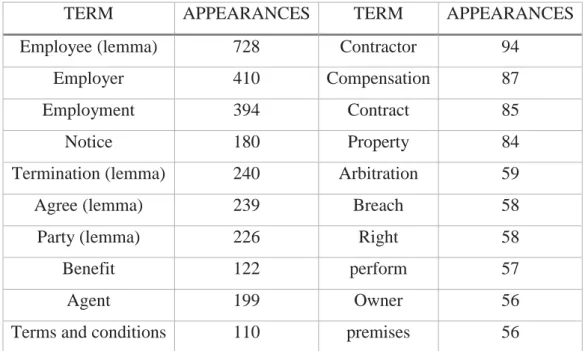
We analyze fourty-one candidate words to obtain twenty terms. They are ordered by appearances, being the first one the term which has the highest number of appearances taking into account their belonging to the same lemma, if applicable. The list of terms and its appearances are the following:
TERM APPEARANCES TERM APPEARANCES Employee (lemma) 728 Contractor 94
Employer 410 Compensation 87 Employment 394 Contract 85 Notice 180 Property 84 Termination (lemma) 240 Arbitration 59 Agree (lemma) 239 Breach 58 Party (lemma) 226 Right 58 Benefit 122 perform 57
Agent 199 Owner 56
Terms and conditions 110 premises 56 Table 3. English glossary.
D.2. Spanish Wordlist
To create the wordlist in Spanish, we followed exactly the same procedure as for the English language. The result of the wordlist with noise can be observed in Figure 6.
46
As with the wordlist in English, the most frequent words in employment contracts in Spanish are grammar/grammatical words. In the position number ten we find the first word with semantic content. We now proceed to study these data.
D.2.1. Analysis of the data
The following table (table 2) shows the twenty words most frequently used from the subcorpus of employment contracts in Spanish.
Nº WORD FREQUENCY Nº WORD FREQUENCY
1 De 5457 11 Los 638
2 La 2547 12 Por 601
3 El 1970 13 O 579
4 En 1816 14 Con 563
5 A 1764 15 Las 498
6 Y 1015 16 Trabajador 411
7 Que 968 17 Ley 354
8 Del 931 18 Tiempo 329
9 Se 715 19 Trabajo 328
10 Contrato 667 20 Al 325
Table 4. 20 most common word in Spanish employment contracts.
47
This is also reflected in the language of law, where four of the most frequent words are the definite articles la, el, los, and las. The particle del, number eight in the list, is a contraction formed by the preposition de plus the definite article el. Following the particle del in the list, we find the personal pronoun of the third person se. According to the dictionary of the Real Academia Española (hereinafter known as the RAE), it is the atonic form of él. This form is very common because it is used for female, male, and neutral forms.
The rest of the words that appear on the list belong to the category of coordinators. The coordinators which most frequently appear are the copulatives y and que, followed by the disjunctive o.
After this analysis, we highlight the absence of verbs among the twenty most frequent words of Spanish subcorpus, while in English subcorpus, we had the verbs shall, will, and to be.
As we know, to carry out an analysis according to our goal (elaborate a glossary with the twenty most common terms of employment contracts), we must eliminate the noise, as we did with English subcorpus. In this case we have made a stopword list formed by the first 2000 most frequent words in Spanish, extracted from the list of the 10,000 most frequent words in Spanish of the RAE corpus. Since it is our mother tongue, we removed from these 2000 words, those that we considered suspicious to be terms. To this list, we have added a common stopword list, extracted too from the webpage
http://members.unine.ch/jacques.savoy/clef/spanishST.txt. Finally, we have added
repeated words in Spanish employment contracts but are not terms, as DNI, NIE, dña,
domicilio, euros, boe, or art.
48
Figure 7. WordList Spanish subcorpus without noise.
Now that we have eliminated a great part of the noise, we proceed to the analysis of the data. To classify a word on the list as a term, we have used two dictionaries. On the one hand, we have used the online RAE dictionary (which labels the semantic field of terms in a distinctive color, implying that these are specific to a specialized language) and on the other hand, the online law encyclopedia
http://www.enciclopedia-juridica.biz14.com/i/index-p.htm. In addition to the dictionaries, we employ the
concordance tool available in the program AntConc. We follow the same parameters as in the English analysis.
We use the same method as in the English analysis. Our Spanish candidates are: 1: trabajador 2: empresa 3: jornada 4: parcial 5: colectivo
6: servicio 7: servicios 8: formación 9: cláusulas 10: convenio
11: bonificación 12: derecho 13: requisitos 14: laboral 15: legal
16: vigente 17: período 18: dispuesto 19: partes 20: salario
21: estatuto 22: específicas 23: corresponda 24: cuotas 25: resolución
26: aprobado 27: reducción 28: representante 29: cliente 30: establecidos
31: semanales 32: certificación 33: proveedor 34: legislativo 35: objeto