FACULTAD de FILOSOFÍA Y LETRAS
DEPARTAMENTO de FILOLOGÍA INGLESA
Grado en Estudios Ingleses
TRABAJO DE FIN DE GRADO
Social Media in the World of Sales: Translation &
Analysis
Rodrigo Ramos Collado
Tutor: Isabel Pizarro Sánchez
ABSTRACT
Economy and technology fields are subjects of great importance in nowadays society. Translation of documents and articles has grown throughout the years in order to connect the whole world. These topics are considered to have specialized vocabulary that must be translated with the help of tools such as specialized dictionaries and or economy glossaries among others. Hence, this work deals with the translation and analysis of an informative article of Harvard Business Review’s magazine titled: How B2B Sellers Are Offering Personalization at Scale, from its source language, English, into Spanish. The
main purpose of the analysis is to show the differences but also the similitudes in the translation of general aspects of grammar and economy terminology between English and Spanish languages.
Keywords: economy, technology, translation, translation analysis, terminology, informative article
RESUMEN
Los campos de economía y tecnología son temas de gran importancia en la sociedad actual. La traducción de documentos y artículos ha crecido a lo largo de los años con el fin de conectar el mundo entero. Se considera que estos temas poseen vocabularios específicos que deben ser traducidos con la ayuda de herramientas como diccionarios especializados o glosarios de economía entre otros. Por ello, este trabajo tiene como objetivo la traducción y el análisis de un artículo informativo de la revista Harvard Business Review titulado: How B2B Sellers Are Offering Personalization at Scale. Desde
su lengua origen de escritura, el inglés, al español. El propósito principal del análisis es mostrar las diferencias y similitudes que existen entre el inglés y el español, tanto en la traducción de aspectos general de la gramática como en la terminología económica.
TABLE OF CONTENTS
1. Introduction...1
2. Reference Texts...2
3. Methodology and Resources...5
3.1. Methodology...5
3.1.1. Type of Translation...6
3.1.2. Reference texts...8
3.1.3. Analysis of reference texts...8
3.2.Resources...9
3.2.1. Source text (ST)...9
3.2.2. Other: Dictionaries, Databases, Forums and Glossaries...10
4. Translation of the Article: How B2B Sellers are offering personalization at scale...12
5. Analysis and Translation Commentary...21
5.1.Rhetorical level...21
5.1.1. Rhetorical situation...21
5.1.2. Context...22
5.2.Grammatical level...22
5.3.Terminological level...28
5.4.Non-verbal elements...33
6. Conclusion...35
7. References...37
7.1.Primary Sources...37
7.2.Secondary Sources...39
7.3.Reference texts...40
FIGURES/TABLES...PAGE Figure 1...2
Figure 2...7
1 1. Introduction
In current society, the connection among the different countries is unavoidable. Not only is the language exchange important but also the cultural exchange. Aside from being a way of communication, this connection is based on sharing documents that need a translation. Before starting with the analysis, it is important to notice the definition of translation, from a remarkable author, Peter Newmark (1998):
The act of translating is the transference of the meaning of a text, from one language to another, taking care mainly of the functional relevant meaning. The theory of translation is neither theory nor science, but a huge group of knowledge. (Newmark, 1998)
The article chosen for this work belongs to the magazine, Harvard Business Review, in which is considered a mixture of economy and technology. Apart from having
analyzed the translation, a commentary is going to be developedof every economic and technological term. Even though this is not a research paper, it is based on referential texts to support the translation of the article.
To carry out the translation, several specialized tools have been used: monolingual and bilingual dictionaries; economic webpages which include forums fed by economic professionals; and above all monolingual glossaries that have previously studied the economic terminology. Moreover, comparable texts, used to look for terminology, are going to be used in the development of the analysis. Finally, texts used as reference with specific terminology are needed in order to develop this work.
In the analysis, a section of comments on the translation is going to be provided, taking into consideration the difficulties in the process of translation. This section is going to be divided according to the different levels of study. The aim of this work is to identify new terminology of this emerging topic, which will help future translators.
2 2. Reference Texts
In this work, the main purpose not only is to identify the economic terminology but also to translate the text accurately. The text is aboutthe use of new technologies in economy to obtain a better profit in the process of selling. The process of mixing these two worlds, economy and technology, results in the introduction of new terminology which is going to be analyzed along this paper. As previously stated, it is necessary to take into account some theories and studies from authors who have a great impact in the translation of economic terms.
The translation of economy texts is considered one of the most important fields in the modern society due to the globalization. “Increased international trade, and the
lowering of barriers to such trade, frequently results in improved international relations”
(RAND, 2018). In order to establish international relationships is necessary to build a bridge among people of different countries, performing translations.
The first chosen text was written by a translation scholar, Peter Newmark, who has established some basis of translation in his works, in particular, A Textbook of Translation. This work is included as a basis of our work, as it is a very complete work
in terms of analysis and study. It includes every aspect of translation, “My purpose in this book is to offer a course in translation principles and methodology” (Newmark, 1987).
“I cannot make you a good translator; I cannot cause you to write
well. The best I can do is to suggest to you some general
guidelines for translating” (Newmark, 1987).
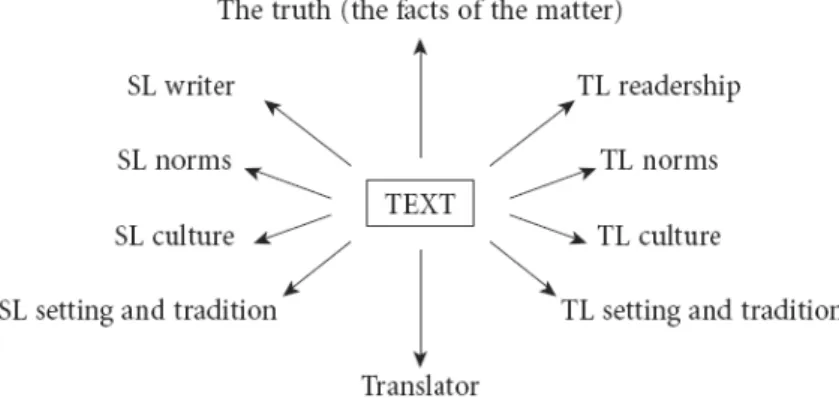
After stating this, he provides a figure about the translation dynamics and some important aspects to be considered in a translation.
3
Figure 1 shows the principal elements that should be considered before beginning the translation. The most relevant parameters are shown as for instance, the cultural aspect of SL (Source Language) and TL (Target language) and the grammatical rules among others. Obviously, if every aspect is considered in a normal translation, it is doubtless that this should be included in an economic translation. In addition, it is important to take into account the different cultures, as they will probably suppose a trouble in the translation.
The next text selected is the book Genre Analysis: English in Academic and Research Settings by John M. Swales. It deals with role of language in academic settings.
This work helps us to write in correct academic English. Some ideas about the discourse community have been extracted to help us to acknowledge the background of a specific community (in this case the economic-technological community).
The third reference text is La Traducción Especializada (en Inglés y Español en Géneros de Economía y Empresa) written by Dra. Suau, professor from the University of
Valencia (Spain). This work, opposite from others, copes with the economic translation. Dra. Suau (2010) states that:
“Una propuesta teórico-práctica y descriptiva de los géneros más comunes en el campo económico-empresarial en inglés y en español, aplicándolos a la traducción especializada” (A theoretic-practical and descriptive proposal of the most common genres in the economic-business field in English and Spanish, applying them to specialized translation) (Suau 2010)
As it can be seen, she reflects the principles of translation established by Newmark and Swales. This is another reason why these authors have been selected.
La Traducción Económica Inglés- Español: Reflexiones desde una Perspectiva Discursiva y Terminológica is the next reference. This work is written by a group of
Spanish University professors, linguists and professional translators (Pedro A. Fuertes Olivera, Eva Samaniego Fernández, Silvia Montero Martínez and Mercedes Garcia de Quesada). It deals with the communicative codes of a discourse community (Swales) and with its importance to translate specific terminology. Not only do these authors establish
4
(1986, 1987) made a contribution in this work stating that “El lenguaje económico es un lenguaje comprimido en el que es frecuente encontrarse con reducciones gramaticales”. This affirmation should be considered as many terminological abbreviations is going to be found.
Lastly, an article from a Spanish newspaper, EL PAIS, is considered. It copes with
the methodology used to translate their article’s titles. As it is considered of utmost importance, it is going to be included as another reference text for the translation of the title. “The title of any article will show the audience a lot of information of the article itself before reading any word of it” (Vella and Martínez, 2012). Although this article proposes a translation from the SL to a TL, and the genre is not exactly the same (News report) it is useful to consult doubts. As the authors said in the initial approach of the work:
(1) El uso peculiar que de la lengua general se hace en este tipo de documentos.
(2) La carga «cultural» que encierran, incluyendo estereotipos culturales, información explícita e implícita, transparente para los miembros de una determinada comunidad lingüística y cultural, y opacos para el extranjero.
(3) La densidad informativa que encontramos en los «títulos» o «titulares» de prensa. (Vella and Martínez, 2012)
5 3. Methodology and resources
3.1. Methodology
The translation of economic texts has become an important topic to attend in current society due to its importance in the communication among people of the entire world. The economic world is a growing and changing world “EVER since the global economy completed its rebound from the financial crisis of 2008, it has grown at a
moderate but steady pace” (The Economist, 2018). Any translation made in the past
would have become obsolete, as the world is in constant change according to connotations
and uses. The translation of our work is the one called “technical translation”.
One of the main goals of this work is to analyze the terminology used in articles of sale related to economy and to the use of new technologies. In this kind of text appears terminology we have translated and analyzed.
To elaborate our work, we have translated the mentioned article with the help of several specialized tools. Next, we have identified differences and similitudes in the translation of grammar aspects but also the terminology of the field.
The analyzed article is found in the specialized language of economy. In order to know how we must translate the text we must know what a specialized language is.
Specialized language is more than a technical or particular instance of general language. In today´s society with its emphasis on science and technology, the way specialized knowledge concepts are named, structured, described, and translated has put terminology or the designation of specialized knowledge concepts in the limelight (Faber, Lopez 2012).
Given that it is a specialized language we have analyzed the roots, the culture surrounding it and all the influential features of the language; its usages and the information it carried out in order to be accurate with our translation. Literal translation cannot only be used when we are translating a specific text, because the context in which the word is used might change the meaning of the word. In this translation the specialized tools, such as economic dictionaries or specific glossaries, play an important role.
6
Every text has a function, according to Karl Bulher in his work Theory of Language: The Representational Function of Language (1990) states that “language has
three main functions: the expressive, the informative, and the vocative” (Bulher, 1990). The three main functions he refers to are called dominant functions. Behind them, there is a large list of sub-functions such as persuasive or descriptive function. Functions are identified in the analyzed article together with the dominant one, the informative:
In all types of fact oriented, scientific and knowledge-based writing the function of language can be characterized as informative. These texts are intended to convey the truth and to keep their readers well informed. They neither aim at pleasing our senses nor appeal to our attitude. Hence, informative texts tend to use standard, non-regional, non-class, non-idiolectal language. The style is mostly technical and non-emotive. Text-books, reports, research reports, academic articles, scientific-literature, etc. form this text type (Anukriti, 2005)
3.1.1. Type of translation
Translation is a complex procedure in which the translator must assess the type of translation that should be performed, and the tools that are going to be used in the process. There are several authors that have made different classifications of translations types. Larson (1984) in a work distinguishes between Form-Based Translation and Meaning Based-Translation. Catford in 1978 divides the translation depending on three aspects
which are extent, level, and ranks, depending on them there might be different types of translation. Another classification is done by Roman Jakobson (2000) in On Linguistic Aspects of Translation. Our work is developed with the classification that Peter Newmark
7
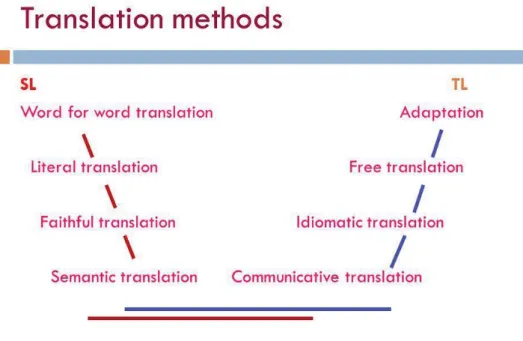
FIGURE 2: Types of translation
Figure 2 presents a traditional classification of the methods of translation.
Communicative and idiomatic translation are going to be proposed because newspapers and magazines give preference to the acceptance of the target audience. According to Newmark Communicative and Idiomatic translations are:
“Communicative translation attempts to render the exact
contextual meaning of the original in such a way that both content and language are readily acceptable and comprehensible to the readership.” (Newmark, 1988)
“Idiomatic translation reproduces the ‘message’ of the original
but tends to distort nuances of meaning by preferring colloquialisms and idioms where these do not exist in the original.”
8 3.1.2. Reference Texts
When translating a text, it should be notice the specific field and genre that are going to be translated. One method which enable us to distinguish the genre and the field is by means of texts from other authors that have worked in the same field in the past, or authors that have analyzed the same genre. These works are called reference texts, and they are helping us with our translation and analysis.
... [it] is necessary to first carry out large scale contrastive stylistic study (in a given register) to establish cohesive patterns in SL (the source language) and TL (the target language), and then to examine translations to and from both languages to investigate shifts in cohesive levels that occur in translation. (Blum-Kulka 1986, 33)
For that reason, we have look for texts from English and Spanish language (monolingual or bilingual) that establish a series of parameters that have guided us to achieve a good translation.
In the searching of all these reference texts, it is important to consider its well- use in order to develop the work. They should be looked for, according to different formats for instance, books, essays or articles about translation. They were works that talk about how an economy text should be translated, they were also texts about how the title of an article should be translated.
3.1.3. Analysis of Reference Texts
In our study, some referential texts have been reviewed in order to do the translation more accurate. The analysis of the texts is being performed as some relevant information about our topic might be found. Some of the information included in those works are related to the topic we were dealing with, but there were others in which we had to isolate some section, for example, A Textbook of Translation by Peter Newmark,
although it is not a specific in the economic field, it is completely useful since it is a perfect manual of basic concepts of translation.
However, in Swales work, Genre Analysis has been analyzed in terms of finding.
Having analyzed the text, the following aspects are considered of utmost importance.
9
1. Genre analysis - setting the scene
Aims and purposes
Outline of the book
Origins and influences
- Part 2 KEY CONCEPTS
2. The concept of discourse community
Speech communities and discourse communities
A conceptualization of discourse community
An example of a discourse community
Remaining issues
Considering these parts, a knowledge can be built in order to analyze the genre of this article and the specific characteristics of a discourse community, being very helpful to establish the context and parameters in the economy translation.
Aside from using referent texts, some comparable texts are also used so as to have terminology to be compared with the one in our work. This comparison is made in the Terminological level, in which it is necessary to deal with the specific vocabulary and the terms that are identified as specific.
3.2. Resources
In the present paper, several resources have been used throughout the whole process. In this section, the resources have been classified into two main groups. The first group includes the ST: How B2B Sellers are offering personalization at scale (1050 words). The latter one contains sources such as general dictionaries, economy
dictionaries, glossaries, databases, forums and webpages of reference.
3.2.1. Source Text (ST)
The Source Text selected for our work is an article from the economy magazine
Harvard Business Review publishing by the Harvard University Business School in July
10
The article selected was taken out from the online edition of the magazine. This text has been chosen for two main reasons, one of them is because it deals with the social networks incorporation into the selling process. Hence, not only does it deal with economy, but also it deals with technology and the applications in economy. Secondly, the extracted vocabulary will be very useful for further translations. Economy is a growing subject in this evolutionary world. With that premise, a new glossary is not going to be created, but new terms might be included.
3.2.2. Other resources: Dictionaries, Databases, Forums and Glossaries
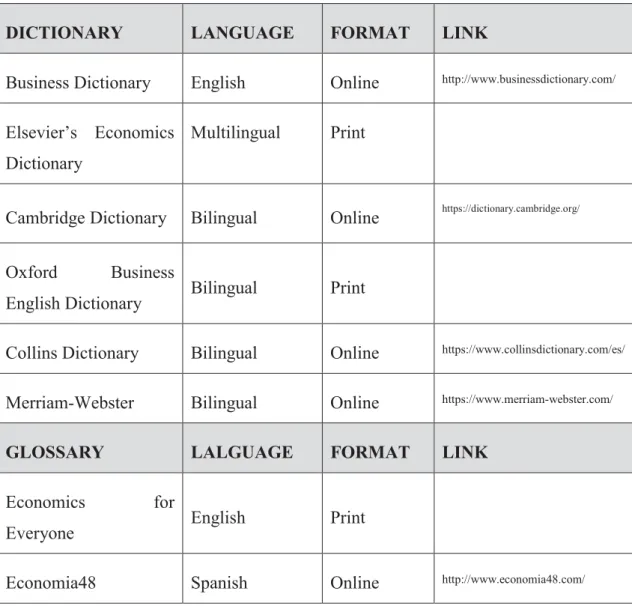
As it can be noticed in Table 1, the resources used in this work are divided into categories according to their format: dictionaries, databases and glossaries.
DICTIONARY LANGUAGE FORMAT LINK
Business Dictionary English Online http://www.businessdictionary.com/
Elsevier’s Economics
Dictionary
Multilingual Print
Cambridge Dictionary Bilingual Online https://dictionary.cambridge.org/
Oxford Business
English Dictionary Bilingual Print
Collins Dictionary Bilingual Online https://www.collinsdictionary.com/es/
Merriam-Webster Bilingual Online https://www.merriam-webster.com/
GLOSSARY LALGUAGE FORMAT LINK
Economics for
Everyone English Print
Economia48 Spanish Online http://www.economia48.com/
11
The majority of the sources belong to the field of Economy but there are also some of them of general knowledge. In table 1 some used sources are shown, not only are the sources used to look for specific terminology, but also, they have been used along the development of the work.
It is important to specify the dictionaries used to perform this work, they are
Oxford Business Dictionary or Elsevier’s economics Dictionary. The former includes a
brief definition of the terms, whereas the latter has only the translation in some languages.
On the contrary, encyclopedias such as Economia48 or in Economics for Everyone
12
4. Translation of the Article: How B2B Sellers are offering personalization at scale
In the present section, a translation of the article How B2B Sellers are Offering Personalization at Scale is carried out. In the left, the ST can be found, whereas the TT
is placed in the right column. Furthermore, there is also a third column in the left margin of the paper with the enumeration of paragraphs.
It is important to remark that the text is highlighted in different colors in order to differentiate the parts of the text. The underlined elements are used to show which parts present general grammar difficulties; in bold the specific terms we have considered to be in the terminology.
SALES
How
B2B
Sellers are
offering personalization at
scale
Justin Shriber JULY 12, 2017
VENTAS
¿Cómo los vendedores
B2B
ofrecen personalización a
medida?
Justin Shriber 12 de julio de 2017
1 As consumers in this data-driven, algorithmically obsessed world, we’ve
come to expect highly personalized experiences that are tailored to our specific needs. Companies like Netflix and Uber set that tone, giving us what we want, when we want it — usually on the first try.
13
2 These “have it your way” consumer experiences have changed the way the business world thinks about sales. B2B buyers have slowly been conditioned to expect the same personalized treatment that they get while shopping on Amazon. They want to be approached with relevant offers at the right moments, not
when it’s convenient for a sales rep. They have little to no patience for ill-timed, generic pitches.
Estas experiencias como consumidores de
“a tu manera” han cambiado la forma de
pensar del mundo de los negocios sobre las ventas. Los compradores B2B han sido condicionados poco a poco con la expectativa de recibir el mismo trato personalizado que cuando compran en Amazon. Quieren ser abordados con ofertas pertinentes en los momentos idóneos, no cuando sea conveniente para los
comerciales. Tienen poca o ninguna paciencia para las ofertas genéricas inapropiadas.
3 Sales professionals and organizations are responding with new strategies and technologies that allow them to deliver personalized experiences at scale. The best sellers are combining the information served up by social platforms with the latest sales tech to go in warm, rather than cold, with a message that is on point from the start. In other words, they are using social selling.
Las organizaciones y profesionales de ventas están respondiendo con nuevas estrategias y tecnologías que les permiten ofrecer experiencias personalizadas a medida. Los mejores vendedores están combinando la información obtenida en las plataformas sociales con la última tecnología en ventas, para calentar motores, con un mensaje establecido a priori. En otras palabras, están usando el social selling.
4 Here are three areas where leading reps distinguish themselves:
14
5 Smarter targeting. Social media platforms offer rich demographic information, and the smartest sales pros are using it to segment “likely buyers” into “buyers who are ready to buy now,”
capitalizing on something that
yesterday’s sales pros could only dream
of: intent signals. These signals, which include job changes (people are more inclined to make bold moves when they enter a new role), social posts (an indicator of top-of-mind questions), and hiring patterns (an indicator of investment), help sales pros know when
it’s time to reach out. Sales pros can use social media features like advanced filters and lead bots to further facilitate the process of identifying qualified leads.
Focalización inteligente. Las plataformas de redes sociales ofrecen abundante
información demográfica, y los
profesionales en ventas más inteligentes la están usando para segmentar “posibles compradores” en “compradores que están preparados para comprar ahora” sacando provecho de algo con lo que los antiguos expertos en ventas solo podían soñar:
huellas de intención. Estos indicios, que incluyen cambios de trabajo (las personas son más propensas a realizar movimientos atrevidos cuando entran en un nuevo rol), las publicaciones sociales (indicador “lo
15
6 Better understanding. A recent survey found that 80% of buyers don’t believe
that the salespeople they deal with understand their business. When salespeople start the conversation with a tried-and-true opener like “Can I ask you
a few questions?” they reinforce this perception. By contrast, leading sellers
tend to open with “I noticed that you’ve been thinking about…” How? They’ve
followed social media threads to prepare for the face-to-face meeting long before it happened. Part of asking the right
questions is understanding who’s on the buying committee, which is particularly challenging given that 6.8 people are involved in purchasing decisions, on average. Since buyers have next to no tolerance for vague questions fired off by the uniformed, the sales pro who can most quickly get to the heart of the matter with every decision maker typically wins.
Mejor comprensión. Un reciente estudio revela que un 80% de los compradores no creen que los vendedores traten de entender sus negocios. Cuando un vendedor comienza una conversación con una expresión testada y aprobada como “¿puedo hacerte unas preguntas?” intensifican su atención. Por otro lado, los mejores vendedores tienden a comenzar con “me he
dado cuenta de que estas interesado en…”
16
7 Closer engagement. Twenty-three percent of deals go dark because reps fail to engage buyers through the entirety of the sales process. When sales professionals are unable to provide
ongoing value, the buyer feels no obligation to maintain a dialogue. On the other hand, when connections are made through a trusted mutual acquaintance, a buyer often feels obligated to stay engaged longer. And once contact is made, the best sellers use technology to
gauge whether the information they’re
sharing with a buyer hits the mark. Tools like email tracking and PointDrive allow sales reps to see where a buyer digs in and what a buyer ignores, providing a feedback loop. They can then use that information to tailor future interactions.
Compromiso más cercano. El veintitrés por ciento de las ofertas caen en saco roto debido a que los comerciales no consiguen involucrar por completo a los compradores durante el proceso de ventas. Cuando los profesionales en ventas no consiguen proporcionar un incentivo constante, el comprador no se ve comprometido a mantener el diálogo. Por otro lado, cuando las relaciones se realizan por medio de un conocido mutuo de confianza, el comprador a menudo se siente obligado a permanecer comprometido durante más tiempo. Y una vez se ha establecido el contacto, los mejores vendedores utilizan la tecnología para evaluar si la información que comparten con el comprador da en el blanco. Las herramientas como seguimiento de correo electrónico y PointDrive (Herramienta de ventas personalizadas) permiten a los agentes en ventas ver donde indaga un comprador y que es lo que ignora,
proporcionando un ciclo de
17
8 At an individual sales rep level, social
selling can be powerful. But when it’s
rolled out across sales organizations, the impact can be significant. Marrying social selling with the right technologies can deliver a measurable impact on a
sales pro’s performance. A global survey of sales professionals conducted by LinkedIn (where I work) last year found that 83% of top social sellers work at companies with focused social selling programs. When social selling is deployed, win rates increase by 1.2x, and deal sizes increase by 1.3x.
A nivel particular de los agentes de ventas, el social selling puede ser poderoso. Pero cuando se implementa en la organización comercial el impacto puede ser significativo. La unión del social selling con las tecnologías adecuadas puede generar un impacto significativo en el rendimiento de los profesionales en ventas. Una encuesta global sobre profesionales en ventas realizada por LinkedIn (donde trabajo) el año pasado descubrió que el 83% de los principales social sellers trabajan en empresas con programas de social selling especificos. Cuando se implementa el social selling los índices de ganancia se multiplican en un 1,2, y el número de ventas aumenta hasta en un 1,3.
9 To achieve this level of impact, companies can do three things:
Para alcanzar este nivel de impacto, las empresas pueden hacer tres cosas:
10 Build centers of excellence. Leading sales organizations are establishing a
“center of excellence,” which defines
and oversees the rollout of practices that operationalize social selling. Investing in tools and the change management that goes with them is essential. Eighty-four percent of sellers working with companies that prioritized this saw real impact.
Construir centros de excelencia. Las principales organizaciones de ventas están
18
11 For example, when the Sacramento Kings took on new ownership, the
basketball franchise’s sales leadership
adopted social selling, which drove a shift in confidence, especially among its newer reps. With support and buy-in from the owners, sales leaders, and sales reps themselves, the sales team saw a 20% increase in attendance, 42% increase in deal size, and 3.2x larger deals sourced through social platforms.
Por ejemplo, cuando los Sacramento Kings cambiaron de propietarios, la directiva de ventas de la franquicia de baloncesto adoptó el carácter del social selling, lo cual llevó a un cambio en la confianza, en particular entre los nuevos comerciales. Con el apoyo y participación por parte de los propietarios, líderes en ventas y los mismos agentes de ventas, el equipo de ventas experimentó un aumento del 20% en la asistencia, un 42% en el número de acuerdos y el número de ofertas provenientes de las plataformas sociales 3,2 veces mayor.
12 Measure the impact. Second, companies measure leading indicators, such as
meetings secured through social engagement and time spent on social media preparing for interactions, as well as lagging indicators driven by social selling, like impact to bookings, win rates, and average selling price. This typically requires integration with the
CRM system.
Evaluar el impacto. En segundo lugar, las empresas valoran los principales indicadores, tales como mítines
conseguidos a través del compromiso social y el tiempo invertido en redes sociales preparando las interacciones, así como los
19
13 Gain executive buy-in. Lastly, success requires that social selling be led from the top down. Executives need to be active on social media and leverage their networks to open doors for their teams. If execs aren’t comfortable with this,
they can get help from their marketing team members, who are typically the most socially savvy. Eighty percent work for companies with a CEO who supports the adoption of a new approach.
Obtener aprobación ejecutiva. Por último, el éxito requiere que el social selling se realice de arriba abajo. Los ejecutivos deben ser activos en las redes sociales y aprovechar estas para abrir puertas a sus equipos. Si no quedan satisfechos con esto, pueden recibir ayuda de los miembros de su equipo de marketing, los cuales, normalmente, son los más entendidos en el ámbito social. El ochenta por ciento trabaja para empresas con un CEO que apoya la adopción de un nuevo enfoque.
14 Here’s what all this looks like in practice. When SAP expanded from its enterprise-resource-planning business to cloud solutions, a major hurdle it faced was negotiating a new, more rapid sales cycle. The inside sales team was brought in to nurture leads and help manage the
pipeline, and it found immediate value using social selling for high-volume but highly targeted prospecting. SAP’s
inside sales team saw a 40% increase in the sales pipeline, saw $4 million in revenue from its first phase, and closed several deals of more than $300,000.
Así es como todo esto se ve en la práctica.
Cuando el SAP (programa de
procesamiento de datos) amplió su negocio de planificación de recursos empresariales a
soluciones en la nube, uno de los mayores problemas a los que se enfrentó fue la negociación de un nuevo ciclo de ventas más rápido. El equipo interno de ventas se incorporó para educar y nutrir a los clientes potenciales y ayudar a administrar el
20
15 As buyer demands continue to inch higher, it is imperative that both sales professionals and sales organizations evolve their strategies to address those expectations. Embracing new sales tech and social selling strategies is the key to creating one-to-one interactions at scale
— but thoughtful, strategic execution is critical to making it all work. Only then will B2B sales professionals be able to capitalize on personalization at scale and fully realize how disruptive it can really be.
21 5. Analysis and translation commentary
In the present section of the work, every part of the text is analyzed, the format, the structure, the vocabulary and all the relevant elements that have supposed a great difficulty when translating.
Notwithstanding, it is important to notice the different levels in which the translation is going to be analyzed, in particular the Rhetorical Level, the Grammatical Level and the Terminological Level
5.1. Rhetorical level
It is important to make a definition of the world “rhetoric”. Corbett (1985) states that:
“Rhetorical criticism is a mode of analysis that focuses on the text itself.” “It is more interested in a literary work for what it does than for what it is.” (Corbett, 1985).
The rhetorical analysis of a text or close reading is “an analysis focused on the relation among the text, the author and the audience” as Nordquist (2018) said. It is the analysis of how writers and speakers use words to influence the audience. The analysis consists of breaking the text into parts and then it explains how that parts work together to create a certain effect.
Consulting webpages and essays from different authors, The KSU (Kennesaw State University) Writing Center or Miami University webpage among others, about How to write a Rhetorical Analysis Essay, there is a recurrent structure with some fixed parts
to follow. This structure is made-up by these main parts:
5.1.1. Rhetorical situation
Regarding the audience, it is directed to people with a good deal of knowledge about economy and technology, since there is specific vocabulary of both subjects. Then, it can be said that the audience ranges from students of economy to expert economists.
22
growth and profitability providing solutions to different marketing sales and service problems. He can be considered an economy expert.
The text tries to explain to the audience the new selling methods in this technologized society, it could be said that it is an informative text at the same time that it is an expository text in which are presented and explained several terms and concepts.
5.1.2. Context
In terms of context, every aspect surrounding the text, such as the historical background, has been included. They would provide the acceptance of the text in the different audiences. In the concrete case of this text, the translation should be very accurate in terms of new technology since some terms or expressions could be banned in the target audience or merely do not exist. The claim of the text is the part in which it is analyzed the main idea that the author wants to transmit. In the case of this text, it is the idea of combine technology and economy to develop certain skills of sale.
This main idea needs a group of statements that support its claim. The text is full of these support statements in form of facts, data, evidences and other things. Those ideas, in especial, the data ones could generate some difficulties at the time of translate them, for example the change from dollars to euros or miles to kilometers. All these ideas should bring the main idea to the acceptance of the audience.
Finally, in the context section, the claim and the ideas that support it should have a connection that warrants the plausibility of the idea, more specifically the beliefs, experiences or values that the authors assume they share with their audiences. The writer should share the same assumptions that their audience, if it is not in that way the argument of the text will not be effective. For that reason, the audience is said to be as specific as the text, from students of economy to expert social sellers interested in the new technologies used in the social selling.
5.2. Grammatical level
23
The study of the classes of words, their inflections, and their functions and relations in the sentences. It is the study of what is to be preferred and what avoided in inflection and syntax (Merriam-Webster).
Apart from these definitions, other definitions might be considered, and this time from linguistics of great importance such as Kirkham (1829) “grammar is the art of
speaking and writing the language with property” keeping in mind the word as a
suggestion that grammar is a form of social decorum that involves certain rules.
In the grammatical analysis of this text, aspects studied such as the translations of the passive voice, nominal groups and all the aspects of syntax or morphology that have supposed a difficulty in our translation. Then, we have the different difficult translated terms or structures supported by a little translation commentary.
As a first glimpse, it can be perceived in the heading a verbal voice change, the present continuous verb “are offering” changes into the present simple in Spanish due to the weirdness of this verbal tense in the Spanish language while avoiding literal translation.
Moreover, in the heading the word “personalization” can be seen. Three generic dictionaries (Oxford, Cambridge and Collins) have been considered and there is no reference to this word. Therefore, the term has been looked up in a specialized dictionary of business, specifically the Cambridge business dictionary. This dictionary says the process of making something suitable for the needs of a particular person. For that reason, the translation should be “personalización”. It is a very literal translation but in
this case is quite accurate.
Finally, the term “at scale” should be translated as “a escala”. However, it has
been used a synonym “a medida” because it is more accurate in the business context. For example, in the third paragraph “experiences at scale” should be translated as “experiencias a medida (de cada consumidor)”. It is referred to the consumers so “escala”
has no sense as post-modifier of this subject.
In paragraph 1, there is an instance of grammatical change from the adverb
24
the Spanish grammar are not so commonly used, this translation technique is known as transposition (move from a grammatical category to another without altering the meaning). There is another change in the sentence structure since in the SL the word is a pre-modifier of the noun while in the TL is placed in a post-modifier position becoming the DO of the phrase.
Next to that in the same paragraph there is an example of passive voice, “are tailored”, translated to the Spanish grammatical structure “pasiva refleja”, which is a
common structure in Spanish language that combine the features of the passive and
features of the reflexive constructions. Its common construction is “se + verb” in this case
“se elaboran”.
Finally, at the end of this paragraph we can see an idiom, a popular expression from a language that uses exemplification and figures of speech to explain something. At the time of translating these expressions, we must consider different facts from the TL. For that reason, it must be borne in mind that some terms might not been accepted in TL or even they do not have the same meaning. Hence, it is more convenient to consider a translation of meaning rather than a simple word translation. With this regard, the
expression “on the first try” has been translated into “a la primera”.
In paragraph 2, the sentence “have it your way”, which at first sight could have the appearance of an idiom, is indeed a registered slogan of one of the biggest multinational food company, Burger King. In an article of the online newspaper, Mailonline, it can be seen that this slogan has been used by the company for forty years
until 2014 when it was substituted for another one supposing a new grammatical challenge. This shift was made in the defiance of grammar, as stated by Mailonline (2014)
“they could live how they want anytime.”
Then, there is a movement in the structure and a transposition. In this case passive voice is maintained, as it can be seen in the following instance “have slowly been conditioned”, if it is translated using the “se” pronoun as “se condicionan” it might sound
25
after the verbal construction. Furthermore, it is noticeable that “slowly” is translated as
“poco a poco” maintaining the same meaning of the adverb.
In the same paragraph 2, there is another transposition, in this case with the verb
“to expect” which is transformed into a noun phrase.
Then, the word “relevant” can be found. It can be translated as “relevante”.
However, this translation is quite poor and robotic. For this reason, it has been decided to
use a synonym instead, which is “pertinente”. It has sense in the context and it fits even
better in the Spanish translation.
Afterwards, considering paragraph 5, it can be seen that the word “capitalizing” literally translated means “escribir en mayúsculas”. Notwithstanding, it has not much
sense in the context we are dealing with, therefore, we have to look for a more suitable translation that could be “sacar provecho”.
Regarding paragraph 5, there is another term that suppose a difficulty when
translating. A perfect equivalent could not be found for the expression “top-of-mind questions”. However, a further research has been made, and after having looked many webpages, it has been found a reliable webpage from the WIPO (World Intellectual Property Organization) in which this expression is translated generally. Therefore, it has been concluded that the most suitable equivalent might be “la primero (cosa) que te viene a la cabeza” we found this expression in one of its articles (English-Spanish) and this translation is generalized trough other articles.
Another term which supposed some difficulties when translating was to the
phrasal verb “reachout”. As every phrasal verb, it consists of two parts, one the main verb and then the preposition. It is remarkable that the phrasal verb has not much to do
with the former verb. The former verb means “llegar/ alcanzar”. However, when the preposition “out” is added, the meaning changes completely, being “contactar”.
Furthermore, when focusing on the translation, it can be appreciated that it includes a transposition and a verb change. In this way, the translation of the verb is changed into
26
of translations, and after reaching this translation, it might be concluded that it does not fit with the business context.
In paragraph 6, there are some troubles found when translating. The first case is an idiom “tried and true” which has been translated almost literally in “testada y aprobada”. The second term is “to open”. This term has to be looked in the Oxford Business English Dictionary. It provided a suitable translation for that term, “entablar”.
Then, it was necessary another transposition. With this regard, the expression
“particularly challenging” has to be translated by adapting the translation to the context,
in this way it was translated as “sorprendente desafío”. The following expression is “6.8
people”. It refers to a statistic (the number of people out of ten) and in a specialized context it might be understood. However, in Spanish, it is necessary to state that reference (out of ten), in both colloquial and formal context. Therefore, the translation might be
“6,8 personas de cada 10”. Afterwards, the expression “the heart of the matter” also
presents a trouble when translating. Hence, it has been opted to use a free translation being
“al meollo del asunto” more akin to what the SL refers to. Finally, the expression
“decision maker” appears in the SL, but it does not appear exactly in the TL. It has been translated by “esas personas” considering the word “people” in the example “6.8 people”
as the referent for that expression.
Paragraph 7 begins with the idiom “deals go dark”. The term “deals” is analyzed in the terminology section. This word is going to determine the expression “go in dark”
whose literal translation in the TL is “van a la oscuridad”. As this expression cannot be used in this context, it has been translated in the most suitable way it has been found. With this regard, it has been chosen the expression “Caer en saco roto”. It is a Spanish idiom found in Diccionario de Dichos y Refranes in the webpage Academic. Then, the
next problem found is the expression “feels no obligation”. This expression has been translated using the Spanish structure, “pasiva refleja”. Hence, the translation is “no se ve comprometido”. Furthermore, it has to be noticed that in this expression, there is a transposition from the noun “obligation” to the adjective “comprometido” and a verb change from “feel” to “see” in Spanish. The following expression is “hits the mark”.
27
decided that the most accurate translation is “dar en el blanco”. Finally, there is a last
difficulty in this paragraph. “Digs in” is a phrasal verb which has not much to do with the former verb, “dig- excavar”. As it cannot be used in an economic text, it is needed to be further analyzed. It has been found that the preposition “in” modifies the meaning of the
phrasal verb. With this regard, “explorar, buscar” can be suitable translations. As it is quite unconvincing, it has been opted to use the word “indagar”, that is looking for
information; asking for it until reaching it.
In paragraph 10, there are not many trouble terms. Firstly, the compound noun
“center of excellence” is translated literally in “centro de excelencia” after looking for an equivalent term in Spanish, it has been decided that the literal translation might be pretty accurate, as this term can be found not only in economy, but also in politics and technology. Lastly, the verb “operationalize”, there is not a highly accurate equivalent in the TL, indeed the translation proposed is “operacionalizar”. Notwithstanding, it is unconvincing, therefore it has been decided that a phrase might be more accurate in this
case. So it has been proposed the phrase “poner en funcionamiento”.
In paragraph 11, it can be found a phrasal verb, “take on”. In order to translate this term, it has been opted to do a modulation. With this regard, “take on” has been translated by “cambio” in Spanish. Because in the SL construction the phrase is “took on new…”
which is a construction that supposed a change of something.
Moreover, in paragraph 13, there is another expression which needs to be translated in the most accurate way. “The most socially savvy” consists of a noun and an
adverb ending in-ly. Adverbs ending in “-ly” are frequently translated by means of changing the grammatical category. In this way, “socially” changes into the adjective
“social”. Furthermore, it changes its function in the phrase from pre-modifier of the
adjective “savvy” to the core of the preposition phrase in a post-modifier position. The final translation proposed is “los más entendidos en el ámbito social”. The word “ámbito”
has be added in order to maintain the accuracy in the TL. However, it can be omitted.
28
however, in this context that translation does not fit very well. Hence, this term is going to be translating by means of compensation, in particular the expansion method, adding
the verb “educar” andtranslating it finally as “educar y nutrir” because of its reference (the group of potential leads),
In the final paragraph of the text, the term “inch higher” represents a difficulty
since the meaning of the verb “inch” is “mover”. Although when it is followed by the
comparative adjective “higher” the translation changes into “aumentar”. It might seem as a phrasal verb but the construction of verb + comparative adjective does not appear as a phrasal verb pattern. Moreover, “one-to-one” might be considered as a term which
presents problems, because its translation is not as simple as “uno a uno” in the TL.
Indeed, it is a false friend and therefore it is necessary to propose a more accurate
translation as for instance “individuales”.Lastly but not least, the adverb “really” ending up in “-ly” has been translated into a prepositional phrase “en realidad” by means of a transposition.
5.3. Terminological level
This section deals with the study of specific economic and technologic terminology of the text. According to the Cambridge English Dictionary, Terminology is defined as “a group of special words or expressions used in relation to a particular subject or activity”. Another similar definition might be found in the Oxford Dictionary “the body of terms used with a particular technical application in a subject of study, profession, etc.”.
Firstly, “B2B” is a specific term and it appears in the title. It refers to the business-to-business market in which the one company sells its products to another one but not directly to the consumers. The translation into Spanish should be “venta de empresa a empresa” but after having consulted several documents and web pages, the term is not translated but transferred, because it is accepted as a worldwide term.
29
according to information that has been collected”. From other resources, it has been found the following translation “recabar datos”. As it can be seen, both the definition and the translation are quite similar, so that is why that translation has been chosen.
The term “tone” is normally translated as “tono” in general contexts. However, it
does not seem very accurate for this context. With this regard, “pauta” is thought to be
the most suitable translation. It is important to notice that this term has been included in the terminology due to its specific use.
In paragraph 2, the term “ill-timed” has been translated into “inapropiadas” since
“ill-timed” refers to something which comes in a wrong moment for the wrong person.
The term “ill” means “enfermo” or “algo malo”. Nevertheless, it cannot be translated as
such, since it is a compound noun, and “ill” is the pre-modifier of “timed”. Literally it
means “en el momento equivocado” the term we have used is a synonym of this one.
The term “pitches”, at a first sight, presents no difficulty when translating it. However, the general meaning of the word does not have any relation with the context of economy. Therefore, a further research is needed in order to find the most accurate translation in the economic context. Finally, according to the Dictionary, the term “sales pitches” is translated as “propuestas de venta”. Notwithstanding, this translation is not highly accurate in this context, so it is necessary to look for another equivalent which fits
better. With this regard, “ofertas” has been chosen as it is more specific and appropriate
for this context.
In paragraph 3, the term “social selling” is found in some economy pages such as
Victor Martin’s Economy Blog or Social Selling Coach. Besides, it is transferred and
accepted in the Spanish vocabulary. This term is referred to the use of social media in the process of sales.
30
“representante” even though is referred to politics context. Furthermore, in the economic context, there is a more suitable term “comercial”or “representante comercial”
One of the terms that has represented a significant problem in the translation is the
compound noun “intent signals”. This compound term is referred to something that has a reference in the past. Consulting different dictionary definitions, finally the Cambridge Dictionary defines intent as “what someone wants and plans to do”. Taking this definition into consideration, it might be translated as “tener intención de hacer algo” in the TL. Regarding the second word, “signal”, there are many translations as well, but the most appropriate one is “huellas”. Finally, when joining the two words, the translation provided
is “huellas de intención”.
Then, the term “lead bot” should be paid attention as the word “lead” appears several times in the text having different functions inside the phrase (noun, verb, adjective pre-modifier, etc.). In the case of “lead bots”, “lead” functions as the pre-modifier of
“bots”. Considering the context, the term has been translated into “orientativo”.
According to the Cambridge Dictionary, in this context, “lead” means: “to cause someone to do something” and the meaning of the second word “bot” is: “computer program that works automatically, especially one that searches for and finds information on the internet”. As there are not perfect equivalents for these two words, the best solution is to make transference since it includes an explanation.
In paragraph 6, the term “buying committee”might be highlighted as “committee”
may have a good deal of possible translations. It has been considered that “comunidad de consumidores” would fit well in the context we are dealing with. When translating
“committee”, many synonyms might be found, according to Espasa (2006), it is proposed one synonym which is “comunidad”. It is the most appropriate for the context.
In paragraph 7, there is the term: “ongoing value”. The translation of “value” in a
common dictionary is “valor”. Regarding the Cambridge and Collins Dictionaries in the section of economy, the translation of the word is “incentivo”. This term fixed with the
31
In paragraph 11, the next difficulty is the term “deal” which as it can be seen in the terminological analysis has different translations, in this case the translation is
“acuerdo” but it goes in its plural form due to the coherence and concordance with the verb.
In paragraph 12, the term “meeting” is a perfect example of the use of adaptation
in translation. Over the years, this term was transferred into Spanish, being the equivalent
word “mitin”. It is accepted and included in the terminology of the language. For that reason, it has been used in the TL rather than other equivalent words such as: “reunión”, “asamblea” or other one which could have different connotations.
The compound noun “lagging indicators” is translated as “indicadores retrospectivos”. According to Collins Dictionary and Cambridge Dictionary “lagging indicators” are defined as “a measure of economic activity that relates to events or developments in the past, not to change that have taken place since those events or developments”.
At the end of this paragraph, there is an example of an acronym: “CRM system”. It makes reference to Customer Relationship Management. The way to translate it is by
making a transference “Sistema CRM” supported by a brief definition into brackets.
In paragraph 13, the term “buy-in” is a compound noun formed by a verb and a preposition. It is defined in the Cambridge dictionary as “the fact of agreeing with and accepting something that someone suggests”. Regarding this definition, the term has been translated as “aprobación”. Nevertheless, it is important to notice that this expression might appear to be a false friend as “buy” means “comprar”. When adding the preposition, the meaning changes completely. Indeed, it is important to mention that in the translation of this example, there is a transposition from verb to noun. “Execs” is another example of abbreviation, referring to executives. In this case, in the TL, the term is omitted as it has a referent in the previous sentence. In Spanish, sometimes the subject is omitted when there is an immediate referent (pro cover noun language). Furthermore, the term “savvy”
is also included in this section as its main translation is “sabio”. Nevertheless, for this context, this translation is not very appropriate so another one is going to be used,
32
CEO is another example of transferred acronym. In this case, instead of adding an explanation of what the acronym means, the readers of the article, taking into account that they are a specialized audience, should know what CEO is. It is the main person responsible for managing a company (Chief Executive Officer).
In paragraph 14, the acronym SAP can be found. This acronym might be found in the webpage TechhTarget. According to this webpage, SAP is referred to “one of the largest vendors of enterprise resource planning (ERP) software and related enterprise applications”. The company’s ERP system enables customers to run their business
processes, including accounting, sales, production, human resources and finance, in an integrated environment. Considering every aspect mentioned previously, it has been opted for a translation by transference. In this case there is going to be a translation of the term and an explanation, to clarify any doubt that might arise.
Continuing with the translation, other terminology that might cause problems has been faced. In this case, we are dealing with the term “cloud solutions”. First of all, it is necessary to clarify the meaning of the term. “The Cloud” is an element with a high
presence in the technological world. It is the main innovation of the 21st Century. It is a
virtual platform which offers a great deal of online services, for instance it provides the possibility of gathering information and sharing it with other people anywhere. Furthermore, it can also be used to buy programs for a limited period of time. It is likely that this term is well known by almost every technological user. For this reason and
considering the translation provided over the years (“nube”), this term has been translated as “soluciones en la nube”.
The next term that needs a further analysis is “Pipeline”. It is quite controversial because of its variety of meanings. Regarding the economic field, this term might be translated as “cartera” or “cartera de valores” referring to the sales flow or the money
flow. On the contrary, regarding other contexts, the term “sales pipeline” has a coined meaning, “proceso de ventas” or “canal de ventas”. Taking into account the context of
33 5.4. Non-verbal elements
The present section is going to deal the non-verbal elements that is the format and the design of the text, the layout. Firstly, it is important to notice what layout stands for.
According to the Cambridge Dictionary, layout “is the way that something is arranged”.
Furthermore, according to the Merriam-Webster, layout is defined as “a design or
arrangement of something: the way is laid out.”
Considering the definitions previously provided, the structure of the text is going to be analyzed. The text translated is taken from an article of a magazine. This ype of text is likely expositive, as the article is informing us about a product providing real data. Considering the type of text, the text presents the main idea in the introduction which goes from paragraph 1 to 3. Afterwards in the following paragraphs, the arguments that support the main idea can be found. Finally, a conclusion of the arguments explained is stated in the last paragraph.
Another feature to take into consideration is the punctuation of the text, in
particular the TL. The TL’s punctuation is necessarily changed in order to give cohesion
and coherence to the translation. It is of utmost of importance to consider the grammatical and lexical varieties when writing in two different languages. In some cases, they are hardly similar, and those differences need to be tackled. For instance, considering paragraph 1, there is an enumeration separated by coma in the SL, when the TL translation was made, it has to be considered the Spanish rules for this aspect, in this case, the enumeration turns into simple phrase and the punctuation signs disappear. Furthermore, there are more occasions in which the shift process of enumerations has to be done. Moreover, it is also important to take into consideration the subordinate clauses, as they are differently structured in English and in Spanish. Sometimes, it is also a matter of punctuation.
34
35 6. Conclusion
The work that has been analyzed and translated is Social Media in the World of Sales belongs to the field of economy. This article is said to have a specialized vocabulary
that should be analyzed and studied as specific terminology. This work is about the translation and analysis of a typical newspaper article of economy and its terminology. This work is purely analytic and descriptive. Not only have dictionaries, databases or online forums been relevant for the development of the analysis but also reference texts have been used. Translation of the article has been done trying to be as accurate as possible following the patterns found in the reference texts. The translation of specific terminology enables us to see the influence of globalization in the field of economy, a subject that changes on daily basis. Furthermore, this factor (globalization) has influence in terms of transferences since the term in English (SL) is transferred in its original form to the TL as it is a globalized term. Several examples of this feature can be appreciated, especially in the acronyms but also with other specific terms.
According to the levels of study:
First of all, in the rhetorical level, which studies the structure of the text itself, we do not appreciate great differences between the SL and the TL, since the rhetorical structure of the newspaper economy articles is greatly generalized. What is done is to follow the guidelines of the comparable texts to be accurate.
Secondly, regarding the syntactic level, we have found several differences in the sentence structures due to the difference between the languages themselves. Not only does English differ from Spanish in terms of grammatical structure, but also, they differ in other grammatical features in particular, the omission of the subject (Spanish) or the pre-modifiers construction in English in opposition to the post-modifier construction in Spanish. At this level, the biggest differences between languages have been encountered.
36
been previously said, globalization plays a very important role in the translation of this genre.
Finally, regarding non-verbal elements, we tried to follow the form of the ST without making any important change in order to have more or less the same structure We could also highlight some changes in punctuation that could not be avoided. On the contrary, cultural elements are considered as the economy and technology are globalized fields. Nevertheless, the cultural differences do not play any role in the general translation or in the translation of the specific terms. Therefore, the only way they could be influential is in the translation of the idioms that, as we have said in previous sections, the author includes in the text.
In the translation and analysis, it has been concluded that specific economy dictionaries are the most useful resources when translating specific terminology. It could be also highlighted that it is better if the dictionary is monolingual with a complete definition of the term. This definition enables us to know the word meaning intuitively. Glossaries with the same structure than monolingual specialized dictionaries are also used in the development of the work. They have been very useful as they were developed by professional economists.
37 7. References
7.1. Primary Sources
Academic. Diccionario de dichos y refranes. 2017. Accessed June 3, 2018.
http://www.esacademic.com/dic.nsf/sp_sp_dichos_refranes/740/echar.
Banjar, Shadia. Translation, Function of the text. Slideshare. Accessed May 11, 2018.
https://es.slideshare.net/dr.shadiabanjar/translation-function-of-the-text-presentation
Behrens, Bergljot. Nominalization: A Case Study of Linguistic Text Conventions in Comparable and Parallel Texts: English and Norwegian. University of Oslo,
Norway, 2014
Brislin, Richard W. Translation: Applications and Research. John Wiley & Sons Inc.,
1976.
Bresson, Jean-Philippe and Soutoul, Franck. Slogans as Trademarks - European and French Practice. Ompi, 2010. Accessed March 3, 2018.
http://www.wipo.int/wipo_magazine/en/2010/02/article_0007.html.
Bühler, Karl. Theory of Language: The Representational Function of Language. John
Benjamins Publishing Company, Amsterdam/Philadelphia, 1990.
Espasa Calpe. Diccionario de sinónimos y antónimos. Editorial S. L. U. Espasa libros,
2006.
Dossani, Rafiq. International Economic Relations. RAND Corporation. Accessed
May 31, 2018. https://www.rand.org/topics/international-economic-relations.html.
Faber, Pamela. A Cognitive Linguistic View of Terminology and Specialized Language. Walter de Gruyter GmbH & Co. KG, Berlin/Boston, 2012.
Fundéu BBVA. Mitin, major que meeting. 2011. Accessed March 5, 2018.