DANIEL ALEJANDRO MARÍN SALAZAR IVA ILIĆ
UNIVERSIDAD EAFIT
ESCUELA DE ECONOMÍA Y FINANZAS MAESTRÍA EN ADMINISTRACIÓN FINANCIERA
ACCOUNTING INFORMATION AND THE STRUCTURE OF CORPORATE DEBT COVENANTS
Presented project as partial requirement to obtain dual Master Degree in Financial Management and Sc. in Finance1
DANIEL ALEJANDRO MARÍN SALAZAR2 IVA ILIĆ3
TUTOR: JUANA ALEDO, Ph. D.
UNIVERSIDAD EAFIT
ESCUELA DE ECONOMÍA Y FINANZAS MAESTRÍA EN ADMINISTRACIÓN FINANCIERA
MEDELLÍN 2018
1 Dual degree agreement between Universidad EAFIT and Universidad Carlos III de Madrid. 2 [email protected]
Abstract
In this End of Mater Project, we analyse the most relevant empirical and theoretical papers and main ideas behind them. Following academic work made us understand what is the role of accounting information in the improvement of debt contracting and how it achieved this, among different mechanisms. Here we are focusing our attention on two different theories, The Agency theory and The Incomplete contract theory. We consider really important the differences between two of them and how they, together, influence contract making. Furthermore, we base our analysis on different type of covenants included in both theories, as well as on the impact of accounting conservatism to risk reduction or at least risk perception. Finally, we explain importance of existence of renegotiation process both, ex-post and ex-ante. All this in order to understand how debt covenants are made, why lenders rely on them and why in different case scenarios they play completely different role.
Key Words:
Debt contacting, debt covenants, accounting information, incomplete contract theory, agency theory.
Index
Introduction ... 5
The Agency and The Incomplete Contract Theories, and the Role of Accounting Information in Debt Contracting ... 6
2.1. The Agency Theory ...6
2.2. The incomplete contract theory ... 10
2.3. Comparison and discussion ... 13
2.4. Accounting conservatism and its importance ... 16
3. Prior Related Empirical Literature ... 17
3.1. Debt covenants and accounting conservatism, Nikolaev (2010), Journal of Accounting Research... ...18
3.2. Capital versus performance covenants in debt contracts, Christensen, H. and Nikolaev, V. (2012), Journal of Accounting Research ... 24
3.3. Renegotiation of financial contracts: Evidence from private credit agreements, Roberts, M. and Sufi, A. (2009), Journal of Financial Economics ... 30
4. Conclusion ... 36
Introduction
For the last centuries people and companies were trying to ensure deals in writing. Contracts are the usual way of protection when doing business. They have changed over the years, have been improved and nowadays they include some mechanisms that increase their efficiency. One of these mechanisms are covenants representing restrictions that usually rely on the borrowers´ accounting information. Today’s debt contracts usually rely on covenants, almost 90% of these kind of contracts in the US between 1995 and 2005 included 1 or more of them (Roberts and Sufi, 2009). This can give us an idea of the importance of covenants in contract theory and that is why we are interested in how covenants, hand in hand with accounting information, increase the efficiency of debt contracts.
In this End of Mater Project, we analyse the most relevant empirical and theoretical papers and main ideas behind them. Following academic work made us understand what is the role of accounting information in the improvement of debt contracting and how it achieved this, among different mechanisms.
In the second section we present two theories that explain how accounting-based covenants increase the efficiency of debt contracting. The first one is the Agency Theory, which claims that accounting based covenants decrease the agency costs by aligning the conflict of interest arisen between borrowers and lenders. On the other hand, there is the Incomplete Contract Theory that claims existence of a scope for opportunistic behaviour after the debt is issued, due to the incompleteness of contracts.4 Opportunistic behaviour means that the company manager can act on
behalf the stockholders in detriment of debtholders welfare. Both theories are complementary because they have different approaches to the problem, giving a wider understanding of the role of accounting information in the improvement of the efficiency of debt contracting. We also discuss the point of view of both theories when different problems arise. Following, we present the role of accounting conservatism in the efficiency of debt contracting. Accounting conservatism has an
important role in debt contracting as it can show the real state of nature of the borrower, reflecting then the exact credit risk of the borrower (known as contractibility of accounting information).
Section three is reserved for the summary of the other main papers used for the purpose of writing this End of Master Project. The idea with it is to give a wider view of resources and ideas we had while writing it. Even though those are not all papers used, we thought they represent core stones of our research and we wanted to present two different things. In first place, having discussions about development of debt covenants throughout history and on the other, talking about renegotiation in a case that debt contract is not ex-ante efficient (before the debt is issued). After discussing two mentioned theories we focus on impact of accounting conservatism in debt contracting. Realizing how important conservatism is for lenders, especially if it has been used for the years. Later on we want to emphasize existence of different types of covenants used and how their presence lowers the risk of lenders. Moreover, we highlight reasons for taking into account public not private loans. This way we rounded the first part of our research and then we move to renegotiation as the other way of solving possible disagreements.
In the last section we point out to main unanswered questions already mentioned throughout the paper. Besides, we try to demonstrate our point of view based on the research we’ve done. This all, according to the literature used and quantitative research they have shown in the papers.
The Agency and The Incomplete Contract Theories, and the Role of Accounting Information in Debt Contracting
2.1. The Agency Theory
to perform a couple of activities that involve giving decision making authority to the agent. As people are rational individuals, according to the economic theory they are utility maximisers, there are reasons to think that the agent is going to pursue his own interest, which in some cases is going against the principal’s interests. In order to prevent this and to ensure that the agent is going to take decisions that benefit the principal, the principal has to give incentives and also has to incur in some costs, called agency costs as follows:
1. The monitoring expenditures by the principal, through budget restrictions, compensation policies, among others;
2. The bonding expenditures by the agent;
3. The residual loss, defined as the loss in the principal’s welfare caused by some decisions taken by the agent.
The agency relationship can be extent to the relationship of an owner manager of a firm (as the agent) and the outside shareholders (as the principals). After providing financing, as outside shareholders bear a portion of the costs arisen due to owner-manager’s decisions, the owner-manager losses incentives to follow unproductive activities, arising agency costs. As portion of the company’s ownership of outside shareholders’ increase compared to the owner-manager’s ownership, the agency costs increase for the outside shareholders.
within the company, the owner-manager is going to have higher incentives to take more risk (Christensen, Nikolaev and Wittenberg-Moerman, 2016).
The conflict of interest arisen between debtholders and equity holders leads to other agency costs, such as (Jensen and Meckling, 1976):
1. The opportunity wealth loss caused by the impact of debt on the investment decisions of the firm;
2. The bonding and monitoring expenditures incurred by both the owner-manager and the debtholders;
3. The reorganization and bankruptcy costs.
The optimal combination of the capital structure of a company is given when the marginal agency costs of equity equal the marginal costs of debt. As outside shareholders and debtholders are rational investors, they discount the agency cost arisen, so the owner-manager is the one that carry them. As a result of this, the owner-manager needs a mechanism, such as issuing debt with a set of covenants, which makes him have more incentives to hurt less the welfare of both, debtholders and outside shareholders (Jensen and Meckling, 1976).
In some cases, covenants can limit the owner-manager to take optimal actions, leading to reduction of the profitability of the company, affecting then future cash flows and the value of the owner-manager’s claims. This, added to the cost involved in subscribing covenants and making the owner-manager to comply with them are considered as monitoring costs. As we explained before, debtholders don’t carry agency costs, but the owner-manager do, therefore, he has to assure that these costs are the lowest possible (Jensen and Meckling, 1976).
One more reason to choose mostly accounting information as the base for covenants lies in their conservatism. Based on timely loss recognition, impairment principle and lots others, they assure the lowest value of the assets and highest value of liabilities, allowing bad state to be spotted as soon as possible. To one, this might seem insignificant, but it reduces worries and therefore costs, especially in debt contracts. Since in Europe debtors are mostly banks, which are conservative by nature, importance of having conservative numbers in the book increases. Despite of this, as it can be seen later in the paper, they require less covenants than in public debt contracts. This is because they can acquire all information immediately and directly from the board of directors and not relying on the public information provided by company.
If project is profitable performance covenants won’t apply since they are supposed to early indicate and prevent crisis, if everything is going as planned there is no reason to prevent managers from taking actions, as they consider them the right ones. On the other hand, capital covenants will prevent shareholders to reduce level of equity, even though project is profitable. As measure of precaution these covenants forbid lowering equity below some point (regardless of the state in which company is in). In good state, this prevents them from extracting the equity for their sake, and in bad state it means they will not be able to invest in bad projects or withdraw their part after certain conditions are met.
agency theory does not consider the role of decision rights, which make come up some questions that are not answer by this theory (Christensen et al., 2016):
1. Why do many debt contracts include relatively few covenants? Considering the agency theory perspective, it is expected that a debt contract should incorporate lots of covenants combined with multiple performance indicators; 2. Covenants are renegotiated usually in situations different to financial distressed situations, leading to ask: what is the purpose of committing to covenants if they are being renegotiated later;
3. Why do lenders actively participate in companies’ governance by influencing investing and financing decisions or even though by replacing the companies’ managers;
4. Financial covenants don’t seem to align directly both shareholders and debtholders interests because covenants are frequently renegotiated, this goes against the initial purpose of committing to them.
Meanwhile, there is the incomplete contract theory, which covers some issues questioned that are not answered by the agency theory. This theory allows us to get better understanding of the topic and why covenants and accounting information are so important in debt contracting. This doesn’t mean that one is more useful than other; it just means that one has another approach to the problem, giving us a wider view of it. That’s why we see them as complementary theories. We will now focus on the incomplete contract theory and the questions it covers.
2.2. The incomplete contract theory
Coase (1937) argued that prices and contracts are costly to rely on in order to coordinate some economic activities. This is due to the need of price discovery and the need of comprehensive long-term contracts negotiation, which can be, both, time consuming and costly. He also argued that long term contracts can only establish the limits of what is expected from both parties to do or restrain from doing. Left to clarify in the future are exact details of acceptable behaviour. Other authors such as Klein, Crawford and Alchian (1978) claim that after a deal is closed, opportunistic behaviour arise between the both parties, leaving just 2 mechanisms that prevent this it:
1. Contracting - more expensive than vertical integration and “a contract therefore may be clearly enforceable but still subject to post-contractual opportunistic behaviour” (Klein, Crawford and Alchian ,1978; page 301); 2. Vertical integration – referring to strategy of acquiring businesses within the
same production vertical (backward or forward). It can help reducing the costs and improving efficiency. However, sometimes, because of job delicacy it is better to rely on known sources then to acquire other businesses and managing them without required know-how.
In extension to the previous theories, Groosman and Hart (1986) argued that as it is usually expensive to specify certain actions in a contract and that’s better for one party to purchase all rights, but only those which are written in the contract. The purchase of those remaining control rights is meant as “ownership”. They conclude that “ex-ante efficiency of the relationship between 2 parties will depend on how residual rights of control are allocated. […] the incompleteness of a contract is the source of our conclusion that the distribution of property rights has efficiency consequences” (Groosman and Hart, 1986; page 718).
renegotiation process. Thus, contracts may consider the way to allocate control rights when there are different possible scenarios in future which are not taken into account. The main problem of the incomplete contract theory is when, due to the incompleteness of a contract, an opportunistic behaviour arises. This problem is known as hold-up problem (Christensen et al., 2016). It arises when one party (manufacturer) makes a big sunk investment and enter in a negotiation with another party (trader) to trade their products. The trader gets bargaining power due to the need of the manufacturer to recover and get profits on the investment he just made. Due to this higher bargaining power, the trader can benefit by appropriating some gains from the manufacturer, arising a distortion of the investment incentives of the manufacturer (Hermalin and Katz, 2009). This can be seen as an opportunistic behaviour of the trader, who is expropriating rent from the manufacturer, which make place for the scope of opportunistic renegotiation to appear (Christensen et al., 2016). According to Christensen et al. (2016), the hold-up problem can be extent to debt contracts, where the borrower threatens the lender with the idea of going into a high risky project (that was known by the lender) after the debt was issued. Due to this, the borrower assures existence of renegotiation process of debt conditions as well as his position in it (Dewatripont and Maskin, 1995). On the other hand, a lender can threaten to recall debt earlier, before the project has been done (Sharpe, 1990). Therefore, the hold-up problem can be mitigated by assigning control rights to the party that is subject to create higher value (Christensen et al., 2016).
Zender (1991) claimed that when liquidation is efficient, creditors are supposed to take over control. In this case, ex ante influence is not obtained by contract design, but with possibility of shifting control rights. Efficiency is determined by ability to allocate control to one that has the best incentives. Shareholders usually have the highest incentives to maximize value because they are receivers of the last resort, nonetheless it might be the case that, at some point, someone else is better to take the power.
the power shape the renegotiation outcome in future and improve ex-ante incentives. Thereby, renegotiations are sort of threat for managers to behave.
Usage of accounting information is completely different than in the agency theory. Here they refer to new, upcoming information that will change how things should be done and were inaccessible at the point of making the contract. Therefore, they will, at some point, be incomplete and that incompleteness will lead to deadweight losses. Basic idea lies in determining when new state occurs, which is not covered by primary contract. To do so, they use accounting-based covenants. Now, as previously mentioned, someone could ask why they don’t use market mechanism such as prices and contracts. According to Christensen et al. (2016), Coase (1937) ague that they are costly because prices have to be discovered and contracts negotiated. Moreover, the same opportunistic behaviour incentives could lead to contract incompleteness on purpose. This means that they allocate control rights to one that has right incentives, but without saying which action should be taken. When threshold is breached allocation of control takes place, and those financial covenants are showing the state of the world of borrower. Further renegotiation relies on covenant that has been breached more than on initial contract. This allows increase of bargaining power of damaged party and will assure that, in future, conditions are met in a sense that interest of all stakeholders are followed and for value to be maximised.
On the other hand, monetary incentive schemes are not considered enough in this framework, cash flow and decision rights are used to complement it. This could be because sometimes is way more efficient to allocate decision rights and then make proper incentives for managers through salary and bonuses.
2.3. Comparison and discussion
can be all different, non-monetary compensations, which add value for entrepreneur and for investor could be completely useless. Since it is impossible for entrepreneur to internalize all costs and benefits due to the fact that investor has to earn something, this problem has to be solved differently. In the papers, there are two solutions proposed:
1. Make a contract in a way to align incentives of both, however this would be quite costly;
2. Division of control and cash flow rights as separate contracting instruments – when one doesn’t work, apply the other.
Both theories deal with how to protect stakeholders’ rights and the value of their investment, but they are looking at the problem from different perspective and therefore they offer different solutions. As previously mentioned, they go from preventing managers from taking unwanted actions through shifting control rights to other parties, but all with the same goal – protect stakeholders and value of their stakes. To do so, they have to cope with different mechanisms and to find a way around to handle all possible problems that might occur meanwhile. That being said, we must not consider them competitive or sufficient on their own because only with combination of two we will be able to see the full picture and determine what the best choice is in order to preserve the value.
Christensen et al. (2016), distinguish on how both theories address contracting problems:
a. Control rights vs Incentive schemes
actions are observable, therefore they will have to pay attention on how they act and costs will automatically be reduced, for some portion at least. Others are not so easy to spot, thus might be included through incentive schemes. This partially aligns interests of managers by tying their monetary compensation with firms’ performance. Problem occurs when it is not observable how hard agent works and if he has been unlucky or not, if any of those is observable problem will not exist. Covenants that have been used to resolve the problem of unobservability, such as restriction of dividend pay-out, are accounting-based. This being said, one can see the importance of accounting-based information.
b. Covenants and lender opportunity
c. Control renegotiations
Jensen and Meckling (1976) don’t consider it, even though it has quite an important role. Without existence of renegotiations it would be silly talking about agency theory at all since they solve debt overhang problem via ex-post renegotiation. If thinking about the incomplete contract theory it is even more straight forward how important renegotiation is.
After going through all aspects that agency theory covers, we have to take into consideration flaws that one has, otherwise we would not be able to fully understand and explain the theory itself and its usefulness. Namely, some questions are left unanswered. Firstly, why do many debt contracts include relatively few covenants? Accounting based covenants are frequently renegotiated outside financial distress, leading to following question. What is the value of committing to a covenant if the covenant is subsequently renegotiated? Third, why do lenders actively participate in firm governance by influencing investment and financing decisions or even by replacing the management? Finally, it is difficult to understand the purpose of some financial covenants that don’t appear to directly limit or incentivize the borrower’s actions but require adherence to pre-specified performance thresholds (Christensen et al., 2016; page 403). Again, we see that the incomplete contract theory covers this part more carefully. This is due to importance of renegotiations in this theory, otherwise, it wouldn’t have the basis to exist.
2.4. Accounting conservatism and its importance
showing the data and it’s up to manager to choose in which way it will present information and how conservative it will be, but once chosen it should be maintained because otherwise will have bad reputation implications. Here, again, conservative option has its importance because the more conservative the books of some company are, the more confidence public has about their whereabouts and their actions.
3. Prior Related Empirical Literature
In this section we want to discuss three different papers we mainly used for the researching of this topic. In order to show most recent, relevant data and to present our view and conclusions about accounting information and debt covenants we had to go deeper into the topic, reading more than these three documents with the idea of getting a wider understanding, but our main focus was in those 3 papers. We consider them core stones of our research and the main ideas showed in this paper come from them. First we will talk about two closely related papers “Debt covenants and accounting conservatism” by Nikolaev (2010) and “Capital versus performance covenants in debt contracts” by Christensen, H. and Nikolaev, V. (2012). They are mainly focused on how covenants influence debt contracts and what information do they take into account and why is, indeed, their importance in debt contracting. Third paper is somehow different, looking on another aspect of the problem which is renegotiation of financial contracts. How does renegotiation work in real life, what are the advantages and disadvantages of it? Paper mentioned is “Renegotiation of financial contracts: Evidence from private credit agreements” by Roberts, M. and Sufi, A. (2009).
on. That is the main reason why this information is easily accessible. On the other hand, there is no such regulation in Europe so all the data collected is not perfectly reliable at all.
In this part we want to make clear distinction between private and public debt and their usage. We want to show of which importance is for choosing covenants and how lenders decide whom to give benefits when lending and in which to include strict rules.
Finally, the data provided in each paper shows the same thing. Having private or public debt will certainly determine number and how strict are the covenants included. Moreover, it will show the type of covenants used in debt contracts and its influence. The last but not the least, it will demonstrate how renegotiation influence contract making and whether it reduces the risk within contracts.
3.1. Debt covenants and accounting conservatism, Nikolaev (2010), Journal of Accounting Research
The author tests whether firms that rely on covenants in their public debt contracts recognize economic losses in earnings faster, meaning whether they are more conservative. He followed Basu (1997) in order to measure the timely loss recognition as the degree of recognition of losses over economic gains and is basing his testing on the sample of 5000 public debt contracts. Main question is whether that influence the way they recognize economic losses in accounting earnings. It is important because from it depends how and when covenants will apply. Conclusion is that existence of covenants is positively related with timely loss recognition. With this we think about how conservative firm is and whether that depends on public debt it has.
debts are looking for monthly compliance while public ones require yearly time frame. Therefore, public debtors will have higher need for making strict covenants, based on conservatism and including them into contracts. As already mentioned, covenants are there to prevent managers to take decisions that go against debt holders and for this to be possible it is important for accounting system to recognize potential problems as soon as possible. Even though it is not to expect that all problems will disappear with existence of covenants, it is more likely that managers will behave more than they would without them. This especially applies to distress times, where timely loss recognition is supposed to improve efficiency of covenants. Importance of timely loss recognition can also be seen before getting into distressed situation because, if used, it provides good reputation and allows easier access to public debt market. Hand in hand with it goes threat of litigation, since auditors are obliged to check compliance with the covenants they are more open to litigation and therefore they will be more cautious. So, as already stated, there are 2 reasons behind the increase of the demand for timely loss recognition:
1. Good reputation for easy access to public markets (Diamond, 1991), the untimely recognition of losses tarnishes the reputation of the company in the credit markets, affecting the ability of the company to look for resources in the debt markets in the future. Thus, company will not have the incentives to demand timely loss recognition if the firm is not in trouble (Fehr, Brown and Zehnder, 2009);
1. Covenants in private debt are stricter compared to public debt, this means that covenant violations are more common, leading a renegotiation of them, which make the private lender having even more control over the company’s decision, reducing then the risk of expropriation of debtholders’ wealth; 2. Public debt has a range of negative covenants that rely on accounting
information. This is explained by the high cost of a renegotiation due to violation of covenants, given by the high number of debt holders;
3. Private debt contracts usually require quarterly or even monthly compulsory covenants compliance, while public debt contracts require annual compliance. This allow managers to have longer period to act in an opportunistic way before anyone is able to obtain already existing information.
Things above suggest that public debt holders may be more concerned about the degree of timely loss recognition than private debt holders, thus in bigger need of covenants to protect them. Therefore, more important for the survey to show how important timely loss recognition is for them. Accordingly, however helpful the covenants are in more than one way, one has to pay attention to trade-off between costs and benefits of using them.
Moreover, the author emphasize how timely loss recognition can improve the efficiency of debt contracting:
1. Makes easier transfer of decision rights to debtholders; 2. Makes the signal role of covenants to be spotted easier.
This because when company approaches distressed situation, timely loss recognition makes an early transfer of key control decisions to bondholders (or prevents managers from taking some actions, depending of which theory framework we are in). This becomes more important when the debt contract relies on covenants. About main hypotheses in his paper, we can distinguish more than mentioned below, but for the purpose of our research we will focus only on two:
- H1: Timely recognition of economic losses increases with the use of debt
- H2: Companies that rely on debt covenants more extensively exhibit a greater
increase in timely recognition of economic losses following debt issue.
In order to test the relationship between covenants and the degree of timely loss recognition, he followed Basu (1997) and measured the accounting conservatism allowing the degree of covenants used to influence the effect of bad news on earnings. Both models below use 10 year rolling window that takes the prior 5 years before the debt issue and the following 5 years after the debt issue.
He estimated the following regression (1):
𝐸𝑡
𝑃𝑡−1 = 𝛼0+ 𝛼1∗ 𝐷 ∗ (𝑅𝑒𝑡𝑡 < 0) + 𝛼2∗ 𝑅𝑒𝑡𝑡+ 𝛼3∗ 𝐷 ∗ (𝑅𝑒𝑡𝑡 < 0) ∗ 𝑅𝑒𝑡𝑡+ 𝛽0∗
𝑅𝑒𝑠𝑡𝑖𝑟𝑐𝑡𝑠+ 𝛽1 ∗ 𝐷 ∗ (𝑅𝑒𝑡𝑡< 0) ∗ 𝑅𝑒𝑠𝑡𝑟𝑖𝑐𝑡𝑠+ 𝛽2∗ 𝑅𝑒𝑡1∗ 𝑅𝑒𝑠𝑡𝑟𝑖𝑐𝑡𝑠+ 𝛽3∗ 𝐷 ∗ (𝑅𝑒𝑡𝑡 <
0) ∗ 𝑅𝑒𝑡𝑡∗ 𝑅𝑒𝑠𝑡𝑟𝑖𝑐𝑡𝑠+ 𝜀𝑡(1)
Where,
1. Et - year t earnings, Pt–1 is the market value of equity at the end of year t–1;
2. Rett - the annual return;
3. D(.) - an indicator function: taking value of one when its argument is true,
and zero otherwise;
4. Restricts - denotes one of the covenant indices (for a debt contract s) described
above.
He constructed an index to quantify the reliance of the public debt to a certain type of covenant, he divided it in 5 types of covenants: Pay-out related restrictions, investment related restrictions, financing related restrictions, accounting related covenants, other covenants. Of primary interest is the coefficient β3, which is
expected to be positive under hypothesis H1. β3 represents covenant intensity on
conservatism, and one more important variable is α3 represents conservatism as it
Table 1: Debt covenants and accounting conservatism
Source: Nikolaev (2010), page 151
Here we pay the most attention to an overall index α3 and β3.
To test hypothesis H2, the author augments equation (1) to allow the coefficient β3
to take different values before and after the debt issue. The association between covenants and timely loss recognition thereby can vary in a post-issue period. In order to test that he estimated the following regression (2)
𝐸𝑡
𝑃𝑡−1 = 𝛼0+ 𝛼1∗ 𝐷 ∗ (𝑅𝑒𝑡𝑡 < 0) + 𝛼2∗ 𝑅𝑒𝑡𝑡+ 𝛼3∗ 𝐷 ∗ (𝑅𝑒𝑡𝑡 < 0) ∗ 𝑅𝑒𝑡𝑡+ 𝛽0∗
𝑅𝑒𝑠𝑡𝑖𝑟𝑐𝑡𝑠+ 𝛽1 ∗ 𝐷 ∗ (𝑅𝑒𝑡𝑡< 0) ∗ 𝑅𝑒𝑠𝑡𝑟𝑖𝑐𝑡𝑠+ 𝛽2∗ 𝑅𝑒𝑡1∗ 𝑅𝑒𝑠𝑡𝑟𝑖𝑐𝑡𝑠+ 𝛽3∗ 𝐷 ∗ (𝑅𝑒𝑡𝑡 <
0) ∗ 𝑅𝑒𝑡𝑡∗ 𝑅𝑒𝑠𝑡𝑟𝑖𝑐𝑡𝑠+ϒ0∗ 𝐴𝑓𝑡𝑒𝑟𝑡+ϒ1∗ 𝐷 ∗ (𝑅𝑒𝑡𝑡< 0) ∗ 𝑅𝑒𝑡𝑡∗ 𝑅𝑒𝑠𝑡𝑟𝑖𝑐𝑡𝑠∗ 𝐴𝑓𝑡𝑒𝑟𝑡+
𝜀𝑡 (2)
Among a database of 205,000 debt issues by 10,900 companies, between 1980 and 2006, he took out from the sample non-industrial companies (including banks and financial institutions), leaving the sample with 27,771 issues by 6,158 firms. From those issues, only 7,956 have covenant information available. Taking just 1 issue per firm per year, the author got a final sample of 5,420 issues by 2,466 companies. In the first regression he found that the coefficient α3 is positive and significant, in
accordance to what Basu (1997) found, he found that adding 10 covenants to a debt contract results in an increase in timely loss recognition of 0.15. Taking independently the payout related restriction group (with the highest effect), the investment related restriction group and the financing related restriction group have positive and significant association with timely loss recognition.
Timely loss recognition increases in the accounting related group. Overall, the evidence supports hypothesis H1 across different types of covenants.
Under H2, firms that use covenants more extensively should exhibit a larger increase in timely loss recognition, and the other way around as well.
In the other hypothesis, which not presented here, the author found that the coefficients are negative and statistically significant across all 4 specifications, meaning that the association between public debt covenants and timely loss recognition decrease by the extent to which companies rely on private debt or its covenants.
Table 2: Debt covenants and accounting conservatism
Source: Nikolaev (2010), page 153
Here we pay attention to β3 and the last parameter because it shows positive
correlation among reputation in public sector after signing the debt.
To conclude, we want to say that there is an obvious relation between timely loss recognition and amount/strictness of the covenants. Since timely loss recognition helps preventing opportunistic behaviour through triggering existing covenants it can be said that lenders would prefer or even require from borrowers to be conservative. And in this manner we continue with following papers regarding this topic, now focusing our attention to difference in covenants applied.
3.2. Capital versus performance covenants in debt contracts, Christensen, H. and Nikolaev, V. (2012), Journal of Accounting Research
There is almost no literature that work on the structure of covenant packages or the trade-offs among financial ratios. There are 3 questions that are still not answer yet:
1. What determines the design of covenant packages?
2. Do covenants based on different accounting ratios reduce agency costs through different mechanisms?
3. How do the properties of the accounting system influence the choice of covenants?
They developed 2 empirical predictions to test the arguments above, the choice between capital or performance covenants is reduced to a cost benefit analysis of both type of covenants mechanisms though which contracts address the agency problems. The use of capital covenants requires to keep a high proportion of capital to be effective and therefore limits financial flexibility of the borrower, this can be a problem for financial constrained companies. Aghion and Bolton (1992) suggested that financially constrained companies can forgo certain profitable projects. The authors predict that as borrowers become more financially constrained, the use of performance covenants increases compared to capital covenants (Hypothesis 1). The use of performance covenants can be costly because unwarranted control transfers open the way to rent seeking. Unwarranted control transfers increase as the accounting information of a company doesn’t reflect well the state of nature of it, thus they predict that the use of capital covenants increase compared to performance covenants as contractibility of accounting information declines. (Hypothesis 2)
In this study the authors distinct two types of mechanisms that can help to avoid the conflict of interest that arise in debt contracts, performance covenants and capital covenants, both type of covenants match with the classification made by Aghion and Bolton (1992):
performance of the company, having also the capability of looking forward. This is why they are used as a timely indicator of the financial distress of a company, helping to achieved contingent control transfers;
b. Capital covenants - they rely on accounting information that is gotten from the balance sheet and gives information about the sources and uses of capital within the company. The use of these type of covenants is the best way for achieving the alignment ex ante of interest between debtholders’ and shareholders’ interest by making shareholders keeping enough capital during the life of the debt contract, being effective in reducing the agency cost of debt, by making the value of the shares of the company sensitive to the decisions of the manager.
In order to test Hypothesis 1, they estimated 4 models, regressing the proportion of performance covenants over the total set of covenants within a debt contract (P/P+C or covenant mix) on covenant determinants identified in previous studies such as Nach, Netter and Poulsen (2003), Billett, King and Mauer (2007) and Chava and Roberts (2008), as control variables in all models and they also use as regressors the proxies of financial constrains proposed by Whited and Wu (2006), in the second model; Kaplan and Zingales (1997), in the third model; and Clearly (1999), in the fourth model (the F-constraint-WW, the F-constraint-KZ and the F-constraint-CL respectively)5.
As it can be seen in table 4, they found that older dividend paying companies and the ones with low leverage rely more on capital covenants rather than performance covenants. Dividend paying companies (mature companies) are less likely to be financially constrained, but, high leveraged companies are expected to be.
The 3 financial constraints described above exhibits positive and statistically significant coefficients, implying that companies rely on performance covenants in their covenants packages more as they become more financially constrained. They found that high growth companies tend to rely on more performance covenants
5 These measures of financial constrains use different characteristics within companies in order to capture a measurement
rather that capital covenants, consistent with the cost of capital constraints increasing with high growth opportunities. In contrast with prior studies (they argued that these results are due to the lack of distinguish between performance and capital covenants) that said that high growth companies face more covenants (Bradley and Roberts, 2004) and (Demiroglu and James, 2010) or face fewer covenants (Skinner 1993).
Companies with larger portion of tangible assets rely more con capital covenants rather than performance covenants, this can be explained that this type of assets can help to avoid asset substitution due to their use as collaterals and they are easier to monitor via covenants (Skinner, 1993). Capital covenants are more used because they ensure the value of the collateral exceeds the minimum required.
Source: Christensen and Nikolaev (2012), page 90
They use the Kaplan and Urwitz (1979) probability model in order to get 4 different measures of contractibility (C1, C2, C3 and C4), defined as the ability to predict credit risk. They also defined another variable TLR (Timely Loss Recognition) as an alternative measure of contractibility, which was estimated following a Basu (1997) model and getting from it 𝛽3 (as explained in the section 3.1). In order to test
hypothesis 2 they estimated 5 models, regressing the proportion of performance covenants over the total set of covenants within a debt contract (P/P+C or covenant mix) on covenant determinants used in the first model, the F-constraint-WW and the different contractibility measures (C1 in the first model, C2 in the second one, C3 in the third one, C4 in the fourth one and TLR in the last one).
Source: Christensen and Nikolaev (2012), page 94
They found that the variation in accounting variables explains a great portion of the variation in credit ratings, they also found that contractibility proxies exhibit high correlation with each other, implying that the ability of both the income statement and balance sheet ratios to explain credit risk is closely. C1 and C2 proxies show high correlations with timely loss recognition. Correlations between C1 and C4 (performance covenants) and timely loss recognition are positive and statistically significant, implying that performance covenants increases with the contractibility of accounting information. All contractible measures are negative correlated with capital covenants, suggesting that companies retreat to capital covenants when accounting information doesn´t capture the default risk.
They concluded that splitting financial covenants into capital and performance covenants is central to understand how accounting is used to control agency problems. Capital covenants are used to align both parties’ interests by restricting the capital structure of the borrower, and performance covenants act as trip wires that transfer control to lenders when the borrower’s performance deteriorates, arising then a conflict of interest between both of them.
They found that capital covenants are negatively correlated with performance covenants, implying that the choice of both reflects trading-off their costs. Accounting information can be used in order to align both parties’ interest and to facilitate state contingent control allocation. The use of performance covenants over capital covenants increases with the financial constraints of the borrower, consistent with the claim that capital structure restrictions are costly for financial constraint companies. The use of performance covenants over capital covenants decreases as contractibility of accounting information declines. Performance covenants act as trip wires but capital covenants don’t, they also found that performance covenants are good predictors of future contract renegotiations.
3.3. Renegotiation of financial contracts: Evidence from private credit agreements, Roberts, M. and Sufi, A. (2009), Journal of Financial Economics
Renegotiation plays an important role in many corporate finance theories. There are not many empirical studies that examine renegotiation outside bankruptcy or default situations, which have arisen a lot of questions that are still not answered: How often are financial contracts renegotiated? What are the primary outcomes of renegotiation? What factors trigger renegotiation? And, how is renegotiation related to the initial terms of the agreement?
provide empirical evidence about renegotiation, its core stones and implications in financial contracting. This study is also related to previous ones as the authors examine why borrowers and lenders agree to include both ex ante and ex post contingencies into debt contracts.
They found that 645 loans were renegotiated before the maturity, 208 matured and 147 are right censored (95 of them do not have any information and other 52 were not renegotiated). They found that debt contracts are modified through a renegotiation process, on average, within 538 days after signing the contract (43,6% of the total term of the loan). A contract with maturity of at least one year has a probability of being renegotiated of over 90%, it increases to 96% if the term of the contract is at least 3 years.
A company might want to renegotiate its debt contract when the covenants within it restrict something that the company wants to do, such as entering a merger or acquisition, increasing its capital expenditures, changing its financial policies, among others. Renegotiations can also be a consequence of macroeconomic factors, for example credit market liquidity, financial health of banks and aggregate stock market or just due to covenant violation or acting against contingencies included in the contract. There are 3 groups of contingencies:
1. Pricing grids which make the interest rate spread a function of financial ratios or credit ratings (73% of the total number of loans studied used this kind of contingency);
2. Borrowing bases, which relates the loan with the value of the collateral, such as accounts receivable and inventories (20% of the total number of loans studied used this kind of contingency);
3. Financial covenants, which are specific ratios linked to the financial statements that the borrower must comply with.
Renegotiation can be seen as an out-equilibrium phenomenon (Maskin and Moore, 1999), where parties sign the contract that is pareto optimal for both. When time goes on there is a possibility of getting out of the equilibrium, opening the possibility that agents tear up the contract and look for a renegotiation. In this sense, renegotiations can be seen as a game played by both agents when there is a surplus under the initial terms of the contract, after the debt was issued.
Gromb (1995) creates a model that when having high cash flow, borrower can negotiate better conditions in his favour compared to ones in the initial contract. This can be extent to credit quality, where better conditions of borrowers’ credit quality give him more bargaining power to renegotiate. With increase in his bargaining power, the borrower must have other financing options in order to demonstrate a real threat to the lender and enforce him to negotiate. Renegotiations can also be led by the opposite situation, as the borrower is deteriorating its credit quality, it stops being pareto optimal. As the company is experiencing poor performance, covenants are being violated (or even without violating them), making the lender to push for a compensation due to additional credit risk he bears.
They estimated a probit model in order to examine the decisions behind renegotiating, the model is the following
𝑃𝑟(𝑅𝑒𝑛𝑒𝑔𝑜𝑡𝑖𝑎𝑡𝑒) = 𝜙(𝑋𝑙𝑡𝛽)
Where,
- 𝜙, is the standard normal cumulative distribution function;
- X, is a vector of covariates of each loan (l) for each quarter (t);
- 𝛽, is the unknown parameter vector that is estimated by maximum likelihood.
measure of short term liquidity, volatility of EBITDA over book assets in order to capture the expectations of future renegotiation and the stock returns of each company in order to get the cost of equity (as equity is a competitor of debt in the financing of a company).
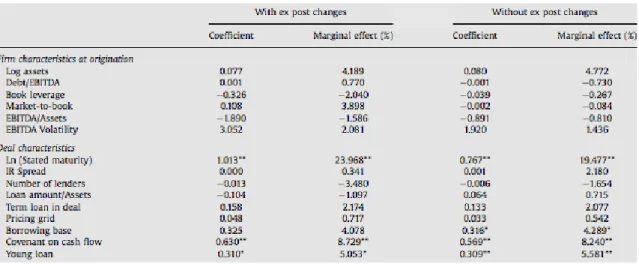
They also took macroeconomic factors such as BB-AAA credit spread on public traded bonds in order to measure credit market conditions, the leverage of commercial banks in the USA as total liabilities over book assets, in order to measure the financial sector health, the GDP growth as a measure of productivity and the CRSP value-weighted index as a measure of the attractiveness of equity financing. In order to capture the evolution of these variables, they got the difference between the current value and the value at the time of the origination of the loan. There are included control variables as Fama and French 12-industry fixed effects in order to measure the structure of syndicate lending, the credit rating fixed effect as a way of controlling credit risk variation, the initial terms of the loans, which are introduced as the natural logarithm of the stated maturity, the average interest rate, the number of participants in the syndicate loan, the proportion of the loan in the book assets, the loan time elapsed the presence of any contingency and a time trend in order to capture any trend of the data.
more concessions as getting an extent in the maturity, a reduce in the collateral of the loan or even a relaxation of the contingencies included in the debt contract. About the outcomes of renegotiations, they found that maturity changed on average 776 days (64% of relative change) while loan amounts changed on average US$ 193 millions (43% of relative change) and interest rates changed on average 64 basic points (40% of relative change). The most common outcome in a renegotiation is maturity in the first place (57% of the cases), the increase in the loan amount in second place (56% of the cases), in third place is the modification in the interest rates (over 55% of the cases), and finally 11% of the cases finished in a change of lender.
Table 5: Probit model results, Panel A
Source: Roberts and Sufi (2009), page 173
renegotiation. GDP growth and aggregate equity market returns have a weaker effect in the likelihood of entering a renegotiation.
Table 5: Probit model results, Panel B
Source: Roberts and Sufi (2009), page 174
They suggest that long maturity loans and loans that rely on cash flow covenants are more likely to be renegotiated. The presence of pricing grids or borrowing bases do not make a renegotiation less likely and the presence of borrowing bases predicts renegotiations as it is correlated with the changes in ex post company’s characteristics. Other ex-ante contingencies do not have strong prediction in renegotiation.
4. Conclusion
After going through all papers, their statistics and surveys we can say that with way deeper understanding we can talk about given topic. Having knowledge about variety of covenants and accounting conservatism helps us understand, in depth, how contracts are made and why covenants are included. In order to be able to understand the topic and to have comprehensive knowledge about it we had to make distinction between The Agency theory and The Incomplete contract theory. This being said, one has to understand how important is to differ limitations of both and main difference between them. One, as already mentioned, forbids managers to take certain actions while other shifts controlling rights to one with the right incentives. They are able to do it because of various covenants included in the deal and they differ among themselves as well.
Accounting-based covenants can be used in order to align both parties’ interest by making the borrower keeping certain amount capital, which makes the borrower has “skin in the game” (capital covenants). They also facilitate state contingent control allocation, by allocating bargaining power when the borrower’s performance deteriorates (performance covenants), giving incentives to the borrower to renegotiate the initial terms of the debt contract modifying them according to the borrower’s real state of nature. It makes the scope of borrower’s opportunistic behaviour decrease.
Saying this we have to be aware that neither of theories is sufficient or complete. There is a lot of research in progress and there are still some questions unanswered: what are the ex-ante and ex-post efficiency implications of renegotiation? (Roberts and Sufi, 2009), how large are the benefits of using accounting-based information in debt contracting? is it possible to design any accounting rules in order to make easier debt contracting? (Christensen et al., 2016).
5. References
Aghion, P. and Bolton, P. (1992). An Incomplete Contracts Approach to Financial Contracting. The Review of Economic Studies, 59(3), p.473.
Basu, S. (1997). The conservatism principle and the asymmetric timeliness of earnings1. Journal of Accounting and Economics, 24(1), pp.3-37.
Berlin, M., and L. J. Mester. Debt Covenants and Renegotiation. Journal of Financial Inter- mediation 2 (1992): 95–133.
Billett, M. T.; T.-H. D. King; and D. C. Mauer. (2007). Growth Opportunities and the Choice of Leverage, Debt Maturity, and Covenants. The Journal of Finance, 62, pp.697–730.
Bradley, M., and M. R. Roberts. (2004). The Structure and Pricing of Corporate Debt Covenants. SSRN eLibrary.
Chava, S., and M. R. Roberts. (2008). How Does Financing Impact Investment? The Role of Debt Covenants. The Journal of Finance, 63, 2085–2121.
Christensen, H. and Nikolaev, V. (2012). Capital Versus Performance Covenants in Debt Contracts. Journal of Accounting Research, 50(1), pp.75-116.
Christensen, H. and Nikolaev, V. and Wittenberg-Moerman, R. (2016). Accounting Information in Financial Contracting: The Incomplete Contract Theory Perspective.
Journal of Accounting Research, 54(2), pp.397-435.
Clearly, S. (1999). The Relationship Between Firm Investment and Financial Status. The Journal of Finance, 54, pp. 673–92.
Demiroglu, C., and C. M. James. (2010). The Information Content of Bank Loan Covenants. Review of Financial Studies, 23, pp. 3700–3737.
Dewatripont, M. and Maskin, E. (1995). Credit and Efficiency in Centralized and Decentralized Economies. The Review of Economic Studies, 62(4), pp.541-555. Diamond, D. (1991). Monitoring and Reputation: The Choice between Bank Loans and Directly Placed Debt. Journal of Political Economy, 99(4), pp.689-721.
Gromb, D., (1995). Renegotiation in debt contracts. Working Paper, London Business School.
Grossman, S. and Hart, O. (1986). The Costs and Benefits of Ownership: A Theory of Vertical and Lateral Integration. Journal of Political Economy, 94(4), pp.691-719. Hermalin, B. and Katz, M. (2009). Information and the hold-up problem. The RAND Journal of Economics, 40(3), pp.405-423.
Huberman, G. and Kahn, C. (1988). Strategic renegotiation. Economics Letters, 28(2), pp.117-121.
Jensen, M. and Meckling, W. (1976). Theory of the firm: Managerial behaviour, agency costs and ownership structure. Journal of Financial Economics, 3(4), pp.305-360.
Kaplan, S., and L. Zingales (1997). Do Investment-Cash Flow Sensitivities Provide Useful Measures of Financing Constraints? Quarterly Journal of Economics, 112, pp.169–216.
Klein, B., Crawford, R. and Alchian, A. (1978). Vertical Integration, Appropriable Rents, and the Competitive Contracting Process. The Journal of Law and Economics, 21(2), pp.297-326.
Lys, T. and Watts, R. (1994). Lawsuits against Auditors. Journal of Accounting Research, 32, p.65.
Maskin, E., Moore, J., 1999. Implementation and renegotiation. Review of Economic Studies, 66, pp.39–56.
Nash, R.; J. Netter; AND A. Poulsen. (2003). Determinants of Contractual
Niloaev, V. (2010). Debt Covenants and Accounting Conservatism. Journal of Accounting Research, 48(1), pp.51-89.
Rajan, R., and A. Winton. (1995). Covenants and Collateral as Incentives to Monitor. Journal of Finance, 50, pp.1113–1146.
Roberts, M. and Sufi, A. (2009). Renegotiation of Financial Contracts: Evidence from Private Credit Agreements. Journal of Financial Economics, 93, pp.159-184. Skinner, D. (1997). Earnings disclosures and stockholder lawsuits. Journal of Accounting and Economics, 23(3), pp.249-282.
Skinner, D. J. (1993). The Investment Opportunity Set and Accounting Procedure Choice: Preliminary Evidence. Journal of Accounting and Economics, 16, pp.407–
445.
Watts, R. (2003). Conservatism in Accounting. SSRN Electronic Journal.
Whited, T., and G. Wu. (2006). Financial Constraints Risk. Review of Financial Studies, 19, 531–559.