Structural style of inversion of rifts and passive
margins: feedback between mountain building and
surface processes
Abstract:Inversion of sedimentary basins and passive margins at various stages of their evolution is modelled with thermo-mechanical viscous-plastic finite element techniques. We focus on two aspects of the inversion and collision process: 1) the role of the strength of the lower crust on the style of inver-sion, and 2) feedback relations of surface processes with the tectonic deformation and their control on the style of lithosphere inversion. The model involves a 35 km thick crustal layer and a 125 km length lithosphere. All materials follow frictional-plastic strain softening, or thermally activated viscous flow laws. The model is thermally coupled and the thermal evolution is calculated. During a first phase, the model is extended to form a rift basin. The rift basin or passive margin geometry is then used as initial condition for a phase of lithosphere scale inversion and collision. Using a prior rift or passive margin formation phase allows examining the role of pre-existing heterogeneity on the style of inversion and continental collision. We examine the effect of very simple end member surface process models on the style of mountain building: 1) no erosion and no sedimentation, 2) no erosion and complete sedimen-tation, and 3) complete erosion and complete sedimentation. Very contrasting behavior is observed for these end-member variations in surface process model.
Keywords: mechanical modelling, lithosphere inversion, strain localization.
1Dep. Earth Science, Bergen University, Bergen, Norway.
2Dep. Oceanography, Dalhousie University, Halifax, Canada.
*e-mail: [email protected]
R. S. H
UISMANS1*ANDC. B
EAUMONT2While there is significant progress in understanding first order controls on styles of rifting and passive margin formation, still relatively little is known about factors that control the structural style of inversion of these structures. Especially the importance of struc-tural weaknesses formed during earlier rifting vs. new formed structures both at crustal and lithospheric scale, and the role of mass redistribution by surface processes and their relative importance are not very well understood.
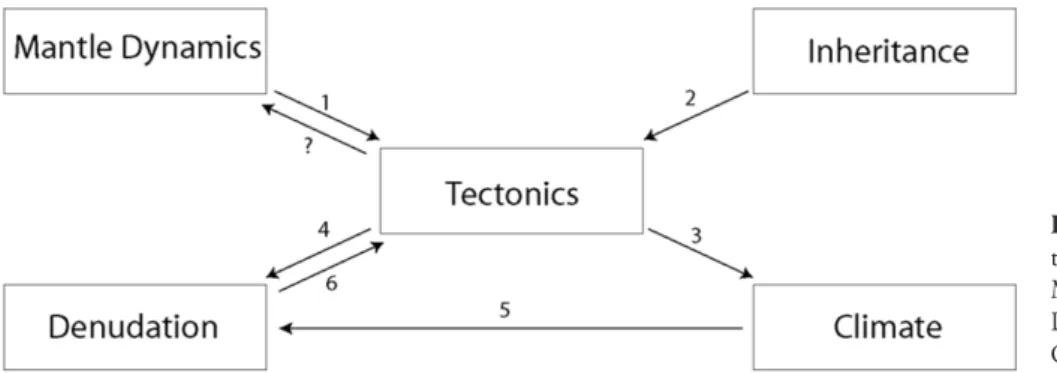
Much recent work has been devoted to understanding the coupling and feedbacks between tectonics, surface
link 3), which can result in orographic denudation. Climate and denudation are linked through oro-graphic forcing of precipitation, through glaciation and, on a global scale, by changing precipitation pat-terns (Fig. 1, link 5). The primary feedbacks of sur-face processes on tectonics result from redistribution of mass causing variations in gravitational stresses that can enhance or inhibit deformation, and from the influence of exhumation on the thermal structure and, hence, rheological properties of the crust and lithosphere (Fig. 1, link 6) (Beaumont et al., 1992; Willett, 1999; Braun, 2006).
Recent advances in both tectonic and surface process modelling allow quantitative investigation of these fundamental relationships (Beaumont et al., 1992; 2000b; Willett, 1999; Stolar et al., 2006). This has greatly increased the predictive power of such models and their ability to reproduce geological observations. It has, for instance, been demonstrated that the large-scale geometry of an orogen depends on the domi-nant wind direction (Beaumont et al., 1992; Willett, 1999). Studies linking critical wedge dynamics and surface processes on the scale of the whole orogen have established how overall wedge geometry is relat-ed to surface process efficiency (Stolar et al., 2006; Roe et al., 2006).
However, a number of first-order questions and chal-lenges remain: 1) the coupling and feedbacks on the scale of individual structures have not been assessed, 2) most coupled tectonic (TM)-surface process mod-els (SPM) consider only 2D tectonic deformation (e.g. Beaumont et al., 2000b); investigating coupled 3D TM’s and plan view SPM’s is necessary, 3) perhaps the greatest difficulty is the range of spatial and tem-poral scales involved, through which the interaction evolves. Improvements need to be made to include better physically based components with appropriate-ly scaled model parameters that allow correct integra-tion of the non-linear SPM components on the required model time resolution (e.g. Braun, 2006).
Continental rift zones and passive margins exhibit a range of structural styles from non-volcanic to vol-canic and from narrow to wide margins (Louden and Chian, 1999; Whitmarsh et al., 2001). The factors controlling these styles or rift modes are, although still subject of active research, reasonably well understood (Braun and Beaumont, 1987; Bassi et al., 1993; Buck, 1991; Huismans and Beaumont, 2002; Lavier and Manatschal, 2006; Huismans and Beaumont, 2007). The major remaining challenges are 3D aspects of rifting and passive margin formation.
Factors controlling tectonic inversion of rift zones and passive margins are, however, less well constrained. Both local inherited weaknesses and regional inherit-ed crust and mantle lithosphere structure are believinherit-ed to contribute to the structural style of inversion. However, it is still unclear in which extent structural inheritance plays a role during inversion tectonics. Regional inherited factors contributing to the struc-tural style of inversion include variations 1) in crustal and lithospheric thickness, 2) in composition (e.g. wet vs. dry, felsic or mafic rheologies), and 3) in ther-mal structure that affects the lateral and vertical strength distribution. Specifically the time since rift-ing, the spatial variation and amount of crustal and mantle lithosphere thinning, and potential melting of middle/lower crust and mantle during the extension-al phase will determine the response of the lithospher-ic system to inversion.
The strength of inherited faults and shear zones is not well constrained. Major faults and shear zones show repeated reactivation through time (Holdsworth, 2004) which suggests these structures are weak. The processes leading to the implied weakening are, how-ever, not well understood and are strongly debated (Scholz, 2000; Zoback, 2000). Proposed weakening mechanisms include 1) alteration of feldspar rich rocks into mica rich aggregates with lower frictional and ductile strength, 2) cohesion loss, 3) grain size reduction leading to viscous weakening, 4)
isation of mantle rocks lowering frictional strength; or dynamic effects such as 5) fluctuations of fluid pres-sure and mineralization in fault gauges, 6) shear heat-ing and formation of melt leadheat-ing to catastrophic fault failure, and 7) shear heating during viscous deformation leading to thermal runaway on shear zones. Studying the role of inherited large fault struc-tures during inversion tectonics may shed light on the temporal and spatial variation of the strength of large faults.
The Pyrenean-Cantabrian mountain belt is a very well studied example of an inverted rift basin and passive margin. Deep seismic crustal cross sections constrain crustal structure from east to west, pre-inversion and inversion structures have been mapped in great detail, and a large geochronological data base provides con-straints on exhumation history (e.g. Choukroune and ECORS Team, 1989; Muñoz, 1992; Fitzgerald et al., 1999; Vergés et al., 2002). Formation of the pre-Pyrenean rift zone occurred during a series of rift events in the Triassic and Late Jurassic, culminating in close to crustal separation in the Late Cretaceous with the final rift stages developing synchronously with early Bay of Biscay opening. Crustal scale restoration (Vergés et al., 2002) constrains the end Cretaceous crustal structure for cross sections in the eastern, cen-tral and western Pyrenees.
The Pyrenean-Cantabrian mountain belt was formed by inversion of this rift basin, partly continental, part-ly oceanic. The surface expression of this inversion is a 150 km wide collision zone flanked by thin-skinned fold and thrust belts and associated foreland basins. The mountain belt is characterised by decreasing amounts of shortening (120-170 km) and exhuma-tion going from east to west. Exhumaexhuma-tion of the oro-gen is asymmetric with greater and younger exhuma-tion on the southern side. Erosion of the core of the Pyrenees evolved from a broad region of unroofing from 60-40 Ma, followed by a progressive southward shift with high erosion rates between 36-20 Ma in the south and low erosion rates on the northern side of the orogen. Erosion and exhumation localized in the core of the Pyrenean belt around 20 Ma (Beaumont
et al., 2000a; Sinclair et al., 2005). During the post-orogenic evolution erosional processes have created a peneplain (Babault et al., 2005), which origin remains controversial (Gibson et al., 2007). The change from planation to fluvial incision during Pliocene times is attributed to capture, climate change and neotectonic uplift. The three major fluvial systems are character-ized by terraces, which formed in response to the post-orogenic tectonic evolution and the dynamics of
climate. The Cantabrian Mountains constitute the western prolongation of the Pyrenees. This part of the system was uplifted as a consequence of the inversion of the Mesozoic passive margin in the southern part of the Bay of Biscay.
Moderate inversion, good preservation of both pre-and syn-orogenic strata, pre-and good constraints on crust and lithospheric structure make the Pyrenean-Cantabrian Mountains belt an excellent example to study rift and inversion tectonics, orogenic processes and post-orogenic uplift and their relation to inheri-tance and climate-driven surface processes. The exceptional preservation of syn-orogenic strata in the Pyrenees allows reconstructing shortening rates since early stages of collision and constrains the geometry through intermediate stages (Muñoz, 1992; Vergés et al., 2002).
Lithosphere scale inversion of passive margins
In previous works we focused on the dynamic evolu-tion of sedimentary basins and passive margins and their inversion (Huismans and Beaumont, 2002, 2003, 2007, in preparation; Huismans et al., 2005) which indicated that surface processes can strongly impact the style of deformation (Huismans and Beaumont, 2002; Buiter et al., 2004).
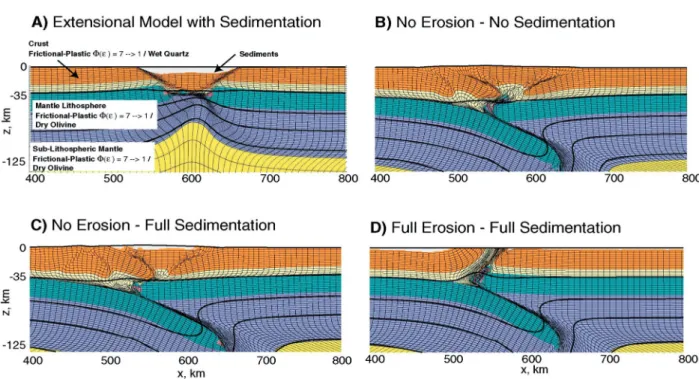
Preliminary forward dynamic models illustrate the first order control of inheritance and surface process-es on stylprocess-es of passive margin inversion (Fig. 3). Forward dynamic models are inverted after an initial rift phase (Fig. 3a). The model results show strongly contrasting styles of inversion tectonics. In the case without surface processes (Fig. 3b) initial deformation occurs on rift related crustal border faults and shear zones in the mantle lithosphere, after which the ‘oro-genic wedge’ grows by outward propagation of new formed thrust structures. The case of highly efficient erosion (all topography is removed, figure 3D) shows a significantly different style of inversion with most deformation localized in a very narrow region.
TopoEurope project PYRTEC: Pyrenean inversion tectonics, surface processes and climate
A large interdisciplinary project submitted to the ESF Eurocores program TopoEurope, “Spatial and tempo-ral coupling between tectonics and surface processes dur-ing lithosphere inversion of the Pyrenean-Cantabrian mountain belt”, will study factors that control the structural style of inversion in the Pyrenean-Cantabrian mountain belt. Project partners include academic institutions in Norway, Spain, France, Netherlands, and the United Kingdom. The project will study the importance of structural weaknesses formed during earlier rifting vs. new formed contrac-tional structures both at crustal and lithospheric scale,
and the role of mass redistribution by surface process-es and their relative importance. The Pyrenean-Cantabrian mountain belt and associated structures in the Bay of Biscay is one of the best candidates to study feedback relations between tectonic inversion, inherit-ed structures, and surface processes as: 1) inversion is moderate and the pre-orogenic rift/passive margin structure can be very well constrained, 2) excellent geological and geophysical data-bases constrain pres-ent day crustal structure, inversion tectonics, foreland basin architecture, and exhumation history, and 3) the belt shows remarkable along-strike variations in the amount of convergence and style of deformation, pro-viding different scenarios to study the feedback rela-tions between tectonic inversion, structural inheri-tance and surface processes.
To understand the fundamental coupling between tectonic and surface processes it is essential to inte-grate data constraints on deep structure, tectonic evo-lution, exhumation and deposition, with quantitative coupled tectonic and surface process models. A strongly interdisciplinary approach, coupling observa-tional studies and theoretical modelling, will provide the conditions to significantly enhance our under-standing of the coupling and feedback between large scale deformation, surface process response, and structural inheritance during inversion tectonics in general and the Pyrenean mountain belt in particular. The project will use state-of-the-art large deformation
Figure 2.Numerical setup and modelling Approach. (A) Model geometry showing crust and mantle lithosphere layer thicknesses, the weak seed, and the velocity boundary conditions. Extension or shortening is driven by velocity boundary conditions and seeded by a small plastic weak region. The model has a free top surface and the other boundaries have zero tangential stress (free slip). Whether material deforms plastically or viscously depends on the ambient conditions. At yield flow is plastic, below yield deformation is viscous. The initial temperature field is laterally uniform, and increases with depth from the surface, T0= 0 ºC, to base of crust, Tm= 550 ºC,
following a geotherm for uniform crustal heat production, A = 0.8μW m-3and a basal heat flux, q
m= 20 mW m-2. The temperature
increases linearly with depth in the mantle lithosphere and the sub-lithospheric mantle is isothermal at Ta= 1330 ºC. For more details
analogue, numerical, and surface process modelling techniques to develop novel insights on the tectonic and surface process controls on inversion tectonics.
Conclusions
The model results indicate that the efficiency of surface process models to remove and distribute
mass in the system forms a strong control on the overall style of inversion and collision. Without ero-sion or sedimentation deformation migrates out-ward into the foreland after an initial phase of oro-genic growth. In the end-member case where ero-sion removes all topography, deformation is local-ized in the core of the orogen with strong asymmet-ric exhumation.
Figure 3.Effect of simple end-member surface processes during lithosphere scale inversion. (A) Forward extensional model, (B) inver-sion with no eroinver-sion-no sedimentation. Note outward migration of thrusts into foreland, (C) inverinver-sion with no eroinver-sion-full sedimen-tation. Note sediments in core of the inverted zone, (D) inversion with full erosion-full sedimensedimen-tation. Note strong localized deforma-tion in central zone. (Huismans and Beaumont, in preparation).
References
BABAULT, J., VANDENDRIESSCHE, J., BONNET, S., CASTELLTORT, S. and CRAVE, A. (2005): Origin of the highly elevated Pyrenean pene-plain. Tectonics, 24. doi:10.1029/2004TC001697.
BASSI, G., KEEN, C. E. and POTTER, P. (1993): Contrasting styles
of rifting; models and examples from the eastern Canadian mar-gin. Tectonics, 12: 639-655.
BEAUMONT, C., FULLSACK, P. and HAMILTON, J. (1992): Erosional control of active compressional orogens. In: K. R. MCCLAY(ed):
Thrust Tectonics. Chapman & Hall, London: 1-18.
BEAUMONT, C., KOOI, H. and WILLETT, S. (2000a): Coupled
tecton-ic-surface process models with applications to rifted margins and col-lisional orogens. In: M. A. SUMMERFIELD(ed): Geomorphology and Global Tectonics. John Wiley and Sons Ltd.: 29-55.
BEAUMONT, C., MUÑOZ, J. A., HAMILTON, J. and FULLSACK, P.
(2000b): Factors controlling the Alpine evolution of the central Pyrenees inferred from a comparison of observations and geody-namical models. J. Geophys. Res., 105: 8121-8145.
BRAUN, J. (2006): Recent advances and current problems in mod-elling surface processes and their interaction with crustal deforma-tion. In: S. BUITERand G. SCHREURS(eds): Analogue and numer-ical modelling of crustal scale processes. Geol. Soc. London: 307-325.
BRAUN, J. and C. BEAUMONT(1987): Styles of continental rifting:
results from dynamic models of lithospheric extension. In: C. BEAUMONTand A. J. TANKARD(eds):Sedimentary basins and basin forming mechanisms: 241-258.
BUCK, W. R. (1991): Modes of continental lithospheric extension.
J. Geophys. Res., 96: 20161-20178.
BUITER, S. J. H, HUISMANS, R. S. and BEAUMONT, C. (2004): Formation of extensional sedimentary basins; the role of surface processes in mode selection. In: G. BERTOTTI, S. J. H. BUITER, P. RUFFO and G. SCHREURS(eds): From mountains to sedimentary
basins; modelling and testing geological processes. Bol. Geofis. Teor. Apl., 45, 1: 187-191.
FITZGERALD, P. G., MUÑOZ, J. A., CONEY, P. J. and BALDWIN, S.
L. (1999): Asymmetric exhumation across the Pyrenean orogen: implications for the tectonic evolution of a collisional orogen.
Earth Planet. Sc. Lett., 173: 157-170.
GIBSON, M., SINCLAIR, H. D., LYNN, G. J. and STUART, F. M.
(2007): Late- to post-orogenic exhumation of the Central Pyrenees revealed through combined thermochronological data and modelling. Bas. Res., 19: 323-334.
HOLDSWORTH, R. E. (2004): Weak faults – Rotten cores. Science, 303: 181-182.
HUISMANS, R. S. and BEAUMONT, C. (2002): Asymmetric
lithos-pheric extension: the role of frictional-plastic strain softening inferred from numerical experiments. Geology, 30: 211-214.
HUISMANS, R. S. AND BEAUMONT, C. (2003): Symmetric and Asymmetric lithospheric extension: Relative effects of frictional-plastic and viscous strain softening. J. Geophys. Res., 108, 22 pp. doi:10.1029/2002JB002026.
HUISMANS, R. S., BUITER, S. J. H. and BEAUMONT, C. (2005): The effect of plastic-viscous layering and strain-softening on mode selection during lithospheric extension. J. Geophys. Res., 110, 17 pp. doi:10.1029/2004JB003114.
HUISMANS, R. S. and BEAUMONT, C. (2007): Roles of lithospher-ic strain softening and heterogeneity in determining the geometry of rifts and continental margins. In: G. D. KARNER, G. MANATSCHALand L. M. PINHIERO(eds): Imaging, mapping and
modelling continental lithosphere extension and breakup. 282: 107-134. Geol. Soc. London Spec. Publ. doi: 10.1144/SP282.6.
HUISMANS, R. S. and BEAUMONT, C. (in preparation): Structural style of inversion of rifts and passive margins: feedback between mountain building and surface processes.
LAVIER, L. L. and MANATSCHAL, G. (2006): A mechanism to thin
the continental lithosphere at magma-poor margins. Nature, 440: 324-328, doi:10.1038/nature04608.
LOUDEN, K. E. and CHIAN, D. (1999): The deep structure of
non-volcanic rifted continental margins. Phil. Trans. R. Soc. Lond. A-Math., Phys., Eng. Sc., 357: 767-804.
MUÑOZ, J. A. (1992): Evolution of a continental collision belt: ECORS Pyrenees crustal balanced cross sections. In: K. R. MCCLAY
(ed): Thrust Tectonics. Chapman & Hall, London: 235-265.
ROE, G., STOLAR, D. and WILLETT, S. D. (2006): Critical topog-raphy and its dependence on climate and tectonics in a steady state. In: S. D. WILLET, N. HOVIUS, M. T. BRANDONand D. M. FISHER(eds): Tectonics, climate and landscape evolution. Geol. Soc.
Am. Spec. Pap., 398: 227-240.
SCHOLZ, C. H. (2000): Evidence for a strong San Andreas Fault.
Geology, 28: 163-166.
SINCLAIR, H. D., GIBSON, M., NAYLOR, M. and MORRIS, R. G. (2005): Asymmetric growth of the Pyrenees revealed through measurement and modelling of orogenic fluxes. Am. J. Sci., 305: 369-406, doi:10.2475/ajs.305.5.369.
STOLAR, D., WILLETT, S. D. and ROE, G. (2006): Climatic and tectonic forcing of a critical orogen. In: S. D. WILLET, N. HOVIUS, M. T. BRANDONand D. M. FISHER(eds): Tectonics, climate and
landscape evolution. Geol. Soc. Am. Spec. Pap., 398: 241-250.
VERGÉS, J., FERNÀNDEZ, M. and MARTINEZ, A. (2002): The Pyrenean orogen: pre-syn- and post-collisional evolution. In: G. ROSENBAUMand G. S. LISTER(eds): Reconstruction of the evolution of the Alpine Himalayan Orogen. J. Virtual Expl., 8: 57-76.
WHITMARSH, R. B., MANATSCHAL, G. and MINSHULL, T. A.
(2001): Evolution of magma-poor continental margins from rift-ing to seafloor spreadrift-ing. Nature, 413: 150-154.
WILLETT, S. D. (1999): Orogeny and orography: the effects of erosion on the structure of mountain belts. J. Geophys. Res., 104: 28957-28981.