There seems to be consensus among researchers from different academic disciplines (e.g., anthropologists, sociologists, economists, and psychologists) about the existence of gendered divisions in different societies and throughout history (Albelda, 1986; Aliaga, 2006; Carrasco, Borderías, & Torns, 2011; Crompton, Scott, & Lyonette, 2010; National Institute of Statistics, 2015). These divisions occur in the workplace—for example, in the form of segregation of professions/occupations by gender (Jarman, Blackburn, & Racko, 2012) and in the home (Bianchi, Milkie, Sayer, & Robinson, 2000; Treas & Drobnic, 2010).
These gendered divisions, in turn, infl uence several aspects of the daily life of women and men, in general to the detriment of women (vertical segregation/inequality): psychological well-being (Des Rivieres-Pigeon, Saurel-Cubizolles, & Romito, 2002) partner or personal satisfaction (Bodi, Mikula, & Riederer, 2010), number or severity of confl icts (Buunk, Kluwwer, Schuurman, & Siero, 2000), marital quality (Dierdoff & Ellington, 2008), mental health,
divorce, or domestic violence in intimate relationships, among others (Fontaine & Matias, 2008; Mikula, 1998).
Different changes in gender roles have taken place in the work and home environments (Carrasco et al., 2011; Kan, Sullivan, & Gershuny, 2011). These have been greater in the workplace, even if equality has not yet been reached, not even in industrialized societies (Wood & Eagly, 2002). In the domestic environment, women have been reducing the time spent on housework while men have been becoming increasingly involved in it, even though women continue to do most of the household chores (Coltrane, 2000; Duran, 2000; Shelton & John, 1996).
These changes have been mostly infl uenced by two types of factors: (a) individual/relational—time availability, economic resources, gender ideology, education, age, ethnicity, social class, type of family and/or partner—, and (b) social—social wellbeing models, gender norms, women’s participation in the workforce, economic development (Bouffartigue, 2010; Fuwa, 2004; Hook, 2006; Rodríguez, 2008; Sullivan, 2000).
Several methods have been employed in the analysis of such changes and their causes in the domestic environment (e.g., self-reports, diaries about the use of time and the frequency with which certain tasks are carried out, such as cleaning the house, cooking, doing laundry, repairing damaged utensils, gardening, car maintenance, and childcare, Hook, 2006). In this paper, we will
ISSN 0214 - 9915 CODEN PSOTEG Copyright © 2016 Psicothema www.psicothema.com
The gendered division of housework
Juan Fernández, M. Ángeles Quiroga, Sergio Escorial and Jesús Privado
Universidad Complutense de MadridAbstract
Resumen
Background: In spite of the verifi able achievements obtained in gender equity, one wonders if they still exist in our societies gendered activities (roles) at the household level. This study states an affi rmative prediction. Gender role is here organized in four different nuclei: instrumentality inside and outside home for men; expressiveness and instrumentality inside home for women, pertaining to two clearly different domains (household activities for men and household activities for women). Method: 98 women and 86 men completed the Gender Roles Questionnaire (GRQ). Results: Obtained results showed that: (a) men and women do not do certain household activities (roles) with the same frequency; (b) the four-dimensional approach fi ts the data better than the one-dimensional and even better than the two-dimensional approach (household gender roles for men and women separately). Conclusion: Discussion focuses on the implications of these results for both research and education.
Keywords: Gender equity, gender roles, household gender division, gender roles questionnaire.
La división generizada de las tareas domésticas. Antecedentes: pese a los constatables logros en la igualdad de género, cabe preguntarse si todavía existen, en nuestras sociedades, actividades (roles) generizadas en el ámbito doméstico. La predicción es que sí. El rol de género se organiza aquí en cuatro núcleos diferentes: instrumentalidad intra y extra-hogar para los varones y expresividad e instrumentalidad intra-hogar para las mujeres, dentro de dos claros dominios (doméstico varón y doméstico mujer). Método: 98 mujeres y 86 varones respondieron al Cuestionario de Roles de Género (CRG). Resultados: los resultados pusieron de manifi esto: a) que varones y mujeres claramente difi eren en el ejercicio de ciertas actividades (roles) domésticas; b) que el planteamiento de cuatro dimensiones se ajusta mejor a los datos que el unidimensional e, incluso, que el bidimensional (roles de género domésticos de varones y roles de género domésticos de mujeres). Conclusiones: se establecen las posibles implicaciones derivadas de estos resultados, tanto para el ámbito de la investigación como para el educativo.
Palabras clave: equidad de género, roles de género, división doméstica de género, cuestionario de rol de género.
Psicothema 2016, Vol. 28, No. 2, 130-136
doi: 10.7334/psicothema2015.169
Received: June 25, 2015 • Accepted: January 7, 2016 Corresponding author: Juan Fernández Sánchez Facultad de Psicología
Universidad Complutense de Madrid 28223 Madrid (Spain)
focus on the latter —specifi c house chores—, considering that it is one of the most realistic ways to operatively defi ne gender roles in a given moment in history and in a particular society, making it possible to understand their possible causes (Braun, Lewin-Epstein, Stier, & Baumgärtner, 2008; Fernández Quiroga, Del Olmo, Aróztegui, & Martín, 2011; Fernández, Quiroga, Escorial, & Privado, 2014; Warren, 2011).
Based on the approach adopted here, it is assumed that: (a) gender roles have been analyzed in a diversity of ways, one of which focuses on the study of the frequency of execution of different household chores (Bouffartigue, 2010; Crompton et al., 2010; Wood & Eagly, 2002); (b) within this area, there will be a certain division of labor: there will be differences in the frequency with which individuals of each sex execute each type of task (Fernández et al., 2011; Fernández et al., 2014; Hook, 2006; Treas & Drobnic, 2010); (c) all household chores could be grouped into the well known dimensions of instrumentality (i.e., a person sensitive to the material context that conditions his/her personal growth and that of his/her family members, and carries out activities to change such context) and expressiveness (i.e., a person sensitive to the emotional needs of those he/she lives with and who performs certain activities to satisfy them) (Addis & Mahalik, 2003; Connell, 2005; Fernández, 2011; Fernández, Quiroga, Del Olmo, & Rodríguez, 2007; Nayak & Kehily, 2008). In this paper, only certain aspects pertaining to the instrumental dimension (men intra- and extra-household instrumentality and women intra-household instrumentality) and only one pertaining to the expressive dimension (women intra-household expressiveness) will be evaluated, not because there are no other aspects of instrumentality and expressiveness common to women and men, but because these are the ones that continue to show empirical differences between the sexes (Hook, 2006). The basis for this proposed breakdown comes from the analysis of empirical data available in the literature in this area (Connell, 2005; Fernández et al., 2011; Fernández et al., 2014; Hook, 2006; Sullivan, 2000; Treas & Drobnic, 2010; Wood & Eagly, 2002).
Taking into account these considerations, two objectives or hypotheses were tested: (a) there are still signifi cant differences in terms of the household chores performed by women and men; (b) these chores do not fi t a one-dimensional pattern entirely (only one gender role), but a two-dimensional one (two gender roles differentiated by sex: chores that are preferentially performed by one sex and not the other) or even a multi-dimensional one that emerges according to the three types of instrumentality and one type of expressiveness; that is, a pattern that is formed by four dimensions.
Methods
Participants
The sample consists of 184 participants, of whom 98 are women and 86 are men. The average age was 42.36 years (SD = 10.29 years). Most of them (150) have lived with a partner for more than three years (although couples have not been evaluated as such). All participants reported having a paid job. In terms of their educational level, 119 (64%) participants had completed university studies whereas 66 (36%) had not.
The demographic characteristics show a certain degree of independence from each other [Age × Sex: t(148) = 0.086, p =
.932 and d = .014; Educational level × Sex: χ2(1, N = 150) = .476, p = .503, C* = .079; Age × Educational level: t(148) = 2.606, p = .010 and d = .44], with the exception of Age × Educational level. Given that the focus of this paper is on the analysis of men and women and not on age or educational level, it was concluded that the sample did not present demographic bias related to the objectives of the study.
Instruments
The Gender Roles Questionnaire (GRQ) contains 44 items of which 21 relate to gendered household activities, 7 relate to gendered workplace activities, and 16 relate to non-gendered household activities. The validity of its items as gendered activities has been analyzed by Fernández et al., (2011) and replicated by Fernández et al., (2014), using a computerized decision task (Fernández et al., 2011; Fernández et al., 2014). In this paper, only the gendered activities related to the domestic environment were analyzed, even though the full questionnaire was administered to mask the purpose of the study. Out of the 21 items related to the household domain, two items were eliminated because their relation to gender has diminished in recent years (Fernández et al., 2014). When we refer to neutral items, we refer to those that do not discriminate based on sex, such as, for example: walk the dog, look for new apartment, pick up the mail from the mailbox, or choose a restaurant.
All items in this questionnaire are answered using a Likert-type scale ranging from 1, meaning that a given task is never performed, to 7, meaning that the task is always performed. This assessment tool is available for online evaluation; however, in this study, an investigator remained present while participants completed questions, although in such a way that guaranteed the anonymity of the responses.
Procedure
Participants completed the questionnaire as part of a broader assessment protocol that also included two decision tasks. The questionnaire was completed between the two decision tasks. The evaluation was carried out individually by research assistants who were especially trained to ensure the uniformity and correct application of the test.
Participants were asked to be sincere and spontaneous in their responses as part of the test’s instructions, given that otherwise, the research would be useless. In addition, the participants were guaranteed full confi dentiality in regards to their answers, and were told to take into account that “sometimes they may have to answer the questions using their imagination to fi nd out what they would do, or remembering similar experiences from their own lives to the ones posed by the questions asked”. There was no time limit to answer. The completion of this test took about 5 minutes.
Data analyses
LISREL 8.80 statistical package was used (Jöreskog & Sörbom, 2006).
Results
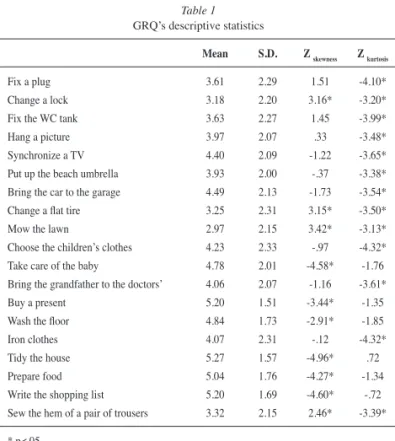
As could be predicted from both a theoretical and empirical standpoint, item distribution did not follow a normal distribution. This can be seen in the data presented in Table 1.
The results of the contingency analysis conducted to evaluate the possible differences between men and women—frequency with which they performed each gendered activity—are presented in Table 2. The relationship was statistically signifi cant in all items. For the group of items, the range of values for statistical association coeffi cients ranged between .41 and .83, although nearly 80% of these values were above .55. In regard to the values of the standardized residuals, it is important to note that several of them reached very high magnitudes, which refl ects the distance of the observed data compared to a model of equality of answers between men and women.
Before presenting the results of the goodness of fi t of the three models described above, and in regard to the second hypothesis of this study it is important to note that the estimation procedure used in the three models was Robust Maximum Likelihood (MLM) on the polychoric correlations matrix, given the violation of the assumption of univariate and multivariate normal distribution and the response format of the items that make up the instrument.
The fi rst tested model (Model 1) was a one-dimensional model: all items load on one latent factor, refl ecting the common variance, and it could be interpreted as a domestic gender role factor. The results indicate that the fi t of this model is poor (χ2(152) = 438.54, p<.001; χ2/df = 2.88; RMSEA –Root Mean Square Error of Aproximation– = .101; CFI –Comparative Fit Index– = .93; NFI –Normed Fit Index– = .90). The second model (Model 2) that was tested is a two-dimensional model, where the items load on
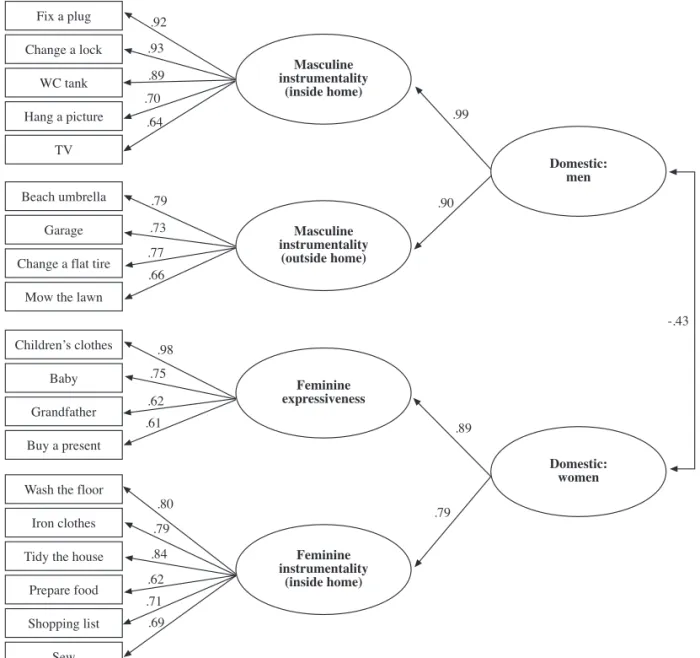
two factors (men domestic role and women domestic role). The results show that this model fi t the data very well (χ2(151) = 89.54, p<.001; χ2/df = 0.59; RMSEA = .000; CFI = 1.00; NFI = .98). The third model (Model 3), hierarchical, can be conceived as nested with the previous model. In Model 3, the men’s domestic role and women’s domestic role factors were obtained as second-order factors. For the men’s domestic factor, the existence of two fi rst-order factors (intra-household instrumentality, and extra-household instrumentality) is postulated. For the women’s household factor, the existence of another two fi rst-order factors (intra-household instrumentality and expressiveness) is postulated. The results show that this model also fi ts the data very well (χ2(147) = 59.47, p<.001; χ2/df = 0.41; RMSEA = .000; CFI = 1.00; NFI = .99). Figure 1 shows the structure of Model 3, given that as pointed out in the discussion, is the one that makes more sense from a theoretical point of view. This fi gure offers information about the items factor loadings, the fi rst-order latent factors on the second-order latent factors, and the correlation between the second-second-order latent factors (r = - .43).
In order to determine the consistency of the scales derived from this model, the reliability (Cronbach’s alpha) of each of the six obtained factors was calculated. For the fi rst-order factors, appropriate values were obtained for the different factors: .91 for men’s intra-household instrumentality, .78 for men’s extra-household instrumentality, .82 for women’s expressiveness, and .87 for women’s intra-household instrumentality. In the same way, the internal consistency for the two second-order factors was high: .92 for men’s household and .90 for women’s household.
Discussion
The results of this study show that in the area of housework, there is a clear difference in the frequency with which men and women perform each activity. All indices of association obtained show statistically signifi cant values, but their magnitude varies from .41 to .83. Accordingly, the two items in which the association with sex is lower (C =.41 and C = .48) are preparing the food and mowing the lawn. This means that men and women are beginning to share tasks that used to be more gendered. At the other extreme are tasks that show a stronger association with sex (.71 < C <.85), such as: fl at tire, fi x a plug, synchronize TV, fi x the WC tank, and change a lock, which most frequently continue to be carried out by men.
Taken together, these data are consistent with those found in Spain by the National Institute of Statistics in the years 2009-2010: regardless of the type of household (couple with children, couple without children, one-person household, single parent with one child) and employment status (employed, unemployed), women spent on average an extra hour a day doing housework (NIS, 2015). European data also confi rm these results, although differences in time spent doing housework by men and women are smaller in the case of Germany, United Kingdom, Norway, and Belgium, while they are greater in Italy, Lithuania, Hungary, and Spain (Aliaga, 2006). Therefore, in the late twentieth and early twenty-fi rst century, the domestic environment remains clearly gendered (Bianchi et al., 2000; Coltrane, 2000; Fernández et al., 2011; Fernández et al., 2014; Shelton & John, 1996).
These data also show that more than referring to instrumentality and expressiveness, it would perhaps be more accurate to refer to instrumentalities and expressivities, understood from our standpoint as activities or roles that, to a varying degree, are performed by Table 1
GRQ’s descriptive statistics
Mean S.D. Z skewness Z kurtosis
Table 2
Sample sizes (in bold), Percentage of Response, Corrected Standardized Residuals, and Contingency Coeffi cients (C*) for the GRQ by Sex and Item
Item
Women Men
C (p)
1 2 3 4 5 6 7 1 2 3 4 5 6 7
Hang a picture
25 25.5 3.4 17 17.3 22.4 15 15.3) 17 17.3) 7 7.1) 5 5.1 -2.7 12 12.2 -2.1 6 7.0 -3.4 5 5.8 -2.4 9 10.5) 19 22.1) 11 12.8) 15 17.4 2.7 21 24.4 2.1 .51 (< .001)
Change a fl at tire
58 59.2 7.1 15 15.3 12 12.3 5 5.1 2 2.0 -2.6 3 3.1 -2.0 3 3.1 -5.6 8 9.3 -7.1 13 15.1 8 9.3 8 9.3 10 11.6 2.6 9 10.5 2.0 30 34.9 5.6 .74 (< .001)
Bring the car to the garage
18 18.4 2.0 17 17.3 3.7 14 14.3 2.2 14 14.3 12 12.2 10 10.2 13 13.3 -4.3 7 8.1 -2.0 1 1.2 -3.7 4 4.7 -2.2 13 15.1 10 11.6 15 17.4 36 41.9 4.3 .57 (< .001)
Fix a plug
46 46.9 6.3 24 24.5 3.0 6 6.1 11 11.2 2 2.0 -3.7 3 3.1 -2.9 6 6.1 -4.7 5 5.8 -6.3 7 8.1 -3.0 6 7.0 11 12.8 15 17.4 3.7 13 15.1 2.9 29 33.7 4.7 .76 (< .001)
Synchronize a TV
22 22.4 4.7 21 21.4 3.6 17 17.3 3.4 11 11.2 9 9.2 7 7.1 -2.9 11 11.2 -4.3 0 0.0 -4.7 3 3.5 -3.6 2 2.3 -3.4 16 18.6 14 16.3 18 20.9 2.9 33 38.4 4.3 .72 (< .001)
Put up the beach umbrella
24 24.5 2.3 17 17.3 3.4 16 16.3 2.3 19 19.4 8 8.2 -2.8 10 10.2 4 4.1 -3.5 10 11.6 -2.3 2 2.3 -3.4 5 5.8 -2.3 14 16.3 20 23.3 2.8 17 19.8 18 20.9 3.5 .59 (< .001)
Fix the WC tank
44 44.9 5.6 20 20.4 2.9 12 12.2 9 9.2 -2.2 5 5.1 4 4.1 -2.6 4 4.1 -5.5 7 8.1 -5.6 5 5.8 -2.9 5 5.8 18 20.9 2.2 8 9.3 13 15.1 2.6 30 34.9 5.5 .73 (< .001)
Mow the lawn
50 51.0 2.1 13 13.3 2.0 12 12.2 9 9.2 6 6.1 -2.2 5 5.1 3 3.1 -3.1 31 36.0 -2.1 4 4.7 -2.0 4 4.7 8 9.3 14 16.3 2.2 11 12.8 14 16.3 3.1 .48 (< .001)
Change a lock
58 59.2 7.3 19 19.4 6 6.1 8 8.2 1 1.0 -4.1 4 4.1 2 2.0 -5.0 7 8.1 -7.3 11 12.8 8 9.3 13 15.1 16 18.6 4.1 7 8.1 24 27.9 5.0 .77 (< .001)
Write the shopping list
1 1.0 2 2.0 -2.6 3 3.1 -2.7 6 6.1 -2.6 13 13.3 33 33.7 2.0 40 40.8 4.7 5 5.8 10 11.6 2.6 12 14.0 2.7 16 18.6 2.6 17 19.8 17 19.8 -2.0 9 10.5 -4.7 .61 (< .001)
Buy a present
0 0.0 0 0.0 -3.6 2 2.0 -3.4 6 6.1 -3.6 15 15.3 37 37.8 3.5 38 38.8 5.5 1 1.2 10 11.6 3.6 14 16.3 3.4 22 25.6 3.6 22 25.6 13 15.1 -3.5 4 4.7 -5.5 .74 (< .001)
Bring the grandfather to the doctors’ 10 10.2 -3.4 6 6.1 6 6.1 15 15.3 15 15.3 26 26.5 2.8 20 20.4 3.5 26 30.2 3.4 11 12.8 9 10.5 13 15.1 15 17.4 9 10.5 -2.8 3 3.5 -3.5 .53 (< .001) Iron clothes 8 8.2 -4.6 7 7.1 -2.9 8 8.2 10 10.2 10 10.2 13 13.3 42 42.9 5.8 31 36.0 4.6 19 22.1 2.9 6 7.0 11 12.8 9 10.5 5 5.8 5 5.8 -5.8 .66 (< .001)
Take care of the baby
12 12.2 2 2.0 1 1.0 -2.8 1 1.0 -3.6 14 14.3 37 37.8 2.4 31 31.6 4.7 15 17.4 6 7.0 9 10.5 2.8 13 15.1 3.6 21 24.4 18 20.9 -2.4 4 4.7 -4.7 .63 (< .001)
Tidy the house
1 1.0 1 1.0 0 0.0 -4.0 7 7.1 -2.7 16 16.3 30 30.6 43 43.9 6.1 5 5.8 5 5.8 13 15.1 4.0 18 20.9 2.7 23 26.7 18 20.9 4 4.7 -6.1 .69 (<. 001)
Choose the children’s clothes
12 12.2 -3.1 0 0.0 -5.3 1 1.0 -3.0 5 5.1 -2.8 11 11.2 22 22.4 3.5 47 48.0 7.2 27 31.4 3.1 22 25.6 5.3 10 11.6 3.0 16 18.6 2.8 6 7.0 4 4.7 -3.5 1 1.2 -7.2 .83 (< .001)
Wash the fl oor
2 2.0 1 1.0 -3.7 7 7.1 13 13.3 15 15.3 26 26.5 34 34.7 5.3 6 7.0 14 16.3 3.7 10 11.6 21 24.4 17 19.8 15 17.4 3 3.5 -5.3 .62 (< .001) Prepare food 0 0.0 -3.3 4 5.1 8 8.2 12 12.2 11 11.2 34 34.7 28 28.6 2.4 9 10.5 3.3 7 8.1 11 12.8 11 12.8 11 12.8 25 29.1 12 14.0 -2.4 .41 (.016)
Sew the hem of a pair of trousers 11 11.2 -6.0 10 10.2 -2.2 9 9.2 18 18.4 12 12.4 2.6 15 15.3 2.7 23 23.5 4.8 45 52.3 6.0 18 20.9 2.2 9 10.5 9 10.5 2 2.3 -2.6 3 3.5 -2.7 0 0.0 -4.8 .72 (< .001)
each of the sexes. At least, it would be apropriate to distinguish between intra- and extra- household instrumentality, in the case of men, and intra-household instrumentality and expressiveness, in the case of women. The obtained contingency coeffi cient data support this distinction. Accordingly, out of the fi ve items related to men’s instrumentality showing a strong association with sex (71 < C <.85), four are intra-household (80%); and out of the three items referring to the household environment in the case of women and showing a high association with sex, two relate to expressiveness (66%). The scales that evaluate these four constructs show a good internal consistency (from .78 to .91), as would be expected both from an empirical and theoretical point of view. Nevertheless, in no way can this classifi cation of intra- and extra-household tasks be considered as defi nitive, but rather as a possible taxonomy to assess the changes that could emerge as the result of necessary policies that should be implemented to achieve equality.
The data obtained in this study (computerized self-reports) have been previously ratifi ed by other studies using “judges” who had to identify the type of activities that society considers gender-specifi c, as well as by other studies using implicit evaluation tasks that
measure response times to gendered items (smaller) in comparison to neutral items and to items associated with the opposite gender (Fernández et al., 2011; Fernández et al., 2014). This type of methodological triangulation is perhaps one of the most powerful procedures to validate results obtained from participants who have not been selected through an authentic sampling, as is the case of this study.
As for the tested models, both Models 2 and 3 show good fi t, almost identical in both cases. This is not the case with Model 1, whose fi t indices are not good.
From a purely statistical point of view, given its parsimony, we might be inclined to Model 2, which supports the differentiation of household gender roles in two patterns, one characteristic of women and one of men. However, both from a theoretical standpoint (grounded in the literature: Instrumentality and expressiveness within the domestic environment) and a practical standpoint (greater differentiation and breakdown for possible future intervention programs), we believe that Model 3 is more psychologically and socially signifi cant. Thanks to its good fi t, it is clear that one should refer to gender roles, in plural, and to different
Masculine instrumentality
(inside home)
Masculine instrumentality
(outside home)
Feminine expressiveness
Feminine instrumentality
(inside home)
Domestic: men
Domestic: women Fix a plug
Change a lock
WC tank
Hang a picture
TV
Beach umbrella
Garage
Change a flat tire
Mow the lawn
Children’s clothes
Baby
Grandfather
Buy a present
Wash the floor
Iron clothes
Tidy the house
Prepare food
Shopping list
Sew
-.43 .99
.90
.89
.79 .92
.93
.89
.70
.64
.79
.73
.77 .66
.98
.75
.62 .61
.80
.79
.84
.62 .71 .69
patterns of instrumentality for each gender role, as well as at least one type of expressiveness. The introduction of the concepts of intra- and extra-household instrumentality and expressiveness, evaluated by objective activities, can be seen as a step forward in studies about gender roles. The scientifi c literature points out that women and men are becoming increasingly similar in regard to certain aspects of extra-household instrumentality, as occurs with certain types of intra-household expressiveness (Kan et al., 2011; Wood & Eagly, 2002). In this way, it is possible to operationalize concepts that have shown some ambiguity since they were fi rst proposed, as is the case of instrumentality and expressiveness. The instrument developed makes it possible for this study to be replicated nationally or internationally.
The general theoretical model within which these results should be interpreted is basically that of the ideology of gender, rather than that of the availability of time or the dependency of resources, given that belief systems—this type of activity is typical of women whereas this other type is typical of men—are the ones that largely determine the frequency with which individuals perform household tasks within a given social context (Braun et al., 2008). Formal education, across different levels, must be one of the keys factors for the transformation of gender inequalities within the family context, given that belief systems are gradually formed and consolidated thanks to the different education systems. Therefore, making gender injustice in the most intimate areas visible in classrooms is a necessary condition to eradicate it, if by no means suffi cient.
At this point, it makes sense to continue investigating the possible positive and negative repercussions, for women and men, of these clusters of activities, which have been found to be biased according to sex in the scientifi c literature (Bodi et al., 2010;
Buunk et al., 2000; Des Rivieres-Pigeon, et al., 2002; Dierdoff & Ellington, 2008; Fontaine & Matias, 2008; Mikula, 1998).
This study has limitations that should be highlighted. The most signifi cant one is related to the limited information available about the group of participants evaluated. We know nothing about their family life: the presence or absence of children, their situation, or whether participants have other dependents. Knowing these aspects in future work will make it possible to assess whether or not the conditions of domestic life alter the domestic gender roles described in this paper and under what circumstances (age, employment, and economic status). The size of the sample of participants evaluated (N = 184) did not allow us to analyze the data by age group. This aspect may be very important in order to verify the presence or absence of social change regarding domestic gender roles.
In addition to these limitations, the strength of the instrument used is noteworthy. This instrument has been developed to be completed using a computer, the reliability data obtained are very good, and all items also refer to similar activities to those described (by the instructions given to participants), and thus, they are to be taken in their double condition of specifi c activities and as categories.
In summary, this study shows that in contemporary Spanish society, there are still clear gendered domestic activities, although in some of them, there are also important change trends. Today, the best way to describe the domestic role of gender is to pluralize naming, at least two gender roles, one characteristic of men and one of women that simultaneously include two patterns of domestic activities that both sexes perform with very different frequency: intra- and extra-instrumental household activities, for men, and intra-household and expressive activities for women.
References
Addis, M. E., & Mahalik, J. R. (2003). Men, masculinity, and the contexts of help-seeking. American Psychologist, 58, 5-14.
Albelda, R. P. (1986). Occupational segregation by race and gender, 1958-1981. Industrial and Labor Relations Review, 39, 404-411.
Aliaga, C. (2006). How is the time of women and men distributed in Europe. Statistics in Focus, 4, 1-11.
Bianchi, S. M., Milkie, M. A., Sayer, L. C., & Robinson, J. P. (2000). Is anyone doing the housework? Trends in the gender division of household labor. Social Forces, 79, 191-228.
Bodi, O., Miluka, G., & Riederer, B. (2010). Long-term effects between perceived justice in the division of domestic work and women’s relationship satisfaction: Testing for moderation effects. Social Psychology, 41, 57-65.
Bouffartigue, P. (2010). The gender division of paid and domestic work: Some remarks in favour of a temporal perspective. Time & Society, 19, 220-238. Braun, M., Lewin-Epstein, N., Stier, H., & Baumgärtner, M.K. (2008). Perceived equity in the gendered division of household labor. Journal of Marriage and Family, 70, 1145-1156.
Buunk, B. P., Kluwer, E. S., Schuurman, M.K., & Siero, F.W. (2000). The division of labor among egalitarian and traditional women: Differences in discontent, social comparison, and false consensus. Journal of Applied Social Psychology, 30,759-779.
Carrasco, C., Borderías, C., & Torns, T. (Eds.) (2011). El trabajo de cuidados: historia, teoría y políticas [The care work: History, theory and politics]. Madrid: Catarata.
Coltrane, S. (2000). Research on household labor: Modeling and measuring the social embeddeness of routine family work. Journal of Marriage and the Family, 62, 1208-1233.
Connell, R. W. (2005). Masculinities (2nd ed.). Berkeley: University of California Press.
Crompton, R., Scott, J., & C. Lyonnette, C. (Eds.) (2010). Gender inequalities in the 21st Century. Aldershot: Edward Elgar.
Des Rivieres-Pigeon, C., Saurel-Cubizolles, M. J., & Romito, P. (2002). Division of domestic work and psychological distress 1 year after childbirth: A comparison between France, Quebec, and Italy. Journal of Community and Applied Social Psychology, 12, 397-409.
Dierdorff, E. C., & Ellington, J. K. (2008). It’s the nature of the work: Examining behavior-based sources of work-family confl ict across occupations. Journal of Applied Psychology, 93, 883-892.
Durán, M. A. (2000). Concentración y reparto del trabajo no remunerado en los hogares [Concentration and distribution of unpaid household labor]. Cuaderno de Relaciones Laborales, 17, 91-122.
Fernández, J. (2011). Un siglo de investigaciones sobre masculinidad y feminidad: una revisión crítica [A century of research on masculi-nity and feminimasculi-nity: A critical review]. Psichotema, 23, 167-172. Fernández, J., Quiroga, M. A., Del Olmo, I., & Rodríguez, A. (2007).
Fernández, J., Quiroga, M. A., Escorial, S., & Privado, J. (2014). Explicit and implicit assessment of gender roles. Psicothema, 26, 244-251. Fernández, J., Quiroga, M. A., Del Olmo, I., Aróztegui, J., & Martín, A.
(2011). Objective assessment of gender roles: Gender Roles Test (GRT-36). The Spanish Journal of Psychology, 14, 899-911.
Fontaine, A. M., & Matias, M. (Eds.).(2008). Work, family and personal dynamics: International perspectives. Porto, Portugal: Legis/LivPsic. Fuwa, M. (2004). Macro-level gender inequality and the division of
household labor in 22 countries. American Sociological Review, 69, 751-767.
Hook, J. L. (2006) Care in context: Men’s unpaid work in 20 countries, 1965-2003. American Sociological Review, 71, 639-660.
Jarman, J., Blackburn, R. M., & Racko, G. (2012). The dimensions of occupational gender segregation in industrial countries. Sociology, 46, 1003-1019.
Jöreskog, K. G.. & Sörbom, D. (2006). LISREL 8.80 for Windows [Computer Software]. Lincolnwood, IL: Scientifi c Software International, Inc. Kan, M. Y., Sullivan, O., & Gershuny, J. (2011). Gender convergence in
domestic work: Discerning the effects of interactional and institutional barriers from large-scale data. Sociology, 45, 234-251.
Mikula, G. (1998). Division of household labor and perceived justice: A growing fi eld of research. Social Justice Research, 11, 215-241. National Institute of Statistics (2015). Empleo del tiempo, conciliación
trabajo y familia (actualizado 26 mayo 2015). En Mujeres y hombres
en España (pp. 1-7) [Time employment, work-family balance (updated May 26, 2015). In Women and Men in Spain (pp. 1-7). Retrieved from: http://www.ine.es/ss/Satellite?L=es_ES&c=INEPublicacion_C&cid=1 259924822888&p=1254735110672&pagename=ProductosYServicios %2FPYSLayout¶m1=PYSDetalleGratuitas¶m2=125992547 2420¶m4=Mostrar
Nayak, A., & Kehily, M. J. (2008). Gender, youth and culture: Young masculinities and femininities. Basingstoke, UK: Palgrave.
Rodríguez, M. C. (2008). La distribución sexual del trabajo reproductivo [The sexual division of reproductive work]. Acciones e Investigaciones Sociales, 26, 61-90.
Shelton, B. A., & John, D. (1996). The division of household labor. Annual Review of Sociology, 22, 299-322.
Sullivan, O. (2000). The division of domestic labour: Twenty years of change? Sociology, 34, 437-456.
Treas, J., & Drobnic, S. (Eds.). (2010). Dividing the domestic: Men, women, and household work in cross-national perspective. Stanford, CA: Stanford University Press.
Warren, T. (2011). Researching the gender division of unpaid domestic work: Practices, relationships, negotiations, and meanings. The Sociological Review, 59, 129-147.
Wood, W., & Eagly, A. (2002). A cross-cultural analysis of the behaviour of women and men: Implications for the origins of sex differences.