T
H
E
M
A
R
K
E
T
S
O
F
T
H
E
M
E
D
IT
E
R
R
A
N
E
A
N
MEDITERRANEAN
THE MARKETS OF THE
MEDITERRANEAN
THE MARKETS OF THE
Published by
Institut Municipal de Mercats de Barcelona Coordination
Oscar Martin Texts
Genís Arnàs | Núria Costa | Agustí Herrero | Oscar Martin | Gerard Navarro | Oscar Ubide
Documentation
Joan Ribas | Marco Batignani and Ursula Peres Verthein, from the Observatori de l’Alimentació (ODELA) | Research Centre at the Universitat de Barcelona
Design and Layout Serveis Editorials Estudi Balmes Translation
Neil Charlton | Pere Bramon Photographs
Jordi Casañas | Núria Costa Acknowledgements
The Institut de Mercats de Barcelona wishes to thank all the institutions and people that have made this study possible: Juan Valea and Carmen Casado, from the Directorate General of Industry and Trade of the Valencian Government | Francisci Dasí and Pedro Fuster, from the Vendors’ Association at Central Market in Valencia | Miguel Ángel Mormeneo and José Luis Hernández, from the Vendors’ Association at Central Market in Castellón | Miroslav Pupiç-Bakraç, Deputy Director of Public Relations of TrÏnice Zagreb, an organisation that manages the Zagreb network of markets (Croatia) | Dalila ElKerdany, PhD, professor of architecture and urban design, Faculty of Engineering, University of Cairo | Tarek Waly, Director of the Tarek Waly Center Architecture and Heritage | May Bendki Mamarbachi, from the Beroia Tourism Agency | Kamal Mouzawak, Director of Souk el Tayeb | Christine Codsi, Deputy Director of Souk el Tayeb | Tomàs Alcoverro, Middle East correspondent for the newspaper La Vanguardia| Kathy Seleme, Middle East correspondent for the EFE Agency | Çetin Palanci, President of the Spice Market in Istanbul | Ibrahim Yanik, General Coordinator of the Association of Wholesale Traders of Fresh Fruit and Vegetables in Istanbul | Rasim Keklik, member of the Assembly of the Chamber of Commerce of Istanbul | Mesut S¸engün, President of the Association of Street Vendors in Istanbul | Bayram Ali Çakiro ˘glu, President of the Wholesale Markets in Istanbul | Betül Karahan, member of the Conservatory of Mediterranean Cuisines in Istanbul
Mercè Homs Jordi Martí Sara Jaurrieta Xavier Mulleras Isabel Ribas Joan Laporta Jordi Joly Albert González Bernat Morales Salvador Domínguez Alejandro Goñi Faustino Mora Joan Estapé Josep Lluís Gil Eva Maria Gajardo Lluís Orri
Jordi Torrades, Manager Manel Armengol, Secretary Antonio Muñoz, Controller Managing Board Jordi Torrades, Manager
Francisco Collados, Director of the Economic and Financial Service Manel Armengol, Head of the Legal Service
Pere X. Sirvent, Head of Projects
5
Xavier Trias Mayor of Barcelona7
Raimond BlasiPresident of the Institut Municipal de Mercats de Barcelona. Councillor of Trade, Consumption and Markets, Barcelona City Council
8
Jordi TorradesManager of the Institut Municipal de Mercats de Barcelona
INTRODUCTION
11
AN APPROACH TO THE MARKETSOF THE MEDITERRANEAN
The Concept of Market The Mediterranean
The Formation of the Mediterranean Economic Space
The Market as a Space for Sociability
15
THE MEDEMPORION PROJECTPresentation and Objectives Partners
Strategic Lines
10 GOOD PRACTICES
THE FOUNDATIONS
OF THE STUDY
21
GOOD PRACTICES TO BE PROMOTEDFeatures Shared by the Markets of the Mediterranean
10 Policies of Good Practices
26
METHODOLOGYSelection Criteria
Quantitative Techniques and Qualitative Techniques
32
THE CITIES AND THE MARKETSBarcelona Beirut Cairo Castellon Fes Genoa Istanbul Ljubljana Marseilles Turin Valencia Zagreb
COMPARATIVE ANALYSIS
OF THE MARKETS
55
MANAGEMENT AND HUMANRESOURCES
Management Model
Trading Access and Cost for Traders Human Aspects
62
INFRASTRUCTURE AND LOGISTICSTypes of Markets State of the Buildings Facilities
Supply of Products: Opening Times and Transport Establishments
Sales Flows
66
TRANSPORT AND ACCESSIBILITYLocation of Markets
Accessibility and External Services in the Market Access to Buildings
69
PRODUCTSNumber of Establishments According to Commercial Sector
Market Specialisation Product Origin
Seasonal and Organic Products Types of Supply
80
CUSTOMER SERVICESOpening times
Complementary Services
Connection with the Commercial Area
83
SAFETY AND HYGIENECleaning Service
Hygiene and Maintenance Waste Processing
Product Traceability
86
MARKET PROMOTIONAND COMMUNICATION
Advertising Campaigns Websites and Social Networks Educational Programmes Festivals and Special Initiatives Product Promotion
Tourism through Markets
91
BIBLIOGRAPHY1
1
Barcelona is a cosmopolitan city, both Catalan and universal, and profoundly Mediterranean. A city that has been able to combine tradition and innovation in perfect harmony. These are the characteristics that have made it the headquarters of the Union for the Mediterranean, an organisation that fosters dialogue and cooperation between the two shores of this sea that we share and that unites us.
The markets of Mediterranean cities are excellent places for seeing how, through trade and the relations between people of highly diverse origins, a common way of acting has been forged. This is why it is important that we keep them alive and bring them up to date to respond to new social needs, because markets are not only places of economic exchange but also real invigorating centres of urban life.
In this study you can see how 12 cities, including Barcelona, have managed this commitment to preserve their markets. In all cases we find trade driven by families and businesses, and a municipal authority that ensures provision of a basic service, with everyone aware that the benefit generated together is much enhanced. At the public authority we must strengthen these enriching systems of cooperation and shared responsibility. The policies of good practices described here must be our source of inspiration.
The involvement of the European Union in this project through the Med programme makes the value of our markets clear and strengthens the future of the Mediterranean region as well as its markets. This is a document that must also help to guide the Europe 2020 strategy. Thanks to all the traders and public workers involved for guiding us towards the future of Mediterranean markets.
X
Barcelona is proud of its 43 markets that receive more than 60 million visits per year. Markets are one of the sectors that make Barcelona a more human city. A local and, above all, quality trade that makes the life of the people who live and work in the city more pleasant. The Network of Municipal Markets is very important for Barcelona, both economically, as centres generating business and employment, and socially, given their function as one of the pillars of the country.
In this scenario, the Municipal Government’s main priority is to implement economic promotion policies to stimulate trade in the city, both through markets and the 17 commercial neighbourhood areas, given that we are fully aware that Barcelona has been, is and will be the city par excellence of the trader and shopkeeper.
One of the key elements in the success of the markets of Barcelona has been their commercial, functional and architectural remodelling. Since 1993, 19 markets have been remodelled, and we are currently driving forward the redevelopment of another ten as well as improvements in all facilities.
This system we have called the “Barcelona Market Redevelopment Model” is a modest contribution by our city to the network of European cities that also understand markets as motors of neighbourhoods and cities. This book explains many other systems and models that work while adapting to the reality
surrounding each one. However, they all have the interest and objective shared by traders and public authorities to serve citizens-consumers and make their lives more pleasant.
We must be imaginative and visionary to ensure the evolution of our markets and cities but, above all, we must enhance the teamwork between entrepreneurship in trade and the local public authority.
R
Raaiimmoonndd BBllaassii
President of the Institut Municipal de Mercats de Barcelona
disappear, threatened by new commercial formats; others, in contrast, are still present and maintain a preeminent place in the distribution of food and other consumer products.
Barcelona is a city that, with the return of democracy, made a commitment in the 1990s to the local commercial model of markets. Since then, a public body – the Institut de Mercats de Barcelona – has taken responsibility for the management, operation and improvement of the 43 markets in the city. Over the years, the IMMB has expanded the understanding of the values and organisation of markets, has developed studies about customers and stall owners and has sought
imaginative ways to continuously renew and improve the service to ensure its ongoing competitiveness.
This study is a new approach to the reality of the local food markets in the
geographical area of the Mediterranean. It does not seek to be an exhaustive work but a starting point from which to explore the different realities set out. Although many more remain, we have visited markets in twelve cities in the northern and southern Mediterranean – Barcelona, Turin, Genoa, Marseilles, Ljubljana, Zagreb, Valencia, Castellón, Istanbul, Fes, Beirut and Cairo. We have experienced the reality in each one of the cities through meetings, as appropriate, with public officers, traders, architects…, who have given us an insight, despite the Mediterranean unity, into the different uses and customs of each culture. Much of the data has been obtained from existing studies included in a detailed bibliography at the end of the book. Other data has been provided by the managers in the markets through questionnaires prepared for the study.
From this data, we have extracted a set of ten good practices that we consider offer solutions to shared problems and also a future model for the markets. They are ten points of reflection and work, aimed at the operators of markets and officers, obtained from the good practices observed. We are convinced that markets have a very important role in the cities that we build for our children both for the quality of life they give us through fresh products and the local shopping they represent, and the relations between neighbours and the economic invigoration they generate in their surrounding area.
This is a document for contributing ideas, for generating debate and for analysing the current and future challenges facing markets. Each city and each market can discover the different management models and assess which is most ideal for its development. A market with a supermarket? Private, shared or public
management? Specialising in local production or international products? There are many valid options but we must reflect and invest time, ideas and resources.
The reflection undertaken by all of us who work in the markets, both public authorities and private organisations, must result in a collective awareness that enables us to share interests, objectives and resources. The MedEmporion project of the Med Programme of the European Union has given us the tools to take this first step. The cities participating in the project – Barcelona, Turin, Genoa and Marseilles – believe in the future of Mediterranean and European markets and in working together to make our voice heard in the definition of the EU trade policies and of our respective countries. We will continue advancing towards the management model of excellence of markets that are essential for our citie.
JJoorrddii TToorrrraaddeess
AN APPROACH TO THE
MARKETS OF THE
MEDITERRANEAN
The Concept of Market
The word market, and many others from the different European languages, derives from the Latin marketus and refers to the place or manner of contact between people buying and people selling. This happens equally with the Arabic word suq, which also refers to a meeting of buyers and sellers.
However, at present can we define the market only as a space where commercial transactions take place? The word market can, of course, refer to many aspects of the same concept in the Mediterranean area. Whether we understand it as an offer-demand-price device or as a place, the square, where people buy small quantities of products, the market is an institution of a universal nature with its own rules (equivalences, coins, guarantees…) although these are not always apparent.
Authors do not agree on the origin of markets; for some, they come from ancient times, in Egypt or India, where people used to meet in inland trade exchange centres at strategic locations, such as harbours or crossroads, and which usually coincided with the holding of other festivals, both religious and pagan.
Beyond the exact moment when markets began, we find some aspects which contributed to their emergence:
••
The frequent scarcity of supplies due to concentrations of people on the occasion of religious festivals.••
The influx of refugees.••
The displacement of the rural population.••
The undertaking of public works, such as city ramparts and temples.Thus, the market is not only a typical buying and selling point but a highly socialised place allowing us to see some specific rules of
behaviour which, along with supply, enable us to
understand the rhythms of the peoples and their traditions. The market, apart from being a point of trading contact, is also the reflection of the society in which it takes place.
The Mediterranean
Defining the Mediterranean is also not an easy task. There are too many criteria for us to draw a line that separates the Mediterranean from the non-Mediterranean, an obstacle that has nevertheless not impeded the formulation of numerous and diverse definitions. This is probably due to the fact that the identity of the Mediterranean, albeit vague, is very powerful and the result of environmental elements, cultural features and the interaction between them.
Despite bringing together three continents, the Mediterranean shows some ecological unity and some continuity in the way human beings use its natural resources.
been based on combinations of technical systems linked to the exploitation of the resources, which are differentiated and yet similar, if not contiguous, such as:
••
Grain-producing agriculture on the coastal plains and river basins.••
Forestry (vines, olive and chestnut trees) on the mountain sides.••
Short or long transhumant grazing in the high regions and the bordering desert areas.Moreover, despite the three monotheist religions present in the region (Jewish, Christian and Muslim) and their relatively confrontational relations, a long history has brought together the different peoples while developing multiple exchanges and different spaces, both at a local and global level, to the point that, beyond the diversity of languages, the Mediterranean offers related forms of social organisation and shared values.
According to the French historian Fernand Braudel (1902-1985), the Mediterranean is, above all, a “border-space”, a border between the cultures that have developed around it. However, the different names that the
Mediterranean has received have been the result of a determined historical and political
circumstance and do not help to reflect the different social, religious and economic changes that the basin has experienced over the
centuries. Neither do they help to reveal the differences and commonalities between the eastern and western coasts or between the north and the south.
The Formation of the Mediterranean Economic Space
The expansion of trade in the Mediterranean – on which Graph 1 provides some significant data – has been a long process, over many centuries, which finally consolidated in the Middle Ages with the emergence of cities and merchants.
It was during the Middle Ages, as a result of the development of trade, when fairs and markets experienced a real growth and were constituted as periodical meeting places of merchants in well-linked urban centres.
The market, the leading character in the Middle Ages, has indeed been the origin and end of the economic flows which made it possible and allowed its later development. Thus, when there was a commercial need to establish determined periods during which buyers and sellers could meet, the response was the creation of fixed markets and concessions. The authorities created and granted markets everywhere for the use of foreign merchants. Concessions also met the needs of supply and the tax-raising purposes of the sovereign. The market has been the heart of the city, the foundation of urban life.
Graph 1. Key dates in the expansion of trade in the Mediterranean.
1100 BC
1000 900 800 600 500 400 300 200 100 100 200 300 500 600 700 800 1000 1100 1200 1300
700 BC 400 AC 900 AC 1400 AC
Greco-Roman period
• Increase of trade dynamism thanks to Roman currency. • Concentration of markets on the coast as a result of the development of shipping.
Roman Empire • Gradual expansion of trade transactions towards northern Europe. • Process of articulation of the economic unity of the Mediterranean, northern Europe and the Middle East.
Early Middle Ages
• Expansion of East-West trade exchange with the Byzantine Empire.
• Trade advantage of the Muslim Empire.
Late Middle Ages
• Trade advantage of the Christian Empire. • Emergence of merchants and consolidation of markets. Phoenician
Empire
INTRODUCTION AN APPROACH TO THE MARKETS OF THE MEDITERRANEAN
If anything has identified the European urban world since the Late Middle Ages, if anything has defined what a city is, this has been the privilege of being able to hold a fair or market.
The Belgian historian Henri Pirenne (1862-1935) attributed the renaissance of the city to the re-emergence of the figure of the trader and the invigoration of extensive long-distance routes of sumptuary trade. Trade, whether international or of a more modest nature, channelled through local peasant markets, fostered the long cycle of growth in medieval Europe from the year 1000. Products which were only available at determined times or seasons (wool, grains, furs, young cattle…) could be found, once the production period had ended, in the market or annual fair. Merchandise produced more or less continuously throughout the year, mainly the most perishable goods such as butter, cheese, eggs and meat, could be sold weekly in the market and, in the case of fish, even daily.
Markets, in short, while facilitating the
transportation and exchange of products, have contributed to shaping territories. Moreover, their development brings about economic growth, enables the appearance of new services and the concentration and growth of the population. Meanwhile, this generates new
needs related to the planning of spaces and services. On some occasions, a market has involved the development of a city around it, which has given it a specific layout and, on others, the urban concentration has involved the location of different markets as a fundamental supply service for numerous people, mainly salaried and not involved in the production of food. For this reason, urban markets can give way to a specific
architecture and also to a determined urban layout.
The Market as a Space for Sociability The markets of the Mediterranean offer a sufficiently broad basis for discussing the different realities of the whole territory.
The image of the Barcelona municipal markets, for instance, coexists with that of other cities with more blurred, less structured, more fragile and intermittent realities. Thus, the dynamic of all markets is not a fixed, stable and stagnated reality but rather moveable, permeable and subject to the changes that society experiences over the years, mainly because it is actually an expression of society itself.
••
The municipal market, held daily within a covered building.••
The activity of the travelling market, which is determined by the market day established by each town or village and usually held outdoors.••
The specific fairs and markets, based on specific activities, such as sectors or determined products aimed at consumers.However, market activity not only concerns food products but also responds, among others, to the buying and selling of products for the home or for professional agricultural activity, cultural products, clothes and even second-hand products.
In food markets we also find different realities: there are peasant markets, markets of generic products (the most common), handicraft markets or markets of organic products.
The presence, shaping and meaning of the market go beyond its fundamental activity of supplying the urban and rural population and issues such as order, urban layout, stimulation of the local economy, municipal finances and health or hygiene control become instrumental to interpreting the character that the presence of a market gives to a specific place.
Although each of the countries analysed features a particular structure of market activity, we can find shared approaches in the joint reality of the markets of the Mediterranean based on specific disciplines, such as architecture, which provides us with an overall vision of the construction typologies of these urban facilities and gives us the opportunity to establish comparative models in order to observe their similarities and
differences. Moreover, it enables us to establish a starting point for the analysis of the commercial activity of the markets and the effect on the social organisation.
Markets, as institutions close to citizens and builders of social relations, become a space appropriate for the transmission and exchange of information, a space for sociability, where social links and relationships of trust are forged, both
between customers and between customers and traders.
Nevertheless, the proliferation of commercial establishments that play the same, or at least similar, function as markets makes us reflect on the process of sociability currently developed by municipal markets:
••
At present, is the statement that markets facilitate social links and relationships of trust still pertinent?••
Is it a sufficiently broad reality for the whole of society to value it or does it only correspond to those who habitually go to the market?••
What is the impact of markets on society in terms of consumer habits?••
What can markets do to maintain and consolidate the links?Sociability means dialogue. Dialogue between generations, social classes, neighbourhoods, peoples, cultures… A dialogue often interrupted due to current lifestyles.
Markets, as meeting points and supply centres, can survive and become strategic spaces to transmit agreed social values established by the population as a whole.
..Concepts such as dependence, accessibility (without obstructions), solidarity and exchange can be disseminated based on a hypothetical dialogue between generations.
THE MEDEMPORION PROJECT
Presentation and Objectives
INTRODUCTION THE MEDEMPORION PROJECT
model was the Barcelona Process, of November 1995, which defined the new bases for the development of dialogue between
Mediterranean countries through the launch of a series of proposals that have later been gradually consolidated.
With the aim of establishing an area of security, economic progress and intercultural dialogue in a region that shares common characteristics, the intentions of multiplying the links and forms of cooperation in different fields have since been declared or strengthened. These include actions such as valuing cultural heritage, the
intensification of environmental programmes and the development of studies and research related to the regions in question. The later assessments of the proposals issued in the Barcelona Process and which were
implemented in the subsequent years indicate positive effects mainly related to the tendency towards the systematisation of economic and social policies undertaken in the countries involved.
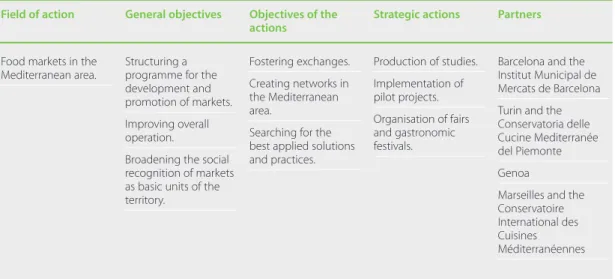
Nevertheless, the analyses also coincide in pointing out that there are still future challenges and a great need for development in several fields. This context justifies the creation of the MedEmporion project, for which we can see the basic data in Table 1. With the aim of promoting
and improving the food markets in the
Mediterranean region, the project seeks to create networks, foster exchanges and find the best practices applied to the commercial life of markets.
The project is developed through the
Mediterranean Business Development Initiative (MED Initiative) of the European Union, a programme that funds the actions related to the community strategic lines for territorial cohesion, the national structure plans of the member states and the specific needs of the Mediterranean area.
Within the field of the MED Initiative, the MedEmporion is framed within the axis “Promotion of a polycentric and integrated development of the Med space” and, specifically, to the item that foresees “strengthening of identity and enhancement of the cultural resources for a better integration of the Med space.”
Partners
With shared objectives, the cities of Turin, with the Conservatoria delle Cucine Mediterranee del Piemonte; Barcelona, with the Institut Municipal de Mercats de Barcelona (IMMB); Marseilles, with the Conservatoire International des Cuisines Méditerranéennes, and Genoa lead the MedEmporion project.
Field of action General objectives Objectives of the actions
Strategic actions Partners
Food markets in the Mediterranean area.
Structuring a programme for the development and promotion of markets.
Improving overall operation.
Broadening the social recognition of markets as basic units of the territory.
Fostering exchanges.
Creating networks in the Mediterranean area.
Searching for the best applied solutions and practices.
Production of studies.
Implementation of pilot projects.
Organisation of fairs and gastronomic festivals.
Barcelona and the Institut Municipal de Mercats de Barcelona
Turin and the Conservatoria delle Cucine Mediterranée del Piemonte
Genoa
Marseilles and the Conservatoire International des Cuisines Méditerranéennes
The leading cities of the project represent regions with an outstanding importance in the promotion of the commercial life of food markets and also share the experience of and potential for solid development in this issue and awareness of the value of this activity in the social dynamics of a community.
B
Baarrcceelloonnaa aanndd tthhee IInnssttiittuutt MMuunniicciippaall ddee MMeerrccaattss Although the origin of markets in Barcelona goes back to the Roman period and the first
permanent market in the city was founded in the 10th century, it was not until the 19th century – which is defined as the period of reference in the formation of the modern market system in Barcelona (1874-1921) – that the shaping of the current model of markets began. It was then when some buildings which are still a reference in the city were constructed, such as La
Barceloneta Market (1884), Santa Caterina Market (1888) or La Boqueria (Sant Josep Market, 1840). The historical period in which most of these buildings were developed was linked to a general urban development plan, which would be later represented by the figure of the town developer Ildefons Cerdà.
From the late 19th century in Barcelona the notion took root of municipal markets as fundamental facilities and entities in the constitution of the urban space and as central elements of the life of neighbourhoods.
Another issue of reference in the administrative model of the Barcelona markets is that of the redevelopment process which began in 1992, the year when the Olympic Games were held in the city. Since then, the Council has undertaken or promoted the modernisation of over half of the 43 municipal markets included in the network.
In the framework of this process, the municipal public initiative carries out restructuring works that affect several aspects of the markets, such as modernisation of infrastructures, adaptation of the product range, with the introduction in many cases of supermarkets, the incorporation
of new services and the reinterpretation of the social function and environmental commitment, in an ongoing attempt to maintain the
balance between the policies that defend the rights and needs of the citizens and those that ensure the feasibility of the traders’ businesses.
The markets of the city are managed by the Council through its own institute,
the Institut Municipal de Mercats de Barcelona (IMMB).
Based on a public management model but with a significant involvement of private operators, the markets promote values linked to food consumption such as:
••
The marketing of fresh and quality local products.••
The immediate relation between food and health.••
The promotion of responsible consumption.M
Maarrsseeiilllleess aanndd tthhee CCoonnsseerrvvaattooiirree IInntteerrnnaattiioonnaall d
deess CCuuiissiinneess MMééddiitteerrrraannééeennnneess
Marseilles, the main economic centre in southern France, mainly grew during the second half of the 19th century around the Vieux Port. After overcoming a serious crisis in the second half of the 20th century, the city recovered in the last decades of the century. The port of Marseilles has become the most important in the country and one of the major ports in Europe.
The Conservatoire International des Cuisines Méditerranéennes (CICM) in Marseilles was founded in 1999 with the objective of creating a Mediterranean network devoted to the culinary, touristic and cultural heritage of the countries in this geographical area.
INTRODUCTION THE MEDEMPORION PROJECT
education. It is formed by institutions, territorial organisations and universities, as well as individual members from the food sector and professionals acting in different areas, which makes it a multidisciplinary group.
The CICM has created a reflection and working group to research and promote the culinary heritage of the territories that make up the Mediterranean area.
The management model of the markets is public, with a network of 30 open-air municipal markets, 24 of which are food markets. Some of the most important are the La Plaine Market, Le Prado Market (with a wide range of clothes, fruit and vegetables) and Le Cours Julien, among others.
T
Tuurriinn aanndd tthhee CCoonnsseerrvvaattoorriiaa ddeellllee CCuucciinnee M
Meeddiitteerrrraannééee ddeell PPiieemmoonnttee
Founded by the Romans in 28 BC, in 1563 Turin became the capital of the Savoy region and in 1861 the first capital of Italy. After a century of strong development, based on manufacturing and the car industry, in the 1980s it experienced a profound crisis of demographic and industrial decline. It would not be until the 1990s when the city re-emerged thanks to the renewal of industry and investment in
innovation.
The approval of the city’s Framework Action Plan in 1995 was a determining factor in the
beginning of the phase of urban transformation. In this way, Turin also began a process of territorial marketing aimed at attracting new investments and was chosen as a city for the holding of events at national and international level.
Turin has a large number of urban food markets, of which the most important is Porta Palazzo Market.
Turin is an important gastronomic centre and promoter of local culinary traditions, as shown by initiatives such as Slow Food, Terra Madre and the Salone del Gusto.
The Conservatoria del Piemonte is a federal section of the Conservatoire International des Cuisines Méditerranéennes based in Marseilles. Its activity mainly focuses on the promotion of sustainable organic and environmental agriculture, as well as the agricultural activities that can create a balanced relation between sustainability, price and quality. For this reason, the Conservatoria del Piemonte insists on the idea that food is a fundamental part of
preserving the global concept of environmental sustainability. Techniques designed for the conservation of natural resources and
biodiversity, practices of sustainable agriculture and cultivation and organic agriculture stand out in the work it develops.
G Geennooaa
Genoa, the capital of the region of Liguria, has a broad network of industries and services and an important centre of handicraft activity. Its coast extends approximately along 35 km and it has a notable historical centre which houses, for instance, the Palazzo Ducale and the Rolli Palaces, listed as Heritage of Humanity by UNESCO.
The gastronomy of Liguria and, particularly, that of Genoa is characterised by vegetables and aromatic herbs and the extensive use of olive oil, major expressions of the
Mediterranean culinary identity.
The most important market is L’Orientale, a historical facility located in the most commercial part of the city. The Council has recently
conducted a study on the uses and preferences of consumers in relation to this market with the objective of guiding the improvements that must be undertaken in the future.
Strategic Lines
holding of a gastronomic festival in each city. These actions are complemented by a series of meetings, events and activities.
A
Accaaddeemmiicc SSttuuddiieess
The two academic studies proposed in the framework of the action plan are:
••
A comparative analysis of the markets of the Mediterranean.••
A study on the origin of the food products sold in local markets.The comparative analysis aims to describe the current situation of Mediterranean food markets with the end of later identifying the strong points, weak points, shortcomings and opportunities.
The work incorporates analysis of markets in cities that, although not exactly located in the Mediterranean arch, the research team considered of great value because of the information they can provide.
This work is developed with the aim of establishing a model of good practice that can become a useful tool for the operation of the markets, while incentivising their current commercial performance and defining
the bases for the implementation of the objectives that the study identifies as future challenges.
The comparative analysis seeks to be an instrument for the MedEmporion project partners so that they can have a greater understanding of the current reality of the markets and, above all, identify the best solutions for common problems.
The analysis focuses on achieving the following objectives:
••
Undertaking a first general approach enabling mapping the situation of the local food markets in the Mediterranean geographical field.••
Analysing the current and future challenges of the markets (i.e. strong points, weak points, shortcomings and opportunities).••
Issuing recommendations through the identification of good practices applied to the general operation of the food markets, aimed both at market operators and local policy officers in the European field.Along with this comparative analysis, a second study has been conducted on the origin of the products sold, in the framework of the debate on food sovereignty. The markets of the
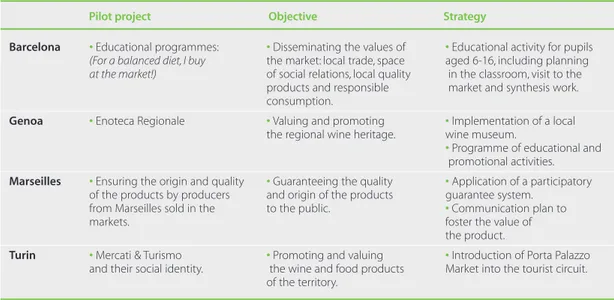
Table 2. Basic data of the pilot projects.
Barcelona • Educational programmes: • Disseminating the values of • Educational activity for pupils
(For a balanced diet, I buy the market: local trade, space aged 6-16, including planning
at the market!) of social relations, local quality in the classroom, visit to the products and responsible market and synthesis work. consumption.
Genoa • Enoteca Regionale • Valuing and promoting • Implementation of a local the regional wine heritage. wine museum.
• Programme of educational and promotional activities.
Marseilles • Ensuring the origin and quality • Guaranteeing the quality • Application of a participatory of the products by producers and origin of the products guarantee system.
from Marseilles sold in the to the public. • Communication plan to
markets. foster the value of
the product.
Turin • Mercati & Turismo • Promoting and valuing • Introduction of Porta Palazzo and their social identity. the wine and food products Market into the tourist circuit.
of the territory.
INTRODUCTION THE MEDEMPORION PROJECT
Mediterranean area trade in both local and traditional products and products from other regions of the world. However, in recent years experts have noticed a significant decrease in the percentage of local food production and
marketing. The study analyses the origin of the products sold in order to identify initiatives and practices applicable to the operation of the markets which help increase the value of local products.
P
Piilloott PPrroojjeecctt
Four pilot projects were put forward, one for each of the participating cities, whose characteristics can be seen in Table 2. All projects are developed at a local level although the objective of ongoing dissemination and integration of the results continues. Among the activities programmed there are educational campaigns, cultural events or solidarity actions.
F
Faaiirrss aanndd GGaassttrroonnoommiicc FFeessttiivvaallss
Between 2009 and 2011, four gastronomic and market festivals were held, one in each of the four cities. With the objective of promoting the market culture, the central element of the
Mediterranean identity, these included cultural, educational and leisure activities (talks,
performances, cookery workshops, conferences, presentation of studies, tasting of local
products…).
In Barcelona, the success of the fair Mercat de Mercatsin 2010 meant that it was repeated the following year and is now held annually.
The Mercat de Mercatsin Barcelona is held in the centre of the city and turns the square in front of the cathedral into a fictional market for three days during the weekend. According to data published on the IMMB website, the second Mercat de Mercats (held in 2011) was attended by 130 traders and producers, and received approximately 230,000 visitors, with 200,000 direct purchases and 48,000 food tastings.
THE FOUNDATIONS
OF THE STUDY
1
GOOD PRACTICES TO BE
PROMOTED
Features Shared by the Markets of the Mediterranean
This study, conducted on municipal markets in a significant number of Mediterranean cities, highlights a set of features and concepts that they all share to a greater or lesser extent.
The peculiarities found in this study enable us to define markets as a specific format of living trade with its own characteristics within the great diversity that exists, which differentiates them from other commercial options.
These peculiarities justify both the work of this document and the attempt to argue for the conservation of markets while promoting them as a specific distribution channel, especially for fresh food.
The main distinguishing attributes identified are:
••
HHeerriittaaggee aanndd iiddeennttiittyy rreeffeerreenncceess ooff ttoowwnnss aanndd vviillllaaggeess. Both from a tangible and intangible point of view, in most cases markets have a historical origin and are located in town centres, where often for centuries trade has been carried out while becoming an intrinsic part of the social and economic life of towns, neighbourhoods and villages and, therefore, as an indivisible part of their growth and development, to the extent that, on many occasions, this has resulted in buildings which, along with having an important architectural value, have conditioned and structured the surrounding areas.••
SSttrruuccttuurriinngg aanndd iinnvviiggoorraattiinngg eelleemmeennttss ooff ttrraaddee aanndd tthhee ssoocciiaall lliiffee ooff tthhee aarreeaa. The market encompasses within its surrounding areas a significant number of different businesses that invigorate the urban centres of towns and villages. This generates a set of factors that foster the use of urban spaces, securely generating social and personal bonds. This is also explained by the characteristics of theformat of the shops inside and outside the market, where a large number of small-scale actors operate and where direct and personal relations are a sign of identity.
••
EEccoonnoommiicc aanndd eemmppllooyymmeenntt iimmppaacctt. The aforementioned features show that markets have a significant economic impact on themselves and their environment and also offer a high degree of employment. In fact, the specialised small and medium sized formats, the personal service and the indirect generation of activity and jobs partly explain the better resistance to periods of crisis. Finally, the high concentration of products and services offered encourages competition and therefore a desirable regulation of prices.••
FFoooodd rreeffeerreenncceess. People identify them as places where they will find a wider range of products and higher quality, especially regarding fresh food. Moreover, they almost always reflect the diet and food habits of where they are located, both through local and easily available products as well as their forms of presentation and preparation, which could be considered another kind of heritage.••
SSuussttaaiinnaabbllee llooccaall mmooddeell. The range of products in the market is generally conceived as local, both in terms of access, on foot in most cases, and because they favour the selling of local, regional or national products. They are, therefore, a very sustainable business model in terms of energy consumption with respect to the movement of people and goods and also the link with the territory.The aforementioned set of shared attributes explains, for example, the attraction of visiting the market in a city to get to know many aspects of its character, relations, food, cooking, and so on.
10 Policies of Good Practices
The information collected through the research process, the questionnaires delivered and the fieldwork undertaken has provided a rich variety in the way markets operate.
The items summarised below have been developed in much more detail in the rest of the study, where it is possible to identify the cities or markets in which the different recommended and transferable practices are notable or lacking. These practices are tools to guide both strategic policies and specific action plans aimed at municipal markets. In the framework of EU countries, these practices can bring the cities closer to the objective of smart cities and, in other countries, they can guide their action lines.
1. Modernisation in management Considering markets as a future option for the distribution of food involves a reflection and a commitment to how to manage these facilities:
••
It is essential to modernise the key action lines and the specific regulations governing the operation of markets, adapted to each local and national reality. Moreover, the municipal authorities should establish a benchmark for markets in their town and, if necessary, a minimal organisational structure.••
Whether the form of management is public or not, we can say that success has always been determined by the involvement of traders in different aspects of management, as true key agents of markets.••
When there is a significant number of markets in a town, it is desirable to develop networking management (Netmarkets) at the level defined for each situation.2. Modernisation of facilities and venues
The modernisation of facilities and venues in the markets is a priority line of action for generating interest and use among citizen-clients. When mainly physical actions are planned for improving infrastructures and market buildings, different factors must be considered:
••
Remodelling of buildings, especially those involving the recovery of architectural heritage, while adapting their structure, facilities and commercial appeal to modern times (façade, access...).••
Including in the intervention, whenever possible, the improvement of logistical facilities (storage, loading and unloading, waste) to have markets that are adequate for the current needs of traders while minimising environmental risks.••
Provide, through prior studies, for the need to adapt the commercial offer to the demand, so that businesses are more competitive, while gaining in size and introducing new services (specialities, restaurants...). As a complement, the introduction of supermarkets within the same market must be encouraged as a more effective tool for facilitating daily shopping in one place, and thus make markets the establishments of reference for buying food.••
Encourage the training of traders as motors of ongoing change, given that the modernisation of markets, in a context of generaltransformation of trade, can only be successful if the people running the businesses are
and in a more entrepreneurial management of the establishments and of future promotional and customer loyalty drives. It is also necessary to provide training to the new generations to ensure business continuity as «artisans» of food products.
3. Adapting services to consumer demand In keeping with the line set by the commercial sector in general, the markets of the future should be aimed at the consumer by observing current demands to make the necessary adjustments to facilities:
••
The adaptation of market opening times to current consumption habits is a majorchallenge, given that markets have traditionally concentrated their activities in the morning. Adaptations and solutions are diverse and, as in other practices, their success always involves the full involvement of traders.
••
Depending on the profile of consumers in each market, it is advisable to incorporate services that are already common in other businesses and sectors: home delivery, credit card payment, left luggage, parking areas...4. Promotion of healthy food habits and practices
The strength of the binomial between market management and traders is the ability to become prescribers of healthy food habits and practices.
The function of promoting food knowledge, essential in the learning process of the population, can be articulated through a set of elements:
••
Promotion of culinary practices.••
Promotion of knowledge about the product.••
Promotion of healthy habits.The educational initiatives aimed at schools are a good system for children ? future customers ? to see the market and market professionals as prescribers of healthy food, respectively.
5. Promotion of fresh products and their culinary properties
The privileged capacity of the trader specialising in food to focus on a range of products is a strategic opportunity for markets to be identified 10 GOOD PRACTICES. THE FOUNDATIONS OF THE STUDY
GOOD PRACTICES TO BE PROMOTED
1
1
2
2
c
MARKET
MANAGEMENT
10 good practices
1
10
0
Capacity to make their voice heard in international decision-making regulatory bodies.1
1
Modernisation of management: regulations, traders’involvement and creation of networks.2
2
Modernisation of facilities and venues.3
3
Adapting services to consumer demands.4
4
Promotion of healthy food habits and practices.5
5
Promotion of fresh products and their gastronomic properties.6
6
Participation in social, charitable and cultural activities.7
7
Food hygiene and product traceability.8
8
Waste processing and sustainability models.9
-with the products of greatest excellence and with an added value.
Some aspects that favour promotion in this respect are:
••
The presence of restaurants and bars inside and outside the markets.••
The existence of areas in the markets for holding presentations of products and cookery demonstrations.••
The organisation of gastronomic fairs and festivals promoted by the markets and producers.6. Participation in social, charitable and cultural activities
The commercial activity in markets generates countless personal and social relations that become fundamental for the life of the neighbourhoods. The involvement of market traders in the social, cultural and charitable initiatives in the region strengthens the bonds and creates a win-win relationship. These include giving help to a neighbour in need or cooperating in the neighbourhood festival. This reinforces the identity of the neighbourhood and also the economy of the market and surrounding areas.
The historical roots of markets in their cities, neighbourhoods and villages, almost always in
central locations, foster a sense of belonging among citizens when using them and their surrounding areas for social and cultural cohesion activities.
The market has a potential to lead the presence of associations and relations in the commercial areas, while becoming an integral part of the commercial life of the area or town as a key piece and establishing shared policies and actions aimed at trade promotion and invigoration.
7. Food hygiene and product traceability Future consumers, with increasingly more and better knowledge, will be more demanding, which will determine shopping choices and consumer preferences. This change towards favouring fresh products in general and markets in particular will greatly depend on safety precautions in the handling of the products and the transmission of this information.
Users increasingly attach greater importance to the safety of the products they consume, especially if they are fresh, as well as the origin (e.g. Mediterranean), how they are obtained (e.g. fish farming) or processed (e.g. frozen). For consumers, having access to this information is fundamental.
We should note the advantages of all the agents involved following the same practices and guidelines.
The implementation of specific educational programmes on hygiene aimed at the market agents creates a positive impact overall, which explains why their implementation is
recommended.
8. Waste processing and sustainability models The new social trends towards caring for and respecting the planet make clear the need to consolidate policies that respect the
environment, such as:
10 GOOD PRACTICES. THE FOUNDATIONS OF THE STUDY GOOD PRACTICES TO BE PROMOTED
••
Introducing the selective collection of cardboard, plastic and polystyrene.••
Improving the levels of selective collection of organic waste.••
Incorporating or enlarging mechanisms for saving electricity and water.••
Promoting or encouraging the introduction of solar panel energy.The management of waste in markets must also be adapted to the municipal model of collection and processing. As elements inherent in the urban layout, municipal markets must work in accordance with the general actions of the city.
Whenever possible, promoting models of sustainability applied to waste processing is recommended, as already carried out in several cities examined in this study. The reduced use of bags and packaging made of contaminating material is also advisable.
9. Cross-over strategic communications and invigoration policy
The promotion and dissemination of markets in a world full of advertising messages is essential to keep one step ahead of the competition. Strategies can be organised in different hierarchies and emerge both from individual establishments in the market and the market as a whole or the city market network. The coordination of messages and strategies is a key element in this hierarchy and generates benefits by transmitting a positive perception of
shopping in the market.
The messages must position the markets with the values that distinguish them: quality and local products for a healthy diet, the value of
knowledge of the professionals who create them... Each city and market must develop their own complementary concepts.
Channels must be
adapted to each society and
take into account actions such as local activities ? raffles, gifts, and discounts ?, those related with the media and digital resources such as websites and social networks, and large-scale promotional events such as fairs and festivals.
10. Capacity to make their voice heard in international bodies
Finally, if markets wish to position themselves as a specific channel with an added value of food distribution, they must be able to make their voice heard – in order to promote their model and their values – in the European and international bodies that issue the future regulations and strategies in terms of trade and food distribution policies.
The design of a European network of municipal markets, with a mission and appropriate management bodies, can be an effective tool for achieving these objectives.
METHODOLOGY
Selection Criteria
When conducting the study we identified and resolved the questions concerning the selection of cities and markets, as well as the indicators to consider in order to achieve the objectives set out.
The Selection of Cities
In order to work with a representative sample of the whole of the Mediterranean area, we considered it appropriate to select those cities in which the presence of markets and their commercial activity have certain relevance, whether because of the amount of activity or the number of markets. The study has focused, whenever possible, on cities with covered or permanent markets.
However, in order to have a sample sufficiently representative of the whole of the Mediterranean as an area of analysis, we took into account the need to incorporate some cities that did not fully obey the criteria initially established.
Turin, Marseilles, Genoa and Barcelona, as partners of the MedEmporion project, were the first cities we worked with and those that closely meet the criteria initially
established.
With the aim of extending the study to the remaining Mediterranean arch – while following the criteria of trade activity, the presence of
covered markets and strategic location in the whole of the Mediterranean area – we included the cities of Valencia, Castellón, Fes, Cairo, Beirut, Istanbul, Ljubljana and Zagreb.
The Selection of Markets
The fact that markets are so diverse made the approach of a comparative analysis difficult. For this reason, two basic criteria were chosen when selecting markets: covered and permanent.
The basic criterion of the study was that markets are covered and permanent as these are the most representative features of the evolution processes of markets throughout history.
The construction of covered markets in the Mediterranean goes back to the Middle Ages although their moment of splendour was in the late 19th century, influenced by the so-called iron architecture that prevailed in England and France. The municipal authorities tended to build markets to meet a series of needs:
••
Organising activity on market days.••
Decongesting the public space.••
Improving control and payment of fees.••
Improving hygiene conditions to ensure quality of products and safety of people.Moreover, it was considered that the
construction of markets played a key role in the active life of the city. Hence, the tendency in many urban centres to advocate a
neighbourhood market model, with a network of markets strategically distributed throughout the city with the aim of ensuring supply to the whole population.
Although in many European countries the permanent covered markets gradually disappeared or declined, this is not the case in Mediterranean countries, where they are still preserved and have a central role in the commercial life of cities.
10 GOOD PRACTICES. THE FOUNDATIONS OF THE STUDY
METHODOLOGY
markets of each city, with 50 stalls or more, and work, whenever possible, with a maximum group of five markets per city.
Nevertheless, in the early stage of the research we realised that the current state of the markets of some of the participating cities did not fully match the objective of the study. In these cases, we tried to resolve the shortcomings detected by producing reports based on visits made that could complete parts of the questionnaire that were left unanswered. The difficulty obtaining some data means that the information processed from each market is unequal, which hinders the comparison.
Moreover, the study has two differentiated geographical areas, with two different levels of intensity:
••
The markets of the Mediterranean area (Catalonia and the Valencian Community, Piedmont and Liguria) as representative of the situation of Spain, France and Italy. The work in this field has been undertaken with the support of previous data and studies and taking advantage of the MedEmporion meetings and activities (festivals) in each of the cities and also the contribution of the participating bodies.••
The markets in the rest of the Mediterranean. We proposed a representative choice of cities where the historical presence of markets has been significant and continuous and where they still play a key role.The study was based on the production of different questionnaires with the aim of
obtaining data which can be compared between the cities. These questionnaires have been mainly completed by the group of markets in the Med area. For the second group, when we had difficulty obtaining data from the questionnaires during the research, we tried to compensate the shortcomings with other more qualitative and specific data for each case.
The Choice of Indicators
In the initial approach of the study we reached the conclusion that it was necessary to establish key indicators on which all markets could provide information that could be later compared. The indicators selected were the following:
••
Typology and size: study the types of food and non-food markets currently in operation in the Mediterranean area and classify them by typology, size and location.••
State of infrastructures: diagnose the state of the infrastructure and the logistics of themarkets in the cities analysed, its shortcomings and remodelling needs.
••
Administrative organisation: study the different management models – public, private, public-private –, the existence of bylaws, their possible updating, the role played by traders inmanagement…
••
Analysis of the product for sale and its origin: classify the types of products for sale and analyse their origin in terms of proximity.••
State of commercial life: analyse the existence of traders’ associations, promotional campaigns and participation of traders in marketmanagement and in the market’s with the commercial environment.
••
Importance in the local economy: analyse the relevance of food markets in the local economy.••
Social function: analyse whether markets fulfil a social function in the surrounding area and assess their social responsibility.••
Social valuing: explore whether there are opinion studies on the social value of the markets in each area.Quantitative Techniques and Qualitative Techniques
To meet the aims of the study, we have used a methodology that includes quantitative and qualitative techniques, so that they could be
processed jointly and strengthen each other. These techniques can be summarised as follows:
••
Production of questionnaires for the markets in order to collect quantitative data with which to analyse each case.••
Visits to the cities and their markets in order to obtain qualitative data enabling us to complete and extensively examine the analysis where the quantitative data was unavailable. It includes actions with discussion groups, directobservation, field diaries and the collection and analysis of documentation related to the issue under study.
Questionnaires
With reference to quantitative techniques, two different questionnaire formats were developed and applied to the participating cities to obtain categorised information on the wide panorama and multiplicity of realities found in the field of study.
The questionnaires were created with the aim of acting as an instrument capable of
10 GOOD PRACTICES. THE FOUNDATIONS OF THE STUDY
METHODOLOGY
In the phase prior to the production of the questionnaires, we carried out a process of compiling information, cataloguing and documentary analysis with regard to the issues examined in the study. This stage, called “Formulation of the State of the Issue”, helped define the overall panorama of the existing information (quantity, types, shortcomings) on issues considered relevant in the later process of development of the work.
The sources found were categorised according to their nature: institutional (bylaws, good practice guides…), academic (papers, publications, books, theses…) or general (advertising material,
informative texts, leaflets, press articles and news in newspapers and magazines…).The examination of this theoretical framework provides a context for this material given that it defines what kind of information must be researched, explored or verified. Consequently, questionnaires were produced that would be applied to the cities and the markets selected as information providers for the study and they were defined as follows:
••
General questionnaire by city. This is a means of recognising the function of this type of commercial activity within a determined area and a tool for observing the different aspects related to the general operation of the group of markets in the region (Table 1).••
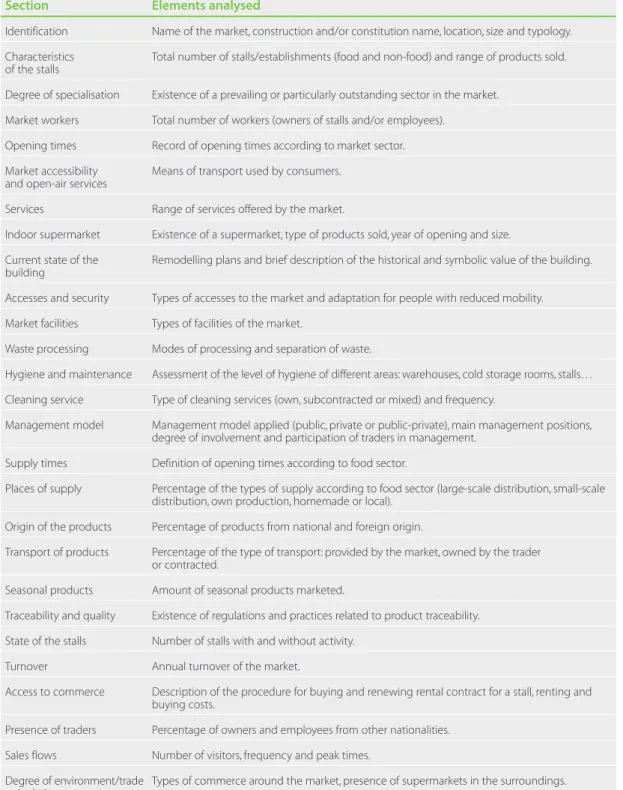
Specific questionnaire by market. Conceived for all those city markets with over 50 active stalls, whether selling food or other products (Table 2).For the formulation of the questionnaires, a series of items (questions) were selected, mainly closed but also some open-ended questions. The closed questions were binary choice (Yes/No) and multiple choice (mark with an X). The questions were phrased to facilitate the responses, the interpretation and coding of results, and the
1
1
2
2
Section Elements analysed
Identification Total number of markets, covered, open-air or mixed, with over 50 stalls, number of establishments without activity…
Management Type of management (public, private or public-private), existence of regulations and bylaws, system redevelopment policies…
State of commercial Current commercial life and compared with the last 10 years, existence of some type of current trade life promotion in the markets, commercial mix of the markets…
Social function Verification of the importance of markets in the social life of the territory (capacity to foster social relations and responsible consumption practices) and analysis of the impact on tourism.
Budget and Percentages of public and private funding and budgets for the development of promotional funding campaigns.
Identification of Indication of the aspects that can be recommended as active and good practices of the markets and good practices which could be transferred to other Mediterranean markets.
Section Elements analysed
Identification Name of the market, construction and/or constitution name, location, size and typology.
Characteristics Total number of stalls/establishments (food and non-food) and range of products sold. of the stalls
Degree of specialisation Existence of a prevailing or particularly outstanding sector in the market.
Market workers Total number of workers (owners of stalls and/or employees).
Opening times Record of opening times according to market sector.
Market accessibility Means of transport used by consumers. and open-air services
Services Range of services offered by the market.
Indoor supermarket Existence of a supermarket, type of products sold, year of opening and size.
Current state of the Remodelling plans and brief description of the historical and symbolic value of the building. building
Accesses and security Types of accesses to the market and adaptation for people with reduced mobility.
Market facilities Types of facilities of the market.
Waste processing Modes of processing and separation of waste.
Hygiene and maintenance Assessment of the level of hygiene of different areas: warehouses, cold storage rooms, stalls…
Cleaning service Type of cleaning services (own, subcontracted or mixed) and frequency.
Management model Management model applied (public, private or public-private), main management positions, degree of involvement and participation of traders in management.
Supply times Definition of opening times according to food sector.
Places of supply Percentage of the types of supply according to food sector (large-scale distribution, small-scale distribution, own production, homemade or local).
Origin of the products Percentage of products from national and foreign origin.
Transport of products Percentage of the type of transport: provided by the market, owned by the trader or contracted.
Seasonal products Amount of seasonal products marketed.
Traceability and quality Existence of regulations and practices related to product traceability.
State of the stalls Number of stalls with and without activity.
Turnover Annual turnover of the market.
Access to commerce Description of the procedure for buying and renewing rental contract for a stall, renting and buying costs.
Presence of traders Percentage of owners and employees from other nationalities.
Sales flows Number of visitors, frequency and peak times.
Degree of environment/trade Types of commerce around the market, presence of supermarkets in the surroundings. articulation
Strong points, weak points and Description of the items. suggestions for improvement
10 GOOD PRACTICES. THE FOUNDATIONS OF THE STUDY
METHODOLOGY
statistical processing. We used two types of open-ended questions: restricted response (direct) and extensive response (descriptive). The inclusion of open-ended answers made it possible to resolve any shortcomings of information and avoid partial results.
Fieldwork
In terms of the qualitative techniques grouped in the fieldwork, the following actions were
undertaken, in order of application:
••
Document collection, aimed at research for the development and production of the questionnaires; it also served to obtain contents and information concerning the different issues included in the study.••
Production of a guide, based on the aforementioned indicators, in order to collect data in the field diaries.••
Once the visit had been made, creation of discussion groups (one for each city visited) with the objective of completing theinformation obtained based on the field diaries and an overall vision of the reality examined. The discussion groups followed the pattern established based on the indicators selected, which meant that the data obtained was
coherent and facilitated the analysis. The discussion group sessions were complemented by examining the photographs taken during the fieldwork, which provided a more precise image of the reality of each market, allowing us to organise and classify the different issues approached.
We tried to resolve the issues, shortcomings and contradictions that gradually emerged during the research, whether in relation to the analysis of the data obtained through the questionnaires or the information from the fieldwork, by contacting the social agents and the experts on markets in each city, whenever possible.
cultural and social habits in Mediterranean countries. The 12 cities chosen are: Barcelona, Turin, Genoa, Ljubljana, Istanbul, Fes, Beirut, Zagreb, Valencia, Castellón, Cairo and Marseilles.
However, although the information collected is diverse, we have tried to homogenise it so that the analysis is as comparative as possible.
BARCELONA
VALENCIA CASTELLON
MARSEILLES TURIN
FES
LJUBLJANA ZAGREB
ISTANBUL GENOA