Agent-Based Model for the Effect of Curing Temperature on Cement
Hydration
1
Cerro-Prada E1*, Vázquez-Gallo MJ, Alonso-Trigueros J, Romera-Zarza AL
Escuela Universitaria de Ingeniería Técnica de Obras Públicas (Universidad Politécnica de Madrid), Madrid, Spain
Abstract
An agent-based model considers a system as a collection of autonomous entities called agents. Each independent agent behaves on the basis of a set of rules and, depending on the system circumstances, may act in different ways. This paper describes an agent-based model to simulate the early and intermediate stages of cement hydration, taking into account the effects of curing temperature and water-cement ratio. With this approach, calcium silicate phases are considered as agents of the system, while time and water play the role of activator agents and temperature acts as a determiner agent. This computational model aims to describe the behavior of these agents individually, in order to simulate the dynamic of the hydration process of cement. A model based on agents for the cement hydration allows one to analyze the degree of hydration and the formation and growth of the C-S-H gel as functions of time.
Regarding the influence of curing temperature on hydration kinetics, experimental results show two opposite effects: the reaction rate increases when temperature rises, but the density of the hydration products also increases at higher temperatures, resulting in a slower permeation of free water through the hydration products. Combining these two effects, the hydration rate is therefore lower during the late period at elevated temperature. Concerning the water-cement ratio, experimental studies have demonstrated that a higher proportion leads to a higher hydration rate from the middle period of hydration onwards, while it scarcely affects hydration rate in the early stages. These effects on hydration kinetics are reproduced by the agent-based model presented here.
The model validation is conducted by comparison between computed and experimental results achieved on ordinary cement pastes with different water-cement ratios cured at various temperatures (ranging from 20ºC up to 50ºC). The thermal effects on the density of different cement pastes are analysed with the thermogravimetric analysis (TGA) and the derivative thermogravimetric analysis (DTG) curves. Such techniques will be used to determine the amount of non-evaporated water presented in the pastes, as well as to give effective information about the degree of hydration of the system at certain time.
Originality
Our previous work has involved this agent-based approach for modelling the early stages of cement hydration, focusing on the microstructure development and C-S-H gel formation, resulting in agreement with reported experimental results. The new approach presented here models the hydration process and microstructure formation of cement pastes at the particle level, with the novelty that the curing temperature, as a determinative factor, shows its effects on the hydration kinetics at early and intermediate stages. Through the use of thermogravimetric analysis, the thermodynamic data for the hydration products - which are used as time-dependent input parameters within the model-, can be refined in order to achieve better accuracy.
Chief contributions
The agent-based model presented here, comprises an algorithm that computes the degree of hydration, the water consumption and the layer thickness of C-S-H gel as functions of time for different temperatures and different w/c ratios. The results are in agreement with reported experimental studies, demonstrating the applicability of the model. As the available experimental results regarding elevated curing temperature are scarce, the model could be recalibrated in the future. Combining the agent-based computational model with TGA analysis, a semi-empirical method is achieved to be used for better understanding the microstructure development in ordinary cement pastes and to predict the influence of temperature on the hydration process.
Keywords: agent-basedmodelling, microstructure development, thermogravimetric analysis.
1. I-TRODUCTIO-
Hydration of cement is surely one of the most extensively studied processes within the research of cementitious materials. Because of the complexity of the physical-chemical reactions involved in the process, however, many aspects concerning its behaviour are not yet understood and many questions still remain unanswered. It has been widely reported that certain variables clearly affect the hydration of cement, including the grain size, chemical composition, physical state and availability of water. Another such factor is the curing temperature during the hydration process, which is arguably the one variable that has the most significant effect on the rate of hydration (Lin, 2009) and, therefore, on the strengh development of the material.
Thermoanalytical methods (TGA/DTG and differential thermal analysis) have been shown to have an immense importance in the study of the effects of the curing temperature on the hydration of cement pastes (Guirado, 1998), not only to better understand the temperature influence on the cement based materials but also to assess fire-damaged concretes (Alarcon-Ruiz, 2005). In this work, thermogravimetric techniques have been used in combination with an intensive computational model framework, with the aim of providing a valid modelling approach to reproduce the thermal effects on the hydration process of cement pastes and to assess the influence of the water/cement ratio on the ultimate degree of hydration.
1.1. THEORETICAL BASIS
The theoretical considerations applied in this work, are founded on both the Arrhenius rate theory for chemical reactions -which is based on the concept of an activated molecule- and the currently accepted (Brown, 1980), (Sestak, 1984) equation of the kinetic rate of non-isothermal systems, given by the non-lineal law:
( ) ( )
A d
k f
dt
α
θ α
= (1.1)
where t represents time, α is the extent of reaction, θ is the absolute temperature, f(α) is a function that fits the reaction model (Guirado, 1998) and kA(θ) is the exponential approximation to the Arrhenius rate law:
( )
E R A
k θ =Ae− θ (1.2)
where the activation energy E and pre-exponential factor A, are the so called Arrhenius parameters, being R the universal gas constant. The Arrhenius law shown in (1.2) is, in fact, the basis of the procedure prescribed in (ASTM, 1998) in which the mix-specific activation energy is experimentally determined from the linear relationship between ln(kA) and 1/θ. Hence, the activation energy E is an index of the temperature sensibility of cement-based systems.
In order to better select the Arrhenius parameters involved in the experimental work carried out in this research, the extent of reaction α, in the non-isothermal kinetic rate shown in (1.1) is expressed as
d d d
dt d dt
α α θ
θ
= (1.3)
hence, taking into account the constant heating rate β used in this work, equation (1.1) can be simplified:
( )
E R
d A
e d
f
θ α
θ
α β
−
Therefore, a relationship between the variation of the extent of reaction and the curing temperature can be obtained by:
( )
E R
d A
e d
f
θ α
θ
α β
−
=
∫
∫
(1.5)The Arrhenius parameters E, A and the fitting function f(α) used in this work, were carefully chosen following the kinetic model reported by Breugel, 1991, pp.133. Regarding the activation energy E, further description will be provided in section 2.2.
1.2. AGE%T-BASED MODELLI%G APPROACH
The model presented herein is inspired by a stochastic simulation system called HydratiCA, (Bullard, 2007). The HydratiCA model uses cellular automata’s approach and deals rigorously with the kinetic processes at the chemical phase level, reaching great detail of accuracy although that results in significant computational difficulty. Here we predict cement microstructure by simulating a number of cement particles confined in a computational volume which makes this approach tractable as well as scalable with the number of particles or the system size.
Agent-based modelling (ABM) consists of a set of agents that encapsulate the behaviour of the various individuals that make up a whole system, following a set of rules (Holland, 1995). A great advantage of this approach in simulating complex systems is that emergent phenomena can be modelled through simple rules governing the behaviour of each agent. The agents are autonomous entities that may act in different ways, depending on the system circumstances. In the work presented here, we use an agent-based model to study the early and intermediate stages of cement hydration. With this approach, calcium silicate phases are considered as different kind of agents of the system, while time and water play the role of activator agents and temperature acts as a determiner agent. This is a localized microstructural model aiming to simulate the hydration kinetics and the microstructure development as hydration evolves at the cement particle scale, using localized rules to mimic the hydration process.
This computational approach aims to contribute to the still scarce set of models for cement hydration, responding to the recent calls for Advances in Models <eeded, (Garboczi, 2009), (Scrivener, 2008), by providing a new computational paradigm in which the complexity of the process is efficiently distributed in individual computational entities. We have previously applied this agent-based approach for modelling the cement hydration process (Cerro-Prada, 2008, 2009), through an algorithm that computes the degree of hydration and the thickness of the C-S-H gel in terms of the time, considering hydration of alite and belite in ordinary Portland cement at constant ambient temperature, being these two chemical phases mainly responsible for the formation of C-S-H gel. The model has proved to be suitable for reproducing cement hydration process, achieving good agreement with reported experimental results.
2. METHODS A-D MATERIALS
Type CEM I 42,5 Portland cement (Type I according with ASTM C150) was supplied by Portland Valderrivas, Madrid, Spain. Its chemical composition is shown in Table 1. The cement pastes were prepared with de-ionised water, using a water/cement ratio of 0.5. Mixing was conducted using the Hobart Mixer. The cement powder was first placed in a mixing bowl. Initially, a small amount of the mixing water was added. The mixing was conducted for a minute to remove lumps in the cement powder. The rest of the mixing water was then poured into the bowl and mixed was a further two minutes, and then vibrating was applied for 30 seconds to avoid any air bubbles.
Table 1: Chemical Composition of OPC (wt%)
SiO2 Al2O3 Fe2O3 CaO MgO SO3
20.80 4.40 2.90 62.3 2.70 3.14
Finally, the fresh cement paste was poured out of the bowl and spin-coated on a square glass substrate for 10 seconds, during which the substrate rotated at 1500 r.p.m. The resulting specimens from this experimental technique were circular shaped plates with a diameter of approximately 31.5 mm and a thickness of 1.0 mm. The samples were then divided into two groups, each to be thermally treated at two different hydration stages: early hydration (0 ~ 3 days) and intermediate hydration (3 ~ 7 days). If the TGA was to be conducted at intermediate hydration, in order to avoid leaching of Ca(OH)2 from the cement paste system, the corresponding specimen was cured in a plastic bag with a small amount of lime water at 20ºC for 6 days. Thermal analysis was then conducted on both groups of samples, in a TA Instruments Q500 Thermogravimetric Analyzer, from ambient temperature up to 900ºC, with a heating rate of 10ºC min-1.
2.1. DEGREE OF HYDRATIO%
It can be assumed that the degree of hydration of a cement paste is directly proportional to the amount of chemically bound water present (Guirado, 1998). The combined water can be considered to be completely eliminated from the sample when heating from 105ºC up to 900ºC (Taylor, 1997), due to the descomposition of carboaluminate hydrates and the C-S-H. At lower temperatures, typically from 30ºC up to 105ºC, the evaporable water is lost, and still there is a small but not significant part of bound water that escapes. In the work we present here, the TGA data have been used to determine the chemically bound water from the difference between the sample weight at 105ºC and its weight after heating at 900ºC, minus the mass loss due to CO2 desorption produced by the calcite decomposition, which occurs between 600ºC and 800ªC. The degree of hydration of the cement paste at a hydration time t, can be calculated by the following expression (Mounanga, 2004):
105º 900º 600º 800º 0
( ) ( )
( )
TGA
n C
W W W W
t
W W
c
α = − − − (2.1)
2.2. ACTIVATIO% E%ERGY
As is mentioned in section 1.1, the activation energy E is currently used as one of the parameters when describing temperature effects on the cement’s hydration rate. Accordingly to experimental data, a formula has been established (Breugel, 1991) for the apparent activation energy in terms of the chemical composition of anhydrous cement, the curing temperature and the degree of hydration, namely:
1.5
3 0 3 3
( , , ) exp ( %)n 0.025 0.33( %) 30
E T α C S =pα −m C S + T + C S + (2.2)
where p0, m and n are experimentally obtained coefficients, α is the degree of hydration and (C3S%) is the mass percentage of alite in the sample, being T the Celsius temperature. According to expression (2.2), and also highlighted in section 1.1, the activation energy E changes during hydration process when curing temperate varies. Therefore, the agent-based model presented here, dynamically computes -in an adaptive fashion- the value of degree of hydration α according with activation energy variations, depending on the step within the hydration process.
2.3. VALIDATI%G THE AGE%T-BASED MODEL
The agent-based computational approach we have developed comprises a set of rules which come from a systematic ab-initio study of hydration process (Breugel, 1991). The kinetic laws drive an initial phase-boundary reaction in which a layer of C-S-H gel is formed over the surfaces of non-hydrated cement particles, starting at a certain critical time when the product layer around each cement particle reaches the so called transition thickness. The core algorithm pseudo-randomly assigns to each cement particle its rhythm for decreasing, depending on the size and composition of the particle, coherently built from experimental data.
The chemically bound water previously determined by the TGA experiments, can be used to validate the agent-based model at the taken-decision level, as the rules for the cement particles to chemically react are deterministic, depending on the amount of water available. In this sense, the computational model was launched to compute a qualitatively identical specimen than the samples analysed by the TGA facilities. The percentage of non-evaporable water empirically measured was recalculated as one’s complement of the available water and compared with the predicted value, which is necessarily required for the agents to decide whether the hydration proceeds. If the percentage difference between the predicted value and the combined water mass experimentally weighed is within a range of ±10%, then it can be assumed that reasonable validation of the computation model has been achieved for this analysis. This validation mechanism provides a simple but effective means of assessing the accuracy of the agent-based modelling framework, as well as establishing its capabilities for future enhancement.
3. RESULTS A-D DISCUSSIO-
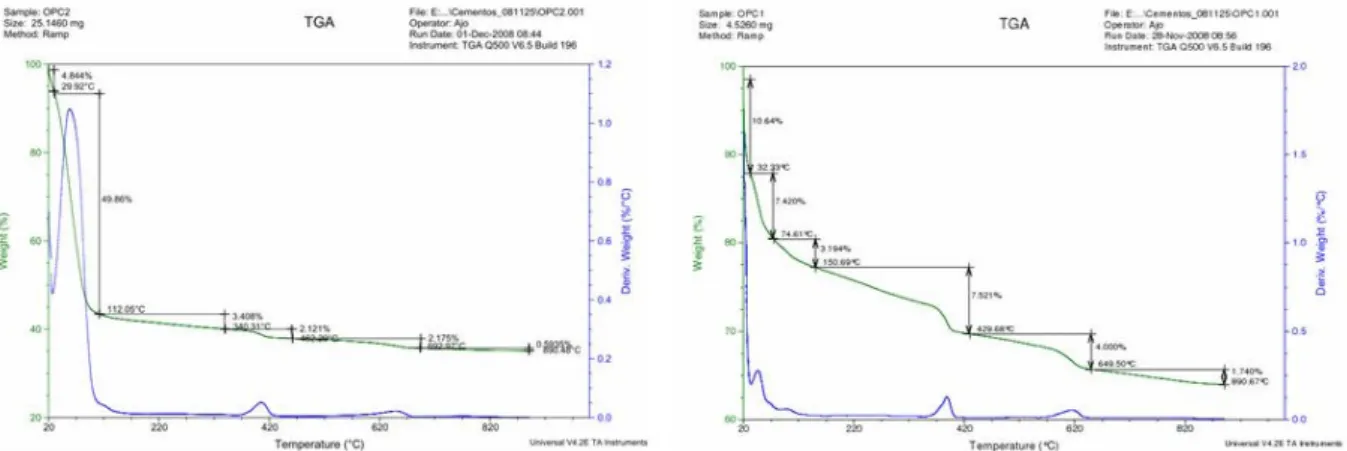
In Figure 2 the TGA/DTG results of two samples with w/c=0.5 hydrated at 20ºC during 3 days and 6 days are represented, corresponding to early and intermediate stages of hydration. Firstly, the significant weight gain that occurs at 30ºC in the sample hydrated for 3 days (Figure 2, left) needs to be observed. Assuming that the hydration takes place via dissolution and precipitation processes (Lothenbach, 2006), the moisture transport after abruptly exposing the paste to a higher temperature will take place, producting a pressure gradient that enhances both the water diffusion rate in the cement paste and the calcium hydroxide formation. This last mentioned reaction requires carbon dioxide absortion, which results in an initial overweight degradation of the sample.
with the predicted results computed by the Agent-Based model, as is shown in Figure 3. Very good agreement is found between the experimental and simulated values of α. The analysis of the chemically/physically combined water is highlighted, resulting both measured and modelled values in good agreement with experimental work reported, as well as from comparison with calculated values from chemical equations.
Figure 2: TGA/DTG curves of OPC paste (w/c=0.5) hydrated at 20ºC for 3 days (left) and 6 days (right).
Figure 3: Left: Experimental results and simulation of the evolution of the degree of hydration versus time of an OPC paste (w/c=0.5) at 20ºC. Centre: ultimate degree of hydration predicted versus water/cement ratio, at 20ºC.
Right: Modelled degree of hydration versus time of the same OPC sample, at different temperatures The percentage difference between the predicted and measured value has been calculated, showing to fit within the validation range assumed in section 2.1. The effect of the spin-coating method used to prepare the specimens has been determined from comparison between the experimental initial water content and the modelled value for the same parameter, and so used to adjust the model. This novel preparation technique has herein shown its impact on the hydration process as producing a significant evaporation of the initial water present in the sample, modifying the experimental water/cement ratio at the pre-induction period. In this sense, further work on spin-coated cement pastes needs to be carried out in order to determine suitable correction factors for the ABM, when modelling hydration of cement systems prepared by spin-coating. Regarding the influence of the water/cement ratio on the ultimate degree of hydration, the computational model predicts a w/c ratio of approximately 0.3 to be required for fully completing the hydration process, modelling the relationship between these two parameters as is shown in Figure 3 (centre). These results support the previously observed fact that the equation (3.1) reported by Mills, 1966, might underestimate the ultimate degree of hydration (Lin, 2009).
/ 1.031
0.194 /
ultimate
w c w c
α =
4. CO-CLUSIO-S A-D FURTHER WORK
The efficacy of the Agent-Based model presented when computing the hydration process of OPC, has been achieved by comparing the degree of hydration computed with the value measured by the thermogravimetric analysis. The good agreement between experimental results and simulations shows that the temperature effects on the hydration process is well reproduced by the Agent-Based modelling approach. Analysis of the amoung of initial water loss during the spin-coating preparation technique and their effect on the degree of hydration, are currently under study, to validate the observations from adjusting the computational ABM to the experimental results.
REFERE-CES
- Alarcon-Ruiz, L. et Al., 2005. The Use of Thermal Analysis in Assessing the Effect of Temperature on a Cement Paste. Cement and Concrete Research, 35(3), pp. 609-613.
- ASTM C 1074 (1998) “Standard Practice for Estimating Concrete Strength by the Maturity Method”
- Breugel, K. van, 1991, Simulation of the Hydration and Formation of Structure in Hardening Cement-Based Materials. Thesis (PhD). Delft University of Technology.
- Brown, M.E. et Al., 1980. Reactions in the Solid State, Comprehensive Chemical Kinetics, Vol. 22. Amsterdam: Elsevier. Ch.3.
- Bullard, J.W., 2007, A Three-dimensional Microstructural Model of Reactions and Transport in Aqueous Mineral Systems, Modelling and Simulation of Materials, Sci. Eng., 15, pp. 711-738.
- Cerro-Prada, E. et Al., 2008. Modelling Hydration Process of Cement Nanoparticles by using an Agent-based Molecular Formation Algorithm. 1st International Congress on <anotechnology and Applications (<A<A 2008), Crete, Greece September 29 – October 1 2008. Acta Press 615-082.
- Cerro-Prada, E. et Al., 2009. Nanoscale Agent-based Modelling for Nanostructure Development of Cement. 3rd International Symposium on <anotechnology in Construction (<ICOM3, 2009), pp. 175-180, Prague, Czech Republic May 31 – June 2 2009. Berlin Heidelberg: Springer-Verlag, 175-180.
- Czernin, W., 1980. Cement Chemistry and Physics for Civil Engineers. 2nd English edition, New York: Foreign Publications Inc,.
- Garbozci, E.J., 2009, Concrete Nanoscience and Nanotechnology: Definitions and Applications, 3rd International Symposium on <anotechnology in Construction (<ICOM3, 2009), pp. 81-88, Prague, Czech Republic May 31
- Guirado, F. et Al., 1998, Thermal Decomposition of Hydrated Alumina Cement (CAH10). Cement and Concrete Research, 28(3)pp. 381-390.
- Holland, J.H., 1995. Hidden Order: How Adaptation Builds Complexity. Reading, MA: Addison-Wesley. - Lin, F. and Meyer, C., 2009. Hydration kinetics modeling of Portland cement considering the effects of curing temperature and applied pressure, Cement and Concrete Research, 39(4)pp. 255-265.
- Lothenbach, B. and Winnefeld, F., 2006. Thermodynamic modelling of the hydration of Portland Cement. Cement and Concrete Research, 36(2), pp.209-226.
- Mills, R.H., 1966. Factors influencing cessation of hydration in water cured cement pastes. Special Report No. 90, Proceedings of the Symposium on the Structure of Portland Cement Paste and Concrete, Highway Research Board, Washington DC, USA (1966), pp. 406–424.
- Mounanga, P. et Al., 2004. Predicting Ca(OH)2 content and chemical shrinkage of hydrating cement pastes
using analytical approach, Cement and Concrete Research, 34(2), pp.255-265
- Scrivener, K. & Kirkpatrick, R.J., 2008. Innovation in Use and Research on Cementitious Materials. Cement and Concrete Research, 30(2), 128-136.
- Sestak, J., 1984. Thermophysical properties of solids, Comprehensive Analytical Chemistry vol. 12D. Amsterdam, Elsevier.
- Taylor, H.F.W., 1997. Cement Chemistry. 2nd edition .Thomas Telford Publishing.