A study on the mix design and fundamental properties of pre-cast concrete artifacts prepared with coarse and fine recycled aggregates.
J. GARCÍA-NAVARRO*, A. de GUZMAN, M. CERVANTES Polytechnic University of Madrid, Spain
This paper analyzes the use of Construction and Demolition Waste as aggregate in pre-cast concrete artifacts production incorporating coarse and fine fractions. The recycled aggregates used were sourced from a Spanish sorting facility and were mainly composed of concrete rubbles and ceramic materials.
A complete study of the properties of the aggregates was carried out and laboratory trials were conducted to investigate the possibility of the use of 10%, 20%, 30% and 50% contents of coarse recycled aggregates replacing natural aggregates, and their influence on the physical and mechanical properties of concrete.
The results showed that up to 30% substitution of coarse aggregate had minor effects on the compressive strength of the samples produced but this value would decrease at high levels of replacement. Based on this mixture of 30% coarse fraction replacement, two new mixture ratios incorporating 5% and 10% fine recycled aggregates were also investigated.
Keywords: Construction and demolition waste; Recycled aggregates; Pre-cast concrete; Compressive strength.
1. Introduction
In Spain, a huge quantity of Construction and Demolition Wastes (CDW), 40 million tons, are produced every year. These wastes are mainly composed of concrete rubble and bricks. The disposal of the wastes has become a severe social and environmental trouble in the territory, mainly due to unauthorized dumping. Only about 15% of the CDW is currently recycled in our country, much lower than the levels of recycling of other European countries that are around 95% and also below the European average, which is 50% (F.I.R., Cuperus G., 2009). One of the aims of the II Spanish National Waste Plan is to recycle 35% of CDW by 2015 (PNIR, 2007). Therefore the possibility of reuse these wastes in construction industry is hence of increasing importance.
In the construction sector, one of the main natural resources used, are the aggregates from the crushing and sieving of natural stone. The negative visual effect in landscape may be doubled if to landfills we add quarries and gravel pits which extract this type of raw material. The objective of this project is the incorporation of recycled aggregates in place of natural aggregates in concrete to produce pre-cast, non-structural artifacts, (Hao, T., Liu, L. X., Xie, L. L., 2005, Poon, C. S., Kou, S. C., Wan, H. W., Etxeberria, M., 2009). This will significantly reduce the use of millions of tons per year of natural aggregates which are currently being extracted and reduce the impact on landscape caused by the extraction of this material. At the same time this would help to reduce thousands of tons of debris accumulated in landfills, and both social and environmental representing costs.
In Spain the use of recycled aggregates is becoming usual, mainly in secondary applications as in the implementation of sub-bases and road bases, embankments or fillings.
Recent studies and researching have allowed the incorporation of new annexes to the current Spanish Standard for Structural Concrete (EHE, 2008) which enables the use of significant fractions of these aggregates in structural concrete manufacture.
However, in the case of non-structural concrete, particularly in pre-cast concrete artifacts manufacture, the EHE-08 permits up to 100% content of recycled aggregates, but only considering recycled aggregates from concrete rubble and just for the coarse fraction replacement and with a resulting compressive strength higher than 15MPa.
The aim of this investigation is to study the feasibility of using sorted recycled concrete and ceramic aggregates from CDW in pre-cast non-structural concrete, incorporating both coarse and fine fractions as a previous step to develop technical documents and guides that support the correct use of recycled aggregates for this application (Cachim, P. B., 2009; Correia, J. R., 2006; de Brito, J., Pereira, A. S., Correia, J. R. 2005; Debieb, F., Kenai, S., 2008; Evangelista, L.; Khatib, J. M. 2005).
2. Experimental details
2.1. Materials
The mixes’ constituents were cement, water, coarse and fine natural aggregates and coarse and fine recycled aggregates. Portland cement, commercially available in Spain, comply with EHE-08 was used.
The Recycled Aggregates (RA) used in this study were sorted C&DW, sourced from a Spanish recycling facility located in Cordoba and were mainly composed of concrete rubbles and ceramic materials. The constituents of recycled aggregates are shown in Table 1.
Table 1
Constituents of recycled aggregates.
The recycled aggregates derived from a size fraction 20/40 mm and underwent a further process of mechanized sieving to produce recycled coarse aggregate 5/10 mm (RCA) and recycled fine aggregate 0/5mm (RFA), according to the particle size requirements of EHE-08 for concrete. The physical properties and the grading curves of RA are shown in Table 2 and Fig. 1, respectively.
Material Sieve Fractions: 0/5-5/10
Dry mass (g) %
Natural Stone 2547 50,94
Ceramic materials
Brick 633
928 18,56 Tiles 295
Mortar, concrete 1250 25
Plaster 33 0,66
Marble 112 2,24
Slate 120 2,4
Table 2
Physical Properties of Aggregates.
Natural aggregates (NA) obtained from a local siliceous quarry were used. Table 2 also shows the physical properties of NA. Fig. 2 shows the grading curves of these aggregates.
Fig. 1.
Particle size distributions of RA with EHE limits indicated.
Fig. 2.
Particle size distributions of RA with EHE limits indicated.
PROPERTIES TEST
METHOD (0/5) RA (5/10) RA (0/4) NA (0/6) NA (6/12) NA
Water absorption (%) 10 min
UNE-EN 1097-6
8,00 7,18 - - -
24 h 8,59 7,29 2,44 1,25 1,51
Particle bulk density (mg/m³) 10 min 2,43 2,45 - - -
24 h 2,41 2,55 2,59 2,74 2,62
Dry Surface Saturated Density (Mg/m³) 10 min 2,20 2,23 - - -
24 h 2,17 2,30 2,50 2,68 2,56
Density-oven-dry (mg/m³) 10 min 2,04 2,08 - - -
24 h 2,00 2,15 2,44 2,65 2,52
Total sulfur compounds (%)
EN 1744-1: 1998
0,52 0,17 - - -
Acid-soluble sulphate content (%) 1,18 0,20 - - -
Light particles (%) - 0,50 - - -
2.2.Mix proportioning
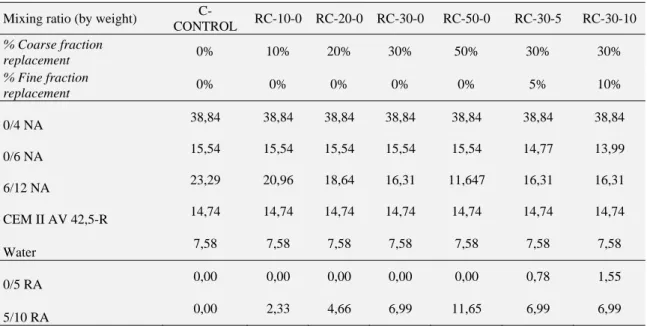
The cement and natural aggregates used in the manufacture of the specimens would be the same as those used in the final product manufacture. Five different mixes were employed to examine the influence of incorporating coarse recycled aggregate on the properties of concrete: a control mix C-CONTROL, and four doses with a replacement rate on the coarse fraction (NA 6/12 and RA 5/10) of 10%, 20%, 30% and 50%. The water/cement ratio for all mixes was 1:2.
At the sight of results, based on the mixture of 30% coarse fraction replacement, two new mixture ratios incorporating 5% and 10% fine recycled aggregates were also investigated. Details of the mixes are given in Table 3.
Table 3 Mixing ratios
2.3. Mixing procedure
Normally, workability is not important for molded precast artifacts and only a small amount of water is required. However in this case of RA with high content of ceramic material and adhered mortar in the mixture, the amount of added water used in this study was relatively higher. To make the mixtures workable it was necessary to pre-saturate the RA used, so ten minutes before mixing, RA were immersed in water (Barra, M., Vazquez, E., 1996; de Juan, M.S., Alaejos Gutiérrez, P., 2009).
2.4. Casting, curing and testing
For each mix, 6 cylindrical prisms of dimensions d150x300 mm were cast in steel moulds and kept in a mist room at 20ºC and 95% RH for 24 h until unmolding (EN 12390-1). Then they were placed in water at 20ºC for curing. Testing was conducted at 7 and 28 days of curing. Figure 3 shows photographs of the casting of specimens.
Mixing ratio (by weight)
C-CONTROL RC-10-0 RC-20-0 RC-30-0 RC-50-0 RC-30-5 RC-30-10
% Coarse fraction
replacement 0% 10% 20% 30% 50% 30% 30%
% Fine fraction
replacement 0% 0% 0% 0% 0% 5% 10%
0/4 NA 38,84 38,84 38,84 38,84 38,84 38,84 38,84
0/6 NA 15,54 15,54 15,54 15,54 15,54 14,77 13,99
6/12 NA 23,29 20,96 18,64 16,31 11,647 16,31 16,31
CEM II AV 42,5-R 14,74 14,74 14,74 14,74 14,74 14,74 14,74
Water 7,58 7,58 7,58 7,58 7,58 7,58 7,58
0/5 RA 0,00 0,00 0,00 0,00 0,00 0,78 1,55
Fig. 3.
Photographs of the casting.
3. Results and discussion
3.1. Aggregate properties
The characterization of aggregates is presented in Tables 1 and 2 and Fig. 1 and 2. As shown in Table 1, up to 50% of recycled material consists of natural aggregate, which means that only the 50% resting will influence in the behavior of the concrete specimens tested. Similarly, 25% is mortar and concrete, which are stronger materials than ceramic. Therefore, if we replace 30% of NA, only 15% of the aggregates added will influence in the final concrete properties.
As shown in table 2, the results indicate higher water absorption capacity in RA, 7% against 2-2.5% of NA and a slightly decrease in the density of RA compared with that of NA, this was expected because of the content of ceramic materials and adhered mortar within the constituents of RA.
Coefficient of Los Angeles determines the strength of the aggregates. EHE-08 limits this value to 40%. The RA used in the investigation although satisfying this requirement present 50% higher value compared to NA.
3.2. Fresh properties of concrete
The slump values are shown in Table 4 for concrete containing 0%, 20%, 30%, 50%, 30-5% and 30-10% RA. At a water to cement ratio of 1:2, all concretes but the one containing 50% RA present good workability without the use of admixtures. Fig.4 shows the method used to determine the concrete slump.
3.3. Compressive strength
Laboratory trials were conducted to determining compressive strength in specimens, after 7 and 28 days curing, and modulus of elasticity at 28 days, Fig. 4 shows the compressive testing machine used.
However, at replacement levels of 10%, 20% and 30%, the relative strength increases after 28 days of curing. This might be attributed to further cementing action of unhydrated cement particles in RA that contribute to the strength development.
Fig. 4.
Photographs of the Abrams Cone and compressive testing machine (EN 12350-1/2/3:2006; EN 12390-1/2/3:2001).
For each period (7 or 28 days), tow specimens were tested for compression, and a third one to determine the Modulus of Elasticity and Poisson's coefficient.
Table 4
Concrete slump values and compressive strength.
PROPERTIES
AN (6/12) AR (5/10) AN (6/12, 0/4) AR (5/10, 0/5)
C-CONTROL RC-10-0 RC-20-0 RC-30-0 RC-50-0 RC-30-5
RC-30-10
Additive - - - - 0,8 - -
Concrete slump 0 cm 0 cm 0 cm 0 cm 24 cm 1 cm 2 cm
Compressive strength (MPa)
7 DAYS 32,25 30,23 31,1 32,06 24,43 22 20,17
Compressive strength (MPa)
28 DAYS 37,58 38,42 40,72 38,56 31,5 27,82 25,58
Modulus of Elasticity (MPa)
EN 83316, 1996. 27.656 31.682 29.779 28.453 21.872 24.311 24.315
The results show that the decrease in concrete strength was even more pronounced when RA were added in their fine fraction. Although this reduction in strength, the values comply with the EHE-08 requirements for resulting compressive strength over 15MPa for non-structural concrete.
4. Conclusions
This paper presents the results of an investigation on the use of crushed recycled debris from CDW, as aggregates in the production of non-structural pre-cast concrete. Based on the results of this study, the following conclusions can be drawn:
2. The EHE-08 accepts up to 20% replacement in the coarse fraction for structural concrete, as the influence of this replacement in compressive strength is not significant. This study shows that for non-structural concrete this replacement can be increased to 30%, keeping the compressive strength value after 28 days curing, at the level of the control concrete, around 38MPa and above 15MPa which marks the EHE-08. However, a replacement on the fine fraction up to 10% decreases resistance around 30% but also remains above the accepted limit.
3. The results show that recycled aggregates obtained from the construction and demolition waste sorting facility has potential to be used as aggregates for making non-structural pre-cast concrete artifacts.
4. The use of 30% of RA in concrete production would save about 11.5 million tons of natural stone extracted from quarries every year, which means an important reduction of the negative impact on landscape these quarries produce, as well as so many tons of debris that are being accumulated nowadays in landfills.
References
Barra, M., Vazquez, E., The influence of retained moisture in aggregates from recycling on the properties of new hardened concrete. Waste Management 1996. 16, 113-117.
Cachim, P.B., Mechanical properties of brick aggregate concrete. Construction and Building Materials, 2009 23(3), 1292-1297.
Correia, J. R., de Brito, J., & Pereira, A. S. Effects on concrete durability of using recycled ceramic aggregates. Materials and Structures, 2006 39(2), 169-177.
de Brito, J., Pereira, A. S., & Correia, J. R., Mechanical behaviour of non-structural concrete made with recycled ceramic aggregates. Cement & Concrete Composites, 2005 27(4), 429-433.
de Juan, M.S., Alaejos Gutiérrez, P., Study on the influence of attached mortar content on the properties of recycled concrete aggregate.Construction and Building Materials,
2009. 23(2), 872-877.
Debieb, F., Kenai, S., The use of coarse and fine crushed bricks as aggregate in concrete. Construction and Building Materials, 200822(5), 886-893.
EHE-08, 2008. In: Ministerio de Fomento (Ed.), Instrucción de Hormigón Estructural, Spain. Available online at:
Hwww.fomento.es/MFOM/LANG_CASTELLANO/DIRECCIONES_GENERALES/OR
GANOS_COLEGIADOS/CPH/instrucciones/H (accessed 20 04 2010).
EN 1097-6: 2000, 1097-6/ A1:2006 Natural stone test methods. Density and water absorption.
EN 1744-1: 1998. Light particles. Total sulfur compounds. Acid-soluble sulphate content.
EN 12350-1/2/3:2006. Fresh concrete slump test.
EN 12390-1/2/3:2001. Compressive strength of test specimens. Determination of the modulus of elasticity in compression.
Evangelista, L., de Brito, J. Mechanical behavior of concrete made with fine recycled concrete aggregates. Cement & Concrete Composites 2007. 29, 397-401
F.I.R., Cuperus G., Presentation: 4th National Congress of Demolition and Recycling, 2009 Zaragoza, Spain. Available online at:
www.congresorcd.com/cond_ponentes.cfm (accessed 20 04 2010).
Hao, T., Liu, L. X., & Xie, L. L., A study on the mix design and fundamental properties of concrete perforated bricks made of recycled aggregates. Presentation: International Symposium on Innovation and Sustainability of Structures in Civil Engineering-Including Seismic Engineering, Nanjing, PEOPLES R CHINA (2005).
Khatib, J. M. Properties of concrete incorporating fine recycled aggregate. Cement and Concrete Research, 2005 35(4), 763-769.
PNIR, Ministerio de Medio Ambiente Y Medio Rural Y Marino. II Plan Nacional Integrado de Residuos. January 2007. Available online at:
Hwww.mma.es/portal/secciones/calidad_contaminacion/residuos/planificacion_residuos/ borrador_pnir.htmH (accessed 20 04 2010).
Poon CS, Kou SC, Wan HW, et al. Properties of concrete blocks prepared with low grade recycled aggregates. Waste Management, 2009. 29(8), 2369-2377