Probabilistic Atlas Based Segmentation Using
Affine Moment Descriptors and Graph-Cuts
Carlos Platero, Victor Rodrigo, Maria C a r m e n Tobar, Javier Sanguino, Olga Velasco, and José M. Poncela
Applied Bioengineering Group - Technical University of Madrid [email protected]
Abstract. We show a procedure for constructing a probabilistic atlas based on affine moment descriptors. It uses a normalization procedure over the labeled atlas. The proposed linear registration is defined by closed-form expressions involving only geometric moments. This proce-dure applies both to atlas construction as atlas-based segmentation. We model the likelihood term for each voxel and each label using parame-tric or nonparameparame-tric distributions and the prior term is determined by applying the vote-rule. The probabilistic atlas is built with the variabili-ty of our linear registration. We have two segmentation strategy: a) it applies the proposed affine registration to bring the target image into the coordinate frame of the atlas or b) the probabilistic atlas is non-rigidly aligning with the target image, where the probabilistic atlas is previously aligned to the target image with our affine registration. Fi-nally, we adopt a graph cut - Bayesian framework for implementing the atlas-based segmentation.
K e y w o r d s : probabilistic atlas, affine transformation, graph-cut.
1 I n t r o d u c t i o n
Much research has been developed t o integrate prior knowledge into t h e seg-m e n t a t i o n task. We focus on prior knowledge of shape and appearance of t h e object of interest. These approaches requiere a modeling or training step before t h e actual segmentation takes place. These ideas find their root in t h e active shape models first introduced by Cootes et al [1] based on matching a shape model t o an unseen image using l a n d m a r k s . Later, there has been increasing interest in using level set-based representation for shape priors [2,3,4], which avoids l a n d m a r k s . However, segmentation techniques t h a t rely on t h e optimiza-tion of t h e complex funcoptimiza-tionals require t h e adjustment of multiple p a r a m e t e r s . Consequently, these m e t h o d s suffer from sensitivity t o t h e tuning process.
the atlas segmentation. The probabilistic atlas is commonly used in the analysis
of medical images, since it integrates a priori knowledge of the shape and the
appearance.
To combine prior knowledge and some type of regularization based on the
framework of a Markov random field (MRF) is a well established technique for
the medical image segmentation [6]. In these approaches spatial information
in terms of a probabilistic atlas and the contextual information are used to
formulate a maximum a posteriori probability (MAP-MRF). Since Grey et al
[7] proposed graph cuts as a generic method for estimating the maximum a
posteriori, it has been widely used for optimization in this area. For the case of
two labels, Greig constructed a graph with two terminal vertices such that the
minimum cut provides a global optimal labeling. For the multi-label problem,
Ishikawa [8] solved the minimization problem for energy functions with pairwise
terms that are convex in the linearly ordered labels. Therefore, we adopt a graph
cut - Bayesian framework for implementing the atlas-based segmentation.
The paper is organized as follows: in Section 2, we show the problem of the
linear registration and our approach based on the image normalization. Section 3
describes the method for constructing a probabilistic atlas. Section 4 presents our
framework for segmentation using the atlas information and the graph cuts for
optimizing the posterior probability. Finally, in Section 5, we apply our procedure
to liver segmentation from CT images.
2 Linear Registration Using Afflne M o m e n t Descriptors
We present a procedure for generating a probabilistic atlas based on affine
mo-ment descriptors. It captures the variability of learning samples and tries to
generalize for the segmentation task. Our first step is to align the training
sam-ples, in order to avoid artifacts due to different pose. Traditionally, the pose
parameters have been estimated minimizing a energy functional, via gradient
descent [3,9].
Our approach considers a training set consisting of N binary images
{Si}i=i,...,N : fí C M" ^ {0,1}, n = 2 or 3. For the multi-label problem,
manual segmentation images have to be converted to binary images. All images
in the database are aligned with a single binary image as reference, S
ref. The
new aligned images are defined as Si = Si o T^
1, where T¿ is an affine
trans-formation, given by the composition of a rotation, a scaling transformation and
a translation. Equivalently, <S¿ = Si o Ti. We propose a criterion for alignment
based on a shape normalization algorithm [11]. It is only necessary to compute
the first and second order moments. The first-order moments locate the centroid
of the shape and the second-order moments characterize the size and orientation
of the image. Given a binary image Si, we compute the second-order moments
matrix, and the image is rotated using the eigenvectors and it is scaled along the
eigenvectors according to the eigenvalues of the second-order moment matrix of
Si and S
ref, where S
ref is a normalized shape. Then, it is translated by the
consider moments up to order two, S\ is approximated to an ellipse/ ellipsoid
centered at the image centroid. The rotate angles and the axes are determined
by the eigenvalues and the eigenvectors of the second-order moment matrix [11].
Let Ri be the rotation matrix.
Let {A^ }j=i_.._„ be the eigenvalues of the reference image S
re¡. We consider
one of the following scale matrices: a) W¿ = \ / ^ p - • I where A
c= (]T/=i Aj)
1^™,
c = {ref, i} and I is the identity matrix or b) W¿ is a diagonal matrix where
/ Xref
Wjj = \ -h- • In the first case it is a homothety, while in the second case
the size fits in each principal the reference. The first option is used for
shape priors without privileged directions otherwise the second case is chosen.
Finally, the affine transformation translates the origin of the coordinate system
to the reference centroid x
ref. We denote the «—shape centroid as x¿. The affine
transformation is then defined as follows:
Tr
1(x) = R
i-W
i-(x-x
i) + x
ref. (1)
This affine transformation aligns from S\ to S
ref. Of course, it is a bijection if
det(Ri • Wj) T¿ 0. If we use a scaling identical in all directions, S
ref will be only a
numeric artifact for the pose algorithm. The alignment error does not depend on
the reference, S
ref. But when each principal axis is adjusted to the reference, the
alignment error depends on the choice of the reference. We can not guarantee the
optimal pose for any shape. But neither the gradient descent method guaranteed
to find the optimum because there is not evidence that the proposed functionals
are convex. Our procedure is fast and optimum if the shapes are closed to ellipses
or ellipsoids.
3 Construction of the Probabilistic Atlas
Our framework is based on the Bayesian decision theory. Given the target image
to be segmented, I : Í2 G K
n—> K, and the probabilistic atlas, it assigns the
label that maximizes the posterior probability:
F
x= F(x) = a,Tgmax.p(I
x\lj)p(x,lj),
IjELwhere F : Q G M
n—> L = {Zi, Z2, ...,/&} is a labeling of the voxels of Í2, p(I
x\lj)
represents the likelihood term of the voxel appearance at x corresponding to the
label lj and p(x,lj) is the prior term at x, which models the shape variability.
Therefore, these terms represent the appearance and shape models and they
are constructed using the aligned training images. The appearance and shape
models are built with the variability of our linear registration.
3.1 Appearance Prior Modeling
training images in intensity are normalized using histogram matching. We de-note the normalized and aligned training images as {5¿}¿=II..JV : tl C Rn —> L
and {Ii}i=ii..N '• & C Rn —> R. Gaussian mixture models are used intensively
for distribution estimation and their parameters are tuned by using expectation-maximization based method [6], which provides a global view of the whole object appearance. In this work we model the probabilistic appearance for each voxel and each label using parametric or nonparametric distributions. We have imple-mented two options: i) each voxel on the aligned learning set follows a normal distribution for each label, ./V(/x(x,/¿),<7Q(X,/¿)):
, s = T,{i\s,(x)=i3} TÁX) 2 , s = E{¿|^(g;)=;3-}(/¿(a;) ~ KxJj)f
3 #{i\Si(x)=lj} G[,3> #{i\Si(x) = l¿}
ii) It follows a nonparametric distribution, considering the probabilistic atlas and the target image into the same coordinate frame (see next section):
p(
i\i.) = I v
K(K*)-U*)\
^ Xl " #{z\Si(x)=l3}aw(x,l3) f- V *w{x,li) ) '
where K(z) = -4=exp(—-L^-) and
°w{*,h) = #{ils'(x)=h} ^ÍP\sp(x)=h}mÍn"^1^ ~1"^2
-3.2 Shape Prior Modeling
To capture the variability of the shape, the set of aligned manually segmented images are used. In [2,3,4], principal component analysis (PCA) of the signed distance functions of training data is used to capture it. However, PCA provides a global view of the shape variability. Saad et al [12] introduce a modification of the idea of a probabilistic atlas by incorporating additional information derived from the distance transform. However, we have observed that a local estimation over our aligned training data provides robust results. It defines the prior term at x applying the vote-rule as
4 Image Segmentation Strategy
The appearance and shape models are built with the variability of our linear registration, without learning based on non-rigid registration as in [5]. The draw-back is the need of an initial solution for the segmentation. However, this initial solution does not need to be robust because the proposed affine transformation uses only the first and second order moments.
registration to bring this image into the coordinate frame of the atlas S = SoT^
1and I = IoT^
1, where T
_ 1is calculated as (1) or b) the probabilistic atlas is
non-rigidly aligning with the target image, where the probabilistic atlas is previously
aligned to the target image with our affine registration, S
ref = S
ref oT. In both
cases, the posterior probability is calculated for the unseen image.
Optimizing the posterior probability is not an easy task, especially because
there are so many realizations of the MRF model and the optimization is prone
to be caught in local maximums. Greig et al. [7] were the first to discover that
powerful min-cut/max-flow algorithms from combinatorial optimization can be
used to minimize certain important energy functions in computer vision. In
par-ticular, they showed that graph cuts can be used for restoration binary images.
The problem was formulated as a maximum a posterior estimation with a MRF
regularization that required the minimization of the following energy:
E{F)=Y
JVÁF
X)+ J2 V
xy(F
x,F
y), (2)
xGS2 {x,y}
x: y G 0: x ^ y
where for the case of two labels L = {h,h}, V
X(F
X) = < * ., J? _ , , X
x=
l°g ( g z l i S S i i ) ^ d V
xy(F
x, Fy)
={^
V>0XF
XÍF
V-
G r d g constructeda graph with two terminal vertices {s,t}, such that the minimum cut provides
a global optimal labeling. There is a directed edge {s, x} from s to the voxel
x with weight
UJSX= X
xif X
x> 0; otherwise, there is a directed edge {x,t}
from x to t with weight uj
xt= —X
x- There is an undirected edge {x, y} between
two internal vertices with weight uj
xy= ¡3
xy. It is a smoothness term based on
intensities {/(#), I(y)}, which represents the realizations of the MRF model. For
the multi-label problem, if each V
xydefines a metric, then minimizing (2) is
known as the metric labeling problem and can be optimized effectively with the
a-expansion algorithm [13].
5 Validation, Experiments and Results
The experimental validation is performed using the problem of liver
segmen-tation from 3D CT images. Algorithms relying solely on image intensities or
derived features usually fail. To deal with missing or ambiguous low-level
in-formation, shape and appearance prior information has to be employed. The
proposed method has been considered on 20 patients CT slice set and tested on
another 10 specified CT dataseis.
In a first step we align the training data by the proposed procedure. In this
case, each principal axis is adjusted to the reference. Experimentally, S
ref was
chosen by minimizing the Similarity Index, ÍSI=jj ^
¿. *°*i. -
r e /), over the
Table 1. Results of the affine registration: ¡JLSJ and a si values of the SI Type (J-SI VSI SSD 0.54 0.10
[3] MI [9]
0.63 0.07
Our
0.68 0.05
t h e source s and sink t, is proposed to: Xx = log This proposal is
with an initial solution. It is obtained filtering t h e image by a nonlinear diffusion filter with selection of t h e optimal stopping time. Then, region growing and 3D edge detector are applied t o t h e filtered image. Morphological post-processing merges t h e previous steps, giving t h e initial solution. Next, t h e probabilistic at-las and t h e t a r g e t image are placed into t h e same coordinate frame using our affine transformation. T h e non-rigid registration between t h e probabilistic atlas and t h e t a r g e t image was performed with ElastiX [14]. We use t h e m i n - c u t / m a x flow algorithm of Boykov-Kolmogorov for energy minimization [15]. In our im-plementation, t h e d a t a term, defines t h e edge weights connecting each node t o
t r ( s , ¿ 2 )
PJIx 1^1 )p(x,l± ) &(x, I J )
based on t h e more reliable of t h e probability estimations if there are less disper-sion in t h e samples. We have experimentally observed t h a t normal distribution model for probabilistic appearance prior is more robust t h a n t h e n o n - p a r a m e t r i c one. We think t h a t it is due t o less dependence on t h e initial solution. T h e pa-r a m e t e pa-r s of Vxy were t u n e d using t h e leave-one-out technique from training d a t a
according t o t h e segmentation scores. In our case, a 6 neighborhood relation is used t o save memory.
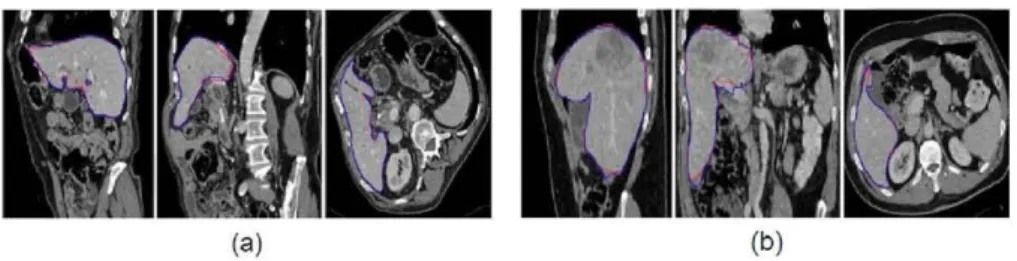
Fig. 1 shows slices from two cases, drawing t h e result of t h e m e t h o d (in blue) and t h e reference (in red). T h e quality of t h e segmentation and its scores are based on t h e five metrics [16]. Each metric was converted t o a score where 0 is t h e m i n i m u m and 100 is t h e m a x i m u m . Using this scoring system one can loosely say t h a t 75 points for a liver segmentation is comparable t o h u m a n performance.
Table 2. Average values of the metrics and scores for all ten test case: volumetric overlap error (mi), relative absolute volume difference (TO2), average symmetric sur-face distance (1713), root mean square symmetric sursur-face distance {rrn) and maximum symmetric surface distance {m¿)
T y p e
A T I [5]
Fig. 1. From left to right, a sagittal, coronal and transversal slice for an easy case (a) and a difficult one (b). The outline of the reference standard segmentation is in red, the outline of the segmentation of the method described in this paper is in blue.
Table 2 lists t h e average values of t h e metrics and their scores over t h e test d a t a set. It shows t h e performances for t h e three segmentation strategies: a) atlas matching b) probabilistic atlas with only linear registration and b) probabilistic atlas with nonrigid techniques. T h e average c o m p u t a t i o n times for t h e liver segmentation task are 203.4 s., 25.3 s. and 211.7 s. respectively ([Dual CPU] Intel Xeon E5520 @ 2.27GHz).
6 Conclusion
We have presented two main contributions. F i r s t l y t h e linear registration has been solved using an image normalization procedure applied t o t h e labeled atlas. An advantage is t h a t t h e proposed affine transformation is deñned by closed-form expressions involving only geometric m o m e n t s . No additional optimization over pose p a r a m e t e r s is necessary. This procedure has been applied b o t h t o atlas construction as atlas-based segmentation. Secondly we model t h e probabilistic a p p e a r a n c e for each voxel and each label using p a r a m e t r i c or n o n p a r a m e t r i c distributions and t h e prior t e r m is determined by applying t h e vote-rule. T h e a p p e a r a n c e a n d shape models are built with t h e variability of proposed linear registration. We adopt a graph cut - Bayesian framework for implementing t h e atlas-based segmentation. F i n a l l y we illustrate t h e benefits of our approach on t h e liver segmentation from C T images.
References
1. Cootes, T., Taylor, C , Cooper, D., Graham, J., et al.: Active shape models-their training and application. Computer Vision and Image Understanding 61, 38-59 (1995)
2. Leventon, M., Crimson, W., Faugeras, O.: Statistical shape influence in geodesic active contours. In: IEEE Computer Society Conference on Computer Vision and Pattern Recognition, vol. 1. IEEE Computer Society, Los Alamitos (1999/2000) 3. Tsai, A., Yezzi, A., Wells, W., Tempany, C , Tucker, D., Fan, A., Crimson, W.,
4. Cremers, D., Rousson, M.: Efficient kernel density estimation of shape and inten-sity priors for level set segmentation. In: Suri, J.S., Farag, A. (eds.) Parametric and Geometric Deformable Models: An application in Biomaterials and Medical Imagery. Springer, Heidelberg (2007)
5. Wang, Q., Seghers, D., D'Agostino, E., Maes, F., Vandermeulen, D., Suetens, P., Hammers, A.: Construction and validation of mean shape atlas templates for atlas-based brain image segmentation. In: Christensen, G.E., Sonka, M. (eds.) IPMI 2005. LNCS, vol. 3565, pp. 689-700. Springer, Heidelberg (2005)
6. Park, H., Bland, P., Meyer, C.: Construction of an abdominal probabilistic atlas and its application in segmentation. IEEE Transactions on Medical Imaging 22, 483-492 (2003)
7. Greig, D., Porteous, B., Seheult, A.: Exact maximum a posteriori estimation for bi-nary images. Journal of the Royal Statistical Society. Series B (Methodological) 51, 271-279 (1989)
8. Ishikawa, H.: Exact optimization for Markov random fields with convex priors. IEEE Transactions on Pattern Analysis and Machine Intelligence 25, 1333-1336 (2003)
9. Maes, F., Collignon, A., Vandermeulen, D., Marchal, G., Suetens, P.: Multimodal-ity image registration by maximization of mutual information. IEEE Transactions on Medical Imaging 16, 187-198 (2002)
10. Heikkila, J.: Pattern matching with affine moment descriptors. Pattern Recogni-tion 37, 1825-1834 (2004)
11. Pei, S., Lin, C : Image normalization for pattern recognition. Image and Vision Computing 13, 711-723 (1995)
12. Saad, A., Hamarneh, G., Moller, T.: Exploration and Visualization of Segmentation Uncertainty Using Shape and Appearance Prior Information. IEEE Transactions on Visualization and Computer Graphics 16 (2010)
13. Boykov, Y., Veksler, O., Zabih, R.: Fast approximate energy minimization via graph cuts. IEEE Transactions on Pattern Analysis and Machine Intelligence, 1222-1239 (2001)
14. Klein, S., Staring, M., Murphy, K., Viergever, M., Pluim, J.: elastix: a toolbox for intensity-based medical image registration. IEEE Transactions on Medical Imaging 29 (2010)
15. Boykov, Y., Kolmogorov, V.: An experimental comparison of min-cut/max-flow al-gorithms for energy minimization in vision. IEEE Transactions on Pattern Analysis and Machine Intelligence 26, 1124-1137 (2004)