Accepted Manuscript
ABCG5/G8 gene is associated with hypercholesterolemias without mutation in candidate genes and non-cholesterol sterols
Itziar Lamiquiz-Moneo, Lucía Baila-Rueda, Ana M. Bea, Rocío Mateo-Gallego, Sofía Pérez-Calahorra, Victoria Marco-Benedí, Antonio Martín-Navarro, Emilio Ros, Montserrat Cofán, José Carlos Rodríguez-Rey, Miguel Pocovi, Ana Cenarro, Fernando Civeira
PII: S1933-2874(17)30458-0
DOI: 10.1016/j.jacl.2017.09.005 Reference: JACL 1184
To appear in: Journal of Clinical Lipidology Received Date: 28 July 2017
Revised Date: 13 September 2017 Accepted Date: 22 September 2017
Please cite this article as: Lamiquiz-Moneo I, Baila-Rueda L, Bea AM, Mateo-Gallego R, Pérez-Calahorra S, Marco-Benedí V, Martín-Navarro A, Ros E, Cofán M, Rodríguez-Rey JC, Pocovi M, Cenarro A, Civeira F, ABCG5/G8 gene is associated with hypercholesterolemias without mutation in candidate genes and non-cholesterol sterols, Journal of Clinical Lipidology (2017), doi: 10.1016/ j.jacl.2017.09.005.
This is a PDF file of an unedited manuscript that has been accepted for publication. As a service to our customers we are providing this early version of the manuscript. The manuscript will undergo copyediting, typesetting, and review of the resulting proof before it is published in its final form. Please note that during the production process errors may be discovered which could affect the content, and all legal disclaimers that apply to the journal pertain.
M
AN
US
CR
IP
T
AC
CE
PT
ED
Full title 1ABCG5/G8 gene is associated with hypercholesterolemias without mutation in candidate 2
genes and non-cholesterol sterols
3
Short title 4
ABCG5/G8 mutations in genetic hypercholesterolemia 5
Authors 6
Itziar Lamiquiz-Moneoa, Lucía Baila-Ruedaa , Ana M. Beaa, Rocío Mateo-Gallegoa, Sofía
7
Pérez-Calahorraa, Victoria Marco-Benedía, Antonio Martín-Navarroa, Emilio Rosb,
8
Montserrat Cofánb, José Carlos Rodríguez-Reyc, Miguel Pocovid, Ana Cenarroa, Fernando
9 Civeiraa. 10 Affiliation 11 a
Unidad Clínica y de Investigación en Lípidos y Arteriosclerosis, Hospital Universitario
12
Miguel Servet, Instituto de Investigación Sanitaria Aragón (IIS Aragón), CIBERCV,
13
Universidad de Zaragoza, Zaragoza, Spain.
14
b
Unitat de Lipids, Servei d'Endocrinologia i Nutrició, Institut d'Investigacions
15
Biomediques August Pi i Sunyer, Hospital Clinic and CIBER Fisiopatologia de la
16
Obesidad y Nutrición (CIBEROBN), Instituto de Salud Carlos III (ISCIII), Barcelona,
17
Spain
18
c
Departamento de Biología Molecular, Facultad de Medicina, Universidad de Cantabria,
19
and Instituto de Investigación Valdecilla (IDIVAL), Santander, Cantabria, Spain.
20
d
Universidad de Zaragoza, Departamento de Bioquímica, Biología Molecular y Celular,
21
50009, Zaragoza, Spain
22
*Corresponding author 23
Name: Itziar Lamiquiz-Moneo
24
Address: Unidad Clínica y de Investigación en Lípidos y Arteriosclerosis, Hospital
25
Universitario Miguel Servet, Avenida Isabel La Católica 1-3, 50009, Zaragoza, Spain
26
Telephone number: (34) 976765500 (EXT 2895)
27
E-mail address: [email protected]
M
AN
US
CR
IP
T
AC
CE
PT
ED
2 Keywords 29Genetic hypercholesterolemia, ABCG5/G8, non-cholesterol sterols, cholesterol absorption 30
Abstract 31
Context
32
Approximately 20-40% of clinically-defined familial hypercholesterolemia cases do not show a
33
causative mutation in candidate genes (mutation-negative FH), and some of them may have a
34
polygenic origin.
35
Objective
36
The aim of this work was to study the prevalence of ABCG5/G8 genetic variants in
mutation-37
negative FH, as defects in these genes relate to intestinal hyperabsorption of cholesterol and
38
thus ABCG5/G8 variants could explain in part the mechanism of hypercholesterolemia.
39
Design, Setting and patients:
40
We sequenced the ABCG5/G8 genes in 214 mutation-negative FH and 97 controls. Surrogate
41
markers of cholesterol absorption (5α-cholestanol, β-sitosterol, campesterol, stigmasterol and
42
sitostanol) were quantified by high performance liquid chromatography tandem mass
43
spectrometry in both studied groups.
44
Results
45
We found 8 mutation-negative FH patients (3.73%) with a pathogenic mutation in ABCG5/G8
46
genes. We observed significantly higher concentration of surrogate markers of cholesterol
47
absorption in mutation-negative FH than in controls. In addition, we found significantly higher
48
concentrations of cholesterol absorption markers in mutation-negative FH with ABCG5/G8
49
defects than in mutation-negative, ABCG5/G8 negative FH. A gene score reflecting the number
50
of common single nucleotide variants associated with hypercholesterolemia was significantly
51
higher in cases than in controls (p=.032). Subjects with a gene score above the mean had
52
significantly higher 5α-cholestanol and stigmasterol than those with a lower gene score.
53
Conclusions
54
Mutation-negative FH subjects accumulate an excess of rare and common gene variations in
55
ABCG5/G8 genes. This variation is associated with increased intestinal absorption of 56
M
AN
US
CR
IP
T
AC
CE
PT
ED
cholesterol, as determined by surrogate makers, suggesting that these loci contribute to
57
hypercholesterolemia by enhancing intestinal cholesterol absorption.
58 Abbreviations 59 GH: genetic hypercholesterolemias 60 FH: Familial hypercholesterolemia 61 TC: Total cholesterol 62 TG: triglyceride 63
LDLc: Low density lipoprotein cholesterol
64
SNVs: single nucleotide variations
65
CHD: cardiovascular disease
66
Mutation-negative FH: Familial hypercholesterolemia without mutation in candidate genes
67
HDLc: High density lipoprotein cholesterol
68
HPLC-MS/MS: high performance liquid chromatography tandem mass spectrometry
69
BMI: Body mass index
70
Apo: Apolipoprotein
71
miRNAs: microRNAs
M
AN
US
CR
IP
T
AC
CE
PT
ED
4 Introduction 73Genetic hypercholesterolemias (GH) are a heterogeneous group of lipid disorders caused
74
by monogenic and polygenic defects and characterized by very high plasma
75
concentrations of total cholesterol (TC) due to increased low-density lipoprotein
76
cholesterol (LDL-C) and high risk of premature coronary heart disease (CHD). Familial
77
hypercholesterolemia (FH) is the most common monogenic GH [1], with autosomal
78
codominant transmission and with a current estimated prevalence of about 1:200-250 in
79
the general population [2, 3]. FH is caused by mutations in LDLR, the gene coding for the
80
LDL receptor; APOB, coding for apolipoprotein (apo) B; PCSK9 [4, 5], which codes for
81
the enzyme proprotein convertase subtilisin/kexin type 9, or APOE genes [6]. In addition,
82
a rare recessive form of FH is also caused by mutations in the LDLRAP1 gene [7].
83
However, a causative mutation in candidate genes is not found in approximately 20-40%
84
of clinically defined FH cases [8], suggesting that there are either other as yet unidentified
85
genetic causative loci or these cases represent severe polygenic hypercholesterolemia.
86
Actually, affected subjects with clinical FH but without mutations in candidate genes,
87
accumulate some common single nucleotide variations (SNVs) with a small LDL-C
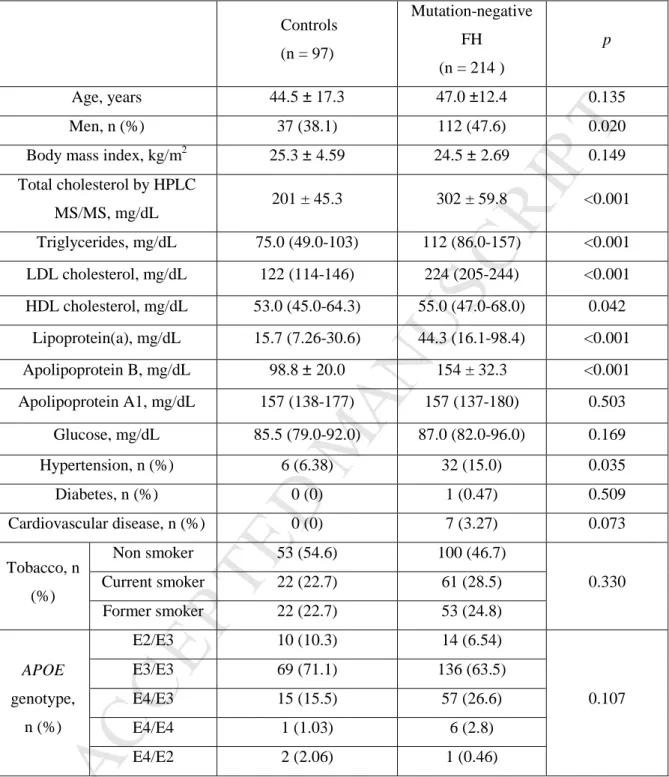
88
raising effect [9] that do not fully explain the high LDL-C phenotype of these subjects.
89
Different GWAS have shown that at least one hundred loci are associated with
90
LDL-C concentration in the population [10, 11]. One of these loci is ABCG5/G8; this
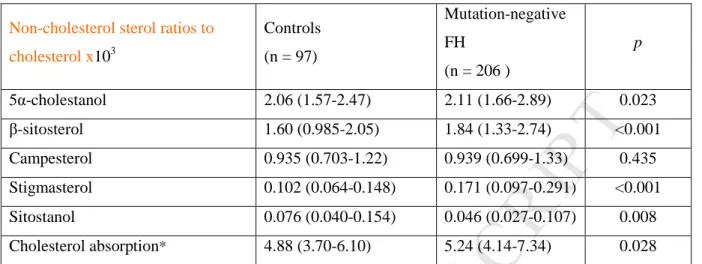
91
gene complex encodes the proteins ABCG5 and ABCG8, which form a heterodimer
92
conveyor located in the membrane of enterocytes and hepatocytes. It has been shown that
93
ABCG5/G8 limits the intestinal absorption of cholesterol and phytosterols and promotes
94
their hepatobiliary secretion. Severe functional mutations in ABCG5/G8 cause
95
sitosterolemia, a rare autosomal disorder characterized by an increase of phytosterols in
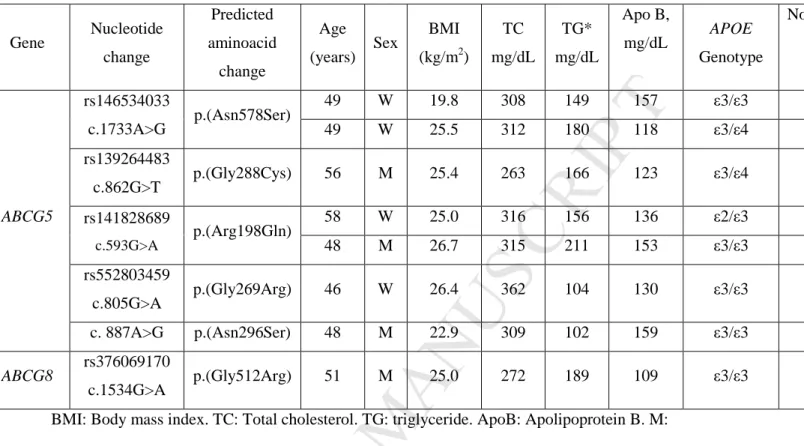
96
blood, up to 30 times greater than normal [12]. In addition, studies have shown that
97
ABCG5/G8 variation is associated with cholesterol and non-cholesterol sterol plasma 98
levels [13-17]. However, the contribution of ABCG5/G8 loci variation to
mutation-99
negative FH has not been previously examined.
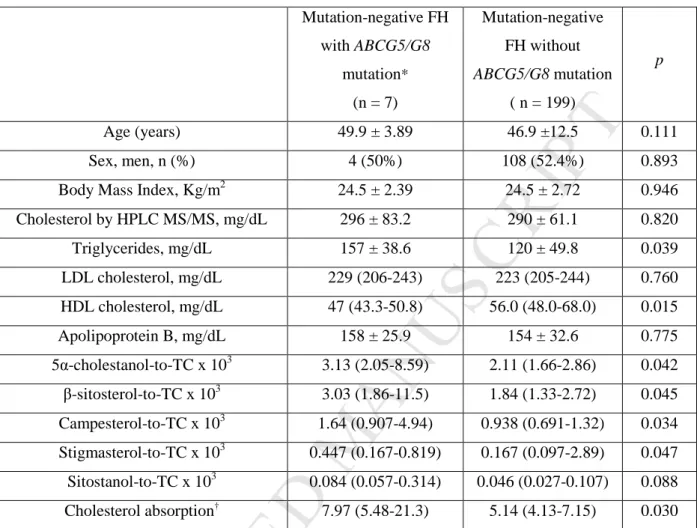
M
AN
US
CR
IP
T
AC
CE
PT
ED
Considering that mutation-negative FH subjects usually have higher
non-101
cholesterol sterol concentrations than other types of GH [18], probably due to intestinal
102
sterol hyperabsorption, we hypothesized that genetic variations in ABCG5/G8 are
103
involved in some forms of mutation-negative FH. Hence, the aim of this study was to
104
analyze common and rare mutations in ABCG5/G8 in a large cohort of mutation-negative
105
FH and assess their association with non-cholesterol sterols and LDL-C, to establish the
106
genetic contribution of these loci in this type of GH.
107
Material and Methods 108
Subjects
109
Unrelated subjects (n = 214) 18–79 years of age with a clinical diagnosis of non-FH GH:
110
LDL-C above the 95th percentile of the Spanish population [19], triglycerides (TG)
111
below 200 mg/dL, and familial presentation (at least one first-degree relative with the
112
same phenotype) from the Lipid Clinics at Hospital Universitario Miguel Servet,
113
Zaragoza and Hospital Clinic, Barcelona were selected for this study. In all subjects, the
114
absence of a pathogenic mutation in LDLR, APOB and PCSK9 genes was confirmed by
115
the Lipochip ® platform [20]. Exclusion criteria were the presence of an ε2/ε2 genotype
116
or the p.(Leu167del) mutation in the APOE gene. Exclusion criteria were secondary
117
causes of hypercholesterolemia including obesity (body mass index >30 kg/m2), poorly
118
controlled type-2 diabetes (HbA1c >8%), renal disease with glomerular filtration rate <30
119
ml/min and/or macroalbuminuria, liver diseases (ALT> 3 times upper normal limit),
120
hypothyroidism (TSH >6 mIU/L), pregnancy, autoimmune diseases and treatment with
121
protease inhibitors. Assessment of cardiovascular risk factors, personal and family history
122
of cardiovascular disease, intake of drugs affecting intestinal or lipid metabolism, and
123
anthropometric measurements were performed in all participants. The normolipemic
124
group (n= 97) consisted of healthy, unrelated men and women volunteers aged 18–79
125
years, who underwent a medical examination at the Hospital Miguel Servet of Zaragoza.
126
Exclusion criteria for control subjects were personal or parental history of premature
127
cardiovascular disease or dyslipidemia, current acute illness, or use of drugs that might
M
AN
US
CR
IP
T
AC
CE
PT
ED
6influence glucose or lipid metabolism. All subjects signed an informed consent to a
129
protocol previously approved by our local ethics committee (Comité Ético de
130
Investigación Clínica of Aragón, Zaragoza, and of Hospital Clínic, Barcelona, Spain).
131
Clinical and laboratory determinations 132
Cases and controls were assessed for personal and familial history of cardiovascular
133
disease, medication use and cardiovascular risk factors. EDTA plasma and serum samples
134
were collected after 10-12 hours of fasting in all participants after at least 6 weeks
135
without lipid-lowering drugs in subjects without prior cardiovascular disease. TG levels
136
were determined by standard enzymatic methods. High-density lipoprotein cholesterol
137
(HDL-C) was measured directly by an enzymatic reaction using cholesterol oxidase
138
(UniCel DxC 800; Beckman Coulter, Inc., Brea, CA, USA). Lipoprotein(a), apo A1, apo
139
B and C-reactive protein were determined by IMMAGE kinetic nephelometry
(Beckman-140
Coulter, Inc.). In patients with prior cardiovascular disease, baseline lipid values were
141
obtained from medical records.
142
Genetic analysis
143
Whole blood genomic DNA was isolated by using standard methods. Promoters, coding regions
144
and intron-exon boundaries of ABCG5 (NM_022436) and ABCG8 (NM_022437)were
145
amplified by PCR and purified by ExoSap-IT (USB). Amplified fragments were sequenced by
146
the Sanger method using the BigDye 3.1 sequencing kit (Applied Biosystems) in an automated
147
ABI 3500xL sequencer (Applied Biosystems). DNA sequences were analyzed using
148
VariantReporterTM software (Applied Biosystems). APOE genotypes were determined by DNA
149
sequencing of exon 4 as previously described [21].
150
To evaluate the pathogenicity of new identified genetic variants, we used PolyPhen-2 [22]
151
and Mutation Taster [23]. The effect of variants in potential splicing sites was predicted
152
with NetGene2 [24] and NNSplice [25]. We refer to non-synonymous variants as
153
sequence variations causing amino acid substitutions (missense variants) or introducing a
154
premature stop codon (nonsense variants). Intronic variants were considered when they
155
were located in intron-exon boundaries.
M
AN
US
CR
IP
T
AC
CE
PT
ED
In order to compare the frequency of identified variants in the general population
157
we have compiled the allele frequencies of the identified variants from the 1000 Genomes
158
Project [26] and ExAc Browser Data [27].
159
Mutations were defined as genetic variants with a frequency lower than 1% in the
160
general population. A mutation was defined as pathogenic when it was not present in
161
controls and bioinformatic analysis prediction defined it as “damaging” (Polyphen-2) or
162
“disease causal” (MutationTaster). Single Nucleotide Polymorphism (SNP), was defined
163
as genetic variants with a frequency higher than 1% in the general population.
164
Gene score
165
A gene score using the sum of the risk alleles of 27 genetic variants with allelic
166
frequencies statistically different between cases and controls was calculated for each
167
subject.
168
Determination of serum sterols
169
Serum concentrations of cholesterol, 5α-cholestanol, β-sitosterol, campesterol,
170
stigmasterol, sitostanol, desmosterol and lanosterol were quantify by high performance
171
liquid chromatography tandem mass spectrometry (HPLC-MS/MS) in 206 non-FH GH
172
subjects without lipid-lowering drugs and 97 controls according to the method previously
173
described [28]. In 8 subjects non-cholesterol sterols were not quantified because 7 had
174
prior CHD and one had not provided a serum sample. Data were expressed as mg/dL, as
175
well as normalized to total cholesterol. Briefly, 100 µL of serum were transferred to
176
screw-capped vials, and 6 µl of deuterium-labeled internal standard, [2H6]
cholesterol-177
26,26,26,27,27,27 (7.9 mM) for non-cholesterol sterols, and [2H7]
cholesterol-178
25,26,26,26,27,27,27 for cholesterol, were added. Alkaline hydrolysis was performed for
179
20 min at 60ºC in an ultrasound bath, followed by a double extraction with 3 µl of
180
hexane. The extract was loaded onto the solid-phase extraction cartridge (1 mg,
181
Discovery DSC-18, Supelco, Spain), which was preconditioned with 400 µl of methanol
182
and gravity eluted. The non-cholesterol sterols and cholesterol were desorbed with 1.4 µL
M
AN
US
CR
IP
T
AC
CE
PT
ED
8of 2-propanol by gravity, and 40 µL of the final mixture was injected into the
HPLC-184
MS/MS system.
185
Statistical Analyses
186
Analyses were performed using SPSS version 20.0 (Chicago, Ilinois, USA). The nominal
187
level for significance was p< 0.05. Normal distribution of variables was analyzed by the
188
Kolmogorov–Smirnov test. Quantitative variables with normal distribution were
189
expressed as mean ± standard deviation and were analyzed with Student t-test. Variables
190
with a skewed distribution were expressed as medians and interquartile ranges and were
191
analyzed with the Mann-Whitney U test. Qualitative variables were expressed as a
192
percentage and were analyzed by Chi-square test.
193 194 195 196
M
AN
US
CR
IP
T
AC
CE
PT
ED
Results 197The main clinical and biochemical characteristics of the two groups: 214 mutation-negative FH
198
patients and 97 normolipemic controls are presented in Table 1. By study design, compared to
199
normolipidemic controls, mutation-negative FH participants had significantly higher values of
200
total cholesterol, triglycerides, HDL-C, LDL-C, lipoprotein(a), and apo B, as well as a higher
201
prevalence of hypertension and cardiovascular disease. No differences in age, body mass index
202
(BMI) or APOE genotype variability were found between patients and controls.
203
Non-cholesterol sterol-to-TC ratios are presented in Table 2. 5α-cholestanol,
204
stigmasterol and sitostanol ratios were significantly higher in cases than in controls (p=.023,
205
p<.001 and p=.003, respectively). The sum of all cholesterol absorption surrogate markers and 206
phytosterols was also significantly higher in mutation-negative FH than in controls (p= .028).
207
The frequency of SNVs in ABCG5/G8 genes found in mutation-negative FH was
208
compared to the frequency in controls, in the 1000 Genomes Project and ExAc Browser Data.
209
Appendix table 1 shows the 29 SNVs identified which allelic frequencies were significantly
210
different from those identified in controls or described in the 1000 Genomes Project or in the
211
ExAc Browser Data. They include 27 SNPs and two mutations: p.(Gly269Arg) in ABCG5 and
212
p.(Gly512Arg) in ABCG8.
213
Table 3 shows the clinical characterization of patients carrying pathogenic mutations
214
identified by sequencing in ABCG5 and ABCG8. A total of eight patients out of 214 (3.73%)
215
were carriers of 6 pathogenic mutations: p.(Asn578Ser), p.(Gly288Arg), p.(Arg198Gln),
216
p.(Gly269Arg), and p.(Asn285Ser) in ABCG5 and p.(Gly512Arg) in ABCG8. One of them is
217
described for the first time in this work: p.(Asn578Ser) in ABCG5. None of these pathogenic
218
mutations were present in controls. Appendix table 2 shows bioinformatic analysis of six
219
pathogenic mutations.
220
Subjects with mutation-negative FH with pathogenic mutations in ABCG5/G8 genes
221
had significantly higher non-cholesterol sterol-to-TC ratios (5α-cholestanol, β-sitosterol,
222
campesterol, and stigmasterol) and cholesterol absorption than subjects without mutation in
223
ABCG5/G8 genes (p=.042, p=.045, p=.034, p=.047 and p=.030, respectively). TC 224
M
AN
US
CR
IP
T
AC
CE
PT
ED
10concentrations did not show significant differences between the groups (Table 4). There were no
225
differences in desmosterol and lanosterol, cholesterol synthesis markers, between both groups
226
(Supplemental Table 3). In one out of eight patients with mutation-negative FH with pathogenic
227
mutation in ABCG5/G8 genes, cholesterol absorption markers were not determined because
228
serum without lipid lowering drugs was not available.
229
Among the 27 common genetic variants with significantly different frequencies between
230
cases, 1000 Genomes Project and ExAc Browser Data, only c.*380T>G, located in the 3´ UTR
231
of ABCG5 gene was associated with statistically significant differences in non-cholesterol sterol
232
to TC ratios (5α-cholestanol, β-sitosterol, stigmasterol and campesterol) and cholesterol
233
absorption. T allele carriers had higher intestinal cholesterol absorption than subjects carrying
234
the G allele (p=.011, p=.00, p=.002, p=.022 and p=.002, respectively), but TC concentrations
235
were not significantly different between genotypes (Table 5).
236
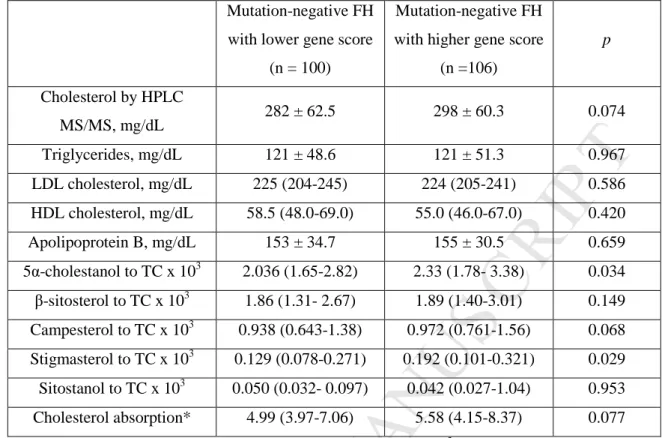
A gene score reflecting the total number of risk alleles at the 27 SNVs associated with
237
hypercholesterolemia was significantly higher in cases than controls (p=.032). Subjects with
238
scores above the mean (>33 points) had significantly higher non-cholesterol sterol to TC ratios
239
(5α-cholestanol and stigmasterol) than subjects with the lowest score (p=.034 and p=.029,
240
respectively). Cholesterol absorption was non-significantly higher in subjects with the highest
241
score compared to those with the lowest score (p=.077) (Table 6).
242 243
M
AN
US
CR
IP
T
AC
CE
PT
ED
Discussion 244This study shows that ABCG5/G8 gene variation would play a role in the pathogenesis of
245
genetic hypercholesterolemia unrelated to LDLR, APOB, PCSK9 and APOE genes. As
246
previously reported [29], subjects with GH unrelated to common genetic defects disclose higher
247
surrogate markers of intestinal cholesterol absorption than controls. There are, however, three
248
novel findings that can be highlighted from this work.
249
First, ABCG5/G8 genetic variation contributes to GH through rare pathogenic mutations
250
with large effects and with common variants with small effects. Patients with rare ABCG5/G8
251
pathogenic mutations disclose approximately twice the serum concentrations of surrogate
252
markers of intestinal cholesterol absorption than those not carrying mutations. However, the
253
percentage of common mutation-negative FH subjects carrying these rare pathogenic
254
ABCG5/G8 mutations is low, approximately 4%. We did not find any pathogenic mutation in 255
the control group; hence we could consider that these major defects are involved in the high
256
LDL-C phenotype in these patients. However, we must take into account that there could be
257
other SNVs in other genes, which could explain part of the phenotype of these subjects, and the
258
number of normolipemic controls in not high enough to exclude completely their presence in
259
the normolipemic population. We found 8 patients carrying six pathogenic mutations. Five
260
mutations were in ABCG5 and one mutation was in ABCG8. The mutations p.(Arg198Gln),
261
p.(Gly269Arg), p.(Asn296Ser) and p.(Gly288Arg) in ABCG5 are located in the cytosolic
N-262
terminal region, prior to the first transmembrane domain. In this N-terminal region of ABCG5,
263
one mutation causing sitosterolaemia has been previously described [30]. The mutation
264
p.(Asn578Ser) in ABCG5 is located in the extracellular domain, and this position seems to
265
interact with the amino acid Arg419. The mutations p.(Arg419Pro) and p.(Arg419His) at the
266
same residue have been shown to cause sitosterolaemia. The mutation p.(Gly512Arg) in ABCG8
267
is located in the transmembrane α-helix domain; a close mutation in this domain,
268
p.(Leu501Pro), also causes sitosterolaemia [31].
269
Second, our results show that mutation-negative FH subjects accumulate risk alleles of
270
ABCG5/G8 with small effects on non-cholesterol sterols, suggesting that, in most of these GH 271
M
AN
US
CR
IP
T
AC
CE
PT
ED
12cases, the contribution of ABCG5/G8 genetic variation has a limited effect within a polygenic
272
background, as occurs in other genetic dyslipidemias [32]. Among common SNVs frequently
273
found in mutation-negative FH, only one SNVs in 3´UTR showed significant variations in
non-274
cholesterol sterols by itself. Variants in 3´UTR have been previously involved in the
275
pathogenesis of some mutation-negative FH. An important mechanism of post-transcriptional
276
regulation linked to the 3´UTR implicates the binding of microRNAs (miRNAs), small
non-277
protein coding RNAs that regulate gene expression at the post-transcriptional level. [33]. The
278
frequency of the c.*380T>G variant in ABCG5, located in 3´UTR, is significantly lower in
279
mutation-negative FH than in controls, and T allele carriers had higher intestinal cholesterol
280
absorption than subjects carrying the G allele. The c.*380T>G variant has been previously
281
associated with sitosterolaemia [34]. The mir-494 is a miRNA, which has been previously
282
associated with this variant [35]. Bioinformatic analysis of this variant showed that T allele
283
carriers disclose mir-494, which is not present in G allele carries. For this reason, we propose
284
that mir-494 could regulate the absorption of non-cholesterol sterols and could explain in part
285
the pathogenesis of the hypercholesterolemia in these subjects.
286
Finally, our study supports the multifactorial origin of most mutation-negative FH, in
287
whom intestinal hyperabsorption of sterols plays a minor role that does not fully explain the
288
etiology of these hypercholesterolemias, and with different contributions among subjects
289
depending on the number of risk alleles they carry. Those subjects that accumulate many risk
290
alleles of ABCG5/G8 show a clearer hyperabsorption mechanism that could explain some of the
291
LDL-C variation. We have recently analyzed a group of mutation-negative FH families with
292
hyperabsorption in the proband. The cosegregation analysis showed a substantial contribution of
293
hyperabsorption on the LDL-C concentration, although with high variation among the families
294
[29].
295
An interesting issue is the potential relationship between ABCG5/G8 gene variation and
296
CHD risk. The C allele of the c.1199C>A, p.(Thr400Lys) variant in ABCG8 has been
297
previously associated with CHD [36]. In our study, the frequency of this risk allele variant was
298
significantly higher in mutation-negative FH subjects than in the 1000 Genomes Project,
M
AN
US
CR
IP
T
AC
CE
PT
ED
suggesting that the association with CHD previously reported could be mediated by its effect on
300
LDL-C. However, the association of plasma phytosterols with CHD has not been clearly
301
established [37]. Actually, none of 8 subjects with severe pathogenic mutations in ABCG5/G8 in
302
our study had CHD. Further studies are required to establish the potential association of
303
ABCG5/G8 variation and atherosclerosis. 304
Our study has limitations: We have not performed functional studies of the ABCG5/ABCG8
305
variants detected, but due to their large number their analysis would require a different
306
approach. We have analyzed surrogate markers for intestinal cholesterol absorption; although
307
very well validated; they have some limitations, and may be influenced by diet, sex, age, BMI,
308
and APOE genotype. However, the differences in non-cholesterol sterols between
mutation-309
negative FH subjects and controls and between patients with and without pathogenic
310
ABCG5/G8 mutations were not modified by any of these confounding factors. Subjects with 311
hyperabsorption-associated ABCG5/G8 mutations had no higher LDL cholesterol
312
concentrations than the other hypercholesterolemic subjects of genetic cause. Our interpretation
313
is that hypercholesterolemias with hyperabsorption do not present a more severe phenotype than
314
those other genetic forms not associated with this mechanism and by the moment of unknown
315
origin.
316
In conclusion, the sequencing analysis of a large group of subjects with genetic
317
hypercholesterolemia and no pathogenic mutation in LDLR, APOB, PCSK9 or APOE genes,
318
shows that they accumulate an excess of rare and common gene variations in ABCG5/G8 genes.
319
This variation is associated with surrogate markers of increased intestinal cholesterol
320
absorption, suggesting that these loci contribute to their hypercholesterolemia by raising
321
intestinal cholesterol absorption.
322
Financial support 323
This study was supported by grants from the Spanish Ministry of Economy and
324
Competitiveness PI15/01983, PI13/02507, PI12/01321, CIBERCV, CIBEROBN and Cuenca
325
Villoro Fundation. These projects are co-financed by Instituto de Salud Carlos III and the
M
AN
US
CR
IP
T
AC
CE
PT
ED
14European Regional Development Fund (ERDF) of the European Union "A way to make
327
Europe".
328
Disclosure summary 329
I certify that neither I nor my co-authors have a conflict of interest as described above that is
330
relevant to the subject matter or materials included in this work.
331
Author contributions 332
ILM performed the experiments and contributed to the writing of the manuscript. FC
333
contributed substantially to the conception and design and to the writing of the
334
manuscript; all authors participated in acquisition, analysis and interpretation of the data,
335
in the drafting of the article or critical revision and in final approval of the version to be
336
published.
337
Acknowledgments 338
Genetic analyses were performed in the Sequencing and Functional Genomics Facility of
339
Servicios Científico Técnicos of CIBA (IACS-Universidad de Zaragoza), Zaragoza,
340
Spain. CIBERCV and CIBEROBN are initiatives of Instituto de Salud Carlos III, Spain.
341 342 343 344 References 345
1. Goldstein JK, Hobbs HH, Brown MS. Familial hypercholesterolemia. In: Scriver CR,
346
Beaudet AL, Sly WS, Valle D (eds). The Metabolic & Molecular Bases of Inherited
347
Disease. 8th ed. New York: McGraw-Hill; 2001. p. 2863–2913. 348
2. De Ferranti SD, Rodday AM, Mendelson MM, Wong JB, Leslie LK, Sheldrick RC. 349
Prevalence of Familial Hypercholesterolemia in the 1999 to 2012 United States
350
National Health and Nutrition Examination Surveys (NHANES). Circulation.
351
2016;133:1067-72.
M
AN
US
CR
IP
T
AC
CE
PT
ED
3. Akioyamen LE , Genest J, Shan SD, Reel RL, Albaum JM, Chu A et al. Estimating the
353
prevalence of heterozygous familial hypercholesterolaemia: a systematic review and
354
meta-analysis.BMJ Open. 2017; 1:7-9. 355
4. Civeira F. International Panel on Management of Familial Hypercholesterolemia.
356
Guidelines for the diagnosis and management of heterozygous familial
357
hypercholesterolemia. Atherosclerosis. 2004; 173:55-68.
358
5. Futema M, Plagnol V, Li K, Whittall RA, Neil HA, Seed M, Simon Broome
359
Consortium, Bertolini S, Calandra S, Descamps OS, Graham CA, Hegele RA, Karpe F,
360
Durst R, Leitersdorf E, Lench N, Nair DR, Soran H, Van Bockxmeer FM1; UK10K
361
Consortium, Humphries SE. Whole exome sequencing of familial
362
hypercholesterolaemia patients negative for LDLR/APOB/PCSK9 mutations. J Med
363
Genet. 2014;515:37-44. 364
6. Cenarro A, Etxebarria A, de Castro-Orós I, Stef M, Bea AM Palacios L, Mateo-Gallego
365
R, Benito-Vicente A, Ostolaza H, Tejedor T, Martín C, Civeira F. The p.Leu167del
366
mutation in APOE gene causes Autosomal Dominant Hypercholesterolemia by
down-367
regulation of LDL receptor expression in hepatocytes. J Clin Endocrinol Metab. 2016;
368
101:2113-21.
369
7. Ciccarese MA, Pacifico G, Tonolo G, Pintus P, Nikoshkov A, Zuliani G, Fellin R,
370
Luthman H and Maioli M. A new locus for autosomal recessive hypercholesterolemia
371
maps to human chromosome 15q25-q26. Am J Hum Genet. 2000; 66:453-460.
372
8. Palacios L, Grandoso L, Cuevas N, Olano-Martín E, Martinez A, Tejedor D, Stef M.
373
Molecular characterization of familial hypercholesterolemia in Spain. Atherosclerosis.
374
2012;221:137-42.
375
9. Talmud PJ, Shah S, Whittall R, Futema M, Howard P, Cooper JA, Harrison SC,
376
Li K, Drenos F, Karpe F, Neil HA, Descamps OS, Langenberg C, Lench N,
377
Kivimaki M, Whittaker J, Hingorani AD, Kumari M, Humphries SE. Use of
low-378
density lipoprotein cholesterol gene score to distinguish patients with polygenic
M
AN
US
CR
IP
T
AC
CE
PT
ED
16and monogenic familial hypercholesterolemia: a case-control study. Lancet.
380
2013; 381:1293-301.
381
10. Teslovich TM, Musunuru K, Smith AV, Edmondson AC, Stylianou IM Koseki M et al.
382
Biological, clinical and population relevance of 95 loci for blood lipids. Nature 2010;
383
466:707–13.
384
11. Willer CJ, Schmidt EM, Sengupta S, Peloso GM, Gustafsson S Kanoni S et al.
385
Discovery and refinement of loci associated with lipid levels. Nat Genet. 2013; 45:1-24.
386
12. Yu , L. , J. Li-Hawkins , R. E. Hammer , K. E. Berge , J. D. Horton , J. C. Cohen , and
387
H. H. Hobbs. Overexpression of ABCG5 and ABCG8 promotes biliary cholesterol
388
secretion and reduces fractional absorption of dietary cholesterol. J. Clin. Invest. 2002;
389
110:671–80 .
390
13. Lily Jakulj , 1, Maud N. Vissers , Michael W. T. Tanck , Barbara A. Hutten , Frans
391
Stellaard , John J. P. Kastelein , Geesje M. Dallinga-Thie. ABCG5/G8 polymorphisms
392
and markers of cholesterol metabolism: systematic review and meta-analysis. J Lipid
393
Res. 2010;51:3016-26. 394
14. Berge , K. E., K. von Bergmann, D. Lutjohann, R. Guerra, S. M. Grundy, H. H. Hobbs,
395
and J. C. Cohen. Heritability of plasma non-cholesterol sterols and relationship to DNA
396
sequence polymorphism in ABCG5 and ABCG8. J. Lipid Res 2002; 43: 486–94.
397
15. Hubacek , J. A. , K. E. Berge , J. Stefkova , J. Pitha , Z. Skodova , V. Lanska , and R.
398
Poledne. Polymorphisms in ABCG5 and ABCG8 transporters and plasma cholesterol
399
levels. Physiol. Res. 2004;53:395–401.
400
16. Weggemans RM, Zock PL, Tai ES, Ordovas JM, Molhuizen HO, Katan MB. ATP
401
binding cassette G5 C1950G polymorphism may affect blood cholesterol concentrations
402
in humans. Clin. Genet. 2002;62:226–229.
403
17. Chen ZC, Shin SJ, Kuo KK, Lin KD, Yu ML, Hsiao PJ. Significant association of
404
ABCG8:D19H gene polymorphism with hypercholesterolemia and insulin resistance. J.
405
Hum. Genet. 2008;53:757–63. 406
M
AN
US
CR
IP
T
AC
CE
PT
ED
18. Civeira F, Ros E, Jarauta E, Plana N, Zambon D, Puzo J et al. Comparison of genetic
407
versus clinical diagnosis in familial hypercholesterolemia. Am J Cardiol.
408
2008;102(9):1187-93.
409
19. Wu G, Li GB, Yao M, Zhang DQ, Dai B, Ju CJ, Han M. ABCG5/8 variants are associated 410
with susceptibility to coronary heart disease. Mol Med Rep. 2014;6:2512-20. 411
20. Stef MA, Palacios L, Olano-Martín E, Foe-A-Man C, van de Kerkhof L, Klaaijsen LN,
412
Molano A, Schuurman EJ, Tejedor D, Defesche JC. A DNA microarray for the
413
detection of point mutations and copy number variation causing familial
414
hypercholesterolemia in Europe. J Mol Diagn. 2013;15:362-72.
415
21. Solanas-Barca M, De Castro-orós I, Mateo-Gallego R, Cofán M, Plana N Puzo J
416
et al. Apolipoprotein E gene mutations in subjects with mixed hyperlipidemia and
417
a clinical diagnosis of familial combined hyperlipidemia. Atherosclerosis. 2012;
418
222::449-55.
419
22. Adzhubei IA, Schmidt S, Peshkin L, Ramensky VE, Gerasimova A, Bork P et al. A
420
method and server for predicting damaging missense mutations. Nat Methods.
421
2010;7:248–49.
422
23. Schwarz JM, Rödelsperger C, Schuelke M, Seelow D. MutationTaster evaluates
423
disease-causing potential of sequence alterations. Nat Methods. 2010;7:575-6.
424
24. Brunak S, Engelbrecht J, Knudsen S. Prediction of human mRNA donor and acceptor
425
sites from the DNA sequence. J Mol Biol. 1991;220:49–65.
426
25. Reese MG, Eeckman FH, Kulp D, Haussler D. Improved splice site detection inGenie. J
427
Comput Biol. 1997;4:311–23. 428
26. 1000 Genomes Project Consortium, Abecasis GR, Auton A, Brooks LD, DePristo MA,
429
Durbin RM. An integrated map of genetic variation from 1,092 human genomes.
430
Nature. 2012;491:56–65. 431
27. Monkol Lek, Konrad J. Karczewski, Eric V. Minikel, Kaitlin E. Samocha, Eric Banks,
432
Timothy Fennell et al. Analysis of protein-coding genetic variation in 60,706 humans.
433
Nature. 2016; 536: 285–291.
M
AN
US
CR
IP
T
AC
CE
PT
ED
1828. Baila-Rueda L, Cenarro A, Cof_an M, et al. Simultaneous determination of oxysterols,
435
phytosterols and cholesterol precursors by high performance liquid chromatography
436
tandem mass spectrometry in human serum. Analytical Methods. 2013;5:2249–2257.
437
29. Baila-Rueda L, Cenarro A, Lamiquiz-Moneo I, Mateo-Gallego R, Bea AM,
Perez-438
Calahorra S, Marco-Benedí V, Civeira F. Bile acid synthesis precursors in subjects with
439
genetic hypercholesterolemia negative for LDLR/APOB/PCSK9/APOE mutations.
440
Association with lipids and carotid atherosclerosis. J Steroid Biochem Mol Biol. 441
2016;16:30263-71.
442
30. Hubacek JA, Berge KE, Cohen JC, Hobbs HH. Mutations in ATP-cassette binding
443
proteins G5 (ABCG5) and G8 (ABCG8) causing sitosterolemia. Hum Mutat.
444
2001;4:359-60.
445
31. Jyh-Yeuan Lee, Lisa N. Kinch, Dominika M. Borek, Jin Wang, Junmei Wang, Ina L.
446
Urbatsch, Xiao-Song Xie, Nikolai. Grishin, Jonathan C. Cohen, Zbyszek Otwinowski,
447
Helen H. Hobbs, and Daniel M. Rosenbaum. Crystal structure of the human sterol
448
transporter ABCG5/ABCG8. Nature. 2016;533:561–64.
449
32. De Castro-Orós I, Cenarro A, Tejedor MT, Baila-Rueda L, Mateo-Gallego R,
450
Lamiquiz-Moneo I, Pocoví M, Civeira F. Common genetic variants contribute to
451
primary hypertriglyceridemia without differences between familial combined
452
hyperlipidemia and isolated hypertriglyceridemia. Circ Cardiovasc Genet.
2014;7:814-453
21.
454
33. Perez-Campo F; De Castro-Orós I; Noriega A; Cofán M; Lamiquiz-Moneo I; Cenarro
455
A; Ros E; Civeira F; Pocoví M; Rodríguez-Rey JC. Functional analysis of new 3´UTR
456
genetic variants in genes associated with hypercholesterolemias. J Clin Lipidol. 2017
457
[In press].
458
34. NCBI ClinVar. https://www.ncbi.nlm.nih.gov/clinvar/variation/336031/
459
35. PolymiRTS Database 3.0. http://compbio.uthsc.edu/miRSNP/miRSNP_detail_all.php
460
36. Wu G, Li GB, Yao M, Zhang DQ, Dai B, Ju CJ, Han M. ABCG5/8 variants are
461
associated with susceptibility to coronary heart disease. Mol Med Rep. 2014;6:2512-20.
M
AN
US
CR
IP
T
AC
CE
PT
ED
37. Jeemon P, Pettigrew K, Sainsbury C, Prabhakaran D, Padmanabhan S. Implications of
463
discoveries from genome-wide association studies in current cardiovascular practice.
464
World J Cardiol. 2011;3:230-47. 465
M
AN
US
CR
IP
T
AC
CE
PT
ED
1Table 1. Clinical and biochemical characteristics of controls and mutation-negative FH.
Quantitative variables are expressed as means ± standard deviations, except for variables not following normal distribution that are expressed as medians (interquartile ranges). Qualitative variables were expressed as %. The p value was calculated by Student's t test or Mann-Whitney U and Chi-square, as appropriate.
HPLC-MS/MS: high performance liquid chromatography tandem mass spectrometry.
Controls (n = 97) Mutation-negative FH (n = 214 ) p Age, years 44.5 ± 17.3 47.0 ±12.4 0.135 Men, n (%) 37 (38.1) 112 (47.6) 0.020
Body mass index, kg/m2 25.3 ± 4.59 24.5 ± 2.69 0.149
Total cholesterol by HPLC MS/MS, mg/dL 201 ± 45.3 302 ± 59.8 <0.001 Triglycerides, mg/dL 75.0 (49.0-103) 112 (86.0-157) <0.001 LDL cholesterol, mg/dL 122 (114-146) 224 (205-244) <0.001 HDL cholesterol, mg/dL 53.0 (45.0-64.3) 55.0 (47.0-68.0) 0.042 Lipoprotein(a), mg/dL 15.7 (7.26-30.6) 44.3 (16.1-98.4) <0.001 Apolipoprotein B, mg/dL 98.8 ± 20.0 154 ± 32.3 <0.001 Apolipoprotein A1, mg/dL 157 (138-177) 157 (137-180) 0.503 Glucose, mg/dL 85.5 (79.0-92.0) 87.0 (82.0-96.0) 0.169 Hypertension, n (%) 6 (6.38) 32 (15.0) 0.035 Diabetes, n (%) 0 (0) 1 (0.47) 0.509 Cardiovascular disease, n (%) 0 (0) 7 (3.27) 0.073 Tobacco, n (%) Non smoker 53 (54.6) 100 (46.7) 0.330 Current smoker 22 (22.7) 61 (28.5) Former smoker 22 (22.7) 53 (24.8) APOE genotype, n (%) E2/E3 10 (10.3) 14 (6.54) 0.107 E3/E3 69 (71.1) 136 (63.5) E4/E3 15 (15.5) 57 (26.6) E4/E4 1 (1.03) 6 (2.8) E4/E2 2 (2.06) 1 (0.46)
M
AN
US
CR
IP
T
AC
CE
PT
ED
Table 2. Non-cholesterol sterols in controls and mutation-negative FH.
Non-cholesterol sterol ratios to cholesterol x103 Controls (n = 97) Mutation-negative FH (n = 206 ) p 5α-cholestanol 2.06 (1.57-2.47) 2.11 (1.66-2.89) 0.023 β-sitosterol 1.60 (0.985-2.05) 1.84 (1.33-2.74) <0.001 Campesterol 0.935 (0.703-1.22) 0.939 (0.699-1.33) 0.435 Stigmasterol 0.102 (0.064-0.148) 0.171 (0.097-0.291) <0.001 Sitostanol 0.076 (0.040-0.154) 0.046 (0.027-0.107) 0.008 Cholesterol absorption* 4.88 (3.70-6.10) 5.24 (4.14-7.34) 0.028
*Cholesterol absorption denotes the sum of sterol ratios to cholesterol x103 of 5α-cholestanol, β-sitosterol, campesterol, stigmasterol and sitostanol
Quantitative variables with not following normal distribution were expressed as median (interquartile range). The p value was calculated by Mann-Whitney U.
M
AN
US
CR
IP
T
AC
CE
PT
ED
3Table 3. Clinical characteristics of patients carrying pathogenic mutations in ABCG5/G8 genes.
BMI: Body mass index. TC: Total cholesterol. TG: triglyceride. ApoB: Apolipoprotein B. M: Men. W: Woman
Quantitative variables are expressed as means, except for variables not following normal distribution that are expressed as medians*.
Gene Nucleotide change Predicted aminoacid change Age (years) Sex BMI (kg/m2) TC mg/dL TG* mg/dL Apo B, mg/dL APOE Genotype Non quantified ABCG5 rs146534033 c.1733A>G p.(Asn578Ser) 49 W 19.8 308 149 157 ε3/ε3 49 W 25.5 312 180 118 ε3/ε4 rs139264483 c.862G>T p.(Gly288Cys) 56 M 25.4 263 166 123 ε3/ε4 rs141828689 c.593G>A p.(Arg198Gln) 58 W 25.0 316 156 136 ε2/ε3 48 M 26.7 315 211 153 ε3/ε3 rs552803459 c.805G>A p.(Gly269Arg) 46 W 26.4 362 104 130 ε3/ε3 c. 887A>G p.(Asn296Ser) 48 M 22.9 309 102 159 ε3/ε3 ABCG8 rs376069170 c.1534G>A p.(Gly512Arg) 51 M 25.0 272 189 109 ε3/ε3
M
AN
US
CR
IP
T
AC
CE
PT
ED
Table 4. Lipids and non-cholesterol sterols in mutation-negative FH subjects with mutation in
ABCG5/G8 genes and in mutation-negative FH without mutations in ABCG5/G8 genes.
Mutation-negative FH with ABCG5/G8 mutation* (n = 7) Mutation-negative FH without ABCG5/G8 mutation ( n = 199) p Age (years) 49.9 ± 3.89 46.9 ±12.5 0.111 Sex, men, n (%) 4 (50%) 108 (52.4%) 0.893
Body Mass Index, Kg/m2 24.5 ± 2.39 24.5 ± 2.72 0.946
Cholesterol by HPLC MS/MS, mg/dL 296 ± 83.2 290 ± 61.1 0.820 Triglycerides, mg/dL 157 ± 38.6 120 ± 49.8 0.039 LDL cholesterol, mg/dL 229 (206-243) 223 (205-244) 0.760 HDL cholesterol, mg/dL 47 (43.3-50.8) 56.0 (48.0-68.0) 0.015 Apolipoprotein B, mg/dL 158 ± 25.9 154 ± 32.6 0.775 5α-cholestanol-to-TC x 103 3.13 (2.05-8.59) 2.11 (1.66-2.86) 0.042 β-sitosterol-to-TC x 103 3.03 (1.86-11.5) 1.84 (1.33-2.72) 0.045 Campesterol-to-TC x 103 1.64 (0.907-4.94) 0.938 (0.691-1.32) 0.034 Stigmasterol-to-TC x 103 0.447 (0.167-0.819) 0.167 (0.097-2.89) 0.047 Sitostanol-to-TC x 103 0.084 (0.057-0.314) 0.046 (0.027-0.107) 0.088 Cholesterol absorption† 7.97 (5.48-21.3) 5.14 (4.13-7.15) 0.030
*Referred to patients described in detail in Table 3.
†Cholesterol absorption denotes the sum ratios to cholesterol x103
of 5α-cholestanol, β-sitosterol, campesterol, stigmasterol and sitostanol
Quantitative variables are expressed as mean ± standard deviation, except for variables not following normal distribution that are expressed as median (interquartile range). The p value was calculated by Student's t test or Mann-Whitney U, as appropriate.
M
AN
US
CR
IP
T
AC
CE
PT
ED
5Table 5.Non-cholesterol sterols in mutation-negative FH subjects with the rs2278356 variant and in mutation-negative FH without the rs2278356 variant. .
rs2278356 c.*380T>G Mutation-negative FH with variant c.*380T>G (n=97) Mutation-negative FH without variant c.*380T>G (n=109) p Cholesterol by HPLC MS/MS, mg/dL 292 ± 62.8 290 ± 61.1 0.838 Triglycerides, mg/dL 118 ± 46.8 124 ± 52.8 0.317 LDL cholesterol, mg/dL 218 (205-239) 230 (206-250) 0.021 HDL cholesterol, mg/dL 56.0 (48.5-67.0) 55.0 (46.0-68.0) 0.459 Apolipoprotein B, mg/dL 151 ± 33.6 157 ± 31.3 0.176 5α-cholestanol to TC x 103 2.07 (1.69-2.82) 2.37 (1.68-3.41) 0.011 β-sitosterol to TC x 103 1.68 (1.26-2.40) 2.28 (1.42-3.40) 0.001 Campesterol to TC x 103 0.831 (0.642-1.31) 1.16 (0.757-1.64) 0.002 Stigmasterol to TC x 103 0.142 (0.082-0.278) 0.179 (0.097- 0.329) 0.022 Sitostanol to TC x 103 0.043 (0.025-0.088) 0.052 (0.027-0.116) 0.420 Cholesterol absorption† 4.66 (4.03-6.44) 6.12 (4.34-8.32) 0.002
†Cholesterol absorption denotes the sum ratios to cholesterol x103
of 5α-cholestanol, β-sitosterol, campesterol, stigmasterol and sitostanol
Quantitative variables are expressed as mean ± standard deviation, except for variables not following normal distribution that were expressed as median (interquartile range). ln(5α-cholestanol to TC x 103), ln(β-sitosterol to TC x 103), ln(campesterol to TC x 103),
ln(stigmasterol to TC x 103), ln(sitostanol to TC x 103) and ln(cholesterol absorption) were used to calculate p for trend adjusted by confusing factors: body mass index, sex and age.
M
AN
US
CR
IP
T
AC
CE
PT
ED
Table 6. Non-cholesterol sterols in mutation-negative FH according to SNV gene score. Mutation-negative FH
with lower gene score (n = 100)
Mutation-negative FH with higher gene score
(n =106) p Cholesterol by HPLC MS/MS, mg/dL 282 ± 62.5 298 ± 60.3 0.074 Triglycerides, mg/dL 121 ± 48.6 121 ± 51.3 0.967 LDL cholesterol, mg/dL 225 (204-245) 224 (205-241) 0.586 HDL cholesterol, mg/dL 58.5 (48.0-69.0) 55.0 (46.0-67.0) 0.420 Apolipoprotein B, mg/dL 153 ± 34.7 155 ± 30.5 0.659 5α-cholestanol to TC x 103 2.036 (1.65-2.82) 2.33 (1.78- 3.38) 0.034 β-sitosterol to TC x 103 1.86 (1.31- 2.67) 1.89 (1.40-3.01) 0.149 Campesterol to TC x 103 0.938 (0.643-1.38) 0.972 (0.761-1.56) 0.068 Stigmasterol to TC x 103 0.129 (0.078-0.271) 0.192 (0.101-0.321) 0.029 Sitostanol to TC x 103 0.050 (0.032- 0.097) 0.042 (0.027-1.04) 0.953 Cholesterol absorption* 4.99 (3.97-7.06) 5.58 (4.15-8.37) 0.077
*Cholesterol absorption denotes the sum ratios to cholesterol x103 of 5α-cholestanol, β-sitosterol, campesterol, stigmasterol and sitostanol.
Quantitative variables not following normal distribution were expressed as median (interquartile range). ln(5α-cholestanol to TC x 103), ln(β-sitosterol to TC x 103), ln(campesterol to TC x 103), ln(stigmasterol to TC x 103), ln(sitostanol to TC x 103) and ln(cholesterol absorption) were used to calculate p for trend adjusted by confusing factors: body mass index, sex and age.
M
AN
US
CR
IP
T
AC
CE
PT
ED
• Phytosterols as markers of intestinal cholesterol absorption are elevated in FH-
• The present study demonstrates an increase in ABCG5/G8 mutations in FH- • Subjects with mutations in ABCG5/G8 have increased plasma phytosterols
M
AN
US
CR
IP
T
AC
CE
PT
ED
Supplemental Table 1. Allele frequencies of genetic variants with allelic frequencies significantly different in mutation-negative FH from those identified in controls or described in the 1000 Genomes Project.
Gene Nucleotide change Predicted aminoacid change Bioinformatic Analysis Frequency in mutation-negative FH Frequency in controls p 1 Frequency in the 1000 Genomes population P2 Frequency in ExAc P 3 ABCG5 rs6756629 c.148C>T p.(Arg50Cys) Damaging 0.047 0.067 0.243 0.076 0.0457 0.066 0.1094 rs9789463 c.502-395T>G - Benign 0.210 0.242 0.378 0.347 <0.001 0.224 0.665 rs4549146
c.339A>G p.(Val113Val) Benign 0.276 0.351 0.062 0.422 <0.001 0.4319 <0.001
rs4557032
c.502-192C>T - Benign 0.259 0.273 0.717 0.344 0.0017 - -
rs114938914
c.502-256G>A - Benign 0.040 0.062 0.225 0.077 0.0099 0.1416 0.007
rs552803459
c.805G>A p.(Gly269Arg) Damaging 0.005 0.000 0.339 0.000 0.0296 <0.001 <0.001
rs4148187
c.1324+164C>T - Benign 0.264 0.253 0.761 0.334 0.0093 - -
rs200839584
c.1570G>A p.(Val524Ile) Benign 0.005 0.000 0.339 0.000 0.0296 <0.001 <0.001
rs150002815
c.1320T>A p.(Asn440Lys) Benign 0.012 0.000 0.129 0.000 0.0006 <0.001 <0.001
rs2278356
c.*380 T>G - Benign 0.270 0.340 0.1183 0.320 0.0339 - -
rs2278357
M
AN
US
CR
IP
T
AC
CE
PT
ED
ABCG8 rs3806471 c.-19T>A - Benign 0.237 0.227 0.7791 0.297 0.0204 0.417 <0.001 rs72647315 c.-15A>C - Benign 0.050 0.050 0.9390 0.000 0.0296 0.000 <0.001 rs11887534c.55G>A p.(Asp19Asn) Benign 0.042 0.096 0.0082 0.080 0.0107 0.077 0.007
rs4148209
c.64-21C>A - Benign 0.291 0.273 0.6476 0.371 0.0038 0.388 <0.001
rs4148210
c.64-7C>T - Benign 0.275 0.278 0.9243 0.372 <0.001 0.386 <0.001
rs4148211
c.161A>G p.(Tyr54Cys) Benign 0.279 0.273 0.8741 0.371 <0.001 0.387 <0.001
rs4148213 c.165+105G>C - Benign 0.296 0.278 0.6576 0.372 0.0058 - - rs4148214 c.561+43T>C - Benign 0.322 0.412 0.0280 0.461 <0.001 0.561 <0.001 rs114197606 c.964+178G>A - Benign 0.002 0.000 0.4494 0.032 0.0057 - - rs376069170 c.1534G>A p.(Gly512Arg) Probably damaging 0.002 0.000 0.4494 0.000 0.0025 0.000 <0.001 rs4148217
c.1199C>A p.(Thr400Lys) Benign 0.033 0.000 0.0105 0.201 <0.001 0.2146 <0.001
rs4245794 c.1212-77T>C - Benign 0.068 0.093 0.2811 0.107 0.0209 - - rs34198326 c.1411+104A>G - Benign 0.052 0.124 0.0015 0.090 0.0128 - - rs371711306 c.1845G>C p.(Met615Ile) Benign 0.050 0.000 0.3403 0.000 0.030 0.000 <0.001 rs55741639 c.965-58A>G - Benign 0.023 0.000 0.0314 0.016 0.2072 - - rs4953027 c.1412-152A>G - Benign 0.289 0.117 <0.001 0.247 0.0956 - -
M
AN
US
CR
IP
T
AC
CE
PT
ED
rs10709506 c.1411+90delA - Benign 0.132 0.240 0.0009 0.153 0.3054 - - rs28517482 c.1412-8C>T - Benign 0.343 0.196 0.0002 0.397 0.0548 0.599 <0.001The p value was calculated by Chi-square test, by comparing mutant versus wild-type allelic frequencies between mutation-negative FH and controls (p1),
between mutation-negative FH and 1000 Genomes Project (p2) andbetween mutation-negative FH and ExAc Browser Data (p3
M
AN
US
CR
IP
T
AC
CE
PT
ED
Supplemental Table 2. Bioinformatic Analysis of pathogenic mutations
Gene Nucleotide
change
Predicted aminoacid
change
Bioinformatic Analysis Frequency
in the 1000 Genomes population Frequency in the ExAc SIFT (score) PredictSNP2* (probability) Polyphen-2 (score) Mutation taster (probability) ABCG5 rs146534033 c.1733A>G p.(Asn578Ser) Tolerated (0.10) Damaging (87%) Probably Damaging (0.984) Disease causing (0.984) 0.000 <0.001 rs139264483 c.862G>T p.(Gly288Cys) Damaging (0.00) Damaging (87%) Probably Damaging (0.999) Disease causing (0.999) 0.000 <0.001 rs141828689 c.593G>A p.(Arg198Gln) Damaging (0.02) Damaging (87%) Probably Damaging (1.000) Disease causing (0.999) 0.00399 0.0023 rs552803459 c.805G>A p.(Gly269Arg) Damaging (0.00) Damaging (87%) Probably Damaging (1.000) Disease causing (0.999) 0.000 <0.001
c. 887A>G p.(Asn296Ser) Damaging
(0.02) Possibly damaging (0.635) Disease causing (0.999) - - ABCG8 rs376069170 c.1534G>A p.(Gly512Arg) Tolerated (0.37) Damaging (87%) Possibly damaging (0.682) Disease causing (0.997) 0.000 0.000
M
AN
US
CR
IP
T
AC
CE
PT
ED
Supplemental Table 3. Cholesterol synthesis markersin mutation-negative FH subjects with mutation in ABCG5/G8 genes and in mutation-negative FH without mutations in ABCG5/G8 genes. Mutation-negative FH with ABCG5/G8 mutation* (n = 7) Mutation-negative FH without ABCG5/G8 mutation ( n = 199) p Lanosterol-to-TC x 103 0.11 (0.05-0.31) 0.11 (0.07-0.16) 0.961 Desmosterol -to-TC x 103 2.18 (0.89-6.12) 2.24 (1.73-2.91) 0.940
*Referred to patients described in detail in Table 3.
Lanosterol and demosterol are expressed as ratios to cholesterol x 103
Variables are expressed as median (interquartile range). The p value was calculated by Mann-Whitney U.