
Enhancing vocabulary learning through two different techniques from a PPP approach
100
0
0
Texto completo
(2) ENHANCING VOCABULARY LEARNING THROUGH TWO DIFFERENT TECHNIQUES FROM A PPP APPROACH. CAROLAIN OCAMPO RAMOS This project is presented to obtain the diploma of Licenciatura en Español y Lenguas Extranjeras. Project director RONALD ANDRÉS ROJAS LÓPEZ. UNIVERSIDAD PEDAGÓGICA NACIONAL FACULTAD DE HUMANIDADES DEPARTAMENTO DE LENGUAS BOGOTÁ, 2019.
(3) NOTE OF ACCEPTANCE. ___________________________________ ___________________________________ ___________________________________ ___________________________________ ___________________________________ ___________________________________. ___________________________________ Signature ___________________________________ Signature ___________________________________ Signature. Bogotá D.C., June 2019..
(4) ABSTRACT This document describes a pedagogical intervention made through an action research project Which searched to foster and enhance student’s vocabulary learning process through the implementation of two different learning techniques following the three stages of PPP approach, presentation-practice-production. The participants in this research were the fourth-grade students of Liceo Femenino Mercedes Nariño, located in Bogotá, Colombia. Throughout the observation and intervention process, worthy data were collected which evidenced the development of pedagogical proposal, following a methodological design of three stages, in which vocabulary was implemented starting from a decontextualizing technique that aimed to recognize the new vocabulary to pass to a semi contextualizing technique that allowed to use the vocabulary learned. The results that emerged from the triangulation of data allowed to analyze the findings and account for the conclusions, in turn to explain the implications and limitations of the project.. Keywords: Vocabulary learning, techniques, decontextualizing, semi contextualizing, PPP.. RESUMEN Este documento describe una intervención pedagógica realizada a través de un proyecto de investigación de acción que buscó fomentar y mejorar el proceso de aprendizaje de vocabulario de los estudiantes mediante la implementación de dos técnicas de aprendizaje diferentes siguiendo las tres etapas del enfoque de PPP, presentación-práctica-producción. Los participantes en esta investigación fueron las estudiantes de cuarto grado del Liceo Femenino Mercedes Nariño, ubicado en Bogotá, Colombia. A lo largo del proceso de observación e intervención, se.
(5) recopilaron datos valiosos que evidenciaron el desarrollo de la propuesta pedagógica, siguiendo un diseño metodológico de tres etapas, en las que se implementó el vocabulario a partir de una técnica descontextualizada que buscaba reconocer el vocabulario nuevo pasar a una técnica semi contextualizada que permitió utilizar el vocabulario aprendido. Los resultados que surgieron de la triangulación de datos permitieron analizar los hallazgos y dar cuenta de las conclusiones, a su vez para explicar las implicaciones y limitaciones del proyecto.. Palabras clave: Aprendizaje de vocabulario, técnicas, descontextualización, semi contextualización, PPP..
(6) FORMATO RESUMEN ANALÍTICO EN EDUCACIÓN - RAE Código: FOR020GIB. Versión: 01. Fecha de Aprobación: 10-10-2012. Página 1 de 4. 1. Información General. Tipo de documento Acceso al documento Titulo del documento Autor(es). Trabajo de grado Universidad Pedagógica Nacional. Biblioteca Central Enhancing vocabulary learning through two different techniques from a PPP approach. (Mejora del aprendizaje de vocabulario a través de dos técnicas diferentes desde el enfoque PPP) Ocampo Ramos, Carolain. Director. Rojas López, Ronald Andrés. Publicación. Bogotá, Universidad Pedagógica Nacional, 2019, 88p.. Unidad Patrocinante Palabras Claves. Universidad Pedagógica Nacional APRENDIZAJE DE VOCABULARIO; TÉCNICAS DE APENDIZAJE; RECONOCIMIENTO ORAL Y ESCRITO; PRESENTACIÓN-PRÁCTICA-PRODUCCIÓN. 2. Descripción. Investigación acción de carácter cualitativo desarrollada en la I.E.D Liceo Femenino Mercedes Nariño ubicado en la localidad Rafael Uribe Uribe de la ciudad de Bogotá, en la cual se llevó a cabo una intervención pedagógica en los grados tercero y cuarto con el fin de implementar dos técnicas de aprendizaje de vocabulario; descontextualizada y semi contextualizada para mejorar el aprendizaje de vocabulario en el aula a través del enfoque de presentación-práctica-producción.. 3. Fuentes. Abrudan, C. (2010). Vocabulary and Language Teaching. Annals of the University of Oradea: Economic Science Amrizal, Z. H. (2018). Presentation – Practice – Production (PPP) Method: An Alternative Method Used in Enhancing student’s Vocabulary Mastery. University of Muhammadiyah Lampung. Aziz, A.K. (2015). Effective Strategies for Turning Receptive Vocabulary into Productive.
(7) Vocabulary in EFL Context. University of Sulaimani. Burns, A. (1999). Collaborative action research for English language teachers. Cambridge: Cambridge University Press. Burns, A. (2010). Doing action research in English language teaching: A guide for practitioners. Brown, H. D. (1994). Teaching by principles: An interactive approach to language pedagogy. Upper Saddle River, Prentice Hall Regents. Cantor, K. (2015). The impact of picture strategy for English vocabulary learning. Universidad Pedagógica Nacional. Cristancho, Y.V. (2016). Fostering vocabulary learning through a cultural context and ICTS resources in an EFL classroom. Universidad Pedagógica Nacional. Gonzalez, S.L. (2017). Audiovisual aids as a tool to promote meaningful EFLvocabulary learning. Universidad Pedagógica Nacional. Harmer, J. (1991). The practice of English language teaching. Longman Handbooks for Language Teachers. London/New York. Harmer, J. (2009). How to teach English, new edition. Hung,H.T. (2015). Intentional Vocabulary Learning Using Digital Flashcards. University Road, Yanchao District, Kaohsiung, Taiwan. Krashen, S.D. (1991). The input hypothesis: An update. Washington, D.C.: Georgetown University. La escuela vigente y su proyección al Nuevo siglo, 2001. P. 58 Lewis, M. (1993), The Lexical Approach, Hove: Language Teaching Publications. Nation, I. S. P. (1990). Teaching and Learning Vocabulary. New York: Heinle and Heinle. Oxford, R., & Crookall, D. (1990). Vocabulary Learning: A Critical Analysis of Techniques. TESL Canada Journal, 7(2), 09-30. Philips, D.K. & Carr, K. (2010). Becoming a Teacher through Action Research, Third Edition. Richards, J. C. and W. A. Renandya. (eds.). 2002. Methodology in Language Teaching: An Anthology of. Current Practice. Cambridge: Cambridge University. Shen, W.W. (2003). Current Trends of Vocabulary Teaching and Learning Strategies for EFL Settings. College of Humanities and Social Sciences. Schlaga, S. (2012). The use of learning strategies in learning from text and pictures. Freiburg: Germany University of Education..
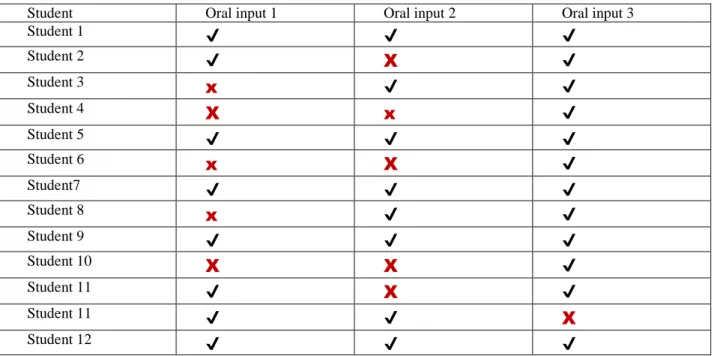
(8) Taylor, S.J. & Bogdan, R. (1984) Introducción a los nuevos métodos cualitativos de investigación. Wilkins, D. A. (1972). Linguistics in language teaching. Edward Arnold, London.. 4. Contenidos. Este estudio presenta un enfoque de investigación acción, por lo tanto, se desarrolló a lo largo de seis capítulos. En el primer capítulo se realiza una descripción y contextualización del lugar y población con la que se llevó a cabo la intervención pedagógica. Igualmente, se identifica y se describe el problema de investigación y su respectivo estado del arte con una posterior delimitación de la pregunta de investigación y sus objetivos, general y específicos. Esta pregunta está enfocada en el análisis de la implementación de dos técnicas de aprendizaje para mejorar el aprendizaje de vocabulario por medio del enfoque de presentación-practica-producción. En el segundo capítulo se presenta el marco teórico que soporta científica y teóricamente la creación de constructos referentes al tema de la investigación. El tercer capítulo desarrolla el diseño metodológico del proyecto, explicando el procedimiento para el uso de instrumentos de recolección de datos y el posterior análisis de estos. Luego, en el cuarto capítulo se presenta la descripción de la intervención pedagógica llevada a cabo en este proyecto el cual constó de tres ciclos. De igual manera, en el capítulo cinco se presenta el análisis de los datos recolectados a través de la intervención y los descubrimientos logrados. Por último, el capítulo seis presenta las conclusiones a su vez que discute los hallazgos del proyecto, sus impactos, limitaciones y recomendaciones del estudio.. 5. Metodología. Este proyecto de investigación acción fue llevado a cabo a lo largo de tres fases. La primera fase consistió en un proceso de observación y recolección de muestras para determinar el problema y pregunta de investigación. De este modo, para la segunda fase, se diseñó la propuesta de intervención pedagógica que buscaba dar solución al problema de investigación encontrado. Así, el desarrollo de sesiones de clase con la población permitió guiar el proyecto a través de la observación, planeación, diseño y aplicaciones para luego llevar acabo un nuevo proceso de observación que permitiera realizar una reflexión sobre los datos e información recolectada durante las intervenciones. Esto permitió encontrar dificultades y debilidades a lo largo del proceso de intervención para sesiones futuras. Igualmente, la recolección de los datos se llevó a cabo a través de instrumentos como diarios de campo, encuestas y artefactos. Finalmente, luego de la intervención pedagógica, se procedió a organizar y sistematizar la información recolectada lo cual permitió un adecuado análisis de esta. Así pues, los hallazgos encontrados permitieron el establecimiento de conclusiones y sugerencias para futuras investigaciones en relación tema de este proyecto..
(9) 6. Conclusiones. Las conclusiones de este proyecto surgen a partir de los objetivos específicos propuestos. Así, en relación al primero objetivo, se pudo establecer que el proceso de aprendizaje de vocabulario en las estudiantes fue desarrollado de manera organizada mediante los ciclos expuestos en la propuesta pedagógica. Con respecto al segundo objetivo, en los resultados se evidenció que el uso de las dos diferentes técnicas permitió establecer una orden en la forma de presentar los contenidos, partiendo del ejercicio más simple al más complejo. Así mismo, la implementación de estas dos técnicas reflejó los ciclos propuestos en la intervención pedagógica. Finalmente, en referencia al último objetivo, fue posible determinar la pertinencia del uso del enfoque de presentación-practica-producción, ya que este modelo fue capaz de adaptarse a un contexto como el de las estudiantes anteriormente nombradas, teniendo en cuenta aspectos como su nivel de lengua, su edad, sus intereses, las horas de clase a la semana y el número de estudiantes.. Elaborado por: Revisado por:. Ocampo Ramos, Carolain Rojas López, Ronald Andrés. Fecha de elaboración del Resumen:. 03. 06. 2019.
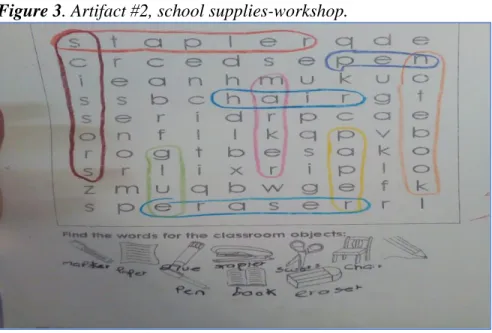
(10) CONTENT TABLE Characterization…………………………………………………………………………………1 Local and institutional context……………………………………………......………….........1 Population………………………………………………...…………………………………….3 Diagnosis………………………………………………………………………………………..5 Statement of the problem….………...…………………..………………………………….…8 Rationale of the study…………………………………..……………..………………………10 Literature review…………………………………………………………………………..….12 Research question………………...……………………………………..……...……………..17 Research objectives……………………………………………...………...………………….17 Theoretical framework……………………………………...……………...…………………..18 Vocabulary learning…………………………………………………………………………19 Vocabulary learning techniques……………………………………………………………23 Decontextualizing learning technique………………………………………………………25 Semi contextualizing technique………………………………………………………………26 Research design…………………………………………………………….…………………...29 Type of research……………………………………….…………………………………......29 Type of study…………………………………………………………………………………30 Data analysis methodology………………………………………………………………….30 Participants…………………………………………………………………………………..31 Data collection instruments and procedures………………………………..…..………….31 Pedagogical intervention…………………………………………….………............................34 Pedagogical basis……………………………………………………………...……………....34 Pedagogicaproposal…………………………………………………………………...……...37 Lessson chronogram…………………………………………………………………………39 Planning model……………………………………………………………………………….40 Data analysis…………………………...…………………………………………...…………...41 Categories analysis…………………………………..………………………………………..43 Decontextualzing vocabulary learning technique……………………….………………….43 Semicontextualizing vocabulary learning technique……………….………………………49 Conclusions…………………………………….………………………………………….........58 General recommendations……………………………………………………………………..61 References……………………………………………………………………………………….63.
(11) List of tables Table 1: Previous studies………...….…………………………...…………………….……….12 Table 2: Analysis categories …………...…………………………………………...………….33 Table 3: Lesson chronogram…………………………………………………………………...39 Table 4: Students’ oral comprehension results……………………………………………….50 List of appendices Annex A: Characterization survey…………………………………………………………….65 Annex B. Diagnostic test………………………………………………………………………68 Annex C: Field note #3 2018-1………………………………………………………………..70 Annex D: Consent format……………………………………………………………………..71 Annex E: Lesson plan sample…………………………………………………………………74 Annex F: Field note #1, 2018-2………………………………………………………………..75 Annex G: Field note #2, 2018-2………………………………………………………………..77 Annex H. Perception survey………………………………………………………………......78 Annex I: Field note #5,2018-2…………………………………………………………………80 Annex J: Field note #7, 2018-2………………………………………………………………...81 Annex K: Artifact applied on October the 22nd 2018………………………………………..82 Annex L: Artifact applied on April 2019……………………………………………………...83 Annex M: Artifact applied on April 2019………………………………………………….....84.
(12) 1. CHARACTERIZATION. This chapter presented an overview of the institution and the participants with whom the current research was made alongside with a related analysis of the classroom environment. This section aimed at drawing special focus to any local and institutional particularity that had a significant impact on the English learning process of the participants. A detailed student analysis was presented, taking into consideration relevant details linked to the cognitive, socio- affective, cultural and linguistic areas. Then, an analysis of the observations made in the first semester of 2018, the results of a survey and a diagnostic test applied to students were presented in order to contextualize cultural and academically the group of participants within this research. Then a set of previous national and international researches were exposed in a state of art to have a general background of the main topic of this research. Starting from this, the statement of the problem was described, finally, a research question with its respective general and specific objectives were stated. Local and Institutional context The I.E.D Liceo Femenino Mercedes Nariño School is in Bogotá, Colombia. This institution is situated in Restrepo neighbourhood and belongs to the 18th sector of Rafael Uribe Uribe district. This institution limits, to the north, with Primera de Mayo avenue (22nd street south), on the east, with Dario Echandia avenue (cra 10), which is the limit between San Cristobal and Rafael Uribe localities; at the south, with the south side of the Bosque de San.
(13) 2. Carlos’s park and with Gustavo Restrepo’s urbanization, and to the west, with Caracas avenue. This shows that the school is in a medium-class strata neighbourhood, with a residential and a commercial sector. The main purpose of the Liceo’s Institutional program (PEI) is to create “autonomous and critical women with scientific perspectives that can transform society by giving their opinions or critics in a constructive way in their future endeavours” (Coexistence manual, 2014). The Mission of the school is to foster the integral training of women promoting the values of: respect, honesty, identity, solidarity and autonomy, focusing on their life project, oriented to the transformation of contexts where they interact, guaranteeing the enjoyment of a full life (Coexistence manual, 2014). The Vision of the school aims to be recognized by the quality of its service and its graduates, whose count with a proper knowledge required for a society of knowledge, with a handling of foreign languages as English and French, health sciences, and new TICS (Coexistence manual, 2014). The pedagogical model of the school is Holistic . This model claims that the human being is a multidimensional subject who is defined based on his/her social and personal diversity. In this model, the teacher works as a facilitator, it means that the teacher should guide and take the responsibility of the teaching and learning processes of the students who are the main actors of it. In regard to EFL, the school is focused on preparing students with languages as English and French to contribute to their life project, directed to a superior education or professional life, where students may be competent developing skills as listening, speaking, reading and writing, reaching.
(14) 3. a B1 level (in a short term) and a B2 level (in a long term), this in order to assume the exigences of globalization, the TLC demands’ and others. In primary, the school stablished a main aim, this is to “develop knowledges, communicative competences and social and intercultural values and the development of implicit thinking in foreign languages (English and French) to achieve a good understanding, interpretation and textual production that allows the student to interact in specific contexts in bilingual societies, process based in the European Reference Framework for languages.” (English curriculum, 2018) Population The institution attends a total of 5640 students in the day and 750 at night, divided in three educational levels; preschool, elementary and secondary school. The population considered in this study belongs to fourth grade of primary, the 405 group, which is situated in elementary school, in the afternoon shift. This group counts with 38 students (all of them are girls) with ages among 7 and 10 years old. Starting from the learners’ cognitive characteristics, none of the students present any serious cognitive problem. Considering the survey applied to this population on March the 14th of 2018 (Annex A), it was determined that approximately 65% of students lives in a regular family, formed by mother, father, grandparents and brothers or sisters. In their hobbies the 80% of them prefer to spend their free time with their families. Besides, most of them show to receive.
(15) 4. help from at least one member of their family to do their homework, specially their parents, what indicates they have a good relationship in their homes. Not all the students live in the same district in which the school is located, but all of them live in 2 and 3 social strata neighbourhoods. Also, in their homes most of them count with technological tools such as TV, computer, tablet, etc. This shows that they are at the same level and capacities, talking in economic terms. Academically, they seem to be motivated for all the subjects, but specially for Informatics and Physical Education. The classroom environment is comfortable, in the survey a 70% of the participants claim to have an excellent/good relationship with their classmates and a 65% of them prefer group work or pair work. Inside the class, they showed interest for activities like drawing, painting, and writing. Outside the class, they prefer activities such as playing, going to the park, watching movies, listening to music and surfing on the Internet. A final aspect to analyse, and it opens the next section of analysis, is their interest about English. A 78% of them claims to do well in English, but the reasons to their answers are related only to good grades or good behaviours in the class, not to their language level or development. Regarding what they like to do in their English class, they prefer to watch videos and listening to songs. Also, 68% of them claimed to be better at listening and 50% claimed to be good at writing, which is paradoxical because the writing skill is not highly put into practice in the English class. On the other hand, only 7 of them told to be good at reading in English, and in the question “what do you like to do in your English class? The option of reading tales had the lowest rate, with only a 30% of preference..
(16) 5. Finally, they showed to be interested on English as a path to establish friendship with people from other countries and have a better opportunity of education, which suggests a need to learn English communicatively but before that, they must develop elementary levels to do it.. Diagnosis To carry out a wider analysis of the previous characterization, this section was focused on the analysis of data collected from a diagnostic English test applied to the students on March the 21st of 2018 (Annex B). The test aimed to assess student’s vocabulary and the four main skills (reading, listening, writing, and speaking). However, considering the head teacher’s advices, the speaking and the writing section were not developed because the students weren’t still able to respond according to difficulties of these two skills because they haven’t had the preparation for this kind of performances. The test was made in a written way, it was individual, and the students had one hour to complete it. To carry out this test, the teacher gave the instruction for each point. When everybody finished the first point, then the teacher explained the second one and so on. The instructions were given in mother tongue, this in order to help students understand the points easily to save time. Considering this previous information, the test was developed in three sections, which are explained in the next paragraphs..
(17) 6. The first section to develop was vocabulary; this section was leaded to evaluate the vocabulary knowledge of the students. It aimed to assess elementary vocabulary such as numbers from 1 to 12, colours, school supplies vocabulary, family’s vocabulary and greetings. This was made with different strategies; matching, filling gaps and multiple-choice questions. The second section evaluated reading comprehension; in this part the students received a text of a girl whose introduces herself and says all her personal information (name, age, nationality, birthday, favourite food, favourite colour, favourite animal, etc.). After reading the text the students had to answer 10 open questions considering the information given by the text, for example: what her name is? what her nationality is? The third section was listening comprehension; here, the students had to fill 10 gaps with the missing words of the listening. The audio was an elementary listening exercise for children, which topic was greetings. Regarding the first section, it was remarkable the strengths and the weaknesses in the students in terms of vocabulary. Considering the observations made along the first semester of 2018, it is evidenced that students recognize numbers in English through songs that the teacher proposed in the class, however in the diagnostic test, the results were different; only 22 students of 38 reached at least 6 correct answers of 12 in the first point, which consisted in matching numbers with their written way. Starting from the observation named and this result, it is evidenced that the students can recognize, for example, the numbers vocabulary orally, but when it comes to a written code they are not completely able to identify it. Although a 58% reached the.
(18) 7. objective of this point, it was not the expectation to achieve because it is an elemental topic they should know clearly. On the other hand, the second point of vocabulary section is colours. In this point, the students had a blank palette of colours and they had to colour it according to the colour asked in that palette. In this part, the 98% of the students reached the goal approximately, and this allowed to establish that they don’t have problems when recognizing these. Regarding the third point, which was about school supplies vocabulary, the 95 % didn’t identify these objects. Despite of the fact that they had the images of each object and a suitable word bank to do the exercise, they weren’t able to do it. This let us see that the program stated by the school is not followed when it comes to this kind of vocabulary, that is even promoted in their English classroom. In the fourth point of vocabulary section was the family’s vocabulary (mother, father, sister, brother, grandfather). For this exercise, some images from Los Simpson’s family were used. They had to relate the images to the vocabulary given in the instruction. The first thing that I could notice in this point is that participants don’t follow instructions (or they don’t even read them). In this point only 17 students were able to answer correctly, while the other ones made mistakes caused by not reading the instructions and not paying attention to the teacher explanation. The most common mistake found was writing the answers in Spanish (even though they had the hint to put them in English) and colouring the characters, which was an activity that they were not asked to do..
(19) 8. To end with this vocabulary section, in the fifth point that consisted in greetings, only 60% of the students achieved the goal of almost 5 correct answers from 10, which is very concerning, taking into account that since they started classes, the teacher had intensified the use of greetings in the class, and taking into account the national standards, the students should know clearly when and how to use greetings, so this result didn’t complete the expectations put into play about this topic. Finally, in the reading comprehension part, it could be noticed that only 49% of the students reached the goal of answering correctly a minimum of 5 questions from 10. The other 51% of the students didn’t consider the instructions given in the test and by the teacher as well. They answered to the questions with their own personal information, despite of the fact that the instructions were explained once and again. This brief analysis accompanied with the field notes about observations allowed to consider firstly, that a significant part of the population needed to be aware of the instructions, and secondly, it showed why the students didn’t have the results expected in terms of recognizing vocabulary in a written code and the problems with understanding the written words in English, this problem was described in the next section. Statement of the problem Starting from the observations done, it was possible to say that the students practiced and developed widely their listening skill, this was evidenced in the observations, when describing.
(20) 9. the activities that the head teacher proposed, most part of them had to do with songs, children’s rounds, videos, kinaesthetic activities and sometimes solving guides in which writing skill was promoted. However, it was evident that students could recognize some words or expressions orally, but not exactly in a written code and going deeper, understanding their actual meaning. This was proved along the observations made, and as an example of this, it was considered the exercise of recognizing numbers in the diagnosis test. In the class observations, students could easily say aloud the numbers in English, however, at the moment of recognizing it in a written code, only the half part of the group was able to do it, which meant that students were only repeating commands but they were not actually aware of what they were learning. Another evidence of this could be seen in the field note #3 from 2018-1 semester (Annexe C) where the teacher taught the numbers through a song, the students learnt it by listening to it, they pronounced it very well, but by the lack of visual aids students were not able do a word-soundimage-concept association and they only limited to repeat words and sentences without know the real meaning of these. The fact of not creating integral activities that include somehow the reading or writing skill was evidenced in the diagnosis test, where some of them wrote the words as they sound in their target language “gurifni” “gudmornin” in the case of greetings or regarding to family’s vocabulary with words like “fader” and “moder”. This wrong interpretation of the words happened because there was a lack of visual aids that allowed to students to be aware or conscious of the written code and the concept of the topics they learn..
(21) 10. When it comes to skills, it was evidenced that the teacher focused in reinforcing the skills of listening and speaking (which in this case, I interpret more as repetition than speaking) while writing and the reading skill were not as well developed as the previous ones. This was evidenced in the question number 12 of the survey which is: ¿Qué es más facil para ti?” and they were given four options to choose, where listening in English had the highest rate with a 68% of positive answers, while reading had the lowest rate with only 30% of positive responses. This meant that it was important to reconsider how was it possible to link all the abilities in the way that it did not get repetitive and was profitable for students. Considering this, it was relevant to mention that through the data collected in the observations, the students listened and repeat more than speak, but they did not go further than this; they just received and repeated commands when the teacher asked them to do it, but when they were demanded to produce a simple tense, they could not do it without teacher’s help giving them hints. With this evidences and interpretations, it was important to say that the main problem with the students of 405 is that they did not count with a meaningful strategy that help them to really learn the vocabulary they were supposed to know, which in this phase of students’ learning, is the main base to arrive to communicate something. Besides that, it was noticed that visual aids were not used as a resource to learn vocabulary, even considering that they were in an elementary level and they needed to learn vocabulary and simple sentences to get elements to communicate with each other. Considering this serious problem, taking into account that.
(22) 11. vocabulary is the main source they learn when it comes to speak a new language, the methodology of presentation-practice-production (PPP) along with two vocabulary learning strategies were chosen to contribute to fill this vocabulary learning gaps and see the vocabulary learning not as a process of memorizing isolated words without any specific purpose but as a process of learning different groups of vocabulary that at the end were joined with an specific objective. Rationale of the study Considering the problems exposed previously in the fourth-grade students of Liceo Femenino Mercedes Nariño, this section presented the contributions that the execution of this study provides in three fundamental scenarios for education, that is, the individual learning of the students, the contributions to the institutional methodologies and the learning landscape of the English language as a foreign language within the framework of the proposals of the national ministry. First, the implementation of vocabulary learning techniques presented in this study, could contribute to the learning of new vocabulary focused on the relationship of image, word and sound, which allows a clearer awareness of the language, helping the students to not only identify the new words but comprehend the meaning of the new concepts in different situations. Vocabulary is the basis in a language, it is the basis in a foreign language process; that is the reason why this project takes into account vocabulary; it is important to emphasize in vocabulary as a way to practice and improve English, as I. S. P. Nation said in his book Teaching and.
(23) 12. Learning Vocabulary “... both learners and researchers see vocabulary as being very important, if not the most important, element in language learning” (Nation, 1990); but there is a situation which was developed previously, and it is how vocabulary has been taught in English classes. According to the statement of the problem, it is very important to bear in mind the teaching of meaningful vocabulary; it is not just to write lists of words and repeat them to assume that a language is being learned; words have to be learned for a reason and they have to be understood in a situation related to the students. Secondly, at the institutional level, considering the intentions reflected in the mission of the school where the formation of integral students with good management of the foreign language is the focus, the application of this study contribute to get this integral formation in languages, since it links the more developed student’s language skills with the new ones that they acquire, which in this case reading comprehension. Finally, at a national level, this project contributes to meet the expectations of the MEN considering the English language basic standards established in Colombia. To that extent, this vocabulary learning proposal presents a tool for the strengthening and consolidation of knowledge necessary to learn a foreign language. The need to train citizens capable of competing with the world to interact, share and recognize each other on the plane of the nation in front of other cultures, whatever it may be a point of openness to the construction of a generation that opens and reflects actively from the imaginaries that the communicative processes of the English language offer to conceive the individuality of being and its cultural identity..
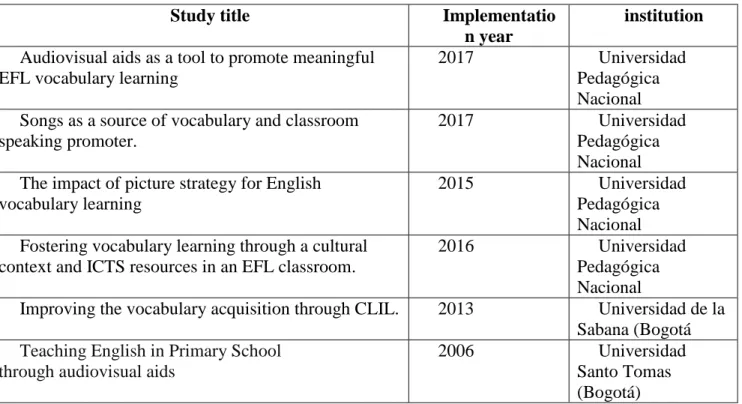
(24) 13. Literature review In the next chart, they are mentioned all the studies, which were useful as basis in this research. The four first are placed at Universidad Pedagógica Nacional, the following three are situated locally, and the last are studies from international stature. Table 1. Previous studies. Study title Implementatio n year Audiovisual aids as a tool to promote meaningful 2017 EFL vocabulary learning Songs as a source of vocabulary and classroom speaking promoter.. 2017. The impact of picture strategy for English vocabulary learning. 2015. Fostering vocabulary learning through a cultural context and ICTS resources in an EFL classroom.. 2016. Improving the vocabulary acquisition through CLIL. Teaching English in Primary School through audiovisual aids. 2013 2006. institution Universidad Pedagógica Nacional Universidad Pedagógica Nacional Universidad Pedagógica Nacional Universidad Pedagógica Nacional Universidad de la Sabana (Bogotá Universidad Santo Tomas (Bogotá).
(25) 14. Meaningful learning through audiovisual strategies. 2008. Intentional Vocabulary Learning Using Digital Flashcards Presentation – Practice – Production (PPP) Method: An Alternative Method Used in Enhancing student’s Vocabulary Mastery. 2015. Effective Strategies for Turning Receptive Vocabulary into Productive Vocabulary in EFL Context. 2015. Universidad de la Salle (Bogotá) University Road (Taiwan). 2018 University of Muhammadiyah Lampung University of Sulaimani (Iraq). In the first study, Gonzalez (2017) in his project “Audiovisual aids as a tool to promote meaningful EFL vocabulary learning” describes the importance of using audiovisual aids to improve vocabulary learning with third grade students. In his research, he describes the problem as vocabulary is taught out of context and without a purpose, just list of words to learn, having in mind this, he proposed to teach vocabulary through audiovisual elements such as videos, songs and listening exercises that helped students increment their vocabulary knowledge. Through this research, Gonzalez (2017) could establish that videos and songs resulted useful when learning new vocabulary, students felt interested and motivated to learn new vocabulary in a different and entertained way. This study takes relevance in this research because it shows the usefulness of audiovisual aids when it comes to learn new vocabulary, considering that is resulted to be a useful instrument when it comes about teaching to young learners. Mejorano (2017) in his project “Songs as a source of vocabulary and classroom speaking promoter”, describes the problem of his project as the lack of vocabulary students have when expressing their ideas. To this problem, Mejorano (2017) proposes a new technique to approach.
(26) 15. students to learn and use new vocabulary when speaking: songs. The implementation of songs within classroom allowed that Mejorano (2017) realized that it was a good to first, learn new vocabulary and second, a good way to foster speaking skills in students. However, Mejorano (2017) claimed that the activities done in the classroom are not enough when it comes to learn deeply the new vocabulary, for what he enhances the importance of autonomous work in the students. This project is useful to this research in the way that it supports the idea of using tools that can provide some context to learn new vocabulary. Cantor (2015) in her project “The impact of picture strategy for English vocabulary learning” describes the usefulness of picture strategy when learning vocabulary. In her project, she describes the main problem as students can not understand well the English classes because of their lack of vocabulary knowledge, to this problem, Cantor (2017) proposes to use picture strategy, applying it with verbal and written teaching strategies. Throughout this project, Cantor (2015) could establish that students not only understood the meaning of the words, but they also improved their listening and speaking skills by comprehending the meanings and word-sound relations. This study supports this research in the way that it shows that with appropriated techniques and instruction, vocabulary can be more than set of words to learn. In her project, Cristancho (2016) describes the problem as students do not count with an accurate level of English according to the grade they are in. To this problem, Cristancho (2016) proposes setting a cultural context supported by ICTs on the strengthening of EFL third graders’ vocabulary learning process, starting from students’ cultural context. Through this research, Cristancho (2016) found that students not only increased their vocabulary, but also, they learned.
(27) 16. to use it in different contexts. Cristancho also enhances on the importance of using TICS within the classroom, arguing that it is a complete tool that helps developing the four language skills known.. Gutierrez (2013) implemented the use of CLIL (Content and Language Integrated Learning). The author also found the problem of the interference of mother tongue (Spanish); Gutierrez (2013) stated that English classes were boring for students, but they were interested in topics related to Science and Geography, in that way, the investigator took advantage of that interest, and created strategies addressed to the language development. Gutierrez (2013) concluded in her project that students improve the vocabulary acquisition through an approach which involves the learning subjects different to English class. It becomes important for this research, since it is presented a very successful in enhancing the learning of languages and other subjects matters, and in the positive attitude development of youngers towards themselves as language learners.. Schlaga, Floraxa, and Ploetznera (2006) made use of the text and picture-based approach to improve comprehension. They mentioned that the use of pictures is an appropriate method for the age of the students (young learners), since they tend to have a better acquisition of grammar rules when a text is accompanied by images. However, the authors also advise that there should be a much higher complexity at each English level to develop further processing of text and image. The previous study is relevant for the present one as its results show that through implementation of the strategies, students increased their knowledge in the foreign language by.
(28) 17. means of a higher level of complexity; the authors stated that the students were interested and motivated in the classes through the use of pictures accompanied by a text. The use of pictures becomes a pedagogical strategy for children to improve their writing skills at the school level. Nirmala addressed to the problems affecting the learners’ academic success, such as lack of exposure, poor reading habits, lack of a conducive learning environment and so on, which affect their performance and confidence, even, the addressed population also tended to translate. Through picture strategy, Nirmala (2008) involved the total participation of the group and the picture reading became in a good habit of vocabulary learning. Regarding the conclusions of Nirmala (2008), to use pictures was positive in building trust to express ideas with vocabulary learned. Nirmala’s study (2008) works as the basis in this study to the extent that has brought a positive change to the environment of students, since the fact of the picture reading becomes a habit is a good point that favors the vocabulary acquisition. In his study Intentional “Vocabulary Learning Using Digital Flashcards” Hung (2015) describes the role of digital flashcards in a university classroom environment. Hung (2015) aimed to analyze the relevance of using this tool to learn vocabulary in an intentional way. To apply this project, Hung counted with a computer for each student, where they created their own flashcards with at least five words they chose about certain topic, and then they shared it with their partners. This project demonstrated that students improved notoriously in their English exams, as well as the profiency in comprehension and production skills. This study is important to this this research in the way that it shows that intentional vocabulary teaching can have good results when it counts with a clear purpose..
(29) 18. In her study “Presentation – Practice – Production (PPP) Method: An Alternative Method Used in Enhancing student’s Vocabulary Mastery” Amrizal (2018) aimed to describe application of PPP method in teaching vocabulary at University of Muhammadiyah Lampung and to know the result of students’ vocabularies achievement after teaching by using PPP method. After applying this method, Amrizal (2018) could establish that students’ vocabulary mastery improved in a significant way, this because their test scored were higher than expected and that’s what the study searched for, she also argued that students recognized the PPP method had helped them to master vocabulary and had motivated them to learn more. This study is important to this research because it allows to see PPP applied in other contexts, showing that despite of the fact that is considered a basic method, it is useful and for some students can be fun. Finally, in his project “Effective Strategies for Turning Receptive Vocabulary into Productive Vocabulary in EFL Context” Aziz (2015) express his concerns about why always students have more a receptive vocabulary than a productive one and discuss about the traditional vocabulary learning techniques. To become this receptive to productive vocabulary, he makes a process with students of introducing well the vocabulary, then recording it, and the putting in contexts or situations students know. The main result to this study was that students were able to use and share the new vocabulary with their partners, discussing and acting in different situations. This study is important to this research because it supports the idea that vocabulary is not only a receptive part of the language, but it is important to look for the way to make it somehow productive..
(30) 19. Having in mind the description of the problem, the rationale of the study and the previous researches, a research question with its corresponding objectives emerged:. Research question: How could the 405 students of Liceo Femenino Mercedes Nariño enhance their English learning vocabulary through two vocabulary learning techniques?. General objective: To analyze the incidence of using decontextualizing and semi-contextualizing vocabulary learning techniques in the process of vocabulary learning of 405 students of Liceo Femenino Mercedes Nariño.. Specific objectives: To describe the students´ vocabulary learning throughout the pedagogical intervention. To contrast the usefulness of two kinds of vocabulary learning techniques when learning vocabulary. To describe the usefulness of PPP teaching approach when teaching and learning vocabulary..
(31) 20. THEORETICAL FRAMEWORK To start with this chapter, it was important to take into account the conception of learning a foreign language for this research, later two main constructs which were the basis for this research were exposed. According to Brown (1994) language is a system which allows expressing meanings, and it is the primary source of interaction and communication. Language learning involves looking at language as a whole and concentrating on the meaning or gist rather than the grammatical structures or individual words. However, in early ages the learning is produced through the input, which is central in this study. “The learning increases as children are exposed to a constant input of the target language in class, it will contribute to lasting better English skills, measured in increased vocabulary “(p. 56). Krashen (1981) supports this view and presents three categories of adapted input from which the second language learner can benefit: “teacher-talk”, “foreigner-talk”, and “interlanguage” input. The first is seen as the classroom language that accompanies exercises, the language of explanations in second language, and the language of classroom management. This category is presented when the teacher uses their verbal and no verbal language to explain the instructions and organization of the class. The second is the manner of speaking that is often used by adults when talking to very young native speaker children. This type of input allows to students to perceive the language clearly, since the adult decreases the speed in the speech. And the last one is the.
(32) 21 “imperfect” second language, which is produced when the students speak among them with linguistic defects.. The above introduction allowed to state that foreign language learning is seen as a process, in which the principal factor in early ages is the input received that helps to students to develop a social learning, since it is the effect of direct instructions of the language. As Brown expressed, the main function of language is expressing and understanding meanings, rather than learning grammatical structures, which is the point where this research spins around, focusing on student’s vocabulary learning in order to not only identify isolated words, but understanding their meaning and know the context where they can use it.. The three categories mentioned by Krashen also took importance in this research, the first one is reflected in the way the teacher explains topics and give clear instructions to develop an activity, the second is evidenced when the teacher acts like a model to what students should learn and how do they do it, taking into account aspects, for example, as the pronunciation of the vocabulary shown by the teacher. Finally, the last category is reflected in this study when the students create their own descriptions or meaning about a situation.. Vocabulary learning For many years, the subject of vocabulary has been left aside when it comes about learning a new language. However, in the late years many researchers had put their attention into this subject and nowadays there is an open discussion about what vocabulary learning is. In this section were exposed different visions about the concept of vocabulary and its implications when learning a language..
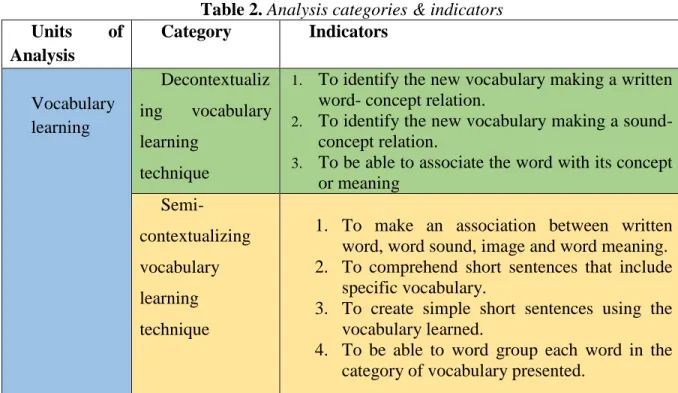
(33) 22 Richards and Renandya (2002) state that “Vocabulary is a core component of language proficiency and provides much of the basis for how well learners speak, listen, read, and write” (p.255). This definition allows to confirm that vocabulary is the main part of the process of learning a new language, knowing the meaning of words is essential for learners to be able to understand or express an idea clearly. Without a considerable amount of vocabulary knowledge, the comprehension and performance of an EFL learner is going to be limited and poor. In other words, vocabulary is central to English language teaching because without enough vocabulary students cannot understand others or express their own ideas.. This previous idea is supported by Brown (2007) who explained that although learning a language cannot be reduced to only learning vocabulary, stated that it is also true that no matter how well the students learns grammar, no matter how successfully the sounds of L2 are mastered, without words to express a wide range of meanings, communication in an L2 just cannot happen in any meaningful way.. For Abrudan (2010), words represent the building block upon which knowledge of the second language can be built. This reinforces the idea of the role of vocabulary in second language learning. Starting from this, it is possible to say that vocabulary more than being a “skill” to be developed, it could work as a solid bedrock upon which to build the overall language proficiency. It is important to understand that language is not only composed by grammar and the skills known to develop, as Wilkins (1973) stated, “without grammar, very little can be conveyed; without vocabulary nothing can be conveyed” (p. 111-112) This statement helps to understand that to develop comprehension in a foreign language, even having clear grammar structures -and this happens even in advanced levels of language knowledge- if the learner does not know the.
(34) 23 vocabulary presented within the texts (oral or written), it is harder for him/her to comprehend the real meaning of it. This idea is also supported by researchers who realized that many of learners' difficulties, both receptively and productively, result from an inadequate vocabulary, and even when they are at higher levels of language competence and performance, they still feel in need of learning vocabulary (Laufer 1986; Nation 1990). To continue with the previous idea, Abrudan (2010) states that “If language structures make up the skeleton of a language, the vocabulary provides the flesh and the vital organs” (p.270). This allows to say that vocabulary is what gives the meaning to what an idea wants to express. Grammar is a well-structured fact in language learning, but once the learner acquires it, it does not change, whereas vocabulary is an instrument that learner does not end up learning, the wider vocabulary the better performance in the second language (although grammar and vocabulary are interdependent). Vocabulary knowledge is not something that can ever be fully mastered; it is something that expands and deepens over the course of a lifetime, Abrudan (2010). Is important to know that vocabulary can be learned in two ways: incidentally and intentionally. The first one occurs through indirect exposure to words, such a reading or listening texts, the second one (which is the one to use within this research) happens through explicit instruction in specific words and word-learning strategies. (Abrudan,2010).. To keep up with the importance of vocabulary within language learning, Krashen, as cited in Lewis (1993) states a strong idea “First, a large vocabulary is of course essential for mastery of a language. Second language acquirers know this; they carry dictionaries with them, not grammar books, and regularly report that the lack of vocabulary is a major problem’’ (p.25). After analyzing this idea, it is pertinent to wonder why this happens when a foreigner, for example,.
(35) 24 arrives to a new country and prefers to carry a dictionary than a grammar book, this can be answered since the point of view that although the learner does not possess well-structured grammar basis, with few words is able to express an idea.. The previous background ideas allowed to enhance the role of vocabulary learning in a foreign language. It is important to clarify that this research looks for to put in practice the importance of vocabulary learning within the English as a foreign language learning, taking into account the context, the knowledge, and the time exposure of the learners in the classroom.. In this way, vocabulary is considered for this study as the main piece to build the foreign language learning. Understanding vocabulary not only as a list of words that students memorize because they have to, but relating these words to concepts, images and meanings that can help them to understand a language context. It is important to mention that vocabulary must not be taught as a set of commands, where students respond to it just because they are used to do it, but really understanding the meaning of the words that they learn and the real use of them. Having in mind the visions of each author mentioned before which result to be similar one to another, the one exposed by Richards and Renandya (2002) is the one that adjust better to this research, because it defines vocabulary a core component, which is relevant to establish the main vision that spins around along this study, this understanding that no matter how well grammar structures a learner owns, if there is a low knowledge of vocabulary, neither language comprehension nor language production is possible, then the learner capacity to comprehend or express an idea would be harder..
(36) 25 Therefore, vocabulary is applied in this study in an intentional and systematic way, in which students learn a certain group of vocabulary with a purpose. To describe this systematic process, it is useful to take as a reference the 5R model proposed by Brown & Payne (1994) which goes from first receiving the words, then recognizing them in a written an oral form, then retaining in their mind the meaning and the image of each word, later retrieving the words and finally recycling them for their own use, whether is comprehension or production of the language. This previous model is adapted within the next construct of this framework and it will be the basis to develop a pedagogical proposal.. Vocabulary learning techniques Firstly, it is important to identify the definition of technique. For Brown (1994) technique is “any of a wide variety of exercises, activities or tasks used in the language classroom for realizing lesson objectives” (p.16), in other words, it is a way to carry out the development of a lesson in within the classroom. Many authors have exposed and established their own models among what vocabulary learning techniques or steps are important to carry out when teaching vocabulary. In this construct will be as reference to Oxford & Crookall (1990) to talk about the vocabulary learning techniques which apply better to this research.. Oxford & Crookall (1990) describe the techniques of vocabulary instruction in four categories: (1) de-contextualizing: word lists, flashcards, and dictionary use; (2) semi-contextualizing: word grouping, association, visual imagery, aural imaginary, keyword, physical response, physical sensation, and semantic mapping; (3) fully contextualizing: reading, listening, speaking, and writing; (4) adaptable: structured reviewing. To understand widely these techniques, Shen (2003).
(37) 26 shares a chart (Figure 1) putting these techniques in a range of decontextualize and contextualize, to understand better what are the factors among this scale. Fifure 1. Existing vocabulary learning strategies, Shen (2003). To understand the previous figure, decontextualizing techniques are the ones that don’t provide any communicative context to learners that allow them to remember, relate or knowing the actual use of the word. Semi contextualizing techniques are partially wrapped with context but not at all, so this technique allow to the learner to relate the new knowledge with the previous one or acquiring the new words relating it with something meaningful, but it is not part of a naturalistic communication. Fully contextualizing techniques involve the learners in a communicative environment and finally, adaptable technique, refers to a technique that can reinforce other techniques at any part of the contextuality continuum. Oxford & Crookall (1990).. Nevertheless, to carry out this study it was only taken into consideration the first (decontextualizing) and second technique (semi-contextualizing), which are the ones that adjust better to the conditions of this research, such as time exposure, language level of the students and.
(38) 27 the objectives stated at the beginning of this document. These two techniques are explained deeply in the next paragraphs. Decontextualizing technique It uses totally removed from context strategies, such as wordlist, flashcards and dictionary use. In this section the focus will be in wordlist and flashcards, which are the ones that are involved within this study. Before describing these strategies, it is important to clarify that any of these can have modifications, adding some degree of context, in order to not neglect them at all. The wordlist seem to be one of the most decontextualizing learning strategy, since it does not provide any context in which student can hold on, but only a set of isolated words which aim is simply the learner identify and memorize, these strategy does not even require at all the instruction of a teacher, when it appears in textbooks, it is available for the learners to learn it alone (Oxford & Crookall,1990). Despite of this, the learner will always try to relate the new word to one from the L1 to start identifying the meaning of L2 words. Although this strategy has not shown good results working as a main tool for learning new vocabulary, in this research it was used to receive and identify a first written impression of the words.. Flashcards are another element that seemed to be decontextualized, but they can be improved, and they even result to be more common when learning vocabulary than expected. The flashcards have three components, the first one is writing down or receiving the l2 word, the second one is the L1 word meaning behind, or an image that can help to understand the meaning of the L2 word. The third and last one, is using the card to get familiar with new words presented. Although ordinary flashcards are not seen as a good tool to introduce new words to learners, with creativity it is possible to modify them adding a bit of context:.
(39) 28 For instance, learners can sort flashcards into piles representing different groups of words (e.g., nouns, adjectives, adverbs, verbs, prepositions; words that are already learned vs. words still needing to be learned; past tense forms vs. present tense forms). Learners can tape flashcards to particular objects like lamp, table, and chair signified by the words on the cards, thus providing a visual (and to a degree tactile) context. Visual context might also be added by taping relevant pictures to the cards. Learners can arrange flashcards on the floor in a kind of semantic map, with related words closer together and unrelated words farther apart. Finally, students can add context by writing the new words in complete, meaningful sentences on the cards (p.12) The previous quote is a demonstration of what is possible to do with flashcards and how useful they can be to learn new vocabulary if they are presented to learners with that features and aims. It is important to clarify that this decontextualizing strategy takes place in this study only as a way to introduce new vocabulary to students in a first stage, remembering the 5R model, where they receive and recognize the words presented, to help students to get familiar with the new words, identifying them first in a written an oral form, to be able later to make a transition to meaning and use of the words learned throughout the pedagogical practice.. Semi contextualizing technique Is that in which some of the context comes from associations with other words or word-sounds (Oxford & Crookall,1990). Semi-contextualizing techniques allow some degree of context but fall short of full contextuality; thus, new words may be linked with something that is meaningful to the learner, but they are not used as part of naturalistic communication (Oxford & Crookall,1990).. To understand this in a better way, the authors explain different techniques used within this category. The first one is word grouping, which establishes new groups or sets of words which hang together because of some common theme or characteristic. Groups can be based on type of.
(40) 29 word (e.g., all nouns or adjectives), grammatical form (e.g., irregular verbs of a certain kind), topic (e.g., words about weather), practical function (e.g., terms for things that make a car work), language function (e.g., apology, request, demand), similarity (e.g., warm, hot, tepid, tropical), dissimilarity or opposition (e.g., friendly /unfriendly), the way one feels about something (e.g., like, dislike), and so on (Oxford & Crookall, 1990). This idea is close to what Harmer (1991) calls enumeration. Setting a topic (e.g. Clothes) and enumerate a list of its items (e.g. Pants, skirt, shoes). This is a good technique to make vocabulary learning easier and more organized.. Another technique to take into account is visual imagery, for vocabulary learning is based on making associations between a picture and a word. This technique is based on the theory that most learners are capable of associating new information to concepts in memory by meaningful visual images, and that visual images make learning more efficient., (Oxford & Crookall, 1990). The list of pictures includes: posters, flashcards, wall charts, magazine pictures, board drawings, stick figures and photographs (Alqahtani, 2015).. Physical response results to be another technique that can help learners to remember vocabulary easily. This technique relies on using body language linked with words at the same time (Oxford & Crookall, 1990). One very common strategy to carry out this technique is following commands. As example, when the teacher teaches body parts vocabulary, putting his hands on his head when he says the word “head” and so on. This technique activates different parts of the brain and stimulate learner’s schemata.. The last technique is physical sensation, this is known for involving the learners in sensitive experiences that provide a small amount of context in terms of a physical association with a new.
(41) 30 word (Oxford & Crookall, 1990). An example of this is playing with the senses of learners, tasting new flavors to explain words such as: salty, sweet, bittersweet, delicious, disgusting. This technique will create a significant learning and will help the learner remember the vocabulary exposed easily.. Therefore, it can be argued that contextual, semi-contextual and de-contextual strategies of teaching vocabulary are all needed to help learners to learn words. On the one hand, learners need a lot of native-like input in order to absorb authentic frameworks of the target language, and to enable them to achieve native-like proficiency. On the other hand, it is necessary to use strategies to facilitate lexical consolidation in their memories. Therefore, learning words needs to involve a wide range of skills (Zimmerman, 1997). This implies that it is difficult to isolate vocabulary learning strategies from one another.. The techniques described above are the ones that compose this research, they will be developed with several activities that will help learners acquire new vocabulary in an organized, intentional and systematic way. Making the vocabulary learning something significant that helps learners to interiorize all the new knowledge. The previous techniques are applied in this study in two phases. The first one is the decontextualizing technique, that works as an initial way to introduce new vocabulary to the learners, in which they receive and identify the new words, doing it first in a written code and then in an oral one, to finally understand the meaning of that words. In the second phase with semi contextualizing techniques the learners are expected to not only identify the words, but also to be capable of associating the written and oral code with an image and meaning of the words presented in phase 1 and in this sense, to be able to comprehend the use of these groups of vocabulary to develop several tasks with different levels of complexity..
(42) 31. RESEARCH DESIGN This chapter was focused on the research design and methodology that leaded this study. First, it was explained the type research, which defined how this research was conducted. Secondly , a brief description of the process of gathering, analysis, and presentation of data was given as well as ethical considerations of this study.. Type of research This study was conducted through the qualitative research, that consists in observing reality and understanding social problems in their natural setting. According to Philips & Carr (2010), qualitative research “involves looking in-depth at non-numerical data, which means that this focuses on the knowledge as fluid and subjective, not as countable and fixed” (p.26). Taylor and Bogdan (1994) state that qualitative research relies on descriptive data obtained from spoken or written statements made by people as well from observable behaviors. According to Taylor and Bogdan (1994) qualitative methods are inductive; this means that researchers develop concepts throughout the investigation, based on the data collected which subsequently is evaluated and analyzed. The qualitative method favors this research, since it can be used to study language learning processes, and at the same time, the roles of learners, which are manifested through behaviors. Considering these definitions, this study is going to be framed within qualitative research because its aim is to describe and analyse students’ learning process and behaviours during a pedagogical intervention..
Figure
+2
Documento similar
As generalization depends precisely on the degree of conditioning of this common element, this mechanism can elegantly explain perceptual learning within standard
For instance, the best overall accuracy of bagging in Breast with 20% noise is achieved using a 10% sampling ratio: The test error goes from 4.1% when no noise is injected to 3.5%
In particular, different versions of the training set for the base learners can be used, as in bagging (bootstrap sampling of training data), class-switching (noise injection in
The recent exponential growing of machine learning techniques (data-mining, deep-learning, manifold learning, linear and nonlinear regression techniques ... to cite but a few) makes
On the other hand, the interaction of students with human teachers providing hints led to a significant difference in learning gain between the post-test and the pre-test according
Curation Practices Multimodal Literacy Critical Dispositions Global Discourses COLLABORATION.?. Searching,
changes in: the production processes of television, especially content production and management; the communication platforms and techniques; the professional
In the “big picture” perspective of the recent years that we have described in Brazil, Spain, Portugal and Puerto Rico there are some similarities and important differences,
