
Machine Translationness: a Concept for Machine Translation Evaluation and Detection
139
0
0
Texto completo
(2) i Come, your answer in broken music, for thy voice is music and thy English broken. W. Shakespeare (Henry V. Act 5, Scene 2). Always be a first-rate version of yourself, instead of a second-rate version of somebody else. Judy Garland.
(3) Abstract. Machine translationness (MTness) is the linguistic phenomena that make machine translations distinguishable from human translations. This thesis intends to present MTness as a research object and suggests an MT evaluation method based on determining whether the translation is machine-like instead of determining its human-likeness as in current evaluation approaches. Therefore we present an evaluation method that assesses machine translations according to what they are (translations produced by a machine) and not to what they resemble (human translations). The method rates the MTness of a translation with a metric, the MTS (Machine Translationness Score). The MTS calculation is in accordance with the results of an experimental study on machine translation perception by common people. MTS proved to correlate well with human ratings on translation quality. Besides, our approach allows the performance of cheap evaluations since expensive resources (e.g. reference translations, training corpora) are not needed. Machine translationness ratings can be applied for other uses beyond machine translation evaluation. The MTS metric can be an important indicator to prevent the consequences of the massive use of MT, such as plagiarism and other forms of cheating, or the detection of unsupervised MT documents published on the Web..
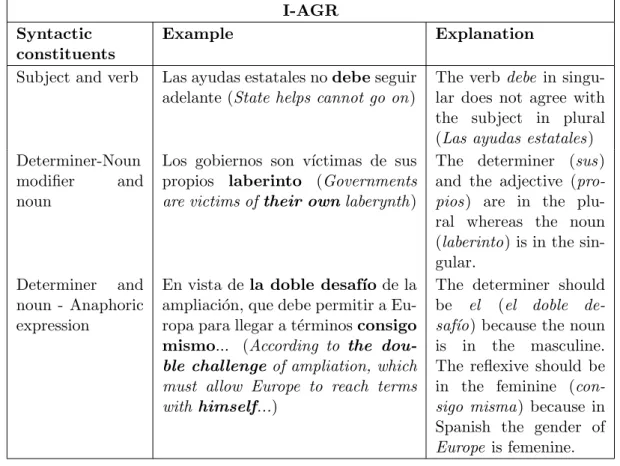
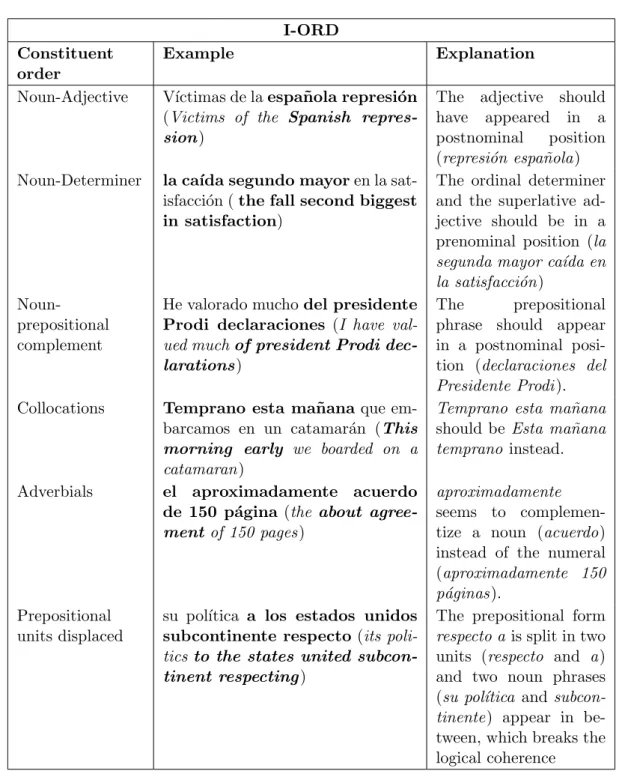
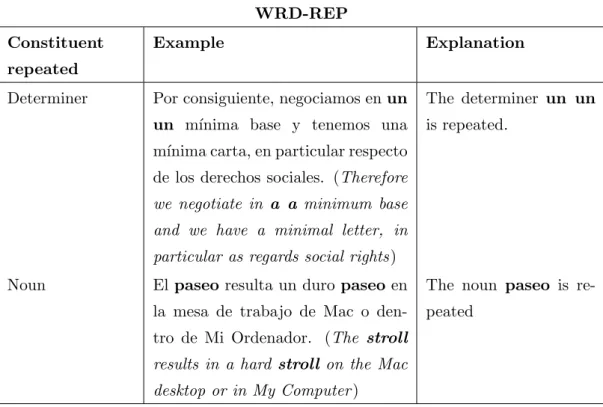
(4) Acknowledgements I write the acknowledgements when I put a final stop to my permanent thesis state, and now I think of my uncle writing the acknowledgements section of his PhD long time ago. Sharing this instant is the fulfillment of a task inspired by my admiration and love for him. I want to thank my director, Salvador, for encouraging me to write this thesis. My gratitude reaches beyond his suggestions, his support at hard times, his concern in disseminating my work from the very beginning, and his contribution in the writing of this thesis, obsessed as he was in making it ’readable’ and ’understandable’. I would also like to thank friends at UOC, UB, UPC and other universities for their concern and good advice for this thesis. I know that they are happy for me, and I feel proud to share this moment with them. I also acknowledge the important contribution of people who distracted me from this hard work. Some of them are not with me on this finishing line, but they deserve all my gratitude. And last but not least I want to thank my family for their support and patience. And, obviously, I want to thank Laia for her care, love, cheerfulness, sensibility, and easygoing. In sum, thanks to all the people who helped me to sow the silver seeds of machine translationness. Now I will enjoy with them the ripe and golden apples of the sun.. iii.
(5) Agraı̈ments Escric aquest apartat quan poso punt i final al meu estat de tesi permanent. Un estat iniciat ja des de ben petit, quan vaig decidir ser doctor, com el meu tiet. Per fi he assolit una tasca inspirada per la meva admiració cap a ell. Vull donar les gràcies al meu director, en Vadó, per animar-me a fer aquesta tesi. La meva gratitud va molt més enllà de les seves suggerències, el seu suport en temps durs, la seva implicació en donar a conèixer aquest treball des de bon començament, i la seva contribució en l’escriptura d’aquesta tesi, a més de la seva obsessió en fer-la ’llegible’ i ’comprensible’. M’agradaria també agrair els meus amics de la UOC, la UB, la UPC i d’altres universitats pel seu interés per la tesi i pels seus molt bons consells. Sé que estan molt contents per mi, i em sento orgullós de que estiguin aquı́ per compartir-ho. També agraeixo la gran contribució de la gent que m’ha distret de la tesi. Alguns no estan amb mi a la lı́nia d’arribada però mereixen tota la meva gratitud. Per últim, però per això no menys important, vull agrair a la meva famı́lia el seu suport i paciéncia. I, evidentment, vull agrair-li a la Laia el seu amor, els seus ànims, el seu seny, i que hagi intentat sempre posar-me les coses ben fàcils, amb una pacient alegria. Hi ha molt d’ella en aquestes págines. En resum, gràcies a tots els que m’han ajudat a plantar les argentades llavors de la machine translationness. Ara gaudiré amb ells de les daurades pomes madurant-se al sol.. iv.
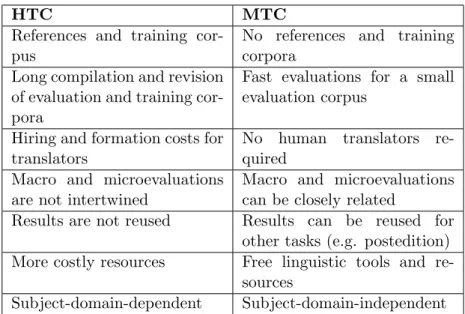
(6) Contents Abstract. ii. Acknowledgements. iii. Agraı̈ments. iv. List of Figures. ix. List of Tables. x. 1 Introduction 1.1 MTness and its importance . . . . . . . . . . . . . . . . . 1.1.1 MTness and translation quality . . . . . . . . . . . 1.1.2 MTness and MT use . . . . . . . . . . . . . . . . . 1.1.3 Internet as a corpus of language use . . . . . . . . 1.1.4 MTness and information retrieval . . . . . . . . . . 1.2 MTness as a field of research and a novel proposal for MT 1.3 Organization and overview . . . . . . . . . . . . . . . . . .. . . . . . . . . . . . . . . . . . . . . . . . . . . . . . . . . . . . evaluation . . . . . . . .. 2 Evaluation of MT Quality and Machine Translationness 2.1 HTC Methods . . . . . . . . . . . . . . . . . . . . . . . . . . 2.1.1 HTC in human evaluations . . . . . . . . . . . . . . . 2.1.1.1 ALPAC Evaluation . . . . . . . . . . . . . . 2.1.1.2 The Van Slype Report . . . . . . . . . . . . . 2.1.1.3 The JEIDA contributions . . . . . . . . . . . 2.1.1.4 The DARPA Evaluation Campaigns . . . . . 2.1.1.5 The FEMTI . . . . . . . . . . . . . . . . . . 2.1.2 HTC in automatic evaluations . . . . . . . . . . . . . 2.1.2.1 The Reference Proximity Assumption (RPA) 2.1.2.2 The Accuracy Assumption (ACA) . . . . . . 2.1.2.3 The Human Likeness Assumption (HLA) . . 2.1.2.4 Translation quality in automatic evaluations 2.2 The shortcomings of the HTC . . . . . . . . . . . . . . . . . . 2.3 The machine translationness criterion and its contributions . 2.4 Conclusion . . . . . . . . . . . . . . . . . . . . . . . . . . . . 3 MTness Experimental Study. . . . . . . . . . . . . . . .. . . . . . . . . . . . . . . .. . . . . . . . . . . . . . . .. . . . . . . . . . . . . . . .. . . . . . . . . . . . . . . .. . . . . . . .. . . . . . . . . . . . . . . .. . . . . . . .. 1 2 3 3 5 6 8 10. . . . . . . . . . . . . . . .. 11 12 12 12 13 14 14 16 16 17 21 22 23 24 26 28 29. v.
(7) Contents 3.1 3.2. 3.3. Goals of the Empirical Study . . Empirical Study Methodology . . 3.2.1 The Informants . . . . . . 3.2.2 Corpus of the Experiment 3.2.3 The survey . . . . . . . . 3.2.4 Collection of Data . . . . Summary . . . . . . . . . . . . .. vi . . . . . . .. . . . . . . .. . . . . . . .. . . . . . . .. . . . . . . .. . . . . . . .. . . . . . . .. . . . . . . .. . . . . . . .. . . . . . . .. . . . . . . .. . . . . . . .. . . . . . . .. . . . . . . .. . . . . . . .. 4 MTness Typology 4.1 MTness Types . . . . . . . . . . . . . . . . . . . . . . . . . 4.1.1 Lexical types . . . . . . . . . . . . . . . . . . . . . . 4.1.1.1 Word not pertaining to the target language 4.1.2 Syntactic Types . . . . . . . . . . . . . . . . . . . . 4.1.2.1 Inadequate syntactic agreement (I-AGR) . 4.1.2.2 Inadequate part of speech (I-POS) . . . . . 4.1.2.3 Inadequate verbal form (I-VERBF) . . . . 4.1.2.4 Inadequate constituent order (I-ORD) . . . 4.1.2.5 Word overgeneration (OVER-WRD) . . . . 4.1.2.6 Word repetitions (WRD-REP) . . . . . . . 4.1.2.7 Syntactic gap (SYNT-GAP) . . . . . . . . 4.1.3 Semantic Types . . . . . . . . . . . . . . . . . . . . . 4.1.3.1 Semantic gaps (SEM-GAP) . . . . . . . . . 4.1.3.2 Semantic incoherence (SEM-INCOH) . . . 4.1.3.3 Contextual incoherence (CON-INCOH) . . 4.1.4 Formatting Types . . . . . . . . . . . . . . . . . . . 4.2 Discussion . . . . . . . . . . . . . . . . . . . . . . . . . . . . 4.2.1 Relevance of the typology . . . . . . . . . . . . . . . 4.2.1.1 MTness typology and MT error typologies 4.2.2 Explicative capacity of the typology . . . . . . . . . 4.2.3 Predictive capacity of the typology . . . . . . . . . . 4.3 Conclusion . . . . . . . . . . . . . . . . . . . . . . . . . . .. . . . . . . .. . . . . . . .. . . . . . . .. . . . . . . .. . . . . . . .. . . . . . . .. . . . . . . .. 29 30 30 32 33 33 35. . . . . . . . . . . . . (NO-L2) . . . . . . . . . . . . . . . . . . . . . . . . . . . . . . . . . . . . . . . . . . . . . . . . . . . . . . . . . . . . . . . . . . . . . . . . . . . . . . . . . . . . . . . . . . . . . . . . . . . . . . . . . . . . . . . . . .. . . . . . . . . . . . . . . . . . . . . . .. . . . . . . . . . . . . . . . . . . . . . .. 36 36 37 37 37 37 38 39 39 39 41 42 42 42 43 44 45 45 46 46 48 48 49. . . . . . . . .. 50 51 53 53 54 54 55 57 59. . . . .. 60 60 62 63. 5 MTness Perception 5.1 MTness and machine translations vs human translations . . . . . . 5.2 MTness in distant-close language pairs and MT methodology . . . 5.3 Mismatches in underlined MTness instances . . . . . . . . . . . . . 5.3.1 Vocabulary knowledge . . . . . . . . . . . . . . . . . . . . . 5.3.2 Subjective linguistic and stylistic criteria . . . . . . . . . . . 5.3.3 MTness instance overlapping . . . . . . . . . . . . . . . . . 5.3.4 Non-salient MTness instances . . . . . . . . . . . . . . . . . 5.3.5 Source language evocation . . . . . . . . . . . . . . . . . . . 5.4 MTness salience and MTness overlapping in MTness detection and uation . . . . . . . . . . . . . . . . . . . . . . . . . . . . . . . . . . 5.4.1 MTness salience . . . . . . . . . . . . . . . . . . . . . . . . 5.4.2 MTness overlapping . . . . . . . . . . . . . . . . . . . . . . 5.5 Conclusion . . . . . . . . . . . . . . . . . . . . . . . . . . . . . . .. . . . . . . .. . . . . . . . . . . . . . . . . . . . . . . . . eval. . . . . . . . . . . ..
(8) Contents. vii. 6 Automatic MTness Detection 6.1 MTness detection based on Internet searches . . . . . . . . . . . . . . . 6.2 MTness detection based on the native speaker0 s linguistic and intuitive knowledge . . . . . . . . . . . . . . . . . . . . . . . . . . . . . . . . . . . 6.2.1 The parse tree representations . . . . . . . . . . . . . . . . . . . 6.2.2 Detection of MTness instances in the use of words . . . . . . . . 6.2.3 Detection of MTness instances in the relations between words . . 6.2.3.1 Hypothesis DTR matching with reference DTR . . . . . a) Creation of reference DTRs . . . . . . . . . . . . . . . . a.1) Creation of reference syntactic DTRs . . . . . . . . . a.1) Creation of reference morphological DTRs . . . . . . b) Creation of hypothesis DTRs . . . . . . . . . . . . . . . c) Detection of MTness instances in syntactic DTRs . . . d) Detection of MTness instances in morphological DTRs 6.2.3.2 Testing the real use of co-occurrent words . . . . . . . . 6.2.3.3 MTness types with no specific algorithms . . . . . . . . 6.3 Summary . . . . . . . . . . . . . . . . . . . . . . . . . . . . . . . . . . .. . . . . . . . . . . . . . .. 66 67 69 70 71 71 72 72 73 73 75 77 79 79. 7 Calculation of the MTS Metric 7.1 The MTS score . . . . . . . . . . . . . . . . . . . . . . . . . . 7.1.1 The mts calculation . . . . . . . . . . . . . . . . . . . 7.1.1.1 The syntactic mts calculation . . . . . . . . . 7.1.1.2 The morphological mts calculation . . . . . . 7.1.1.3 The co-occurrent mts calculation . . . . . . . 7.1.2 The MTS calculation algorithm . . . . . . . . . . . . . 7.2 An example of MTS calculation . . . . . . . . . . . . . . . . . 7.2.1 Calculation of the MTS in multi-sentence translations 7.3 Summary . . . . . . . . . . . . . . . . . . . . . . . . . . . . .. . . . . . . . . .. 81 81 82 83 84 84 84 84 86 87. . . . . . . . . . . .. 88 88 90 90 90 90 91 91 92 92 92 93. . . . . .. 93 93 94 95 95. . . . . . . . . .. . . . . . . . . .. . . . . . . . . .. . . . . . . . . .. . . . . . . . . .. . . . . . . . . .. 8 Experimental Evaluation of the Proposal 8.1 MTness-Eval: an MTness evaluation tool . . . . . . . . . . . . . . . . . 8.1.1 Parsing and generation of hypothesis DTR and queries . . . . . . 8.1.2 MTness detection . . . . . . . . . . . . . . . . . . . . . . . . . . . 8.1.3 Scoring . . . . . . . . . . . . . . . . . . . . . . . . . . . . . . . . 8.2 Evaluation costs . . . . . . . . . . . . . . . . . . . . . . . . . . . . . . . 8.2.1 Expenses of the experiment . . . . . . . . . . . . . . . . . . . . . 8.2.2 Expenses in the MTness-Eval resources . . . . . . . . . . . . . . 8.2.2.1 Dictionaries . . . . . . . . . . . . . . . . . . . . . . . . . 8.2.2.2 The reference syntactic and morphological DTR . . . . 8.2.2.3 The dependency parser . . . . . . . . . . . . . . . . . . 8.2.2.4 The search engine . . . . . . . . . . . . . . . . . . . . . 8.2.2.5 Resource costs in comparison to state-of-the-art evaluations . . . . . . . . . . . . . . . . . . . . . . . . . . . . . 8.2.3 Reusability of the data . . . . . . . . . . . . . . . . . . . . . . . . 8.3 The rating of fluency and accuracy . . . . . . . . . . . . . . . . . . . . . 8.3.1 Evaluators . . . . . . . . . . . . . . . . . . . . . . . . . . . . . . . 8.3.2 Translation quality scale . . . . . . . . . . . . . . . . . . . . . . .. 64 . 64.
(9) Contents. viii. 8.3.3. 8.4 8.5 8.6. Correlation analysis . . . . . . . . . . . . . . . . . . . . . . . . . . 96 8.3.3.1 Correlation variables in MTS . . . . . . . . . . . . . . . . 96 8.3.3.2 MTS correlation and comparison to state-of-the-art metrics 97 a) Correlation in n-gram metrics . . . . . . . . . . . . . . . 97 b) Correlation in syntactic RPA metrics . . . . . . . . . . . 98 c) Correlation in classification-based metrics . . . . . . . . . 99 8.3.4 Differences in MTS and state-of-the art approaches . . . . . . . . . 100 8.3.4.1 Differences between MTness and n-gram approaches . . . 100 8.3.4.2 Comparison between MTS and syntactic RPA metrics . . 102 8.3.4.3 MTS and the Legitimate Translation Variation . . . . . . 102 8.3.4.4 Comparison between MTS and classification metrics . . . 103 MTS and machine-like distinction . . . . . . . . . . . . . . . . . . . . . . . 103 Consistency of our method . . . . . . . . . . . . . . . . . . . . . . . . . . 105 Conclusion . . . . . . . . . . . . . . . . . . . . . . . . . . . . . . . . . . . 106. 9 Conclusions and Future Work 9.1 Introduction . . . . . . . . . . . . . . . . . . . . 9.2 Contributions . . . . . . . . . . . . . . . . . . . 9.2.1 MT Evaluation . . . . . . . . . . . . . . 9.2.2 Machine translation detection . . . . . . 9.2.3 MT Postedition . . . . . . . . . . . . . . 9.2.4 Use and abuse of MT technologies . . . 9.3 Future Work . . . . . . . . . . . . . . . . . . . 9.3.1 Improving resources . . . . . . . . . . . 9.3.2 Other applications of MTness detection 9.3.3 The study of MTness . . . . . . . . . .. . . . . . . . . . .. . . . . . . . . . .. . . . . . . . . . .. . . . . . . . . . .. . . . . . . . . . .. . . . . . . . . . .. . . . . . . . . . .. . . . . . . . . . .. . . . . . . . . . .. . . . . . . . . . .. . . . . . . . . . .. . . . . . . . . . .. . . . . . . . . . .. . . . . . . . . . .. 108 . 108 . 108 . 108 . 110 . 111 . 111 . 111 . 112 . 112 . 113.
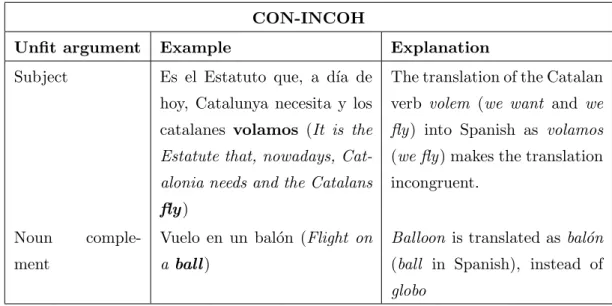
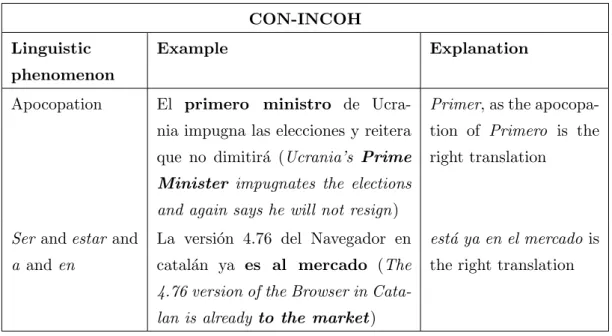
(10) List of Figures 2.1. Example of BLEU calculation (Way, 2004). 3.1. Schematic representation of a contrast unit . . . . . . . . . . . . . . . . . 35. 5.1 5.2 5.3 5.4. Underlined segments and source languages . . . . . . . . . . . . . . . . . Underlined segments according to MT methodology and language-pairs Perception agreement in CA-ES/EN-ES MTness types . . . . . . . . . . Perception agreement in syntactic MTness instances (language pair and MT methodology) . . . . . . . . . . . . . . . . . . . . . . . . . . . . . . Perception agreement in semantic MTness instances . . . . . . . . . . . Underlining agreement in MTness types . . . . . . . . . . . . . . . . . .. 5.5 5.6 6.1. . . . . . . . . . . . . . . . . . 19. . 53 . 54 . 55 . 56 . 58 . 61. 6.3 6.4 6.5 6.6. Examples of MTness detection based on Internet searches (Moré and Climent, 2007) . . . . . . . . . . . . . . . . . . . . . . . . . . . . . . . . . . Typed dependency tree of the Spanish sentence Las reformas fueron demasiado radicales (The reforms were too radical) with arcs (on the left) and indented lines (on the right) . . . . . . . . . . . . . . . . . . . . . . Examples of hypothesis DTRs . . . . . . . . . . . . . . . . . . . . . . . . Examples of MTness detection in syntactic DTRs . . . . . . . . . . . . . Examples of MTness detection in morphological DTRs . . . . . . . . . . Examples of MTness co-ocurrent words . . . . . . . . . . . . . . . . . .. 7.1 7.2. NS, reference string and DiTs of El pelo necesita un peine . . . . . . . . . 83 MTS calculation of las reformas propuso era demasiado radical . . . . . . 85. 8.1 8.2. MTness-Eval flow . . . . . . . . . . . . . . . . . . . . . . . . . . . . . . . Log excerpt explaining why Una masa celebrada para el muerto (A mass celebrated for the dead man) is an MTness instance . . . . . . . . . . . Asiya Toolkit screen showing the references and the HWCMr4 score for the translation Las reformas propuso era demasiado para los polı́ticos (The reforms proposed was too radical for the politicians) . . . . . . . . Scatter plot H score-MTness . . . . . . . . . . . . . . . . . . . . . . . . . Scatter plot H score-MTness . . . . . . . . . . . . . . . . . . . . . . . . . Q-Q plot for the MTness method . . . . . . . . . . . . . . . . . . . . . .. 6.2. 8.3. 8.4 8.5 8.6. ix. . 66. . . . . .. 68 73 75 77 78. . 89 . 94. . . . .. 102 104 104 106.
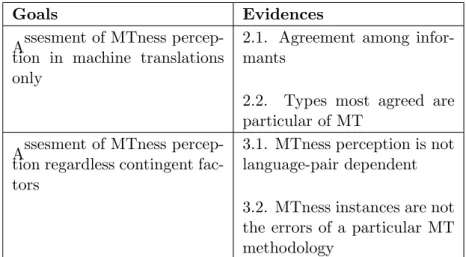
(11) List of Tables 2.1 2.2. DARPA scale for Adequacy and Fluency . . . . . . . . . . . . . . . . . . . 15 Advantages of MTC compared to HTC evaluations . . . . . . . . . . . . . 27. 3.1 3.2 3.3 3.4 3.5. Goals and evidences of the experimental study . . . . . . . Data about the age of informants . . . . . . . . . . . . . . . Data about the educational level of informants . . . . . . . Data about the sex of informants . . . . . . . . . . . . . . . Goals, evidences and procedures of the experimental study .. . . . . .. . . . . .. . . . . .. . . . . .. . . . . .. . . . . .. . . . . .. 30 31 31 31 35. 4.1 4.2 4.3 4.4 4.5 4.6 4.7 4.8 4.9 4.10 4.11 4.12 4.13 4.14 4.15. Examples of NO-L2 instances . . . . . . . . . . . . . . . . . . . Examples of I-AGR instances . . . . . . . . . . . . . . . . . . . Examples of I-POS instances . . . . . . . . . . . . . . . . . . . Examples of I-VERBF instances . . . . . . . . . . . . . . . . . Examples of I-ORD instances . . . . . . . . . . . . . . . . . . . Examples of OVER-WRD instances . . . . . . . . . . . . . . . Examples of WRD-REP instances . . . . . . . . . . . . . . . . Examples of SYNT-GAP instances . . . . . . . . . . . . . . . . Examples of SEM-GAP instances . . . . . . . . . . . . . . . . . Examples of SEM-INCOH instances . . . . . . . . . . . . . . . Examples of CON-INCOH instances . . . . . . . . . . . . . . . Examples of apocopation and ser/estar CON-INCOH instances Example of a STR-CHAR instance . . . . . . . . . . . . . . . . Coincidences between MTness types and two MT-error types . Goals 2 and 3 and evidences of the experimental study . . . . .. . . . . . . . . . . . . . . .. . . . . . . . . . . . . . . .. . . . . . . . . . . . . . . .. . . . . . . . . . . . . . . .. . . . . . . . . . . . . . . .. . . . . . . . . . . . . . . .. 37 38 38 39 40 41 41 42 43 44 44 45 45 48 49. 5.1 5.2 5.3 5.4. Examples of lexical instances underlined in human translations . . . . Examples of underlined segments due to linguistic and stylistic criteria Example of disagreement in underlined segments . . . . . . . . . . . . Example of I-POS agreement . . . . . . . . . . . . . . . . . . . . . . .. . . . .. . . . .. 51 52 56 59. 6.1 6.2. Examples of lexical MTness assessment . . . . . . . . . . . . . . . . . . . 70 MTness detection methods . . . . . . . . . . . . . . . . . . . . . . . . . . 80. 7.1 7.2. SYNT-GAP instance . . . . . . . . . . . . . . . . . . . . . . . . . . . . . . 85 I-AGR instance . . . . . . . . . . . . . . . . . . . . . . . . . . . . . . . . . 86. 8.1 8.2 8.3. Sources of the syntactic refererence patterns . . . . . . . . . . . . . . . . . 92 Fluency measures mapped onto a 3-point scale . . . . . . . . . . . . . . . 96 Comparison of scatterplots for MTS and n-gram metrics . . . . . . . . . . 98 x. . . . . ..
(12) List of Tables 8.4. xi. Correlation of BLEU, METEOR, ROUGE-L and GTM with one and four references . . . . . . . . . . . . . . . . . . . . . . . . . . . . . . . . . . . . 98 8.5 Syntactically-oriented results for one reference (correlation index over 0.30 99 8.6 Comparison between MTS and syntactically-oriented metrics for four references (correlation index over 0.40) . . . . . . . . . . . . . . . . . . . . . 100 8.7 H score, MTS and n-gram metrics for Centro alrededor del cual algo rotates 101 8.8 H score, MTS and ngram metrics for Vuelo en un balón (flight on a ball) . 101 8.9 H score, MTS and n-gram metrics of Vuelo en un balón with Vuelo en un globo as a reference . . . . . . . . . . . . . . . . . . . . . . . . . . . . . . . 101 8.10 Comparison of scatterplots between the non-expert and expert group appreciations and MTS . . . . . . . . . . . . . . . . . . . . . . . . . . . . . . 105.
(13) Chapter 1. Introduction Artificial Intelligence (AI) machines are evaluated for their capacity to emulate human behaviour and they are said to exhibit intelligent behaviour if they pass the Turing test (Turing, 1950). The test is passed if the judge, confronted with output performed by a machine and by a human, cannot tell the machine from the human. A machine translation system (MTSy) is an example of a machine that emulates intelligent human behaviour. Therefore, the interest in machine translation (MT) output has lain in determining whether this output is indistinguishable from a human translator output. This is what we will call the human translationness criterion (HTC) which is applied in machine translation evaluations. Our thesis, on the contrary, will deal with the linguistic features that make machine translations distinguishable from human translations. These features contribute to what we call machine translationness (MTness) which we define as the quality of machine translations that makes them distinguishable from human translations. MTness is the flavour of machine translations, and is perceived as something odd, queer and difficult to be attributed to a human being. The ALPAC report already forecasted, in the 1960s, the impossibility for MT techonology to emulate fully human behaviour (Melby, 1995). In other words, the report warned about the inevitableness of machine translationness. This was so not only because of the state-of-the art technology of the time but also for AI limitations. AI should succeed in emulating human reasoning, inferences, communication strategies, sentiment monitoring, application of common sense, and other cognitive and communicative aspects which are widely agreed to be very difficult to attain. Since the ALPAC report MT specialists have been aware that passing the Turing test is utopian. However, features that differentiate MT systems from human translators have not deserved much attention as an object of research. Specialists consider these features as errors of the system but not all. 1.
(14) Chapter 1. Introduction. 2. errors are actually distinguishable from humans. For instance errors according to grammar normative prescriptions are common among speakers of the language. Non-human MT features especially draw the attention of Luddites1 , columnists and commentators that present absurd and hilarious translations to mock at the technological attempt to emulate a human task (Budiansky, 1998) and also to warn about its perils (Porsiel, 2011). Absurdity and foolishness in MT is even the topic of a website2 . Far from this intention, the objective of this thesis is to present errors distinguishable from human translations as an object of study and show its practical applications in ICT. Currently, machine translation systems are extensively used and popular. Machine translation has become available for everyone. By clicking a button we can translate web pages, subtitle videos on the web in different languages, understand the menu in a foreign language captured by a mobile phone, or communicate with someone whose language we do not know. For this reason MTness is also widely extended and is currently an everyday phenomenon people live with. MTness is then a phenomenon worth to be studied. In section 1.1 we will present different aspects where MTness must be taken into account and in sections 1.2 and 1.3 we will concrete what this thesis will be about.. 1.1. MTness and its importance. In this section we will demonstrate the importance of MTness in four aspects:. • Translation quality • MT use • Internet as a corpus of language use • Information retrieval. Translation quality is the absolute requirement for both human and machine translations. Specially in business scenarios, where the clients expect high-quality translations. MT use is also a key factor, not only because of its universal and free access. A very important consequence of the widespread use of machine translation is the presence of MTness as a phenomenon one must live with. We will focus on the consequences of MTness when the Internet is both taken as a corpus of language use and a source for information retrieval. This is specially important because nowadays the Internet is the principal source of information. 1 2. See (Hillas, 2009) about the negative attitude towards MT http://www.fortunecity.com/business/reception/19/index.html. [Accessed 8 April 2012].
(15) Chapter 1. Introduction. 1.1.1. 3. MTness and translation quality. MTness may seem to affect only the quality of translations generated by a machine but, in fact, it affects the quality of translations by humans as well. Some professional translators use online MT tools that free them from tiring tasks (Vlasta, 2012) and saves them time. If MT reached acceptable quality levels, human translators would become correctors of MT systems. This is unlikely to happen in careful translations in distant language pairs (e.g. patents translated from Japanese into English), but it is true for closer language pairs (say, Spanish-Catalan). However, no matter how carefully the professional translator revises the translation, a route of entry is open to MTness. There are real workflows where professionals only correct MT output. One well-known example is the daily publication of the Catalan version of the newspaper El Periódico, originally written in Spanish (Fité, 2006). The challenge of publishing separate daily editions in Spanish and in Catalan would not be possible if the translation workflow were not supported by MT, and professionals were not limited to correcting (postediting) MT output. However, the El Periódico experience is also an example of how MTness is disseminated, and scattered. MTness dissemination was especially important during the first days of publication, when the MTSy was not tuned enough and human posteditors were not yet trained to detect all the mistakes under time pressures. As MT has been used to provide other publications, websites, etc. with the Catalan and Spanish versions, readers have made public in the media their anecdotic reading of MT errors. Even the digital newspaper El Punt organised a contest. The reader who detected the most amusing MT error in the Catalan version of any publication was awarded with the Catalan version of a Tom Stoppard0 s play, translated by a renowned Catalan writer 3 . When flaws in human translations are found, the blame is often put on the MTSy that hypothetically was used by the translator. So machine translation is a sort of goat scape that may hide the translator0 s carelessness or any other circumstance. Evidences of MTness should be demonstrated (Multilizer, 2011). However research in MT has not dealt with characterizing these evidences. MT research has been more concerned in evaluating the resemblance of machine translations to human translations. That is, machine translations have been assessed on what they are not (human translations) rather than on what they really are (an output generated by a machine).. 1.1.2. MTness and MT use. Unversal and free access to MT systems facilitate the non appropiate use of this technology. For instance, language teachers often feel they are correcting a machine translation 3. http://www.vilaweb.cat/www/capde7mana/forums/ftop7?forum=2749335. [Accessed 8 April 2012].
(16) Chapter 1. Introduction. 4. instead of a composition written by a student (Sommers et al., 2006). Machine Translator Detector 4 is a tool that can be used to detect whether a text is a machine translation but MTness is not taken into account. In fact, the tool only determines how likely a text is a translation performed by one of these systems: Google Translate, Yahoo!, Babel Fish and Bing. On the other hand, it requires the text in the source language. Unfortunately, the source text is seldom available when testing if someone has not been fair. For this reason an MTness automatic detector, needless of the source text, would be as useful as plagiarism detectors to avoid inappropiate use of tools on the Web. The MTness detector would also be useful for detecting spam and phishing messages because most of them have been translated automatically with no postedition and their degree of MTness is very high. As for appropiate use, we already mentioned that translators use MT systems. We also said that translators just postedit the translation when the source and the target languages are very close and the translation quality is quite acceptable. However, close language pairs and the fact that the target document keeps the layout of the source document may have disadvantages. Errors may go unnoticed in the first and even the second reading. Here are some examples of frequently overlooked errors in CatalanSpanish translations. • The presence of the Catalan conjunction i (and) instead of the Spanish conjuction y • Corria (was running) instead of corrı́a • No preposition a before a human direct object. Other non-corrected errors come from multilingual quotations. Translators often have to translate a quotation in a language they do not know. Then the translator uses an MTSy but is not able to postedit the translation as a speaker of the language would. When the translation is published readers that do know the language complain about fragments that lead to misinterpretations 5 . Translators, teachers and other professionals who are concerned about the linguistic correctness of their publications must spend time in a through and careful postedition. This task is rarely performed in a single reading. For this reason, a postedition tool that detected MTness instances would be very useful. 4. http://www.translatordetector.com/ [Accessed 18 May 2012] http://blog.fluenthistorian.com/2011/07/05/why-you-should-not-rely-on-machine-translation/ [Accessed 16-04-2012] 5.
(17) Chapter 1. Introduction. 1.1.3. 5. Internet as a corpus of language use. For some natural language processing applications the Web is considered a large representative corpus of language use. In (Moré and Climent, 2004) and (Sjöbergh, 2006) the Web is the reference for grammar checkers, although the authors warn about the uneven quality of published contents, so the examples of use from the Web should pass idoneity conditions. Nowadays, the Web is the environment where multilingual spontaneous communication is more lively. There has been an explosion of informal, inmediate and collaborative publications (blogs, wikies, tweets, comments in social networks, and so on). MT plugins in blogs and social network environments, with a wide range of language pairs, have helped participants in a blog or a social network to overcome linguistic barriers. The fact that multilingual followers of a blog machine translate and publish their comments in the author0 s language is not spurious, even when the author0 s language is minoritarian. The author also machine translates the reply in the native language of the commentator. Authors and participants think in worldwide terms. They are aware that followers and casual readers may live anywhere and belong to very different linguistic contexts. This is the reason why blog writers who are not fluent in English machine translate their posts into this language in order to reach a worldwide target. On the other hand, there is an affective bond between the author and the follower. Both of them show interest in the other0 s culture and sometimes, as a token of respect, write in the addresee0 s language by means of MT. I was reported an experience that exemplifies this. A Portuguese artist was a follower of a blog written in Catalan. He read the posts by using an online MTSy. Then he machine translated his comments from Portuguese into Catalan, and the author replied in Portuguese, by using a MTSy, as a courtesy for having written in his native language. Twitter provides the most spontaneous, fastest and liveliest communication in Internet among individuals from all over the world. MT in tweets is regarded as an obvious feature, because MT provides the possibility to make large amounts of up-to-date information accessible for journalists, researchers and enterprises(Jehl, 2010). However, the instancy of communication and the awareness that a tweet0 s life is very short do not favour people to correct the MT output. Besides, as in the case of posts in blogs, the authors do not have the knowledge of the language to postedit the messages. So machine translated tweets contribute to spreading MTness throughout the Web. MTness is becoming more and more present on the Web and developers of linguistic services that take the Web as a corpus are aware of this. One example is the bilingual online dictionary service Linguee that shows contexts of use of a word or phrase in the.
(18) Chapter 1. Introduction. 6. source language and pairs each context to its translation in the target language. Both source and target contexts are retrieved from publications on the Web. The context pairs are filtered according to a machine-learning algorithm that distinguishes good and bad contexts. Translations with MTness are among the bad contexts. One thing the engine learned is that web sites with the word Wordpress are likely to have been translated by an MTSy so they are not good contexts1 . Not only is this criterion too radical (all published post in Wordpress, machine translated or not, become not good) but also discriminates posts that have been correctly postedited. Inmediate and non revised publications on the Web causes a paradox exemplified in the consequences of Google Translate0 s success. Google0 s MT system also uses the Web as a corpus. It learns to translate from the huge number of Web documents parallelised with their translations. When the learning corpus contains documents translated by the system itself, and these documents have MTness instances, the engine is also learning to translate as machines do. To overcome this paradox is a challenge for Microsoft researchers to enhance their technology by solving the deadlock of their competitorGoogle. Therefore, (Rarrick et al., 2011) present an algorithm that identifies machinetranslated content in Webscraped parallel corpora. The main goal is to clean polluted corpora for training statistical MT systems, and they suggest the application of the algorithm for improving search engines. Another motivation for filtering out machine translated sentences in Web parallel corpora is to obtain resources for training statistical MT systems when there are few available billingual parallel corpora (Antonova and Misyurev, 2011). Although (Rarrick et al., 2011) say that for high-density languages (such as English, Japanese, German), only a small percentage of web pages are generated by MT systems, the percentage of non-revised machine translated sentences they found in parallelised web pages was considerable (15%). For low-density languages, the numbers increase dramatically. For instance, the same authors estimated that nearly 50% among all Web content (not only bilingual) in Lithuanian was machine translated. So MTness is a significant problem that affects not only multilingual communication on the Web but also threatens the presence of minority languages and languages with fewer resources than the ones with high presence in the Internet.. 1.1.4. MTness and information retrieval. Nowadays there is strong concern about retrieving information from informal, collaborative and inmediate communication spaces (social networks, blogs, wikies). We highlight 1. http://www.linguee.com/english-spanish/page/about.php?source=ES [Accessed 09-03-2014].
(19) Chapter 1. Introduction. 7. two reasons in particular. The first one is the fact that blogs and wikies are becoming references to explore specific subjects in detail. The second reason is the commercial interest in sentiment analysis, that is, in determining opinions about a product or service. Therefore there is interest in retrieving information from sources that are, as we have seen before, vulnerable to MTness. Although participants in a collaborative project control the quality of a publication, MTness can momentarily misguide the readers. For instance, a Wikipedia entry which is the machine translation of the same entry in a different language. If the translation is non-revised, MTness may mislead readers until errors are fixed by a contributor. Nowadays, it is possible for a visitor to read los Bocados (the Bites) in the Spanish translation of a Catalan blog, wiky or tweet, referring to the Mossos d0 esquadra, the police guard in Catalonia, just because Mossos is also the plural of Mos which means 0 bite0 .. As long as this error is not fixed many people may believe that policemen in. Catalonia are known in Spain as los Bocados. MTness on the Web is also a challenge for search engines. The quality of the search results depends on the quality of the documents found. In a competition between search engines (Google, Yahoo, Bing) the filtering of odd documents is crucial. In fact, Google noticed that if they continued to permit the massive and indiscriminate use of their Google Translate API they were shooting themselves in the foot, because non-postedited contents would impact negatively on the results of their search engine. As Kirti Vashee says (Vashee, 2011) Google is in reality polluting its own drinking water. In sentiment analysis, the algorithms that detect opinions are based on the recognition of words that connote appreciation, satisfaction or, on the contrary, rejection, or disappointment. Here MTness may mislead. Imagine someone reads the following headline in a Spanish newspaper: el Máster de Software Libre se fue a hacer puñetas hace 1 mes (the Master in Free Software went to hell one month ago) when the real meaning was that the Master in Free Software started one month ago, just because the Catalan verb 0 engegar0 was mistranslated. The reader has the wrong idea that the Master was a failure, and the negative consequences of this interpretation for the institution that organized it are obvious. An MTness detector, as a module of an evaluator of Web publications would be very interesting to improve search results, information retrieval and dissuade people, in the middle and long term, from the nocive and abusing use of MT..
(20) Chapter 1. Introduction. 1.2. 8. MTness as a field of research and a novel proposal for MT evaluation. In this thesis we deal with MTness in translation quality. Our objectives are to characterize MTness from a linguistic point of view and to suggest a method of determining how machine-like a translation sounds. Scoring the MTness of a translation would help to prevent the negative consequences of MT use and abuse we explained in the previous section. The thesis puts MTness into the light of a research object and also presents a novel proposal for MT evaluation. MT evaluation is currently based on the HTC. Therefore MTness is not the focus of research yet. Actually MT evaluation research is focused on overcoming the following drawbacks:. Expensive Methodologies Human evaluations are very costly in money and time. The conditions to get reliable results demand the designing of the evaluation procedures, hiring more than one evaluator, training them, selecting appropriate translations for the evaluation corpus, compiling and analysing data, and so on. Actually, automatic evaluations appeared as a cheap alternative to human evaluations. However, many human translations are needed in order to assess whether the MTSy0 behaviour is distant or close to a human translator0 s behaviour. Compilation and revision of these human translations also require high costs. Not fully reliable results Translation quality perception is very subjective. Therefore the results in human evaluations must be presented noting the subjectivity of human judgements. In automatic evaluations, it has been proved that metrics do not provide a global measure of quality (Giménez, 2008). They focus on partial aspects, such as lexical choice but are not suitable to capture the quality at the sentence level (Blatz et al., 2003) and (Turian et al., 2003). Even the assumption of the reliability of a measure may lead to wrong conclusions about the quality of a system (Callison-Burch et al., 2006). The rationale for calculating metrics seems not to correspond to a well defined explanation of human translationness nor translation quality perception by humans. Non-reusable results In human evaluations, the judgement about the quality of a translation is represented by a numerical score. Scores by themselves say very little about problems that should be solved and improvements. On the other hand, the current guidelines for human evaluations suggest that the system should be evaluated in its context of use. Therefore evaluations in different contexts of use become different problems and the data obtained in one evaluation are difficult.
(21) Chapter 1. Introduction. 9. to be reused in another. In automatic evaluations, the metrics also say very little about things to be improved and the type of errors a system generates.. Our proposal is to face MT evaluation not by measuring qualities of something translations are not (human translations) but, on the contrary, by measuring features of what they really are (translations generated by a machine). MTness features are machineidiosyncratic features so our approach lies on an assumption we call the machine translationness criterion (MTC) which, informally, can be expressed as the less MTness in a machine translation, the better. This is so because, as we said before, texts with MTness are odd and queer. The main contributions of this thesis in this research line are:. machine translationness score (MTS) MTS indicates the degree of MTness in a translation. Contrary to HTC scores, MTS indicates how far translations are distant from human translators0 behaviour. Therefore, this score can be straightforwardly interpreted in terms of translation quality. The higher the score, the worse the translation is. Multi-task evaluations MTC evaluations can be performed for tasks other than testing MT systems (detection of inappropiate use of MT, quality evaluation of Web contents, reliability evaluations of information retrieval) Cheaper evaluations MTC evaluations can be performed automatically, with free and open-source resources, and need not collect nor generate human-made translations. Cost-saving is remarkable and evaluations can be performed on-the-fly. Reliable evaluations MTC is intuitive and widely agreed, and MTS values are more informative about translation quality than values of HTC metrics. Reusable results MTC evaluation results are obtained by a previous detection of MTness instances in the translation. The MTness instances detected are data that can be reused in an automatic postedition module and are straight evidences of the system0 s errors that need to be solved in new versions. Another side of this thesis is the linguistic study on MTness features. This study has been necessary for the detection of MTness instances. Besides, the study provides a novel theoretical insight to MT, and opens up new paths in other fields of knowledge (psycholinguistics, artificial intelligence, cognitive linguistics) The main contributions of this study are:.
(22) Chapter 1. Introduction. 10. Experimental work about MTness perception Although much has been said about queer, odd and foolish MT translations our study contributes in determining what linguistic features cause astonishment. MTness Typology A linguistic typology of MTness instances has been established from real MTness perceptions. Apart from the interest in typifying the linguistic features that make translations sound machine-like, it serves to discriminate MT errors as those critical (MTness errors) and not-so-critical, which helps developers to focus in solving the errors with most impact.. 1.3. Organization and overview. This thesis has three parts. The first part deals with MTness as a topic of research. The second part is about our proposal of evaluating translation quality by measuring MTness. We explain the method and the resources needed to calculate the MTS, and discuss the results obtained in an experiment carried out to evaluate the proposal. Reusability of the results for other tasks such as postedition or detectors of inappropiate use of MT will also be discussed. Finally, the third part is devoted to the conclusions and future work. The thesis is organized as follows: Part 1 Chapter 2: Contextualization of MTness in the MT Evaluation problem and advantages of our approach. Chapter 3: Experimental study of MTness Chapter 4: MTness typology Chapter 5: Discussion about MTness perception Part 2 Chapter 6: MTness automatic detection Chapter 7: Calculation of the MTS score Chapter 8: Experimental evaluation of our proposal Part 3 Chapter 9: Conclusions and future work.
(23) Chapter 2. Evaluation of MT Quality and Machine Translationness In this chapter we put the concept of machine translationness (MTness) in the light of machine translation evaluation (MTE), and remark the relevance of MTness rating in terms of a novel methodological approach. Although the first MTE campaign for the ALPAC already disclosed the wide gap between human and machine translators, machine translations are still evaluated as if they were human translations. In fact, two of the most important MT quality items- target language fluency and fidelity to the original- are the outcomes of human capacities: language proficiency and understanding. Unfortunately human MT evaluation (HMTE) (HMTE), especially the criteria for scoring these items, are very subjective and vary among evaluators. The procedures to obtain as many reliable and objective data as possible have increased the costs of HMTE in time and money. As an alternative, automatic MT evaluation (AMTE) performs methods that lower costs and establish metrics whose values are not subjective perceptions. These methods have been based on the assumption which is stated in the following terms: a machine translation is as better as similar to a human translation of the same original. Other approaches have appeared, such as the ones based on the human-likeness assumption, that is a machine translation is as better as more human-like is. Costs have been reduced, development cycles of MT systems have been accelerated, but the reliability of these assumptions have not been critically analysed. This chapter summarizes MTE and puts our proposal in context. Our proposal is to state the machine translationness criterion (MTC) which is the criterion by which a machine translation is evaluated according to qualities of machines. This criterion is distinguished from the human translationness criterion (HTC), which is the criterion 11.
(24) Chapter 2. Evaluation of MT Quality and Machine Translationness. 12. on which MT evaluation methods have been based so far. HTC-based methods score qualities of human beings in machine translations. The chapter is organised as follows. In section 2.1 we will overview the methods based on HTC. In section 2.2 the shortcomings of HTC-based methods will be discussed and in section 2.3 we will present the contributions of the MTC proposal.. 2.1. HTC Methods. In this section we will overview the methods based on the HTC. First we will present the HTC in human evaluations and then in automatic evaluations. The presentation will be organized in a chronological order. This will help us to explain how quality rating in machine translation has changed and how evaluation methods have adapted to these changes.. 2.1.1 2.1.1.1. HTC in human evaluations ALPAC Evaluation. In 1966 the ALPAC report informed the sponsors of machine translation in the United States about the prospects of this technology. The report described how mature MT systems, especially the systems sponsored, were in reducing translation costs from Russian into English. The ALPAC report is well known because of its pessimistic prospects (Hutchins, 1996), which marked a turning point in MT evolution. But, apart from that, the ALPAC aimed to confectionate a report according to well-grounded and standardintended evaluation procedures. The experiments performed, explained in (Carroll, 1966), were designed to know whether MT could satisfy the demands of human translation, especially those regading intelligibility and fidelity to the source. The ALPAC evaluation was based on the HTC because it implied the performance of a Turing test: both machine and human translations were presented to evaluators and, although they were told about the existence of machine translations, they did not know whether the translation to evaluate was human or not. Evaluators scored intelligibility and fidelity with the numerical values of a scale. The scale for intelligibiliy had 9 values and the scale for fidelity had 10 values. In the case of intelligibility, each numerical value corresponded to a subjective appreciation when reading the translation. For instance, this is the description of the value corresponding to the generally unintelligible appreciation: it tends to read like nonsense but, with.
(25) Chapter 2. Evaluation of MT Quality and Machine Translationness. 13. a considerable amount of reflection and study, one can at least hypothesize the idea intended by the sentence. As for fidelity, the grades corresponded to the informativeness appreciated when monolingual and bilingual evaluators had to compare the translation to a reference. For bilingual evaluators, the reference was the source and for monolingual evaluators the reference was a human translation of the same source. Most informative translations were regarded as translations with the lowest fidelity, because their interpretation was different from the interpretation of the reference. Accordingly, the least informative translations were those with the highest fidelity, because their interpretation did not deviate from the source. The use of scales was an important contribution, among other methodological proposals such as the association between subjective appreciations and objective measures. For instance, time reading was associated to intelligibility (unintelligible translations demand more reading time). Another important contribution was the participation of monolingual and bilingual evaluators in order to know how the knowledge of the source language influenced the intelligibility and fidelity appreciations. Lastly, some recommendations already indicated the costs of the methodology. For instance, three or four evaluators were recommended to be used.. 2.1.1.2. The Van Slype Report. In 1979 the Marcel van Dijk Bureau wrote a report (Slype, 1979) for the European Commission with two objectives: firstly, to recommend the best methods to evaluate the SYSTRAN system, which was the system used by the Commission, and secondly, to assist in designing progress evaluations during the development of the MT system sponsored by the Commission (the EUROTRA Project). The report puts an accent on the importance of establishing what the evaluation was for. So two types of evaluation were defined, depending on the finality: the macroevaluation and the microevaluation. The macroevaluation measures translation quality (inteligibility, fidelity and acceptability), which is consistent with the HTC, along with economic items (reading time and correction time), and is performed to validate a new system version or compare it with other systems. The microevaluation identifies translation errors and provides information to plan the production of an improved version of the system. In constrast with (Carroll, 1966), the report suggested scales for intelligibility with just 4 grades, from complete unintelligible to very intelligible (basely and fairly intelligible in.
(26) Chapter 2. Evaluation of MT Quality and Machine Translationness. 14. between). Fidelity was also measured with a 4-grade scale with descriptions ranging from completely or almost completely unfaithful to completely or almost completely faithful. As for acceptability, this item indicates the shift from the Turing-test oriented evaluations to the context-of-use orientation the report points out. Acceptability is measured by asking the evaluator whether the translation quality is acceptable, taking into account the fact that the translator is a machine, and appreciating its capacity to perform fast translations and its suitability to the context of use.. 2.1.1.3. The JEIDA contributions. In the 1980s, machine translation in Japan was emerging. The electronic industry was growing and exportation demanded the fast translation of huge amounts of documentation, user guides, and so on. In 1988 The Japan Electronic Industry Development Association (JEIDA) commissioned a report on the machine translation state of the art from 1966 onwards (Nagao, 1989). The report actually took the ALPAC report as a refence, which was explicitly stated in the title A Japanese view of machine translation in the light of the Recommendations and Considerations Reported by ALPAC, U.S.A.. The conclusions of the JEIDA report were diametrically opposed to the ALPAC conclusions. Despite limitations in linguistic coverage, JEIDA reccomended to invest in machine translation because state-of-the-art systems were useful, and able to provide the gist of a topic so that the user could understand it without much effort. According to the report, systems were capable of satisfying a 800 billion ien market. Therefore utility displaced the human versus machine translator comparison as a basis for evaluations. In the early nineties, the JEIDA worked on creating an evaluation method that answered the question is it worth working on machine translation? (JEIDA, 1992). This method had to consider all the necessary costs and confront them with profits. After modelling the user context, a number of questions were elaborated to be answered by evaluators. The questions were associated to the parameters of the user context model (translation needs, type of document, language pairs, time, installation conditions, etc.). The best system was the one that best fitted the user context model. Besides, the method also measured the relationship between the action of the system and the user0 s satisfaction.. 2.1.1.4. The DARPA Evaluation Campaigns. In 1991 the DARPA (Defense Advanced Research Projects Agency) wanted to establish a methodology of evaluation that was suitable for any system, regardless the language pair, translation environment, and engine (rule-based, statistical or human/not human.
(27) Chapter 2. Evaluation of MT Quality and Machine Translationness. 15. assisted) ((White, 1994), (White, 1995)). The aim was to attain an overview of the translation quality of the systems they sponsored, which were quite heterogeneous. Intelligibility and fidelity were the main translation qualities because their appreciation is independent from the language pair, the use context and the engine method. Fidelity was measured according to two criteria: adequacy and informativeness, whereas intelligibility was measured according to fluency. Adequacy was the degree in which a segment of the machine translation kept the meaning of the source segment. Informativeness was the degree in which the translation contained enough information to ask about. In order to measure this, evaluators had to answer some questions about the content of the text. Finally, fluency was the degree in which the translation was well formed according to the grammar rules and conventions of use in the target language. Both adequacy and fluency were graded in a 1-5 scale as is shown in table 2.1. Score 5 4 3 2 1. Adequacy All information Most Much Little None. Fluency Flawless English Good Non-native Disfluent Incomprehensible. Table 2.1: DARPA scale for Adequacy and Fluency. The DARPA evaluation campaign carried out in 1994 disclosed the problems of HTC evaluations based on subjective appreciations. There was little agreement in the subjective appreciations, so many data had to be collected and interpreted in order to get significant results. Besides, the costs were significant. For instance, each source was translated by a human translator because evaluators were not bilingual and had to appreciate adequacy by comparing the machine translation with the human translation. The size of the evaluation corpus augmented with the addition of human translations, which were used as control segments to assure that the appreciations were consistent regardless of the origin (human or machine). The process was slow and expensive. Many evaluators were involved, many translations had to be evaluated, and many human translators were enrolled to produce the human version for each machine translation. However, despite the efforts, the data obtained from human assessments were difficult to reuse. Yet a positive outcome was the huge corpora of machine translations paralleled with human translations..
(28) Chapter 2. Evaluation of MT Quality and Machine Translationness 2.1.1.5. 16. The FEMTI. In 1993 the European Commission was concerned in standarising linguistic technology production in order to speed up the creation of new products and their transfer to other projects. The Expert Advisory Group on Language Engineering Standards, known as EAGLES, was created and an evaluation working group designed a common method to evaluate natural language processing systems and products. For MT technology, evaluations assess systems according to HTC quality standards (consistency, fidelity, wellformedness, etc.), and also guide potential consumers to decide which system to use. Assessment and guiding criteria focus on the suitability of systems to their specific purpose, following the trend of previous approaches such as JEIDA0 and Van Slype0 s and especially the ISO 9126 standards (ISO, 1991). Even bad and crummy machine translations are considered to be acceptable if front-end users prefer to postedit them rather than translating from scratch (Church and Hovy, 1993) as Wagner already said in 1985 when considering postedition costs of Systran systems (Wagner, 1985). The evaluation framework for machine translation systems is the FEMTI1 , which guides evaluation according to the context of use (Hovy et al., 2002a); (Hovy et al., 2002b)). For instance, in (Bruckner and Plitt, 2001) the evaluation is set in an evironment where translation memories are used. The FEMTI organizes quality features in taxonomies (Popescu-Belis et al., 2001). The features of one taxonomy defines the use of the system (e.g. user profile, task, input). The second taxonomy defines the characteristics of the machine translation system. The taxons of the second taxonomy are pointed from taxons of the first taxonomy, and have metrics and measures which indicate the suitability of the system to the context of use. The more positive values, the better the system. The evaluation leader can choose the most suitable method to obtain these values. The FEMTI provides a collection of methods for each taxon. Although FEMTI provides well-defined guidelines to perform an evaluation, the taxonomies and the pointing from axons from the first taxonomy to the second reflect the complexity of a rigurous method of human evaluations. Standard procedures demand costly actions (e.g. methods that avoid subjectivity, impact calculation of lexical and semantic errors (Marrafa and Ribeiro, 2001)).. 2.1.2. HTC in automatic evaluations. Automatic evaluations appeared as an alternative to human evaluations, which proved to be very expensive in time and money and the results were not as objective as they 1. http://www.isi.edu/natural-language/mteval/.
(29) Chapter 2. Evaluation of MT Quality and Machine Translationness. 17. were expected (c.f. 2.1.1.4). Since the early 2000s, automatic evaluation methods have been used to obtain objective and reliable results in a very short time. In this section we will explain three assumptions that have supported automatic evaluation methods so far:. • The Reference Proximity Assumption (RPA) • The Accuracy Assumption (ACA) • The Human Likeness Assumption (HLA). These assumptions are relevant because, as we will explain more fully in this section, they are the principles on which the main state-of-the-art methods of automatic evaluations are based. Finally we will discuss how translation quality is assessed in automatic evaluations.. 2.1.2.1. The Reference Proximity Assumption (RPA). The reference proximity assumption (RPA) is formulated as follows: the closer a machine translation is to a professional human translation, the better it is (Papineni et al., 2002). The human translation of the original is the quality reference to evaluate the machine translation, in the same way as the human translation was also the reference for evaluating fidelity and adequacy in ALPAC and DARPA methods (c.f. 2.1.1.1 and 2.1.1.4 ) The quality degree is expressed with a metric obtained by an objective method: the distance between the machine translation, called hypothesis, and the human translation, called reference. a) Translation reference and legitimate translation variations If the distance were calculated with only one reference, good translations would be unfairly assessed as bad translations because legitimate translation variations (LTV) have not been taken into account. For instance, a hypothesis where words appear in a different order from the reference can be a legitimate variation. Let’s see the example of the hypothesis in Catalan li agrada la xocolata (’he likes chocolate’) and the reference la xocalata li agrada (’he likes chocolate’). Both translations are good but the different word order would penalise the hypothesis if LTV were not considered..
(30) Chapter 2. Evaluation of MT Quality and Machine Translationness. 18. b) Metrics for measuring the distance between the hypothesis and the reference The most common metrics are the ones called n-gram metrics, or methods based on the lexical similarity between a machine translation and one or more human references. We will summarise them according to the groups of measures explained in (Giménez, 2008). b.1) Edit Distance Measures Edit Distance Measures are based on the number of changes to be applied to convert the machine translation into a reference. The most used metrics is the WER (Word Error Rate) (Nießen et al., 2000). WER is the Levenshtein distance (Levenshtein, 1966), which is the calculation of the minimum number of substitutions, deletions and insertions to be performed to convert the machine translation into a reference. WER, however, does not permit reordering of words, which is a drawback when facing LTV. So the PER (Position-Independent Word Error Rate) (Tillmann et al., 1997) is used when the edit distance is calculated regardless of word order. Another solution for the LTV handicap is to calculate the distance of the hypothesis by collecting a set of references, as the mWER does. The mWER (multiple Word Error Rate) is calculated by obtaining the Levenhstein distance of the hypothesis with respect to each reference and the final result is the shortest distance. Another measure based on the Levenhstein distance with multiple references is RED (Ranker based on Edit Distances) (Akiba et al., 2001). b.2) Precision-oriented Measures These measures convey the proportion of n-grams in the hypothesis which are also present in a set of reference translations. The number of items in the n-gram generally ranges from 1 to 4 words. Therefore, the calculation of these measures is based on precision with respect to a representative sample of legitimate translations. BLEU (Bilingual Evaluation Understudy) (Papineni et al., 2002) has become the standard in automatic evaluation. In figure 2.1 an example of BLEU calculation is shown (Way, 2004). In this calculation, the precisions of unigrams (p1 ) bigrams (p2 ), trigrams (p3 ), and so on are combined. On the other hand, a brevity penalty factor (BP in the figure) is introduced for hypotheses that are shorter or as long as references, just to avoid examples such as the the the being regarded as good. The National Institute for Standards and Technology (NIST) (Doddington, 2002) created the NIST, which is very similar to BLEU but weighs n-grams that are not very frequent because they afford high informativeness. Another criterion to weigh n-grams is statistical salience (Babych and Hartley, 2004), such as tf.idf for relevance and S-Score.
(31) Chapter 2. Evaluation of MT Quality and Machine Translationness. 19. An Example MT Hypothesis: the gunman was shot dead by police . – Ref 1: The gunman was shot to death by the police . – Ref 2: The gunman was shot to death by the police . – Ref 3: Police killed the gunman . – Ref 4: The gunman was shot dead by the police . • Precision: p1=1.0(8/8) p2=0.86(6/7) p3=0.67(4/6) p4=0.6 (3/5) • Brevity Penalty: c=8, r=9, BP=0.8825 • Final Score: 4 1 × 0.86 × 0.67 × 0.6 × 0.8825 = 0.68. Figure 2.1: Example of BLEU calculation (Way, 2004). for the degree of pertainance of a n-gram to a specific document. As salient n-grams are expected to be common in all translation variations, the method allows to consider just one reference. Since (Papineni et al., 2002) experiments have been carried out to prove that values correlate with HTC-based quality perceptions. This correlation is interpreted as human acceptability (Giménez, 2008). b.3) Recall-oriented measures Recall-oriented measures compute the proportion of n-grams in the references covered by the hypothesis. The aim is to capture translation quality, especially fluency, at onesentence level, not at multi-sentence level as precision-oriented measures do. ROUGE (Recall-Oriented Understudy for Gisting Evaluation) is a recall-oriented measure ((Lin, 2004), (Lin and Och, 2004a)) that was compared with BLEU, NIST, WER and PER for the ORANGE (Oracle Ranking for Gisting Evaluation) method, a method to automatically evaluate automatic metrics (Lin and Och, 2004b). ROUGE is, in fact, a package of measures (ROUGE-L, ROUGE-W and ROUGE-S) based on two notions: the longest common sequence (LCS) and the skip-bigram co-occurrence. A sequence S is a subsequence from another sequence Z extracted by eliminating some of the elements of Z but not altering the relative position of the remaining elements. For instance,.
(32) Chapter 2. Evaluation of MT Quality and Machine Translationness. 20. [<¡B, C, D, B>] is a subsequence of [<A, C, B, D, E, G, C, E, D, B, G>] As we see, elements of the subsequence are not necessarily contiguous with respect to the sequence Z. As for common subsequence, given two sequences X and Y, G is a common subsequence of X and Y if G is a subsequence of X and Y as well. Finally, the LCS will be the longest common subsequence of X and Y. The intuition is that the longer the LCS of two translations is, the more similar the two translations are. On the other hand, the more consecutive matched elements in the LCS the better. So, given a set of hypothesis to evaluate, the one with the longest LCS, with more consecutive matched elements (ROUGE-L), will be the best. ROUGE-W is a metric that favors consecutive LCSes. As (Lin and Och, 2004b) point out a skip-bigram is any pair of words in their sentence order, allowing for arbitrary gaps. Skip-bigram co-occurrence statistics measure the overlap of skip-bigrams between a candidate translation and a set of reference translations. Therefore the more co-occurrent skip-bigrams the better (ROUGE-W). ROUGE intends to capture differences in fluency due to grammatical structure. For instance, let0 s see the following example: S1 (Reference): police killed the gunman S2 (Hypothesis): police kill the gunman S3 (Hypothesis): the gunman kill the police ROUGE-L scores better S2 than S32 . However, the BLEU value for bigrams would be the same. b.4) Measures combining precision and recall When the hypothesis is equal to a reference both precision and recall are also equal, so the highest matching degree between hypothesis and reference corresponds to a good translation. When there is no coincidence, the F-measure is taken into account because it indicates the degree of precision and recall. The F-measure is the key value for metrics such as GTM (General Text Matching) and METEOR. GTM (Melamed et al., 2003) relates precision and recall in unigrams. METEOR ((Lavie et al., 2004), (Banerjee and Lavie, 2005)) also accounts for word ordering and calculates matchings between hypothesis and references in lemmas and synonyms, based on WordNet (Fellbaum, 1998). 2. ROUGE allows for word-stemming, as in kill and killed.
(33) Chapter 2. Evaluation of MT Quality and Machine Translationness. 21. Other measures are BLANC (Broad Learning and Adaptation for Numeric Criteria) (Vlad et al., 2005) and SIA (Stochastic Iterative Alignment) (Liu and Gildea, 2006). b.5) The syntactic approach Translations should be evaluated as wrong because of their ungrammaticality. However, all the n-gram metrics have difficulties in capturing grammaticality at the sentence level. (Liu and Gildea, 2005b) present a method to calculate fluency based on a previous syntactic representation of the sentence, which is a dependency tree. The method is based on the notion of HWCM (Head Word Chain Matching), and calculates the fraction of matching head word chains of a given length between the hypothesis and the reference trees. A headword chain is defined as a sequence of words which corresponds to a path in the dependency tree. HWCM has variants, such as the ones in the Asiya MT Evaluation Toolkit4 , which distinguish HWCM of words (HWCM-w), grammatical relations (HWCM-r) and grammatical categories (HWCM-c). So DP-HWCMw-4 retrieves the matching proportion of length-4 word chains and DP-HWCMc-3 computes average accumulated proportion of category chains up to length 2. Other variants are provided by (Amigó et al., 2006), who present the following three metrics:. • TREE: overlapping between the words hanging from non-terminal nodes of a type tree, for instance a predicate of a clause • GRAM: overlapping between the words with a gramatical category, for instance the word overlapping between adjectives or adverbs • LEVEL: overlapping between the words hanging at a certain level of the tree, or deeper.. 2.1.2.2. The Accuracy Assumption (ACA). The accuracy assumption (ACA) can be explained in these terms: good translations are those that are accurate with respect to the source or the translation reference in the sentence level. Evaluating sentence accuracy is not new as we have seen in human evaluations. The novelty is the automatic calculation of semantic similarities between machine translations and references(Giménez and Márquez, 2008). The similarities are over named entities, semantic roles and other basic items of a semantic tree. 4. http://asiya.lsi.upc.edu/.
(34) Chapter 2. Evaluation of MT Quality and Machine Translationness. 22. Semantic analysis still have several drawbacks. On the one hand, semantic parsers have been mainly developed for English and Chinese ((Palmer et al., 2005), (Fung et al., 2006), (Liu and Gildea, 2005a)). Therefore, this approach cannot be performed for other languages until reliable semantic parsers are produced. On the other hand, the approach is very complex, and, as (Lo and Wu, 2010a) consider, semantic labels are difficult to annotate automatically and deterministically. Therefore, Lo and Wu suggest the utility approach. This approach consists in transferring to humans the task of checking whether the most basic items in the semantic analysis of the machine translation are properly translated. By doing this, humans evaluate whether the translation is useful for a reader to succesfully understand at least the basic event structure (who did what, to whom, when, where, and why). This reduces the costs of collecting references (luwo2011).. 2.1.2.3. The Human Likeness Assumption (HLA). A methodological alternative to evaluating with reference translations is based on the human likeness assumption (HLA). According to the HLA, a machine translation that resembles a human translation is good. A method based on the HLA evaluates translation quality straightforwardly, and does not depend on an indirect procedure such as the comparison between the translation and a set of reference strings. On the other hand, (Reeder, 2001) says that there is no need to compile a huge amount of output to distinguish a system that performs like a human the same way as there is no need to read many texts to distinguish a native speaker from a learner. So the assumption suggests saving the costs of elaborating reference translations and confectioning huge evaluation corpora. We will present two HLA strategies. The first one consists in regarding evaluation as a classification problem. A human/non human translation classifier is trained to perform this task. The second strategy, despite not being strictly based on RPA, takes advantage of RPA measures to identify the features that make machine translations resemble human translations. a) Human/non-human translation classifier The strategy turns evaluation into an automatic classification problem. Given a translation, how exact is our prediction about its human/non-human nature? The evaluator would emulate the human capacity of distinguishing a human translation. In fact, the proposal is the counterpart of a Turing Test: it is the machine, not a human being, the one who must recognise a human translation (Jones and Rusk, 2000))..
Figure
+7
Documento similar
Using additional measure- ments of the power consumed by the CNC machine and a model that is based on experimental curves that relate this power consumption and the surface roughness
We reviewed and highlighted the significance of big data analytics for personalized medicine and health care by focusing mostly on machine learning perspectives on
To sum up, the data collected for each segment includes the Spanish source segment, machine translation into English, its English post-edited version, its annotation based on
Our approach is based on a previous monolingual extraction of term candidates in each language, the creation of candidate bigrams from both segments of the same translation unit, and,
After a deep study of the state of the art for the task of person detection, it has been possible to train a neural network based on the Yolo v2 detection, using MobileNet and Tiny
Key words: machine translation, technology, foreign language teaching and learning, academic dishonesty, Google Translate Joan Clifford.. Lecturer in the Department of Romance
Abstract: This paper presents the process required to implement a data driven Predictive Maintenance (PdM) not only in the machine decision making, but also in data acquisition
Due to the fact that the dynamic performance of the machine depends strongly on its inductances, some basic dimensions of a real machine are used and a comparison between
