i
Facultad de Humanidades y Educación
Magíster en la Enseñanza del Inglés como Lengua Extranjera
THE PROCESS OF LEARNING ENGLISH AS A FOREIGN LANGUAGE THROUGH THE INTERACTIVE METHODOLOGY OF THE DIALOGIC PEDAGOGY “ENLAZANDO
MUNDOS” IN A VULNERABLE SCHOOL CONTEXT LOCATED IN PENCO.
Thesis submitted in partial fulfillment of the requirements for the degree of
Master of Arts in TESOL
MÓNICA PAULINA SALCEDO HERNÁNDEZ Thesis Advisor: Cecilia Bastías Díaz.
ii
iii
ACKNOWLEDGEMENTS
iv
TABLE OF CONTENTS
CHAPTER 1: BACKGROUND OF THE STUDY ... 8
1.0.INTRODUCTION ... 8
1.1.RATIONALE OF THE STUDY ... 12
1.2.SIGNIFICANCE OF THE STUDY ... 14
1.3.OBJECTIVES AND RESEARCH QUESTIONS ... 15
1.4.ORGANIZATION OF THE STUDY ... 16
CHAPTER 2: CONTEXTUAL FRAMEWORK ... 17
2.0. INTRODUCTION ... 17
CHAPTER 3: THEORETICAL FRAMEWORK ... 21
3.1.DEVELOPMENT OF LANGUAGE SKILLS ... 21
3.2.EFLTEACHING METHODS AND APPROACHES ... 21
3.3.LEARNING STYLES... 23
3.4.INTERACTION AND COMMUNICATION... 25
3.5.EFLCOMMUNICATIVE COMPETENCE ... 26
3.6.COMMUNICATIVE ACTIVITIES AND TASKS ... 27
3.7.DIALOGIC PEDAGOGY “ENLAZANDO MUNDOS” ... 28
3.8.INTERACTIVE TECHNIQUES ... 32
3.9.TRANSFORMATION ... 34
3.10.MOTIVATION ... 36
CHAPTER 4: METHODOLOGICAL FRAMEWORK ... 38
4.1.QUALITATIVE PARADIGM ... 38
CHAPTER 5: ANALYSIS AND DISCUSSION ... 47
5.1.SEMI-STRUCTURED INTERVIEW RESULTS ... 47
5.1.1. Category 1: Role of collaborators... 48
5.1.2. Category 2: Facilitation of Communication... 52
5.1.3. Category 3: Effectiveness of Activities ... 54
5.1.4. Category 4: Interactive lesson planning ... 55
5.1.5. Category 5: Advantages and Disadvantages of the Interactive Methodology ... 56
5.1.6. Category 6: Relationship between students and collaborators ... 60
5.2.FOCUS GROUP RESULTS ... 63
5.2.1. Category 1: Activities ... 64
5.2.2. Category 2: Oral production ... 64
5.2.3. Category 3: Learning Opportunities ... 65
v
5.2.5. Category 5: Materials ... 67
5.2.6. Category 6: Roles and Functions ... 68
CHAPTER 6: CONCLUSIONS AND PROJECTIONS ... 71
6.1.SPECIFIC OBJECTIVE 1:“TO IDENTIFY THE ROLE OF THE STUDENTS AND LANGUAGE COLLABORATORS INVOLVED IN THE PROCESS OF LEARNING ENGLISH AS A FOREIGN LANGUAGE THROUGH THE INTERACTIVE METHODOLOGY” ... 71
6.2.SPECIFIC OBJECTIVE 2:“TO DETERMINE THE PERCEPTION OF THE STUDENTS INVOLVED IN THE CONTEXT OF THE INTERACTIVE METHODOLOGY” ... 73
6.3.SPECIFIC OBJECTIVE 3:“TO DESCRIBE THE RELATIONSHIP THAT IS ESTABLISHED BETWEEN THE STUDENTS AND THE COLLABORATORS IN THE CONTEXT OF THE INTERACTIVE METHODOLOGY” ... 75
6.4.PROJECTIONS ... 77
6.5.FURTHER INVESTIGATION ... 78
REFERENCES ... 79
LINKOGRAPHY ... 81
ANNEXES ... 87
ANNEXA:SEMI-STRUCTUREDINTERVIEWFORCOLLABORATORS ... 88
ANNEXB:FOCUSGROUP ... 89
ANNEXC:CONSENTLETTERPARENTS ... 90
ANNEXD:CONSENTLETTERTEACHER ... 91
ANNEXE:VALIDATIONEXPERTOPINION ... 92
ANNEXF:PROGRAMMEANDCALENDARIZATIONMEETING ... 94
ANNEXG:LESSONPLAN ... 96
ANNEXH:SEMI-STRUCTUREDINTERVIEW ... 100
ANNEXI:SEMI-STRUCTUREDINTERVIEW ... 112
ANNEXJ:SEMI-STRUCTUREDINTERVIEW ... 118
ANNEXK:FOCUSGROUP ... 131
ANNEXL:PRELIMINARYRESULTS ... 137
ANNEXM:MATRIXOFQUESTIONS ... 142
LIST OF TABLES Table 1: Learning Modalities 4 ... 25
Table 2: Semi-Structured Interview Results ... 47
Table 3: Sub-category 1: Interactive Lesson Delivery – Collaborator 1 ... 48
Table 4:Sub-category 1: Interactive Lesson Delivery – Collaborator 3... 49
Table 5: Sub-category 1: Interactive Lesson Delivery, Collaborator 2... 50
Table 6: Sub-category 2: Productive skills ... 50
Table 7: Sub-category 3: Small groups, Collaborator 1 ... 51
Table 8: Sub-category 3: Small groups, Collaborator 3 ... 51
Table 9: Sub-category 3: Small groups, Collaborator 2 ... 51
Table 10: Sub-category 3: Small groups, Collaborator 2 ... 52
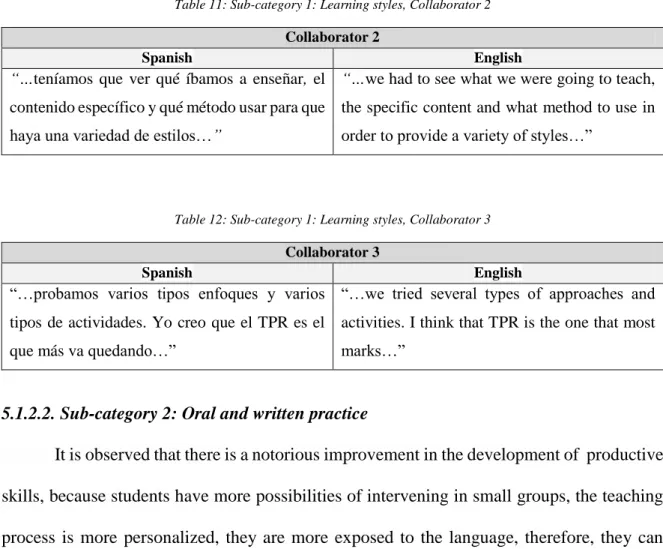
Table 11: Sub-category 1: Learning styles, Collaborator 2 ... 53
Table 12: Sub-category 1: Learning styles, Collaborator 3 ... 53
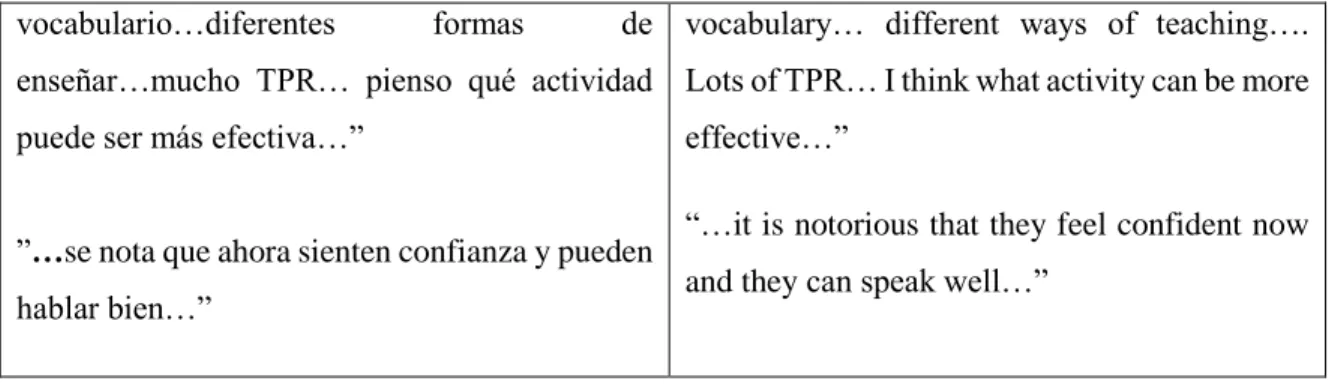
Table 13: Sub-category 2: Oral and written practice, Collaborator 2 ... 54
vi
Table 15: Sub-category 1: Collaborative Decision making, Collaborator 2 ... 55
Table 16: Sub-category 1: Collaborative Decision making, Collaborator 3 ... 56
Table 17: Sub-category 1: Opportunities, Collaborator 3 ... 56
Table 18: Sub-category 1: Opportunities, Collaborator 2 ... 57
Table 19: Sub-category 1: Opportunities, Collaborator 1 ... 57
Table 20: Sub-category 1: Opportunities, Collaborator 2 ... 58
Table 21: Sub-category 1: Opportunities, Collaborator 3 ... 58
Table 22: Sub-category 2: Drawbacks, Collaborator 3 ... 59
Table 23: Sub-category 2: Drawbacks, Collaborator 2 ... 59
Table 24: Subcategory 3: How to improve disadvantages, Collaborator 1 ... 60
Table 25: Sub-category 1: Close Relationship, Collaborator 1... 61
Table 26: Sub-category 1: Close Relationship, Collaborator 2... 61
Table 27: Sub-category 1: Close Relationship, Collaborator 3... 61
Table 28: Sub-category 2: Sense of Safety, Collaborator 1 ... 62
Table 29: Sub-category 2: Sense of Safety, Collaborator 2 ... 62
Table 30: Emerging Category: Future Teacher Formation, Collaborator 3 ... 63
Table 31: Emerging Category: Future Teacher Formation, Collaborator 1 ... 63
Table 32: Focus Group Results ... 63
Table 33: Subcategory: Variety of activities, Student 1 ... 64
Table 34: Subcategory: Variety of activities, Student 2 ... 64
Table 35: Subcategory: Development of productive skills, Student 1 ... 65
Table 36: Subcategory: Development of productive skills, Student 2 ... 65
Table 37: Subcategory: Small groups, Student 1 ... 66
Table 38: Subcategory: Small groups, Student 2 ... 66
Table 39: Subcategory: Close relationships, Student 1... 67
Table 40: Subcategory: Close relationships, Student 2... 67
Table 41: Subcategory: Engagement, Student 1 ... 67
Table 42: Subcategory: Engagement, Student 2 ... 68
Table 43: Subcategory: Supporters, Student 1 ... 68
Table 44: Subcategory: Supporters, Student 2 ... 69
Table 45: Subcategory: Close relationships, Student 1... 69
7
ABSTRACT
The lack of learning English effectively in the Chilean public school has produced a wide gap between public and
private schools. The Dialogic Pedagogy of the Interactive groups, which focuses on communicative activities and
collaborative work, has become the potential solution that will narrow those differences. This study aims at comprehending
the process of learning English through the Interactive Methodology of the Dialogic Pedagogy “Enlazando Mundos” in a
vulnerable school context located in Penco, eighth region. The type of research was qualitative, consisting of a study case
.The participants were 28 eighth grade students, males and females, from Forjadores de Chile Primary School, selected by
probability sampling. The research instruments were a semi-structured interview and focus group. The findings showed that
the students presented an increase in their level of motivation as well as in their outcomes since the methodology is centred
in their own interactions and peer learning, which caused very positive perceptions and attitude toward the process of
learning English. Furthermore, the implications drawn from the study were the effectiveness of the work with the
methodology which had direct impact on students’ performance, self-esteem and interpersonal relationships.
KEY CONCEPTS: Dialogic Pedagogy, vulnerable school, Interactive Methodology, communicative activities, social
skills, perceptions, self-esteem.
RESUMEN
La falta de aprendizaje de inglés de manera efectiva en Chile ha producido una amplia brecha entre las escuelas
públicas y privadas. La Pedagogía Dialógica de los Grupos Interactivos, que se centra en las actividades comunicativas y el
trabajo colaborativo, se ha convertido en la solución potencial que podría reducir esas diferencias. Este estudio tiene como
objetivo, comprender el proceso de aprendizaje de Inglés a través de la Metodología Interactiva de la Pedagogía Dialógica
"Enlazando Mundos", en un contexto escolar vulnerable ubicada en Penco, VIII Región. El tipo de investigación fue
cualitativo, y consistió en un estudio de caso. Los participantes fueron 28 estudiantes de octavo básico, varones y mujeres,
de la escuela pública” Forjadores de Chile “seleccionados por muestreo probabilístico. Los instrumentos de investigación
fueron una entrevista semi-estructurada y grupo focal. Los resultados del estudio fueron, la efectividad del trabajo y un alto
impacto en el rendimiento, motivación y las relaciones interpersonales.
CONCEPTOS CLAVE: Pedagogía Dialógica, escuela vulnerables, Interactivo Metodología, actividades comunicativas,
8 Background of the Study
CHAPTER 1: BACKGROUND OF THE STUDY
1.0. Introduction
In the context of a globalized world, English has become one of the most used languages in the whole world. According to Soares (2010), around four hundred million people in the world speak English as their first language and over nine hundred million use it as a second language. It is likely that the number will grow more and more as English is used as a global means of communication for different purposes and in a variety of contexts.
The needs of English in Chile are similar to those of the modern world in terms of business, tourism and education therefore, the demand for Chilean students to be able to communicate in English is increasing significantly.
Nevertheless, something is wrong in our educational system. Something is wrong with our schools because the students are not succeeding, particularly if we see the results of the standardized tests in Chilean public schools.
On the other hand, students are not learning to communicate in English at all or if they do, they hesitate, get nervous and are afraid of making mistakes. Why do students fear if everybody makes mistakes, even in their mother tongue? The problem is that the fear of making a mistake destroys their fluency.
On account to this fact, it can be stated that there is an urgent need to transform this reality in order to overcome the obstacles that are found in the process of learning English as a second language.
9 Background of the Study
year. In order to quantify the results of these efforts, the Chilean government created a standardized test SIMCE Inglés1 to measure the competences of students in English. This test was created in 2010 and is taken every two years. According to the Ministry of Education (2012), when this test was first applied in 2010, only 11 percent of students from third grade high school reached level A2 according to CEFR2 parameters.
The experts from the Ministry of Education concluded that those students present high academic self-confidence and more hours of English classes. Therefore, it is evident that some of the needs Chilean students have in order to learn English in a self-confident way, is motivation and a change of methodology in the development of the learning process.
While in private schools the curriculum embraces English from kindergarten up to fourth grade high school, with specialized teachers and effective textbooks which bring digital tools in software and compact disks, in public schools they start in fifth grade, compulsorily according to the national programme, Mineduc (2012) with no more resources than the textbook given by the Ministry of Education and the teacher.
It is blatantly obvious that students, who have better economic and social conditions, also have more access to better quality education. Private schools offer them the best means, alternatives and conditions for studying and practicing what they are taught in class: good learning spaces, such as self-access rooms, computer and language labs, comfortable classrooms with
1 El sistema de Medición de la Calidad de la Educación (Education Quality Measurement System, SIMCE) is a battery
of tests used in Chile to measure certain aspects of school curricula. Currently, a state agency, The Agency for Quality of Education, is in charge of administrating the tests to students in 2nd, 4th, 6th, and 8th grade (basic education) and 10th and 11th grade (2nd and 3rd years of secondary education).(https://en.wikipedia.org/wiki/SIMCE)
2Common European Framework of Reference: International standard for describing language ability
(https://en.wikipedia.org/wiki/Common_European_Framework_of_Reference_for_Languages#Common_reference_
levels)
10 Background of the Study
central heating, audiovisual resources and digital boards. Private schools count on canteens, big gymnasiums, sports fields and playgrounds, everything perfectly well conjugated in virtue of the achievement of their students’ academic as well as personal goals. The specialized teachers-who are determined in obtaining good results in standardized tests-, provide students with all kinds of input and the best tools in order to develop their skills for processing, internalizing and applying the information.
The small number of students per class allows teachers to interact with them in English without any problems. Teachers can also, make any arrangement or physical changes they want inside the classroom, implementing thus, various strategies in order to foster and assure a good process of learning and good results in students. As classes are more interactive and learner centred, students speak English most of the time with their teachers and peers and receive permanent feedback. As a consequence, they have more opportunities to rehearse and improve their language practices. This phenomenon can be proven by Ferrada´s theory (2008) based on the project “Enlazando Mundos”3. In her investigations, she has demonstrated that the dialogue and
interaction are innovative means that make the difference in learning.
These studies have been undertaken in several local communities of the VIII region and the results, in terms of motivation and outcomes, are incredibly positive in the different establishments especially with vulnerable conditions.
On the lights of this Dialogic Methodology, teachers are just guides of the process, not protagonists, they devote their attention to encourage students to participate in class by means of
3 Experience of building an educational model based on the transformative, critical and dialogic theory developed
11 Background of the Study
different styles of learning varied activities and materials especially designed for them in order to prompt interaction as much as they can during the process and, that way, make learning a more attractive and encouraging experience. The contents are used as mere instruments to achieve communication in the second language, what is very relevant, is the role of collaborators who are intended to cause a reaction in the students through the reinforcement of their soft skills (Saldaña, 2009).
12 Background of the Study
In general, the deterioration of the Chilean public educational system has caused inequity in Education. It is very important to smooth the differences and find the way to narrow them as soon as possible. It is urgent, for us teachers, to make a change and implement some transforming practices that foster and guarantee a significant learning process that makes students more interested in learning English and improving their academic results.
This task can seem difficult to achieve and it can also sound something impossible to do, but the Dialogic Pedagogy “Enlazando Mundos” (Ferrada, Flecha 2008) can provide a positive solution to address these issues. This pedagogical methodology can bring surprising new educational strategies based on an effective communication and useful resources for teaching a foreign language in our classrooms.
1.1. Rationale of the study
The Dialogic Pedagogy “Enlazando Mundos” has been tested in the last years in different
establishments of the VIII region. University Professor Donatila Ferrada (2008) has been its pioneer in the Universidad Católica de la Santísima Concepcion, with very favorable results in several fields like Mathematics, Spanish , Biology and, of course, English proving that this methodology is cross-disciplinary and helps students practice, in a variety of ways, any content of any subject.
The model has also been put into practice in San Sebastian University in Concepción, where students of the English Teaching Programme have experienced the benefits of the Methodology in different levels of the pre-service teacher training and have implemented it in
13 Background of the Study
The investigation relies on the fact that this pedagogical model can help teachers develop their teaching skills and also improve the English language learning levels of their students in an unconventional and creative way.
It is interesting to see how students learn through the interaction with their classmates and collaborators in the working stations that this methodology offers. They are led by these collaborators who develop activities with different teaching approaches in order to invite and motivate them to perform in front of their peers through five or six different activities constituted in stations.
It is also encouraging for teachers to notice the students’ improvements and outcomes throughout the process. There is enough confidence in that the dialogic methodology will give good results, because after being implemented in different countries of South America such as Brazil with excellent results, it has also been implemented for over six years in the vulnerable local schools and since 2012, in tertiary Institutions such as San Sebastian University’s curriculum of the English Teaching Programme with successful results. It was found very advantageous for the students, since they were able to learn in an alternative way and it was possible to cover the programs of study without any hindrances.
With this didactic model, the attitude of the students presents a radical change in relation to their traditional role: from a passive receptive agent of knowledge, the student becomes the protagonist of the dialogic creation of knowledge (Ferrada, 2008).
14 Background of the Study
PUC International Conference in Villarrica Bastías and Quintanilla (2014), and in the second seminar on the Dialogic Pedagogy held in USS, Campus Concepción (2014).
1.2. Significance of the study
The Dialogic Pedagogy “Enlazando Mundos” will bring a new way of tackling second language learning and teaching, as a proposal of solution to narrow and diminish the gap between the outcomes of private and public system.
Likewise, this study will be useful for curriculum policy makers, English teachers, initial Teacher Training Programs and administrators who attempt to help students with low levels of motivation and plenty of difficulties to produce English whether written or oral. It can also be used as a guideline for developing students ‘productive skill through the use of communicative activities.
Based on what Harmer (2007) proposes in order to foster production, this original pedagogical model can provide a new strategy that will allow students check their own progress and will ensure a high level of motivation, because it considers aspects such as maximized chances to use the language, interaction and a lot of language exposure, opportunities that will enable them to communicate in English, which they are going to learn unconsciously, due to the fact that they are repeatedly immersed in it.
15 Background of the Study
1.3. Objectives and research questions
The main objective of this study is:
To comprehend the process of learning English as a Foreign Language through the
Interactive Methodology of the Dialogic Pedagogy “Enlazando Mundos” in a vulnerable school context located in Penco, VIII Region.
Yet, the specific objectives of the research are:
1. To identify the role of the students and the language collaborators involved in the process of learning English as a Foreign Language through the Interactive Methodology.
2. To determine the perception of the students involved in the process of learning English as a Foreign Language through the Interactive Methodology.
3. To describe the relationship that is established between the students and the collaborators in the context of the Interactive Methodology.
Thus, the study aims to answer the following research questions:
1. What is the role of the students and the language collaborators involved in the process of learning English as a Foreign Language through the Interactive Methodology?
2. What is the perception of the students and the language collaborators involved in the process of learning English as a Foreign Language through the Interactive Methodology? 3. What is the relationship that is established between the students and the collaborators in
16 Background of the Study
1.4. Organization of the study
17
Contextual Framework
CHAPTER 2: CONTEXTUAL FRAMEWORK
2.0. Introduction
The Dialogic Pedagogy has already had its first implementation in Europe and Asia, where there is evident awareness of the importance of the teaching- learning process for the development of a nation. Thailand, for example, is an important exponent of learning communities; they solve their problems by sharing their experiences and knowledge in learning communities since 1981 when adults created centers for that purpose. Then, the government created reading centers or meeting places where the citizens had talks about politics, social life or personal issues. These centers were located in various places of the community, such as, temples, schools, community halls, renovated buildings, factories or prisons and were led by a coordinator or a volunteer teacher who gave people informal education in order to promote literacy and improve their quality of life and alleviate poverty.
The Thai model of non- formal learning became an important interactive method since people interchanged knowledge and experience in it. Thanks to these community centers, and to the dialogue between the participants and the monitors, people learn a lot about a variety of things inside the community (Leowarin, 2010).
Ramón Flecha (1997), a Spanish teacher of sociology, is one of the first European explorers of the communicative methodology and learning communities. His investigation about learning communities in Spain has been, in part, inspiration for this study, due to the fact that it proves that, by transforming the communities, it is possible to overcome school failure and conflict.
18
Contextual Framework
Professor Donatila Ferrada (2008) implemented first, this innovative pedagogical methodology in two subjects: Spanish and Mathematics, and later, in Biology. Based on the great impact of this experience, the idea of implementing this method in English as a Foreign Language subject grew up. Having some experimental tests developed in different cities in the 8th region, the Interactive Didactic on English lessons had very good results. Nowadays, this methodology is actively implemented at San Sebastian University in Concepción where new concepts have been internalized.
The idea of this Interactive Methodology was conceived after observing several implementations carried out in the teaching practice field of San Sebastian University. It has been interesting to notice that the resources used in the Interactive Methodology are powerful enough to engage students increasing the motivation to learn and to participate in the activities. Thus, it can be any kind of activity (listening, writing, reading or speaking) the results are the same, higher motivation and self-confidence, increased participation and effective learning in a personalized way.
The project “Enlazando Mundos”, has been implemented in some public schools that have
hard social, cultural and economic problems, where the participants assume a collaborative predisposition in order to give students the same learning opportunities and narrow the gap of Education.
19
Contextual Framework
The research methodology used in this study is qualitative; it is framed within a constructivist and holistic perspective, because the reality is studied in their natural context. The data collection techniques used were semi-structured interviews and a focus group who had the pedagogical interventions implemented during the semester.
In light of the findings, it appears that the motivation of the students in the subject of English increases considerably and dialogic learning is assessed through the methodology of the interactive groups where learning occurs horizontally and democratically, that is, there is no hierarchy of positions, in contrast to traditional teaching. Among the limitations of this methodological proposal participants report that the time available to plan and execute interventions has been the most difficult, especially to find the best strategy for all actors involved in the programming of each intervention to work properly. It is concluded that this new educational model points to a new conception of education, where the student learns the teacher and vice versa, creating in the classroom, a dialogic and community environment.
Professor Donatila Ferrada (2008) in her article entitled "Enlazando Mundos: A pedagogical model that builds hopes of equality and inclusion in public schools”, said that the
current Chilean society has perpetuated the educational inequities in schools with social and economic vulnerability. Thus, the author defines the “Enlazando Mundos” group as a set of social
partners mobilized by the generation of equality of learning for all students. The conclusions of the article highlights four central ideas: 1) the “Enlazando Mundos” group repositions the role of
20
Contextual Framework
school failure in vulnerable contexts; 4) the project develops from practical construction of the inter-subjective fields of learning, teaching and evaluative for the transformation of all the agents involved.
Regarding the empirical evidence of the Project “Enlazando Mundos”, Saldaña (2009)
21 Theoretical Framework
CHAPTER 3: THEORETICAL FRAMEWORK
This theoretical framework contains the main concepts closely related to the research theme, namely: the process of learning English as a Foreign Language through the Interactive Methodology of the Dialogic Pedagogy “Enlazando Mundos” in a vulnerable school context
located in Penco, VIII region.
3.1. Development of language skills
Many researchers (Wongsuriya, 2003; Phuphanpet, 2004; Kethongkum, 2005 & Promshoit, 2010), who have done investigation on students‘ listening and speaking abilities, agree that the causes are complex: first, that students have few opportunities to use English outside the classroom; second, they cannot apply the knowledge learnt from the classroom to use in real life situations and they have little repertoire of vocabulary so they are not able to communicate using appropriate words; third, students do not trust in their ability to speak English; fourth, many teachers do not focus on speaking because it takes more time to practice, they emphasize grammatical structures; fifth, students do not have a clear goal for speaking English and last, students are reluctant to speak English because their past experiences have been negative.
3.2. EFL Teaching methods and approaches
22 Theoretical Framework
Classical–learning of Latin and Greek– Then came the Grammar Translation Method (19th century) which lead children to learn huge lists of vocabulary in isolation with lots of grammar rules. In the middle of the 20th century, the Audio-Lingual Method appeared presenting a new format of patterns and models. Later, cognitive code learning based on deeper structures of the language, flourished responding to the so called Chomskyan Revolution. In the 1970´s Community language learning, Suggestopedia (Lozanov, 1971), the Silent Way (Gattegno, 1974), Total Physical Response (TPR) (Asher, 1969) Cognitive Theoretical Background, Natural Approach (Krashen & Terrel, 1983) appeared and affirmed that language was facilitated through discovery and creation more than repetition or memorization of what had to be learned. Besides, (Ausubel, 1961) also proposed Discovery Learning. He supported the idea that learners should develop independence, autonomy, responsibility and collaboration. He refers to the process of acquisition of a second language as the interactions of the subject with the new information. Teacher is a stimulator, is silent most of the time, students have to process the information themselves in order to discover the meaning and sense of it.
23 Theoretical Framework
Unfortunately, those attempts have not been enough, especially in vulnerable contexts, where the teacher needs to be more creative and work even harder in order to engage those unmotivated students; they do not count on all the teaching aids and material resources that privates are able to provide.
With the purpose of reducing the differences between the two sectors, there have been many attempts to discover the most functional and appropriate approach. Some of the most used along the history of language teaching have been Task Based Learning, PPP (Presentation, Practice, and Production) and Grammar Translation Method which will be addressed in this study. Teachers have been supported for decades by these methods, providing lots of opportunities to improve students’ motivation and learning practices, but there is the sensation that it is not
enough, that there is still more pending research on it. Lessons along the time have remained almost the same, teacher as the center of attention and students following instructions as if they were robots.
Lessons are usually boring and students become uninterested, because they do not have many possibilities to ask questions or participate, because as the classes are so large, there is no opportunity of intervening. Besides, teachers are not able to motivate all the children, rehearse with them and give them feedback individually or in small groups, it is almost impossible to attend all the students inside the classroom (Gardner and Smythe, 1975).
3.3. Learning styles
24 Theoretical Framework
guaranteed that they learn in the same way. Since each student learns differently, they have different concerns and their progress varies. On the other hand, each time the teacher explains in class or assigns an exercise to be done by students, they use their own system of representation.
The concept of learning styles from the viewpoint of Barbara Prashnig (2004), is the particular involuntary way in which the individual assimilates, retains and processes information. Besides, Revilla (1998) states that some characteristics of learning styles are relatively stable, but they can change; they may be different in different situations; they are likely to be improved and when students are taught according to their own learning style, they learn more effectively.
On the other hand, each learning style points out the preference for the means of representation -channel of perception- that every person has, without exclusivity. In this sense, the ideal learning is the efficient use of the three channels –visual, auditory or kinesthetic- and the ability to adapt Educational materials to the way students learn. From this perspective, a teacher must be able to recognize the prevailing styles students learn by choosing specific teaching strategies to the diverse needs of them (Perez Jimenez, 2001).
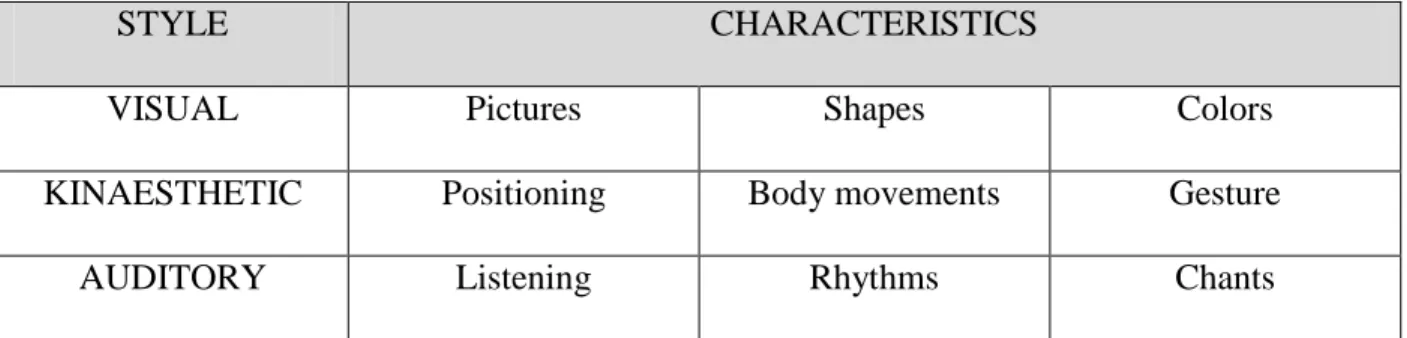
If students use pictures, shapes or colours to internalize the information they receive, then it can be said that they are visual. On the other hand, if they learn through movements, they are probably kinaesthetic and, in the case they learn by using their audition, they are definitely, auditory.
The following table shows a classification three modalities and what elements are the most used by learners:
25 Theoretical Framework
Table 1: Learning Modalities 4
STYLE CHARACTERISTICS
VISUAL Pictures Shapes Colors
KINAESTHETIC Positioning Body movements Gesture
AUDITORY Listening Rhythms Chants
3.4. Interaction and communication
It is necessary, for the sake of young learners of English, to make a change in the way lessons are worked, in order to fulfill the needs of the class, it is urgent to make a transformation in the scenario for the students. Paulo Freire (1970) in “the Pedagogy of the Oppressed” suggests that it is urgent to make a change from the bank education, where the educator gives information to the student and sees him as an empty recipient that has to be filled, to an education where both learn from each other through real interaction.
If we consider interaction among subjects who are involved in the learning process, we see that there are several theories in terms of communication. That is why the German psychologist and philosopher Jürgen Habermas (1985) with his theory of communicative action, proposes that there has to be a dialogue with the subject next to one in order to reach an interpersonal relationship with the purpose of reaching a successful communicative performance.
4
26 Theoretical Framework
3.5. EFL Communicative competence
The concept “communicative competence” has been defined as the knowledge of both rules of grammar and rules of language used appropriately in a given context (Hymes, 1992). According to Larsen- Freeman (1987), the characteristic of communicative language teaching are concerned about the communicative intent. To develop learners’ communicative competence, learners first
learn how to convey meaning, and how to participate in speech events. Grammar should not be the main focus.
Professor emeritus and psychologist Sandra Savignon (1983, p8) points out the characteristics of communicative competence as follows:
1. Communicative competence is a dynamic rather than a static concept. It is interpersonal because it relies on the negotiation of meaning between two or more people who share degree with the same symbolic system.
2. It applies to various other symbolic systems including both written and spoken language.
3. It is context specific. This is because communication happens in many situations and its success depends on one’s understanding of the context and on previous
experience.
The word ‘competence’ and ‘performance’ are different: Competence means what one
27 Theoretical Framework
3.6. Communicative activities and tasks
The main objective of communicative activities is to motivate purposeful and meaningful interaction among students. Communicative tasks are designed so learners will have a reason to interact; they can bridge an information and opinion gap and can ask for or provide real information, or find out about their friends’ opinions.
Communicative activities can motivate the classroom and prepare the learners for real- life interaction (Gower, Phillips & Walters, 2005).
Littlewood (1998) determines the importance of communicative activities under the following ideas:
1. Communicative activities provide whole-task practice through many kinds of communicative activities in order to suit the learners’ levels of ability.
2. Communicative activities improve motivation. The learner’s ultimate objective is to take part in communication with others. The more students see their classroom learning related to their objective, the more their motivation increase.
3. Communicative activities allow natural learning. Many aspects of language learning can happen only through natural processes which work when the learner is involved in using the language for communication. That is why communicative activities are a vital part of the total learning process.
4. Communicative activities can create a context which supports learning. Communicative activities instigate positive personal relationships among the learners and between learners and collaborators, which encourages individuals to learn better.
28 Theoretical Framework
the participants in order to complete the task. The activity takes place in the real time; therefore, the outcomes cannot be exactly predictable.
Communicative activities can encourage students to use English, and students are motivated to communicate with others because they have an aim for using the language and creating the interaction among students.
3.7. Dialogic Pedagogy “Enlazando Mundos”
Ramón Flecha (1997) affirms that, dialogue and mutual collaboration are extremely necessary, therefore the Dialogical Pedagogy of the interactive groups is the perfect alternative to deal with this issue.
Bearing in mind the fact that education has a variety of areas that can be exploited in order to have better results. Different methods, approaches and theories are still being adapted to regular classrooms where students can do several activities to reach the goal of a better understanding. Thus, during the last decades, several authors have been working on a pedagogy that can help to make a connection between the teacher and the students through a simple instrument: communication. The “Dialogic Pedagogy” fulfills this need.
29 Theoretical Framework
It is important to say that the origin of the methodology of the interactive groups is present in different places of the world (Ramón Flecha, 2007) in Spain, writes about learning communities which do not need teachers inside the classroom, but other sort of helpers such as family members, school members, other students among others, can be incorporated. Donatila Ferrada (2008) in Chile and Paulo Freire in Brazil (1970), are great Latin American exponents of the interactive group methodology, both interested in studying the real needs of an oppressed education with the purpose of shortening the differences present inside the classroom. They argue that the dialogic pedagogy produces positive effects in students due to the interaction that occurs when learning through this method. It is essential for meaningful learning, that previous knowledge is found in the cognitive structure of them, because they are used to anchor the new input.
Ferrada and Flecha (2008) stated that the dialogic pedagogy covers different educational fields including: the intersubjective construction of the curriculum, the intersubjective construction of the learning process, of the didactic, and of evaluation.
1) The intersubjective construction of the curriculum: The collaborators work together based on the principle of interaction of the Dialogic Pedagogy, defining theoretical and practical categories based on the subject. They work together in the planning phase in order to reach the main aim of the whole process including cross-curriculum aims and make agreements related to the design and development of it inside the classroom.
2) The intersubjective construction of the learning: This point is reached by applying the 8 principles of the dialogic learning:
30 Theoretical Framework
ii. Cultural intelligence: It refers to the capacity of interaction and communication with others in order to interchange information and culture. This means that all persons are intelligent and are able to contribute.
iii. Creation of sense: This means, potentiate students’ learning in order to foster interaction driven by themselves.
As students are faced to different social agents who offer different possibilities of learning, they have wider alternatives to choose.
iv. Solidarity: This refers to the idea that all the members are responsible of each other’s learning, then, they are ready to help and support among themselves.
v. Egalitarian dialogue: Means that all the participants have the same right and opportunities to communicate.
vi. Equality in the differences: Means that all the differences are respected in order to reach equality in the opportunity to learn.
vii. Transformation: It refers to the traditional classroom is transformed into a public classroom that is directed by all the participants of the teaching – learning process.
viii. Emotionality/Corporality: as biological beings, we need to establish emotional and physical relationship with the participants.
31 Theoretical Framework
through a collective revision based on the formal assessment of the curricular progress of the students.
The Dialogical Pedagogy of interactive groups offers the teachers, the possibility to work with large numbers of students divided into small heterogeneous groups, with a monitor who will be in charge of delivering the information about contents through varied learning strategies in a short period of time with the purpose of attending all the individual differences (Ferrada, 2008).
Vygotsky (1978) in his theory of social learning and scaffolding explains that human beings learn in groups when they are together and support each other. He suggests that learning occurs only in a social context which demands constant interaction among the members. Besides, Ausubel (1961), refers to the theory of meaningful learning that shows us that students learn for a longer period of time and in a deeper way if teachers deal with their interests and personal life. Moreover, other authors argue that dialogue, communication and interaction are predominant characteristics in the process of learning, therefore what children learn does not depend on what happens within the classroom only, it depends on the correlation between what happens in the school, the house and the street. Accordingly, schools are becoming learning communities and the work in them is an approach to overcome social and educational inequalities Elboj, C., Puigdellívol, I., Soler, M., & Valls, R, 2002).
32 Theoretical Framework
On the other hand, Slavin & Cooper (1999, p.3), agree that cooperative learning is the “pedagogical practice that promotes social interactions among students, encouraging them to work collaboratively and productively with others”. This previously mentioned theory proposes new
methods to be implemented in classes. Furthermore, it ensures a constant change from the traditional teaching process, in which students learn passively, to a new Interactive Methodology, where students need to think abstractly in order to find solutions to the activities proposed in class. It can be concluded then, that the communicative methodology, based on the active participation of the members involved in the process, requires the creation of conditions that provide equal intersubjective dialogue among the participants.
3.8. Interactive techniques
33 Theoretical Framework
Along with cooperative learning, it is necessary to first, teach the students about the structure of the group work so that they are able to know consciously how they are going to work and thus, maximize their learning. (Lou, Y., Abrami, P., Spence, J., Poulsen, C., Chambers, B., & d’Apollonia, S,1996) say that it has been discovered that students achieve a higher level of
proficiency in groups of three or four more than when they are in larger groups or remain in the whole-class. In addition, Gillies (2014, p. 8), affirms that: “the effectiveness of the learning depends on how the group is organized in terms of students’ abilities and weaknesses”, that means that it is important to have heterogeneous groups (high-medium- and low-ability) created randomly in order to enrich learning.
Some investigations studied the importance of the effects of small-group learning, Pai, Sears and Maeda (2014) found that small-group learning had a positive impact on students’ performance when compared to individual performance. The results of these analyses showed that students can achieve more outcomes when they work cooperatively rather than when they work individually (Gillies,2014).
Making students interact benefits the group cohesion and the motivation at the moment of completing a task. When teachers structure small group activities with these conditions, students interact more, using more words per turn of speech and communicating more equitably, therefore, ideas are shared among the members of the group. Regarding today’s teaching process,
34 Theoretical Framework
Moreover, students sometimes do not want to ask for any kind of help during the lesson, they remain with what they already know, and also they keep their doubts for themselves. The Dialogic Pedagogy changes those drawbacks of traditional classes by making the lessons opened to discussion, promoting knowledge from the basis of communication, cooperation and freedom of opinion, where everybody has the same right and opportunity to participate.
3.9. Transformation
In a traditional class the learning and the evaluations are not established together as part of the same process, they are considered as separated topics. Teachers usually use tests to evaluate the achieved learning. In traditional classes students are taught concepts and theories but they are not taught with the use they can give to those ideas.
“The traditional English teaching, the procedure, the teaching and study environment are
rigid, teachers are usually circling around the classroom, interrupting when students are speaking or listening”. Besides, they tend to “pay special attention to grammar and reading, leaving the productive skills such as speaking and writing apart” Liu (2014, p 374-378).
35 Theoretical Framework
Some of the changing dimensions, developed in the school by teachers and students, are concrete and abstract thinking, two dimensions that need to be developed during the learning process, where the previous experiences are relevant when learning new concepts Vygotsky (1992). Students learn the basic concepts such as, sports, television, arts, etc., after learning some specific topics, they can think abstractly and use more complex vocabulary and add other functions to the language. Thus, it can be concluded that the word and other signs are the paths that lead our mental processes and encourage us to solve problems through communication and comprehension Vygotsky (1992).
At this point, the teacher’s role is very clear: give students the possibility of getting the
knowledge from their concrete individuality with a specific procedure. This has to be considered by the teacher when planning an activity or when assessing.
The dialogic learning then, results from the interactions produced thanks to the egalitarian dialogue among all the persons who belong to the group contributing with their own arguments.
The Dialogic Pedagogy is based on principles that support the egalitarian dialogue, transferring their cultural intelligence to the members of the group focusing thus, the problem with different perspectives especially when the context is transformed and adapted to make it real and meaningful, where the same opportunities of learning are provided and no differences exist among them. Then, with the help of collaborative monitors inside the classroom, students can improve their knowledge very significantly (Flecha and Piugvert, 2002). This methodology allows teachers, inside the classroom, to develop an environment of constant dynamism, since every different rotation gives students a wide variety of possibilities to learn the same content.
36 Theoretical Framework
hand, the help of didactic resources and material for collaborators and students is very important, because these tools support and encourage students to understand meaningfully.
As a synthesis, the reader can observe that this model considers and keeps the correlation between the instrumental and social learning inside each programmed activity, the diversity of learning strategies, the heterogeneity of students, the personalized attention through the formation of small groups with a collaborator each, the diversity of agents -different from the teacher- the professional role of the teacher who assumes as a coordinator of pedagogical work, the collaborative and constructive role of the students, the permanent generation of high expectations, from the teacher and collaborators, in all the students.
3.10. Motivation
It is important to remember that one of the most important components of a successful class, is motivation and it is, for all teachers known, a very difficult task to achieve especially in English, which students, who belong to a vulnerable context, do not consider relevant for them. Gardner and Lambert (1972) recall that affective factors are extremely related on what the student does in the classroom, how he or she works. In the case of students from a public school, where English is not seen as an important subject, those who are highly motivated and have a positive attitude towards a topic, will learn and have better results that those who are not motivated. According to Rodriguez (1987 p.4) “learners with positive attitudes towards the language will tend to do better than students with negative attitudes”.
37 Theoretical Framework
crucial in order to develop a meaningful learning process in a comfortable and motivating environment.
It is important to remember that one of the most crucial actions for any successful lesson is to keep students motivated. It is already known that this is a difficult task to achieve, since students are not keen in learning English. They are usually worried about other issues. What can teachers do to change this frequent and difficult reality then? (Gardner and Smythe, 1975) recalled that affective factors were extremely related on how a student works inside the classroom. Students that are highly motivated and have a better attitude to a specific topic will have better results after learning certain content.
The implementation of the Dialogic Pedagogy in schools has made the English teaching and learning process more dynamic for students, whose only desire is to move and do things.
According to Gardner and Smythe (1975), one of the teacher´s main aim is to motivate the learners and
maintain the motivation during the whole class, by involving them and exciting their curiosity.
Affect, achievement, attitude, and activities are all vital aspects of motivation and factors that create and foster the desire to learn Harmer (2007). On the other hand, external factors (extrinsic motivation) such as words, guidance and support, can be used to influence the internal desire to achieve some goal (intrinsic motivation), but one form of sustaining students’ motivation is giving them responsibilities for themselves, make them become “doers” Harmer (2007).
Methodological Framework 38
CHAPTER 4: METHODOLOGICAL FRAMEWORK
4.1. Qualitative Paradigm
Creswell states that a paradigm is mainly a worldview, a framework of beliefs, values and methods within which research takes place (Creswell, 2005).
This research was undertaken with a qualitative approach and is aimed at comprehending student’s process of learning English as a Foreign Language through the Interactive Methodology of the Dialogic Pedagogy “Enlazando Mundos” in a vulnerable school.
Creswell (2005), expressed that: “a qualitative study was an inquiry process of understanding a social
or human problem, based on building a complex, holistic picture, formed with words, reporting detailed
views of informants, and conducted in a natural setting” (p.204 ). He states that a qualitative approach is one in which the inquirer often makes knowledge claims based primarily on the multiple meanings of individual experiences or meanings socially and historically constructed and that it uses strategies of for obtaining information such as narratives, phenomenologies, ethnographies, grounded theory studies, or case studies (Creswell, 2005).
In the same way, “A qualitative research is based on descriptive data that does not make (regular) use of statistical procedures” (Mackey and Gass, 2005 p.162). Considering the previous focuses, this investigation was supported by the participants’ impressions, opinions and
Methodological Framework 39
This chapter discusses the research methodology including population, sample, research instruments, data collection procedures and data analysis.
4.2. Design
The design of this investigation was a study case in the implementation of the Interactive Methodology. Through this study case, particular understanding and insight of participants’ roles, perceptions and relations will be gained. It allows the researcher to explore individuals or groups, through simple to complex interventions, relationships, communities, or programs (Yin, 2003). In the Dialogic Pedagogy of the Interactive Groups, the class was divided into 6 or 7 different groups at random no matter that the members of each one of these groups had heterogeneous characteristics.
4.3. Data
The data collected in this study consisted of the student’s answers to the semi structured interview and a focus group.
4.4. Instruments
Methodological Framework 40
in a spreadsheet, taking into consideration the most relevant and common information as well as the research objectives.
A semi structured interview was the chosen instrument to get information from the learning collaborators and teacher of English since this sort of data collection is an easy and accurate way to get specific information about general perceptions of the participants, due to the fact that everyone responds to the same questions.
In this case the answers to the interview brought specific information within a safe and relaxed environment in which students did not feel pushed to respond what they were expected to, but they freely expressed their opinions and feelings towards the new Methodology implemented for their process of learning English.
Furthermore, the teacher and the collaborators, who are students of English Teaching Programme from San Sebastian University, answered a semi structured interview through which they expressed their opinions and perceptions related to the methodology, the implications of it and the impact this new model caused on their teaching style.
The researcher chose semi structured interviews as a way of gathering information because according to Wengraf (2001) semi structured interviews “produce a session in which most of the informant’s responses cannot be predicted in advance” (p.5). In that way, the aim was to get
unplanned answers and make the interview more spontaneous and fluent, therefore, the researcher could have the chance to go further with the answers provided by the informants and get other impressions that might have not been considered in the formulated questions.
Methodological Framework 41
4.5. Validation
The instruments mentioned above were validated by three University Professors from San Sebastian University. Angie Quintanilla, who is an English Professor graduated from Concepción University, who also has a master degree in the field of Linguistics done in Concepción University. Wanda Yáñez, an English Professor graduated from Concepción University who also has a degree on English Teaching for primary students from Concepción University and a Master‘s degree in Higher Education from Andrés Bello University. Last, but not least, Maria Alejandra Torres, secondary English teacher graduated from Concepción University and Master in Educational Curriculum from UARCIS. The Professors validated the questions for the interview students would answer, after an accurate revision (see Annexes A and B) their feedback and support helped to improve the investigation process, pointing out specific and very important details that had been left behind before the validating process (see Annex E).
On the other hand, consent letters were sent to school members and parents to be authorized (see Annexes C and D).
4.6. Population
The population for this study was a group of Eighth Grade students from Colegio Forjadores de Chile, in the City of Penco, VIII Region. This level was chosen due to the fact that they have been working with the Interactive Methodology since 2013, when they were in Sixth Grade.
Methodological Framework 42
While the School Mission is to foster Education and Culture in order to enable students to face the new experiences successfully with a creative and divergent look, the School vision aims at forming persons with solid values and competences which enable them to successfully face the changes of the modern society.
According to these perspectives and to be consistent with them, the school members are permanently concerned about their students’ welfare. Therefore, they are open to modify their practices and adapt the context in order to facilitate the process for learning.
The principal and the school board, followed by teachers, inspectors, secretaries, parents and students, compose the school community. There is also a special needs program in charge of a specialist.
The 8th Grade has 28 students, which is an average number of learners per class. Both male and female students attend classes. The age of them varies from 13 to15 years old. Besides, they have three hours of English a week; Tuesdays and Thursdays in charge of the teacher.
The 8th Grade constantly uses Travelers 8 course book which is given by the government through the Ministry of Education. Along with this, several extracts from Movers exam are used. In relation with this, the class counts on resources such as flashcards, worksheets, videos, games, songs, pieces of writing and many technological gadgets that can be seen at the school for teaching purposes. Each classroom has its own notebook, speakers and multimedia device, in order to assist teachers' work.
On the other side, with regard to social background, a very low social status is noted in this public school. Most of the students show a high vulnerability condition.
Methodological Framework 43
priority; students are not interested in it, since they do not have enough possibilities to learn meaningfully, because they do not have the chance to be in a positive and participative learning environment. Most classes are teacher centered and it is almost impossible for a teacher to attend all the students inside the classroom (Davila, Ghiardo and Medrano, 2005).
4.7. Sample
The sample consisted of two student teachers and a teacher of English, who worked as
collaborators in each station. The former student teachers, belonged to 3rd year of English Teaching Programme of San Sebastian University; institution that has been working with the Dialogic Pedagogy of the Interactive groups since 2011. The latter, teacher of English, worked as a moderator as well as collaborator. He also was in charge of explaining the aim to students at the beginning of the class
and measuring time allotted to each activity – ten minutes.
Finally, school English Teacher, who worked as moderator as well as collaborator. His work was to explain students the aim of the class before starting work in the stations and was also in charge of the time that each station lasted, ten minutes.
The probability sampling was the technique chosen in the selection of students who would answer the questions. This type of sampling is done at random, because, in that way, bias is avoided. According to Ferrer (2010), in this type of technique, all individuals in the population can be part of the sample, having positive probability of contribution, when taking part of it.
Methodological Framework 44
4.8. Procedures
The Dialogic Methodology of the interactive groups was planned to be worked through interventions in the classroom of the 8th Grade. The research collaborators started doing interventions in the class since the third week of August up to the last week of November. The collaborators and the teacher were able to see by themselves, how the students reacted in front of the interactive stations (see Annexes F and G).
The interventions inside the classroom were performed twice a month and lasted three months, beginning in August and ending in November. The actors involved in the process were the English Teacher, who played the roles as a guide, time keeper and learning collaborator; and three volunteers from pre-service teacher training program from San Sebastian University who helped as learning collaborators.
Methodological Framework 45
After the focus group was carried out, the data analysis was ready to be made. It was necessary to keep the evidence of the student’s responses, as well as the digital recording of the
meeting, in a written transcription that was registered in a spreadsheet (see annex M).
After the fourth week of work – the interventions were done every other week - the semi- structured interviews were carried out by the collaborators (see Annex H). They were asked beforehand to support the research and were contacted a few days before the interviews took place. A set of six questions were prepared for these interviews. The collaborators were asked to attend a specific place to make the recordings of the interviews without any interference.
Finally, the investigator interviewed the school teacher of English in the principal´s office for a period of half an hour as well. He was asked questions that were related to his vision and perceptions with regard to the Interactive Methodology. He was very open to facilitate and bring all the necessary help in this study. Besides, the teacher was interviewed in the principal´s office for a period of half an hour as well.
4.9. Implementation of the Dialogic Pedagogy “Enlazando Mundos”
Methodological Framework 46
The class was divided into five or six heterogeneous groups of students, these groups worked simultaneously in stations using different learning strategies or methodologies. The aim of the group work was to give students the opportunity to practice a certain topic, according to his/her own individual differences. The students experimented with different activities for the same topic or grammar point and about the same length of time (10 minutes each). A collaborator who conducted one of the 6 activities, was in charge of each station. The teacher and collaborators planned the interventions in advance (see Annex G) providing that each working station had a different activity.
The teacher asked each group of students to go to one of the working stations, and develop the corresponding activity, after ten minutes, he asked them to move from one station to another.. As a conclusion, it can be said that the teacher was the guide of the process only, because he/she introduced the lesson aim to the whole group. Then, the collaborators developed each activity in each learning station (rotating groups) and, finally, the teacher checked pupils’ level of
achievement in front of the whole group again.
4.10. Data analysis
Analysis and Discussion 47
CHAPTER 5: ANALYSIS AND DISCUSSION
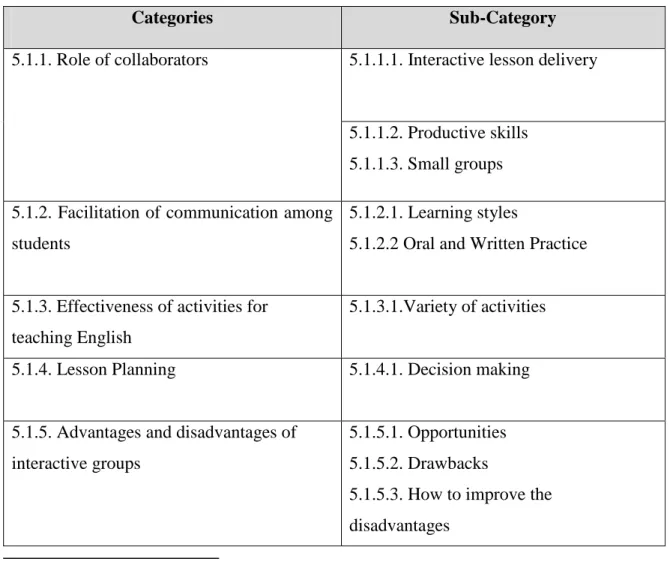
The information from this research was obtained from a Semi-structured interview collaborators had with the researcher and a focus group of students. This study explored the roles of collaborators and students, their perceptions towards their experience with the interactive groups and the relationship that was generated after the interventions.4
5.1. Semi-Structured Interview Results
Table 2: Semi-Structured Interview Results
Categories Sub-Category
5.1.1. Role of collaborators 5.1.1.1. Interactive lesson delivery
5.1.1.2. Productive skills 5.1.1.3. Small groups
5.1.2. Facilitation of communication among students
5.1.2.1. Learning styles
5.1.2.2 Oral and Written Practice
5.1.3. Effectiveness of activities for teaching English
5.1.3.1.Variety of activities
5.1.4. Lesson Planning 5.1.4.1. Decision making
5.1.5. Advantages and disadvantages of interactive groups
5.1.5.1. Opportunities 5.1.5.2. Drawbacks
5.1.5.3. How to improve the disadvantages
4 The following original cites are in the informants ‘mother tongue, however, they have been translated into
Analysis and Discussion 48
5.1.6. Relationship between students and collaborators
5.1.6.1. Close relationship 5.1.6.2. Sense of safety
5.1.1. Category 1: Role of collaborators
5.1.1.1. Subcategory 1: Interactive lesson delivery.
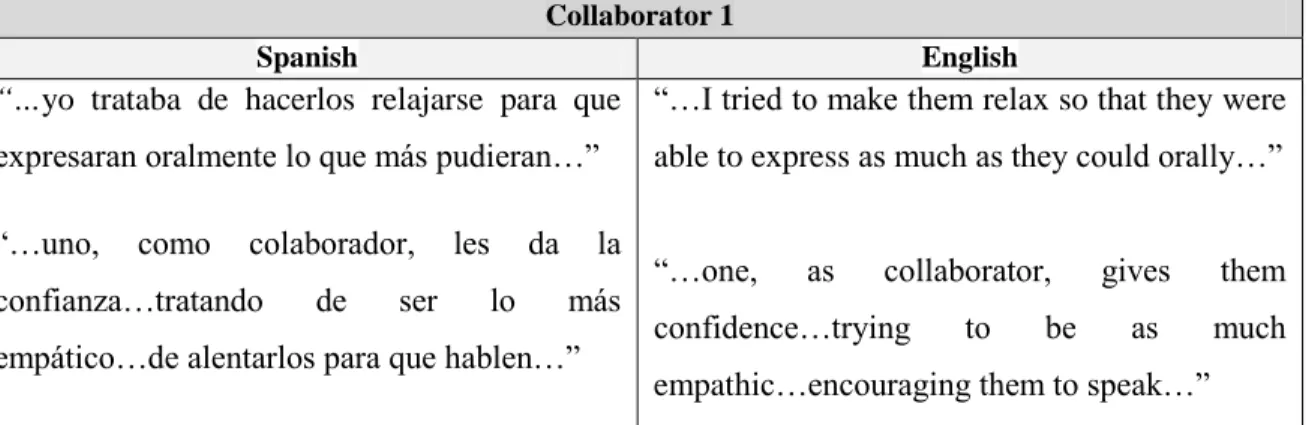
The first category of analysis is related to the roles of learning collaborators. Two participants mentioned the importance of group work and commitment at the moment of planning and delivering the lesson; they mentioned that the relationship among collaborators in the classroom was of mutual support, everybody made their contributions in order to make the students achieve their goals (Slavin & Cooper, 1999, p.3). The following quote graphics this thought:
Table 3: Sub-category 1: Interactive Lesson Delivery – Collaborator 1
Collaborator 1
Spanish English
“…cada vez que teníamos un problema, todos los demás trataban de solucionarlo y, entre todos, buscábamos la posible solución…”
“…every time one had a problem, all the others tried to solve it and all of us looked for the possible solution…”
Analysis and Discussion 49
Table 4:Sub-category 1: Interactive Lesson Delivery – Collaborator 3
Collaborator 3
Spanish English
“… (como colaboradores) en la
implementación, nosotros cumplíamos el rol de
facilitadores del aprendizaje, tratábamos de
otorgarles las herramientas apropiadas para que
los estudiantes desarrollaran todo su
aprendizaje…“
“…nosotros cumplíamos el rol de
facilitadores…”
“…as collaborators in the implementation, we
played the role of facilitators of learning, we
tried to bring the appropriate tools so that
students could develop all their learning…”
“…we had the role of facilitators…”
As it was established in the framework about one of the principles of the Dialogic Pedagogy, “transformation” (Flecha & Piugvert, 2002) is also part of this pedagogy,