
Narratives and the oral use of phrasal verbs
105
0
0
Texto completo
(2) DOCUMENTO DIGITAL PARA REPOSITORIO El presente formulario debe ser diligenciado en su totalidad como constancia de entrega del documento para ingreso al Respositorio Digital (Dspace). Narratives and the Oral Use of Phrasal Verbs TITULO SUBTITULO McCormack, Thomas AUTOR(ES) Apellidos, Nombres (Completos) del autor(es) del trabajo. PALABRAS CLAVE (Mínimo 3 y máximo 6). Verbos frasal. Hispanohablantes. Los relatos. Escuela bilingüe. Los alumnos jóvenes. RESUMEN DEL CONTENIDO (Mínimo 80 máximo 120 palabras). Con el fin de buscar prácticas útiles para el aprendizaje de verbos compuestos para estudiantes de Inglés, esta investigación desarrolló actividades de aula en donde se permitió que los estudiantes usarán narraciones orales relacionadas con varias actividades predeterminadas. En este estudio cualitativo, se recolectó información de los estudiantes, la se analizó y luego se trianguló de acuerdo con las normas de investigación de la teoría inductiva. Aunque los estudiantes continuaban evitando usar ciertos verbos compuestos, al final de la investigación fue posible observar que los estudiantes lograron mejorar su vocabulario. Dicho éxito fue resultado de la relación entre: el uso de narraciones, la oportunidad de practicar verbos compuestos mediante narrativas, la construcción de conocimiento que fue utilizada para la creación de narraciones, y por último la habilidad para diseñar narraciones utilizando verbos compuestos. Este estudio fue realizado en la ciudad de Bogotá, con estudiantes de quinto grado de primaria en un colegio bilingüe, y cuya lengua materna es el español.. Autorizo (amos) a la Biblioteca Octavio Arizmendi Posada de la Universidad de La Sabana, para que con fines académicos, los usuarios puedan consultar el contenido de este documento en las plataformas virtuales de la Biblioteca, así como en las redes de información del país y del exterior, con las cuales tenga convenio la Universidad. De conformidad con lo establecido en el artículo 30 de la Ley 23 de 1982 y el artículo 11 de la Decisión Andina 351 de 1993, “Los derechos morales sobre el trabajo son propiedad de los autores”, los cuales son irrenunciables, imprescriptibles, inembargables e inalienables..
(3) 1 Running head: Narratives and the Oral Use of Phrasal Verbs. Narratives and the Oral Use of Phrasal Verbs. Thomas McCormack. Master in English Language Teaching–Autonomous Learning Environments Department of Foreign Languages and Cultures Universidad de la Sabana Chía, 2012.
(4) i Running head: Narratives and the Oral Use of Phrasal Verbs. Narratives and the Oral Use of Phrasal Verbs. By: Thomas McCormack. Submitted in fulfillment of the requirements for the degree of Master in English Language Teaching-Autonomous Learning Environments. Directed by: David Shepherd. Master in English Language Teaching–Autonomous Learning Environments Department of Foreign Languages and Cultures Universidad de la Sabana Chía, 2012.
(5) ii Running head: Narratives and the Oral Use of Phrasal Verbs. This research report is the result of my own work and includes nothing that was done in collaboration with others. Name: Thomas McCormack Signature:.
(6) iii Running head: Narratives and the Oral Use of Phrasal Verbs. Acknowledgements To my wife, Marcela, whose support and patience allowed me to complete this journey.
(7) iv Running head: Narratives and the Oral Use of Phrasal Verbs. Abstract In an attempt to find practical classroom practices for the learning of phrasal verbs for young English language learners, this Action Research study developed classroom activities which had learners use oral narratives in a variety of connected class activities. In this qualitative study, through the use of three instruments data was obtained from students, analyzed and then triangulated according to the principles of grounded research. While students still demonstrated avoidance of opaque phrasal verbs at the end of the pedagogical intervention, students did however demonstrate vocabulary improvement. This improvement was found to be related to the supportive context of the narratives, the opportunity to practice the phrasal verbs through oral narratives, the social construction of knowledge which went into the creation of the narratives, and the ability to be creative in the narrative process which created a desire to use the target phrasal verbs. This study was conducted in a grade five bilingual school setting in with Spanish speaking learners in Bogotá, Colombia.. Keywords: Phrasal verbs, Narratives, Young Learners, Spanish Speakers, Bilingual school.
(8) v Running head: Narratives and the Oral Use of Phrasal Verbs. Resumen. Con el fin de buscar prácticas útiles para el aprendizaje de verbos compuestos para estudiantes de Inglés, esta investigación desarrolló actividades de aula en donde se permitió que los estudiantes usarán narraciones orales relacionadas con varias actividades predeterminadas. En este estudio cualitativo, se recolectó información de los estudiantes, la se analizó y luego se trianguló de acuerdo con las normas de investigación de la teoría inductiva. Aunque los estudiantes continuaban evitando usar ciertos verbos compuestos, al final de la investigación fue posible observar que los estudiantes lograron mejorar su vocabulario. Dicho éxito fue resultado de la relación entre: el uso de narraciones, la oportunidad de practicar verbos compuestos mediante narrativas, la construcción de conocimiento que fue utilizada para la creación de narraciones, y por último la habilidad para diseñar narraciones utilizando verbos compuestos. Este estudio fue realizado en la ciudad de Bogotá, con estudiantes de quinto grado de primaria en un colegio bilingüe, y cuya lengua materna es el español.. Palabras clave: Verbos frasal, los relatos, los alumnos jóvenes, hispanohablantes, escuela bilingüe.
(9) vi Running head: Narratives and the Oral Use of Phrasal Verbs. Table of Contents 1. Chapter 1: General Information...........................................................................p.2 2. Chapter 2: Theoretical Framework......................................................................p.9 3. Chapter 3: Research Design.................................................................................p.28 4. Chapter 4: Pedagogical Intervention....................................................................p.36 5. Chapter 5: Research Analysis..............................................................................p.43 6. Chapter 6: Implications for Pedagogical Practice................................................p.64 7. References............................................................................................................p.69 8. Appendix..............................................................................................................p.75.
(10) 2 Running head: Narratives and the Oral Use of Phrasal Verbs. Chapter 1: General Information When growing up in Canada, the researcher’s parents’ home was warmed by a wood stove. If one parent were to declare, “Thomas, extinguish the fire so we can clean the chimney” this statement would immediately be puzzling for the researcher as a native speaker of English. The researcher might even wonder why this parent was talking like a firefighter making a report to the local news station. This statement would be essentially an incorrect one not for any grammatical reasons but because of the formality of the language used. The register of the sentence was rendered incorrect by the overly formal word choice of “extinguish” instead of the more commonly used phrasal verb “put out” which is used in general conversation. This kind of incorrect register would be unlikely amongst native speakers, but an English as a Second language (ESL) teacher like the researcher of the present study, might have found this to be a common error made by learners. For the past 3 years, this researcher has been living and working as an English literature and language teacher in Bogotá, Colombia. During this period, while inside and outside of learning environments, careful observations of students’ language were conducted informally and formally as a requirement for In-Service Certificate of English Language Teaching (ICELT). In these observations, numerous incorrect utterances were noted including the students use of the verb demonstrate instead of the more commonly used to show, participate instead of take part in and prepare instead of to make. One of the first books referenced concerning some of the examples of student speech listed above was Learner English (Swan & Smith, 2001). In this book, it was noted that Spanish speakers and speakers of Romance languages in general have a tendency to use Latin based cognates when speaking in English and generally avoid the use of phrasal verbs which.
(11) 3 Running head: Narratives and the Oral Use of Phrasal Verbs. are virtually exclusive to Germanic languages such as English. This observation made by Learner English (Swan & Smith, 2001) led to further readings of investigations and Action Research Projects which focused on phrasal verb use by ESL learners. These investigations and project include studies by academics such as, Dagut & Laufer (1985), Liao and Fukuya (2004), Waibel (2007), and Wood (2007), who further confirmed the difficulty learners have with the use of phrasal verbs. While these studies have clearly advanced ESL teaching practices through their investigations of phrasal verbs, these studies of learners from various cultural backgrounds have exclusively focused on adult or university level students who are in an ESL learning environment. Due to the lack of research on phrasal verbs for young Spanish speaking learners in bilingual schools, this researcher believes there is an academic need to investigate teaching methods to improve the use of phrasal verbs in the classroom. This use of overly formal register by students led to desire as a teacher to find suitable teaching activities for the grade five students the researcher was presently teaching at a bilingual school in Colombia. One of the most engaging activities found was a class activity suggested by Martinez in Lewis’s (1997) book Implementing the Lexical Approach. In this class activity, Martinez focuses on the use of narratives as an instructional technique for students in the use of phrasal verbs. Using this class activity as a base, a detailed three hour class module on the use of phrasal verbs through the construction of narratives was designed specifically for grade five Spanish speaking learners in a bilingual school. This activity was thought appropriate for younger students because it appeared to meet many of the needs of young learners outlined by Harmer (2007) such as using their imagination (in making their own narratives), being physically creative (to hand draw the phrasal verbs from their stories) and addressed, through the variety of short interesting activities, the reality that young learners.
(12) 4 Running head: Narratives and the Oral Use of Phrasal Verbs. have short attention spans and teachers need a range of activities for a given time period. For these reasons, it was believed that this would be an appropriate technique in the instruction of phrasal verbs even though Martinez did not specifically design this instructional technique as a means of instruction for young learners in a bilingual setting (Lewis, 1997). As this module was designed with as specific group in mind, a general outline of the participants and the general teaching context in the school is needed. Gimnasio del Norte is a private school located a few kilometers north of Bogota, Colombia. As the cost of the monthly tuition at Gimnasio del Norte is higher than the monthly salary of the average citizen of Bogotá, only students with parents of financial means are able to study at the school. This school, which has been operational for over 30 years, has been part of an international association of schools known as International Baccalaureate (IB) since 1992 but only in the last five years have elementary students been a part of this program. The IB is a non-profit educational foundation which expects schools to follow the established curriculum requirements but provides enough flexibility to allow member schools to meet the needs of students and local and national educational requirements. The teaching of an additional language or bilingual instruction is also a requirement by IB for member schools (International Baccalaureate Organization, 2007). In the wider ESL teaching world, it is not difficult to find a considerable amount of content in student textbooks aimed at guiding students on formal or informal language use. In fact, in many widely used ESL textbooks such as Interchange 1 (Richards, Hull & Proctor, 2005), informal language devices such as contractions can generally be found starting in the first chapter and many other such informal structures throughout the textbook. As this researcher was coming from an ESL teaching background in South Korea, the lack of informal.
(13) 5 Running head: Narratives and the Oral Use of Phrasal Verbs. language structures in the curriculum of bilingual schools in Bogotá was surprising. When the researcher first started teaching in a bilingual school environment, it was informally observed that overly formal structures in casual conversation were used by students. The researcher’s first thought was that this incorrect language use was the result of the use of standard American classroom textbooks found in the researcher’s previous bilingual school. These textbooks tended to stress the use of formal register as they were designed for young native speakers who already understood the conventions of informal speech. Generally, in bilingual schools in Bogotá, there are no formal ESL classes and instead these mostly private institutions aim to immerse students in English by teaching core subjects in the target language. This system, which has its successes, does however seem to undervalue the use of English for general everyday purposes which require the use of informal language. As bilingual schools aim to produce functionally bilingual individuals by the end of the 11th grade, it seemed to the researcher of this study that this issue of overly formal language use was in need of further investigation. Most of the grade five students at Gimnasio del Norte have been studying at this bilingual school for the past five to six years. These students have English class six hours a week and they also take Mathematics, Social Studies and Science in English for an additional eight hours a week. These students are able to produce coherent utterances in English and they are able to express themselves with an acceptable level of clarity on a wide variety of topics for their language level. Although there are four students with below level speaking skills, the remaining students could be classified as being at a B1 English level according to the 2001 Common European Framework of Reference: Learning, Teaching, and Assessment (CEFR). This evaluation of the learners’ English language level was based on the criteria for B1 level.
(14) 6 Running head: Narratives and the Oral Use of Phrasal Verbs. language learners found in the Global Scale created by the Council of Europe (2001). These students show greater strength in speaking than in any of the other three skills, and at times, are able to speak above their language level. Although the students are mostly B1 level learners, many students consistently produce fossilized structures and avoid more difficult structures as a “path of least resistance” means of communication. The use of English in casual oral communication by these grade five students, in common with many other Spanish speakers communicating in English, may not always sound authentic due to its incorrect use of register. This use of incorrect register is due in part to an over reliance on Spanish cognates which are generally appropriate in English academic language but not in general conversation. Unfortunately, because phrasal verbs are much more difficult to use than cognates and are avoided by Spanish speakers (Swan & Smith, 2001), this will require much more than just awareness raising activities by teachers with students on the appropriate use of phrasal verbs. Information concerning students has not only been drawn from my own observations but also through a questionnaire which was submitted to students entitled “General Information” (See Appendix A). In the questionnaire, when asked if the students knew what phrasal verbs were, none of them answered in the affirmative. Even after a very brief explanation, many students still seemed unsure and the students told me they were never instructed specifically in the use of any multi-unit lexical item. Every student in the class has been learning English since kindergarten but no student seems to be comfortable using anything but a number of basic phrasal verbs whether they are conscious of it or not. Also in this questionnaire, every student except for two stated they “partially agree” or the “totally agree” with the statement, “I like to tell stories I have made in English.” For this reason and through personal experience,.
(15) 7 Running head: Narratives and the Oral Use of Phrasal Verbs. this researcher believed that models which centered on the convention of storytelling would be enjoyable for the majority of the class when implemented. With a class activity on the learning of phrasal verbs through the use of narratives clearly outlined and having thoroughly investigated this perceived language difficulty both through academic literature and through the examination of the subjects this researcher felt a detailed pedagogical process of observation and reporting known as Action Research was required to further knowledge in this area. Specifically two questions will be examined in this Action Research Project: 1. What is the effect of using narratives on the use of phrasal verbs? 2. What are the perceptions of the grade five students towards the use of narratives as a technique in learning phrasal verbs? One of the main objectives of this Action Research Project was to explore the use of oral narratives in an attempt to improve the use of phrasal verbs by grade five learners so they may be able to produce more natural utterances in their general conversation. It was hoped that if students were able to produce more natural narratives with improved register they would ultimately be able to transfer this ability to improved and more authentic conversation. This Action Research Project aimed to determine whether the lessons the researcher designed based on an outline was an effective instructional technique for grade five Spanish speaking students at a bilingual school in Bogotá and possibly young Spanish speaking students in Latin America. Another principal objective was to collect qualitative data from students at the end of each teaching module to determine their perceptions towards the teaching modules in its individual parts and as a whole..
(16) 8 Running head: Narratives and the Oral Use of Phrasal Verbs. The researcher of this study also feels this Action Research Project is justified because many teachers are unfamiliar with phrasal verbs and feel uncomfortable themselves using them as non-native speakers of English (Armstrong, 2004). When informed of this Action Research Project, the other teachers at the researcher’s previous bilingual school and in Gimnasio del Norte, did not know what phrasal verbs were and, for this reason, the researcher believes these teachers have not spent time instructing students in their use. Because students seem to have no instructional experience in this type of lexis this could be a major reason why students have such difficulty using phrasal verbs and not simply due to an L1 to L2 transfer problem (Swan & Smith, 2001). For this reason, the researcher believes well-structured class modules designed to teach students about phrasal verbs could be greatly beneficial to the improvement of the register of their general conversation, as, at the very least, it would no longer be avoiding this language need by teachers. In order for students to learn to rely less on Spanish cognates and start using more phrasal verbs, considerable support through well-structured classes on the use of phrasal verbs by teachers will be needed. As language teachers recognize the importance for their students to learn how to use informal and formal register in appropriate circumstances, more effort will be needed to create and design classes which address these needs of Colombian Spanish speaking students. With the goal of improving the register of young learners through a greater understanding of the use of phrasal verbs, a three hour class module which focused on narratives was designed, implemented and reported upon..
(17) 9 Running head: Narratives and the Oral Use of Phrasal Verbs. Chapter 2: Theoretical Framework. In this chapter, the main constructs of this Action Research Project will be presented based on the review of literature and the state of the art. The essential elements which will be focused on are phrasal verbs and the use of narratives as a learning tool of phrasal verbs as understood by the Lexical Approach. After the construct phrasal verbs, narratives as a means of developing phrasal verbs will be the other construct focused on; as the instructional modules will be principally based on the narrative instructional technique outlined by Martinez (Lewis, 1997). Narratives as a means of developing phrasal verbs were also investigated because considerable time was spent on the production stage where students produced their own narratives. Due to the design of the pedagogical intervention, Constructivism was considered a part of the theoretical bases of this research. Constructivism is a theory of learning which advocates the idea that knowledge is acquired or “constructed” by the learner and thus the instructor should encourage learners to discover principles of knowledge by themselves (Bruner, 1996). The objectives of Constructivism state that the learners’ needs should be negotiated with students and that learners should work together to socially construct their own knowledge, meanings and understandings (Hanckbarth, 1996). For most ESL teachers, one of the main goals of the profession is to increase L2 fluency in learners. It is generally understood in the classroom, that if learners are to make themselves understood in their L2, a diverse lexicon is of the upmost importance. To this end, usually one of the first things that are taught to new ESL learners is basic vocabulary. In most ESL classrooms as well as in many ESL textbooks, a great deal of attention is paid to the teaching of vocabulary and to the teaching of grammar as separate entities. It is not uncommon to find.
(18) 10 Running head: Narratives and the Oral Use of Phrasal Verbs. full vocabulary lessons at the start of a unit in a textbook or to see a teacher teaching at least a few vocabulary words at the start of a language lesson. Generally, most of these vocabulary lessons being taught focus on single lexical units or words and less attention is paid to multiple word units known as lexical chunks or lexical phrases. This is interesting considering Erman and Warren´s (2000) report which claims that these lexical chunks make up 58.6% of the spoken word in the English language. This report was also supported by Schmitt and Carter (2004), who argue lexical chunks constitute a large proportion of spoken discourse. As argued by Nesselhauf (2005), lexical chunks are not only important in terms of fluency and comprehension for the native speaker but also for the learner. If this position is sound, certainly more classroom activities and more English language textbooks should be focusing on the use and practice of lexical chunks for the learner.. But what are lexical chunks or lexical phrases exactly? These multi-word units perhaps should not be understood as a series of separate words put together but actually as a single word with meaning. These lexical chunks are generally understood as being lexicalized according to Ellis (1996) and they act more like a single “big word” (p.111). These “big words” are kept as a complete unit in the lexicon of the speaker and are then later accessed for use as whole complete units. Some examples of lexical chunks include phrasal verbs, such as “sleep in”, “get out” , “look after” and “jump into”, collocations, such as, “light rain” and “burst into laughter”, Institutionalized utterances, such as, “If I were you”, and “five bucks says they don´t qualify”, and idioms, such as, “cash cow”, “pain in the neck”, and “asleep at the wheel”. These “big words” can exist because meaning of a vocabulary word can change due to the lexical items relation to other words around it (Hedge, 2000). As Hatch and Brown.
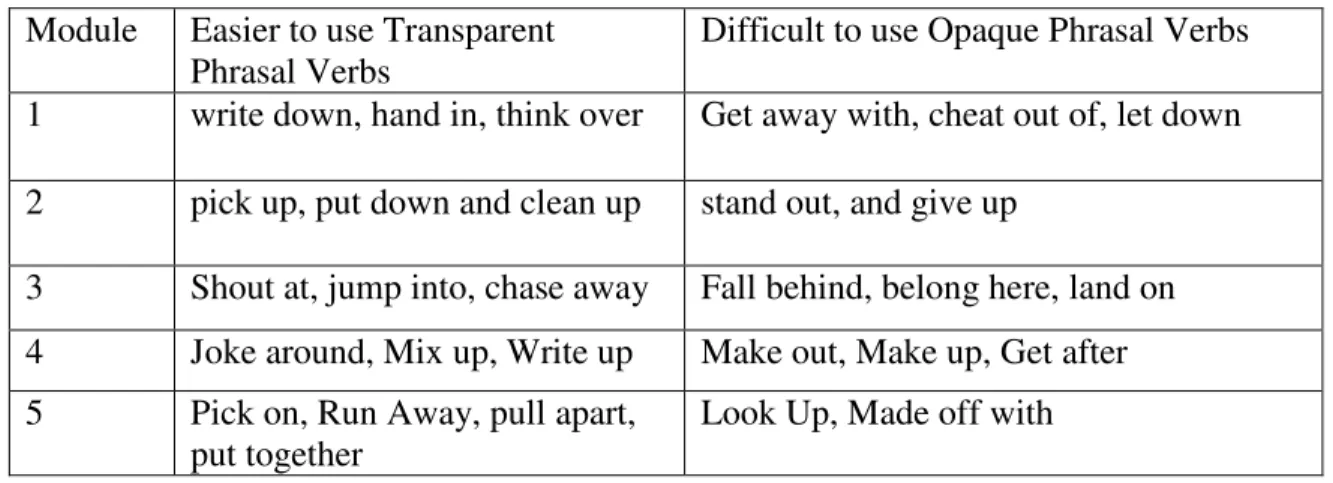
(19) 11 Running head: Narratives and the Oral Use of Phrasal Verbs. (1995) aver, “…it seems almost arbitrary that some meanings are held in single words and others in several words” (p.189).. For the language learner, according to Pawley and Snyder (1983), multi word units can be extremely important in terms of accurate fluency and comprehension. According to Nattinger (1998), this is why in ESL education, words should be learned not only as single lexical items but also as a complete lexical phrase which would be stored as a lexical chunk that can be retrieved at a later date to be included in its entire form in speech production (Hedge, 2000). Fluency in learners would be enhanced if learners were able to use these language chunks automatically because less planning, processing, and encoding is needed. Learners could then concentrate more on other processes of speaking including the planning of discourse, generating other needed lexical items, rhythm and variety (Wood, 2009). Because so many other aspects of production depend on having these lexical chunks at the ready disposal of students, they should be taught to use these lexical items at an early language level. It would be unrealistic to expect learners to manipulate lexical chunks with the same ease as a native speaker and build language from the ground up and for this reason Bolinger (1971) suggests that learners should store language chunks for ready use as the English language has a great amount of language that is already prefabricated.. The idea of formulating a practical teaching approach of multi-word items was first proposed by Willis in 1990 and was then popularized by Lewis in 1993 in his much heralded book The Lexical Approach. The Lexical Approach moved away from a traditional focus on syntax and tense usage and is more focused on teaching phrases that consist of combined words. This approach came from the understanding that a great deal of oral production is made.
(20) 12 Running head: Narratives and the Oral Use of Phrasal Verbs. up of fixed phrases or lexical chunks and oral production works well because it follows a set pattern. In his later book, Lewis (1997) emphasizes his beliefs by claiming, “Language consists not of traditional grammar and vocabulary but often of multi-word prefabricated chunks” (p.3).. This idea of turning away from the traditional divide between grammar and vocabulary instruction is not unique to Lewis. This rejection was described by Nattinger and Decarrico (1992) as an understanding of multi-word chunks as the link between lexis and grammar. An investigation by Dechert (1984) has shown that problems in lexis can be a greater obstacle to fluency than grammatical problems and being grammatical correct is not always essential for clear communication. When communicating with a non-native English speaker, native English speakers are better able to work through grammatical errors than incorrect word choice which can greatly interfere with meaning. Due to the importance of lexis in communication and comprehension it would seem appropriate for ESL teachers to spend more time on lexis than grammar.. The aim of Lewis’ (1997) second book was to discuss and present practical teaching solutions for ESL instructors interested in applying the Lexical Approach in the classroom. One of these practical solutions from the same book (Lewis, 1997, pp. 146 to 151) was a detailed suggestion by Martinez. The latter scholar suggested teachers take the following steps when presenting new phrasal verbs. First, the teacher should create a short narrative which includes target phrasal verbs. This narrative should include various visual prompts that will help the students to follow the story and create deeper interest. After the narrative is completed, the teacher should then give the same phrasal verbs on pieces of paper to the.
(21) 13 Running head: Narratives and the Oral Use of Phrasal Verbs. students and have them arrange them in order according to the story they have just heard. When the learners have recreated the story using the desired phrasal verbs, learners can then create an original story of their own again using the target phrasal verbs.. Bolinger (1971) dramatically describes phrasal verbs as, “an explosion of lexical creativeness that surpasses anything else in our language” (p. xi). This may seem something of an over statement for a type of multi-word chunk that is quite commonly used not only in oral communication but also in a considerable amount of written content that is not written for a formal audience but phrasal verbs do seem quite complex due to their creative use by English speakers. Coelho (2004) clearly defines phrasal verbs as such, “Phrasal verbs are verbs that combine a verb and an adverb or a preposition” which together forms a phrasal verb “that means something different from the separate meaning of the individual words” (p.81). Harmer (2007) provides the following definition, “a phrasal verb is made up of two or more words, yet it is only one meaning unit” (p. 38). Phrasal verbs have also been described by Lewis (1993) as two- or three-word idiomatic expressions, consisting of a verb and a particle or a combination of a particle and a preposition. Combinations that consist of three lexical items, according to, are sometimes called phrasal-prepositional verbs (Ackerman & Webelhuth, 1998) while some linguists call them complex predicates or multi-word verbs (Parrott, 2000). Some examples of phrasal prepositional verbs are, come down with, do away with and look down on. Boliger (1971) considers the term phrasal verb a more accurate term because it describes not only two word combinations but multiword combinations as well. In this study I will be exclusively using the term phrasal verbs as it is the term which is most widely used..
(22) 14 Running head: Narratives and the Oral Use of Phrasal Verbs. Although there is some confusion as to whether to place phrasal verbs in the category of idioms or as collocations, it is generally understood that phrasal verbs can contain a variety of meanings and can be best viewed in terms of transparency. Phrasal verbs can range from completely idiomatic which are known as opaque phrasal verbs to completely transparent in meaning which are called transparent phrasal verbs. Transparent phrasal verbs (which are the easiest to understand by ESL learners) may include, look ahead, pull up, and go out. These lexical chunks can be easily understood because each lexical item retains its literal meaning. With the term pull up used as transparent phrasal verb it is fairly clear that something is being raised and up refers to the direction the thing is being raised. However, if pull up is used to describe the parking of a car the meaning becomes much more unclear. Opaque phrasal verbs which are much more difficult to understand include, bump into (to meet someone by chance), hit on (seduce), and turn up (arrive). These opaque phrasal verbs are completely idiomatic and cannot be understood through an analysis of their individual parts. Phrasal verbs which cannot be described as either opaque or transparent are generally known as semi-transparent phrasal verbs. These semitransparent phrasal verbs are not always easy to place in one category or the other as a certain degree of subjectivity must be used (Armstrong, 2004). It has, in addition, been noted that the meaning is generally more transparent when the lexical chunk is put into context.. Semitransparent phrasal verbs, as defined by Celce-Murcia and Larsen- Freeman (1999), are phrasal verbs whose meaning is not as transparent as literal phrasal verbs, but not as idiomatic as opaque phrasal verbs either. Some phrasal verbs found in this category are, lock up, start out, break down, take off, set up and drink up (Celce-Murcia & Larsen-Freeman, 1999). Semitransparent phrasal verbs are also sometimes known to some linguists as.
(23) 15 Running head: Narratives and the Oral Use of Phrasal Verbs. ‘aspectual phrasal verbs’. These kinds of semitransparent phrasal verbs for this study will be understood as occurring when the verb retains its meaning but the particle does not (Armstrong, 2004).. Phrasal verbs are known to be difficult to learn by language learners and Sinclair (1996) even refers to them as “the scourge of the learner” (p.78) since they present so many inherent difficulties. One big difficulty in understanding phrasal verbs is that the majority are only decodable through context (Armstrong, 2004). Some phrasal verbs have different meanings depending on the context in which they are found. A native English speaker would have little difficulty immediately understanding meaning but these changes in meaning based on context can be impenetrable for many learners of English (Armstrong, 2004). Another problem for learners is that the meaning of a verb can change greatly when combined with a particle (Hedge, 2000). Even advanced learners are not always sure whether the compound form is possible or commonly used by native speakers and have difficulty translating to L1. Learners also tend to question the order the words come in, for example, there are put in and there is input (Hatch & Brown, 1995). The rules of combining verb plus particle which enables native English speakers to coin new combinations with ease, also render phrasal verbs very difficult to learn. Although the syntactic nature can cause many difficulties for the learner, the main difficulty, for English learners in understanding phrasal verbs, lies is their semantic complexity (Armstrong, 2004). One final obstacle to learning phrasal verbs is that they require considerable practice and experience if basic rules about which phrasal verbs can be separated and which cannot be separated are to be learned (Coelho, 2004)..
(24) 16 Running head: Narratives and the Oral Use of Phrasal Verbs. In common with many other linguistic groups, Spanish speakers also struggle with phrasal verbs. In fact, phrasal verbs are one of the most difficult lexical structures for Spanish speakers to master (Swan & Smith, 2001). Much of this difficulty is caused by the fact that verb + particle constructs such as phrasal verbs are uncommon outside of Germanic languages and, for this reason, learners tend to avoid these types of lexical chunks. There are also other studies that suggest it is the opaque nature of many phrasal verbs that causes avoidance by Spanish speakers (Gaston, 2004). Spanish speakers also tend to have difficulty with two and three part phrasal verbs because their meaning cannot be discerned from their individual parts. Spanish Learners tend to feel more comfortable with synonyms derived from Latin instead of the more commonly used phrasal verbs. This is because there are many Latin based word equivalents in Spanish to that of English phrasal verbs, for example, the verb extinguir is more or less equivalent to the phrasal verb put out (Swan & Smith, 2001) so learners might be more inclined to say “extinguish a fire” instead of using the more commonly said phrasal verb. Despite the vast difficulties that must be overcome, Waible (2007) claims, “there is no reason why this should not be achieved at the school level and why also beginners should be not exposed to more and especially a greater number of idiomatic phrasal verbs” (p.168).. Part of this difficulty to learn phrasal verbs could originate from the fact that phrasal verbs are very difficult to teach for both non-native and native English speaking teachers. Native English speaking teachers can certainly understand all phrasal verbs despite the various degrees of transparency involved but a language learner needs to be taught how to recognize these varying degrees of transparency (Armstrong, 2004). To do this the teacher not only needs to be fluent in the language but also needs to be educated on how the language structures of phrasal verbs work. Some of the responsibility for the difficulty in the use of.
(25) 17 Running head: Narratives and the Oral Use of Phrasal Verbs. phrasal verbs by learners is due to the fact that, “language teachers are not sufficiently aware of the semantic systems and regularities underlying these complex combinations” (Armstrong, 2004, p.214). If teachers are to properly teach phrasal verbs they also need to know which structures are most likely to occur in natural conversation, which is certainly no easy task for native and non-native ESL teachers (Hatch & Brown, 1995). Many non-native English speaking teachers also struggle because they do not have a strong command of phrasal verbs and therefore feel uncomfortable teaching them (Nassaji & Tian, 2010). Not to mention the fact that according to Bolinger (1971), new phrasal verbs are created all the time and this can cause difficulty for anyone trying to learn them as a teacher (Nassaji & Tian, 2010). To teach phrasal verbs, the ESL teacher needs to be aware of a wide range of information, including the fact that up and out are the two most commonly used particles in the formation of phrasal verbs. They should also know bi-syllabic verbs such as loosen up, marry off, and single out are not a common type of phrasal verb and they usually have a weak second syllable. Teachers also need to understand the relation between the particle and the verb and how this affects the meaning if they are to instruct learners on how to decode and understand phrasal verbs (Armstrong, 2009). Although certain problems can be laid at the feet of the ESL instructor, there are other obstacles to the effective teaching of phrasal verbs to consider. In Costa Rica, Esquivel Morales (2000) states that teachers have a difficult time teaching phrasal verbs due to constraints of curriculum that is organized around the textbooks and that these textbooks generally do not examine phrasal verbs as they relate to spoken English. Mishan (2004) also complains that prescribed TESOL text books for teachers often present phrasal verbs in an inauthentic way and the only phrasal verbs that do appear are found randomly in textbook dialogue..
(26) 18 Running head: Narratives and the Oral Use of Phrasal Verbs. Since the mid nineteen-eighties there have been numerous studies that have examined the use of phrasal verbs in the classroom. One of the earliest studies was conducted by the team of Dagut and Laufer (1985). In their study, they found that ESL students who did not have phrasal verbs in their L1 (Hebrew speakers) were more likely to avoid the use of phrasal verbs than learners whose L1 did contain phrasal verbs (Dutch). These finding were contrary to the predicted results by Dagut and Laufer (1985). They originally assumed Dutch speakers would avoid these lexical chunks due to complicated semantic difficulties found in phrasal verbs. Through a variety of tests (which included multiple choice, memorization, and translation) students were elicited to use either one word or phrasal verbs in their responses. More specifically, from the final results, it was noted that although Dutch speakers did not avoid phrasal verbs, they were more likely to avoid opaque phrasal verbs.. McFarland’s study in 1985 investigated the comprehension of phrasal verbs by 32 advanced ESL learners. This study then compared its results with 32 native English speakers. This study aimed to determine whether opaque or transparent phrasal verbs or both were accessed by the learner during discourse comprehension. The role context played in the lexical access process was also investigated. In the implementation phase, learners were presented orally with forty phrasal verbs which, in context, were biased towards either the transparent or opaque understanding. The final results found that ESL learners understanding of phrasal verbs whether transparent or opaque were similar to native English speakers.. In 1993, Laufer and Eliasson conducted a study with advanced Swedish ESL learners. In this investigation they used two types of tests: 1. a multiple choice test and 2. a translation test. These tests were designed to discern the passive knowledge of phrasal verbs by the learners..
(27) 19 Running head: Narratives and the Oral Use of Phrasal Verbs. By comparing the results of this investigation to the study conducted by Dagut and Laufer in 1985, it was found that phrasal verbs were avoided by non-Germanic L1 learners (Hebrew speakers) but not by Germanic speaking L1 learners (Swedish, Dutch speakers). It was not only noted that similar opaque phrasal verbs were not avoided by Germanic speaking L1 learners but also that Swedish learners used more opaque phrasal verbs than Dutch learners.. Through a multiple choice test given to Finnish and Swedish speaking Finns, Sjöholm (1995) was able to explore intermediate and advanced ESL learners’ use of phrasal verbs. Sjöholm also examined the learners’ number of years of study and time spent living in an English speaking country compared to their command of the use of phrasal verbs. This study also aimed to determine the relation between transparency of phrasal verbs and whether avoidance of phrasal verbs was connected to structural or semantic problems. The results from this study showed that both the Finnish and Swedish speaking groups used fewer phrasal verbs than English native speakers and that Finnish speakers used fewer phrasal verbs than the Swedish speakers (this was particularly true for the intermediate level speakers). While Swedish speakers felt more comfortable using similar Swedish based opaque phrasal verbs, Finnish speakers avoided these kinds of lexical chunks. Finally, speakers from both linguistic groups who spent time in English speaking countries performed better in the use of opaque phrasal verbs.. In the study of four advanced ESL German learners, Lennon (1996) showed that even advanced learners can be overburdened in the understanding and use of the commonly used verbs put and take in phrasal verb construction. This study showed that although learners were strong in the understanding of the verbs as single lexical items, they could be easily.
(28) 20 Running head: Narratives and the Oral Use of Phrasal Verbs. confused by misleading phrasal verbs which used incorrect verbs in the verb plus particle lexical chunks.. Esquivel Morales (2000) explored the relationship between English language level in Spanish speaking Puerto Ricans and the comprehension of phrasal verbs on a semantic and syntactic level. This study concluded that there was a relation between the comprehension of the English language and the understanding of phrasal verbs.. The investigation conducted by Liao and Fukuya (2004) focused on the avoidance of phrasal verbs in relation to language level (intermediate and advanced learners), type of test (multiple-choice, translation, recall) and type of phrasal verb (transparent, opaque). This investigation had six separate groups of Chinese university students take one of the three tests and a group of native English speakers take the multiple choice test. It was found that intermediate learners tended to avoid phrasal verbs and chose to use one word equivalents instead. Intermediate learners were found to use far fewer phrasal verbs than advanced learners. It was also found that the advanced group of learners used nearly as many phrasal verbs as native English speakers. The results of this study also showed avoidance issues by the learners were the result of L1 to L2 transfer problems and semantic difficulty encountered in the phrasal verbs. Finally, it was shown that all ESL learners used more transparent phrasal verbs than opaque ones.. “Avoidance of phrasal verbs by Spanish-speaking learners of English” was the title of a study conducted by Gaston (2004). In this study the evaluation of written phrasal verb production by 29 native Spanish-speaking ESL students found that avoidance is triggered mainly by semantic factors and by low proficiency levels in the second language..
(29) 21 Running head: Narratives and the Oral Use of Phrasal Verbs. Waible’s (2007) study focused on a group of German and a group of Italian advanced ESL learners. Using a data base of written production from these two groups, transparent and opaque phrasal verbs were examined. The written discourse was then compared to that of native English speakers. The research showed the most obvious difference between these two groups of learners was that the German ESL learners used 24.6% more phrasal verbs than native English speakers while Italian ESL learners used 41.7% fewer phrasal verbs than English native speaking students. The lack of phrasal verbs in the writing of Italian learners was found to be connected with the use of a high number of Latinate verbs. The German learners were found to write in a more informal style and used more phrasal verbs if they were allowed to use resources, did not feel pressured by time constraints, and there was a correlation between the amount of exposure to ESL instruction and the number of phrasal verbs used. German learners’ ability to creatively form new phrasal verbs based on strict phrasal verb patterns was found to be more advanced than that of the Italian learners. This strength to build new phrasal verbs was found to be the result of phrasal verbs existence in the German language but not in Italian. In both Italian and German learners, it was found that more phrasal verbs were used if the learner spent time in an English speaking country. Based on the findings, it was concluded that structural differences between the learners L1 and L2 were the basis of any difficulties in the acquisition of phrasal verbs. The ability to learn phrasal verbs remains inconclusive due to the narrow scope of the target group in the study. It is the view of the author that opaque phrasal verbs are stored whole by the learner due to the low error rate of use by the learners.. Wood’s 2009 study of Japanese and Chinese L1 learners of English found that increased use of formulaic sequences appeared to play a role in the fluency gain. Wood’s case study.
(30) 22 Running head: Narratives and the Oral Use of Phrasal Verbs. focused of the use of formulaic sequences in spontaneous communication by a female Japanese L2 learner (pseudonym Sachie) of English in two oral narrative speaking tasks separated by a six-week interval. During the interval, Sachie participated in a series of weekly fluency workshops which focused on incorporating formulaic sequences in speech. Sachies’ narration was analyzed with respect to the length of runs between pauses and the speech rate, as well as the use of formulaic sequences. Sachie, who has an undergraduate degree from Japan, was in her early twenties at the time of the data collection and was studying English in Canada for a year. Sachie was required to produce narratives spontaneously in the university language laboratory on topics of personal relevance. No preparation time or notes to prepare for her narrative were allowed. In the input stage the learner listened to audio recording of native speakers telling personal narratives. The learners worked in teams to reconstruct the entire text as was heard in the audio recording. Learners then compared their rendition of the narrative with the original text. Learners were then to take note of the differences with special attention paid to formulaic language. In the practice and production stage, after listening to the narrative of the native English speaker, the learners made a short narrative of their own. Quantitative data suggests that the Japanese subject was able to speak with increased fluency after the workshop, as well as produce a greater quantity of speech including a greater quantity of formulaic sequences which were derived from the native speaker’s narrative model found in the fluency workshop. The Japanese subject was able to use the formulaic sequences found in the workshop models effectively in her personal narratives with an acceptable level of fluency. Upon reflection Wood states, “Further research in this area would benefit from a large cohort of participants and a longer timeline between focused instruction and production of speech samples” (2009, p. 12)..
(31) 23 Running head: Narratives and the Oral Use of Phrasal Verbs. All of the studies mentioned above have produced interesting and valuable data for the academic consideration in the field of ESL teaching and learning. There are, however, various areas of phrasal verb research left to be explored which were not included in these investigations mentioned above. The majority of these studies deal with phrasal verbs and transparency on some level. Despite the fact that ESL learners’ relationship with opaque and transparent phrasal verbs is explored, none of these studies attempts to examine ESL learners’ relationship with semitransparent phrasal verbs. All of these studies examined ESL learners at the university level as target groups for their research, but none of these examine how young learners deal with the language acquisition of phrasal verbs. Many of these studies examine existing knowledge of intermediate and advanced learners of phrasal verbs but only a few including Wood (2009) and Waibel (2007) attempt to examine the relationship between the actual teaching of these phrasal verbs and acquisition by the learners. Most of these studies (with the exception of Wood (2009)) focus on learners’ written use of phrasal verbs and not enough research has been done to investigate the oral use of phrasal verbs. The following study was partially constructed with these unexplored areas in mind.. While considerable research exists on the study of phrasal verbs, no studies exist which relate to both phrasal verbs and the use of narratives in the classroom despite considerable research conducted by the researcher in various academic databases such as EBSCO, ProQuest and ELT journal. Although, frustrating at first, it is now seen as an opportunity to venture into unexplored pedagogical territory. As a means of casting a wider net for the investigative needs of this Action Research Project, a search for academic materials which related to oral narratives and vocabulary acquisition was conducted. Again, no specific materials were found.
(32) 24 Running head: Narratives and the Oral Use of Phrasal Verbs. but on a wider search for oral narratives in general a few articles were found that made indirect reference to oral narratives and vocabulary acquisition.. Cortazzi and Jin (2007) followed and recorded the language development of a group of young English language learners living in Britain from various cultural backgrounds. These year three learners were asked to use keywords, story maps and photos to orally tell and retell simple stories in English and in their first language (Gujerati). These students first heard a story in English and then in their native language. As students heard the story, pictures were placed on the board to aid students in the retelling of the story. The learners reported that, “the pictures helped them to organize their knowledge of the story” (Cortazzi & Jin, 2007, p.654). In the second step, teachers helped learners choose key words (nouns and verbs) from the story and then they wrote them on cue cards which were organized into a story map to tell a new story to their classmates. Thirdly, using photos which were taken during the story map process, students reflected on the learning which took place several weeks previously. Through the use of this approach it was found that “visual support and visual means of modeling stories” (Cortazzi & Jin, 2007, p.654) gave learners the metacognitive space to plan, remember, develop understand and reflect upon their narratives. It was also the authors’ belief that meaning was central to the narrative process and that expressing intended meaning and trying to understand meaning expressed from others was fundamental to language development. From this research, the authors suggested the implementation of a curriculum structured around the use of narratives would be beneficial to language learning as students would be able to learn not only from the telling of their own stories but would ultimately learn how to tell better stories. This research study is seen as particularly pertinent as the use of.
(33) 25 Running head: Narratives and the Oral Use of Phrasal Verbs. visual cues and the use of retelling stories are metacognitive strategies also found in the pedagogical intervention implemented in this Action Research Project.. The critical role which vocabulary plays in the ability to properly convey an oral narrative was the motivation for a study conducted by Uccelli and Páez (2007). In this study, the researchers focused on the development of narrative and vocabulary skills for bilingual Spanish/English speaking American kindergarten children. Even though the majority of these Latino children were born in the U.S., these children were found to lack vocabulary knowledge of English which may have been related to their lack of exposure to English in the home. Data was gathered from vocabulary tests and narrative tasks where students had to tell a narrative both in Spanish and English. These students were provided with simplistic pictorial stories and were then asked to produce an oral account of what happened in the story in both English and Spanish without the aid of the pictures. Students were evaluated on the narrative quality of their stories by bilingual researchers who based the scores for the narratives on such things as syntax, noun lexicon and the clarity of the story. The original narrative tests took place in kindergarten while a second round of testing took place when the students were in grade one. The results of this study found that children with larger English vocabularies had higher test scores in their narrative quality. This finding resulted in a recommendation for practitioners working with kindergarten children to develop vocabulary knowledge and language features found in narratives. Interestingly, this study also found that students who were instructed in the use of narratives in Spanish were better able to tell coherent stories in English. As this researcher aims to improve the use of a form of vocabulary (phrasal verbs) in young learners so that they will be able to communicate orally in an effective way, the.
(34) 26 Running head: Narratives and the Oral Use of Phrasal Verbs. findings of this study are considered valuable as it places a high value on the learning of vocabulary as a means of effective oral storytelling for young learners.. Also using a series of pictures as a catalyst for oral story telling Kang (2003) investigated the cultural differences between narratives by Korean Adult EFL learners and those of native English speakers. The findings of this study showed that cultural differences heavily influenced narrative strategies such as Korean speaking students tended to tell shorter stories then their English speaking counterparts. The findings which elaborated on the structural differences in narratives produced by Korean students was also mirrored in Uccelli’s (1997) investigation which found that Spanish speaking children tended to deviate from chronological storytelling and often included a series of independent stories within a single narrative.. In a recent study conducted in Alberta, Canada, adult learners of English and there ESL teachers were interviewed in an attempt to establish the value students and teaches placed on the use of narratives in the classroom (Nicholas, Rossiter & Abbott, 2011). Every instructor interviewed placed a great value on the incorporation of learners’ stories in their teaching. All instructors reported that narratives told by learners were advantageous because it brought in new vocabulary to the classroom. Instructors also reported valuing oral narrative over written ones particularly at the lower language levels. Teachers valued giving their students time to plan and the use of repetition as effective classroom strategies. These recent immigrant students also reported that they enjoyed telling stories about themselves and listening to stories about other people. Although this study focuses on adult learners from various cultural backgrounds the views held by teachers are still considered valid for the purposes of this study..
(35) 27 Running head: Narratives and the Oral Use of Phrasal Verbs. In the context of bilingual schools in Bogota which may be very similar to the context of this Action Research Project, Ordóñez (2005) studied the English and Spanish oral production of narratives by high school Spanish speaking students. These narratives were compared to that of students in both monolingual schools in Spanish and in English in the U.S. A simple wordless picture book was used to elicit the oral narratives in Spanish and English. It should be noted that students were given the option to tell the story either in Spanish or English first. Because all students decided to tell the story in Spanish first, Ordóñez (2005) considers this choice was made as students wanted to initially perform their best and affectively it increased confidence. Although these students were an average of 15 years old and would have experienced years of English language training they still demonstrated limitations not only in their English narratives but also in their Spanish narratives as well.. Given the importance placed on narratives in the human experience, a belief which is shared by Brophy (2009) who states, “The telling of stories lies at the heart of human communication and underpins the development and cohesion of all societies and cultures” (p. IX), it is believed that narratives will provided a meaningful context for the learning of lexical chunks like phrasal verbs..
(36) 28 Running head: Narratives and the Oral Use of Phrasal Verbs. Chapter 3: Research Design The type of study and the implementation of a study can greatly determine the relationship between the researcher and subject as well as influence the final results of that study. For this reason, the researcher of this study thinks it is important to go into some detail and discuss these relevant matters. The three instruments that will be used will be presented and justified based on research already carried out. Questions about validity and the use of proper triangulation in this research will be examined. In this chapter on research design, the researcher will also look at some of the ethical concerns this study will raise, the principal objectives, and the time line the research will follow. Qualitative research is a scientific method of inquiry in which the researcher is one of the principal actors in the process. Generally, the qualitative researcher asks questions and detailed data is gathered from the natural environment then analysed. Qualitative analysis can be defined as, “a process of examining and interpreting data in order to elicit meaning, gain understanding, and develop empirical knowledge” (Corbin & Strauss, 2008). Because quantitative research offers little flexibility, qualitative methods are seen as more practically related to classroom concerns (Dick, 2011). Also unlike quantitative research, which aims to find generalized answers to problems, qualitative researchers provide detailed descriptions and let the reader determine whether the study applies to their particular situation (Del Siegle, 2002). As a teacher of young learners, it is the researcher’s responsibility to form supportive relationships with students not just in areas of academics but also in affective areas as well. This type of connection with students makes astute observation from a distance impossible. In the elementary school setting there also exists the dynamic of the young learner and the adult teacher in the classroom which can lead to a.
(37) 29 Running head: Narratives and the Oral Use of Phrasal Verbs. very different interpretation of similar events in the field. Due to these realities of teaching young learners, this investigative paper followed the more humanistic guidelines of qualitative research and analysis. Because this research is of a pedagogical nature and aimed to specifically examine and improve classroom practice, the guidelines of an Action Research Project were followed. A very simple definition of Action Research as given by O’Brian (1998) is, “learning by doing” (n.p.). A somewhat more complete definition of Action Research would be, “…a process in which participants examine their own educational practice systematically and carefully, using the techniques of research” (Ferrance, 2000, p. 7). Action Research, in a school environment, is a reflective process that searches for solutions to real problems found in schools, in instructional technique, and in student under achievement. Action Research, in essence, allows teachers to move away from theoretical research and also allows them to investigate and make changes in areas of education in which they have real influence; classroom practices (Ferrance, 2000). Names such as Participatory Research, Collaborative Inquiry, Emancipatory Research, Action Learning, and Contextual Action Research are some of the various synonyms used for Action Research (O´Brian, 1998). In terms of educational research, the process of Action Research might look something like this: 1. An educator identifies a problem in the school or in the classroom. 2. The educator researches the problem and gathers data. 3. The educator interprets the data..
(38) 30 Running head: Narratives and the Oral Use of Phrasal Verbs. 4. The educator designs an action plan that is designed to resolve this problem based on the same data and, possibly data collected from the target learners. 5. The educator implements this action plan in a real life educational setting. 6. The educator analyzes the trustworthiness of the action plan using a qualitative method of study. 7. If the analysis of the implementation of the action plan does not produce favourable results, the educator repeats the process. As stated in number six above, Action Research mostly relies on qualitative and not quantitative methods of research. A great deal of Action Research also requires considerable flexibility if the researcher is to be responsive to the needs of the study. This study took place in the bilingual school Gimnasio del Norte which is located in Bogotá, Colombia. Gimnasio del Norte, describes itself as a bilingual school and it is part of the association of schools known as International Baccalaureate which promotes the use of a second language in schools. As a bilingual school, the majority of the students’ instruction is in English. English, Math, Science, Art and Social Studies are all taught in English which accounts for over 15 hours of instruction a week. The participants in this project were 18 grade five students who range between the ages of 11 to 12. As six students missed various separate parts of the pedagogical implementation, any data collected from them was excluded from this Action Research Project. The majority of these students have been studying at the school for an average of six years, while a few students have recently transferred from other bilingual schools. The average student in this class would most likely be considered at a B1 level of fluency in.
(39) 31 Running head: Narratives and the Oral Use of Phrasal Verbs. English according to The Common European Framework. In terms of their production skills, most of these students can orally communicate with reasonable clarity in terms of pronunciation, fluency and content but many of the students are particularly weak in conveying clear and meaningful content in writing. In the receptive skills, students do not enjoy reading but generally have a strong comprehension of readings for their level. Students have in the past demonstrated weakness in understanding listening exercises designed for their level. Students will avoid speaking in English, as they prefer to speak in Spanish and students will often “take the path of least resistance” method in communication and will use simpler and less accurate forms. This researcher who has carried out and applied the research modules has ten years of experience in teaching the English language but only three years of experience living and teaching in Colombia. It should also be noted that the researcher has not worked or studied in bilingual schools before arriving in Colombia. The researcher also maintained a journal during the period of pedagogical implementation which was one of the principal tools of data collection. In Action Research, researchers must be sure that their study is properly triangulated to ensure validity. Validly is a term that is connected with the reliability and accuracy of data. Ultimately, validity asks whether your data accurately represents what you have been studying (Dick & Swenson, 2006). There are many different kinds of validity such as, internal validity (the connection between final results and the data),external validity (how closely the findings relate to similar but different contexts), democratic validity (other opinions permitted based on the data), outcome validity (are research questions answered and does this raise new questions), process validity (is the process unbiased), catalytic.
(40) 32 Running head: Narratives and the Oral Use of Phrasal Verbs. validity (are changes made based on results) and dialogue validity (is the work evaluated by peers in an unbiased way?) (Burns,1999). This study aimed to consider all these varieties of validity. Triangulation is a method of assuring that final results in research are more accurate by having more than one type of data collection instrument in your study. As data collection methods can be biased towards producing particular results, triangulation hopes to avoid bias by being able to compare results from more than one method of data collection. A properly triangulated study might also allow for various opinions to be entered into final results and not just that of the author. Although triangulation is a valuable tool used to enhance validity, it does have several drawbacks. Students who have little experience being asked their opinions on teaching practices, and colleagues who have no training on how to properly observe a class are two such drawbacks that could interfere with the validity of the study (Burns, 1999). For these reasons, in-depth student opinion was not always easily attained and students were at times encouraged to convey clear and meaningful ideas when reporting their personal perceptions. To ensure proper validity through triangulation the researcher of this study has chosen three separate instruments which were used in this Action Research Project. 1. Closed Questionnaire (See Appendix B) In this study five similar three hour 20 minute classroom teaching modules were conducted. Closed Questionnaire 1.1 was used at the end of Module 2. Students had 15 minutes to complete the instrument. This simple closed questionnaire was used due to the age and concentration level of the students. Because these students are younger, the.
(41) 33 Running head: Narratives and the Oral Use of Phrasal Verbs. researcher did not think they would be able to sit down and write for a lengthy period which is required when doing open questionnaires. The researcher also felt that students might view an open questionnaire negatively because they dislike writing and they would not have the English vocabulary to express their opinions clearly. When “The Closed Questionnaire” was piloted with a group of grade five learners from my previous bilingual school it contained several open questions. It was found that many students were unable to answer these questions in a clear and meaningful way which related clearly with my research questions. For this reason, all of the questions in “The Closed Questionnaire 1.1” had possible answers provided. Question Number 1 contained two parts which related to my research question about the perceptions the students had towards the use of narratives as a technique in learning phrasal verbs. In the first part of Question 1, the learners had an opportunity to state their general perception of the module through five possible responses from the Likert Scale. In the second part of Question 1, students were given an opportunity to specify what it was about the class they liked or disliked. Question 2 was designed to answer the research question, “What is the effect of using narratives on the use of phrasal verbs?” The first part of Question 2 again uses the Likert Scale to evaluate the usefulness of the module. Students were given an opportunity in the second part of the question to specify what was useful and which parts of the module were not useful. The closed questionnaire was chosen so there would be “No difference between articulate and inarticulate respondents” (Galloway, 1997)..
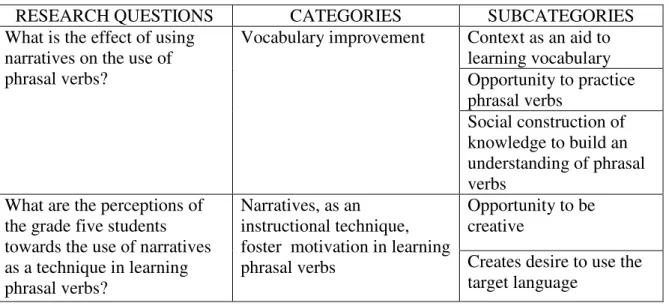
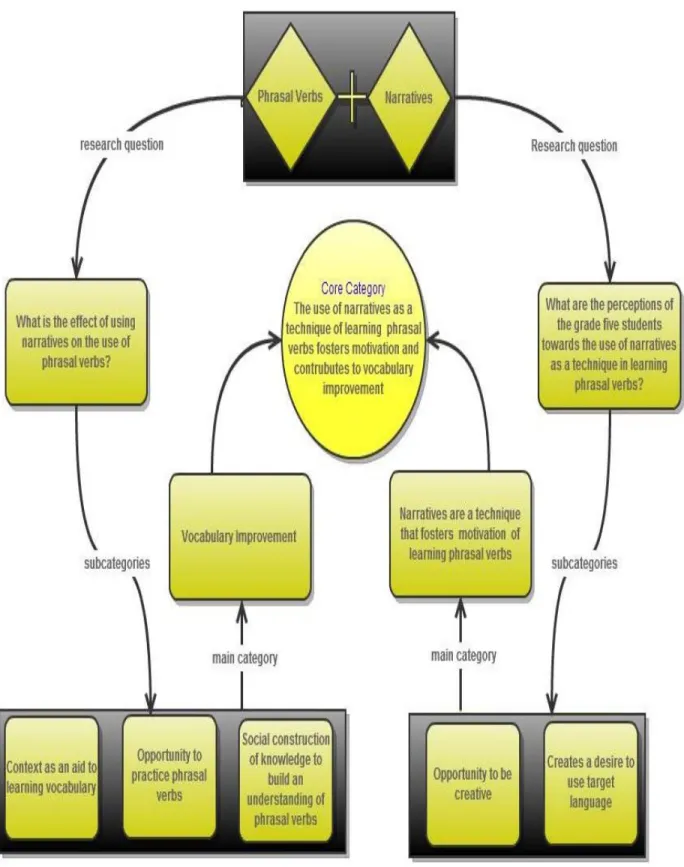
(42) 34 Running head: Narratives and the Oral Use of Phrasal Verbs. Open and Closed Questionnaire Unfortunately, after the implementation of “The Closed Questionnaire” with the students from Gimnasio del Norte it was found that the data retrieved was not wholly satisfactory, and a similar second questionnaire which contained open elements named “Open and Closed Questionnaire”, was created (See Appendix C). This second questionnaire, despite the previous unsatisfactory piloting, included open questions after the closed questions. Because the students at Gimnasio del Norte were perceived by the researcher to be more disciplined in terms of writing and conveying better thought out ideas than the grade five students from the previous bilingual school, it was felt that open questions would produce valuable data related to the study. 2. Journal Observations (See Appendix D) As this is a qualitative study it was clear to the researcher that student opinions should be balanced with the needs and values of the instructor. For this instrument, information was recorded either at the end of the class or at the end of the day, but no later. Journals are an important tool for observers because they help to improve and focus observation skills (Chamot, Barnhart & Kevorkian, 1998). In the journal, the researcher recorded observations of the use of phrasal verbs by students under two headings: Effectiveness, and Perceptions. The heading Effectiveness corresponds to the research question “What is the effect of using narratives on the use of phrasal verbs?” and the heading Perceptions corresponds to the research question“What are the perceptions of the grade five students towards the use of narratives as a technique in learning phrasal verbs?” Any information recorded about the perceptions of the students was based on what the researcher saw and heard as students were engaged in the module..
(43) 35 Running head: Narratives and the Oral Use of Phrasal Verbs. 3. Students’ Performance For the last instrument, students were asked to create a story individually. Students were given a very short period of time to plan and to draw a storyboard. Students were asked again to draw storyboards in this activity as it was thought by the researcher an effective means of orally telling the story to classmates for the learners without having to rely solely on memory or a story that was already written out. These students were not asked to include any phrasal verbs in their story and were given complete liberty to include whatever lexis they felt was appropriate to their narratives. As students presented their stories to the class, they were recorded using a digital audio recording device. The recordings were analysed to see if students were willing to use any of the target phrasal verbs studied of their own free will. A transcript (See Appendix E) was made the students’ short narratives. This instrument aimed to answer primarily the research question: “What is the effect of using narratives on the oral use of phrasal verbs?”. Because the researcher of this study was instructing underage learners, consent from the director of the elementary school, who is also partially responsible for curriculum at the school, was necessary. For this reason, the researcher wrote a letter of permission to the director which has been signed (See Appendix F). Permission from the parents (See Appendix G) to include information given by their son or daughter in this Action Research Project and to record their voice in the last hour of the implementation was also sought after. Finally, none of the students’ names were included in the study..
Figure
Documento similar
Busuu; (2) fieldwork, to observe learners’ learning experience in the two online communi- ties selected for the study; (3) online survey, submitted to learners to find out about their
(1984), Foreign and Second Language Learning: Language Acquisition Research and Its Implication for the Classroom, Cambridge, Cambridge University Press.. (1996), La
A revision of the methodology for the study of attitudes toward mathematics for the correct validation of the instrument is carried out in this research, and an estimation of
The aim of this paper is to demonstrate that reading authentic literary material in the English as a Foreign Language (EFL) classroom can improve students’ language learning skills as
the Spanish, Italian, Swedish, Dutch, Russian and Bulgarian subsections of the ICLE (1,287,517 words). More concretely, I analyse L2 use of out-PVs at different grain levels
In the case of speaking, researcher shows that a rich variety of activities might be done to promote this particular language skill in the language
languages of study: Spanish, Catalan and English as a foreign language. Learners’
This research investigates the role of ICT in language learning inside two English classrooms - a primary and a secondary – in order to explore the nature of motivation
