
Cooperative banking groups in Europe : comparative analysis of the structure and activity / Ricardo J Palomo Zurdo
33
0
0
Texto completo
(2) PALOMO ZURDO, RICARDO J.. 88. Grupos de banca cooperativa en Europa. Análisis comparativo de su estructura y actividad RESUMEN: El objetivo de este trabajo es conocer la situación de los principales sistemas o grupos de banca cooperativa mediante el análisis de determinados aspectos de su estructura y de las actividades y servicios que ofrecen. El objetivo es compararlos con el caso español para poder apreciar los aspectos comunes o diferentes que los caracterizan bajo las diversas circunstancias. Este análisis trata también de identificar el sistema de toma de decisiones y las relaciones económicas y estructurales existentes entre las cooperativas de crédito de base y las estructuras centralizadas que operan en el seno de los grupos de banca cooperativa. PALABRAS CLAVE: Cooperativas de crédito, banca cooperativa, cajas rurales, grupos de banca. cooperativa.. Groupes bancaires coopératifs en Europe : analyse comparative des structures et des activités RÉSUMÉ: L’objectif de cet article est de montrer la situation des principaux groupes (ou systèmes) bancaires coopératifs européens à travers l’analyse d’aspects particuliers de leurs structures, de leurs activités et des services qu’ils offrent, afin de comparer ces groupes avec le cas espagnol, pour déterminer les aspects communs ou différents qui caractérisent les systèmes coopératifs bancaires dans diverses circonstances. Cette analyse prétend également identifier les systèmes de prise de décisions et les relations économiques et structurelles existantes entre les coopératives de crédit de base et les structures centralisées qui opèrent au sein des groupes coopératifs bancaires. MOTS CLÉ: Coopératives de crédit, banque coopérative, groupes bancaires coopératifs.. www.ciriec-revistaeconomia.es. CIRIEC-ESPAÑA • SPECIAL ISSUE • No. 62/2008.
(3) CO-OPERATIVE BANKING GROUPS IN EUROPE: COMPARATIVE ANALYSIS OF THE STRUCTURE AND ACTIVITY (pp. 87-119). 1.- Introduction1. Co-operative banks are quite powerful in many countries in the World, especially in Western Europe, in Northern America, and even in Far East countries, such as Japan. In fact, in some of these countries they have, or share, a leading role together with other financial institutions. (Cöté and Vezina, 1998). The name of co-operative banking can be understood as a term which identifies, in a broad sense, two different legal forms: on the one hand, credit co-operative societies; and, on the other hand, financial institutions and specialised service institutions, which are linked to the first ones, but without a co-operative form (Palomo, 1995). In the same way, credit co-operative societies, also known as cooperative savings banks or co-operative credit savings banks, have other more precise names in Spain, according to their different specialisation. These names are: cajas rurales, cajas populares and cajas profesionales. As for the method used to collect all the information presented in this paper, it was based, mainly, in a broad questionnaire carried out among the managers of the main co-operative banking groups in certain European countries (Germany, France, the Netherlands, and Italy). Furthermore, in some cases, this information has been completed with personal interviews. In particular, the co-operative banking groups selected and analysed have been: the German Volksbanken and Raiffeisenbanken Group, the French Crédit Agricole Mutuel Group, the Dutch Rabobank Group, and the Italian Banche di Credito Cooperativo (known as the Casse Rurali ed Artigiane until 1995), whose respective market shares are 21, 22, 25 and 8 per cent. In this respect, in the case of France, the analysis of its four co-operative banking groups would have required a substantial extension of this paper which would had exceeded its aims. Therefore, it has been decided to choose the Crédit Agricole Mutuel group due to its relevant size. With regard to Spain, an equivalent and compared study of the Spanish group, known as the Grupo Caja Rural, has been included. This group is presently made up of 77 credit co-operatives which form the Asociación Española de Cajas Rurales (AECR), which, at the same time, are members of the employers’ association of this sector, the Unión Nacional de Cooperativas de Crédito (UNACC).. 1.- This paper is based on books and papers published by the author, between 1995-2007, mainly the titles: PALOMO, R. (1995): La banca cooperativa en Europa, Unión Nacional de Cooperativas de Crédito y Asociación Española de Cooperativas de Crédito. Madrid; PALOMO, R. (1997): “Los grupos financieros cooperativos”, Revista CIRIEC-España, nº 27, diciembre, pp. 35-68; PALOMO, R. (Coor.) (2004): Banca cooperativa y economía social en Europa. Unión Nacional de Cooperativas de Crédito, Ministerio de Trabajo y Asuntos Sociales (DG Fomento de la Economía Social y del Fondo Social Europeo). Madrid. CIRIEC-ESPAÑA • SPECIAL ISSUE • No. 62/2008. www.ciriec-revistaeconomia.es. 89.
(4) PALOMO ZURDO, RICARDO J.. 90. Nowadays, it can be assured that the Spanish cajas rurales make up a co-operative banking group which is set up as a federate banking pattern whose main features are equivalent to those of other European groups (Palomo, 1997). To come to this pattern, the Spanish co-operative credit has gone through a long, and sometimes tortuous, way since its first antecedents, a century ago (Martínez, 2003). This makes an important difference with regard to the development, more or less continuous and maintained, of the rest of the European groups analysed, whose consolidation as such took place several decades ago. Thus, after a long stage in which advances and recessions alternated, in the 50s and 60s the expected take-off of the rural co-operative credit took place, and its existence consolidated. However, the Spanish banking crisis together with other socio-political factors and a particular economic situation, led to a series of reorganisations in the sector which caused public intervention and the consequent setting up, in 1984, of the Grupo Asociado Banco de Crédito Agrícola-Cajas Rurales, (Barea, 1987; García de Blás, 1987) which was intended to emulate a public-private mixed pattern inspired by the French Crédit Agricole Mutuel pattern (Martín, 1988; García, 1989; Cerdá, 1988). But this co-operative banking pattern with public intervention failed in a few years. In fact, in 1989, most of the provincial cajas rurales broke their links with this group, so creating the present co-operative banking group around the nowadays known as Asociación Española de Cajas Rurales (AECR). Therefore, in 1989, a split took place within the Spanish cajas rurales, which progressively attenuated until 1996, when they almost achieved a complete re-unification. This has given rise to the definite setting up of a co-operative banking organised group made up of the cajas rurales and a number of specialised institutions, perfectly capable of facing the relevant challenges that may arise in the near future as well as in the long run. This particular group structure which identifies the Spanish co-operative banking pattern, known as Grupo Caja Rural, is characterised by an specific way of managing and developing its activity. This activity, to be identified as such, requires the definition and application of certain functioning and working criteria which lead its behaviour and development patterns. But it is also essential that the members which belong to this co-operative banking group know, understand, respect and assume such criteria as if they were particular ones. Concretely, the main features of the present Spanish federate banking group which the cajas rurales have made up can be summarised in the following concepts: decentralisation, subsidiariness, solidarity, interco-operation, and territoriality. They all must be understood as a compromise assumed by the institutions linked to this group; a compromise which takes shape in a number of common guidelines unanimously accepted by the association agreement that these institutions must sign. (Palomo and Carrasco, 2001).. 3.- Doing this we are assuming the Rock and Klinedinst criterion (Rock and Klinedinst 1994). www.ciriec-revistaeconomia.es. CIRIEC-ESPAÑA • SPECIAL ISSUE • No. 62/2008.
(5) CO-OPERATIVE BANKING GROUPS IN EUROPE: COMPARATIVE ANALYSIS OF THE STRUCTURE AND ACTIVITY (pp. 87-119). •. Decentralisation in this federated banking group can be understood as the respect for the decision-making and working capacity of every caja rural, as it precisely corresponds to the principle inherent in the spirit of the co-operative formula, which has been established through the democratic participation of its members in the management of the co-operative societies.. •. Subsidiariness has a double functional sense. In its upward sense, it is intended to meet certain operative needs which the cajas rurales have through the transfer of services or particular actions to specialised structures. In this way, these needs are satisfied and fully guaranteed to be successful, and allow the obtaining of economies of scale. On the other hand, in its downward sense, it must respect the main field of activity of the cajas rurales which make up the group.. •. Solidarity appears in different aspects, but it has its most precise expression in the common guarantee funds which reinforce the group solvency and which, due to their private character, may operate with a higher opportunity and flexibility than public funds.. •. Interco-operation is a classical principle of co-operatives, and, therefore, it is part of the business culture of the cajas rurales.. •. Territoriality is understood as the power and right inherent to every caja rural to operate with a full legal and economic independence in its respective region of activity.. Therefore, the election of the federate banking formula (Fernández, 1993) meets the need of providing the cajas rurales with a co-operative banking organised group which promotes their action unity and brings forward common guarantee and operating instruments which, under business development principles, assure the survival and growth of the cajas rurales, in order to fully satisfy their users’ (partners and clients) expectations.. 2.- Structure of the main co-operative banking groups in Europe. The credit co-operative groups share similar business structures which are made up of: local credit co-operative societies (usually known as primary or local co-operative banks or savings banks); in some cases, regional co-operative banks (working as intermediaries between local co-operative banks and the central or central-national co-operative bank, although there is a progressive trend towards the suppression of this intermediate operative stage in some groups); and a central co-operative bank. (Palomo, 1995; González, 1996). CIRIEC-ESPAÑA • SPECIAL ISSUE • No. 62/2008. www.ciriec-revistaeconomia.es. 91.
(6) PALOMO ZURDO, RICARDO J.. 92. This relative homogeneity in the operating organisation structures appears within an institutional frame which usually takes shape in a credit co-operative societies federation or association. Furthermore, the operating structure of the co-operative banking groups is usually completed or extended with specialised institutions which offer products and services to the credit co-operatives which are part of these groups, so obtaining a considerable reduction in costs and other synergic effects.. 2.1. Level One: Local Co-operative Banks The so-called local or primary co-operative banks have a legal statute of credit co-operative societies. Their region of activity is the municipality or the province, although in some cases these geographical limits are surpassed; e.g. in Spain, most of the provincial, or primary, cajas rurales are statutorily and legally authorised to work throughout the country (Palomo, 1999). In Spain, there is a distinction among cajas rurales (agricultural savings banks), cajas populares (popular savings banks), and cajas profesionales (professional savings banks), due to their traditional specialisation, but almost all of them, in order to be compared with other European groups, can be identified with the primary or local co-operative banks. In Germany, primary institutions are credit co-operative societies with the particular name of “Raiffeisenbanken” (similar to the Spanish cajas rurales) and “Volksbanken”, which are popular or professional and preferably urban institutions (Aschoff and Hennigsen, 1985). In France, the Crédit Agricole Mutuel group has local credit co-operative societies called “Caisses Locales de Crédit Agricole”, regulated by a 1885 Law in which their essential institutional role is emphasised as opposed to an almost testimonial banking operativity (which is in the hands of the regional savings banks). In Italy, the legal statute of the local co-operative banks also corresponds to credit co-operative societies, here called “banche di credito cooperativo”, although they were known as “casse rurali ed artigiane” until 1995. Finally, the Dutch co-operative banks are statutorily independent credit co-operatives (although they take the trade name of the group central institution, being generically identified as “rabobanks”). They are legally considered “organised co-operative banks”, although it should be noticed that the Dutch legal compilation does not expressly include the co-operative society form, which is compared to the association form. It could be thought that the smaller the relative size of the local institutions it is, the higher their cohesion within the groups they make up it will be. This circumstance would be confirmed due to the www.ciriec-revistaeconomia.es. CIRIEC-ESPAÑA • SPECIAL ISSUE • No. 62/2008.
(7) CO-OPERATIVE BANKING GROUPS IN EUROPE: COMPARATIVE ANALYSIS OF THE STRUCTURE AND ACTIVITY (pp. 87-119). fact that smaller institutions have a less individual operating capacity, which should be completed by other higher structures and mutual guarantee mechanisms. The structure of the Spanish cajas rurales consists of: a General Assembly of members, a Board of Directors (whose members are elected by the General Assembly), a Chairman, and a Managing Director (a person with professional experience appointed and engaged by the Board of Directors). Strictly speaking, there is not a Board of Supervision, but together with the internal control mechanisms (Chaves and Soler, 2004) that every financial institution should have according to the law in force, the supervision of these institutions is in the hands of the Banco de España (Central Bank of Spain) and the Public Administrations with competence in this matter. The German credit co-operatives have a structure made up of: a General Assembly of members, a Board of Directors (whose members are also elected by the General Assembly), a Managing Director, and a Board of Supervision. This Board of Supervision or control consists of a minimum of three members elected by the General Assembly, and its main function is to make sure that the Board of Directors works properly. Apart from this internal control procedure, since 1996, the auditorial functions are carried out by the regional federations. Therefore, this co-operative banking group had a double control mechanism external to that developed by the Managing Director: the individual and particular mechanism of every institution carried out by their Board of Supervision, and the collective mechanism carried out without harming the supervisory power exerted by the Administration. In France, the “caisses locales de crédit agricole” have a structure which consist of: a General Assembly of members (mainly made up of farmers and companies which have a co-operative form, or which do not have it, but are related to the agricultural and food industry), a Board of Directors, and an honorific Chairman. The local financial institutions of the Rabobank group are managed by a Board of Directors, controlled by a Board of Supervision. Both boards are appointed by a General Assembly, and the first one appoints one or more managing directors, who are responsible for the daily activity of every institution. As for the Italian local co-operative banks, their structure consists of : a General Assembly of partners (among who there are many farm owners and agricultural and food companies), a Board of Directors, a kind of Board of Supervision known as “Collegio de Sindaci”, and a Managing Director (Azzi, 2000).. CIRIEC-ESPAÑA • SPECIAL ISSUE • No. 62/2008. www.ciriec-revistaeconomia.es. 93.
(8) PALOMO ZURDO, RICARDO J.. 94. 2.1.1. Links Among Local Co-operative Banks Strictly speaking, there is not a direct patrimonial link among the Spanish cajas rurales, although there is an indirect one (which will be later analysed) among the institutions which constitute the Asociación Española de Cajas Rurales, whose headquarters are in Madrid. On the other hand, the cajas rurales, cajas profesionales, and cajas populares are members (directly; not through regional federations) of the Unión Nacional de Cooperativas de Crédito (UNACC), which, being the employers’ association of the sector and with its headquarters in Madrid, assumes their representation. In Germany, local co-operative banks are indirectly linked, through regional federations of credit co-operatives and the National Federation of Popular Banks and Raiffeisen Banks, known as Bundesverband der Deutschen Volksbanken und Raiffeisenbaken (BVR), with its headquarters in Bonn. The BVR is, at the same time, related to the rest of the German co-operative sectors through the German Confederation of Co-operatives, known as the Deutscher Genossenschafts und Raiffeisenverband (DGRV). It should be noticed that in Germany, the merger between local co-operative banks and the German central co-operative bank DG Bank is not allowed by statutory provisions of this Bank (Aschoff and Hennigsen, 1985). In France there is not either a direct patrimonial link among the “caisses locales de crédit agricole”, but there is an indirect decisional and financial link which is established through the regional federations, to which these savings banks belong. At the same time, these federations take part in the national federation or confederation, known as Fédération Nationale du Crédit Agricole (FNCA), with its headquarters in Paris. In Italy, the active presence of the local co-operative banks federations should be pointed out, which have authority over the operating structure of these local institutions. Nevertheless, there is neither a link in this case among local credit co-operatives, and they are only linked through the federations, or in some particular operating aspects in which more than one institution work together. In order to become a member of the Group, it is indispensable that the co-operative bank belongs to a federation, to which it contributes economically by paying membership fees. Furthermore, in this Italian group, local co-operative banks are members, through the regional federations, of a national confederation known as Federazione Italiana delle Banche di Crédito Cooperativo. In the Netherlands, there is not an intermediate operating level made up of regional co-operative banks. This fact makes it easier the relations among the local institutions of this group, which is characterised by a strong cohesion (established by the principle of permanent membership).. www.ciriec-revistaeconomia.es. CIRIEC-ESPAÑA • SPECIAL ISSUE • No. 62/2008.
(9) CO-OPERATIVE BANKING GROUPS IN EUROPE: COMPARATIVE ANALYSIS OF THE STRUCTURE AND ACTIVITY (pp. 87-119). As it can be seen, there is not a direct patrimonial link among local co-operative banks in the European groups analysed (as it could be, for example, by means of cross-holdings), but such link is established through higher representative or operating levels. In the second case, local co-operative banks participate in the share capital and the governing bodies of the regional co-operative banks (in some cases), of the central co-operative banks, or the institutions which offer common services in a centralised way. 2.1.2. Activity of Local Co-operative Banks The groups previously analysed show that local co-operative banks or savings banks are fully independent to launch their own product and service policies, within the limits established by law and/or the statutes which these institutions follow in every co-operative banking group. In many cases, and especially in the co-operative credit groups which have the most cohesion, the development of all new products, or some of them, is in the hands of the central co-operative banks. This is a relatively common fact, above all with complex or specialised services (such as international transactions and transactions within financial markets difficult to reach, or initiatives which require a considerable critical mass of activity to become profitable, or just feasible). It has been found that there are no impositions of products and services policies by the central cooperative banks to the local ones, although, according to the information given, in some cases higher institutions launch certain products and services, whose distribution is offered by them in competitive conditions to local credit co-operatives. This method is usual within the German co-operative banking group, and it is much more than usual within the groups which operate with the principle of permanent membership or community. This is the case of the Dutch Rabobank group and the regional savings banks of the Crédit Agricole Mutuel group in relation to their local institutions. In this respect, it should be pointed out that the “caisses locales de crédit agricole” have a mere role of channels for applications for loans, which are sent to the corresponding regional savings banks, what confirms their limited banking operating capacity. The local co-operative banks of the Dutch Rabobank group, according to the principle of permanent membership they have with the central bank, carry out their activity independently, but they are considerably subjected to the guidelines established by the central bank. These guidelines mainly affect their strategic policy (i.e. permission is required to open new branch offices in order to avoid mutual competence among institutions within the Group), and risk supervision and control. In short, local institutions are free - in theory- to offer their own products and services to their members and customers; but in practice they operate as franchises for a wide range of these products and services which are developed by the central bank.. CIRIEC-ESPAÑA • SPECIAL ISSUE • No. 62/2008. www.ciriec-revistaeconomia.es. 95.
(10) PALOMO ZURDO, RICARDO J.. 96. In Italy, local credit co-operatives are subjected, in some aspects of their commercial and credit policy, to the supervision carried out by regional federations, and, although they are fully independent to offer their own products, some of them are developed by the central bank. In the same way, local federations and the national federation “recommend” their members the use of certain common services (Cafaro, 1999).. 2.2. Level Two: Regional Co-operative Banks The regional co-operative banks which are part of some of the credit co-operative groups analysed, usually have a legal statute of superior credit co-operative societies. However, in some cases, they are stock companies, mainly shared by local co-operative banks and co-operative societies from other management sectors. These regional co-operative banks have the role of an intermediate operating level between local co-operative banks and the central co-operative bank. They originated mainly due to the already satisfied need which, in the past, demanded the creation of regional institutions which worked as compensating and balancing instruments of financial flows among the different regions in some countries, due to the seasonality of productions. In other cases, as it happened in France, they originated by law. In Germany, regional co-operative banks have been gradually disappearing since the 60s, and those which are already extinguished have transferred their functions to the central DZ BANK. This trend towards the disappearing of regional institutions seems to lead to a group with only two levels and it may be a consequence of the fact that many times the existence of this kind of institutions raises the price of products and services, and affects the group operating capacity and efficiency. In France, the existence of regional agricultural savings banks (caisses regionales de crédit agricole) with a legal form of secondary credit co-operative societies with a variable capital, according to the 1894 Law, is justified due to the reduced and limited operating capacity of the local agricultural savings banks. These local institutions are members of the regional ones, assuming a mere function of depository institutions, being the regional savings banks responsible for the real credit activity and the development of products and services (local savings banks contribute with the funds they get, and transfer them in the form of deposits to their corresponding regional savings banks). The share capital of the regional savings banks belongs to local savings banks and other co-operative societies (usually quite large agricultural and food co-operatives). As co-operatives, they have a Board of Directors (usually made up of the chairmen of local savings banks), a Managing Director and a Chairman. There are no regional co-operative banks within the Dutch group, but there is a certain division of the territorial areas of local institutions into 43 areas, in order to allow an easy way of regional representation. www.ciriec-revistaeconomia.es. CIRIEC-ESPAÑA • SPECIAL ISSUE • No. 62/2008.
(11) CO-OPERATIVE BANKING GROUPS IN EUROPE: COMPARATIVE ANALYSIS OF THE STRUCTURE AND ACTIVITY (pp. 87-119). In Italy, the technical-operating structure of the Group demanded, after the re-structuring they suffered in 1962, the setting up of an intermediate operating level made up of regional co-operative banks, in a similar way to the European German and French co-operative banking groups (Oppo, 1996). Collaboration between the Italian local co-operative banks and regional banks is voluntary, and, as for the activity of these regional institutions, it is the same as in the local ones, that is to say, every institution is fully independent to offer its own products and services, although some of them are launched by the central bank. In the same way, the national federation recommends the offering of certain services which are common to the Group. In conclusion, there is not a direct economic link among the co-operative banking groups which have regional co-operative banks. As it happens with local co-operative banks, they are indirectly linked through the national federations and/or as shareholders of the share capital which the central co-operative banks have.. 2.3. Level Three: Central Co-operative Banks All the European co-operative banking groups which are fairly developed, including those which have not been analysed in this report, have a central co-operative bank. The setting up of this kind of institution appears in the history of every one of their respective cooperative banking groups as an achievement inherent to the development process of this credit form, and also as an answer to a number of real needs which need the development, in a centralised way, of certain activities and operations (Cals, 2000). The groups analysed prove the growing leading role of the central co-operative banks within the co-operative bank groups on which they are based. This is the consequence of the need to reach a higher competitiveness within the financial group and the gradual introduction of concepts, such as global banking, within a more and more inter-related economic environment. In this sense, the central co-operative banks allow the centralising of certain operating aspects, and the obtaining of enough critical mass to operate with an enough profit margin in the financial markets. Even so, the role played by central co-operative banks does not harm the operating and decision-making independence which characterises and is the base for the local credit co-operatives, but it tries to foster their cohesion as a Group of institutions which share an identity and an aim. The central banks also manage a joint offering of services which are becoming more and more complex and specialised. All this has as a result a higher satisfaction for customers and users, who have access to services with competitive quality and prices.. CIRIEC-ESPAÑA • SPECIAL ISSUE • No. 62/2008. www.ciriec-revistaeconomia.es. 97.
(12) PALOMO ZURDO, RICARDO J.. 98. In this way, the function of banking head offices that central banks assume favours the integration of the sector, and the linking of credit co-operatives with a whole range of companies specialised in offering certain central services which are gradually becoming essential for the activity of any modern banking group. As for their legal nature, the central co-operative banks analysed are not credit co-operative societies, but stock societies (usually limited companies), whose shareholders are, mainly, the credit cooperative societies which make up every respective co-operative banking group (Cöté, 2001). Among their shareholders, there are usually co-operatives from other sectors of activity. The guideline for the functioning of this kind of central institutions is the above-mentioned principle of subsidiariness, which is intended to meet certain operative needs which credit co-operatives have by the transfer of particular services and/or activities to specialised structures from the group itself, so that they are successfully satisfied. In particular, the functions that central co-operative banks carry out for their shareholder or member institutions are usually those related to services which should be developed in a centralised way, in order to obtain economies of scale and management, such as those concerning clearing and means of payment, activity within national and international financial markets, institutional and corporate banking, and specialised and advising services (such as international trade operations, stock in companies, etc.). In short, everything which is known as universal banking services (one of whose main components is, in this case, retail banking). In this way, the “users” of central co-operative banks are mainly: local co-operative banks or savings banks, regional co-operative banks or savings banks (in case they exist), and customers outside the Group (institutions and large companies, including the head offices from other co-operative sectors). The fact that central co-operative banks carry out their own independent banking activity, usually assuming business with large companies and national institutions, limits a possible competition with the activity of local credit co-operatives. This characteristic is inherent to the statutory rules of the central institutions, and, in many cases, it is possible due to the power they have to represent, on their own behalf, the financial capacity of the total of the institutions of the Group (i.e. in the Dutch group, the consolidation of balance sheets of credit co-operatives with the central bank is allowed). This allows the access to companies and markets which local credit co-operatives could not easily reach by themselves. In this sense, all the co-operative banking groups analysed allow central institutions to have their own branch offices in certain strategic national and international places, and, even in certain areas not covered by the local co-operative banks (“shadow areas”). The credit co-operative societies which are the base for their respective co-operative banking groups take part, through their representatives, in the decision-making structures of the central cooperative banks.. www.ciriec-revistaeconomia.es. CIRIEC-ESPAÑA • SPECIAL ISSUE • No. 62/2008.
(13) CO-OPERATIVE BANKING GROUPS IN EUROPE: COMPARATIVE ANALYSIS OF THE STRUCTURE AND ACTIVITY (pp. 87-119). In Spain, the cajas Rurales have, in proportion to their volume of total assets, 85% of the share capital of the Banco Cooperativo Español, S.A., whose headquarters are in Madrid. The remaining 15% belongs to the German central co-operative bank, the Deutsche Genossenschaftsbank (DZ BANK). These shareholder institutions have the right to vote in proportion to their stock participation in the General Assembly of Shareholders of the Bank, which must elect the members for the Board of Directors, which, among other things, has to appoint a Managing Director (Asociación Española de Cajas Rurales, 1997). In the same way, in Germany, the “Raiffeisenbanken” and “Volksbanken” participate directly (when there are no regional co-operative banks in their area) or through regional co-operative banks (when there are in their area) in the share capital of the DZ BANK, whose headquarters are in Frankfurt am Main. The governing and decision-making structure of the DZ BANK is made up of a General Assembly of Shareholders (where, as it has been previously mentioned, the German State has to participate by Law), a Board of Directors (whose members are elected by the General Assembly, and whose function, among others, is the appointment of an auditor with the consent of the Federal Minister of Finance), an Executive Committee (whose members are elected by the Board of Directors, which also appoints a Chairman for this Committee and one or more deputy Chairmen). Moreover, Advising Councils may be created for the respective regional administrations or offices which are under the Bank itself. In France, the Crédit Agricole Mutuel group has a central co-operative bank, the Caisse National de Crédit Agricole (CNCA), whose headquarters are in Paris, and which is the central operating structure of the Group. Its function is the co-ordination of the activity of the regional and local savings banks. This Bank was a public institution since its setting up in 1920 until the Mutualisation Law came into force in 1988. Since then, it has legally become a private limited company. The managing and governing structures of the Caisse Nationale de Crédit Agricole (CNCA) are made up of a Board of Directors (whose members are chairmen and managing directors of the regional savings banks and representatives of the employees); a Managing Director, and a Chairman (plus, in some cases, one or more deputy Chairmen). The existence of a supervisory structure in the French group, known as Direction de Inspection, which is part of the operative structure of the CNCA, must be pointed out as well. In the Dutch co-operative banking group, the central co-operative bank is known as the Cöoperative Centrale Raiffeisen-Boerenleenbank Nederland (Rabobank Nederland), with its headquarters in Utrecht, and created in 1972 by the merger of the two Dutch co-operative central banks which existed at that time. It is a stock private company, whose capital belongs to all the local co-operative banks and other minor co-operative institutions.. CIRIEC-ESPAÑA • SPECIAL ISSUE • No. 62/2008. www.ciriec-revistaeconomia.es. 99.
(14) PALOMO ZURDO, RICARDO J.. 100. This co-operative banking group is made up of : a General Assembly of members (which annually assembles 3,000 representatives from the local co-operative banks). This Assembly has to approve or reject the important decisions which affect the activity of the Group or the central bank. Furthermore, it elects the members for the Board of Directors of the Rabobank Nederland (made up of between 5 and 9 members of the local co-operative banks, whose role is to look after the interests of these institutions and their members from the managing structures of the central bank). There is also an Executive Committee (which is in charge of the managing of the daily banking activity within the central bank), and a Supervisory Committee. Apart from this governing structures, there is a Labour Council, where all the employees’ categories of the Group, from the local co-operative banks as well as the central bank, are represented. In Italy, the Istituto Centrale delle Banche di Crédito Cooperativo (until 1995 known as Istituto Centrale delle Casse Rurali de Artigiane or ICCREA), is the central co-operative bank of the group. It was created in November 1963, with the double purpose of completing the project for the integration of the Italian agricultural co-operative credit, and avoiding the dependence of the local institutions on others outside the banking sector. This institution has a legal statute of a stock company, and its shareholders are the local and regional institutions. Its managing and governing structures are a Board of Directors, an Executive Committee, the “Collegio dei Sindaci” (similar to a Board of Supervision), and a Managing Director. In Spain, the cajas rurales are linked to the Banco Cooperativo Español through the Asociación Española de Cajas Rurales, which has a certain federate character- although it cannot be solely considered as such- and which carries out the function of an institutional frame in which the activity of the Bank is developed. Moreover, the cajas rurales participate in the managing of the Banco Cooperativo Español with the votes which, as shareholders, they have in the General Assembly, in proportion to their respective volume of total Assets (Melian, 2004). In Germany, local credit co-operatives participate in the managing of the DG BANK by means of their direct or indirect stock participation through the regional co-operative banks. Furthermore, the German Federation of Volksbanken und Raiffeisenbanken (BVR) takes part as well in the managing of the DG BANK regarding the control of its aims and the preservation of the principles which inspire its activity. In France, the caisses locales de crédit agricole participate only indirectly in the central institution CNCA, since the regional savings banks (not the local ones) are those which have its share capital as shareholders. In any case, the national federation respects the interests of the local savings banks through the regional ones and looks after the fulfilment of the commitments which the central bank has with the institutions of the Group. The Dutch co-operative savings banks participate directly in the managing of the central institution through 24 Regional Meetings of Representatives, which are held twice a year. The representatives in www.ciriec-revistaeconomia.es. CIRIEC-ESPAÑA • SPECIAL ISSUE • No. 62/2008.
(15) CO-OPERATIVE BANKING GROUPS IN EUROPE: COMPARATIVE ANALYSIS OF THE STRUCTURE AND ACTIVITY (pp. 87-119). these meetings, together with the members of the Board of Directors and the Board of Supervision of the central bank Rabobank Nederland make up the so-called Centrale Kringvergadering, which is a Central Meeting of Representatives, who meet every trimester. Therefore, it is here where local cooperative banks mainly define and discuss the policy of the Group. In a similar way, in Italy, local co-operative banks participate as shareholders in the Istituto Centrale delle Banche di Credito Cooperativo.. 3.- Classification and characteristics of centralised activities within the co-operative banking groups The European co-operative banking groups have specialised institutions, which offer certain activities, in a common or centralised way, to the credit co-operatives which make up the basis of these groups. These institutions have very specific functions in certain fields of activity directly or indirectly related to the particular activity of the financial intermediaries. They are intended to satisfy the demand of products and services by partners and users of the credit co-operatives, with the adequate guarantees and quality levels. They pursue, at the same time, the obtaining of economies of scale and synergic effects through the managing of a volume of operations enough for these products and services to be profitable or, at least, to allow a decrease in the excessive costs which, otherwise, they would have to face if such products and services had to be offered in an individual and isolate way by each one of the credit co-operatives which are part of the group (Palomo, 2004). Nowadays, these activities have surpassed the genuine and strictly banking field, and their offer has expanded towards other adjacent fields derived from the main one. This is a consequence of desintermediation and deregulation and the particular need of looking for new business areas which compensate the increasing competence among financial intermediaries, and, at the same time, as it has been previously mentioned, the need of trying to satisfy the growing demand of integrated services by users. The wide range of such activities makes it necessary to distinguish three large groups, although the limits of their classification are only relatively clear: centralised banking activities, centralised parabanking activities, and other centralised activities. CIRIEC-ESPAÑA • SPECIAL ISSUE • No. 62/2008. www.ciriec-revistaeconomia.es. 101.
(16) PALOMO ZURDO, RICARDO J.. 102. 3.1. Centralised Banking Activities The centralised banking activities are usually offered by the different departments of the central co-operative banks, such as the foreign department, money and currency markets, treasury management, clearing operations, means of payment, stock market, investment and business banking, etc. Nevertheless, in many cases, the degree of specialisation or complexity of some activities and their considerable volume have propitiated the creation of independent institutions with very particular functions, but also created within the co-operative banking groups, which so release the central co-operative banks from some of the functions that they have. This is the case, for example, of mortgage banks, financial leasing companies, securities firms, etc., which could appear in the section of parabanking activities (which later will be dealt with). Obviously, the offering of centralised banking activities has a cost. When they are considered as daily activities within the banking operating functions, and they are offered from the corresponding departments of the central co-operative banks, their cost is usually assumed by these central institutions, and, even more, since their use may be statutorily compulsory for the credit co-operatives of the Group. However, other activities may have a price group for the institutions which use them. This group usually works through a fixed fee, due to the availability of these activities, which may be more or less increased, in proportion to the average volume of activity (which may be lineal or degressive, depending on the case). In Spain, the co-operative savings banks member of the Asociación Española de Cajas Rurales have the Banco Cooperativo Español (BCE), set up in 1990 and with its headquarters in Madrid, to offer centralised banking services to the institutions of the Group. The stock participation in this Bank of the member institutions is compulsory, according to a statutory provision. Its functions, among others, are the co-ordination of the financial policy of the shareholder cajas rurales, the development of specific financial services, and the action as a dealer in participated operations. This Bank has different areas of specialised business: a large companies area, an international area, a commercial banking area, a money, capital and foreign exchange markets area, and a clearing and means of payment area. As for the operating question, the participation of the Bank in certain services and activities is compulsory concerning treasury, means of payment and exchange operations, and voluntary concerning the rest of the services offered.. www.ciriec-revistaeconomia.es. CIRIEC-ESPAÑA • SPECIAL ISSUE • No. 62/2008.
(17) CO-OPERATIVE BANKING GROUPS IN EUROPE: COMPARATIVE ANALYSIS OF THE STRUCTURE AND ACTIVITY (pp. 87-119). At the same time, the cajas rurales are not allowed to work with other institutions outside the group which may offer similar services to those of the Banco Cooperativo Español, and which are compulsory. In any case, any caja rural is allowed to establish and develop by itself the services which the Bank may offer, but whose use is voluntary. The price of these services is established through a fixed fee according to their availability, plus a variable amount, which is applied in proportion to the average volume of activity of every caja rural with regard to the services used. Prices will be adapted to market prices and costs as much as possible, so that they do not produce relevant benefits or losses to the Bank. The benefits obtained by the Banco Cooperativo Español may be distributed among its shareholder institutions in the form of dividends and in proportion to their participation in the share capital (which is proportional to their respective volume of Assets in relation to the total of the shareholder cajas rurales). In Germany, the DZ BANK offers centralised banking services to credit co-operatives. These institutions are no obliged to use such services, but there is a formal agreement which recommends their use. In practice, this agreement is not very relevant, since due to the proved efficiency of this institution and the wide range of services which offers to the credit co-operatives of the Group, they obtain significant economies of scale, which they could not reach if they operated with other intermediaries outside the group. In any case, the absence of a statutory obligation to operate with these centralised services makes it impossible any legal procedure against the credit co-operatives, in case they refused to work with such services. The price group used to offer these services from the central bank to the member institutions of the group is mainly based on a fee which is proportional to the volume of activity achieved with this service, although regarding some atypical activities, a fixed fee may be established, or even a price may be negotiated. With regard to the DZ BANK, it assumes certain functions of a central institution, which do not allow to consider it exclusively as an institution whose task is mainly the offering of centralised banking services. Its functions are, among others, the control of the legal regulation of the institutions of the Group, and the necessary approval by this Bank of the relevant decisions made within the specialised central services companies, which could consist of modifications in the capital share or in its ownership, business strategies, non forecast investments, etc. In short, the DZ BANK is, at the same time, a central services co-operative bank, a central institution, and a bank with its own commercial activity, and independent from the rest of the institutions of the Group.. CIRIEC-ESPAÑA • SPECIAL ISSUE • No. 62/2008. www.ciriec-revistaeconomia.es. 103.
(18) PALOMO ZURDO, RICARDO J.. 104. In France, the Caisse Nationale de Crédit Agricole (CNCA) offers centralised banking services similar to those of any other banking group. Furthermore, it assumes relevant functions as the head institution of the co-operative banking group on which it is based. Some of these functions are: co-ordination of the activity of local and regional savings banks, approval of the annual accounts of the regional savings banks, previous authorisation to the granting of certain loans by the regional savings banks, establishment of common commercial policies for the total of the credit co-operatives of the Group, co-ordination of international trade operations, management and co-ordination of subsidiaries in their country or abroad, etc. The price group established for the central services offered by this central institution to the member institutions of the Group is similar to the German one; so, there are fixed fees for certain services, and fees which are proportional to the volume of activity for other services. The functions of the French central co-operative bank are quite extensive, and surpass those of other central co-operative banks, such as the Spanish or the Italian ones, although it does not have as many functions as the Rabobank Nederland in the Dutch group. In this sense, the functions of the central bank Rabobank Nederland can be divided into three categories: •. •. •. It plays the role of a central bank, which obligates it to offer administrative and advising services to local co-operative banks, and to supervise them constantly (according to the legal order of the Dutch central bank Nederlandsche Bank). At the same time, it establishes the global strategies and aims of the total of the local co-operative banks, but allowing the adequate flexibility so that every bank has its own operating independence. It carries out its own independent banking activity, which mainly tends towards the corporate banking of large companies and the international activity. All this makes it a profitable complement to the total of the co-operative banks. It operates as the central treasurer of the Group, it carries out functions of liquidity clearing and acts as a channel for the treasury surplus of the local co-operative banks. In fact, the direct transfer of funds among co-operative banks is not allowed, but all the operations of this kind must be made through the central bank.. Other aspects which should be pointed out in the relation between local co-operative banks and the central Rabobank Nederland are the following: •. The local institutions must report, every three months, on the loans granted (some of them must even be approved by the central bank).. •. They must buy shares in the share capital of the central bank in proportion to their volume of Assets.. www.ciriec-revistaeconomia.es. CIRIEC-ESPAÑA • SPECIAL ISSUE • No. 62/2008.
(19) CO-OPERATIVE BANKING GROUPS IN EUROPE: COMPARATIVE ANALYSIS OF THE STRUCTURE AND ACTIVITY (pp. 87-119). •. The principle of territoriality applied to the local co-operative banks is very strict, in order to avoid situations of mutual competence. In the same way, the opening of new branch offices has to be previously approved by the central institution.. •. Any modification in the statutes or functioning rules of the local co-operative banks has to be approved by the central institution.. •. At an accountant level, the total of the Dutch co-operative banks carry out the balance sheets consolidation together with the central bank.. The main fields of activity of the Rabobank Nederland, in relation to the central services which offers, are: money and capital markets, derived products, foreign service, corporate banking and investment banking. The price group for the central services offered by the Rabobank Nederland to local co-operative banks, in most cases related to the typical activities of banking intermediation, is based on the payment of commissions proportional to the volume of activity. With some services in which the administrative management prevail against their volume of activity, a fixed fee is usually established (for example, in partnering operations, etc.). In Italy, the central co-operative bank, known as Istituto Centrale delle Banche di Credito Cooperativo, carries out all the functions which are particular and common in a central bank and which, therefore, are similar to those of other European central co-operative banks. These functions are, among others, those concerning treasury, stocks market, electronic banking, credits syndicated with the local co-operative banks, international activity, etc. The group of contributing to the costs of the centralised banking services implies that every Italian local or regional co-operative bank pays only its corresponding fee according to its volume of activity with every service used. Moreover, there is not a statutory obligation for local co-operative banks to participate in these central services, and it is allowed that these institutions operate with financial intermediaries outside the Group. In case these centralised services were profitable, the Italian local and regional co-operative banks would take part in them through the dividends which corresponded them as shareholders of the central co-operative bank. The co-operative banking groups analysed prove that, although in certain particular cases it could happen that any centralised banking service were slightly more expensive for the credit co-operatives than if they obtained it from other intermediaries outside the group, it is true that the total of the services offered are highly profitable; so the presence of central institutions is completely justified.. CIRIEC-ESPAÑA • SPECIAL ISSUE • No. 62/2008. www.ciriec-revistaeconomia.es. 105.
(20) PALOMO ZURDO, RICARDO J.. 106. Other relevant aspect of the European groups analysed is that the central co-operative banks carry out the functions of head institutions of their respective groups, sometimes under a principle of permanent membership which strengthens cohesion among co-operative banks, their self-identification as members of a group, their financial status, and their competitiveness. Due to that fact, central co-operative banks are much more than an instrument to centralise certain banking services in order to obtain economies of scale for the local credit co-operatives; that is to say, they are institutions with their own identity, which long ago lost their original role of instrumental institutions, assuming nowadays extensive and growing functions, with which they guide and lead the development of the co-operative banking groups.. 3.2. Centralised Parabanking activities In the so-called parabanking activities, it is usual to include products and services related to insurance business, investment funds and pension plans agencies (although they are becoming more and more essential in the banking activity itself), partnering or the search for partners and commercial contacts for customers and users, advising on foreign markets, leasing, factoring, credit cards and banking debit services, travel agencies, intermediation or participation in real estate operations and promotions, and as many activities as the growing of a banking group may offer. This type of specialised activities are usually offered by companies created within the co-operative groups themselves, which, despite their independent legal status as differentiated business areas, they work for the whole of the credit co-operatives on which they are based in their respective groups. These types of companies are subsidiary companies, and the local credit co-operatives as well as the central co-operative banks participate in their share capital. As for the economic maintenance of the specialised institutions which carry out these activities, there are usually two basic types of financing. In some cases, a price group is established in relation to the use of the services that credit co-operatives make. This fee may even be compulsory, although that particular activity is not used, and it is considered as infrastructure expenses inherent to the membership of credit co-operatives to their corresponding co-operative banking group. This is justified if the Group considers that these added activities benefit the institutions which are part of this Group, allowing them to increase their services offer and becoming a way to increase their number of members and customers. In the same way, co-operative savings banks are usually required to contribute with money to the establishment of the share capital of these specialised institutions. In most cases, these companies do not produce any functioning cost (although there could be an establishment cost) for the credit co-operatives of every group. In this case, every specialised comwww.ciriec-revistaeconomia.es. CIRIEC-ESPAÑA • SPECIAL ISSUE • No. 62/2008.
(21) CO-OPERATIVE BANKING GROUPS IN EUROPE: COMPARATIVE ANALYSIS OF THE STRUCTURE AND ACTIVITY (pp. 87-119). pany carries out its own business with individuals or companies which are customers of the co-operative banks, using their network for the distribution of their products and services. In exchange, cooperative banks may receive a commission for every operation in which they act as intermediaries, and/or may participate as shareholders in the profits of the specialised companies. A typical case is insurance business.. 3.3. Other Centralised Activities Under this section, different activities which may be or are usually carried out within the co-operative banking groups are grouped. These may be considered as infrastructure, support or logistic activities; so they are more related to the internal functioning of these groups than with the particular commercial activity which the institutions carry out for their members and users. These activities are, among others: centralised data and information processing and computer coverage of the operating network; training of employees (in their different levels and categories); legal and technical advising to the institutions of the group; spreading activity, institutional relations, attainment of combined agreements between the institutions of the group and third parties, the defence of communal interests, etc. It is evident that the functions which have a more representative character require a centralised coordination, which is usually assumed by national federations or associations; whereas the functions which have an operating character or a higher technical or technological character are carried out by specialised institutions (as it usually happens with computer services). The cost of most of the functions and services offered by the federate structures is covered with the membership fees of every member and/or with other funds (including possible public grants for training, conferences, etc.). Nevertheless, a price group is usually established for the use of the second type of operating services offered by specialised companies. This generally happens with data processing centres and with particular advising and analysis services. The credit co-operatives member of the Asociación Española de Cajas Rurales have the services offered by the company Rural Servicios Informáticos (RSI), set up in 1986 and with its headquarters in Tres Cantos (Madrid). RSI is responsible for the definition and implementation of a common strategy regarding the automatic processing of the information of the cajas rurales, contributing with an advanced centralised computer support which operates as a corporate centre for the whole network.. CIRIEC-ESPAÑA • SPECIAL ISSUE • No. 62/2008. www.ciriec-revistaeconomia.es. 107.
(22) PALOMO ZURDO, RICARDO J.. 108. 4.- Conclusions. Once the analysis of the main organising and functioning characteristics of the main European cooperative banking groups has been carried out, it is time to make some general and particular conclusions about the different aspects which have been dealt with. In the same way, and according to the aims established at the beginning of this paper, it has been considered necessary and suitable to make valuations about the comparison of these European patterns with the Spanish one, made up of cajas rurales and the central and specialised services companies which belong to the Asociación Española de Cajas Rurales. A characteristic feature of all the co-operative banking groups -not only of those analysed hereis the existence of local co-operative banks or savings banks which are always credit co-operative societies sharing the same identity and an equivalent legal statute, and carrying out similar functions in the groups they base. In all the cases analysed, the adjective local is not used as the particular and official term for these institutions, but as an agreed term so that they can be distinguished from other regional or secondary co-operative banks, or from other central, national or tertiary co-operative banks. Moreover, the adjective “local” is not intended to lessen relevance to these institutions, although their size is usually smaller than that of the regional or central co-operative banks. In fact, these institutions are the origin, the base and the centre of activity of the present co-operative credit groups. In the same way, it can be proved that the local scope of these institutions has to be understood in a broad sense, and it cannot to be limited exclusively to a municipality or a determined area. So, some local credit co-operatives have a higher economic size than the central and/or regional co-operative banks of their own groups (as it usually happens in Spain); and there are also others which work in territorial areas higher than the regional banks. Furthermore, it should be indicated that in some European groups concentrating processes have taken place among credit co-operatives which are geographically close. The excessive proliferation of local credit co-operatives in the past, and the present extremely small size of many of them has made it necessary a slow and expensive take-over process (still taking place), which is intended to achieve an operating size more adequate to the present competitiveness and guarantee patterns (Sanchís, 2003). As for the link which could be among the primary credit co-operatives which make up a co-operative banking group, it can be said that there is not a direct patrimonial connection among them. The only link they may have is indirectly established through representative common organisations (such www.ciriec-revistaeconomia.es. CIRIEC-ESPAÑA • SPECIAL ISSUE • No. 62/2008.
(23) CO-OPERATIVE BANKING GROUPS IN EUROPE: COMPARATIVE ANALYSIS OF THE STRUCTURE AND ACTIVITY (pp. 87-119). as national federations or, in some cases, regional ones), or through their independent participation, but with common effects, in central or specialised services companies which are established within the co-operative banking groups themselves, and which usually have been jointly promoted by the local co-operative banks, as it happens with the regional and/or local co-operative banks. This fact is relevant and significant for the identification of the business grouping form which characterises the co-operative banking groups. The word “group” has been precisely used in this paper due to its broad meaning, which makes reference to a set of elements mutually related which is different from other sets, without the need of specifying how they are related. In this respect, as it has been proved in this report, links in the co-operative banking groups or systems are based neither on inter-societies stock in the share capital nor on parent-subsidiary companies relations or other forms of corporate control. Due to that fact, form the point of view of the economic orthodoxy, co-operative banking groups could not be properly called a business group; however, although they are not legally groups by right, they are groups by act; or, in other words, although they are not specifically groups, they are implicitly groups. In this respect, it has been proved that co-operative banking groups are organised groups which have common representative and operating structures, whose strategies and main action lines are developed under common policies or “group” policies which produce an unity of action (Embid, 1995; Koulychizky, 1991; Barlett and Goshal, 1993). It is also relevant to say that everything is planned with an indefinite length, and that these groups usually have particular and joint guarantee instruments; and, even in some cases, legal regulation allows an accountant consolidation, and gives to the groups central structures the centralised supervision of their members’ activity, and the responsibility of looking after the application of legal regulations (this is evident in Holland, and in a more limited way in France and Germany, but it does not happen in Spain). All this justifies the desire that these co-operative banking groups are legally recognised as business groups, so that they have a legal consideration equivalent to that of other banking groups. It should also be said that the traditional classification of the forms of business grouping, as well as many economic theories, are suffering a progressive lag, which in some cases does not allow their adapting to the present business world. This lag process accelerates as the economic development accelerates too, led by the concepts of globalisation, deregulation, liberalisation or desintermediation, what it makes it necessary the creation of new concepts or the revision of the contents of these concepts. From an even more critical point of view, it could be said that the concept of group by itself is broad enough so as to leave room for other interpretations, so its vagueness can also be applied to the concept of business group, although this one seeks protection, out of habit, in the traditional interpretation (Barea, Juliá, Monzón, 1999). CIRIEC-ESPAÑA • SPECIAL ISSUE • No. 62/2008. www.ciriec-revistaeconomia.es. 109.
(24) PALOMO ZURDO, RICARDO J.. 110. A clear conclusion is that all the groups analysed have specialised operating structures in certain fields of activity, or in very specific services, which have a double aim. On the one hand, they try to make it possible that their users have access, with enough guarantees of success, to an offer of products and services made by the group, and which in some cases complements the offer made by every co-operative institution itself. On the other hand, the central services structures make sure that the credit co-operatives can obtain economies of scale in all the activities in which the attainment of such cost saving is possible if their managing is carried out in a centralised way for the whole of the group institutions, and which, due to operating reasons, require a certain critical mass of activity which cannot be easily reached individually working. Therefore, the range of centralised services may be as extensive as the co-operative banking groups want, but their endowment and establishment depend on strictly economic reasons; that is to say, that it will be suitable the creation of a centralised service if it allows the obtaining of value added to the whole of the institutions of the group. This more or less flexible economising reason is the one which must be applied in all business activities, independently that they are developed or not in a cooperative way, since the aim of the company (of all companies) is just to create value added for their owners, who, in this case, are the members at the base. Globalisation many times leads to uniformity and the attenuation or elimination of diversity (Schediwy, 1997). This demands an answer to balance this state of affairs, and to make co-operative credit to be identified as a member of the financial community which consciously wants to continue being different (Soler, 2002; Spear, 1997), providing a particular business culture and a peculiar, but very effective and efficient, organisation form.. www.ciriec-revistaeconomia.es. CIRIEC-ESPAÑA • SPECIAL ISSUE • No. 62/2008.
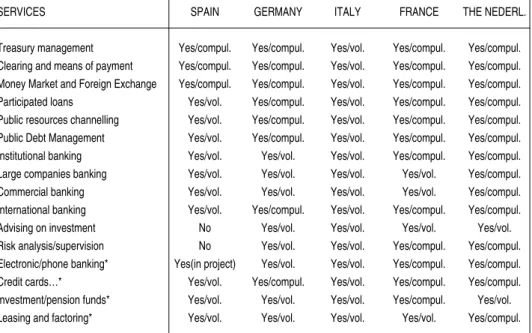
(25) CO-OPERATIVE BANKING GROUPS IN EUROPE: COMPARATIVE ANALYSIS OF THE STRUCTURE AND ACTIVITY (pp. 87-119). Table 1. Main Services Offered By Central Co-Operative Banks (The existence and compulsory or voluntary character of every service is indicated) SERVICES Treasury management Clearing and means of payment Money Market and Foreign Exchange Participated loans Public resources channelling Public Debt Management Institutional banking Large companies banking Commercial banking International banking Advising on investment Risk analysis/supervision Electronic/phone banking* Credit cards…* Investment/pension funds* Leasing and factoring*. SPAIN. GERMANY. ITALY. FRANCE. THE NEDERL.. Yes/compul. Yes/compul. Yes/compul. Yes/vol. Yes/vol. Yes/vol. Yes/vol. Yes/vol. Yes/vol. Yes/vol. No No Yes(in project) Yes/vol. Yes/vol.. Yes/compul. Yes/compul. Yes/compul. Yes/compul. Yes/compul. Yes/compul. Yes/vol. Yes/vol. Yes/vol. Yes/compul. Yes/vol. Yes/vol. Yes/vol. Yes/compul. Yes/vol.. Yes/vol. Yes/vol. Yes/vol. Yes/vol. Yes/vol. Yes/vol. Yes/vol. Yes/vol. Yes/vol. Yes/vol. Yes/vol. Yes/vol. Yes/vol. Yes/vol. Yes/vol.. Yes/compul. Yes/compul. Yes/compul. Yes/compul. Yes/compul. Yes/compul. Yes/compul. Yes/vol. Yes/vol. Yes/compul. Yes/vol. Yes/compul. Yes/compul. Yes/compul. Yes/compul.. Yes/compul. Yes/compul. Yes/compul. Yes/compul. Yes/compul. Yes/compul. Yes/compul. Yes/compul. Yes/compul. Yes/compul. Yes/vol. Yes/compul. Yes/compul. Yes/compul. Yes/vol.. Yes/vol.. Yes/vol.. Yes/vol.. Yes/vol.. Yes/compul.. (*) Theses services are usually offered by independent managing societies or specialised institutions.. Source: own elaboration from questionaries.. CIRIEC-ESPAÑA • SPECIAL ISSUE • No. 62/2008. www.ciriec-revistaeconomia.es. 111.
(26) PALOMO ZURDO, RICARDO J.. 112. Table 2. Economic-Financial Regime Of The Main Centralised Activities In The Co-Operative Banking Groups PRICE GROUP. PRICE GROUP (Usually a fixed fee plus a variable amount depending on the volume of activity). WITHOUT A DIRECT PRICE (No fees are paid for the use of particular services, but a general fee may be paid as a federation membership fee, etc.). BANKING ACTIVITY (CENTRAL BANKS). PARABANKING ACTIVITY (INSURANCE AND OTHERS). OTHER ACTIVITIES (INFRASTRUCTURE SERVICES). MOST CASES. VERY FEW CASES. MOST CASES (COMPUTER SERVICES…). - Usually in the typical - Usually there are no fees for - Common in data processing services of central the services offered by specia- centres and network centralised co-operative banks. lised companies outside the computer management centres. - Common in individualised or central co-operative banks. - Usually it is compulsory to voluntary complex services. * Participation in the share operate with this services. * Usually participation in the capital may be compulsory, * The possible results are divishare capital is compulsory, and in such case, with a possided among shareholders or with a possible sharing out of ble sharing out of dividends. they consolidate with dividends. the Group. A FEW CASES. MOST CASES. MOST CASES (FEDERATE SERVICES). - Only in some cases and pre- - Co-operative banks operate - They are usually services offeferably in statutorily compulas a distributing network. red by federations regarding sory services to local/regional - Co-operative banks receive training, legal advising, informainstitutions. direct commissions and possition, etc.) ble dividends if they participate - Fees may be paid with very in the share capital of the spe- particular services, individually cialised companies. demanded to federations.. Source: own elaboration from questionaries.. www.ciriec-revistaeconomia.es. CIRIEC-ESPAÑA • SPECIAL ISSUE • No. 62/2008.
(27) CO-OPERATIVE BANKING GROUPS IN EUROPE: COMPARATIVE ANALYSIS OF THE STRUCTURE AND ACTIVITY (pp. 87-119). 113. Table 3. Names And Areas Of Activity Of Specialised Institutions In The Credit Co-Operative Groups AREA OF ACTIVITY. SPAIN. GERMANY. ITALY. FRANCE. THE. (Cajas Rurales). (Volksbanken-. (Banche di. (Crédit Agricole). NETHERLANDS. Raiffeisenbanken) Credito Cooperativo). BANKING SERVICES. (Rabobank). Banco Coop. Esp.. DG BANK. ICCREA. CNCA. INSURANCE BUSINESS. Seguros RGA. R+V Versicherung. Assimoco. PREDICA PACIFICA. Interpolis. DATA PROCESSING CENTRES. Rural Servicios. BIK. Coopeld. CEDICAM. Rabofacet. Informáticos TRAVELLING AND TOURISM. Rural Tours. MORTGAGES. RABOBANK. (Only a certain hardware) RV. Touristik DG HYP. Münchener. Rabohypotheekbank. Hypothekenbank LEASING. Deutsche Genossen-. Autolease. schafts. Leasing FACTORING INVESTMENT FUNDS. UNICOMI/UNIMAT and UCABAIL. DG Diskontbank Gescooperativo. FINANCIAL MARKETS. De Lage Landen Factors Coogestioni. DG Direkt. SEGESPAR. AGRICULTURAL FINANCING LARGE COMPANIES FINANCING MARKETING OF PRODUCTS. UNICREDIT. De Lage L. Finance. DG Agropartners. AGRICULTURAL DEVELOPMENT. SOFIPAR. AGRICULTURAL MACHINERY HOUSEBUILDING AND SHIPBUILDING. HP Verbist BV. SOFIDECA. SOGEQUIP Bausparkasse. Nederlandse. Schwäbisch Hall. Scheepshyphotheekbank. TRANSPORT. Transcoop.. MATERIAL PURCHASE. Ciscra. RESEARCHING. Censcoop. TRAINING. Scuola Centrale del Credito Cooperativo. PUBLICATIONS. DG Verlag. Ecra. Source: own elaboration from questionaries.. CIRIEC-ESPAÑA • SPECIAL ISSUE • No. 62/2008. www.ciriec-revistaeconomia.es.
(28) PALOMO ZURDO, RICARDO J.. 114. Market s hare -. Credits (%). Deposit s (%). n/a. 44. 2.046. 220. 1.219. n/a. n/a. n/a. 220. 5.631. 741.052. 1.375. 579. 484. 277. 2,67. 2,43. 293. 473. 535.000. 600.000. 2.250. 9.739. 9.048. 6.756. 22,81. 21,70. 29. 80. 64.000. 122.000. 483. 1.221. 954. 848. 0,50. 0,50. 1.255. 14.100. 16.000.000. 30.000.000. 187.000*. 961.200*. 551.000*. 497.700*. 15,80. 11,80. 1. 1. n/a. 15. 94. 7.393. 0. 1.165. n/a. n/a. 83. 4.822. 1.912.287. 9.878.047. 19.334. 96.208. 82.466. 77.219. 5,03. 5,24. Crédit Agricole. 41. 11.000. 5.700.000. 31.000.000. 157.000. 1.381.000. 438.100. 544.600. 25,00. 20,90. Crédit Mutuel. 18. 5.065. 6.900.000. 14.500.000. 58.380. 482.676. 422.800. 220.000. 12,4. 16,80. Banques Populaires. 20. 2.880. 3.200.000. 7.000.000. 34.994. 204.000. 92.000. 109.000. 6,2. 8,2. 16. 145. 175.541. 175.541. 974. 2.570. 2.135. 1.935. 0,8. 1. Members. Loans (E uro. 9. Total As sets. n/a. Staff. n/a. Clients (1). Market s hare -. Million). Million) Deposit s (Euro. Banking outlets. Regiona l/Local B anks. Full Member Organisations. (Euro M illion). Table 4. Key Statistics as on 31-12-2006. BELGIË/BELGIQUE/BELGIEN - Belgium Crédit Professionnel (a) BÃLGARIJA - Bulgaria/Bulgarie/Bulgarien Central Co-operative Bank CYPRUS - Chypre/Zypern Co-operative Central Bank DANMARK - Denmark/Danemark/Dänemark Sammenslutningen Danske Andelskasser (a) DEUTSCHLAND - Germany/Allemagne BVR/DZ BANK ÉIRE - Ireland/Irlande/Irland Irish Sea Fisheries Board (a) ESPAÑA - Spain/Espagne/Spanien Unión Nacional de Cooperativas de Crédito FRANCE - France/Frankreich. HELLAS - Greece/Grece/Griechenland Association of Cooperative Banks of Greece ITALIA - Italy/Italie/Italien Assoc. Nazionale fra le Banche Popolari. 89. 7.808. 1.065.000. 8.100.000. 73.269. 374.600. 267.100. 251.300. 21,90. 20,10. FEDERCASSE. 438. 3.758. 822.893. 5.000.000. 27.835. 136.941. 111.084. 94.305. 8,40. 6,60. (a) 2005 figures. (1): Estimate. n/a: Not applicable. * Addition Kreditgenossenschaften+ DZ BANK-Konzern+WGZ-Bank-Konzern+MHB eG. www.ciriec-revistaeconomia.es. CIRIEC-ESPAÑA • SPECIAL ISSUE • No. 62/2008.
Figure



Documento similar
Posteriorly, Oliver and Segev classified the groups which admit a fixed point free action on an acyclic (finite) 2-complex [10].. Our proof of Theorem 3.2 is built upon the results
The expansionary monetary policy measures have had a negative impact on net interest margins both via the reduction in interest rates and –less powerfully- the flattening of the
Jointly estimate this entry game with several outcome equations (fees/rates, credit limits) for bank accounts, credit cards and lines of credit. Use simulation methods to
On the other side of the spectrum we could find a more-efficient and more professionalized banking system which entities were growing or had been restructuring
In particular, we use monetary policy as the basis for some policy challenges arising from changes in payment systems, while we rely on the economics of banking to analyse the
The suitability of the analysis of the social consequences led to by the image that is exhibited in television series on different social groups and issues has proved more
Relationship between the total cluster stellar mass and the photometric blue fraction for the ALHAMBRA cluster and group sample stacked into different redshift bins. The galaxy
In this respect we can classify institutions in three categories: Cooperation and development ( Union of Arab Banks,1974; Islamic Development Bank, 1975; Arab Monetary Fund,
![Un análisis comparado del desempeño de la banca ética [A comparative analysis the performance of ethical banking]](data:image/gif;base64,R0lGODlhAQABAIAAAP///wAAACH5BAEAAAAALAAAAAABAAEAAAICRAEAOw==)