Coordination and Supramolecular Chemistry
Álvaro García-Romero,
[a]Alex J. Plajer,
[b]Lucía Álvarez-Miguel,
[a]Andrew D. Bond,
[b]Dominic S.
Wright
[b]and Raúl García-Rodríguez*
[a]Abstract: Post-functionalisation of the aluminate anion [EtAl(6-Me-2-py)3]– (1) (2-py = 2-pyridyl) with alkoxide ligands can be achieved by the selective reactions of the lithium salt 1Li with alcohols in the appropriate stoichiometry. This method can be used to introduce 3-py and 4-3-py functionality in the form of 3- and 4-alkoxymethyl3-pyridyl groups, while maintaining the integrity of the aluminate framework, thereby giving entry to new supramolecular chemistry. Chirality can be introduced either by using a chiral alcohol as a reactant or by the step-wise reaction of 1Li with two different non-chiral alcohols. The latter route has allowed the synthesis of a rare example of a chiral-at-aluminium aluminate.
Introduction
There has recently been a resurgence of interest in tripodal tris(2-pyridyl) ligands, particularly in their potential applications as spectator ligands in catalysis, but also in a range of other applications in coordination, organometallic and bioinorganic chemistry.[1] Most of the studies in the last 40 years or so have
focused on neutral ligands with lighter bridgehead atoms E(2-py)3 (E = CR, COR, CH, N, P, P=O, etc.; Figure 1 A).[2] More recently there has been growing interest in heavier, more metallic bridgehead ligands of Groups 13,[3] 14,[4] and 15.[5] Changing the bridgehead can have a large effect on the coordination and properties of the ligands. For instance, as Group 15 is descended, the Lewis acidity of the bridgehead atom of the neutral ligands [E(2-py)₃] (E = N–Bi) increases, changing the donor properties of the ligand and the coordination mode. Thus, changing the bridgehead atom is a method that can be used to modulate the catalytic activity of the metal complexes.[5b] We have been particularly interested in Group 13 tris(2-pyridyl)aluminates ([RAl(2-py)3]–; Figure 1 B) as they are
unusual in this area in having an overall negative charge (rather than being neutral).[3a] As one of the few anionic members of the tris-pyridyl family, they exhibit strong affinity for metal cations and have extensive coordination chemistry with a broad range of transition metals,[6] main-group metals[7] and lanthanides.[8] The closely related tris(2-pyridyl)borates[3b, 9] have also attracted
recent interest, stemming from their potential applications in polymer and supramolecular chemistry.[10]
Figure 1A conventional, neutral tris(2-pyridyl) ligands containing non-metallic bridgeheads, Btris(2-pyridyl)aluminates, C mono-substitution of a 2-pyridyl group by an RO group.
Our most recent interest in aluminates has turned to the elaboration of their frameworks via exchange of the 2-pyridyl groups of B with other donor groups (Figure 1 C). In contrast to B-bridged tris(2-pyridyl) borate ligands, the higher polarity of the Al-C bond enables easy exchange of the pyridyl groups. This is seen in the room-temperature reactions of the sterically hindered aluminate [EtAl(6-Me-2-py)3]– (1) with ROH (R = H or Me), in
which the exchange of just one of the 6-Me-py groups can be controlled (Scheme 1).[11] The reactions of 1 with racemic
mixtures of the chiral alcohols Rʹ(Me)CH(OH) (Rʹ = C2H5, C6H13,
and C6H5) leads to mixtures of dimeric SS/RS- and
SR-diastereomers. Owing to their different molecular symmetries, the RR/SS and RS dimers exhibit different signals in their 1H and
7
Li NMR spectra, with the 6-Me groups acting as reporter groups (Scheme 2).[12]
Scheme 1 Exchange of a 6-Me-py group of anion 1 for an RO group, forming dimers with Li2O2 cores.
[a] Dr R. Garcia-Rodriguez, Mr A. García-Romero, Lucía Álvarez-Miguel ,GIR MIOMeT-IU Cinquima-Química Inorgánica Facultad de Ciencias, Universidad de Valladolid; Campus Miguel; Delibes, 47011 Valladolid; [email protected]
[b] Mr A. J. Plajer, Dr A. D. Bond, Prof. Dr D. S. Wright, Department of Chemistry, University of Cambridge, Lensfield Road, Cambridge CB2 1EW; [email protected]
Scheme 2 Reaction of 1Li with chiral alcohols and the formation of RR, SS
and RS dimers, with the magnetically-inequivalent 6-Me environments highlighted.
With the above background in mind, we present here a study of the ways in which ligand exchange of the 6-Me-py groups of 1
can be used to (i) access previously unexplored 3-py and 4-py functionality, leading to supramolecular assemblies, and (ii) build chirality at the Al centre by the incorporation of three different substituents.
Results and Discussion
One interesting idea in the general area of tris(pyridyl) ligands is the incorporation of donor functionality into the 3- and 4-positions, which should result in a fundamental change in the character of the ligand from intramolecular and tripodal for 2-py substituents to intermolecular for 3- and 4-py groups (Figure 2). A rare example illustrating this feature is observed with C(4-py)4,
which functions as a tetrahedral node in the diamondoid lattice arrangement of [AgBF4{C(4-py)4}].[13] Despite their obvious
potential as building blocks in supramolecular chemistry, the coordination chemistry of these ligands remains largely unexplored and only a few complexes containing neutral 3- and 4-py ligands with non-metallic C,[13-14] Si[15] and P[16] bridgeheads
have been structurally characterized. The fundamental problem in developing any of the 3- or 4-py ligand systems of this type is the unreliability of the metal-halogen exchange reactions that generate the lithio-pyridine intermediates from the corresponding bromo-pyridines.[17] For this reason, despite our best efforts, we have been unable to obtain any of the metal-bridged tris(pyridyl) ligands containing 3-py or 4-py groups.
Figure 2 Tris(pyridyl ligand frameworks containing 3- and 4-py groups, allowing inter-molecular interactions, in contrast to more common 2-py ligands, which produce intra-molecular interactions (see for instance, 1Li in Scheme 1).
We therefore decided to explore the incorporation of 3-OCH2py
and 4-OCH2py groups using our previously established
post-functionalisation strategy. The reactions of 2-(OH)CH2py,
3-(OH)CH2py and 4-(OH)CH2py (1 equivalent) with 1Li at -78 oC in
toluene led to the formation of the lithium complexes [Li{EtAl(2-OCH2-py)(6-Me-2-py)2}]2 (3Li), [Li{EtAl(3-OCH2
-py)(6-Me-2-py)2}]2 (4Li), and [Li{EtAl(4-OCH2-py)(6-Me-2-py)2}]2 (5Li),
containing the mono-substituted anions (Scheme 3). These can be isolated in crystalline form after workup of the reactions, and the low-temperature X-ray structures of each were determined.
Scheme 3 Syntheses of 3Li, 4Li and 5Li incorporating 2-OCH2py, 3-OCH2py,
and 4-OCH2py functionality, respectively.
The lithium salts 3Li, 4Li, and 5Li were isolated in crystalline form after work up of the reactions in 29-57% yields and were characterized by elemental analysis and heteronuclear (1H, 13C,
7Li and 27Al) NMR spectroscopy, in addition to obtaining their
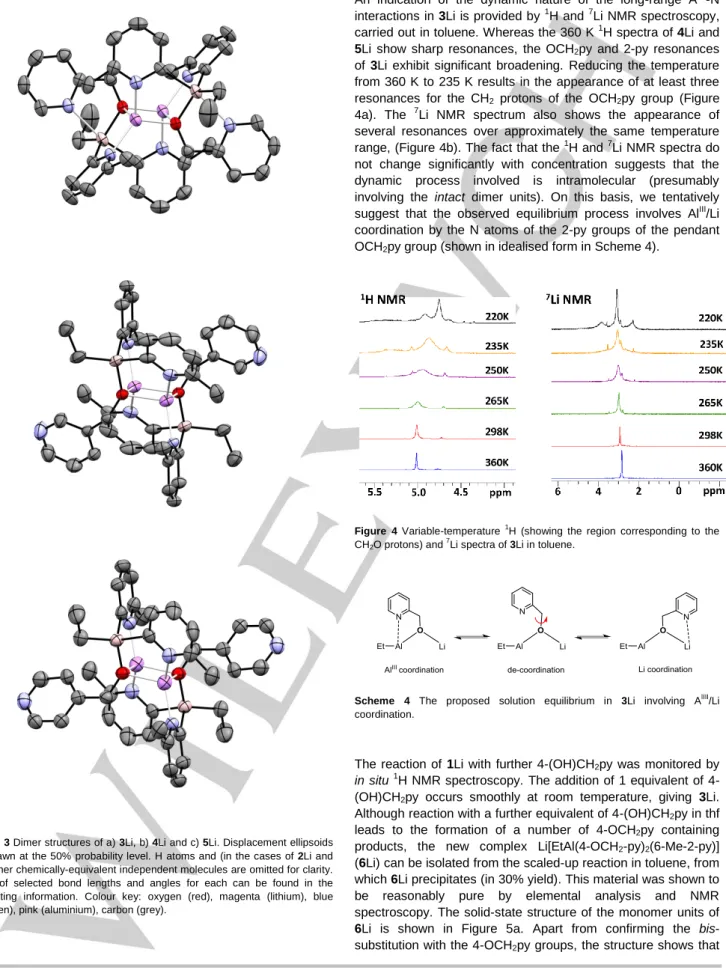
single-crystal X-ray structures. They all form dimeric structures in the solid state, which are similar to the previously reported dimers 2a and 2b (Scheme 1), containing central Li2O2 cores
(see Figure 3). However, while the 3-N and 4-N atoms of 4Li and
5Li are not involved in any secondary intra- or inter-molecular interactions, in the case of 3Li the OCH2py arm is involved in
intramolecular coordination through the 2-N atoms to the AlIII centres of the [EtAl(6-Me-2-py)2(2-OCH2py)]– anion, resulting in
a distorted trigonal bipyramidal geometry. This interaction [2.309(2) Å] is at the upper end of neutral donor-AlIII interactions
Figure 3 Dimer structures of a) 3Li, b) 4Li and c) 5Li. Displacement ellipsoids are drawn at the 50% probability level. H atoms and (in the cases of 2Li and
5Li) other chemically-equivalent independent molecules are omitted for clarity. A list of selected bond lengths and angles for each can be found in the supporting information. Colour key: oxygen (red), magenta (lithium), blue (nitrogen), pink (aluminium), carbon (grey).
An indication of the dynamic nature of the long-range AlIII-N
interactions in 3Li is provided by 1H and 7Li NMR spectroscopy, carried out in toluene. Whereas the 360 K 1H spectra of 4Li and
5Li show sharp resonances, the OCH2py and 2-py resonances
of 3Li exhibit significant broadening. Reducing the temperature from 360 K to 235 K results in the appearance of at least three resonances for the CH2 protons of the OCH2py group (Figure
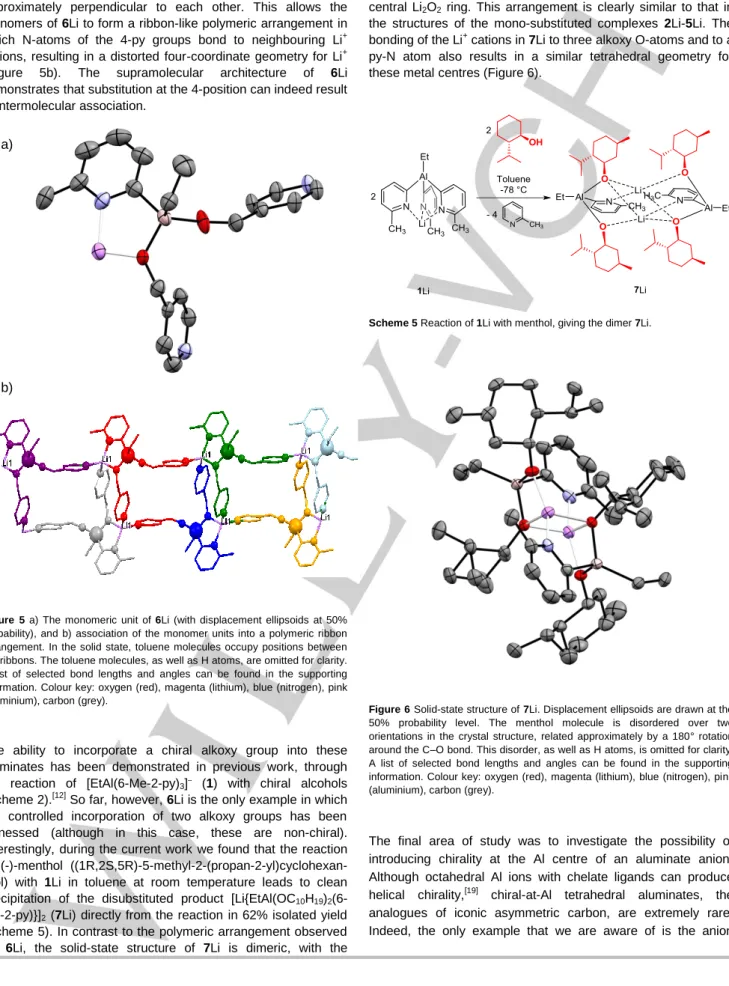
4a). The 7Li NMR spectrum also shows the appearance of several resonances over approximately the same temperature range, (Figure 4b).The fact that the 1H and 7Li NMR spectra do not change significantly with concentration suggests that the dynamic process involved is intramolecular (presumably involving the intact dimer units). On this basis, we tentatively suggest that the observed equilibrium process involves AlIII/Li coordination by the N atoms of the 2-py groups of the pendant OCH2py group (shown in idealised form in Scheme 4).
Figure 4 Variable-temperature 1H (showing the region corresponding to the CH2O protons) and
7
Li spectra of 3Li in toluene.
Scheme 4 The proposed solution equilibrium in 3Li involving AlIII
/Li coordination.
The reaction of 1Li with further 4-(OH)CH2py was monitored by
in situ 1H NMR spectroscopy. The addition of 1 equivalent of 4-(OH)CH2py occurs smoothly at room temperature, giving 3Li.
Although reaction with a further equivalent of 4-(OH)CH2py in thf
leads to the formation of a number of 4-OCH2py containing
products, the new complex Li[EtAl(4-OCH2-py)2(6-Me-2-py)]
(6Li) can be isolated from the scaled-up reaction in toluene, from which 6Li precipitates (in 30% yield). This material was shown to be reasonably pure by elemental analysis and NMR spectroscopy. The solid-state structure of the monomer units of
6Li is shown in Figure 5a. Apart from confirming the bis-substitution with the 4-OCH2py groups, the structure shows that
a) a)
b)
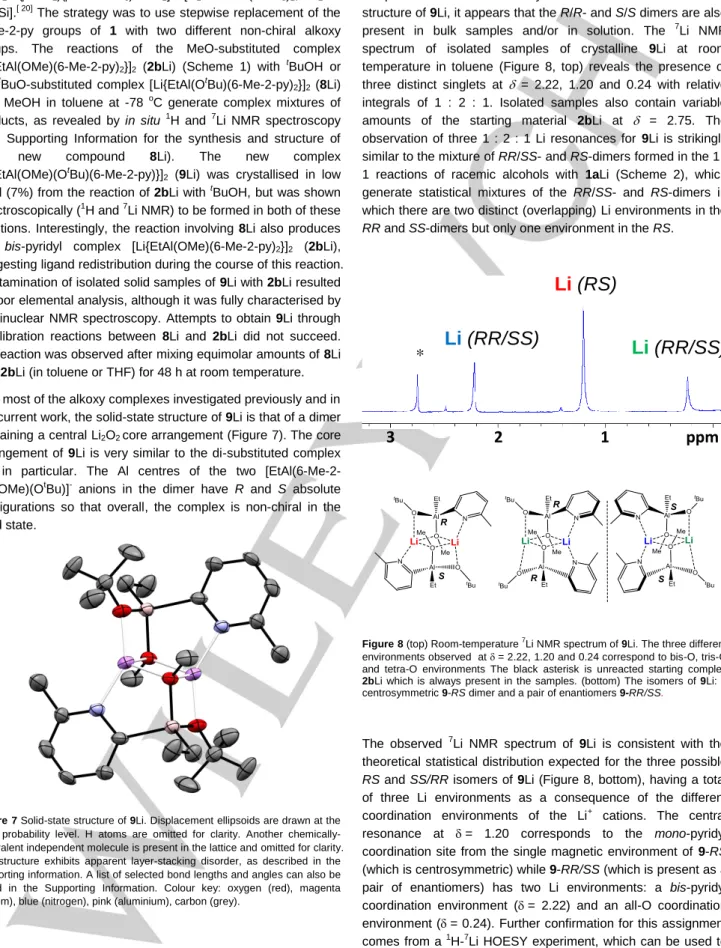
the donor-N atoms of the 4-py groups are orientated approximately perpendicular to each other. This allows the monomers of 6Li to form a ribbon-like polymeric arrangement in which N-atoms of the 4-py groups bond to neighbouring Li+ cations, resulting in a distorted four-coordinate geometry for Li+ (Figure 5b). The supramolecular architecture of 6Li demonstrates that substitution at the 4-position can indeed result in intermolecular association.
Figure 5 a) The monomeric unit of 6Li (with displacement ellipsoids at 50% probability), and b) association of the monomer units into a polymeric ribbon arrangement. In the solid state, toluene molecules occupy positions between the ribbons. The toluene molecules, as well as H atoms, are omitted for clarity. A list of selected bond lengths and angles can be found in the supporting information. Colour key: oxygen (red), magenta (lithium), blue (nitrogen), pink (aluminium), carbon (grey).
The ability to incorporate a chiral alkoxy group into these aluminates has been demonstrated in previous work, through the reaction of [EtAl(6-Me-2-py)3]– (1) with chiral alcohols
(Scheme 2).[12] So far, however, 6Li is the only example in which the controlled incorporation of two alkoxy groups has been witnessed (although in this case, these are non-chiral). Interestingly, during the current work we found that the reaction of (-)-menthol ((1R,2S,5R)-5-methyl-2-(propan-2-yl)cyclohexan-1-ol) with 1Li in toluene at room temperature leads to clean precipitation of the disubstituted product [Li{EtAl(OC10H19)2
(6-Me-2-py)}]2 (7Li) directly from the reaction in 62% isolated yield
(Scheme 5). In contrast to the polymeric arrangement observed for 6Li, the solid-state structure of 7Li is dimeric, with the
association of the two monomer units occurring through a central Li2O2 ring. This arrangement is clearly similar to that in
the structures of the mono-substituted complexes 2Li-5Li. The bonding of the Li+ cations in 7Li to three alkoxy O-atoms and to a py-N atom also results in a similar tetrahedral geometry for these metal centres (Figure 6).
Scheme 5 Reaction of 1Li with menthol,giving the dimer 7Li.
Figure 6 Solid-state structure of 7Li. Displacement ellipsoids are drawn at the 50% probability level. The menthol molecule is disordered over two orientations in the crystal structure, related approximately by a 180° rotation around the C–O bond. This disorder, as well as H atoms, is omitted for clarity. A list of selected bond lengths and angles can be found in the supporting information. Colour key: oxygen (red), magenta (lithium), blue (nitrogen), pink (aluminium), carbon (grey).
The final area of study was to investigate the possibility of introducing chirality at the Al centre of an aluminate anion. Although octahedral Al ions with chelate ligands can produce helical chirality,[19] chiral-at-Al tetrahedral aluminates, the analogues of iconic asymmetric carbon, are extremely rare. Indeed, the only example that we are aware of is the anion
a)
[R1R2Al(-CH2)(-CHSiMe3)SiMe2]- [R1 = CH(SiMe3)2, R2 =
Me2Si].[ 20] The strategy was to use stepwise replacement of the
6-Me-2-py groups of 1 with two different non-chiral alkoxy groups. The reactions of the MeO-substituted complex [Li{EtAl(OMe)(6-Me-2-py)2}]2 (2bLi) (Scheme 1) with tBuOH or
the tBuO-substituted complex [Li{EtAl(OtBu)(6-Me-2-py)2}]2 (8Li)
with MeOH in toluene at -78 oC generate complex mixtures of products, as revealed by in situ 1H and 7Li NMR spectroscopy (see Supporting Information for the synthesis and structure of the new compound 8Li). The new complex [Li{EtAl(OMe)(OtBu)(6-Me-2-py)}]2 (9Li) was crystallised in low
yield (7%) from the reaction of 2bLi with tBuOH, but was shown spectroscopically (1H and 7Li NMR) to be formed in both of these reactions. Interestingly, the reaction involving 8Li also produces the bis-pyridyl complex [Li{EtAl(OMe)(6-Me-2-py)2}]2 (2bLi),
suggesting ligand redistribution during the course of this reaction. Contamination of isolated solid samples of 9Li with 2bLi resulted in poor elemental analysis, although it was fully characterised by multinuclear NMR spectroscopy. Attempts to obtain 9Li through equilibration reactions between 8Li and 2bLi did not succeed. No reaction was observed after mixing equimolar amounts of 8Li and 2bLi (in toluene or THF) for 48 h at room temperature.
Like most of the alkoxy complexes investigated previously and in the current work, the solid-state structure of 9Li is that of a dimer containing a central Li2O2 core arrangement (Figure 7). The core
arrangement of 9Li is very similar to the di-substituted complex
7Li in particular. The Al centres of the two [EtAl(6-Me-2-py)(OMe)(OtBu)]- anions in the dimer have R and S absolute configurations so that overall, the complex is non-chiral in the solid state.
Figure 7 Solid-state structure of 9Li. Displacement ellipsoids are drawn at the 50% probability level. H atoms are omitted for clarity. Another chemically-equivalent independent molecule is present in the lattice and omitted for clarity. The structure exhibits apparent layer-stacking disorder, as described in the supporting information. A list of selected bond lengths and angles can also be found in the Supporting Information. Colour key: oxygen (red), magenta (lithium), blue (nitrogen), pink (aluminium), carbon (grey).
Despite the observation of only the R/S-dimer in the solid-state structure of 9Li, it appears that the R/R- and S/S dimers are also present in bulk samples and/or in solution. The 7Li NMR spectrum of isolated samples of crystalline 9Li at room temperature in toluene (Figure 8, top) reveals the presence of three distinct singlets at = 2.22, 1.20 and 0.24 with relative integrals of 1 : 2 : 1. Isolated samples also contain variable amounts of the starting material 2bLi at = 2.75. The observation of three 1 : 2 : 1 Li resonances for 9Li is strikingly similar to the mixture of RR/SS- and RS-dimers formed in the 1 : 1 reactions of racemic alcohols with 1aLi (Scheme 2), which generate statistical mixtures of the RR/SS- and RS-dimers in which there are two distinct (overlapping) Li environments in the RR and SS-dimers but only one environment in the RS.
Figure 8 (top) Room-temperature 7Li NMR spectrum of 9Li. The three different environments observed at = 2.22, 1.20 and 0.24 correspond to bis-O, tris-O and tetra-O environments The black asterisk is unreacted starting complex
2bLi which is always present in the samples. (bottom) The isomers of 9Li: a centrosymmetric 9-RS dimer and a pair of enantiomers 9-RR/SS.
The observed 7Li NMR spectrum of 9Li is consistent with the theoretical statistical distribution expected for the three possible RS and SS/RR isomers of 9Li (Figure 8, bottom), having a total of three Li environments as a consequence of the different coordination environments of the Li+ cations. The central resonance at = 1.20 corresponds to the mono-pyridyl coordination site from the single magnetic environment of 9-RS (which is centrosymmetric) while 9-RR/SS (which is present as a pair of enantiomers) has two Li environments: a bis-pyridyl coordination environment (= 2.22) and an all-O coordination environment (= 0.24). Further confirmation for this assignment comes from a 1H-7Li HOESY experiment, which can be used to
3
2
1
ppm
*
Li (RR/SS)
Li
(RS)
assess the spatial proximity between 7Li and 1H nuclei (Figure 9). The 1H-7Li HOESY shows cross-peaks between the 7Li resonance of the centrosymmetric RS dimer = 1.20 ppm, in red), the O-CH3 resonance at = 3.28, the py-CH3 resonance
at = 2.49, and a weaker cross peak (not shown in the figure) with the OtBu resonance at = 1.30. For the homochiral SS/RR dimers, the two lithium atoms are in different environments. One Li atom ( = 2.22) faces the 6-Me-2-py group (marked in blue in Figure 9) while the other one ( = 0.24) faces the OtBu group (marked in green in Figure 9). This is consistent with the 1H-7Li HOESY experiment in which the 7Li resonance at = 2.22 ppm for the RR/SS dimers has cross-peaks with the O-CH3
resonance at = 3.27 and the CH3 resonance of the 6-Me-Py at
= 2.49, while the other 7Li resonance for the RR/SS dimers at = 0.24 ppm has cross-peaks with the O-CH3 group at = 3.27
and a weaker cross-peak with the OtBu group at = 1.30 ppm, but no cross peaks with the 6-Me-Py protons.
Figure 81
H-7
Li HOESY (298 K, d8-toluene, 500 MHz, mixing time of 100 ms)
spectrum of 9Li. The isomers of 9Li are shown above with the three different Li environments highlighted in different colours. The NOE signals observed in the experiment are shown with arrows. The dotted arrow represents the weaker NOE signal observed between Li and Ot
Bu groups (which are further away). The dotted lines in the spectrum are guides for the eye.
Conclusions
Using our previously developed post-functionalisation methodology, we have shown that the exchange of the 6-Me-2-py ligands for appropriate alkoxide ligands can be used to (i) introduce 3-py and 4-py functionality (which in the case of 6Li leads to intermolecular association), (ii) introduce chiral substituents into the frameworks of aluminate ligands (and for the first time, two such groups in the new complex 7Li), and (iii) build chiral-at-the-metal arrangements (as in the case of 9Li), which cannot be accessed by conventional equilibration reactions. Further exploration of this research direction will continue in future studies in this area.
Experimental Section
Materials and general methods: All syntheses were carried out on a
vacuum-line under argon or N2 atmosphere. Products were isolated and
handled under N2 or argon atmosphere. Elemental analysis was obtained
on a Perkin Elmer 240 Elemental Analyser. All NMR solvents were stored over molecular sieves and degassed by three freeze–pump–thaw cycles under nitrogen prior to use. The chemical shift values are given in ppm.
1
H and 13C chemical shifts are referenced to TMS. 7Li and 27Al NMR experiments are referenced to a solution of LiCl/D2O and a solution of
AlCl3.6H2O/D2O, respectively. The unambiguous assignment of NMR
resonances was accomplished by additional 2D NMR experiments [(1
H-1
H COSY, 1H-1H NOESY, 1H-13C HMQC and 1H-13C HMBC experiments
(see SI for details)]. Li[EtAl(6-Me-2-py)3] (1Li)[5a] and
[Li{EtAl(OMe)(6-Me-2-py)2}]2 (2bLi),[12] were synthesized as described previously. X-ray data
were collected on a Bruker D8 QUEST diffractometer with an Incoatec
IS Cu microfocus source. Crystals were mounted directly from their
mother liquor using perfluorohydrocarbon oil to prevent atmospheric oxidation, hydrolysis, and solvent loss, and the temperature was held at
180(2) K using an Oxford Cryosystems N2 cryostat (see ESI for details).
CCDC 1849411-1849417 contain the supplementary crystallographic data for this paper. These data are provided free of charge by the Cambridge Crystallographic Data Centre.
Scheme 6. Atom labeling scheme used in the NMR studies of the pyridyl aluminates ligands.
Synthesis of [Li{EtAl(2-OCH2-py)(6-Me-2-py)2}]2 (3Li):
Li[EtAl(6-Me-2-py)3]·(200 mg, 0.589 mmol) was dissolved in toluene (5 mL), and to this
cloudy solution 1 eq. of HOCH2-2-py (57 L, 0.589mmol) was added at
-78 oC. The mixture was allowed to reach room temperature, and then
further stirred at room temperature for 3 h to give a clear solution. The solvent was evaporated under vacuum and the residue was dried under
vacuum to remove free 6-CH3-2-pyH. 4 mL of toluene was added to the
crystals of 3Li. Total yield 100-120 mg 48-57% Elemental analysis, calcd.
for 3Li, C 67.6, H 6.5, N 11.8%; Found C 67.7, H 6.6, N 11.9%. 1H NMR
(298 K, d8-toluene, 500 MHz), = 7.75 (br, 1H, H6 py’), 7.59 (d, J = 7.0
Hz, 2H, H3 py), 7.09 (t, J = 7.6 Hz, 2H, H4 py), 6.84 (t, J = 7.4 Hz, 1H, H4
py’), 6.67 (br, 1H, H3 py’), 6.54 (d, J = 7.5 Hz, 2H, H5 py), 6.30 (t (br), J =
5.5 Hz, 1H, H5 py’), 4.96 (s(br), 2H, OCH
2), 2.21 (s, 6H, C6–CH3), 1.40 (t,
J = 7.7 Hz, 3H, Al–CH2CH3), 0.43 (q, J = 7.7 Hz, 2H, Al–CH2). 13C{1H}
NMR (298 K, d8-toluene, 100.6 MHz), = 188.7 (br, C2 py), 162.93 (C2
py’), 156.55 (C6 py), 147.59 (C6 py’), 136.95 (C4 py’), 132.68 (C4 py),
130.15 (C3 py), 122.12 (br, C3 py’),121.97 (C5 py’), 120.12 (C5 py), 66.56
(OCH2), 24.60 (C6–CH3), 11.01 (Al–CH2CH3), 1.19 (br, Al–CH2). 27Al
NMR (298K, d8-toluene, 130.3 MHz, ref solution of AlCl3·6H2O/D2O), =
137 (very br, s). 7Li NMR (298K, d
8-toluene, 194.4 MHz, ref solution of
LiCl/D2O), = 2.92 (s).
Synthesis of [Li{EtAl(3-OCH2-py)(6-Me-2-py)2}]2 (4Li):
Li[EtAl(6-Me-2-py)3] (200 mg, 0.589 mmol) was dissolved in toluene (4 mL), and to this
cloudy solution 1 eq. of HOCH2-3-py (57 L, 0.589 mmol) was added at
-78oC. The mixture was allowed to reach room temperature and then
further stirred at room temperature for 2 h. The solvent was evaporated under vacuum, the residue was dried under vacuum and 5 ml of toluene was added. Filtration over Celite, concentration (to ca. 2 ml), and slow diffusion of n-hexane (ca. 5 ml) as the non-solvent at -15°C afforded
colorless crystals of 4Li. 70 mg first batch. 33% yield. Elemental analysis,
cald. for 4Li, C 67.6, H 6.5, N 11.8%; Found C 67.9, H 6.5, N 11.8%. 1H
NMR (298 K, d8-toluene, 500 MHz), = 8.21 (d, J = 1.8 Hz, 1H, H2 py’),
8.18 (dd, J = 4.8 and 1.8 Hz, 1H, H6 py’), 7.63 (d, J = 7.0 Hz, 2H, H3 py),
7.09 (t, J = 7.5 Hz, 2H, H 4py), 6.75 (dt, J = 7.8 and 1.8 Hz, 1H, H4 py’),
6.50 (d, J = 7.8 Hz, 2H, H5py), 6.30 (dd, J = 7.8 and 4.8 Hz, 1H, H2 py’),
4.59 (s, 2H, OCH2), 2.05 (s, 6H, C6–CH3), 1.40 (t, J = 8.1 Hz, 3H, Al–
CH2CH3), 0.53 (q, JHH = 8.1Hz, 3H, Al–CH2). 13C{1H} NMR (298 K, d8
-toluene, 100.6 MHz), =186.3 (br, C2 py), 157.15 (C6 py), 149.69 (C2 py’),
148.62 (C6 py’), 134.46 (C4 py’),133.84 (C4 py), 130.84 (C3 py), 122.57
(C5 py’),121.66 (C5 py), 64.32 (OCH2), 24.32 (C6–CH3), 10.61 (Al–
CH2CH3), 1.14 (br, Al–CH2). 27Al NMR (298 K, d8-toluene, 130.3 MHz, ref
solution of AlCl3·6H2O/D2O), = 145 (very br, s). 7Li NMR (298K, d8
-toluene 194.4 MHz, ref solution of LiCl/D2O), = 2.55 (s).
Synthesis of [Li{EtAl(4-OCH2-py)(6-Me-2-py)2}]2 (5Li):
Li[EtAl(6-Me-2-py)3]·(215 mg, 0.63 mmol) was dissolved in toluene (5 mL), and to this
cloudy solution 1 eq. of HOCH24py (69 mg, 0.63 mmol) was added at
-78°C The mixture was allowed to reach room temperature, then further stirred at room temperature for 16 h. The solvent was evaporated under vacuum and the residue was dried under vacuum for 2 h in order to
completely removed 6-CH3-2-pyH. To the white residue, 5 mL of toluene
was added. After filtration of the resulting suspension, the solution was concentrated under vacuum (to ca. 2-3 mL), and slow diffusion of n-hexane as the non-solvent (ca. 5 mL) at -15°C afforded colorless crystals of 5Li. 60 mg. 29% yield. Elemental analysis, cald. for 5Li C 67.6, H 6.5 N,
11.8%; Found C 67.0, H 6.6, N 11.8%. 1H NMR (298 K, d8-toluene, 500
MHz), = 8.08 (m, 2H, H2 py’), 7.61 (d, J = 7.2 Hz, 2H, H3 py), 7.09 (t, J =
7.5 Hz, 2H, H 4py), 6.54-6.46 (m, 4H, 2H, H5 py and 2H H3 py’), 4.56 (s,
2H, OCH2), 2.05 (s, 6H, C6–CH3), 1.35 (t, J = 8.1 Hz, 3H, Al–CH2CH3),
0.46 (q, J = 8.1Hz, 3H, Al–CH2). 1H NMR (298K, d8-THF, 500 MHz), =
8.37 (m, 2H, H2 py’), 7.37 (m, 2H, H3 py’), 7.33 (d, J = 7.2 Hz, 2H, H3 py),
7.21 (t, J = 7.7 Hz, 2H, H 4py), 6.78 (d, J = 7.7 Hz, 2H, H5 py), 4.88 (s, 2H, OCH2), 2.42 (s, 6H, C6–CH3), 1.07 (t, J = 8.1 Hz, 3H, Al–CH2CH3), 0.89
(q, J = 8.1Hz, 3H, Al–CH2). 13C{1H} NMR (298 K, d8-toluene, 100.6
MHz), =186.2 (br, C2 py), 157.20 (C6 py), 149.92 (C4 py’), 149.80 (C2 py’), 133.95 (C4
py), 130.81 (C3 py), 121.69 (C5 py), 65.68 (OCH2), 24.44
(C6–CH
3), 10.61 (Al–CH2CH3), 1.01 (br, Al–CH2). 13C{1H} NMR (298 K,
d8-toluene, 100.6 MHz), =188.8 (br, C2 py), 156.47 (C6 py), 154.63 (C4
py’), 150.06 (C2 py’),132.54 (C4
py), 130.43 (C3 py), 122.69 (C3 py’),
120.08 (C5 py), 65.09 (OCH
2), 24.69 (C6–CH3), 10.69 (Al–CH2CH3), 0.90
(br, Al–CH2). Al NMR (298 K, d8-toluene, 130.3 MHz, ref solution of
AlCl3·6H2O/D2O), = 130 (very br, s). 7Li NMR (298K, d8-toluene, 194.4
MHz, ref solution of LiCl/D2O), = 0.93 (s).27Al NMR (298K, d8-toluene,
130.3 MHz, ref solution of AlCl3·6H2O/D2O), = 144.8 (very br, s). 7Li
NMR (298 K, d8-toluene, 194.4 MHz, ref solution of LiCl/D2O), = 2.55
(s).
Synthesis of Li[EtAl(4-OCH2-py)2(6-Me-2-py)] (6Li):
Li[EtAl(6-Me-2-py)3] ·(215mg, 0.63 mmol) was dissolved in toluene (5 mL) and to this
cloudy solution 2 eq. of HOCH2-4-py (140 mg, 1.28 mmol) was added at
room temperature. The mixture was further stirred at room temperature for 16 h. At this point a white precipitate was observed. An additional 5 mL of toluene was added, and the precipitate was isolated by filtration
and dried under vacuum to give 6Li as a waxy solid (65mg,30% Yield).
The analytical results listed below correspond to this material. Colourless
crystals of 6Li·toluene suitable for X-ray experiments were obtained from
a saturated solution of 6Li in a 3:1 mixture of toluene/THF after 24h at
-15 °C. Elemental analysis, cald. for 6Li C 64.7, H 6.2 N, 11.3%; Found C
65.4, H 6.3, N 10.2%. 1H NMR (298K, d8-THF, 500 MHz), = 8.33 (m, 4H,
H2 py’), 7.41 (d, J = 7.1 Hz, 1H, H3 py), 7.35 (t, J = 7.6 Hz, 1H, H4 py),
7.30 (m, 4H, H3 py’), 6.92 (d, J = 7.7 Hz, 1H, H5 py), 4.83 (s, 4H, OCH
2),
2.40 (s, 3H, C6–CH3), 1.03 (t, J = 8.1 Hz, 3H, Al–CH2CH3), -0.87 (q, J =
8.1 Hz, 3H, Al–CH2). 13C{1H} NMR (298K, d8-toluene, 100.6 MHz), =
187.40 (br, C2 py), 156.62 (C6 py), 155.90 (C4 py’), 149.95 (C2 py’),133.69
(C4 py), 131.10 (C3 py), 122.05 (C3 py’), 121.16 (C5 py), 64.52 (OCH2),
24.16 (C6–CH
3), 10.46 (Al–CH2CH3), -0.65 (br, Al–CH2). 27Al NMR (298 K,
d8-toluene, 130.3 MHz, ref solution of AlCl3·6H2O/D2O), = 120 (very br,
s). 7Li NMR (298K, d8-toluene, 194.4 MHz, ref solution of LiCl/D2O), =
0.75 (s).
Synthesis of [Li{EtAl(OC10H19)2(6-Me-2-py)}]2 (7Li):
Li[EtAl(6-Me-2-py)3] (200 mg, 0.589 mmol) was dissolved in toluene (5 mL) and
(−)-menthol (184 mg, 1.179 mmol) was added at room temperature. The mixture was stirred at room temperature for 4 h. At this point a white precipitate had formed. The addition of nhexane (5 mL) and storage at -15°C afforded more white precipitate. The mother liquor was syringed off
and the white solid was dried under vacuum to give 7Lias a white solid.
160 mg. 62% yield. Colorless crystals of 7Li were obtained from a
saturated solution of 7Li in toluene at -20 oC. Elemental analysis, cald. for 7Li, C 72.2, H 10.6 N, 3.0%; Found C 72.3, H 10.6, N 3.3%. 1H NMR
(298K, d8-thf, 500 MHz), = 7.40 (d, J = 7.0 Hz, 1H, H3 py), 7.27 (t, J =
7.5 Hz, 1H, H4 py), 6.81 (d, J = 7.5 Hz, 1H, H5 py), 3.47 (m, 2H, OCH
menthol), 2.60 (m, 1H, CH menthol), 2.43 (m, 1H, CH menthol), 2.40 (s, 3H, C6–CH3), 2.18 (m, 1H, CH2 menthol), 1.97 (m, 1H, CH2 menthol),
1.62 (m, 2H, CH2 menthol), 1.53 (m, 2H, CH2 menthol), 1.36 (m, 2H, CH2
menthol), 0.97 (t, J = 8.0 Hz, 3H, Al–CH2CH3. partially overlapped with
menthol resonances), 0.97-0.75 (m, 23H, menthol), 0.64 (d , J = 7.0 Hz,
3H, CH3 menthol), -0.08 to -0.24 (m, 2H, Al–CH2). 13C{1H} NMR (298 K,
d8-thf, 100.6 MHz), =190.6 (br, C2 py), 155.84 (C6 py), 132.87 (C4 py),
130.96 (C3 py), 120.27 (C5py’), 71.56 (OCH), 71.17 (OCH), 53.23 (C menthol), 53.13 (C menthol), 49.40 (C menthol), 48.90 (C menthol), 36.37 (C menthol), 32.98 (C menthol), 32.94 (C menthol), 25.80 (C menthol), 25.58 (C menthol), 23.88 (C6–CH3), 23.82 (C menthol), 23.18
(C menthol), 23.14 (C menthol), 22.34 (C menthol), 22.25 (C menthol),
16.62 (C menthol), 16.40 (C menthol), 10.93 (Al–CH2CH3), 1.36 (br, Al–
CH2). 27Al NMR (298K, d8-thf, 130.3 MHz, ref solution of AlCl3.6H2O/D2O),
= 111.0 (very br, s). 7Li NMR (298K, d8-thf, 194.4 MHz, ref solution of
LiCl/D2O), = 0.52 (s).
Synthesis of[Li{EtAl(OMe)(OtBu)(6-Me-2-py)}]2 (9Li):
[Li{EtAl(OMe)(6-Me-2-py)2}]2 (2bLi) (200 mg, 0.72 mmol) was dissolved in toluene (5 mL),
and to this cloudy solution 1 eq. of tBuOH (69L, 0.72 mmol) was added
The solvent was evaporated under vacuum, and the residue was dried
under vacuum for 2 h in order to completely remove 6-CH3-2-pyH. To the
white residue 5 mL of toluene was added, and the resulting cloudy solution was filtered and concentrated under vacuum to ca. 0.5mL. 3mL of n-hexane was added, and the solution was concentrated under vacuum until the precipitation of a white solid was observed, which was dissolved by gentle heating. Slow diffusion of n-hexane (ca. 3mL) as the
non-solvent at -15°C afforded a few colorless crystals of 9Li(ca. 10mg,
7% yield). Additionally, 9Li could be prepared by reacting
[Li{EtAl(OtBu)(6-Me-2-py)2}]2 (8Li) and MeOH in a similar manner as
indicated above. 1H NMR (298 K, d
8-toluene, 500 MHz), ), = 7.50-7.43
(m, 1H, H3 py, RS and RR/SS), 7.14-7.09 (m, 1H, H4 py, RS and RR/SS),
6.64-6.59 (m, 1H, H5 py, RS and RR/SS), 3.28 (s, 3H, OCH
3, RS), 3.27
(s, 3H, OCH3, RR/SS), 2.49 (s, 3H, Py-CH3, RS), 2.28 (s, 3H, Py-CH3, RR/SS), 1.47-1.41 (m, 3H, Al–CH2CH3, RS and RR/SS), 1.32-1.29 (m,
9H, C(CH3)3, RS and RR/SS), 0.51-0.36 (m, 2H, Al-CH2, RS and RR/SS).
27Al NMR (298 K, d
8-toluene, 130.3 MHz, ref solution of AlCl3·6H2O/D2O),
= 124 (very br, s). 7Li NMR (298 K, d8-toluene, 194.4 MHz, ref. solution
of LiCl/D2O), = 2.22 (s, RR/SS), 1.20 (s, RS), 0.24 (s, RR/SS).
Elemental analysis, cald. for 9Li C 60.2, H 8.9, N, 5.4%; Found C 59.8, H
8.7, N 6.3%. As noted in the paper, the samples contained small amounts of the starting complex 2bLi, which was difficult to separate. The values reported here are the best obtained over several analyses on a single sample.
Acknowledgements
We thank the Spanish MINECO-AEI and the EU (ESF) for a Ramon y Cajal contract (RG-R, RYC-2015-19035) and the Leverhulme Trust (Grant for DSW and RG-R).
Keywords: tris-pyridyl aluminate • alkoxide • chirality• X-ray
[1] a) A. Maleckis, J. W. Kampf and M. S. Sanford, J. Am. Chem. Soc.
2013, 135, 6618-6625; b) N. M. Camasso and M. S. Sanford, Science
2015, 347, 1218-1220; c) A. G. Walden and A. J. M. Miller, Chem. Sci.
2015, 6, 2405-2410; d) S. Hanf, R. Garcia-Rodriguez, S. Feldmann, A. D. Bond, E. Hey-Hawkins and D. S. Wright, Dalton Trans.2017, 46, 814-824; e) S. Hanf, R. Garcia-Rodriguez, A. D. Bond, E. Hey-Hawkins and D. S. Wright, Dalton Trans2016, 45, 276-283; f) H. Martinez-Garcia, D. Morales, J. Perez, M. Puerto and I. del Rio, Chem. - Eur. J.
2014, 20, 5821-5834.
[2] L. F. Szczepura, L. M. Witham and K. J. Takeuchi, Coord. Chem. Rev.
1998, 174, 5-32.
[3] a) H. R. Simmonds and D. S. Wright, Chem. Commun. 2012, 48, 8617-8624; b) C. Cui, R. A. Lalancette and F. Jaekle, Chem. Commun. 2012,
48, 6930-6932; c) F. Garcia, A. D. Hopkins, R. A. Kowenicki, M. McPartlin, M. C. Rogers, J. S. Silvia and D. S. Wright, Organometallics
2006, 25, 2561-2568.
[4] a) K. Zeckert, J. Griebel, R. Kirmse, M. Weiss and R. Denecke, Chem. - Eur. J. 2013, 19, 7718-7722; b) I. Schrader, K. Zeckert and S. Zahn,
Angew. Chem., Int. Ed. 2014, 53, 13698-13700; c) F. Reichart, M. Kischel and K. Zeckert, Chem. - Eur. J. 2009, 15, 10018-10020; d) K. Zeckert, S. Zahn and B. Kirchner, Chem. Commun. 2010,46, 2638-2640; e) R. Garcia-Rodriguez and D. S. Wright, Dalton Trans. 2014, 43, 14529-14532; f) A. J. Plajer, A. L. Colebatch, M. Enders, A. Garcia-Romero, A. D. Bond, R. Garcia-Rodriguez and D. S. Wright, Dalton Trans. 2018, 47, 7036-7043.
[5] a) Gneu, M. J. Leitl, L. H. Finger, N. Rau, H. Yersin and J. Sundermeyer,
Dalton Trans. 2015, 44, 8506-8520; b) A. J. Plajer, A. L. Colebatch, F. J.
Rizzuto, P. Pröhm, A. D. Bond, R. García‐Rodríguez and D. S. Wright,
Angew. Chem., Int. Ed.2018. DOI:10.1002/anie.201802350
[6] a) R. Garcia-Rodriguez, T. H. Bullock, M. McPartlin and D. S. Wright,
Dalton Trans. 2014, 43, 14045-14053; b) C. S. Alvarez, F. Garcia, S. M. Humphrey, A. D. Hopkins, R. A. Kowenicki, M. McPartlin, R. A. Layfield, R. Raja, M. C. Rogers, A. D. Woods and D. S. Wright, Chem. Commun.
2005, 198-200; c) F. Garcia, A. D. Hopkins, R. A. Kowenicki, M. McPartlin, M. C. Rogers and D. S. Wright, Organometallics2004, 23, 3884-3890.
[7] T. H. Bullock, W. T. K. Chan and D. S. Wright, Dalton Trans. 2009, 6709-6711.
[8] a) R. Garcia-Rodriguez, H. R. Simmonds and D. S. Wright,
Organometallics 2014, 33, 7113-7117; b) R. Garcia-Rodriguez, S. Kopf and D. S. Wright, Dalton Trans. 2018, 47, 2232-2239.
[9] S. Y. Jeong, R. A. Lalancette, H. Lin, P. Lupinska, P. O. Shipman, A. John, J. B. Sheridan and F. Jakle, Inorg. Chem.2016, 55, 3605-3615. [10] a) G. M. Pawar, R. A. Lalancette, E. M. Bonder, J. B. Sheridan and F.
Jäkle, Macromolecules2015, 48, 6508-6515; b) P. O. Shipman, C. Cui, P. Lupinska, R. A. Lalancette, J. B. Sheridan and F. Jakle, ACS Macro Lett. 2013, 2, 1056-1060.
[11] R. Garcia-Rodriguez and D. S. Wright, Chem. - Eur. J. 2015, 21, 14949-14957.
[12] R. Garcia-Rodriguez, S. Hanf, A. D. Bond and D. S. Wright, Chem. Commun.2017, 53, 1225-1228.
[13] K. Matsumoto, M. Kannami, D. Inokuchi, H. Kurata, T. Kawase and M. Oda, Org. Lett. 2007, 9, 2903-2906.
[14] M. Fujita, S. Y. Yu, T. Kusukawa, H. Funaki, K. Ogura and K. Yamaguchi, Angew. Chem., Int. Ed 1998, 37, 2082-2085.
[15] a) F. A. Cotton, E. V. Dikarev, M. A. Petrukhina, M. Schmitz and P. J. Stang, Inorg. Chem.2002, 41, 2903-2908; b) M. S. Deshmukh, V. S. Mane, A. S. Kumbhar and R. Boomishankar, Inorg. Chem.2017, 56, 13286-13292; c) M. S. Deshmukh, A. Yadav, R. Pant and R. Boomishankar, Inorg. Chem.2015, 54, 1337-1345.
[16] a) A. W. Kleij, M. Lutz, A. L. Spek, P. W. N. M. van Leeuwen and J. N. H. Reek, Chem. Commun 2005, 3661-3663; b) X. Wang, S. S. Nurttila, W. I. Dzik, R. Becker, J. Rodgers and J. N. H. Reek, Chem. - Eur. J.
2017, 23, 14769-14777; c) A. M. Kluwer, R. Kapre, F. Hartl, M. Lutz, A. L. Spek, A. M. Brouwer, P. W. N. M. van Leeuwen and J. N. H. Reek,
Proc. Natl. Acad. Sci. U.S.A. 2009, 106, 10460-10465; d) V. Bocokić, A. Kalkan, M. Lutz, A. L. Spek, D. T. Gryko and J. N. H. Reek, Nat. Commun. 2013, 4, 2670.
[17] a) A. M. Kluwer, I. Ahmad and J. N. H. Reek, Tetrahedron Lett.2007, 48, 2999-3001; b) R. J. Bowen, A. C. Garner, S. J. Berners-Price, I. D. Jenkins and R. E. Sue, J. Organomet. Chem. 1998, 554, 181-184. [18] For similar pyridyl nitrogen distances, in the range of 2.22-2.25 Å in
neutral aluminium compounds see for instance a) P. A. Cameron, V. C. Gibson, C. Redshaw, J. A. Segal, M. D. Bruce, A. J. P. White and D. J. Williams, Chem. Commun 1999, 1883-1884; b) G. J. E. Davidson, L. H. Tong, P. R. Raithby and J. K. M. Sanders, Chem. Commun 2006, 3087-3089; c) S. J. Trepanier and S. Wang, Organometallics1996, 15, 760-765.
[19] a) M.-S. Seo and H. Kim, J. Am. Chem. Soc. 2015, 137, 14190-14195; b) L. Martin, H. Akutsu, P. N. Horton, M. B. Hursthouse, R. W. Harrington and W. Clegg, Eur. J. Inorg. Chem. 2015, 2015, 1865-1870; c) H. R. Hoveyda, V. Karunaratne, S. J. Rettig and C. Orvig, Inorg Chem1992, 31, 5408-5416.
[20] W. Uhl, M. Koch and J. Wagner, Z. Anorg. Allg. Chem. 1995, 621, 249-257. (CSD version 5.39, Feb 2018); b) Examples of chiral-at-ligand complexes are more well known, see for example: J. Lewin´ ski, J. Zachara, I. Justyniak, Chem. Commun. 1997, 1519–1520.