Semiconductor
Manufacturing Basics,
Comparison Between
Agent Based and Discrete
Event Simulation
TECHNISCHE UNIVERSITÄT DRESDEN
Alejandro Carretero Sánchez
Bachelor Thesis
Student ID 4585943
Submited to Prof. Thorsten Schmidt June 2017
Institute of Material Handling and Industrial Engineering
TABLE OF CONTENTS
TABLE OF CONTENTS
TABLE OF CONTENTS ... 1
LIST OF FIGURES & TABLES ... 2
LIST OF ABREVIATIONS ... 3
1.- INTRODUCTION ... 4
2.- SEMICONDUCTOR MANUFACTURING BASICS ... 6
2.1.-INTRODUCTIONTOTHESEMICONDUCTOR ... 6
2.1.1.- ENVIRONMENT IN SEMICONDUCTOR MANUFACTURING ... 6
2.1.2.- DEFINITION OF A WAFER ... 7
2.1.3.- DEFINITION OF A FOUP ... 8
2.2.-TRANSPORTATIONSYSTEMS ... 9
2.2.1.- OHT, AGV SYSTEMS AND APLICATIONS ... 10
3.- MODELLING BASICS, AGENT BASED, DISCRETE EVENT SIMULATION AND SOFTWARE ... 11
3.1.-LEVELSOFABSTRACTION ... 13
3.2.-MAINAPPROACHES ... 14
3.3-DIFFERENTTYPESOFMODELLING ... 16
3.3.1.- SYSTEM DYNAMICS ... 16
3.3.2.- DISCRETE EVENT ... 17
3.3.3.- AGENT BASED ... 18
3.4-SIMULATIONSOFTWARE ... 20
3.4.1.- ANYLOGIC ... 20
3.4.2.- ARENA ... 21
3.4.3.- AUTOMOD ... 22
3.4.4.- ENTERPRISE DYNAMICS ... 22
3.4.5.- EXTEND SIM ... 23
3.4.6.- FLEXSIM ... 23
4.- COMPARISM OF AGENT BASED AND DISCRETE EVENT SIMULATION ... 24
5.- AMHS, AGV AND SYSTEM SIMULATION DIFERENCIES ... 30
6.- CONCLUSSION ... 33
LIST OF FIGURES & TABLES
2
LIST OF FIGURES & TABLES
FIGURE 1: SEMICONDUCTOR WAFER FAB ... 7
FIGURE 2: ETCHED WAFER ... 7
FIGURE 3: 300 MM WAFER CARRIER ... 8
FIGURE 4: INTERBAY/INTRABAY AMHS CONFIGURATION IN WAFER FABRICATION FACILITIES. ... 9
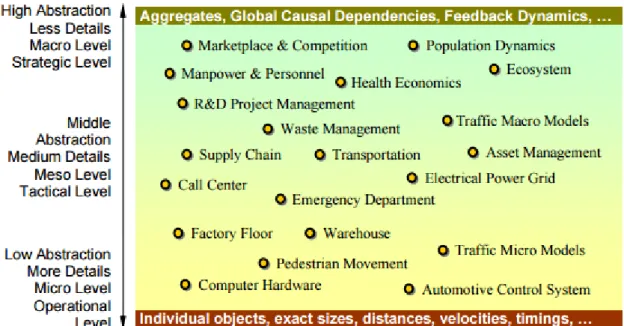
FIGURE 5: ABSTRACTION LEVEL SCALE, APLICATIONS OF SIMULATION MODELLING. ... 13
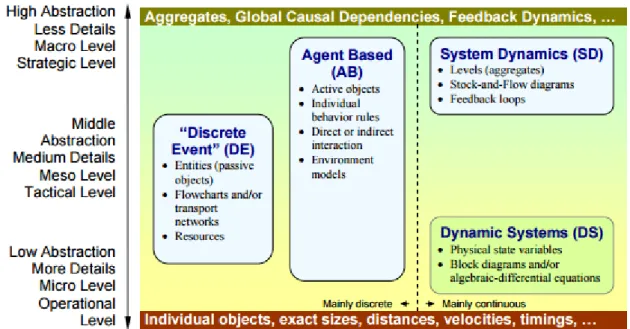
FIGURE 6: APPROACHES IN SIMULATION MODELING ON ABSTRACTION LEVEL SCALE. ... 15
LIST OF ABREVIATIONS
3
LIST OF ABREVIATIONS
AMHS Automated Material Handling System
FAB Semiconductor fabrication plant
ABS Agent Based Simulation
DES Discrete Event Simulation
SD System Dynamics
MM Multi Method
FOUP Front Opening Unified Pod
OHT Overhead Hoist Transfer
AGV Automated Guided Vehicle
ZFS Zero Footprint Storage
GPSS General Purpose Simulation System
1.- INTRODUCTION
4
1.- INTRODUCTION
The semiconductor industry is based on developing smaller, faster and cheaper
technologies. The more transistors can be packed into the same chip, the faster the chip
will do what it was designed to do. Thanks to the strong competition between
manufacturers and to new technologies that lower the cost of production per chip, the
pressure is always pushing them to improve the ways of making the products.
To ensure reliable products and in order to reduce operating costs, highly automated
manufacturing systems are developed to conduct the operations and make millions of
decisions per day. Such complex systems require from techniques that allows us to carry
them, here is where simulation systems start making sense.
The motivation behind this Bachelor Thesis is to gather different information about the
automated material handling systems or AMHS being utilized in the semiconductor
industry and the ways of doing it. By putting into perspective both the size and
complexity of the different elements taking part into the semiconductor processes, it
will be easier then to understand why simulation is a must.
But, Why simulation? Simulation is a tool; It is the artificial context that puts a hypothesis
to the trial by associating parameters to real entities using what we call models. It allows
the company or the modeller to develop and test a system without taking risks, with the
possibility of simulating in a different time scale, spending less money and time than
creating the real model and allowing us to make changes and put the system to the test.
When it comes to AMHS simulation, not every simulation is valid, there are mainly two
specific methods used and studied within this pages; Agent Based and Discrete Event
Simulation. Each of them have their advantages and disadvantages, pros and cons that
5 The aim of this Bachelor Thesis is to give a detailed comparison, to determine the
advantages and disadvantages that each method have, by providing useful information
about both of them so the most appropriate decision when simulating can be made.
The structure followed along this Bachelor thesis is now explained; In chapter two
SEMICONDUCTOR MANUFACTURING BASICS an overview to the semiconductor industry
will be made, in order to understand the importance of simulation, the environment,
specific vocabulary and resources used by the industry will be shown and explained.
Chapter three MODELLING BASICS, AGENT BASED, DISCRETE EVENT SIMULATION AND
SOFTWARE will be about the different modelling methods mainly used, Agent Based and
Discrete Event, as well as the software available in the industry. In chapter four
COMPARISIM OF AGENT BASED AND DISCRETE EVENT SIMULATION the main differences
between the two methods, when to use each one depending on the model and the items
that the modeller wants to simulate, advantages and disadvantages of using one or the
other will be shown. Also the possibility of combining them into a simulation given by
specific software will be analysed. Lastly chapter five AMHS, AGV AND SYSTEM
SIMULATION DIFERENCIES will show in first-hand how a model should be approached
from the different points of view when modelling, whether it is Agent Based or Discrete
Event so in the last chapter CONCLUSSION it will be clear that nothing is left to chance
2.- SEMICONDUCTOR MANUFACTURING BASICS
6
2.- SEMICONDUCTOR MANUFACTURING BASICS
With the goal of contextualizing the semiconductor industry and in order to understand
the following chapters and why the simulation is a common practice when talking about
AMHS it is important to define what a semiconductor is or what is it that makes it one
of the most complex industries in the world.
2.1.- INTRODUCTION TO THE SEMICONDUCTOR
A semiconductor is a material that has certain unique properties in the way it reacts to
electrical current, its conductivity is between a good conductor and an insulator. While
a semiconductor is not an invention, nowadays there are such a wide variety of
semiconductor devices that uses semiconductor materials for the manufacturing of
electronic parts. Semiconductor materials include the elements silicon and germanium,
and also the compounds gallium arsenide, lead sulphide, or indium phosphide. (Mary
Bellis, 2016)
Although this names may seem that have nothing to do with the topic, they are
important because they have specific ways of being manufactured and mentioning them
will help to understand why certain factories use what it is called a ‘Clean Room’ to
develop the semiconductor devices.
2.1.1.- ENVIRONMENT IN SEMICONDUCTOR MANUFACTURING
In this context of extremely complex products and high technology manufacturing it is
necessary to have a certain control over the manufacturing processes in terms of
physical operations. The wafer fabrication manufacturing requires an extraordinary
2.- SEMICONDUCTOR MANUFACTURING BASICS
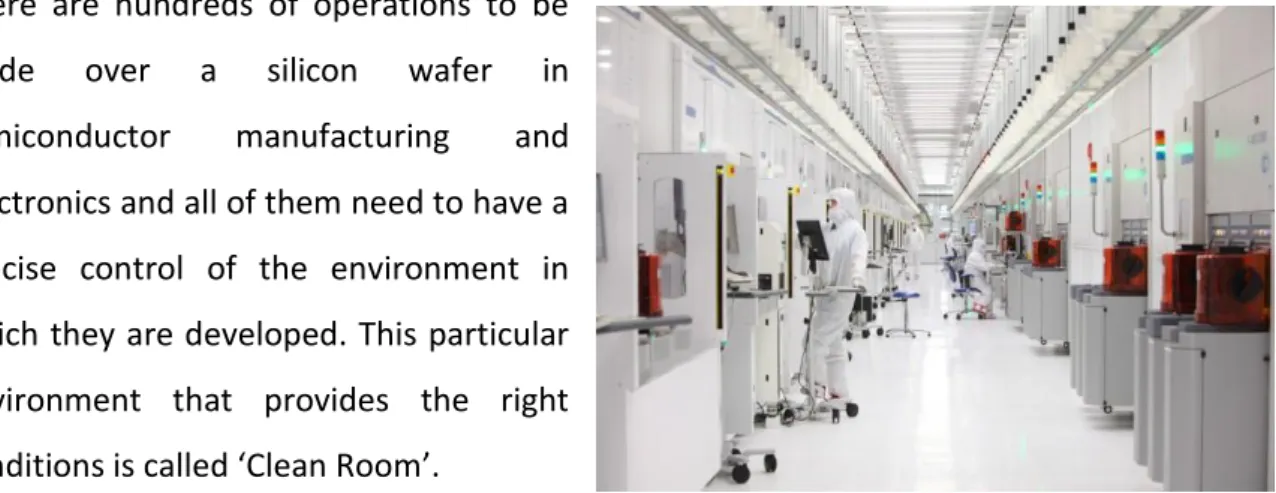
7 There are hundreds of operations to be
made over a silicon wafer in
semiconductor manufacturing and
electronics and all of them need to have a
precise control of the environment in
which they are developed. This particular
environment that provides the right
conditions is called ‘Clean Room’.
Figure 1: Semiconductor Wafer Fab (Extreme Tech, Intel Micron Unveil)
A clean room is a particular environment that provides with a low level of environmental
pollutants such as dust, airborne microbes, aerosol particles and chemical vapours. To
be more precise, it has a controlled level of contamination that comes determined by
the number of particles per cubic meter at a specified particle size. In order to give a
perspective, the air outside contains around 35.000.000 half micrometre and larger
particles per cubic meter, while a cleanroom following the standard for ISO 1 allows no
particles in that size range and only 12 particles per cubic meter with a diameter of
0.3µm and smaller. (Global Society for Contamination Control, 2016)
2.1.2.- DEFINITION OF A WAFER
In microelectronics, a wafer is a thin sheet of a
semiconductor material, such as silicon glass, in which
microcircuits are constructed by doping techniques
(e.g. Ion diffusion or implantation), etching and
deposition of various materials. Therefore, wafers are
essential in the manufacture of semiconductor devices
as integrated circuits or solar cells.
2.- SEMICONDUCTOR MANUFACTURING BASICS
8 Depending on the destination and specifications required for the applications of the final
products they are manufactured in various sizes ranging from 25.4 mm to 300 mm and
between of the order of half a millimetre. They are usually obtained by cutting large
cylinders of semiconductor material using diamond discs and then being polished by one
of their faces.
The orientation is important as many of the electronic and structural properties of the
individual crystals are highly anisotropic. For example, the formation of defined planes
in the crystals in the wafers only occurs in some concrete directions. Burning the wafers
in such directions facilitates their further division into individual tokens so that the
billions of elements of a medium wafer can be separated into a multitude of individual
circuits. (Pablo Kummetz, 2010)
2.1.3.- DEFINITION OF A FOUP
FOUP is a really common instrument used in
semiconductor manufacturing, it stands for
Front Opening Unified Pod and it consist of a
specialised plastic enclosure designed to hold
the silicon wafers safely avoiding any contact
with any worker or machinery while it’s on its
way to deliver the wafers so they can be
processed. FOUPs began to appear with the first
300mm wafer processing tools, and were
designed with the bottom opening door being replaced by a front opening door to allow
robot handling mechanisms to access the wafers directly from the FOUP.
In modern 300mm wafer fabs wafers and reticles are transported fully automatically in
carriers called FOUPs, using an AMHS. A FOUP is a container that holds up to 25 wafer
jobs of 300mm wafers in an inert, nitrogen atmosphere that fully loaded wheights
around 9 kilograms. Automated material handling is always a critical operation in wafer
fabs. In many 200mm wafer fabs and in most back end facilities material handling is
usually carried out manually. (Nishi, Doering, 2007)
2.- SEMICONDUCTOR MANUFACTURING BASICS
9
2.2.- TRANSPORTATION SYSTEMS
Before getting in detail about specific ways of transport the different products it is
important to define the way that transportation is made in this kind of factories where
complex systems are used.
An important thing to consider is to differentiate between interbay systems and intrabay
systems inside a wafer fab. The first ones are used to store and transport wafers or
reticles between the various bays, that means that transportation takes place from
stocker to stocker or from stocker to an interlevel lift system and vice versa.
Figure 4: Interbay/Intrabay AMHS configuration in wafer fabrication facilities. (El-Kilany
2.- SEMICONDUCTOR MANUFACTURING BASICS
10 On the other hand, intrabay systems have the purpose to move carriers from wafers and
reticles within a bay, in this situation the transportation is carried out between stockers
and machines or directly between machines of a bay. The automated transport in 300
mm wafer fabs also covers transport within a bay. This is caused by the increase in area
and weight of the wafers. (Mönch u. a., 2012)
2.2.1.- OHT, AGV SYSTEMS AND APLICATIONS
"OHT" is the abbreviation for Overhead Hoist Transfer. It consists in an automated
transport system that travels on the overhead track and "directly" accesses the load port
of the stocker or process equipment by the belt driven hoisting mechanism. This is
widely recognized as the main transport system for 300 mm FAB and next generation
FABs. (Muratec, o. J.)
"AGV" is a floor running Automated Guided Vehicle capable of functioning without
driver operation programmed to move between different manufacturing stations, they
are used to increase efficiency, decrease damage to goods and reduce overhead.
As it is previously discussed, the transportation systems of FABs can be largely divided
into intra-bay and inter-bay. The initial 150mm FABs relied only on Overhead Shuttles
(OHS) for automatic inter-bay transportation, while the 200mm FABs added Automatic
Guided Vehicles (AGV) for automatic intra-bay transportation. The 300mm FABs
introduced a segregated approach where high-speed Overhead Hoist Transports (OHT)
are used for intrabay transportation and OHS's are used for inter-bay transportation.
The inefficiency of operating intra-bay and inter-bay transportation in a segregated
manner in 300mm FABs has recently been raised, so a unified approach where OHT's
are used for both intra- and inter-bay transportation has been developed. (Mönch u. a.,
3.- MODELLING BASICS, AGENT BASED, DISCRETE EVENT SIMULATION AND SOFTWARE
11
3.- MODELLING BASICS, AGENT BASED, DISCRETE EVENT
SIMULATION AND SOFTWARE
In the last decades the semiconductor manufacturing industry has evolved from being
almost exclusively scientific research to a grown developed industry. Nowadays more
than 200.000 people in Europe works for this industry in a direct way and more than one
million people in indirect jobs generated by the industry. With hundreds of machines
and thousands of operations, today wafer fabs represent one of the most complex
manufacturing systems in the planet. This dimensions together with the complexity of
the supply chain means that simple, intuitive, manual techniques are not likely to
succeed. (Fowler u. a., 2015)
When the industry first started to produce, the main concerns were about device design
and yield management, while manufacturing and supply chain management were not
seen as a source of competitive advantage. Due to the strong competition between
manufacturers, model-based decision making became more important every day, by
using simulation to improve, manufacturers started to stand from the competence and
get better results noticing that this approach was notably successful. (Fowler u. a., 2015)
That is why simulation is one of the most used methods among the huge variety offered
by Industrial Engineering, Computer Science and Operations Research. Simulation as a
technology has a number of inherent difficulties and limitations that have to be taken
into account when considering its use. Using simulation in semiconductor
manufacturing was the object of intensive scientific discussions, at the same time, using
discrete-event simulation in wafer fabs is not as straightforward as one might think.
3.- MODELLING BASICS, AGENT BASED, DISCRETE EVENT SIMULATION AND SOFTWARE
12 Modelling is defined as a method to solve problems in which the system that wants to
be studied is replaced by a representation of it that describes the real system and is
called model. Simulation is a tool for modelling used when a real experiment can’t be
conducted because it would be really expensive, impossible or just too complicated to
carry. There are many reasons why simulations are made; from the costs of designing
and testing, because the time required to conduct the experiment would be impractical,
etc.
It is also necessary to distinguish between physical and mathematical modelling, for
example a physical model would be a scale copy of a car in a wind tunnel. Simulations
are basically mathematical models made by computer whose behaviour is dictated by
equations and algorithms, typically based on date, and are represented by a computer
interface for the user to understand it better. This kind of models ‘copy’ the behaviour
of some real world systems and create theoretical outputs based on varying the input
data, by doing this, the user is able to examine really complex behaviours and situations
on an enormous range of conditions much more quickly and inexpensively than with
3.- MODELLING BASICS, AGENT BASED, DISCRETE EVENT SIMULATION AND SOFTWARE
13
3.1.- LEVELS OF ABSTRACTION
In order to understand the magnitude of simulation and modelling, a classification of
the different problems into different levels, levels of abstraction for simulation
modelling is developed. Figure 5 below shows the different kind of problems that can
be addressed when it comes to simulation modelling. These problems are put into a
scale where the level of abstraction of the model is defined, showing for each one of
them which is the most appropriate.
This way, physical modelling where singular objects with defined dimensions, distances,
velocities and timings are set into detailed level. While other systems such as
mechatronic and control systems, micro-traffic simulations and so on are situated at the
bottom of the chart.
Also referring to the chart, factory models with conveyors and stations are placed
higher, they are no longer exact physical properties and don’t use average timings. Same
applies to warehouse logistics models with many different components such as
storages, loading and unloading operations, due to their more complex structure when
modelling.
3.- MODELLING BASICS, AGENT BASED, DISCRETE EVENT SIMULATION AND SOFTWARE
14 When we take a look at the middle or high abstraction range topics on the chart we can
tell how business processes as well as service systems are usually modelled following
schedules and timings but also physical movement is present sometimes. Network and
transportation simulation deals with schedules, loading and unloading or processing
times, macro level traffic and transportation models are situated into middle high
abstraction levels, they don’t consider individual vehicles or packets, but their volumes
instead. When it comes to supply chains there is plenty of different abstraction levels
depending on each particular case, that’s why it also belongs to the mid- high range.
If we move higher into the chart we find the more complex models where not many
things are defined and the difficulty to model is higher, problems at the top of the chart
are typically approached in terms of aggregate values, global feedbacks, trends, etc.
Individual elements such as people, parts, products, vehicles, animals, houses are never
considered there since we are talking about much more abstract items. (Borshchev,
2004)
3.2.- MAIN APPROACHES
At this point it is now time to define the way to approach every single kind of problem,
depending on the level of abstraction according to the scale used in the previous figure,
we can define three main approaches; System Dynamics (SD), Discrete Event (DE) and
Agent Based (AB). The most traditional ones are System Dynamics and Discrete Event,
while Agent Based is relatively new. In the figure we can also finde the Dynamic Systems
(DS) which are as well used to model and design but more physical oriented. Technically
System Dynamics and Dynamic Systems are mainly for continuous processes whereas
3.- MODELLING BASICS, AGENT BASED, DISCRETE EVENT SIMULATION AND SOFTWARE
15 According to Figure 6 we can take a look on how the different approaches correspond
to the different levels of abstraction. At the bottom of the chart we find Dynamic
Systems, due to their physical not abstract modelling, on the opposite, since System
Dynamics has to deal with aggregates it is placed in the highest abstraction level.
Discrete Event modelling is located in a low to middle abstraction position of the chart,
while Agent Based models are implemented across all different abstraction levels since
in a model of this kind, an agent placed into an Agent Based model can represent objects
of very diverse nature and scale, at the bottom of it from the physical agents such as
cars, robots or pedestrians to mid abstraction level agents such as customers to higher
levels where active objects such as competing companies are modelled.
Until very recently Agent Based has been almost purely academic. However, the
increasing demand for global business optimization have forced the modellers to look
at Agent Based and combined approaches in order to get a deeper insight into complex
interdependent processes that have different natures. (Filippov, 2004)
3.- MODELLING BASICS, AGENT BASED, DISCRETE EVENT SIMULATION AND SOFTWARE
16
3.3- DIFFERENT TYPES OF MODELLING
Depending on the particularities of the system we are trying to model there will be
significant differences on the way of modelling them. We can define three different
types when we simulate a model, each one of them have their own advantages and
limitations. There is not one way of modelling that is better than another, they will just
be more appropriate for different situations according to the specifications of our
model.
3.3.1.- SYSTEM DYNAMICS
The first type of modelling was introduced in the 1950s before any other system was
implemented, based mainly in the laws of physics, to investigate economic and social
systems. Nowadays, system dynamics is mainly used for long-term, strategic models and
represent people, products, events or any other item by quantity. It is a modelling
method that allows us to create computer simulations of complex, real systems and use
them to implement processes and design more efficiently.
This kind of modelling means that there is movement needed, what it is called dynamic
systems. System Dynamics is a method in which the user has to model a system as a
closed structure with a defined behaviour. When it comes to system dynamics there are
what it is called feedback loops, they are what makes this type of modelling stable, when
the system gets feedback it can either reinforce its past behaviour or balance it by doing
3.- MODELLING BASICS, AGENT BASED, DISCRETE EVENT SIMULATION AND SOFTWARE
17 It is important when speaking about system dynamics to define what stocks and flows
are, when we talk about stocks we are talking about the memory of the system and also
the source of disequilibrium and they are usually expressed in quantities such as people,
inventory levels or knowledge, while when we talk about flows we are speaking about
the rates at which the system states change and are usually the measurements of certain
quantities in a given time period, for example items produced in one year.
3.3.2.- DISCRETE EVENT
Discrete event modelling was first created not long after system dynamics, it was the
decade of 1960s when it was introduced to carry GPSS (General Purpose Simulation
System). It requires the user to think about the system that wants to be modelled as a
process in which a series of agents perform a number of operations in a given order.
The fact that the model is designed as a process flowchart where operations are
represented by blocks means that these operations can include delays, service by
different resources and others. In this context where different agents try to get limited
resources it is normal to have queues in every simulation of this kind.
Since the different service times as well as the agent arrival times come normally from
a probability distribution instead of a fixed timing, systems modelled with discrete event
will be stochastic, which means that in order to obtain a significant or relevant output a
model must be running for at least a certain amount of time to complete a specific
3.- MODELLING BASICS, AGENT BASED, DISCRETE EVENT SIMULATION AND SOFTWARE
18 Most of the processes we see in the world have one thing in common, they change in
time, however when we analyse these processes it sometimes is a good approach to
separate what is a continuous process into a series of simpler and more discrete parts
of it so its analysis is also easier to understand. The main approach to Discrete Event
Modelling is to approximate continuous real processes with ones a lot simpler,
non-continuous that the modeller defines.
When it comes to modelling using this technique, it is important to consider that if a
successful simulation is what we are looking for, Discrete Event Modelling should only
be used when the system we are trying to simulate can be described as a sequence of
different operations with a beginning and an end.
3.3.3.- AGENT BASED
Agent based is one of the most recent methods used in simulation if we compare it to
the others that will be described as system dynamics or discrete event modelling. It was
only fifteen years ago when it was finally implemented, when some series of
practitioners from the academic world saw that there were some needs that weren’t
being covered:
o Back in the day traditional modelling could not capture some ways of interpretation about certain systems.
o It was then possible to make object oriented modelling, unified modelling language and state charts thanks to the advances in technology.
3.- MODELLING BASICS, AGENT BASED, DISCRETE EVENT SIMULATION AND SOFTWARE
19 Agent based modelling is based on how the system’s objects behave instead of focusing
on how the whole system behaves, considering this as the first approach it is possible to
build a model by associate the objects to an agent into the model and start defining how
they behave. Once that first step is done there is a need to establish the relationships
between the agents and also with the environment that is defined also by the user. What
the different programs do is simulate the global system by incorporating every single
behaviour from the individuals.
But what it is called an agent doesn’t necessarily have to be a physical object, in an agent
based model an agent can represent many diferent things, from people, equipment or
vehicles to organizations as companies or non material things like flights or ideas. With
this in mind we can find agents that communicate with others as well as modelled in
isolation, from existing in a certain space to exist with no need of space and from
learning behaviors to static behaviors in time.
On the contrary to what it seems, there is not a specified language for simulation with
agent based models but instead all the structure surrounding a model is defined from
scripts or from graphical editors. Generally an agent has a variable that defines its state,
whatever the agent does comes defined by this variable and wheter it makes an action
or it reacts to another it will be conditioned by its state. But this is not the only way of
modeling with agent based, we can aslo define its behavior with certain rules that are
3.- MODELLING BASICS, AGENT BASED, DISCRETE EVENT SIMULATION AND SOFTWARE
20
3.4- SIMULATION SOFTWARE
This part of the chapter is a description about all the different environments mainly used
for the creation of models and their characteristics, based on their usability and
reliability. As the difficulty of keeping up with the increasing demands from companies
with old simulation tools is becoming more evident, innovative, fast and agile reaction
is needed to increase the productivity. It is intended to give a complete, meaningful
overview about the different simulation tools. With the emergence of several
environment tools that supports features like graphical user interfaces and advanced
visualization tools a wider variety of tools have raised in the last decades. The majority
of simulation environments have their own programming language while others are
based on graphical interfaces.
3.4.1.- ANYLOGIC
Anylogic is a simulation software that allows the user to combine various ways of
simulation, it supports a multi-method simulation that combines the fields of discrete
event modelling, agent based modelling and system dynamics. It supports all of the
known modelling approaches and consists on objects for modelling of processes. It is a
Java based and independent platform. Different perspectives are associated with
different variables supported by AnyLogic. The simplicity of the interface makes it easy
to create non-complex models, resources like Source, Queue, Delay, Resource, Pool
3.- MODELLING BASICS, AGENT BASED, DISCRETE EVENT SIMULATION AND SOFTWARE
21 It allows the user to use the Drag&Drop method where a good visualization of the
elements can be achieved. A model created with Anylogic can be expanded without
limits, a current state of the model can be saved and later restored at a later stage.
Supply chain logistics, health care, transportation & warehousing, airports and stations
are some of the main applications of AnyLogic.
3.4.2.- ARENA
ARENA is an entity based flowcharting simulation software, the main approaches
implemented by it are Discrete Event simulations. The use of modules is a fundamental
factor when simulating with this software, graphical objects are used into the
simulations of it to build these modules. Connector lines are used to join these modules
together and to specify the flow of entities. While modules have specific actions relative
to entities, flow, and timing, the precise representation of each module and entity
relative to real-life objects is subject to the modeller. Statistical data, such as cycle time
and WIP (work in process) levels, can be recorded and made output as reports. They can
also be used to build experimental models, it allows the user to select the different
templates from the collection and organizes the different modules to represent the
various simulations. Despite the importance that the graphic interface has inside this
software, when there is a need to create any other non-indexed tool, ARENA offers the
user the programing language Siman to create the code. It is a flexible tool that
introduces several functionalities such as measures and tracks performance metrics,
advanced templates, runtime features or the vision flow charting. It provides real time
modelling, validation, verification and debugging, making communication between
3.- MODELLING BASICS, AGENT BASED, DISCRETE EVENT SIMULATION AND SOFTWARE
22
3.4.3.- AUTOMOD
From the company Applied Materials, the software Automod is one of the largest, most
used modelling software in the world. It is a mainly used as a Discrete Event simulation
tool that deploys material handling templates, flow and control logic is also based on
material handling simulation. It offers a three dimensional environment where the user
can develop from virtual reality, animation grafics, statistics and optimization getting a
really interactive modelling. In the applications of the software we can find that the
main applications come from modelling of manufacturing processes trough warehouse
simulation and supply chain to online emulation. Allowing the user to operate not only
graphical but by the utilization of simulation language, it also supports operational
analysis, evaluation of strategies, revamp existing facilities making it easier to make a
decision for the user.
3.4.4.- ENTERPRISE DYNAMICS
Enterprise Dynamics is a simulation software from Incontrol Simulation Software, it is
an object oriented, scheduling modelling tool mainly based on events. With its own
simulation language 4D Script supports both two and three dimensional animations,
allowing the developer to model the problem virtually and later provide a solution for
it. The main tool when simulating with Enterprise Dynamics are the objects called
Atoms, indexed into a library, capture the behaviour of the items wanted to be modelled
and creating the model. With the functionality and easy to use drag and drop it is mainly
focused in airport, pedestrian dynamics show flow, transportation planning, equipment
and capacity planning and optimization of processes, offers the user more than 1500
3.- MODELLING BASICS, AGENT BASED, DISCRETE EVENT SIMULATION AND SOFTWARE
23
3.4.5.- EXTEND SIM
Extend Sim is a product from the company Imagine That Inc., it is a simulation software
focused primarily into discrete event and mixed discrete continuous systems. The main
simulations carried out when modelling are for continuous, dynamic, linear and
non-linear but also agent based systems. It displays an easy to use interface with visual
content where the modeller can place from logical elements to physical ones, all of it
developed by a drag and drop system. The simulation structure is based on blocks where
the user can modify the connexions between them depending on the specifics of the
model as well as enter the different parameters into the blocks dialog box. These blocks
are icons, user interface and animation, precompiled code created by the developers
that allows the user to easily use blocks such as create, queue, activity, resource or pool.
It also creates graphical interface that identifies the relationships in the developed
system.
3.4.6.- FLEXSIM
Flexim software is a simulation software mainly created with the goal of simulating
object oriented, discrete event processes. It uses the Open GL technology to simulate,
offering a three dimensional virtual reality for the animation of the models, with its own
precompiled programing language it uses a four main object oriented approach; namely
node, fixed resource, task executer and visual object classes are defined to represent
the objects. One of the main attractive points about this software comes with the
possibility of different users to access a simulation from various locations, this means a
4.- COMPARISM OF AGENT BASED AND DISCRETE EVENT SIMULATION
24
4.- COMPARISM OF AGENT BASED AND DISCRETE EVENT
SIMULATION
Once an idea about what the different methods are and what are the different
simulation choices that a user can choose from when beginning a simulation, it is time
to put into perspective how the different approaches will change the way our model will
work.
As it is previously mentioned, Discrete Event simulation has been the main and principal
way when it comes to simulation and modelling for over 40 years, with the arrival of
agent based simulation the promise of a new, potentially more applicable way of
approaching simulation was now the centre of attention. However, throughout the
years there is relatively little evidence that shows how Agent Based Simulation has a
higher weight into the simulation community when it comes to application. This
contrasts with the much greater volume of Agent Based Simulation papers and
publications in different journals within several disciplines. (Siebers,2010)
But how or what kind of simulation environment can Agent Based be more useful than
the other simulation approaches? The answer to this question is not short at all and will
be answered among the following lines but in order to have a previous idea we say that
Agent Based Simulation help the modeller to understand real-world systems where
representations or modelling of different individuals is important and for which each
individual have an independent behaviour so the agents will respond to the simulated
4.- COMPARISM OF AGENT BASED AND DISCRETE EVENT SIMULATION
25 One of the main problems in the last years and it is currently going on nowadays is that
problems requiring simulation have not been adequately addressed by Discrete Event
Simulation or System Dynamic approaches, so they are not properly modelled with the
existing simulation software, toolkits or development environments. Here is where
Agent Based Simulation, for including behaviour into such models have advantage
because it is its natural approach. In other words, Agent Based Simulation allows people
to model their real-world systems of interest in ways that were either not possible or
not comfortable to work with using traditional modelling techniques, such as Discrete
Event Simulation. (Macal, 2010)
If we take a more traditional operations front, agile manufacturing and dynamic supply
chains, as well as the automated material handling systems, are natural application
areas. These applications require from modelled systems that can be dynamic and have
the ability to quickly adapt to changing requirements and events on a real time basis.
For instance, taking an Agent Based approach we can include descriptive models of how
people make the decisions within a system and then observe the effects of that same
decision. This doesn’t mean a user can’t develop these kind of complex models using
other methods, in some various domains, it can be straightforward to understand how
people make decisions, how or when they decide when an action has to be taken. In
these cases, it is also possible to develop some not so complex but useful queuing
models in the traditional Discrete Event applications domain that incorporate general
agent behaviours. For example, we can model how people actually behave in the
evacuation of a building or an area when designing evacuation strategies.(Garnett,
4.- COMPARISM OF AGENT BASED AND DISCRETE EVENT SIMULATION
26 The election of one of the methods when it comes to modelling, Agent Based or Discrete
Event, should be based mainly on each problem specifications and requirements instead
of the final application domain. The problem comes when considering the categories of
application rather than on the nature of the ongoing research questions that drive the
applications. This discussion on the adequate applicability of Agent Based could become
a problem, that’s why the importance of following the good practice when modelling is
essential; in the first place the research question should be clearly defined and
identified, and in second place the question about which method is more applicable for
solving the specific problem. So the discussion now is to enumerate the problems that
uniquely Agent Based is being used depending on the several application domains, since
even some of these topic could be simulated with other methods, the lower level of
abstraction is easier to understand with Agent Based Simulation. According to the
journal of simulation the following points shows a fair list of Agent Based applications
(Buxton a.o., 2010):
1. when the problem has a natural representation as agents—when the goal is modelling the behaviours of individuals in a diverse population;
2. when agents have relationships with other agents, especially dynamic relationships—agent relationships form and dissipate, for example, structured contact, social networks;
3. when it is important that individual agents have spatial or geo-spatial aspects to their behaviours (eg, agents move over a landscape);
4. when it is important that agents learn or adapt, or populations adapt;
5. when agents engage in strategic behaviour, and anticipate other agents’ reactions when making their decisions;
6. when it is important to model agents that cooperate, collude, or form organisations;
7. when the past is not a predictor of the future (eg, new markets that do not currently exist);
8. when scale-up to arbitrary levels is important, that is, extensibility;
4.- COMPARISM OF AGENT BASED AND DISCRETE EVENT SIMULATION
27 Then, for what kind of problems is Discrete Event Simulation appropriate for? DES is
mainly useful for problems that are seen as processes instead of singular objects. When
it comes to problems that consist of queuing simulations, complex network of queues
where the processes have to be previously described and defined and the goal is to
represent the uncertainty through stochastic distributions. Manufacturing and service
industries as well as queuing situations are some of the main applications in terms of
environments. The common tendency to use an approach which we are familiar with to
model a problem which ends up being impossible to model with the approach selected
in the first place, is in fact a reason why before starting to model we should take a look
at what are the main definitions and differences between the approaches.
According to Shannon (1975) Agent Based Simulation is the process of designing an
Agent Based Model of a real system and conducting experiments with this model for the
purpose of understanding the behaviour of the system and evaluating various strategies
for the operation of the system. In Agent Based Models, a complex system is
represented by a collection of agents that are programmed to follow some behaviour
rules. System properties emerge from its constituent agent interactions (Bonabeau,
2002). Agents are ‘objects with attitudes’ (Bradshaw, 1997), discrete entities that are
designed to mimic the behaviour of their real-world counterparts. Agents have their
own set of goals and behaviours and their own thread of control. Unlike objects, agents
are capable of making autonomous decisions and also of showing proactive behaviour,
4.- COMPARISM OF AGENT BASED AND DISCRETE EVENT SIMULATION
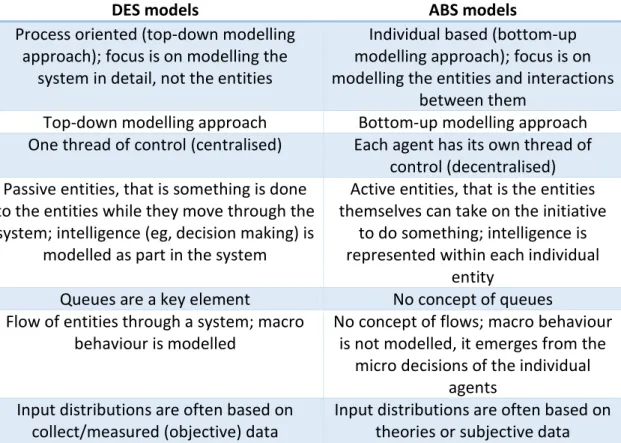
28 The following table focuses on a comparison between the two different model types,
Agent Based and Discrete Event models, presenting an overview of all the attributes that
allows us to classify a model’s approach.
DES models ABS models
Process oriented (top-down modelling approach); focus is on modelling the
system in detail, not the entities
Individual based (bottom-up modelling approach); focus is on modelling the entities and interactions
between them
Top-down modelling approach Bottom-up modelling approach One thread of control (centralised) Each agent has its own thread of
control (decentralised) Passive entities, that is something is done
to the entities while they move through the system; intelligence (eg, decision making) is
modelled as part in the system
Active entities, that is the entities themselves can take on the initiative
to do something; intelligence is represented within each individual
entity
Queues are a key element No concept of queues Flow of entities through a system; macro
behaviour is modelled
No concept of flows; macro behaviour is not modelled, it emerges from the
micro decisions of the individual agents
Input distributions are often based on collect/measured (objective) data
Input distributions are often based on theories or subjective data
Table 1: Main differences between ABS and DES (Siebers, 2010)
When we take a look at the definitions, one significant observation can be made, this
is that there are not any true Agent Based Simulation models when we are talking
about applications. Instead it is noticeable that the majority of the models where we
represent the process flow as a Discrete Event Simulation model and then we add
acrive entities such as agents (autonomous and capable of displaying behaviour) are
actually a combination of both approaches having as a result a model that is none of
4.- COMPARISM OF AGENT BASED AND DISCRETE EVENT SIMULATION
29 In any case the fact is that nowadays there are very few models of Discrete Event
Simulation that takes an approach in which the entities are the centre of focus and
shows active behaviour. The perspective the modeller takes when simulating in terms
of agent focus or process focus will define how the model has to be executed an
implemented. If it was impossible for a Discrete Event Simulation to include active
entities then the differentiation between both approaches would be clear, DES and
ABS.
However, the approach of applying both methods combined seems to be the next step,
actually current step, to solve the problems that the manufacturers and service
providers have to face. Software developers have a responsibility here as well, as long
as the demand is increasing, it is to create new advanced, easy to use software that
allows the user to add intelligence to the entities instead of having all of the
information focused in the process flow definition.
The increasing computer power and the evolution of user interfaces brings as
consequences that the software developers and the Discrete Event Simulation is
progressively evolving towards a ‘drag and drop’ systems. Languages such as Simul8
then emerged to make the processes accessible and cost effective for all kind of
modellers. (Kelton a.o., 2003)
Taking this as a starting point, Agent Based Simulation had before starting a series of
barriers that made it more difficult to access, at least from the commercial point of
view, since for academic purposes the existing software (Repast, NetLogo) is adequate.
When it comes to the commercial use the software offer is really limited to mainly one
software, Anylogic, making it again not that easy for the consumer or for the enterprise
since the modeller needs to be comfortable with Java and object oriented
5.- AMHS, AGV AND SYSTEM SIMULATION DIFERENCIES
30 These are reasons why Agent Based Simulation is still in the domain of few skilled people
and academic researchers. It is a more natural way of simulation and allows it to be used
for relatively modern problems more robustly not forcing the modeller to take many of
the different workarounds needed to be applied when using System Dynamics or
Discrete event. Despite the technical approach of the software available nowadays
Agent Based Simulation is not a replacement for the other simulation methods, it is not
a method that will solve all the problems with more exactitude, faster, better and easier
way than either System Dynamics or Discrete Event simulation, but it is however a much
more flexible modelling approach that can answer a range of issues better than the
previous mentioned before.
5.- AMHS, AGV AND SYSTEM SIMULATION DIFERENCIES
In this part of the thesis we will discuss one of the applications of the previous described
methodologies for simulation and modelling, by defining what AMHS is in the first place,
an overview of what are the resources used by it and how do we approach a simulation
of this kind with both simulation approaches Agent Based and Discrete Event Simulation.
AMHS or Automated Material Handling System can be defined as an integrated system
that envolves such different activities as handling, storing and managing (controlling)
materials. One of the main goals of the application of automated material handling
systems is to make sure that right material is delivered safely in the right amount and in
the right destination with the minimum cost and in time. But there is one more
definition that needs to be made, when we speak about material in this context the
word refers to all kind of raw materials but also to work in process, subassemblies and
5.- AMHS, AGV AND SYSTEM SIMULATION DIFERENCIES
31 When it comes to modelling an AMHS it is also important to define the different
resources and equipment, from conveyors, monorails, hoists, cranes, to automated
guided vehicle systems such as unit load carriers, towing or automated storage and
retrieval systems, although not all of them are present in an AMHS simulation.
In order to carry the automatic transportation of materials one key element will be
needed to move around the workspace the different products, the previously
mentioned Automated Guided Vehicle has a significant importance when speaking
about AMHS. The AGVs belongs to a class of highly flexible, intelligent and versatile
material handling systems used to transport materials from various loading locations to
the respective unloading across the facility. An AGV is formed by four main parts; The
first one is the vehicle, used to move and transport the materials without a human
operator. Second one is the guide, it tells the vehicle where to move around and which
is the path permissible to operate. The control unit in third place monitors and directs
the system operations, including feedback, inventory and vehicle status. Lastly the
computer interface, that enables each vehicle to communicate with each other in order
to make the system as flexible as possible.
Once the problem is defined in all its aspects is now time to set the different approaches
for the different simulations, in the first place an Agent Based Model of the AMHS is
going to be described. As we have mentioned before an ABS is a mainly object oriented
system, this means that some agents will need to be defined. For this type of approach
the AGVs will be the agents, they will be the ones in charge of carrying the diferent
products or materials to the different places in the simulation. Materials are defined in
the simulation either as other agents, static in this case or simulated as resources,
5.- AMHS, AGV AND SYSTEM SIMULATION DIFERENCIES
32 This locations or places won’t necessarily be agents but instead could be simulated as
servicies, stations where the products are generated and the agents deliver and receive
them. But one of the questions into any simulation is how the agents behave and move
within the space. In this type of approach, the user defines certain paths, these paths
are to be respected by the AGVs, what makes an ABS so flexible is the fact that every
single one of the transfers inside the simulation is automatically implemented by the
simulation so that the different agents have the ability to interact and communicate
with each other allowing the system to, while respecting the constraints given by the
user, make deccisions by themselves and implement the fastest possible way to
complete the transactions.
When it comes to define the Discrete Event Simulation of the example presented we
can find that there are some interesting diferencies between both of them. From the
point of view of the modeller this kind of approach is a process oriented simulation, in
this particular case, the AGVs will no loger be agents but instead standard resources
used just like the rest of the elements. The approach described within this lines does not
define certain objects as it is commonly understood for the word, but instead it will focus
on the events that are taking place within the simulation, it is no longer important if the
object carrying the product or material is an AGV but the process itself, the fact that an
event is taking place at a certain time from a specific point to another. The way of doing
it is by defining certain states into the simulation, these states will represent the
simulation at every time, certain events defined by the user will take place at certain
times, comunication inside the model is no longer a characteristic of the system and the
user is to be focused on optimizing the loops, queuing and timing of the different events
6.- CONCLUSSION
33
6.- CONCLUSSION
While an important part of the simulation and modelling problems have not been
correctly focused by the main approaches, the reality is that the tendency of usage when
it comes to modelling is quite static. May the reasons for this staticity be the formation
and understanding of the companies, independent users and researchers or the lack of
more accessible specific software that allows them to move forward, from older, not so
complete simulation software with more traditional approaches, to more easy to use,
flexible software.
The truth is that whether the main applications and approaches are basically the same
year after year, new methods brought by software companies are starting to grow,
bringing to the table more dynamic ways of using simulation, starting with the
application of the combination of various methods, multi method simulation seems to
be the direction where this industry is slowly facing.
Although addressing the different simulation problems into specific classes so that
certain approaches can solve certain problems is a tendency due to the inherent human
condition that tries to set some order, index and classify all kinds of problems, people
who has studied the different methdods and approaches agree when saying the
application of the approaches on a standardized way is not the correct way. The
applicability of these methods should relay on the modeller, the approach needs to be
given independently of the field of application, always depending on the specifics of
each problem.
Taking a closer look to a more specific demonstration, when the problem to be studied
is an Automated Material Handling System, the simulation of it won’t be better by
applying one or other method just by taking a look at the field of study, instead the
specifics of the problem will have to be taken into account and in the last moment is the
modeller of the simulation who has to make the decision.
This means, Agent Based Simulation is not better than Discrete Event Simulation or vice
versa but one will always be better for a specific problem than the other. Finding it easier
when deciding which one depends on the specifics and it is the whole purpose of this
7.- REFERENCES
34
7.- REFERENCES
Deepthi Sehrawat (2014): „Simulating Multi-Agent Systems with AnyLogic system:
Review“. In: Deepthi Sehrawat al. International Journal of Research Aspects of
Engineering and Management ISSN: 2348-6627, Vol. 1., S. 95–98.
Fowler, John W.; Lars Mönch; Thomas Ponsignom (2015): „Discrete-Event Simulation for
Semiconductor Wafer Fabrication Facilities: A Tutorial“. In: ResearchGate.
Global Society for Contamination Control (2016): „Cleanroom“. GSFCC. Abgerufen von
http://www.gsfcc.org/cleanroom.html.
Grigoryev, Ilya (2015): AnyLogic 7 in Three Days: A Quick Course in Simulation Modeling.
Createspace Independent Pub. — ISBN: 978-1-5076-9136-6
Mary Bellis (2016): „Evolution and Function of the Semiconductor“. Abgerufen von
http://inventors.about.com/od/computersandinternet/a/What-Is-A-Semiconductor.htm.
Mönch, Lars; Fowler, John W.; Mason, Scott (2012): Production Planning and Control for
Semiconductor Wafer Fabrication Facilities: Modeling, Analysis, and Systems.
Springer Science & Business Media. — ISBN: 978-1-4614-4471-8
Munters (o. J.): „Fabricación de semiconductores - Munters“. Abgerufen von
https://www.munters.com/es/industrias/electronics/semiconductor-manufacture/.
Muratec (o. J.): „OHT | AMHS for Semiconductor Fab. | PRODUCTS | CLEAN FA |
MURATEC,MURATA MACHINERY, LTD.“. Abgerufen von
http://www.muratec.net/cfa/products/.
Nishi, Yoshio; Doering, Robert (2007): Handbook of Semiconductor Manufacturing
7.- REFERENCES
35 Pablo Kummetz (2010): „Chips y más chips | Economía | DW.COM | 23.03.2010“.
Abgerufen von http://www.dw.com/es/chips-y-m%C3%A1s-chips/a-5373146.
Paige Tanner (2015): „An Overview of the Semiconductor Industry - Market Realist“.
Siebers, Macal, Garnett, Buxton, Pidd (2010): Journal of Simulation "Discrete-Event
simulation is dead, long live agent-based simulation!" Operational research
society
Borshchev, Filippov (2004): Conference of the System Dynamics "From System Dynamics
and Discrete Event to Practical Agent Based Modelling: Reasons, Techniques,
Tools"
Hanjra, Sherry (2016): International Journal of Engineering Research and General
Science, Volume 4, Issue 3, "Simulation Environments".
Bonabeau E (2002). Agent-based modelling: Methods and techniques for simulating
human systems. Proceedings of the National Academy of Science of the USA 99:
7280–7287
Bradshaw J (1997). Software Agents. MIT Press: Cambridge, MA, (cited in Odell J (2002).
Objects and agents compared. J Object Technol 1(1): 41–53.
Macal CM and North MJ (2007). Agent-based modelling and simulation: Desktop ABMS.
In: Henderson SG et al (eds). Proceedings of the 2007 Winter Simulation
Conference. IEEE Press: Washington DC, 9–12 December, pp 95–106.
Shannon RE (1975). Systems Simulation: The Art and Science. Prentice-Hall: Englewood
Cliffs, NJ.
Kelton WD, Sadowski RP and Sturrock DT (2003). Simulation with Arena. 3rd edn,