
Assortment as a clustering variable: an application to the distribution of ceramics and construction materials in Spain
28
0
0
Texto completo
(2) 384 10. assortment as a clustering variable: an application to the distribution of ceramics and construction materials in spain. 1. Introduction As in the rest of Europe, the distribution sector in Spain is going through a phase of reconstruction. Various authors (e.g. Seth and Randall, 1999; Dawson, 2000) have pointed out, among other determinants of the new trends in commerce, the increase in consumer mobility, the popularization of the use of e-commerce, the growing size of establishments, market concentration, domestic market saturation and changes in legislation. Classification plays a central role in the systematic understanding and prediction of any phenomenon (Singh, 1990) and in particular it is essential for understanding and analyzing relationships in retailing (Guy, 1998), as commercial establishments are heterogeneous in various aspects, such as their location, size, and type of customers. According to Mason and Mayer (1990), the structure of the retail system can be described via different classifications that altogether help to analyze the impact of the retail commerce on the economy and serves as a tool for business managers who wish to develop strategies to increase profits. In addition, by analyzing the size, growth rate and future trends of several components of a given classification, it is possible to assess the competitive position of the establishments of a company, or a sector in a geographical area. Furthermore, a consistent and complete classification allows researchers to empirically compare and test the results obtained for different geographical, cultural and temporal contexts (Guy, 1998). The process for the extraction of classes begins with the choice between two approaches: the deductive approach (also denominated theoretical or a priori), using the a priori grouping of companies (typologies), and the inductive approach (denominated post-hoc or empirical), which generates strategic types using computer algorithms (taxonomies). In both cases, the selection of the dimensions used to cluster companies is a crucial step in thought about business competition. The classification of commercial establishments and its relationship with companies’ strategies and the results of their activity in terms of productivity and effectiveness have traditionally interested marketing researchers (Entenberg, 1959; Bucklin, 1963; Lewis and Thomas, 1990; Conant et al., 1990; Vallet, 2000). A current of literature on distribution. [116]. may · august 2010 · esic market.
(3) assortment as a clustering variable: an application to the distribution of ceramics and construction materials in spain. 10 385. has focused on merchandise as a key variable for building a classification typology of retailing. The decision about the product assortment is perhaps one of most important that must be taken by the distributor (Kahn, 1999). However, most research has focused on grocery retailing, and there are few works in other sectors of activity. This paper aims to develop a typology of companies in ceramic and construction materials distribution in Spain in order to characterize the companies as the first step in the development of further research. The rest of the paper is organized as follows. Section 2 reviews literature about the classification of the companies from the distribution sector. Section 3 describes the methodology used, and Section 4 the characteristics of the sample and the databases. Next, the results obtained are analyzed. Finally, sections 6 and 7 draws conclusions and outlines future work, respectively.. 2. Review of the literature In this section we review the main contributions of typologies and taxonomies in the distribution industry, as well as the assortment as key element in the classification of distributors. 2.1. Typologies and taxonomies in the distribution industry Retailers have several strategic options to meet their objectives. In the literature on retail distribution several typologies are detailed, these can be classified under four groups: the adaptation of the typologies of Miles and Snow (1978) and Porter (1980) to the retail sector, growth typologies, competitive positioning typologies and retailer format typologies. In the first group, Ellis and Calantone (1994) have studied the relationship between strategic types and retailer’s results, whereas Porter’s types (1980) have been adapted to the positioning strategies of price leadership, differentiation and segmentation (e.g. Bamfield, 1987; Savitt, 1987; McGee, 1987; Johnson, 1987; Helms et al., 1992). Secondly, by applying the model proposed by Ansoff (1965) to the retail distribution, growth routes have generated basic consolidation strategies, geographical market development, development of new trading formats and diversification (Knee and Walters, 1985; Robinson and. may · august 2010 · esic market. [117].
(4) 386 10. assortment as a clustering variable: an application to the distribution of ceramics and construction materials in spain. Clarke-Hill, 1990; Pellegrini, 1994; Filser, 1987; Savitt, 1987; McGee, 1987; Omura, 1986; Burstiner, 1990; Dawson, 1991; Levy and Weitz, 1992; Gosh, 1990; Lewison, 1994; Cox and Brittain, 1994; Pellegrini, 1994; Tordjman, 1991; Muñiz, 1995; Casares et al., 1987). Regarding retail positioning strategies, Berry and Barnes (1987) explore customers’ motivations for visiting a store, proposing four generic retail positioning strategies: value retailers, time-efficient retailers, high-contact retailers and sensory retailers. Finally, Mason and Mayer (1990) distinguish different classifications of commercial formats, i.e. descriptive classifications, which specify the different dimensions of the retail structure mostly offered by official statistics, and strategic classifications, which help the retailer to develop differential marketing by using the elements of the marketing mix that are more difficult to find in official statistics. Descriptive classifications include classifications by property or relationship with other organizations (Davidson et al., 1988; Rosenbloom, 1980; Berman and Evans, 1992; Levy and Weitz, 1992; Lewison, 1994) such as vertical integration (Díez, 2005; Svensson, 2008); geographical location (Davies, 1974; Potter, 1981; Dawson and Sparks, 1986; Guy, 1998; Shaw and Cresswell, 2002; Thurstain-Goodwin and Gong, 2005) and by size of retailer (Rosenbloom, 1980; Dunne et al., 1992; Puelles, 2004). Strategic classifications gather the classification of formats according to the contact with the consumer and the customer shopping purpose. In the former group there is a distinction between sale with establishment and sale without establishment (Mason and Mayer, 1990; Davidson, Sweeney and Stampfl, 1988; Bolen, 1988; Rosenbloom, 1980; Gosh, 1990; Berman and Evans, 1992; Levy and Weitz, 1992; Dunne et al., 1992; Lewison, 1994). The latter group is the result of the distinction between shopping trips to cover routine needs (convenience shopping) and those made occasionally and mainly for personal satisfaction (comparison shopping). Even if it is usual the classification by retailer size, this type of classification involves the arbitrary use of borders. In addition, in the so-called “small distributor” group, there is a wide variety of retailers. For that reason, the classification based on the size of the store would have to be com-. [118]. may · august 2010 · esic market.
(5) assortment as a clustering variable: an application to the distribution of ceramics and construction materials in spain. 10 387. pleted with its characterization based on the type of products that it sells (Guy, 1998). As opposed to typologies, the second method of classification of strategies covers the post-hoc approaches (TAXONOMIES). The post-hoc or empirical approaches are those in which the strategic types have arisen from the empirical data. The different types of strategies appear after the data treatment and statistical analysis. The empirical study of the competitive strategies has been analyzed from various disciplines. Economic sciences have looked for a unit of analysis between the industry and the company to explain the competitive forces, denominated strategic group (Marion, 1998; Harrigan, 1985; Hawes and Crittenden, 1984; Flavian, 1995, 1998; Muñiz, 1995, 1996a, 1996b; Bello and Muñiz, 1998; García and Rodríguez, 1994, 1996; Vázquez, 1992; Ruiz and Iglesias, 1997). The identification and analysis of the groups depend on key strategic dimensions chosen by the researcher, and most of the time, based on the secondary data available. In addition, studies in psychology also use intermediate levels of aggregation of companies that they call cognitive taxonomies (Porac, Thomas and Emme, 1987). The identification and analysis of the groups obtained depends on company managers’ perceptions of its competitive environment, and managers propose the key measurement dimensions of the strategy. Also, studies in business administration and marketing try to find generic types of strategies through the inductive method. The results of these works are generic taxonomies and positioning taxonomies. Generic taxonomies are characterized by the study of several sectors, and based on big samples and manager perceptions, they look for generic marketing strategies. Conant et al. (1993) and Vallet and Mollá (2002) have developed this concept in the retailing sector. The positioning taxonomies are based on the customer perception of the image of the retailer, and depending on this, competitive positioning retail strategies are defined (Hernandez et al., 1995; Vázquez, 1992, 1989; Ring, 1979; Oppewal and Timmermans, 1997; Davies and Brooks, 1989).. may · august 2010 · esic market. [119].
(6) 388 10. assortment as a clustering variable: an application to the distribution of ceramics and construction materials in spain. 2.2. Assortment as a classification variable The definition of the assortment constitutes one of the retailer’s main decisions and makes it possible to define the commercial differentiation, together with customer service, promotion and price policy (Balderston, 1956). In addition, merchandise is the factor that most often appears in the studies of retail image (Lindquist, 1974; Gil et al., 1995). The factors that determine assortment are multiple (Vázquez, 1989:52) and from their interaction a favorable image appears: retailer mission, market demand, higher or lower numbers of different types of customer, the commercial area, sales area and capital available for fixed investments and stock. However, the merchandise can be the same (brands of manufacturer in grocery distribution, for example) and does not differentiate establishments. What is important is the way and the context in which the merchandise is displayed, rather than the merchandise itself (Davies and Brooks, 1989:219). An important part of the retailer strategy is the development of own brands, which constitutes an additional form of differentiation from competitors, to obtain reputation, to create customer loyalty toward the store and to build a corporative image (Vázquez, 1989:56). It is also necessary to consider the differences of approach between the producer and the retailer, regarding the composition of the product portfolio. Whereas the producer aims at defined segments of market, the retailer copes with a set of consumers belonging to the different segments of producers. The producer has a product portfolio on which it stamps a brand image, which adapts to one or several segments, with competition at international level, and portfolio management is carried out through the marketing mix. By contrast, the distributor has a product portfolio (assortment) coming from different companies, on which he stamps a standard image, adapted to a geographical area of attraction, with competition at local level and managed through retailing-mix actions. Thus, there is need to refine the definition of the typology of retailers depending on their product assortment. Considering Bucklin’s (1963) definition of retailer or product assortment as a mix of market goods together with a series of services in order to reduce costs between economic. [120]. may · august 2010 · esic market.
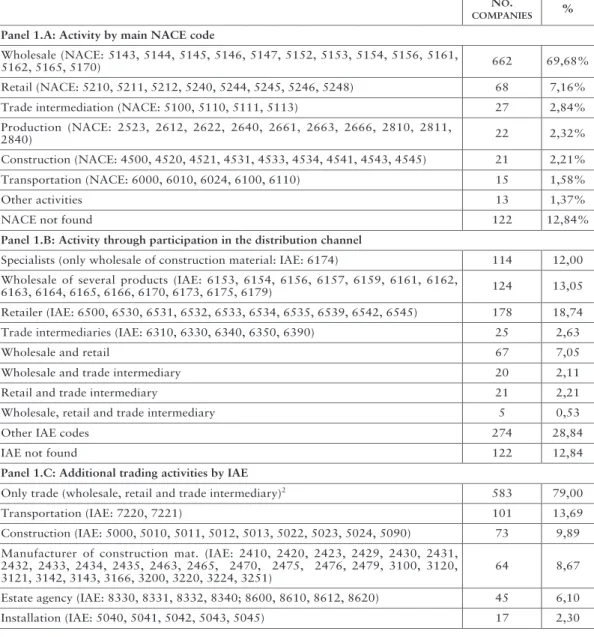
(7) assortment as a clustering variable: an application to the distribution of ceramics and construction materials in spain. 10 389. agents in the subsequent levels of the distribution channel, we describe below some typologies based on the assortment. First, distributors can be classified according to the variety of their assortment. The variety refers to the number of different product lines, and the assortment is the choice of products within a line. Variety can be defined as wide (multiple product lines) or narrow (few lines), and assortment can be characterized as deep (many products in a line) or superficial (few products in a line). Following these options, the typology of Tordjman (1991) distinguishes four distributor strategies based on the breadth or depth of the assortment: defensive strategy, with a broad, shallow assortment; offensive strategy, with a narrow, deep assortment; push strategy, with a narrow, shallow assortment, and pull strategy, with a broad, deep assortment. It is important to distinguish between this assortment-based definition of defensive strategy from the strategy based on maximizing royalty or customer retention (Berné et al., 2005). In a second classification, it is possible to distinguish between non-specialized distribution, multi-product specialized distribution and singleproduct specialized distribution (Vallet and Mollá, 2006). On the other hand, among the specialized retailers Vallet and Mollá (2006) distinguish four great categories based on his assortment: specialized store, which displays a limited line, a narrow, deep assortment; single line store (of specialties, superspecialist, or niche specialist), which is characterized by a very narrow and very deep assortment, by a specialized line or part of the line; large specialized surface, which offers a narrow, very deep assortment and large store size (between 5,000 and 10,000 m2); and factory stores, which offer a narrow, semi-deep assortment. Also, taking into account that managerial decisions regarding assortment can aim at different objectives and, consequently, generate diverse retailer formats, Balderston (1956) proposes a typology with eight types of different distributors, i.e., conventional, specialty shop, volume-oriented distributor, bargain-oriented distributor, distributor specialized in new purchase combinations, distributor specialized in sporadic buyers, distributor with technical services and status symbol distributor.. may · august 2010 · esic market. [121].
(8) 390 10. assortment as a clustering variable: an application to the distribution of ceramics and construction materials in spain. Although the distributor can pursue different objectives simultaneously, there is generally a predominant objective that conditions the choice of assortment regardless of short-term marginal considerations, as it affects both the present and future store image. In summary, various criteria have been used by different authors to classify commercial stores. Some are totally inclusive, whereas others are not. Some involve classifying the stores in generic categories that must be defined according to merchandise assortment, type of owner, size and inner design, or a combination of these. For the purpose of analyzing the distribution structure at national or local level, a classification based on the types of products offered seems to be the most appropriate (Guy, 1998). A second dimension could be the size of the store or the form of ownership.. 3. Research method This study is inductive, as it aims at building a taxonomy of distributors of ceramics and construction materials in Spain considering the empirical evidence. We have used secondary data, belonging to the database of the National Association of Distributors of Ceramics and Construction Materials (ANDIMAC) and applied a cluster analysis considering the key variables of assortment in the different product families. First, the hierarchical method has been used to delimit the number of conglomerates. Next, as it is not expected that groups are included in other groups, a K-Means non-hierarchical clustering method is selected. Nevertheless, this method requires a number of a priori clusters for the initial analysis, as well as centroids, which are provided by the hierarchical analysis previously carried out (Punj and Stewart, 1983). In order to consider the issues relating to the validity of the results, a three-step procedure is followed. The first step consists of selecting the optimal number of clusters for the analysis through interactive techniques and internal validation of the solution obtained (Ellis and Calantone, 1994). For the internal validation of the alternative solutions, we developed a confirmatory cluster analysis, we applied a discriminant analysis and we. [122]. may · august 2010 · esic market.
(9) assortment as a clustering variable: an application to the distribution of ceramics and construction materials in spain. 10 391. compared the results of a cluster analysis for two alternative sub-samples. First, an additional non-hierarchical analysis was performed. In this case, a centroid is set randomly to begin with. If the results are robust, it is expected that the final solution does not differ substantially from the previous one. Secondly, the assignment group obtained from the cluster analysis is compared with the one obtained from the discriminant analysis. The chance-adjusted kappa concordance coefficient is calculated for the two solutions for the second sub-sample. The optimal number of clusters is calculated maximizing kappa, assuring its internal validity and replicability. Once the number of clusters has been determined, the data are classified and a K-Means analysis is performed with the optimal number of groups. This is the last solution of the clustering process. Thirdly, we divided our data in two random samples for internal validation, following Punj and Stewart (1983). The first data set constitutes the sample that was used to generate the possible alternative clustering solutions. The second data set is used to select between alternative clustering solutions based on stability and replicability. It is basically a comparison of the clusters assigned through the crossed validation of the second data set. The second phase of the cluster analysis consists of validating the groups comparing the average values of clusters through other measures. In this way, we try to determine whether the subjects belonging to each group behave in a different way concerning variables that have not been included in the analysis, as it is expected that the differences between clusters involve different behaviors in several variables. In particular, after defining the clusters, their external validity is verified through studying whether the clusters obtained present significant differences regarding their activities complementary to commerce and various measures of resources (volume of assets, number of employees, own brands, total number of product families, number of warehouses, total store area, average sales area of the store, number of vehicles), of results (turnover, profitability, productivity, market share) and others (customer credit, supplier credit). The null hypothesis of equality in the different variables between the clusters is tested using one-way ANOVA. Finally, in the third phase, the distinguishing features of the clusters are identified, both regarding the group-. may · august 2010 · esic market. [123].
(10) 392 10. assortment as a clustering variable: an application to the distribution of ceramics and construction materials in spain. ing variable (product assortment) and the variables for their characterization (resources, results and others).. 4. Sample and databases. (1) S.A.B.I. is an Informa database that contains the annual reports of the most important Spanish and Portuguese companies since 1990. This information is obtained from different official sources, i.e. Trade Register, BORME (Official Bulletin of the Trade Register) and specialised business press.. [124]. As literature pays little attention to the study of the distribution of durable goods, we have centered our analysis on the sector of distribution of ceramic and construction material in Spain. The database of companies from the sector is obtained from the secondary information available. Two sources were used to locate the companies in the sector: the database of companies associated with ANDIMAC and the companies included in the Alimarket database of economic information as retailers or wholesale suppliers of ceramics and construction materials. The two databases were purged of duplicate data, companies exclusively specializing in the distribution of electrical components, metals, etc. Once filtered, the final sample consisted of 950 distributors of construction material whose NACE (National Classification of Economic Activities) and/or IAE (Tax on Economic Activities) codes are related to the wholesale of construction material. Once the sample of companies has been defined, some indicators were analyzed in order to allow a first characterization of the sector, e.g. geographic location, type of activity, product category, number of employees, volume of assets and turnover, registered own brands, profitability, productivity, and average number of days of customer and supplier credit. All this information was mainly obtained from the database of business information SABI (Iberian Accounting Analysis System)1. From the Alimarket database, in addition we obtained information about number of warehouses, warehouse area and number of vehicles. Market share, number of product families and average store area are calculated from the available information. The distributors of ceramic and construction material present some peculiarities that distinguish them from companies belonging to other sectors. In order to describe the companies of the sample, we first analyze their type of activity following the NACE and IAE code. Table 1 shows the statistics obtained for the companies from the sample.. may · august 2010 · esic market.
(11) 10 393. assortment as a clustering variable: an application to the distribution of ceramics and construction materials in spain. Table 1. Activity NO. COMPANIES. %. Wholesale (NACE: 5143, 5144, 5145, 5146, 5147, 5152, 5153, 5154, 5156, 5161, 5162, 5165, 5170). 662. 69,68%. Retail (NACE: 5210, 5211, 5212, 5240, 5244, 5245, 5246, 5248). 68. 7,16%. Trade intermediation (NACE: 5100, 5110, 5111, 5113). 27. 2,84%. Production (NACE: 2523, 2612, 2622, 2640, 2661, 2663, 2666, 2810, 2811, 2840). 22. 2,32%. Construction (NACE: 4500, 4520, 4521, 4531, 4533, 4534, 4541, 4543, 4545). 21. 2,21%. Transportation (NACE: 6000, 6010, 6024, 6100, 6110). 15. 1,58%. Other activities. 13. 1,37%. NACE not found. 122. 12,84%. Specialists (only wholesale of construction material: IAE: 6174). 114. 12,00. Wholesale of several products (IAE: 6153, 6154, 6156, 6157, 6159, 6161, 6162, 6163, 6164, 6165, 6166, 6170, 6173, 6175, 6179). 124. 13,05. Retailer (IAE: 6500, 6530, 6531, 6532, 6533, 6534, 6535, 6539, 6542, 6545). 178. 18,74. Trade intermediaries (IAE: 6310, 6330, 6340, 6350, 6390). 25. 2,63. Wholesale and retail. 67. 7,05. Wholesale and trade intermediary. 20. 2,11. Retail and trade intermediary. 21. 2,21. Wholesale, retail and trade intermediary. 5. 0,53. Other IAE codes. 274. 28,84. IAE not found. 122. 12,84. Only trade (wholesale, retail and trade intermediary)2. 583. 79,00. Transportation (IAE: 7220, 7221). 101. 13,69. Construction (IAE: 5000, 5010, 5011, 5012, 5013, 5022, 5023, 5024, 5090). 73. 9,89. Manufacturer of construction mat. (IAE: 2410, 2420, 2423, 2429, 2430, 2431, 2432, 2433, 2434, 2435, 2463, 2465, 2470, 2475, 2476, 2479, 3100, 3120, 3121, 3142, 3143, 3166, 3200, 3220, 3224, 3251). 64. 8,67. Panel 1.A: Activity by main NACE code. Panel 1.B: Activity through participation in the distribution channel. Panel 1.C: Additional trading activities by IAE. Estate agency (IAE: 8330, 8331, 8332, 8340; 8600, 8610, 8612, 8620). 45. 6,10. Installation (IAE: 5040, 5041, 5042, 5043, 5045). 17. 2,30. Source: Own elaboration. (2) See Table 1.C for further details about the IAE description in each category of distributor (wholesale supplier, retailer and trade intermediary).. may · august 2010 · esic market. [125].
(12) 394 10. assortment as a clustering variable: an application to the distribution of ceramics and construction materials in spain. As shown in Panel A of table 1, for the companies in the sample the wholesale trade is the main activity declared by more than half of the companies, followed by the retail trade. In particular, of the 950 companies of the total sample, 69.68% are wholesalers. This percentage is 79.95% if we consider only the companies for which we have information about their NACE codes. For the total sample, only 7.16% of the companies are defined as retailers. The other companies, i.e. 10.32%, are trade intermediaries, manufacturers, producers, constructors and carriers. In these cases it could be hypothesized that these companies have diversified their activity and have passed from being simple carriers or constructors to distributing construction materials. Secondly, according to their IAE codes, 77.68% of the companies in the sample declare that they are wholesalers of glass, construction material and installation accessories (IAE 6174), among other activities. Some synchronize the trade in this kind of material with another type of wholesale trade, retail commerce and/or trade intermediation. In order to explore the companies with the 6174 IAE code in more detail, we follow two criteria: their participation in the distribution channel and their participation in activities in addition to the distribution of construction materials. First, we group the companies under 6174 code depending on whether they are exclusively wholesalers of construction material or, on the contrary, they also practice wholesale trade in another type of merchandise and/or retail trade or trade intermediation. Panel B of table 1 shows the distribution of companies according to their participation in the distribution channel. As can be observed, nearly one third of construction material wholesalers make their work compatible with other activities apart from trade. Within commercial tasks, nearly a fifth of construction materials wholesalers also act as retailers. As opposed to these, there is a numerous group of companies selling both construction materials and other types of goods. On the other hand, as an important percentage of wholesale construction materials companies (6174 IAE code) declares that it carries out other activities apart from trade, we describe these companies according to their participation in activities additional to distribution according to other IAE codes. The. [126]. may · august 2010 · esic market.
(13) assortment as a clustering variable: an application to the distribution of ceramics and construction materials in spain. results obtained are shown in panel C of table 1. Although 79.00% of the companies from the total sample are exclusively dedicated to trade, some companies act as carriers, manufacturers of construction materials, installers, constructors and/or promoters and estate agencies. Finally, we describe the companies according to the type of product that they commercialize. Table 2 shows the results obtained for the total sample. Thus, in table 2.A (wholesale of construction materials) we can observe that, after the wholesale of goods related to construction, the companies of the sector commercialize durable goods, followed by wood and cork. Regarding retailing, we can see in table 2.B that, after the sale of construction material and bathroom articles and furniture, the sale of household items, hardware, and decoration items is also important. On the other hand, the existence of distributors’ registered trademarks is important in many ranges of distribution. In the distribution sector, although it is still an embryonic phenomenon, its importance will undoubtedly grow in the next few years. In this sense, from the 950 companies in the sample, 226 companies3 have at least one own brand. Of these companies, more than a half have only one registered trademark. In particular, the existence of own brands is a more frequent strategy at wholesale companies or at companies acting as both wholesaler and retailer. Finally, table 3 shows the distribution of companies based on the number of employees, the volume of assets and the annual income.. may · august 2010 · esic market. 10 395. (3) One should interpret the data about own brands cautiously, as the SABI database (which obtains this information from Marc@Net, the online counseling service about brands and trademarks) states that there is no information about the company’s brands. This statement can be interpreted in the sense that the company does not hold a distributor brand, or that this information is not available.. [127].
(14) 396 10. assortment as a clustering variable: an application to the distribution of ceramics and construction materials in spain. Table 2. Product category IAE. CONCEPT. N. %. 2.A. WHOLESALE RELATED TO CONSTRUCTION MATERIALS 6174. CONSTRUCTIÓN MATERIAL, GLASS, INSTALLATION ACCESSORIES. 738. 77,68. 6156, 6157, 6159. DURABLE GOODS, FURNITURE AND HOME DEVICES. 100. 10,53. 6173. WOOD AND CORK. 88. 9,26. 6170 and 6179. INTER-INDUSTRIAL EXCEPT MINERALS AND CHEMICAL PRODUCTS. 50. 5,26. 6153. HOME APPLIANCES, HARDWARE. 38. 4,00. 6152. FURNITURE. 15. 1,58. 6163. MINERALS. 15. 1,58. 6175. WOOD AND METAL MACHINERY. 12. 1,26. 6162. IRON AND STEEL. 8. 0,84. 6154. RADIO-ELECTRICAL MATERIALS AND ELECTRONICS. 7. 0,74. 6166. CHEMICAL PRODUCTS. 3. 0,32. 6165. OIL AND LUBRICANTS. 2. 0,21. 6164. NON-FERROUS METALS. 1. 0,11. 2.B. RETAIL RELATED TO CONSTRUCTION MATERIALS 6534. CONSTRUCT. MATERIALS, ART.AND BATHROOM FURNITURE. 214. 22,53. 6533. HOUSEHOLD ART., HARDWARE, DECORATION, GIFTS OR ORNAMENTS. 86. 9,05. 6530, 6536, 6539. OTHER HOUSEHOLD AND CONSTRUCTION ITEMS. 34. 3,58. 6532. ELECTRIC AND NON-ELECTR. HOME DEVICES AND KITCHEN FURNITURE. 34. 3,58. 6545. MACHINERY EXCEPT HOME DEVICES, OFFICE AND MEDICAL ITEMS. 10. 1,05. 6531. FURNITURE (EXCEPT OFFICE FURNITURE). 8. 0,84. 6535. DOORS, WINDOWS, VENETIAN BLINDS, MOULDINGS, FRAMES, WOODEN PLATFORMS. 5. 0,53. 6542. ACCESSORIES AND PARTS. 2. 0,21. Source: Own elaboration.. [128]. may · august 2010 · esic market.
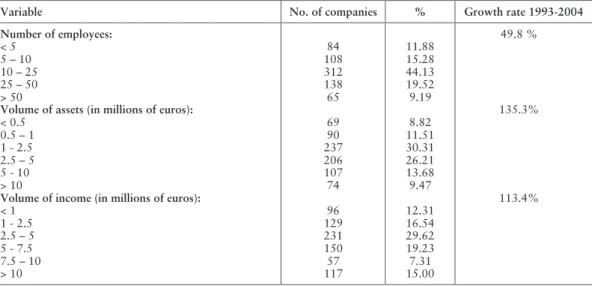
(15) 10 397. assortment as a clustering variable: an application to the distribution of ceramics and construction materials in spain. Table 3. Distribution of the total sample by number of employees, volume of assets and annual income (year 2003) and growth rates (1993-2004) Variable Number of employees: <5 5 – 10 10 – 25 25 – 50 > 50 Volume of assets (in millions of euros): < 0.5 0.5 – 1 1 - 2.5 2.5 – 5 5 - 10 > 10 Volume of income (in millions of euros): <1 1 - 2.5 2.5 – 5 5 - 7.5 7.5 – 10 > 10. No. of companies. %. 84 108 312 138 65. 11.88 15.28 44.13 19.52 9.19. 69 90 237 206 107 74. 8.82 11.51 30.31 26.21 13.68 9.47. 96 129 231 150 57 117. 12.31 16.54 29.62 19.23 7.31 15.00. Growth rate 1993-2004 49.8 %. 135.3%. 113.4%. Source: Own elaboration.. As shown in table 3, the distributions of the three variables are quite similar.. 5. Analysis of results Since the objective of the present paper is to propose a typology for classifying the distributors of ceramics and construction materials, we first apply a non-hierarchiral cluster analysis to the total sample, distinguishing three groups through the dendogram that are internally validated by a K-Means cluster analysis and a discriminant analysis. In order to obtain more detailed information about the meaning of the differences between the elements belonging to the clusters, we perform a variance analysis considering as factor the cluster assigned and as dependent variables those used to classify the elements of the sample. The results obtained are exposed in table 4.. may · august 2010 · esic market. [129].
(16) 398 10. assortment as a clustering variable: an application to the distribution of ceramics and construction materials in spain. Table 4. Average of cluster descriptors and variance analysis Variables. Cluster 1. Cluster 2. Cluster 3. F. Differences between groups *. Construction material Inter-industrial Electrical material Oil and chemical products Machinery Hardware Durable goods Metals, iron and minerals Wood and cork Other products. 0.91 0.06 0.02 0.01 0.01 0.58 0.63 0.04 0.13 0.08. 0.47 0.27 0.07 0.07 0.87 0.27 1.00 0.00 0.07 0.00. 0.94 0.06 0.00 0.00 0.01 0.00 0.00 0.02 0.11 0.03. 24.495 a 5.698 a 5.524 a 5.262 a 383.015 a 403.726 a 620.908 a 1.638 0.289 6.698 a. 1-2, 2-3 1-2, 2-3 1-2, 2-3 1-2, 2-3 1-2, 2-3 1-2, 1-3, 2-3 1-2, 1-3, 2-3 1-2, 1-3. Number of cases %. 207 24.94. 15 1.81. 608 73.25. a, b, c Significantly different from zero at confidence levels of 99%, 95% and 90%, respectively. * In order to test the significance of the differences between the types of retailers, the Tukey post-hoc multiple comparison test is used. Only the statistically significant differences between groups at the 5% level are shown.. Clusters present significant differences in all clustering variables, except the trade in metals, iron and minerals, and wood and cork. In order to validate the results of the clustering process internally, a discriminant analysis is performed, obtaining the results shown in table 5.. Table 5. Contingency table: (Group assigned by Cluster Analysis) X (Group assigned by Discriminant Analysis) Group assigned by Discriminant Analysis. Group assigned by Cluster Analysis. Kappa index. [130]. 1. 2. 3. Total. 1. 204 24.6%. 3 0.4%. 0 0.0%. 207 24.9%. 2. 2 0.2%. 13 1.6%. 0 0.0%. 15 1.8%. 3. 0 0.0%. 7 0.8%. 601 72.4%. 608 73.3%. Total. 206 24.8%. 23 2.8%. 601 72.4%. 830 100.0%. 0.964. may · august 2010 · esic market.
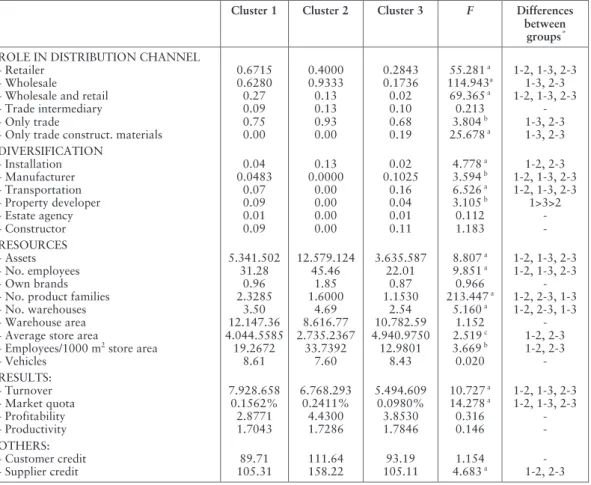
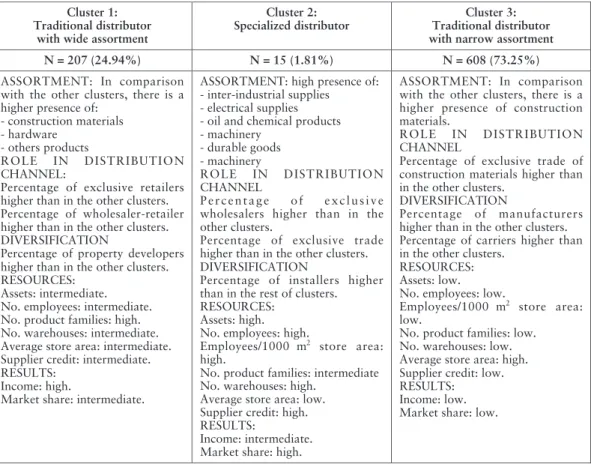
(17) assortment as a clustering variable: an application to the distribution of ceramics and construction materials in spain. 10 399. From table 5 it is inferred that in 98.6% of the cases the classification obtained through discriminant analysis coincides with the one obtained through cluster analysis. The kappa index of agreement between both classifications is of 0.964, significant for a level of confidence of 99%. In particular, the variables that contribute to a greater extent to the discriminant analysis are construction material, hardware and durable goods, being their Wilks’ lambda 0.504, 0.123 and 0.121 respectively (p < 0.000). In addition, regarding external validation of the results of the cluster analysis, diverse variables of resources, results and other characteristics have been analyzed in order to discover the existence of differences between clusters in diverse dimensions. Table 6 shows the results obtained through the ANOVA analysis. Finally, we define the clusters based on their main characteristics. In table 7, the particular features of each cluster are summed up. Following the typologies of Vallet and Mollá (2006), we call the first cluster “traditional distributor with wide assortment”, since it includes both pure retailers and distributors that are simultaneously wholesalers and retailers, which sell a large number of product families, with an assortment of construction materials, hardware and others. They diversify their activity acting as property developers. They are characterized by having the highest income, an intermediate market share and an intermediate negotiation power with the suppliers, among their main characteristics.. may · august 2010 · esic market. [131].
(18) 400 10. assortment as a clustering variable: an application to the distribution of ceramics and construction materials in spain. Table 6. Average of cluster descriptors and variance analysis. ROLE IN DISTRIBUTION CHANNEL - Retailer - Wholesale - Wholesale and retail - Trade intermediary - Only trade - Only trade construct. materials DIVERSIFICATION - Installation - Manufacturer - Transportation - Property developer - Estate agency - Constructor RESOURCES - Assets - No. employees - Own brands - No. product families - No. warehouses - Warehouse area - Average store area - Employees/1000 m2 store area - Vehicles RESULTS: - Turnover - Market quota - Profitability - Productivity OTHERS: - Customer credit - Supplier credit a, b, c. [132]. Cluster 1. Cluster 2. Cluster 3. F. Differences between groups *. 0.6715 0.6280 0.27 0.09 0.75 0.00. 0.4000 0.9333 0.13 0.13 0.93 0.00. 0.2843 0.1736 0.02 0.10 0.68 0.19. 55.281 a 114.943a 69.365 a 0.213 3.804 b 25.678 a. 1-2, 1-3, 2-3 1-3, 2-3 1-2, 1-3, 2-3 1-3, 2-3 1-3, 2-3. 0.04 0.0483 0.07 0.09 0.01 0.09. 0.13 0.0000 0.00 0.00 0.00 0.00. 0.02 0.1025 0.16 0.04 0.01 0.11. 4.778 a 3.594 b 6.526 a 3.105 b 0.112 1.183. 1-2, 2-3 1-2, 1-3, 2-3 1-2, 1-3, 2-3 1>3>2 -. 5.341.502 31.28 0.96 2.3285 3.50 12.147.36 4.044.5585 19.2672 8.61. 12.579.124 45.46 1.85 1.6000 4.69 8.616.77 2.735.2367 33.7392 7.60. 3.635.587 22.01 0.87 1.1530 2.54 10.782.59 4.940.9750 12.9801 8.43. 8.807 a 9.851 a 0.966 213.447 a 5.160 a 1.152 2.519 c 3.669 b 0.020. 1-2, 1-3, 2-3 1-2, 1-3, 2-3 1-2, 2-3, 1-3 1-2, 2-3, 1-3 1-2, 2-3 1-2, 2-3 -. 7.928.658 0.1562% 2.8771 1.7043. 6.768.293 0.2411% 4.4300 1.7286. 5.494.609 0.0980% 3.8530 1.7846. 10.727 a 14.278 a 0.316 0.146. 1-2, 1-3, 2-3 1-2, 1-3, 2-3 -. 89.71 105.31. 111.64 158.22. 93.19 105.11. 1.154 4.683 a. 1-2, 2-3. Significantly different from zero at confidence levels of 99%, 95% and 90%, respectively.. may · august 2010 · esic market.
(19) assortment as a clustering variable: an application to the distribution of ceramics and construction materials in spain. 10 401. Table 7. Summary of cluster characteristics Cluster 1: Traditional distributor with wide assortment. Cluster 2: Specialized distributor. Cluster 3: Traditional distributor with narrow assortment. N = 207 (24.94%). N = 15 (1.81%). N = 608 (73.25%). ASSORTMENT: In comparison with the other clusters, there is a higher presence of: - construction materials - hardware - others products ROLE IN DISTRIBUTION CHANNEL: Percentage of exclusive retailers higher than in the other clusters. Percentage of wholesaler-retailer higher than in the other clusters. DIVERSIFICATION Percentage of property developers higher than in the other clusters. RESOURCES: Assets: intermediate. No. employees: intermediate. No. product families: high. No. warehouses: intermediate. Average store area: intermediate. Supplier credit: intermediate. RESULTS: Income: high. Market share: intermediate.. ASSORTMENT: high presence of: - inter-industrial supplies - electrical supplies - oil and chemical products - machinery - durable goods - machinery ROLE IN DISTRIBUTION CHANNEL Percentage of exclusive wholesalers higher than in the other clusters. Percentage of exclusive trade higher than in the other clusters. DIVERSIFICATION Percentage of installers higher than in the rest of clusters. RESOURCES: Assets: high. No. employees: high. Employees/1000 m2 store area: high. No. product families: intermediate No. warehouses: high. Average store area: low. Supplier credit: high. RESULTS: Income: intermediate. Market share: high.. ASSORTMENT: In comparison with the other clusters, there is a higher presence of construction materials. ROLE IN DISTRIBUTION CHANNEL Percentage of exclusive trade of construction materials higher than in the other clusters. DIVERSIFICATION Percentage of manufacturers higher than in the other clusters. Percentage of carriers higher than in the other clusters. RESOURCES: Assets: low. No. employees: low. Employees/1000 m2 store area: low. No. product families: low. No. warehouses: low. Average store area: high. Supplier credit: low. RESULTS: Income: low. Market share: low.. The second cluster, denominated “specialized distributor with wide assortment”, includes companies that act only as wholesalers, with a very diverse assortment, i.e. inter-industrial supplies, electrical equipment, chemical products and oil, machinery and durable products. They diversify their activity by providing their customers with installation services. Regarding their resources, they are the group with the highest level of assets, number of employees, number of warehouses and employee/sales area ratio. This cluster could be also denominated as “high-contact specialists”, as most of its companies show a high ratio of employees per. may · august 2010 · esic market. [133].
(20) 402 10. assortment as a clustering variable: an application to the distribution of ceramics and construction materials in spain. store. Regarding results, they are the group with greatest market quota, intermediate income and greatest negotiation power with the suppliers. Several distribution chains as well as associated establishments are among the members of this group, constituting an example of the development of multi-store chains or companies and of the importance of associationism in this sector. Finally, most of companies are in third cluster, including distributors that sell a small number of product families, specialized in trade in construction materials, with a very narrow assortment (smaller number of families of products and of construction materials only), and acting in many cases as manufacturers and carriers. Regarding their resources, they are the group with the highest average store area, but with respect to the rest of ratios they are the companies with the lowest assets, number of employees, number of product families, number of warehouses and employee/sales area ratio. According to their results, they are those with the smallest income and market quota. We have called this cluster “Traditional distributor with narrow assortment”, even if it includes companies that could be denominated “value specialists”, as well as some “factory stores”.. 6. Conclusions The above analyses have allowed us to identify a set of structural characteristics of the companies involved in ceramic and construction materials distribution in Spain, considering secondary sources of information, constituting a first approach to the description of the sector. In this way, we consider that we have contributed to shedding light on the situation of a sector characterized by the wide heterogeneity of its companies in their assortment and activities. Through a clustering process, we obtained clusters differing significantly in their assortment, as well as in their business activities, resources and results. Once identified the assortment-based typology of companies, in order to provide practitioners with a valid instrument for the decision-making process, the next step in this research might be a longitudinal analysis of the relationship between the assortment decisions of the company and its performance.. [134]. may · august 2010 · esic market.
(21) assortment as a clustering variable: an application to the distribution of ceramics and construction materials in spain. 10 403. It can be pointed out that the clusters obtained reflect the importance of associationism in this sector, where diverse companies are grouped into cooperatives, purchasing centers, alliances and distribution chains in order to obtain better commercial conditions, to reduce their logistics costs and to draw up marketing plans adapted to the market (Diaz, 2004). In this way, they try to face up to the competition coming from the big specialized DIY stores in the United States and a large part of Europe and which are being introduced into Spain with great success but with several years of delay with respect to European and North American distribution (Vallet and Mollá, 2006). The distribution chains and the associated companies show significantly better results and greater negotiation power with suppliers than the traditional distributors.. 7. Limitations and future research In this paper we have used secondary sources of information. This fact has limited the amount and quality of the results obtained. Such limitations are due to the presence of inaccurate or not fully updated data, and the restriction involved in using fields of information not specifically designed for the purpose of this research. Nevertheless, these results offer a first approach that can be completed in as far as new companies are located and incorporated in the database, and further information is available for all the companies. However, with the existing data, only the breadth of the assortment can be studied, not its depth. A survey including questions about the depth of the product portfolio could greatly contribute to extending the conclusions of this study in the line of Tordjman (1991). It is important to note that the characteristics of the databases used in this study involve incurring a set of a priori biases. In particular, the database of ANDIMAC includes a large number of small companies for which it was not possible to find financial information. On the other hand, the Alimarket database incorporates an excessive number of wholesale companies due to the purging decisions that were adopted in our study. All in all, the results offered in this study must be interpreted cautiously, as it is a work in progress and the analysis of the sector will be improved in as far. may · august 2010 · esic market. [135].
(22) 404 10. assortment as a clustering variable: an application to the distribution of ceramics and construction materials in spain. as further information on more companies comes from other sources. Thus, obtaining primary data through a survey constitutes a high-priority necessity. The use of primary data for a sample of companies of the sector can allow us to overcome some of these limitations and to introduce some more interesting topics to characterize this sector. In this sense, this work provides a new point of view for three lines of research. Firstly, the effectiveness of the clustering process could be tested in other geographical contexts and other product markets. Another possible research involves going backward to understand the antecedents of the present situation of this sector. Finally, the relationship between the type of distributor obtained and its results can be analyzed more deeply. Additional data about the assortment and the activities developed by the distributor can contribute to a clearer definition of the situation in the distribution sector.. 8. References ANSOFF, I. (1965). Corporate Strategy: An Analytical Approach to Business Policy or Growth and Expansion. McGraw Hill, New York. BALDERSTON, F.E. (1956). “Assortment Choice in Wholesale and Retail Marketing”. Journal of Marketing, Vol. 21, pp. 175-183. BAMFIELD, J. (1987). “Rationalization and the problems of re-positioning: UK cooperatives caught in the middle”, en Johnson, G. (ed.), Business Strategy and Retailing, John Wiley and Son Ltd, pp. 153-170. BELLO, L. and MUÑIZ, N. (1998). “Análisis de grupos estratégicos en la distribución comercial en España”. Boletín ICE Económico, nº 2587, pp. 27-39. BERMAN, B. and EVANS, J.R. (1992). Retail Management, A Strategic Approach (fifth ed.). McMillan Publishing Company, Nueva York. BERNÉ, C., GARCÍA, M. and PEDRAJA, M. (2005). “The defensive orientation of the strategies of small retail stores”, EsicMarket, 120 Enero-Abril 2005, pp. 203-221. BERRY, L.L. and BARNES, J.A. (1987). “Retail Positioning Strategies in the USA”, en Johnson, G. (ed.), Business Strategies and Retailing, John Wiley and Son Ltd., pp. 107-115.. [136]. may · august 2010 · esic market.
(23) assortment as a clustering variable: an application to the distribution of ceramics and construction materials in spain. 10 405. BOLEN, W. H. (1988). Contemporary Retailing (3ª ed.), Englewood Cliffs. Prentice Hall, New Jersey. BUCKLIN, L.P. (1963). “Retail Strategy and the Classification of Consumer Goods”, Journal of Marketing, Vol. 27 (1), pp. 50-55. BURSTINER, I. (1990). Basic Retailing (2nd ed.). Richard D. Irwin, Inc., Homewood, IL. CASARES, J.; BRIZ, J.; REBOLLO, A. and MUÑOZ, P. (1987). La economía de la distribución comercial. Ed. Ariel, Barcelona. CONANT, J. S.; SMART, D. T. and SOLANO-MENDEZ, R. (1993). “Generic retailing types, distinctive marketing competencies and competitive advantage”, Journal of Retailing, Vol. 69 (3), pp. 254-279. CONANT, J. S., MOKWA, M. P. and VARADARAJAN, P.R. (1990). “Strategic types, distinctive marketing competencies and organizational performance: a multiple measures-based study”, Strategic Management Journal, Vol. 11 (September), pp. 365-383. COX, R. and BRITTAIN, P. (1994). Retail Management (2nd ed.). Pitman Publishing, London. DAVIDSON, W.R.; SWEENEY, D.J. and STAMPFL, R.W. (1988). Retailing Management (6ª ed.). John Wiley & Sons, New York. DAVIES, G. and BROOKS, J. (1989). Positioning Strategy in Retailing, Paul Chapman Publishing Ltd., London. DAVIES, R.L. (1974). Retail and commercial planning. Croom Helm, Beckenham. DAWSON, J.A. (1991). “Transición hacia una planificación estratégica del comercio minorista”, en Consellería de Industria, Comercio y Turismo (ed.): Estrategias de Distribución Comercial, en Busca de la Excelencia, Generalitat Valenciana, pp.13-38. – (2000). “Retailing at century end some challenges for management and research”, International Review of Retail, Distribution and Consumer Research, Vol. 10 (1), pp. 119–148. DAWSON, J.A. and SPARKS, L. (1986). “Issues for the planning of retailing in Scotland”, Scottish Planning Law Practice, vol. 18, pp. 38-40. DÍAZ, A. (2004). “Ferretería y bricolaje: un sector en transformación”, Code 84, 20-02-2004.. may · august 2010 · esic market. [137].
(24) 406 10. assortment as a clustering variable: an application to the distribution of ceramics and construction materials in spain. DÍEZ, I. (2005). “Vertical integration, market imperfections, firm attributes and industry changes”, ESIC Market, 122 September-December, pp. 119-148. DUNNE, P.; LUSH, R.; GABLE, M. and GEBHARDT, R. (1992). Retailing. South Western Publishing Co., Cincinnati, Ohio. ELLIS, B. and CALANTONE, R. (1994). “Understanding competitive advantage through a strategic retail typology”, Journal of Applied Business Research, Vol. 10 (2), pp. 23-32. ENTENBERG, R. D. (1959). “Suggested Changes in Census Classifications of Retail Trade”, Journal of Marketing, Vol. 24 (1), pp. 39-43. FILSER, M. (1987). “Les options stratégiques de la firme de distribution”, Revue Francaise du Marketing, Vol. 115 (5), pp. 37-48. FLAVIAN, C. (1995). La metodología de grupos estratégicos como herramienta de gestión empresarial. Un análisis dinámico del sector de la distribución, PhD thesis, Universidad de Zaragoza. – (1998). “Estrategias detallistas en la distribución alimentaria”, Distribución y Consumo, nº 38 (February/March), pp. 69-79. GARCÍA, J.M. and RODRIGUEZ, M. (1994). “Identificación de los grupos estratégicos en función de las variables del “retailing-mix”: aplicación al comercio textil”, Minutes of the 8th National Congress and 4th Hispano-French Congress of the European Association of Management and Business Economics (AEDEM), Caceres 94, Hernandez Mogollón, R. (ed.): La Reconstrucción de la empresa en el nuevo orden económico, pp. 579-598. – (1996). “Grupos estratégicos en el sector del comercio textil: una metodología fundamentada en las variables del retailing -mix”, Información Comercial Española, nº 750 (February): pp. 133-152. GIL, I.; MOLLÁ. A. and BERENGUER, G. (1995). “La validación del constructo imagen del punto de venta y el análisis de su incidencia en la selección a través de la puesta a punto de un M.I.C.S.”, Actas del VII Encuentro de Profesores Universitarios de Marketing, Barcelona, Esic, pp. 235-248. GOSH, A. (1990). Retail Management. The Dryden Press, Orlando, Florida.. [138]. may · august 2010 · esic market.
(25) assortment as a clustering variable: an application to the distribution of ceramics and construction materials in spain. 10 407. GUY, C.M. (1998). “Classifications of retail stores and shopping centres: some methodological issues”, GeoJournal, nº 45, pp. 255–264. HARRIGAN, K.R. (1985). “An application of clustering for strategic groups analysis”. Strategic Management Journal, nº 6, pp. 55-73. HAWES, J.M. and CRITTENDEN, W.F. (1984). “A taxonomy of competitive retailing strategies”. Strategic Management Journal, nº 5, pp. 275-287. HELMS, M.M.; HAYNES, P. and CAPPEL, S.D. (1992). “Competitive strategies and business performance within the retailing industry”, International Journal of Retail and Distribution Management, Vol. 20 (5), pp. 3-14. HERNÁNDEZ, M.; MUNUERA, J.L. and RUIZ DE MAYA, S. (1995). “La estrategia de diferenciación en el comercio minorista”, Información Comercial Española, nº 739 (March), pp. 27-45. JOHNSON, G. (ed.) (1987). Business Strategy and Retailing. John Wiley and Sons Ltd. KAHN, B.E. (1999). “Introduction to the special issue: Assortment planning”. Journal of Retailing, Vol. 75 (3), pp. 289–293. KNEE, D. and WALTERS, D. (1985). Strategy in Retailing: Theory and Practice. Philip Allen, Oxford. LEVY, M. and WEITZ, B.A. (1992). Retailing Management. Richard D. Irwin, Homewood. LEWIS, P. and THOMAS, H. (1990). “The linkage between strategy, strategic groups and performance in the UK retail grocery industry”. Strategic Management Journal, Vol. 11, pp. 385-397. LEWISON, D.M. (1994). Retailing. MacMillan College Publishing Company, New York. LINDQUIST, J.D. (1974). “Meaning of Image”, Journal of Retailing, Vol. 50 (4), pp. 29-38. MARION, B. (1998). “Competition in grocery retailing: the impact of a new strategic group on BLS prices increases”, Review of Industrial Organization, Vol. 13 (4), pp. 381-399. MASON, J.B. and MAYER, M.L (1990). Modern Retailing, Theory and Practice. Richard D. Irwin, Homewood.. may · august 2010 · esic market. [139].
(26) 408 10. assortment as a clustering variable: an application to the distribution of ceramics and construction materials in spain. MCGEE, J. (1987). “Retailer strategies in the UK”, en Johnson, G. (ed.): Business Strategy and Retailing, John Wiley and Son Ltd., pp. 89-106. MILES, R.E. and SNOW, C.C. (1978). Organizational Strategy, Structure and Process. Ed. McGraw-Hill, Nueva York. MUÑIZ, N. (1995). Alternativas de diversificación e internacionalización, y evolución de los grupos estratégicos en el comercio minorista europeo y español. PhD thesis, Universidad de León. – (1996a). “Evolución de los grupos estratégicos en la distribución comercial europea”, Actas del VIII Encuentro de Profesores Universitarios de Marketing, Zaragoza, Esic, pp. 327-338. – (1996b). “Diferencias en las estructuras comerciales de los principales países de Europa”, en Luque, T. (1996): La empresa en una economía globalizada: retos y cambios, AEDEM, Granada, Vol. IA, pp. 323-337. – (1993). “Estrategias de posicionamiento en las empresas de distribución comercial”, Distribución y Consumo, 10: 46-57. OMURA, G. (1986). “Developing retailing strategy”, International Journal of Retailing, Vol. 1(3), pp. 17-32. OPPEWAL, H. and TIMMERMANS, H. (1997). “Retailer self-perceived store image and competitive position”, International Review of Retail, Distribution and Consumer Research, Vol. 7 (1), pp. 41-59. PELLEGRINI, L. (1994). “Alternatives for growth and internalization in retailing”, International Review of Retail, Distribution and Consumer Research, Vol. 4 (2), pp. 121-148. PORAC, J.; THOMAS, H. and EMME, B. (1987). “Knowing the competition: the mental models of retailing strategists”, in Johnson, G. (ed.): Business Strategy and Retailing, John Wiley: New York, pp. 59-79. PORTER, M.E. (1980). Competitive Strategy, The Free Press, New York. POTTER, R.B. (1981). “The multivariate functional structure of the urban retailing system: A British case study”, Transactions of the Institute of British Geography, Vol. 6, pp. 188-213. PUELLES, M. (2004). “Los Grandes Especialistas No Alimentarios”, Distribución y Consumo, 78, pp. 15-22. PUNJ, G. and STEWART, D.W. (1983). “Cluster analysis in marketing research: review and suggestions for application”, Journal of Marketing Research, Vol. 20, pp. 134-148.. [140]. may · august 2010 · esic market.
(27) assortment as a clustering variable: an application to the distribution of ceramics and construction materials in spain. 10 409. RING, L.J. (1979). “Retail positioning: a multiple discriminant analysis approach”, Journal of Retailing, Vol. 55 (1), pp. 25-36. ROBINSON, T.M. and CLARKE-HILL, C.M. (1990). “Directional growth by European retailers”, International Journal of Retail & Distribution Management, Vol. 18 (5), pp. 3-14. ROSENBLOOM, B. (1980). “Strategic planning in retailing: prospects and problems”, Journal of Retailing, Vol. 56 (1), pp. 107-120. RUIZ, A. e IGLESIAS, V. (1997). “El análisis de las estrategias de marketing: un estudio del comercio minorista”, Información Comercial Española, 763 (June), pp. 151-161. SAVITT, R. (1987). “American retail strategies and the changing environment”, in Johnson, G. (ed.): Business Strategy and Retailing, John Wiley and Son Ltd, pp. 117-132. SETH, A. and RANDALL, G. (1999). The Grocers the rise and Rise of the Supermarket Chains. Kogan Page, London. SHAW, M. and CRESSWELL, P. (2002). “Standard segments for retail brands”. Journal of Targeting, Measurement and Analysis for Marketing, Vol. 11 (1), pp. 7-23. STERN, L.W; E-ANSARY, A.I.; COGHLAN, A.T. and CRUZ, I. (1999). Canales de comercialización, 5ª edición. Ed. Prentice Hall, Madrid. SVENSSON, G. (2008). “Supply Chain Management versus Sustainable Chain Management”, EsicMarket, 129, January-March, pp. 219-237. THURSTAIN-GOODWIN, M. and GONG, Y. (2005). “Mapping longterm retail trends in London”, Journal of Targeting, Measurement and Analysis for Marketing, Vol. 13 (3), pp. 220-233. TORDJMAN, A. (1991). “El marketing del distribuidor”, en Consellería de Industria, Comercio y Turismo (ed.): Estrategias de Distribución Comercial, en Busca de la Excelencia. Generalitat Valenciana, pp. 41-78. VALLET, T. (2000). La estrategia de marketing de las empresas minoristas en los sectores de no alimentación. PhD thesis, publicada en Colección CD Magna Nº 5, Tesis Doctorales, curso 2000-2001 primer semestre, Publicaciones de la Universitat Jaume I: Castellón. VALLET, T.; MOLLÁ, A. (2002). “La influencia de la percepción del entorno sobre los estilos de planificación y la amplitud del plan de mar-. may · august 2010 · esic market. [141].
(28) 410 10. assortment as a clustering variable: an application to the distribution of ceramics and construction materials in spain. keting. Una aplicación a la distribución minorista de no alimentación”. Revista Española de Investigación en Marketing-ESIC, Vol. 6 (2), pp. 113-144. – (2006). “Las estrategias del comercio especializado”. Información Comercial Española. Revista de Economía, nº 828 (January-February), pp. 137-156. VÁZQUEZ, R. (1989). “La imagen de la empresa detallista y su percepción por los consumidores: una aplicación del analisis factorial”, EsicMarket, nº 63, pp. 49-75. – (1992). “El consumidor y su actitud hacia la compra en establecimientos detallistas: identificación de segmentos y análisis de percepciones”, Estudios sobre Consumo, nº 23 (April), pp. 49-64.. [142]. may · august 2010 · esic market.
(29)
Figure


+3
Documento similar
In countries like Brazil, the role of State enterprises in the construction of energy infrastructure and development of resources, centered around petroleum and electricity, was
The expansionary monetary policy measures have had a negative impact on net interest margins both via the reduction in interest rates and –less powerfully- the flattening of the
Jointly estimate this entry game with several outcome equations (fees/rates, credit limits) for bank accounts, credit cards and lines of credit. Use simulation methods to
In our sample, 2890 deals were issued by less reputable underwriters (i.e. a weighted syndication underwriting reputation share below the share of the 7 th largest underwriter
The Dwellers in the Garden of Allah 109... The Dwellers in the Garden of Allah
aggregates from construction and demolition waste as road base layer. Road Materials and Pavement Design, 1-15. Analysis of chromium and sulphate origins in construction
17,18 Contrary to graphene, the band gap in ML-MDS separating the valence and conduction bands is naturally large and due to the absence of inversion symmetry in ML-MDS the
Abstract: This paper introduces jNEP: a general, flexible, and rigorous implementation of NEPs (the basic model) and some interestenting variants; it is specifically designed to
