
Redescription of Ammodytoides gilli, the tropical eastern Pacific sand lance (Perciformes: Ammodytidae)
5
0
0
Texto completo
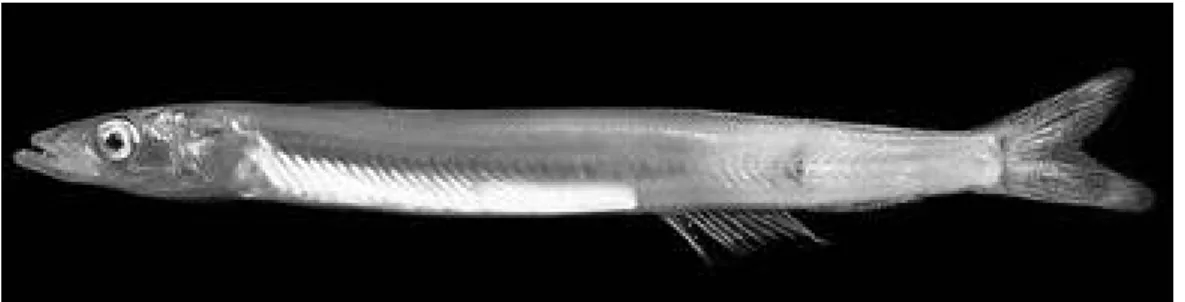
(2) 112. R E V I S TA DE BIOLOGIA T R O P I C A L. Fig. 1. Ammodytoides gilli. USNM 326833, juvenile, 42.3 mm SL, Panama, Azuero Peninsula,drawn by Keiko Hiratsuka Moore.. ic”, USNM 45384). Seale, 1940: 36 (first record from Galapagos Is., [CAS 6881]). Ida, 1973: 71 (fig. 3, radiograph of head, extra ossicles in oral region). Winterbottom et al., 1989: 62 (range erroneously given as “California to Hawaii”, Bleekeria renniei Smith possibly conspecific with B. gilli). Allen and Robertson, 1994: 256 (description, range extended to Panama [USNM 326833], color fig.). Ammodytes lucasanus Beebe and Tee-Van, 1938: 306-308 (original description [NYZS 25249A = CAS SU 46501]; Cape San Lucas, Baja California, from stomachs of several species of fishes and a comorant). Ammodytoides gilli. Ida and Randall, 1993:151 (eastern Pacific species). Ida et al. 1994:252 (ANSP specimens; generic placement). Randall et al., 1994:85 (eastern Pacific). Grove and Lavenberg, 1997:542-544 (description, Galapagos Islands CAS 6881, LACM 44139-1; Ammodytes lucasanus a junior synonym), fig. 304. Collette and Randall, 2000:398 (comparison with other known species of Ammodytoides). Ammodytoides lucasanus. Ida et al. 1994:252 (generic placement).. Diagnosis: A species of Ammodytoides with dorsal-fin rays 44-47 (mean 46.1); analfin rays 22-24 (mean 23.0); pectoral-fin rays 14 or 15; pelvic fins absent; lateral line incomplete, pored lateral-line scales 85-94 + 2-5 unpored scales = 88-98 (mean 94.4); gill rakers on first arch (5-7) + (21-25) = 26-31 (mean 28.7); vertebrae (31-33) + (23-26) = 55-58, including hypural plate (mean 56.5). Description: Body elongate, body depth 9.5-11.2% SL, body width 5.9-7.8% SL; head length 25.4-27.8% SL; snout length 6.9-7.9% SL; orbit diameter 4.1-5.1% SL; fleshy interorbital distance 3.8-4.9% SL; upper jaw length 7.8-9.5% SL; least caudal peduncle depth 4.8-5.4% SL; caudal peduncle length 3.6-6.0% SL; predorsal distance 25.1-26.9% SL; preanal distance 62.5-65.3% SL; caudal. fin length 12.8-16.0% SL; caudal fin concavity 6.3-7.8% SL; pectoral fin length 9.911.1% SL. Scales small, thin, and cycloid, arranged in straight diagonal rows; head naked, no row of small scales on upper part of opercle; scales extending anteriorly to supratemporal lateral line canal; about 10-12 rows of predorsal scales; fins naked except caudal fin with scales extending about three-fourths distance to posterior margin; lateral line high on body, ascending from gill opening to a point three scales below origin of dorsal fin, passing posteriorly parallel to upper margin of body, with pored scales ending above midlateral line, 2-5 scales from the caudal base. Suborbital lateral line canal interrupted, with four preorbital and four postorbital pores (as in A. pylei, Randall et al., 1994:fig. 2A). Freshly collected fish translucent greywhite, belly silvery white; large fish with upper two-thirds of head and nape yellow; 15 small black dots evenly spaced along anterior half of outer margin of dorsal fin. Specimens brown in preservative. Dorsal, anal, and caudal fins with many tiny black spots (Fig. 1); 1-5 larger black blotches in dorsal fin of three larger specimens (69.5-84.4 mm SL), absent in smaller specimens (42.3-62.2 mm SL). Caudal fin with increased numbers of melanophores in small specimens, forming distinct V-shaped blotch when caudal fin is partially folded. Ontogenetic changes: The 42.3-mm specimen (Fig. 1, 2) appears to be one of the.
(3) I N T E R N AT I O N A L J O U R N A L OF T R O P I C A L B I O L O G Y AND CONSERVAT I O N. 113. Fig. 2. Ammodytoides gilli. USNM 326833, juvenile, 42.3 mm SL, Panama, Azuero Peninsula, photograph by Gerald R. Allen.. smallest known specimens of any species of Ammodytoides, providing information on ontogenetic changes. Reduction in the length of the expanded posterior dorsal fin lobe found in the smallest juvenile is indicated by the decrease in number of scales between the end of the depressed fin and the origin of the caudal fin. The tip of the last dorsal fin ray is separated from the upper origin of the caudal fin by 6-9 rows of scales in specimens 62-100 mm SL, 4-6 rows of scales in specimens 55-60 mm SL, 2-3 rows in specimens 51.2-51.6 mm, and by only a single scale in the smallest specimen examined (42.3 mm SL). Adult Ammodytoides have branched dorsal and anal fin rays, starting with the third ray in each fin. However, smaller specimens of A. gilli, 42.3-57.6 mm SL, lack branched rays in the dorsal and anal fins. Between 58.0 and 58.8 mm, the fin rays are not branched but the tips of the fin rays are blunt, not pointed as in a simple soft ray. By 59.2 mm, the third to at least the tenth dorsal and anal fin rays are branched as in the largest specimens examined. Comparisons: Ammodytoides gilli has fewer lateral-line scales (88-98) than other species of Ammodytoides or Bleekeria (99123) and fewer dorsal-fin rays (45-47) than the other species of Ammodytoides. There is no row of small scales on upper part of opercle as is present in A. pylei (Randall et al., 1994). Ammodytoides gilli has a longer head than either A. pylei or A. kimurai (25.4-27.8% SL vs. 22.0-24.6%), larger eye (4.1-5.1% SL. vs. 2.8-3.7%), longer upper jaw (7.8-9.5% SL vs. 6.6-7.9%), shorter caudal peduncle (3.66.0% SLvs. 8.4-12.0%), longer predorsal distance (25.1-26.9% vs. 21.8-24.7%), longer caudal fin (12.8-16.9% SL vs. 10.5-12.9%), and a longer pectoral fin (9.9-11.1% SL vs. 8.4-9.5%). Material examined: 50 specimens (42.3-115 mm SL) from 12 lots, arranged from north to south. USNM 45384 (88.5), lectotype of Bleekeria gilli , herein selected; probably “Dr. Stimpson’s collections from the Pacif ic” (Bean, 1895); D 47, A 23, P1 14, lateral-line scales 90 + 4 = 94, gill rakers 6 + 22 = 28, vertebrae 33 + 24 = 57. USNM 357762 (8, 78.5-91.9) and MCZ 35968 (1, 115), paralectotypes; out of USNM 45384; in poor condition. CAS SU 46501 (1, 99.0), Baja California, Cape San Lucas; April 25, 1936; from stomach of Euthynnus “alleterata” (= E. lineatus), originally NYZS 25249-A; holotype of Ammodytes lucasanus. CAS SU 46502 (1, 100), Baja California, Cape San Lucas; May 6, 1936; from stomach of Seriola colburni ; paratype of A. lucasanus. CAS SU 46266 (7, ca. 80-85), Cape San Lucas; originally NYZS 25541; stomach contents; in poor condition. CAS SU 46737 (9, ca. 50-54), Cape San Lucas; originally NYZS 25429, 25541; in poor condition. ZMH 18287 (2, 52.5-56.3), Cape San Lucas; April 25, 1936. USNM 377763 (13, 55.0-84.5) and USNM 377764 (3, 51.6-67.7), Panama, Isla Montuosa, 7° 50’N, 82° 25’W; 25 m on fine sand bottom; D. R. Robertson; Dec. 12, 1998. USNM 326833 (1, 42.3), Panama, Azuero Peninsula, Playa Venao, small lagoon near Tuna Commission Laboratory, approx. 7° 24.5’N, 80° 11’W; rock and sand bottom in 2-3 m; G. Allen and D. R. Robertson station 32; April 29, 1990. CAS 6881 (1, 59), Galapagos Is., Floreana I., Black Beach; Jan. 14, 1934. LACM 44139-1 (1, 63), Galapagos Is., Fernandina I., Punta Espinosa; dried. AMNH 16044 (1, 75.7), 10 mi off northwestern coast of Ecuador, 1° 07’ N, 79° 55’ W; Askoy Expedition; April 17, 1941. Two additional specimens could not be located. SIO 59-209 (2, 47-60), Cabo San Lucas, 22° 52.38’ N, 109° 53.6’ W; C. Limbaugh and R. Rosenblatt; March 20-22, 1959..
(4) 114. R E V I S TA DE BIOLOGIA T R O P I C A L. Distribution: Ammodytoides gilli is presently known from the tropical eastern Pacific from Cabo San Lucas, Baja California, south to Panama, Ecuador, and the Galapagos Islands. Previous records from the Hawaiian Islands apply to the recentlydescribed A. pylei (Randall et al., 1994). Type Locality: In the original description, Bean (1895) wrote only that the specimens were from “Dr. Stimpson’s collection from the Pacific.” After examining all available material from the eastern Pacific and material of all other described and known undescribed species of Ammodytoides, it seems clear that the name gilli is the first name applied to the sand lance found in the tropical eastern Pacific Ocean. Direct comparison with the types of Ammodytes lucasanus shows this name to be a junior synonym of Ammodytoides gilli. Ecology: Like other members of the family, A. gilli is usually found over sand bottoms at moderate depths, 2-25 m. A school of about 500 were seen group-spawning at 4 PM on Dec. 13, 1998 in 7 m of water over sand in the lagoon on the south side of Isla Montuosa in the Gulf of Chiriqui by the second author. This sand lance is preyed upon by a variety of fishes such as the tuna Euthynnus lineatus and the amberjack Seriola colburni as well as sea birds such as comorants. Discussion: Ammodytoides gilli and the three additional species described by Ida and Randall (1993), Randall et al. (1994), and Collette and Randall (2000) fit the definition of the genus as given by Ida et al. (1994). Species of this genus differ from species of Bleekeria in the following characters: no teeth in jaws; infraorbital canal interrupted; pored lateral-line scales ending high on caudal peduncle instead of curving downward and continuing onto base of caudal fin; two predorsal bones present; olfactory rosettes absent; neural and haemal spines on four posterior caudal vertebrae expanded and flattened; dorsal-fin rays 44-50 (one fewer than the previously recorded range), and anal-fin rays 21-25.. In addition to Ammodytoides gilli, known species of the genus include the typespecies, A. vagus (McCulloch and Waite, 1916) from Lord Howe Island, A. rennei (Smith, 1957) from South Africa, A. kimurai Ida and Randall, 1993 from the Ogasawara Islands, A. pylei Randall et al. 1994 from the Hawaiian Islands, and A. leptus Collette and Randall, 2000 from Pitcairn Island. Comparative material examined: Complete data for the comparative material is presented in Collette and Randall (2000). Ammodytoides kimurai Ida and Randall, 1993: paratype, USNM 324610 (1, 121). A. leptus Collette and Randall, 2000: holotype, USNM 360076 (1, 96.2), paratypes, BPBM 16949, MCZ 157036, AMS I.39856-001, USNM 360077-78 (8, 75.8-89.8). A. pylei Randall, Ida, and Earle, 1994: paratype, USNM 316514 (1, 137). A. rennei (Smith, 1957): RUSI 8440 (1, 56.4); ROM 41487 (1, 60.7). A. vagus (McCulloch and Waite, 1916): holotype, AMS I-9272 (143 mm SL). Bleekeria mitsukurii Jordan and Evermann, 1902: USNM 59599 (2, 78.5-151); UW21253 (2, 91.6-107). B. viridianguilla (Fowler, 1931): paratypes, ANSP 53462-5 (4, 116 -137). Protammodytes sarisa (Robins and Böhlke, 1970): holotype, ANSP 113091 (115 mm SL); paratype, ANSP 113092 (99.2).. ACKNOWLEDGMENTS We thank Gerald R. Allen for giving the first Panamanian specimen to the first author thereby initiating this study. John Earle assisted in field work which was supported by National Geographic Society Grant 5831-96 to the second author. Curators at the institutions listed above made comparative material available. Keiko Hiratsuka Moore drew Fig. 1. Ruth Gibbons X-rayed specimens. Drafts of the manuscript were read by Hitoshi Ida, Thomas A. Munroe, and John E. Randall. Hitoshi Ida provided especially useful comments. RESUMEN Ammodytoides gilli (Bean, 1895) es el nombre correcto para la “lanceta arenera” del Pacífico tropical oriental que habita desde Baja California sur a Panamá, Ecuador, y las islas Galápagos. Ammodytes lucasanus Beebe and Tee-Van, 1938 es un sinónimo. Se redescribe la especie con base en 50 ejemplares y se le compara con otras especies de .Ammodytoides. Se indican los cambios ontogénicos a partir de un ejemplar de 42 mm de longi-.
(5) I N T E R N AT I O N A L J O U R N A L OF T R O P I C A L B I O L O G Y AND CONSERVAT I O N. tud, incluyendo reducción del lóbulo de la aleta dorsal posterior y el desarrollo de rayos ramificados en las aletas anal y dorsal.. REFERENCES Allen, G. R. & D. R. Robertson. 1994. Fishes of the tropical eastern Pacific. Crawford House Pty. Ltd., Bathurst, NSW, 332 p. Beebe, W. & J. Tee-Van. 1938. Eastern Pacific Expeditions of the New York Zoological Society, XV. Seven new marine fishes from Lower California. Zoologica, N.Y. 23: 299-312. Bean, T. H. 1895. Description of a new species of fish, Bleekeria gilli. Proc. U.S. Nat. Mus. 17: 629-630. Collette, B. B. & J. E. Randall. 2000. Ammodytoides lep tus, a new species of sand lance (Teleostei: Ammodytidae) from Pitcairn Island. Proc. Biol. Soc. Washington 113:397-400. Grove, J. S. & R. J. Lavenberg. 1997. The fishes of the Galapagos Islands. Stanford Univ., Stanford, CA, 863 p. Ida, H. 1973. Extra ossicles in the oral region on three species of Bleekeria (Ammodytidae). Japan. J. Ichthy. 20: 67-72.. 115. Ida, H. & J. E. Randall. 1993. Ammodytoides kimurai, a new species of sand lance (Ammodytidae) from the Ogasawara Islands. Japan. J. Ichthy. 40: 147-151. Ida, H., P. Sirimontaporn & S. Monkolprasit. 1994. Comparative morphology of the fishes of the family Ammodytidae, with a description of two new genera and two new species. Zool. Stud., Tokyo 33: 251-277. Leviton, A. E., R. H. Gibbs, Jr., E. Heal & C. E. Dawson. 1985. Standards in ichthyology and herpetology. Part I. Standard symbolic codes for institutional resource collections in herpetology and ichthyology. Copeia 1985: 805-832. Randall, J. E., H. Ida & J. L. Earle. 1993. Ammodytoides pylei, a new species of sand lance (Ammodytidae) from the Hawaiian Islands. Pacific Sci. 48: 80-89. Seale, A. 1940. Report on fishes from Allan Hancock expeditions in the California Academy of Sciences. Allan Hancock Pacific Exped. 9(1): 1-46. Winterbottom, R., A. R. Emery & E. Holm. 1989. An annotated checklist of the fishes of the Chagos Archipelago, central Indian Ocean. Royal Ontario Mus. Life Sci. Contrib. No. 145, 226 p..
(6)
Figure

Documento similar
In addition to two learning modes that are articulated in the literature (learning through incident handling practices, and post-incident reflection), the chapter
In the previous sections we have shown how astronomical alignments and solar hierophanies – with a common interest in the solstices − were substantiated in the
The fact of being distributed and available from distant locations all around the world makes the WWW
age diagram showing T DM values for the studied metabasites from the Eastern Pyrenees and for other Pyrenean Ediacaran metabasites and felsic rocks (Casas et al., 2015; Padel et
The Dwellers in the Garden of Allah 109... The Dwellers in the Garden of Allah
rostral elements tubular, horn-like, diverging weakly from carapace midline; proximally broad, triangular; ornamented with various tubercles of various sizes; ocular eave small,
The regression of the JJAS ATL3 index onto the SOND SLP and low-level winds in ATL_VARAGCM, reveals that westerly anomalies in the eastern equatorial Pacific weaken, whereas
The aim of the present work is to clarify whether the Pacific SST interannual variability has really changed due to the Atlantic Ocean forcing in the last decades of the
