
An experimental comparison of Cognitive versus Traditional approaches to teaching the prepositions in, on, at
82
0
0
Texto completo
(2) TABLE OF CONTENTS. 1.. INTRODUCTION ....................................................................................................... 1. 2.. THEORETICAL FRAMEWORK ............................................................................. 3. 2.1.. Traditional approaches to prepositions ........................................................................................ 3. 2.2.. The polysemy approach to prepositions ....................................................................................... 4. 2.3.. Theoretical background ................................................................................................................ 6. 2.4. A model for the polysemy of in, on, at......................................................................................... 11 2.4.1. In: proto-concept of CONTAINMENT ..................................................................................... 11 2.4.2. On: proto-concept of SUPPORT ............................................................................................... 12 2.4.3. At: proto-concept of ENCOUNTER .......................................................................................... 14 2.5.. 3.. The time metaphor ...................................................................................................................... 16. METHODOLOGY .................................................................................................... 18. 3.1.. Objectives ..................................................................................................................................... 18. 3.2.. Participants .................................................................................................................................. 18. 3.3. Materials ...................................................................................................................................... 19 3.3.1. Questionnaires .......................................................................................................................... 20 3.3.2. Teaching materials .................................................................................................................... 21 3.4.. Procedure ..................................................................................................................................... 23. 4.. RESULTS ................................................................................................................... 25. 5.. DISCUSSION ............................................................................................................. 35. 5.1.. Answers ........................................................................................................................................ 35. 5.2.. Students........................................................................................................................................ 37. 5.3.. Conditions of the experiment: drawbacks .................................................................................. 37. 6.. CONCLUSION .......................................................................................................... 40. 7.. REFERENCES .......................................................................................................... 42. 8.. APPENDICES ............................................................................................................ 44. Appendix 1. Model A (pre-test)................................................................................................................. 44.
(3) Appendix 2. Model B (pre-test) ................................................................................................................. 49 Appendix 3. Model A (post-test) ............................................................................................................... 54 Appendix 4. Model B (post-test)................................................................................................................ 59 Appendix 5. Powerpoint slides. Teaching materials control group I (spatial meanings) ........................ 64 Appendix 6. Powerpoint slides. Teaching materials control group II (temporal meanings) ................... 67 Appendix 7. Powerpoint slides. Teaching materials experimental group I (spatial meanings) ............... 69 Appendix 8. Powerpoint slides. Teaching materials experimental group II (temporal meanings) ......... 72 Appendix 9. Exercises: spatial meanings (control and experimental group). Taken from Song (2013) 75 Appendix 10. Exercises: temporal meanings (control and experimental group). Taken from Song (2013).......................................................................................................................................................... 76.
(4) LIST OF FIGURES Figure 1. Radial category for in (Navarro i Ferrando, 1998, p. 266) .................................. 12 Figure 2. Radial category for on (Navarro i Ferrando, 1998, p. 219) .................................. 14 Figure 3. Radial category for at (Navarro i Ferrando, 1998, p. 174) ................................... 15 Figure 4. Number and percentage of students who have improved, worsened or obtained equal results in Task 2 between the pre-test and the post-test (control group) .................... 31 Figure 5. Number and percentage of students who have improved, worsened or obtained equal results in Task 2 between the pre-test and the post-test (experimental group) .......... 31 Figure 6. Number and percentage of students who have improved, worsened or obtained equal results in Task 3 between the pre-test and the post-test (control group) .................... 32 Figure 7. Number and percentage of students who have improved, worsened or obtained equal results in Task 3 between the pre-test and the post-test (experimental group) .......... 32 Figure 8. Number and percentage of students who have improved, worsened or obtained equal results in Task 2 + Task 3 between the pre-test and the post-test (control group) .... 33 Figure 9. Number and percentage of students who have improved, worsened or obtained equal results in Task 2 + Task 3 between the pre-test and the post-test (experimental group) ............................................................................................................................................. 34. LIST OF TABLES Table 1. Summary of the topological, dynamic and functional elements conjured by the proto-concept of CONTAINMENT (in).............................................................................. 11 Table 2. Summary of the topological, dynamic and functional elements conjured by the proto-concept of SUPPORT (on) ........................................................................................ 13 Table 3. Summary of the topological, dynamic and functional elements conjured by the proto-concept of ENCOUNTER (at) ................................................................................... 15 Table 4. Number of correct, incorrect and blank answers to Task 2 in the pre-test and the post-test (control group) ...................................................................................................... 26 Table 5. Number of correct, incorrect and blank answers to Task 2 in the pre-test and the post-test (experimental group) ............................................................................................. 26 Table 6. Number of correct, incorrect and blank answers to Task 3 in the pre-test and the post-test (control group) ...................................................................................................... 27 Table 7. Number of correct, incorrect and blank answers to Task 3 in the pre-test and the post-test (experimental group) ............................................................................................. 27 Table 8. Number of correct, incorrect and blank answers to Task 2 + Task 3 in the pre-test and the post-test (control group) .......................................................................................... 28 Table 9. Number of correct, incorrect and blank answers to Task 2 + Task 3 in the pre-test and the post-test (experimental group) ................................................................................ 29 Table 10. Percentages of correct, incorrect and blank answers to Task 2, Task 3, and Task 2 + Task 3 in the pre-test and the post-test, and their variation between the two tests (control group)................................................................................................................................... 30 Table 11. Percentages of correct, incorrect and blank answers to Task 2, Task 3, and Task 2 + Task 3 in the pre-test and the post-test, and their variation between the two tests (experimental group) ........................................................................................................... 30.
(5) LIST OF ABBREVIATIONS CL. Cognitive Linguistics. CS. Cognitive Semantics. ESO. Enseñanza Secundaria Obligatoria (Compulsory Secondary Education).
(6) ABSTRACT When learning a new language, prepositions are as commonly used as they are difficult to master. In the Spanish learning context, the first and most common prepositions to be taught in Secondary Education are the lexical units in, on, at. However, the fact that the teaching of these prepositions comes early does not mean that they are easy to learn. In fact, teaching materials have typically assumed that prepositions are used in a non-systematic way, thus dealing with them from a collocational perspective. Against that position, research on the field of Cognitive Linguistics (henceforth CL) has demonstrated that only a small minority of prepositional uses are thoroughly idiomatic. According to this discipline, there exist two positions in relation to prepositional meaning, namely monosemy and polysemy. Following the latter perspective, Navarro i Ferrando (1998) has developed a theoretical model in which the meanings of the prepositions in, on and at can be described by radial networks containing spatial, force-dynamic and functional semantic elements. In the present study, the effectiveness of this model in teaching the prepositions in, on, at has been tested. For this purpose, an experiment has been designed in which two groups of 4 ESO are taught the target prepositions following two different approaches: a CL one and a traditional one. Thus, it is hypothesised that after the study, the group following the CL approach will present a higher improvement in their command of the target prepositions than the group taught by means of a traditional approach. The overall results obtained in the experiment corroborate the hypothesis stated above, thus proving the advantages that a field such as CL can offer to the sphere of language teaching. However, the results also suggest the necessity of further research that helps to understand the extent to which factors such as motivation can influence the success of this approach. Keywords: prepositions, polysemy, Cognitive Linguistics, radial network, proto-concept.
(7) 1. INTRODUCTION When learning a new language, prepositions are as commonly used as they are difficult to master. In fact, in my experience as a Practicum Secondary School teacher in the IES Francesc Ribalta (Castellón), I have observed a common tendency among students to struggle with the use of prepositions. This observation coincides with my own experience as an English learner, as well as with the general literature on this topic. In the Spanish learning context, the first and most common prepositions to be taught in Secondary Education are the lexical units in, on, at. However, the fact that the teaching of these prepositions comes early does not mean that they are easy to learn. Indeed, the similarities between their meanings make them particularly difficult to distinguish for Spanish learners, who usually think that they can translate them into the “equivalent” in their mother tongue en (Navarro i Ferrando, 1998; 2000). This simplistic vision of prepositions is not exclusive to students, since linguists have also tended to deal with them by ignoring their semantic properties and focusing on their syntactic function instead. Thus, prepositions are usually relegated to the status of easy words the usage of which is considered chaotic or idiomatic (Navarro i Ferrando, 1998; 2006). Accordingly, teaching materials not only devote little space to dealing with prepositions, but also present them from a collocational approach. Because of this, learners are forced to learn them phrase by phrase, what implies a great amount of rote learning to get familiar with only a small set of meanings (Lindstromberg, 1996; 1998). However, in the last decades it has been demonstrated that only a small minority of prepositional uses are thoroughly idiomatic. A field which has paid much attention to this topic is that of Cognitive Linguistics, and more specifically Cognitive Semantics (henceforth CS), both from a theoretical and a pedagogical perspective (Boers, 2013; Boers and Demecheleer, 1998; Bratož, 2014; Feist, 2000; Johnson, 1987; Lakoff, 1987; Lindstromberg, 1996; 1998; Navarro i Ferrando, 1998; 2000; 2006; Navarro i Ferrando, Campoy & Caballero, 2001; Song, 2013; Tyler and Evans, 2003). In the light of that research, the aim of this Thesis is to test the effectiveness in teaching the prepositions in, on, at of an approach based on a theoretical model developed by Navarro i Ferrando (1998), following a CL approach to prepositional semantics. For this purpose, an experiment has been designed in which two groups of 4ESO are taught the prepositions in, on, at from two different perspectives: one, following the CL approach mentioned above; the other, by means of a traditional approach based on collocations. In order to compensate 1.
(8) for the differences in their command of English, the class with an overall lower English level follows the CL approach, while the group with better English proficiency follows the traditional one. Taking into account the characteristics of the two groups, our initial hypothesis is that, after the study, the group following a CL approach will present a higher improvement in their command of the target prepositions than the group taught by means of a traditional approach. If this hypothesis is met, the present study could provide further evidence for the benefits that the field of CL, and particularly the cognitive approach to prepositional semantics, may offer to the world of language pedagogy.. 2.
(9) 2. THEORETICAL FRAMEWORK In English, prepositions are the main tool to describe spatial relations. From a CL point of view, language is considered to reflect the real world, so that spatial relations expressed linguistically are conceptualisations or abstractions of physical ones. The perception of recurrent experiences conjugating the same aspects of space allows for humans to conceptualise spatial scenes in the form of a series of image schematic structures (Johnson, 1987; Lakoff, 1987; Navarro i Ferrando, 2012). Image schemas are dynamic structures based on bodily experience that appear first in children’s pre-linguistic experience and are successively applied in order to make sense of new experiences. In terms of their image schematic configuration, spatial concepts are relational and need two other entities in the construal event for conceptualisation to take place (Langacker, 1987; Navarro i Ferrando, 1998; 2000; 2006; Silvestre López and Navarro i Ferrando, 2007). These are the trajector (henceforth Tr) and the landmark (henceforth Lm), whose relationship is asymmetrical. The former is the localised entity; although its name suggests movement, it appears both in static and dynamic relations. The latter, being the complement of the preposition, functions as background or reference point for the Tr.. 2.1.. Traditional approaches to prepositions. The meanings of prepositions are typically defined by the most salient dimension(s) appreciated in the configurations conjugated by the use of each spatial particle. Grammar books nowadays still present an outdated vision on prepositional meaning, which has traditionally been developed following a geometric or topological approach (Navarro i Ferrando, 1998; 2006; Silvestre López and Navarro i Ferrando, 2007). Navarro i Ferrando (1998; 2000; 2006) classifies the main descriptions of prepositional meaning into two different positions: . A position based on monosemy, which defines prepositional meaning as a core sense and presents two trends: 1. The core sense determines all the uses of a preposition, whereas the context provides meaning aspects extrinsic to the spatial concept. 2. The core sense is present in all the contexts where a preposition occurs. These introduce meaning nuances that can be ascribed to the preposition.. 3.
(10) . The second position considers prepositions as polysemous items, with both prototypical and non-prototypical senses. These can be derived from a basic image-schema by means of family resemblances and image schema transformations.. In the core sense approaches, the description of in, on, at has followed the topological or geometric configurations mentioned above. In relation to these, Feist (2000) provides an account of its main exponents, which is summarised below. The first geometric descriptions of the semantics of prepositions were the ones developed by Lindkvist and Bennett in 1950 and 1975, respectively. Both authors considered the geometry of the scene in order to differentiate the usages of the prepositions in and on. Talmy (1983) proposed that spatial terms represent only a series of selected aspects from a referent spatial scene through a process he called “schematisation” (as cited in Feist, 2000, p. 27). Overall, these descriptions have considered geometric factors such as verticality, contact between the Tr and the Lm, or inclusion of the Tr in the Lm. Apart from the geometry of the scene itself, the geometry of the Lm has also been traditionally considered important in accounts such as the ones developed in 1975 by Bennett or in 1986 by Herskovits (as cited in Feist, 2000, p. 28). Some of the views corresponding to this approach claim that at should be used when the prepositional object is conceptualised as a point; on, when it is a seen as a line or surface; and in, in the case of areas and volumes. One of the reasons why geometric approaches to prepositional meaning are so pervasive is that geometry is a highly salient aspect to human perception. However, descriptions based on geometry have a series of limitations. On the one hand, there exists a series of spatial usages which cannot be explained by this type of accounts. On the other hand, they are unable to explain the reasons why it is possible to describe particular scenes using different prepositions without a change in the spatial relation between the Tr and the Lm. To this, Navarro i Ferrando adds that prepositions like in, on and at can be used with any type of Lm dimensionality (1998; 2000; 2006).. 2.2.. The polysemy approach to prepositions. Given the inadequacy of topological approaches in determining the type of relationship established between two entities, the polysemy approach tries to introduce further aspects to the analysis of relational concepts: 4.
(11) . Topology: The visual perception of objects gives the speaker clues for establishing and conceptualising topological relations such as coincidence, contact, inclusion, proximity, etc.. . Force-dynamics: The human experience of self-motion and object motion provides the clues for conceptualising patterns of interaction in terms of force-dynamics.. . Function: The experience of the effects of interaction, as well as the consequences of those effects, give rise to functional patterns in the conceptualisation of spatial relationships between different entities (Navarro i Ferrando, 2006, p. 171).. The consideration of these dimensions in the conceptualisation of spatial relations would be in line with one of the main principles of CL, i.e. the embodiment hypothesis (Lakoff, 1987; Varela et al., 1981). This perspective claims that human conceptualisation of reality is both constrained by our perceptual and cognitive capacities, and strongly rooted in bodily experience as well as in physical and social interaction. In other words, “the conceptualisation of both force-dynamic and functional relationships is as primary as the conceptualisation of topological ones in the acquisition of spatial concepts” (Navarro i Ferrando and Tricker, 2001, p. 296). Following the polysemy approach, Navarro i Ferrando (1998; 2000; 2006) describes the primary meanings of the prepositions in, on, at as conceptual schemas or proto-concepts conformed by the three dimensions detailed above. “Proto-concepts are family-resemblance configurations where some aspects may be focused upon, while others constitute a background in the conceptualisation of a particular situation” (2006, p. 173). From these proto-concepts, specialised and extended meanings are derived, resulting in a semantic structure shaped as a radial network. In this network, the proto-concept is situated at the centre, and the peripheral meanings arise by its extension through the topological, dynamic and functional conceptual regions conjugated in the spatial relationship. The mechanisms that produce these derived meanings (i.e., polysemy) are, according to Navarro i Ferrando (1998; 2006) shifts, implying slight modifications of the conceptual schema (e.g. rotation), partial sanction, giving salience to particular configurations (i.e. specialisation of meaning), and metaphorical mappings from the physical to the abstract domains, prompting figurative meanings.. 5.
(12) 2.3.. Theoretical background. In CL, the ideas developed above in relation to cognition are also extrapolated to the field of language and language pedagogy. In this sense, the experience gained through the cognitive and perceptual capacities involved in human interaction with the world determines the way in which language works. Taking this into account, some linguistic phenomena are more likely to occur than others because of their coherence with human experience, i.e., they are “motivated” (Boers, 2013, p. 211). However, this motivation is not always transparent for language learners. According to the polysemy approach, prepositions are an example of motivated language items, in which the different senses of each spatial particle derive from a primary sense and extend conforming a semantic network. However, English teaching materials, and teachers in general, have tended to treat the semantics of prepositions from a “collocational approach” (Lindstromberg, 1996, p. 227). This means that learners have not been shown the links between the different meanings of prepositions, but rather have had to memorise them one by one, a practice that implies lots of rote learning. Against that position, the advantage of the polysemy approach to prepositions in terms of pedagogy is that it can help learners to deal with their semantic structure as an overall meaning conformed by a relatively small number of related meanings more or less systematically combined. Thus, it allows for enquiries into what individual words mean, as opposed to what phrases they occur in, what can lead to a decrease in the memorisation effort that students have to perform (Lindstromberg, 1996). Several important works have been published in relation to the semantics of prepositions from a polysemous perspective. Among these, it is worth commenting on the following. Lindstomberg’s 1998 work consists of a compilation of explanatory materials on more than 70 prepositions and other spatial particles. The main characteristic of this work is that it has not been designed to be used by linguists, but rather it is addressed to users of prepositions in general. In each chapter, the author brings together a set of spatial particles related to each other according to different aspects of their meanings, e.g. the shape of the Lm (e.g. Lm as container, Lm as surface). In many cases, the explanations are developed by contrasting the meanings of the different spatial particles (e.g. “On vs in” in Chapter 5), and are illustrated by icons. From a theoretical point of view, the author draws mainly from Lakoff and Johnson’s 1990 work (as cited in Lindstromberg, 1998, p. 7), as well as from Lakoff (1987). Thus, although 6.
(13) it is not explicitly stated, Lindstromberg follows a Cognitive approach to prepositional semantics. Accordingly, the author describes the “prototypical mental image of ‘in-ness’ [as] that of a Landmark enclosing a Subject [Tr]” (1998, p. 29, my italics); the central sense of on as conjugating a “[Tr] in contact with a line from the top (…) or with the upper surface of a plane or solid” (1998, p. 52). Regarding at, the author states that: When it is used spatially, at is imprecise about the relation between the Subject and the Landmark. It differs from in by not characterising the Subject as bracketed or enclosed by the Landmark and from on by not entailing contact with a surface. At is also wholly neutral about the relative sizes of the Landmark and the Subject […]. Owing to the subtlety of its meaning, at is perhaps the most troublesome preposition for foreign learners (1998, p. 165).. With regards to our focus, Lindstromberg’s work lacks the systematisation required to provide a comprehensive account on the meaning of prepositions. Indeed, not only the relations between the different senses expressed by each spatial particle are not stated explicitly, but also the descriptions presented above are mainly geometric. Despite this, the analysis performed by the author could be useful in practical terms, either by adapting his explanations to the design of teaching materials and activities, or by using them in what Boers calls “distributed learning” (2013, p. 216). The latter refers to the teaching of prepositional senses as they “come up in context” (2013, p. 217), in opposition to the provision of a complete description of prepositional meanings at once. In their 2003 work, Tyler & Evans perform an exhaustive analysis of English prepositions from a CL perspective. In order to do so, the authors design a replicable methodology for determining the distinct senses as well as the primary sense of each spatial particle. In this sense, they argue that the spatial scenes profiled by prepositions consist of both configurational as well as functional elements arising from human experiential interaction with space (2003, p. 50). Thus, in is described as expressing the concept of containment. In this type of spatial configuration the Tr is located within a Lm presenting an interior, an exterior and a boundary. Nevertheless, this configuration allows for some flexibility, as it does not always involve “canonical three-dimensional LMs” (2003, p. 184). In addition, the Lm exerts an influence on the Tr, since the former constrains the latter. The authors do not offer a formal analysis of our other target particles; nonetheless, they suggest that on indicates contact between a Tr and a two dimensional planar Lm, whereas at indicates proximity between a Tr and a Lm in a location conceptualised as a point (2003, p. 178). 7.
(14) Concerning our focus, Tyler & Evans’ (2003) approach to the semantics of prepositions can be considered as similar to the one followed by Navarro i Ferrando (1998; 2000; 2006) in that it incorporates functional elements in the description of prepositional meanings. Their methodology to identify the different senses and the primary sense associated to spatial particles seems useful for the development of an as accurate as possible analysis of each preposition; however, this task goes beyond the scope of the present Thesis. In sum, Tyler & Evans’ (2003) work attests the convenience of approaching prepositional semantics from a polysemous perspective, although it provides little new information about the spatiofunctional configurations coded by our target prepositions. Song (2013) undertakes an experimental comparison of a CL and a traditional approach to teaching the spatial, temporal and abstract usages of the prepositions in, on and at. For this purpose, the author designed a set of explanatory lessons and activities following the two distinct approaches, which were delivered to students after performing a pre-test and before performing a post-test. Regarding the CL approach followed by Song (2013), the author suggests that the several meanings of prepositions can be described by different image-schematic configurations. These configurations essentially contain spatial and dynamic elements, the predominance of which depends on the context where they appear. In order to illustrate the primary meanings of the target prepositions, Song includes in his teaching materials representations of simplified versions of these schemas: “CONTAINMENT for in, CONTACT for on, and ADJACENCY for at” (2013, p. 29). In contrast, the traditional approach in Song’s (2013) experiment involves providing students with lists including the different definitions of the prepositions in, on and at, taken from the Oxford Advanced Learner’s Dictionary (Hornby et al., 2005). In this sense, the author defines. this approach as a “dictionary-based rote learning method” (2013, p. 69). The results of Song’s (2013) study show that the students following a CL approach performed better in the post-test and showed more improvement between the pre-test and the post-test, particularly those with a higher English level. Notwithstanding, participants at a lower proficiency level benefitted more from the traditional approach in some of the variables considered in the experiment. The author argues that this is due to the cognitive abilities of the lower proficiency students being less developed than the ones of their counterparts, a condition that would make the former unable to perform the cognitive operations required to follow the CL approach (2013, p. 170).. 8.
(15) A problem with this argument is that the author equates the students’ proficiency in the English language with their capacity to use formal operational thinking. On the one hand, although the capacity to use formal operations affects the mastery of a foreign language, it should not be taken as its only determinant factor, since variables such as attendance to extracurricular English lessons could also have an important influence as well. On the other hand, all students participating in the experiment were around the same age, so it would be logical to assume that their capacity to use cognitive operations was similar. Therefore, it should be considered that their aptitude to follow the CL approach was similar as well. The present Thesis advocates for the latter position, as it is hypothesised that a lower proficiency group taught by means of a CL approach will improve more their command of the target prepositions than a higher proficiency group following a traditional approach. Despite the discrepancy described above, the results of Song’s experiment would be consistent with our hypothesis, as the students following a CL approach to teaching the semantics of prepositions showed greater improvement than the ones taught by means of a traditional approach. Apart from this, Song’s (2013) work constitutes one of the few available examples that I have found for the design and implementation of teaching materials following the CL theoretical treatment of the semantics of prepositions. In fact, both Song’s posters and exercises have served as reference for the creation of the explanations and activities used in the present study. Finally, one of the latest research projects dealing with the application of CL theory to the field of English teaching is the one carried out by Johansson Falck (2018). Despite being based on the CL tenets that meaning is embodied, and that abstract concepts are understood in terms of concrete ones, the author’s approach to teaching prepositions is different to all the works mentioned above. Indeed, rather than focusing on the relations between the different senses of prepositions, Johansson Falck (2018) proposes paying attention to their complements instead. Thus, when dealing with the abstract usages of the prepositions in and on, the author suggests that the concepts referred to by the terms accompanying them are motivated by human bodily experience with the spatial relations instantiated by these prepositions. In other words, the abstract uses of in derive from a spatial relation where a Tr is located within a Lm containing it, while abstract on uses emerge from a spatial relation mediating contact and support between a Tr and a Lm (Tyler and Evans, 2007; as cited in Johansson Falck, 2018, p. 286). According to this view, an example of category instantiated by abstract in includes “phrases that refer to cognitive concepts such as thoughts, feelings, opinions, or human qualities, 9.
(16) [construed] in line with the fact that our own bodies, minds, and heads may be perceived as containers for certain bodily processes and qualities” (2018, pp. 287-288). Likewise, examples of the abstract usages of on can also refer to concepts such as thoughts or opinions. However, in the conceptualisation of these categories, the aspect focused on is not their content, but rather the relationship between people’s opinions or thoughts and the topics on which they have those opinions or thoughts. Therefore, the spatial structure conjured by these instances would be that of the trajectory of people’s thoughts –or in more general terms, of language– onto other abstract concepts, or, simply put, “that of a person putting an object on another object” (2018, p. 290). On the basis of these theoretical principles, Johansson Falck (2018) designed two qualitative studies involving a small number of Swedish students. In these experiments, learners were presented a series of phrases containing instances of abstract usages of in and on together with their accompanying categories. In relation to these, students were asked to collaboratively perform actions such as discussing the location of thoughts and feelings in the body, or drawing the possible motivation for the instances of abstract uses of in and on. After the study, learners were given some questionnaires in which they reported that they had increased their knowledge on the abstract usages of the target prepositions, and more importantly, that they had enjoyed doing so. Concerning our study, the main advantage of Johansson Falck’s (2018) approach is that it can be applied to the design of engaging activities for Secondary School students. In particular, it is interesting to see how the author has been able to implement activities that foster collaborative learning and therefore result more motivating for students, who usually do not show much enthusiasm about prepositions. Moreover, the author presents an innovative perspective on the description and teaching of the abstract usages of prepositions, which students often regard as difficult to learn. However, the author’s exclusive concern about the abstract usages of in and on not only goes beyond the scope of the present study, but also may imply the necessity of complementing it with an approach to teaching the spatial usages in the first place. This is due to the fact that it could be beneficial for students to understand firstly the concrete usages from which the abstract ones emerge. In addition, the small number of participants, as well as the lack of objective instruments to measure the students’ gains in accuracy, suggest that the results obtained in this experiment are limited as evidence for the usefulness of Johansson Falck’s (2018) approach to the field of language pedagogy.. 10.
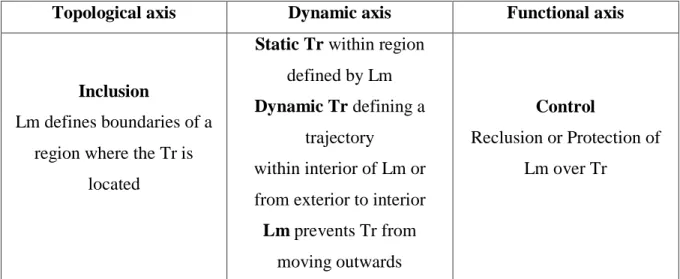
(17) 2.4.. A model for the polysemy of in, on, at. To finish with this section, an outline of Navarro i Ferrando’s (1998; 2006) models for the multimodal semantic structure of the prepositions in, on, at is presented below.. 2.4.1. In: proto-concept of CONTAINMENT The conceptual schema instantiated by in can be defined by the term CONTAINMENT (Table 1). Human experience with this type of schema determines that it is composed of the following elements. According to the force-dynamic configuration, the Tr may be either static within the interior region defined by the Lm, or dynamic, moving within the interior or from the exterior to the interior of the Lm. In any case, the Lm prevents the Tr from moving outside. Regarding the topological configuration, the Lm defines an interior space where the Tr, being smaller, is located. The functional dimension defines the relationship of control of the Lm over the Tr as one of reclusion or protection.. Topological axis. Dynamic axis. Functional axis. Static Tr within region defined by Lm. Inclusion Lm defines boundaries of a region where the Tr is located. Dynamic Tr defining a. Control. trajectory. Reclusion or Protection of. within interior of Lm or. Lm over Tr. from exterior to interior Lm prevents Tr from moving outwards. Table 1. Summary of the topological, dynamic and functional elements conjured by the proto-concept of CONTAINMENT (in). As mentioned in Section 2.2., the semantic structure of prepositions can be represented as a conceptual schema with the shape of a radial network (Figure 1). In the radial network for in, the central element corresponds to the proto-concept of ENCLOSURE, renamed CONTAINMENT (Navarro i Ferrando, 2006). This is also the primigenial sense, as it is 11.
(18) considered to be the first usage learnt by children. The senses surrounding the central meaning, i.e. peripheral senses, are assumed to have been acquired later, and emerge through meaning extensions from the central meaning. These extensions are first generated through image-schema transformations, and then by means of mechanisms such as “blending spaces, semantic bleaching, or double highlighting” for further specialisations (1998, p. 145). Each prepositional usage gives salience to particular perceptual aspects, which give rise to the conceptual regions where the different senses extend, namely topological, force-dynamic and functional. These regions do not present clear-cut borders, but rather form a continuum where the distance between the different senses reflects the extent to which they are related.. Figure 1. Radial category for in (Navarro i Ferrando, 1998, p. 266). 2.4.2. On: proto-concept of SUPPORT The conceptual schema of on can be defined by the term SUPPORT (Table 2). The configuration defined by human experience with this schema can be described as including the following elements. On the one hand, the force-dynamic dimension determines that the resting side of the Tr and its orientation towards the Lm define the motion axis. Prototypically, this corresponds to the vertical axis with respect to the human canonical standing position, so the Tr exerts force downwards; however, the vertical axis may rotate 12.
(19) in situations where the position of Tr’s resting side does not coincide with the human one. According to topological configuration, the relationship between the Tr and the Lm is one of contact, involving the outside part of the Lm and the resting part of the Tr. Last, in relation to the functional dimension, the Tr holds control of the situation. It may be prototypically self-control, or motion control, which may be extended to the Lm.. Topological axis. Dynamic axis. Functional axis. Orientation Tr’s resting side towards Lm Contact. Motion. Control. Outside part of Lm-resting. Perpendicular to the ground. Self-control or motion. side of Tr. Direction. control of Tr over Lm. Vertical (Tr exerts force downwards) Table 2. Summary of the topological, dynamic and functional elements conjured by the proto-concept of SUPPORT (on). In the radial network representing the semantic structure of on (Figure 2), the proto-concept of SUPPORT, which is also considered to be the first usage acquired by children, is situated at the centre of the net. The peripheral senses are situated around the central meaning. This situation indicates both that native speakers learn them later, and that they emerge from the central meaning through meaning extensions. At the first level of specialisation, these extensions are first generated through image-schema transformations highlighting one of the perceptual aspects (topological, force-dynamic, or functional). Further specialisations take place by means of mechanisms such as “blending spaces, semantic bleaching, or double highlighting” (1998, p. 145). Thus, peripheral meanings expand across the conceptual regions emerging from the highlighted perceptual aspects. The different conceptual regions are not fully separated, as the boundaries between them are merged. The relation between senses belonging to different conceptual regions is measured in terms of the distance separating them.. 13.
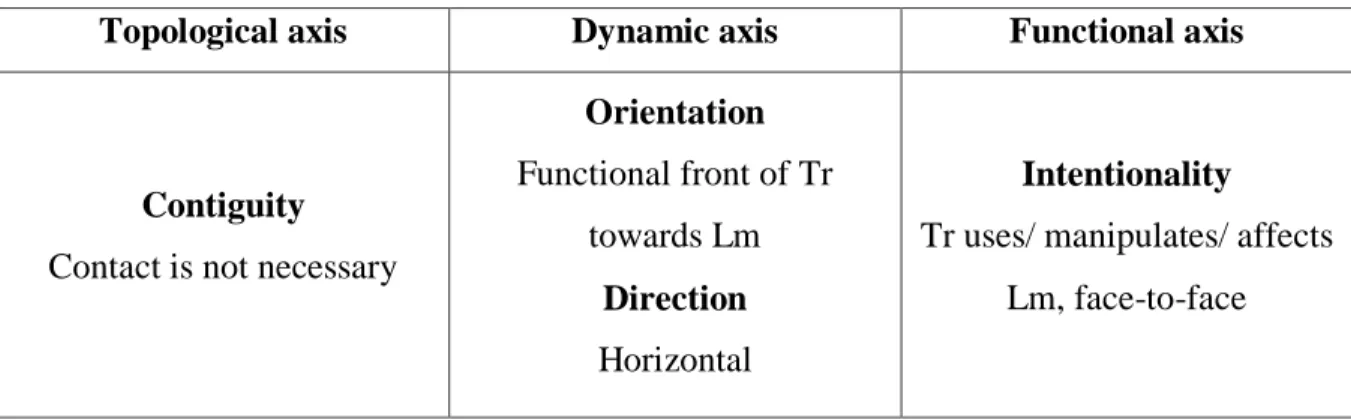
(20) Figure 2. Radial category for on (Navarro i Ferrando, 1998, p. 219). 2.4.3. At: proto-concept of ENCOUNTER The conceptual schema for at can be defined by the term ENCOUNTER (Table 3). Based on human bodily experience with this schema, at conjures the following elements. According to the force-dynamic configuration, the motion axis is defined by the functional front of the Tr and its orientation towards the Lm. The human canonical standing position determines that this axis is prototypically horizontal. As regards the topological configuration, the relationship between the Tr and the Lm is of contiguity, which does not necessarily imply contact. Finally, in relation to the functional dimension, there is certain intentionality of the Tr with respect to the Lm in order to use, manipulate, or affect it.. 14.
(21) Topological axis. Dynamic axis. Functional axis. Orientation Contiguity Contact is not necessary. Functional front of Tr. Intentionality. towards Lm. Tr uses/ manipulates/ affects. Direction. Lm, face-to-face. Horizontal Table 3. Summary of the topological, dynamic and functional elements conjured by the proto-concept of ENCOUNTER (at). Figure 3. Radial category for at (Navarro i Ferrando, 1998, p. 174). 15.
(22) The polysemic structure of the preposition at is represented in the radial category corresponding to Figure 3. The primigenial sense, which is the first meaning that children learn, is situated at the centre of the network. Around the central sense, the peripheral meanings, acquired in later stages, extend through the topological, force-dynamic and functional regions. The peripheral senses corresponding to the first level of specialisation are generated by highlighting one of the perceptual aspects that give rise to the conceptual regions. Other mechanisms, such as blending spaces, semantic bleaching and double highlighting give rise to further specialisations. The conceptual regions across which the different specialised meanings do not present clear-cut borders, so the extension from one sense to another is gradual. Accordingly, the extent to which senses situated in different regions are related to each other is represented by the distance that separates them.. 2.5.. The time metaphor. Apart from the spatial sense, one of the first and most common usages of prepositions among Secondary School students is the temporal one. Accordingly, it seems appropriate to devote the present section to describe the ways in which this sense is generated. In order to do this, a summary of Navarro i Ferrando’s (1998) account of the temporal uses of the prepositions in, on, at is provided as follows. The time metaphor allows for the understanding of time in terms of physical space. In Western culture, time is usually represented by means of a metaphor as a path in which the future is ahead. This allows for two options: to remain statically or to move along the path. In the first case, standing still implies either facing other things coming, or having our back turned against them. In the second case, we move either facing our way, or backwards; in the case of Western culture, we move forward to meet the future. The preposition at illustrates only the stative sense of the path metaphor. The coincidence sense of at is used to express periods of time that are understood as extensions with which another entity coincides. Therefore, at is generally used with very short periods or moments in time, since these ease the conceptualisation of complete coincidence. However, the relation of the Tr with the period of time is not only of coincidence, but also of use, as the time referred to is used for a purpose. The coincidence sense, thus, generates expressions that indicate periods of time like parts of the day (at night, at dawn, at dusk, at noon, at midnight, at day time…) or other periods like 16.
(23) at present, at times, at---time, at Christmas, or period, date, interval moment, turn, etc. The time referred to might coincide with the present moment, what explains idioms like at present or at the moment. At is also used with lexical items with the meaning of events/ periods that refer to the time of the event/period (e.g. at birth, at death, at maturity, at infancy). A further metaphorical extension implies the use of expressions that indicate parts of periods of time. In these cases, the time designated is part of a larger period that may be expressed by nouns indicating a time period. These nouns equal the duration of the period (start, outset, onset, conclusion, commencement…). This sense also explains collocations like at+stage, at + phase. The preposition on exploits both the stative and the dynamic senses of the path metaphor. When using on, the Tr holds a contact relation with the period of time, which may last as long as that period does. However, the dynamic aspect can also express that the Tr is in contact with successive parts of the period. In this way, on allows for the choice of locating the event at any point of the period referred to. According to all this, on takes: dates, the days of the week, nouns referring to a day (anniversary, Christmas, Easter), periods of time, parts of the day, etc., as well as collocations of the type on+V-ing, in which the Tr may be located on the time path at several points. Furthermore, the meaning of on allows for contact of the Tr with the period of time (Lm), and particularly with the Lm’s outer limits. This fact helps to develop the meaning of expressions like on time, later on, from + [period of time] + on. The temporal sense of in expresses the coincidence of an entity with a time span that is included in a larger span. Therefore, the complements of in necessarily include at least three smaller periods: the period referred to with the Tr; a period before it; and another period after it. In landmarks are periods the conception of which imply the three subperiods mentioned above. These can be weeks, days, months, years, seasons, parts of the day, periods of human life (childhood), hours, minutes… and periods in general. Idiomatic expressions like in time, in due time, once in a while, in the meantime, in advance are also generated in this way. Last, a special usage of the time metaphor takes into account only two of the three possible periods included in the Lm. On these occasions, the period occupied by the Tr coincides with the end of the period denoted by the Lm (e.g. You were back in ten minutes).. 17.
(24) 3. METHODOLOGY In order to test the initial hypothesis, namely that a group following the CL methodology will show greater improvement in their command of the prepositions in, on, at than another group learning them by means of a traditional collocational approach, an experiment has been designed in which both approaches are compared. Two 4ESO groups participated in the experiment: 4ESO BK (control group) and 4ESO ACL (experimental group). The students in the two classrooms were asked to take a test before and after receiving instruction on the target prepositions, based on the two distinct approaches. The effectiveness of the two approaches has been assessed through a comparison between the results obtained by the students in the pre-test and in the post-test. In the present section, an account of the research process followed in this study is provided.. 3.1.. Objectives. The present study primarily attempts to examine whether the CL method based on a theoretical model developed by Navarro i Ferrando (1998) is more effective in teaching the prepositions in, on, at than a traditional approach based on collocations. For this purpose, the hypothesis that a group of students taught by means of a CL methodology will show greater improvement in their command of the target prepositions than another group taught following a collocational approach has been tested by means of an experiment.. 3.2.. Participants. During my Practicum, and in consonance with my supervisor’s schedule, I have taught English to two 1ESO, two 2ESO and two 4ESO classrooms. However, not only the topic to be dealt with (i.e., prepositions), but also the theoretical reasoning involved in the explanatory sessions, required a certain command of the language as well as familiarity with abstract thought. For this reason, only the 4ESO groups participated in the experiment, since they were both assumed to have reached an intermediate English level and to be able to employ abstract thought. Thus, the participants in the experiment comprised students belonging to the 4ESO KB and 4ESO ACL groups. The average student profile in both classrooms is that of a 16 to 18 year old individual who can speak Spanish and Catalan, apart from English and, in some cases, 18.
(25) other native languages. However, a number of differences can be observed between the two classroom contexts. Regarding 4ESO KB, it is a group of 27 students, with a percentage of 44% male and 56% female members. 30% of the classroom is of foreign origin, including Romanian, Venezuelan, Algerian and Chinese nationalities. In this classroom, students from two different groups, B and K, have been put together in the English subject, and their overall language command is higher than the one in 4ESO ACL. In fact, most of the students in this classroom were part of high-performance English groups in previous academic years. In terms of motivation, the classroom shows a positive attitude towards learning, and most of them are planning on continuing their studies (Bachiller and University) in the following years. In relation to 4ESO ACL, it is composed of 16 students, 50% male and 50% female, 44% of whom are foreigners coming from Romania, Venezuela, Algeria and Slovakia. Most of these students were part of low-performance English groups, and their overall language command is lower than the one in group 4ESO KB. In general, their motivation towards learning, and particularly towards learning English, is also lower than in the other group. This may be due in part to the fact that the members from the C group are expected to end their studies or take vocational training as soon as they can, so they feel that they will not need English in the future. Taking into account these characteristics, a fair comparison between the two classroom contexts seemed difficult to achieve. Therefore, in order to compensate for the differences in level and motivation, the experimental methodology was used in the less advantaged group, 4ESO ACL, whereas 4ESO BK became the control group. Thus, it was hypothesised in the present study that 4ESO ACL would show greater improvement on their knowledge of the prepositions in, on, at after receiving instruction in the experimental methodology. On the contrary, 4ESO BK, the control group, would show a lower degree of improvement after being taught the target prepositions following a collocational approach.. 3.3.. Materials. Two types of materials were used in this study. On the one hand, the teaching materials used as support for the theoretical classes; on the other hand, the pre-tests and post-tests, or questionnaires, used at the beginning and at the end of the research process. 19.
(26) 3.3.1. Questionnaires Two questionnaire models were created for this experiment, namely A (Appendix 1 and Appendix 3) and B (Appendix 2 and Appendix 4). These were handed in to students in a way that allowed for no individual sitting next to another to have the same model. Both models were used as pre-test and post-test, so students who had used one model as pre-test used the other one as post-test. The handouts were three pages long, and were printed double-sided in black and white. At the top of each handout, a table was placed in which students had to write their name, the group they belonged to and the date. Next to this, a letter indicated whether the handout corresponded to model A or model B. As regards content, the questionnaires were carefully designed to be equal in terms of difficulty. Since spatial and temporal meanings of prepositions are usually taught together, the lessons and questionnaires used in this experiment included both usages, so as to avoid disrupting this notion. However, the main focus of this study concerned the acquisition of spatial meanings, so the temporal usages were ignored when assessing the results. Taking all this into account, each handout consisted of four tasks related to the usages of the prepositions in, on, at: . Task 1 was a sentence-generation exercise in which students were asked to write three sentences expressing spatial meanings and three sentences expressing temporal meanings of the target prepositions. This task was designed as a warm-up for learners to start thinking about the contexts in which they know the target prepositions are used. For that reason, it was placed in the first page, so as to prevent learners from being influenced by the prepositional contexts displayed in the rest of exercises.. . Task 2 was a fill-in-the-gap activity that required the students to choose the most correct preposition to complete a set of 30 sentences. Sixteen of these exploited the temporal senses and fourteen the spatial senses of the target prepositions. The sentences were all extracted from Units 121 to 125 in Murphy’s English Grammar in Use (2012, pp. 242-252), which are devoted to the prepositions in, on, at. This was made to ensure the appropriateness of the exercise to the students’ English level, which at the 4ESO stage is assumed to be intermediate.. . Task 3 was also a fill-in-the-gap activity, but on this occasion the sentences lacked both the preposition and its complement. The complements to be used in the different gaps were scrambled on a table, and students had to select the most suitable one for 20.
(27) each sentence. Following the rationale behind Task 2, the six sentences used in this exercise were also extracted from Murphy’s (2012) units devoted to prepositions, and included a proportion of two temporal and four spatial usages. . Task 4 consisted of 3 sub-sections aimed at making students reflect upon the answers they had emitted in the previous exercises, and the mechanisms they had used to select them. The first question enquired into whether students used any rules in their choice of prepositions. The second question considered other mechanisms by which students would choose a preposition over the others. In the following question, learners were asked about the difficulty of the exercises and prepositions they had been dealing with. Apart from these, an additional question asking students whether they considered useful what they had learnt was included in the post-test. Finally, a section where students could add any comments if they wanted was placed at the end of the questionnaires.. In relation to the main research question posed in this study, the assessment of the results has only taken into account the data collected from Task 2 and Task 3 in the questionnaires. However, the information gathered from the first and last question has been useful when weighing the results obtained in the experiment.. 3.3.2. Teaching materials The design of the theoretical and practical materials used in the two explanatory lessons in this study followed a similar structure in the two groups where these were implemented. Thus, for the theoretical explanations, four Powerpoint presentations were prepared and projected on a screen by means of a computer and a projector. Two of them were devoted to the spatial and temporal meanings of the target prepositions from a CL perspective, and the other two from a collocational one. It must be pointed out here that the decision to include the temporal meaning of the prepositions in, on, at was taken so as to comply with the way in which it is usually taught, that is, together with the spatial senses. Despite this, only the usages related to the latter were considered in the assessment of the experiment’s results. With respect to the control group, 4ESO BK, the target prepositions were taught from a collocational perspective. For this, and following Song’s (2013) example of a traditional approach, the different collocational contexts in which the prepositions can be used appeared 21.
(28) in the Powerpoints arranged in terms of a definition elicited by the particular utterances shown on screen. In other words, collocations such as the ones appearing in the sentences “The kids are playing in the street” or “I read about the event in the newspaper” were presented as examples of in meaning “at a point within an area or surface”. The arrangement of prepositional contexts in terms of meaning was made in order to make it easier for students to memorise the different collocations with which the target prepositions can be used. This procedure was used both for the spatial and the temporal meanings of in, on, at. Apart from this, an introduction to the concept of preposition was used at the beginning of the first lesson (Appendix 5), and a review of the spatial usages preceded the teaching of the temporal ones in the second session (Appendix 6). Concerning the experimental group, 4ESO ACL, the Powerpoint (Appendix 7) used in the first lesson began with an introduction to CL and the main concepts that students needed to understand in this approach. Thus, definitions of trajector, landmark and image schema, as well as an explanation of the topological, dynamic and functional meaning dimensions in prepositions were provided. After this, students were presented a simplified version of the proto-concepts developed by Navarro i Ferrando (1998) to explain the meanings of in, on, at. In the second session (Appendix 8), all these notions were revised, and the main ideas to be kept about the proto-concepts for the target prepositions were highlighted. Then, students were introduced to the time metaphor, which was considered necessary for the understanding of the temporal meanings of prepositions from a CL perspective. After this, the temporal usages of in, on, at were explained following Navarro i Ferrando’s (1998) descriptions of the same prepositions. However, slides summarising the temporal contexts in which these prepositions are used were also included. This is due to the difficulty involved in explaining the temporal usages of these prepositions from a CL approach, since in many cases these are assumed to be collocational. Furthermore, it was considered that this decision would not affect the results of the experiment, since the temporal uses would not be taken into account in the analysis. The theoretical explanations described above included some interactive examples to ensure the understanding of the points being referred to in the control and the experimental group. In addition, these were followed in both cases by the same series of practical exercises, aimed at allowing students to implement what they had just learnt. These exercises were taken from Song (2013), where the author also compares a CL with a traditional approach to teaching the prepositions in, on, at. In the case of the spatial usages, the activities included a fill-in22.
(29) the-gap and a multiple choice exercise (Appendix 9). For the temporal meanings, a multiple choice activity and a matching exercise were included (Appendix 10).. 3.4.. Procedure. In the present study, an experiment has been designed in order to test the effectiveness of two different teaching methodologies for prepositions: a CL-based approach, and a traditional collocational approach. This experiment has been carried out as follows: In the first session, students from 4ESO BK (control group) and 4ESO ACL (experimental group) were asked to fill in a questionnaire as a pre-test (see Appendix 1 and Appendix 2). Two versions of the questionnaire, namely A and B, were distributed around the classrooms so that no students sitting contiguously had the same model, in order to avoid cheating. Although the test was designed to last over 30 minutes, students were given the whole session (55 minutes) to complete their handout. First of all, the students were told that this test would not have any influence on their English mark, so they did not need to worry about the result or about their grammar. After this, the instructions were read aloud and learners were encouraged to ask for any doubt or unknown vocabulary they found. All these measures were taken so as to make sure that students would focus on the main point of the experiment: the use of the prepositions in, on, at. After the pre-test and before the post-test, two 55-minute sessions were devoted to teaching the prepositions in, on, at in both 4ESO classrooms. In these, two different methodologies were used: a CL approach in the experimental group (4ESO ACL), and a traditional approach in the control group (4ESO BK). In order to ensure the same learning opportunities, both methodologies were applied under similar conditions. The second session took place three days after the first session in 4ESO BK and a day later in 4ESO ACL. This lesson was devoted to introducing prepositions, which was subsequently followed by instruction on the spatial usages of in, on, at (see Appendix 5 and Appendix 7). Once the explanation was finished, the students in both classrooms were given the same exercises to be done in groups (see Appendix 9). The third session was implemented a day later, following the same structure as the previous one. Its first part was devoted to reviewing the spatial usages of the target prepositions learnt in the previous session, and to teaching the temporal ones (see Appendix 6 and Appendix 8). After this, some exercises were used to apply the theory just learnt (see Appendix 10). 23.
(30) As mentioned above, the theoretical explanations included both the temporal and spatial usages of the target prepositions, with the purpose of being consistent with the way in which in, on, at are usually taught. Nevertheless, the temporal usages were ignored in the assessment of the experiment’s results, as these go beyond the scope of this study. The day after the fourth session, once classes were finished, all the participants received an e-mail sent by their English teacher (my supervisor). This e-mail contained the Powerpoint presentations and practical exercises used in the explanatory lessons. Students were asked to revise these materials for the next session, although they were not told that they were going to do the experiment’s post-test, scheduled for the following day. In the post-test session, the handouts were the same as in the pre-test, but students who had previously taken model A, now received model B, and vice-versa. As in the first phase of the experiment, the students were given a 55-minute session to complete the test, and were provided with all the means and information necessary for them to exclusively focus on the target prepositions. The only difference between the pre-test and the post-test was an additional question included in the latter, which enquired about the perceived usefulness of what students had learnt (see Appendix 3 and Appendix 4). In order to test the main hypothesis in this study, a comparison was made between the achievements obtained by students in both groups in the initial and final questionnaires. However, as some members from the two groups had missed either the pre-test or the posttest, the number of valid samples was lower than the number of people in each classroom. Thus, in 4ESO BK –the control group- the final amount was 21, while in 4ESO ACL –the experimental group- only 11 samples were valid.. 24.
(31) 4. RESULTS The results of the experiment are presented in the tables and graphics below. These figures have been created in order to compare two dimensions of the data collected in the study. One dimension is the number and quality of learners’ answers in the pre-test and post-test; the other, the students’ overall performance in the initial and final questionnaires. On the one hand, in Table 4 (control group) and Table 5 (experimental group) the number of correct (✓), incorrect (X) and blank (Ø) answers provided to Task 2 are displayed in two columns. The left column shows the answers corresponding to the pre-test, while the ones relating to the post-test are situated on the right. Each of the table’s rows represents the answers provided by a student from the control or the experimental group, as it is indicated in the first column. At the bottom of the tables, the Total amount of correct, incorrect and blank answers summed up in each classroom is pointed out. Below these quantities, the numbers labelled as Maximum correspond to the sum of all the Task 2 items from all questionnaires in the two groups. Since the control group (4ESO BK) consists of 20 students, and Task 2 contains 14 items in every questionnaire, the total number of Task 2 items from all the questionnaires in 4ESO BK is 280. In contrast, only 11 samples have been collected from the experimental group (4ESO ACL), so the total amount of Task 2 items in the latter is 154. These quantities also correspond to the highest possible number of correct, incorrect or blank answers attainable by the sum of all the members in both groups, respectively. Table 6 and Table 7 follow the same rationale as the previous ones, but the results referred to on this occasion are related to Task 3. Again, the responses obtained from the students in the two groups are classified into correct, incorrect or blank. Taking into account that Task 3 contains only 4 items, the maximum possible number of correct, incorrect or blank answers attainable by the control group (4ESO BK) is 80, whereas in the experimental group (4ESO ACL) it is 44.. 25.
(32) Control group 4ESOBK. Task 2. Pre-test Post-test X Ø X Ø ✓ ✓ S1 7 5 2 7 7 0 S2 5 7 2 4 10 0 S3 6 8 0 10 4 0 S4 9 5 0 4 10 0 S5 7 7 0 8 6 0 S6 7 6 1 9 5 0 S7 9 5 0 7 7 0 S8 9 5 0 7 7 0 S9 7 7 0 9 5 0 S10 8 6 0 8 6 0 S11 5 9 0 8 6 0 S12 5 8 1 6 8 0 S13 6 8 0 6 8 0 S14 9 5 0 2 12 0 S15 7 7 0 7 7 0 S16 4 10 0 5 9 0 S17 7 7 0 7 7 0 S18 5 9 0 7 7 0 S19 5 9 0 6 8 0 S20 7 7 0 6 8 0 Total 134 140 6 133 147 0 Maximum 280 280 Table 4. Number of correct, incorrect and blank answers to Task 2 in the pre-test and the post-test (control group). Experimental group 4ESO ACL. Task 2. Pre-test Post-test X Ø Ø ✓ ✓ ✓ S1 6 8 0 6 8 0 S2 8 6 0 2 12 0 S3 3 11 0 5 9 0 S4 6 7 1 7 6 1 S5 9 5 0 5 9 0 S6 5 8 1 5 9 0 S7 4 10 0 10 4 0 S8 8 6 0 6 8 0 S9 7 7 0 6 8 0 S10 4 10 0 5 9 0 S11 5 9 0 6 8 0 Total 65 87 2 63 90 1 Maximum 154 154 Table 5. Number of correct, incorrect and blank answers to Task 2 in the pre-test and the post-test (experimental group) 26.
(33) Control group 4ESOBK. Task 3. Pre-test Post-test X Ø X Ø ✓ ✓ S1 1 3 0 1 3 0 S2 1 3 0 1 3 0 S3 2 2 0 3 1 0 S4 2 2 0 2 2 0 S5 2 2 0 0 4 0 S6 2 2 0 1 3 0 S7 2 2 0 0 4 0 S8 1 3 0 1 3 0 S9 2 2 0 1 3 0 S10 2 2 0 2 2 0 S11 0 4 0 3 1 0 S12 2 2 0 1 3 0 S13 1 3 0 2 2 0 S14 2 2 0 2 2 0 S15 1 3 0 1 3 0 S16 3 1 0 0 4 0 S17 0 1 3 1 3 0 S18 0 4 0 4 0 0 S19 3 1 0 2 2 0 S20 0 4 0 1 3 0 Total 29 48 3 29 51 0 Maximum 80 80 Table 6. Number of correct, incorrect and blank answers to Task 3 in the pre-test and the post-test (control group). Experimental group 4ESO ACL. Task 3. Pre-test Post-test X Ø Ø X Ø ✓ S1 1 3 0 1 3 0 S2 1 3 0 2 2 0 S3 0 4 0 2 2 0 S4 2 1 1 1 3 0 S5 1 3 0 2 2 0 S6 2 2 0 0 4 0 S7 2 2 0 3 1 0 S8 0 0 4 0 0 4 S9 2 2 0 1 3 0 S10 0 0 4 3 1 0 S11 1 3 0 1 3 0 Total 12 23 9 16 24 4 Maximum 44 44 Table 7. Number of correct, incorrect and blank answers to Task 3 in the pre-test and the post-test (experimental group) 27.
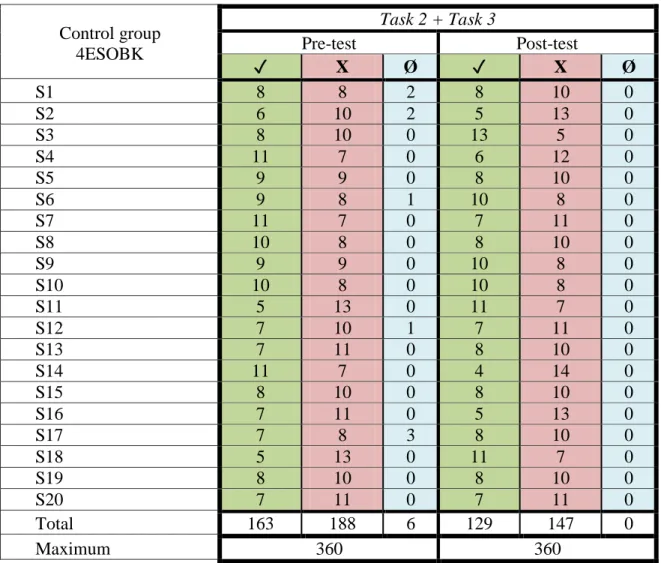
(34) The data gathered from Task 2 and Task 3 in 4ESO BK (control group) and in 4ESO ACL (experimental group) are considered together in Table 8 and Table 9. These tables allow for an integral overview of the results achieved in the pre-test and the post-test in the control and experimental groups. In these, the number of correct, incorrect and blank answers to Task 2 + Task 3 in the pre-test and the post-test have been summed up both at an individual level (each row) as well as at the level of the classroom as a whole (Total). Again, the tables’ last rows (Maximum) indicate the total number of items from Task 2 and Task 3 from all questionnaires in the two groups. As in the tables above, this quantity corresponds to the highest possible amount of correct, incorrect or blank answers that can be scored by the whole classrooms according to the number of students they have.. Control group 4ESOBK. Task 2 + Task 3. Pre-test Post-test X Ø X Ø ✓ ✓ S1 8 8 2 8 10 0 S2 6 10 2 5 13 0 S3 8 10 0 13 5 0 S4 11 7 0 6 12 0 S5 9 9 0 8 10 0 S6 9 8 1 10 8 0 S7 11 7 0 7 11 0 S8 10 8 0 8 10 0 S9 9 9 0 10 8 0 S10 10 8 0 10 8 0 S11 5 13 0 11 7 0 S12 7 10 1 7 11 0 S13 7 11 0 8 10 0 S14 11 7 0 4 14 0 S15 8 10 0 8 10 0 S16 7 11 0 5 13 0 S17 7 8 3 8 10 0 S18 5 13 0 11 7 0 S19 8 10 0 8 10 0 S20 7 11 0 7 11 0 Total 163 188 6 129 147 0 Maximum 360 360 Table 8. Number of correct, incorrect and blank answers to Task 2 + Task 3 in the pre-test and the post-test (control group). 28.
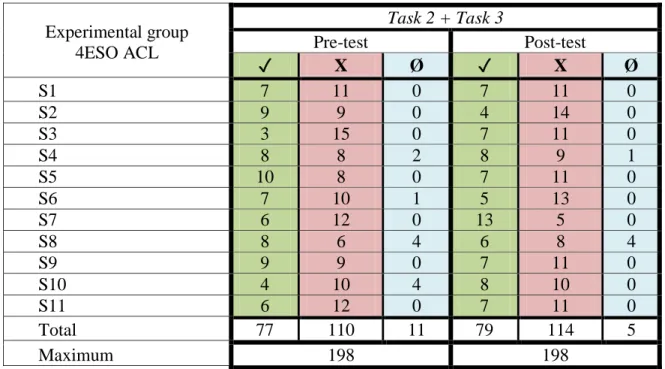
(35) Experimental group 4ESO ACL. Task 2 + Task 3. Pre-test Post-test X Ø X Ø ✓ ✓ S1 7 11 0 7 11 0 S2 9 9 0 4 14 0 S3 3 15 0 7 11 0 S4 8 8 2 8 9 1 S5 10 8 0 7 11 0 S6 7 10 1 5 13 0 S7 6 12 0 13 5 0 S8 8 6 4 6 8 4 S9 9 9 0 7 11 0 S10 4 10 4 8 10 0 S11 6 12 0 7 11 0 Total 77 110 11 79 114 5 Maximum 198 198 Table 9. Number of correct, incorrect and blank answers to Task 2 + Task 3 in the pre-test and the post-test (experimental group). In order to facilitate the comparison between the results from the pre-test and the post-test in the two groups, the quantities displayed on Table 4 to Table 6 are transformed into percentages in Table 10 and Table 11. Thus, the number of correct, incorrect and blank answers to Task 2, Task 3, and to the combination of both tasks (Task 2 + Task 3), has been divided by their respective number of maximum possible answers. In the last row in Table 10 and Table 11, the difference between the percentages corresponding to the pre-test and the post-test (Variation) are illustrated. A negative Variation indicates that the number of items corresponding to an answer type (for instance, correct answers) in the post-test is lower than the number of the same answer type in the pretest, and vice-versa.. 29.
(36) Task 2 Task 3 Task 2 + Task 3 Control group 4ESO BK X Ø X Ø X Ø ✓ ✓ ✓ Pre-test 47.9 % 50% 2.1% 36.25% 60 % 3.75% 45.3% 52.2% 2.5% Post-test 47.5 % 52.5% 0% 36.25% 63.75% 0% 45% 55% 0% Variation -0.4 +2.5% -2.1 % 0% +3.75% -3.75% -0.2% +2.8% -2.5% Table 10. Percentages of correct, incorrect and blank answers to Task 2, Task 3, and Task 2 + Task 3 in the pre-test and the post-test, and their variation between the two tests (control group). Experimental Task 2 Task 3 Task 2 + Task 3 group X Ø X Ø X Ø ✓ ✓ ✓ 4ESO ACL Pre-test 42.2% 56.5% 1.3% 27.3% 52.3% 20.4% 38.9% 55.6% 5.5% Post-test 40.9% 58.4% 0.7% 36.4% 54.5% 9.1% 39.9% 57.5% 2.6% Variation -1.3% +1.9% -0.6 % +9.1% +2.2% -11.3% +1% +1.9% -2.9% Table 11. Percentages of correct, incorrect and blank answers to Task 2, Task 3, and Task 2 + Task 3 in the pre-test and the post-test, and their variation between the two tests (experimental group). 30.
(37) On the other hand, a comparison has also been made in relation to the number of students in each classroom who have achieved the same, better or worse results in the pre-test and the post-test. These are illustrated in the graphics that follow.. 4ESO BK TASK 2 Equal (4). Worse (7). Better (9). 20%. 45%. 35%. Figure 4. Number and percentage of students who have improved, worsened or obtained equal results in Task 2 between the pre-test and the post-test (control group). 4ESO ACL TASK 2 Equal (1). Worse (5). Better (5). 9.10%. 45.45%. 45.45%. Figure 5. Number and percentage of students who have improved, worsened or obtained equal results in Task 2 between the pre-test and the post-test (experimental group) 31.
(38) Figure 4 and Figure 5 represent the difference between students’ performance in Task 2 in the pre-test and the post-test. In the graphics, the proportion of students who have achieved the same, worse or better results is represented as a number and as a percentage.. 4ESO BK TASK 3 Equal (7). Worse (7). Better (6). 30 % 35%. 35 %. Figure 6. Number and percentage of students who have improved, worsened or obtained equal results in Task 3 between the pre-test and the post-test (control group). 4ESO ACL TASK 3 Equal (3). Worse (3). Better (5). 27.27%. 45.45%. 27.27%. Figure 7. Number and percentage of students who have improved, worsened or obtained equal results in Task 3 between the pre-test and the post-test (experimental group) 32.
(39) The data gathered in relation to the students’ performance in Task 3 are represented in Figure 6 and Figure 7. As in the previous graphics, the number of students belonging to the control group (4ESO BK) is bigger than the number in the experimental group (4ESO ACL), because more samples have been obtained from the former than from the latter. Last, in Figure 8 and Figure 9 the students’ performance in tasks 2 and 3 are gathered together. Thus, Figure 8 represents the proportion of students in the control group (4ESO BK) who have achieved equal, worse or better results in the questionnaires as a whole, whereas Figure 9 makes reference to the same information as corresponding to the experimental group (4ESO ACL).. 4ESO BK TASK 2 + TASK 3 Equal (5). Worse (8). Better (7). 25% 35%. 40%. Figure 8. Number and percentage of students who have improved, worsened or obtained equal results in Task 2 + Task 3 between the pre-test and the post-test (control group). 33.
(40) 4ESO ACL TASK 2 + TASK 3 Equal (1). Worse (6). Better (4). 9.1%. 36.4%. 54.5%. Figure 9. Number and percentage of students who have improved, worsened or obtained equal results in Task 2 + Task 3 between the pre-test and the post-test (experimental group). 34.
Figure


+7




Documento similar
Keywords: Metal mining conflicts, political ecology, politics of scale, environmental justice movement, social multi-criteria evaluation, consultations, Latin
Even though the 1920s offered new employment opportunities in industries previously closed to women, often the women who took these jobs found themselves exploited.. No matter
The expression ((having become common since the spring)) -the French original reads ((etant devenues populaires des le printems»- refers to the spring of 1708 and is
On the other hand, the interaction of students with human teachers providing hints led to a significant difference in learning gain between the post-test and the pre-test according
Government policy varies between nations and this guidance sets out the need for balanced decision-making about ways of working, and the ongoing safety considerations
No obstante, como esta enfermedad afecta a cada persona de manera diferente, no todas las opciones de cuidado y tratamiento pueden ser apropiadas para cada individuo.. La forma
The expansionary monetary policy measures have had a negative impact on net interest margins both via the reduction in interest rates and –less powerfully- the flattening of the
Jointly estimate this entry game with several outcome equations (fees/rates, credit limits) for bank accounts, credit cards and lines of credit. Use simulation methods to
