
Development of electrochemical devices for the determination of drugs of abuse
271
0
0
Texto completo
(2)
(3) UNIVERSIDAD DE BURGOS DEPARTAMENTO DE QUÍMICA. Memoria de investigación titulada “Development of electrochemical devices for the determination of drugs of abuse” presentada para optar al Grado de Doctora en la Universidad de Burgos.. Fdo.: Laura Asturias Arribas.
(4)
(5) UNIVERSIDAD DE BURGOS DEPARTAMENTO DE QUÍMICA. Dña. M. Julia Arcos Martínez, Catedrática de Universidad del Departamento de Química de la Universidad de Burgos, y Dña. M. Asunción Alonso Lomillo, Profesora Titular del Departamento de Química de la Universidad de Burgos,. INFORMAN. FAVORABLEMENTE. sobre la presente Tesis Doctoral,. titulada “Development of electrochemical devices for the determination of drugs of abuse”, realizada en el Área de Química Analítica del Departamento de Química de la Universidad de Burgos por Dña. Laura Asturias Arribas. Y para que así conste, firman el presente informe en Burgos, a 24 de abril de 2014.. Fdo.: M. Julia Arcos Martínez. Fdo.: M. Asunción Alonso Lomillo.
(6)
(7) A mis padres y mi hermano..
(8)
(9) Me gustaría expresar en estas líneas mi agradecimiento a todas aquellas personas e instituciones que, de una forma u otra, han estado presentes en el proceso y realización de este trabajo de doctorado. En primer lugar me gustaría agradecer a mis directoras de tesis, M. Julia Arcos Martínez y M. Asunción Alonso Lomillo, por acercarme la electroquímica y dirigirme en este trabajo, además de su apoyo y ánimo a experimentar sobre las inquietudes que surgían en el camino en el desarrollo de este trabajo. Al profesor Jean-Michel Kauffmann, por haberme brindado la posibilidad de trabajar en su grupo de investigación y aportarme diferentes y nuevas visiones sobre los biosensores y las técnicas usadas. Al grupo del profesor Juan Ramón Castillo Suárez de la universidad de Zaragoza, por acercarme al mundo de los immunosensores. A mis compañeros y profesores del área de Química Analítica, por los debates constructivos y el intercambio de ideas. A mis padres, familiares y amigos, por todo su apoyo, consideración y cariño. Y por último, agradecer al ministerio de Educación, Cultura y Deporte por la financiación obtenida a través de una beca FPU. Gracias..
(10)
(11) DEVELOPMENT OF ELECTROCHEMICAL DEVICES FOR THE DETERMINATION OF DRUGS OF ABUSE Laura Asturias Arribas.
(12)
(13) INDEX.
(14)
(15) INDEX. ABBREVIATIONS .................................................................................................................7 CHAPTER 1: INTRODUCTION ........................................................................................11 CHAPTER 2: AIMS .............................................................................................................17 CHAPTER 3: GENERAL THEORETICAL FOUNDATIONS .......................................21 3.1.- DRUGS OF ABUSE ....................................................................................................... 23 3.1.1.- Cocaine ...............................................................................................................23 3.1.2.- Codeine ...............................................................................................................26 3.1.3.- Analytical determinations of cocaine and codeine..............................................29 3.2.- MINIATURISED AND DISPOSABLE SENSORS ............................................................... 35 3.2.1.- SPEs manufacture ...............................................................................................37 3.2.2.- Modification with nanomaterials ........................................................................38 3.2.3.- Electrochemical biosensors .................................................................................40 3.3.- ENZYMATIC SYSTEMS ................................................................................................ 46 3.3.1.- Cytochrome P450................................................................................................46 3.3.2.- Acetylcholinesterase ...........................................................................................53 3.4.- REFERENCES .............................................................................................................. 60 CHAPTER. 4:. SENSITIVE. AND. SELECTIVE. COCAINE. ELECTROCHEMICAL DETECTION USING DISPOSABLE SENSORS..............75 4.1.- INTRODUCTION .......................................................................................................... 79 4.2.- EXPERIMENTAL.......................................................................................................... 80 4.2.1.- Reagents ..............................................................................................................80 4.2.2.- Apparatus ............................................................................................................81 4.3.- METHODS................................................................................................................... 81 4.3.1.- Home-made SPEs fabrication .............................................................................81 4.3.2.- Functionalisation of SPCEs with MWCNTs ......................................................82 4.3.3.- Electrochemical measurements ...........................................................................82 4.4.- RESULTS AND DISCUSSION ........................................................................................ 83 4.4.1.- Optimisation of the pH of the supporting electrolyte..........................................83 4.4.2.- Influence of the nature of the screen-printed working electrode in the voltammetric behaviour of cocaine ............................................................................84 4.4.3.- Influence of the solvent used in the dispersion of MWCNTs for the modification of SPCEs ...............................................................................................85 4.4.4.- Influence of the concentration of MWCNTs in the modification of SPCEs .......86 3 Laura Asturias Arribas.
(16) DEVELOPMENT OF ELECTROCHEMICAL DEVICES FOR THE DETERMINATION OF DRUGS OF ABUSE. 4.4.5.- Cocaine detection using SPCEs and MWCNTs-SPCEs by square-wave voltammetry ............................................................................................................... 89 4.5.- CONCLUSIONS .......................................................................................................... 103 4.6.- REFERENCES ............................................................................................................ 103 CHAPTER. 5:. CYP450. BIOSENSORS. BASED. ON. SCREEN-PRINTED. CARBON ELECTRODES FOR THE DETERMINATION OF COCAINE .......... 111 5.1.- INTRODUCTION ........................................................................................................ 115 5.2.-EXPERIMENTAL ......................................................................................................... 116 5.2.1.- Reagents ........................................................................................................... 116 5.2.2.- Apparatus ......................................................................................................... 118 5.3.- METHODS ................................................................................................................. 118 5.3.1.- SPEs preparation .............................................................................................. 118 5.3.2.- Functionalisation of SPCEs .............................................................................. 118 5.3.3.- Measuring procedure ........................................................................................ 127 5.3.4.- Real sample preparation ................................................................................... 128 5.4.- RESULTS AND DISCUSSION ....................................................................................... 128 5.4.1.- SPCEs characterisation..................................................................................... 128 5.4.2.- Optimisation of the influential variables on the chronoamperometric measures with the CYP450-biosensor ..................................................................... 130 5.4.3.- Biosensor validation ......................................................................................... 134 5.5.- CONCLUSIONS .......................................................................................................... 139 5.6.- REFERENCES ............................................................................................................ 140 CHAPTER 6: ELECTROCHEMICAL DETERMINATION OF COCAINE USING SCREEN-PRINTED CYP2B4 BASED BIOSENSORS ............................... 145 6.1.- INTRODUCTION ........................................................................................................ 149 6.2.- EXPERIMENTAL ........................................................................................................ 151 6.2.1.- Reagents ........................................................................................................... 151 6.2.2.- Apparatus ......................................................................................................... 152 6.3.- METHODS ................................................................................................................. 152 6.3.1.- CYP2B4 based SPCEs fabrication ................................................................... 152 6.3.2.- Measuring procedure ........................................................................................ 153 6.4.- RESULTS AND DISCUSSION ....................................................................................... 154 6.4.1.- Characterisation of the biosensor ..................................................................... 154 6.4.2.- Optimisation of the chronoamperometric variables ......................................... 156. 4 PhD Thesis.
(17) INDEX. 6.4.3.- Spectrophotometric study of CYP2B4 based biosensor ...................................158 6.4.4.- Biosensor validation..........................................................................................160 6.5.- CONCLUSIONS .......................................................................................................... 164 6.6.- REFERENCES ............................................................................................................ 165 CHAPTER 7: SCREEN-PRINTED BIOSENSOR BASED ON THE INHIBITION OF. THE. ACETYLCHOLINESTERASE. ACTIVITY. FOR. THE. DETERMINATION OF CODEINE ............................................................................169 7.1.- INTRODUCTION ........................................................................................................ 173 7.2.- EXPERIMENTAL........................................................................................................ 175 7.2.1.- Reagents ............................................................................................................175 7.2.2.- Apparatus ..........................................................................................................176 7.3.- METHODS................................................................................................................. 176 7.3.1.- Fabrication of SPCTTFEs ...................................................................................176 7.3.2.- Immobilisation of the enzyme AChE onto SPCTTFEs .......................................176 7.3.3.- Measuring procedure ........................................................................................178 7.4.- RESULTS AND DISCUSSION ...................................................................................... 178 7.4.1.- Electrochemical behaviour of codeine in SPCEs ..............................................178 7.4.2.- Characterisation of SPCTTFEs ...........................................................................179 7.4.3.- Optimisation of the enzymatic immobilisation stage ........................................180 7.4.4.- Optimisation of the chronoamperometric variables ..........................................181 7.4.5.- Study of the type of inhibition ..........................................................................182 7.4.6.-Validation of the method ...................................................................................185 7.5.- CONCLUSIONS .......................................................................................................... 190 7.6.- REFERENCES ............................................................................................................ 190 CHAPTER 8: CYTOCHROME P450 2D6 BASED ELECTROCHEMICAL SENSOR FOR THE DETERMINATION OF CODEINE ........................................197 8.1.- INTRODUCTION ........................................................................................................ 201 8.2.- EXPERIMENTAL........................................................................................................ 203 8.2.1.- Reagents ............................................................................................................203 8.2.2.- Apparatus ..........................................................................................................204 8.3.- METHODS................................................................................................................. 204 8.3.1.- Home-made SPCEs fabrication ........................................................................204 8.3.2.- Functionalisation of SPCEs ..............................................................................205 8.3.3.- Electrochemical measurements .........................................................................206 5 Laura Asturias Arribas.
(18) DEVELOPMENT OF ELECTROCHEMICAL DEVICES FOR THE DETERMINATION OF DRUGS OF ABUSE. 8.3.4.- Real sample preparation ................................................................................... 206 8.4.- RESULTS AND DISCUSSION ....................................................................................... 207 8.4.1.- Optimisation of the immobilisation stage......................................................... 207 8.4.2.- Optimisation of the chronoamperometric experimental variables ................... 207 8.4.3.- Method validation ............................................................................................ 211 8.5.- CONCLUSIONS .......................................................................................................... 217 8.6.- REFERENCES ............................................................................................................ 218 CHAPTER 9: GENERAL CONCLUSIONS ................................................................... 223 ANNEX: IMMUNOSENSORS FOR COCAINE DETECTION ................................... 229 A.1.- DEVELOPMENT OF IMMUNOSENSORS: AN INTRODUCTION ...................................... 233 A.1.1.- Types of immunoassays .................................................................................. 234 A.1.2.- Immunoassay applications............................................................................... 236 A.2.- EXPERIMENTAL ....................................................................................................... 237 A.2.1.- Reagents .......................................................................................................... 237 A.2.2.- Apparatus......................................................................................................... 238 A.3.- METHODS ................................................................................................................ 239 A.3.1.- Immobilisation of the antibody onto the magnetic microparticles .................. 239 A.3.2.- Blockage of the polystyrene microtiters .......................................................... 240 A.3.3.- Direct competitive assay of cocaine ................................................................ 241 A.3.4.- Spiked urine sample preparation ..................................................................... 244 A.4.- RESULTS AND DISCUSSION ...................................................................................... 244 A.4.1.- Study of the blockage of the ELISA plate ....................................................... 244 A.4.2.- Optimisation of the experimental variables ..................................................... 245 A.4.3.- Cross-reactivity ............................................................................................... 253 A.4.4.- Urine sample analysis ...................................................................................... 255 A.4.5.- Validation of the cocaine immunosensor ........................................................ 256 A.5.- CONCLUSIONS ......................................................................................................... 257 A.6.- REFERENCES............................................................................................................ 257. 6 PhD Thesis.
(19) ABBREVIATIONS.
(20)
(21) ABBREVIATIONS. ABBREVIATION. FULL NAME. AChE. Acetylcholinesterase. Ag/AgCl SPE. Screen-printed Ag/AgCl reference electrode. ATI. Acetylthiocholine iodide. BSA. Bovine serum albumin. CNTs. Carbon nanotubes. coc-HRP. Cocaine horseradish peroxidase conjugate. CYP450. Cytochrome P450. CYP2B4. Cytochrome P450 subfamily 2B4. CYP2D6. Cytochrome P450 subfamily 2D6. DMF. Dimethylformamide. EDC. N-(3-dimethylaminopropyl)-N’-ethylcarbodiimide. GA. Glutaraldehyde. HRP. Horseradish peroxidase. MBs. Magnetic beads. MWCNTs. Multi-walled carbon nanotubes. NADPH. Nicotinamide adenine dinucleotide phosphate. NHS. N-Hydroxysuccinimide. OLS. Ordinary least squares regression. pAbcoc. Polyclonal cocaine antibody. PLS. Partial least squares regression. RSD. Relative standard deviation. SPAuE. Screen-printed gold electrode. SPCE. Screen-printed carbon electrode. SPCCYPE. Screen-printed carbon-cytochrome P450 2B4-composite electrode. SPCPtE. Screen-printed platinised carbon electrode. SPCTTFE. Screen-printed carbon electrode modified with tetrathiafulvalene. SPE. Screen-printed electrode. TMB. 3,3’,5,5’-tetramethylbenzidine. TTF. Tetrathiafulvalene. 9 Laura Asturias Arribas.
(22)
(23) CHAPTER 1: INTRODUCTION.
(24)
(25) CHAPTER 1: INTRODUCTION. Drug abuse is a global problem that affects all kind of social classes, since these substances produce addictive effects. The misuse and trafficking of these drugs have very strong and severe consequences on victims, such as social exclusion, imprisonment for drug possession or for driving under their influence, health problems or even death. Thus, research works have been orientated towards the development of analytical methodologies to accurately and precisely determine these compounds. Electrochemical sensors have been described as ideal devices to be routinely used, thanks to their simplicity and small size, for in situ and on line analysis, as a screening test, but with the additional advantage of quantification. Moreover, it should be taken into account the characteristics that the screen-printing technology provides to the manufacture of transducers, such as the disposable nature. A wide choice of designs, sizes and materials allows the screen-printing fabrication of electrochemical devices, according to the requirements of the analysis. Additionally, the signal of these sensors can be improved, in terms of sensitivity and selectivity, by modifying their working surface. On one hand, carbon nanomaterials, which have shown excellent thermal and electrical conductivity and mechanical resistance, have opened a wide investigation field applied to analytical sensors. On the other hand, the incorporation of biological components through different immobilisation techniques has given as a result high selective biosensors to be used in complex matrixes. Experimental design methodology has been presented as a useful tool for the optimisation of experimental variables in the amperometric studies, where factors such as pH of the media or applied working potential have great influence in the response of the electrochemical sensor. The performance of the sensor is studied through its validation in terms of precision, capability of detection and accuracy, which allows knowing the applicability of the device in real-life samples, such as pharmaceutical drugs and biological samples.. 13 Laura Asturias Arribas.
(26) DEVELOPMENT OF ELECTROCHEMICAL DEVICES FOR THE DETERMINATION OF DRUGS OF ABUSE. This PhD thesis gathers the experimental results of successive studies in the development of electrochemical devices for the determination of illegal and legal drugs of abuse, such as cocaine and codeine. The use of the screen-printing technology. has. permitted. to. obtain. miniaturised. sensors. with. different. characteristics, depending on the requirements of the study. In this way, carbon or gold pastes have been used in the manufacture of working electrodes, in some cases mixing these inks with redox mediators or biological elements to confer additional features to the sensor, leading to more sensitive analyses. The experimental methodology carried out in the development of the different electrochemical sensors can be summarised in the following stages: . Fabrication of the miniaturised screen-printed devices consisting of a threeelectrode system.. . Immobilisation of nanomaterials or a biological element with a suitable method of immobilisation.. . Optimisation of the experimental variables and subsequent validation of the method.. . Application of the sensors in the determination of the studied analyte in complex matrixes. In consequence, chapter 4 shows the results obtained in the determination of. cocaine in confiscated street samples, taking into consideration the possible interaction with other compounds in these kinds of samples, such as paracetamol, codeine and caffeine. Two different solutions have been attempted to solve this problem. On one hand, the modification of disposable carbon sensors with carbon nanotubes (CNTs) has allowed the voltammetric quantification of cocaine by using ordinary least squares (OLS) regressions. On the other hand, partial least squares (PLS) regressions have been used for the resolution of the overlapped voltammetric 14 PhD Thesis.
(27) CHAPTER 1: INTRODUCTION. signals when using screen-printed carbon electrodes (SPCEs) without any modification. Then, chapters 5 and 6 illustrate the development of two modified biosensors based on the enzyme cytochrome P450 2B4 (CYP2B4) for the simple and selective determination of cocaine, and its application in street samples. Chronoamperometric and voltammetric measurements have been used to study the biotransformation of the drug. Chapter 7 is devoted to the detection of a different drug, codeine. This work describes the development of a redox-mediated biosensor based on the enzyme acetylcholinesterase (AChE) for codeine quantification, monitoring the inhibitory response produced on the activity of enzyme. Next, chapter 8 presents the selective determination of codeine in pharmaceutical and biological samples using an enzymatic biosensor based on the isoform 2D6 of the cytochrome P450 (CYP2D6), which is responsible of the transformation of codeine into morphine. Finally, the preliminary results obtained during an academic visit in the University of Zaragoza are shown. The aim of the research was to develop an optical and electrochemical immunosensor for cocaine determination in biological samples.. 15 Laura Asturias Arribas.
(28)
(29) CHAPTER 2: AIMS.
(30)
(31) CHAPTER 2: AIMS. The main goal of the proposed research activity is the creation of new knowledge that enables significant scientific and technological developments in the area of electrochemical biosensors and immunosensors, to determine different compounds of interest in clinical analysis. This global objective implies the achievement of specific ones, which are here described: . Study of the influence of different materials and curing conditions in the screen-printing manufacture of electrochemical devices.. . Functionalisation of the electrochemical sensors with CNTs, redox mediators and biorecognition elements, which implies the study of different modification strategies.. . Optimisation of the different experimental variables that have a strong influence on the electrochemical response.. . Validation of the developed screen-printed sensors in terms of: Precision, including reproducibility and repeatability. Capability of detection. Accuracy, applying the sensors in the determination of cocaine and codeine in cocaine street samples, pharmaceutical drugs and biological samples. 19. Laura Asturias Arribas.
(32)
(33) CHAPTER 3: GENERAL THEORETICAL FOUNDATIONS.
(34)
(35) CHAPTER 3: GENERAL THEORETICAL FOUNDATIONS. 3.1.- DRUGS OF ABUSE One of the main social problems, which is spread all over the world and affects all kind of societies, cultures and social classes, is the dealing and consumption of drugs of abuse. These substances damage not only human health but also have disastrous social consequences that are reflected in the deterioration of the individuals and their families or even the appearing of a criminal behaviour. This problem affects to individuals as well as whole countries, distorting its economy and complicating international relationships between countries [1]. However, not all drugs classified as drugs of abuse are illicit ones. There are some drugs, such as alcohol, tobacco or codeine, which are abused although its distribution and sale is permitted. Drugs of abuse are psychoactive or psychotropic substances that stimulate the central nervous system producing pleasant effects and that is the reason why they are used in excess and, sometimes, without any control (self-medication). Their analysis is essential in areas such as medicine, forensic science or criminology, and consequently, it is of a great importance to control and determine this kind of substances.. 3.1.1.- COCAINE. 3.1.1.1.- Historical events Cocaine is one of the 14 alkaloids found in the leaves of the Erythroxylon coca plant. The Erythroxylon coca plant is native from South America (Bolivia, Colombia, Ecuador and Peru), Mexico and Indonesia. Ancient civilisations used these leaves in religious ceremonies and chewed them to free their active principle, obtaining benefits like physical resistance and appetite suppression [2, 3]. It was not until 1859 that a German chemist called Albert Niemann (1834 – 1861) isolated the 23 Laura Asturias Arribas.
(36) DEVELOPMENT OF ELECTROCHEMICAL DEVICES FOR THE DETERMINATION OF DRUGS OF ABUSE. alkaloid cocaine from the leaves of the Erythroxylon coca plant [4]. Then, Carl Koller, who was a Viennese ophthalmologist, used it for the first time as a local anaesthetic in 1884 [5]. In 1891, two hundred intoxication cases, thirteen of which ended in death, were reported due to this drug. For that reason, at the end of the 19th century, it was demonstrated that this substance possessed several undesirable effects such as addiction and its use was stopped in medicine giving way to less toxic local anaesthetics [5, 6].. 3.1.1.2.- Cocaine: action and effects Cocaine, whose scientific name is bezoylmethylecgonine (C17H21NO4), acts as an analgesic or a local anaesthetic (Figure 3.1). It soothes pain, suppresses the sensitivity in the place where it is applied and acts as a vasoconstrictor. It blocks the capture of dopamine and other biogenic amines, such as noradrenalin and serotonin, producing an increase in the concentration of this neurotransmitter in the synapse and increasing the activity among the nerve pathways in which it is involved. This blockage triggers the sensation of euphoria which leads to addition [7], besides distorting functions involved in the modulation of the movement, the affective live or the pleasure. O N O O. O Figure 3.1.- Cocaine structure.. Cocaine is metabolised in humans by two different pathways: hydrolytic reactions and oxidative processes focused on the tropanic nitrogen atom. However, 24 PhD Thesis.
(37) CHAPTER 3: GENERAL THEORETICAL FOUNDATIONS. while the hydrolytic pathway pharmacologically inactivates cocaine; the oxidative route mediated by the enzyme cytochrome P450 (CYP450) is responsible for this drug hepatotoxicity (Figure 3.2) [8].. Figure 3.2.- Metabolism of cocaine in human body.. This drug can produce psychological effects such as euphoria, loquacity, sociability increase, mental acceleration, hyperactivity and sexual desire increase. On the other hand, the most important physiological effects are fatigue reduction, appetite inhibition, sleeping time decrease, arterial pressure increase and even death [3].. 25 Laura Asturias Arribas.
(38) DEVELOPMENT OF ELECTROCHEMICAL DEVICES FOR THE DETERMINATION OF DRUGS OF ABUSE. 3.1.1.3.- Cocaine street samples Cocaine has been turned into one of the most consumed illegal drugs in the history [9]. Every single confiscated street sample contains a percentage of adulterants, in the range from 16 to 85 % [10]. According to Shannon [9], the adulterants in cocaine street samples can be divided in five general categories: local anaesthetics (lidocaine, benzocaine and procaine), sugars (lactose, sucrose and mannitol), stimulants (caffeine, ephedrine or even amphetamine), toxins (quinine and strychnine) and inert compounds (inositol, talc and starch). Other substances, which have been determined in adulterated cocaine samples, are: analgesics and anti-inflammatories (paracetamol and acetylsalicylic acid), by-products of morphine (codeine and heroin), sedative drugs (methaqualone), stimulants (pemoline), drugs with hallucinogen and neurotoxic effects (phencyclidine), flour, ascorbic acid, boric acid, calcium, potassium, thallium, sodium bicarbonate, plaster, magnesium sulphate, dust brick and benzene [9, 11, 12].. 3.1.2.- CODEINE. 3.1.2.1.- Historical events Codeine is an alkaloid that is extracted from opium Papaver somniferum poppy. Besides codeine, other alkaloids are found in this plant, namely morphine, papaverine and thebaine, among others [13]. Opioids have been used for several years to treat different kinds of pain. Even the ancient Egyptians used natural opioids with this aim [14]. In 1832, the French chemist Pierre Jean Robiquet (1780 – 1840) identified and isolated the alkaloid codeine [15]. Additionally, between the 1800s and 1900s, 26 PhD Thesis.
(39) CHAPTER 3: GENERAL THEORETICAL FOUNDATIONS. synthetic and semi-synthetic derivatives from morphine and codeine were produced in an attempt to obtain compounds with higher anaesthetic effect and less side effects [13].. 3.1.2.2.- Codeine: action and effects Codeine, or 3-methylmorphine, is one of the most common used antitussive drugs, having analgesic and antidiarrheal properties (Figure 3.3) [16, 17]. Although it belongs to the same opium family as morphine and heroin, codeine is used for the treatment of moderated pain and induces less euphoria and sedation than the firsts. Nevertheless, it can also induce addiction. Although codeine does not produce as strong effects as heroin, it is also considered a drug of abuse [18].. Figure 3.3.- Codeine structure.. Codeine is metabolised in humans through three different main routes; two of them carried out by CYP450s and the other by glucuronosyltransferases (Figure 3.4).. 27 Laura Asturias Arribas.
(40) DEVELOPMENT OF ELECTROCHEMICAL DEVICES FOR THE DETERMINATION OF DRUGS OF ABUSE. Figure 3.4.- Codeine metabolism in human body.. Nevertheless, the analgesic effect of codeine is just associated to the formation of morphine. This reaction is mediated by the enzyme CYP2D6 [19]. The side effects that this drug can produce are nausea, vomiting, dizziness, drowsiness, constipation, euphoria, dysphoria and pruritus. At high dosage, the 28 PhD Thesis.
(41) CHAPTER 3: GENERAL THEORETICAL FOUNDATIONS. patient can experiment respiratory depression, stupor or coma, dependence, bradycardia, apnoea, circulatory collapse, cardiac arrest or even death [20].. 3.1.2.3.- Pharmaceutical preparations Codeine is sold in pharmaceutical preparations as syrups and pills for the treatment of cough and light to moderated pain. Additionally, some other active principles and different excipients can be also added to these preparations. Active principles such as acetaminophen, acetylsalicylic acid or caffeine, among others, can be mixed with codeine in this kind of drugs [21]. Sodium benzoate, sucrose, ethanol, glycerol, sorbitol, among others, can be found as excipients accompanying the active principles [20].. 3.1.3.- ANALYTICAL DETERMINATIONS OF COCAINE AND CODEINE Due to the increase in the consumption of drugs of abuse, a great control of these kinds of analytes is required, so that new methods of detection in different matrixes have been developed. The determination of cocaine and its metabolites has been performed in different complex matrixes by raman spectroscopy [22], chromatography [22-25], capillary electrophoresis [26, 27], electrochemistry [28-53], aptasensors [54-62], as well as optical [63-67], piezoelectric [68-70] and radio-immunoassays [22]. As for codeine, the main methodologies reported for its determination in biological and pharmaceutical samples have been gas chromatography [71], liquid chromatography. [72],. electrophoresis. [26],. chemiluminescence. [73]. or. electrochemistry [18, 21, 74-92]. In some cases, two or more of these techniques have been combined to improve the analysis [72, 93].. 29 Laura Asturias Arribas.
(42) DEVELOPMENT OF ELECTROCHEMICAL DEVICES FOR THE DETERMINATION OF DRUGS OF ABUSE. 3.1.3.1.- Electrochemical determinations of cocaine and codeine Nowadays, the development of chemical sensors is presented as one of the most active areas in Analytical Chemistry, being used in wide application fields such as industry, environment, agro-alimentary and clinical branches [94]. Among these types of sensors, electrochemical ones (mainly amperometric and voltammetric sensors) are some of the most studied devices [95]. A chemical sensor is a small device that can be used in order to perform a direct measurement in the matrix of a sample and is capable of decode that chemical information into an analytical signal [95, 96]. It consists of two basic components: a receptor, which interacts with the analyte, and a transducer that takes the chemical signal and changes it into an analytical signal that is registered in a processor. According to the transducer, the chemical sensors can be classified in optical, electrochemical, piezoelectric and thermal ones. The simplicity of the electrochemical techniques, their low cost and their relative short time of performance, have provided a great advantage in the use of these robust devices in several fields compared to the rest of transducers and even, to chromatographic techniques [28]. These electrochemical transducers, which can be divided in conductometric, potentiometric and amperometric transducers, consists of two or three main electrodes connected between them forming a closed circuit when they are submerged in solution [97]. Electrochemical methods can be probably found among the oldest measurement techniques, being used in a very wide range of analytical possibilities thanks to the recent technological developments in signal processing and electronic systems [98]. In this way, electroanalytical techniques have also played a significant role in the development of detectors for chromatographic methods and have been an important branch in biosensor development [38, 96]. 30 PhD Thesis.
(43) CHAPTER 3: GENERAL THEORETICAL FOUNDATIONS. Electrochemical determinations for cocaine The structure of cocaine contains several functional groups that can suffer redox reactions (Figure 3.1). These reactions can be divided into two electrochemical procedures: . Reactions based on the oxidation of the tertiary amine [28, 33, 34, 38]. This irreversible signal has been registered around + 1 V using carbon paste [28, 33, 38] and glassy carbon electrodes [33, 34, 38], in buffer solutions at pH values higher than 6.5. Additionally, working electrodes have been modified with Uranyl Schiff base films [30, 31] and hexacyanoferrate films [36] in an attempt to lower the oxidation potential and obtain a better capability of detection.. . Reactions based on the reduction of the ester groups, registered between – 1 and – 1.5 V in buffer solutions at pH values higher than 7, using mercury electrodes [35, 37]. Electrochemical techniques, such as cyclic voltammetry [28, 30, 31], square-. wave voltammetry [37], differential pulse voltammetry [34] and chronoamperometry [33, 38], have been used in these electrochemical procedures. Besides that, other procedures have been described for the determination of cocaine, such as the use of potentiometric selective membrane electrodes [32, 39]. The reported cocaine-selective membrane electrode barely presented any interference with other substances, such as morphine, codeine or methamphetamine [39]. Additionally, a PVC matrix-type cocainium ion selective electrode was described for determining cocaine in some illicit powders [32]. Moreover, electrochemical biosensors, mainly aptasensors [29, 40-48, 50, 52, 53] and immunosensors [49, 51, 66], have been reported for the determination of this drug in different matrixes. Gold electrodes have been mostly used in the 31 Laura Asturias Arribas.
(44) DEVELOPMENT OF ELECTROCHEMICAL DEVICES FOR THE DETERMINATION OF DRUGS OF ABUSE. development of cocaine aptasensors [29, 41-43, 46-48, 52, 53]. Besides, indium tin oxide [40], glassy carbon [44, 45] and graphene modified SPCEs [50] have been also used, being additionally modified with gold nanoparticles [40, 45, 50] or CdS quantum dots [44]. Labels such as horseradish peroxidase (HRP) [47, 53], alkaline phosphatase [50], methylene blue [29, 41, 46, 48, 52] and platinum nanoparticles [42] have been utilised for the monitoring of these biosensors (Figure 3.5.A-B). Label free immunoassays have been also reported using electrochemical probes based in the electrochemical response of ferrocene [40, 43], [Fe(CN)6]4-/3- [44, 45] and [Ru(NH3)6]3+ [44] (Figure 3.5.C).. Figure 3.5.- General schemes of the aforementioned aptasensors: A) Enzyme-labelled aptasensor based on the monitoring of the product of the enzymatic reaction, in this case, the monitoring of the HRP oxidised p-benzoquinone in hydroquinone. B) Aptasensor based on the monitoring of a redox label. C) Aptasensor based on an analytical probe, such as [Fe(CN)6]3-.. Furthermore, two immunoassays have been reported for the determination of this drug: . The first one is based on the co-immobilisation of the enzyme HRP with the benzoylecgonine antibody in an affinity membrane on an oxygen electrode. The amperometric signal of the sensor is due to the response of the HRP to. 32 PhD Thesis.
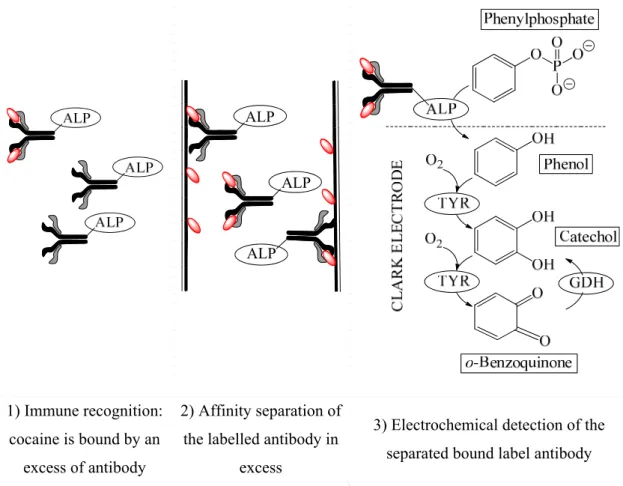
(45) CHAPTER 3: GENERAL THEORETICAL FOUNDATIONS. H2O2, which decreases when cocaine is linked to the immobilised antibody [51]. . The second work couples the use of a flow immunoassay based on an alkaline phosphatase labelled anti-cocaine antibody with a biosensor based on the enzymes tyrosinase and glucose dehydrogenase immobilised on a Clack-type oxygen electrode as amperometric detector (Figure 3.6) [49, 66].. ALP. ALP. ALP. 1) Immune recognition:. 2) Affinity separation of. cocaine is bound by an. the labelled antibody in. excess of antibody. excess. 3) Electrochemical detection of the separated bound label antibody. Figure 3.6.- Schematic representation of the procedure performed using a flow immunoassay coupled with a bienzymatic biosensor for cocaine detection. (ALP: alkaline phosphatase, TYR: tyrosinase, GDH: glucose dehydrogenase).. 33 Laura Asturias Arribas.
(46) DEVELOPMENT OF ELECTROCHEMICAL DEVICES FOR THE DETERMINATION OF DRUGS OF ABUSE. Electrochemical determinations for codeine Analogously, codeine can suffer electrochemical transformations due to the different redox groups that it contains (Figure 3.3). Oxidation of the three organic groups has been reported. Peaks associated to these groups have been seen to be influenced by the pH of the media so that, depending on the pH of the buffer solution, these peaks are overlapped (acid pHs) or separated (from neutral to basic pHs) [18]. Oxidation peaks appeared between + 0.9 and + 1.2 V, depending on the pH and the working electrode. Aluminium [76], platinum [74], gold [74], borondoped diamond film [85], carbon [78] and graphite [80] electrodes have been reported for codeine electrochemical determination, but the most common used electrode has been glassy carbon electrode [18, 21, 77, 79, 84, 86]. The working surface has been also modified with carbon [77, 81, 83, 88] or metallic nanomaterials [76, 86]. In addition, the miniaturisation of these transducers has been also applied for the determination of this analyte [84], being the main electrochemical techniques cyclic voltammetry [76, 79, 80], differential pulse voltammetry [18, 88, 91], squarewave voltammetry [21, 81, 84, 86] and chronoamperometry [77, 92]. The incorporation of bioelements, enzymes, aptamers or antibodies, to the electrochemical transducers can sometimes improve the sensitivity of the signal and, consequently, avoid possible interferences [82, 87, 89, 90]. Two aptasensors have been reported for the determination of codeine, in which the aptamers have been immobilised in a gold electrode [82] or a gold-mesoporous silica-nanoparticles modified glassy carbon electrode [90]. In the first aptasensor, the cocaine monitoring was carried out thanks to the ferrocene carboxylic acid, with which the RNA sequence was labelled (Figure 3.5.B) [82]. In the second biosensor, the determination was monitored through an electroactive redox probe, [Fe(CN)6]4-/3- (Figure 3.5.C) [90]. In addition, two enzymatic biosensors have been described in bibliography. One of them is based on a biosensor flow injection system coupled with a Clark type oxygen electrode, on which the enzymes morphine dehydrogenase and salicylate 34 PhD Thesis.
(47) CHAPTER 3: GENERAL THEORETICAL FOUNDATIONS. hydroxylase were immobilised (Figure 3.7) [87]. Another enzymatic amperometric sensor based on morphine dehydrogenase has been described to determine codeine using planar devices and phenazine methosulphate as redox mediator (Figure 3.8) [89].. H3CO. H3CO. O. O MDH NCH3. HO. NCH3 NADP+. NADPH. CODEINE. O CODEINONE. OH. SDH. OH. OH CO2 +. COO O2. Catechol. Salycilate. Figure 3.7.- Enzymatic scheme of the biosensor described for the determination of codeine in a Clark-type oxygen electrode (MDH: morphine dehydrogenase, SDH: salicylate dehydroxylase, NADPH: nicotinamide adenine dinucleotide phosphate).. 3.2.- MINIATURISED AND DISPOSABLE SENSORS The utilisation of electrochemical sensors in several analytical areas has required an improvement in some of the characteristics of the conventional electrodes, such as the tedious cleaning and recovery stages. An attractive alternative to the use of conventional electrodes lies in the possibility of fabricating miniaturised disposable devices [99-101].. 35 Laura Asturias Arribas.
(48) DEVELOPMENT OF ELECTROCHEMICAL DEVICES FOR THE DETERMINATION OF DRUGS OF ABUSE. Figure 3.8.- Scheme of the enzymatic biosensor described for the determination of codeine (MDH: morphine dehydrogenase, PMS: phenazine methosulphate).. Screen-printing technology infers important characteristics to the fabrication of miniaturised sensors: . Great flexibility in the electrode design in terms of spatial distribution, form and area.. . A wide range of materials for their fabrication.. . Low cost production.. . Disposable nature, which avoids cleaning stages.. . Better reproducibility.. . Possible usage for in situ analysis.. . Possible additional modification to develop sensitive and selective biosensors. Taking into account these characteristics, a great investigation field based on. screen-printed electrodes (SPEs) is presented, with analogous applications as for the conventional ones.. 36 PhD Thesis.
(49) CHAPTER 3: GENERAL THEORETICAL FOUNDATIONS. 3.2.1.- SPES MANUFACTURE SPEs are obtained through ink printing on a flat surface or substrate. Screenprinting technology is based on forcing the flow of a paste through a mesh that defines a particular part of the transducer (Figure 3.9).. Figure 3.9.- Printing procedure. (A) The substrate is placed under the mesh, which has the desire pattern that will define one or more components of the transducer. (B) The corresponding ink is deposited on the mesh. (C) Straightaway, a squeegee sweeps the ink from one side to another, forcing the ink to pass through the mesh. (D) The ink is deposited on the surface of the substrate.. The inks or pastes, which have different characteristics depending on which component of the sensor is printed, are sequentially deposited on the substrate. In general, the pastes can be divided into conductive and isolating inks [102]. Figure 3.10 represents a SPE and the sequential deposition of the inks that define each of the parts of the device. This sequence can vary depending on the specifications of the ink. 37 Laura Asturias Arribas.
(50) DEVELOPMENT OF ELECTROCHEMICAL DEVICES FOR THE DETERMINATION OF DRUGS OF ABUSE. (time and temperature of curing), to avoid possible degradation of the other parts of the transducer.. Figure 3.10.- Sequential deposition of the different inks that define an ordinary electrochemical transducer.. As it has been previously mentioned, these devices can be easily modified with bioelements, carbon nanomaterials, metallic nanoparticles or metallic nanofilms in order to improve their sensitivity and/or selectivity.. 3.2.2.- MODIFICATION WITH NANOMATERIALS Nanotechnology has become one of the most interesting fields in Analytical Chemistry. This awaken interest for nanomaterials is not only due to its wide variety of sizes, forms and composition, but also due to its properties [103]. Carbon nanomaterials have been employed in electrochemistry research since they are chemically inert, have a wide potential window and are suitable for different types of analysis.. 38 PhD Thesis.
(51) CHAPTER 3: GENERAL THEORETICAL FOUNDATIONS. Owing to their unique properties, carbon nanomaterials have been extensively used for the modification of electrodes. The primarily carbon namomaterials used for this aim are graphene, CNTs, fullerenes C60 and carbon nanofibres (CNFs) (Figure 3.11).. Figure 3.11.- Structure of fullerene, a single-walled CNT and the stacking of graphene sheets to form nanofibres.. CNTs can be divided in two categories: single-walled CNTs and multi-walled CNTs (MWCNTs), being the last formed by concentric cylindrical structures. CNTs are presented as a new carbon based material with better characteristics than other carbon materials normally used in electrochemistry, such as glassy carbon or graphite [104]. They have been used in different devices due to their structure and their interesting physical properties: excellent thermal conductivity, good mechanical resistance and semi-conductive or conductive nature, which depend on the structure, defects and impurities on the matrix of the material [105]. CNTs have been applied in fields like energy storage, energy conversion and chemical sensors, among others [104]. However, according to the analytical applications, this type of materials has been used in the construction of gas sensors,. 39 Laura Asturias Arribas.
(52) DEVELOPMENT OF ELECTROCHEMICAL DEVICES FOR THE DETERMINATION OF DRUGS OF ABUSE. electrochemical detectors and biosensors [106, 107]. Their applications in amperometric and voltammetric methods are especially favourable [107]. The use of CNTs in electrochemical measurements leads to an increase of the active surface of the electrode and an improvement of the electron transference between the electrode and the solution, as well as in the process reversibility [107].. 3.2.3.- ELECTROCHEMICAL BIOSENSORS A biosensor is an analytical device that combines a biologically sensitive material with an appropriate transducer system, which transforms the biochemical response into an electrical or optical signal (Figure 3.12) [95].. Figure 3.12.- Biosensor scheme.. Electrochemical biosensors are a type of chemical sensors that combine the analytical potential of the electrochemical techniques with the specificity of. 40 PhD Thesis.
(53) CHAPTER 3: GENERAL THEORETICAL FOUNDATIONS. biological processes, due to the biospecific agent immobilised or retained in a suitable electrode [95].. 3.2.3.1.- Biologically sensitive elements The most important component in a biosensor is the biological element. The wide variety of bioelements used in biosensors allows its classification in two main groups [108]: . Catalytic biosensors: enzymes, tissues or microorganisms and biological receptors.. . Affinity biosensors: nucleic acids and antibodies. Catalytic biosensors have been the most developed ones and, among them all,. the enzymatic ones have been technologically advanced due to its low cost and availability in market [109]. Enzymes are catalysts of numerous biochemical reactions, being a lot of them specific to just one substrate. Organic tissues or microorganisms, which contain several enzymes in their composition, can be directly used as biosensors, although they are not as selective as the purified enzymes [110]. Receptors, which are placed through the lipid bilayer in the cellular membrane, are proteins that present molecular recognition properties, giving affinity and specificity values comparable to the antibody ones. Antibodies, which bonds specifically to their corresponding antigen, confer high sensitivity to the biosensors.. 41 Laura Asturias Arribas.
(54) DEVELOPMENT OF ELECTROCHEMICAL DEVICES FOR THE DETERMINATION OF DRUGS OF ABUSE. 3.2.3.2.- Immobilisation methods In order to obtain an effective biosensor, a close contact must be established between the biological element and the transducer. For that reason, the immobilisation method is a crucial stage in the fabrication of these devices, affecting characteristic parameters from the biosensor, such as lifetime and sensitivity [111]. Different types of immobilisation of the biological component have been described: adsorption, microencapsulation, entrapment, cross-linking, covalent bonding or composite.. Adsorption immobilisation The immobilisation is produced due to a superficial phenomenon in which the biological element is attached on the transducer surface. This methodology is used in cases where substances have a tendency of being adhered to the surface of the transducer. Although it is one of the simplest procedures to modify the surface of the electrode, its mayor inconvenient is, in general, the weak bond formed between the biologic element and the electrode, giving less stable biosensors. The adsorption step can be influenced by the variation in temperature, type of biological material and electrode nature [112].. Microencapsulation immobilisation In the microencapsulation methodology, the biological material is in contact with the transducer though adsorption processes and then, protected with a membrane permeable to the analyte. Glucose acetate, collagen, Teflon and Nafion are the most common materials used as such membranes.. 42 PhD Thesis.
(55) CHAPTER 3: GENERAL THEORETICAL FOUNDATIONS. In general, this type of immobilisation origins biosensors that are more stable in time than the previous ones, since the enzyme is preserved and is not in direct contact with the solution that contains the analyte. In overall, this physical separation makes the response to be slower, but not less sensitive [99].. Entrapment immobilisation In this type of immobilisation, the biological element is trapped in a polymeric compound formed by the electro- or photopolymerisation of its monomer. This polymerisation is executed in presence of the biological element, so that it gets trapped in the matrix formed by the polymer. This technique is easy to perform from an experimental point of view and does not require a big amount of biological material. Additionally, the biologic component does not suffer any structural alteration. Nevertheless, the created barrier complicates the diffusion of the analyte towards the biocomponet and consequently, the response time of the sensor increases [99].. Cross-linking immobilisation This method of immobilisation provides an additional stabilisation to the proteins adsorbed on the transducer surface thanks to the incorporation of a bifunctional compound. In this way, a true chemical bond is formed between both the protein and the binder, forming a net [113]. Glutaraldehyde (GA) is one of the most used bifunctional agents. These biosensors are more stable in time, but the biological component can be denatured by the cross-linking agent [111]. Lysine-rich proteins, such as bovine serum albumin (BSA), are frequently added together with the biorecognition element to prevent this effect [99]. 43 Laura Asturias Arribas.
(56) DEVELOPMENT OF ELECTROCHEMICAL DEVICES FOR THE DETERMINATION OF DRUGS OF ABUSE. Covalent bond immobilisation The covalent bond established between the biological component and the transducer is a more complicated immobilisation method than the previous ones, but it origins more stable biosensors. It is based on a previous activation of chemical groups from the surface of the electrode, which will react with the nucleophilic groups of the biological element. This method leads to an orientated immobilisation and, therefore, these biosensors lead to more reproducible results [112].. Composite The biological element can be homogenously mixed with the paste that will be part of the working electrode of the transducer. The stability of the biosensor will depend on the nature of the bioelement, the composition of the paste and the ink curing process [102].. 3.2.3.3.- Miniaturised amperometric enzymatic biosensors Electrochemical biosensors have acquired special importance in several industrial applications due to the use of miniaturisation technologies in the manufacture of electrodes, which facilitates mass production of biosensors, reducing fabrication costs and assuring a good reproducibility [114]. One of the most promising electrochemical biosensors in terms of sensitivity is the amperometric one, which combines the high selectivity of enzymes with the simplicity of amperometric transducers. These biosensors monitor faradaic currents that are the result of electron exchanges between the biological system and the electrode, which maintain an appropriate constant potential [108]. Thus, the enzyme interacts with the analyte, producing species that can be oxidised or reduced in the. 44 PhD Thesis.
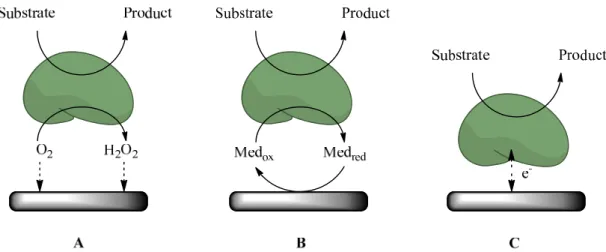
(57) CHAPTER 3: GENERAL THEORETICAL FOUNDATIONS. working electrode. Therefore, the produced current is proportional to the concentration of the analyte [111]. Amperometric enzymatic biosensors can be classified in three main groups depending on the mechanism of the electron transfer between the bioelement and the transducer (Figure 3.13) [95, 115]: . First generation biosensors: The monitoring of the signal is performed thanks to the detection of the cofactor or one of the products of the enzymatic reaction.. . Second generation biosensors: The enzymatic reaction is mediated by a redox species, which improves the electron exchange between the enzyme and the transducer.. . Third generation biosensors: The enzymatic reaction is monitored through direct electron exchange between the enzyme and the electrode surface.. Figure 3.13.- Representation of the three types of amperometric enzymatic biosensors. First (A), second (B) and third (C) generation biosensors.. 45 Laura Asturias Arribas.
(58) DEVELOPMENT OF ELECTROCHEMICAL DEVICES FOR THE DETERMINATION OF DRUGS OF ABUSE. 3.3.- ENZYMATIC SYSTEMS Human body is every day in contact with a broad variety of xenobiotics, not only from food components but also from pharmaceuticals and environmental toxins. The detoxification of these substances is carried out by complex enzymatic mechanisms that are performed in different parts of the body [116]. These enzymatic mechanisms are divided into two main phases [117]: . Phase I, in which xenobiotics are biotransformed into an inactive compound or a toxic one, with the same activity or even more active than the initial substance.. . Phase II, in which the metabolite from phase I is conjugated with an endogenous substrate such as gluconic acid, acetic acid or sulphuric acid, in order to facilitate its excretion. The enzymatic system CYP450 is mainly responsible for phase I mechanism.. This mechanism can be slow down or inhibited by some xenobiotics, which can be substrates from one enzyme, but inhibitors from other.. 3.3.1.- CYTOCHROME P450 CYP450 system was discovered at the end of the 1950s decade by David Garfinkel and Martin Klingenberg [118]. CYP450 was initially thought to be a single enzyme, but soon enough multiple forms of this enzyme were found. Each of these forms differs from the rest in its substrate selectivity and certain physicochemical characteristics [118]. This group of enzymes can be found mainly in liver and intestinal mucosa, controlling and metabolising a wide range of endogenous substances and xenobiotic compounds. This system has a very high affinity for carbon monoxide. For that 46 PhD Thesis.
(59) CHAPTER 3: GENERAL THEORETICAL FOUNDATIONS. reason, when it interacts with such gas, a reduced compound is formed and presents a Soret band in the ultraviolet-visible spectrum. Its maximum absorption band is set at 450 nm, which gives the name of CYP450 to these enzymes [119].. 3.3.1.1.- CYP450: structure and function Porphine is a tetrapyrrolic macrocycle that acts like a four-position chelating ligand. All derivatives from porphine have the name of porphyrin. One of the most important porphyrins is protoporphyrin IX, which is part of the heme group (Figure 3.14) [120].. Figure 3.14.- Macrocyclic structures of porphine (A), protoporphyrin IX (B) and heme group (C).. CYP450s are hemeproteins that contain one single heme prosthetic group. This group is formed by an iron atom in a protoporphyrin IX. The iron atom is linked to a cysteine residue, which is in the proximity of a terminal carbon from the polypeptide chain of the apoprotein. These enzymes act in the mitochondrial electron. 47 Laura Asturias Arribas.
(60) DEVELOPMENT OF ELECTROCHEMICAL DEVICES FOR THE DETERMINATION OF DRUGS OF ABUSE. transport, being associated to the redox pair Fe(II)/Fe(III), and weigh around 12000 Daltons (Figure 3.15) [118].. Figure 3.15.- Structural conformation of mammal CYP2B4 [121] (A) and human CYP2D6 [122] (B).. Small and crucial changes within the catalytic centre of the CYP450s are what differentiate the diverse cytochromes. These variations modify the catalytic activity, the substrate specificity, the redox potential, the spin-state equilibrium and the spectral properties [118, 119].. 3.3.1.2.- Cytochrome P450 subfamilies As it has been previously said, CYP450 is not a single identity, but a wide group of enzymes (more than 1000 different forms) [119]. Five CYP450 isoforms (1A2, 2C9, 2C19, 2D6 and 3A4) are responsible for approximately 95 % of the drug metabolism that is mediated by this enzyme in the human body. [123]. For instance, CYP450 2B subfamily and CY2D6 are the enzymes responsible for the toxic biotransformation of drugs such as cocaine and codeine, respectively [119]. 48 PhD Thesis.
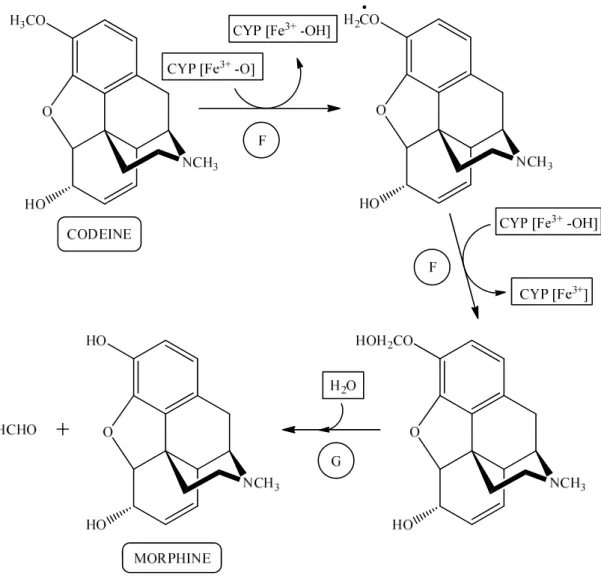
(61) CHAPTER 3: GENERAL THEORETICAL FOUNDATIONS. CYP450 2B subfamily CYP450 2B subfamily is the main hepatic CYP450 isoform in animals but it is poorly expressed in humans (CYP450 2B6 isoform). This subfamily is inducible by phenobarbital and other barbiturates. Substrates like cocaine, nicotine, phenobarbital and testosterone, among others, are metabolised by this enzyme [119].. CYP450 2D subfamily CYP2D6 is one of the isoforms that plays a very important role in the detoxification of xenobiotics in human body, although it is expressed at lower levels in the liver by comparison with the rest of this family of enzymes [124]. This enzyme metabolises over 50 drugs clinically used and xenobiotics that contain a highly protonated nitrogen atom at physiological pH, such as codeine, dextromethorphan, imipramine and metoprolol, among others [119, 124].. 3.3.1.3.- Catalytic cycle CYP450 presents a great functional versatility, fact that is reflected in the wide variety of catalytic processes that can be carried out and also, in the wide range of substrates that can be metabolised [125]. The oxidative biotransformations that are catalysed by the CYP450 are aromatic and aliphatic hydroxylations, N- and S-oxidations, epoxidations, O-, N- and S-dealkylations, deaminations, desulfurations, dehalogenations and dehydrogenations [126]. According to the CYP450 catalytic cycle (Figure 3.16), the organic substrate (R-H) is firstly attached to the metallic centre of the heme group producing a conformational change in the protein structure, around the iron atom (A). An 49 Laura Asturias Arribas.
(62) DEVELOPMENT OF ELECTROCHEMICAL DEVICES FOR THE DETERMINATION OF DRUGS OF ABUSE. electrode is then transferred to the system in order to reduce the iron atom from the ferric state (Fe3+) to the ferrous one (Fe2+) (B). This new state and the high affinity of the iron for the oxygen permit the union of an oxygen molecule to the metallic site (C). A second reduction leads to a superoxide formation (D), in which an internal electronic transference is produced between the iron and the superoxide to obtain the active species (Fe3+-O) (E). This compound is the responsible for the substrate transformation into the oxidised product (F-G) [119].. Figure 3.16.- CYP450 generic catalytic cycle.. In summary, the reaction between the cytochrome and its substrate (R-H) requires the combination of oxygen with the organic substrate in order to give a 50 PhD Thesis.
(63) CHAPTER 3: GENERAL THEORETICAL FOUNDATIONS. monoxygenated metabolite. Additionally, two electron equivalents are supplied by a cofactor (nicotinamide adenine dinucleotide (NADH) or NADPH, depending on the CYP450 system) and transferred in two consecutive stages. In the case of the transformation of cocaine, the last two steps (F-G) from the cycle can be explained through the following sequence in which cocaine is transformed in norcocaine, giving formaldehyde as subproduct of the metabolism (Figure 3.17) [127].. Figure 3.17.- Cocaine demethylation mediated by CYP450 2B subfamily to obtain norcocaine. F and G, steps of the CYP450 generic catalytic cycle.. As it has been said in section 3.1.1.2, the N-dealkylation of cocaine by CYP450 triggers its hepatotoxicity. Moreover, once norcocaine is generated, further metabolism produces N-hydroxynorcocaine and this, in turn, generates norcocaine 51 Laura Asturias Arribas.
(64) DEVELOPMENT OF ELECTROCHEMICAL DEVICES FOR THE DETERMINATION OF DRUGS OF ABUSE. nitroxide and norcocaine nitrous ion. These last two metabolites are responsible for the hepatotoxicity of this illegal drug [8, 128]. In the same way, codeine transformation by CYP2D6 leads to the formation of morphine and also formaldehyde as subproduct of the biological reaction (Figure 3.18).. Figure 3.18.- Codeine biotransformation into morphine by CYP2D6. F and G, steps of the CYP450 generic catalytic cycle.. 52 PhD Thesis.
(65) CHAPTER 3: GENERAL THEORETICAL FOUNDATIONS. Once codeine is metabolised into morphine, this one is transformed in two different glucoronidic forms: morphine-3-glucuronide (M3G) and morphine-6glucuronide (M6G). While M6G exhibits even greater analgesic properties than morphine, M3G is thought to produce the side effects of this drug [129]. As it has been previously said, each enzyme can metabolise more than one substrate, as well as a substrate can be metabolised by more than one enzyme. Thus, cocaine is N-demethylated by both CYP2B4 and CYP450 3A4 isoforms (Figure 3.2) [119, 130]. Meanwhile, codeine can be N-demethylated by CYP3A4 and Odemethylated by CYP2D6, leading to different products (Figure 3.4) [130].. 3.3.2.- ACETYLCHOLINESTERASE Acetylcholinesterases along with butyrylcholinesterases are the two main groups of cholinesterases. These enzymes transform the neurotransmitter acetylcholine into choline and acetic acid and have a special interest in fields such as toxicology, pharmacology and neurobiology (Figure 3.19) [131-133].. Figure 3.19.- Transformation of acetylcholine by AChE.. 3.3.2.1.- Acetylcholinesterase: structure and function AChE is a polymorphic enzyme that consists of four globular catalytic subunits (Figure 3.20) [134]. Its active centre is formed by two subsites, the anionic. 53 Laura Asturias Arribas.
(66) DEVELOPMENT OF ELECTROCHEMICAL DEVICES FOR THE DETERMINATION OF DRUGS OF ABUSE. binding site and the esteratic site [135]. Besides, AChE is a serine hydrolase that plays a very important role in the cholinergic transmission.. Figure 3.20.- Structural conformation of AChE [136].. Nerve impulses stimulate the release of acetylcholine, which transmits the stimulus across the synapse from a nerve cell to a muscle one, where it binds to the acetylcholine receptor [137]. After the acetylcholine arrives to the other side of the synapse and passes the information, the AChE is responsible for hydrolysing the neurotransmitter, which is recycled to form new neurotransmitters for the next message [136, 138].. 3.3.2.2.- Acetylcholinesterase inhibition Several compounds have been described as AChE inhibitors, such as mercury,. procaine,. cocaine,. nicotine,. morphine,. codeine,. caffeine,. urea,. organophosphorous compounds, etc. [139].. 54 PhD Thesis.
(67) CHAPTER 3: GENERAL THEORETICAL FOUNDATIONS. AChE inhibitors can be divided in reversible and irreversible inhibitors, containing most of them at least one positively charged nitrogen group [131]. The inhibition of this enzyme gives, as a result, the accumulation of the neurotransmitter at the synapse. This accumulation leads to the blockage of the neurotransmission and even the death of the individual. Consequently, this inhibition can produce damages in nervous, respiratory and muscular functions [137]. For instance, pesticides are based on the inhibition of this enzyme producing the insect death [140]. Nevertheless, medical studies are nowadays focused on the inhibition of this enzyme for the treatment of different neuromuscular disorders [135], especially in an attempt to invert the symptoms of Alzheimer’s disease. People, who suffer from this degenerative disease, lose many nerve cells. Selecting an inhibitory drug, which could block the activity of the enzyme, would raise the levels of the neurotransmitter. acetylcholine.. This. inhibition. can. potentiate. cholinergic. neurotransmission and strengthen the nerve signals that remain, which in turn produces improvement in memory and goal-direct thought [136, 141].. 3.3.2.3.- Types of inhibition Inhibition is an important process that controls the biological activity of cells. The study of the inhibition not only has interest in controlling the cells but also in knowing the behaviour of the enzymes. Enzymes can be inhibited through different procedures. When the enzymatic kinetics is represented in terms of reaction speed versus the concentration of the substrate, the graphical representation describes a hyperbole (Figure 3.21). The enzymatic reaction can be expressed as the following scheme: ↔. → 55. Laura Asturias Arribas.
(68) DEVELOPMENT OF ELECTROCHEMICAL DEVICES FOR THE DETERMINATION OF DRUGS OF ABUSE. where E is the enzyme, S the substrate and P the product of the enzymatic transformation.. v. 1/v. vmax. vmax-1 [S]. Km Km.i. 1/[S]. Km-1 Km.i-1. (A). (B). Figure 3.21.- Kinetics representation (A) and Lineweaver-Burk plot (B) of a competitive inhibition.. The Michaelis-Menten linear equation (Eq. 3.1) describes the reaction rate versus the substrate concentration of a great variety of enzymatic reactions. Nonetheless, the Lineweaver-Burk plot (Eq. 3.2), which is a graphical representation used to calculate the kinetic parameters of the interaction between an enzyme and the substrate, is frequently used.. . 3.1. . 3.2. 1. 1. 1. where vmax is the maximum speed of a reaction catalysed by an enzyme when it is totally saturated by its substrate and Km (Michaelis constant) is the concentration of substrate that is necessary to achieve half the vmax (or saturate half of the active sites). It also gives information about the affinity of the enzyme for the substrate. According to this, two main types of inhibition are described and characterised depending on the vmax and Km, namely reversible and irreversible inhibition.. 56 PhD Thesis.
(69) CHAPTER 3: GENERAL THEORETICAL FOUNDATIONS. 3.3.2.3.1.- Reversible inhibition In the reversible inhibition, the inhibitory molecule paralyses or slows down the enzymatic activity, but this action is reversible and the inhibitor can be separated from the enzyme, restoring the enzyme activity to its initial value. The bonds that are established between the enzyme and the inhibitor are non-covalent. Depending on the binding site, inhibitors can be competitive and noncompetitive. However, there are variations in the way that the different inhibitors bind to the enzyme or to the system enzyme-substrate [142].. Competitive inhibitor The inhibitor and the substrate compete for the active centre of the enzyme, so that the number of substrate molecules that are capable of attaching to the active site decreases. The competitive inhibition is reversible when increasing the substrate concentration. Kinetically speaking, the vmax of the enzyme does not vary in presence of a competitive inhibitor, but the Km increases with the amount of inhibitor since the affinity for the substrate is less (Figure 3.21).. Non-competitive inhibitor In this case, the substrate and the inhibitor do not compete for the active centre. The inhibitor is attached to the enzyme through a site different from the active site, so that the inhibitor modifies the structure of the active centre and makes the enzyme less capable of transforming the substrate. This type of inhibition does not reverse when the concentration of substrate is increased.. 57 Laura Asturias Arribas.
(70) DEVELOPMENT OF ELECTROCHEMICAL DEVICES FOR THE DETERMINATION OF DRUGS OF ABUSE. The affinity of the enzyme for the substrate (Km) does not change, but the vmax is decreased proportionally with the presence of the inhibitor (Figure 3.22).. v vmax. 1/v. vmax,.i. [S]. Km=Km,i. 1/[S]. Km-1=Km,i-1. (A). (B). Figure 3.22.- Kinetics representation (A) and Lineweaver-Burk plot (B) of a non-competitive inhibition.. Uncompetitive inhibitor The inhibitor binds to the system enzyme-substrate, but it is not able to bind to the free enzyme [143]. This type of inhibition does not reverse by increasing the substrate concentration. Lineweaver-Burk plot shows parallel lines and the kinetic parameters (vmax and Km) decrease by the same factor (Figure 3.23).. Mixed inhibitor As the non-competitive inhibitor, the mixed inhibitor binds at a different site from the active centre, which provokes changes in the structure of the enzyme,. 58 PhD Thesis.
(71) CHAPTER 3: GENERAL THEORETICAL FOUNDATIONS. leading to a decrease in the enzymatic activity. The inhibition cannot be overcome by high substrate concentration [142]. In the Lineweaver-Burk plot, while the vmax decreases, Km increases (Figure 3.24).. v. 1/v. vmax vmax,.i. [S]. Km.i Km. 1/[S]. Km.i-1 Km-1. (A). (B). Figure 3.23.- Kinetics representation (A) and Lineweave-Burk plot (B) of a uncompetitive inhibition.. v vmax. 1/v. vmax,.i. [S]. Km Km.i. 1/[S]. Km-1 Km.i-1. (A). (B). Figure 3.24.- Kinetics representation (A) and Lineweaver-Burk plot (B) of a mixed inhibition.. 59 Laura Asturias Arribas.
(72) DEVELOPMENT OF ELECTROCHEMICAL DEVICES FOR THE DETERMINATION OF DRUGS OF ABUSE. 3.3.2.3.2.- Irreversible inhibition The molecules bind covalently to the enzyme, avoiding its freedom without damaging the enzyme. Consequently, the effect of an irreversible inhibitor is permanent [144].. 3.4.- REFERENCES 1.. Pascual Simón, J.R. and B.L. Fernández Rodríguez, Consideraciones Generales sobre Drogas de Abuso. Medisan 6, 2002, p. 58-71.. 2.. Goldstein, R.A., C. DesLauriers, and A.M. Burda, Cocaine: History, Social Implications, and Toxicity-A Review. Disease-a-Month 55, 2009, p. 6-38.. 3.. Pascual, C., et al., Drogas: + información - riesgos. 2001: Plan Nacional sobre Drogas, Ministerio de Interior - Gobierno de España.. 4.. Niemann, A., Über eine neue organische Base in den Cocablättern. Archiv der Pharmazie 153, 1860, p. 288-292.. 5.. Dillane, D. and B.T. Finucane, Local anesthetic systemic toxicity. Canadian Journal of Anesthesia 57, 2010, p. 368-380.. 6.. Grzybowski,. A.,. Cocaine. and. the. eye:. A. historical. overview.. Ophthalmologica 222, 2008, p. 296-301. 7.. Komorsky-Lovric, S., I. Galic, and R. Penovski, Voltammetric determination of cocaine microparticles. Electroanalysis 11, 1999, p. 120-123.. 8.. Kloss, M.W., G.M. Rosen, and E.J. Rauckman, Cocaine-mediated hepatotoxicity. A critical review. Biochemical Pharmacology 33, 1984, p. 169-173.. 9.. Shannon, M., Clinical toxicity of cocaine adulterants. Annals of Emergency Medicine 17, 1988, p. 1243-1247.. 60 PhD Thesis.
(73) CHAPTER 3: GENERAL THEORETICAL FOUNDATIONS. 10.. UNODC, World Drug Report, (United Nations publication). 2012: Vienna.. 11.. Doweiko, H.E., Concepts of chemical dependency. 8th ed. 2012, Belmont, CA (USA): Brooks/Cole.. 12.. Evrard, I., S. Legleye, and A. Cadet-Taïrou, Composition, purity and perceived quality of street cocaine in France. International Journal of Drug Policy 21, 2010, p. 399-406.. 13.. Stout, P.R. and L.J. Farrel, Opioids - Effects on Human Performance and Behavior. Forensic Science Review 15, 2002, p. 29-59.. 14.. Trescot, A.M., et al., Opioid pharmacology. Pain Physician 11, 2008, p. S133-S153.. 15.. Robiquet, P.J., Nouvelles observations sur les principaux produits de l'opium. Annales de Chimie et de Physique 51, 1832, p. 225-267.. 16.. López Castellano, A.C., L. Moreno Royo, and V. Villagrasa Sebastián, Manual de Farmacología: Guía para el uso racional del medicamento. 2006, Madrid: Elsevier.. 17.. Velázquez, B.L., et al., Farmacología Básica y Clínica. 18th ed. 2008, Madrid: Médica Panamericana.. 18.. Garrido, J.M.P.J., et al., Voltammetric oxidation of drugs of abuse: II. Codeine and metabolites. Electroanalysis 16, 2004, p. 1427-1433.. 19.. Frost, J., et al., Investigation of morphine and morphine glucuronide levels and cytochrome P450 isoenzyme 2D6 genotype in codeine-related deaths. Forensic Science International 220, 2012, p. 6-11.. 20.. Vidal Vademecum Spain S.A.; Available from: http://www.vademecum.es.. 21.. Garrido, J.M.P.J., et al., Electroanalytical determination of codeine in pharmaceutical preparations. Analytical Letters 35, 2002, p. 2487-2498.. 61 Laura Asturias Arribas.
Figure


+7



Documento similar
It is generally believed the recitation of the seven or the ten reciters of the first, second and third century of Islam are valid and the Muslims are allowed to adopt either of
Because of the many possible applications and domains of sentiment analysis, different sentiment analysis methods (SAMs) have been developed to address SAC Ribeiro et al. There are
The determination of taurine based on ECL was investigated using different electrochemical platforms: bare screen-printed graphene (SPGrE) or gold (SPAuE) electrodes and ZnO NWs
Astrometric and photometric star cata- logues derived from the ESA HIPPARCOS Space Astrometry Mission.
The photometry of the 236 238 objects detected in the reference images was grouped into the reference catalog (Table 3) 5 , which contains the object identifier, the right
Our results here also indicate that the orders of integration are higher than 1 but smaller than 2 and thus, the standard approach of taking first differences does not lead to
well as powerful and versatile method for the modification of surfaces at the molecular level. SAMs of electroactive molecules have been exploited as electrochemical switches in
A cathodic inversion voltammetry study was performed maintaining the cathodic potential inversion during 240 s in order to verify and refine the energy conditions of potential and /
