
Spray drying encapsulation of red wine : stability of total monomeric anthocyanins and structural alterations upon storage
27
0
0
Texto completo
(2) 1 2 3 4. “Spray drying encapsulation of red wine: stability of total. 5. monomeric anthocyanins and structural alterations upon storage”. 6 7. Izmari Jasel Alvarez Gaona (1) (2), Caterina Bater, (1) María C. Zamora (1) (2) and Jorge. 8. Chirife (1). 9 10 11 12 13 14 15. (1). Facultad de Ingeniería y Ciencias Agrarias, Pontificia Universidad Católica. Argentina, Av. Alicia Moreau de Justo 1516-1560, C1107AFF CABA (2). Consejo Nacional de Investigaciones Científicas y Técnicas (CONICET), Godoy. Cruz 2290, CABA. 16 17 18 19 20 21 22 23 1.
(3) 24. Abstract. 25. Wine C. Sauvignon was encapsulated by spray drying to obtain a wine powder. 26. having a low water activity (aw). Maltodextrin DE10 was added to wine before. 27. atomization. The retention of Total Monomeric Anthocyanins (TMA) in the wine. 28. powder was found to be above 83%.. 29. Wine powder was stored under various relative humidities, and TMA. 30. concentration was determined up to 120 days at 38ºC. Anthocyanins decreased. 31. steadily during storage and increasing RH% enhanced the losses. Results stressed the. 32. importance of aw (or RH%) as a key control parameter for anthocyanins stability. 33. during storage.. 34. Encapsulated wine collapsed when exposed few days to 58% RH and 38ºC;. 35. this was investigated by spray drying wine model systems containing various non-. 36. volatile components of the dry extract, namely glycerol, organic acids and. 37. monosaccharides. Structural alterations of encapsulated wine were attributed to. 38. glycerol, main component of dry extract and which has a very low glass transition. 39. temperature.. 40 41. Key words: Red wine –Anthocyanins- Spray drying –Tg – Glycerol. 42 43 44. Practical Applications. 45. The main practical application of this work is that it allows the wine to be. 46. transformed into a freely flowing powder by the addition of maltodextrin before the. 47. atomization stage in spray drying. The encapsulated wine contains 5 times the. 48. concentration of anthocyanins than that in liquid wine (both expressed in mg / 100 g).. 49. This is the first published work on spray drying of red wine.. 50 51 52 53 54 2.
(4) 55. INTRODUCTION. 56. Red wine, as a consequence of its polyphenolic content can be considered a. 57. useful raw material for making a number of different healthy food and drink products. 58. (Di Giacomo and Taglieri, 2012; Rocha-Parra et al., 2016). Wines are rich in. 59. compounds as flavonoids (catechins, flavonols and anthocyanins) which are. 60. implicated in health benefits. Like resveratrol, quercetin and catechins, anthocyanins. 61. also have high antioxidant capacity and are researched for their possible effects for. 62. reducing the risk of cancer and for fighting against cardiovascular disease and aging. 63. (Nistor et al., 2015; Rocha-Parra et al., 2016). Epidemiological evidence has. 64. indicated that a moderate consumption of red wine reduces the incidences of coronary. 65. heart disease, atherosclerosis and platelet aggregation (Li et al., 2009).. 66. In recent years, Sanchez et al. (2013), Galmarini et al. (2013) and Rocha Parra. 67. et al. (2016) reported results on the freeze drying encapsulation of red wine with. 68. maltodextrin, or maltodextrin plus arabic gum, obtaining a powder with low alcohol. 69. (≤1%). Water and almost all alcohol were removed during freeze drying and the use. 70. of appropriate amount of carriers led to encapsulation of dry extract components. 71. (polyphenols among them). Very recently, Wilkowska et al. (2016 and 2017) studied. 72. spray drying of chokeberry juice and chokeberry wine (fermented chokeberry juice). 73. using. 74. cyclodextrin). They reported anthocyanins stability during storage at 8 and 25°C as. 75. well as the antioxidant and antimicrobial activity of fruit wine microencapsulated. 76. using the different carriers.. different. carriers. (maltodextrin,. arabig. gum. and. hydroxypropyl-β-. 77 78. Spray drying can be used as an encapsulation method when it entraps. 79. ‘‘active’’ materials within a protective matrix. The spray-drying technique has been. 80. widely used for drying heat-sensitive foods and pharmaceuticals (Masters, 1991),. 81. because of the rapid water evaporation from the droplets. (Tonon et al., 2010;. 82. Mahdavi et al., 2014). Compared to other conventional microencapsulation. 83. techniques, it offers the attractive advantage of producing microcapsules at lower cost. 84. than freeze drying, in a simple and continuous operation. Carrier agents are usually. 85. employed as an aid in the spray drying process. Several substances can be used as 3.
(5) 86. carriers to microencapsulate anthocyanins (Fang and Bhandari, 2012; Souza et al.,. 87. 2015; Osorio et al., 2010) namely maltodextrins, arabic gum, starch, etc.. 88. Maltodextrin of low dextrose equivalent has been widely use because of their good. 89. water solubility, low viscosity at high concentrations, low cost, and the ability to. 90. increase the glass transition temperature (Tg) of the system (Wagner and Warthesen,. 91. 1995; Desorby, Netto, and Labuza, 1997; Cai and Corke, 2000).. 92 93. The objective of the present work was to study the feasability of spray drying. 94. to encapsulate red wine in a maltodextrin matrix to obtain a powder which can be. 95. used as ingredient for the food and/or pharmaceutical industries. The storage stability. 96. of Total Monomeric Anthocyanins (TMA) in encapsulated red wine stored at. 97. different relative humidities (RH%) was monitored. Structural alterations. 98. experimented by encapsulated wine when exposed to selected RH % and temperature. 99. were investigated by spray drying wine model solutions.. 100. No previous studies on spray drying encapsulation of red wine have been previously. 101. reported in literature.. 102 103. MATERIALS AND METHODS. 104. Reagents. 105. Glycerol, fructose and glucose were purchased from CICARELLI, Argentine.. 106. Tartaric acid and gallic acid from ANEDRA, USA. Malic acid from MERCK,. 107. Germany. Sodium carbonate, potassium carbonate and sodium bromide were. 108. purchased from Biopack, Argentina.. 109 110. Samples preparation. 111. Wine Cabernet Sauvignon, “Postales del Fin del Mundo” (2015) from. 112. Neuquen, Argentina. Alcohol content was 14.1% (v/v) and pH 3.7. Maltodextrin used. 113. for encapsulation had DE10 and was purchased from Ingredion, S. A, Argentine. Salts. 114. (reagent grade) used for relative humidity (RH%) control were: magnesium chloride. 115. (33%), potassium carbonate (43%) and sodium bromide (58%).. 116 4.
(6) 117. Spray drying. 118. A mixture of 13.5% (w/w) maltodextrin DE10 and 86.5% (w/w) wine was. 119. prepared and spray-dried with a mini spray dryer Buchi model B-290 (Büchi. 120. Laboratoriums Technik, Switzerland) under the following operating conditions: feed. 121. flow rate 600 g/h; drying air inlet temperature, 135ºC to 170°C; flow meter spraying. 122. air (rotameter) 30 mm, 0.23 bar pressure drop and 439 L/h actual volume flow (at. 123. standard temperature and pressure).. 124 125. Storage Conditions. 126. Spray dried wine powder in small opaque glass flasks was stored in a constant. 127. temperature oven kept at 38°C in one or the other of the following conditions, a) in. 128. hermetically sealed flasks to preserve its initial moisture condition (aw = 0.19). 129. during 120 days; b) in open flasks placed over one or the other of the following. 130. saturated solutions: MgCl (33% RH) during 120 days, K2C03 (43% RH) during 115. 131. days, and NaBr (RH 58%) during 21 days. Temperature 38°C is representative of. 132. accelerated shelf life studies (Labuza, 1982). Samples were periodically removed. 133. from storage and analyzed at selected times.. 134 135. Water activity and moisture content. 136. Water activity (aw) was measured using a dew point hygrometer “Aqualab. 137. Series 3” (Decagon Devices, USA) previously calibrated. Moisture content was. 138. determined gravimetrically (2 g sample) in a forced convection constant. 139. temperature oven at 90ºC during 6 hours, cooled for 1 h in a glass dessicator and. 140. re-weighted.. 141 142. Scanning electron microscopy (SEM). 143. Scanning Electron Microscopy, morphological analysis was performed by. 144. SEM using a FEI, Quanta 200 microscope (Netherlands). The spray dried red wine. 145. samples were placed in a carbon support and coated with a layer of gold (40–50 nm). 146. and examined using an acceleration voltage of 5 kV.. 147 5.
(7) 148. Wine Dry Extract. 149. Ten g of each wine sample were weighed in glass containers and dried in a. 150. constant temperature convection oven for 2 h at 105ºC, and then cooled for 1 h in. 151. glass dessicator.. 152. Solubility. 153. One g of wine powder was dissolved in 100 mL of distilled water and. 154. mixed for 5 minutes in a magnetic stirrer. The solution was centrifuged at 3000 g. 155. for 5 minutes and 25 mL of supernatant were transferred into glass containers. The. 156. samples were dried in a constant temperature oven for 5 h at 105ºC. The. 157. percentage of solubility was calculated according to AOAC (1995).. 158. Chromatic Characteristics. 159. A 1% m/v solution was prepared with 1 g of wine powder and 100 mL of. 160. distilled water. The spectrophotometric measurements were taken with UV-Vis. 161. spectrophotometer (T60 – PG Instruments, UK) using quartz cells (1 cm path. 162. length) and distilled water as reference liquid in order to set the zero on the. 163. absorbance scale at the wavelengths of 420, 520 and 620 nm. Measurements were. 164. made by triplicate and the average is reported.. 165. Total monomeric anthocyanin by the pH-differential method. 166. Monomeric anthocyanin content was measured following the method. 167. described by Giusti and Wrolstad (2001). One g of wine powder was diluted in 8 g. 168. of distilled water and 100 μL of this solution were added into a tube containing. 169. 4900 μL of 0.025 M potassium chloride buffer, pH 1.0. One hundred μL of the. 170. initial solution were added into a tube containing 4900 μL of 0.4 M sodium acetate. 171. buffer, pH 4.5. The tubes were equilibrated for 15 minutes at room temperature,. 172. and then the absorbance was measured both at 700 nm and 520 nm in a UV-Vis. 173. spectrophotometer (T60 – PG Instruments) using quartz cells (1 cm path length).. 174. Absorbance was calculated as A = (A520. 175. and the results were expressed as mg cyanidin 3-glucoside equivalents g-1 of powder,. nm. 6. -A700. nm) pH 1.0. - (A520 nm - A700. nm) pH 4.5,.
(8) 176. using a molar extinction coefficient of 2.69 x 10⁴, and a molecular weight of 449.2. 177. for cyanidin 3-glucoside.. 178. Wine Model systems. 179. Model systems (A and B) resembling red wine composition (with added. 180. maltodextrin), were prepared by mixing pre-determined quantities of water, ethanol,. 181. maltodextrin DE10, glycerol, tartaric acid, malic acid, fructose and glucose. These. 182. models were spray dried at 145ºC inlet temperature and resulting powders used in. 183. rehumidification experiments described elsewhere. Composition of model systems. 184. (before spray drying) was as follows. Model A: hydroalcoholic solution 14% v/v. 185. (84.99%), maltodextrin DE10 (13.5%), glycerol (0.80%), tartaric acid (0.38%), malic. 186. acid (0.26%), fructose (0.07%) and glucose (0.03%). Model B: hydroalcoholic. 187. solution 14% v/v (85.79%), maltodextrin DE10 (13.5%), tartaric acid (0.38%), malic. 188. acid (0.26%), fructose (0.07%) and glucose (0.03%).. 189. Re-humidification experiments. 190. Wine powder and spray dried wine models were poured (2 g) in 4 cm. 191. diameter plastic holders kept over saturated solution of NaBr (RH 58%) and placed at. 192. 38ºC ± 1ºC. At selected times (6, 21, 30, 43, 51, 69, 74 y 92 hours) the radial. 193. shrinkage of the powders was measured and photographs were taken.. 194. Sorption isotherms. 195. A sorption isotherm (in a limited range of RH%) was determined. One and. 196. half g of wine powder spray dried at different temperatures were exposed at different. 197. RH% at 38ºC until equilibrium was noted. Samples were made by triplicate and the. 198. average is reported.. 199 200 201. 7.
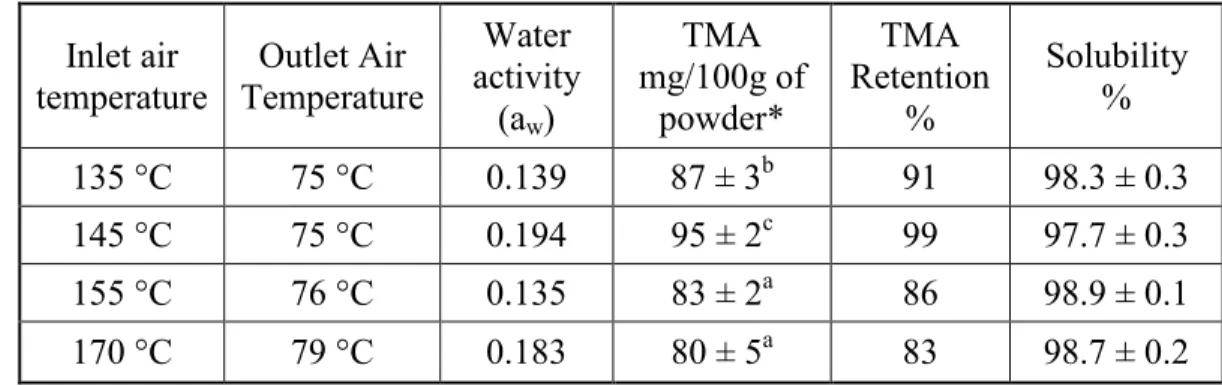
(9) 202. RESULTS AND DISCUSSION. 203. Spray drying of red wine. 204. Total Monomeric Antocyanin content (TMA) and dry extract of liquid red. 205. wine were determined to be, 171 ± 7 mg/L (as cianydin-3-glucoside) and 2.27%. 206. (w/w), respectively. The value of TMA is in good agreement with results reported by. 207. Fanzone et al. (2012) for red wines from Argentine.. 208. It is well known that spray drying of fruit juices is difficult due to the presence. 209. of low molecular weight sugars and acids with low glass transition temperature (Tg). 210. (Bhandari et al., 1993; Bhandari et al., 1997). These components which are present in. 211. fruit juices in high proportion and have low Tg, can stick on the dryer chamber wall. 212. during drying, leading to low product yield. Moreover, structural alterations, such as. 213. agglomeration and caking may occur in these amorphous food powders when stored. 214. at temperatures above the Tg. Part of these problems can be solved by the addition of. 215. carrier agents, like maltodextrin and arabic gum, to the product before being. 216. atomized.. 217. It was early noted in present study that spray drying of red wine also had. 218. problems of sticking to the walls of the dryer and agglomeration of powder during. 219. storage under certain conditions of RH% and temperature. In previous trials it was. 220. found that maltodextrin addition below 13.5% resulted in poor process yield and. 221. stickeness, and for this reason this maltodextrin concentration was adopted. The dry. 222. extract of present red wine is 2.27%, thus, addition of 13.5% maltodextrin leads to a. 223. ratio maltodextrin/wine dry solids of about 6. Table 1 shows the results of spray. 224. drying of red wine added with 13.5% (w/w) maltodextrin, at different inlet air. 225. temperatures, and for each one TMA retention and % solubility.. 226. Outlet air temperatures were in the range 75-79ºC (Table 1) and in all drying. 227. runs a free-flowing powder having aw below 0.20 was obtained. Due to simultaneous. 228. elimination of water and ethanol during spray drying, the concentration of total. 229. anthocyanins in the wine powder was increased to five times greater than in the. 230. original liquid wine. Solubility was very close to 100% and was practically. 231. independent of inlet air temperatures. At all temperatures the retention of TMA was 8.
(10) 232. high (>83%) indicating that spray drying allows a good anthocyanin retention. Silva. 233. et al.. 234. (maltodextrin and arabic gum) and temperatures (140-180ºC) for the production of. 235. jaboticaba extracts by spray-drying microencapsulation. They also found that. 236. anthocyanin retention was high in all of the experimental conditions with retention. 237. values above 80%. Bernstein and Noreña (2015) also reported that anthocyanins. 238. retention during spray drying encapsulation of a red cabbage extract using 10% arabic. 239. gum as encapsulating agent, yielded high anthocyanins retention in the range 83-91%. 240. for inlet air temperatures of 140-160ºC. Wilkowska et al. (2016) spray dried black. 241. chokeberry (Aronia melanocarpa) juice and wine using maltodextrin, a mixture of. 242. maltodextrin with arabic gum and hydroxypropyl-β-cyclodextrin as coating. 243. materials. They followed degradation kinetics of polyphenols and antioxidant. 244. stability in microencapsulated juice and wine preparations from chokeberry over 12. 245. months under storage at 8 and 25°C. Wilkowska et al. (2016) reported that the type of. 246. encapsulant proved to have a significant effect on the storage stability of polyphenol. 247. microencapsulates. Microcapsules of maltodextrin showed a loss of 25% in total. 248. anthocyanins after 12 months storage at 25ºC. They did not report the effect of. 249. moisture content (or aw) on anthocyanins stability during storage. Wilkowska et al.. 250. (2017) also spray dried different fruit wines (chokeberry, blackcurrant and blueberry). 251. using hydroxypropyl-β-cyclodextrin and inulin as encapsulants and followed the. 252. structural, physicochemical, and biological properties of the spray-dried wine. 253. powders over 12 months of storage in darkness under refrigeration (8ºC).. (2013) performed a simultaneous optimization of different carrier agents. 254. Wilkowska et al. (2017) reported that spray drying of fruit wine at inlet. 255. temperature of 140°C lead to a powder with less than 1% ethanol content; it is. 256. noteworthy that 140°C is the same inlet temperature we used in present spray drying of red. 257. wine. Also, Sanchez et al. (2013) reported that freeze drying of red wine (Cabernet. 258. Sauvignon) added with maltodextrin resulted in a residual ethanol content of 0.8%.. 259. Thus, althought we did not determine alcohol content in present spray dried wine. 260. powder, we may suffely assume that it is a “low” ethanol content product (i.e. below. 261. 1%).. 262 9.
(11) 263 264. The high TMA retention % observed (Table 1) may be explained on the basis. 265. of the particular drying characteristics during spray drying of liquid foods. The. 266. following description of spray drying events is widely accepted in literature (Ranz. 267. and Marshall 1952; Huang, 2011; Anandharamakrishnan, 2015). When a food. 268. solution (i.e. wine with dissolved maltodextrin) is fed to the atomizer the droplets. 269. formed are mixed with hot air and this causes the solvent (water and some ethanol) to. 270. evaporate, leading to formation of particulates. The drying of droplets containing the. 271. dissolved solid can be divided into two different stages known as constant rate period. 272. and falling rate period. In the first stage the droplet diameter decreases due to water. 273. evaporation from the wetted surface, whereas the mass fraction of the dissolved. 274. maltodextrin increases. In this period droplet evaporation rate is nearly constant and. 275. the droplet surface temperature (Ts) is also constant and may be represented by the. 276. wet bulb temperature (Twb). This is strictly valid when the solvent is water; in wine,. 277. the solvent includes a small mass fraction of ethanol (water 89% w/w + ethanol 11%. 278. w/w) but it is not considered by now. Note that vapour pressure lowering effect of. 279. maltodextrin DE10 can be neglected due to its relatively high molecular weight (about. 280. 1300); for example, a 14% (w/w) maltodextrin DE10 solution has a relative water. 281. vapour pressure, p/po = 0.998.. 282. An important fraction of the available moisture in a droplet may be removed during. 283. the period of constant rate, thus protecting anthocyanins from degradation because Ts. 284. = Twb. In a study of spray drying of proteins, Anandharamakrishnan et al. (2008). 285. reported Twb = 44.5ºC and 46.6ºC for inlet air temperatures as high as 160ºC and. 286. 180ºC, respectively. As more moisture is removed from the droplet, the maltodextrin. 287. dissolved in the liquid reaches a concentration beyond its saturation concentration and. 288. forms a shell at the droplet surface denominated “crust formation”. This crust of. 289. maltodextrin in present work can be seen in SEM micrographs of spray dried wine.. 290. The begining of crust formation is an important characteristic of spray drying since. 291. the evaporation rate is now dependent upon the rate of water vapor diffusion through. 292. the dried surface shell. In this period, evaporative cooling is not sufficient to maintain. 293. Ts = Twb causing a gradual increase in Ts. Although the particle will begin to heat it is 10.
(12) 294. almost at the coolest part of the dryer, where the drying air is at or near the outlet. 295. temperature of the dryer. Consequently, the particles are never heated above the. 296. outlet temperature of the dryer (75-79ºC in Table 1). Red wine used contained 11%. 297. (w/w) ethanol and its possible effect on spray drying rates deserves some comments.. 298. Ethanol should somewhat facilitate the evaporation process during the constant rate. 299. period (as compared to water alone). However, at lower moisture contents (falling. 300. rate period) the diffusion coefficient of the solvent (water + ethanol) through the shell. 301. becomes the determining factor for evaporation rate. The molecule of ethanol, due to. 302. its molecular size larger than of water, may hinder diffusion in the dried matrix. 303. (Menting et al., 1970). Nevertheless, the overall effect, if any, on final aw of powder. 304. did not appear to be important enough from a practical point of view.. 305 306. Sorption isotherms (in a limited range of RH %) of raw wine powder. 307. Figure 1 shows the sorption isotherms (in a limited range of RH %) at 38ºC of. 308. wine powder spray dried at 135ºC, 155ºC and 170ºC. The sorption isotherm was. 309. determined only up to a 43% RH because at 58% RH the structure of wine powder. 310. completely collapsed with release of typical red wine color.. 311. The sorption isotherm of the powdered wine does not appear to be influenced by the. 312. temperature of previous drying. This is an indication that spray drying treatment did. 313. not produce modifications in the active sites available for water sorption in the. 314. substrate (Iglesias and Chirife, 1976); and may be considered also as an indicator of. 315. the mildness of spray dying treatment.. 316 317. Chromatic profiles and morphology of spray dried particles. 318. The chromatic profile of red wines is formed by the participation of various. 319. phenolic compounds: anthocyanins, tannins, flavones and phenolic acids.. 320. Anthocyanins are the polyphenolic substances with the most important role in the. 321. color of wines. The natural evolution of young red wine leads to changes of structures. 322. and chromatic properties of wine due to polymerization reactions, condensation and. 323. oxidation (Visan and Dobrinoiu, 2013). Similarly, spray drying may promote such. 324. chemical modifications leading to changes in the chromatic profile of reconstituted 11.
(13) 325. dried wine. Figure 2 shows the effect of inlet air temperature on the chromatic values. 326. of reconstituted spray dried red wine dried at different air inlet temperatures. The. 327. differences between the absorbance values of wines spray dried at different. 328. temperatures is very small and is mainly observed at 155ºC and 170ºC. Although a. 329. Tukey Test indicated a significant difference between absorbance values of wines. 330. dried at different temperatures, this may be due to the very small standard deviation. 331. values of present absorbance measurements. In practice, only wines dried at 155ºC. 332. and 170ºC seem to show difference with the dried ones at 135ºC and 145°C. Present. 333. results are also an indication of mildness of spray drying of red wine under present. 334. experimental conditions.. 335. The size of particles depends on the size of the droplets after atomization and. 336. the total solute concentration in the solution going to be spray-dried. However, not. 337. only the droplet size and the total solid content of the liquid feed but, also external. 338. drying conditions as well as the material and formulation properties have to be. 339. considered when discussing effects on particle morphology (Schiffter, 2005; Schiffter. 340. and Lee, 2007). Figure 3 shows the SEM microphotographs of the wine powders at. 341. 145 and 155ºC inlet air temperatures. The particles showed spherical shape and. 342. various sizes, which is typical of materials produced by spray drying, although most. 343. of the particles showed a shriveled surface. According to Alamilla-Beltrán et al.. 344. (2005), when relatively low inlet air temperatures are used, the crust is more pliable. 345. and collapsed, while the use of higher drying temperatures results in a more rigid and. 346. porous crust.. 347 348. Stability of Total Monomeric Anthocyanins during storage. 349. Figure 4 shows the stability of TMA during storage (38ºC) of encapsulated. 350. wine as it comes out of the spray dryer (aw about 0.19), and also exposed to RH%,. 351. 33%, 43% and 58%. Anthocyanins concentration slowly decreased with time over a. 352. period of about 120 days and the rate of loss was increased by the increase in relative. 353. humidity. After 120 days storage anthocyanins loss amounted to 44% for the sample. 354. as it comes out of the spray dryer; at 43% RH (115 days) loss was 78% and it was. 355. associated with visible caking of the sample (Figure 5, forward). At 58% RH (21 12.
(14) 356. days) total collapse was visually observed (accompanied by release of red wine color). 357. this being related to the greatest rate of loss of anthocyanins.. 358. These results are similar to those reported by Rocha-Parra et al. (2016) for the. 359. stability of total anthocyanins in a freeze-dried encapsulated (maltodextrin plus arabic. 360. gum) wine stored at 38ºC and various relative humidities. They also found that. 361. increasing RH% decreased the retention of anthocyanins in freeze-dried encapsulated. 362. red wine. Other authors also reported (Tonon et al., 2010) that anthocyanin stability. 363. in spray-dried encapsulated acai juice was negatively influenced by the increase of. 364. water activity. They attributed to the higher molecular mobility, which allows easier. 365. oxygen diffusion, thus accelerating the oxidation reactions.. 366. It is interesting to note that the observed reduction in the rate of anthocyanins. 367. degradation when moisture content/aw is decreased, contributes to protect against the. 368. negative effect of droplets temperature increase following the constant rate period.. 369 370. Behaviour of spray dried red wine stored at 38ºC at increasing RH %. 371. It is known that structural changes (such as caking, collapse) in amorphous. 372. food powders are a time dependent phenomena and a function of (T-Tg) where T is. 373. storage temperature and Tg is glass transition temperature (Roos and Karel, 1991).. 374. Figure 5 shows the behaviour of red wine powder after six days storage at 38ºC under. 375. relative humidities of 33%, 43% and 58%. At 43% RH caking of the powder is. 376. visually apparent (some color release is also observed) while at same time at 58% RH. 377. total structural collapse and release of wine color from the collapsed matrix, is. 378. evident. The moisture content for samples humidified at 33% and 43% were, 4.8%. 379. (w/w) and 7.2% (w/w), respectively. Observed caking/collapse behavior is attributed. 380. to the well known influence of moisture content on reduction of Tg with. 381. corresponding transition from a glassy to rubbery state (Roos, 1995). Therefore, in. 382. samples stored at 43% and 58% RH the structural changes visually observed. 383. indicated that the amorphous solid is in the rubbery state, and glass transition. 384. temperature of wine powder (Tgm) is below storage temperature; that is, Tgm is <. 385. 38ºC. It is noteworthy that these structural alterations occured despite the high ratio. 386. maltodextrin/dry extract wine (about ≈ 6). 13.
(15) 387. To explain this phenomenon, the composition of dry extract of red wine was. 388. analyzed. Approximate concentration of principal compounds present in the dry. 389. extract of a typical red wine (data from Paladino, 2014) were (as % of dry extract):. 390. glycerol 37.4%, tartaric acid 17.8%, malic acid 12.1%, phenolic compounds 10%,. 391. minerals 6%, fructose 2.8%, citric acid 2.1%, sorbitol and manitol 1.6%, glucose. 392. 1.2%. Thus, glycerol is by far, the main component of the red wine dry extract.. 393. Several of these compounds have a low glass transition temperature (Tg), particularly. 394. glycerol whose Tg is well below values for the other constituents of the dry extract.. 395. Values reported for Tg of anhydrous glycerol ranged between -81ºC to -90ºC (Win. 396. and Menon, 2006; Zondervan et al., 2007). Tg values for the other constituents of the. 397. wine dry extract (also anhydrous state) are, tartaric acid = 16ºC, malic acid = -20ºC,. 398. glucose = 32ºC, and fructose = 8ºC (Rahman, 2009; Bhandari and Roos, 2016).. 399. Glycerol found in wine is mainly formed as a by-product of glicero pyruvic. 400. fermentation by wine yeasts: its amount is influenced by several factors such as. 401. yeasts strain, fermentation temperature and addition of sulphur dioxide (Rankine and. 402. Bridson, 1971). As an example, representative Chilean red wines have between 5.2 to. 403. 12.2 g/L glycerol (Ureta and Brinnkmann, 1986).. 404. As mentioned before, structural changes in amorphous food powders are a. 405. time dependent phenomena and a function of (T-Tg) where T is storage temperature. 406. and Tg is the glass transition temperature (Roos and Karel, 1991; Roos, 1995, Foster. 407. et al., 2006). Instead of measuring the Tg of wine powder and wine models, an. 408. alternative approach was used. It consisted in observing and comparing the structural. 409. alterations that occurred in the different powders stored at identical temperature,. 410. RH% and time. Experiments of rehumidification of the spray dried wine models,. 411. were performed and results are shown in Figure 6. It compares measured radial. 412. shrinkage during storage at 38ºC and 58% RH of spray dried wine models (A and B).. 413. The results show that red wine powder and model with glycerol experimented a. 414. noticeable radial shrinkage as a function of time, but this was not observed in the. 415. model without glycerol, suggesting than glycerol plays a major role in the structural. 416. alterations of spray dried red wine powder. Maltodextrin DE10 is by far the main. 417. component in wine powder (ratio maltodextrin/wine dry extract = 6) and has an 14.
(16) 418. anhydrous Tg = 160ºC (Roos, 1995). It appears that glycerol is able to plasticize. 419. maltodextrin DE10, with a concomitant reduction of Tg of red wine powder.. 420. Interestingly, Enrione et al., (2010) were able to measure the effect of glycerol on the. 421. Tg for waxy maize and rice starch extruded-glycerol. They determined Tg by. 422. Differential Scanning Calorimetry (DSC) and reported that at 5% moisture content. 423. addition of 5% glicerol produced a reduction of about 27ºC in the Tg of the maize. 424. matrix.. 425. On spray drying of liquid foods, the powder particles stick to one another and. 426. to the walls of the dryer, leading to low product yield. This behavior was also studied. 427. using the wine models which were spray dried. The yield was determined in terms of. 428. percentage as the ratio of g of solids in the powder obtained in the cyclone to the g of. 429. solids in the feed. All components in the spray dried powders appeared to be well. 430. mixed and visual indication of some phase separation (i.e. glicerol) was not observed.. 431. The average (four replicates) yield was 52.9% for model with glycerol and 59.3% for. 432. model without glycerol (statiscally different according to Tukey test values p < 0.05).. 433. The Gordon and Taylor equation (eq. 1) is used to calculate the Tg of a binary. 434. mixture of solids and water, and it reads (Roos, 1995). 435 436. Tg =. xs Tgs + k xw Tgw. (1). xs + k xw. 437 438. where Tg, Tgs, and Tgw are the glass transition temperaturas of the mixture, solid, and. 439. water, respectively; xs is the mass fraction of solid, xw is the mass fraction of water,. 440. and k is the Gordon-Taylor parameter. Equation (1) is restricted to binary mixtures of. 441. solids and water. However multicomponent systems may be also considered systems. 442. of solids and water and the use of multiple components with their individual mass. 443. factors may be used (Roos and Drusch, 2015). According to Goula and Adamopoulos. 444. (2008) the Tg of multicomponent solid mixtures such as matodextrin-red wine. 445. mixture, may be determined using a mass weighted mean rule. The multicomponent. 446. mixture is assumed to be composed of n individual binary solid-water mixtures,. 447. where n is the number of solid components. Firstly, the moisture dependence of Tg 15.
(17) 448. for each binary solid-water mixture is experimentally determined. Finally, the solids. 449. are assumed to be perfectly mixed and the Tg of the multicomponent mixture is. 450. computed as a mass weighted mean on a water free basis,. 451 452. Tgm. =. ∑ni=1 (Tg i . xi ). (2). 453 454 455. ∑ni=1 xi = 1. (3). 456 457. where, Tgm represents the Tg for the multicomponent mixture including water, Tgi is. 458. the Tg of binary solid-water mixtures, (i.e. maltodextrin-water; tartaric acid-water,. 459. etc), and xi is the mass fraction of an individual solid component on a water free. 460. solids basis (eq.3).. 461. Glycerol constitutes a high mass fraction of the dry wine, and since its Tg is very low. 462. (about -83ºC), it will have a dominant influence on the value of Tgm (eq 2) of wine dry. 463. extract. Adhikari et al. (2004) also assumed that Tg of multi-component solid. 464. mixtures may be determined using a mass weighted mean rule.. 465 466. A visual (qualitative) assesment of the collapse behaviour of spray dried models formulated with or without glycerol may be observed in Figure 7.. 467 468 469 470 471 472 473 474 475 476 477 478 479 16.
(18) 480. Conclusions. 481 482. Wine C. Sauvignon may be encapsulated by spray drying by previously. 483. adding 13.5% maltodextrin. An encapsulated wine powder having water activity (aw). 484. 0.19 was obtained, and the retention of TMA was very high (> 83%). The wine. 485. powder was stored under various RH % and TMA determined up to 120 days storage. 486. at 38ºC. Anthocyanins decreased steadily during storage and increasing RH%. 487. enhanced the losses. The results stressed the importance of water activity (or RH%). 488. as a key control parameter for anthocyanins stability during storage of spray dried. 489. encapsulated red wine.. 490. The ease of structural collapse of red wine powder at certain relative. 491. humidities was mainly attributed to the presence of glycerol which is known to have a. 492. very low Tg and is also a major constituent of the dry extract of red wine.. 493. In the case where it is desired to make a wine to be spray dried for use as an. 494. ingredient in the food and pharmaceutical industries, manipulation of the. 495. fermentation variables could result in a wine with a lower glycerol content and. 496. therefore more resistant to structural alterations during wine powder storage.. 497 498 499 500 501 502 503 504 505 506 507 508 509 510 17.
(19) 511. Acknowledgments. 512 513. Authors acknowledge financial support from Facultad de Ingeniería y Ciencias. 514. Agrarias, Pontificia Universidad Católica Argentina.. 515 516 517 518 519 520 521 522 523 524 525 526 527 528 529 530 531 532 533 534 535 536 537 538 539 540 541 18.
(20) 542. References. 543 544. Adhikari, B., Howes, T., Bhandari, B. R., & Troung, V. (2004). Effect of addition of. 545. maltodextrin on drying kinetics and stickiness of sugar and acid-rich foods during. 546. convective drying: experiments and modelling. Journal of Food Engineering, 62(1),. 547. 53-68. http://dx.doi.org/10.1016/S0260-8774(03)00171-7. 548 549. Alamilla-Beltrán, L., Chanona-Perez, J. J., Jimenez-Aparicio, A. R., & Gutierrez-. 550. Lopez, G. F. (2005). Description of morphological changes of particles along spray. 551. drying. Journal. 552. http://dx.doi.org/10.1016/j.jfoodeng.2004.05.063. 553. Anandharamakrishnan, C., Rielly, C. D., & Stapley, A. G. F. (2008). Loss of. 554. solubility of α-lactalbumin and β-lactoglobulin during the spray drying of whey. 555. proteins. LWT-Food. 556. http://dx.doi.org/10.1016/j.lwt.2007.03.004. of. Food. Science. Engineering, 67(1),. and. Technology, 41(2),. 179-184.. 270-277.. 557 558. Anandharamakrishnan, C. (2015). Spray drying techniques for food ingredient. 559. encapsulation. John Wiley & Sons.. 560 561. AOAC (1995). Official Methods of Analysis (16th ed). Arlington Virginia:. 562. Association of Official Analytical Chemists International.. 563 564. Bernstein, Anahi, & Noreña, Caciano Pelayo Zapata. (2015). Encapsulation of Red. 565. Cabbage (Brassica oleracea L. var. capitata L. f. rubra) Anthocyanins by Spray. 566. Drying using Different Encapsulating Agents. Brazilian Archives of Biology and. 567. Technology, 58(6), 944-952. https://dx.doi.org/10.1590/S1516-89132015060226. 568 569. Bhandari, B. R., Senoussi, A., Dumoulin, E. D., & Lebert, A. (1993). Spray drying of. 570. concentrated. 571. http://dx.doi.org/10.1080/07373939308916884. fruit. juices. Drying. 19. Technology, 11(5),. 1081-1092..
(21) 572. Bhandari, B. R., Datta, N., & Howes, T. (1997). Problems associated with spray. 573. drying. 574. http://dx.doi.org/10.1080/07373939708917253. 575. Bhandari, B. R., & Roos, Y. H. (Eds.). (2016). Non-Equilibrium States and Glass. 576. Transitions in Foods: Processing Effects and Product-Specific Implications.. 577. Woodhead Publishing Series in Food Science, Technology and Nutrition.. of. foods. Drying. sugar-rich. technology, 15(2),. 671-684.. 578 579. Cai, Y. Z., & Corke, H. (2000). Production and Properties of Spray-dried Amaranthus. 580. Betacyanin. 581. http://dx.doi.org/10.1111/j.1365-2621.2000.tb10273.x. Journal. Pigments.. of. Food. Science,. 65. (7),. 1248-1252.. 582 583. Desobry, S. A., Netto, F. M., & Labuza, T. P. (1997). Comparison of spray‐ drying,. 584. drum‐ drying. 585. preservation. Journal. 586. http://dx.doi.org/10.1111/j.1365-2621.1997.tb12235.x. and. freeze‐ drying of. for food. β‐ carotene. encapsulation. science, 62(6),. and. 1158-1162.. 587 588. Di Giacomo, G., & Taglieri, L. (2012). Production of Red Wine Polyphenols as. 589. Ingredient for the Food and Pharmaceutical Industry. International Journal of Food. 590. Science. 591. http://dx.doi.org/10.5923/j.food.20120202.03. 592. Enrione, J., Osorio, F., Pedreschi, F., & Hill, S. (2010). Prediction of the glass. 593. transition temperature on extruded waxy maize and rice starches in presence of. 594. glycerol. Food. 595. http://dx.doi.org/10.1007/s11947-010-0345-1.. 596. Fang, Z., & Bhandari, B. (2012). Comparing the efficiency of protein and. 597. maltodextrin on spray drying of bayberry juice. Food Research International, 48 (2),. 598. 478-483. https://doi.org/10.1016/j.foodres.2012.05.025. and. Nutrition. and. Engineering,. bioprocess. 599. 20. technology, 3(6),. 2(2), 12-15.. 791-796..
(22) 600. Fanzone, M., Zamora, F., Jofré, V., Assof, M., Gómez‐ Cordovés, C., &. 601. Peña‐ Neira, Á. (2012). Phenolic characterisation of red wines from different grape. 602. varieties cultivated in Mendoza province (Argentina). Journal of the Science of Food. 603. and Agriculture, 92(3), 704-718. http://dx.doi.org/10.1002/jsfa.4638. 604 605. Foster, K. D., Bronlund, J. E., & Paterson, A. T. (2006). Glass transition related. 606. cohesion of amorphous sugar powders. Journal of Food Engineering, 77(4), 997-. 607. 1006. http://dx.doi.org/10.1016/j.jfoodeng.2005.08.028. 608 609. Galmarini, M. V., Maury, C., Mehinagic, E., Sanchez, V., Baeza, R. I., Mignot, S., .... 610. & Chirife, J. (2013). Stability of individual phenolic compounds and antioxidant. 611. activity. 612. Technology, 6(12), 3585-3595. http://dx.doi.org/10.1007/s11947-012-1035-y. during. storage. of. a. red. wine. powder. Food. and. Bioprocess. 613 614. Giusti, M. and Wrolstad, R. E. 2001. Characterization and Measurement of. 615. Anthocyanins by UV-Visible Spectroscopy. Current Protocols in Food Analytical. 616. Chemistry. F: F1:F1.2. http://dx.doi.org/10.1002/0471142913.faf0102s00. 617. Goula, A. M., & Adamopoulos, K. G. (2008). Effect of maltodextrin addition during. 618. spray drying of tomato pulp in dehumidified air: I. Drying kinetics and product. 619. recovery. Drying. 620. http://dx.doi.org/10.1080/07373930802046369. 621. Goula, A. M., & Adamopoulos, K. G. (2010). A new technique for spray drying. 622. orange juice concentrate. Innovative Food Science & Emerging Technologies, 11(2),. 623. 342-351. https://doi.org/10.1016/j.ifset.2009.12.001. 624. Huang, D. (2011, October). Modeling of particle formation during spray drying.. 625. Paper presented at European Drying Conference, Palma Balearic Island, Spain.. 626. Abstract retrieved from http://www.uibcongres.org/imgdb/archivo_dpo10983.pdf. Technology, 26(6),. 627. 21. 714-725..
(23) 628. Iglesias, H. A., & Chirife, J. (1976). Equilibrium moisture contents of air dried beef.. 629. Dependence on drying temperature. International Journal of Food Science &. 630. Technology, 11(6), 565-573. http://dx.doi.org/10.1111/j.1365-2621.1976.tb00755.x-. 631. i1. 632 633. Labuza, T. P. (1982). Shelf-life dating of foods. Food & Nutrition Press, Inc.. 634 635. Li, H., Wang, X., Li, Y., Li, P., & Wang, H. (2009). Polyphenolic compounds and. 636. antioxidant properties of selected China wines. Food Chemistry, 112(2), 454-460.. 637. http://dx.doi.org/10.1016/j.foodchem.2008.05.111. 638 639. Mahdavi, S. A., Jafari, S. M., Ghorbani, M., & Assadpoor, E. (2014). Spray-drying. 640. microencapsulation of anthocyanins by natural biopolymers: A review. Drying. 641. technology, 32(5), 509-518. http://dx.doi.org/10.1080/07373937.2013.839562. 642 643. Masters, K., 1991, Spray Drying Handbook, 5th edition, Longman Scientific and. 644. Technical, UK.. 645 646. Menting, L. G., Hoogstad, B., & Thijssen, H. A. C. (1970). Aroma retention during. 647. the drying of liquid foods. International Journal of Food Science & Technology, 5(2),. 648. 127-139. http://dx.doi.org/10.1111/j.1365-2621.1970.tb01550.x. 649 650. Nistor, E., Dobrei, A., Camen, D., Mălăescu, M., & Prundeanu, H. (2015).. 651. Anthocyanins and phenolics in Cabernet Sauvignon and Pinot Noir wines. Journal of. 652. Horticulture,. 653. http://www.journal-hfb.usab-. 654. tm.ro/romana/2015/Lucrari%20PDF/Lucrari%20PDF%2019(1)/41Nistor%20Eleonor. 655. a%201.pdf. Forestry. and. Biotechnology, 19(1),. 226-229.. Retrieved. from. 656 657. Osorio, C., Acevedo, B., Hillebrand, S., Carriazo, J., Winterhalter, P. & Morales, A.. 658. L. (2010). Microencapsulation by Spray-Drying of Anthocyanin Pigments from 22.
(24) 659. Corozo (Bactris guineensis) Fruit. Journal of Agricultural and Food Chemistry, 58. 660. (11), 6977-6985. http://dx.doi.org/10.1021/jf100536g. 661 662. Paladino, S. (2014). Notes of Class: Chemical Composition of Musts and Wines.. 663. Retrieved from Facultad de Ciencias Agrarias Universidad Nacional de Cuyo.. 664 665. Rahman, M. S. (2009). Food properties handbook. CRC press.. 666 667. Rankine, B. C., & Bridson, D. A. (1971). Glycerol in Australian wines and factors. 668. Influencing its formation. American Journal of Enology and Viticulture, 22(1), 6-12.. 669. Retrieved from http://www.ajevonline.org/content/22/1/6.abstract. 670 671. Ranz, W. E., & Marshall, W. R. (1952). Evaporation from drops. Chemical. 672. Enginnering Progress, 48(3), 141-146.. 673. Rocha-Parra, D. F., Lanari, M. C., Zamora, M. C., & Chirife, J. (2016). Influence of. 674. storage conditions on phenolic compounds stability, antioxidant capacity and colour. 675. of freeze-dried encapsulated red wine. LWT-Food Science and Technology, 70, 162-. 676. 170. http://dx.doi.org/10.1016/j.lwt.2016.02.038. 677. Roos, Y., & Karel, M. (1991). Phase transitions of mixtures of amorphous. 678. polysaccharides. 679. http://dx.doi.org/10.1021/bp00007a008. 680. Roos, Y. H. (1995). Glass transition-related physicochemical changes in foods:. 681. Chemical and rheological changes during phase transition in food. Food. 682. technology, 49(10), 97-102.. 683. Roos, Y. H., & Drusch, S. (2015). Phase transitions in foods. Academic Press.. and. sugars. Biotechnology. 684. 23. Progress, 7(1),. 49-53..
(25) 685. Sanchez, V., Baeza, R., Galmarini, M. V., Zamora, M. C., & Chirife, J. (2013).. 686. Freeze-drying encapsulation of red wine polyphenols in an amorphous matrix of. 687. maltodextrin. Food. 688. http://dx.doi.org/10.1007/s11947-011-0654-z. and. Bioprocess. Technology, 6(5),. 1350-1354.. 689 690. Schiffter, H.A., 2005. Single droplet drying of proteins and protein formulations via. 691. acoustic levitation. PhD Thesis. Friedrich-Alexander-University, Erlangen, Germany. 692 693. Schiffter, H. & Lee, G. (2007). Single-droplet evaporation kinetics and particle. 694. formation in an acoustic levitator. Part 1: Evaporation of water microdroplets. 695. assessed using boundary-layer and acoustic levitation theories. J. Pharm. Sci., 96:. 696. 2274–2283. http://dx.doi.org/10.1002/jps.20860. 697 698. Silva, P. I., Stringheta, P. C., Teófilo, R. F., & de Oliveira, I. R. N. (2013). Parameter. 699. optimization for spray-drying microencapsulation. 700. jaboticaba) peel extracts using simultaneous analysis of responses. Journal of Food. 701. Engineering, 117(4), 538-544. http://dx.doi.org/10.1016/j.jfoodeng.2012.08.039. of jaboticaba (Myrciaria. 702 703. Souza, V. B, Thomazini, M., Balieiro, J. C. C & Fávaro-Trindade, C. S. (2015).. 704. Effect of spray drying on the physicochemical properties and color stability of the. 705. powdered pigment obtained from vinification byproducts of the Bordo grape (Vitis. 706. labrusca).. 707. https://doi.org/10.1016/j.fbp.2013.11.001. Food. and. Bioproducts. Processing,. 93,. p.. 39-50.. 708 709. Tonon, R. V., Brabet, C., & Hubinger, M. D. (2010). Anthocyanin stability and. 710. antioxidant activity of spray-dried açai (Euterpe oleracea Mart.) juice produced with. 711. different. 712. http://dx.doi.org/10.1016/j.foodres.2009.12.013. carrier. agents. Food. Research. International, 43(3),. 907-914.. 713 714. Ureta, F.C & Brinkmann, E., (1986). Contenido de glicerol, 2.3 Butanodiol y. 715. alcoholes amilicos de vinos chilenos. Utilización de una metodología por 24.
(26) 716. cromatografía de gases. AGRICULTURA TECNICA (CHILE), 46(4), 429-434.. 717. Retrieved from http://www2.inia.cl/medios/biblioteca/agritec/NR04664.pdf. 718 719. Vișan, L., & Dobrinoiu, R. (2013). Studies on the chromatic characteristics of red. 720. wines and color evolution during maturation. Scientific Bulletin. Series F.. 721. Biotechnologies, 17,. 722. http://biotechnologyjournal.usamv.ro/pdf/vol.LVI/Art23.pdf. 132-136.. Retrieved. from. 723 724. Wagner, L. A., & Warthesen, J. J. (1995). Stability of spray‐ dried encapsulated. 725. carrot. 726. https://doi.org/10.1111/j.1365-2621.1995.tb06290.x. carotenes. Journal. of. food. Science, 60(5),. 1048-1053.. 727 728. Win, K. Z., & Menon, N. (2006). Glass transition of glycerol in the volume-. 729. temperature. 730. https://doi.org/10.1103/PhysRevE.73.040501. plane. Physical. Review. 731 732 733 734 735 736 737 738 739 740 741 742 743 744 25. E, 73(4),. 040501..
(27) 745 746 747. TABLE 1. Spray dried encapsulation of red wine with different inlet air temperatures. Inlet air Outlet Air temperature Temperature 135 °C 145 °C. 75 °C 75 °C. Water activity (aw). TMA mg/100g of powder*. TMA Retention %. Solubility %. 0.139. 87 ± 3b. 91. 98.3 ± 0.3. 0.194. 95 ± 2. c. 99. 97.7 ± 0.3. a. 86. 98.9 ± 0.1. 83. 98.7 ± 0.2. 155 °C. 76 °C. 0.135. 83 ± 2. 170 °C. 79 °C. 0.183. 80 ± 5a. 748 749 750. *Means with the same letter are not significantly different according to the Tukey Test (p > 0.05). 751 752. 26.
(28)
Figure
Documento similar
The precise knowledge of the pressure structural stability of different wolframites and their HP structures has opened two new avenues to explore: (i) the study of the
We propose that dark matter is stable as a consequence of an accidental Z 2 that results from a flavour symmetry group which is the double-cover group of the symmetry group of one
Alcohol, like all other drugs of abuse, acutely activates the mesocorticolimbic dopamine system and, upon chronic administration, produces functional alterations of this im-
Viability, efficacy and storage stability of freeze-dried biocontrol agent Candida sake using different protective and rehydration media.. (J. Food Protec.,
In this work commercial suspensions of colloidal alumina and titania have been used, as well as a mixture of both prepared to a weight ratio of 87/13, in order to compare the
Figure 1. a) Schematic representation of the spray drying synthesis of COF-TAPB-BTCA. b) Representative FESEM images of amorphous COF-TAPB-BTCA spheres. c) Representative
More specifically, Theorem 1 shows that under any work-conserving HL service discipline, a subcritical multi-class queueing net- work satisfying state space collapse (in fluid
The pigment stability during storage was evaluated after 24 weeks; the HPLC chromatogram (Fig. 1) of the spray-dried pigment, presents peaks at 23 and 24.5 min corresponding to
