
Contagio semántico y signo lingüistico
103
0
0
Texto completo
(2) In common conversation about people and things present to the senses, the most important “modifiers” and “qualifiers” of the speech sounds made and heard are not words at all, but the perceived context of situation. In other words, “meaning” is a property of the mutually relevant people, things, events in the situation. Some of the events are the noises made by the speakers. John R. Firth. Introduction During the second half of the 20th century, a newly emergent paradigm, the Cognitivism, set the guidelines that mainstream research would follow to study human cognition (Gardner, 1987). Given the prominent role that language plays in cognition, many researchers tried to describe and explain the way individuals interpret words. In fact, language interpretation became one of the most crucial problems to be solved in disciplines such as Psychology (Fodor, 1983), Artificial Intelligence (Minsky, 1975, Shank & Abelson, 1977), and Linguistics (Chomsky, 1965). There are two key assumptions that define the core of the cognitivist approach to language and meaning. The first one is the compositionality of meaning (Hagoort & Van Berkum, 2007). Language interpretation was thought to be attained by decoding linguistic units (such as morphemes and words) having a stable and symbolic meaning which is ultimately parsed and integrated in a higher order unit: the sentence. By this token, the problem of word meaning was conceived in terms of a mental lexicon in which meaning was stored in long-term memory (Cornejo, Ibáñez & López, 2008). The second key assumption is that the meaning conveyed by words and sentences can, and even should, be explained in vacuo, that is, with no need to consider any particular real world context. This claim was explicitly defended by Chomsky (1965) and Fodor and Garret (1966). These two assumptions are complementary inasmuch as they ultimately support the exclusively symbolic nature of knowledge and representation that cognitivists championed, but they are by no means exclusive of Cognitivism. Traces of them can also be found in more recent proposals by Jackendoff (2002) or Hauser, Fitch and Chomsky (2002). In cognitive neuroscience, a very recently published paper by Hinzen and Poeppel (2011) inspects four lines of inquiry tackling the semantic problem by exploring the interface between lexicon and syntax, showing that the compositional or combinatorial approach is still largely present in mainstream researchers studying language. The authors are certainly careful to state the extreme complexity.
(3) of the problem and to acknowledge the existence of “non-linguistic” factors or “preconceptual” structures (that is, non symbolic elements), but overall their review makes clear that a significant portion of current research in cognitive neuroscience is highly aligned with the two assumptions above mentioned. This traditional view of meaning and syntax does have some faults. By stressing combinatorial syntactic processing interacting with various lexical traits embedded in words, this formal account of language interpretation usually neglects pragmatic, contextual factors such as prosody, intentionality, gestures, and social interaction in general. In real life, all of these nonsymbolic elements, and probably many others, are usually present and actually shape the meaning of linguistic units. More crucially, context-free formal accounts of meaning and syntax fail to explain the highly plastic connection linking meaning and linguistic signs in everyday circumstances (Cornejo et al., 2008). Thus, it is quite common to observe a conflict between the postulates of many cognitive theories and what people actually say or interpret when engaged in human activities involving language. One possible reason for this conflict might be the independence assumed between language and the material world. When semantics and syntax are conceived in terms of selfsufficient computations that can in fact interact with the manifold properties of the world and social life but that cannot be substantially altered by them, the final result is a schism between language and world, which are ultimately conceived and studied as two separate domains. The project here sketched is based on the claim that language is much more linked to the material world physically perceived by individuals than traditional cognitive theories about language usually acknowledge. More specifically, the working hypothesis is that the formal, symbolic, context-free meaning of words that is traditionally studied in cognitive science is just one of many semiotic dimensions. When a word is used in everyday circumstances, a highly stable semantic dimension coexists –within the very same word– with a much more elusive and changing dimension closely linked to the perceived material world (that is, closely linked to interlocutors, settings, events, and so on). Of particular interest will be the relation established between words and objects. In this project, some tools from neuroscience will be used. Therefore, a few central concepts regarding general principles describing the way brain functions will be briefly outlined.
(4) at the beginning. After that, the focus will be shifted to the N400 component that will be used in this study. An attempt will be subsequently made to develop a theoretical framework that will try to establish that the meaning conveyed by linguistic signs can be seen as part of a manifold semiotic process in which both a symbolic and non-symbolic dimension can be distinguished. One key aspect of this semiotic process is what will be defined as semantic contagion. Finally, the last section of this project will provide details about the methodology and the experimental designs that will be implemented to empirically test the theoretical claims driving the whole project. The brain as a proactive organ Several authors have claimed that one of the most important aspects of human brain dynamics and functioning is its “proactive” or “predictive” nature (Van Berkum 2010, Bar 2007, Mesulam 2008). Expanding findings on the neural processes involved in human vision to other cognitive dimensions and drawing on proposals such as the mathematical account of brain functioning offered by Friston (2005), the main idea behind the predictive nature of brain is that human cognition is a highly interactive process in which the brain constantly generates predictions: The brain is no longer viewed as a transformer of ambient sensations into cognition, but a generator of predictions and inferences that interprets experience according to subjective biases and statistical accounts of past encounters. This top-down, inside-out account of brain activity is not new but is becoming increasingly more important to recent thinking in cognitive neuroscience. Reality according to this approach does not appear to be built one sensation at a time but as an emergent product of the iterative dialectic between externally generated inputs and internally generated hypotheses, expectations, and interpretations (Mesulam, 2008, p.368). In this vein, cognition is conceived as a permanent interaction (an “iterative dialectic”) between external stimuli and top-down internal processes which ultimately generate predictions, analogies or inferences (Bar, 2007). These top-down processes are highly sensitive to the associations that the brain might have established for one particular input. Thus, the recognition or interpretation of a stimulus is strongly influenced by the previous experiences an individual might have had in past involving that particular stimulus or similar ones. The word experience.
(5) must be understood in a very definite sense. Since every experience of the world always occurs in space and time, experiencing the world in one particular moment necessarily means to encounter the multiple aspects of the world, that is to say noises, visual perceptions, tactile sensations, bodily sensations like warmth or cold… Experience is multisensory in nature. If experience impacts on memory by shaping “representations”, “associations” or “analogies, (Bar, 2007, Mesulam, 2008), the predictive top-down processes the brain engages in are also necessarily affected by experience. The point can be made then that experience provides multiple sources for the brain to establish complex, multisensory associations. Another key element in this predictive account of human brain functioning is context. When discussing receptive fields in human visual system, Friston (2005) states that “Classical models… assume that evoked responses will be expressed invariably in the same units or neuronal populations, irrespective of context. However, real neuronal responses are not invariant but depend upon the context in which they are evoked” (p. 826). Bar (2007) maintains that Finally, the activation of associations for prediction will not be as useful if it simply activates automatically all the information associated with the linked representation(s) in memory. Instead, it needs to take into account the context in which this input is encountered, and selectively activate the most relevant associations (p. 286). This means that when interpreting an external input (whether a word, a picture or an object) human brain makes use of the actual context in which the input is perceived. This context does not activate all of the related “information” in brain. Only relevant associations are established, and this is accomplished by means of the iterative dialectic mentioned above. Since the context surrounding any stimulus is always a grounded, concrete experience of the world in space and time, it follows that perceiving or interpreting an input in real life is strongly influenced both by an experiential (external) context and by a history of past experiences which, in turn, has been strongly shaped by the actual multisensory contexts in which the input has been encountered. Needless to say, all of this can bear very important consequences for language interpretation. N400 overview.
(6) During the few last decades, neuroscience techniques like EEG, MEG, and fMRI have been widely used to study human cognition. In the EEG field, ERPs have proved to be particularly apt to address language-related questions because of their high temporal resolution, being the N400 component, first reported by Kutas and Hillyard (1980), arguably one of the most extensively studied ERPs. The N400 component is a negative deflection of the electrical signal produced by brain activity. It ranges between 200 ms – 600 ms after the onset of a target stimulus, peaking the highest around 400 ms. In the first report of the N400 effect (Kutas & HIllyard, 1980) the by now famous sentence “He spread the warm bread with socks” made clear that the target word socks elicited an N400 which was not present when the above sentence was ended by the target word “butter” instead. Many subsequent experiments proved that the N400 component is highly linked to cloze probability, semantic relatedness between words, word frequency, rhymes, phonological features, and many other properties of words (Kutas, Van Petten & Kluender, 2006). Also, it can be elicited using both written and spoken words, and using either words embedded in sentences or sequentially displayed word pairs. Along with data supporting the verbal nature of the N400 effect, there is compelling evidence showing that many non-linguistic stimuli can and do elicit N400, including video images (Sitnikova, Holcomb, Kiyonaga, & Kuperberg, 2008), faces (Barrett, Rugg, & Perrett, 1988), still pictures (Ganis, Kutas, & Sereno, 1996), gestures (Cornejo, Simonetti, Ibáñez, Aldunate, Ceric, López, & Núñez, 2009), hand signs (Kutas, Neville & Holcomb, 1987), music (Koelsch 2011), and voice (Van Berkum, Van den Brink, Tesink, Kos, & Hagoort, 2008), just to mention a few non-linguistic elements capable of impacting on the N400 component. Although a distinction can then be made between studies using linguistic and nonlinguistic stimuli to elicit N400 effects, the dominant view in neuroscience is probably still closely tied the conceptual nature of the associations that generate the N400 component: …verbal and nonverbal N400s reflect similar cortical computations occurring in different, but overlapping, populations of neurons. Overall, the extant data suggest that N400 amplitude is a general index of the ease or difficulty of retrieving stored conceptual knowledge associated with a word (or another.
(7) meaningful stimulus), which is dependent on both the stored representation itself, and the retrieval cues provided by the preceding context (Kutas, Van Petten & Kluender, 2006, p. 669). This project aims at showing that the line separating the verbal dimension from the nonverbal one is much fuzzier than generally assumed. Since linguistic stimuli will be used, the N400 effect will be here viewed as a marker reflecting semantic expectations. This term adequately encompasses two important ideas that are essential for the whole project. Firstly, the fact that the N400 effect, when observed in language-based experiments using words as targets, is indeed linked with lexical dimensions that can be broadly labeled as semantic, that is, as having to do with meaning. This claim is supported by studies that have shown dissociation between the N400 component and the P600 component (Kuperberg, 2007). In this regard, the work of Paczynski, Kreher, Ditman, Holcomb, and Kuperberg (2006) is particularly revealing. When subjects were presented the sentence “At long last the man's pain was understood by the______”, non-animate target nouns such as medicine and pens elicited the same N400 effect elicited by the animate target violinist. However, non-animate nouns also elicited a P600 component that was absent in violinist. Since neither medicine, pens or violinist were congruent with the sentential context but generated differential effects, it can be said that P600 is linked to syntactic anomalies in sentences, while the N400 is mostly sensitive to lexical or semantic fit. Secondly, the use of expectations is consistent with the above outlined proactive or predictive nature of brain functioning. Top-down processes and predictions in which human brain engages in to make sense of external inputs not only apply to the description of visual processes involving objects, but also to the neural dynamics of language interpretation. Faced to the task of interpreting words, human brain is highly predictive and tries to anticipate what will appear next in a sentence, for instance. When prediction is not supported by facts, when an input following a prime does not match what the brain might have expected by virtue of “subjective biases and statistical accounts of past encounters”, the N400 effect underscores the mismatch. This interpretation of potentials like N400 and P600 is offered by Friston (2005) and Van Berkum (2010). N400 and language.
(8) According to a review by Lau, Phillips and Poeppel (2008), within cognitive neuroscience the N400 effect observed in language and meaning is usually interpreted from one of two standpoints: the integration view and the lexical view. In the former, “…the N400 effect… reflects the process of semantic integration of the critical word with the working context” (921). In this account, the meaning of a word is determined by its integration in a “working context” which is usually a sentence. In the lexical view, “…the N400 effect reflects facilitated activation of features of the long-term memory representation that is associated with a lexical item”. The meaning of a word is assumed to be stored in long-term memory and is conceived as conceptual in nature. Both views emphasize language interpretation as a compositional or combinatorial process. This conception of language has been described by Hagoort and Van Berkum (2007) as belonging to a long-standing tradition assuming that “…the meaning of an utterance is a function of the meaning of its parts and of the syntactic rules by which these parts are combined” (p. 801). Besides narrowing the problem of language interpretation to a nuclear unit (the sentence), the above outlined views consider context in a very impoverished way, usually equating it to the words co-occurring with a particular target word within a sentence. Of course there are alternative approaches to N400 and language. The work by Hagoort, Hald, Bastiaansen and Petersson (2004) explored the N400 effect using the following sentence: “The Dutch trains are _____ and very crowded”. The blank was filled with three adjectives: yellow, white and sour. The three resulting sentences were all syntactically correct, but when the word sour was used a semantic anomaly occurred and an N400 was expected (as indeed was the case) because there is no semantic fit between trains and sour. As for white and yellow, they do not involve any semantic violation, because they are both consistent with a canonical predication about trains. However, Dutch trains are yellow, as people living in Holland know by everyday experience. As already mentioned, the standard account of language assumes that meaning is highly independent from the material world. Consistent with this, language interpretation has been viewed as a two-step process (Hagoort et al., 2004): the first step involves analyzing the sentence in a bottom-up fashion by means of word integration or lexical activation and syntactic parsing. The second step, once the linguistic (propositional) meaning has been decoded, allows for the verification of the sentence´s content against pragmatic factors or world knowledge to.
(9) determine whether the sentence is true or adequate. Had this been the case, the target words sour (implying a semantic violation) and white (implying a world knowledge violation) should have shown, at the very least, different patterns in latency. Nevertheless, the effect for both words “… was identical in onset and peak latency and was very similar in amplitude and topographic distribution to the semantic N400 effect” (Hagoort et al, 2004, p. 439). These findings suggest that world knowledge can influence language interpretation within the same time-frame as semantic knowledge does. This is also consistent with other data questioning multiple-stage models of language interpretation (Kutas, 1993). Another pivotal study challenging some deeply-rooted assumptions about word meaning is the one conducted by Nieuwland and Van Berkum (2006). Being aware of the well established fact that, at a sentence level, the mismatch between an inanimate agent and a verb requiring an animate syntactic subject elicits an N400 component (Weckerly & Kutas, 1999), they explored the effect of textual context on the N400 potential by constructing fictional short stories in which inanimate nouns such as yacht or peanut were assigned the agent role in sentences constructed around a predicate requiring an animate argument, such as cry o fall in love. In one experiment, they constructed a cartoonlike story revolving around a “dancing peanut”. They observed that as the story evolved, the N400 amplitude decreased. In other words, the first time in the story that a peanut was presented as the inanimate subject of a verb requiring an animate one, the N400 amplitude was high, but as the text progressed and it was made clear that the story was a fiction, the N400 usually observed in sentences violating animacy constraints progressively decreased until finally disappear. By the end of the story, the critical sentence “The peanut was _______” was completed with one of two targets: salted or in love. If the meaning of this sentence, embedded at the end of a fictional story in which peanuts are portrayed as alive and animate, is interpreted in two steps, the first corresponding to a lexical-semantic processing, the target in love should have elicited an N400 effect, because it includes an utter animacy violation. Salted, on the other hand, should have elicited no N400, since it is a canonical non animate predicate for a standard non animate argument. The results were just the opposite: salted elicited an N400 effect while in love did not. These results suggest the interpretation of a sentence can be influenced by elements which go beyond the sentence itself, in this case the story as a whole. A canonical inanimate-inanimate relation at sentence level is perceived by the brain as anomalous because of the prior context.
(10) provided by the story. Inversely, an anomalous inanimate-animate relation was perceived by the brain as appropriate because of the same prior context provided by the story. …the results of our experiments constitute strong evidence that discourse context can completely overrule lexical–semantic violations. As such, they support interactive, ‘‘single-step’’ models of language comprehension, in which local and global context can both immediately influence interpretation, without giving principled precedence to local semantic information (Nieuwland & Van Berkum, 2006, p. 1106). This study is closely related to a topic that has always troubled cognitive scientists dealing with language: metaphors. The standard semantic theory elaborated by Katz and Fodor (1963) relied on the notion of “semantic primitives” which were thought to be nuclear universal elements underlying lexemes. Among these semantic primitives, animacy was one of the most crucial primitives of nouns, and was seen as feature helping individual to parse sentences (more precisely, the propositions underlying sentences). These sentences, much in line cognitivism´s assumptions, were always analyzed independently from context. The results of this research prove that human brain does integrate information which go beyond a particular sentence to ultimately adequate its predictions and expectations. In other words, the text context helps the interpretation of a metaphor in a very dynamic and flexible way, overriding “semantic” violations. The two experiments just reviewed support the idea that the N400 effect linked to a word is sensitive to elements others than the local sentential context. In the experiment by Hagoort et al, world knowledge generates an N400 peak. In the experiment by Nieuwland and Van Berkum, the discourse context overruled the violation of animacy constraints. A few other studies can be mentioned to reinforce the idea that the N400 component is not exclusively tied to sentence level processing. For instance, the study by Hirschfeld, Zwitserlood and Dobel (2011) showed an interaction between sentences and visually displayed pictures. Van Berkum et al. (2008) showed that conventional sentences including no anomaly at all could elicit an N400 effect when they were pronounced by voices displaying features not compatible with the conveyed propositional content (for instance, the utterance “Every evening I drink a glass of wine before going to bed” pronounced by a child or “I cannot sleep without my.
(11) teddy bear in my arms’’ pronounced by an adult). In this experiment, the N400 was not generated by linguistic violations, but by the mismatch between the propositional content and the speaker´s age or genre. The work by Cornejo et al. (2008) showed that the incongruence between speech and co-occurring gestures could elicit an N400 effect when the gestures were not congruent with the utterances. To summarize, the N400 component can be thought of as an electrophysiological marker of semantic expectations. When confronted to linguistic stimuli (words) the brain rapidly generates predictions based on previously established associations and contextually relevant information. These predictions may transcend the sentence level to include text, world knowledge, voice features, and gestures, among other non-linguistic elements. Language, grammar, and meaning Saussure’s Cours in General Linguistics (1916/1959) ends with this statement: “…the true and unique object of linguistics is language studied in and for itself” (p. 232, emphasis in original). Chomsky (1965) explicitly argued that Universal Grammar was to be found in human linguistic competence, not in human linguistic performance. Saussure and Chomsky are arguably two of the most influential linguists of the 20th century. Although in the surface they may be considered as rivals, deep down their theories are very similar (Cornejo 2004). One key element relating Saussure´s Structuralism to Chomsky´s Universal Grammar is time. More precisely, the way they both relegate time. It is well known that Saussure (1916/1959) introduced a clear distinction between synchrony and diachrony, and it is of course true that this distinction does acknowledge that natural languages do change in time (it could be hardly stated otherwise). However, this distinction was introduced to argue that the true, if not only, object of Linguistics as a science is to describe the system of relations underlying a language that must be studied synchronically. In a sense, a system described in this fashion can be viewed as a subtle way to emphasize its timeless nature, especially when the relations are conceived in highly abstract and formal terms. Saussure´s complementary distinction between langue and parole mirrors this distinction. Chomsky´s notion of competence is even more straightforward in this regard. Universal Grammar belongs to competence, which is to be distinguished from performance, “the actual use of language in concrete situations” (1965, p. 4). The object of Linguistics is to describe how.
(12) Universal Grammar´s rules and principles can explain human linguistic competence. In this line of reasoning, the words “human” and “universal” imply a theory strong enough to explain language faculty in any individual living in any society in which any language is spoken. Ultimately, this equals to say that the rules underlying UG are timeless: they allow humanity to acquire and use language in any moment of history and in any geographical zone. This way of understanding the notions of rules and system (as strong enough to be universal and timeless) is closely tied to the numerous efforts undertaken in many social sciences to study their respective objects resorting to a scientific method, which very often translates into describing social facts in the same way as physicists describe world and matter (some of the consequences of this rationale in Psychology and Linguistics have been established by Gould 1981 and Voloshinov, 1929/1986). In the particular case of language, relegating time also implies relegating space. For a process to deploy in time, space is needed. Therefore, to describe language in such a way that the proposed formal relations or rules are valid regardless of time, the physical space in which language occurs must be also relegated. As for meaning, in the two theories just outlined all of this implies assuming that the concrete words used to interact in human societies possess a meaning either socially fixed (Saussure) or biologically granted by abstract rules coded in genes (Chomsky). In both accounts, the meaning of words is viewed as something that is not substantially altered by the specific spatio-temporal conditions in which words are uttered and exchanged. “True” meaning is something that remains invariant in spite of changes in context. However, real life language situations are necessarily grounded in space in time. Language is always embedded in some context. Since context is dynamic and is constantly changing, it does not easily fit in a “universalist” timeless account of language. The simplest way to solve this problem is to ignore it or considering it as epiphenomenal. This schism between formally-conceived language and the material world in which is actually used highly resembles the problem detected by Gibson when studying vision (1950). Models of vision used in laboratories to train pilots for flight were highly consistent with the mathematical principles of optics and human vision neural physiological basis. However, it was soon realized that pilots trained in laboratories had severe problems when flying their aircrafts in real life situations. Similarly, the formal descriptions provided by language theories emphasizing systematic, abstract aspects of language blatantly fail to explain, let alone predict, what happens.
(13) in real life. The mismatch led Gibson to emphasize that visual perception must be understood ecologically, that is, as something that is intrinsically tied to the real, concrete world inhabited by an organism. Also, he advanced the term affordance to underscore “the complementarity of the animal and the environment” (1986, p. 127). He posed that visual perception is affected and shaped by specific environment in which an organism dwells. In an ecological approach, visual perception is the final product of an interaction, a dialectics between a living organism and its environment. Gibson´s affordance theory applies to language too. In fact, the affordance notion is consistent with the concept of natural grammar proposed by Halliday (1994). In Halliday´s view, language acquisition is ontogenetically supported by the concrete experience of a world in which objects and events are physically perceived. He uses the example of a child watching a man as he washes a car. The child can utter something like man car wash to convey the idea that a man is washing a car. Taken out of context, these three words so uttered are not sufficient to convey an unambiguous meaning. However, they contain the nuclear elements of a transitive relation (SVO). Ontogenetically, a transitive relation is something that a child can perceive in the world in the absence of language because the entities of the world do engage in transitive relations (as it is the case with intransitive relations, for that matter). What language and grammar provide is a milieu for the child to linguistically code this relation. The multiple languages of the world allow persons to code transitive relations in many ways by means of affixes, inflections, case, and so on. Following Halliday´s reasoning, then, there is no need to postulate an abstract UG to explain language acquisition, since the multiple grammars sustaining the many languages spoken on Earth do not spring in vacuo but are acquired and used in a material world that affords the linguistic coding of certain relations. In Semantics, the animacy feature supposed to be “embedded” in the words can be simply viewed as an analogical correlate of a world in which some entities are perceived to move and some others are still. Language and world are closely tied. However, if language and a grammar were absolutely dependent on the physical world they would not allow human beings to communicate the way they do. In an attempt to accommodate UG claims to evidence from Biology and Neuroscience, Hauser, Chomsky and Fitch (2002) inspected the human language faculty within a broad framework that revises some of Chomsky´s early postulates (1965, 1981, 1995). For instance, they made sure to distinguish.
(14) human language from animal languages, implicitly granting non-human primates sophisticated communication skills that Chomsky himself had previously denied (1966). Also, they acknowledged the role of word frequency in language interpretation, a notion closely linked to performance and disregarded in Chomsky´s first proposals (Biber, 2002). Two conclusions in Hauser et al. paper (2002) are particularly revealing because they are advanced as features that distinguish human language from other animal communication systems. The first is that “...most of the words of human language are not associated with specific functions (e.g., warning cries, food announcements), but can be linked to virtually any concept that humans can entertain. Such usages are often highly intricate and detached from the here and now” (p. 1576, emphasis added). The second conclusion is that human language systems are recursive, which allows infinite combinations to be elaborated from a discrete set of finite elements. Of course this combination is guided by rules. Both conclusions can be rephrased like this: recursivity, that is, grammar, allows human languages to transcend the immediate experiential context in which signs are used to predicate about entities which are not present to the senses. If a semiotic system is completely dependent on the here and now, the meaning conveyed by the signs in that system cannot transcend space and time since these signs can only be “meaningful” when they co-occur with their referents. The signs of human natural language, on the other hand, allow people to predicate about the future and the past. This can only be accomplished if those signs are linked to meaning by virtue of a convention or rules. These rules (which are by no means equal to Chomsky´s transformational rules) must be more sophisticated than the mere arbitrary assignment of a referent to a given sound. This is already the case in primate species like vervet monkeys, which are able to produce different alarm calls for different kinds of predators but lack the ability to predicate about things which do not co-occur in space and time with the signs they use (Levinson, 2004). Thus, predication about things and events not present to the senses demands a complex system of conventions. According to Deacon (1998), this system of conventions is grammar, which specifies thematic roles, tenses, mood, and so on. Based on Peirce´s semiotic theory.
(15) (1894), Deacon stresses that linguistic signs used in human languages are symbols in the Peircean sense that they are both capable of generating meaning in the absence of what is referred and that get their meaning by convention. Both requirements are fundamental for a sign to be considered a symbol. However, as Deacon points out repeatedly, symbols in Peirce´s theory also contain an index and an icon. According to Peirce, an index is a sign of something else by virtue of a relation of cause-effect or part-whole. More generally, a sign points or indicates at something else because “…is physically connected with its object” (EP 2:9). In Deacon´s interpretation, this connection stems from the co-ocurrence of the sign and a referent in space and time. A symbol, then is composite sign. Commenting on Peirce´s semiotic theory, Jakobson (1997) states that The most widely known of Peirce´s general assertions is that three kinds of signs exist. Yet the things which are the best known quite easily undergo various distortions. Peirce does not at all shut signs up in one of these three classes. These divisions are merely three poles, all of which coexist within the same sign. The symbol, as he emphasized, may have an icon or an index incorporated to it, and “the most perfect of signs are those in which the iconic, indicative and symbolic characters are blended as equally as possible” (p. 1032, emphasis added) A final important aspect of Deacon´s interpretation of Peirce´s semiotic theory is what he labels as “the hierarchical nature of reference” (1998, p. 69). Ontogenetically, for a child to master a language it is first necessary that he grasps the indexical nature of signs. This means that children have to establish an association between a sound and an object which is based on spatio-temporal contiguity. Eventually, after these indexical associations have been established, children come to implicitly grasp the system underlying a language: its grammar. Once this accomplished, signs become symbols capable of conveying complex meanings which do not directly depend on experience. This view is consistent with has been observed in evolutionary psychology since very long ago. Vygotsky (1986) identified a stage in children development in which they understand words not only as referring to a particular object, but also to some properties of that object. At.
(16) some stage of a child´s evolution the word cow does not only mean something like “four legged mammal”, but can also mean milk. This happens because milk and cow are physically linked or, in Deacon´s account, because they co-occur in space and time. By combining Deacon´s approach with Halliday´s notion of natural grammar, it can be said that both language and grammar rely heavily on the world experienced in space and time. The physical experience of world is crucial to establish indexical associations that later on grammar refines introducing symbolic, non context-dependent relations. More importantly, not only these relations require experience, but the final product of this process, linguistic signs (symbols) do include an index in them. Therefore, linguistic signs can be said to have an indexical potential: the capability to refer something by sheer spatio-temporal contiguity. Linguistics signs have the potential to mean or refer by co-occurring in space and time with other elements. Semantic contagion Language is a fact of the world. Whether uttered or written, words are material and are inserted in concrete contexts. In everyday face-to-face interactions, the symbolic meaning of words interacts with bodily movements, gestures, sounds, objects… As was already discussed, human brain is able to generate predictions elaborating on many of the multiple sources that the concrete world offers. Thus, linguistic signs always interact with non linguistic elements to ultimately generate an extremely complex meaning. To state that meaning of linguistics signs is complex does not translate into saying that its rules or laws are very complicated to find. Here, complex is to be understood as composite, as merging several dimensions. Consequently, the starting point here adopted will be that meaning is an holistic process comprising several interacting dimensions. It is of the essence of the meaning of any word to include a social dimension and an individual one, to be stable but to rapidly change when certain circumstances also change. More importantly, words get their meaning by interacting with other words in sentences, utterances, written texts and conversations, but also by interacting with people, gestures, objects, non-linguistic sounds, pictures, and so on. In this project, an elaboration based on Bréal´s concept of contagion will be advanced. Michel Bréal, French philologist known for being Saussure´s mentor and for having coined the.
(17) term Semantics, thoroughly studied linguistic change, trying to unravel the principles describing how words change over time, i.e. diachronically. One of such principles is contagion: I have elsewhere proposed the word contagion to describe a phenomenon that is quite frequent and causes that a word grasp the meaning of its environment. It is quite clear that this contagion is nothing else but a particular way for ideas to be associated (1897, p. 221) Bréals proposal of contagion only applied to the diachronic phenomenon by which the meaning of a lexeme was absorbed by other ones by virtue of their repeated co-ocurrence in a syntagm. Bréals examples were exclusively syntactic. The environment he mentions is linguistic in nature: it is what is modernly known as cotext, “the immediate linguistic environment in which a unit of discourse of momentary interest to an interpreter (a word, phrase, utterance, set of utterances) occurs and is interpreted in a discourse sequence” (Janney, 2002, p. 458). Years after Bréal´s proposal, in the studies focusing on linguistic change the notion of contagion started to be labeled as metonymy and to include broader processes of meaning interaction. According to Nerlich y Clarke (1992), the kinds of metononimy identified in Bréal´s wake are:. …the part stands for the whole (also called synecdoche), the cause for the effect, the container for the contained, the form for the function, the material an object is made of for the object, the place for the people who live there, the name of a producer for the product, an article of dress for the person who wears it, the name of an author for his or her work, the object used for the user, the controller for the controlled, the institution for the people responsible, the place for the event, and so on. (p.134) A careful look at the myriad of examples reflecting semantic change that linguists and lexicologists have been able to identify in many different languages (Traugott and Dasher, 2002) supports the conclusion that there are no laws deterministically explaining the way words change their meaning in time: semantic change is highly random and arbitrary. Also, the semantic change undergone by words reflects how a particular society actually uses these words. Words.
(18) are used in historical context by societies and persons possessing values, beliefs, ideologies, technology. In time, some of these dimensions (and probably many others) propagate until “entering” words and eventually shift their meanings. Thus viewed, semantic change is the final result of an holistic semiotic process which is originally microgenetic and strongly determined by indexical co-ocurrence. In this project, the concept of semantic contagion will be advanced to refer to a process by which words can grasp their meaning both by interacting with other words in sentence or text and by being embedded in real life contexts. It is believed that this way of conceiving meaning is consistent with Firth´s epigraph at the beginning of this text. Firth´s vision of language and grammar is known to be very different from the standpoints championed by his continental European colleagues, partly because, unlike other linguists, throughout his career he combined theoretical reflections with anthropological field research. Firth inherited from Malinowski the idea of “context of situation”. Both to Malinowski (1923) and Firth (1950), the meaning conveyed by the words exchanged in real life interactions is intertwined with events, actions and intentions. To fully grasp the meaning of a word used in everyday situations it is necessary to observe the word as part of a living context in which speakers experience the world through their senses. Only then it is possible to apprehend what linguistic signs convey when embedded in “the living reality of language in fluxu” (Malinowski, 1923, p. 306). The general problem The most relevant claims underlying this project can be summarized as follows: . Language is a material fact of the world. Being language concrete, human brain perceives it in an holistic fashion as part of the concrete context in which language is experienced. This allows human brain to engage in predictions which transcend the symbolic-only aspect of language and meaning to include non-linguistic dimensions capable of impacting in semantic expectations. The N400 component might reflect this highly complex process.. . The schism between language and the material world is deeply rooted in many of the theories trying to explain language and meaning. Regardless of the many possible.
(19) explanations for this, the fact is that there good theoretical (and empirical) reasons to seriously question the “ecological” validity of this assumption. . When studied diachronically, linguistic signs can be observed to change their meaning not only because of internal abstract principles which are self-contained in language, but also because words are exchanged and used in concrete contexts in which flesh and blood persons produce and perceive words. These microgenetic “contexts of situation” can drive the process here labeled as semantic contagion and eventually alter words´ meaning. Given the general theoretical framework, the below described experiments will try to. answer the following question: can the meaning of a word be explained in terms other than symbols? More precisely, is it possible to pinpoint in one single word a “symbolic” source of meaning and a “non-symbolic” source of meaning?.
(20) References. Bar, M. (2007). The proactive brain: using analogies and associations to generate predictions. Trends in cognitive sciences, 11(7), 280-9. Barrett, S. E., Rugg, M. D. & Perrett, D. I. (1988) Event-related potentials and the matching of familiar and unfamiliar faces. Neuropsychologia , 26, 105–117 Biber, D. (2002). Corpus linguistics: investigating language structure and use. Cambridge: University Press Breal, M. (1897). Essai de Sémantique. París: Librairie Hachette. Chomsky, N. (1965). Aspects of the Theory of Syntax. Cambridge, MA: MIT Press. Chomsky, N. (1966 [1972]). Lingüística cartesiana: un capítulo de la historia del pensamiento racionalista. Madrid: Gredos. Chomsky, N. (1981). Lectures on government and binding: the Pisa lectures. Berlin: Mouton de Gruyter. Chomsky, N. (1995). The Minimalist Program. Cambridge, MA: MIT Press Cornejo, C. (2004). Who Says What the Words Say?: The Problem of Linguistic Meaning in Psychology. Theory & Psychology, 14(1), 5-28. Cornejo, C., Ibañez, A. & Lopez, V., (2008). Significado, contexto y experiencia: Evidencias conductuales y electrofisiológicas del holismo del significado. In C. Cornejo & E. Kronmüller (Eds.), La pregunta por la mente: Aproximaciones. desde. latinoamérica (pp. 211-240). Chile: JCSaez Editor Cornejo, C., Simonetti, F., Ibáñez, A., Aldunate, N., Ceric, F., López, V., & Núñez, R. (2009). Gestures and Metaphorical Comprehension: Electrophysiological Evidence of the Influence of Gestures on Metaphorical Processing. Brain and Cognition, 70, 42-52. Evans, N., & Levinson, S. C. (2009). The myth of language universals: language diversity and its importance for cognitive science. The Behavioral and brain sciences, 429-448. 32(5),.
(21) Firth, J. (1950). Personality and language in society. Sociological Review, 42 (11). In J. Firth, Papers in Linguistics 1934-1951 (pp. 177-189). London: Oxford University Fodor, J. (1983). The modularity of mind: an essay on faculty psychology. Cambridge, MA: MIT Press. Fodor, J. & Garrett, M. (1966). Some Reflections on competence and performance. In J. Lyons & R. J. Wales (Eds), Psycholinguistic Papers (pp. 492-496). Edimburgo: Edinburgh University Press. Friston, K (2005). A theory of cortical responses. Philosophical Transactions of the Royal Society of London. Series B. Biological Science. 360. 815-836. Ganis, G., Kutas, M., & Sereno, M. I. (1996). The search for "common sense": An electrophysiological study of the comprehension of words and pictures in reading. Journal of Cognitive Neuroscience, 8, 89-106. Gardner, H. (1987). La nueva ciencia de la mente: historia de la revolución cognitiva. Barcelona: Paidós. Gibson, J. J. (1950). The perception of the visual world. Boston: Houghton Mifflin. Gibson, J. J. (1986). The ecological approach to visual perception. New York: Taylor and Francis Group. Gould, S. J. (1981). The Mismeasure of Man. New York: W.W. Norton & Co Hagoort, P., Hald, L., Bastiaansen, M., & Petersson, K. M. (2004). Integration of word meaning and world knowledge in language comprehension. Science (New York,. N.Y.),. 304(5669), 438-441. Hagoort, P., & Van Berkum, J. (2007). Beyond the sentence given. Philosophical Transactions of the Royal Society, 362, 801–811 Halliday, M. A. K. (1994). An Introduction to Functional Grammar. London: Edward Arnold. Hauser, M., Chomsky, N., & Fitch, T. (2002). The Faculty of Language: What Is It, Who Has It, and How Did It Evolve ?,Advancement Of Science, 298(5598), 1569-1579..
(22) Hinzen, W. & Poeppel, D. (2011) Semantics between cognitive neuroscience and linguistic theory: Guest editor's introduction. Language and Cognitive Processes, 0000, 00 (00), 120. Hirschfeld, G., Zwitserlood, P., & Dobel, C. (2011). Effects of language comprehension on visual processing - MEG dissociates early perceptual and late N400 effects. Brain and language, 116(2), 91-96. Jackendoff, R. (2002). Foundations of language: Brain, meaning, grammar, evolution. Oxford: Oxford University Press. Janney, R. (2002). Cotext as context: vague answers in court. Media, 22, 457-475. Katz, J. & Fodor, J. (1963). The structure of a Semantic Theory. Language 39, 170-210 . Koelsch S. (2011) Towards a neural basis of processing musical semantics. Physics of Life Reviews;8(2), 89–105 Kuperberg, G. (2007). Neural mechanisms of language comprehension: challenges to. syntax.. Brain research, 1146, 23-49. Kuperberg, G., Caplan, D., Sitnikova, T., Eddy, M. & Holcomb, P. (2006). Neural correlates of processing syntactic, semantic, and thematic relationships in sentences. Language and Cognitive Processes, 21(5), 489-530. Kutas M. 1993. In the company of other words: electrophysiological evidence for single-word and sentence context effects. Lang. Cogn. Process.8:533–72 Kutas M. & Hillyard S. (1980). Reading senseless sentences: Brain potentials reflect. semantic. incongruity. Science, 207 (4427), 203-205 Kutas, M., Neville, H. J., & Holcomb, P. J. (1987). A preliminary comparison of the N400 response to semantic anomalies during reading, listening, and signing. Electroencephalography and Clinical Neurophysiology , Supplement , 39, 325–330. Kutas, M., & Federmeier, K. D. (2011). Thirty years and counting: finding meaning in the N400 component of the event-related brain potential (ERP). Annual review of psychology, 62, 621-647. Kutas M, Van Petten C, & Kluender R (2006). Psycholinguistics electrified II: 1994-2005. In: Traxler M, Gernsbacker MA (eds), Handbook of Psycholinguistics, second edition. New York: Elsevier, pp 659-724..
(23) Lau, E. F., Phillips, C., & Poeppel, D. (2008). A cortical network for semantics: (de)constructing the N400. Nature reviews, Neuroscience, 9(12), 920-933. Levinson, S. (2003). Language and mind: Let's get the issues straight! In D. Gentner, & S. Goldin-Meadow (Eds.), Language in mind: Advances in the study of language. and. cognition (pp. 25-46). Cambridge, MA: MIT Press. Levinson, S.C. (2004). Deixis and pragmatics. In L. Horn & G. Ward (eds.), The Handbook of Pragmatics. Oxford: Blackwell, 97-121 Malinowski, B. (1923). The problem of meaning in primitive languages. In C. Ogden & I.A. Richards, The Meaning of Meaning (pp. 297-335). Londres: Routledge &. Kegan. Paul Mesulam M. (2008). Representation, inference, and transcendent encoding in. neurocognitive. networks of the human brain. Annals of Neurology , 64, 367-378. Minsky, M..L. (1975).. A framework for representing knowledge. In P. Winston (Ed.), The Psychology of Computer Vision, pp. 211-277. McGraw-Hill, New York Nerlich, B. & Clarke, D. (1992). Outline of a model for semantic change. In G. Kellermann & M Morrissey (Eds.), Diachrony within Synchrony: Language History. and Cognition. (pp. 125-141). Frankfurt: Peter Lang. Nieuwland, M. & Van Berkum, J., (2006). When peanuts fall in love: N400 evidence for the power of discourse. Journal of cognitive neuroscience, 18(7), 1098-1111. Nieuwland, M. & Van Berkum, J. (2005). Testing the limits of the semantic illusion phenomenon: ERPs reveal temporary semantic change deafness in discourse comprehension. Brain research. Cognitive brain research, 24(3), 691-701. Paczynski, M., Kreher, D.A., Ditman, T., Holcomb, P. & Kuperberg, G.R. (2006). Electrophysiological evidence for the role of animacy and lexico-semantic associations in processing nouns within passive structures. Cognitive Neuroscience Supplement, Abstract. Peirce, C. S. (1894), What is a sign, in Essential Peirce Selected Philosophical Writings , v. 2, pp. 4-10. Ed. Peirce Edition Project. Bloomington: Indiana University Press. Saussure, F. de (1916/1959). Course in General Linguistics. New Yor: Philosophical Library..
(24) Schank, R.C., & Abelson, R.P. (1977). Scripts, plans, goals and understanding: An inquiry into human knowledge structures. Hillsdale, NJ: Erlbaum. Sitnikova, T., Holcomb, P., Kiyonaga, K., & Kuperberg, G. (2008). Two neurocognitive mechanisms of semantic integration during the comprehension of visual real-world events. Journal of cognitive neuroscience, 20(11), 2037-2057. Traugott, E. & Dasher, R. (2002). Regularity in semantic change . Cambridge: Cambridge University Press. Van Berkum, J. (2010). The brain is a prediction machine that cares about good and bad Any implications for neuropragmatics? Italian Journal of Linguistics, 22, 181- 208 Van Berkum, J. J. A., Van den Brink, D., Tesink, C. M. J. Y., Kos, M., & Hagoort, P. (2008). The neural integration of speaker and message. Journal of Cognitive Neuroscience, 20(4), 580-591. Vygotsky, L. (1986). Thought and language (2nd ed.). Cambridge, MA: MIT Press. Voloshinov, V. (1929/1986). Marxism and the philosophy of language. Cambridge, Massachussetes: Harvard University Press. Willems, R., Hagoort, P., & Casasanto, D. (2010). Body-specific representations of action verbs: neural evidence from right- and left-handers. Psychological science, 21(1), 67-74. Wimmer, H. & Perner, J. (1983). Beliefs about beliefs: Representation and constraining function of wrong beliefs in young children’s understanding of deception. Cognition, 13, 41-68 Weckerly, J., & Kutas, M. (1999). An electrophysiological analysis of animacy effects in the processing of objective relative sentences. Psychophysiology, 36, 559–570..
(25) Manipulating objects can impact on N400: Untangling context Camilo Quezada Gaponova,*, Vladimir Lopeza & Carlos Cornejoa. Escuela de Psicología, Pontificia Universidad Católica de Chile, Santiago, Chile.. a. Corresponding author: Camilo Quezada Gaponov, Escuela de Psicología, Pontificia Universidad Católica de Chile, 8940000, Santiago, Chile e-mail: [email protected] Phone: +56-2-23545883 Fax: (56-2) 2978 2762. 1. Introduction. In everyday life, language does not go unaccompanied. When people are reading by themselves, talking to each other or hearing a lecture, words are exchanged and/or perceived in a physical setting in which non-linguistic contextual elements are always present, whether objects, speakers, computer screens, music, smells, noises, etc. Even if contextual elements surrounding language manifestations are diverse and dynamic, they have been largely dismissed because several theories of language claimed that language could be studied irrespective of them, in vacuo (Fodor & Garret, 1966). Context was eventually placed into a “pragmatic basket” (Bar-Hillel, 1971) and in cognitive science “two-step” models of language interpretation were advanced to account for the interpretation of non-literal, pragmatic meaning (Fodor, 1983; Forster, 1979). However, results from cognitive neuroscience do not seem to support such a view (Nieuwland & Van Berkum, 2006; Van Berkum, 2009), suggesting instead that meaning is much more sensitive to contextual and pragmatic factors than was thought. If this is indeed the case, it seems sensible to establish what linguistic dimensions are prone to be influenced by 1.
(26) context and pragmatics. In this paper, we intend to address one particular question: can lexical meaning be influenced by a non-linguistic input? More precisely, we intend to explore how perceiving and manipulating an object can impact on a word’s meaning as reflected by one specific neural marker: the N400 component. In doing so, we wish to introduce a distinction that may be of methodological relevance when studying language, namely the distinction between context and co-text. In language-related ERP literature, the term context is most commonly used to denote the linguistic stimuli preceding a target of interest. Thus, word primes in word pairs, sentences preceding a critical word, and texts framing the appearance of a given word are all referred to as the context modulating ERPs such as N400 and P600. Even if sometimes expressions such as “sentential context” or “discourse context” are also used to specify its linguistic nature, the term context has been long and consistently used to encompass the manifold linguistic-only inputs used in ERP experiments (Hillyard & Kutas, 1983; Kutas & Van Patten, 1988; Lau, et al., 2008). When used this way, however, the term actually conflates two dimensions that in linguistics are considered as different. Catford (1965) is credited as the first linguist to distinguish a situational context from a strictly linguistic one. He introduced, for the latter, the term co-text to highlight the fact that when faced with problems such as translating the meaning of a sentence from one language to another, one could discern a clear-cut level of formal relationships in which linguistic units interact with each other by virtue of purely languagebased mechanisms, but also another level in which the very same linguistic elements relate to the particular circumstances (context) in which they emerge and are used. Both levels are highly interlocked, so that one set of linguistic formal constraints will most likely determine the way an utterance or sentence can convey a particular meaning in a given concrete situation. Crucially, following Catford (1965), both formal and contextual relationships can impact on the syntagmatic arrangement (syntax) of the words of any given utterance or written sentence as well as their meaning (lexis). Linguists differ on the relevance of context for the study of language, with some authors viewing it as an epiphenomenon (Chomsky, 1965) and some others highlighting its importance in their models (Halliday, 1983; see Van Dijk, 1997, for an intermediate proposal and Beaugrande, 1991, for a 2.
(27) review of mainstream theories in linguistics). Distinguishing between context and co-text has proven to be especially fruitful in domains of applied linguistics in which language is studied as deployed in actual conversations and texts, such as discourse analysis (Brown & Yule, 1983; Schiffrin et al., 2001). In real-life, it is very often the case that content of utterances and sentences cannot be precisely established by considering only the linguistic units surrounding them. The key point is that words’ meaning may vary as a function of the impact of two different, although highly interlocked, sources: a) the words surrounding a given linguistic unit of interest (co-text) and b) the non-linguistic situation in which a word, sentence, text or utterance is realized (context). Thus, “cotext is [is simply] the immediate linguistic environment in which a unit of discourse of momentary interest to an interpreter (a word, phrase, utterance, set of utterances) occurs and is interpreted in a discourse sequence[...] Cotext is a natural consequence of the linearity of language and the sequentiality of talk” (Janney, 2002, p. 458). If language-related ERP experiments are reviewed following this definition, it will be soon be clear that the words that modulate the amplitude of the components for a given target are actually co-text. More importantly, it will be also clear that not all ERP experiments do in fact include context (as here defined) in their designs. Consequently, the amplitude of, for instance, the N400 component, does not always reflect the effects of different contextual conditions. Very often, it reflects the impact of different co-textual conditions, that is, the effects of linguistic units influencing some other linguistic units. Nevertheless, there certainly are ERP studies that observe how non-linguistic factors such as world knowledge (Hald et al., 2007; Chwilla & Kolk, 2005), genre (Nieuwland & Van Berkum, 2006), speaker (Van Berkumet al., 2008), personal values (Van Berkumet al., 2009), and mood (Egidi & Nusbaum, 2012) can impact on language. Hagoort et al. (2007) showed that a violation of real-world knowledge can modulate the amplitude of the N400 component just as much as a purely semantic (linguistic-only) violation does. In their experiment, the perfectly grammatical sentence “The Dutch trains are white and very crowded” elicited the same N400 as did the sentence “The Dutch trains are sour and very crowded”, simply because Dutch trains are yellow. Another example of research in 3.
(28) which context and co-text are experimentally dissociated is the work conducted on co-speech gestures. In this field, language comprehension is observed in a situational context, with utterances co-occurring with non-linguistic elements (gestures). Results in this area show that gestures impact on the N400 component, modulating its amplitude by virtue of their fit with the verbal content of sentences (Wu & Coulson, 2010; Cornejoet al., 2009, see Willems & Hagoort, 2007 for a review). Özyürek et al. (2007) reported an N400 effect for sentences like “He slips on the roof and rolls down” when the aurally presented critical word roll is simultaneously accompanied by the mismatching gestures of an actor describing with his hands an action consistent with walking across. Even if this sentence perfectly complies with syntax and semantics, an N400 effect is observed, driven by the situational context in which the sentence occurs. ERP literature in which context and co-text are treated as different is rare, but does exist. Schumacher (2012) reviewed relevant studies conducted within Cognitive Neuroscience clearly distinguishing both notions, therefore separating co-text effects from context effects and focusing on the latter (see also Schumacher, 2014 and Bambini & Bara, 2012). Also, there is a handful of ERP studies in which the word co-text is used to denote the same as here (Ng et al., 2014; Schumacher et al., 2010). In none of these works, however, an attempt has been made to empirically establish the grounds on which untangling context might be said to be of relevance. Distinguishing context from co-text is not a mere terminological nuance. It is both a conceptual issue and a methodological one. ERP literature has clearly demonstrated that co-text strongly influences words at many levels. However, establishing the impact of co-text on words does not exhaust the problem of determining how meaning is constructed, even if co-text is arguably a key factor in language processing. Non-linguistic context is always at work when speakers engage in language comprehension or production, but less is known about its effects on syntax and/or meaning. This might turn problematic if findings are expected to model what happens in real life, since naturalistic use of language involves a constant interaction with non-linguistic elements. We believe that a more accurate terminology in which both dimensions are not conflated might help to more precisely discern the actual impact of non-linguistic context on language. 4.
(29) To explore the idea that a non-linguistic element can influence the meaning of a word, we decided to adopt the N400 component (Kutas & Hillyard, 1980a) as a dependent measure because it has proven to be especially important for the study of meaning. There is currently no debate that texts, sentences or word-pairs can elicit N400 effects which are more negative for incongruous stimuli as compared to congruous ones (Kutas & Federmeier, 2011). These effects are viewed as semantic because they were soon shown to be dissociated from some non-semantic properties of linguistic stimuli, such as the physical properties of target words (lower or upper case, Kutas & Hillyard, 1980b), and certain low-level syntactic violations (Kutas & Hillyard, 1983). Lexical priming has been used in ERP studies with the apparent conclusion that when two words are presented in a prime-target sequence, the N400 amplitude for semantically related targets is more positive as compared to the amplitude for non-related targets or nonwords (Hillyard & Kutas, 1983; Kutas & Van Petten, 1988). Even if there is some debate regarding the mechanisms underlying N400 effects elicited by semantic priming (Lau, Phillips & Poeppel, 2013; Kutas & Federmeier, 2011; Lau et al., 2013), it seems safe to claim that “...very few of the inferences gleaned from studies using the N400 as a dependent measure would be substantively affected by the outcome of this debate” (Kutas & Federmeier, 2011, p. 630). The N400 component can be considered as a marker of semantic processing, observable only when some kind of congruous/incongruous relationship can be established between meaningful stimuli (Federmeier & Laszlo, 2009). As such, when linguistic material is used, the N400 is a robust marker of the semantic/conceptual fit between words. Thus, we designed an experiment to determine whether the physical properties of an object can impact on its semantic representation, as reflected by the N400 amplitude. We implemented a lexical priming paradigm based on word-pairs, which is known to elicit an N400 effect that can reliably be considered as an index of the semantic fit between words. Our design is a 2x3 mixed-factor ANOVA with participants assigned to two groups. The first group was given one object and the other group was given a different one. All participants were asked to read the same text, which explained in length what the received object was and introduced a novel name for it (a pseudoword). The only difference 5.
(30) between both groups was the encountered object. During the experiment, participants in each group were presented three kinds of targets always primed by the constructed pseudoword: words mentioned in the text they read (Co-textual Condition); words not mentioned in the text but consistent with the object they did handle (Object-Related Condition), and words not mentioned in the text but consistent with the object they did not handle (Unrelated Condition). Given this design, the very same set of targets was physically related to the handled object for one group of participants but altogether unrelated for participants in the other group. If the semantic representation of the constructed prime was solely based on its co-textual relation with other words in the text, the amplitude of the N400 component was expected to be highly negative for targets in the Object-Related Condition and the Unrelated Condition, since those words were intentionally excluded from the supplied text and none of them bore any linguistic relation whatsoever with the pseudoword. On the contrary, if the physical perception and manipulation of the objects did interact with the pseudoword, our hypothesis predicted a disordinal interaction, with the N400 amplitude in each group decreasing when targets were objectrelated and increasing when they were unrelated.. 2. Method. Four requirements were considered critical. Firstly, participants would encounter a completely unknown word, since all words convey some degree of variable meaning which will inevitably differ from one person to another because of their personal backgrounds. A carefully designed pseudoword would minimize differences between participants and would provide them with an equal starting point. Secondly, the objects to be handled had to be just as novel and unknown as the pseudoword, to control for relevant prior knowledge and personal histories that might affect results. Thirdly, determining which targets could be soundly considered as object-related was not something that could be arbitrarily established. Therefore, a study was required to control for possible bias. Finally, we decided that the 6.
(31) experiment as a whole (the presentation of the pseudoword, the novel objects, and the generated text) had to be as believable as possible, so as to maximize the expected effects. We addressed all of these constraints when constructing and selecting the materials and when designing the sample, as described below.. 2.1. Participants. Forty-three undergraduates from the Pontificia Universidad Católica de Chile were recruited. Undergraduates from technical majors were not sampled to prevent relevant prior knowledge from impacting on the text’s verisimilitude. Since meeting this requirement was important for our design, once the experiment was completed we requested all participants to fill a questionnaire in which they were asked whether they had ever heard of the word before, whether had seen the handled object before, and whether they considered the text as plausible. No participants had ever heard of the word before nor had ever encountered any of the objects before. 95% of them judged the text as believable. Only subjects displaying an artifact rate lower than roughly 10% in each experimental condition (i.e. up to two trials rejected per condition) were included in the final sample. After discarding both faulty recordings and participants exceeding the adopted artifact rate per condition in any one of the three blocks considered in the experiment, the final the sample consisted of 34 right-handed undergraduates (18 in one group and 16 in the other one, 24 female, 10 male, mean age = 20.5). All participants signed an informed consent complying with research standards and approved by the Ethics Committee of the Psychology School of the Pontificia Universidad Católica de Chile.. 2.2. Stimuli. 7.
(32) 2.2.1. Pseudoword. Seven trisyllabic pseudowords (a most common number of syllables for Chilean-Spanish technical lexemes) were constructed. Three of these words had a CV.CV.CV syllabic structure and four of them had a CVC.CV.CV syllabic structure. In order to select the pseudoword to be used, we conducted a study in which 45 undergraduates were presented the stimuli and asked to freely write down all of the associations that each one of them might elicit. All pseudowords were novel and meaningless, but we anticipated that some of their phonological properties might activate similar existing lexemes, which would result in some degree of unwanted convergence. For instance, the pseudoword rabuja consistently elicited the Spanish word bruja (witch) because of their phonological resemblance, and was thus discarded. The chosen pseudoword (chirene) was the one that elicited the highest number of different words, which was assumed to reflect the lowest “semantic” convergence.. 2.2.2. Targets. Four highly uncommon objects were selected. Three of them belonged to a pneumatic valve mechanism and the other one was a part of an old sewing machine. To determine which objects were more suitable for the experiment, we conducted a study with 12 undergraduates who first blindly manipulated each object and later on visually inspected it. At both stages, participants were asked to utter all of the words that every object might evoke. All of the evoked words were annotated and subsequently listed. We assumed that words consistently mentioned by different participants handling a given object could be considered as reflecting a particularly salient feature of that object, and so we closely considered how many times a given word was mentioned for each object. Also, we considered the number of different words per object, assuming that a smaller amount of mentioned words reflected a higher degree of object-related salience. Finally, we selected two differently shaped objects weighing almost the same (280 grams and 270 grams), along with a set of object-related words for each one of 8.
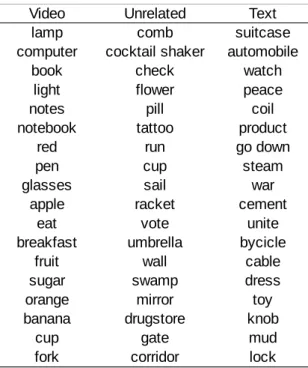
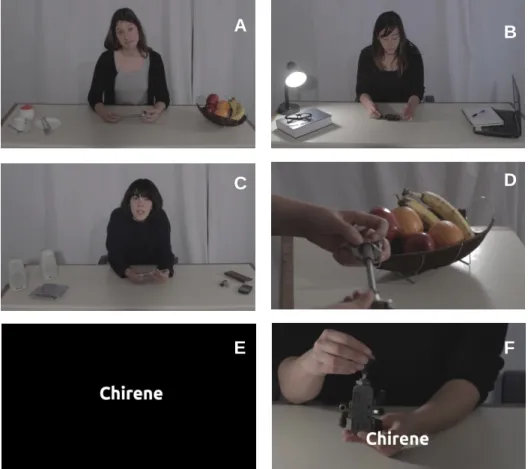
(33) them. We decided that words in each set could not overlap, so we excluded words mentioned for both objects. Words pointing at physical features such as color, weight, and sound were also excluded because we considered them as reflecting too general properties potentially shared by many other objects. We obtained 19 object-related words for one object and 20 for the other one. Once defined these two set of words, we conducted a behavioral pilot with 15 undergraduates following the same protocol that participants would later on follow during the EEG experiment. These undergraduates were presented the two set of object-related words and another one belonging to the Co-textual Condition, besides fillers. By inspecting RTs, we finally selected 15 targets per condition. Selected targets ranged from 2 to 4 syllables. They belonged to different semantic domains and part of speech. They collapsed both animate and inanimate words (one of the objects strongly evoked an insect, while the other one highly evoked a blender and some other kitchenware, Fig. 1). Targets for each object also belonged to different categories (see supplementary material, S1). Care was taken to balance words related to both objects considering syllable length and word frequency in Chilean Spanish (Sadowsky & Martinez, 2012). This inductive procedure granted targets an ecological validity, since they were not chosen arbitrarily but carefully selected after a sample of undergraduates encountered the objects and handled them in the same way participants would subsequently do in the laboratory. However, this strongly impacted on the number of possible targets per condition. We set at 15 the maximum amount of targets that could reasonably be considered as physically related to a given object. A higher number of targets, although desirable for an ERP experiment, might have introduced unwanted confounds.. 9.
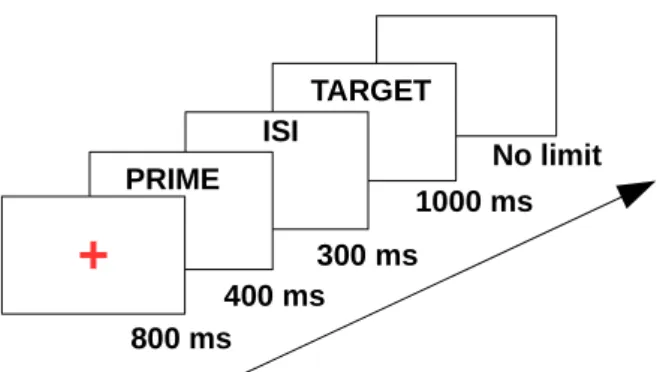
(34) As for “linguistic” targets, a 491-word length text was elaborated and chirene was defined as a mechanical part used in industrial engines (supplementary material, S2). This text was used to supply students with a plausible “knowledge network” for the newly encountered pseudoword. It was carefully designed not to include any of the words previously selected as object-related. Eight undergraduates were asked to read the text and afterward annotate 10 words they recalled the most, which helped in selecting the 15 targets finally included in this condition (both syllable structure and word frequency in this condition were balanced to match obejct-related targets). Since these words were only linked to the pseudoword by virtue of their co-occurrence in the text, this condition was operationally regarded as co-textual. Filler/target ratio was 2:1.. 2.3. Procedure. All participants performed the task in the same order. Once the montage was completed, they were asked to blindly manipulate the assigned object. Then, they were asked to handle it and visually inspect it. After having physically perceived and freely handled the newly encountered object, participants were given the text, which provided them with a name for the object (chirene) and explained what it was. Upon reading the text, all participants received the same on-screen instructions, followed by some rehearsal trials in which none of the targets or fillers were used. These instructions made clear that word-pairs would be presented. Every word-pair was to be introduced by a red cross. The task would consist of determining, on a self-paced basis, whether the second word in each pair had been mentioned in the previously read text or not. Sequence for each trial was: fixation point (800 ms), prime (400 ms), ISI (300 ms), and target (1000 ms) (see Fig. 2). Targets were always preceded by chirene, while fillers were always preceded by some other pseudoword. Considering both fillers and targets, the ratio between words mentioned in the text and words not mentioned in the text was 1:1. To observe how the expected effects evolved in time, participants performed the task three 10.
Figure
+2
Documento similar
Products Management Services (PMS) - Implementation of International Organization for Standardization (ISO) standards for the identification of medicinal products (IDMP) in
Products Management Services (PMS) - Implementation of International Organization for Standardization (ISO) standards for the identification of medicinal products (IDMP) in
This section provides guidance with examples on encoding medicinal product packaging information, together with the relationship between Pack Size, Package Item (container)
La recuperación histórica de la terciaria dominica sor María de Santo Domingo en los últimos años viene dada, principalmente, por causa de su posible influjo sobre personajes
El Tratado de Maastricht introduce como elemento fundamental de la Unión Europea la cooperación en los ámbitos de la justicia y en los asuntos de interior (JAI) y establece la doble
El nuevo Decreto reforzaba el poder militar al asumir el Comandante General del Reino Tserclaes de Tilly todos los poderes –militar, político, económico y gubernativo–; ampliaba
6 Para la pervivencia de la tradición clásica y la mitología en la poesía machadiana, véase: Lasso de la Vega, José, “El mito clásico en la literatura española
De hecho, este sometimiento periódico al voto, esta decisión periódica de los electores sobre la gestión ha sido uno de los componentes teóricos más interesantes de la
