Accepted Manuscript
Determination of halides using Ag nanoparticles-modified disposable electrodes. A first approach to a wearable sensor for quantification of chloride ions
J. Bujes-Garrido, D. Izquierdo-Bote, A. Heras, A. Colina, M.J. Arcos-Martínez
PII: S0003-2670(18)30168-5 DOI: 10.1016/j.aca.2018.01.063 Reference: ACA 235710
To appear in: Analytica Chimica Acta
Received Date: 17 July 2017 Revised Date: 24 January 2018 Accepted Date: 27 January 2018
Please cite this article as: J. Bujes-Garrido, D. Izquierdo-Bote, A. Heras, A. Colina, M.J. Arcos-Martínez, Determination of halides using Ag nanoparticles-modified disposable electrodes. A first approach to a wearable sensor for quantification of chloride ions, Analytica Chimica Acta (2018), doi: 10.1016/ j.aca.2018.01.063.
M
AN
US
CR
IP
T
AC
CE
PT
ED
Ag nanoparticles
Halide
solution
LSV
Potential
Pe
ak
cu
rre
nt
Pe
ak
cu
rre
nt
Halide concentration
Ag
0AgX + e
-M
AN
US
CR
IP
T
AC
CE
PT
ED
1
DETERMINATION OF HALIDES USING Ag
NANOPARTICLES-MODIFIED DISPOSABLE
ELECTRODES. A FIRST APPROACH TO A WEARABLE
SENSOR FOR QUANTIFICATION OF CHLORIDE IONS.
J. Bujes-Garrido, D. Izquierdo-Bote; A. Heras, A. Colina, M. J. Arcos-Martínez*
Department of Chemistry. Faculty of Sciences. University of Burgos.
Plaza Misael Bañuelos s/n, 09001 Burgos, Spain, *[email protected]
Abstract
This work reports a simple voltammetric method for the determination of chloride,
bromide, and iodide ions using screen-printed carbon electrodes modified with silver
nanoparticles electrochemically deposited on the working electrode surface. UV/Vis absorption
spectroelectrochemistry was used to study the electrodeposition of silver nanoparticles on the
working carbon electrode on PET or Gore-Tex® supports, and their subsequent oxidation in the
presence of halide ions.
The main figures of merit of the developed sensors, such as reproducibility and detection
limit, have been calculated. Reproducibility values of 2.22%, 2.83% and 3.23% were obtained
for chloride, bromide and iodide determinations, respectively. Additionally, the lowest detected
amount of chloride, bromide and iodide ions were 3.0·10-6 M, 5.0·10-6 M and 5.0·10-6 M,
respectively.
Taking into account the relevance of the determination of chloride ion concentration in
sweat, the voltammetric method for the determination of halides has been successfully
transferred to a Gore-Tex® support to build a first approach to a wearable sensor that facilitates
the quantification of this ion in sweat samples. The Gore-Tex® sensor provides a good
M
AN
US
CR
IP
T
AC
CE
PT
ED
2
Keywords: Halide ions electrochemical determination; Wearable screen-printed sensors;
UV/Vis absorptometric spectroelectrochemistry; Silver nanoparticles; Sweat analysis.
1.
Introduction
Halide ions are present in a number of industrial, medical, and environmental processes,
playing in most cases an essential role. Therefore, the selective determination of halide ions is
significant for monitoring both excessive and deficient concentration levels in natural resources,
which can result in different types of pollution and, even, of physiological disorders. For
example, cystic fibrosis, acid−base disorders and high blood pressure [1, 2] can be diagnosed by
measuring the chloride level in biological systems. Cystic fibrosis (CF) is a common chronic
disease one of whose symptoms is related to a high level of chloride in sweat. Thus, the gold
standard laboratory test for the diagnosis of CF, along with a genetic analysis is considered the
chloride measurement in sweat (sweat test) [3-5].
A number of strategies have been proposed for the determination of halide ions in the
environment or in physiological systems, including ion chromatography [6-8], coulometric
titrations [9], or spectrometry [10]. Electrochemical analysis also presents a favorable scenario
for determining halide ions in biological samples [11]. The most frequently used potentiometric
methods were those based on ion selective electrodes [1, 12-20].
In recent years, the substitution of traditional electrodes by new disposable screen-printed
electrodes (SPEs) has emerged as an interesting alternative for these determinations with many
advantages, such as high sensitivity and selectivity, simplicity and lower costs, as well as the
possibility of performing “in situ” analysis. The use of this kind of sensors is scarcely found in
the literature for the determination of halide ions in biological samples [21-25]. In addition,
electrochemical screen-printed sensors can be considered as promising wearable chemical
sensors suitable for diverse applications due to their high performance, inherent miniaturization
M
AN
US
CR
IP
T
AC
CE
PT
ED
3
Medical interest for on-body wearable systems arises from the need to monitor patients
over long periods of time. As a result, there has been a significant increase in sweat analysis in
recent years because it is a non-invasive way of monitoring fluids and electrolyte loss by elite
athletes during sport events (rehydration optimization) [27]. This kind of sensors can be used to
improve the clinical management of certain pathologies such as CF, for which monitoring pH,
chloride and sodium ion concentration can provide valuable information about this disease
[28-30].
In a previous work, it was proved that some textile such as Gore-Tex®, is a suitable
material as electrodic support to develop screen printed sensors. In fact, a disposable sensor was
developed to determine chloride ion [31]. The namely sensor was based on a completely
different approach than the sensor proposed in this work. Thus, in that previous work, the
Nernstian shift of the voltammetric peak of a control compound, such as ferrocenemethanol,
was measured to determine chloride ions, but the sensitivity was rather poor in comparison with
the new methodology. Now, we introduce the development of a more sensitive disposable
Gore-Tex® sensor based on the oxidation of silver nanoparticles in presence of chloride ions, which
takes into account the strong interaction of chloride and silver ions. Regarding chloride
determination in sweat samples, to the best of our knowledge, no wearable sensors have been
previously described, and therefore, the proposed device could be considered as a first approach
to a wearable sensor to determine the chloride ion concentration in synthetic sweat samples.
Integrating a circuit into the sensor (lab on a chip), the new sensor could be applied to obtain an
early diagnosis of CF disease in a near future.
Moreover, in order to better understand the electrochemical process, a deeper study of the
electrochemical behavior of different halide compounds was carried out using carbon working
electrodes (SPCEs) modified with silver nanoparticles (AgNP). In addition, a
spectroelectrochemical study was performed to shed more light on the electrochemical
processes that take place during the detection of halides [32], as well as on the influence of the
M
AN
US
CR
IP
T
AC
CE
PT
ED
4
2.
Experimental
2.1 Reagents and solutions
All the chemicals were of analytical grade and were used as received without further
purification. High-quality water (Milli Q A10 system, Millipore, Bedford, USA) was employed
for preparing all solutions.
KCl and NaCl were provided by Sigma-Aldrich (Steinheim, Germany). KBr, KI, KNO3,
AgNO3, NaH2PO4 and urea were purchased from Merck (Darmstadt, Germany). NaHCO3,
NaNO3, CaCl2, MgCl2, and lactic acid (85%) were supplied from Panreac (Barcelona, Spain).
Synthetic sweat sample was prepared according to a Stefaniak and Harvey research [33].
The used sample was a mixture of bicarbonate 3.0 ·10-3 mol L-1, phosphate 2.3·10-5 mol L-1,
Mg2+ 8.2·10-5 mol L-1, K+ 6.1 10-3 mol L-1, Ca2+ 4.7 10-6 mol L-1, Na+ 3.1·10-2 mol L-1, Cl- 2.3·10
-2
mol L-1, urea 1.0·10-2 mol L-1 and lactate 1.4·10-2 mol L-1.
C10903P14 (carbon ink) and D2071120D1 (dielectric ink) were purchased from Gwent
Electronic Materials (Torfaen, U.K). Electrodag 6037 SS (Ag/AgCl ink) and Electrodag 418
(Ag ink) were supplied by Acheson Colloiden (Scheemda, The Netherlands).
3-Layer Gore-Tex® laminate Waterproof Breathable Ripstop Nylon Fabric was supplied
by Rockywoods (Loveland, USA).
2.2 Apparatus
Electrochemical measurements were performed with a µAutolab electrochemical system with GPES software package to control the instrument, register and perform the analysis of
M
AN
US
CR
IP
T
AC
CE
PT
ED
5
Spectroelectrochemical experiments were carried out using a PGSTAT 302N potentiostat
(Eco Chemie B.V., Utrecht, The Netherlands) coupled to a QE65000 spectrometer (Ocean
Optics, Florida, USA). The light beam, supplied by a DH-2000 deuterium-halogen light source
(Ocean Optics, Florida, USA), was both guided to, and collected from the working electrode
surface of the SPCEs by a reflection probe (FCR-7UV200-2-1.5X1SR, Avantes, Apeldoorn,
The Netherlands).
2.3 Sensor manufacturing
Home-made SPEs used in this work consist of a carbon working electrode (SPCE, area of
12.56 mm2), a carbon counter electrode and a silver/silver chloride pseudoreference electrode.
The carbon ink was used in the conductive paths of SPEs. These electrodes were produced on a
DEK 248 printing machine (DEK, Weymouth, UK) using polyethylene terephthalate (PET) of
500 µm thickness or Gore-Tex® as supports, according to the procedure described elsewhere
[34]. Both supports were pre-heated to 120 ºC for 1 hour before the printing process.
2.4 Silver nanoparticles modified SPCEs preparation and characterization
The working electrode surface was electrochemically modified with AgNP according
with the method described in the literature [35].
When analysing the behavior of halides by voltammetric and spectroelectrochemical
techniques, AgNP were electrodeposited using chronoamperometry under the following
conditions: applying -1.20 V vs screen-printed Ag/AgCl electrode during 20 s in a 200 µL drop of 10-4 M AgNO3 prepared in Britton Robinson buffer, pH 2. After the electrodeposition
process, AgNP modified SPCEs (AgNP-SPCEs) were thoroughly washed with Milli-Q water.
Meanwhile, when analyzing synthetic sweat sample (Section 3.3), AgNP were
electrodeposited using chronoamperometry under the following conditions: applying -1.20 V vs
M
AN
US
CR
IP
T
AC
CE
PT
ED
6
Britton Robinson buffer, pH 2. After the electrodeposition process, AgNP modified SPCEs
(AgNP-SPCEs) were thoroughly washed with Milli-Q water.
2.5 Voltammetry measurements
Linear sweep voltammetry (LSV) experiments were recorded between -0.20 V and +0.60
V (vs. a screen printed Ag/AgCl pseudoreference electrode), in a 200 µL droplet of the sample placed onto the surface of the electrode system. The sample droplet contains chloride, bromide
or iodide ions, depending on the studied system, and KNO3 0.01 M. as supporting electrolyte.
The scan rate was 0.01 V s-1 and the step potential was 0.005 V.
2.6 Spectroelectrochemical measurements
Spectroelectrochemical experiments were performed in a near-normal reflection
arrangement. For this purpose, a reflection probe was placed in the drop, perpendicular to the
electrode surface, for the spectroscopic measurements. This optical configuration allows us to
follow the spectroscopic changes that take place on the electrode surface during the
electrochemical experiments that were performed in a 200 µL drop containing chloride ion and
KNO3 using the same parameters than in the LSV experiments. Absorbance data from all
spectroelectrochemical experiments were calculated taking as reference spectrum the one at the
starting potential of each individual experiment.
3.
Results and discussion
The presence of AgNP on the working electrode surface is very useful for determining
halides because the oxidation of AgNP can be used to generate silver halides on the electrode
surface, according with the procedure described above in section 2.4. Thus, in this work, the
working SPCE was modified with AgNP in order to develop a sensor that allows us the
M
AN
US
CR
IP
T
AC
CE
PT
ED
7
When halide ions were not present in the sample, a single voltammetric peak was
obtained due to the oxidation from AgNP to silver (I) ions. However, in the presence of halides,
two overlapped voltammetric peaks were obtained, the first one due to silver halides formation
on the electrode surface, and the second one due to oxidation from AgNP to silver cations [21]
(Figure 1).
There is a different trend in the interaction between silver cations and halide ions. In fact,
the oxidation of the different silver halides performed by linear voltammetry suffers a potential
shifting to positive values according to the electronegativity of the halides. The higher the
electronegativity of the halide, the higher the ionic character of the bond, and consequently, the
higher the solubility. This relationship is determined by the solubility product constant (Ksp). Ksp
values at 25 ºC of silver chloride, silver bromide and silver iodide are 1.8 10-10, 5.0 10-13 and 8.3
10-17 mol2 L-2 respectively. Therefore, the smaller the Ksp, the stronger the interaction between
the silver and the halide anions. In consequence, as can be seen in Figure 1, anodic
voltammetric peaks of the different halides emerge at higher overpotentials for the highest
soluble silver halide: +0.10 V for silver chloride, +0.05 V for silver bromide, and -0.18 V for
silver iodide (Figure 1), confirming the different trend of chloride, bromide and iodide to form
silver halides.
Moreover, Figure 1 shows that the second oxidation peak in the overlapped signal, which
is related to the oxidation of AgNP to silver (I), exhibits different height depending on the
studied halide. In the case of silver chloride, the most soluble halide, the height of the second
peak is the highest compared to those of the other halides. This fact can be related to the
solubility product constant. Thus, the higher the Ksp, the higher the current peak of the second
process that is related to the oxidation of nanoparticles. This result is consistent with the higher
solubility of silver chloride regarding the other silver halides, taking into account that in a
chloride medium there is a larger amount of Ag(I) in solution.
In fact, when the halide concentration increases, this second anodic peak becomes smaller
M
AN
US
CR
IP
T
AC
CE
PT
ED
8
chosen as a proof of concept to illustrate the redissolution of AgNP due to the fact that iodide
solutions show the greatest difference between the two anodic peaks, allowing a clear
observation of the phenomenon. When silver halide peak increases in the LSV experiment,
Ag(0)/Ag(I) oxidation peak decreases (Figure 2.a). The presence of the halide ions encourages
the silver halide formation to a greater extent than the oxidation of Ag(0) to Ag(I) because a
lower oxidation potential was required [21]. This behavior can be observed for the three halides
at the different concentrations. In the limit case, the halide concentration is so high that all
AgNP are involved in the generation of silver halide, and the second anodic peak is not
observed because there are no more AgNP.
It is also remarkable that the difference of potential between the first and the second
oxidation processes depends on the halide present in solution [24]. Thus, the lower the solubility
product constant, the higher the difference in the oxidation peak potentials between the two
oxidation processes.
3.1 UV/Vis absorption spectroelectrochemistry study using PET sensors.
A UV/Vis absorptometric spectroelectrochemistry study was carried out in order to obtain
a better understanding of the electrochemical process described above. In this way, the
electrochemical signal is completely related to the evolution of the absorbance bands in the
UV/Vis spectra.
First, the modification of SPCEs with AgNP was followed by UV/Vis absorption
spectroelectrochemistry in a near-normal arrangement. Figure 3 shows the spectra evolution
obtained concomitantly with AgNP electrochemical deposition. During the first 4 s, an almost
flat band is observed, that can be related to the generation of small clusters in the beginning of
the experiment. This band evolves to the typical AgNP plasmon band, centered at 420 nm,
related to the generation of polydispersed AgNP [37].
Once AgNP are deposited on the electrode surface, a linear sweep voltammogram was
M
AN
US
CR
IP
T
AC
CE
PT
ED
9
halide ions. Figure 4a shows the spectra between 250 and 800 nm registered during this
electrochemical experiment, selecting some significant potential and taking the AgNP spectrum
as reference spectrum for chloride ions. Each UV/Vis spectrum was taken every 200 ms. Two
absorbance bands evolve during the experiment, one centered at 385 nm and the other centered
at 550 nm. We can rationalize these bands in terms of the two phenomena described above: 1)
generation of silver chloride on the AgNP surface and 2) oxidation of AgNP to generate Ag(I).
The voltabsorptograms at these two significant wavelengths, 385 and 550 nm, plotted together
with the voltammogram indicated that the optical signal fully deconvolves the electrochemical
process (Figure 4b).
The absorbance at 385 nm starts to increase concomitantly with the first oxidation peak in
the LSV, indicating the formation of the AgCl on the NPs surface. Absorbance at this
wavelength achieves a constant value after this first oxidation peak, suggesting that AgCl covers
the AgNP surface. However, absorbance at 550 nm decreases at potentials related to the second
overlapped oxidation peak, indicating the reoxidation of the AgNP electrodeposited on the
carbon electrode surface, process that occurs at higher potentials. Thus, the optical signal
confirms that first silver cations generated during the oxidation of the AgNP precipitate
instantaneously as silver chloride due to the chloride present in the solution, and once it is
covered by AgCl, the redissolution of the nanoparticles occurs.
Spectroelectrochemistry also confirms the behavior observed at high halide
concentrations shown in Fig. 2a for iodide. Voltabsorptograms of the AgNP oxidation in
presence of different KI concentrations, 5 µM, 20 µM, 40µM and 80 µM (Figure 2.b), show the evolution of the absorbance at 385 nm. At the lower iodide concentrations, two different steps
can be clearly observed in the voltabsorptogram, one around -0.20 V that is related with the
silver halide formation, and the other one around +0.15 V due to the oxidation of AgNP to
Ag(I). In the first redissolution of AgNPs, around -0.20 V, absorbance at 385 nm increases
continuously due to the iodide diffusion until the second oxidation potential is reached. At
M
AN
US
CR
IP
T
AC
CE
PT
ED
10
different slope than in the first oxidation step, reaching a constant value when the AgNPs are
fully oxidized to Ag(I). For the highest iodide concentration, 80 µM (purple line), the absorbance at 385 nm starts to grow at -0.20 V, reaching a maximum and constant absorbance
value after the first anodic peak, around -0.1 V, because of the complete consumption of all
AgNP deposited on the surface.
3.2 Spectroelectrochemistry measurements using Gore-Tex® sensors
In a previous study [31], it was proved the good properties of Gore-Tex® as substrate for
SPEs, but the possibility of electrodepositing AgNP by using this backing support was not
explored. Thereby, Gore-Tex® electrochemical sensors have been developed by depositing
AgNP onto the working electrode surface and performing LSV in order to determine the
chloride concentration following the procedure described above. To carry out a more complete
study of the Gore-Tex® sensors, UV/Vis absorption spectroelectrochemistry measurements
were performed. For this purpose, the same experiments performed in the PET substrate were
carried out using the Gore-Tex® substrate. The UV/Vis absorption spectra obtained during the
AgNP electrodeposition on the wearable sensor are very similar to the spectra shown in Figure 3
registered on a PET screen printed electrode. However, absorbance values are lower because the
spectroscopic signal of the wearable sensor is affected by the roughness of the backing material
since Gore-Tex® surface is rougher than PET surface.
LSV experiments were carried out from -0.20 V to +0.60 V at 0.01 V s-1 and the
spectroscopic signal was simultaneously obtained. The voltammetric signals show a similar
behavior with respect to the one performed on the PET sensor exhibiting the same peak
potential, confirming that the backing material where the electrode system is printed does not
modify the electrochemical signal qualitatively.
Moreover, Figure 5 shows the derivative voltabsorptogram at 385 nm together with the
M
AN
US
CR
IP
T
AC
CE
PT
ED
11
spectroscopic signal is completely related to the oxidation process observed in the LSV
experiment.
3.3 Electrochemical determination of halide ions using PET sensors
Following the procedure described above, once AgNP were electrodeposited onto the
working electrode surface, the electrochemical sensor was ready for determining the
concentration of the halide in solution by LSV.
The concentration of the halides in the solution is related to the silver halides formed on
the electrode surface. A linear relationship was found between the height of the first anodic peak
and the halide concentrations, allowing us to quantify the halide ions, even for the chloride case,
where the two peaks are in close proximity, but the first peak can be used to obtain a good
chloride determination as can be deduced from the figures of merit shown below.
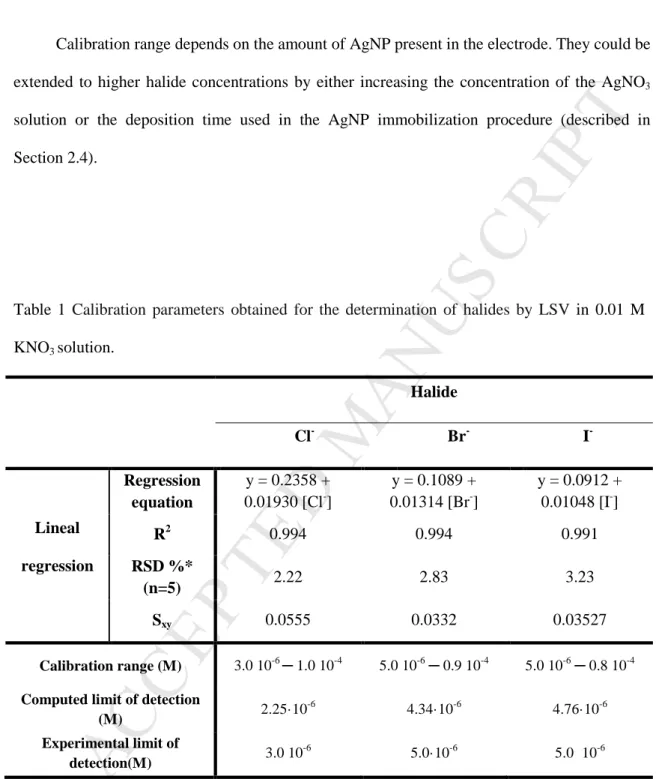
Calibration standards were prepared by spiking known concentrations of each halide in a
0.01 M KNO3 solution and calibration curves were built by taking the average of 5
measurements for each concentration, in the calibration range shown in Table 1.
In order to characterize the analytical method, the reproducibility was calculated by
taking the average of the RSD values obtained from the 5 intensities measured using different
sensors for each concentration (Figure 6). Outliers were detected by using PROGRESS program
[38], which uses an algorithm based on a least median square (LMS) regression. Once, these
outliers points were removed from the calibration set, ordinary least square (OLS) regressions
were built with the remaining points. Sensitivity values, obtained from the slope of the
regressions are shown in Table 1and the good reproducibility of the method is supported by the
RSD values obtained.
Additionally, the detection limit of the analytical method was obtained for a given
probability of false positive (α) and negative (β) of 0.05 [39, 40]. The minimum detectable
M
AN
lowest calibration standard values. Thus, the latter values were taken as average detection limits
from an analytical point of view.
Calibration range depends on the amount of AgNP present in the electrode. They could be
extended to higher halide concentrations by either increasing the concentration of the AgNO3
M
AN
US
CR
IP
T
AC
CE
PT
ED
13
3.4. Application to synthetic sweat samples using Gore-Tex® electrochemical
sensors
In order to check the performance of the chloride sensors, a synthetic sweat sample was
analyzed by using Gore-Tex® sensors. First, a calibration curve was built.
As in the PET substrate sensors, once the Gore-Tex® sensors were modified with AgNP,
200 µL drops of sample with different concentrations of chloride ion were placed on the
electrode surface and LSV was performed. A linear relationship between the height of the first
oxidation peak and the chloride ions concentration was obtained. The calibration range was
from 0.005 M to 0.06 M and the slope value of this regression was 292.2 µA·M-1. Precision was
calculated, in the same way as at PET sensors, obtaining a RSD value of 1.61 %.
Once the calibration curve was obtained, a droplet of synthetic sweat sample was placed
on the electrode surface and immediately a voltammetric measurement was performed. Next,
the height of the oxidation peak was interpolated in the previously built calibration curve and
the chloride concentration of the synthetic sweat sample was calculated from the corresponding
linear regression. Thus, the chloride concentration was 0.024±0.009 M using the Gore-Tex®
sensor. The detected value is in good agreement with the value of chloride content in sweat
samples (0.023 M). Therefore, from these results, we conclude that the developed method is
both precise and suitable for the analysis of chloride ions.
4.
Conclusions
Given the relevance of wearable electrochemical sensors, a Gore-Tex® screen printed
voltammetric sensor has been developed for the determination of chloride ions by modifying the
working electrode with AgNP. The selectivity of the sensor, which also showed excellent
reproducibility (RSD=1.61 %), makes it an appropriate option for monitoring the chloride
concentration in sweat.
The development of this new chloride test, which is based on a low cost, non-invasive,
M
AN
diagnosis of, for instance, cystic fibrosis. This first approach to a wearable electrochemical
sensor is flexible, comfortable, and biocompatible. Therefore, it could be made commercially
available for continuous health monitoring through contact with the human body. This might be
done using a circuit integrated on a single chip to develop an electrochemical system capable of
measuring, collecting data and processing the information. Sweat storage would not be required
since the sweat would be continually available using some substances as pilocarpine to induce
it. Moreover, the presence of AgNP in this sensor gives it antimicrobial properties.
Spectroelectrochemistry was a key tool for obtaining more complete information about
the changes on the electrode surface, helping to confirm the processes involved in both the
AgNP generation and the reoxidation of silver in the presence of halides.
Acknowledgements
Authors would like to acknowledge funding obtained through the Spanish Ministry of
Science and Innovation (MICINN), Ministry of Economy and Competitiveness (MINECO) and
the European Regional Development Fund (FEDER) (TEC20013-40561-P and MUSSEL
RTC-2015-4077-2)
References
[1] F. Faridbod, M.R. Ganjali, R. Dinarvand, P. Norouzi, Developments in the field of conducting and non-conducting polymer based potentiometric membrane sensors for ions over the past decade, Sensors, 8 (2008) 2331-2412.
[2] F. Qu, N.B. Li, H.Q. Luo, Polyethyleneimine-Templated Ag Nanoclusters: A New Fluorescent and Colorimetric Platform for Sensitive and Selective Sensing Halide Ions and High Disturbance-Tolerant Recognitions of Iodide and Bromide in Coexistence with Chloride under Condition of High Ionic Strength, Analytical Chemistry, 84 (2012) 10373-10379.
[3] C. Vazquez Cordero, Diagnosis of cystic fibrosis, Anales Espanoles de Pediatria, 50 (1999) 431-438.
M
AN
applications and promising future in metabolomics, Journal of Pharmaceutical and Biomedical Analysis, 90 (2014) 139-147.[6] C. Villagrán, M. Deetlefs, W.R. Pitner, C. Hardacre, Quantification of Halide in Ionic Liquids Using Ion Chromatography, Analytical Chemistry, 76 (2004) 2118-2123. [7] F. Hao, P.R. Haddad, T. Ruther, IC determination of halide impurities in ionic liquids, Chromatographia, 67 (2008) 495-498.
[8] T.K. Malongo, S. Patris, P. Macours, F. Cotton, J. Nsangu, J.M. Kauffmann, Highly sensitive determination of iodide by ion chromatography with amperometric detection at a silver-based carbon paste electrode, Talanta, 76 (2008) 540-547.
[9] E. Cotlove, H.H. Nishi, Automatic titration with direct read-out of chloride concentration, Clinical chemistry, 7 (1961) 285-291.
[10] L.C. Gilday, N.G. White, P.D. Beer, Triazole- and triazolium-containing porphyrin-cages for optical anion sensing, Dalton Transactions, 41 (2012) 7092-7097. [11] K. Arai, F. Kusu, N. Noguchi, K. Takamura, H. Osawa, Selective determination of chloride and bromide ions in serum by cyclic voltammetry, Analytical Biochemistry, 240 (1996) 109-113.
[12] J.N. Babu, V. Bhalla, M. Kumar, R.K. Mahajan, R.K. Puri, A chloride selective sensor based on a calix[4]arene possessing a urea moiety, Tetrahedron Letters, 49 (2008) 2772-2775.
[13] B.J. Sucman E., Determination of chlorides in foods using ion-selective electrodes: A review, Canadian journal of analytical sciences and spectroscopy, 47 (2002) 5.
[14] K.G. Kumar, K.S. John, C.J. Indira, A chloride ion-selective potentiometric sensor based on a polymeric Schiff base complex, Indian Journal of Chemical Technology, 13 (2006) 13-16.
[15] E. Bakker, Y. Qin, Electrochemical sensors, Analytical Chemistry, 78 (2006) 3965-3983.
[16] V.K. Gupta, Potentiometric sensors for inorganic anions based on neutral carriers, Arab. J. Sci. Eng., 35 (2009) 7-25.
[17] W.J. Warwick, L. Hansen, Measurement of chloride in sweat with the chloride-selective electrode, Clinical Chemistry, 24 (1978) 2050-2053.
[18] A.W.M. Sweetsur, An ion-selective electrode method for the determination of chloride in milk, The Analyst, 99 (1974) 690-692.
[19] T.V. Shishkanova, D. Sýkora, J.L. Sessler, V. Král, Potentiometric response and mechanism of anionic recognition of heterocalixarene-based ion selective electrodes, Analytica Chimica Acta, 587 (2007) 247-253.
[20] C.Y. Cheng, Z.M. Huang, W.Y. Chung, D.G. Pijanowska, M. Dawgul, Development of Polymeric Resin Ion-exchanger Based Chloride Ion-selective Electrode for Monitoring Chloride Ion in Environmental Water, Journal of the Chinese Chemical Society, 59 (2012) 122-131.
[21] H.S. Toh, C. Batchelor-Mcauley, K. Tschulik, R.G. Compton, Electrochemical detection of chloride levels in sweat using silver nanoparticles: A basis for the preliminary screening for cystic fibrosis, Analyst, 138 (2013) 4292-4297.
[22] G. Colovos, G.S. Wilson, J.L. Moyers, Simultaneous determination of bromide and chloride by cathodic stripping voltammetry, Analytical Chemistry, 46 (1974) 1051-1054.
M
AN
biological samples, Biosensors and Bioelectronics, 24 (2009) 3008-3013.[25] H.S. Toh, K. Tschulik, C. Batchelor-Mcauley, R.G. Compton, Electrochemical quantification of iodide ions in synthetic urine using silver nanoparticles: A proof-of-concept, Analyst, 139 (2014) 3986-3990.
[26] J.R. Windmiller, J. Wang, Wearable Electrochemical Sensors and Biosensors: A Review, Electroanalysis, 25 (2012) 29-46.
[27] R.M. Morgan, M.J. Patterson, M.A. Nimmo, Acute effects of dehydration on sweat composition in men during prolonged exercise in the heat, Acta Physiologica Scandinavica, 182 (2004) 37-43.
[28] G. Matzeu, L. Florea, D. Diamond, Advances in wearable chemical sensor design for monitoring biological fluids, Sensors and Actuators, B: Chemical, 211 (2015) 403-418.
[29] S. Anastasova, B. Crewther, P. Bembnowicz, V. Curto, H.M. Ip, B. Rosa, G.Z. Yang, A wearable multisensing patch for continuous sweat monitoring, Biosensors and Bioelectronics, 93 (2017) 139-145.
[30] J. Kim, R. Kumar, A.J. Bandodkar, J. Wang, Advanced Materials for Printed Wearable Electrochemical Devices: A Review, Advanced Electronic Materials, 3 (2017).
[31] J. Bujes-Garrido, M.J. Arcos-Martínez, Development of a wearable electrochemical sensor for voltammetric determination of chloride ions, Sensors and Actuators B: Chemical, 240 (2017) 224-228.
[32] T. Kuwana, Electrochemical studies using conducting glass indicator electrodes, Analytical Chemistry, 36 (1964) 2023-2025.
[33] C.J. Harvey, R.F. LeBouf, A.B. Stefaniak, Formulation and stability of a novel artificial human sweat under conditions of storage and use, Toxicology in Vitro, 24 (2010) 1790-1796.
[34] M.A. Alonso-Lomillo, C. Yardimci, O. Domínguez-Renedo, M.J. Arcos-Martínez, CYP450 2B4 covalently attached to carbon and gold screen printed electrodes by diazonium salt and thiols monolayers, Analytica Chimica Acta, 633 (2009) 51-56. [35] O.D. Renedo, M. Julia Arcos Martínez, A novel method for the anodic stripping voltammetry determination of Sb(III) using silver nanoparticle-modified screen-printed electrodes, Electrochemistry Communications, 9 (2007) 820-826.
[36] R. Zhang, S. Xu, Y. Zhu, J. Luo, X. Liu, D. Tang, One-pot facile preparation of Ag nanoparticles for chloride ion sensing, Colloid and Polymer Science, 294 (2016) 1643-1649.
[37] S.W. Lee, S.H. Chang, Y.S. Lai, C.C. Lin, C.M. Tsai, Y.C. Lee, J.C. Chen, C.L. Huang, Effect of temperature on the growth of silver nanoparticles using plasmon-mediated method under the irradiation of green LEDs, Materials, 7 (2014) 7781-7798. [38] P.J. Rousseeuw, Robust Regression and Outlier Detection, John Wiley and sons, 1989.
[39] J. Inczédy, T. Lengyel, A.M. Ure, A. Geléncsér, A. Hulanicki, Compendium of Analytical Nomenclature, 3rd ed., Port City Press Inc, Baltimore, 2000.
M
AN
US
CR
IP
T
AC
CE
PT
ED
17
FIGURE CAPTIONS
Fig 1: Linear sweep voltammograms recorded from -0.40 to +0.60 V in 0.01 M KNO3
(magenta line) and in presence of 80 µM of iodide ion (green line), bromide ion (red line) or
chloride ion (blue line). Scan rate = 0.01 V s-1. Electrodic system printed in PET support.
Fig 2; a) LSV performed from -0.30 V and +0.30 V in 0.01 M KNO3 in presence of
increasing concentrations of KI. (Scan rate = 0.01 V·s-1). b) Voltabsorptograms at 385 nm and
registered from -0.35 V to +0.35 V in KNO3 0.01 M in presence of increasing concentrations of
KI. Scan rate = 0.01 V·s-1.
Fig 3: Spectra evolution during AgNP generation applying -1.20 V vs Ag/AgCl SPE
during 20 s in a solution 10-4 M AgNO3, prepared in Britton Robinson buffer. Electrodic system
printed in PET support.
Fig 4: a) UV-Visible spectra registered during LSV experiment, b) Comparison of the
voltabsorptograms at 385 nm (blue line) and at 550 nm (green line) with the LSV experiment
performed in 0.01 M KNO3 in presence of 30 µM chloride ion. Scan rate = 0.01 V·s -1
.
Electrodic system printed in PET support.
Fig 5: Comparison between derivative voltabsorptogram at 385 nm and LSV.
Experiment performed in 0.01 M of KNO3 in presence of 30 µM of chloride ion. Scan rate =
0.01 V·s-1. Electrodic system printed in Gore-Tex® support.
Fig 6: Calibration curve for the determination of halides. Linear regressions between
M
AN
US
CR
IP
T
AC
CE
PT
ED
18
halides formation against the concentration of the halide ions. Each data point is the mean of
M
AN
US
CR
IP
T
AC
CE
PT
ED
19
M
AN
US
CR
IP
T
AC
CE
PT
ED
20
Figure2:
a)
M
AN
US
CR
IP
T
AC
CE
PT
ED
21
M
AN
US
CR
IP
T
AC
CE
PT
ED
22 Figure 4:
a)
M
AN
US
CR
IP
T
AC
CE
PT
ED
23 Figure 5:
M
AN
US
CR
IP
T
AC
CE
M
AN
US
CR
IP
T
AC
CE
M
AN
US
CR
IP
T
AC
CE
M
AN
US
CR
IP
T
AC
CE
M
AN
US
CR
IP
T
AC
CE
M
AN
US
CR
IP
T
AC
CE
M
AN
US
CR
IP
T
AC
CE
M
AN
US
CR
IP
T
AC
CE
M
AN
US
CR
IP
T
AC
CE
PT
ED
Highlights
• Voltammetric screen-printed electrodes to halide ions determination by modifying the working electrode with AgNP.
• New, simple and flexible and biocompatible Gore-Tex® wearable
electrochemical sensor for voltammetric determination of chloride ions.
• Spectroelectrochemistry monitors the electrodeposition and redissolution processes.