General Synthesis of Alkenyl Sulfides by Palladium-Catalyzed
Thioetherification of Alkenyl Halides and Tosylates
Noelia Velasco, Cintia Virumbrales, Roberto Sanz, Samuel Suárez-Pantiga* and Manuel A.
Fernández-Rodríguez*
†Área de Química Orgánica, Departamento de Química, Facultad de Ciencias, Universidad de Burgos, Pza. Misael Bañuelos s/n, 09001-Burgos, Spain
Supporting Information Placeholder
ABSTRACT: The cross-coupling reaction of alkenyl bromides with thiols catalyzed by palladium complexes derived from inex-pensive dppf ligand is reported. These reactions occur under low catalyst loading, in high yields and display wide scope, including the coupling of bulky thiols and trisubstituted bromoolefins, and functional group tolerance. In addition, the thioetherification of less reactive chloroalkenes and, for the first time, alkenyl tosylates was accomplished using a catalyst generated from CyPFtBu alkylbisphosphine ligand.
Alkenyl sulfides are valuable building blocks widely used as enolate surrogates, Michael acceptors or as intermediates to 4- and 5-membered cyclic compounds.1 They have found appli-cations in total synthesis2 and material science3 and are also frequently found in natural products, pharmaceuticals and biologically active compounds.4 Consequently, great effort has been made in the last decade for the development of general synthetic methodologies to access alkenyl sulfides.5 Among all the established strategies, the addition of thiols to alkynes is the most straightforward approach. Nevertheless, the regio- and steroselectivity of the process is difficult to control in an efficient way, even under metal-catalyzed conditions,5,6 and the scope displays restrictions that include the addition of branched aliphatic thiols5d and the formation of fully substitut-ed alkenyl sulfides. Alternatively, access to alkenyl sulfides from the corresponding alkenyl halides is also feasible by halogen-lithium exchange reactions followed by treatment with disulfides, although this protocol presents important drawbacks associated with the low functional group tolerance of organolithiums.
To overcome these limitations, the metal-catalyzed CS cross-coupling reactions of haloalkenes appear as the best alternative for the preparation of alkenyl thioethers. In this sense, several copper-catalyzed protocols have been reported.7 However, these processes require high temperatures and/or high catalyst loadings and are typically restricted to iodoalkenes or -bromostyrenes, whose reactions could be attributable to a non-catalyzed thiolate addition followed by bromide elimination.7a,8 In contrast to related reactions with
with thiols have been poorly explored and the reported studies are limited to particular examples10 or to intramolecular reac-tions to produce benzo[b]thiophenes.11 These drawbacks have restrained the use of this methodology for the synthesis of relevant alkenyl thioethers. Therefore, the development of a general and scalable cross-coupling procedure for the CS alkenylation is highly desirable.
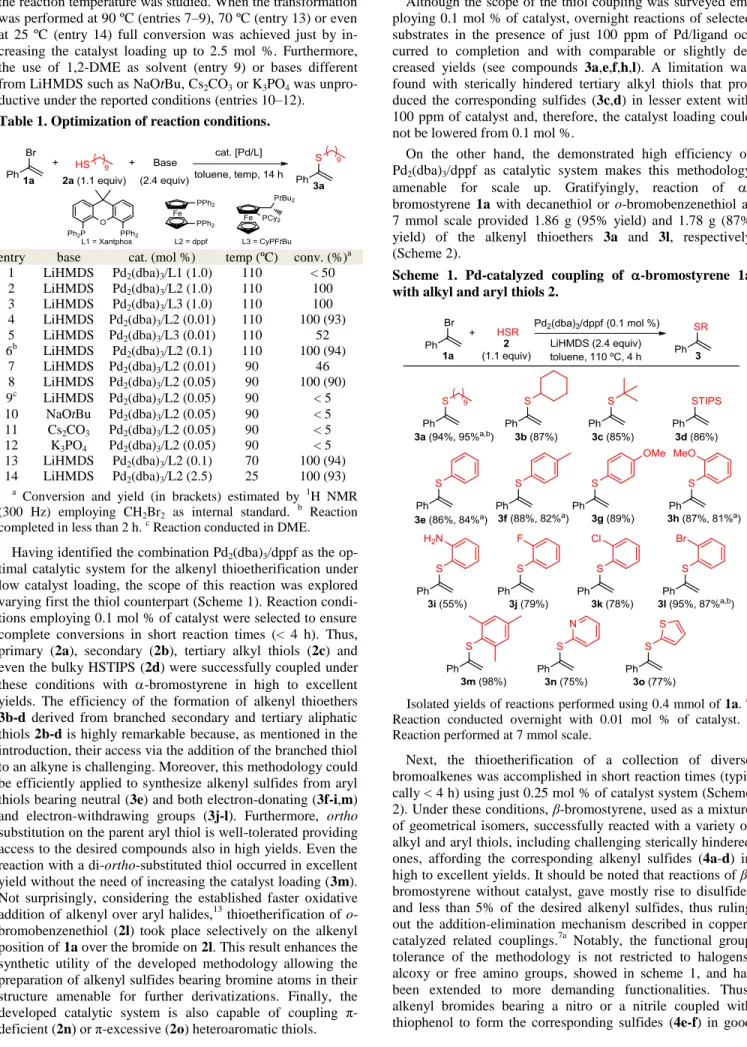
To this aim, the coupling of α-bromostyrene 1a with a slight excess of 1-decanethiol 2a (1.1 equiv) was selected as model reaction, and the most significant results are summarized in Table 1. Using Pd2(dba)3 as palladium source, several ligands
were tested. Initial results with 1.0 mol % of catalyst indicated that ferrocenyl phosphines L2 and L3 were the most efficient ligands, achieving total conversion to the desired alkenyl sulfide 3a after 14 h (entries 1–3). Reactions in the absence of palladium or with catalysts derived from biaryl phosphine ligands, such as Sphos, RuPhos, BrettPhos or XPhos, led to < 5% conversion to the coupled product accompanied with thiol oxidation to disulfide.12 Encouraged by the results with bisphosphine ligands L2 and L3, the catalyst loading was considerably decreased (entries 4–6). At very low catalyst amounts (0.01 mol %) CyPFtBu ligand (L3) failed to promote the reaction to full conversion (entry 5), whereas by using dppf as ligand (L2) 3a was obtained in 93% yield that corre-sponds to a remarkable turnover number of 9300 (entry 4). Not surprisingly, reduced reaction time of less than 2 h was achieved by just using 0.1 mol % of the latter catalyst system (entry 6). Reactions employing other palladium sources such as Pd(OAc)2, Pd[P(o-tol)3]2 or [allylPdCl]2 were not or less
the reaction temperature was studied. When the transformation was performed at 90 ºC (entries 7–9), 70 ºC (entry 13) or even at 25 ºC (entry 14) full conversion was achieved just by in-creasing the catalyst loading up to 2.5 mol %. Furthermore, the use of 1,2-DME as solvent (entry 9) or bases different from LiHMDS such as NaOtBu, Cs2CO3 or K3PO4 was
unpro-ductive under the reported conditions (entries 10–12).
Table 1. Optimization of reaction conditions.
entry base cat. (mol %) temp (ºC) conv. (%)a 1 LiHMDS Pd2(dba)3/L1 (1.0) 110 < 50
2 LiHMDS Pd2(dba)3/L2 (1.0) 110 100
3 LiHMDS Pd2(dba)3/L3 (1.0) 110 100
4 LiHMDS Pd2(dba)3/L2 (0.01) 110 100 (93)
5 LiHMDS Pd2(dba)3/L3 (0.01) 110 52
6b LiHMDS Pd2(dba)3/L2 (0.1) 110 100 (94)
7 LiHMDS Pd2(dba)3/L2 (0.01) 90 46
8 LiHMDS Pd2(dba)3/L2 (0.05) 90 100 (90)
9c LiHMDS Pd
2(dba)3/L2 (0.05) 90 < 5
10 NaOtBu Pd2(dba)3/L2 (0.05) 90 < 5
11 Cs2CO3 Pd2(dba)3/L2 (0.05) 90 < 5
12 K3PO4 Pd2(dba)3/L2 (0.05) 90 < 5
13 LiHMDS Pd2(dba)3/L2 (0.1) 70 100 (94)
14 LiHMDS Pd2(dba)3/L2 (2.5) 25 100 (93) a
Conversion and yield (in brackets) estimated by 1H NMR (300 Hz) employing CH2Br2 as internal standard.
b
Reaction completed in less than 2 h. c Reaction conducted in DME.
Having identified the combination Pd2(dba)3/dppf as the
op-timal catalytic system for the alkenyl thioetherification under low catalyst loading, the scope of this reaction was explored varying first the thiol counterpart (Scheme 1). Reaction condi-tions employing 0.1 mol % of catalyst were selected to ensure complete conversions in short reaction times (< 4 h). Thus, primary (2a), secondary (2b), tertiary alkyl thiols (2c) and even the bulky HSTIPS (2d) were successfully coupled under these conditions with -bromostyrene in high to excellent yields. The efficiency of the formation of alkenyl thioethers
3b-d derived from branched secondary and tertiary aliphatic thiols 2b-d is highly remarkable because, as mentioned in the introduction, their access via the addition of the branched thiol to an alkyne is challenging. Moreover, this methodology could be efficiently applied to synthesize alkenyl sulfides from aryl thiols bearing neutral (3e) and both electron-donating (3f-i,m) and electron-withdrawing groups (3j-l). Furthermore, ortho
substitution on the parent aryl thiol is well-tolerated providing access to the desired compounds also in high yields. Even the reaction with a di-ortho-substituted thiol occurred in excellent yield without the need of increasing the catalyst loading (3m). Not surprisingly, considering the established faster oxidative addition of alkenyl over aryl halides,13 thioetherification of o -bromobenzenethiol (2l) took place selectively on the alkenyl position of 1a over the bromide on 2l. This result enhances the synthetic utility of the developed methodology allowing the preparation of alkenyl sulfides bearing bromine atoms in their structure amenable for further derivatizations. Finally, the developed catalytic system is also capable of coupling π-deficient (2n) or π-excessive (2o) heteroaromatic thiols.
Although the scope of the thiol coupling was surveyed em-ploying 0.1 mol % of catalyst, overnight reactions of selected substrates in the presence of just 100 ppm of Pd/ligand oc-curred to completion and with comparable or slightly de-creased yields (see compounds 3a,e,f,h,l). A limitation was found with sterically hindered tertiary alkyl thiols that pro-duced the corresponding sulfides (3c,d) in lesser extent with 100 ppm of catalyst and, therefore, the catalyst loading could not be lowered from 0.1 mol %.
On the other hand, the demonstrated high efficiency of Pd2(dba)3/dppf as catalytic system makes this methodology
amenable for scale up. Gratifyingly, reaction of -bromostyrene 1a with decanethiol or o-bromobenzenethiol at 7 mmol scale provided 1.86 g (95% yield) and 1.78 g (87% yield) of the alkenyl thioethers 3a and 3l, respectively (Scheme 2).
Scheme 1. Pd-catalyzed coupling of -bromostyrene 1a with alkyl and aryl thiols 2.
Isolated yields of reactions performed using 0.4 mmol of 1a. a. Reaction conducted overnight with 0.01 mol % of catalyst. b Reaction performed at 7 mmol scale.
Next, the thioetherification of a collection of diverse bromoalkenes was accomplished in short reaction times (typi-cally < 4 h) using just 0.25 mol % of catalyst system (Scheme 2). Under these conditions, β-bromostyrene, used as a mixture of geometrical isomers, successfully reacted with a variety of alkyl and aryl thiols, including challenging sterically hindered ones, affording the corresponding alkenyl sulfides (4a-d) in high to excellent yields. It should be noted that reactions of β -bromostyrene without catalyst, gave mostly rise to disulfides and less than 5% of the desired alkenyl sulfides, thus ruling out the addition-elimination mechanism described in copper-catalyzed related couplings.7a Notably, the functional group tolerance of the methodology is not restricted to halogens, alcoxy or free amino groups, showed in scheme 1, and has been extended to more demanding functionalities. Thus, alkenyl bromides bearing a nitro or a nitrile coupled with thiophenol to form the corresponding sulfides (4e-f) in good 1
yields. Moreover, reactions of substrates having ketone or ester groups, unsuccessful under the standard conditions, occurred in the presence of CyPFtBu ligand (1.0 mol %) and the weaker Cs2CO3 base (4g-h). Regarding the substitution
degree of the resultant sulfide, the method is also competent in the preparation of disubstituted (acyclic 4h and cyclic 4i) and trisubstituted alkenyl sulfides (4j-l) using catalyst loadings up to 1.0 mol % and reaction times between 4 and 24 h. Remark-ably, the latter fully substituted alkenyl thioethers (4j-l) are inherently not accessible by the thiol addition to alkynes strat-egy.
Scheme 2. Pd-catalyzed coupling of diverse alkenyl bro-mides 1 with representative thiols 2.
Isolated yields of reactions performed at 0.4 mmol scale. a Re-action conducted with 1.1 equiv of base. b Reaction performed with CyPFtBu as ligand and Cs2CO3 as base.
c
Reaction conduct-ed with 1.0 mol % of catalyst system.
Once the generalization of the alkenyl thioetherification process with a wide range of alkenyl bromides was demon-strated, we decided to evaluate other haloalkenes as potential coupling partners with 1-decanethiol (1a) and thiophenol (1e) (Table 2). Whereas more reactive iodoalkenes performed similarly to their parent bromoalkenes (entries 1–2), less reac-tive chloroalkenes failed to react with the catalyst derived from dppf ligand, even at higher loadings (1.0 mol %). Never-theless, as it was demonstrated for related thioetherifications of aryl chlorides,14 bis-phosphine CyPFtBu was revealed as the ligand of choice for the coupling of chloroalkenes enabling the synthesis of alkenyl sulfides 3a and 3e by simply using 0.5–1.0 mol % of this catalytic system (entries 3–4). Reactions of 1-chlorocyclopentene also occurred with the model thiols under the same reaction conditions (entries 5–6).
Table 2. Pd-catalyzed coupling of alkenyl iodides and chlo-rides with decanethiol and thiophenol.
entry halide thiol L (x mol %) product Yield (%)a
1 dppf (0.05) 3a 91
2 dppf (0.01) 3e 72
3 CyPFtBu (1.0) 3a 75
4 CyPFtBu (0.5) 3e 80
5 CyPFtBu (0.5) 75
6 CyPFtBu (0.5) 55
a
Isolated yields of reactions performed at 0.4 mmol scale.
Alkenyl sulfonates are attractive alternatives to halides, as they are easily synthesized from abundantly available ketones increasing the range of available substitution patterns. Among sulfonates, alkenyl tosylates are more convenient counterparts than the corresponding triflates because of the lower cost of the sulfonating reagents used for their preparation, as well as their greater crystallinity and stability to water, which allows their storage.15 However, this stability makes the oxidative addition to Pd(0) more challenging and, therefore, alkenyl tosylates are less reactive in palladium-catalyzed processes.16 Consequently, couplings of alkenyl tosylates with thiols are unknown. Interestingly, a 5 mol % of the combination Pd2(dba)3/CyPFtBu ligand, catalyzed the coupling of -(p
-toluenesulfonyl)styrene with both decanothiol and thiophenol in high yields (Scheme 3, 3a,e). The usefulness of this reaction was further demonstrated with the efficient couplings of alkenyl tosylates derived from branched aliphatic, alkyl disubstituted, cyclic or functionalized ketones (Scheme 3, 4n-r), for which corresponding bromoalkenes are not easily avail-able.
Scheme 3. Pd-catalyzed coupling of alkenyl tosylates 5 with representative thiols 2.
Isolated yields of reactions performed at 0.4 mmol scale. a Cs2CO3 (2.0 equiv.) used as base.
In conclusion, a general, selective and scalable methodology for the synthesis of alkenyl sulfides through palladium-catalyzed C–S bond cross-coupling has been developed based on the use of inexpensive bisphosphine dppf ligand. This synthetic approach is capable of coupling a wide variety of aliphatic and (hetero)aromatic thiols to alkenyl bromides with diverse substitution patterns and functionalities under very low catalyst loading (generally 0.01–0.25 mol %) in high yields. The scope of the process is broad and includes the employ-ment of sterically hindered alkyl and aryl thiols and the access to fully substituted alkene derivatives, overcoming the main synthetic limitations of the metal-catalyzed direct reaction of thiols with alkynes. In addition, catalytic species generated from Pd2(dba)3 and CyPFtBu ligand allowed less reactive
chloroalkenes and, for the first time, readily available tosyloxyalkenes to be also active coupling counterparts for the alkenyl thioetherification with both alkyl and aryl thiols. 1
ASSOCIATED CONTENT
Supporting Information
The Supporting Information is available free of charge on the ACS Publications website.
Experimental details, characterization data and NMR spectra for all new compounds (PDF).
AUTHOR INFORMATION
The authors declare no competing financial interest.
ACKNOWLEDGMENT
We are grateful to the Junta de Castilla y León and FEDER (BU076U16) and Ministerio de Economía y Competitividad (MINECO) and FEDER (CTQ2016-75023-C2-1-P) for financial support. N.V. and S.S.-P. thank FEDER for predoctoral and postdoctoral contracts, respectively. C.V. thanks Universidad de Burgos for a predoctoral contract.
REFERENCES
(1) a) Li, Q.; Dong, T.; Liu, X.; Lei, X. A Bioorthogonal Ligation Enabled by Click Cycloaddition of o-Quinolinone Quinone Methide and Vinyl Thioether. J. Am. Chem. Soc.2013, 135 4996−4999. b) Shaikh, A. k.; Cobb, A. J. A.; Varvounis, G. Mild and Rapid Method for the Generation of ortho-(Naphtho)quinone Methide Intermediates.
Org. Lett.2012, 14 4− 7. ) Zhu, Y.; Xie, M.; Dong, S.; Zhao,
X.; Lin, L.; Liu, X.; Feng, X. Asymmetric Cycloaddition of , -Unsaturated -Ketoesters with Electron-Rich Alkenes Catalyzed by a Chiral Er(OTf)3/N N’-Dioxide Complex: Highly Enantioselective Synthesis of 3,4-Dihydro-2H-pyrans. Chem. Eur. J. 2011, 17, 8202– 8208. d) Sabarre, A.; Love, J. Synthesis of 1,1-Disubstituted Olefins via Catalytic Alkyne Hydrothiolation/Kumada Cross-Coupling. Org. Lett.2008, 10, 3941–3944. e) Farhat, S.; Marek, I. From Vinyl Sul-fides, Sulfoxides, and Sulfones to Vinyl Transition Metal Complexes.
Angew. Chem. Int. Ed. 2002, 41, 1410–1413.
(2) a) Pearson, W. H.; Lee, I. Y.; Mi, Y.; Stoy, P. Total Synthesis of the Kopsia lapidilecta Alkaloid (±)-Lapidilectine B. J. Org. Chem.,
2004, 69, 9109–9122. b) Mizuno, H.; Domon, K.; Masuya, K.; Tanino, K.; Kuwajima, I. Total Synthesis of (–)-Coriolin. J. Org. Chem.1999, 64, 2648–2656. c) Bratz, M.; Bullock, W. H.; Overman, L. E.; Takemoto, T. Total Synthesis of (+)-Laurencin. Use of Acetal-Vinyl Sulfide Cyclizations for Forming Highly Functionalized Eight-Membered Cyclic Ethers. J. Am. Chem. Soc.1995, 117, 5958–5966.
(3) a) Kausar, A.; Zulfiqar, S.; Sarwar, M. I. Recent Developments in Sulfur-Containing Polymers. Polym. Rev.2014, 54 1 − 67. b)
Nakabayashi, K.; Abiko, Y.; Mori, H. RAFT Polymerization of S-Vinyl Sulfide Derivatives and Synthesis of Block Copolymers Having Two Distinct Optoelectronic Functionalities. Macromolecules2013,
46 99 −6 1 .
(4) a) Lavecchia, A.; Cosconati, S.; Limongelli, V.; Novellino, E. Modeling of Cdc25B Dual Specifity Protein Phosphatase Inhibitors: Docking of Ligands and Enzymatic Inhibition Mechanism.
ChemMedChem 2006, 1, 540–550. b) Sader, H. S.; Johnson, D. M.; Jones, R. N. In Vitro Activities of the Novel Cephalosporin LB 11058 against Multidrug-Resistant Staphylococci and Streptococci.
Antimicrob. Agents. Chemother.2004, 48, 53–62. c) Johannesson, P.; Lindeberg, G.; Johansson, A.; Nikiforovich, G. V.; Gogoll, A.; Synnergren, B.; Le Grèves, M.; Nyberg, F.; Karlén, A.; Hallberg, A.
Vinyl Sulfide Cyclized Analogues of Angiotensin II with High Affini-ty and Full Agonist ActiviAffini-ty at the AT1 Receptor. J. Med. Chem. cent Advances in Sulfur- and Phosphorous-Centered Radical Reac-tions for the Formation of S–C and P–C Bonds. Tetrahedron2015,
71, 7481–7529. b) Lee, C.-F.; Liu, Y.-C.; Badsara, S. S. Transition-Metal-Catalyzed C–S Bond Coupling Reaction. Chem. Asian. J.2014,
9, 706–722. c) Beletskaya, I. P.; Ananikov, V. P. Transition-Metal-Catalyzed C–S, C–Se, and C–Te Bond Formation via Cross-Coupling and Atom-Economic Addition Reactions. Chem. Rev. 2011, 111, 1596–1636. d) Zyk, N. V.; Beloglazkina, E. K.; Belova, M. A.; Dubinina, N. S. Methods for the Synthesis of Vinyl Sulfides. Russ. Chem. Rev.2003, 72, 769–786.
(6) Revisions: a) Dondoni, A.; Marra, A. Metal-Catalyzed and Metal-Free Alkyne Hydrothiolation: Synthetic Aspects and Applica-tion Trends. Eur. J. Org. Chem.2014, 3955–3969. b) Castarlenas, R.; Di Giuseppe, A.; r -Torrente, J. J.; Oro, L. A. The Emergence of Transition-Metal-Mediated Hydrothiolation of Unsaturated Carbon– Carbon Bonds: A Mechanistic Outlook. Angew. Chem. Int. Ed.2013,
52, 211–222. Selected references: c) Strydom, I.; Guisado-Barrios, G.; Fern , I.; Liles, D. C.; Peris, E.; Bezuidenhout, D. I. A Hemilabile and Cooperative N-Donor-Functionalized 1,2,3-Triazol-5-Ylidene Ligand for Alkyne Hydrothiolation Reactions. Chem. Eur. J.
2017, 23, 1393–1401. d) Degtyareva, E. S.; Burykina, J. V.; Fakhrutdinov, A. N.; Gordeev, E. G.; Khrustalev, V. N.; Ananikov, V. P. Pd-NHC Catalytic System for the Efficient Atom-Economic Syn-thesis of Vinyl Sulfides from Tertiary, Secondary, or Primary Thiols.
ACS Catal.2015, 5 7 −7 13. ) G .; r .; r -Torrente, J. J.; Crucianelli, M.; Polo, V.; Sancho, R.; Lahoz, F. J.; Oro, L. A. Ligand-Controlled Regioselectivity in the Hydrothiola-tion of Alkynes by Rhodium N-Heterocyclic Carbene Catalysts. J. Am. Chem. Soc. 2012, 134 171− 183. f) Weiss, C. J.; Marks, T. J.
Organozirconium Complexes as Catalysts for Markovnikov-Selective Intermolecular Hydrothiolation of Terminal Alkynes: Scope and Mechanism. J. Am. Chem. Soc. 2010, 132 1 33−1 46. ) o F.;
Fraser, L. R.; Love, J. A. Rhodium-Catalyzed Alkyne Hydrothiolation with Aromatic and Aliphatic Thiols. J. Am. Chem. Soc. 2005, 127, the Synthesis of Aryl, Heteroaryl, and Vinyl Sulfides. J. Org. Chem.
2010, 75 36 6−3643.
(8) For Cu-catalyzed intramolecular coupling of bromoolefins, see: Newman, S. G.; Aureggi, V.; Byan, C. S.; Lautens, M. Intramolecular Cross-Coupling of gem-Dibromoolefins: A Mild Approach to 2-Bromo Benzofused Heterocycles. Chem. Commun. 2009 36− 3 .
(9) For a review on related amination reaction, see: Barluenga, J.; Valdés, C. Palladium catalyzed alkenyl amination: from enamines to heterocyclic synthesis. Chem. Commun. 2005 4 91−49 1.
(10) a) Guilarte, V.; Fernández-Rodríguez, M. A.; García-García, P.; Hernando, E.; Sanz, R. A Practical, One-Pot Synthesis of Highly Substituted Thiophenes and Benzo[b]thiophenes from Bromoenynes and o-Alkynylbromobenzenes. Org. Lett.2011, 13 1 − 1 3. b) Moreau, X.; Campagne, J. M.; Meyer, G.; Jutand, A. −S Bo For ation: Rate and Mechanism of the Cou-pling of Aryl or Vinyl Halides with a Thiol Derived from a Cysteine.
Eur. J. Org. Chem.2005 3749−376 .
(11) a) Zeng, F.; Alper, H. Palladium-Catalyzed Domino C−S Coupling/Carbonylation Reactions: An Efficient Synthesis of 2-Carbonylbenzo[b]thiophene Derivatives. Org. Lett. 2011, 13, 6 − 71. b) Byan, C. S.; Braunger, J. A.; Lautens, M. Efficient Synthesis of Benzothiophenes by an Unusual Palladium-Catalyzed V −S o . Angew. Chem. Int. Ed. 2009, 48, 7 64−7 6 .
(13) For an additional competition experiment that further demon-strates the greater reactivity of alkenyl bromides over aryl bromides with thiols under the developed catalytic conditions, see SI.
(14) a) Fernández-Rodríguez, M. A.; Shen, Q.; Hartwig, J. F. Highly Efficient and Functional-Group-Tolerant Catalysts for the Palladium-Catalyzed Coupling of Aryl Chlorides with Thiols. Chem. Eur. J.2006, 12, 7782–7796. b) Fernández-Rodríguez, M. A.; Shen, Q.; Hartwig, J. F. A General and Long-Lived Catalyst for the Palla-dium-Catalyzed Coupling of Aryl Halides with Thiols. J. Am. Chem. Soc.2006, 128, 2180–2181.
(15) Chassaing, S.; Specklin, S.; Weibel, J.-M.; Pale, P. Vinyl and Aryl Sulfonates: Preparations and Applications in Total Synthesis.
Curr. Org. Synth.2012, 9 6− 7.
(16) For selected examples of Pd-catalyzed coupling reactions of alkenyl tosylates, see: a) Li, B. X.; Le, D. N.; Mack, K. A.; McClory, A.; Lim, N.-K.; Cravillion, T.; Savage, S.; Han, C.; Collum, D. B.; Zhang, H.; Gosselin, F. Highly Stereoselective Synthesis of Tetrasubstituted Acyclic All-Carbon Olefins via Enol Tosylation and S k −M r o . J. Am. Chem. Soc. 2017, 139, 1 777−1 7 3. b) Fujino, T.; Hinoue, T.; Usuki, Y.; Satoh, T. Synthe-sis of Difluorinated Enynes through Sonogashira-Type Coupling.
Org. Lett. 2016, 18, 56885691. c) Limmert, M. E.; Roy, A. H.; Hartwig, J. F. Kumada Coupling of Aryl and Vinyl Tosylates under Mild Conditions. J. Org. Chem.2005, 70, 93649370.