
Straightforward Synthesis of
Dihydrobenzo[
a
]fluorenes through
Au(I)-Catalyzed Formal [3+3] Cycloadditions
Patricia García-García, Muhammad A. Rashid,
†Ana M. Sanjuán,
Manuel A. Fernández-Rodríguez and Roberto Sanz*
Área de Química Orgánica, Departamento de Química, Facultad de Ciencias, Universidad de Burgos, Pza. Misael Bañuelos s/n, 09001-Burgos, Spain [email protected]
Received Date (will be automatically inserted after manuscript is accepted)
ABSTRACT
Dihydrobenzo[a]fluorene derivatives have been prepared by a formal intramolecular [3+3] cycloaddition of
o-(alkynyl)styrenes bearing a secondary alkyl group at the -position of the styrene moiety. The process, catalyzed by
a cationic gold(I) complex, involves a 1,2-hydride migration as the key step. 6,11-Dihydro-5H-benzo[a]fluorenes could be obtained from the initially generated 6,6a-dihydro-5H-benzo[a]fluorenes by subsequent heating of the reaction mixture under gold(I) or Brønsted acid-catalysis, or directly by conducting the reactions at high temperature.
Benzo[a]fluorene and, in particular, its polyhydro derivatives, are cores frequently found in diverse natural products possessing biological activity (Figure 1). This tetracyclic skeleton is present, for instance, in isoprekinamycin,1 veratramine2 or nakiterpiosinone3 and
is the structural base of whole families of compounds such as the dasyscyphins,4 walsuchocins5 or fluostatins.6
† Current address: Department of Chemistry and Biochemistry.
University of Agriculture, Faisalabad-38040, Pakistan.
1 Proteau, P. J.; Li, J. Williamson, T. R.; Gould, S. J.; Laufer, R. S.;
Dmitrienko, G. I. J. Am. Chem. Soc.2000, 122, 83258326.
2 Johnson, W. S.; deJongh, H. A. P.; Coverdale, C. E.; Scott, J. W.;
Burckhardt, U. J. Am. Chem. Soc.1967, 89, 45234526.
3 Gao, S.; Wang, Q.; Huang, L. J.-S.; Lum, L.; Chen, C. J. Am. Chem. Soc.2010, 132, 371383.
4 a) Mierau, V.; de la Parra, V. R.; Sterner, O.; Anke, T. J. Antibiot.
2006, 59, 5356. b) Liermann, J. C.; Kolshorn, H.; Anke, H.; Thines, E.; Opatz, T. J. Nat. Prod.2008, 71, 16541656.
5 Zhou, Z.-W.; Yin, S.; Zhang, H.-Y.; Fu, Y.; Yang, S.-P.; Wang,
X.-N.; Wu, Y.; Tang, X.-C.; Yue, J.-M. Org. Lett.2008, 10, 465468.
6 a) Schneider, K.; Nicholson, G.; Ströbele, M.; Baur, S.; Niehaus, J.;
Fiedler, H.-P.; Süssmuth, R. D. J. Antibiot.2006, 59, 105109. b) Baur, S.; Niehaus, J.; Karagouni, A. D.; Katsifas, E. A.; Chalkou, K.; Meintanis, C.; Jones, A. L.; Goodfellow, M.; Ward, A. C.; Beil, W.;
Moreover, synthetic polyhydrobenzo[a]fluorenes have also shown interesting properties, for example as bone loss inhibitors7 or estrogen receptors.8
Schneider, K.; Süssmuth, R. D.; Fiedler, H.-P. J. Antibiot.2006, 59, 293297.
7 a) Bryant, H. U.; Cullinan, G. J. Tetrahydrobenzo[a]fluorene
compounds and methods of use. Eur. Pat. Appl. EP0832883A1, 1998. b) Bryant, H. U.; Cullinan, G. J. Tetrahydrobenzo[a]fluorene compounds and methods of use. U.S. Patent. 5,821,253, 1998.
8 Tedesco, R.; Youngman, M. K.; Wilson, S. R.; Katzenellenbogen, J.
Figure 1. Selected natural products containing the polyhydrobenzo[a]fluorene skeleton
On the other hand, transition metal-catalyzed cyclization of functionalized unsaturated substrates has emerged in the last years as a fundamental tool for the synthesis of a wide array of cyclic structures not easily prepared by conventional methodologies.9 Particularly
interesting in this field are gold and platinum-catalyzed cycloisomerizations of enynes, that generally entail a rapid increase in structural complexity from readily available precursors under mild conditions.10
In this regard, we have recently described a gold-catalyzed cycloisomerization of o-(alkynyl)styrenes that provides an easy enantioselective access to the indene skeleton and is proposed to proceed via carbocation I
(Scheme 1, via a).11 Continuing with our ongoing interest
in implementing new applications of gold-catalyzed reactions of 1,3-dien-5-ynes,12 we envisioned that those
compounds could be appropiate substrates for the development of a new route to benzo[a]fluorene derivatives.13 Thus, we considered that if a rearrangement
of carbocation I by hydride migration to the adjacent carbon would be possible, the trapping of the new intermediate II by intramolecular nucleophilic attack of an aromatic group could be favoured (Scheme 1, via b). The overall transformation would therefore lead to the formation of the dihydrobenzo[a]fluorene skeleton through a formal [3+3] cycloaddition.14,15 The success of
catalyzed cascade cyclization that affords benzo[b]fluorenes, see: Chen, Y.; Chen, M.; Liu, Y. Angew. Chem., Int. Ed.2012, 51, 64936497.
14 It is worth noting that the unique properties of gold complexes
have allowed the disclosure of new types of cycloaddition reactions that
the proposed reaction would obviusly depend on the appropiate selection of groups R1 and R2, that should be
able to favour the formation of carbocation II from the initially generated carbocation I.
Scheme 1. Previously reported synthesis of indenes and proposed synthesis of dihydrobenzo[a]fluorenes
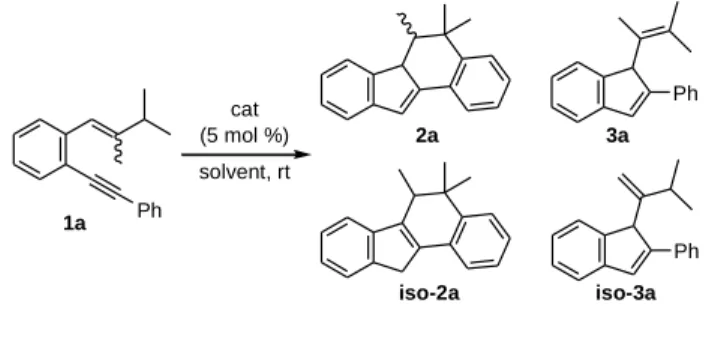
R2 geometrical isomers), having an isopropyl group linked to the double bond, that would generate a rather favored
formation of the dihydrobenzo[a]fluorene products 2a
and iso-2a was obtained, with less than 10% of indene derivatives 3a and iso-3a formed (entry 1). Minor influence of the ligand of the gold complex was observed (entries 14), while the counterion plays a crucial role in the outcome of the reaction (entries 1 vs. 59) as indene derivatives 3a and iso-3a are primarily or even exclusively obtained with triflate (entry 8) or tosylate (entry 9) counterions. The solvent also has a significant influence in the selectivity of the reaction (entries 1 vs. 1013) with CH2Cl2 being the best for promoting the
formal [3+3] cycloaddition (entry 1), whereas ethereal solvents lead mainly to the formation of indene derivatives (entries 12 and 13). It is remarkable how an appropriate selection of the reaction conditions allows the selective isolation in good yields of either dihydrobenzo[a]fluorene (entry 1) or indene derivatives (entry 9).
were previously unfeasible. For a recent revision on gold-catalyzed cycloaddition reactions: López. F.; Mascareñas, J. L. Beilstein J. Org. Chem.2011, 7, 10751094.
15 For other gold-catalyzed cycloaddition reactions involving
Table 1. Effect of the catalyst and the solvent in the selectivity trimethoxybenzene as internal standard; in brackets isolated yield. b2a
was obtained as a ca. 7:1 mixture of diastereoisomers.
Thus, the best conditions for accomplishing the formal [3+3] cycloaddition pathway consist of the use of AuPPh3Cl/AgSbF6 as catalyst in CH2Cl2 as solvent. Under
these conditions we were able to isolate 80% of a ca. 7:1 mixture of 6,6a-dihydro-5H-benzo[a]fluorene 2a and 6,11-dihydro-5H-benzo[a]fluorene iso-2a, differing in the position of the double bond.16
Gratifyingly, selective formation of either 2a or iso-2a
could be achieved by simply controlling the temperature of the reaction (Scheme 2a). So, 75% of 2a was isolated as a ca. 7:1 mixture of diastereoisomers17 when the
reaction was performed at 0 ºC, whereas 79% of iso-2a
was obtained at 80 ºC in DCE. These results suggest that
iso-2a could be formed by a thermal rearrengment of 2a, which was confirmed by the transformation in good yield of isolated 2a into iso-2a upon heating under the reaction conditions or in the presence of a Brønsted acid (Scheme 2a). Moreover, we observed that when the reaction was carried out at 80 ºC not even traces of indene derivatives
3a or iso-3a were formed. Therefore, we checked out the possibility that indene derivatives could cyclize under these reaction conditions to afford iso-2a, which turned out to be the case (Scheme 2b). However, no transformation of 3a/iso-3a was observed in the presence
16 Variable amounts of iso-2a were obtained for all entries in Table 1
where the [3+3] cycloaddition pathway was observed.
17 The relative stereochemistry of the major isomer of 2a was
established by a NOESY experiment and resulted in syn. The same syn -selectivity was also observed and determined for cycloadducts 2b-h
described later in this paper. See Supporting Information for details.
of the cationic gold complex at room temperature, which evidence that these are not intermediates in the synthesis of 2a at low temperature, but the result of a different reaction pathway.
Scheme 2. Effect of the temperature in the selectivity
Accordingly with these results and based on our experience in the cycloisomerization of 1,3-dien-5-ynes we propose the following mechanism (Scheme 3).
Scheme 3. Proposed mechanism
The reaction would be initiated by coordination of the gold complex to the triple bond of the starting dienyne 1a
followed by an intramolecular 5-endo-dig nucleophilic attack of the terminal olefin, leading to an intermediate that can be represented as the contribution of two resonance structures Ia and Ib. As previously proposed, elimination of a proton in I (path a/a´) furnishes a vinyl gold intermediate, which after protodemetalation gives the indene 3a or iso-3a, depending on which proton has been eliminated. On the other hand, intermediate I can undergo a hydride migration giving rise to intermediate II
trapped by nucleophilic attack of the aromatic ring, a Friedel-Crafts alkylation,18 affording
dihydrobenzo[a]fluorene derivative III which after protodemetalation furnishes compound 2a regenerating the catalytic species.19
Table 2. Synthesis of 6,6a-dihydro-5H-benzo[a]fluorenes 2
entry 1 R1 R2 R3 R4 Ar 2 yield directing the cycloisomerization of o-(alkynyl)styrenes 1
to the [3+3] cycloaddition pathway, we checked the potential of this methodology for the synthesis of a family of dihydrobenzo[a]fluorenes 2 and iso-2. Gratifyingly, reaction of easily accessible o-(alkynyl)styrenes 1a-k at 0 ºC20 afforded 6,6a-dihydro-5H-benzo[a]fluorenes 2a-k in
good yieldsand with high diastereoselectivities (Table 2). The method is compatible with the presence of both a halogen (entry 1) and an electron-donating group (entry 2) in the nucleophilic aromatic ring, that can also be heteroaromatic (entry 3). Moreover, diverse substitution paterns are well tolerated at the double bond of the starting material, as long as one of the groups is a secondary alkyl (entries 47). o-(Alkynyl)styrenes 1i-k, having a monosubstituted olefin, are also appropriate substrates for this reaction (entries 810). In addition, further functionality can also be introduced in the central aromatic ring of the starting material (entry 10).
On the other hand reaction of selected o-alkynylstyrenes
1 at 80 ºC allowed for the synthesis of 6,11-dihydro-5H -benzo[a]fluorenes iso-2 with very good yields and again with a wide scope regarding the substitution in all the possible different positions (Scheme 4).
18 For a mechanistically related gold reaction to give fluorenes, see:
Gorin, D. J.; Watson, I. D. G.; Toste, F. D. J. Am. Chem. Soc. 2008, 130, 37363737.
19 Proton elimination from intermediate II, that would lead to 3a after
protodemetalation, could also be posible.
20 Reactions of 1b,e-h occurred at rt without significant formation of
iso-2 adducts, whereas increasing amounts of indenes 3 were observed at 0 ºC, and therefore these reactions were performed at rt.
Scheme 4. Synthesis of 6,11-dihydro-5H-benzo[a]fluorene iso-2
a
Reaction conducted at rt
Finally, taking advantage of our previously reported enantioselective synthesis of indenes by using dinuclear chiral gold(I) catalysts,11,21 we explored the possibility of
obtaining enantioenriched dihydrobenzo[a]fluorenes. Thus, under the best reaction conditions found,22 we
synthesized some dihydrobenzo[a]fluorenes iso-2 in an enantioselective fashion in good yields although with modest enantiomeric excess (Scheme 5).23
Scheme 5. Enantioselective synthesis of benzo[a]fluorenes iso-2
In conclusion, we have developed an efficient synthesis of dihydrobenzo[a]fluorenes through a novel gold-catalyzed intramolecular formal [3+3] cycloaddition of simple o-(alkynyl)styrenes. Reactions take place through
21 For gold(I)-catalyzed enantioselective cycloisomerizations of
1,n-enynes see: a) Chao, C.-M.; Vitale, M. R.; Toullec, P. Y.; Genêt, J.-P.;
22 See Supporting Information for a detailed study.
23 Compared with our previous results (ref. 11), the observed modest
a tandem 5-endo cyclization[1,2]-hydride migrationFriedel-Crafts alkylation to afford the corresponding cycloadducts in good yields. Efforts to identify new reaction pathways of o-(alkynyl)styrenes that could provide selective and straihgtforward access to other relevant policyclic compounds are currently underway.
Acknowledgment. We are grateful to MICINN and FEDER (CTQ2010-15358 and CTQ2009-09949/BQU) and Junta de Castilla y León (BU021A09 and GR-172) for financial support. A.M.S. thanks Junta de Castilla y León (Consejería de Educación) and Fondo Social Europeo for a P.I.R.T.U. contract. M.A.R. thanks MEC for a “Young Foreign Researchers” contract (SB2009-0186). P.G.-G. and M.A.F.-R. thank MICINN for “Juan de la Cierva” and “Ramón y Cajal” contracts.
Supporting Information Available. Experimental procedures, and characterization data for all new compounds. Copies of 1H and 13C NMR spectra. This
![Figure 1. Selected natural products containing the polyhydrobenzo[a]fluorene skeleton](https://thumb-us.123doks.com/thumbv2/123dok_es/3927211.667094/2.918.90.424.82.265/figure-selected-natural-products-containing-polyhydrobenzo-fluorene-skeleton.webp)
![Table 2. Synthesis of 6,6a-dihydro-5H-benzo[a]fluorenes 2](https://thumb-us.123doks.com/thumbv2/123dok_es/3927211.667094/4.918.487.834.116.408/table-synthesis-of-a-dihydro-h-benzo-fluorenes.webp)
