Proceedings of the 10th World Congress of the International Association for Semiotic Studies (IASS/AIS) Universidade da Coruña (España / Spain), 2012. ISBN: 978-84-9749-522-6 Pp. 1695-1704
alleviating doubt in the language
learner
l
aWrieh
unterKochi university of Technology (Japan)
Abstract
This paper demonstrates the application of the pragmatics of signification and pragmatics of communication
to the analysis of the interplay between the speakers of two highly dissimilar languages engaged in
meaning negotiation by means of semantic maps. When a language learner's first language and target
language have profoundly different systems for encoding meaning, the interpretation and formation of
complex second language utterance are at times impeded by the learner's lack of a confident mapping
between meaning and second language syntax. in Japanese, written signs carry meaning, but in many cases do not speak, or do not speak unambiguously. as well, Japanese is a left-branching language, and thus clause semantic completeness is not the primary processing unit in initial segmentation (whereas it is the primary unit in english). This results in a mindset where written utterance need not speak, is not expected to speak, yet where rich meaning does arise. some Japanese college level learners of english, dubbed 'false beginners,' have acquired english vocabulary and grammar knowledge in six years of high school study but, resuming their study of english in college, they appear unable to make sense of, or sense with, strings of english lexical units. This paper presents information structure maps (ismaps), the author's system for low-text representation of the structured information represented in a constrained body of utterance. ismaps provide an 'interlanguage' for a restricted domain of english utterance, i.e. sentence level utterances consisting of logically related atomic lexical units with concrete referents. after using this
mapping tool for meaning clarification for a brief period of time, false beginners have rather consistently
T
his paper takes up the pragmatics of signification and pragmatics of communication inthe analysis of Japanese english learners’ apparent preference for one concept mapping style, ismapping, over others as a medium for negotiating meaning in technical english.
Here the first language (Japanese) and the target language (English) have profoundly different
systems for encoding meaning, and as a result the learner’s interpretation and formation of
complex second language utterance are at times impeded by a lack of a confident mapping
between meaning and second language syntax. The source of this learner preference is surely complex: thus here only an initial search for and exploration of the factors which may account for the semiotic success of ismaps.
1. THE NEED FOR AN INTERLANGUAGE
some Japanese college level learners of english, dubbed ‘false beginners,’ have acquired english vocabulary and grammar knowledge in six years of high school study but, resuming their study of english in college, they appear unable to make sense of, or sense with, strings of english
lexical units. Japanese learners’ difficulties in encoding/decoding English utterance suggest the use of a low-text graphical representation system as a meaning clarification medium.
2. CONCEPT MAPS: A HEURISTIC INVASION
The author has done extensive informal experimentation with three low-text graphical repre-sentation systems, mind maps (buzan & buzan, 1993), cmaps (cañas et al, 2004), and ismaps (Hunter, 2002), as portrayed in terms of mapping domain in Figure 1.
fiGure 1. mappinGtypes, shoWintermsofreferentdomains
mapping system has no granularity at the level of syntax. The Japanese learners of english stu-died here have consistently expressed dissatisfaction with mind maps as a meaning negotiation
interface, citing vagueness and insufficient expressiveness as reasons.
cmaps are an instance of novakian maps (novak and cañas, 2006). novakian maps are similar to mind maps, except that in novakian maps each link represents a relation which is always signaled by a text label on the link.
fiGure 2. a CmapofthestruCtureofthispaper
ismapping (information structure mapping) is the author’s system for low-text represen-tation of the structured information represented in a constrained body of utterance, i.e., the set of sentence level utterances consisting of logically related atomic lexical units, further cons-trained to include only utterances with concrete referents. ismaps serve as an ‘interlanguage’ for Japanese learners of english for expressing information within that restricted domain of english utterance.
Viewing the second language learning/use scenario as a mapping scenario, the author introduced three low-text mapping systems (mind maps, cmaps, and the author’s ismaps) as ‘interlanguage’ for instructor-learner negotiation of meaning in english and for exploration of the effectiveness of low-text mapping as a language task sign system.
For example, the english utterance: Skyscrapers, usually found in big cities, are higher than ordinary apartment buildings, presents decoding difficulties to the Japanese learner. Ethnographic observation shows that often such learners will not confidently generate the
Japanese equivalent, structured as: Big city de can be seen skyscraper no hou ga ordinary no apartment yori high desu.
The Japanese learner can be given the ismap seen in Fig. 4 as a graphical support for encoding/decoding the above utterance into/from english.
fiGure 4. exampleofaClarifyinG ismap.
Here the lexical items in the utterance are all known: only unsureness about syntacti-cal equivalence is impeding the learner’s interpretation of the utterance. There is no inherent logic (in the abductive/inductive/deductive sense) underlying natural language syntax, only
convention. The graphical support in figure 4 serves to assure the learner that the content of
the utterance is within his/her grasp.
3. SERENDIPITY: IMMEDIATE, STRONG PREFERENCE
After using the ISmap tool as a meaning clarification medium for a brief period of time, these
Japanese false beginners rather consistently began to demonstrate new willingness to interpret received english utterance, and to engage in the risky business of producing english utterance to convey meaning. Further, the learners predominantly expressed strong preference for ismaps over both mind maps and cmaps.
as well, the learners quite uniformly reported that Mind Maps were uninteresting, and many subjects rejected cmaps from the outset (often never having used them). The use of ismaps, and of the represented information structures as a frame for learning materials crea-tion, proved so popular that both have been incorporated into commercial textbooks (Greene
4. SEARCH FOR ANALYTICAL TOOLS
Rational use of ismaps as a tool for professional second language teaching work demands a theoretical characterization of how the tool functions. semiotic analysis at the levels of
signi-fier/message/interpretant and iconicity seems to afford only a taxonomic labeling of components of the scenario, but does not readily suggest an inroad to identification of the dynamics of the
phenomenon under examination.
eco (1990, 212) suggests a seemingly appropriate approach rooted in open, empirical observation:
We should conceive of two different pragmatic approaches: a pragmatics of significa -tion (how to represent in a semantic system pragmatic phenomena) and a pragmatics of communication (how to analyze pragmatic phenomena that take place in the course of a communicative process).
such phenomena as textual co-reference, topic, text coherence, reference to a set of
knowledge idiolectally posited by a text as referring to a fictional world, conversational
implicature, and many other phenomena concern an actual process of communication and
cannot be foreseen by any system of signification. Other phenomena, such as presupposition,
prediction of ordinary contexts, rules for felicity conditions, and so on, can, as we shall
see, be considered by the study of a coded system of signification, to describe which both
the semantical and the pragmatical approaches are strictly and inextricably interrelated.
The following sections report the findings of a naïve application of those two pragmatics
approaches as means of explaining the apparent success of the system in overcoming second language learner doubt.
4.1 Analytical tools to explain success: pragmatics of communication
in the application of a pragmatics of communication to explore the workings of the ismap success, three useful communication related tools were found within this framework: cultural
Japanese-English (J-E) difference knowledge; linguistic J-E difference knowledge, and psy -chological (language development) knowledge related to J-e difference.
a number of cultural features are potential factors in student reluctance to encode/decode english utterance. in Japanese society, reticence is cultivated in the young. speaking one’s opinion before one’s elders is seldom done. as well, since english is an examination subject in secondary school, perfectionism in the sense of wishing not to err grammatically is frequently
observed; thus English as necessarily perfect is a young culture meme. Further, there has for decades been a rather general defeatist ethos in Japan regarding communication in English;
though this is weakening now, it persists in many young people.
Communication related linguistic phenomena which may influence decoding reticence
As well, psychological phenomena related to first language acquisition of Japanese and
english are relevant to the question under examination. in Japanese, individual written signs carry meaning, but in many cases do not speak, or do not speak unambiguously. Japanese is a left-branching language, and thus clause semantic completeness is not the primary processing unit in initial segmentation, whereas it is the primary unit in english (Mazuka 1998: 65). This results in a mindset where written utterance need not speak, is not expected to speak, yet where rich meaning does arise.
4.2 Pragmatics of signification
In the application a pragmatics of signification to exploration of the workings of the ISmap
success, theoretical tools which proved useful within this framework were:
- Visual Design Grammar / Systemic Functional Linguistics;
- conceptual integration Theory / dual coding Theory - Metaphor comprehension studies
Visual Design Grammar says that layout in mixed media in English signifies rhetorical
relationships in two ways: left, central and right images or texts are GiVen, Mediator and neW, respectively, while top, central and bottom images or texts are ideal, Mediator and Real (Kress and van leeuwen, 1996). see Figure 5.
fiGure 5. rhetoriCalfeaturesassiGnifiedin enGlish doCumentlayout. from Kressandvan leeuWen 1996: 184.
This formalized approach to rhetorical features is not present in Japanese media and gra-phic arts. Furthermore, systemic Functional linguistics, surely the precursor of Visual design Grammar, says that rhetorical cohesion hinges on GiVen, what the listener / reader already knows, and neW, what the speaker/writer is going to ‘break.’ (Halliday 1985: 132). dominant Japanese rhetorical schemes do not generally include Given/new.
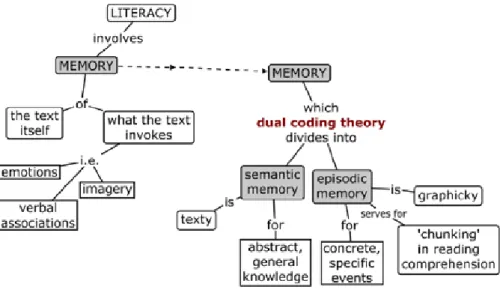
given culture than others? a second question, related to cognitive load, is what kind of memory is involved in the storage of the information carried in text, high-text maps and low-text maps. Figure 6 sketches the surrounding frame.
fiGure 6. literaCyandmemory (basedon fauConnierand turner 2002: 213-214)
Maps are instances of conceptual blending, and conceptual blending is metaphorical
behavior; then discussion of mapping systems must eventually turn to the topic of metaphor com -prehension. different from english, Japanese is a between-the-lines language: recent research suggests that in Japanese, metaphor priming effects are derived from syntactic factors. There is evidence to suggest that Japanese processing of metaphor, when primed with base (inverted form of metaphor), is faster than when primed with target (Kurosawa & Kawahara 1999: 75).
This is at odds with recent findings about the primacy of abstraction factors in metaphor com
-prehension in English, a specificity-oriented language (Gentner and Wolff, 1997).
5. DISCUSSION
This paper used two approaches, pragmatics of signification and pragmatics of communication,
in a tentative analysis of Japanese english learners’ apparent preference for one concept mapping style over others as a medium for negotiating meaning in technical english. The exploration
identified a number of important other questions regarding the Japanese learner of English, rhe -torical structures, visual information design, and the metaphorical nature of low-text mappings. also of interest is the related question, what are these ‘information structures’ represented in
ISmaps? Do they represent a distinct and complete set of relations in some definable domain?
or are they perhaps ‘structural memes’, some set of established structures that have a life out-side language, and in fact are only secondarily signaled by language? certainly pragmatics of
signification and pragmatics of communication will provide a clarifying overarching framework
SOURCES
baddeley, a. d. & Hitch, G. (2001): «Working memory in perspective: Foreword.» in J. andrade (ed.), Working memory in perspective (pp. xv-xix). Hove: Psychology Press.
baddeley, a. d. (1986): Working memory. new York: oxford university Press. baudrillard, J. (1994): Simulacra and Simulation. univ. of Michigan Press.
bazerman, c. and Prior, P. (2004): What Writing Does and How It Does It. erlbaum.
boroditsky, l., schmidt, l.a., and Phillips, W. (2003): «sex, syntax and semantics.» in Gentner, d. and Goldin-Meadow, s. language in Mind: Advances in the Study of Langauge and Thought. MiT Press. brown, K. (1999): Developing Critical Literacy. sydney, australia: national centre for english language
Teaching and Research, Macquarie university.
buzan, T. and buzan, b. (1993): The Mind Map Book. bbc Worldwide.
cañas, a. J., Hill, G., carff, R., suri, n., lott, J., eskridge, T., Gómez, G., arroyo, M. and carvajal, R. (2004): «cmaptools: a knowledge modeling and sharing environment.» in: Concept Maps: Theory, Methodology, Technology, Proceedings of the First International Conference on Concept Mapping. p. 125-133. downloaded april 8, 2008 from http://cmc.ihmc.us/papers/cmc2004-283.pdf
chandler, P. and J. sweller (1992): «The split-attention effect as a Factor in The design of instruction.» British Journal of Educational Psychology, 62: 233-246.
cmap tools. institute for Human & Machine cognition. http://cmap.ihmc.us/ dawkins, R, (1989): The Selfish Gene (2 ed.). oxford university Press. deacon, T. (1997): The Symbolic Species. norton.
eco, u. (1979): A Theory Of Semiotics. Midland.
— (1979): The Role Of The Reader: Explorations in the Semiotics of Texts. Midland. — (1989): The Open Work. Harvard univ. Press.
— (1990): The Limits of Interpretation. Midland. — (2000): Kant and the Platypus. Harcourt brace.
Fauconnier, G. (1997): Mappings in Thought and Language. cambridge u. Press.
Fauconnier, G. and Turner, M. (2002): The Way We Think: Conceptual Blending and the Mind’s Hidden Complexities. basic books.
— (2008): «The origin of language as a Product of the evolution of Modern cognition.» in laks, bernard et. al. (eds) Origin and Evolution of Languages: Approaches, Models, Paradigms. equinox. — (2008): «Rethinking Metaphor.» in Gibbs, R. (ed.) Cambridge Handbook of Metaphor and Thought.
cambridge university Press.
Florey, K.b. (2006): Sister Bernadette’s Barking Dog. Melville House Publishing.
Gentner, d. & Goldin-Meadow, s. (2003): Language in Mind: Advances in the Study of Language and Thought. MiT Press.
Gentner, d., & Wolff, P. (1997): «alignment in the Processing of Metaphor.» Journal of Memory and Language, 37, 331-355.
Greene, d. & Hunter, l. (2002): Critical thinking. Tokyo: asahi Press.
Grow, G. (1996): «serving the strategic Reader: cognitive Reading Theory and its implications for the Teaching of Writing.» Viewed June 30, 2007 at http://www.longleaf.net/ggrow/strategicReader/ index.html
Halliday, M.a.K. (1978): Language as Social Semiotic: The Social Interpretation of Language and Meaning. london: edward arnold.
— (1985): An Introduction to Functional Grammar. london: edward arnold.
Horn, R. e. (1998): «Visual language: Global communication for the 21st century.» bainbridge island, Wa: MacroVu Press. http://www.macrovu.com
Hunter, l. (1998): Text nouveau, Visible structure in Text Presentation. computer assisted language learning 11 (4) october 1998.
— (2002): «information structure diagrams as link icons.» Learning Technology 4(3) July 2002. issn 1438-0625. 2002. http://lttf.ieee.org/learn_tech/issues/july2002/index.html#1
— (2007): Thinking in English. cengage.
Imai, M. and Mazuka, R. (2003): «Reevaluating linguistic relativity: Language-Specific Categories and the
Role of universal ontological Knowledge in the construal of individuation.» in Gentner, d. and Goldin-Meadow, s. Language in Mind: Advances in the Study of Language and Thought. MiT Press. Kellogg, R. T. (2001): «competition for Working Memory among Writing Processes.» American Journal
of Psychology, 114 (2), 175-192.
Kellogg, R. T., olive, T., & Piolat, a. (2007): «Verbal and Visual Working Memory in Written sentence Production.» in d. Galbraith & M. Torrance (eds.), Basic processes in writing. dordrecht: Kluwer academic Publishers.
Kress, G. and van leeuwen, T. (1996): Reading Images: The Grammar of Visual Design. Routledge. Kurosawa, M., & Kawahara, T. (1999): «an experimental study in Metaphor comprehension.» Bulletin of
the Graduate School of Education, The university of Tokyo 39, 247-257.
— (1999): «alignment or abstraction? Metaphor comprehension in Japanese.» Proceedings, Second International Conference on Cognitive Science. http://www.jcss.gr.jp/iccs99olP/p3-19/p3-19.htm lakoff, G. and Johnson, G. (1980): Metaphors We Live By. u. of chicago Press.
Mann, William c. and sandra a. Thompson (1988): «Rhetorical structure Theory: Toward a Functional Theory of Text organization.» Text 8 (3): 243-281.
Matsunaga, s. (1996): «The linguistic nature of Kanji Reexamined: do Kanji Represent only Meanings?» The Journal of the Association of Teachers of Japanese 30(2) pp. 1-22. seen october 14, 2009 at http://www.jstor.org/stable/489563
Mazuka, R. (1998): The Development of Language Strategies: a Cross-Linguistic Study Between Japanese and English. erlbaum.
Morris, c. (1938): Foundations of the theory of signs. univ. of chicago Press.
Munnich, e. and landau, b. (2003): «The effects of spatial language on spatial Representation: setting some boundaries.» in Gentner, d. and Goldin-Meadow, s. Language in Mind: Advances in the Study of Language and Thought. MiT Press.
nisbett, R.e. (2003): The geography of thought. Free Press.
olive, Thierry (2004): Working Memory in Writing: empirical evidence from the dual-Task Technique. european Psychologist 9(1), pp. 32-42. Working paper downloaded from http://cat.inist.
fr/?aModele=afficheN&cpsidt=15431008
sadoski, M. and Paivio, a. (2001): Imagery and Text: A Dual Coding Theory of Reading and Writing. erlbaum.
smith, F. (2004): Understanding Reading. erlbaum.
Tufte, e.R. (1990): Envisioning Information. cheshire, conn: Graphics Press.
Turner, M. (2007): «The Way We imagine.» in ilona Roth (ed.) Imaginative Minds. london: british academy & oxford university Press.
— (2007): «Frame blending.» in Favretti, R.R. (ed.) Frames, Corpora, and Knowledge Representation. bologna: bononia university Press, 2008. 13-32.