https://doi.org/10.1051/0004-6361/201834050 c
ESO 2018
Astronomy
&
Astrophysics
Milky Way metallicity gradient
from
Gaia
DR2 F/1O double-mode Cepheids
B. Lemasle
1, G. Hajdu
2,1,3, V. Kovtyukh
4,5, L. Inno
6,8, E. K. Grebel
1, M. Catelan
2,3,?, G. Bono
7,8, P. François
9,10,
A. Kniazev
11,12,13,14, R. da Silva
8,15, and J. Storm
161 Astronomisches Rechen-Institut, Zentrum für Astronomie der Universität Heidelberg, Mönchofstrasse 12-14, 69120 Heidelberg, Germany
e-mail:[email protected]
2 Instituto de Astrofísica, Pontificia Universidad Católica de Chile, Av. Vicuña Mackenna 4860, 782-0436 Macul, Santiago, Chile 3 Instituto Milenio de Astrofísica, Santiago, Chile
4 Astronomical Observatory, Odessa National University, Shevchenko Park, 65014 Odessa, Ukraine 5 Isaac Newton Institute of Chile, Odessa Branch, Shevchenko Park, 65014 Odessa, Ukraine 6 Max-Planck-Institut für Astronomie, 69117 Heidelberg, Germany
7 Dipartimento di Fisica, Università di Roma Tor Vergata, Via della Ricerca Scientifica 1, 00133 Rome, Italy 8 INAF – Osservatorio Astronomico di Roma, Via Frascati 33, 00078 Monte Porzio Catone, Rome, Italy 9 GEPI, Observatoire de Paris, CNRS, Université Paris Diderot, Place Jules Janssen, 92190 Meudon, France 10 UPJV, Université de Picardie Jules Verne, 33 rue St. Leu, 80080 Amiens, France
11 South African Astronomical Observatory, PO Box 9, 7935 Observatory, Cape Town, South Africa 12 Southern African Large Telescope Foundation, PO Box 9, 7935 Observatory, Cape Town, South Africa
13 Sternberg Astronomical Institute, Lomonosov Moscow State University, Universitetskij Pr. 13, Moscow 119992, Russia 14 Special Astrophysical Observatory of RAS, Nizhnij Arkhyz, Karachai-Circassia 369167, Russia
15 ASI Science Data Center, Via del Politecnico snc, 00133 Rome, Italy
16 Leibniz-Institut für Astrophysik Potsdam, An der Sternwarte 16, 14482 Potsdam, Germany
Received 8 August 2018/Accepted 13 September 2018
ABSTRACT
Context. The ratio of the first overtone (1O)/fundamental (F) periods of mixed-mode Cepheids that pulsate simultaneously in these
two modes (F/1O) is metallicity-dependent. It can therefore be used to characterize the systems that host such variable stars. Aims. We want to take advantage of the F/1O double-mode Cepheids listed in theGaiaData Release 2 (DR2) catalog to derive the metallicity gradient in the Milky Way disk.
Methods. The metallicity is derived from the ratio of the first overtone and fundamental periods provided byGaiaDR2 while the
GaiaDR2 parallaxes are used to determine the Galactocentric distances of the stars.
Results. From a visual inspection of the light curves, it turns out that a large fraction (77%) of the Galactic F/1O double-mode Cepheids inGaiaDR2 are spurious detections.GaiaDR2 provides three new bona fide F/1O Cepheids. Combining them with the currently known F/1O Cepheids and using theGaiaDR2 parallaxes for the entire sample, we can derive the metallicity gradient in the Milky Way disk. We find a slope of –0.045±0.007 dex kpc−1using a bootstrap method, and of –0.040±0.002 dex kpc−1using a total least squares method. These results are in good agreement with previous determinations of the [Fe/H] gradient in the disk based on canonical Cepheids.
Conclusions. The period ratio of F/1O Cepheids allows for a reliable determination of the metallicity gradient in the Milky Way, and
in turn, in other systems that would be difficult to reach via classical spectroscopic methods.
Key words. stars: abundances – stars: distances – stars: variables: Cepheids – Galaxy: disk
1. Introduction
Cepheids are pulsating variable stars and the vast majority of them pulsates in a single mode, in general either the fundamental (F), the first-overtone (1O), or the second-overtone (2O) mode. A small fraction of the Cepheids pulsate in two modes simul-taneously (in general F and 1O or 1O and 2O). A few rare ob-jects even pulsate in three modes simultaneously (e.g.,Moskalik 2014;Poretti et al. 2014;Soszy´nski et al. 2015).
Double-mode Cepheids have been used to test stellar evo-lutionary and pulsation models (e.g., Buchler & Szabó 2007; Buchler 2008; Smolec & Moskalik 2010). They have also been used to study the stellar populations of the few galax-ies in which they have been discovered, namely the Milky
? On sabbatical leave at the European Southern Observatory, Av. Alonso de Córdova 3107, 7630355 Vitacura, Santiago, Chile.
Way (Oosterhoff 1957a,b), M 31 (Poleski 2013; Lee et al. 2013), M 33 (Beaulieu et al. 2006), the Large Magellanic Cloud (LMC; e.g., Alcock et al. 1999; Soszy´nski et al. 2008; Marquette et al. 2009), and the Small Magellanic Cloud (SMC; e.g.,Marquette et al. 2009;Soszy´nski et al. 2010).
Petersen diagrams (Petersen 1973) where the period ratios of mixed-mode Cepheids are plotted versus the longer period are very useful tools to study the properties of these stars. Combined with the huge amount of data provided by the Optical Grav-itational Lensing Experiment (OGLE) survey (Udalski et al. 2015), they led to numerous discoveries in recent years for both Cepheids and RR Lyrae stars (e.g., Coppola et al. 2015; Smolec et al. 2016;Prudil et al. 2017).
overtone modes (1O/2O), and around P10 = P1/P0 = 0.72 for the Cepheids pulsating simultaneously in the fundamen-tal and first overtone modes (F/1O). Moreover, the period ratios are different for the F/1O double-mode Cepheids lo-cated in the Milky Way, the LMC, and the SMC, and these stars occupy different regions of the Petersen diagram, which is a consequence of the metallicity difference between these galaxies (e.g., Buchler & Szabó 2007). In contrast, P21 is metallicity-independent. Several authors (Sziládi et al. 2007; Kovtyukh et al. 2016) have calibrated the relation between P1/P0and [Fe/H] using high-resolution spectroscopy of Galac-tic Cepheids and used it to study, for instance, the metallicity distribution of the young population in the Magellanic Clouds.
In this paper, we want to apply this same calibration relation to the F/1O double-mode Cepheids newly discovered byGaia (Gaia Collaboration 2016,2018) in order to derive their metal-licities. Combining it with accurate distances determined directly from theGaiaData Release 2 (DR2) parallaxes or using period-luminosity relations, we can derive the metallicity gradient in the Galactic disk. Such gradients (and their temporal evolution) pro-vide strong constraints on the mechanisms driving the chemo-dynamical evolution of the Milky Way (e.g.,Minchev et al. 2018; Navarro et al. 2018;Prantzos et al. 2018;Grisoni et al. 2018) and on the relative importance of, for example, stellar radial migration or the possible variation of star formation efficiency.
The paper is organized as follows: in Sect.2we briefly de-scribe the sample of currently known F/1O double-mode Cepheids in the Milky Way while in Sect.3we analyze the new F/1O candi-dates inGaiaDR2. In Sect.4we comment on individual variable stars. Section5is dedicated to the determination of the Milky Way metallicity gradient. Results are summarized in Sect.6.
2. F/1O double-mode Cepheids currently known in the Milky Way
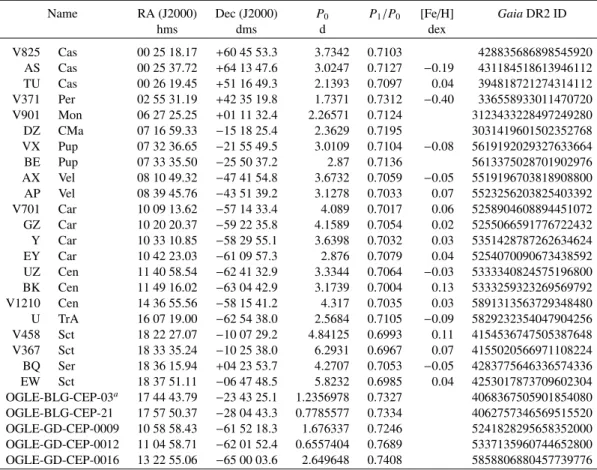
Only 27 F/1O Cepheids are known in the Milky Way disk1. The coordinates and properties of those known for a long time are listed in the McMaster Cepheid database2, to which we added V901 Mon (Antipin 2006). A few more have been recently re-ported in the disk, the bulge, or the far side of the disk by the OGLE survey (Soszy´nski et al. 2011;Pietrukowicz et al. 2013). Kovtyukh et al.(2016) also reported the chemical composition for 18 of them. We gathered all the relevant information for the sample used in this paper in Table1.
3. New Galactic F/1O double-mode Cepheids in
GaiaDR2
3.1. F/1O double-mode Cepheids in Gaia DR2
We searched for the F/1O double mode Cepheids in Gaia DR2, in the dedicated catalog for Cepheids (gaiadr2.vari_cepheid) that contains 9572 Cepheid
candi-1 A similar number of 1O/2O double-mode Cepheids (that are not rel-evant for this paper) have also been discovered: CO Aur and V1048 Cen have been known for a long time; V767 Sgr, and V363 Cas have been reported byHajdu et al.(2009), and several more stars have been identi-fied by, for example,Soszy´nski et al.(2011),Pietrukowicz et al.(2013), Khruslov(2013), andKhruslov & Kusakin(2016) in large scale photo-metric surveys.
2 https://www.physics.mcmaster.ca/Cepheid/BeatCepheid.
html
dates (Clementini et al. 2018). We found 162 stars for which the keywordmode_best_classificationindicates “MULTI” and themulti_mode_best_classificationindicates “F/1O”.
However, a large fraction (>80%) of them are located in the Magellanic Clouds. To date, many more double-mode Cepheids have been discovered (mostly via microlensing surveys) in the LMC and SMC than in the Milky Way. For instance, OGLE (Udalski et al. 2015) reports 95 and 68 F/1O and 322 and 239 1O/2O double-mode Cepheids in the LMC and SMC, re-spectively. The difference between the Milky Way and the Magellanic Clouds concerning double-mode Cepheids is caused by the mean metal content affecting the topology of the instabil-ity strip (Bono et al. 2002).
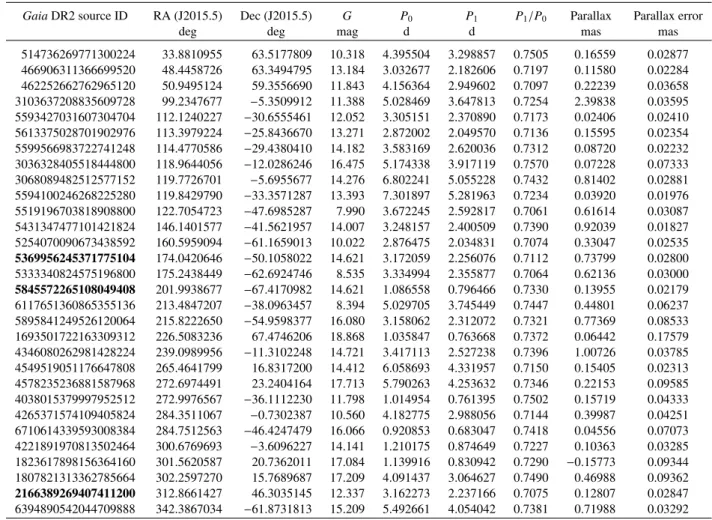
Since we are not interested in the LMC and SMC Cepheids in our study of the Galactic metallicity gradient, it is an easy task to deselect them (based on their position on the sky) in order to restrict our sample to the candidate double-mode Cepheids located in the Milky Way. We are then left with 30 stars. Their properties are listed in Table2.
By cross-matching these Cepheids with the 27 currently known Galactic Cepheids, we find that only four of them have been recovered byGaiaas F/1O Cepheids, namely UZ Cen, AX Vel, EY Car, and BE Pup. In Table 3, we list the periods and period ratios provided byGaiaand by the McMaster database. The periods and the period ratios are in excellent agreement.
In addition to the four stars quoted above, seven known double-mode Cepheids are identified in the gaiadr2.vari_cepheid catalog, but as single-mode pul-sators, either in the fundamental (U Tra, BK Cen, GZ Car, V458 Sct, TU Cas) or in the first-overtone mode (Y Car, V825 Cas).
In order to clarify the status of the 16 remaining stars, we first checked the mainGaiacatalog, which indicates that three of the known double-mode Cepheids are not recognized as variable stars, namely V367 Sct, V371 Per, and V901 Mon. Then we also investigated the gaiadr2.vari_classifier_result catalog (Holl et al. 2018). With the exception of the three stars reported as non-variable, all the double-mode Cepheids that have long been known can be found in this catalog, 15 as classical Cepheids and four as type II Cepheids (AS Cas, DZ CMa, V825 Cas, and BE Pup). It is not surprising that the gaiadr2.vari_cepheidcatalog contains only a fraction of the Cepheids identified by the variability classifier, and in particular that the stars for which fewer epochs were observed are missing. We note that V825 Cas, classified as a type II Cepheid (but with abest_class_scoreclose to 0) by themulti-stage random forest semi-supervised classifier, is tabulated as a first-overtone classical Cepheid in thegaiadr2.vari_cepheid catalog. Also BE Pup, identified as a type II Cepheid (best_class_score≈0.34) by the same classifier, is properly listed as a double-mode Cepheid in thegaiadr2.vari_cepheid catalog. The five F/1O Cepheids recently discovered by OGLE are not present in the gaiadr2.vari_cepheid or in the gaiadr2.vari_classifier_resultcatalog.
3.2. Visual inspection of F/1O Cepheid candidates
Table 1.List of F/1O double-mode Cepheids currently known in the Milky Way.
Name RA (J2000) Dec (J2000) P0 P1/P0 [Fe/H] GaiaDR2 ID
hms dms d dex
V825 Cas 00 25 18.17 +60 45 53.3 3.7342 0.7103 428835686898545920
AS Cas 00 25 37.72 +64 13 47.6 3.0247 0.7127 −0.19 431184518613946112
TU Cas 00 26 19.45 +51 16 49.3 2.1393 0.7097 0.04 394818721274314112
V371 Per 02 55 31.19 +42 35 19.8 1.7371 0.7312 −0.40 336558933011470720
V901 Mon 06 27 25.25 +01 11 32.4 2.26571 0.7124 3123433228497249280
DZ CMa 07 16 59.33 −15 18 25.4 2.3629 0.7195 3031419601502352768
VX Pup 07 32 36.65 −21 55 49.5 3.0109 0.7104 −0.08 5619192029327633664
BE Pup 07 33 35.50 −25 50 37.2 2.87 0.7136 5613375028701902976
AX Vel 08 10 49.32 −47 41 54.8 3.6732 0.7059 −0.05 5519196703818908800
AP Vel 08 39 45.76 −43 51 39.2 3.1278 0.7033 0.07 5523256203825403392
V701 Car 10 09 13.62 −57 14 33.4 4.089 0.7017 0.06 5258904608894451072
GZ Car 10 20 20.37 −59 22 35.8 4.1589 0.7054 0.02 5255066591776722432
Y Car 10 33 10.85 −58 29 55.1 3.6398 0.7032 0.03 5351428787262634624
EY Car 10 42 23.03 −61 09 57.3 2.876 0.7079 0.04 5254070090673438592
UZ Cen 11 40 58.54 −62 41 32.9 3.3344 0.7064 −0.03 5333340824575196800
BK Cen 11 49 16.02 −63 04 42.9 3.1739 0.7004 0.13 5333259323269569792
V1210 Cen 14 36 55.56 −58 15 41.2 4.317 0.7035 0.03 5891313563729348480
U TrA 16 07 19.00 −62 54 38.0 2.5684 0.7105 −0.09 5829232354047904256
V458 Sct 18 22 27.07 −10 07 29.2 4.84125 0.6993 0.11 4154536747505387648
V367 Sct 18 33 35.24 −10 25 38.0 6.2931 0.6967 0.07 4155020566971108224
BQ Ser 18 36 15.94 +04 23 53.7 4.2707 0.7053 −0.05 4283775646336574336
EW Sct 18 37 51.11 −06 47 48.5 5.8232 0.6985 0.04 4253017873709602304
OGLE-BLG-CEP-03a 17 44 43.79 −23 43 25.1 1.2356978 0.7327 4068367505901854080
OGLE-BLG-CEP-21 17 57 50.37 −28 04 43.3 0.7785577 0.7334 4062757346569515520
OGLE-GD-CEP-0009 10 58 58.43 −61 52 18.3 1.676337 0.7246 5241828295658352000
OGLE-GD-CEP-0012 11 04 58.71 −62 01 52.4 0.6557404 0.7689 5337135960744652800
OGLE-GD-CEP-0016 13 22 55.06 −65 00 03.6 2.649648 0.7408 5858806880457739776
Notes.P1/P0 are from the McMaster Cepheid database, except for V371 Per, fromWils et al.(2010), V901 Mon fromAntipin(2006), and for the OGLE Cepheids, fromSoszy´nski et al.(2011), andPietrukowicz et al.(2013). When available, metallicities are fromKovtyukh et al.(2016). (a)This Cepheid is located on the far side of the Galactic disk, in a flared outer disk, according toFeast et al.(2014).
these works, as indicated by the comments we give upon indi-vidual variables in Sect.4.
A number of stars have been previously classified as single-mode Cepheids, while the rest were previously unknown vari-ables. We have visually inspected theGaia DR2G-band light curves of each of these variables. For some, a simple inspection of the light curve folded with the main periodicity was enough to establish the single-mode nature of these stars. For these, the limited amount of data points, together with the light curve gaps and the automated classification procedures must have led to the wrongful claim of a secondary periodicity.
TheGaiaDR2G-band light curves of the rest of the F/1O Cepheid candidates were inspected, using variability analysis based on the Discrete Fourier Transform (Deeming 1975), as implemented in the package Mufran (Kollath 1990), and the non-linear harmonic fitting routinelcfit. The main periodicities were identified in the discrete Fourier spectra of the succes-sively pre-whitened (the so-far identified frequencies removed) light curves of the stars. For a number of variables, we have inspected photometry from other sources, mostly from the All Sky Automated Survey for SuperNovae (ASAS-SN) survey (Shappee et al. 2014;Kochanek et al. 2017) to confirm the pe-riods appearing in the DR2 data. Examples of such analyses are shown in Fig.1.
We have found that only three of the 26 new Galactic F/1O Cepheid candidates inGaiaDR2 can be really classified as such based on previous evidence and our analysis. These variables are listed in Sect.3.5. For the rest of the 23 variables, we give our reasons for discarding them as F/1O Cepheids in Sect.4.
3.3. Efficacy of F/1O Cepheid identification in Gaia DR2
Our analysis allows us to revise the efficiency of the variability analysis pipeline devised for the classification of double-mode Cepheids, when applied to the GaiaDR2 data. As mentioned before, four of the 30 F/1O Cepheid candidates were already known before, and three additional stars turned out to be real F/1O Cepheids, according to our analysis. Therefore, for the specific case of F/1O Cepheids, the precision of theGaiaDR2 sample in the Galactic field is 7/30 ∼ 23%. Furthermore, as mentioned before, 27 F/1O Cepheids have been known in the Galactic field, and this current data release has only recovered four of them, therefore the recall is 4/27∼15%. It is expected that these numbers will improve with the number of data points in the light curves in forthcomingGaiareleases.
3.4. The Petersen diagram
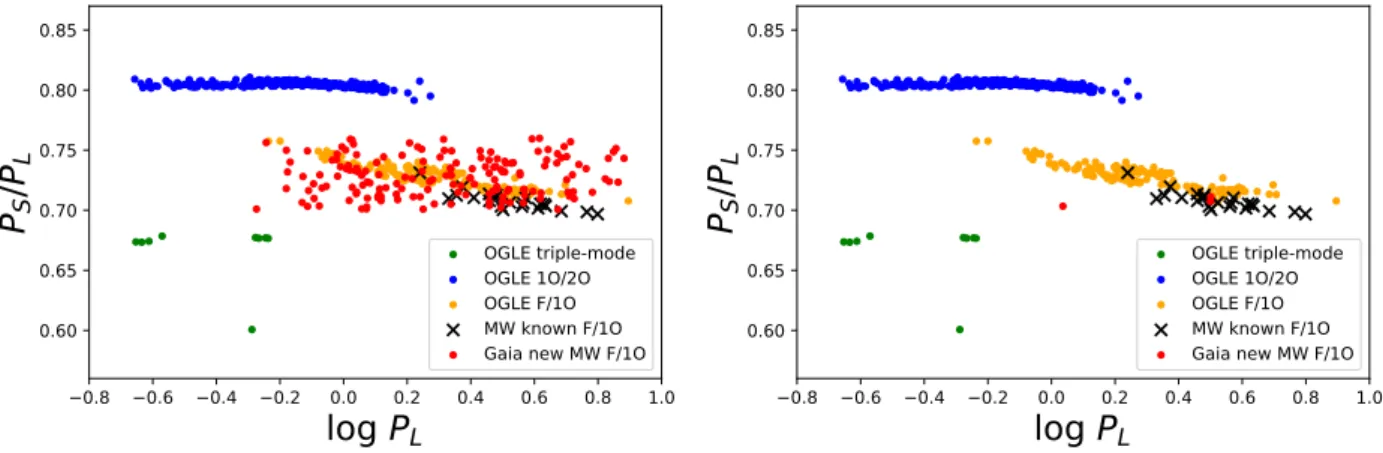
The Petersen diagram (Petersen 1973) is a useful tool to exploit the information on the physical properties of pulsating variable stars that pulsate in at least two modes simultaneously. It shows the period ratioPS/PLof a shorter periodPSand a longer period PL as a function of PLor logPL. Observed periods are usually estimated with good accuracy and the error bars in this plot are so small that they remain invisible.
Table 2.Properties of candidate Galactic F/1O double-mode Cepheids inGaiaDR2.
GaiaDR2 source ID RA (J2015.5) Dec (J2015.5) G P0 P1 P1/P0 Parallax Parallax error
deg deg mag d d mas mas
514736269771300224 33.8810955 63.5177809 10.318 4.395504 3.298857 0.7505 0.16559 0.02877
466906311366699520 48.4458726 63.3494795 13.184 3.032677 2.182606 0.7197 0.11580 0.02284
462252662762965120 50.9495124 59.3556690 11.843 4.156364 2.949602 0.7097 0.22239 0.03658
3103637208835609728 99.2347677 −5.3509912 11.388 5.028469 3.647813 0.7254 2.39838 0.03595
5593427031607304704 112.1240227 −30.6555461 12.052 3.305151 2.370890 0.7173 0.02406 0.02410
5613375028701902976 113.3979224 −25.8436670 13.271 2.872002 2.049570 0.7136 0.15595 0.02354
5599566983722741248 114.4770586 −29.4380410 14.182 3.583169 2.620036 0.7312 0.08720 0.02232
3036328405518444800 118.9644056 −12.0286246 16.475 5.174338 3.917119 0.7570 0.07228 0.07333
3068089482512577152 119.7726701 −5.6955677 14.276 6.802241 5.055228 0.7432 0.81402 0.02881
5594100246268225280 119.8429790 −33.3571287 13.393 7.301897 5.281963 0.7234 0.03920 0.01976
5519196703818908800 122.7054723 −47.6985287 7.990 3.672245 2.592817 0.7061 0.61614 0.03087
5431347477101421824 146.1401577 −41.5621957 14.007 3.248157 2.400509 0.7390 0.92039 0.01827
5254070090673438592 160.5959094 −61.1659013 10.022 2.876475 2.034831 0.7074 0.33047 0.02535
5369956245371775104 174.0420646 −50.1058022 14.621 3.172059 2.256076 0.7112 0.73799 0.02800
5333340824575196800 175.2438449 −62.6924746 8.535 3.334994 2.355877 0.7064 0.62136 0.03000
5845572265108049408 201.9938677 −67.4170982 14.621 1.086558 0.796466 0.7330 0.13955 0.02179
6117651360865355136 213.4847207 −38.0963457 8.394 5.029705 3.745449 0.7447 0.44801 0.06237
5895841249526120064 215.8222650 −54.9598377 16.080 3.158062 2.312072 0.7321 0.77369 0.08533
1693501722163309312 226.5083236 67.4746206 18.868 1.035847 0.763668 0.7372 0.06442 0.17579
4346080262981428224 239.0989956 −11.3102248 14.721 3.417113 2.527238 0.7396 1.00726 0.03785
4549519051176647808 265.4641799 16.8317200 14.412 6.058693 4.331957 0.7150 0.15405 0.02313
4578235236881587968 272.6974491 23.2404164 17.713 5.790263 4.253632 0.7346 0.22153 0.09585
4038015379997952512 272.9976567 −36.1112230 11.798 1.014954 0.761395 0.7502 0.15719 0.04333
4265371574109405824 284.3511067 −0.7302387 10.560 4.182775 2.988056 0.7144 0.39987 0.04251
6710614339593008384 284.7512563 −46.4247479 16.066 0.920853 0.683047 0.7418 0.04556 0.07073
4221891970813502464 300.6769693 −3.6096227 14.141 1.210175 0.874649 0.7227 0.10363 0.03285
1823617898156364160 301.5620587 20.7362011 17.084 1.139916 0.830942 0.7290 −0.15773 0.09344
1807821313362785664 302.2597270 15.7689687 17.209 4.091437 3.064627 0.7490 0.46988 0.09362
2166389269407411200 312.8661427 46.3035145 12.337 3.162273 2.237166 0.7075 0.12807 0.02847
6394890542044709888 342.3867034 −61.8731813 15.209 5.492661 4.054042 0.7381 0.71988 0.03292
Notes.Genuine F/1O Cepheids (see Sect.3.5) are marked in bold. We note that the secondary period ofGaiaDR2 5845572265108049408 has been revised.
Table 3.Variability properties of double-mode Cepheids in common in the McMaster database (left panel) andGaiaDR2 (right panel).
ID P0 P1 P1/P0 Gaiasource ID P0 P1 P1/P0
d d d d
UZ Cen 3.3344 2.3553 0.7064 5333340824575196800 3.33499416 2.35587694 0.7064 AX Vel 3.6732 2.5929 0.7059 5519196703818908800 3.67224527 2.59281694 0.7061 EY Car 2.876 2.036 0.7079 5254070090673438592 2.87647482 2.03483108 0.7074 BE Pup 2.870 2.048 0.7136 5613375028701902976 2.87200198 2.04957028 0.7136
Petersen diagram mostly based on OGLE IV data (see Fig.2, left panel). This can arise either from a misclassification of the star or from a wrong determination of the period(s).
In Fig.2(right panel), we show the Petersen diagram includ-ing only the confirmed Galactic candidates. Two out of the three new F/1O Cepheids fall well within the locus occupied by the Milky Way F/1O Cepheids.
3.5. New Galactic F/1O Cepheids fromGaiaDR2
2166389269407411200. This variable is V1533 Cyg, listed by Simbad as an RR Lyrae variable, based on the classification of Hoffman et al.(2009). However,Wils & Greaves (2004) list this star as a Cepheid. Our analysis of the ASAS-SN data sup-ports the latter classification as a Cepheid variable, pulsating simultaneously in the fundamental and first-overtone modes with the periods given byGaiaDR2.
5369956245371775104. Our analysis confirms that this star is a real F/1O double-mode Cepheid.
5845572265108049408. Analyses of theGaialight curve have revealed that the Gaia DR2 period given for the first over-tone, 0.79647 days, is an alias of the real secondary period, 0.76426 days. The ASAS-SN light curve confirms our finding, resulting in a decrease of the period ratio from 0.7330 to 0.7034. In the following, these stars are sometimes identified (for convenience reasons) asGaia1,Gaia2, andGaia3, respectively.
4. Stars misclassified as Galactic F/1O Cepheids
0.0 0.2 0.4 0.6 0.8 1.0 Folded light curve Original power spectrum
Whitened power spectrum
Fig. 1.Example light curves and power spectra of selected variables from our analysis of theGaiaDR2 F/1O double-mode Cepheid sample. For
each of the four stars, theleft-hand panelsshow theGaia G-band light curves folded with the periodicity found by our analysis. For three stars, the smaller panels show their original (top) and whitened (bottom) power spectra in the frequency region where the fundamental and first-overtone signals are expected. On thetop panels, vertical bars show the identified periodicity of each star. Meanwhile, on thebottom panels, the vertical bars show the location of the secondary periodicity given by theGaiaDR2 variability catalog (gaiadr2.vari_cepheidClementini et al. 2018). For the last star, theright-hand panelshows light curves available for the variable in the literature (Hackstein et al. 2015), which reaffirm our analysis of theGaialight curves.
0.8 0.6 0.4 0.2 0.0 0.2 0.4 0.6 0.8 1.0
Fig. 2.Petersen diagrams (see text for explanations).Left panel: the entireGaiaDR2 sample of F/1O Cepheids (including those located in the
Magellanic Clouds, 162 stars in total) is displayed over OGLE data for different classes of Cepheids pulsating in different modes. Previously known F/1O Cepheids in the Milky Way are shown as black crosses.Right panel: the bona fideGaiaDR2 sample of F/1O Cepheids (three stars) is displayed over OGLE data for different classes of Cepheids pulsating in different modes. Previously known F/1O Cepheids in the Milky Way are shown as black crosses.
466906311366699520. This star, also known as ASASSN-V J031346.98+632052.8, has been reported to be a fundamental-mode classical Cepheid by Jayasinghe et al. (2018). Likewise, theGaialight curve does not show evidence of a secondary pe-riodicity, as shown by the bottom left panels of Fig.1.
514736269771300224. We have found no evidence of addi-tional periodicities in theGaialight curve besides the claimed first-overtone period. Inspection of the ASAS-SN light curve supports this result, and the light curve shape suggests the clas-sification of this variable as a first-overtone Cepheid.
1693501722163309312. This variable is associated with the Ursa Minor dwarf galaxy, with a membership probability of
0.96 (Eskridge & Schweitzer(2001), ID 296 in their Table 1). Its position above the horizontal branch (HB), and relatively long pulsation period of∼0.7637 days, suggest that this object is a post-zero-age horizontal branch (ZAHB) star crossing the insta-bility strip. There is no sign of additional periodicities in the light curve.
1823617898156364160. There is no sign of an additional mode in theGaialight curve of this variable besides the fundamental mode. Its similar period and light curve shape suggests the same variability type as 4221891970813502464.
3036328405518444800. Analysis of the Gaialight curve does not provide evidence for the claimed secondary period. The light curve is missing the rising branch, when folded with the main period, which together with the small amplitude (∼0.3 mag) pre-vents the identification of the variable class of this star.
3068089482512577152. Neither the Gaia nor the ASAS-SN
light curves of this star show any sign of the claimed secondary period. Due to the relatively low total amplitude (∼0.35 mag inG) and the phase gap on the descending branch of the light curve, the type of this variable is uncertain.
3103637208835609728. This candidate Cepheid is the active star ASAS J063656-0521.0, analyzed in detail by Savanov (2014). We note that active and/or spotted stars have been known to masquerade as pulsating variables when the length of photo-metric observations and/or the methods of analysis do not allow for a clear distinction (e.g.,Pietrukowicz et al. 2015).
4038015379997952512. This star is the peculiar variable V725 Sgr.Swope & Shapley(1937) reported this star to be pul-sating with a period that increased from 12 days in 1926, to 21 days in 1935. Since then, the star has become a semi-regular variable with a period of ∼90 days (Percy et al. 2006), though even more recently it has also been reported to be an irregular variable (Battinelli & Demers 2010). The low number ofGaia Gepochs (18) led to the misclassification of this variable as an F/1O Cepheid.
4221891970813502464. This star has been classified as an AHB1/XX Vir variable3 (Sandage & Tammann 2006) by Jayasinghe et al.(2018), based on photometry from the ASAS-SN survey, under the name ASASASAS-SN-V J200242.48-033634.4. The light curve is monoperiodic without any additional mode. 4265371574109405824. This variable is the fundamental-mode classical Cepheid V493 Aql. There is no hint of a secondary pe-riodicity in the light curve, but the inspection of the foldedGaia light curve on Fig.1reveals phase gaps, which probably led to the incorrect classification of this variable.
4346080262981428224. This variable was classified as a binary under the name CSS_J155623.7-111836 byDrake et al.(2014). Our analysis of theGaialight curve supports the claimed fun-damental period of∼3.41711 days, but we find no evidence of a secondary periodicity. Based on the light curve shape, this vari-able is most probably of the BL Her type.
4549519051176647808. This star is likely a binary (probably of EA (Algol) type), with twice the period given for the fundamen-tal mode in theGaiavariability catalog,∼12.117 days.
4578235236881587968. This star does not show a secondary period in its light curve. The relatively high scatter due to its faintness, as well as its total variability amplitude of only ∼0.35 mag, do not permit an unambiguous classification of vari-ability type.
5431347477101421824. The light curve shows a major gap on the rising branch when folded with the period of the claimed fundamental mode. Analysis of the ASAS-SN light curve does not show the claimed first-overtone period, but re-veals changes in the mean magnitude of the variable on a yearly timescale, indicating that this star is probably an active star like 3103637208835609728, despite being classified as a Cepheid by Jayasinghe et al.(2018).
3 For the relation between AHB, XX Vir, BL Her, and type II Cepheids more generally, the reader is referred to Sect. 7.2 inCatelan & Smith (2015).
5593427031607304704. The analysis of theGaiaand ASAS-SN light curves did not reveal any sign of additional periodicity. The light curve shape indicates that this variable is a first-overtone classical Cepheid.
5594100246268225280. Inspection of the Gaia light curve folded with the period given for the first-overtone mode unam-biguously reveals the single, fundamental mode nature of this variable. We note that ther0andi0-band photometry published by Hackstein et al.(2015; for source GDS_J0759223-332125) also supports that classification of this variable, as illustrated by the bottom right-hand panels of Fig.1.
5599566983722741248. This variable has been classified as a fundamental-mode classical Cepheid by Jayasinghe et al. (2018). The Gaia light curve presents significant phase gaps when folded with the pulsation period, probably leading to the misclassification of this variable as an F/1O Cepheid.
5895841249526120064. This star has a total amplitude of only ∼0.13 mag in theGaia G-band light curve, and no sign of a sec-ondary periodicity. The slight asymmetry of the light curve hints at fundamental mode pulsation, as either a BL Her or a classical Cepheid variable.
6117651360865355136. This star is the RV Tau type variable V820 Cen. It has only 19 epochs in theGaia G-band, leading to its misclassification.
6394890542044709888. This star is ASASSN-V J031346.98+
632052.8, classified as a small-amplitude classical Cepheid (DCEPS) by Jayasinghe et al. (2018). There is no sign of ad-ditional periodicities in either the Gaiaor the ASAS-SN light curves. We do note that its low Galactic latitude (−49.795 deg) and faintness would lead to a large inferred distance from the Galactic disk, if the classification as a classical Cepheid held true for this variable, therefore it is most probably some other kind of variable. 6710614339593008384. This variable is the RRab star SSS_J185900.5-462532 (Torrealba et al. 2015), with a pulsation period of∼0.53518 days. The low number ofGaiaepochs (15) has led to the misclassification of this variable.
5. Galactic metallicity gradient
5.1. Galactocentric distance
For all but two stars in our sample (that have negative paral-laxes), we can derive the heliocentric (and, in turn, Galactocen-tric) distance by inverting the parallax value provided byGaia DR2. In Fig.3we compare those distances to the distances com-puted byBailer-Jones et al. (2018) using a purely geometrical distance prior relying on a model of the Milky Way.
Both sets of distances are in excellent agreement as long as the stars are located within∼4–5 kpc from the Sun, a distance beyond which the distance estimates start to diverge. This is pre-sumably due to the combined effect of the decreasing accuracy of theGaiaparallaxes at large distances and of the uncertainties of the Galaxy model from which the priors are determined.
Photometric distances (Genovali et al. 2014) based on reddening-free period-Wesenheit4 relations in the near-infrared (Inno et al. 2013) are also available for some of the stars in our sample, however the accuracy of those distances is not homo-geneous: in the absence of near-infrared time-series data, some of them have been derived using a single-point value taken from
0 2 4 6 8 10 Heliocentric distance from Gaia DR2 parallax) (kpc) 0
2 4 6 8 10
Heliocentric distance (Bailer-Jones+ 2018) (kpc)
V371Per V825Cas
Gaia1
GD-012
BEPup BLG-03 Gaia3
Fig. 3. Comparison of the heliocentric distance computed by
invert-ing the Gaia DR2 parallax to the heliocentric distance derived by Bailer-Jones et al.(2018) using a geometrical distance prior.
the Two Micron All Sky Survey (2MASS) together with light curve templates. Photometric Galactocentric distances are nev-ertheless in excellent agreement with Gaiaparallax-based dis-tances as shown in Fig.4. The small divergence observed in the inner part of the disk is presumably related to increasing uncer-tainties on the reddening law and individual reddening values at large distances in the disk. Since they are available for all but two Milky Way F/1O Cepheids, we used distances directly derived by inverting the Gaia DR2 parallax in the rest of the paper.
5.2. Spatial distribution of the F/1O Cepheids in our sample and sample selection
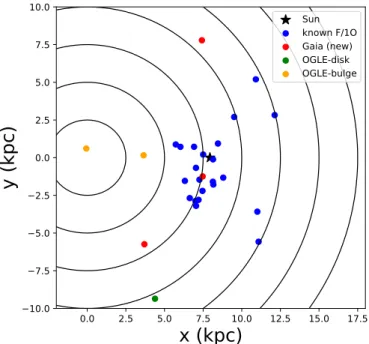
Figure5shows the spatial distribution of the F/1O Cepheids in the Milky Way. The location of the stars has been computed using the inverse of theGaiaDR2 parallaxes as heliocentric dis-tance, and two of the Cepheids in the OGLE disk sample are therefore missing because they have negative parallaxes inGaia DR2.
For the derivation of the gradient, we did not include the OGLE Cepheids in the disk or towards the bulge. As already mentioned, two of the disk ones have negative parallaxes in GaiaDR2 and no homogeneous distances can be determined for these stars. Moreover, the exact location of the OGLE Cepheids towards the bulge remains quite uncertain, one of them being even placed in the flared outer disk at the far side of our Galaxy byFeast et al.(2014).
Furthermore, all but one of the OGLE F/1O Cepheids have fundamental periods shorter than two days, while the relation of Kovtyukh et al.(2016) has been calibrated with F/1O Cepheids with fundamental periods spanning a [2d–6d] range. Metallici-ties derived by applying this formula to shorter period Cepheids might be inaccurate, as seems to be the case for the F/1O CepheidGaia3, with a fundamental period slightly larger than one day.
5 6 7 8 9 10 11 12 13
Galactocentric distance from Gaia DR2 parallax (kpc) 5
6 7 8 9 10 11 12 13
Galactocentric distance (kpc)
V371Per V825Cas
Gaia1 DZCMa
GD-012
BEPup
Bailer-Jones+ (2018) Genovali+ (2014)
Fig. 4. Comparison of the Galactocentric distances computed using
GaiaDR2 parallaxes only, or combining them with a geometrical dis-tance prior (Bailer-Jones et al. 2018). Galactocentric distances derived from near-infrared photometry (Inno et al. 2013;Genovali et al. 2014) and their associated error bars are shown in red. For comparison pur-poses, all the distances have been computed assuming that the Sun is located at 7.94 kpc from the Galactic center (Matsunaga et al. 2013).
0.0 2.5 5.0 7.5 10.0 12.5 15.0 17.5
x (kpc)
10.0 7.5 5.0 2.5 0.0 2.5 5.0 7.5 10.0
y (kpc)
Sun known F/1O Gaia (new) OGLE-disk OGLE-bulge
Fig. 5. Spatial distribution of the F/1O Cepheids in the Milky Way.
The currently known F/1O Cepheids are shown in blue, and in yel-low and green for the bulge and disk Cepheids in the OGLE sample ofSoszy´nski et al.(2011) andPietrukowicz et al.(2013), respectively. The new F/1O Cepheids inGaiaDR2 are shown in red.
5.3. Computation of the gradient: method
determina-Table 4.Galactocentric distances derived fromGaiaDR2 parallaxes (Gaia Collaboration 2018),GaiaDR2 parallaxes combined with a geo-metrical prior (Bailer-Jones et al. 2018), or period-Wesenheit relations in the near-infrared (Inno et al. 2013;Genovali et al. 2014).
Star Rg Rg Rg
kpc kpc kpc
Gaiaparallax Gaiaparallax PW (NIR) with prior
V371 Per 12.454 11.315
TU Cas 8.510 8.492 8.398
V825 Cas 12.084 11.135
AS Cas 9.883 9.969 9.662
Gaia 1 10.757 9.502
DZ CMa 11.575 11.026 OGLE-BLG-CEP-21 3.652 3.622 OGLE-BLG-CEP-03 0.611 2.878
V458 Sct 6.075 6.165 6.488 V367 Sct 5.795 5.913 6.332
EW Sct 7.503 7.508 7.580
BQ Ser 6.952 6.982 7.169
OGLE-GD-CEP-0009 9.559
EY Car 7.573 7.559 7.563
GZ Car 7.728 7.707 7.681
V701 Car 7.777 7.769 7.769
BK Cen 7.156 7.176 7.268
UZ Cen 7.406 7.423 7.465
OGLE-GD-CEP-0012 10.333 8.422
Y Car 7.734 7.694 7.682
Gaia 2 7.571 7.581
AX Vel 8.285 8.264 8.120
AP Vel 8.352 8.324 8.291
BE Pup 12.411 11.512
VX Pup 8.900 8.857 8.703
U TrA 7.068 7.093 7.207
Gaia 3 6.832 6.482
OGLE-GD-CEP-0016 8.563
V1210 Cen 6.504 6.576 6.775
V901 Mon 8.142 8.141
Notes.Distances have been computed assuming a Galactocentric dis-tance of 7.94 kpc for the Sun.
tion of the gradient requires both distances and metallicities for the stars in our sample. Here we use a simple bootstrap method to derive the slope and the intercept of the gradient and their standard deviation.
The first step in our analysis consists in estimating the error on the metallicity derived using theKovtyukh et al.(2016) rela-tion. To achieve this goal, we have generated 10 000 relations between [Fe/H], log(P0), and P1/P0 in a multivariate normal (Gaussian) distribution, for which we use as input parameters the coefficients and the covariance matrix of the function fitted by Kovtyukh et al. (2016). For a given Cepheid, the standard deviation of the 10000 values of [Fe/H] generated is adopted as the error on the metallicity. Having estimated the errors on the metallicity, we can now draw random metallicities assuming a normal distribution around the value given by the Kovtyukh et al.(2016) formula.
For the distances, we draw random parallaxes assuming a normal distribution of the error on the parallax, where the value reported by GaiaDR2 is considered as the standard deviation of the distribution. This parallax is converted into heliocentric and then Galactocentric distanceRG. We assume a
Galactocen-tric distance of 7.94 kpc for the Sun, in order to enable a di-rect comparison with the gradient obtained by Genovali et al. (2014) for numerous Cepheids pulsating in various modes.
We investigated the influence of the adopted solar Galactocen-tric distance and results are given in Table5.
We realize 10 000 drawings of distances and metallicities for the 25 stars in our sample, which means that for a given popula-tion we draw 25 (distance, metallicity) pairs, and we repeat the operation 10 000 times. We then fit a linear gradient to each of these populations and obtain 10 000 slopes and intercepts. Their means and standard deviations give us the slope and intercept of the Galactic metallicity gradient and associated errors.
5.4. Computation of the gradient: alternative method
We also computed the Milky Way metallicity gradient using a total least squares regression (Hogg et al. 2010), as imple-mented in theastroMLpython package (VanderPlas et al. 2012; Ivezi´c et al. 2014). With this method, observational errors on both variablesRGand [Fe/H] are taken into account. For a given
star, the standard deviation of the 10 000 realizations ofRG
com-puted for the bootstrap method is adopted as the uncertainty onRG. In this case, for every Cepheid, the two quantities (RG,
[Fe/H]) are independently determined, therefore their estimates are not correlated. We note, however, that the distributions of the uncertainties (especially onRG) are not exactly Gaussian.
5.5. Results
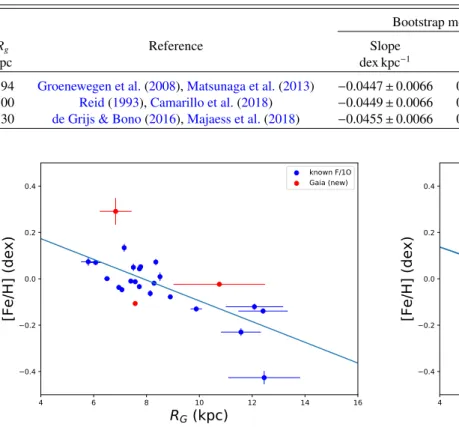
With the bootstrap method, we obtain a slope of −0.0447± 0.0066 dex kpc−1 for the gradient (see Fig. 6), in good agree-ment with the values obtained by, for example,Lemasle et al. (2007; –0.061±0.19 dex kpc−1),Lemasle et al.(2008; –0.052± 0.03 dex kpc−1), or the own sample of Genovali et al. (2014; –0.052±0.004 dex kpc−1). This slope is slightly lower than the slope derived by Genovali et al. (2014; –0.055± 0.002 dex kpc−1) combining their data with literature values adjusted to a common metallicity scale; it is also lower than that obtained byLuck et al.(2011) andLuck & Lambert(2011) who found slopes of –0.055±0.003 and –0.062±0.002 dex kpc−1, respectively. A comparison of the slopes mentioned here can also be found in Fig. 7. It is also worth mentioning that the range in Galactocentric distances covered by the different esti-mates of the metallicity gradient changes between the different samples. The agreement remains reasonable with the total least squares method (Fig. 8), which gives a (shallower) slope of –0.040±0.002 dex kpc−1.
As can be seen in Fig.8, the uncertainties on both [Fe/H] and the Galactocentric distance are small for the nearby Cepheids, because their parallaxes could be determined with a good accu-racy. In contrast, the less accurate parallaxes for distant Cepheids lead to stars that are at best only marginally consistent with the computed slope. Better parallaxes at large distances fromGaia DR2 and a larger sample of F/1O Cepheids in the outer disk would help to better constrain the metallicity gradient in this region.
Table 5.Influence of the adopted distance to the Galactic center on the slope and intercept of the metallicity gradient.
Bootstrap method Total least squares method
Rg Reference Slope Intercept Slope Intercept
kpc dex kpc−1 dex dex kpc−1 dex
7.94 Groenewegen et al.(2008),Matsunaga et al.(2013) −0.0447±0.0066 0.3522±0.0528 −0.0398±0.0024 0.2963±0.0181 8.00 Reid(1993),Camarillo et al.(2018) −0.0449±0.0066 0.3558±0.0532 −0.0398±0.0025 0.2988±0.0181 8.30 de Grijs & Bono(2016),Majaess et al.(2018) −0.0455±0.0066 0.3737±0.0550 −0.0399±0.0025 0.3112±0.0189
4 6 8 10 12 14 16
R
G
(kpc)
0.40.2 0.0 0.2 0.4
[Fe/H] (dex)
known F/1O Gaia (new)
Fig. 6.Metallicity gradient in the disk where distances and metallicities are the nominal values derived from theGaiaDR2 parallaxes and the Kovtyukh et al.(2016) relation, respectively. The color coding is the same as in Fig.5. The slope and the intercept of the gradient have been computed using a bootstrap method (see Sect.5.3).
Lemasle 2007
(99 stars) Lemasle 2008(188 stars) Genovali 2014(128 stars) Genovali 2014(322 stars) Luck 2011a(270 stars) Luck2011b(398 stars) 0.065
0.060 0.055 0.050 0.045
Slope of the gradient
Fig. 7. Comparison of the slopes of the present-day [Fe/H] gradient
derived from Cepheids in different studies (Lemasle et al. 2007,2008; Luck et al. 2011;Luck & Lambert 2011;Genovali et al. 2014). Slopes and error bars are shown in black while the red line and red area repre-sent the result of the current study using 24 F/1O Cepheids (Bootstrap method,Rg=7.94 kpc).
the current relation betweenP1/P0and [Fe/H] no longer holds at short periods.
The quoted results were obtained assuming that the Sun is located at 7.94 kpc from the Galactic center, in order to allow for direct comparisons with the values obtained by Genovali et al. (2014). These authors adopted this distance as it was derived from similar tracers (classical Cepheids) discov-ered in the Galactic nuclear bulge by Matsunaga et al.(2013). We checked, however, that with both the bootstrap and total least squares methods, the slope and intercept of the gradient are
4 6 8 10 12 14 16
R
G
(kpc)
0.40.2 0.0 0.2 0.4
[Fe/H] (dex)
Fig. 8.Metallicity gradient in the disk where distances and metallicities are the nominal values derived from theGaiaDR2 parallaxes and the Kovtyukh et al.(2016) relation, respectively. The slope and the intercept of the gradient have been computed using a total least square method (see Sect.5.4). The ellipses trace the 1-σand 2-σlikelihood contours.
only marginally affected by the choice of other values (8.0 kpc, 8.3 kpc) forRg. Results are tabulated in Table5.
In distant systems, metallicity gradients derived from observations usually refer to the [O/H] gradient measured in HII regions or planetary nebulae. In addition to the intrinsic un-certainties related to the abundance determination in such trac-ers, the comparison with iron gradients derived from Cepheids requires the transformation of the measured [O/H] into Z or [Fe/H], which may vary from system to system or even within the observed system. With these caveats in mind, it is interest-ing to note thatBeaulieu et al.(2006) found a good agreement between their gradients and those derived from HII regions (e.g., Garnett et al. 1997), B supergiants (e.g.,Urbaneja et al. 2005), or planetary nebulae (e.g., Magrini et al. 2004) in M 33. In M 31, Lee et al.(2013) report a good agreement between their double-mode Cepheids gradient and the gradient derived from HII regions (Sanders et al. 2012; Zurita & Bresolin 2012), but the agreement is surprisingly even better with the slope derived byKwitter et al.(2012) from planetary nebulae. Our study vali-dates the use of metallicity gradients derived from F/1O Cepheid period ratios through direct comparison to those obtained using full spectroscopic analyses of related objects, the single-mode classical Cepheids.
6. Conclusions
alternative classification for the remaining stars. With a larger number of individual measurements and hence better populated light curves, it is very likely that the number of genuine F/1O Cepheids will increase in the futureGaiareleases.
Thanks to the accurate Gaia DR2 parallaxes, we have derived Galactocentric distances for almost the entire sample of known Galactic F/1O Cepheids. Taking advantage of the metallicity dependence of theP1/P0 ratio, we have derived the present-day Milky Way metallicity gradient in the thin disk. The slope of −0.045±0.007 dex kpc−1 is in good agreement with the gradient determined using Cepheids pulsating in various modes, which validates the use of F/1O Cepheids to derive metallicity gradients. We recommend high resolution spectroscopic follow-up of short-period F/1O Cepheids in order to extend the period range over which theKovtyukh et al.(2016) relation is applicable.
Acknowledgements. We thank the anonymous referee for her or his sug-gestions that helped to improve the quality of the paper. B.L., G.H., L.I., and E.K.G. acknowledge support from the Sonderforschungsbereich SFB 881 “The Milky Way System” (sub-projects A3, A5) of the German Research Foundation (DFG). Additional support for M.C. and G.H. for this project is provided by Fondecyt through grant #1171273; the Ministry for the Econ-omy, Development, and Tourism’s Millennium Science Initiative through grant IC 120009, awarded to the Millennium Institute of Astrophysics (MAS); by Proyecto Basal PFB-06/2007; and by CONICYT’s PCI program through grant DPI20140066. G.H. acknowledges additional support from the Graduate Stu-dent Exchange Fellowship Program between the Institute of Astrophysics of the Pontificia Universidad Católica de Chile and the Zentrum für Astronomie der Universität Heidelberg, funded by the Heidelberg Center in Santiago de Chile and the Deutscher Akademischer Austauschdienst (DAAD), and by the CONICYT-PCHA/Doctorado Nacional grant 2014-63140099. A.K. acknowl-edges the National Research Foundation of South Africa and the Russian Science Foundation (project no. 14-50-00043). This work has made use of data from the European Space Agency (ESA) missionGaia(https://www.
cosmos.esa.int/gaia), processed by theGaiaData Processing and
Anal-ysis Consortium (DPAC,https://www.cosmos.esa.int/web/gaia/dpac/
consortium). Funding for the DPAC has been provided by national institutions,
in particular the institutions participating in theGaiaMultilateral Agreement. This research has made use of the SIMBAD database, operated at CDS, Stras-bourg, France (Wenger et al. 2000). This research has made use of the Inter-national Variable Star Index (VSX) database, operated at AAVSO, Cambridge, Massachusetts, USA. This research has made use of the TOPCAT5 software
(Taylor 2005). This research has made use of thenumpy,scipy,matplotlib
(Hunter 2007),astropy(Astropy Collaboration 2018),iPython, andastroML
(VanderPlas et al. 2012;Ivezi´c et al. 2014) python packages.
References
Alcock, C., Allsman, R. A., Alves, D., et al. 1999,ApJ, 511, 185
Antipin, S. V. 2006,Peremennye Zvezdy Prilozhenie, 6
Astropy Collaboration (Price-Whelan, A. M., et al.) 2018,AJ, 156, 123
Bailer-Jones, C. A. L., Rybizki, J., Fouesneau, M., Mantelet, G., & Andrae, R. 2018,AJ, 158, 58
Battinelli, P., & Demers, S. 2010,PASP, 122, 144
Beaulieu, J.-P., Buchler, J. R., Marquette, J.-B., Hartman, J. D., & Schwarzenberg-Czerny, A. 2006,ApJ, 653, L101
Bono, G., Groenewegen, M. A. T., Marconi, M., & Caputo, F. 2002,ApJ, 574, L33
Buchler, J. R. 2008,ApJ, 680, 1412
Buchler, J. R., & Szabó, R. 2007,ApJ, 660, 723
Camarillo, T., Mathur, V., Mitchell, T., & Ratra, B. 2018,PASP, 130, 024101
Cardelli, J. A., Clayton, G. C., & Mathis, J. S. 1989,ApJ, 345, 245
Catelan, M., & Smith, H. A. 2015,Pulsating Stars(Wiley-VCH)
Clementini, G., Ripepi, V., Molinaro, R., et al. 2018, A&A, submitted [arXiv:1805.02079]
Coppola, G., Marconi, M., Stetson, P. B., et al. 2015,ApJ, 814, 71
Deeming, T. J. 1975,Ap&SS, 36, 137
de Grijs, R., & Bono, G. 2016,ApJS, 227, 5
Drake, A. J., Graham, M. J., Djorgovski, S. G., et al. 2014,ApJS, 213, 9
Eskridge, P. B., & Schweitzer, A. E. 2001,AJ, 122, 3106
Feast, M. W., Menzies, J. W., Matsunaga, N., & Whitelock, P. A. 2014,Nature, 509, 342
5 http://www.star.bristol.ac.uk/~mbt/topcat/
Gaia Collaboration (Prusti, T., et al.) 2016,A&A, 595, A1
Gaia Collaboration (Brown, A. G. A., et al.) 2018,A&A, 616, A1
Garnett, D. R., Shields, G. A., Skillman, E. D., Sagan, S. P., & Dufour, R. J. 1997,ApJ, 489, 63
Genovali, K., Lemasle, B., Bono, G., et al. 2014,A&A, 566, A37
Grisoni, V., Spitoni, E., & Matteucci, F. 2018,MNRAS, 481, 2570
Groenewegen, M. A. T., Udalski, A., & Bono, G. 2008,A&A, 481, 441
Hackstein, M., Fein, C., Haas, M., et al. 2015,Astron. Nachr., 336, 590
Hajdu, G., Jurcsik, J., & Sodor, A. 2009,IBVS, 5882
Hoffman, D. I., Harrison, T. E., & McNamara, B. J. 2009,AJ, 138, 466
Hogg, D. W., Bovy, J., & Lang, D. 2010, ArXiv e-prints [arXiv:1008.4686] Holl, B., Audard, M., Nienartowicz, K., et al. 2018,A&A, 618, A30
Hunter, J. D. 2007,Comput. Sci. Eng., 9, 90
Inno, L., Matsunaga, N., Bono, G., et al. 2013,ApJ, 764, 84
Ivezi´c, Ž., Connelly, A. J., VanderPlas, J. T., & Gray, A. 2014,Statistics, Data Mining, and Machine Learningin Astronomy(Princeton University Press) Jayasinghe, T., Kochanek, C. S., Stanek, K. Z., et al. 2018,MNRAS, 477, 3145
Khruslov, A. V. 2013,Astron. Nachr., 334, 866
Khruslov, A. V., & Kusakin, A. V. 2016, ArXiv e-prints [arXiv:1605.01313] Kochanek, C. S., Shappee, B. J., Stanek, K. Z., et al. 2017,PASP, 129, 104502
Kollath, Z. 1990,Konkoly Observatory Occasional Technical Notes, 1
Kovtyukh, V., Lemasle, B., Chekhonadskikh, F., et al. 2016,MNRAS, 460, 2077
Kwitter, K. B., Lehman, E. M. M., Balick, B., & Henry, R. B. C. 2012,ApJ, 753, 12
Lee, C.-H., Kodric, M., Seitz, S., et al. 2013,ApJ, 777, 35
Lemasle, B., François, P., Bono, G., et al. 2007,A&A, 467, 283
Lemasle, B., François, P., Piersimoni, A., et al. 2008,A&A, 490, 613
Luck, R. E., & Lambert, D. L. 2011,AJ, 142, 136
Luck, R. E., Andrievsky, S. M., Kovtyukh, V. V., Gieren, W., & Graczyk, D. 2011,AJ, 142, 51
Madore, B. F. 1982,ApJ, 253, 575
Magrini, L., Perinotto, M., Mampaso, A., & Corradi, R. L. M. 2004,A&A, 426, 779
Majaess, D., Dékány, I., Hajdu, G., et al. 2018,Ap&SS, 363, 127
Marquette, J. B., Beaulieu, J. P., Buchler, J. R., et al. 2009,A&A, 495, 249
Matsunaga, N., Feast, M. W., Kawadu, T., et al. 2013,MNRAS, 429, 385
Minchev, I., Anders, F., Recio-Blanco, A., et al. 2018,MNRAS, 481, 1645
Moskalik, P. 2014, in Precision Asteroseismology, eds. J. A. Guzik, W. J. Chaplin, G. Handler, & A. Pigulski,IAU Symp., 301, 249
Navarro, J. F., Yozin, C., Loewen, N., et al. 2018,MNRAS, 476, 3648
Oosterhoff, P. T. 1957a,Bull. Astron. Inst. Netherlands, 13, 320
Oosterhoff, P. T. 1957b,Bull. Astron. Inst. Netherlands, 13, 317
Percy, J. R., Molak, A., Lund, H., et al. 2006,PASP, 118, 805
Petersen, J. O. 1973,A&A, 27, 89
Pietrukowicz, P., Dziembowski, W. A., Mróz, P., et al. 2013,Acta Astron., 63, 379
Pietrukowicz, P., Udalski, A., Szyma´nski, M. K., et al. 2015,ApJ, 813, L40
Poleski, R. 2013,ApJ, 778, 147
Poretti, E., Baglin, A., & Weiss, W. W. 2014,ApJ, 795, L36
Prantzos, N., Abia, C., Limongi, M., Chieffi, A., & Cristallo, S. 2018,MNRAS, 476, 3432
Prudil, Z., Smolec, R., Skarka, M., & Netzel, H. 2017,MNRAS, 465, 4074
Reid, M. J. 1993,ARA&A, 31, 345
Sandage, A., & Tammann, G. A. 2006,ARA&A, 44, 93
Sanders, N. E., Caldwell, N., McDowell, J., & Harding, P. 2012,ApJ, 758, 133
Savanov, I. S. 2014,Astron. Rep., 58, 478
Shappee, B. J., Prieto, J. L., Grupe, D., et al. 2014,ApJ, 788, 48
Smolec, R., & Moskalik, P. 2010,A&A, 524, A40
Smolec, R., Prudil, Z., Skarka, M., & Bakowska, K. 2016,MNRAS, 461, 2934
Soszy´nski, I., Poleski, R., Udalski, A., et al. 2008,Acta Astron., 58, 163
Soszy´nski, I., Poleski, R., Udalski, A., et al. 2010,Acta Astron., 60, 17
Soszy´nski, I., Udalski, A., Pietrukowicz, P., et al. 2011,Acta Astron., 61, 285
Soszy´nski, I., Udalski, A., Szyma´nski, M. K., et al. 2015,Acta Astron., 65, 329
Swope, H. H., & Shapley, H. 1937,Ann. Harvard College Obs., 105, 499
Sziládi, K., Vinkó, J., Poretti, E., Szabados, L., & Kun, M. 2007,A&A, 473, 579
Taylor, M. B. 2005,ASP Conf. Ser., 347, 29
Torrealba, G., Catelan, M., Drake, A. J., et al. 2015,MNRAS, 446, 2251
Udalski, A., Szyma´nski, M. K., & Szyma´nski, G. 2015,Acta Astron., 65, 1
Urbaneja, M. A., Herrero, A., Bresolin, F., et al. 2005,ApJ, 622, 862
VanderPlas, J., Connolly, A. J., Ivezic, Z., & Gray, A. 2012,Proceedings of Conference on Intelligent Data Understanding (CIDU), 47
Watson, C. L., Henden, A. A., & Price, A. 2006,Society for Astronomical Sciences Annual Symposium, 25, 47
Wenger, M., Ochsenbein, F., Egret, D., et al. 2000,A&AS, 143, 9
Wils, P., & Greaves, J. 2004,IBVS, 5512,
Wils, P., Henden, A. A., Kleidis, S., Schmidt, E. G., & Welch, D. L. 2010,
MNRAS, 402, 1156