
A CLIL Approach: Evolution and Current Situation in Europe and in Spain
10
0
0
Texto completo
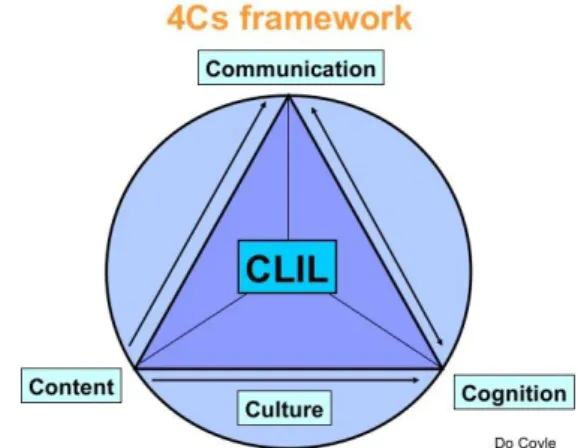
(2) International Journal of Science and Research (IJSR) ISSN: 2319-7064 ResearchGate Impact Factor (2018): 0.28 | SJIF (2018): 7.426. Figure 2: The 4Cs Framework for CLIL (Coyle 2005) The first term is content; and refers to the subject or the topic that provides the basis for learning. Content determines progression in acquiring knowledge, skills and understanding. Once the content has been established, learners must be involved in language use, while using language to learn, they learn to use language itself; that is communication. The next term on the list of the 4Cs is cognition. Learners in CLIL are challenged to develop thinking skills which link concept formation, knowledge and language. It emboldens students to think and build their own interpretation of content. The last term is culture, which allows exposure to alternative perspectives and shared understandings. It deepens linguistic and cultural awareness of otherness and self. Coyle (2002, 2007) applied the triptych linguistic approach to get communication on the grammatical system. This triptych (Figure 3) integrates content learning cognitively with language learning and use. The equality between language and content involves three types of language: The language of learning: it is the language needed for learners to access basic concepts and skills related to the subject. The language for learning: it is the language needed to operate in foreign language classrooms or in a foreign environment. The language through learning: it is the language, which is unplanned, because it cannot be controlled or predicted.. Figure 3: The Language Triptych (Coyle, Hood, Marsch, 2010) Despite these general features, this approach can differ according to the teacher who is carrying it out. A good starting point for CLIL to be implemented is in the first year. of primary education. The process should be progressive, and exposure to the second language should be gradual because students have to get used to it. It should be put into practice with a couple of subjects such as Science and Physical Education. After this first period, and bearing in mind students’ level and comprehension, the courses could be given entirely in the foreign language. Teachers must consider several facts in order to develop a successful CLIL project. They have to consider the foreign language level of their students and their demands. Teachers must take into account what they teach, in terms of both content and language, and what materials they use, due to the fact that these materials have to be adapted to the students’ level. If this approach is correctly developed, it will be very beneficial for students, because they will be learning contents and they will be also learning a foreign language at the same time. 1.2 History of CLIL To understand better the current CLIL methodology, it is important to bear in mind complex historical factors from each region (Guillamón and Renau, 2015). According to Dale (2011, p.19-21), it is a consequence of the influence of bilingualism, second language acquisition theories, cognitive learning theories and constructivism. Coyle, Hood and Marsh (2010) emphasize specifically bilingual education and immersion, typical for specific regions, and content-based language learning and teaching or English as an additional language. Although the word CLIL came into existence recently (1994), it is not a new educational phenomenon (Renau, 2016a, Renau and Alonso, 2016b). In the end of the 19th century there were two ways of learning foreign languages among wealthy families. Some families sent their children abroad to learn a foreign language directly in the country where this language was spoken. Other families used to hire a tutor who taught children grammar rules and vocabulary. As a consequence, many of them acquired languages through language instruction and thanks to daily appearance among the people. The principle of learning foreign languages in their real context with meaningful subject content was emphasised by two notable pedagogues from Central Europe. The first pedagogue is J.A. Comenius (1592-1670), who paid a lot of attention to effective language teaching. The Slovakian Matthias Bel (1684-1749), who was a teacher and headmaster of two grammar schools located in a multilingual German-Hungarian-Slovak-Czech region. For Bel, the language was a mean to teach the content of the curriculum. He reduced the number of grammar rules to a minimum and focused on developing communicative competence and on raising students’ interest in the cultural context of languages. Bilingual education had a long tradition in countries, which have more than one official language. For instance, in Luxembourg long before the law, which set the standards of bilingualism was issued, in 1843, children learnt German (in primary education) and French (in secondary schools). Before the year 1970, the need to design language and content integrated programmes was the result of some geographic, demographic and economic issues. This kind of teaching was mainly used in regions, which were situated near national borders or in big cities. The aim of these programmes was to offer children who lived in these regions a bilingual education and to make. Volume 8 Issue 12, December 2019 www.ijsr.net Licensed Under Creative Commons Attribution CC BY Paper ID: ART20203503. DOI: 10.21275/ART20203503. 1111.
(3) International Journal of Science and Research (IJSR) ISSN: 2319-7064 ResearchGate Impact Factor (2018): 0.28 | SJIF (2018): 7.426 them capable of communicating and understanding with the natives in the area. One of the first programmes of that type was carried out in the French territory of Quebec, Canada, in 1965. A group of English-speaking parents living in this area wanted an educational nursery school programme for their children to become able to speak, read and write in French, to reach normal fulfilment levels throughout the curriculum and to appreciate the customs and culture of French-speaking Canadians, and English-speaking Canadians. They contacted their local educational authorities to solve this matter. As a result, programmes, which immerse students in a language different from their mother tongue were developed and implemented in various schools. The English-speaking children learnt some school subjects in French together with the French-speaking children. In the 1970s and 1980s the term “immersion” was used as a synonym of bilingual education. Subsequently, immersion programmes were designed and spread all over Canada, the United States and the rest of the world. Due to the success of these programmes, Europeans became interested in language policy. In 1978, the European Comission issued a proposal to encourage teaching in schools through more than one language. Later, in 1983, the European Parliament requested the European Comission to promote a new programme to improve foreign language teaching. Owing to the development of various teaching methods and the historical, sociological and educational factors within each region, various sorts of integrated approaches to teach foreign languages came up. However, the effort to copy the Canadian immersion model into the European model was not successful. Marsh (2002, 56) says that the researchers discovered that “immersion bilingual education was successful for majority language speakers (e.g. in Quebec) more than for those coming from a minority language background”. The acronym CLIL was coined by David Marsh, a member of a team working in the area of multilingualism and bilingual education at the Finnish University of Jyväskylä in 1994. The initial concept of CLIL was used to designate teaching subjects through a foreign language. During the 1990s, the acronym CLIL became the most extensively used term used for the integrated content and language education in Europe. According to Marsh (2012, p. 1), “the European launch of CLIL during 1994 was both political and educational. The political driver was based in a vision that mobility across the EU required higher levels of language competence in designated languages than was found to be the case at that time. The educational driver, influenced by other major bilingual initiatives such as in Canada, was to design and otherwise adapt existing language teaching approaches so as to provide a wide range of students with higher levels of competence.” In 2006, the Eurydice stated that CLIL was available in the majority of European member states. The last decade has testified an increase in CLIL research, although it has focused more on the linguistic than the non-linguistic elements of CLIL. Thanks to multi-disciplinary research done by linguists, educators, psychologists and neurologists, the model of dual language and content aims has been gradually complemented by a third strong research focus, which is the emphasis on student’s learning strategies and thinking skills (Mehisto et al., 2008). Nowadays, communication and foreign languages have more importance than some years ago. English is the language of international communication, for this reason. English teaching should not be limited to the study of its structure, but to the use of the language in different contexts in order to be adapted to this new reality (Díaz Merino, 2010). The current education law is the Organic Law of Education 2/2006, on 3rd May. This law introduced some competences underlining, for example, the competence in linguistic communication, as it happened during the 1960s and 1970s with the implementation of the Communicative Language Teaching Method, whose main objectives were making communicative competence the goal of language teaching and developing procedures for the teaching of the four language skills.The current educational system is based in this law, and as a consequence, the main objective of nowadays foreign language lessons is to help students acquire a communicative competence through the four language skills. Currently, lessons follow the eclectic approach, which consists in choosing activities and strategies from different language teaching approaches and methods in order to suit for their own teaching purposes. The Eclectic Approach or Eclecticism was proposed as a reaction to the abundance of teaching methods in the 1970s and the 1980s, and now it can be observed in almost all foreign language lessons, due to the fact that language teachers choose various strategies from all the existing methods. 1.3 Evolution of CLIL The term CLIL was coined by David Marsh, professor and researcher at University of Jyväskylä, Finland (1994): ‘CLIL refers to situations where subjects, or parts of subjects, are taught through a foreign language with dual-focused aims, namely the learning of content and the simultaneous learning of a foreign language.’ Coyle (1999), proposed the 4Cs-Framework, which includes the necessary theoretical principles in order to plan CLIL programmes. These principles were: content, communication, cognition and culture. According to the search for effective CLIL programmes, Navés (2009) establishes a series of parameters and conditions that should be followed so as to develop the CLIL method properly. First of all, the learners’ culture and L1 (first language) need to be respected, because they are a great influence in the foreign language learning. Secondly, CLIL teachers are required to be bilingual or multilingual and completely trained, and they should be in a permanent position within the educational institution. Thirdly, the target language should be integrated and contextualized inside the classroom. Furthermore, students’ parents have to be implicated and foster the CLIL implementation. Lastly, materials used in CLIL contexts have to be planned cautiously.In addition, Mehisto, Marsh and Frigols (2008) suggest that this teaching-learning approach increases motivation, since it is challenging. Another crucial aspect that has to be taken into account when implementing CLIL programmes is that teachers are required to be teachers of both language and content simultaneously (Cummins 1994). Generally, this condition is not viable, since content teachers are neither native speakers nor experts in the foreign language. In these cases, team teaching is the most appropriate methodology to be taken. This method involves. Volume 8 Issue 12, December 2019 www.ijsr.net Licensed Under Creative Commons Attribution CC BY Paper ID: ART20203503. DOI: 10.21275/ART20203503. 1112.
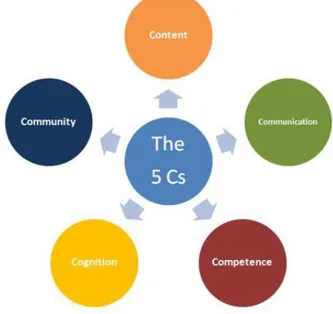
(4) International Journal of Science and Research (IJSR) ISSN: 2319-7064 ResearchGate Impact Factor (2018): 0.28 | SJIF (2018): 7.426 mutual support and learning from each other, particularly from the language teacher towards the content teacher, in the form of development of content terminology and materials, and advising on how the linguistic issues should be assessed (Pavón-Vazquez & Ellison 2013). In recent years another principle, which reinforces the effectiveness of the CLIL methodology, has appeared. It is considered the fifth “C”, as it is the term “competence”. CLIL teachers think about the things their students are be able to do after the lesson, either about the lesson content or about the language that is being learnt.. States. The European Commission’s White Paper on Education and Training (1995) focused on the importance of innovative ideas and the most efficient practices to help all the citizens in the European Union to become proficient in three European languages. Concerning that, European programmes such as Erasmus, Socrates-Erasmus or Comenius have had a positive effect on the development of CLIL. The European Union has neologised two acronyms aimed at clearly distinguish European bilingual education efforts from other programmes which are similar: CLIL for Content and Language Integrated Learning, EMILE for Enseignement d’une matière intégrée à une langue étrangère and AICLE for Aprendizaje Integrado de Contenidos y Lengua. This kind of approach was identified as very important by the European Commission in the European Action Plan (2003-2006): ‘It can provide effective opportunities for pupils to use their new language skills now, rather than learn them now for use later. It opens doors on languages for a broader range of learners, nurturing self-confidence in young learners and those who have not responded well to formal language instruction in general education. It provides exposure to the language without requiring extra time in the curriculum, which can be of particular interest in vocational settings.’ (European Action Plan 2003: Actions 1.2.4 to 1.2.7).. Figure 4: The 5Cs of CLIL (2015) Therefore, when teachers plan a CLIL lesson, they have to bear in mind five principles: Content: teachers build lessons around topics that students already know. Students develop their subject knowledge by being prepared for what they are going to study next. Communication: CLIL teachers do not talk a lot, because students are not prepared to learn in this way. Generally, students learn together while they are working in groups and talking to each other, using as much of the new language as they can. Cognition: learners are trained to think for themselves. CLIL teachers ask questions which focus on thinking skills like analysis or creativity. These are the skills which students will use when they start working. Community or culture: students have to be aware of what they learn, because it can be useful in their lives. CLIL teachers help students to relate the issues they are learning to the real world. Competence: CLIL teachers think about the can-do statements they want their students to be able to make after the lesson, either about the lesson content or about the language that is being learnt.. 2. CLIL in Europe Europe and the European Union have been promoting the learning of foreign languages and the linguistic diversity in education in order to facilitate professional opportunities and to encourage the exchange with Member. CLIL is being implemented in almost all the educational systems of Europe, but its implementation is highly diversified. This variation is due to the educational and linguistic background of each specific country. The CLIL situation in one European country cannot be applied to another, given the very divergent circumstances surrounding language teaching across the continent. However, despite this miscellaneous scenery, certain common characteristics can be identified in European CLIL application. Practically all CLIL models involve enhancing the presence of the target language in the curriculum, as well as incorporating a number of subjects taught through a second language for at least four years. The number of subjects can be increased in Primary Education and decreased in Secondary Education or the other way round. The most widely employed target language which is applied in CLIL programmes is English, along with French and German. Trilingual CLIL instruction is also provided in some countries, such as Spain, Estonia, Latvia, Austria, the Netherlands or Sweden. Despite the fact that a vast range of subjects can be instructed through a CLIL approach, the subjects taught in the second language are normally History, Geography, Science and Social Sciences, particularly in Secondary Education. According to the Eurydice report (2006), almost all the European Union member states have implemented CLIL in some way. Nevertheless, in spite of the efforts made by the European government, each country is responsible for the management and regulation of educational and linguistic strategies and resources (Dalton-Puffer et al. 2010). In Northern Europe countries (Finland, Norway, Sweden and Estonia), CLIL programmes have been broadly employed. In these countries, research has been performed primarily into the. Volume 8 Issue 12, December 2019 www.ijsr.net Licensed Under Creative Commons Attribution CC BY Paper ID: ART20203503. DOI: 10.21275/ART20203503. 1113.
(5) International Journal of Science and Research (IJSR) ISSN: 2319-7064 ResearchGate Impact Factor (2018): 0.28 | SJIF (2018): 7.426 effects of CLIL on foreign language and mother tongue competence and on subject matter learning. The mother tongue and content knowledge are not affected by dualfocused education, since the CLIL students perform as well as their monolingual mates. Languages (second and third language, L2 and L3) are, however, positively affected, as the CLIL stream exceeds its traditional equivalent. The United Kingdom deserves separate attention, due to its peculiar situation with respect to CLIL. The nation whose language, English, is the most widely adopted in CLIL programmes is falling behind in its implementation. The deficiency of CLIL initiatives is a consequence of this situation. The Netherlands stands out as an example of remarkable CLIL investigation.Bilingual teaching in the Netherlands combines subject teaching with the teaching of language skills, so it is not only switching the language in which classes are taught. Teachers of subjects such as Biology, Maths and Science are expected not only to talk English during their lessons but also to stimulate their students to use language in a way which helps them to become more confident speakers. In the remaining three Central European countries, the implantation of CLIL is not as effective as in the Netherlands. In Brussels, for example, research on CLIL is mainly action research which clarifies the difficulties that teachers are experiencing. However, in Austria, interest has particularly centered on narrative competence and lexical proficiency, with some qualitative assessment as well. In Germany, the situation is complex owing to the society’s linguistic repertoire. The main language is German, but two minority languages, Danish and Sorbic are officially recognized. Moreover, there are two languages, French and English, which children have to begin learning at the age of three. As a result, working as a teacher in Germany becomes more demanding than in other countries. In Eastern Europe (Czech Republic, Hungary and Poland), chiefly descriptive accounts can be found in the literature available in English. Teachers have seen CLIL as a challenge and a source of professional fulfillment. Moreover, they required external support and teacher training, and they also need to increase their teamwork. Nevertheless, students complained about the lower standard of content subjects, the use of traditional methodology, and the unsystematic code-switching in class. Other problems found in these countries were the lack of curriculum and the poor access to materials in English. In Italy, due to the linguistic variety as well as the vast influence of minority languages. In this country, no centralized CLIL actions have been supported and no systematic monitoring of its implementation has been conducted. Due to that, CLIL development has been slower. In conclusion, the general results are quite positive, with CLIL impacting methodological innovation and level of reflection. In spite of the difficulties teachers have had to overcome to implement CLIL programmes, they believe in the effectiveness of this approach and consider that it improves their teaching and allows them to see the subject in a different way. Two of the main barriers they have had to face in order to implement CLIL in a proper way are the lack of suitable materials, as well as the huge amount of work.. 2. CLIL in Spain In the last decade CLIL has experienced a quick development in the Spanish region. To understand CLIL in Spain, it must take into account than 17 autonomous regions plus two autonomous cities, which are Ceuta and Melilla, form Spain. The legislative frameworks leading the Spanish education are the Spanish Constitution (1978), the Organic Act on the Right to Education (LODE, 1978) and the Organic Law of Education 2/2006, 3rd May (Ley Orgánica de Educación LOE 2006). These legislative frameworks develop the principles and the rights settled in Spain. The Organic Law of Education offered the legal framework to provide and assure the right to education at national level. Nevertheless, a new educative law named Ley Orgánica de Mejora de la Calidad Educativa (LOMCE) was passed in December 2013 and started to substitute the LOE regarding its principles and curricula. One of the main premises of this law was to support multilingualism and reinforce the learning of two foreign languages. It wanted to follow European Union’s recommendations and directives (Ministerio de Educación, Cultura y Deporte, 2013). Nevertheless, the autonomous communities are in charge of regulating and designing its own particular educational system based in its needs and interests. Therefore, the educational system is controlled within each region, although the Organic Act of Education provides the main frame for all the country. One of the first multilingual programmes was created according to the agreement which was signed in 1996 by the Spanish Ministry of Education, Culture and Sports and the British Council. The principal objective of this programme was to combine the teaching of a Spanish and British curriculum. This project was called The Bilingual and Bicultural Project and it had the purpose of increasing English language levels of children in state schools and giving them the opportunity to follow an official bilingual and bicultural curriculum. This was the starting point of CLIL programmes in Spain. However, more projects have been being developed by the different communities since that moment.The main language that is being implemented thanks to these types of programmes is English, but there are some schools in which French and Portuguese is being implemented too. These multilingual projects start at primary school levels, and they are prolonged to secondary levels. Normally two or three subjects are taught in the target language. The most frequently subject instructed through a CLIL approach are Natural Sciences, PE, Social Sciences and Arts and Crafts. Nowadays, according to Lasagabaster et al. (2010), there are a total of 518 primary and secondary schools which have CLIL projects in Andalusia, 36 public schools in the Basque Country, 135 primary and secondary schools in Catalonia, 20 schools in La Rioja, 200 in Galicia and 206 schools in Madrid. However, the characteristics of its implementation are different, depending on the autonomous region taken into account, but it is important to specify that all these autonomous communities and its interpretations and different ways of accomplishing CLIL programmes are regulated by The Fundamental Law of Education, LOE 2006, which is the base of the current Spanish educational system. All the programmes have been accompanied by teacher training plans to provide teachers with the essential linguistic and methodological skills to implement CLIL, this. Volume 8 Issue 12, December 2019 www.ijsr.net Licensed Under Creative Commons Attribution CC BY Paper ID: ART20203503. DOI: 10.21275/ART20203503. 1114.
(6) International Journal of Science and Research (IJSR) ISSN: 2319-7064 ResearchGate Impact Factor (2018): 0.28 | SJIF (2018): 7.426 was an important challenge for central and regional boards of education. These schemes included language and methodology courses in Spain and periods of study in foreign countries in which the second language was spoken. The central and regional governments fund these studies, because they are necessary for teachers to improve the linguistic and methodological skills, as well as communicative competence. Content Language Integrated Learning is nowadays receiving increasing attention in Spanish education. The different communities in Spain have been developing a series of projects and programmes with the same main objective, which is achieving communicative competence in second and foreign languages in the curriculum (Pérez Vidal, 2005; Fernández Fontecha, 2009). These models differ from one region to another but they can be divided into two main contexts (Ruiz de Zarobe & Lasagabaster, 2010): monolingual communities where Spanish is the official language and bilingual communities in which Spanish and another co-official language such as Catalan, Valencian, Galician or Basque are the languages of tuition. The particular cases of bilingual and monolingual communities will be carefully examined in the next section. In conclusion, in spite of the policies to lower the age at which pupils start to learn English and increase the time they spend in lessons, English proficiency levels among school students remain low in Spain. 2.1 Monolingual communities Monolingual Spanish communities have reinforced initiatives with the aim of supporting CLIL. For instance, in La Rioja a bilingual model was implemented due to a regional educational law in the academic year 2008-2009. It was carried into effect in public and in state-funded schools and it enhanced the early introduction of English as a foreign language in the second cycle of infant education or immersion programmes abroad by 6 th primary school learners. In the Madrid Autonomous Community, the teaching of CLIL is relatively recent, particularly as far as the state school system is concerned. Nevertheless, in comparison to other CLIL programmes in Spain and abroad, there are some characteristics concerning CLIL which stand out. The first feature is that in Madrid there are more than 300 public primary and secondary schools in which a lot of subjects are taught in English as a foreign language. Another feature is the fast implementation rate of CLIL, considering that in a few years more than 250 new institutions have adopted this programme. Anoher example of CLIL around Spain is its implementation in Andalucia. In 2005, the Andalusian government approved the Plan de Fomento de Plurilingüismo (Junta de Andalucía, 2004). This plan represents the first political attempt to promote “a language policy for Andalusian society”. This plan was a success, because in the subsequent four-year period, more than 400 bilingual primary and secondary schools had been created. Moreover, around 600 teaching assistants, who were native speakers, were hired. Thanks to this fact, the students were able to mould their learning around native patterns and the teachers were able to put their English into practice and improve their levels. This plan developed some additional actions, such as the extension of the lessons to study a. foreign language, the creation of more bilingual centres, the anticipation of the second foreign language to primary and infant education and the enhancement of the exchanging programmes for students and teachers. To conclude, it is interesting to mention the case of Extremadura where a CLIL programme for Secondary Education with not only English, but also French and Portuguese is being implemented. 2.2 Bilingual communities In this section, CLIL implementation in bilingual communities in Spain will be the main issue. In these communities, Spanish is the official language together with another co-official regional language, such as Basque, Catalan, Valencian and Galician, both of which are compulsory at non-university levels. Since CLIL came into force, in these communities education is performed in both co-official languages, plus in one or two foreign languages. First, I will focus on the CLIL experiences implemented in the Basque Autonomous Country. In this community both Basque and Spanish are official languages. This means that English represents the third language (L3) for Basque students. The implementation of CLIL programmes in this community has been benefited from the experience gathered in programmes for the normalisation of Basque as an official language (the Basic Law on the Standardisation of Basque, 1982). In the Basque educational system there are three linguistic models available: model A, model B and model D. In model A, all the subjects apart from the Basque language and literature and modern languages are taught in Spanish. In model B, both Spanish and Basque are used to teach all the subjects, approximately 50% in each language. In model D, all the subjects, except Spanish language and literature and modern languages are taught in Basque. Aside from Basque and Spanish, the curriculum comprises a first foreign language, which in most of the schools is English. This language is compulsory and it is normally taught for 3 hours per week. In Secondary Education, French or German are given as optional languages.After the Spanish Educational Reform in 1993, the study of foreign languages began at the age of eight, in the 3rd grade. However, in 1996 a pilot experience began to be executed in the Basque Country. This experience consisted in children starting learning a foreign language at the age of four. This programme has persevered until nowadays, and it has covered all levels until the end of compulsory Secondary Education, when students are aged 16. To take part in the project, teachers are required to have a B2 level in the target language, according to the Common European Framework of Reference for Languages (CEFR). On the other hand, students decide if they want to be in the CLIL programme or if they prefer to follow a traditional methodology. Moreover, Universities and Research of the Basque Government performed four different models of a multilingual project: Early Start to English (2nd cycle of Pre-primary Education) INEBI (English through Content in Primary Education) BHINEBI (English through Content in Secondary Education). Volume 8 Issue 12, December 2019 www.ijsr.net Licensed Under Creative Commons Attribution CC BY Paper ID: ART20203503. DOI: 10.21275/ART20203503. 1115.
(7) International Journal of Science and Research (IJSR) ISSN: 2319-7064 ResearchGate Impact Factor (2018): 0.28 | SJIF (2018): 7.426 Plurilingual Experience Baccalaureate). and. managed to face the situation and finally success has been achieved in this academic scope.. The purpose of these models is to improve communicative skills in a foreign language in a bilingual community.. INTERVIEW TO M. JESÚS FRIGOLS María Jesús Frigols Martín has been involved with curricular development and teacher training since the 1980s, and she specialized in multilingualism and bilingual education in the early 2000s. Since 2000, she has cooperated with an international team exploring ways in which to improve and upgrade education through CLIL. She has also taught languages at Secondary, Vocational and Higher Education, and she is one of the authors of the 2008 award winning book Uncovering CLIL published by Macmillan, Oxford.. (Secondary. Education. Secondly, I will focus on the Catalan language area in Spain, which involves three autonomous communities: Catalonia, where Catalan is spoken; the Valencian community, where Valencian is spoken and the Balearic Islands, in which Balearic Catalan is spoken.Concerning Catalonia, in this community Spanish co-exists with Catalan. Since 1999, the Department of Education of the Generalitat de Catalunya has been launching projects designed to promote CLIL implementation. Pupils in nursery school and primary school in Catalonia are initially educated in Catalan, because all the subjects except Spanish language are taught in Catalan. Spanish is introduced little by little, so by the time students finish Secondary Education they are completely bilingual. Nevertheless, CLIL has not been properly adopted in this community.In Catalan public primary schools the subject matter is chiefly taught by the English teacher. On the contrary, in public secondary schools with CLIL experiences, the content is instructed by the teacher of the non-language subject, such as Maths, Science, PE or Arts and Crafts, this teacher uses the foreign language as the medium of instruction. Given the limited space in the curriculum in Catalonia, which already has the challenge of teaching two official languages, CLIL has increasingly been viewed as a solution to reinforce English competence. Nevertheless, in spite of the experience which this community has with bilingual education, Catalan universities still have to deal with a number of important difficulties in their effort to ensure multilingualism in their institutions. The Balearic Islands form an archipielago which is situated in the Spanish north-eastern coast in the Mediterranean Sea. There are around 1 million inhabitants in these islands. The majority of these inhabitants can perfectly speak and understand Balearic Catalan, since they study the language at school and high school. In addition, these islands have adopted the new European perspective and policies regarding Context Language Integrated Learning approach. Finally, I will speak about the last bilingual community in Spain, Galicia. It is a region located in the north-western of Spain, in which both Spanish and Galician are the official languages. The first pilot CLIL experiences in secondary schools began in the year 1999. These experiences propelled the approval of particular legislation concerning CLIL instructions, such as the Languages Plan (San Isidro 2010). Due to the fact that the Galician Administration had the purpose of improving foreign language skills of teachers and students through a CLIL perspective, some actions were carried out. These actions included some immersion programmes and the creation of a teacher network and teacher-training programmes, among others. Consequently, the number of primary and secondary schools involved in this educational approach has been progressively increasing in the latest years. In general, bilingual communities in Spain, had at the beginning some difficulties in introducing CLIL approaches into primary and secondary schools. However, thanks to the creation and implementation of some programmes, they. She is a coordinator for the Plurilingual Programme at the Board of Education of the Autonomous Region of Valencia, Spain. Moreover, she is a counsellor to the Boards of Education of various autonomous regions in Spain and she has collaborated with the Ministry of Education in the design, development and evaluation of educational curricula and teaching programmes. She has been implicated in European Union projects regarding in-service training too. Nowadays she is coordinating a project for the 3 rd Mediumterm Programme of the European Centre for Modern Languages in Austria, and a Hub coordinator for the ECfunded project CLIL Cascade Network. She also works at the University of Valencia and at the Universitat Jaume I, in Castellón. Regarding the structure, the interview consists of eleven questions. Some questions are about general CLIL aspects such as its implementation or its development. The rest of the questions deal with the CLIL situation in Spain. All the questions with their corresponding answers can be seen below. Question 1: You are one of the best researchers on CLIL. What was the main reason why you got involved with it? Well, thank you very much for your praise, but I wouldn’t go that far. I just was lucky enough to meet David Marsh in 2002, and I started cooperating with him, and a group of European experts in CLIL, such as Hugo Baetens Beardsmore, Gisella Langé, Dieter Wolff, Peeter Mehisto, and others. I realised this approach could act as a catalyst for changing the educational paradigm, and just got involved in the process. Question 2: How would you define CLIL? I would define it as David Marsh and myself did in 2010, a distinct range of methodologies that suit contexts where education is given in a language that is not generally the first language of the students involved. This includes situations where students would be learning a foreign language, but also those involving the use and learning of European regional or otherwise minority and heritage languages. Question 3: In your opinion, what are the positive and negative aspects of CLIL? I think that when CLIL is done well, it has no negative aspects. Only, a lot of good planning, investment and teacher training is needed to get there.. Volume 8 Issue 12, December 2019 www.ijsr.net Licensed Under Creative Commons Attribution CC BY Paper ID: ART20203503. DOI: 10.21275/ART20203503. 1116.
(8) International Journal of Science and Research (IJSR) ISSN: 2319-7064 ResearchGate Impact Factor (2018): 0.28 | SJIF (2018): 7.426 Question 4: Are there any deficiencies in the implementation of CLIL in Spain? Yes, because plurilingualism has become a political issue in most regions, especially where there are two co-official languages. In most cases what is being done is not CLIL, but just teaching in a foreign language, using traditional methodologies. Question 5: CLIL is an innovative way of teaching and learning. Do you think teachers in Spain are ready to perform it? There are some very good CLIL teachers in Spain, but most of the so called CLIL teachers have not been properly trained. Training teachers in CLIL requires a comprehensive Action Plan, investment, good trainers, and leaving aside any objectives that are not related to education. Some autonomous regions have been able to do this (i.e. the Canary Islands). The experts of the ECML project CLIL-CD designed The European Framework for CLIL Teacher Education, and the experts in The CLIL Cascade Network project (co-funded by the European Commission) developed The CLIL Teacher’s Competence Grid. Both of them are excellent, flexible tools to be used as guides for designing the CLIL teacher profile, and CLIL teacher training courses, but they have been ignored by CLIL training providers. Question 6: How could this problem be solved? As I said in the previous question, teachers should be properly trained. Question 7: According to you, does CLIL slow down content learning? Not in my experience. Not good CLIL. The problem is that most times what is called CLIL is not good CLIL, but just teaching in an additional language. When CLIL is done well, there is not content loss at all, on the contrary. Question 8: What is the best implementation? Any age is right, if CLIL is done well.. age. for. CLIL. Question 9: Do you think CLIL methodology motivates students when studying a second language? Why? Definitely, but not only the language. CLIL is a way of learning in alignment with what students need to learn, and want to learn, nowadays. And this is because it is in alignment with this generation’s mindset. Our students think differently, and learn differently, from us; they need a different educational paradigm, based in “learning by doing”, as opposed to “learning by repeating”. Question 10: Coyle (1999) developed the 4Cs Framework, however there is a 5th “C” which is being implemented; could you say to us what this new “C” is? The fifth C stays for “Competence” and it is linked to the other four. We need to bear in mind that our educational system is (at least in theory) competence-based, which means that all the achievements should be expressed in terms of what “students can do” with the knowledge they acquire when they finish the session, lesson, unit, task or project. And here knowledge means Knowledge, not just content matter.. Question 11: Are you optimistic about the future of CLIL? Not in Spain. Plurilingualism has become a political issue in most regions, especially where there are two co-official languages, and the concept is being used in the political scene, as a political asset instead of the educational scene as an educational asset. As a consequence to it, in most cases what is being done is not CLIL, but just teaching in a foreign language, using traditional methodologies. Changing the medium of instruction without changing the method of instruction will not produce good results. Interpretations about the interview This part of the paper focuses on the interpretations that can be extracted from the interview with the CLIL researcher María Jesús Frigols, which can be seen above. María Jesús Frigols had the chance to meet David Marsh in the year 2002 and to cooperate with him and with other European CLIL experts, such as Hugo Baetens Beardsmore or Peeter Mehisto. Due to this fact, she realised that CLIL approach was a crucial factor to change the educational model and she started being involved with it. According to Frigols and David Marsh, the definition of CLIL would be the following: ‘It is a distinct range of methodologies that suit contexts where education is given in a language that is not generally the first language of the students involved. This includes situations where students would be learning a foreign language, but also those involving the use and learning of European regional or otherwise minority and heritage languages’.(Frigols and Marsh, 2010). Regarding the positive and negative aspects of CLIL, Frigols states that when CLIL is done well, it has not any negative aspects. However, in order to perform this, it is necessary a lot of good planning, investment and teacher training. Frigols claims that the majority of CLIL teachers have not been properly trained, due to the fact that training teachers requires an exhaustive Action Plan, investment and good trainers. Only some regions like Canary Islands have been able to achieve that. To solve this problem, some tools, such as The European Framework for CLIL Teacher Education or The CLIL Teacher’s Competence Grid, have been designed to be used as guides to design the CLIL teacher profile and CLIL teacher training courses. However, these tools have been ignored by CLIL training providers. According to Frigols, any age is right for CLIL implementation, provided that it is done well. In this case, there is not any slowing down in content learning. The problem appears when teachers are just teaching in an additional language, which is not good CLIL. This problem could only be solved if CLIL teachers were well trained. Frigols states that CLIL methodology motivates students in all senses, because it is a way of learning in alignment with the contents they need and they want to learn. This is an alignment with the mindset of the current generation. Nowadays, students think differently, for that reason they need a different educational pattern which is based in “learning by doing”. Regarding the evolution of CLIL, Frigols says that in recent years, a fifth. Volume 8 Issue 12, December 2019 www.ijsr.net Licensed Under Creative Commons Attribution CC BY Paper ID: ART20203503. DOI: 10.21275/ART20203503. 1117.
(9) International Journal of Science and Research (IJSR) ISSN: 2319-7064 ResearchGate Impact Factor (2018): 0.28 | SJIF (2018): 7.426 “C” has been implemented. It means “Competence” and it is obviously linked to the other four. Our educational system is based in competences, which means that all the aims are expressed bearing in mind what students can do with the knowledge they acquire when they finish a task, a lesson or a unit. In conclusion, in Spain CLIL presents several limitations which do not allow this method to be further implemented. If CLIL was implemented in a good way and CLIL teachers were trained properly, there would not be any deficiencies in implementing it. In most cases, what teachers do is not CLIL, since they are just teaching in a foreign language, using traditional methodologies. The method of instruction should be changed in order to produce good results. Nevertheless, CLIL implementation in Spain is also difficult due to plurilingualism, particularly in the regions where there are two co-official languages, as the concept is being used as a political issue instead of as an educational issue. In order CLIL to be successful in Spain, CLIL teachers should be trained properly and political issues should be set aside, giving priority to education.. applied to the departments of schools and high schools, CLIL would become the future methodology.. 4. Acknowledgment This research was supported by AGAUR 2018 UJIPR 00072 / UJI-B2018-59 Ignasi Navarro Ferrando. Títol del projecte: EXPRESIÓN METAFÓRICA Y MODELOS COGNITIVOS DE COMUNICACIÓN EN ÁMBITOS ESPECÍFICOS DE LA LENGUA INGLESA (ESP). IMPLICACIONES PRAGMÁTICAS Y PEDAGÓGICAS PARA LA ENSEÑANZA UNIVERSITARIA; BY Generalitat Valenciana. Departament: ESTUDIS ANGLESOS. Títol: EL DISCURSO DE LA ATENCIÓN PLENA: ANÁLISIS DE MODELOS METAFÓRICOS EN CONTEXTOS DE INSTRUCCIÓN DE MINDFULNESS Y MEDITACIÓN. APLICACIONES PARA LA OPTIMIZACIÓN PEDAGÓGICA DEL MINDFULNESS Y LA MEDITACIÓN. Codi: 19I267.01/1; IULMA.. References [1]. 3. Conclusion CLIL is an innovative methodological approach, which aims to develop the integrated learning of a language together with curricular contents. When the European Union claimed the need of multilingual citizens, CLIL development started in many countries. In spite of having been proved that CLIL reinforces learners’ foreign language skills and learner’s motivation, the correct implementation of CLIL implies support in areas such as teacher training, assessment plans, team teaching and the creation of adequate materials. All this considered, the main objective of the present paper was twofold. On the one hand, it aimed to analyse the situation of CLIL in Europe and Spain, bearing in mind monolingual and bilingual communities. On the other hand, it focused on CLIL history and evolution. To delve into these issues, an interview to one of the most relevant researchers in the field of CLIL was conducted. Regarding the interview to María Jesús Frigols, I have to say that her answers were very useful in order to see the point of view of a researcher. She did not present positive attitudes towards the approach in Spain, particularly in bilingual communities. Moreover, there are clear disadvantages such as the poor linguistic level of teachers who teach in the second language or the lack of suitable material. Most of the CLIL teachers have not been properly trained and, as a consequence to it, in most cases what is being done is teaching in a foreign language by using traditional methods, not CLIL. These problems could be solved by providing teachers with support and teacher training programs which have the goal of developing their linguistic proficiency in the target language. The most of the teachers do not have any support to reinforce their notions on CLIL, because in the majority of cases they do not have time and specific knowledge. In conclusion, if there was more collaboration between teachers in order CLIL to be further implemented, there would be balance regarding language and content. Moreover, if the European Union promoted plurilingualism for citizens and this was. [2]. [3]. [4]. [5]. [6]. [7]. [8]. CEFIRE – Conselleria de Educación, Investigación, Cultura y Deporte (2017) Unit 3 Clil principles». Retrieved from: http://cefire.edu.gva.es /pluginfile.php/ 869799/mod_resource/content/1/CA_ Unit%203%20CLIL%20principles.pdf (accessed on 05/02/2017) CLIL4U. (2016). Sandra Attard-Montalto, Lindsay Walter and Douglas Matherson «Main Course». Retrieved from: https://sites.google.com/site/clil4umaincourse/home (accessed on 03/06/2017) Coyle, D. (2008). «CLIL- A pedagogical approach from the European perspective», in N.Van Dusen School and N.H. Horneberg (ed.): Encyclopedia of Language and Education. Conselleria d’Educació, Formació i Ocupació. (2012). Decret 127/2012 de 3 d’agost. Diari Oficial de la Generalitat Valenciana 6834, 23451-60. Conselleria d’Educació, Formació i Ocupació. (2014). Relació de centres que formen part de la Xarxa de Centres Docents Plurilingües de la Comunitat Valenciana amb indicació de l’etapa o etapes on apliquen el projecte lingüistic i el curs d’incorporació. Retrieved from: http://www.cece.gva.es/ocd/sedev/docs/XCP_val.pdf (accessed on 04/03/2017) Conselleria de Cultura, Educació i Ciència. (1998). Ordre de 30 de juny. Diari Oficial de la Generalitat Valenciana 3285, 11118-32. Dalton-Puffer, C., Tarja Nikula & Ute Smit. (2010). «Charting policies, premises and research on content and language integrated learning», in Dalton-Puffer, Christiane, Tarja Nikula & Ute Smit (eds.), Language use and language learning in CLIL classrooms. Amsterdam & Philadelphia: John Benjamins. Díaz Merino, L. (2010). «AICLE-CLIL-EMILE». Retrieved from: http://www.cprceuta.es/Asesorias/Idiomas/archivos/Pal e/FOLLETOS%20Y%20OTROS/FOLLETO%20ENF OQUE%20AICLE%20L.pdf (accessed on10/06/2017). Volume 8 Issue 12, December 2019 www.ijsr.net Licensed Under Creative Commons Attribution CC BY Paper ID: ART20203503. DOI: 10.21275/ART20203503. 1118.
(10) International Journal of Science and Research (IJSR) ISSN: 2319-7064 ResearchGate Impact Factor (2018): 0.28 | SJIF (2018): 7.426 [9]. [10]. [11]. [12]. [13]. [14]. [15]. [16]. [17]. [18] [19]. [20]. [21]. European Centre for Modern Languages. (2011). Coordinator: María Jesús Frígols Martín. «CLIL-CD Curriculum Development for Content and Language Integrated Learning». Retrieved from: http://clilcd.ecml.at/Team/Teammember1/tabid/938/ language/en-GB/Default.aspx (accessed on 22/03/2017) Macmillian publishers Ltd. (2016). María Jesús Frígols. London, United Kingdom; «Macmillian English: learning resources from Macmillian Education». Retrieved from: http://www.macmillanenglish.com/AuthorTemplate.as px?pageid=194&LangType=2057&id=488 (accessed on 22/03/2017) Mehisto, P., Marsh, D. & Frigols, M. J. (2008). «Uncovering CLIL. Content and Language Integrated Learning in Bilingual and multilingual Education».Oxford: Macmillan Education. Fernández Fontecha, A. (2009). «Spanish CLIL: Research and official actions», in Y. Ruiz de Zarobe & R.M. Jiménez Catalán (Eds.) Content and Language Integrated Learning: Evidence from Research in Europe (pp. 3-21). Clevedon: Multilingual Matters. Guillamón-Suesta, F., & Renau Renau, M. L. (2015). «A critical vision of the CLIL approach in secondary education: A study in the Valencian Community in Spain». Latin American Journal of Content and Language Integrated Learning, 8(1), 1-12. Hidalgo, L. (2015). «Reading: traditional ELT vs CLIL », Content and Language Integrated Learing. Retrieved from: http://learningaboutclil.blogspot. com.es /2015/ 03/traditional-elt-vs-clil.html (accessed on 05/02/2017) Junta de Andalucía. (2004). «Plan de Fomento de Plurilinguismo. Sevilla: Consejería de Educación». Retrieved from: http://www.juntadeandalucia.es/averroes/ plurilinguismo/plan.pdf. (accessed on 26/02/2017) Junta de Andalucía. (2008) «Curriculum Integrado de las Lenguas. Sevilla. Consejería de Educación». Retrieved from: http://www.juntadeandalucia.es/educacion/webportal /web/proyecto-linguistico-centro/cil (accessed on 26/02/2017) Kovács, J. (2014). «CLIL – Early competence in two languages». In Kovács, J. & Benkő, É. T. (Eds.), The World at Their Feet: Children’s Early Competence in Two Languages through Education (p. 15–97). Budapest: Eötvös József Könyvkiadó. Krashen, S.D. (1985): «The Input Hypothesis: Issues and Implications». London, Longman. Lasagabaster, D. (2007) «Language use and language attitudes in the Basque Country», in Lasagabaster, D. and Huguet, A. Multilingual in European bilingual contexts. Language use and attitudes. Clevedon: Multilingual Matters. Marsh, D. (2002). «CLIL/EMILE – The European Dimension: Actions, Trends & Foresight Potential».Brussels: European Commission. Mehisto, P., Marsh, D., Frigols, M.J. (2008) «Uncovering CLIL: content and language integrated learning in bilingual and multilingual education». Oxford: Macmillian Education.. [22] Ministerio de Educación, Cultura y Deporte. (2013). «Ley Orgánica para la mejora de la calidad educativa». Retrieved from: http://mecd.gob.es/educacionmecd/areas-educacion/sistema-educativo/lomce.html (accessed on 25/02/2017) [23] Pérez-Vidal, C. (2005). «Content and language integrated learning: A European approach to education», in C. Pérez-Vidal (Ed.) Content and Language Integrated Learning (CLIL). Teaching Materials for Use in the Secondary School Classroom. Barcelona: Universitat Pompeu Fabra. [24] Pokrivčáková, S. et al. (2015). «CLIL in Foreign Language Education: e-textbook for foreign language teachers».Retrieved from: http://www.klis.pf.ukf.sk/dokumenty/CLIL/CLILinFL E-01Hanesov%C3%A1.pdf (accessed on 05/06/2017) [25] Renau Renau, M. L. (2016a). «A Review of the Traditional and Current Language Teaching Methods». International Journal of Innovation and Research in Educational Sciences. Volume 3, Issue 2, ISSN (Online): 2349–5219 [26] Renau Renau, M. L. and Alonso, E. (2016b). « A Pilot Didactic Unit as a Support to the History Subject». International Journal of Humanities and Social Science Invention, 5(1):16-26. [27] Ruiz de Zarobe, Y., (2010). «Written production and CLIL: An empirical study», in C. Dalton Puffer, T. Nikula & U. Smit (Eds.) Language Use in CLIL. Berlin: John Benjamins. [28] Ruiz de Zarobe, Y., & R. M. Jiménez Catalán (eds.) (2009). Content and Language Integrated Learning: Evidence from Research in Europe. Bristol: Multilingual Matters. [29] Ruiz de Zarobe, Y., Sierra, J. & F. Gallardo del Puerto (2011). «Content and Foreign Language Integrated Learning: A Plurilingual Perspective». In Y. Ruiz de Zarobe, J. Sierra & F. Gallardo del Puerto (Eds.) Content and Foreign Language Integrated Learning: Contributions to Multilingualism in European Contexts. Bern: Peter Lang. [30] San Isidro, X. (2010). «An insight into Galician CLIL: Provision and results», in David Lasagabaster & Yolanda Ruiz de Zarobe (eds.), CLILin Spain. Implementation, results and teacher training. Newcastle upon Tyne: Cambridge Scholars. [31] Swain, M. (1995). «Three functions of output in second language learning», in G. Cook,and B. Seidlhofer (ed.): Principle and Practice in Applied Linguistics: Studies in Honour of H.G. Widdowson, Oxford, Oxford University Press. [32] Wolff, D. (2002): «On the importance of CLIL in the context of the debate on plurilingual education in the European Union», in D. Marsh (ed.): CLIL/EMIL the European dimension, University of Jyvaskyla.. Volume 8 Issue 12, December 2019 www.ijsr.net Licensed Under Creative Commons Attribution CC BY Paper ID: ART20203503. DOI: 10.21275/ART20203503. 1119.
(11)
Figure

Documento similar