
The natural history of Equisetum in Costa Rica
13
0
0
Texto completo
(2) REVISTA DE BIOLOGIA TROPICAL. 270. or derumbent stems. In exposed places, fue plants are short and compact (Fig.. 1),. in more protected places they beccme taller with �preading DIanches and in. brushy places they reacn a hoight of six feet, but become thin, straggly, vinelike plants (Fig. ccne freeiy,. almosl. the plants. 2 ) . lt is interesting to note fuat in exposed but in partial1y shaded places the cones become sparse and in cam4 places. plete shade canes are completely absent.. Eqllüettt m bogotense is confined to ranging frcm Costa Rica south to Argentina.. the mountains oí Latin America, It is a plant of the hjgher altitudes. 1 have seen it only above 1000 meters .nd up to 2900 met"s.. and in Costa Rica. The usual habitats are along canals and rivers, in marshy plac !S, and on roadside. cuts or banks (Fig. 3). It was fOllild on a wide variety of soil types and at various above the most obvious requirement is a plentifUj supply of ground. pHs. As noted. water. Occasionally it is fcund growing up furough road fill. or. recently deposited. sands of a river bed in places that appear superficially dIy and barreo. 1he ex�. tensive horizontal rhizome system supplies it with plentifui water either from under the fill OI from adjacent wet areas.. 1 think this growth habit, the extensive. rruzome system sending up aerial stems, has bren. of. exceeding importance to. the genus Equisetltm in its surviva! slnce pal�ozooic times. One seúous limitation for many horsetails 1S inability to tolerate shade. The plant is a poor cempetitor and jf sha.ded it stops ceni.cg, persists for 2.while.. and. eventually loses out in competition for space to oth::r plants. Since its rhi·. zome system i5 abie to penetrate lnto areas of recent �and deposition and there send up aerial stems,. Eqllisetu m is. able to invade. Other vegetation requiring establishment eeqwres. more. barren areas. rapidly (Fig. 4) .. f.com seeds OI slow.glowjng rhizomes. time to invade this newly created land. Thus the. a few years in a given place. horsetails. have. during which time perhaps another area of sand. lE a p ar ticular stand is eroded by fue river, sections of rhizome will be washed out, carried downstream and there deposited to deposition will be develop,d.. vegetatively reproduce the stand in a new locality. Tho horsetails appear ideally adapted far life along rivers, where sand deposition a.c.d. erosion are continua!. features of the environment, b�cause of their growth habit. of an underground. rhizome sy,tem which grows r.pidly, spreads horizontal1y for great distances, and. shoots. This is further enhanced by fue ease with which veg rhizome cao occur. The altitudinal limitation on growth of E. bogo/eme is not easy to under·. "nds up aerial. etative propagation by pieces of the staod. Soil. compo;ition. and pH do not appear to be critica!. Moisture alone seems. esser:tial. Temperature comes. to mind as. a. possibly important factor for at. higher altitudes it is consistently cooler than at lower altitudes. However, one wouJd theo expect latitudes. It ee. E.. bogo/eme. to occur at. altitudes at more norfuerly. is found at higher altitudes in more southerly latit�des. Perhaps warm. temperatures combined with suffcient mo!'Stuce permit other plan ts to grow. so rapidly as te overpower. E.. bogotenu. hold its own. Possibly also Jight intensit"j at. lower. lewer altitudes.. are. critica!.. whereas at ccoler temperatures it can. .nd quality, different at higher fuon.
(3) HAUKE,. EQtJISETUM IN COSTA RICA. 271. A factor of considerable importanee in the life of many plants but 00_ often overlook_d is thei! relatiooship with insects and oth�r animals. (JANSEN, 3 ) . A�ong tbe horsetails, however, no such relation�hips have been observed. Insects rarely if ever feed on them, lay eggs in them, or otherwi:e jive togethel with the horsetails. Nor do ¡hey appear to be bothered with fungus Ol other direases. Perhaps EquiIetum evolved before th� inseets and has outlived any plan: parasites. Possibly it is simply that the siliea coat whieh is eharaeteristic of the genus Equi¡elum discourages insects and other symhionts. The gametophytes in mIture, however, were �ubject to attacks by insect larvae. In faet, these seemed to prefer Equiselum gametophytes to the feen gameto phytes which were occasionally present. as. contaminants.. The other two species of Equisetum found in Latin America and their hybrid are membecs of the subgenus Hippochaete and appear quite different from being gjant members oE the genus (Fjg. 5 ) . They reaeh a heighl 20 f�et jn Costa Rica, and are reported to reaeh 30 feet elsewhere (but tbis. E. bogoleme, of. is not substantiated by any '5:pecimens 1 have seen) . These also grow in �'et plaees sueh as Ihe edges of rjver beds and mmhes. In Costa Rica they are found at scmewhat bwer altitudes than E. bogotente,. 550-1400 meters.. The giant horsetails are mOre restricted in their distribution than the small one, being absent from the highlands to Ihe north and east of the Meseta. # 4, LI0) reveals that they ocenr in th� Cordillera de Talamanca and. Centra!. A look at g�ologic and soil maps of Costa Rica (AID/RIC GIPR map' L9 and. related highlands, which are sedimentary in erigin. but are absent from the Cor dillera Central and Cordillera Tilarán, igneous voleanie highlands (Fig.. 6). It is. difficult to see why this should affect the distribution, since Ihe colonies of giant. horsetail usually occur in alluvial enclaves, not cn parent soils.. TIte disrussicn above of the shading out or erosion cf stands and their re establishment elsewhere by rhizome growth, oc water transport and deposition of rhizom, segments, airo applies to the giant species (Fig.. 7 ) . Several times in our. seareh for "Cola de Caballo grande" we were told by "campesinos" that it had formerly been present in a certain place but was no lcnger there. To cite ene cas�, th�re is a specimen of E. myriochaetum in the N2.tional Museum in San José, from "Meréeage dans la plaine du Rio Ceibo,. 1892.. 200 metres" coll�cted by Tonduz in. We went to that place but could find no marshes and no giant borsetail.. A man in nearby Buenos Aires, of Jndian deseent, to!d. lIS. that it had been. there in his grandfather's time, but was no lcnger around. We also observed among the gi.nt horsetails as among the low horsetails that if part of a stand. were sh.ded and part in the sun, the sunny part would he coning, the shady part would be only vegetative. Olher "mark< made about E. bOKoteme but applicable also here are th. tolerance of various soil types and Phs, the absence of insect and fungus relation ships and the lack oE seasonal deveJoproent. The number of eone; present did seem to decr�ase appreciably during the dry �eason, but growth of new stems and death of old eontinued. UnEke ."Cola de Caballo pequeña" the tall horse-.
(4) IIEVISTA DE BIOLOGlA TIlOP!CAL. 272. tails have hard, fibrous steros, which. appe.r more like the stems of the evergreen. spedes of North America, and probably last longer than do those of E. bogotenIe. Of the giant horsetails E. gigantettm is the most weU knowo. It occurs from Guatemala to Chile, Argentina aod Brazil, and in the Caribbean isl.nds. lo Costa Rica it is fouod around the we,t and south edges of the Meseta Central, at altitudes of. 740. to. 1 100. metees.. 1 have seeo it io seveo different places io. Costa Rica. Also round in six places in Costa Rica, with. E. gigante;¡m, is E. X. Ichaffne";,. a. distribution similar te. its hybrid with E. myriochaetmn. Th, cange. oE the hybrid in Latin America is more limited than that of E. giganletlm, being known only from Mexico to Pero as its other parent, E. myriochae!um. altitude in Costa Rica it is similar to that recorded foc E. myriochaetum, foe found i n at between. 550. and. 1400. In. 1 have. meters ahove sea leve!.. Equisetllm myriochaetum was found by us in only ane place, at Canaan neae San Isidro del General, which in considerably south of the other giant horset�ls. There it occurs at. 1300. mcters. One other record as meotioned aboye. is from furthcr south yet near Buenos Aires and at. 200. meters above sea l�vel). which is quite a bit 10'\ver than the other localities in Colombia or Mexico. There "e two herbarium records for it near Cartago: Cartago, 4600 JI. (1400 m) ¡rme,. 1,928, H. E. StOrk 1888 (OS); 10 miles I01lth of Carlago, 2000 tt. (600 m) 9 Aug. 1940, M. A. ChryIler and JV . E. ROever 5464 (UM). These two localities (ouId not. be Iocated from the ioformation given. Perhaps it was focmerly more. widespread but was less able to tolerate chonges brought about by the clearing and settlement of the land and dis:!ppeared frem most of the Meseta leaving only. its h,brid as evidence of its former presence. Another po"ibility, the E. X Ichaffn e/'i is not of hybrid origin could be presented and substantiated by its presence in Veracruz, Mexico, north of tbe range of E. gigal1teum and in Venezuela, east of the range of E. myriochaetllm. Howev er, it is a perfect intermediate bel:\Veen these mOl having One to three rows of stomata per band (E. myriochaettOIl has one, E. giga1ltetlm has. 2-4). (Figs.. 8-10),. saw-toothed to squarish silica projections along the branches (E. m)'riocbaetltm has saw-tooth peojections, E. giga"te;tm has square) (Figs.. 11-13),. and individ_. ual endodermises (E. m)'riochaetmJl has a doubIe common endodermis, E. gi. ganteum has individual endodermises) (Figs.. 14-16).. This intermediate morphol.. ogy and the irregularity of meiosis aad complet, abortion of the spores (Figs.. 18). 17-. seem overwhelming evidence in favor oE its hyhrid nature. Because oE the. rampant vegetative reproduction in Eqllisetllm a hybrid couId, once {ormed, p'!r si,t for huodreds of years. Perhaps that is the 'most likely explanation, that the hyhrid was formed when E. myriocbaetum was cornmon on the Meseta Central and has persisted since. The giant horsetails and the low ane as well are widely knowo amon8 the country people of Costa Rica because of their use as medicinal planto (MANFREDl,. 4).. Probably this use is a cultural heritage from Spain where. membees of the genus are also used medidnaUy. (FONT QUER,. sien is made by boiling the stem of Eqttisetuln,. aften. 2).. An iofu·. together with corn. tassel, asparagus stem, oc sorne other plant, and the liquid %s drunk as a rore.
(5) H4UK,E, EQl)ISETIJM IN. COSTA. RICA. 273. for kidney trolihle. Small hundles of E. XJcbaffneri are availahle fram • staU selling medicinal plants in the publie market in San José (Fig. 19). The familiarity of the eampesioos with Equ.'Jelum was • great .dv.ntage to me.Ioeating stands of the giant horsetaU. Sinee the taIl EquÍJeltlms grow in wet pIaces such as in marshes and along rivers and since these pIaces are dif· ficult of access it is impractical .to wand-::r about ato random hoping to discaver stands of Eqllisetum, partirulary because these plants are relatively uncommon. The local hotanists knew of only three loealities and the herharium at the Na· tional Museum yielded a fourth, no longer in existence. Te discover more local� ities and thus provide a hroader speetrum of hahitats for field study 1 wou.ld look over topographie maps, seleet an area that had several smaIl streams ae· eessible hy road, go ther. and ask the local inhabitants if they knew Cola de CahaIlo and if so where it eould he found. Though often unsuccessfu.l; this method did yield several .dditional loe.lities for the giant horsetails. The low horsetail E. "bogotense is common at elevations aboye 1100 meters so there was no difficulty Iocating various stands of that species. It was interestiog to observe that not only do the people of costa Rie. utilize Eq¡lisetum but also that the cattle graze upcn it with apparent relish. Eight of the 14 stands of giant horsetail were in areas in which cattle graze and at all eight those portions of the stand available to eattle were grazed c10se to the ground or to a level of vegetation sueh as Mimosa which the cattle did not take. Along fence raws this was partirulary dramatic far if the cattle couId reach their heads through the fence the plants within a head's re.eh wou.ld be eaten whereas if the eattle eouldn'f reaeh through the feoee there would be an abrupt waIl of Equisel1lm at the fenee. In one place a campesino c1aimed that Cola de Caballo was . good for the eattle, preventing sorne trouble with their hlood. 1 found this particulary interes�ing because in Eurape harsetail is considered a noxious weed in pastures; E. palustre has been indicted in the poisaning of cattIe and a major effort is made there to eliminate Equisetum frem pasture land (MUKULA, 5). The gametophytes of the Latin Amerieao Equisel1lmJ have not heeo studied previausly. Such studies were the principal purpose of rny work in Costa Rica and will be reported upen in ar:other papero 1 was not able to Jocate any gameto� phytes growing wild, yet the eopious spore productioo throughout the year by the tropical horsetails would eertainly lead one to expect their presence. Possibly here again as discussed above, corripetition is a major factor. The gametophytes re<Juire ao open place with ahundant moi,ture supply but not f1ooded. They require two months to reach sexual maturity. Prebably in any suitable place, ' 'Yithin two months: othe! vegetatiol.l has become established and overgrawn the low gametophytes, shading them out and inhibiting their development. Furtb", they might be grazed upon and destroyed by insect larvae. Several times in my ' cultures an invasion by insect larvae occurred. These grew rapidly in siz�, and were .ble to eompletely destroy a petri plate fuU cf nearly mature gametoph)'tes within a collple of days. As with other plant:; so also with Equiselum a study of the organism in ..
(6) 274. REVISTA DE BIOLOGJA TROPICAL. its natural .urrounding. reveals much which cannot be learned in any other way. The latin American horsetails show sorne similadties to the Nortb American hor.etail., features of the genus itself and it. .urvival and development ,ince Paleozoic times. They show, in addition, sorne features peculiar to th,mselves, probably attributable to their adaptation to tropical habitats. In all of these things and in tho primeval aspect displayed by ,tands of the giant horsetails (Fig. 20), the genus Eqzáselttm is a fasdnating group of plants.. SUMMA RY Observations on the biology of the four horsetails found in Costa Rica are presented. The small EqZliseltlm bogoteme ranges from Costa Rica ,outh to Argentina; it is widespread in altitudes between 1000 and 2900 m and shows many simiIa,ritíes with E. arvenIe ef the North, except for seasonality, to which the local environment is not conducive. Two giant horsetails, E. gigtJl1lellm and E. myriochaeJuml occur in this country. in restricted Jocalities; lA.�een 550 and 1400 m only One population of the latter was loeated, but several sites were recorded for E. X IChaffneri, considered to be a1l hybrid between the two spedes.. RESUMEN Se presenta una sene de observaciones sobre la historia natural de las cuatro equisetíneas que se encuentran en Costa Rica. EquiJetllm bogotense es una planta pequeña cuya distribución abarca desde este país hasta Argentina. Abunda en paredones, claros y orillas de cauces de agua entre los 1000 Y los 2900 m de altitud. No muestra comportamiento estacional) sino que en toda época se propaga y fructifica. Al sufrir daño sus ápices, produce abundantes ram"" laterales; en sitios soleados produce estróbitos y se quedan cortas las plantas. En sombra o en matorral tiende a crecer hasta casi 2 m COn hábito rastrero, pero no produce esporas. Al sufrir erosión sus localidades, los rizomas arrastrados por el agua colonizan fácilmente los terrenos aluviales. Dos especies giganttscas de Eqlliselllm habitan en lugares pantanosos entre los 550 y 1400 en de altitud. EqlliJettlm gigal1teum fue hallado en la región sud oeste de la Meseta Central; E. myriochaetium s610 en un sitio, Canaán, cerca de San Isidro del General, aunque existen ejemplares de años recientes de la región de C.rtago. Eqtlisetum xschaffneri, que se interpreta como híbrido de estas dos especies, fue hallado en seis sitios en el oeste y sudeste de la Meseta Centra!. Estos equisetos grandes sohrviven con dificultad cuando otra vegetación se desarrolla hasta producirles sombra, que parace impedir la producción de es· tróbilos y el desarrollo de los gametófitos..
(7) H,wX& 'EQtllSEltnI. IN' rosTA· ·RicA. •. LITERATURE CTI'ED 1.. AlD/RIC GIPR No. 4.. Costa Ri,a; Re�jona1 Ana/ysi! 01 Pbysieal Resollr,,,s, C6nJ1'm Ame,ictt 6 Pa. nama.. Prepared by AID Resources Jnveotocy Center.. Corps of. Engi.o:eers,. U. S. Anny, Washington, D. C. Aug. 196). 2.. Fom-QUER. 1962.. P.. .. PIntas J,(etlir¡"ales. El Dioscórides renovado.. Editorial Labor, S. A.. Bar·. ,dona.. ,. ]ANSEN, 1966.. D.. CoevolutioD. E1lobllioll. 4.. MANiREDI. 1966.. ).. oí mutualism betweeo 20:. ants and. acacias 10 Central. America.. 249-27S.. L.. 7000 RU6trlI de 1300 Plantas MeJitinaJel.. Buenos Aires, Argentina... MUKULA, J. 1963.. 5tudies on the biology and control oC marsh horsetail (&juiulIl11':' pal,lSlre L ) . , Anit. Agr, Fellfliae, Ser. Agr. 10. Vol. 2. suppl. 4..
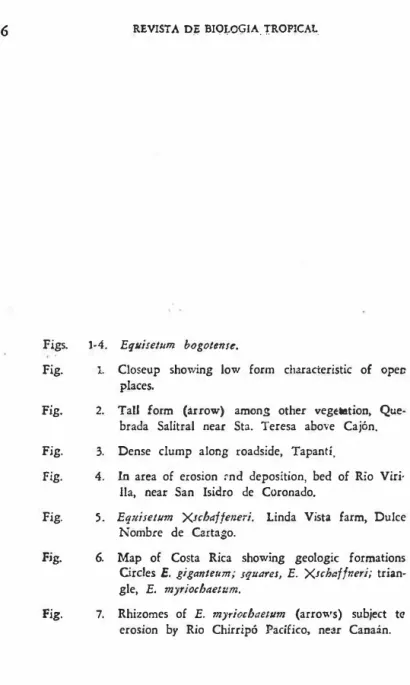
(8) REVISTA D� BIQ�OGIA. TROPICAL.. . 2?6. Figs.. 1·4.. EguiIe/lifTI. bogolenle.. Fig.. 1.. C10seup showing low form characteristic oE apee places.. Fig.. 2.. Tall form (:irrow) amang other vegetation, Que-brada S:liitral near Sta. Teresa aboye Cajón,. Fig.. 3.. Dense clump aloos roadside, Tapantí,. Fig.. 4.. In atea of etosion :>nd deposition, bed of Río Viri· Ua, oea! San Isidro de Coronado.. Fig.. 5. Eql!iJe/llm Xuh:tffeneri. Nombre de Ca.rtago.. Hg.. 6.. Map oE Costa Rica showing geotagic formations urdes E. giganteum; squcrf!S, E. Xuhaffneri¡ trian· gIe, E. myríoehaeJum.. Fig.. 7.. Rhizomes of E. myriochaetllm (arro\\'s) subject ter erosion by Rio Chirripá Pacífico. ne3r Cana:ín.. Linda Vista !armo Dulce.
(9) HAL'KE: EQUISETUM IN COSTA RICA. 277.
(10) REVTSTA DE BIOLOGIA TROPICAL. 278. Figs.. 8-10.. Epidermal maunts 'o show stomatal 3rrangements.. X75. Fig.. 8.. Fig.. 9.. ris:o. lO.. Figs, 1 1 · 1 3 .. E. XsebaJfneri. E. myriochaetum.. E. giga¡i;eum. Profiles of. branch ridges. X75.. Xuhtt/fneri.. Fig.. 1 1.. E.. Fig.. 12.. E. mYI'iochaetllm,. FiS_. 13.. E. gigan/eum.. showing. silica patteros..
(11) HAUKE: EQUISE11.1M IN COSTA RICA. 279.
(12) 280. REVISTA DE BIOLOGIA TROPICAL. Figs. 14-16.. Cross sections of stem internodes showing indo dermal patterns (arrows) , X75.. fig.. 14.. E.. Fig.. 15.. E. myrit)(haelUm, with outer i:.nd inner c:ommOD endoderm ises.. Fig.. 16.. E,. Fígs. 17-18.. XJch,,!flleri,. gig(.(I1lelllll,. wi.th individuad endodermises.. with. individual. endodermises.. Spores, X 190.. Fig.. 17.. Irregular, misshapen, al'hlorophyllous spores of E. Xuhaffneri nonviable.. Fig.. 18.. Spherical, chlorophyIlous, elatered spores oí E. g� ge/1lteu1Jl/ viable.. Fig.. 19.. Bundle of E. >'uJJajj,:er; as purchased in central market of San José.. Fig.. 20.. Authol'. standing by 30 extensive stand of E. Salitral de Desamparados, Costa Rica.. Xuhuffneri,.
(13) HAUKE:. EQUlSETUM. IN. COSTA RlCA. 281. ". • ••. • .;.,. 1.8.
(14)
Figure
Documento similar
Samples of “Turrialba cheese” (Latin-type fresh cheese) were obtained from different locations in Costa Rica to determine the levels of contamination with
Díaz Soto has raised the point about banning religious garb in the ―public space.‖ He states, ―for example, in most Spanish public Universities, there is a Catholic chapel
In the “big picture” perspective of the recent years that we have described in Brazil, Spain, Portugal and Puerto Rico there are some similarities and important differences,
ABSTRACT Transformation of the Specialized Knowledge of Future Primary Teachers on Fraction Division
From the phenomenology associated with contexts (C.1), for the statement of task T 1.1 , the future teachers use their knowledge of situations of the personal
In the preparation of this report, the Venice Commission has relied on the comments of its rapporteurs; its recently adopted Report on Respect for Democracy, Human Rights and the Rule
Methodology is based on combining compactness and density at building level and at urban fabric scale and it is applied to the case of the periphery of Murcia city, in south-
Vocabulario básico para abordar el tema de localización de
Each presentation lasted around 20 minutes and covered the role of natural history collections in ecological research, the quality of data at public
