
PAEPSPL: A FEATURE RETRIEVAL RE ENGINEERING PROCESS
7
0
0
Texto completo
(2) were the effort (time) to perform the processes and the precision (similarity) of the retrieved features. The quasi-experiment results showed that the teams that applied this process got a reduced effort and a higher precision than the teams that performed a different approach. For future work, this process will be extended to cover another phases of the SPL re-engineering process. Also, a case study in a real development environment will be planned and executed to give this proposal more reliability.. Palavras-chave: Software Product Line; Software Re-engineering; Software Process. Modalidade de Participação: Iniciação Científica. PAEPSPL: A FEATURE RETRIEVAL RE-ENGINEERING PROCESS 1 Aluno de graduação. [email protected]. Autor principal 2 Aluno de graduação. [email protected]. Co-autor 3 Docente. [email protected]. Orientador 4 Docente. [email protected]. Co-orientador. Anais do 9º SALÃO INTERNACIONAL DE ENSINO, PESQUISA E EXTENSÃO - SIEPE Universidade Federal do Pampa | Santana do Livramento, 21 a 23 de novembro de 2017.
(3) fa PAEPSPL: A FEATURE RETRIEVAL RE-ENGINEERING PROCESS 1. INTRODUCTION As it happened in the automobile industry, the introduction of product lines in software production caused big changes to the software industry. The benefits and motivation for implementing a Software Product Lines (SPL) are many: reduced maintenance effort, reduced complexity, increased reusability and better cost estimative (POHL et al., 2005). While many systems are now being developed proactively as a software product line, there are still those that emerge when a company has one or more software products and wants to create a software product line out of them. One way to create a SPL is the software product line re-engineering process. The goal of this process is to take a number of product variants and transform them into a SPL with the use of techniques, methods and tools. This process can be divided in three main phases: detection, analysis and transformation (ASSUNÇÃO et al., 2017). During the detection phase, the variability points and commonalities of the products are identified and extracted through the use of feature retrieval techniques. The second phase, analysis, is where the discovered features are organized as a feature model. The last phase, transformation, is when artifacts linked with these features are managed and modified in order to create the SPL. However, this process is still not well defined. Otsuka et al. (2011) and Ziadi et al. (2012) argue that a set of guidelines is needed to formalize this process. Other authors, such as those of Martinez et al. (2015) and Stoermer; O'brien (2001), have pointed that guidelines may lead to an automated support for this process. The main objective of this work is to propose a process that assembles a feature retrieval process for SPL re-engineering. The process main goal is to assemble different feature retrieval processes for each scenario, aiming for a high level of reuse. The main goal of the assembled process is to detect and extract features from a set of product variants, covering the first two phases of the SPL reengineering process. This process intends to provide enough flexibility regarding artifacts, strategies and techniques used for feature retrieval. This flexibility is given by allowing the choice and combination of different techniques for feature retrieval based on information gathered during the process' execution. This information includes: team experiences and skills, domain engineering artifacts, requirements artifacts, product artifact types and extensions, and technologies used to develop the products. A set of guidelines was created to help whoever is performing this process to choose the techniques that better fit their situation. 2. METHODOLOGY The first step to conduct this work was to search in digital libraries for another software re-engineering process. A Systematic Mapping Study (SMS) on SPL reengineering process (ASSUNÇÃO et al., 2017) was found, and it was used as a guideline do construct this work. In the SMS, Assunção et al. (2017) mapped 119 studies, these studies were selected as the universe of studies for this work. However, in order to reduce this large set of studies into a more precise one, the following inclusion criteria (IC) were applied. IC01) The study must address the.
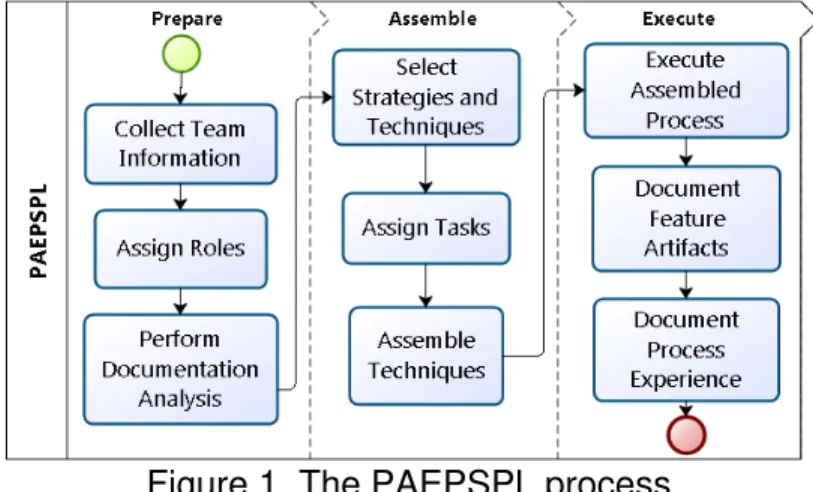
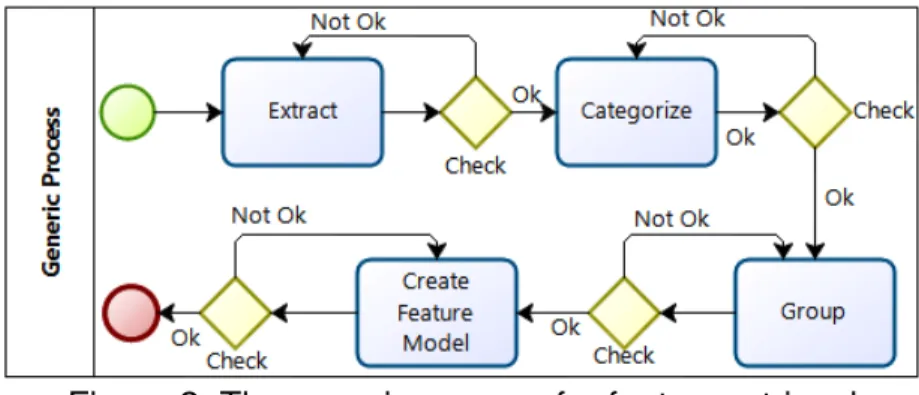
(4) detection or analysis phase of the re-engineering process; IC02) The study must present the use of two or more techniques for feature retrieval; IC03) The study must present some kind of customization/adaptability in their proposal. To be included in this work the studies should answer "yes" to all the ICs. After finishing this process, 70 studies were selected to be analyzed. The studies analysis was done focusing on two topics of interest: combination of strategies and techniques for feature extraction, and adaptability/flexibility/ customization of the proposal to attend different scenarios. After the end of this analysis, a process for feature retrieval was created. To obtain an early feedback about the process a survey was applied in specialists of the SPL and re-engineering fields. The survey contained questions about the contribution, relevance, originality and reliability of the proposed process. After applying some changes to improve the aspects of flexibility and reliability of the proposal, a quasi-experiment was performed. The subjects were eight students of software engineering with some development experience. These subjects were divided in four groups according to their knowledge and skills. Two teams would apply this process while the other two would apply a different approach. The measures of interest here were the effort (time) to perform the processes and the precision (similarity) of the retrieved features. 3. RESULTS and DISCUSSION The Prepare, Assemble and Execute (PAEPSPL), illustrated in Figure 1, is a process that assembles and executes a feature retrieval process for SPL reengineering. The process was design to allow adaptation according to different scenarios and re-applicability. This may reduce the cost and effort of re-applying this process in different or similar scenarios. During Prepare, data such as team experience, skills, and products documentation are analyzed. This information is used to choose most recommended retrieval techniques for that scenario. During the second phase, Assemble, these techniques are assembled in different activities of a generic process, see Figure 2, generating an assembled process. For instance, Formal Concept Analysis (FCA) and Latent Semantic Indexing (LSI) can be assembled as extraction techniques to retrieve the features and create the Feature Model, as showed in Figure 3. And finally, during Execute the assembled process is executed to retrieve features of the product variants.. Figure 1. The PAEPSPL process.
(5) Figure 2. The generic process for feature retrieval. Figure 3. An example of assembled process To help the selection of retrieval techniques, a guidelines section was created in the process documentation. These guidelines described the techniques mapped from the studies analyzed, give examples of use, list input and outputs artifacts used for each technique, point to related techniques and tools, and most important, describes recommended situations, as Table 1 illustrates using the example of clustering technique. Table 1: Guideline for the clustering technique Technique Clustering Definition Group elements based on their dependences Inputs Source Code Outputs Feature tree; Feature clusters; Tools Cluster 3.0; C Clustering Library Related Techniques Formal Concept Analysis Recommended Situations Products with high level of dependencies between feature implementations. The techniques were divided in three groups: i) Static analysis - Dependency Analysis and its variations, Rule-Based Techniques, Data-Flow analysis and its variations, and Clustering; ii) Information retrieval - LSI, Vector Space Model (VSM) and FCA; iii) Support strategies - Expert Driven Extraction and Heuristics. Regarding the Heuristics techniques, a set of heuristics proposed by different works in the SPL re-engineering area were mapped: H1. Filtering: Filter elements that do not contribute directly to the feature retrieved.
(6) H2. Score Modification: Rank elements based on their lexical and syntactical properties, eliminating not relevant elements. H3. Compare: Calculates the similarity degree for each pair of input model elements. H4. Match: Use empirical similarity thresholds and analyze a pair of model elements, returning pairs that are considered similar in a match result. These heuristics were included in the process documentation because they can be combined with any other feature retrieval technique, giving the process more flexibility. The survey applied in specialist of the area resulted in a positive feedback as a great majority of the participants stated that this proposal may be a relevant contribution to the field. The participants, however, also pointed that some improvements should be made regarding the flexibility/adaptability of the process. After the process received this improvements the quasi-experiment was performed. The quasi-experiment results showed that the teams that applied this process got a reduced effort and a higher precision than the teams that performed a different approach. Both empirical evaluations demonstrated that this process is a contribution that reduces the effort of applying the SPL re-engineering process by providing guidance to assemble a feature retrieval process according to a specific scenario. This guidance reduces the effort and the process obtained a higher level of precision of retrieved features. 4. FINAL CONSIDERATIONS This work presented a process that assembles a feature retrieval process for SPL re-engineering. This kind of process is needed because its adaptability and reusability may reduce the effort of applying and re-applying the feature retrieval when construction a SPL. The proposal was created with the information gathered when analyzing a set of proposals of the re-engineering field mapped by Assunção et al. (2017). The result was a generic process that collects information about the domain, the team that will perform the re-engineering, and product artifacts. This information is used to choose the most recommended techniques for that scenario and assembles them into a feature retrieval process. This feature retrieval process is executed and the features are retrieved from the products. To evaluate this proposal a survey was applied in specialist of the area. The survey responses indicated that this proposal may be a relevant contribution to the area. The survey also pointed some needed improvements regarding the flexibility of the process. After these improvements were made, a quasi-experiment was performed. The quasi-experiment results showed that this process reduces the effort and increases the precision of feature retrieval in comparison to another approach. For future work, this process will be extended to cover another phases of the SPL re-engineering process. Also, a case study in a real development environment will be planned and executed to give this proposal more reliability. 5. REFERENCES MARTINEZ, J., ZIADI, T., BISSYANDÉ, T. F., KLEIN, J., & LE TRAON, Y. Bottom-up adoption of software product lines: a generic and extensible approach. In:.
(7) Proceedings of the 19th International Conference on Software Product Line. ACM, 2015. p. 101-110. ZIADI, T., FRIAS, L., DA SILVA, M. A. A., & ZIANE, M. Feature identification from the source code of product variants. In: Software Maintenance and Reengineering (CSMR), 2012 16th European Conference on. IEEE, 2012. p. 417-422. STOERMER, C., O'BRIEN, L. MAP-mining architectures for product line evaluations. In: Software Architecture, 2001. Proceedings. Working IEEE/IFIP Conference on. IEEE, 2001. p. 35-44. ASSUNÇÃO, WKG LOPEZ-HERREJON, R. E., LINSBAUER, L., VERGILIO, S. R., & EGYED, A. Reengineering legacy applications into software product lines: a systematic mapping. Empirical Software Engineering, p. 1-45, 2017. OTSUKA, J., KAWARABATA, K., IWASAKI, T., UCHIBA, M., NAKANISHI, T., & HISAZUMI, K.. Small inexpensive core asset construction for large gainful product line development: developing a communication system firmware product line. In: Proceedings of the 15th International Software Product Line Conference, Volume 2. ACM, 2011. p. 20. POHL, K; BÖCKLE, G; VAN DER LINDEN, F J. Software product line engineering: foundations, principles and techniques. Springer Science & Business Media, 2005..
(8)
Figure
Documento similar
The Dwellers in the Garden of Allah 109... The Dwellers in the Garden of Allah
Ferrimagnetism - Magnetic behavior obtained when ions in a material have their magnetic moments aligned in an antiparallel arrangement such that the moments do not
The workflow manage- ment disciplines described in this paper cover the issues of business process engineering, design process management, and manufacturing workflow management
The first chapter of this thesis, Learning about the international diffusion of durable goods, uses a large data set that includes the diffusion process of 31 durable goods from
The aim of this paper is to review the whole process of assembly, integration and test (AIT) of the readout electronics work package and present the main results to
This paper presents the engineering process we have followed to obtain the safety requirements in one of the robots of the EFTCoR 1 project and the way this requirements have
This paper is devoted to the study of experience as a semiotic process of constructing the personal meaning of the situation lived. Its main purpose is to devise
Business Process Re-engineering, Total Quality Management, Continuous
