Assessment through first-principles calculations of an intermediate-band photovoltaic material
based on Ti-implanted silicon: Interstitial versus substitutional origin
K. Sanchez, I. Aguilera, P. Palacios, and P. Wahnon
Departamento de Tecnologias Especiales, ETSI Telecomunicacion and Institute de Energia Solar, UPM, Ciudad Universitaria, Madrid 28040, Spain
(Received 23 December 2008; revised manuscript received 10 March 2009; published 10 April 2009) Quantum calculations based on density-functional theory are carried out with the aim of discovering the origin of the electronic properties of Ti-implanted Si. This compound is a potential kind of intermediate-band photovoltaic material. Experimental results show a donor level at a few tenths of an eV below the conduction band for this compound. This could correspond to the electronic transition from an intermediate band to the conduction band of the host silicon. The structural, energetic, and electronic properties of several possible configurations appearing from the implantation of Ti on Si are calculated at different dilution levels in order to agree with the experimental conditions. Among the implantation processes, all of which are energetically unfavorable, interstitial Ti setting implies the energetic balance closest to the equilibrium, which agrees with the experimental measurements. Our conclusions predict that interstitial Ti atoms are responsible for the electronic transition found from the measurements, forecasting that a band fulfilling all the requirements of an intermediate-band material is formed in the compound. The optical absorption coefficient of an interstitially Ti-implanted Si compound is shown to illustrate the photoabsorption enhancement achieved in the main part of the solar spectrum with regard to bulk Si.
DOI: 10.1103/PhysRevB.79.165203 PACS number(s): 71.20.Nr, 71.15.Mb, 71.28.+d
I. INTRODUCTION
The emergence of the so-called third generation of solar cells is in progress. Among a number of novel proposals the intermediate-band (IB) solar cell concept1 is one of the hot
topics in current photovoltaic research. The intermediate-band photovoltaic material must have three electronic intermediate-bands close to the Fermi level: valence band (VB) and conduction band (CB) as in a conventional semiconductor and also a narrow partially filled band placed into the host semiconduc-tor gap and isolated from the aforementioned bands. Elec-trons can be promoted directly from the VB to the CB, as in usual semiconductors. Furthermore, photons with energies lower than the band gap can be absorbed by taking advan-tage of the IB in a two-step process. As a result, the photo-current of the solar cell can be increased without decreasing the voltage.
Several crystalline materials have been proposed as intermediate-band materials in order to achieve a highly ef-ficient device.2-7 In most cases transition metals were
intro-duced into host semiconductors, substituting group III atoms in such a way that 3d electrons of the transition metal can form the IB. Theoretical studies have concluded that the syn-thesis of several of these candidates is thus possible.8 Even
the first results of experimental samples have shown triple absorption spectra in accordance with quantum predictions.9
Meanwhile, other possible intermediate-band materials based on Si have been recently proposed in order to demon-strate experimentally the working principles of the intermediate-band solar cell. The clear advantage of Si as host semiconductor is the thorough knowledge of it, which could lead more proficiently to the first experimental devices.1 0 For this reason Olea et al.n attempted to grow
crystalline samples of Ti-implanted Si at concentrations sig-nificantly above the equilibrium solubility limit. They
man-aged to synthesize a crystalline sample of Si with both inter-stitial and substitutional Ti with concentrations of 6 X 10¹⁹ and 1018 c m- 3, respectively. Both amounts are close or even above the so-called Mott limit, from which Ti atoms can form a band instead of isolated impurity levels. This prevents nonradiative Shockley-Reed-Hall recombinations.1 2
Further-more, a deep donor level with a concentration of 7 X 10¹⁷ c m- 3 was obtained at 0.21 eV below the CB by means of an Arrhenius plot of the carrier concentration. In a later report,13 the donor level was estimated to be at 0.36 eV
below the CB by the same authors who carried out a simu-lation by means of a fitting of the sheet resistance.
The intention of this paper is twofold. On the one hand, it is intended to find the origin of the donor level by using first-principles quantum calculations. The structural, ener-getic, and electronic properties of the most probable products from a Ti-implanted Si compound, namely, interstitial and substitutional compositions, are analyzed in detail for this purpose. Furthermore, combinations of these situations are also considered.
On the other hand, the characteristics and position of the electronic states formed in all cases are examined to antici-pate the possible formation of an intermediate-band photo-voltaic material with the desired properties. In addition opti-cal properties of a potential intermediate-band material close to the experimental conditions are computed. The improve-ment in the absorption coefficient across the solar spectrum produced by the IB is verified.
II. METHOD
Density-functional theory (DFT) calculations14,15 were
carried out to obtain atomic, electronic, and energetic prop-erties of compounds based on Si doped with Ti at concentra-tions close to those of the experiment made by Olea et al.13
TABLE I. Structural parameters obtained from the relaxation carried out for substitutional Ti-derived compounds. Values are given in A.
TABLE II. Structural parameters obtained from the relaxation carried out for interstitial Ti-derived compounds. Values are given in A. Compound 4T iS i- S i1 s t ] d[Si„-SiJ T iS iS i6 3 T iS iS i2 1 5 5.477 5.468 2.502 2.504 2.373 2.368
Compound 4Ti,-Siist] 4Ti,-Si2nd] d[Si„-SiJ Ti,Si64 T iiS i2 1 6 5.471 5.466 2.481 2.474 2.772 2.774 2.368 2.366
Three different supercells of conventional Si8 cubic unit cell were considered to include the Ti implantation: 2 X 2 X 2 (Si64), 3 X 3 X 3 (Si216), and 4 X 4 X 4 (Si512). The structures designed from the two former supercells were relaxed in or-der to observe the tendency of the corresponding impurities. Structural optimization for the compounds derived from Si512 was not carried out due to the amount of computational re-sources that would have been required for such number of atoms. Instead, the electronic structure was calculated for atomic coordinates extrapolated from those corresponding to the experimental bulk-Si lattice. As Sec. III will show, the electronic structures observed in the relaxation at low con-centrations differ only slightly from the nonrelaxed results.
Generalized gradient approximation (GGA) with the P W 9 1 parametrization1 6 was used to treat the
exchange-correlation potential in the plane-wave-based code VASP.17,18
The energy cutoff established for the basis set was 245 eV. Projector augmented wave (PAW) potentials1 9,2 0 were used
to represent the inert core electrons. The samplings used to describe the Brillouin zone corresponding to the compounds derived from the 2 X 2 X 2, 3 X 3 X 3, and 4 X 4 X 4 super-cells were T-centered 6 X 6 X 6, 4 X 4 X 4, and 2 X 2 X 2 grids, respectively. A Methfessel-Paxton first-order scheme2 1
with 0 . 1 eV of smearing was chosen to extract the occupa-tions of one-particle levels. The tetrahedron method2 2 was
used to obtain well-defined electronic densities of states (DOSs).
In the cases where ionic optimization was carried out, the atomic forces were minimized to below 0.01 e V / A. Possible Jahn-Teller distortions produced by the implantation of Ti were treated during the relaxation study. This was done by carrying out additional calculations with slightly distorted coordinates and lattice parameters, hence preventing possible saddle point behavior of the starting guess caused by its high symmetry. The distorted relaxations evolved into the struc-tures shown in Sec. III A, discarding therefore the Jahn-Teller distortions. The dumbbell split [110] structure, which is common among Si self-interstitial defects, evolved into a tetrahedral interstitial Ti configuration during the optimiza-tion. Additionally, no antiferromagnetic alignment of local magnetic moments was found energetically stable.
The optical behavior of the materials was characterized by means of their absorption coefficient derived from the dielec-tric function. The imaginary part of the latter was obtained by the sum on independent transitions between Kohn-Sham states, without local field effects, following the method de-scribed by Gajdos et al.,23 as implemented in the OPTICS code.2 4 The real part of the dielectric function was obtained
from the imaginary part by the Kramers-Kronig relations. To obtain the fully converged frequency-dependent dielectric
properties of 3 X 3 X 3 supercell based compounds, 250 empty bands were included, and the Brillouin zone was sampled using an 8 X 8 X 8 Monkhorst-Pack grid including the T point.
III. RESULTS
A. Atomic structure of bulk-, TiSi-, and Ti;-Si compounds
This work includes the optimized structures for bulk-Si-and Ti-implanted compounds, both in substitutional (TiSi) and interstitial (Ti;) cases. The relaxed lattice parameter, a, of bulk Si turned out to be 5.464 A for both Si64 and Si216 supercells, slightly longer than the experimental one (5.43 A). This minor overestimation agrees with the ten-dency of GGA calculations. The resulting interatomic dis-tances (2.366 A) of both supercells agree down to thou-sandths of angstroms, as expected for correctly converged results.
The parameters of the relaxed Ti-substituted compounds are represented in Table I. The lattice parameter is expanded with regard to the bulk Si, marginally in the diluted TiSiSi215 case and more noticeably for the most concentrated case, TiSiSi63, as expected. In both compounds the substitution causes an increment of 0.14 A in the distance to the first four nearest neighbors (Si1st). The distances between the Si atoms placed in the remotest positions available in the cell (labeled as Siro) are 2.368 and 2.373 A for TiSiSi215 and TiSiSi63, respectively. The latter is not close to the bulk re-laxed interatomic distance. Therefore, the stress induced by the substitution is present along the whole cell. However, for the dilute case the Siro-Siro distance corresponds almost to the bulk one, being an indication that the implanted atom does not modify the bulk-Si structure at such a range.
The interstitial implantation of a Ti atom produces a more complex structure than the substitution, as can be seen in Table II. The four nearest neighbors at positions with a tet-rahedral configuration appear at approximately 2.48 A. However the six second nearest neighbors (Si2nd) are placed rather close to the Ti atom, approximately 2.77 A, in such a way that the crystalline field cannot be simplified only to the effect of the four nearest neighbors. This fact will be ana-lyzed in Sec. III C 3.
The interatomic distances between the remotest Si atoms almost coincide with the bulk-Si ones, even for Ti;Si64. This indicates that the interstitial Ti modifies the bulk-Si structure throughout a smaller range than the substitutional Ti.
B. Formation energies
The formation energies of both kinds of Ti implantation were calculated from the total energies obtained for the
com-X K
FIG. 1. (Color online) Band structure for the relaxed TiSiSi63 compound.
-1 0 1
E - EF (eV)
FIG. 2. (Color online) Total and TiSi 3d projected DOSs for the relaxed TiSiSi215 compound compared with that from bulk Si216.
pounds derived from the 3 X 3 X 3 supercell, which is the largest cell allowed to be relaxed in the present study. The formation energy for the interstitial Ti;Si2 1 6 compound was obtained using the equation
1
E[Ti;Si216] = £[Ti,Si216] - E [ S i2J - ^ £ [ T iJ = + 1.51 eV,
where Ti2 corresponds to the common hcp crystalline struc-ture of Ti, made up of two atoms per formula. As a result, the formation of interstitial Ti involves a penalty of 1.51 eV/ atom inserted.
In the case of the substitutional TiSiSi215 compound, the formation energy balance corresponds to
215 1 E[TiSISi215] = E[TiSiSi215] - — E[Si216] - "E [ T i 2 ]
216 2 = + 2 . 1 6 eV.
Therefore, although both implantation types are energetically penalized, this penalty is considerably larger (0.65 eV) for the substitutional Ti. This explains the Ti; concentration to be 50 times greater than TiSi in the experimental sample.
In addition, formation energies of double interstitial im-plantation were calculated, both considering the nearest (N) and remotest (R) possible T irT i; distance configurations,
Ef[TiiTiiSiR216] = ETiiTiiSiRj - E[Si216] - E[Ti2] = + 2 . 9 9 eV,
E
f[Ti,TiSNJ
= E[Ti, T i S N
j
- E [ S i21 6 ] - E[Ti2] = + 2 . 6 3 eV.The formation energy of the remotest Ti ,-Ti , configuration is almost twice the formation energy of a single interstitial Ti atom, as was expected. Although the balance for the nearest configuration is less unfavorable, due to the tendency of the Ti atoms to become aggregated in cluster form, the differ-ence between both configurations is moderate, approximately 0.36 eV. Conversely, the formation energy of an interstitial implantation placed close to a substitutional Ti is
215
Ef [Ti 1TiSiSiN15] = E[TiiTiSiS^L5] - — E[Si216] - E[Ti2] 216
+ 2.09 eV.
Thus the formation energy of a dimer Ti -TiS i is not only much less unfavorable (0.54 eV) than a close Ti ,-Ti , configu-ration but even smaller than the formation energy of a single substitutional Ti.
C. Electronic structure 1. Bulk Si
In a first step the electronic structures of the different bulk-Si unit cells were obtained. The indirect band gaps found correspond to 0.60 and 0.63 eV for the calculations carried out with the experimental and the relaxed structures, respectively. This means that the Si band gap was underesti-mated for nearly 50% of the experimental value (1.12 eV). These results are in agreement with other DFT-GGA calcu-lations carried out in Si reports.2 5,2 6 The bulk D O S will
pro-vide a reference to the different Ti-implanted situations proposed below.
2. Substitutional Ti
Band-structure calculations for the substitutional com-pound derived from the 2 X 2 X 2-Si8 supercell were carried out. In this cell the implantation, either substitutional or in-terstitial, of one Ti atom imposes a concentration [Ti] = 8 X 10²⁰ c m- 3 which clearly exceeds the experimental
situa-300 250 200 150 100 50 0 -1 0 E - EF (eV)
FIG. 3. (Color online) Total and TiSi 3d projected DOSs calcu-lated for the nonrelaxed TiSiSi511 compound compared with that from bulk Si512. 200 150 100 50 0 _ r r
TABLE III. Summary of results for bandwidth and possible electronic excitations obtained from the electronic structure of the compounds implanted with substitutional Ti. Results obtained after the correction of empty bands are in brackets. All values are given in eV.
Compound eg bandwidth AE[VB- eg] AE[VB-CB]
TiSiSi63 0.39 0.52(1.01) 0.81(1.30)
T i S iS i2 1 5 0.15 0.54(1.03) 0.69(1.18)
TiSiSi511 0.08 0.47(0.96) 0.62(1.11)
tion. Nevertheless, it was considered interesting to study these dilution levels in order to check whether an isolated intermediate band can be formed or if, on the contrary, the energy levels from the Ti 3d electrons overlap with any of the Si bands.
The TiS iSi6 3 band structure shows that a doublet appears above the Fermi level (see Fig. 1), just slightly overlapping with the rest of the conduction band. The energy difference between the valence band maximum (VBM) and the conduc-tion band minimum (CBM) is 0.81 eV, rather higher than 0.63 eV obtained for the host compound. Also a minor dis-tortion in the C B M can be seen. The doublet has a bandwidth of 0.38 eV and its minimum is separated from the valence band by 0.52 eV. This low-energy eg doublet, together with a high-energy triplet with t2g symmetry, is originated from the crystal field splitting over the Ti 3d electrons that the tetra-hedral environment imposes.2 7,2 8 The four electrons coming
from TiSi with valence 4+ arrange themselves as the sp3 shell of the former Si atom. As a result, all the levels split from Ti 3d shell. The six remaining Ti 3d levels, corresponding to the t2g triplets, are tightly hybridized with the CB.
The DOS of TiS iSi2 1 5 ([Ti] = 2 X 10²⁰ c m- 3) shows, as in the case of the TiSiSi63, both eg doublets for each spin chan-nel (see Fig. 2). Again these levels are empty while the re-maining Ti 3d manifolds are again within the CB. There is a marked narrowing in the DOS at 0.69 eV above the VBM, which corresponds to a slight eg-CB overlap. This energy difference is considerably smaller than that for the TiS iSi6 3 but still greater than the one corresponding to the bulk Si. The bandwidth of the intermediate band is 0.15 eV and in this case is separated 0.54 eV from the VBM, similarly to the previous case.
A last interstitial Ti calculation for a TiSiSi511 compound corresponding to 1020 c m- 3 is carried out in order to check whether a split of the eg manifolds from the CB is observed
when approaching the TiSi concentration measured by Olea et al.11 Although this value is still 2 orders of magnitude larger than the experimental amount of substitutional Ti, it is expected that the electronic structure at that dilution would be rather similar, except that the bandwidth of the potential IB formed would be slightly reduced.
The DOSs calculated for the TiSiSi511 compound carried out are displayed in Fig. 3. The intermediate levels appear completely isolated from both VB and CB, conversely to the previous cases. The eg doublets are placed 0.07 eV below the C B M and have a bandwidth of 0.08 eV. The resulting band gap is 0.62 eV, slightly higher than that of bulk Si.
From the results obtained above it is observed that substi-tutional Ti at dilution close to the experiment causes eg mani-folds to appear inside the host semiconductor band gap. However, they cannot produce by themselves any donor level because they are empty.
A brief summary of the main characteristics of the elec-tronic structure found for the substitutional Ti at the different dilution levels is shown in Table III. Results considering a band-gap correction based on a rigid shift of 0.49 eV applied over empty bands have been included. The purpose of this correction is to recover the 1.12 eV VB-CB gap of bulk Si, which was found to be 0.63 eV in the previous G G A calcu-lations. The rigid shift is carried out on the assumption that the possible changes induced by the Ti on the host semicon-ductor bands would not be significant.
3. Interstitial Ti
The most relevant quantitative features calculated from the electronic structure of interstitially Ti-implanted com-pounds are summarized in Table IV, where results with the same rigid shift of 0.49 eV than that applied in Table III have been included. In line with its atomic structure, the electronic structure of the interstitial compound is also more complex than that of the substitutional Ti. The effect of the octahedral crystal field originated by the six second nearest neighbors consists of splitting 3d levels into low-energy t2g triplet and high-energy eg doublet. This enters in competition with the tetrahedral crystal field from the four first nearest neighbors, as it was suggested by Ludwig and Woodbury.2 9 As a result
the overall influence of the second neighbors seems to be stronger. This fact is revealed by the band structure shown in Fig. 4. Both t2g manifolds can be seen for each spin channel. These results for atomic relaxed compounds agree with pre-vious theoretical works.2 7,2 8 The filling of these levels
pro-duces a splitting between majority and minority t2g triplets,
TABLE IV. Summary of results for bandwidths and possible electronic excitations obtained from the electronic structure of the compounds implanted with interstitial Ti. Arrows are referred to either majority (f) or minority spin (j) manifold. Results obtained after the correction of empty bands are in brackets. All values are given in eV.
Compound 4g bandwidth 4g bandwidth AE[VB- t|g] A£[4g-CB] AE[tjg-CB] AE[VB-CB]
Ti,Si64 0.49 0.65 0.78 -0.02 (0.47) -0.09 (0.40) 0.71 (1.20)
T i iS i2 1 6 0.17 0.28 0.62 0.19 (0.68) 0.00 (0.49) 0.63 (1.12)
X K
FIG. 4. (Color online) Minority (up) and majority (down) band structures obtained for the relaxed TiiSi64 compound.
with a full triplet emerging in minor contact with the host semiconductor CB and another one partially filled and over-lapped with the CB more closely. The remaining Ti; 3d lev-els appear mixed with higher conduction states. The energy difference between the V B M and the C B M is higher than the calculated semiconductor band gap, but the variation is less significant than that found for the TiS iSi6 3 compound.
DOSs obtained for the interstitial Ti;Si2 1 6 compound are shown in Fig. 5. A splitting similar to that found in the Ti;Si6 4 compound can be appreciated. However, in this case the majority spin t2g triplet is clearly isolated from the rest of the electronic levels and narrower than that calculated for the Ti;Si6 4 case. The energy difference between the majority C B M and V B M almost coincides with the obtained for the host semiconductor band gap. Also, it can be seen that the minority manifold is narrower but not enough to be isolated from the CB. However, due to the well-known D F T under-estimation of the band gap it is expected that describing the CB correctly at higher energies will separate it from the mi-nority spin triplet.
• m
' * -,216 Islf*\
V
J f
• i .
,/ip
w i f
u k :
0 E - EF (eV)FIG. 5. (Color online) Total and T^ 3d projected DOSs for the relaxed Ti,Si216 compound compared with that from bulk Si216. From now on, majority and minority spin DOSs are represented in the upper and lower parts of the graph, respectively.
150 100 50 0 50 100 150 -1 0 E - EF (eV)
FIG. 6. (Color online) Total and T^ 3d projected DOSs calcu-lated for the nonrelaxed TiiSi512 compound compared with that of bulk Si512.
For the most diluted compound, Ti;Si512 (see Fig. 6), both t2g manifolds are completely isolated from both valence and conduction bands. The separation is caused by the narrowing of the intermediate bands. The majority and minority mani-folds are 0.06 and 0.11 eV wide, respectively. The partially filled minority t2g triplet, crossed by the Fermi energy, is separated 0.6 eV approximately from the CB after the band-gap correction. This value is similar to the result obtained by the simulation of the experimental results reported by Olea et al.11 The host semiconductor band gap, 0.61 eV, corresponds
almost exactly to the case of the (nonrelaxed) host S i 51 2.
4. Combination of interstitial and substitutional Ti implantations
In addition, other compounds with combined interstitial and substitutional Ti atoms were studied in order to verify where the energies of both Ti levels are located. A TiSiTiiSi511 unit cell with both sites at the remotest relative positions was designed. The corresponding D O S (see Fig. 7) shows, as expected, that the electronic levels are rather simi-lar to those of the noncombined unit cells. Only a small increase in the energies of the minority eg doublet of the substitutional Ti atom was reported.
The dimer states produced when both impurities get closer modify, to some extent, the electronic structure shown in Fig. 8. A fully occupied majority spin triplet appears at only a few hundredths of eV above the valence band. Unlike the previous case, a half-filled doublet and an empty singlet are placed in the minority channel band gap. The doublet is
150 100
-1 0 1
E-EF (eV)
FIG. 7. (Color online) Total and partial (TiSi 3d and T^ 3d) DOSs calculated for the Ti,TiSiSi5n compound with both implanted Ti atoms located at the remotest sites.
_ r r 50 0 50 100 2 3 150
100
-1 0
E - EF (eV)
FIG. 8. (Color online) Total and partial (TiSi 3d and Ti; 3d) DOSs calculated for the TiITiSiSi511 compound with both implanted Ti atoms located at the nearest sites.
0.2 eV above the V B M and, in turn, the singlet is at 0.2 eV above the doublet. The band gap obtained in this calculation is slightly larger than that corresponding to the host semicon-ductor.
In principle, the existence of a donor level is compatible with this configuration, and even the half-filled doublet could correspond to an intermediate band. However, this close co-existence of both impurities is rather improbable. The reason lies in the fact that the relatively low concentration of Ti; atoms should be combined with the much lower concentra-tion of TiSi atoms.
D. Optical properties
We determined that the interstitial Ti seems to cause the experimental donor level and that it is a solid candidate to form an intermediate band inside the bulk-Si band gap. Therefore, its optical absorption coefficient has been studied to examine the enhancement of the absorption of the solar spectrum in comparison to bulk Si.
The Ti;Si2 1 6 compound was selected to study the improve-ment in the optoelectronic properties given that it corre-sponds to the relaxed structure with the concentration closer to the experiment. Its absorption coefficient is shown in Fig. 9 together with that of bulk Si. In both cases a rigid shift has been applied over the eigenvalues of the CB in order to cor-rect the GGA underestimation of the band gap. For bulk Si the main characteristics of the calculated absorption spec-trum and those from the experimental results agree, except
1400 1200 1000 VEo 800 CO £ 600 a 400 200 0 0 0.5 1 1.5 2 2.5 3 3.5 4 E(eV)
FIG. 9. (Color online) Optical absorption coefficient calculated for Ti,Si216 and bulk-Si compounds. The solar spectrum AM1.5G (in arb. units) has been included as a solid shape in background.
TOTAL V B ^ IBl I B ^ C B T I B ^ C B l V B ^ C B I B ^ IBl 0 0.5 1 1.5 2 2.5 3 E(eV)
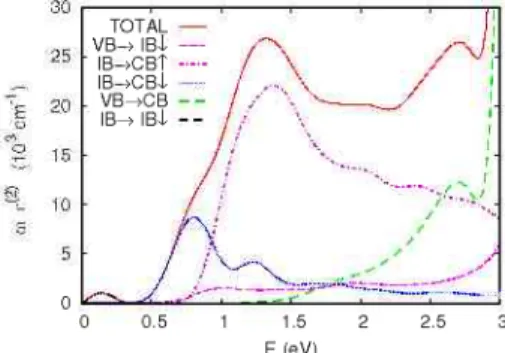
FIG. 10. (Color online) Imaginary part of the dielectric constant calculated for Ti,Si216 compound. Both total and decomposed elec-tronic transitions have been included. In the case of transitions from the VB to the CB (VB ^ CB) both spin components were added together as they had almost the same appearance.
for issues related to indirect transitions and exciton effects. The absorption of the Ti;Si2 1 6 compound is enhanced in the energy range below 3 eV, in which the main part of the solar spectrum is contained.
The imaginary component of the dielectric constant and its different contributions have been examined (see Fig. 10) to verify the role of the IB in the absorption enhancement, given the close relationship between both properties. It can be seen that the main contribution below 3 eV is related to the IB levels. Apart from the intraband transitions, which are not relevant for photoconversion purposes, there is a peak at 0.8 eV resulting from electronic transitions from the minority IB to the CB. A bigger and broader peak appears centered at 1.4 eV. It is caused by the excitations from the majority IB manifold to the CB. The component originated by the tran-sitions from VB to minority IB is modest throughout the studied range. Finally, a noticeable contribution resulting from low-energy transitions between VB and CB is ob-served. These are produced by the change from indirect to direct VB-CB gap as a result of small distortions in the CB states related to the appearance of the IB (see Fig. 2).
IV. SUMMARY AND CONCLUSIONS
It is revealed by the calculated energy balances that both interstitial and substitutional Ti implantation processes are unfavorable, in agreement with the difficulties in growing a crystalline structure without Ti clustering. However, intersti-tial Ti is less unstable by 0.65 eV, which explains the differ-ent concdiffer-entration orders of magnitude found in the Ti-implanted samples of Olea et al.11
The full relaxation of atomic structures shows that substi-tutional Ti only introduces a small elongation of the inter-atomic distances from the tetrahedrally placed nearest neigh-bors. As a result two empty eg-type doublets appear approximately at 0.5 eV above the valence band. In the most concentrated structures, GGA calculations show that these doublets are slightly overlapped with the CB. However, it is expected that a better description by correcting the band-gap underestimation of current calculations would increase both eg and C B M energies to a similar degree, given that both bands are empty. Therefore, we consider that the
substitu-50 0 50 100 150 0
tional Ti would provide an empty band approximately at a few tenths of eV below the conduction band edge. However, the level found through the experiments, being donor, cannot be attributed to these empty states.
Although the interstitially implanted Ti atom relaxes into a site tetrahedrally coordinated by four Si atoms, its second nearest neighbors are sited at octahedral positions just slightly further away, establishing a competition between both crystalline field trends. The low-energy triplets found in the DOS suggest that the main interaction corresponds to the octahedral environment. At an experimental Tii concentra-tion, both majority and minority t2g manifolds are found by the DFT-GGA calculations completely isolated between themselves and the Si CB, the partially filled minority triplet being at 0.11 eV below the CBM. Extrapolating the position of the CB by applying a rigid shift, the minority t2g manifold would be located at approximately 0.5 eV below the CB. In summary, the presence of interstitial atoms is enough to gen-erate the donor state found through the experiments.
The influence of other nearby (interstitial or substitu-tional) Ti atoms could have some effect on the position of the donor level. In the case of coexistence of close Ti-implanted atoms, the energy balances suggest that the TiSi-Ti; dimer is much less unfavorable than Tii-Tii or TiSi-TiSi. In any case, this kind of dimers is rather unlikely in samples with a Ti dilution of around 5 X 10¹⁹ c m- 3.
Besides that a method beyond D F T could set accurately the position of the electronic levels, we argue that the origin of the donor state found in the experimental Ti-implanted Si samples settles from the interstitial Ti. Its isolated partially filled manifold complies with the requirements needed to behave as an appropriate intermediate-band photovoltaic ma-terial. This fact, together with the lower energy formation of interstitial Ti compared with other kind of Ti implantation products, allows the assumption that the manufacture of an intermediate-band solar cell is feasible. The effect of the in-termediate band present in the Ti;Si2 1 6 compound over the absorption coefficient of bulk Si implies a significant en-hancement of the optical absorption in an important part of the incoming solar spectrum, caused essentially by electronic excitations involving the IB.
ACKNOWLEDGMENTS
We would like to acknowledge funding from the GENESIS-FV (Grant No. CSD2006-0004) and the CALI-B A N D (Grant No. MAT2006-10618) projects of the Spanish Ministry of Education and Science and from the N U M A N C I A - M A (Grant No. S-05050/ENE/0310) project of the Community of Madrid. We acknowledge the computer resources and assistance provided by the Centro de Super-computation y Visualization de Madrid (CeSViMa).
1 A. Luque and A. Marti, Phys. Rev. Lett. 78, 5014 (1997). 2P. Wahnon and C. Tablero, Phys. Rev. B 65, 165115 (2002). 3P. Palacios, J. J. Fernandez, K. Sanchez, J. C. Conesa, and P.
Wahnon, Phys. Rev. B 73, 085206 (2006).
4P. Palacios, K. Sanchez, J. C. Conesa, and P. Wahnon, Phys. Status Solidi A 203, 1395 (2006).
5P. Palacios, I. Aguilera, K. Sanchez, J. C. Conesa, and P. Wah-non, Phys. Rev. Lett. 101, 046403 (2008).
6 K. M. Yu, W. Walukiewicz, W. Shan, J. Wu, J. W. Beeman, M. A. Scarpulla, O. D. Dubon, and P. Becla, J. Appl. Phys. 95, 6232 (2004).
7K. M. Yu, W. Walukiewicz, J. W. Ager III, D. Bour, R. Farshchi, O. D. Dubon, S. X. Li, I. D. Sharp, and E. E. Haller, Appl. Phys. Lett. 88, 092110 (2006).
8P. Palacios, P. Wahnon, S. Pizzinato, and J. C. Conesa, J. Chem. Phys. 124, 014711 (2006).
9 R. Lucena, I. Aguilera, P. Palacios, P. Wahnon, and J. C. Conesa, Chem. Mater. 20, 5125 (2008).
10A. S. Brown and M. A. Green, J. Appl. Phys. 96, 2603 (2004). 11 J. Olea, M. Toledano-Luque, D. Pastor, G. Gonzalez-Diaz, and I.
Martil, J. Appl. Phys. 104, 016105 (2008).
12 A. Luque, A. Marti, E. Antolfn, and C. Tablero, Physica B 382, 320 (2006).
13 J. Olea, G. G. Diaz, D. Pastor, and I. Martil, J. Phys. D: Appl. Phys. 42, 085110 (2009).
14P. Hohenberg and W. Kohn, Phys. Rev. 136, B864 (1964). 15W. Kohn and L. J. Sham, Phys. Rev. 140, A1133 (1965). 16J. P. Perdew, J. A. Chevary, S. H. Vosko, K. A. Jackson, M. R.
Pederson, D. J. Singh, and C. Fiolhais, Phys. Rev. B 46, 6671 (1992).
17G. Kresse and J. Hafner, Phys. Rev. B 47, 558 (1993). 18G. Kresse and J. Furthmuller, Phys. Rev. B 54, 11169 (1996). 19P. E. Blochl, Phys. Rev. B 50, 17953 (1994).
20G. Kresse and D. Joubert, Phys. Rev. B 59, 1758 (1999). 2 1M. Methfessel and A. T. Paxton, Phys. Rev. B 40, 3616 (1989). 22P. E. Blochl, O. Jepsen, and O. K. Andersen, Phys. Rev. B 49,
16223 (1994).
2 3M. Gajdos, K. Hummer, G. Kresse, J. Furthmuller, and F. Bech-stedt, Phys. Rev. B 73, 045112 (2006).
24J. Furthmuller, http://www.freeware.vasp.de/VASP/optics. 25S. A. Harrison, T. F. Edgar, and G. S. Hwang, Phys. Rev. B 74,
195202 (2006).
26W. a. L. Scopel, A. J. R. da Silva, and A. Fazzio, Phys. Rev. B
75, 193203 (2007).
27H. Katayama-Yoshida and A. Zunger, Phys. Rev. B 31, 8317 (1985).
28F. Beeler, O. K. Andersen, and M. Scheffler, Phys. Rev. B 41, 1603 (1990).
29 G. W. Ludwig and H. H. Woodbury, Phys. Rev. Lett. 5, 98 (1960).