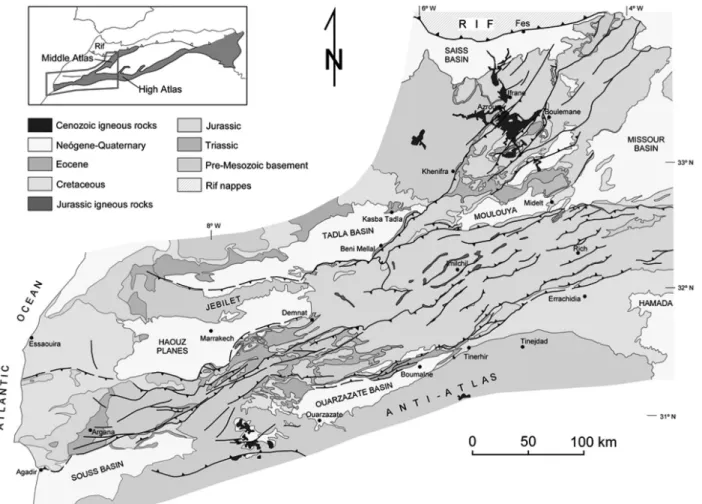
The Ntrending Middle Atlas and the nearly E-trending High Atlas (Fig. 1) are intraplate mountain belts developed in the interior of the African Continent. They derive from the Cenozoic inversion of an orthogonal and an oblique rift respectively, both essentially Jurassic in age (Mattauer et al., 1977; Jacobshagen et al., 1988; Frizon de Lamotte et al., 2000; Teixell et al., 2003). N-S compression transmit-ted from the Europe-Africa plate boundary resultransmit-ted in modest values of shortening, decreasing from east to west along the High Atlas with a maximum value of 24% (Teixell et al., 2003) and reaching only 12% when the High and the Middle Atlas (Arboleya et al., 2004) are considered together. Despite the moderate amounts of shortening and crustal thickening, the mean elevation of the Atlas mountains exceeds 2000 m over large areas, with summits over 4000 m. In
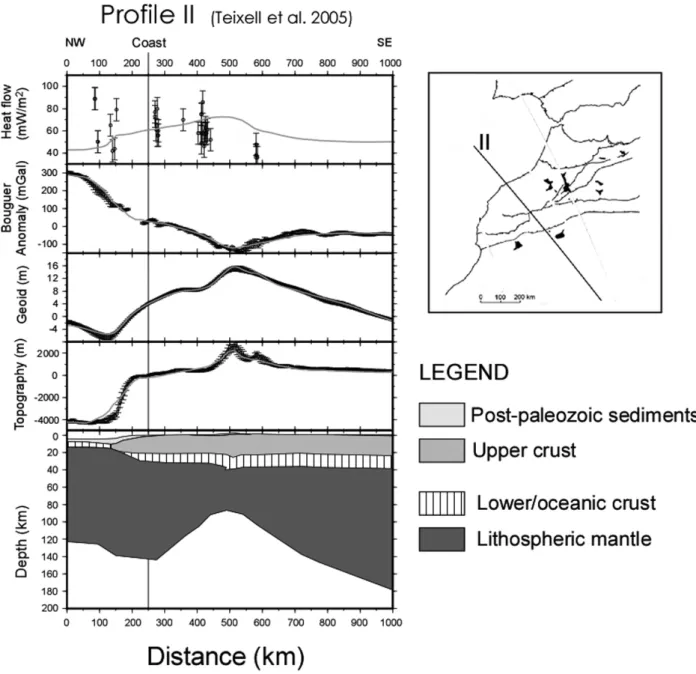
agreement with the shortening values, gravity model-ling suggests the existence of a relatively thin crust (<40 km) that implies a lack of isostatic compensation at crustal level (Ayarza et al., 2005). Topography appears to be compensated at the upper mantle by a 100 km-scale lithospheric thinning deduced from potential field modelling (Fig. 2). This thinning has been attributed to a buoyant mantle upwelling, inde-pendent of the local tectonic regime, and explains the occurrence of abundant alkaline magmatism of Cenozoic age (e.g. Teixell et al., 2003, 2005). A major issue in the intraplate evolution of the Atlas belts lies in the relative chronology of the two inter-fering processes that led to mountain building, that is, compressional crustal thickening and lithospheric thinning. No consensus has been reached on the age
Intraplate tectonics: insights from mountain building
in the Moroccan Atlas and related subsidence in the
Ouarzazate foreland basin
Abstract: Plate interiors show complex distribution of deformation processes in space and time. As an example, we show a series of balanced cross sections across the northern border of the Ouarzazate basin illustrating the geometry and structural evolution of the southern margin of the High Atlas intraplate orogen of Morocco. The study of the tectonic-sedimentation relationships and recently obtained mag-netostratigraphic and paleontological dating of synorogenic sediments enable us to unravel the tecton-ic history of the Atlas Mountains. These results indtecton-icate a discontinuous record of foreland basin devel-opment in the southern Atlas domain from mid Eocene to late Miocene times. Thrusting in the Sub-Atlas frontal thrust belt began before the Aït Ouglif and Kandoula formations, probably during the Oligocene, and has continued until recent times. The alternation of periods of deposition with others lacking any sedimentary record, which does not coincide with specific tectonic events, probably results from the interference of intraplate orogenic deformation and the mantle-related thermal uplift events that have been described for the Moroccan Atlas.
Keywords: intraplate tectonics, High Atlas, foreland basin, thrusting, Cenozoic, Morocco.
1Departament de Geologia, Universitat Autònoma de Barcelona, 08193 Bellaterra, Barcelona, Spain.
*e-mail: [email protected]
of compressional deformation; different tectonic puls-es ranging from the Cretaceous to the Quaternary have been proposed, mainly based on the synorogenic sedimentary record in the southern foreland of the orogen. The timing of the main event of lithospheric thinning is constrained between 15 Ma to recent on the basis of the related alkaline magmatism, but direct geomorphic evidence based on undeformed paleoele-vation markers suggests that the bulk of the mantle-related, thermal uplift has occurred in the last 5 Ma, that is, late with respect to magmatism and shorten-ing, in late Cenozoic times (Babault et al., 2008). Ouarzazate basin; the best syntectonic record of the whole High Atlas
Located in the southern foreland of the High Atlas, the Ouarzazate basin is a small, elongated basin (145 km long, maximum 35 km across and 800 m deep) of Cenozoic age that constitutes the southern foredeep of the mountain chain (Figs. 1 and 3). It contains the best synorogenic record of deformation and its study provides keys to unravelling the history of
compres-sional mountain building in the Atlas. To the north, the Ouarzazate basin is flanked by the marginal thrust belt of the southern high Atlas (the so-called Sub-Atlas zone, figure 3) dominated in outcrop by rocks from late Cretaceous to Neogene ages (Gauthier, 1957). The sedimentary infill of the Ouarzazate basin onlaps the Precambrian of the Anti-Atlas massif, a wide, 100 km-scale arch that plunges beneath the basin. The basin was active and recorded sedimentary aggradation at least from the Late Eocene to the Pliocene (Gauthier, 1957; Fraissinet et al., 1988; Görler et al., 1988; El Harfi et al., 2001; Tesón, 2005).
Different tectonic ages have been proposed to account for the tectonic shortening of the Atlas orogen. Laville
et al.(1977) proposed a Late Cretaceous to Pliocene age of deformation on the basis of local unconformi-ties at the southern High Atlas thrust front. The same criterion was used by Fraissinet et al.(1988) to differ-entiate between four deformation phases during the Oligocene-Pliocene interval. Görler et al.(1988), on the basis of conglomeratic fluxes into the foreland basin, proposed two tectonic pulses, the first of INTRAPLATE TECTONICS: INSIGHTS FROM MOUNTAIN BUILDING IN THE MOROCCAN ATLAS
Figure 1.Geological map of the High and Middle Atlas of Morocco.
Oligocene-Early Miocene age and the second of Late Pliocene to Pleistocene age. Two distinct pulses were also proposed by El Harfi et al. (2001) –Eocene-Oligocene and Mio-Pliocene or Pliocene–, and by Frizon de Lamotte et al. (2000) –Late Eocene and Pleistocene–, on the basis of terrigenous inputs. Tesón and Teixell (2008) revised the detailed geometry of the frontal thrust belt of the Sub-Atlas Zone, and the relationships between individual structures and syn-tectonic sediments, concluding that in this zone, compressional deformation has proceeded in a rather continuous fashion from Oligocene-Early Miocene to Quaternary times.
Record of mountain building in the Ouarzazate basin
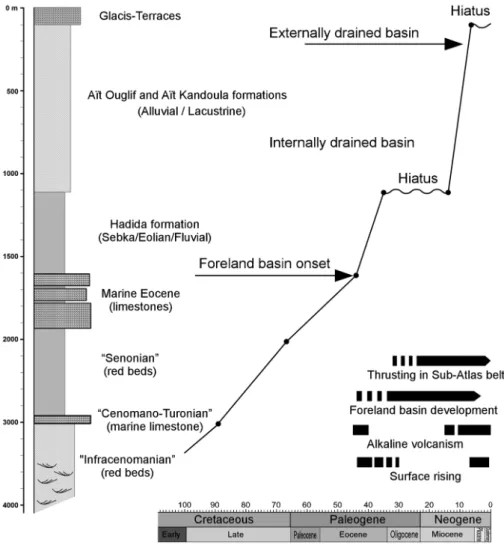
The first foreland deposits in the Ouarzazate basin, as indicated by an inflection in the sediment accumula-tion rate curve (Fig. 4), is the Hadida formaaccumula-tion, com-posed mainly of sebkhal and eolian deposits, with a maximum thickness of ~500 m, which pass laterally to fluviatile sandstones and microconglomerates of the Aït Arbi formation (Gauthier, 1957; El Harfi et al., 2001). The Aït Ouglif formation (Fraissinet et al., 1988; El Harfi
et al., 2001), constituted by polygenic conglomerates of Precambrian to Paleogene rocks, was deposited in an allu-E. TESÓN, A. TEIXELL AND M. L. ARBOLEYA
Figure 2. Lithospheric model across the Central Atlas mountains and Ouarzazate basin, comparing the observed values (open circles with error bars) to modelling results (continuous lines).
vial fan environment. Its mean thickness is 30-40 m. This formation lies with angular unconformity or paraconfor-mity on previous stratigraphic units. Prior to the deposi-tion of this formadeposi-tion there was an episode of extensive erosion recorded in the entire southern Atlas domain (Tesón et al., 2010).
The bulk of the synorogenic sequence is constituted by the Aït Kandoula formation, a succession of shales, lacustrine limestones and alluvial fan conglomerates, about 900 m in thickness. Aït Kandoula formation is usually conformable over Aït Ouglif formation. Recent magnetostratigraphic and paleontological dat-ing of the syntectonic sediments in the Ouarzazate basin (Tesón et al., 2010) have revealed a Middle Eocene age for the Hadida formation (lying between the Middle Lutetian and the Late Bartonian). The Aït Ouglif and Aït Kandoula formations comprise the Late Langhian to the Messinian (Miocene). The top of the Aït Kandoula formation may reach the Upper Messinian in the Aït Kandoula thrust top basin (Benammi et al., 1996). The detailed analysis of tec-tonic-sedimentation relationships leads to the conclu-sion that the shortening activity in the Sub-Atlas thrust belt spanned the period from Oligocene to recent times more or less without interruption (Tesón and Teixell, 2008). Quaternary deformation is evi-denced by tilted and folded terraces in the basin (Sebrier et al., 2006; Arboleya et al., 2008).
Structure of the northern margin of the Ouarzazate basin
The structure of this area is shown in a series of bal-anced cross-sections for the Sub-Atlas zone (Fig. 5). Seismic control is lacking for the eastern part of the area, but fairly complete exposure and well defined stratigraphic thicknesses allowed section construction with a good degree of confidence. For the western part, the geological cross sections are largely based on our interpretation of seismic profiles in regions with poor exposures. The structure is characterized by folds and thrusts detached at various levels. In the internal (northern) part, detachment is located in the Triassic; in the middle part the detachment level is located with-in the Upper Cretaceous; fwith-inally, with-in the frontal part the detachment level is the base of pre-Cenomanian red beds, i.e. in the Amekchoud area (Fig. 5).
The calculated tectonic shortening ranges between 7-8 km for the eastern part of the Sub-Atlas belt (Tesón, 2005) and ~8 km for the western part (section D, Fig. 5), which must represent a large fraction of the total shortening of the High Atlas. These shortening values for the Sub-Atlas belt indicate a low rate of shortening, about 0.3 mm a-1 on average. Although total orogenic
shortening estimations for this transect of the High Atlas are lacking, Beauchamp et al.(1999) and Teixell
et al.(2003) demonstrated that the southern margin of the chain is where most of the shortening is concentrat-INTRAPLATE TECTONICS: INSIGHTS FROM MOUNTAIN BUILDING IN THE MOROCCAN ATLAS
Figure 3. Geological sketch map of the Ouarzazate basin south of the central High Atlas indicating the location of the geological cross sections.
ed; the internal parts of the chain and its northern mar-gin are only slightly deformed in comparison.
Discussion and conclusions
The structural geometry of the Sub-Atlas thrust belt (southern margin of the Moroccan High Atlas) con-forms to an imbricate fan with multiple detachment levels which overrides the Ouarzazate foreland basin. Mesozoic to Lower Tertiary rocks of the leading edges of the thrust sheets override and partition synorogenic basins of Cenozoic age in the proximal margin of the Ouarzazate basin.
New dating of the sedimentary formations and inter-vening hiatuses in the Ouarzazate basin and marginal thrust belt provide constraints on the timing of mountain building in the Intraplate Atlas region. The detailed analysis of tectonic-sedimentation relation-ships suggests that the main shortening activity in the Sub-Atlas thrust belt spanned the period from the Oligocene to recent times in a fairly uninterrupted
manner (Fig. 4). Main thrust faults did not propagate in a simple piggy-back fashion but evidence a com-plex, synchronous sequence with events of fault reac-tivation and out-of-sequence thrusting.
The initiation of orogeny in the High Atlas hinter-land is dated in Middle Eocene times (Lutetian), as recorded by the terrigenous influx and subsidence increase of the Hadida and the equivalent Aït Arbi formations.
A first stage of mantle-related uplift (associated with alkaline magmatism at 40-45 Ma) was probably par-tially responsible for the transition from marine to continental environments coinciding with the early foreland basin stages, and ultimately culminated in the development of a broad uplifted area in the whole Atlas domain, which was submitted to erosion or sed-iment bypass in the following 23 Ma (as recorded by a generalized sedimentary hiatus from 37 to 14 Ma). The second stage of mantle-related uplift, placed by Babault et al. (2008) in post-Miocene times, was E. TESÓN, A. TEIXELL AND M. L. ARBOLEYA
Figure 4. Chronological summa-ry of the main tectonic events in Ouarzazate basin and sediment accumulation curve from creta-ceous to present times.
probably responsible for the end of the Tertiary sedi-mentation in the Ouarzazate basin. The study region provides an example of the complex distribution in space and time of processes that have shaped the geol-ogy of plate interiors.
Acknowledgements
This work benefited from discussion with J. Guimerà, M. Julivert, P. Ayarza, F. Alvarez-Lobato, M. Charroud., B. Cherai and E. Saura provided valuable field assistance. We thank J.
INTRAPLATE TECTONICS: INSIGHTS FROM MOUNTAIN BUILDING IN THE MOROCCAN ATLAS
Figure 5. Serial geological cross-sections illustrating the structure of the northern border of the Ouarzazate basin (see location in figure 3).
Babault, M. L. Arboleya and A. Pastor for their thorough review and comments. Comments by J. Poblet also helped to improve the manuscript. Financial support was granted by projects
CGL2005-24158-E, CGL2006-07226 and CGL2006-4548, the Consolider-Ingenio 2010 project CDS2006-00041, and AECI grant A/2921/05.
E. TESÓN, A. TEIXELL AND M. L. ARBOLEYA
References
ARBOLEYA, M. L., TEIXELL, A., JULIVERT, M. and CHARROUD, M. (2004): A structural transect through the High and Middle Atlas of Morocco, J. Afr. Earth Sci., 39, 3-5: 319-327.
ARBOLEYA, M. L., BABAULT, J., OWEN L. A., TEIXELL, A. and FINKELR. C. (2008): Timing and nature of Quaternary fluvial incision in the Ouarzazate foreland basin, Morocco. J. Geol. Soc. London, 165, 6: 1059-1073.
AYARZA, P., ALVAREZ-LOBATO, F., TEIXELL, A., ARBOLEYA, M. L., TESÓN, E., JULIVERT, M. and CHARROUD, M. (2005): Crustal structure under the central High Atlas Mountains (Morocco) from geological and gravity data. Tectonophysics, 400, 1-4: 67-84.
BABAULT, J., TEIXELL, A., ARBOLEYA, M. L. and CHARROUD, M. (2008): A late Cenozoic age for the long-wavelength surface uplift of the Atlas Mountains of Morocco. Terra Nova, 20, 2: 102-107.
BEAUCHAMP, W., ALLMENDINGER, R. W., BARAZANGI, M., DEMNATI, A., ALJI, M. and DAHMANI, M. (1999): Inversion tecton-ics and the evolution of the High Atlas Mountains, Morocco, based on a geological-geophysical transect. Tectonics, 18, 2: 163-184.
BENAMMI, M., CALVO, M., PREVOT, M. and JAEGER, J. J. (1996): Magnetostratigraphy and paleontology of Ait Kandoula Basin (High Atlas, Morocco) and the African-European late Miocene ter-restrial fauna exchanges. Earth Planet. Sc. Lett., 145(1-4): 15-29.
ELHARFI, A., LANG, J., SALOMON, J. and CHELLAI, E. H. (2001): Cenozoic sedimentary dynamics of the Ouarzazate foreland basin (central High Atlas Mountains, Morocco). Int. J. Earth Sci., 90, 2: 393-411.
FRAISSINET, C., ZOUINE, E. M., MOREL, J. L., POISSON, A., ANDRIEUX, J. and FAURE-MURET, A. (1988): Structural evolution of the southern and northern central High Atlas in Paleogene and Mio-Pliocene times. Lect. Notes Earth Sci., 15: 273-291.
FRIZON DE LAMOTTE, D., SAINT BEZAR, B. and BRACÈNE, R. (2000): The two main steps of the atlas building and geodynam-ics of the Western Mediterranean. Tectongeodynam-ics, 19, 4: 740-761.
GAUTHIER, H. (1957): Contribution a l’etude geologique des for-mations post-liasiques des bassins du Dades et du haut Todra (Maroc meridional). Notes et Memoires du Service Geologique (Rabat), 119: 1-137.
GÖRLER, K., HELMDACH, F. F., GAEMERS, P., HEISSIG, K., HINSCH, W., MAEDLER, K. and SCHWARZHANS, W. (1988): The uplift of the central High Atlas as deduced from Neogene conti-nental sediments of the Ouarzazate Province, Morocco. Lect. Notes Earth Sci., 15: 361-404.
JACOBSHAGEN, V., BREDE, R., HAUPTMANN, M., HEINITZ, W. and ZYLKA, R. (1988): Structure and post-Palaeozoic evolution of the central High Atlas. Lect. Notes Earth Sci., 15: 245-271.
LAVILLE, E., LESAGE, J. L. and SEGURET, M. (1977): Géométrie et cinématique (dynamique) de la tectonique sur le versant sud du Haut Atlas marocain. Aperçu sur les tectoniques hercyniennes et tardi-hercyniennes. B. Soc. Geol. Fr., 7, XIV, 3: 527-539.
MATTAUER, M., TAPPONIER, P. and PROUST, F. (1977): Sur les mécanismes de formation des chaines intracontinentales. L’exemple des chaines atlasiques du Maroc. B. Soc. Geol. Fr., 7, XIX, 3: 521-526.
SEBRIER, M., SIAME, L., ZOUINE, E. M., WINTER, T., MISSENARD, Y. and LETURMY, P. (2006): Active tectonics in the Moroccan High Atlas. C. R. Geosci., 338, 1-2: 65-79.
TEIXELL, A., ARBOLEYA, M. L., JULIVERT, M. and CHARROUD, M. (2003): Tectonic shortening and topography in the central High Atlas (Morocco). Tectonics, 22, 5: 1051. doi: 10.1029/2002tc001460.
TEIXELL, A., AYARZA, P., ZEYEN, H., FERNANDEZ, M. and ARBOLEYA, M. L. (2005): Effects of mantle upwelling in a com-pressional setting: the Atlas Mountains of Morocco. Terra Nova, 17(5): 456-461.
TESÓN, E. (2005): Estudio estructural del margen sur del Alto Atlas entre los valles del Dades y el Mgoun.Trabajo de investigación, Universitat Autònoma de Barcelona, Bellaterra, 79 pp.
TESÓN, E. and TEIXELL, A. (2008): Sequence of thrusting and syntectonic sedimentation in the eastern Sub-Atlas thrust belt (Dades and Mgoun valleys, Morocco). Int. J. Earth Sci., 97, 1: 103-113.
TESÓN, E., PUEYO, E. L., TEIXELL, A., BARNOLAS, A., AGUSTÍ, J. and FURIÓ, M. (2010): Magnetostratigraphy of the Ouarzazate Basin: Implications for the timing of deformation and mountain building in the High Atlas Mountains of Morocco. Geodin. Acta, 23/4: 151-165.