Similar to other European countries, Portugal is encouraging and widening the participation of new groups of people in higher education (HE) as part of a social agenda to promote the equality of opportunities and increase the number of higher education graduates. As a result of these policies and the demographic trends (the number of 18-20-year-olds is decreasing and is expected to continue to fall in the next decade), there is a growing presence of mature students in HE (Russell, 2008). This is a welcomed path, but universities should ask, as Hay, Tan and Whaites (2010, p. 578) questioned: ‘Is higher education ready to receive these non-traditional students?’ (NTS).
Depending on the authors, NTS are known as adults or mature. Thus, age is an important criterion, but the age at which a student is considered an NTS is not unanimous (e.g., 23 years old in Portugal, 25 years old in Spain). Another criterion is the students’ working status: “student-worker phenomenon has transformed the concept of the traditional university student” (Munro, 2011, p. 118). Many other criteria are used in different countries and contexts (Cantwell, Archer, & Bourke, 2001; Gilardi & Guglielmetti, 2010; Laing & Robinson, 2003; Munro, 2011). For example, the U.S. Department of Education (2002) has identifi ed NTS as students who fulfi ll at least one of the following characteristics: delayed enrollment (at least one year postponement of university entry); is a part-time student; has full-time employment; is fi nancially independent; has family responsibilities (e.g., married or dependent). In sum, the features that characterize NTS do not follow a standard defi nition (Kim, 2007); rather, they are context-dependent. Thus, caution should be exercised when analyzing and comparing data from the literature.
ISSN 0214 - 9915 CODEN PSOTEG Copyright © 2014 Psicothema www.psicothema.com
An explanatory model of the intention to continue studying among
non-traditional university students
Pedro Rosário
1, Armanda Pereira
1, José Carlos Núñez
2, Jennifer Cunha
1, Sonia Fuentes
3, Soely Polydoro
4,
Martha Gaeta
5and Estrella Fernández
21 Universidade do Minho, 2 Universidad de Oviedo, 3 Universidad Central de Chile, 4 Universidade Estadual de Campinas
and 5 Universidad Popular Autónoma de Estado de Puebla
Abstract
Background: Although academic achievement is believed to be an important factor in students’ decision to continue studying at university, research on this topic is limited. Method: The current study analyzed the relationship between academic achievement and the intention of 327 non-traditional students to continue studying at university, using a path model. Results: The central hypothesis of the study was confi rmed, as the intention to continue studying was determined by previous academic results, although the amount of variance explained was relatively low (13%). Conclusions: The results from this study indicate that the intention to continue studying at university depends less than expected on the performance achieved. So, universities should consider other variables such as the quality of the academic support offered to these students continue their studies.
Keywords: Non-traditional university students, academic achievement, intent to continue, study methods, structural equation model.
Resumen
Un modelo exploratorio de la intención de continuar estudiando en alumnos universitarios no-tradicionales. Antecedentes: a pesar de la importancia que se atribuye al rendimiento académico en la toma de decisión de los alumnos mayores de 25 años sobre si continuar o no sus estudios en la Universidad, la investigación sobre este tópico es limitada. Método: se analizó la relación entre el rendimiento académico y la intención de 327 alumnos no-tradicionales de continuar sus estudios en la Universidad mediante el ajuste de un modelo de relaciones causales. Resultados: la hipótesis central del estudio fue confi rmada en la medida en que la intención de continuar con los estudios resultó determinada por los resultados académicos previos, aunque la cantidad de varianza explicada fue relativamente escasa (un 13%). Conclusiones: de los resultados obtenidos en este estudio se concluyó que la intención de continuar en la Universidad depende menos de lo que se cree del rendimiento logrado, por lo que las universidades deberán dirigir su mirada también a otras variables como, por ejemplo, la calidad del apoyo que estos estudiantes reciben para continuar sus estudios.
Palabras clave: alumnos no tradicionales; rendimiento académico; inten-ción para continuar; métodos de estudio; modelos de ecuaciones estruc-turales.
Psicothema 2014, Vol. 26, No. 1, 84-90 doi: 10.7334/psicothema2013.176
Received: May 29, 2013 • Accepted: September 6, 2013 Corresponding author: Pedro Rosário
In several Portuguese universities that have recently widened their offer to NTS, the academic system is organized according to the life-style and needs of traditional students (TS), reinforcing the NTS notion of being ‘out of place’ (Ogren, 2003). For this reason and due to the importance of other NTS life roles (i.e., job and family responsibilities), when compared to TS, NTS typically take fewer courses per semester and spend less time at the university. These factors compromise their social interaction with colleagues and attendance at lectures outside of the classroom (Ogren, 2003; Pascarella, Duby, & Iverson, 1982). NTSs’ work experience and value of the university experience can help to explain their focus on class tasks and participation, with comments that often demonstrate a sustained life experience (Dornan, 2001). However, in situations in which the different tasks of their life (e.g., being a professional, a student, a father) compete, the management of the hierarchy of priorities can dictate the cancellation or postponement of these students’ ‘graduation project’ (Chartrand, 1990; Johnston, 2001). One important challenge of NTS lies “in fi nding a balance between their academic and external commitments that enables them to reach a level of engagement suffi cient to achieve academic success” (Gilardi & Guglielmetti, 2011, p. 36). TS typically consider higher education as a natural step in their academic path that can help them to improve their job opportunities. NTS, on the other hand, typically undertake university studies for job fulfi llment (i.e., as an opportunity to obtain a qualifi cation that permits entry into certain jobs) or self-actualization (Adams & Corbett, 2010).
NTSs’ involvement and adaptation to university are associated with the proper management of their different life roles (Adams & Corbett, 2010; Chartrand, 1990, 1992; Metzner & Bean, 1987; Ogren, 2003; Tinto, 1975, 2002). These roles can be adopted simultaneously without confl ict. However, in situations of perceived incompatibility, NTS typically choose their personal life (e.g., responding to the family demands rather than fulfi lling their student role). Because NTS often have employment and family responsibilities, the university demands force them to negotiate their occupational and familiar goals on a daily basis (Adams & Corbett, 2010; Ogren, 2003).
Chartrand (1992) employed structural equation modeling (SEM) to analyze the direct and indirect effects of personal variables (i.e., age, educational goals and high school grade point average [GPA]); academic variables (i.e., certainty of major, satisfaction with the courses and perceived study skills); context variables (i.e., family and friends’ support, diffi culties in fi nancing their education, hours of employment, family responsibilities); and social integration on psychological outcomes (i.e., institutional commitment, academic adjustment and psychological distress) on the intent to continue. She concluded that the background variables were not important contributors to the model, whereas the academic variables played an important role in the model. Furthermore, Chartrand identifi ed the need to fi t the model with other ethnic groups, examine the role of gender and include academic achievement.
The studies in this area have primarily focused on the comparison between TS and NST in their process of adaptation to HE (Cantwell, Archer, & Bourke, 2010; Hay, Whaites, & Tan, 2010; Kimbrough & Weave 1999). Nevertheless, the literature on NTS remains limited, and there is a call for more empirical research on the topic (Cruce & Hillman, 2012; Pascarella, 2006; Tinto, 2002). The previous studies described several factors that infl uence university students’ intention to continue studying (e.g., social integration, academic adjustment) but failed to assess the
impact of academic achievement on the decision to continue their academic path. As mentioned, two decades ago, Chartrand (1992) stated the importance of conducting studies that assess the impact of academic achievement on the intention to continue studying at university; however, such data are lacking.
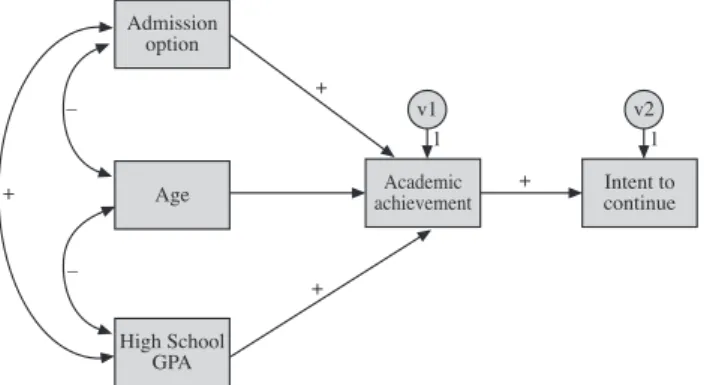
The current study attempted to follow this suggestion by fi tting a path model in a sample of NTS to analyze the relationship of background variables (i.e., option of entry at university, age, high school GPA) and academic achievement (HE GPA) on the intention to continue studying at the university. The path analysis methodology allows the simultaneous analysis of multiple variables and the assessment of the direct and indirect effects of the variables (see Figure 1).
Considering the data provided by previous studies (Cantwell, Archer, & Bourke, 2001; Hoskins, Newstead, & Dennis, 1997; Kimbrough & Weave, 1999), the following predictions have been established in the model: (a) the intention to continue studying at university is signifi cantly related to academic achievement. We expect a positive relationship between students’ academic achievement and their intention to continue studying; (b) the option of admission at university, age, and high school GPA of NTS are related to academic achievement (we expect that entrance into the fi rst choice university, higher high school GPA and younger age are associated with higher academic achievement); (c) the option of admission at university, age, and high school GPA of NTS are signifi cantly related.
Method
Participants
From the 817 NTS studying in the fi rst year, only 327 (123 female) fulfi lled the current study’s defi nition of NTS (U.S. Department of Education, 2002). All participated voluntarily in the present research. These students 1) are more than 23 years old, 2) delayed their university enrollment for at least two years, 3) have family responsibilities (e.g., married; if divorced, is a parent of at least one child), and 4) have full-time employment). This sample represents 39.6% of the fi rst-year students over the age of 23 at the university.
The information necessary to identify this sample was gathered at the university’s academic services offi ce. The average age of participants was 32.7 years (SD = 8.21). Of the sample, 47.7% studied in the area of Languages and Humanities (e.g., Law studies) and 52.3% in the area of Sciences (e.g., Optometry).
High School GPA
Academic achievement Age
Admission option
Intent to continue
v1 v2
1 1
+ +
+ +
– –
Instruments
Data on the variables of option of admission at university, high school GPA and higher education GPA were collected at the university’s academic services offi ce at the end of the higher education fi rst-year admission process (September).
– High school GPA. GPA is a standard measure of achievement used by high schools (10th-12th grade). In Portugal, the high
school scores in each discipline range from 0 to 20, with a passing grade of 10. High school GPA corresponds to the mean of the students’ high school grades across the three grade levels (50%) and the marks from the national exams at the end of high school (50%). The initial values were transformed into the following three categories: 1 (from 10 to 13), 2 (from 14 to 16), and 3 (from 17 to 18).
– Option of admission at university. Students can choose a maximum of fi ve courses from the same scientifi c area but not necessarily from the same university (e.g., Medicine, Dental studies, Biology). As all of the courses have a fi xed number of vacancies to offer, students are ranked and placed in a course by the central services of the Ministry of Education according to their high school GPA. At the end of the process, students can be placed (in one of the fi ve options chosen) or fail admission if all of the selected course locations are occupied by students with higher high school GPAs. The variable “option of admission” was categorized as (1) second option and (2) fi rst option.
– Academic achievement. Academic achievement was assessed through Grade Point Average (GPA). This is a standard measure of achievement used by the university. A student’s achievement in each subject is graded on the following 20point scale: Very Good (17-20), Good (14-16), Pass (10-13), and Fail (0-9). The GPA is then calculated using a numerator that contains the sum of the numerical grades for each subject multiplied by the number of ECTS for that subject and a denominator that contains the total number of credit points for the subjects undertaken. The initial values were transformed into the following three categories: 1 (from 10 to 13), 2 (from 14 to 16), and 3 (from 17 to 18).
– Intent to continue. An e-mail was sent to the 327 NTS enrolled at the end of the school year (July) that asked if they intended to continue studying at the university. The students who did not answer via e-mail (30%) were contacted by phone. The answer was scored as 1 (“I don’t intend to continue my studies at the university”) and 2 (“Yes, I intend to continue”).
– Age. The initial values were transformed into the following three categories: 1 (from 23 to 25 years old), 2 (from 26 to 40 years old), and 3 (from 41 to 59 years old).
Procedure
The university’s research ethics committee authorized the study and the information related to the NTS admission process was collected at the university’s academic services offi ce in September. All of the students were informed of the goals of the research and informed that their participation was voluntary. The confi dentiality of the data was assured. In July, the NTS
participants were asked by the researchers about their intention to continue their academic course at the university via e-mail. The question asked to the students on the e-mail was as follows: Do you intent to continue studying at the University in the next year? At the end of the school year (August), the researchers collected the information on academic achievement (GPA) at the academic services offi ce.
Data analysis
The hypotheses of this study were analyzed using path analysis methodology with AMOS.18 (Arbuckle, 2009). First, a series of goodness-of-fi t statistics were used to analyze the postulated model. Beyond chi-square (χ2) and its associated probability (p),
the information provided by the goodness-of-fi t index (GFI) and the adjusted goodness-of-fi t index (AGFI) (Jöreskog & Sörbom, 1983); the comparative fi t index (CFI) (Bentler, 1990); and the root mean square error of approximation (RMSEA) (Browne & Cudeck, 1993) was used. According to these authors, the model fi ts well when GFI and AGFI > .90, CFI > .95, and RMSEA ≤
.05.
Moreover, if we could not verify the fi t of the model in another sample and the research on NTS was limited, we employed two model evaluation criteria, the Akaike Information Criterion (AIC) and Expected Cross-Validation Index (ECVI). The AIC refl ects the extent to which parameter estimates from the original sample will cross-validate in future samples (Bandalos, 1993) and the ECVI assesses the likelihood that the model cross-validates across similar-sized samples from the same population (Browne & Cudeck, 1993). Because the AIC and ECVI coeffi cients can assume any value, there are no fi xed cutoff points to help in determining model-data fi t. To evaluate the potential for replication of the proposed path model, we compared the ECVI and AIC values with those of both the saturated model and the independence model. Comparing the three models, the model with the smallest ECVI and AIC values exhibits the greatest potential for replication.
Results
Initial data screening
Table 1 presents the descriptive data and the Pearson correlation matrix for the study sample. Before conducting the statistical analyses corresponding to the goals of this study, we examined the matrix with regard to the presence of outliers, linearity and normality of the data. The data set had no missing values because all of the information was gathered by the university’s academic services offi ce.
Testing the hypothesized model
In the fi rst assessment of the path model, the estimated parameters showed the expected magnitudes and sign (consistent with the theory underlying the model), and the standard errors observed were not excessively large or small (Bentler, 1995). Considering the model as a whole, the analyses indicated that the fi t of the hypothesized theoretical model to the data matrix was acceptable, χ2(3) = 10.2, χ2/df = 3.4, p = .017; GFI= .988, AGFI =
.939, CFI = .993, RMSEA = .086.
Because the chi-square was statistically signifi cant and the RMSEA value was higher than expected, data from the residuals and the modifi cation indexes were analyzed. We concluded the need to fi t a model that included the direct effect of high school GPA on the intent to continue (modifi cation index [MI] = 6.091; with a minimum expected value for the parameter of -.088). At the theoretical level, this effect is logical because it is positive, which indicates that higher high school GPA is associated with stronger intent to continue.
Respecifi cation and assessment of the fi nal model
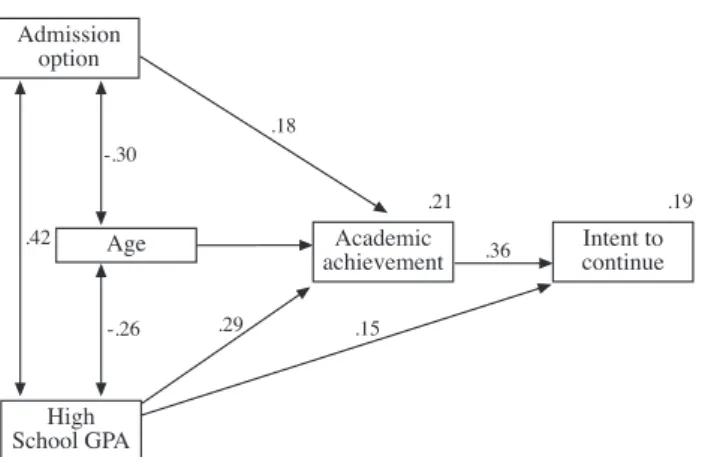
Consequently, the direct effect of the variable high school GPA on intent to continue was included in the model, leaving the parameter free. The results indicated that the fi t of the respecifi ed model was very good, χ2(2) = 2.8, χ2/df = 1.590, p =.244; GFI =
.997, AGFI = .974, CFI = .997, RMSEA = .036. As expected, the new estimated parameter was positive and statistically signifi cant (.15). Neither the residuals nor the modifi cation indexes suggested the need to make further changes to the model. Table 2 and Figure 2 show the coeffi cients that correspond to the direct effects in the model and their respective estimation errors, critical ratio, and associated probability.
The results indicated that all of the study’s hypotheses were confi rmed. As predicted in the fi rst and principal hypothesis, the academic achievement of the fi rst-year NTS was positively and signifi cantly associated with the intention to continue studying at university (.36), i.e., students with a higher university GPA were more likely to report the intention to continue studying at university. Although this relationship was statistically signifi cant, it was lower than expected, and only 12.96% of the variance in students’
intention to continue was explained by academic achievement. Thus, approximately 87% of the variance in students’ decision to continue studying depends on variables other than the students’ academic achievement at the end of the fi rst year.
The modifi cation of the initial model indicated the inclusion of a direct effect linking the students’ previous knowledge (high school GPA) to the intention to continue; this effect was statistically signifi cant (.15). Taking into consideration all of the effects included in the model (direct and indirect, see Table 3), only 19% of the variance in students’ intention to continue at university was explained by the variables in the model.
The second hypothesis was also confi rmed. Students’ age, option of entry and high school GPA were associated with their academic achievement at the end of the fi rst university year. Specifi cally, students who entered in their fi rst choice (.18) were younger (-.13) and had a higher high school GPA (.29) and showed higher academic achievement at the end of the fi rst year. Together, these three variables explained 21% of the variance in academic achievement at the end of the fi rst year.
Thirdly, as expected, the option of entry at university was positively related to high school GPA (.42), that is, students with
Table 1
Correlation matrix and descriptive data (mean, standard deviation, kurtosis and skewness) of variables included in the structural model
1 2 3 4 5
1. Admission pption –
2. Age -.299** –
3. High School GPA .425** .-258** –
4. Intent to continue .240** -.192** .291** –
5. Academic achievement .339** -.256** .401** .415** –
M 1.61 1.96 1.91 1.70 1.94
SD .488 .073 .647 .460 .678
Skewness -.460 .060 .086 -.863 .071
Kurtosis -1.799 -.971 -.616 -1.264 -.816
** p<.01
Table 2
Standardized direct effects in the fi nal model
Coeffi cients SE1 CR2 P<3
Standardized Regression Weights
Admission option ➝ Academic
achieve-ment .177 .077 3.176 .001
Age ➝ Academic achievement -.128 .050 -.2.447 .014
High School GPA ➝ Academic
achieve-ment .293 .058 5.321 .000
Academic achievement ➝ Intent to
con-tinue .356 .037 6.546 .000
High School GPA ➝ Intent to continue .148 .039 2.724 .006
Covariances
Admission option ↔ Age -.102 .020 -5.166 .000
Admission option ↔ High School GPA .134 .019 7.060 .000
High School GPA ↔ Age -.117 .026 -4.506 .000
1 Standardized errors, 2 Critical ratio, 3 Probability
Admission option
Age Academic
achievement Intent tocontinue
High School GPA
-.30
.42
-.26 .29 .15
.36 .18
.21 .19
a higher high school GPA were more likely to enter into their fi rst choice course at university. A negative relation was found between the variables age and option of entry at university (−.30) and between the variables age and high school GPA (−.26). This data revealed that younger NTS tend to obtain a higher high school GPA and consequently enroll in their fi rst choice course at university.
Finally, we examined whether the model is likely to be replicated in other samples of NTS. To answer this question, we compared the ECVI value of .088 found in the path model with that of both the saturated model (ECVI = .092) and the independence model (ECVI = .803). The ECVI value of the path model (.088) was the lowest, which indicates that this model best fi ts to the data and that the answer to the question is more likely to be affi rmative. Moreover, to what extent will the parameters estimated from the current sample of NTS cross-validate in future samples of NTS? The fi ndings demonstrated a high probability of cross-validation because the fi t statistics of the hypothesized model (AIC = 28.825) were substantially smaller than those of the saturated (AIC = 30.000) or the independence (AIC = 261.667) models. In sum, although the results of these two parameters (AIC and ECVI) do not allow an unequivocal conclusion concerning the replicability of the model to other samples of NTS, these positive results strengthen the fi ndings discussed and suggest profi table directions for future research.
Discussion
The principal goal of this research was to understand the extent to which academic achievement at the end of the fi rst year (a) predicts students’ intention to continue studying (direct effect) and (b) mediates the relationship between the students’ option of entry at university, age, high school GPA and intention to continue at university (indirect effects of the model). Generally, the results indicate the importance of assessing the impact of academic achievement on the intent to continue studying at the university, as suggested by Chartrand (1992). Taking into consideration the characteristics of the sample, most salient fi nding of the current study is that academic achievement showed an association lower than that expected with the NTS intentions to continue their studies at university. These fi ndings suggest, in contrast to those obtained in previous studies (e.g., Cantwell, Archer, & Bourke, 2001; Hoskins, Newstead, & Dennis, 1997; Kimbrough & Weave, 1999), the need of further research to investigate other variables than those already investigated.
Furthermore, high school GPA was positively associated with academic achievement, which suggests that previous and robust
content knowledge is related to higher achievement and, therefore, the intention to continue studying at university. These fi ndings are aligned with the literature (Cantwell, Archer, & Bourke, 2001; Hoskins, 1997; Kimbrough & Weave 1999; Núñez et al., 2011; Rosário, Núñez, Valle, Paiva, & Polydoro, 2013).
Another important fi nding is that younger NTS tended to enter their fi rst choices in higher education and achieve higher academic results. A possible explanation for these results may be related to the fact that these students have been away from the educational system for a lesser amount of time and are better prepared to cope with higher education academic demands than their older NTS colleagues. Furthermore, a higher high school GPA (in general, indicating a better academic background) seems to help in persisting in this new academic course, and the opposite also holds true.
The data suggest the need to acknowledge a subgroup perspective when addressing NTS. In fact, younger NTS have a higher high school GPA and consequently higher academic achievement and a stronger intention to continue. Perhaps future research and the new students welcome programs developed by universities should consider the interval time of the delayed enrollment into HE as an important feature in the design of interventions. The data allow the presumption that shorter intervals are associated with higher academic achievement and stronger intention to continue. This result points to chirurgical academic interventions within this population. The university cannot ignore the long break in the academic studies of NTS. This implies, for example, that work in the classroom and the practical work assigned should be adjusted to take into consideration the academic background of NTS.
The current path model showed a very good fi t. Nevertheless, the results revealed that the variables in the model only explained 19% of the variance in the intent to continue; thus, a considerable amount of variance was unexplained. Thus, it is important to consider the inclusion of other variables that could increase the amount of explained variance.
Increasing and widening participation in higher education is an important goal, but how can universities (e.g., administrators, lectures, services and offi ces) help the NTS to continue studying? The investigation suggests the importance of organizing university welcoming programs to facilitate the integration of NTS (i.e., mentoring programs). To fully reach this purpose, these programs could be organized by NTS in advanced grade levels, as these students are more likely to understand the needs of the new NTS.
As previously mentioned, the academic environment of HE is not tailored to the learning needs of NTS (Chartrand, 1992; Ogren, 2003) with requirements and processes that the intensive courses offered by the universities to prepare the ‘non-traditional entry exams’ do not foresee. The mapping of the academic needs perceived by the NTS (for example, through interviews) and the installation of sensitive academic policies to fi ll in the identifi ed gaps may be the next step in retaining these students.
This study did not include teacher or context variables, such as the role of students associations in NTS retention. However, faculties and administrators should refl ect upon the corpus of data on NTS. The university is widening its offer to a public that traditionally did not have access to university training, but the teaching-learning processes are not adapted to the needs of this new population (e.g., assessment system followed, attending class norms).
Table 3
Standardized indirect and total effects in the fi nal model
Age High School GPA
Admission option
Academic achievement
Indirect effects
Academic achievement −.000 .000 .000 .000
Intent to continue −.045 .104 .063 .000
Total effects
Academic achievement −.128 .293 .177 .000
To retain these students at university, it is essential to understand how NTS should be welcomed and integrated into the academy beyond the fi rst week of arrival at campus. It is also important to intentionally instruct them on how to cope with the new curricular challenges that they face (Kimbrough & Weave, 1999). Lastly, to increase the NTS at university, teachers could consider valuing their employment experience in class and altering teaching methodologies and the assessment system to accommodate the educational needs of NTS (Dornan, 2001), as suggested by the NTS quoted in this study.
Limitations of study
The implications derived from this study should be taken with caution due to some theoretical-methodological limitations. Firstly, in this study we obtained information on the relationship between academic performance and the intention to continue studying at University. Future studies could analyze to what extent this relationship can be found regarding not only the intention to continue studying, but also the effective retention or even the completion of a University degree.
Secondly, the use of a single sample of NTS from a single institution is an important limitation due to the diverse nature of NTS. Future studies should include data from a variety of institutions and contexts (e.g., three or four years in the fi rst cycle [graduation]; institutions more or less research-oriented) and acknowledge the defi nition of NTS used (e.g., clear cut-off age, student-workers, full-time workers, part-time students, family responsibilities) (Yorke & Longden, 2004) to allow the comparison of results. Although NTS are globally considered in the literature, it is important to acknowledge the cultural differences and social and economic contexts.
Thirtly, the design of data collection was cross-sectional, which does not allow causal inferences, even from the path analysis
perspective. In the future, to obtain information about causes and effects and the potential reciprocal relations of the model variables, the data should be collected at two or more temporal moments.
Fourthly, to increment the explained variance with regard to academic achievement and the intent to continue, future research should include additional variables in the model such as, for example, fi nancial hardships or the impact of the number of working hours (as suggested by the quoted student and by Sandler, 2000), cognitive and motivational variables (e.g., intellectual and emotional abilities, skills for developing self-regulated learning, academic self-effi cacy, academic, personal and social goals), or context variables (e.g., learning support offered, academic mentoring, colleagues’ social support). Such inclusions may aid in building a more comprehensive model that may guide intervention programs. It would also be important to conduct qualitative research on NTS discourse about studying at University (i.e., goals, challenges, University academic support).
Finally, a robust learning process is a condition for retention (Tinto, 2002); thus, it is important to investigate the micro learning processes that occur in the classroom and reorganize this educational setting to improve student involvement in learning (e.g., type of questions asked to foster students’ participation, detailed notes delivered, number and diversity of exercises and problems with feedback offered). Furthermore, lectures on pedagogical skills should be provided to respond to the academic needs of NTS. Without a true institutional commitment, Portuguese universities will continue to consider NTS as ‘Cinderella students’, as Atwood (2010) sharply coined them.
Acknowledgments
This work was partially funded by the Spanish Ministry of Education and Science (Project: SEJ2006-01518 and Project: EDU2010-16231).
References
Adams, J., & Corbett, A. (2010). Experiences of traditional and non-traditional College Student: A quantitative study of experiences, motivations and expectations among undergraduate Student. Methods of Social Research. Retrived from http://www.unh.edu/sociology/ index.cfm?id=ADF0DA25-E4F5-8F19-0AECEFEB8F59549F. Arbuckle, J.L. (2009). Amos 18.0 User’s Guide. Crawfordville: Amos
Development Corporation.
Atwood, R. (2010, 10 June). The Cinderella students. Times Higher Education, pp. 31-46.
Bandalos, D.L. (1993). Factors infl uencing cross-validation of confi rmatory factor analysis models. Multivariate Behavioral Research, 28, 351-374.
Bentler, P.M. (1990). Comparative fi t indexes in structural models. Psychological Bulletin, 107, 238-246.
Bentler, P.M. (1995). EQS: Structural equations program manual. Encino, CA: Multivariate Software.
Browne, M.W., & Cudeck, R. (1993). Alternative ways of assessing model fi t. In K. Bollen & J. Long (Eds.), Testing Structural Equation Models (pp. 136-162). Newbury Park, CA: Sage.
Cantwell, R., Archer, J., & Bourke, S. (2001). A comparison of the Academic Experiences and achievement of University student entering by traditional and nontraditional means. Assessment & Evaluation in Higher Education, 26(3), 221-234.
Chartrand, J.M. (1990). A causal analysis to predict the personal and academic adjustment os nontraditional student. Journal of Counseling Psychology 37(1), 65-73.
Chartrand, J.M. (1992). An empirical test of a model of nontraditional student adjustment. Journal of Counseling Psychology, 39(2), 193-202.
Cruce, T., & Williams, N. (2012). Preparing for the Silver Tsunami: The demand for Higher Education among older adults. Research in Higher Education, 53(6), 593-613.
Dornan, M. (2001). Metacognitive differences between traditional-age and nontraditional-age college student. Adult Education Quarterly, 51(236), 236-249.
Finney, S.J., & DiStefano, C. (2006). Non-normal and categorical data in structural equation modeling. In G.R. Hancock & R.O. Mueller (Eds.), Structural equation modeling: A second course (pp. 269-314). Greenwich, CT: Information Age Publishing.
Gilardi, S., & Chiara G. (2011). University life of non-traditional students: Engagement styles and impact on attrition. Journal of Higher Education, 82(1), 33-53.
Hoskins, S., Newstead, S., & Dennis, I. (1997). Degree performance as a function of age, gender, prior qualifi cations and discipline studied. Assessment and Evaluation in Higher Education, 22(3), 317-328. Johnston, V. (2001). The progression of Napier students through the fi rst
year of the modular course. Edinburgh, Napier University, Student Retention Project.
Jöreskog, K.G., & Sörbom, D. (1983). LISREL - 6 User’s Reference Guide. Mooresville, IN: Scientifi c Software.
Kim, K. (2007). ERIC Review: Exploring the meaning of “Nontraditional” at the community college. Community College Review, 30(1), 74-88. Kimbrough, D., & Weaver, G. (1999). Improving the background
knowledge of non-traditional students. Innovative Higher Education, 23(3), 197-219.
Laing, C., & Robinson, A. (2003). ‘The Withdrawal of non-traditional students: Developing an explanatory model’. Journal of Further & Higher Education, 27(2), 175-185.
Metzner, B.S., & Bean, J.P. (1987). The estimulation of a conceptual model of nontraditional student. Research in Higher Education, 27(1), 15-37.
Munro, L. (2011). ‘Go boldly, dream large!’: The challenges confronting non-traditional students at university. Australian Journal of Education, 55(2), 115-131.
Núñez, J.C., Cerezo, R., González-Pienda, J.A., Rosário, P., Valle, A., ..., & Suárez, N. (2011). Implementation of training programs in self-regulated learning strategies in Moodle format: Results of a experience in higher education. Psicothema, 23, 274-281.
Ogren, C.A. (2003). Rethinking the nontraditional student form a historical perspective. The Journal of Higher Education, 74(6), 640-664.
Pascarela, E. (2006). How college affects students: Ten directions for future research. Journal of College Student Development, 47(5), 508-520. Pascarella, E.T., Duby, P.B., & Iverson, B.K. (1982). A test and
reconceptualization of a theoretical model of college withdrawal in a commuter institution setting. Sociological Education, 56, 88-100. Rosário, P., Núñez, J.C., Valle, A., Paiva, O., & Polydoro, S. (2013).
Approaches to teaching in High School when considering contextual variables and teacher variables. Revista de Psicodidáctica, 28, 25-45. Russell, M. (2008). The age of uncertainty. Times Higher Education,
March 20-26, p. 24.
Sandler, M.E. (2000). Career decision-making self-effi cacy, perceived stress, and an integrated model of student persistence: A structural model of fi nances, attitudes, behavior, and career development. Research in Higher Education, 41(5), 537-579.
Tinto, V. (1975). Dropout from higher education: A theoretical synthesis of recent research. Review of Educational Research, 45, 89-125. Tinto, V. (2002, June). Promoting student retention: Lessons learned from
the United States. Paper presented at the 11th Annual Conference of the European Access Network, Prato, Italy.
U.S. Department of Education, National Center for Education Statistics (2002). Nontraditional undergraduates. Retrived from http://nces. ed.gov/programs/ coe/2002/analyses/nontraditional.
West, S.G., Finch, J.F., & Curran, P.J. (1995). Structural equation models with non-normal variables: Problems and remedies. In R. Hoyle (Ed.), Structural equation modeling: Concepts, issues and applications (pp. 55-75). Newbury Park, CA: Sage.