Psychological fl exibility is the core concept of the Acceptance and Commitment Therapy (ACT; Hayes, Strosahl, & Wilson, 1999, 2012; Wilson & Luciano, 2002) model of psychological health and behavioral effectiveness. It refers to the ability to behave according to whatever the situation requires in order to pursue valued ends, even in the presence of challenging or unwanted private experiences like thoughts, feelings, physiological sensations, memories, etc. (Hayes, Luoma, Bond, Masuda, & Lillis, 2006). Specifi cally, the ACT model proposes that people are more psychologically healthy and perform more effectively when they base their behavior and
decisions in any given situation more on their long-term goals and values and less on the private experiences that emerge in the present moment or on current situational contingencies (Bond et al., 2011). For instance, if a person values doing excellent and creative work, she will persist in looking for new ideas even if doing so involves experiencing anxiety, doubts, uncertainty, or refraining from procrastination and taking some short-term reinforcing action (e.g., chatting with friends, watching TV). Conversely, people displaying psychological infl exibility, which entails the dominance of private experiences over chosen values and contingencies in guiding action (Bond et al., 2011), will give up in the presence of those private experiences and immediate opportunities.
A great amount of empirical evidence has emerged during the last years supporting the adaptive role of psychological fl exibility and its role as the process of change in ACT interventions (see Hayes et al., 2006; Ruiz, 2010, 2012). Also,
The Spanish version of the Work-related Acceptance and Action
Questionnaire (WAAQ)
Francisco J. Ruiz
1and Paula Odriozola-González
2 1 Universidad de Zaragoza and 2 Universidad de OviedoAbstract
Background: Psychological fl exibility, a key construct of Acceptance and Commitment Therapy (ACT), has recently been found to be an important determinant of mental health and behavioral effectiveness in the workplace. This fi nding has led to designing a measure of psychological fl exibility especially tailored to the workplace (the Work-related Acceptance and Action Questionnaire; WAAQ) in the hope that it may reveal even stronger associations with variables related to a work context. Method: First, we back-translated the WAAQ into Spanish and then administered it to 209 workers, in addition to other relevant work-related measures. Results:
Data were very similar to those obtained with the original WAAQ version. The WAAQ showed a very good internal consistency (α = .92) and a clear one-factor structure. It also showed higher correlations with work-specifi c measures than a general measure of psychological infl exibility (the Acceptance and Action Questionnaire-II; AAQ-II). As hypothesized by the ACT theory, the correlation between the WAAQ and the AAQ-II was moderate but not so high as to suggest that they are assessing the same construct. Conclusions: This Spanish translation of the WAAQ emerges as a reliable and valid measure of psychological fl exibility in relation to the workplace.
Keywords: Work-related Acceptance and Action Questionnaire, psychological fl exibility, Acceptance and Commitment Therapy, Acceptance and Action Questionnaire.
Resumen
Versión española del Cuestionario de Aceptación y Acción Relacionado con el Trabajo (WAAQ). Antecedentes: la fl exibilidad psicológica, un constructo central en la Terapia de Aceptación y Compromiso (ACT), ha mostrado ser un determinante importante de la salud mental y la efectividad conductual en el trabajo. Estos hallazgos han llevado a diseñar una medida de fl exibilidad psicológica ajustada al contexto laboral (Cuestionario de Aceptación y Acción en el Trabajo; WAAQ) que pudiera mostrar asociaciones incluso mayores con variables relacionadas con el contexto laboral. Método: se realizó una traducción inversa del WAAQ en español y se aplicó a 209 trabajadores conjuntamente con otras medidas.
Resultados: los datos obtenidos fueron muy similares a los de la versión original. El WAAQ mostró muy buena consistencia interna (α= .92) y una estructura unifactorial. Además, el WAAQ mostró correlaciones más altas con medidas específi cas del contexto laboral que una medida general de infl exibilidad psicológica (el Cuestionario de Aceptación y Acción - II; AAQ-II). Tal y como hipotetiza el modelo de ACT, la correlación entre el WAAQ y el AAQ-II fue moderada y no tan grande como para sugerir que ambos cuestionarios miden el mismo constructo. Conclusiones: la presente versión española del WAAQ se muestra como una medida fi able y válida de la fl exibilidad psicológica en el contexto laboral.
Palabras clave: Cuestionario de Aceptación y Acción en el Trabajo, fl exi-bilidad psicológica, Terapia de Aceptación y Compromiso, Cuestionario de Aceptación y Acción.
Received: April 17, 2013 • Accepted: September 6, 2013 Corresponding author: Francisco J. Ruiz
Facultad de Ciencias Sociales y Humanas Universidad de Zaragoza
ACT interventions aimed at increasing psychological fl exibility levels have improved performance in several domains (e.g., Bond, Flaxman, van Veldhoven, & Biron, 2010; Ruiz & Luciano, 2009, 2012). In relation to the workplace, Bond and Hayes (2002) proposed that the “goal-related context sensitivity” feature of psychological fl exibility would help people to behave more effectively at work. Indeed, Bond, Lloyd, and Guenole (2013) have recently identifi ed approximately 20 studies that have shown that psychological fl exibility correlates with, and longitudinally predicts, a wide range of work-related outcomes, including mental health, better job performance, increased capacity to learn skills at work, and absence rates (e.g., Bond & Bunce, 2003; Bond & Flaxman, 2006; Donaldson & Bond, 2004) even when controlling for negative affectivity and locus of control (Bond & Bunce, 2003), and emotional intelligence (Donaldson & Bond, 2004). Moreover, ACT interventions designed to improve employee mental health, increase employees’ innovation, and reduce burnout have been effective, as hypothesized, through increasing psychological fl exibility (Bond & Bunce, 2000; Flaxman & Bond, 2010; Lloyd, Bond, & Flaxman, 2013).
The previous studies have assessed psychological fl exibility in the workplace by administering the Acceptance and Action Questionnaire (AAQ; Hayes et al., 2004) or the Acceptance and Action Questionnaire - II (AAQ-II; Bond et al., 2011). These instruments were designed to measure general levels of psychological fl exibility, as averaged across different contexts, in clinical and community samples. Nevertheless, the ACT model suggests that psychological fl exibility is contextually controlled and, therefore, can vary across different contexts (e.g., Bond et al., 2013). For instance, a person may show considerable psychological fl exibility in the context of sport competitions (e.g., training as much as possible even in the presence of physical pain or stress), but at the same time, she may show psychological infl exibility in the work context by allowing herself to be controlled by her fears of failure instead of by her values.
An implication of the previous suggestion is that psychological fl exibility measures tailored to specifi c contexts (e.g., workplace) may be more strongly associated with specifi c variables of that context (e.g., work engagement). Bond et al. (2013) tested this implication by developing a measure of psychological fl exibility in relation to the workplace (the Work-related Acceptance and Action Questionnaire; WAAQ) and examining the extent to which the AAQ-II and the WAAQ correlated with specifi c workplace measures (e.g., work engagement, task performance). These authors found that the WAAQ had good psychometric properties. As hypothesized, the AAQ-II and WAAQ were moderately correlated but the WAAQ was a somewhat better predictor of work-related measures.
The current study aimed to analyze the psychometric properties of the Spanish translation of the WAAQ with a sample of 209 employees and to examine whether it is more strongly associated with work-specifi c measures than a general measure of psychological fl exibility (the AAQ-II). Based on the previous study (Bond et al., 2013), we hypothesized that the Spanish translation of the WAAQ would have similar psychometric properties and construct validity to the the original scale, and that it would show stronger correlations with some work-related measures than the AAQ-II.
Method
Participants
The sample consisted of 209 employees from the south of Spain, with age ranging between 18 and 60 years (M = 36.1, SD
= 12.13). Fifty-two percent were men. The relative educational level of the participants was as follows: 23.4% primary studies, 48.8% mid-level study graduates, and 27.8% college graduates or currently taking university courses. The mean number of years spent in their current job was 7.94 (SD = 9.68), working 35.5 (SD
= 10.82) hours per week: 29.6% worked by day with a lunch break, 20.2% had an intensive working schedule, 14.8% had fl extime, 12.3% worked half a day, 10.3% had a fi xed shift, and 12.8% had a rotating shift.
Regarding their working positions, 16.7% of participants were in an illegal situation or without compensation, 16.3% were temporary workers, 25.1% had a contract for between 6 months and 5 years, and 41.9% had an indefi nite contract. With respect to participants’ hierarchy within the organization, 79% were line-level workers, 5.9% supervisors, 7.3% middle management, 4.4% managers, and 2.4% corporate managers.
Instruments
Acceptance and Action Questionnaire - II (AAQ-II; Bond et al., 2011). The AAQ-II is a general measure of psychological infl exibility. It consists of 7 items which are rated on a 7-point Likert-type scale ranging from 1 (never true) to 7 (always true). The items refl ect unwillingness to experience unwanted emotions and thoughts (e.g., “I am afraid of my feelings,” “I worry about not being able to control my worries and feelings”) and the inability to be in the present moment and behave according to value-directed actions when experiencing psychological events that could undermine them (e.g., “My painful experiences and memories make it diffi cult for me to live a life that I would value,” “My painful memories prevent me from having a fulfi lling life,” “Worries get in the way of my success”). Recent studies have shown that the AAQ-II has better psychometric properties and a clearer factor structure than the fi rst AAQ version (Bond et al., 2011). In this study, we used the Spanish translation by Ruiz, Langer, Luciano, Cangas, and Beltrán (2013), which has shown a one-factor solution, good internal consistency (mean α = .88), and discriminant, convergent and divergent validity.
the recommendations proposed by Muñiz and Hambleton (1996). Thus, we selected two translators, one familiar with the Spanish culture and another familiar with that of the USA, and used the “back-translation” method; that is, the fi rst translator translated the questionnaire into Spanish, and this translation was then translated back into English by the second one (see items translation in Table 1).
Maslach Burnout Inventory-General Survey (MBI-GS, Schaufeli, Leiter, Maslach, & Jackson, 1996). The MBI-GS is a generic measure of burnout and consists of 16 items that are rated on a 7-point Likert-type scale. It contains three factors: Emotional Exhaustion (e.g., “I feel emotionally drained from my work”), Cynicism (e.g., “I have become less enthusiastic about my work”), and Professional Effi cacy (e.g., “I can effectively solve the problems that arise in my work”). Higher scores on Emotional Exhaustion and Cynicism and lower scores on Professional Effi cacy are indicative of greater levels of burnout. In the present study, we used the Spanish translation by Salanova, Schaufeli, Llorens, Peiró, and Grau (2000), which showed adequate psychometric properties.
Utrecht Work Engagement Scale (UWES; Schaufeli, Bakker, & Salanova, 2006). The UWES is a 15-item, 7-point Likert-type scale that aims to measure work engagement as a construct opposed to burnout. It contains three factors: Vigor (e.g., “At my work, I feel bursting with energy”), Dedication (e.g., “I fi nd the work that I do full of meaning and purpose”), and Absorption (e.g., “Time fl ies when I am working”). We used the Spanish translation by Salanova et al. (2000), which showed appropriate psychometric properties in several studies (e.g., Schaufeli, Martínez, Marqués-Pinto, Salanova, & Bakker, 2002; Schaufeli, Salanova, González-Roma, & Bakker, 2002).
Overall Job Satisfaction Scale (OJS; Warr, Cook, & Wall, 1979). The OJS is a 15-item, 7-point Likert-type scale that provides a general measure of job satisfaction. It contains two factors: Intrinsic Satisfaction, related to self-fulfi llment and appreciation, and Extrinsic Satisfaction, related to reward and work conditions. We used the Spanish translation by Munduate (1984), which showed good psychometric properties in several studies (e.g., Augusto-Landa, López-Zafra, Martínez, & Pulido, 2006).
Psychological Empowerment Inventory (PEI; Spreitzer, 1995).
The PEI is a 12-item, 7-point Likert-type scale that measures psychological empowerment in a workplace context. It contains four factors with 3 items each: Meaning (e.g., “The work I do is very important to me”), Competence (e.g., “I am confi dent about my ability to do my job”), Self-determination (e.g., “I have signifi cant autonomy in determining how I do my job”), and Impact (e.g., “My impact on what happens in my department is large”). The PEI has shown good psychometric properties and validity. For the present study, we translated the PEI into Spanish following the same back-translation method described for the WAAQ (Muñiz & Hambleton, 1996). The alpha coeffi cient found in the present sample for the full scale was very good (α = .90). Alpha coeffi cients of the subscales were .88 for Meaning, .81 for Competence, .82 for Self-determination, and .78 for Impact.
Procedure
Participants were recruited from undergraduate labor science students and personal contacts. Individuals who provided informed consent were given a questionnaire packet including the self-report instruments in the order listed above. Upon completion
of the study, we debriefed participants about the aims of the study and thanked them for their participation.
Data analysis
First, to explore the internal consistency of the WAAQ, corrected item-total correlations and Cronbach’s alpha were computed. Second, the mean score and standard deviation were calculated. Third, the Kaiser-Meyer-Olkin index and the Bartlett sphericity test were computed to determine whether the data were apt for conducting factor analyses. Subsequently, an exploratory factor analysis by principal component analysis was conducted. Lastly, the Pearson correlations between the WAAQ and the other scales were computed. Coeffi cient correlations were interpreted following Cohen’s (1998) suggestion of small (.1), medium (.3), and large (.5).
Results
Item analysis of the WAAQ
Table 1 shows the mean score for each item and the corrected item-total correlations. Mean scores ranged from 4.93 (SD = 1.38) for Item 4 to 5.53 for Item 1 (SD = 1.51) whereas corrected item-total correlations ranged from .65 (Item 4) to .81 (Item 6). Cronbach’s alpha of the WAAQ was .92.
Descriptive data
Table 2 shows that participants obtained a mean score of 36.46 (SD = 8.41). Women’s scores were higher (M = 37.48, SD = 8.03) than men’s scores (M = 35.5, SD = 8.68), but this difference did not reach statistical signifi cance, t(203) = -1.70, p = .09.
Construct validity
Factor analysis. Data were apt for conducting a factor analysis according to the Kaiser-Meyer-Olkin index (.90) and the Bartlett sphericity test (χ2 = 933.97, p<.0001). Table 2 shows the Spanish translation of the WAAQ items, which showed good communalities (Costello & Osborne, 2005) and loadings on the main factor ranging from .74 (Item 4) to .86 (Item 6). Figure 1 shows the scree plot resulting from the exploratory factor analysis. A clear one-factor solution was found according to the Kaiser criterion. This factor explained 66.79% of the variance in item scores.
Table 1
Mean scores (SD in Brackets) per item and correlations between each item and the total score
Scale Mean score M (SD)
Corrected item-total correlation
Item 1 5.53 (1.51) .77
Item 2 5.33 (1.44) .78
Item 3 5.27 (1.45) .79
Item 4 4.93 (1.38) .65
Item 5 5.10 (1.43) .71
Item 6 5.12 (1.51) .81
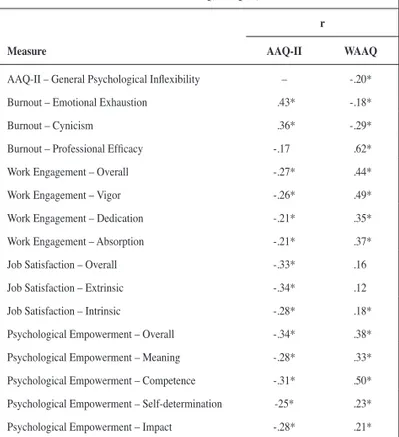
Correlations with related measures. Table 3 shows the correlations between the scores on the AAQ-II and WAAQ with the remaining measures used in this study. Consistent
with previous studies (Bond et al., 2013), the WAAQ showed a small to moderate negative correlation with the AAQ-II (r = -.20). The WAAQ showed a small correlation with the Emotional Exhaustion subscale of the MBI (r = -.18) and a medium correlation with the Cynicism subscale (r = -.29). Higher levels of work-related psychological fl exibility were strongly correlated with measures related to job performance (r = .62 with the Professional Effi cacy subscale of the MBI, and r = .50 with the Competence subscale of the PEI). WAAQ scores also showed medium to large correlations with work engagement as measured by the UWES (r = .44, .49, .35, and .37, respectively, for the total score, Vigor, Dedication, and Absorption). Small correlations were found between the WAAQ and job satisfaction as measured by the OJS (r = .16, .12, and .18, respectively, for the total score, extrinsic, and intrinsic job satisfaction). Lastly, the WAAQ showed small to large correlations with psychological empowerment (r = .38, .33, .50, .23, and.21, respectively, with the total-scale score, Meaning, Competence, Self-determination, and Impact).
The AAQ-II revealed somewhat different patterns of correlations from the WAAQ (see Table 3). Specifi cally, the AAQ-II showed lower correlations than the WAAQ with measures of work effi cacy (i.e., the Professional Effi cacy subscale of the MBI and the Competence subscale of the PEI), and with work engagement as measured by the UWES. However, the AAQ-II showed higher correlations than the WAAQ with psychological distress as measured by the Emotional Exhaustion subscale of the MBI and with job satisfaction as measured by the OJS.
Table 2
Factor loadings from principal axis factoring, scale mean and standard deviation, and alpha value
WAAQ item Factor
loading
Commu-nalities
1. Soy capaz de trabajar efi cazmente aunque tenga preocupaciones personales [I am able to work effectively in spite of any personal worries that I have]
.84 .70
2. Puedo admitir mis errores en el trabajo y aun así seguir siendo exitoso [I can admit to my mistakes at work and still be successful]
.85 .72
3. Puedo trabajar de manera efi caz, incluso cuando estoy nervioso por algún motivo [I can still work very effectively, even if I am nervous about something]
.85 .73
4. Mis preocupaciones no se interponen en mi camino hacia
el éxito [Worries do not get in the way of my success] .74 .54
5. Soy capaz de comportarme según la situación lo requiera, sin que me afecte cómo me sienta [I can perform as required no matter how I feel]
.79 .62
6. Puedo trabajar efi cazmente, incluso cuando dudo de mí
mismo [I can work effectively, even when I doubt myself] .87 .75
7. Mis pensamientos y sentimientos no se interponen en lo que debo hacer en mi trabajo [My thoughts and feelings do not get in the way of my work]
.78 .61
% explained variance 66.79
Scale mean 36.46
Scale SD 8.41
Coeffi cient alpha for scale .92
Scree plot
5
4
3
2
1
0
Eigenvalue
1 2 3 4 5 6 7
Component number
Figure 1. Scree plot resulting from the factor analysis of the WAAQ. The horizontal dashed line represents the Kaiser criterion
Table 3
Correlations between the WAAQ, AAQ-II, and other criteria
r
Measure AAQ-II WAAQ
AAQ-II – General Psychological Infl exibility – -.20*
Burnout – Emotional Exhaustion -.43* -.18*
Burnout – Cynicism -.36* -.29*
Burnout – Professional Effi cacy -.17* -.62*
Work Engagement – Overall -.27* -.44*
Work Engagement – Vigor -.26* -.49*
Work Engagement – Dedication -.21* -.35*
Work Engagement – Absorption -.21* -.37*
Job Satisfaction – Overall -.33* -.16*
Job Satisfaction – Extrinsic -.34* -.12*
Job Satisfaction – Intrinsic -.28* -.18*
Psychological Empowerment – Overall -.34* -.38*
Psychological Empowerment – Meaning -.28* -.33*
Psychological Empowerment – Competence -.31* -.50*
Psychological Empowerment – Self-determination -25* -.23*
Psychological Empowerment – Impact -.28* -.21*
Note: AAQ-II: Acceptance and Action Questionnaire; WAAQ: Work-related Acceptance and Action Questionnaire. To minimize family-wise Type I error, we set the alpha level signifi cance at .01
Discussion
The data obtained provide promising evidence that this Spanish translation of the WAAQ is a valid and reliable measure of psychological fl exibility at the workplace. Overall, the current data are very similar to those obtained by Bond et al. (2013). Specifi cally, the results showed that the WAAQ has very good internal consistency (α = .92) and construct validity in view that the factor analysis led to a clear one-factor solution and the correlations were in the expected direction with several work-related measures. Small correlations were found, however, with measures of job satisfaction.
Importantly, the correlation between the WAAQ and AAQ-II was small to moderate. This correlation indicates that both instruments are assessing related constructs, but the correlation is not so high as to suggest that they are assessing the same one (Bond et al., 2013). The AAQ-II was also correlated with the work-related variables, except for the burnout variable of professional effi cacy. However, the WAAQ was more strongly associated than the AAQ-II with work engagement variables (vigor, dedication, and absorption) and, especially, with effi cacy variables of the MBI and EPI. Conversely, the AAQ-II showed stronger correlations with job satisfaction and the burnout variable of emotional exhaustion.
Overall, these fi ndings replicate the study by Bond et al. (2013) and are consistent with the ACT model (Hayes et al.,
2006) because they show that a work-specifi c measure of psychological fl exibility is more strongly associated with several work-related outcomes than is a general measure of the same construct. This supports the hypothesis that psychological fl exibility is contextually controlled and, therefore, variables related to a specifi c context may best, or even only, be predicted by a measure of psychological fl exibility that is tailored to that particular context (Bond et al., 2013).
Some limitations of this study are worth mentioning. First, the functioning of the WAAQ was tested only in one sample; therefore, further research is necessary to confi rm the results obtained in this study. Second, as all data were obtained using self-report measures, relationships among variables might be artifi cially infl ated. Lastly, given the number of variables that we correlated with the WAAQ and AAQ-II, a potential limitation is the threat of a Type I error. To mitigate this threat, alpha level of signifi cance was set at .01.
In conclusion, this Spanish translation of the WAAQ emerges as a reliable and valid measure of psychological fl exibility in the work context. The current fi ndings also highlight the benefi ts of assessing psychological fl exibility in relation to the specifi c context in which people are being examined. Future research might use the WAAQ to analyze whether it shows better predictive or mediating effects than the AAQ-II in cross-sectional and longitudinal studies or after implementing an ACT intervention aimed at improving workplace functioning.
References
Augusto-Landa, J.M., López-Zafra, E., Martínez, R., & Pulido, M. (2006). Perceived emotional intelligence and life satisfaction among university teachers. Psicothema, 18, Suppl.,152-157.
Bond, F.W., & Bunce, D. (2000). Mediators of change in emotion-focused and problem-focused worksite stress management interventions.
Journal of Occupational HealthPsychology, 5, 156-163.
Bond, F.W., & Bunce, D. (2003). The role of acceptance and job control in mental health, job satisfaction, and work performance. Journal of Applied Psychology, 88,1057-1067.
Bond, F.W., & Flaxman, P.E. (2006). The ability of psychological
fl exibility and job control to predict learning, job performance, and mental health. Journal of OrganizationalBehavior Management, 26,
113-130.
Bond, F.W., Flaxman, P.E., van Veldhoven, M.J.P.M., & Biron, M. (2010). The impact of psychological fl exibility and acceptance and commitment therapy (ACT) on health and productivity at work. In J. Houdmont & S. Leka (Eds.), Contemporaryoccupational health psychology: Global perspectives on research, education, andpractice. Chichester, UK: Wiley-Blackwell.
Bond, F.W., & Hayes, S.C. (2002). ACT at work. In F.W. Bond & W. Dryden (Eds.), Handbook of brief cognitive behaviour therapy. Chichester, UK: John Wiley & Sons.
Bond, F.W., Hayes, S.C., Baer, R.A., Carpenter, K.M., Guenole, N., Orcutt, H.K., …, & Zettle, R.D. (2011). Preliminary psychometric properties of the Acceptance and Action Questionnaire - II: A revised measure of psychological infl exibility and experiential avoidance. Behavior Therapy, 42, 676-688.
Bond, F.W., Lloyd, J., & Guenole, N. (2013, in press). The Work-related Acceptance and Action Questionnaire (WAAQ): Initial psychometric
fi ndings and their implications for measuring psychological fl exibility in specifi c contexts. Journal of Occupational and Organizational Psychology, 86, 331-347.
Cohen, J. (1988). Statistical power analysis for the behavioral sciences
(2nd edition). Hillsdale, NJ: Erlbaum.
Costello, A.B., & Osborne, J.W. (2005). Best practices in exploratory factor analysis: Four recommendations for getting the most from your analysis. Practical Assessment Research & Evaluation, 10, 1-9. Donaldson, E., & Bond, F.W. (2004). Psychological acceptance and
emotional intelligence in relation to workplace well-being. British Journal of Guidance and Counselling, 34, 187-203.
Flaxman, P.E., & Bond, F.W. (2010). A randomised worksite comparison of acceptance and commitment therapy and stress inoculation training.
Behaviour Research andTherapy, 48, 816-820.
Hayes, S.C., Luoma, J.B., Bond, F.W., Masuda, A., & Lillis, J. (2006). Acceptance and commitment therapy: Model, processes and outcomes.
Behaviour Research and Therapy, 44, 1-25.
Hayes, S.C., Strosahl, K.D., & Wilson, K.G. (1999). Acceptance and Commitment Therapy. An experiential approach to behavior change. New York: Guilford Press.
Hayes, S.C., Strosahl, K.D., & Wilson, K.G. (2012). Acceptance and commitment therapy. The process and practice of mindful change. New York: Guilford Press.
Hayes, S.C., Strosahl, K.D., Wilson, K.G., Bissett, R., Pistorello, J., Toarmino, D., …, & McCurry, S.M. (2004). Measuring experiential avoidance: A preliminary test of a working model. The Psychological Record, 54, 553-578.
Lloyd, J., Bond, F.W., & Flaxman, P.E. (2013). The value of psychological
fl exibility: Examining psychological mechanisms underpinning a cognitive behavioural therapy intervention for burnout. Work & Stress, 27, 181-199. Munduate, L. (1984). Motivación en el trabajo [Motivation at work].
Madrid: Ministerio de Trabajo y Seguridad Social.
Muñiz, J., & Hambleton, R.K. (1996). Directrices para la traducción y adaptación de los tests [Guidelines for translating and adapting tests].
Papeles del Psicólogo, 66, 63-70.
Ruiz, F.J. (2012). Acceptance and commitment therapy versus traditional cognitive behavioral therapy: A systematic review and meta-analysis of current empirical evidence. International Journal of Psychology and Psychological Therapy, 12, 333-357.
Ruiz, F.J., Langer, A.I., Luciano, C., Cangas, A.J., & Beltrán, I. (2013). Measuring experiential avoidance and psychological infl exibility: The Spanish translation of the Acceptance and Action Questionnaire-II.
Psicothema, 25, 123-129.
Ruiz, F.J., & Luciano, C. (2009). Efi cacia de la terapia de aceptación y compromiso (ACT) en la mejora del rendimiento ajedrecístico de jóvenes promesas [Acceptance and commitment therapy (ACT) and improving chess performance in promising young chess-players].
Psicothema, 21, 347-352.
Ruiz, F.J., & Luciano, C. (2012). Improving international level chess-players’ performance with an acceptance-based protocol: Preliminary
fi ndings. The Psychological Record, 62, 447-461.
Salanova, M., Schaufeli, W.B., Llorens, S., Peiró, J.M., & Grau, R. (2000). Desde el “burnout” al “engagement”: ¿una nueva perspectiva? [From burnout to engagement: A new perspective]. Revista de Psicología del Trabajo y las Organizaciones, 16, 117-134.
Schaufeli, W.B., Bakker, A.B., & Salanova, M. (2006). The measurement of work engagement with a short questionnaire: A cross-national study.
Educational and Psychological Measurement, 66, 701-716.
Schaufeli, W.B., Leiter, M.P., Maslach, C., & Jackson, S.E. (1996). The Maslach Burnout Inventory-General Survey. In C. Maslach, S.E. Jackson & M.P. Leiter (Eds.), Maslach Burnout Inventory. Palo Alto, CA: Consulting Psychologists Press.
Schaufeli, W.B., Martínez, I.M., Marques-Pinto, A., Salanova, M., & Bakker, A.B. (2002). Burnout and engagement in university students. A cross-national study. Journal of Cross-Cultural Psychology, 33, 464-481.
Schaufeli, W.B., Salanova, M., González-Roma, V., & Bakker, A.B. (2002). The measurement of engagement and burnout: A two simple confi rmatory analytic approach. Journal of Happiness Studies, 3, 71-92.
Spreitzer, G.M. (1995). Psychological empowerment in the workplace: Dimensions, measurement, and validation. Academy of Management Journal, 38, 1442-1465.
Warr, P.B., Cook, J.D., & Wall, T.D. (1979). Scales for the measurement of some work attitudes and aspects of psychological well-being. Journal of Occupational Psychology, 52, 129-148.
Wilson, K.G., & Luciano, M.C. (2002). Terapia de aceptación y com-promiso (ACT). Un tratamiento conductual orientado a los valores