TEMA:
Redes y Servicios Ubicuos para el Internet de las Cosas.
TÍTULO:
Semantic middleware development for the Internet of Things.
AUTOR:
Jesús Rodríguez Molina.
TUTOR:
Dr. José Fernán Martínez Ortega.
VºBº.
DEPARTAMENTO:
DIATEL
Miembros del Tribunal Calificador:
PRESIDENTE:
Eduardo Juárez Martínez.
VOCAL:
José Fernán Martínez Ortega.
VOCAL SECRETARIO:
Vicente Hernández Díaz.
Fecha lectura:
Calificación:
El Secretario,
RESUMEN DEL PROYECTO:
Esta memoria comprende la realización del análisis, diseño, implementación y validación
de una arquitectura middleware para el Internet de las Cosas, la cual se apoya en las
aportaciones previas de otros investigadores de la escuela.
Partiendo de un estado del arte que sirva para adquirir los conocimientos necesarios
para comprender los objetivos del resto del proyecto, se realizará un exhaustivo estudio
de la arquitectura nSOM, una especificación middleware ubicua y orientada a servicios
desarrollada por la EUITT, especialmente de los agentes software que han sido
extendidos (Broker) y de los nuevos agentes software implementados (Orquestador,
Alarmas del Orquestador), entre otros aspectos.
PROYECTO FIN DE CARRERA
Semantic middleware development for
the Internet of Things
Autor
Jesús Rodríguez Molina
Tutor
José Fernán Martínez Ortega
Dr. Ingeniero de Telecomunicación
It matters not how strait the gate,
How charged with punishments the scroll.
I am the master of my fate:
I am the captain of my soul.
ii
ACKNOWLEDGMENTS
I would like to acknowledge all the following people for their assistance and encouragement; they all have been of great help, either by providing their know-how, their direction or their moral support. Without them, having this Final Degree Dissertation made would have been much more difficult.
My parents for their tireless support, even at the moments when, academically, everything seemed to be lost, or I toyed with the idea of giving everything up. Fortunately or not, I believe I have already released them from that effort.
My friends inside and outside the EUITT, some of them a WhatsApp message away, others scattered throughout Europe. I firmly believe that all that lies ahead for them is a promising future achieving their objectives, regardless of how tough they are.
My Diatel colleagues Huang, Sandra and Pedro, who are always friendly, resourceful and skilful and have proved their value as workers and people in all the challenges we have faced. We have worked closely together in the research project of Lifewear where this Final Degree Dissertation is included, enriching us both technically and personally. Hopefully, in the near future we will carry on engaging in work duties together.
My professor and tutor Dr. José Fernán Martínez Ortega, for giving me the chance to work in the field of University Research and Development, which I am interested in above all the others, and the lecturers that have helped me throughout the Lifewear project: Vicente Hernández Díaz, Gregorio Rubio Cifuentes and professor Dr. Ana Belén García Hernando.
iii
ABSTRACT
After the extraordinary spread of the World Wide Web during the last fifteen years, engineers and developers are pushing now the Internet to its next border. A new conception in computer science and networks communication has been burgeoning during roughly the last decade: a world where most of the computers of the future will be extremely downsized, to the point that they will look like dust at its most advanced prototypes. In this vision, every single element of our “real” world has an intelligent tag that carries all their relevant data, effectively mapping the “real” world into a “virtual” one, where all the electronically augmented objects are present, can interact among them and influence with their behaviour that of the other objects, or even the behaviour of a final human user. This is the vision of the Internet of the Future, which also draws ideas of several novel tendencies in computer science and networking, as pervasive computing and the Internet of Things.
As it has happened before, materializing a new paradigm that changes the way entities interrelate in this new environment has proved to be a goal full of challenges in the way. Right now the situation is exciting, with a plethora of new developments, proposals and models sprouting every time, often in an uncoordinated, decentralised manner away from any standardization, resembling somehow the status quo of the first developments of advanced computer networking, back in the 60s and the 70s. Usually, a
system designed after the Internet of the Future will consist of one or several final user devices attached to these final users, a network –often a Wireless Sensor Network- charged with the task of collecting data for the final user devices, and sometimes a base station sending the data for its further processing to less hardware-constrained computers. When implementing a system designed with the Internet of the Future as a pattern, issues, and more specifically, limitations, that must be faced are numerous: lack of standards for platforms and protocols, processing bottlenecks, low battery lifetime, etc.
One of the main objectives of this project is presenting a functional model of how a system based on the paradigms linked to the Internet of the Future works, overcoming some of the difficulties that can be expected and showing a model for a middleware architecture specifically designed for a pervasive, ubiquitous system.
iv
RESUMEN
Tras el extraordinario desarrollo de la Web durante los últimos quince años, ingenieros y desarrolladores empujan Internet hacia su siguiente frontera. Una nueva concepción en la computación y la comunicación a través de las redes ha estado floreciendo durante la última década; un mundo donde la mayoría de los ordenadores del futuro serán extremadamente reducidas de tamaño, hasta el punto que parecerán polvo en sus más avanzado prototipos. En esta visión, cada uno de los elementos de nuestro mundo “real” tiene una etiqueta inteligente que porta sus datos relevantes, mapeando de manera efectiva el mundo “real” en uno “virtual”, donde todos los objetos electrónicamente aumentados están presentes, pueden interactuar entre ellos e influenciar con su comportamiento el de los otros, o incluso el comportamiento del usuario final humano. Ésta es la visión del Internet del Futuro, que también toma ideas de varias tendencias nuevas en las ciencias de la computación y las redes de ordenadores, como la computación omnipresente y el Internet de las Cosas.
Como ha sucedido antes, materializar un nuevo paradigma que cambia la manera en que las entidades se interrelacionan en este nuevo entorno ha demostrado ser una meta llena de retos en el camino. Ahora mismo la situación es emocionante, con una plétora de nuevos desarrollos, propuestas y modelos brotando todo el rato, a menudo de una manera descoordinada y descentralizada lejos de cualquier estandarización, recordando de alguna manera el estado de cosas de los primeros desarrollos de redes de ordenadores avanzadas, allá por los años 60 y 70. Normalmente, un sistema diseñado con el Internet del futuro como modelo consistirá en uno o varios dispositivos para usuario final sujetos a estos usuarios finales, una red –a menudo, una red de sensores inalámbricos- encargada de recolectar datos para los dispositivos de usuario final, y a veces una estación base enviando los datos para su consiguiente procesado en ordenadores menos limitados en hardware. Al implementar un sistema diseñado con el Internet del futuro como patrón, los problemas, y más específicamente, las limitaciones que deben enfrentarse son numerosas: falta de estándares para plataformas y protocolos, cuellos de botella en el procesado, bajo tiempo de vida de las baterías, etc.
Uno de los principales objetivos de este Proyecto Fin de Carrera es presentar un modelo funcional de cómo trabaja un sistema basado en los paradigmas relacionados al Internet del futuro, superando algunas de las dificultades que pueden esperarse y mostrando un modelo de una arquitectura middleware específicamente diseñado para un sistema omnipresente y ubicuo.
v
TABLE OF CONTENTS
Chapter 1 Introduction and objectives ... 1
1.1 The concept of ubiquitous computing. ... 2
1.1.1 Foundations of ubiquitous computing. ... 3
1.1.2 Challenges of ubiquitous computing. ... 5
1.2 Motivations, objectives and contributions. ... 6
1.3 Technological framework. ... 7
1.4 Structure of the report. ... 7
Chapter 2 State of the art in ubiquitous middleware ... 9
2.1 Problem statement. ... 10
2.2 Engineering in middleware for wearable services. ... 10
2.2.1 Main objectives of middleware ... 11
2.2.2 Requirements in wearable services ... 13
2.1.2.1 Middleware based on the family of standards ISO/IEEE 11073... 18
2.1.2.2 Aura. ... 20
2.1.2.3 Gaia. ... 23
2.1.2.4 Oxygen. ... 24
2.1.2.5 One.world. ... 27
2.1.2.6 PCOM/BASE... 29
2.1.2.7 Jini. ... 32
2.1.2.8 UPnP. ... 34
2.1.2.9 CoolTown. ... 36
2.1.2.10 A.U.R.A. ... 38
2.1.2.11 Other ubiquitous-oriented middleware architectures. ... 40
2.2.4 Open issues and new approaches towards middleware. ... 42
2.2.4.1 Lack of standardization and integration of middleware architectures... 42
2.2.4.2 Lack of focus on security and privacy. ... 44
vi
2.2.4.4 New approaches towards middleware. ... 46
2.3 Novel tendencies in ubiquitous computing. ... 52
2.3.1 Pervasive Computing and the Internet of Things. ... 52
2.3.2 Service Oriented Computing and Service Oriented Architecture. ... 55
2.3.2.1 Persistent queries-oriented SOC. ... 56
2.3.2.2 Oasis. ... 57
2.3.3 Semantic Knowledge Management and the Semantic Web. ... 57
2.3.4 Open issues. ... 60
2.4 Hardware platforms. ... 61
2.4.1 Classes of hardware platforms and manufacturers. ... 61
2.4.1.1 Sentilla. ... 62
2.4.1.1.1 Tmote Sky ... 62
2.4.1.2 ETH-Zurich. ... 63
2.4.1.2.1 BTNode rev3 ... 64
2.4.1.3 Libelium. ... 65
2.4.1.3.1 Waspmote. ... 66
2.4.1.4 MEMSIC. ... 67
2.4.1.4.1 Lotus ... 68
2.4.1.4.2 Iris ... 69
2.4.1.4.2 MICAz/MICA2 ... 71
2.4.1.4.3 MICA2dot ... 74
2.4.1.4.4 TelosB ... 75
2.4.1.4.5 MCS Cricket ... 76
2.4.1.5 Oracle. ... 78
2.4.1.5.1 Sun SPOT ... 78
2.4.1.6 Other kinds of ubiquitous hardware. ... 80
2.4.2 Embedded software in hardware platforms. ... 81
2.4.3 Open issues. ... 85
Chapter 3 Service and wearable-oriented semantic middleware: nSOM ... 87
vii
3.1.1 Internetworking model overview. ... 91
3.1.2 Service Discovery Message Specifications. ... 94
3.2 Functionalities of nSOM. ... 99
3.2.1 Simple services. ... 99
3.2.2 Composed services and sensor virtualization. ... 99
3.2.3 Simple services communication model. ... 100
3.2.4 Composed services communication model. ... 101
Chapter 4 System validation and results exposition ... 104
4.1 Justification of the scenario. ... 105
4.1.1 User cases of the scenario. ... 105
4.1.1.1 System actors. ... 106
4.1.1.2 Different user cases. ... 106
4.1.1.2.1 Service exposure. ... 106
4.1.1.2.2 Simple service request: temperature request. ... 107
4.1.1.2.3 Simple service request: body temperature request. ... 107
4.1.1.2.4 Simple service request: heart rate request. ... 107
4.1.1.2.5 Simple service request: breathing rate request. ... 108
4.1.1.2.6 Composed service request: injury prevention request. ... 108
4.1.1.2.7 Composed service request: temperature control request. ... 109
4.1.1.2.8 Composed service request: alarms request. ... 109
4.1.1.2.9 Alarm notification service. ... 110
4.2 Description of the validation scenario. ... 110
4.2.1 Hardware elements of the system. ... 111
4.2.2 Software elements of the system... 115
4.2.2.1 User Interaction subsystem. ... 115
4.2.2.2 Service Management subsystem... 117
4.2.2.3 Context Data Collection subsystem. ... 117
4.2.2.4 Bluetooth Management subsystem. ... 118
4.2.3 Communication on the application layer of the system. ... 118
viii
4.3.1 Setup of the Wireless Sensor Network and node reset. ... 119
4.3.2 Simple services analysis. ... 121
4.3.2.1 Analysis of Temperature1 service. ... 121
4.3.2.2 Analysis of Temperature2 service. ... 123
4.3.2.3 Analysis of Temperature3 service. ... 124
4.3.2.4 Analysis of body temperature service. ... 126
4.3.2.5 Conclusions about performance in simple services. ... 127
4.3.3 Composed services analysis. ... 128
4.3.3.1 Analysis of injury prevention service. ... 128
4.3.3.2 Analysis of temperature control service. ... 130
4.3.3.3 Conclusions about performance in composed services. ... 131
4.3.4 Reset time analysis. ... 131
Chapter 5 Conclusions and future works ... 133
5.1 Conclusions. ... 134
5.2 Future works. ... 136
Annex I ... 138
APIs of the nSOM components ... 138
Classes related to the Broker agent: ... 139
runSun SPOT.java ... 139
runSun SPOT ... 140
Classes related to the Orchestrator agent: ... 145
nSOMOrchestratorAgent.java ... 145
nSOMOrchestratorAlarmsAgent.java: ... 153
Classes related to the Temperature agent: ... 163
TemperatureSensor.java ... 163
nSOMTemperatureAgent1.java ... 165
runBundle.java ... 168
Annex II Chart of available motes ... 172
ix
TABLE OF FIGURES
Figure 1: a model showing the places where every component is placed. ... 3
Figure 2: a Wireless Sensor Network architecture. ... 5
Figure 3: different kinds of middleware adapt the layers below them. ... 11
Figure 4: a taxonomy of the middleware solutions analysed in this state of the art ... 13
Figure 5: different modules of the middleware layers, along with their relationships among them. ... 15
Figure 6: classification of the components for the middleware layer. ... 16
Figure 7: architecture of a ISO/IEEE 11073-based service [Yao&05]. ... 19
Figure 8: disposition of the components of Aura middleware architecture. ... 22
Figure 9: components in the Active space of the Gaia Architecture. ... 24
Figure 10: an example of an Oxygen scenario. ... 25
Figure 11: requirements for an application running on One.world and mapped services. ... 28
Figure 12: general architecture of PCOM/BASE. ... 30
Figure 13: interactions between Control Point and device elements of UPnP. ... 35
Figure 14: a general view of a CoolTown-based system... 37
Figure 15: AURA middleware architecture and placement ... 38
Figure 16: a IEEEXplore search for “ubiquitous middleware architectures” returns 443 results. ... 43
Figure 17: ubiquitous device from the University of Lübeck [Lübeck 12]. ... 45
Figure 18: taxonomy of programming models [Hadim&06]. ... 47
Figure 19: foreseen computing trends by Mark Weiser [ISGTW 07]. ... 53
Figure 20: a RFID infrastructure. ... 54
Figure 21: roadmap for the Internet of Things, from [SRI 08]. ... 54
Figure 22: a representation for a basic Service Oriented Architecture. ... 56
Figure 23: Semantic Web stack, as it appears on [Obitko 12]. ... 58
Figure 24: Sentilla company logo [Sentilla 12]. ... 62
Figure 25: Tmote Sky mote and components [González 10]. ... 62
x
Figure 27: up, BTNode; down, BTNode parts [ETH 08]. ... 64
Figure 28: Libelium logo [Libelium 12]. ... 66
Figure 29: a Waspmote with its modules and top and bottom views of it [Libelium 12b]. ... 66
Figure 30: left, Moog Crossbow logo [Moog-Crossbow 12], right, MEMSIC logo [MEMSIC 10]... 68
Figure 31: top (left) and bottom (right) views of Lotus mote main module [Lotus 12]. ... 68
Figure 32: top (left) and bottom (right) views of Iris mote [Iris 12]. ... 70
Figure 33: top view of a MICAz mote (left) its base station MIB520CB counterpart (right) [MICAz 12]. . 71
Figure 34: top view of a MICA2 mote (left) its base station MIB520 counterpart (right) [MICA2 12]. ... 72
Figure 35: top and bottom views of a MICA2dot, compared with a quarter dollar coin [MICA2Dot 12]. . 74
Figure 36: top view of a TelosB mote and a block diagram [TelosB 12]. ... 75
Figure 37: top view of a MCS Cricket mote and its block diagram [Cricket 12]. ... 77
Figure 38: Oracle corporation logo with the Sun logo above it [Oracle 12]. ... 78
Figure 39: a Sun SPOT mote with its safety lid on (left), without it (right) [Sun SPOT 12]. ... 79
Figure 40: Honeywell HX2 device (left), and Sony Nextep prototype. ... 80
Figure 41: data logging shirt [Northeastern 10]. ... 81
Figure 42: SICS logo. ... 82
Figure 43: Contiki´s communication stacks and how they interrelate [Österlind 09]. ... 82
Figure 44: TinyOS logo. ... 83
Figure 45: application structure with TinyOS below; red and orange layers are TinyOS-based. ... 84
Figure 46: comparison between a Java VM and the Squawk VM [JVM 12]... 85
Figure 47: components of a solar energy harvesting mote [Yastrebova&07]. ... 86
Figure 48: abstraction layers for service and semantic middleware [Lifewear 12]. ... 89
Figure 49: nSOM components [Lifewear 12]. ... 90
Figure 50: internetworking model [Lifewear 12]. ... 92
Figure 51: layout of a PDU and an object inside [Lifewear 12]. ... 95
Figure 52: comparison between a simple and a composed service. ... 100
Figure 53: sequence diagram for a simple service. ... 100
Figure 54: sequence diagram for a composed service... 102
Figure 55: user cases of the scenario. ... 105
xi
Figure 57: one of the actual motes used in the deployment of the system. ... 112
Figure 58: Zephyr BioHarness™ v3, worn by a final user. ... 113
Figure 59: frontal and rear view of a mote augmented with a Bluegiga WT-32 board. ... 113
Figure 60: devices used for the data-collecting scenario. ... 114
Figure 61: Subsystems diagram of our system. ... 115
Figure 62: User Interaction subsystem and its inner components. ... 116
Figure 63: an ESB architecture, as in [Teo&10]. ... 116
Figure 64: Service Management subsystem and its inner components. ... 117
Figure 65: Context Data Collection subsystem and its inner components. ... 117
Figure 66: Bluetooth Management subsystem and its inner components... 118
Figure 67: graph for the time used in setting up the mote (25 attempts)... 121
Figure 68: graph for the time used in completing Temperature1 request (25 attempts). ... 123
Figure 69: graph for the time used in completing Temperature2 request (25 attempts). ... 124
Figure 70: graph for the time used in completing Temperature3 request (25 attempts). ... 126
Figure 71: graph for the time used in completing Body Temperature request (25 attempts). ... 127
Figure 72: graph for the time used in completing Injury prevention request (25 attempts). ... 129
Figure 73: graph for the time used in completing temperature control request (25 attempts). ... 131
xii
TABLE OF CHARTS
Chart 1: Jini architecture and comparison with Java functionalities. ... 32
Chart 2: Tmote Sky technical features... 63
Chart 3: BTNode technical features... 65
Chart 4: Waspmote technical features... 67
Chart 5: Lotus technical features. ... 69
Chart 6: Iris mote technical features. ... 71
Chart 7: MICAz mote technical features. ... 73
Chart 8: MICA2 mote technical features. ... 73
Chart 9: MICA2dot mote technical features. ... 75
Chart 10: TelosB mote technical features. ... 76
Chart 11: MCS Cricket mote technical features. ... 78
Chart 12: Sun SPOT mote technical features. ... 80
Chart 13: objects used in nSOM messaging procedures. ... 95
Chart 14: main features of the Hello message. ... 96
Chart 15: main features of the Bye message. ... 96
Chart 16: main features of the Service Subscription Notification message... 96
Chart 17: main features of the Service Availability Notification message. ... 96
Chart 18: main features of the Service Un-subscription Notification message. ... 97
Chart 19: main features of the Service Shutdown Notification message. ... 97
Chart 20: main features of the Service Registering message. ... 97
Chart 21: main features of the Service Unregistering message. ... 97
Chart 22: main features of the Probe message. ... 98
Chart 23: main features of the Probematch message. ... 98
Chart 24: main features of the Service Data Request message ... 98
Chart 25: main features of the Service Data Response message. ... 98
Chart 26: features of the Service exposure user case. ... 106
xiii
Chart 28: features of the body temperature request user case. ... 107
Chart 29: features of the heart rate request user case. ... 108
Chart 30: features of the breathing rate request user case. ... 108
Chart 31: features of the injury prevention request user case. ... 109
Chart 32: features of the temperature control request user case. ... 109
Chart 33: features of the temperature alarms request user case. ... 110
Chart 34: features of the alarm notification user case. ... 110
Chart 35: measures obtained for WSN setup. ... 121
Chart 36: measures obtained for Temperature1 service. ... 122
Chart 37: measures obtained for Temperature2 service. ... 124
Chart 38: measures obtained for Temperature3 service. ... 125
Chart 39: measures obtained for Temperature3 service. ... 127
Chart 40: measures obtained for injury prevention service. ... 129
Chart 41: measures obtained for temperature control service. ... 130
Chart 42: measures obtained for re-registering an agent. ... 132
Chart 43: list of available wireless sensor nodes [Nodes 12]. ... 179
xiv
ACRONYMS
Acronym Extended text
6loWPAN IPv6 over Low power Wireless Personal Area Networks ACSE Association Service Control Element
ADC Analog to Digital Converter AEMET Agencia Estatal de METeorología AES Advanced Encryption Standard
AFH Adaptive Frequency-Hopping spread spectrum API Application Programming Interface
ARP Address Resolution Protocol
AURA application-aware and user-interaction aware middleware platform BAN Body Area Network
BPEL Business Process Execution Language BSD Berkeley Software Distribution
CASAGRAS
Coordination and support action for global RFID-related activities and standardization
CLDC Connected Limited Device Configuration
CMIDSE Common Medical Device Information Service Element CoAP Constrained Application Protocol
COM Component Object Model
CORBA Common Object Request Broker Architecture
CORDIS Community Research and Development Information Service CPU Central Processing Unit
DAML+OIL
Defense Advanced Research Projects Agency Agent Markup Language + Ontology Inference Layer
DCDO Disconnection Code Description Object
DCOM Distributed Component Object Model DIO Digital Input/ Output
DIO Device Identifier Object
DMNAO Device Model Name Object
DMNUO Device Model Number Object DMO Device Manufacturer Object
DMURLO Device Model URL Object
DNO Device Name Object
DSNO Device Serial Number Object
DTDO Device Type Description Object EDO Event Description Object
EEPROM Electrically Erasable Programmable Read-Only Memory ESB Enterprise Service Bus
EUITT Escuela Universitaria de Ingeniería Técnica de telecomunicación FSK Frequency-Shift Keying
xv
GPIO General Purpose Input/ OutputGRyS Grupo de Redes y Servicios de Próxima Generación HTTP Hyper Text Transfer Protocol
I²C Inter-Integrated Circuit I²S Integrated Interchip Sound
ICMP Internet Control Message Protocol IDE Integrated Development Environment
IEEE Institute of electrical and Electronic Engineers IoT Internet of Things
IP Internet Protocol
ISM Industrial, Scientific and Medical
ISO International Organization for Standardization J2ME Java 2 Micro Edition
JSON JavaScript Object Notation JVM Java Virtual Machine LCD Liquid Crystal Display LED Light-Emitting Diode MAC Medium Access Control
MANET Mobile and Ad-hoc connected NETwork MARKS
Middleware Adaptability for Resource Discovery, Knowledge Usability and Self-healing
MDIB Medical Data Information Base MDP Markov Decision Process
MiLAN Middleware Linking Applications and Networks MOM Message-Oriented Middleware
nesC Network Embedded Systems C nSOM nano Service Oriented Architecture OSI Open Systems Interconnection OWL Web Ontology Language PAN Personal Area Network PC Personal Computer
PCI Protocol Control Information
PCOM Component System for Pervasive Computing PDA Personal Digital Assistant
PDU Protocol Data Unit PHD Personal Health Device PWM Pulse Width Modulation QoS Quality of Service
QPSK Quadrature Phase-Shift Keying RAM Random Access memory
RCSM Reconfigurable Context Sensitive Middleware RDF Resource Description Framework
RDFS Resource Description Framework Schema REST REpresentational State Transfer
xvi
RIF Rule Interchange FormatRMI Remote Method Indication ROM Read Only Memory
ROSE Remote Operation Service Element RPC Remote Procedure Call
RPL Routing Protocol for Low power and Lossy Networks RTOS Real Time Operating System
SD Secure Digital
SDO Service Description Object SDU Service Data Unit
SEO Service Event Object SFS Self-certifying File System
SICS Swedish Institute of Computer Science SIO Service Identifier Object
SME Small and Medium-sized Enterprise SOA Service Oriented Architecture SOAP Simple Object Access protocol SOC Service Oriented Computing
SOIO Service Operation Invocation Object
SPARQL SPARQL Protocol and RDF Query Language SPI Serial Peripheral Interface
SQL Structured Query Language SQO Service Query Object
SSDO Service Subscription Description Object SSDP Simple Service Discovery Protocol
SunSPOT Sun Small Programmable Object Technology SWRL Semantic Web Rule Language
TCP Transport Control Protocol
UART Universal Asynchronous Receiver-Transmitter UDP User Datagram Protocol
UMTS Universal Mobile Telecommunications System UPM Universidad Politécnica de Madrid
UPnP Universal Plug and Play URI Uniform Resource Identifier URL Uniform Resource Locator URN Uniform Resource Name USB Universal Serial Bus VNC Virtual Network Computing W3C World Wide Web Consortium Wi-Fi Wireless Fidelity
WSAN Wireless Sensor and Actuator Network WSDL Web Service Description Language WSN Wireless Sensor Network
Chapter 1
Chapter 1 Introduction and objectives
2
1.1 The concept of ubiquitous computing.
It was Mark Weiser, now considered the forerunner and father of this field of computer science who first coined the term “ubiquitous computing” [Berkeley 99]. In his view, tiny computers would be added to all the common objects, utilities and tools used in a daily routine (from blankets to televisions, machinery, furniture, etc) to the point that this tiny computer grid would become “ubiquitous” and “pervasive”, that is, be present simultaneously everywhere within an area that can be as big as the very planet Earth, or even beyond. This tiny computers, better considered as nodes of a network, harvest information from the entities they are attached to, distributing and sharing it either with other components of the grid or sending them to a final human user, depending on the nature of the service that is going to be provided. In a way, ubiquitous computing can be compared to the top of an iceberg: it is possible because there are many other developments and technologies below (in a layered architecture fashion) and behind (in a timeline) it. In Mark Weiser´s own words: “Ubiquitous computing names the third wave in computing, just now beginning. First were mainframes, each shared by lots of people. Now we are in the personal
computing era, person and machine staring uneasily at each other across the desktop. Next comes
ubiquitous computing, or the age of calm technology, when technology recedes into the background of
our lives” [Berkeley 99].
Ubiquitous computing has also been characterized by J. York and P.C. Pendharkar as “machines that fit the human environment instead of forcing humans to enter theirs” [York 03]. This definition has an
important shade of meaning: ubiquitous tiny computers scattered in an environment will demand as little user interaction as possible; rather than providing human-to-machine interfaces for communication with human users, they will rely just on machine-to-machine interfaces to interact with other ubiquitous computers without annoying people. In any case, given that they are very small, it would be impractical to provide then with keypads or monitors, and the final user would not be able to pay attention to all the data collected at the same time.
Chapter 1 Introduction and objectives
3
Figure 1: a model showing the places where every component is placed.
1.1.1 Foundations of ubiquitous computing.
Although ubiquitous computing can be described or found under different names (pervasive computing, everyware) its main features were suggested by Mark Weiser, and thus virtually all the other given names refer to the same core concepts:
1. “The purpose of a computer is to help you do something else”. As it has been asserted before, computers in a ubiquitous environment should remain unnoticed. The concept of usage of a computer under these new rules differs from the traditional wired or wireless networks: the computer is not accessed explicitly by a human so as to obtain a service, but ubiquitous computers establish connections and communications among themselves in order to silently guarantee the provisioning of a service. Thus, the computer is not self-centred, and actually, requires the interaction with other computers –or more likely, nodes- from the wireless network to achieve its part of the demanded service.
2. “The best computer is a quiet, invisible servant”. If, for example, a user does not demand constant interactions with a lamp or a telephone, the lamp or the telephone will remain idle and will not require any attention from the user. So, in the case they were electronically augmented, their operational behaviour should remain the same: computers attached to everyday´s elements must remain unnoticed and latent, even when they are providing any service (as ubiquitous computers cooperate to offer a service instead of having the final user to ask for it on a particular terminal), with the final aim of offering a holistic integration with the environment, where electronically-augmented devices are just like the non-augmented regular ones, without any other further notification for the final user.
Chapter 1 Introduction and objectives
4
interweaved with the environment, requires that usage and interaction with them is done in a natural and unconscious-like manner, the same way driving or other activities as reading and writing are done.4. “Technology should create calm”. Meaning by this statement that technology should provide a flow of relevant information to the final user but not in an intrusive and noisy fashion (asking for user intervention every other time, transcending the usual functionalities of the object the ubiquitous computer is embedded in, etc.)
In addition to those principles formulated by Mark Weiser, several other ideas can be added according to the experience gained by all the developments made up to this date:
5. An ambient intelligence can be enabled. Thanks to the data retrieval and due to the fact that same requests are managed the same repeated way, the environmental nodes of an architecture can come to gain some intelligence, meaning by that learning how to best tackle a task; for example, if sensors are present in a smart home and the system has a profile associated for each of the residents, when one of them arrives the system can foresee what time the resident will be taking a bath or what luminosity level prefers after having the resident stating their requests with the same parameters several times.
6. Context awareness is present. Somewhat linked to the idea of an ambient intelligence, context awareness is what allows a ubiquitous system to acknowledge under which precise and current conditions the system is carrying out its main duties. This is usually achieved by the readings given by the sensors of system; for example, if there is a system in charge of watering a variety of crops, if it is able to distinguish between a sunny or a rainy day (and therefore, the varying amount of water required by the plants) or what crop is the one they are monitoring (wheat, for example, will not require the amount of water that corn does), then the system is context-aware.
7. User intention can be easily inferred. As it happened on the two features before this, if a task is repeatedly done the same way through many times under similar conditions, the system will be able to deduct what next task the final user is going to try; going on with the smart home example, if a resident arrives at a certain hour and likes watching a TV series on Thursday night, the system can anticipate to the resident and suggest that service by its own; the system could even react to TV timetable changes in order to keep the resident informed about any variation on the expected parameters.
Chapter 1 Introduction and objectives
5
used to share the information either with the final user or with other systems with a different paradigm.Figure 2: a Wireless Sensor Network architecture.
1.1.2 Challenges of ubiquitous computing.
As this is a new field in communications, there are new issues and constrains that were not present before. Usually, they appear around the same key points:
• Nodes of the Wireless Sensor Networks implied in the communications are not like regular routers of Wireless Access Points: they have severe limitations related to their inherent nature of wireless nodes (power is not unlimited in time and energy cannot be easily harvested, radio transmissions have to be reduced and their area of coverage shrunk). Also, the most widespread nodes –or more accurately, motes- that are marketed, being way smaller than their wired counterparts, are not as small as to be ignored once they are attached to an object, so the seamless integration of them is a task yet to be achieved with affordable costs.
• Related with costs comes up the problem of having a Wireless Sensor Network ranging from the dozens to the thousands of nodes, so any increase in the cost of the motes, as small as it may be, may have a significant impact in the cost of the whole network if it is replicated for all the other motes. And should the motes be from different manufacturers, there may be additional trouble implementing a satisfactory middleware architecture that can accomplish its expected functionalities.
Chapter 1 Introduction and objectives
6
because every time that a middleware architecture has to be put forward in almost has to be built from scratch, or at least using developments of earlier architectures that are not necessarily done under the premises of ubiquitous computing. This is just a symptom of the immaturity of many middleware proposals, which in fact until very little time ago were not built after specifically thought ubiquitous environments.• Compared to a “conventional” scenario, a ubiquitous architecture is usually less reliable and more prone to errors and node failures. This is due to the ever-shifting nature not only of the services (they can be dependent on nodes that may be out of commission, or the data required by them to work can be outdated) but also to the fact that the final devices that are carried by the user have much more mobility than the conventional ones, who are fixed on a very precise spot of a room. Self-healing mechanisms are even more welcomed here than in conventional networking.
• Traditional communication models are difficult to be used here; other alternative models based on agents, which will provide some autonomy over the middleware and the infrastructure below, or based on events, that will trigger some nodes or some services, may come in handy for future developments.
1.2 Motivations, objectives and contributions.
The motivations behind a Final Degree Dissertation like this grow from the idea that a contribution to the developing field of the Internet of the Future, in a moment when technologies and developments in this field are not rock solid yet, and therefore can be shaped to an extent with the work or researchers, developers and engineers, is something stimulating and rewarding. An acquisition of know-how and experience in the fields related to the system that will be presented later (software engineering, programming, embedded systems) are desirable too.
Besides, the leading objectives of this Final Degree Dissertation are:
• Undertaking a profound State of the Art regarding middleware architectures, not only to get a grasp of the middleware architectures that have been used in the past, but also of the different alternatives of the present, along with the open issues that challenge the development of legacy and avant-garde middleware subsystems. Besides, a survey on novel tendencies in middleware computing is shown for its usability value.
Chapter 1 Introduction and objectives
7
• Using the possibilities that a lightweight service description language as JSON (JavaScript Object Notation) offers to provide and study the communication performed between nodes and elements from a Wireless Sensor Network, along with its most important parameters (network deployment, simple and composed services, differences between unicast, multicast and broadcast messages, etc.).• Hinting what additions and improvements could be codified into the nSOM semantic middleware architecture for future developments, given the experience acquired after its usage in a real scenario.
1.3 Technological framework.
This Final Degree Dissertation is encased within the research project “LifeWear - Mobilized Lifestyle with Wearables” [Lifewear 12b] (ITEA2, TSI-040200). This project is funded by the program Avanza Competitividad from The Spanish Ministry of Industry, Tourism and Commerce, with partners from both inside Spain and Europe. The objectives of this project are increasing the quality of life of a user by the usage of wearable sensors and devices [Lifewear 10], as well as making wearable devices, and their supporting technologies, more acceptable and popular in everyday´s life.
1.4 Structure of the report.
This Final Degree Dissertation can be broken into several sections in order to make the extensive considerations and concepts on it more manageable:
• Chapter 1: here, an introduction has been made on the concepts that are pivotal to the
understanding of this Final Degree Dissertation: wearable computing, ubiquitous and pervasive computing, where their foundations lie or the special conditions and challenges to be dealt with when creating a system based on the proposals of wearable computing.
• Chapter 2: a state of the art in wearable-oriented middleware is shown here. A statement of
the problem of porting middleware to these architectures in made first, followed of an engineering perspective, how the middleware is –and has been- managed and developed under these new circumstances and both what open issues are currently crippling the development of ubiquitous, pervasive middleware and how the new approaches regarding middleware are bent on tackling them.
• Chapter 3: a thorough exposition of the semantic middleware developed by the GRyS research
Chapter 1 Introduction and objectives
8
• Chapter 4: a system was deployed using a group of hardware (motes, PCs, etc.) and softwarecomponents (an ESB, nSOM, etc.), citing all the system actors and the user cases this scenario would offer. In addition to this, a description of the validation scenario and an analysis of the validation scenario results were also provided.
• Chapter 5: a final chapter has been written noting all the conclusions that can be extracted
from this development, along with the future works that would be interesting to carry out in the short and mid-term future.
Chapter 2
Chapter 2 State of the art in ubiquitous middleware
10
2.1 Problem statement.
It can be argued that adding a new layer on a model that already has a few of them will bring unwanted complexity to the whole system and new issues when trying to solve the relations between the layers that are kept either below or above the new one. Besides, middleware does not provide any tangible functionality by itself: it does not give shape to user interfaces, nor it does collect information from elements of the environments that are going to be studied. At a first glance, it just looks like a waste of time and resources.
However, this notion makes no sense for various reasons. First of all, nowadays computers –and especially, wearable, ubiquitous-related computers- are extremely unlikely to work isolated one from another. On the other hand, computers involved in a communication are extremely unlikely to be perfectly equal machines as well, so information obtained by them by any means will be shared according to how their hardware has been designed (for example, little endiand and big endiand figure representations) and finally, with no further intervention, it is extremely unlikely that results will be understandable for users and, before them, for computers involved in the communication. An additional layer used to adapt all the information coming from hardware-based layers and having it usable for any other computer of the network –a functionality assumed by middleware today- is a challenge that computer scientists and engineers had to face way before the dawn of the era of ubiquitous, pervasive middleware or architectures. In fact, the concept of middleware first appeared as early as 1968 [Ironick 05], referred to as “software used to adapt generic file system functionality to specific application functionality needs” and became popular later in the 1980s as a way to solve the issues inherent to link
newer applications to old legacy systems [Weiderman&97].
Unfortunately, under the conditions where the systems that interest this Final Degree Dissertation perform their duties, a “regular” middleware will find it difficult to fit. Although reasons for claiming so will be developed later, they can be firstly introduced here: many non-ubiquitous middleware solutions belong to an environment created before the specific needs of ubiquitous and pervasive computing were formulated, or even conceived. Therefore, although some of their ideas can be borrowed, usually conventional middleware architectures are unable to be adapted into the environment mentioned before, leaving them powerless to accomplish their expected middleware functionalities.
Because of that, if applications and utilities are to be developed in the context of the Internet of the Future, Internet of Things or by using Wireless Sensor Networks, a ubiquitous, pervasive middleware must be implemented to ensure a correct performance of the whole system.
2.2 Engineering in middleware for wearable services.
Chapter 2 State of the art in ubiquitous middleware
11
2.2.1 Main objectives of middleware
Traditionally, middleware has retained a critical functionality within the domain of electronic systems and appliances -that is, separating the layers above middleware- with its presence justified by a) The need of further development of the software embedded in the actual device into applications and b) Human operators, from programmers to end users, need an high level layer to interact with the whole of the device- from the heterogeneity and peculiarities of the lower, more hardware-oriented layers, and by doing so, providing higher levels with an homogenous and abstract environment. This functionality is overall kept as far as wearable computing is concerned, taking into account the expectable adaptations that must be faced in order to have a middleware layer performing seamlessly under new conditions and rules
Besides, some other objectives can be considered as typical in middleware computing: since it enables developers to make use of a high abstraction level, they can focus on interactions between applications, as their communications are guaranteed by the middleware layer just by making sure that regardless of the system or the electronics put to a use physically, all this heterogeneity will be insulated, enabling interactions among applications on high levels easily (in a networking environment and according to [Marsden, 1991], middleware implements the Session and Presentation Layers of the OSI Reference Model.) as it is said in [Emmerich&02].
Figure 3: different kinds of middleware adapt the layers below them.
Given the particularities of wearable devices and ubiquitous computing, some adaptations will have to take place inevitably. These adaptations have been carried out given the foreseeable challenges that may be faced in a ubiquitous computing-oriented context:
• Dramatic miniaturization of hardware and software characteristics. Some already
Chapter 2 State of the art in ubiquitous middleware
12
• Human intervention is preferably nonexistent. As new paradigms in computing (Internet ofThings, Service Oriented Computing) are developed under the ideas of Mark D. Weiser, it becomes crystal clear that if an everyday augmented element is to become part of a service provided by a Wireless Sensor Network, that supposedly is as quiet and discrete as it can be, intrusion and attention from a human being must be kept at their lowest rates (unless the end user is willing to be told about any datum related to the service) in order to have the wearable device turning into –or remain as- a silent, non-attention demanding electronic piece naturally integrated within its environment –or embedded in an object that is already like that-, which will not add extra duties or discomfort to its human beneficiaries.
• Ever-shifting nature of the ubiquitous content. Should OSI or TCP/IP architectures be
considered as the components architecture of a service found in wearable computing, with a physical layer at the bottom and an application layer at the top, any wearable device is likely to find a huge number of its kind scattered through those layers: personal computers´, wireless nodes´ or smart phones´ electronics as hardware and almost any imaginable idea as applications. Not only must an efficient wearable-based computing middleware layer abstract the general working conditions and offer a usable interface to higher levels, but also has to deal with the changing status of applications: if the wearable device is working in combination with any piece of clothes, services will change as the user walks, drives, etc. In this way, some services will be lost, rendering the application built to exploit them useless, and some other services will be discovered, activating applications already existing or downloading new ones. Middleware should be designed properly to face this possibility and not leaving the user with only a set of applications available in just a few places.
Consequently, if middleware is going to run on machines designed for this ubiquitous context, it must fulfil a series of new requirements not found in a better-known area:
1. High flexibility and adaptation skills. Unlike conventional networks, whose number of
members, configuration, topology and general features change from time to time in a slow pace, wearable devices and ubiquitous networks are way more dynamic, as it has been learnt. A middleware capable of disabling obsolete applications, dropping connections with unreachable nodes or, on the contrary, enabling new applications and discovering new pieces of hardware in the ubiquitous network is a must.
2. Reusability for existing pervasive applications. In an area changing its appearance and its
Chapter 2 State of the art in ubiquitous middleware
13
an update or an upgrade is available). After all, one of the main reasons for designing early middleware platforms was the correct performance of new applications coexisting with old legacy systems [Saif&01].3. Interoperability among different platforms. Obviously, if one of the most important missions
of middleware is negating the complexity of the physical layer and providing a generic abstraction to engineers, the differences and boundaries between platforms that may be present will have to be dissolved so as to develop new applications which are not limited in their scope by the final hardware device that is behind them. Note that since hardware is primarily controlled by the operating system of each electronic device, any interaction with the former will imply requests to the latter, so the complexity of the different operating systems must be born in mind.
Basically, there are two different directions to get a grasp of how to develop middleware in this field: a regular vision (albeit increasingly deemed outdated) with legacy solutions in the ubiquitous computing area and another one based on emerging research results, such as Service Oriented Computing and Semantic Management Knowledge. In addition, a quick look at regular distributed middleware solutions will be taken, although efficiency and usefulness are thwarted by the failure in adapting to a ubiquitous environment.
Figure 4: a taxonomy of the middleware solutions analysed in this state of the art
2.2.2 Requirements in wearable services
Chapter 2 State of the art in ubiquitous middleware
14
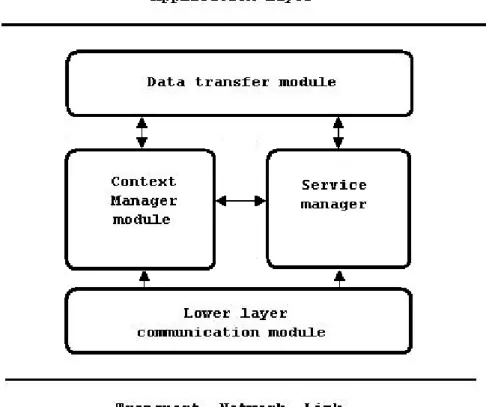
environment, while other research projects suggested an entirely new system to cope with an entirely new area. It is interesting noting that as a middleware layer will be present in all the devices of a ubiquitous environment, middleware developments must be aware that whatever the device is (a wearable computer, a sensor node) other devices present in the network have to be considered.Despite its peculiarities and different adaptations for each service, wearable-oriented middleware will be generally composed by the same several modules in almost all of the implementations:
• A lower-layer communication module. This is a foreseeable part of any conceivable
middleware, as their leading mission is retrieving the heterogeneous data poured from lower layers with fragmented, different technologies (hardware, operating systems, etc) and turn it into a common format, comprehensive for the higher layers of any implemented device (in this case, a wearable appliance), as a regular Object Request Broker would do. Although either high or low layer may differ from what a traditional middleware would deal with, the underlying functionality remains the same.
• A context manager module. As it has already been explained, context is a core concept in
ubiquitous computing, since it will determine not only whether a collection of services will be available or not, but also the precise moment of this availability –or unavailability-. In order to have an accurate idea of this fact, a context manager module is needed so that a categorization of the different contexts and an arranged list of services for each context will be composed. In the end, the context manager will deploy the reachable services for the final user as long as the current context allows them to be available.
• A service manager. Working closely with the context manager, once it has approved the
suitable collection of services, the service manager will tackle the common actions related to the performance of a service: registry, login, logout, download or deletion. Plus, the service manager will be responsible for the discovery of existing services in a context, previously made known by the context manager.
• A distributed data transfer module. Once the input data (obtained from lower levels and
Chapter 2 State of the art in ubiquitous middleware
15
Figure 5: different modules of the middleware layers, along with their relationships among them.
In order to have a global yet detailed view of the most prominent aspects of the middleware architectures that are going to be reviewed, a classification of the main middleware ubiquitous platforms that have achieved some sort of relevance is offered below these lines, inspired by the one suggested as an orthogonal classification of middleware technologies by Noha Ibrahim [Ibrahim 09]. In this conception, there are two views comprised on the same classification:
• A “horizontal” one, where already developed and deployed middleware architectures are present in a layer called Middleware of Types, and new layers have been incorporated under – Middleware of Sensors- and over –“Middleware of Middlewares”- it, thus building a stack of differentiated middleware components.
• A “vertical” one, where a collection of features is gathered under self- or ubiquitous middleware; the focus will be driven to ubiquitous middleware, since self-middleware functionalities according to Ibrahim´s classification are either successfully dealt with in a ubiquitous environment by ubiquitous middleware, or out of the scope of this Final Degree Dissertation.
Chapter 2 State of the art in ubiquitous middleware
16
Figure 6: classification of the components for the middleware layer.
Middleware of Middlewares will offer the needed abstraction from the lower levels (in this case, the type of middleware itself), in a four-staged way, reminiscent of the needs of Service-Oriented Architecture or SOA: a first phase devoted to the development of the application, another one of deployment of the already developed application on the environment, a third phase for execution (which will be focused on the correct performance of the application) and a fourth one where the interaction capabilities of the application are taken care of.
The Middleware of Sensors deals with different suggestions about middleware commonly designed for Wireless Sensor Networks or WSNs. A middleware on this level will usually manage the issues related with the wireless network directly (for example, should a node have a failure, this layer will try to find another one to keep the data flowing) with minimal user interaction.
The Middleware of Types layer is where the different approaches that have become fruitful and turned into different middleware platforms, suited to ubiquitous environments, are located. This project will bend its efforts on a proposal encased in the Middleware of Types layer, so the following reviewed middleware architectures can be placed within the domain of this level.
2.2.3 Legacy solutions in middleware.
Chapter 2 State of the art in ubiquitous middleware
17
and Ubiquitous Computing paradigms were even conceived. Therefore, despite of faring quite well in environments where power supply is taken for granted or at least is reliable enough, and the nodes taking part of them being robust and well-known, when dealing with the new model, some issues almost impossible to get around spring up.To begin with, Remote Procedure Call (RPC) has been discarded for a long time as an employable middleware in the context this Final Degree Dissertation is located. Among its multiple flaws, it is said about it that “RPC semantics of a synchronous, blocking invocation on a statically typed interface are overly restrictive, inflexible, and fail to provide an efficient unifying abstraction for accessing and
modifying state in ubiquitous systems” [Saif&01]. The general feeling about RPC in the research
community is that it is too rigid and unable to deliver a good performance in a dynamic behaviour as a ubiquitous environment demands; for example, it is unable to offer the result of a request to other host or process different from the one that originated it, something that could be needed if a service is to carry some data to a wearable device belonging to a Personal Area Network which is not the source of the request, or if the node that originated the request is down and the response has to be redirected somewhere else.
Alas, an issue as critical in pervasive computing and services based on wearable devices as power consumption is unmanaged in RPC by any means; due to the facts that a) RPC works with a request-answer model employing potentially numerous request-request-answer transactions and b) Delay in RPC is about 100 milliseconds long [Wei 11], it is sure that RPC will consume much of the power a wearable device or a node in a ubiquitous network are able to store, severely limiting the amount of time they can be operational.
Remote Method Indication (RMI) switches to a more object-oriented perspective, but essentially it is a Java implementation of RPC, with the corollary of hampering any effort to make it work in a more flexible way. Additionally, RMI has the problem of providing a Java-only codification, so additional efforts in porting the code to other programming languages would be needed if wearable devices and/or nodes were alien to Oracle manufacturer.
Chapter 2 State of the art in ubiquitous middleware
18
Considering all the trouble that discourages the use of unmodified middleware solutions already developed for traditional networks, it becomes clear that new, specific middleware approaches must be attempted if they are to perform successfully under these new circumstances and constrains.2.1.2.1 Middleware based on the family of standards ISO/IEEE 11073.
ISO/IEEE11073, also known as X.73, is a medical and health device communication set of standards that made possible the appearance of middleware that successfully carries out the duty of interconnecting devices related to the field of Health Informatics, usually named Personal Health Devices (PHDs) [Yao&05]. Since these PHDs are often wearable and wireless by its own nature (badges, patches, etc.) they become potentially part of a ubiquitous environment, although the family of functionalities belonging to this standard are strictly encased on the medical hardware, therefore crippling its usefulness for any other kind of services. This family is strongly based on the standard IEEE 1073, which has been around in industry since the 1980s [24X7 07].
The main objectives that motivated the development of this suite were the need of interchanging data about a final user –or more specifically, a patient- by using standardized interfaces, thus avoiding the trouble that a lack of a common, established implementation may take along (communications hindered by dissimilar working equipment from varied vendors, forced bonding with a small number of manufacturers, etc.) while keeping three key features:
• Real-time. The monitoring and event-driven actions can take place at every moment, a
reasonable goal judging from the sort of final user that will benefit from the services gained via a wearable device. This feature involves all the data harvesting, compiling and transferring from all the PHDs that while worn by the patient, may or may not be composing a PAN on their own.
• Plug and play. In accordance with the idea of merging the wearable computers within the
environment they are placed, PHDs have to be managed by the patient or the staff of paramedics the least possible. Thus, the only action that paramedics should care about is plugging and connecting physically all the required appliances, leaving the more logical tasks (detection, configuration and communication) to be tackled by the devices on their own.
• Efficient exchange of data. This implies that intercommunication must be executed with the
least cost possible, mostly in terms of energy usage and speed. We already know that slow and power over-consuming systems do not stand a chance in a ubiquitous environment.
Chapter 2 State of the art in ubiquitous middleware
19
events on an agent if necessary. Almost always, the manager is an electronic device, like a computer or a smart phone, which can display the data on a monitor with a format that is understandable for a human operator.The different components of this middleware architecture are the following:
Figure 7: architecture of a ISO/IEEE 11073-based service [Yao&05].
As it is displayed, the elements belonging to the architecture are:
• Agent/Manager Application Processes. A part of the middleware not defined by this set of
standards which is used as the interface between the protocol of the local machine and the ISO/IEEE object environment.
• MDIB (Medical Data Information Base). An object oriented database where the objects
Chapter 2 State of the art in ubiquitous middleware
20
content named packages: Medical package, Alert package, System package, Control package, Extended Services package, Communication package, Archival package and Patient package.• ACSE (Association Service Control Element). This element is an implementation of
standards ISO/IEC 15953 and ISO/IEC 15954, and is responsible for the establishment and disestablishment of connections, with no further data interchanged.
• CMDISE (Common Medical Device Information Service Element) and ROSE (Remote
Operation Service Element). These elements are created in order to exchange MMOs.
Services provided by means of CRUD operations such as CREATE, UPDATE or DELETE create, update or delete this MMOs. Reports are used to activate different operations on the agent or manager side. CMDISE is complemented by ROSE for services that usually imply remote operations.
• Communication System (Presentation layer, Session layer, Transport system). All the
layers below the middleware that unable communications, with its local particularities.
Overall, family of standards ISO/IEEE 11073 can be used when implementing four different kinds of features in a service provided in a ubiquitous environment, each one treated by a different specialization of the standards: device data, general application services, Internetworking and gateway and transports (cable, wireless).
Nonetheless, in spite of its solid structure and careful design, standard ISO/IEEE 11073 has enjoyed a very limited success. Among the leading manufacturers of wearable PHDs, only Philips has taken a limited interest in it (and it has to be considered that Philips manufactures many other electronic appliances, unrelated to ubiquitous computing). Several reasons for this have been quoted: this set of standards may have a too complex structure and, perhaps more significantly, ISO/IEEE 11073 is a standard preceding all the development of ubiquitous health devices, rather than following it. This is a good idea in order to offer a framework for brand new developments, but in this case it may ignore the incipient ubiquitous products that are being made and alienate manufacturers from that standard.
As a consequence, although creating a predefined pattern for applications to be developed is quite useful and foresight-like, it has had no previous usage in the industry, and vendors are more likely to stick to their own proprietary, trusted and already deployed solutions until a standard appears and becomes dominant [24X7 07].
2.1.2.2 Aura.
Chapter 2 State of the art in ubiquitous middleware
21
architecture appeared while conducting research activities driven to create some sort of middleware architecture capable of a successful performance in a ubiquitous computing environment [Aura 02].Having chosen Aura as the name of choice is not devoid of meaning: this middleware architecture will create an area around the user (the Aura) wherein information and computing services will become persistent, in spite of their location, and therefore executable at any place. Obviously, as there are many different areas in a ubiquitous environment, with electronic devices of potentially very different nature and performance, if the current and running services are desired to be kept accessible, the Aura will have to adapt to the available resources of the environment, thus moving around the representation of the task, thus adding a self-tuning feature to this middleware architecture. What is more, Aura also aims to anticipate to the actions of the user, enabling service prevision to a degree.
There are several specific components in this middleware architecture [Campo 04], which are:
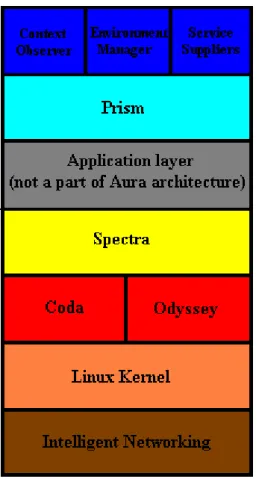
1. Intelligent networking at the lowest level, where depending on the duties from a holistic point of view (the service the ubiquitous network is allegedly suppose to offer), monitoring data transfer from one node to another one will be taking place.
2. Linux kernel, governing a particular piece of hardware upon the whole architecture has been mounted and programmed.
3. Coda, a file access system that will allow the usage of the supplied contents on different modes, depending on the bandwidth available and the mobility of the device that made the request in the first place, with an added offline option.
4. Odyssey, in which the main tasks to be performed are resource management and ensuring support to context adaptation for applications.
5. Spectra, a component providing a remote execution mechanism that will make use of user context so that the best way to deal with a remote petition will be chosen.
Chapter 2 State of the art in ubiquitous middleware
22
In addition to all these components, as the expectable limitations of this ubiquitous environment have been taken into consideration, another feature is put to a use here: the “cyber foreign” usage of hardware appliances, such as a Personal Computer, embedded in the system, to delegate the more resource-demanding (both in terms of computational and energy power) software-related activities to other devices that will not overload the network or the nodes. Once the embedded appliance has obtained the needed output, it will be either stored or retransmitted to the ubiquitous Wireless Sensor Network.A global vision of Aura middleware architecture is represented right at the start of the next page:
Figure 8: disposition of the components of Aura middleware architecture.
Chapter 2 State of the art in ubiquitous middleware
23
2.1.2.3 Gaia.
This middleware architecture appeared in its current form in 2005 [Kjaer 07]. It shares many of the concepts conceived by Aura architecture, especially the ones related to the challenge of adapting data and applications to the possibilities of the current devices that are providing them. For example, where Aura made use of an Aura to name the place in space where all the services would be stored and interfaced, Gaia is implementing a “Smart Space” where once it is active –turning into what is called an Active Space-, the applications and services will be dynamically mapped according to the available resources of the device that uses them, as it was done when using Aura. An Active Space is composed of a cluster of devices that have a strong relation with the final user and all their software capabilities and resources available, from operating systems to applications.
This middleware approach makes an extensive use of ontologies and context awareness [Hung&04]. An ontology can be defined as a structure that organizes into a standardized hierarchy a collection of concepts referring to elements bound to a domain, defining relations among them and offering the possibility to reason and infer behaviours between these entities of the domain. Among the available ontology languages, Gaia makes use of DAML+OIL (that is, a combination of DAML, DARPA Agent Markup Language and OIL, Ontology Inference Layer) to generate ontologies, although this language has been superseded currently by OWL (Ontology Web Language), which will be discussed later.
The most remarkable components of this Active Space which is at the core of the middleware proposal are the following:
1. A hardware devices collection or a hardware cluster bound to greater or a lesser extent to the final user. Depending on the scope of the usage of this middleware approach, the cluster will be integrated by regular-sized electronic appliances (PCs, printers, etc.), or oriented towards a Body Area Network. As usual, the nature of the hardware components can be expected to be fairly heterogeneous. Should the hardware cluster have a greater scope than a person, a human hardware administrator may be needed.
2. A collection of software components.
3. A context provided in varied ways: either by an external device or by a context observer (in a not dissimilar way to Aura´s).
4. A set of applications depending on the context provided and the particular devices from the hardware cluster. As far as this approach is concerned, applications are little more than context consumers, given that applications are supposed context-aware. Often, an application framework is available to develop brand new applications for the hardware cluster.




![Figure 7: architecture of a ISO/IEEE 11073-based service [Yao&05].](https://thumb-us.123doks.com/thumbv2/123dok_es/6815255.834605/38.892.284.642.254.790/figure-architecture-iso-ieee-based-service-yao-amp.webp)