FACULTAD de EDUCACIÓN Y TRABAJO SOCIAL
FACULTAD de FILOSOFÍA Y LETRAS
Master de Profesor de Educación Secundaria Obligatoria y Bachillerato, Formación Profesional y Enseñanzas de Idiomas
TRABAJO DE FIN DE MASTER
The Wonderful Wizard of Oz as a Resource for Teaching English and Social Skills in High School Education
Ángela de la Fuente Retuerto
Tutor: María Teresa Calderón Quindós
DEPARTAMENTO de FILOLOGÍA INGLESA
ABSTRACT
Most of the official documents related to education mention the Social and Civic Competence as a very significant one. The importance of the development of social and emotional skills for students’ success in their academic and personal lives can be explained through SEL approach, as well as why they should be included in our country’s teaching system. In this context, the aim of this dissertation is to create a teaching project for the first foreign language classroom (English), with which Bachillerato first year students can develop their linguistic competence as well as their social and emotional skills. In order to do so, I have chosen the tale The Wonderful Wizard of Oz, written by Frank Baum, as the starting point for the creation of activities related to social and emotional skills. The appropriateness of literature and particularly of the use of this American classic in Bachillerato has been also discussed.
Key words: first year of Bachillerato, literature, social and civic competence, social and emotional learning (SEL), The Wonderful Wizard of Oz.
RESUMEN
Este TFM tiene como objetivo crear una unidad didáctica para la clase de inglés como primera lengua extranjera, con la que los estudiantes del primer curso de Bachillerato desarrollen tanto la competencia lingüística como las habilidades socioemocionales. Para ello, se ha escogido el cuento infantil El Maravilloso Mago de Oz, escrito por Frank Baum, como punto de partida para crear las actividades relacionadas con las competencias anteriores. Primero se ha explicado la importancia del desarrollo de las habilidades socioemocionales para que los alumnos tengan éxito tanto en su vida personal como académica, y por qué su desarrollo debería incluirse en el sistema educativo español. Como se podrá comprobar en este TFM, muchos de los documentos oficiales relacionados con las leyes educativas hacen referencia a la competencia social y cívica como una de las más importantes. Por otro lado, se ha analizado si el texto escogido es adecuado para que lo lea el alumnado al que va dirigida la unidad didáctica. Y por último, se ha expuesto la propuesta didáctica propiamente dicha.
FOREWORD
This dissertation has been written with the purpose of obtaining a Master Degree in Secondary Education Teaching. The competences developed during these Master Studies according to Ley Orgánica 2/2006 and Resolución de 17 de diciembre de 2017 have been put into practice in order to carry out this project, particularly the following:
General competences:
G. 1. To know the curricular contents of the subjects related to the correspondent teaching specialization, as well as the didactic knowledge related to the teaching and learning processes.
G. 2. To plan, develop, and evaluate, either individually or working with other school teachers or professionals, the teaching and learning process fostering educational procedures which ease the acquisition of the typical competences of each subject, paying attention to the level, the students’ prior academic training, and the orientation of that training.
G. 3. To look for, obtain, process, and communicate information (oral, printed, digital, or multimedia information), transform it into knowledge, and apply it to the teaching and learning processes in the different subjects of the teaching specialization.
G. 5. To design and develop learning spaces paying special attention to equity, emotional education and values, equal rights and/or opportunities for men and women, civic education, and respect for Human Rights, which ease social life, decision-making, and the construction of a sustainable future.
G. 6. To acquire strategies to stimulate students’ effort and promote their capacity to learn by themselves and with others, and to develop thinking and decision skills that ease personal autonomy, confidence, and entrepreneurship.
Specific competences of the generic module
E. G. 3. To elaborate projects based on knowledge, skills, and intellectual and emotional aptitudes acquisition.
Specific competences of the specific module
E. E. 7. To turn curriculums into activities and work programs.
E. E. 8. To acquire selection and elaboration criteria in relation to educational materials.
E. E. 9. To promote an atmosphere that eases learning and values students’ contributions.
E. E. 11. To know evaluation strategies and techniques, and understand the evaluation as a regulation tool and to incentive students’ effort.
Specific competences of the practicum module
E. P. 1. To acquire experience in subjects planning, teaching, and evaluation.
INDEX
INTRODUCTION ... 1
1. THEORETICAL BASIS ... 3
1.1. EDUCATIVE SCHOOLS IN CASTILLA Y LEÓN ... 4
1.2. EDUCATIVE APPROACH: SOCIAL AND EMOTIONAL LEARNING ... 5
1.2.1. GUIDELINES TO INTRODUCE SEL IN SCHOOLS ... 7
1.2.2. SPECIFIC GUIDELINES TO INTRODUCE SEL IN THE CLASSROOM ... 9
1.3. LITERATURE AS A RESOURCE... 11
2. TEACHING PROJECT ... 15
2.1. LEVEL ... 15
2.2. OBJECTIVES... 15
2.3. COMPETENCES ... 16
2.4. METHODOLOGY ... 19
2. 5. CONTENTS, EVALUATION CRITERIA AND LEARNING STANDARDS ... 20
2.6. MAIN MATERIAL ... 23
2.7. MAIN LEARNING GOAL ... 23
2.8. TIMETABLE ... 23
2.9. DIVERSITY OUTREACH ... 24
2.10. ASSESSMENT... 24
2.11.1 SESSION 1 ... 29
2.11.2. SESSION 2 ... 32
2.11.3. SESSION 3 ... 35
2.11.4 SESSION 4 ... 39
2.11.5. SESSION 5 ... 43
2.11.6. SESSION 6 ... 47
3. CONCLUSIONS ... 49
REFERENCE LIST ... 53
ANNEXES ... 57
ANNEX 1 ... 59
ANNEX 2 ... 61
ANNEX 3 ... 67
ANNEX 4 ... 69
ANNEX 5 ... 73
ANNEX 6 ... 75
ANNEX 7 ... 79
ANNEX 8 ... 81
ANNEX 9 ... 83
1
INTRODUCTION
Young students during adolescence live a sort of critical period full of changes. These changes have to do with their biology, psychology, their academic duties, etc. They have to learn how to deal with all of those changes in order to be able to solve their problems, become responsible citizens and adults, succeed at school, and in life. To do so, adolescents take academic subjects at school that are supposed to provide them with the skills they need. However, not only are academic subjects important, students also need to develop social and emotional skills that will help them to become part of our society and to succeed at both academic and personal levels.
According to Cohen:
Parents and teachers want schooling to support children’s ability to become lifelong
learners who are able to love, work, and act as responsible members of the community. Yet,
we have not substantively integrated these values into our schools or into the training we
give teachers (2006, p. 201).
So we want children to be supported at school, to learn about academic issues to be able to work in the future, but we also want them to learn nonacademic values that will help them to succeed. However, in most of the cases, those nonacademic values are not taught at school. This happens especially in high school because teachers tend to be very much concerned about their own lessons and they can get some pressure from principals to achieve better results in tests and exams (Cohen, 2006). Besides, teachers do not receive any training related to social or emotional skills, so they do not know how to introduce this kind of learning in their regular lessons.
Why are English lessons suitable to work through SEL approach?
2 with students and different skills can be encouraged. Devoting a Unit of Work to develop social and emotional skills does not mean leaving English aside because students are still going to use the language to communicate, and they will be doing it in a more practical way, and with a purpose.
Objective
My intention is to design an educational proposal for the first year of Bachillerato using the tale The Wonderful Wizard of Oz written by Frank Baum and published in 1900 as the basis for the activities that will be developed in the English lessons. While working on this literary text, students will be able to develop both their competences on the English language and some social and emotional skills that will be useful for both their academic and personal life.
Structure
3
1. THEORETICAL BASIS
According to the LOMCE (Ley Orgánica 8/2013, 2013), the development of social and civic competencies of students is a key issue in high school education. It should be included as a cross curricular subject to promote values such as equality, tolerance, respect, justice, rejection to discrimination, etc. The promotion of those values will help students to participate more actively in the economic, cultural and social life of our society, and to do it in a more critical and respectful way. Besides this, it is also mentioned that it is during this period of education when students fully develop their personality, and working those values while they are still shaping their personality can help them become more respectful and conscious of their own skills. In addition, it seems that conflict prevention is another significant issue, being specifically mentioned the prevention of bullying in schools.
Orden ECD/65/2015 (2015) says that the Key Competencies should be worked through all the subjects during all the stages of education. The evaluation of those competencies has to be integrated within the contents, and they can be measured by means of rubrics, or grading scales, always having into account diversity outreach. Besides, it is also important that students themselves have the opportunity to evaluate each other and themselves since it will help them to be more aware of their strengths, weaknesses, and it will force them to reflect on their own work.
According to the same Orden (2015), the social and civic competence is defined as those that involve the ability to make decisions, solve problems, and interact with other people basing our behavior on democratic beliefs and respect. The social competence has to do with the preparation of students to become active participants of the society. To do so, students need to develop certain skills such as being able to communicate in different contexts, express and understand different points of view, get to agreements showing confidence and empathy, or respect the difference, among others. On the other hand, the civic competence involves being aware of some concepts like democracy, justice, or equality, and of how society works. Some of the skills related to it are showing solidarity and interest in solving problems, and participating in activities related to the community.
4 those skills gives them the opportunity to fully develop their personality as well as it helps them to become more skillful in their social relations with other people. Besides, it gives them the tools that they will need to succeed when they finally join society as active members of it.
Even though emotional aspects are not specifically mentioned, I believe that they are somehow included in this social and civic competence since empathy, solidarity or respect are skills that appear in those documents. These skills, among others, have an emotional baggage, which can be considered as a sign that emotional aspects should be considered as well.
1.1. High schools in Castilla y León developing the Social and Civic Competence
Having looked at what the law says about the social and civic competence, the next step is to see whether those theoretical guidelines are actually put into practice in the high schools of our community or not.
Looking at different educational projects of schools in Valladolid, there are sections in which social harmony within the school is mentioned. These sections refer to having a good atmosphere that involves students, teachers, and even families, saying that this environment helps in the problem solving process, and eases other types of learning. It seems that the most important issue in the plan for social harmony is the prevention of possible problems by explaining the rulebook to students, and developing different activities directed to avoid conflicts.
Students’ autonomy is also significant for schools since education has a key role in students’ learning about being critical and able to make their own choices. This means that the knowledge that students acquire at school is not merely academic, but it develops other skills that will be useful in their daily lives out of school. One of the skills that is repeatedly mentioned in various educational projects is the ability to socialize in such a way that both men and women relate with each other and interact without discrimination.
5
1.2. Educative approach: Social and Emotional Learning
SEL has been developed in the United States from the 1960’s, and seems to be beneficial for students when dealing with conflicts and real life issues. Social skills are behaviors or thoughts that allow us to solve a situation effectively and in an acceptable way for both the person involved and the social context in which he or she finds himself. Then, these kinds of skills help us to solve problems and find the best solution for them. Some of those skills are determined by our biology, environment, and culture, and others depend on our personal experiences (Trianes, Muñoz, and Jiménez, 1997). So we are not completely determined when speaking about social skills. That is the reason why we have to continue developing them, because we can keep learning through all our lives and, especially during the adolescent period, they are very important in order to be able to successfully interact with the people around us.
Social and emotional learning (SEL) is considered to be:
The process through which children and adults acquire and affectively apply the
knowledge, attitudes, and skills necessary to understand and manage emotions, set and
achieve positive goals, feel and show empathy for others, establish and maintain positive
relationships, and make responsible decisions” (Collaborative for Academic, Social, and
Emotional Learning, (n.d.).
The need of social and emotional education is quite old since one of the goals of education has always been to prepare students to be productive, responsible, and engaged citizens of our society. However, it was during the late 1960s when the concept of SEL started to be studied and developed by different researchers in the United States. Little by little, SEL started to be implemented in schools around the country, various projects were put into practice, for example, to prevent violence and drugs, and the term was spread across the educational circles. In 1994, the Collaborative to Advance Social and Emotional Learning (CASEL) was created, whose goal was to establish a “high-quality, evidence-based social and emotional learning (SEL) as an essential part of preschool through high school education”1
1
6 (Collaborative for Academic, Social, and Emotional Learning, (n.d.), (George Lucas Educational Foundation. (2011).
The inclusion of SEL programs in schools is significant since schools offer the appropriate environment in which students can develop their social and emotional skills. First of all, at school students are provided with both cultural values and rules that will determine their behavior. Besides, teachers are essential as well since they are the ones that must create a safe and comfortable climate in the classroom for students to feel motivated, interested, and focused on the lessons (Trianes, et al., 1997). Zins (2004) claims that the process of learning involves students, but also teachers, classmates, and even the support of families, which means that it is a social process in which all of those factors are included. This social process that we call learning usually takes place in schools, which are social places where students get to interact with others. Considering learning as a social process, Zins (2004) considers that emotions have a crucial role in it, since they can ease or make more difficult students’ learning and their success at school. Cohen uses the term SEEAE to refer to social, emotional, ethical, and academic education, and he points out that it focuses on “the promotion of social-emotional competencies and ethical dispositions on the one hand, and the creation of a safe climate for learning on the other” (2006, p. 205). It is then clear that, when dealing with SEL, the atmosphere in the classroom is a key issue. The teacher must generate a good climate in which students feel safe, motivated, and interested in the learning process.
The Office of the Surgeon General (1999) points out that:
Over the last several decades, there has been a growing awareness that students with
significant social, emotional, and/or behavioral needs pose a great challenge for (…)
educators. Without effective interventions, (…) these students struggle with problems that
predispose them to long-term negative outcomes (as cited in Cohen, 2006, p. 208).
Social and emotional learning (SEL) can have a useful and beneficial impact on students’ behavior and long-term outcomes. That is the reason why they should develop those skills guided by teachers, who should be able to give students the strategies they need to become more competent emotionally and socially, and to face their problems with the conviction that they will obtain a positive result.
7 increases, the incidence of problem behaviors decreases, and the quality of the relationships surrounding each child improves” (Elias, 1997, p. 1-2). Besides, Cohen (2006, p. 216) mentions that according to Bar-On (2003), children who are involved in programs related to SEL have fewer difficulties with their interpersonal relations, are better at understanding and expressing themselves, and have more control over their emotions, being able to manage them and solve their problems easier.
One of the issues that slow down the implementation of programs related to SEL in schools and high schools in the United States has to do with parents (Cohen, 2006). It seems that they are sometimes against those programs because they do not consider this kind of learning approach important enough, or because they think that their value system is being violated if schools do not consult them those changes in the curriculum. However, the reaction of parents towards these programs may not be the same in other countries, and parents in Spain may accept these programs as truly beneficial for their children if the right media campaign is carried out to promote SEL in schools. Another key element that affects its implementation is the difficulty to measure and evaluate the development of social and emotional skills on students, and the lack of teacher preparation courses that would allow them to deal with SEL programs effectively in schools. It has to be said that there are many different programs regarding bullying prevention, civics education, mental health, etc., but those programs are usually fragmented, when they should all be coordinated to obtain better results. Finally, the difference that educational leaders and policy makers usually draw between student learning and social and emotional issues does not help to the proper inclusion of these programs in the regular curriculum (Cohen, 2006).
1.2.1. Guidelines to introduce SEL in schools
8 communication, sense of school community, peer norms, school-home-community partnerships, student morale” (Cohen, 2006, p. 212). The third step involves the inclusion of the families in the child’s life and learning process. Parents and school should send kids the same message so that he does not see different behaviors at school and at home, and that is only achieved when there is a partnership between families and school. The fourth step has to do with the inclusion of SEL programs in the curriculum. Sometimes, SEL lessons and skills are usually taught in isolation first, and then students will be able to apply that learning and those skills to both academic and non-academic situations. The final step deals with the evaluation of student progress, which is an issue that is not completely defined yet (Cohen, 2006). The existence of an evaluation seems to be positive, but what should be measured is still being discussed.
There are five main competences that can be taught though SEL programs in schools, according to CASEL (Collaborative for Academic, Social, and Emotional Learning, (n.d.). Those competencies are the following, which are defined by the same organization:
- Self- awareness, which is the “ability to accurately recognize one’s own emotions, thoughts, and values and how they influence behavior and to accurately assess one’s strengths and limitations, with a well-grounded sense of confidence, optimism, and growth mindset”.
- Self-management, which involves the “ability to successfully regulate one’s emotions, thoughts, and behaviors in different situations, and the ability to set a work toward personal and academic goals“.
- Social awareness is the “ability to take the perspective of and empathize with others including those from diverse backgrounds and cultures.”
- Relationship skills which has to do with the “ability to establish and maintain healthy and rewarding relationships with diverse individuals and groups, (…) communicate clearly, listen (…) cooperate with others, resist social pressure, negotiate conflict constructively, and seek and offer help when needed”.
9 The development of each one of these skills helps students to be more aware of their own capacities and self, more capable of recognizing and dealing with their emotions, and more competent in their social interactions.
1.2.2. Specific guidelines to introduce SEL in the classroom
As it has been previously said, there are two important steps to have into account when introducing SEL in schools, and more specifically in a particular classroom. First of all, the teacher has to be aware of the possible issues that affect those students to be able to focus on them. However, I believe that dealing with SEL does not necessarily involve problems in the classroom. It can be worked on as a sort of habit, where students are able to discuss various topics to reflect on them and share their opinions. To do so, the teacher must provide students with the safe environment that has been mentioned in order to be able to discuss opinions naturally and without barriers.
It is interesting that when working with SEL students tend to work with their classmates, which means that they have to work in groups and collaborate with each other. This is a good way to develop their social skills, to help them learn to cooperate with others, and to get to agreements within the groups. However, discussions do not only involve the members of the group, but also the rest of their classmates, which means that the groups have to agree on what they want to share with them and defend it.
In this particular project, the CASEL model of the five competences will be followed. This means that the activities that will be included in the proposal will develop some, if not all, of the competences that CASEL says can be developed through SEL. The fact that students improve their skills related to those competences will make them more aware of the way in which they see themselves, their emotions and thoughts, and also other people’s emotions and thoughts. Students will have the opportunity to reflect on those topics and become more competent when dealing with them. Furthermore, the improvement of their social skills will help them to be more capable of establishing long-lasting relationships, and making responsible decisions based on their own beliefs and concerns.
10 project are self-awareness, social awareness, and relationship skills. Dealing with three competences instead of five will allow students to focus more on those ones and do more activities related to them.
The first competence that will be included in the project is social awareness. As it has been already said, it deals with the perspective that we have from others, our capacity to empathize with them, the respect that we should feel and show to others, and the appreciation for diversity. In this project this competence will be developed throughout different activities that will put students in someone else’s place, to force them to think and behave as if they were not themselves. This activity makes students reflect on someone else’s emotions and become aware that people that surround us deserve respect, empathy, and being treated in a nice way, just like ourselves. Another activity dealing with these competences has to do with the respect that we should show to people who does not think the same way as we do. Students will have to respect other people’s opinions and get to an agreement with them.
Self-awareness has to do with the confidence that we have in ourselves, our capacity to recognize our own emotions, values, and thoughts, and the ability to assess our strengths and limitations. In order for students to develop this competence they will have to think of their own strengths, in a real way because they will be given a situation and they must solve it. Besides, they will have to recognize their own values and thoughts and also their classmates’. These activities will improve their confidence and will make them appreciate their own qualities, which they may already know or might be discovered by others.
Finally, students will develop their relationship skills, first of all because many of the activities suggested have to do with group work, which means that students will have to work with their classmates and put into practice some of the social awareness skills that they are also developing during the sessions. Within the different groups they should be able to communicate clearly, listen to each other to get the best result, and cooperate with their mates, since that is the reason why they will work in groups. When working in groups, students can also develop their ability to seek and offer help to their classmates. This is an issue that may be hard for some students, and working in small groups can help them feel more comfortable to show their own weaknesses as well.
11 fact they have much to do with each other and sometimes working one of them can lead to work another competence at the same time.
In short, even though I have found no evidence that this specific educational approach (SEL) has not been implemented in our country yet, it has been put into practice in the United States, and it has had positive results in students’ performance at school. It can be said then that social and emotional learning does have a beneficial impact on students’ success at school, and since the Spanish legislation does mention several aspects, at both national and autonomous levels, related to especially the development of students’ social competence, I believe it is worth it to include it in this teaching project. Not all the competences related to SEL will be included in this project, but the number is not as important as the fact that students will have the possibility to reflect on several topics that they may not have thought about.
1.3. Literature as a resource
Literature is a very interesting and useful resource when teaching a foreign language since it allows students to read authentic material in the foreign language as well as getting to know some aspects of the culture that surrounds the language. The literature that teachers provide to students can be the authentic one or an adapted version of it. I believe that reading the original version is better than an adaptation because the text has not been manipulated and there are plenty of literary pieces and short stories that students are able to read and understand.
Another reason to bring literature to the classroom is that it allows the teacher to discuss a great deal of topics with students, and those topics arise in a natural way. This is why using literature is significant in the Unit of Work that is put forward in this dissertation, the selected tale will help the teacher to bring into the classroom various topics related to social and emotional learning at the same time that they work on the foreign language and the culture.
12 (Baum, 1900), which was written by Frank Baum. Below the suggested questions by Duff and Maley are displayed, and I will try to give an answer in relation to the selected text.
Is the subject matter likely to interest this group?
Since this Unit of Work is being designed for first year of Bachillerato students, I think that the text can be interesting for them. First of all, it is a very well-known text, and many students may have heard about it. Second, the book has been turned into a film, which can be useful to keep the students’ interest by showing a clip in any of the sessions. Finally, they might have heard about the book, and they might have seen the film, but these kinds of texts are rarely read by students even if they know about them. So it would be a discovery for them and it might change the initial idea of what they thought the story was about.
Is the language level appropriate?
This story was written in English initially for kids, so the language that can be found is not very complicated. The students that will read the text have finished the compulsory secondary education and are continuing their studies, which means that they are supposed to have good command of the foreign language. Furthermore, students will have access to different resources to fill the lack of vocabulary that they may have.
Is it the right length for the time available?
The whole book has too many chapters for the time available in this Unit of Work, which is the reason why students will only read certain chapters that are more related to the issues that we want to deal with in the classroom. This way, the length of the text is shortened and students will be more focused on the topics that they will discuss. Does it require much cultural or literary background knowledge?
As the story is written to be read by children, it does not need any literary background knowledge. Besides, students will not need much cultural knowledge since the aim of the activities will not be doing a deep analysis of the book, which may require more cultural baggage. Instead, the teacher will use the story to discuss social behaviors or emotions with students. That is why they will only need to understand the passages that will be read in the lessons to be able to participate in the activities.
Is it culturally offensive in any way?
13 Spanish high school, and even though English and Spanish cultures are certainly different, they are not as unalike in social behavior or actions as it could occur with other cultures like the Chinese one.
Can it be easily exploited for language learning purposes?
I believe that this book can be exploited in many ways and it can be related to various topics to deal with in the classroom. In the Unit of Work proposed the activities are not focused on the language itself, but the language is going to be a means to discuss several topics. This does not mean that the book is not suitable for language learning purposes, in fact students are going to be forced to use the language to communicate with each other, and that is also a way to learn a language even if students are not strictly doing language activities.
15
2. TEACHING PROJECT 2. 1. Level:
This project is designed for students that are in their first year of Bachillerato, which means that those students have finished the obligatory secondary education and they are continuing their education to be able to access higher studies in the future.
According to the Article 24 of the Real Decreto 1105/2014, 26th December 2015, by which the basic curriculum of Secondary Education and Bachillerato is established, one of the two the main purposes of Bachillerato studies is to provide students with the necessary academic training, intellectual and human maturity, knowledge, and skills that will allow them to carry out social functions as well as join to the working life in a responsible and competitive way.
The same document points out that the tasks suggested to be done in Bachillerato are supposed to favor the students’ capacity to learn by themselves, work in groups, and apply the appropriate investigation methods. The students’ ability to speak in public and reading habits are two issues that are also mentioned as significant skills to be developed by students.
The first foreign language is obligatory in this year, and students usually have English as their first option. Besides, LOMCE (Ley Orgánica 8/2013, 2013) establishes that when teaching a foreign language, either the mother tongue, Spanish, and the co-official language should be set aside to try to use them only to provide support when it is necessary. Furthermore, the skills that are supposed to be more developed are the oral ones, which are listening, spoken production, and spoken interaction.
In this year, students are supposed to have good command of the foreign language regarding both grammar structures and vocabulary. That is why they should not have much trouble to read and understand the chapters of the tale, and to complete the activities related to them. Besides, they are supposed to be able to speak quite fluently, which is one of the skills that will be developed throughout different activities in this project.
2. 2. Objectives
16 a) Practice democratic citizenship from a global perspective, and acquire a responsible civic consciousness that inspired on the values of the Spanish Constitution and the Human Rights, encourages the responsibility of building a fear and equitable society.
b) Consolidate students’ personal and social maturity in order for them to be able to act in a responsible and self-sufficient way, and to develop their critical spirit. Anticipate and solve personal, family, and social conflicts in a peaceful way.
d) Strengthen reading, studying, and discipline habits as requirements for the effective learning progress, and as a means to personal growth.
f) Being able to express oneself in one or more foreign languages with both fluency and accuracy.
g) Make a responsible and reliable use of information and communication technologies.
k) Strengthen entrepreneurship by being creative, flexible, and self-confident, having personal initiative, a critical attitude, and working in groups.
l) Develop artistic and literary sensibility as well esthetic criteria as sources of information and cultural enrichment.
2. 3. Competences:
According to the Orden ECD/65/2015 (2015), 21st January, by which the relations among competences, contents, and evaluation criteria of primary education, secondary education, and Bachillerato, are described, the European Union insists on the fact that citizens must acquire some key competences that are necessary for their personal, social, and professional development. The European Union claims that this full development of citizens will supply the needs of the globalized world in which we live, and will allow us to continue the economic growth bound to knowledge.
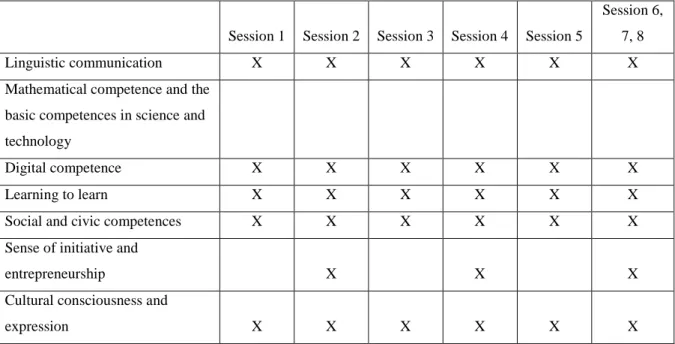
17 In the following figure can be seen the key competences and the sessions in which each competence is going to be developed:
Session 1 Session 2 Session 3 Session 4 Session 5
Session 6,
7, 8
Linguistic communication X X X X X X
Mathematical competence and the
basic competences in science and
technology
Digital competence X X X X X X
Learning to learn X X X X X X
Social and civic competences X X X X X X
Sense of initiative and
entrepreneurship X X X
Cultural consciousness and
expression X X X X X X
Figure 1: Key competences worked in each session
Linguistic communication: Since this teaching project is designed for the foreign language classroom, it seems obvious that this competence appears through the whole Unit of Work. In order to develop linguistic communication it is mandatory that students use and handle the foreign language with a communicative purpose. It can be in an oral or written way, and in various situations and contexts. In this Unit of Work, students will be constantly using the foreign language to communicate with their classmate or the teacher, and to express their ideas, which will help them to develop this competence.
Digital competence: This competence implies the usage of information and communication technologies in the subjects. In this Unit of Work, ICTs are included throughout the whole unit because since students are going to be dealing with texts in the sessions, they are probably going to need help with some of the vocabulary that may appear there. They will be able to use the digital board with internet connection to look for the unknown vocabulary, expressions, or the possible cultural background that surrounds the texts. Besides, it will allow them to know useful resources which they can use in the future.
18 summaries of the chapter they read in the previous session. But they will have to follow a scheme given by the teacher, which means that they will have to read the chapter and do an analytic reading in order to answer the questions or scheme suggested by the teacher. Finally, in the final task they will have to put into practice everything they have learnt during the sessions because instead if reading, which is what they have been doing during the first sessions, they will have to write themselves and include some of the topics that have been discussed.
Social and civic competences: The Foreign language classroom is an appropriate environment to deal with social issues and tolerance towards what is different because the foreign language is a huge difference itself that opens up a whole world of new differences that can make students reflect on. In fact, the Real Decreto 1105/2014 mentions that the effective usage of foreign languages implies having our minds open to new beliefs, interactions with others, and thoughts that are different from ours.
This teaching project is based on Social and Emotional Learning which has a lot to do with this competence which involves the ability to interact with other people, make decisions, and solve conflicts. The development of this competence will assure students’ well-being as well as it will help them to have a better understanding of how society works and how the individual should interact in that society. Some of the basic skills related to the social competence are the ability to communicate in a constructive way and in different situations and contexts, the ability to show tolerance, to express and understand diverse points of view, to feel empathy, and to be able to negotiate inspiring confidence. In this Unit of Work, some of these skills are going to be worked through all the sessions devoting a session for each skill. This way students will focus on one topic and they will do either reflection activities and practice activities that will allow them to become more aware of their skills and to develop them.
19 thoughts, students will have to respect their classmates’ opinions even if they do not agree with them.
Finally, there will be some activities that will be done in groups, which means that students will have to get to agreements and put into practice some of the values and skills that will be developed throughout the unit.
Sense of initiative and entrepreneurship: It is necessary that students develop some sense of initiative and creativity. In this Unit of Work, students will work in pairs or groups in some of the activities suggested which easies the development of leadership skills, group work skills, task delegation, etc. The final task is an activity in which students will develop these skills since it involves group work and it does not have many guidelines, so they will be able to do almost anything they wish. Besides, they will have to organize themselves to finish the task on time. Finally, they will have to take risks as well, and share and defend their ideas and work in front of their classmates always trying to speak in the foreign language. This is a risk itself since it is not the students’ mother tongue, and it already means a challenge.
Cultural consciousness and expression: This competence involves being aware of different cultural and artistic manifestations and showing respect for them. In this case, since the teaching project deals with the tale The Wonderful Wizard of Oz (1900), written by Frank Baum, who was an American writer, students will be in contact with a literary creation from a different country from the very beginning.
2. 4. Methodology
In the Real Decreto 1105/2014 (2015), the first foreign language is treated as a means for communication, which is the reason why it is mentioned that students should be provided with examples or situations of real communication in which they can develop the ability to speak and communicate in the foreign language. That is why the two basic methodologies that will be followed in this teaching project are the communicative approach and the task-based approach.
20 that the foreign language should be taught by creating situations in the classroom in which communicating with each other is an obligation and not restricting the language to academic purposes and to “textbook English” (Verghese, 1989). Some of those authors who wrote about this approach in the last years are Richards and Rodgers (2014), Maqueo (2006), or Littlewood (1998).
Second, the task-based approach is based on the completion of a final task, which usually does not have a unique correct answer, but students have to complete it their own way. The approach is centered in the completion of the final task, and not in the learning of a specific grammatical feature. However, students have to use accurate language and they have to be able to communicate (Bilsborough, 2013). It is common that the previous activities to the final task help to the completion of it. As it happened with the previous methodology, there are a lot of authors who support its usage in the foreign language teaching, such as Willis (1996), or Ellis (2003).
Finally, Krashen (1982) also talks about the affective filter and its impact on second language acquisition. One of the aims of SEL is also to create a safe environment in which students feel confident, and calm, which according to Krashen’s work will also favor the learning of the second language.
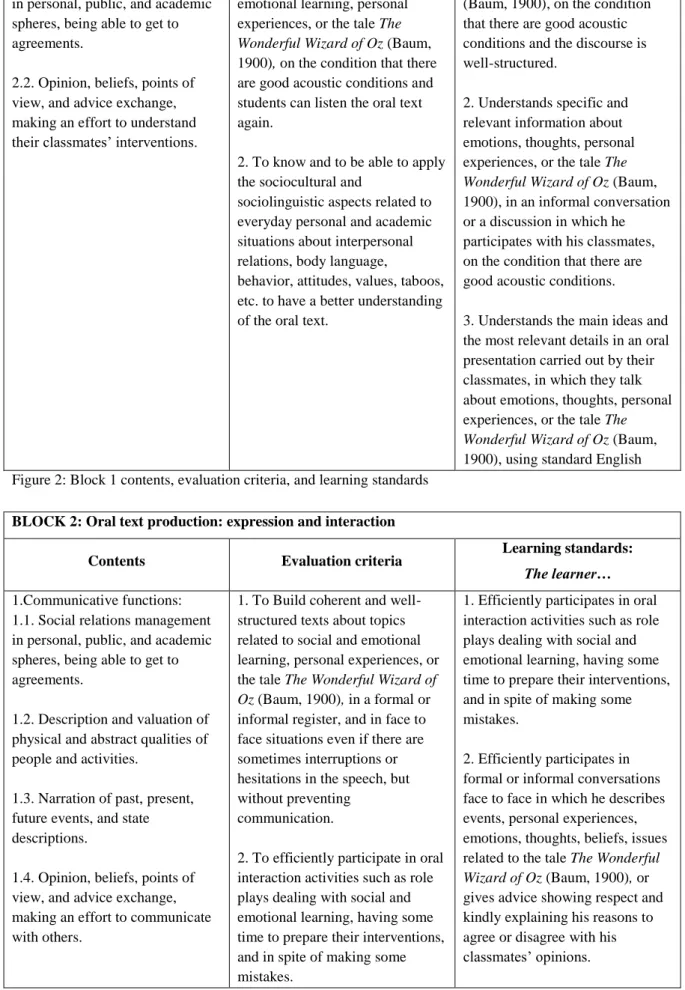
2. 5. Contents, evaluation criteria and learning standards
The contents, evaluation criteria, and learning standards for this teaching projects are the following, which have been taken from the Orden EDU 363/2015, 4 May, which establishes the curriculum and regulates the implementation, evaluation, and development of Bachillerato years in Castilla y León:
BLOCK 1: Oral text comprehension
Contents Evaluation criteria Learning standards:
The learner…
1.Differentiation of types of comprehension (general meaning, essential information, main points, relevant details)
2. Communicative functions: 2.1. Social relations management
1. To identify the essential information, the main points, and the most relevant details in well-structured oral texts reproduced by other people in the classroom using a formal or informal register about topics related to social and
21 in personal, public, and academic
spheres, being able to get to agreements.
2.2. Opinion, beliefs, points of view, and advice exchange, making an effort to understand their classmates’ interventions.
emotional learning, personal experiences, or the tale The Wonderful Wizard of Oz (Baum, 1900), on the condition that there are good acoustic conditions and students can listen the oral text again.
2. To know and to be able to apply the sociocultural and
sociolinguistic aspects related to everyday personal and academic situations about interpersonal relations, body language,
behavior, attitudes, values, taboos, etc. to have a better understanding of the oral text.
(Baum, 1900), on the condition that there are good acoustic conditions and the discourse is well-structured.
2. Understands specific and relevant information about emotions, thoughts, personal experiences, or the tale The Wonderful Wizard of Oz (Baum, 1900), in an informal conversation or a discussion in which he participates with his classmates, on the condition that there are good acoustic conditions.
3. Understands the main ideas and the most relevant details in an oral presentation carried out by their classmates, in which they talk about emotions, thoughts, personal experiences, or the tale The Wonderful Wizard of Oz (Baum, 1900), using standard English Figure 2: Block 1 contents, evaluation criteria, and learning standards
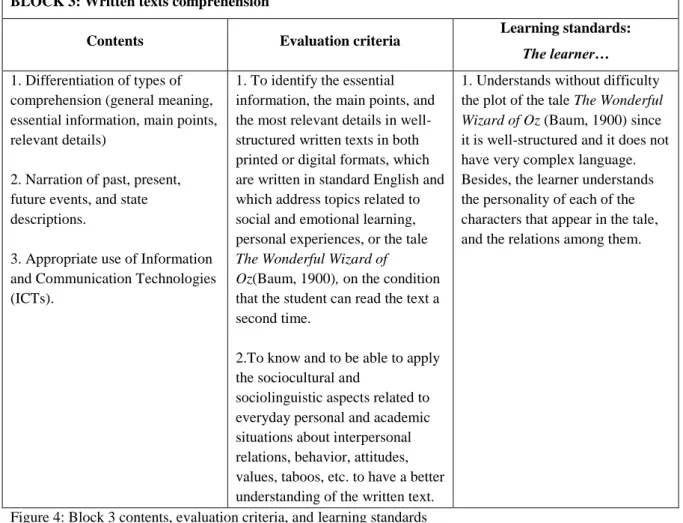
BLOCK 2: Oral text production: expression and interaction
Contents Evaluation criteria Learning standards:
The learner…
1.Communicative functions: 1.1. Social relations management in personal, public, and academic spheres, being able to get to agreements.
1.2. Description and valuation of physical and abstract qualities of people and activities.
1.3. Narration of past, present, future events, and state descriptions.
1.4. Opinion, beliefs, points of view, and advice exchange, making an effort to communicate with others.
1. To Build coherent and well-structured texts about topics related to social and emotional learning, personal experiences, or the tale The Wonderful Wizard of Oz (Baum, 1900), in a formal or informal register, and in face to face situations even if there are sometimes interruptions or hesitations in the speech, but without preventing
communication.
2. To efficiently participate in oral interaction activities such as role plays dealing with social and emotional learning, having some time to prepare their interventions, and in spite of making some mistakes.
1. Efficiently participates in oral interaction activities such as role plays dealing with social and emotional learning, having some time to prepare their interventions, and in spite of making some mistakes.
2. Efficiently participates in formal or informal conversations face to face in which he describes events, personal experiences, emotions, thoughts, beliefs, issues related to the tale The Wonderful Wizard of Oz (Baum, 1900), or gives advice showing respect and kindly explaining his reasons to agree or disagree with his classmates’ opinions.
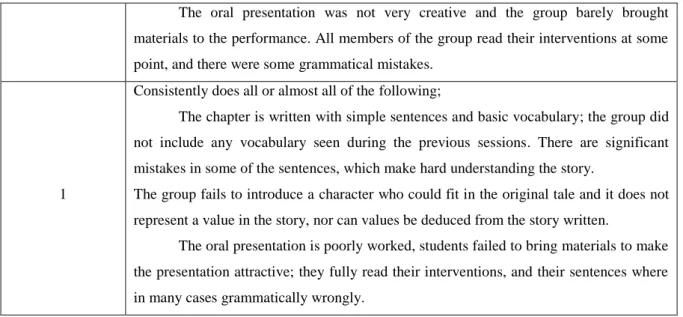
22 BLOCK 3: Written texts comprehension
Contents Evaluation criteria Learning standards:
The learner…
1. Differentiation of types of comprehension (general meaning, essential information, main points, relevant details)
2. Narration of past, present, future events, and state descriptions.
3. Appropriate use of Information and Communication Technologies (ICTs).
1. To identify the essential information, the main points, and the most relevant details in well-structured written texts in both printed or digital formats, which are written in standard English and which address topics related to social and emotional learning, personal experiences, or the tale The Wonderful Wizard of
Oz(Baum, 1900), on the condition that the student can read the text a second time.
2.To know and to be able to apply the sociocultural and
sociolinguistic aspects related to everyday personal and academic situations about interpersonal relations, behavior, attitudes, values, taboos, etc. to have a better understanding of the written text.
1. Understands without difficulty the plot of the tale The Wonderful Wizard of Oz (Baum, 1900) since it is well-structured and it does not have very complex language. Besides, the learner understands the personality of each of the characters that appear in the tale, and the relations among them.
Figure 4: Block 3 contents, evaluation criteria, and learning standards
BLOCK 4: Written text production: expression and interaction
Contents Evaluation criteria Learning standards:
The learner…
1. To find and make an adequate usage of linguistic resources and information and communication technologies (ICTs) such as paper dictionaries, online dictionaries, online resources to look for expressions or cultural references, etc.
2. Communicative functions: 2.1. Description and valuation of physical and abstract qualities of people and activities.
2.2. Narration of past, present, future events, and state descriptions.
1. To write in any format coherent and well-structured texts about topics related to social and emotional learning, personal experiences, or the tale The Wonderful Wizard of Oz (Baum, 1900), being able to justify his own opinions and making an accurate use of the English language.
2. To be aware of the sociocultural and sociolinguistic aspects of the target audience and the differences with his own culture (traditions, attitudes, values, beliefs, taboos, etc.) to be able to adapt the written text towards that specific
audience.
1. Writes in any format a cover letter giving specific details and adding the information that he considers to be significant for the purpose of the letter.
2. Writes, in a conventional format, a short story in which he includes significant information related to social and emotional learning and the tale The Wonderful Wizard of Oz (Baum, 1900), describing situations, characters, places, narrating events in a coherent order, and making an accurate use of the English language.
23
2. 6. Main material:
Some of the activities that will be carried out during this project will need some resources like internet access and digital devices to look for unknown vocabulary, expressions, or cultural references, sheets with questions to give to students and discuss various topics, boxes to make some of the activities anonymously and give students both privacy and anonymity. This way, students will feel more comfortable while doing the activities and they will be able to express their ideas and feelings in a more natural way and without barriers. The teacher will also need some paper cards with the students’ names on them, and some others with role play situations that students will use to get to agreements.
The final task has not many guidelines and students will be allowed to take as many resources as they wish. Some of them may be provided to them and some may be brought by students to the classroom.
2. 7. Main learning goal
The main learning goal of this teaching project is that students become more aware of their social and emotional skills and that they develop them to assure students’ well-being and to make them more capable of joining adult life in a successful way. Furthermore, students will develop their foreign language skills and they will be more capable of communicating both accurately and fluently. They will not study the grammar per se, but they will be putting into practice all the grammar, vocabulary, expressions, etc. that they have already learnt to communicate with their classmates.
2. 8. Timetable
24
2. 9. Diversity outreach
Given that this teaching project is designed to be implemented in any high school in Castilla y León, there is no specific context to take into account when talking about diversity outreach. Moreover, every single student is different and learns in a different way, which means that every classroom is different and will have specific needs for the development of the unit. That is why the activities suggested may be slightly changed in order to adapt them to the specific needs of the students in the classroom. In fact, the Castilla y León autonomous government has recently developed the II plan related to diversity outreach for the years 2017 – 2022 Junta de Castilla y León. (2017). The main goal of the plan is that every single student succeeds at school, and in order to make it possible, it is necessary that schools take care of the individual needs of their students and that none of them is left behind because of his personal, economic, or social circumstances. In the same way, this teaching project suggests several activities which try to promote students’ inclusion and which can be adapted to the specific needs of each student.
2. 10. Assessment
According to LOMCE (Ley Orgánica 8/2013, 2013), the evaluation of students’ learning must be continuous and educational. This means that it is meant to help students in their learning process. However, it should be used as a tool to improve the teaching process too. This means that both students and teachers should be able to use the evaluation process to improve their performances. In the case of students, it will help them to be aware of the learning that they have acquired and in which areas they should exert themselves a bit more. On the other hand, the teaching process can be assessed too and be aware of which activities worked better with students, which were boring to them, which were too difficult or easy for them, etc.
25 During the development of the teaching project, the teacher will pay attention to students’ learning process, and especially to the development of the activities suggested. He will assess the achievement of the objectives proposed for the unit by using some assessment tools.
First, the teacher will observe the students’ performance in the classroom. Since most of the activities involve collaborative work and they develop students’ oral skills, the teacher will be able to monitor them easily. Second, the teacher will keep a journal in which he will write diary entries with comments after each session. Those comments will reflect the observation of students’ work and their learning progress throughout the sessions. However, the teacher will also pay attention to students individually, being able to collect their capabilities both while working in groups and individually.
Even though many of the tasks will be done orally, there are some tasks that involve writing and reading skills, and they will be both individual and collaborative. The tasks which involve that students create a piece of writing will be collected by the teacher at the end of the session, so that he can correct them and assess the usage of the foreign language, their creativity, and their reflection or awareness on the topic. Besides, the teacher will assess their oral presentations and interventions throughout the sessions in the same way.
Since this unit deals with social and emotional learning, the assessment of students’ progress will be oriented to the accurate and fluent use of the English language, but also to the students’ reflection and awareness on the topics and values that they will deal with. In this case, the foreign language will be used as a means for communication. The language is not the focus of the unit, social and emotional learning is. However, students will be putting into practice their knowledge on the foreign language to be able to complete the tasks. This is why both issues have to be taken into account in the assessment of students.
The evaluation of the Unit of Work will be marked according to the following elements:
Evaluation elements Percentage
Final task (rubric in figure 7)
Written chapter 20%
Oral presentation 20%
Active participation 10%
Oral interventions and use of the foreign
language 30%
Vocabulary 10%
26 Appropriateness of
interventions and relation to
the topic
10%
Written tasks 10%
Team work, social awareness and
relationship skills 10%
Figure 6: Evaluation elements
The following figure shows a rubric of the main criteria followed to mark students’ performance in the final task. The written performance of the task will be taken into account meaning half of the points assigned to students, and the other half of the points will be assigned to the oral presentation (figure 7).
Marks Criteria / performance
4
Consistently does all or almost all of the following:
The chapter is written using a correct use of the English language, using complex
sentences, and with no, or almost no, mistakes in the text. Besides, the group included
vocabulary learnt throughout the unit in a correct way making the reading easy and
understandable.
The character included fully fits in the original tale and it does represent a value.
The oral presentation was very creative and attractive; the group brought various
materials to the classroom to enhance their performance. The members of the group did
not read any of their interventions and they were all grammatically correct.
3
Does most or many of the following:
The written chapter has complex sentences which have in some cases
grammatical mistakes but they are not that significant. Besides, some of the vocabulary
learnt throughout the sessions appears in the text. Even though it has some mistakes, they
do not interfere the reading, and the text can still be understood.
The new character fits in the original tale and even though it does not represent a value,
it can be deduced from the story that the group has created.
The oral presentation was quite creative and attractive and the group brought
some materials to perform their story. Some of the members of the group read some of
their interventions but their general performance was good and grammatically correct.
2
Does most or many of the following:
The chapter is written with simple, but grammatically correct sentences. The
group included very few words of the vocabulary that appeared during the sessions, but
the text can be understood in an easy way.
The new character could be included in the original text but it does not completely fit,
and it does not represent any value. Deducing a value out of the story may be hard, and it
27 The oral presentation was not very creative and the group barely brought
materials to the performance. All members of the group read their interventions at some
point, and there were some grammatical mistakes.
1
Consistently does all or almost all of the following;
The chapter is written with simple sentences and basic vocabulary; the group did
not include any vocabulary seen during the previous sessions. There are significant
mistakes in some of the sentences, which make hard understanding the story.
The group fails to introduce a character who could fit in the original tale and it does not
represent a value in the story, nor can values be deduced from the story written.
The oral presentation is poorly worked, students failed to bring materials to make
the presentation attractive; they fully read their interventions, and their sentences where
in many cases grammatically wrongly.
Figure 7: Holistic rubric about final task evaluation
As regards the other elements to take into account for the final mark, active participation of students refers to their interventions to share their opinions and thoughts about the topic that is being discussed with their classmates. All the students will participate but those who do it by their own initiative will receive a higher qualification.
Oral interventions and use of the foreign language has to do with students’ performance in the use of the English language and their reflections related to social and emotional learning. Many of the activities suggested will be done orally, and that means that students will have to speak, both in groups and in public, in order to communicate with each other. They are supposed to be able to manage certain grammar structures and vocabulary at this point, and they may learn new words throughout the unit. That is why the fact that they use them, and even better, that they do it in the right way will be taken into account. On the other hand, the activities are designed to make them reflect on their own ideas about empathy, tolerance, or their own strengths and weaknesses. The teacher will take into account that students make interventions related to the specific topic that is being discussed, and that they are actually reflecting and sharing their opinions. Whether their interventions are wrong or right is not as important as the fact that they reflect on those topics.
28 Finally, since many of the activities involve working in groups, team work, social awareness, and relationship skills refers to the extent to which students have been able to work in different groups in a peaceful way, with respect, and doing collaborative work to obtain the best result. The teacher will assess it by observing students’ work in the classroom.
2.11. Sessions
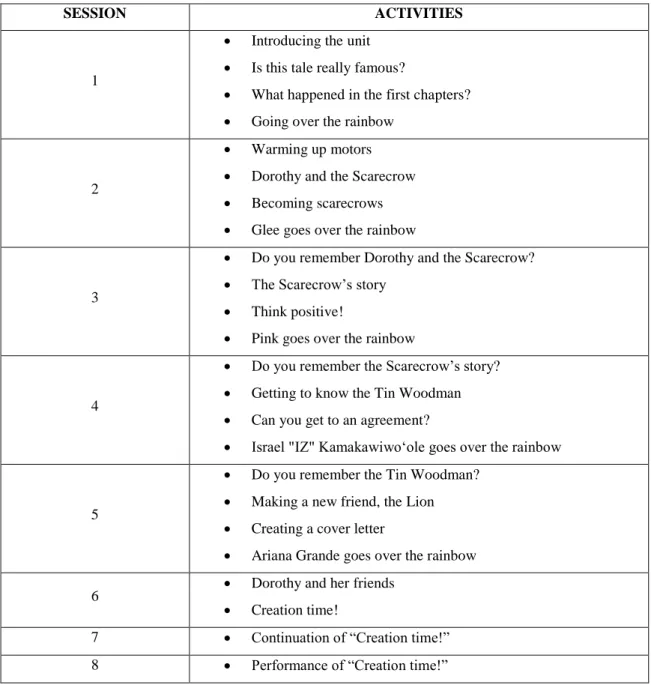
Figure 8 shows the organization of the sessions and the activities included in each of them:
SESSION ACTIVITIES
1
Introducing the unit
Is this tale really famous?
What happened in the first chapters?
Going over the rainbow
2
Warming up motors
Dorothy and the Scarecrow
Becoming scarecrows
Glee goes over the rainbow
3
Do you remember Dorothy and the Scarecrow?
The Scarecrow’s story
Think positive!
Pink goes over the rainbow
4
Do you remember the Scarecrow’s story?
Getting to know the Tin Woodman
Can you get to an agreement?
Israel "IZ" Kamakawiwoʻole goes over the rainbow
5
Do you remember the Tin Woodman?
Making a new friend, the Lion
Creating a cover letter
Ariana Grande goes over the rainbow
6 Dorothy and her friends
Creation time!
7 Continuation of “Creation time!”
8 Performance of “Creation time!”
29
SESSION 1:
Objective of the session: To introduce the tale that will be read in the next sessions and slightly introduce the fact that we will be dealing with social and emotional learning.
Contents of the session: To understand the general meaning and the main points of both oral and written texts doing an appropriate use of ICTs, to narrate past, present or future events and to express opinions, thoughts, and points of view making an effort to communicate with others in a respectful way.
Activity 1:
Title: Introducing the unit
Type of activity: Routine
Timing: 15 minutes
Classroom management: The whole classroom together
Resources: computer room, digital board, speakers, The Wizard of Oz film (LeRoy and Fleming, 1939) from minute 30:00 to 32:23.
Explanation of the activity: The teacher will play a video in which students will watch a clip from the film The Wizard of Oz (LeRoy and Fleming, 1939). After watching the clip, the teacher will ask students to do a brainstorming to try to get as many ideas of the story as possible. In order to do so, the teacher will ask students to tell their classmates all the thoughts that they have related to the story. It does not matter if their ideas are right or not because the goal is to make them speak. Later on, as the sessions pass by, students may discover that some of their initial ideas about the tale were wrong, or not. The main idea is to introduce the tale with which students will be working in the next sessions. The teacher may lead the discussion by asking questions such as if they know from which film the clip is or not, if they have any idea of what the film is about, if they knew that the film was inspired on a book, which characters they think that appear in the story, etc.
After doing the brainstorming, the teacher will explain students that during the next sessions they will be working with some chapters of the original tale The Wonderful Wizard of Oz
30
Activity 2:
Title: Is this tale really famous?
Type of activity: Introduction
Timing: 20 minutes
Classroom management: Pair work
Resources: computer room, sheet with the questions (annex 1).
Explanation of the activity: Students will be asked to look for some information about the author of the tale, Frank Baum, and they will make a summary of it. Besides, the teacher will give them a sheet with some questions that they should look for on the internet. The questions will be the following:
- Is The Wonderful Wizard of Oz the only book written by Baum about the land of Oz? If your answer is negative, which other stories did he write?
- Can you find any version of The Wonderful Wizard of Oz written by another author? - This tale is quite famous; can you figure out the number of languages into which it has
been translated?
- Did the book receive any awards?
- As you already know there is a film based on the tale, but are there theater adaptations too? Did the film or theater adaptations receive any awards?
After finishing the summary and the questions, the whole classroom will briefly share the answers.
In this activity the competence related to social and emotional learning that is being developed is relationship skills.
Activity 3:
Title: What happened in the first chapters?
31
Timing: 10 minutes
Classroom management: the whole classroom together
Resources: box, blackboard or digital board, paper.
Explanation of the activity: Since students will not read the tale from the very beginning, but they will start reading on the third chapter, they need to know what happened until then. In order to pervert them from reading summaries in which information about future chapters appears, the teacher will make a brief summary of the events in chapter one and two. In this summary the teacher will also say that some characters of the story have an only wish and they try to make it real throughout the story.
After having said so, the teacher will give students a piece of paper in which they will have to write their own wish anonymously, and they will put it into a box. The teacher will explain that it could be any wish, even if they think it will not come true or it is already a fulfilled wish, and it can be a wish for themselves, for another person, for the classroom, etc. When all the whishes are in the box, each student will read one in a random way, and the teacher will write it on the blackboard or digital board in order to see whether there are repetitive wishes or not and also to make them reflect on their own wishes and other people’s wishes.
In this activity the competences related to social and emotional learning that are being developed are social awareness and self-awareness.
Activity 4:
Title: Going over the rainbow
Type of activity: Relax
Timing: 5 minutes
Classroom management: The whole group together
32
Explanation of the activity: The teacher will play a clip of the film The Wizard of Oz film (LeRoy and Fleming, 1939) in which the song “Somewhere over the rainbow” is sung by the character of Dorothy. This is one of the most famous scenes of the film, and after watching it, the teacher and students will briefly comment on whether they have heard of it or not, and in which circumstances.
SESSION 2
Objective of the session: To start dealing with the third chapter of the tale, and to develop students’ empathy and their ability to work in groups.
Contents of the session: To understand the general meaning and the main points of both oral and written texts doing an appropriate use of ICTs, to narrate past, present or future events and to express opinions, thoughts, and points of view making an effort to communicate with others in a respectful way.
Activity 1:
Title: Warming up motors
Type of activity: Routine
Timing: 10 minutes
Classroom management: The whole group together
Resources: No material resources are needed