Rebalancing urban mobility: a tale of
four cities
&1 Marı´a Eugenia Lo´pez-LambasPhD
Associate Professor of Transport, Universidad Polite´cnica de Madrid, Madrid, Spain
&2 Maria Vittoria CorazzaPhD
Transport Researcher, ‘Sapienza’ University of Rome, Department of Civil Engineering, Rome, Italy
&3 Andres MonzonEng
Professor of Transport Planning, Universidad Polite´cnica de Madrid, Madrid, Spain
&4 Antonio MussoEng
Professor of Transport Planning, ‘Sapienza’ University of Rome, Department of Civil Engineering, Rome, Italy
1 2 3 4
The key of mobility in urban planning is not in dispute. Integrated strategies that take into account the interrelations among land use, transport supply and demand and the different transportation modes are more necessary than ever. In Europe, regulatory tools such as local mobility plans or traffic plans have been enforced for a long time, evolving into so-called sustainable urban transport plans (SUTP) – that is, plans that merge urban planning, mobility governance, social awareness and environmental safeguards to develop a vision based on sustainability and equity. Indeed, SUTP are aimed at solving typical problems in current land use, such as urban sprawl, which make clear the need for a paradigm shift from transport (or mobility) planning to land use (or city) planning, thereby producing urban mobility plans that are fully aligned with integrated urban development plans. This paper describes how SUTP are articulated across Europe according to four case studies: Peterborough (UK), Chambe´ry (France), Ferrara (Italy) and Pinto (Spain), to highlight variations and commonalities, both among the four national legal frameworks and the actual planning processes at the local level. Objectives, measures and indicators used in the monitoring and evaluation phases have been analysed and the results assessed. The main conclusion of the paper is that, as seen in these real-life examples, the lack of integration between spatial planning and transport strategies results in the unsustainability of urban areas and, therefore, in a significant loss of competitiveness.
1. Introduction
‘Towns and cities are the drivers of the European economy’. From the first lines, the EU European Commission’s Green Paper ‘Towards a new culture for urban mobility’ is quite conclusive (European Commission, 2007a): passenger cars are responsible for 75% of passenger kilometres travelled, while car ownership per household is increasing and the average car occupancy remains close to one. Last but not least, passenger journeys made by transit are less than 10% (European Commission, 2007b). Furthermore, between 2000 and 2030 the demand for passenger transport is expected to grow by 42% (road traffic would then account for 85% and car traffic for 75% in 2030) as well as the amount of freight transported, for which the tonne–kilometres is expected to grow by 63% (road traffic would count for 45%).
A common approach for coping with such a trend is to develop sustainable cities through urban mobility plans, a journey
already started in many European cities where such processes have proved to be successful in reorientating decision-makers toward more sustainable travel choices without renouncing mobility, because transport demand management should not be associated with ‘reducing travel’ but instead with improved mobility (Hendricks, 2008). The paper, by a case studies-based methodology, presents some consolidated outcomes from such processes, trying to compare the different approaches chosen in four European countries, which can be considered state-of-the-art examples in providing different sustainable mobility strategies for urban areas.
Europe change the essence of the sustainable urban transport plans (SUTP), which is to tackle transportation and mobility problems in urban areas through integrated strategies that take into account the interrelations among land use, transport supply and the role of different modes of transportation, individual and collective, together with an appropriate coordination of the various administrative bodies involved.
Balanced coordination between land use and mobility is the core of SUTP, local transport plans (LTP) in the UK, plans de de´placements urbains (PDU) in France, piano urbano della mobilita` (PUM) in Italy and planes de movilidad urbana sostenible (PMUS) in Spain. Common key features of such regulatory tools are:
& reduction of negative impacts due to transportation (mainly connected with congestion phenomena)
& coherence with national/regional strategies
& promotion of non-motorised and alternative modes to rebalance the local modal share
& coverage of all modes of transportation, both for citizens and goods
& enhancement of energy-efficient transportation modes and intelligent transport systems measures to improve transport demand management.
These objectives constitute a kind of common approach open to different strategies, in which the above-mentioned features are pursued in different ways according to what each local situation calls for.
Nevertheless, all SUTP are developed according to policies that aim to enhance the modal shift from motorised to collective and non-motorised transportation modes, as well as the improvement of efficiency for transit operation and vehicles, in such a context in which transport still depends on oil for 96% of its energy needs and oil will become scarcer in future decades. Such a vision is coherent with a concept of sustainability mainly based on actions to save energy savings and reduce pollution.
However, even though the previously mentioned national plans are cast in the same mould, there are some differences, mainly concerning the regulatory process and implementation terms behind each of them. A short description of the regulations systems found in each of these countries is thus provided, to highlight differences and similarities.
2.1 PDU, France
French PDU can be considered the origin of sustainable mobility regulatory tools for urban areas. They are based on three major laws: Loi d’Orientation des Transports Inte´rieurs (Inland Transportation Law, 1982); Loi sur l’Air et
l’Utilisation Rationnelle de l’Energie (Air Quality Law, 1996), which made PDU compulsory for cities with more than 100 000 inhabitants; and Loi relative a` la Solidarite´ et au Renouvellement Urbain (Urban Rehabilitation Law, 2000) that obliges PDU to set road safety objectives and to be compatible with the territorial coherence scheme and the local master plans. The Solidarite´ et au Renouvellement Urbain strengthens the links between local urban development plans and PDU, as both must be compatible with each other and with the territorial coherence scheme, and coherent with the Air Quality Law.
PDU have a 10-year time horizon; they are prepared, approved and implemented by the local public transportation autho-rities, after an exhaustive public audit process. PDU usual measures are aimed at reducing private car volumes and increasing the use of transit and non-motorised modes, thanks to the promotion of side measures such as mobility manage-ment (home-to-work trips planned by companies for their employees), car pooling and car sharing. PDU are also dedicated to boosting parking management policies, the organisation of urban freight distribution and the efficient management of the road network. A set of indicators, decided on a local basis, is the main tool used to assess the effectiveness of the strategies.
Two remarkable features of PDU are worth being highlighted: the great number of participants in the planning process and the coherence between urban planning and mobility strategies. The former is illustrated by the fact that any actor or body involved in the mobility domain, from decision-makers to operators and end-users, participates in talks and shares the outcomes. Furthermore, the Loi sur l’Air et l’Utilisation Rationnelle de l’Energie requires that public surveys be performed before the plan implementation; these surveys are of the utmost importance because on the one hand they make citizens aware of the project and, on the other, they provide feedback to the decision-makers. As citizens are able to express their opinions, the agreements achieved are based on solutions ‘tailored’ to local priorities.
The latter results in priority being given to development in those areas already supplied with transit. Furthermore, any local development plans must be compatible with the PDU.
with more than nine employees located in urban areas, calculated as approximately 1% of the net wage sum.
As a result, PDU and urban transportation plans in general have become increasingly central in the political agenda and highly effective measures for transit as tramways lines, dedicated bus lanes, decisive parking policies both for private and commercial vehicles, along with a strong involvement of citizens and stakeholders, prove the success of the whole process.
2.2 LTP, UK
According to the Transport Act (2000), ‘each Local Transport Authority – LTA – must prepare a document to be known as the Local Transport Plan – LTP – containing their policies for the promotion and encouragement of safe, integrated, efficient and economic transport facilities and carry out their functions so as to implement those policies, services to, from and within their area.’ This is applicable to all local transport authorities.
For their LTP, authorities must consider their contribution to national transport goals as part of overarching priorities – that is, tackling climate change, supporting economic growth, promoting equality of opportunity, contributing to better safety, security and health and improving quality of life. An annual progress report is required as a basis for evaluation, as the level of national funding could be increased if the objectives are reached; moreover, LTP must be prepared within the context of broader policies and objectives contained in relevant regional strategies. The guidance (DfT, 2004) contains, in fact, a range of possible options to meet overall goals such as improved safety, increased accessibility, a more efficient economy, the promotion of integration and the protection of the environment.
LTP time horizons may span 5 years, but authorities can have strategic issues of the plan ‘restated’ from 10 to 20 years, in order to align them with the relevant regional strategy or sustainable communities strategy. After the 5-year period, an exhaustive external audit by an independent auditor takes place. The first round of LTP was launched in 2005 and a second round is currently in progress.
The main funding source is the national government, but there are other options that include specific grants, contributions, pricing measures and charges. Authorities should report on all the indicators contained in the plan as well as on the progress made towards achieving the targets set. If the yearly progress report is positive, the local authority can be eligible for up to 75% of the investment, plus an additional 25%.
Regarding public consultations, representative working groups, ongoing market research and questionnaires, and even
visitors to the area may be involved in the LTP development and implementation.
It is up to authorities to consider the most appropriate performance indicators for monitoring according to local circumstances, but it is recommended that they discuss with other authorities, especially within their region, which standard indicator definitions will enable them and the wider transpor-tation community to benchmark their performance (DfT, 2004). All LTP in this second round (2005–2010) are required to report on 17 indicators. Accordingly, the list of indicators takes into consideration the following evaluation categories: safety (total killed and seriously injured casualties, children killed and seriously injured casualties, total slight casualties); transit (public transport patronage, satisfaction with local bus services, bus time-keeping); infrastructure (principal and non-principal road condition, classified road condition, unclassified road condition, footway condition); private car traffic (changes in traffic flow in urban centres in peak periods, changes in traffic mileage); as well as other indicators that assess accessibility, modal share, etc.
Local authorities can supplement the mandatory indicators with targets for optional indicators, which they see as most reflective of key local success criteria.
2.3 PUM, Italy
Italian urban mobility plans, or PUM, have been enforced since 2000, when the 340/2000 National Law prompted (but did not require) municipalities with more than 100 000 inhabitants to enforce plans to manage local mobility problems. PUM are an evolution of former regulatory tools, the urban traffic plans (UTP), compulsory for communities with more than 30 000 inhabitants since 1996, and aimed at enforcing regulations on private traffic issues, such as congestion or parking management. Currently, many munici-palities, entitled to implement such plans, have PUM already being enforced, whereas UTP are still in the making. The reason is the broadness of the scope of the PUM, which include the provision of long-term strategies to manage private traffic, transit and parking, develop infrastructure, implement intelli-gent transport systems, support ‘niche’ measures such as car pooling/sharing in a comprehensive way, providing decision-makers with the opportunity to manage all the mobility-related problems with just one planning tool. According to this approach, UTP become a mere regulatory tool to manage roads and private traffic, coherent with the general goals stated in the PUM.
Measures planned in any PUM, whose time horizon is 10 years with a biannual revision, must meet some general requirements regarding disincentives to private traffic and the promotion of transit, so as to save energy, reduce air and noise pollution and improve road safety conditions. In particular, as the attention paid to the environmental benefits each measure can achieve is increasing at a national level, planners and decision-makers are converting PUM into sustainable urban mobility plans (SUMP), although there are no laws to support such a vision.
The contents of each PUM are defined according to some national guidelines (Ministero delle Infrastrutture, 2005), in order to ensure comparability of results among the different cities. This explains why it is compulsory to measure the effectiveness of the whole strategy by a cluster of indicators; each of them is meant to measure at least one of the PUM objectives, as follows:
& accessibility (objective: meet citizens’ mobility requirement) & air quality, as reduction of both emissions and
concentra-tions (objective: reduce pollution)
& level of noise (objective: reduce acoustic pollution) & tonne of oil equivalent (objective: energy savings)
& yearly number of fatalities and injuries in accidents (objective: road safety)
& unit/km (objective: increase transport capacity)
& modal share (objective: increase the number of transit users) & level of congestion (objective: reduce urban congestion) & average commercial speed, occupancy rate and frequency of
transit (objective: improve the quality of public transport).
There is no homogeneity in the use of indicators: data for the most common ones (those related to air quality or road safety) are regularly recorded, whereas other indicators such as tonne of oil equivalent or level of congestion are seldom used, not only because the data collection process is difficult, but also because of the uncertainty of the results. As a consequence, the effectiveness of a given strategy is assessed in terms of environmental achievements rather than global mobility improvements.
2.4 PMUS, Spain
The PMUS were launched within the framework of a well-defined, strategic plan, formed by both the national master plan for infrastructures and transport and the energy savings and efficiency strategy. So far, the implementation of PMUS is not compulsory, with the remarkable exception of the Mobility Law issued by the Catalan government in 2003.
However, in 2006 a national guide for the elaboration and implementation of PMUS was launched, containing their main characteristics, measures, implementation methodologies, stakeholders, public participation process, good practices, etc.
(IDAE, 2006). National funding to foster the PMUS imple-mentation is also anticipated. The guide recommends to those municipalities with more than 50 000 inhabitants the adoption of a PMUS with a variable time horizon, depending on the kind of measures to be implemented (from 2 to 8 years).
As for the objectives, the guide does not provide a list beyond those that the word ‘sustainable’ suggests; the plan will depend on each particular case, as the needs of each city are different, but it is recommended that the plan be kept within a regional strategy, with coordination at the municipal and regional levels. As PMUS are the ‘youngest’ among the SUTP in Europe and because of their status as ‘not compulsory’, results and practices are being consolidated day by day, and there are still many avenues to explore.
However, the Sustainable Economy Law of March 2011 (Ley, 2011) seems to have come at the perfect time to put into practice truly integrated land use and mobility planning. First, a definition of urban sustainable mobility plan is provided at the national level and is legally enforceable. Second, the content fits the planning instruments involved, especially those related to infrastructures, transport and energy savings. Finally, it is the first time that all PMUS are required to include tools and mechanisms to allow for monitoring activities. Furthermore, by the year 2012, national funding for the public transport systems will be available only to those municipalities and regions that have already implemented a PMUS.
3. Case studies: targets against indicators The different case studies (one per country mentioned above), described below, are best practice examples of how national regulations on SUTP have been ‘translated’ into local implementations. The common steps in such a process are: the collection of data (usually on a local basis and, when needed, integrated with national statistics), the definition of local objectives, the measures used to address them and the performance indicators chosen to assess prospective benefits from the planned strategies; differences can be found in how indicators and forecasts are processed in each plan.
3.1 Peterborough, UK
The initial diagnosis of the situation showed the need for a shift towards a more sustainable transport policy, because the increase in motorised vehicles was significant in the 1990–2000 period (+4%), with an expected 13% increase for the next 5 years. However, public transport was generally inadequate in terms of the provision of infrastructure, bus shelters, information and other accessibility equipment. Moreover, there was lack of a fully integrated transportation network and a high road accident rate. Peterborough, together with four authorities of similar size and characteristics, formed a LTP benchmarking group to compare its progress on transportation strategies with autho-rities that have similar resources and constraints.
The council issued LTP1 for the 2001–2006 period; LTP2 (2006–2011) was published in March 2006. This second round of LTP has added some new indicators, while the objectives planned in LTP1 that have not yet been accomplished are still considered valid and, accordingly, remedial measures have been enforced (Peterborough City Council, 2007).
In both LTP, the leading strategy is aimed at improving the local mobility pattern, especially from the planning and management points of view. Improvement in travel choice, traffic and demand management, integrated transportation and integration with other policy areas, planning and manage-ment of the highway network, with special attention being paid to rural issues, are the main tasks the two LTP are focused on.
As a consequence, most interventions deal with both infrastruc-ture management and the provision of new transit lines and facilities, the most important of which are the primary public transportation corridor, the introduction of village bus services and rural taxibuses, and the provision of real time passenger information. However, this does not mean that other interven-tions, such as the enforcement of road safety programmes (both for urban and rural areas, with a wide array of measures from speed management strategy and the implementation of puffin, toucan and pegasus crossings to special programmes such as ‘safer routes to school’) and parking management have been neglected.
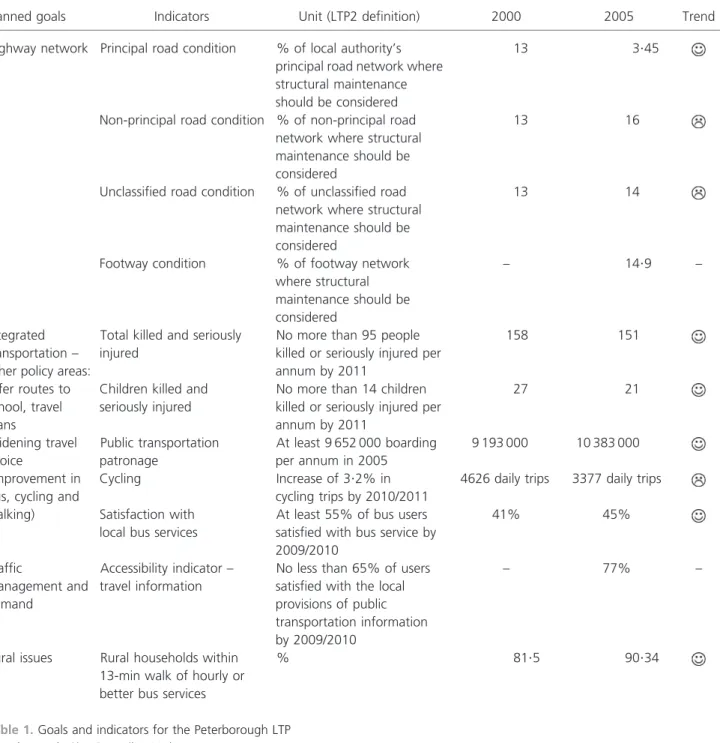
The selection of indicators is meant to assess three main aspects: transit performances, safety levels and the manage-ment of the local infrastructure. Results achieved during the first LTP (2001–2006) illustrating the expected trend through 2011 are reported in Table 1, which also highlights some aspects of the evaluation process. Indeed, it is worth stressing that all the indicators are not ‘measure indicators’ but ‘target indicators’, which means that one indicator can measure more than one intervention and several objectives, providing direct answers about the degree of accomplishment.
A second aspect is the lack of indicators to measure the condition of private traffic, the modal share and any possible
environmental outcomes; accordingly LTP2 has added six new indicators, to comply with such a gap: change in area-wide road traffic, mode share for journeys to school, bus punctu-ality, change in peak period, traffic flows to urban centres, congestion and air quality.
The results achieved so far by LTP1 (Table 1) are contrasting; in part they can be considered positive, seeing as bus passenger journeys per year increased by 9?2% and the number of children (under 16 years) killed and seriously injured decreased by 41% compared with the 1994/1998 average. However, there are still open issues because the number of cycling trips has decreased to a level far below any expectations, which compelled the council to consider a more realistic target based on predicted growth in population and car ownership for LTP2. The increase in rural accessibility has not been fully achieved either, even though from 2001/2002 to 2005/2006 the number of households within a 13-min walk to transit has increased from 81?5% to 90?34%. In terms of the road conditions, the decrease from 13% to 8% in ‘non-principal classified roads’ in need of repair met the plan’s expectations, whereas neither ‘principal classified road’ nor ‘unclassified road’ network indices provided satisfactory values.
3.2 Chambe´ry, France
Chambe´ry, the capital city of the Savoy region with approximately 117 000 inhabitants, is well known in Europe for having started an impressive traffic calming programme across the whole urban area in the 1990s, with creative but effective solutions. The city is also very active in promoting sustainable mobility measures, and the release of the local PDU in 2004 can be considered the regulatory apex of this process. The PDU is based on three main actions:
(a) Fostering transit, such as new bus lines in the outskirts, improved quality of operations, and enhancement of the train as a proper mode for commuting.
(b) Promoting non-motorised travel modes, specifically with the creation of safer and continuous bike networks, along with the rehabilitation of the pedestrian environments. (c) Developing tailored mobility programmes for the
com-munity, namely in mobility management and home-to-school programmes, along with a specific plan for urban freight distribution.
air quality and road safety as well as a reduction in noise pollution.
The process of creating such a vision for the city is based on two steps: first an ex ante evaluation, a do-nothing/do-something comparison, in order to have a preliminary assessment of the effectiveness of the planned strategies and to set the above-mentioned target; then, some ex post measurements aimed at ‘feeding’ a set of indicators to report
on the progress of the PDU and call for possible amendments, as requested by the Solidarite´ et au Renouvellement Urbain. As a consequence, the core of the ex ante evaluation is to forecast the modal split starting from a 1998 reference scenario (Figure 1), coherent with the qualitative goal mentioned above.
The ex post indicators can be divided into three main clusters: economy, safety and mobility. The indicators belonging to the first group are those aimed at measuring the investment costs
Planned goals Indicators Unit (LTP2 definition) 2000 2005 Trend
Highway network Principal road condition % of local authority’s principal road network where structural maintenance should be considered
13 3?45
Non-principal road condition % of non-principal road network where structural maintenance should be considered
13 16
Unclassified road condition % of unclassified road network where structural maintenance should be considered
13 14
Footway condition % of footway network where structural maintenance should be considered
– 14?9 –
Integrated transportation – other policy areas: safer routes to school, travel plans
Total killed and seriously injured
No more than 95 people killed or seriously injured per annum by 2011
158 151
Children killed and seriously injured
No more than 14 children killed or seriously injured per annum by 2011
27 21
Widening travel choice
(improvement in bus, cycling and walking)
Public transportation patronage
At least 9 652 000 boarding per annum in 2005
9 193 000 10 383 000
Cycling Increase of 3?2% in
cycling trips by 2010/2011
4626 daily trips 3377 daily trips
Satisfaction with local bus services
At least 55% of bus users satisfied with bus service by 2009/2010
41% 45%
Traffic
management and demand
Accessibility indicator – travel information
No less than 65% of users satisfied with the local provisions of public transportation information by 2009/2010
– 77% –
Rural issues Rural households within 13-min walk of hourly or better bus services
% 81?5 90?34
(general costs for infrastructure, transit, safety promotion, etc.), while usual indicators, such as the number of fatal accidents, injured, etc. form the safety cluster. The list of indicators for the mobility cluster is a mix of usual indicators (those used to measures transit operations) and more specific ones, including those aimed at measuring the use of bikes (monitoring, for example, the number of available racks) or public parking areas (including measurements of the number of pass holders).
It is important to explain the reasons for the lack of environ-mental indicators: the effectiveness of the planned strategies is assessed according to the progress made towards the accomplish-ment of the main goal, as forecasted in the do-something scenarios. Once such a goal of rebalancing the modal share towards more sustainable travel modes is accomplished, certain environmental benefits can also be attained (and indeed, a reduction of up to 30% of some pollutants was forecast, as well as a similar decrease in noise pollution). Indicators, in their turn, function as ‘controllers’ of the proper implementation of what was planned in the PDU (and thus are very similar to the Peterborough ‘target indicators’); they indicate how close the actions come to reaching the main goal, but are not elements used to assess the success of the plan (Chambe´ry Metropole, 2009).
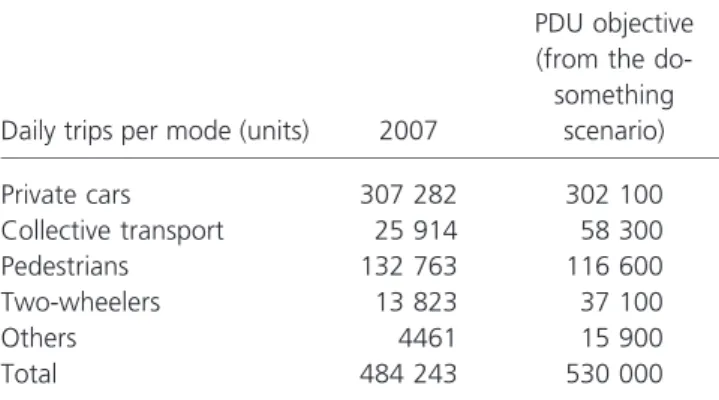
Had the ‘before and after’ evaluation been based only on quantitative data, it would be very tricky to label the whole Chambe´ry experience as successful or unsuccessful. According to the 2007 data (Chambe´ry Metropole, 2011), in terms of motorised modes, the main goal still seems far off when compared with the do-something scenario, the number of trips by private cars being 64% of the total modal share (as opposed to the planned 57%) and trips by collective transport only 5% (planned 11%). However, if walking is considered, a positive increase of 5% has been recorded (Figure 1 and Table 2).
Although there are some differences in the methodologies used to collect the data in the two cases, and this could affect the
comparison, it is undeniable that the dependency on private cars is still strong. However, in spite of the increase in the share of private cars – partly due to an increase in the local motorisation rate (especially for households in the outer areas) – a comprehensive plan to disincentivise the use of private cars was enforced, based on the improvement in the transit supply (more routes), an increase in pay-for-parking places (+18.8% in the 2006–2009 period alone), and a wider bike network (from 47 to 71?5 km between 2004 and 2009). The economic resources behind the initiative have not been negligible (approximatelyJ20 275 085 in 2009).
To explain why the main goal is still unaccomplished, the reasons must be found elsewhere – that is, in the missing link between land use and transport planning. Improved transit supply and increased motorisation rates contributed to a general increase in travel demand (2?5 trips per day by car in 2009), but housing policy contributed even more: until 2009, only 60% of new housing projects were located within a 20-min travel distance of the city centre, which left the remaining 40% in need of a dedicated transit supply for everyday commuting activities. This lesson taught the administrators to plan new housing projects
Collective transport
Collective transport
Private cars
Private cars
Tow-wheelers
Tow-wheelers
Pedestrians
Pedestrians
Others
Others
3 3 3 1998
2010, do-nothing 2010, do-something 22
19 22
7 3 4 11
6 6
%
57 69 65
6 6 11
3 7
3 3
65 69 57
19 22
4 22 3
2010, do-nothing
1998 2010, do-something
Figure 1.Ex ante scenarios for the Chambe´ry modal split (Chambe´ry Metropole, 2009)
Daily trips per mode (units) 2007
PDU objective (from the do-something
scenario)
Private cars 307 282 302 100
Collective transport 25 914 58 300
Pedestrians 132 763 116 600
Two-wheelers 13 823 37 100
Others 4461 15 900
Total 484 243 530 000
along urban corridors where appropriate transit services are operated, but it also paved the way for expanding the assessment of mobility plans and policies, including land use parameters.
Needless to say, it is hoped that this will make it possible to plan and assess mobility policies by considering the effects that these will have on land use and spatial planning issues, which have thus far been neglected.
3.3 Ferrara, Italy
Ferrara, in the Emilia Romagna region, is a typical provincial town in northern Italy; its impressive historical centre from the Renaissance period, for which the city was listed among the Unesco world heritage sites, is surrounded by modern residential districts that have been built from the 1920s on.
With 134 425 inhabitants and in spite of its high motorised vehicle ownership rate, which in 2007 was approximately 803 (number of vehicles/number of inhabitants61000), Ferrara is a bike-friendly community; the 2007 modal split in the urban area was as follows: 5% transit, 45% private cars, 35% bikes and 15% pedestrians and others. This explains why congestion phenomena affect only 7?8% of the entire road network. Such a massive use of bikes does not, however, prevent local administrators from enforcing restrictive measures such as the limited traffic zone (LTZ) in the city centre or on-street pay-for-parking. Moreover, a clear assessment of transit as a ‘weakness’ in the local mobility chain along with the awareness that ‘it takes more and more bikes to make a bike realm’, prompted local decision-makers to enforce, in 2009, the city’s PUM. The strategy of the PUM can be summarised according to two main ideas: ‘disincentives to the use of private cars’ and ‘incentives to attract passengers to transit’. To the former belong measures such as the enlargement of the LTZ, the implementation of zone 30s and higher parking charges; to the latter, a general revision of the transit supply, with more efficient routes along some ‘quality corridors’ and new intermodal change points, along with the promotion of ‘niche’ measures such as collective taxis or mobility management programmes to gain patrons from low-demand areas. An increase in the number of pedestrian and bike routes is a prerequisite to carry out the above-mentioned measures (Comune di Ferrara, 2008).
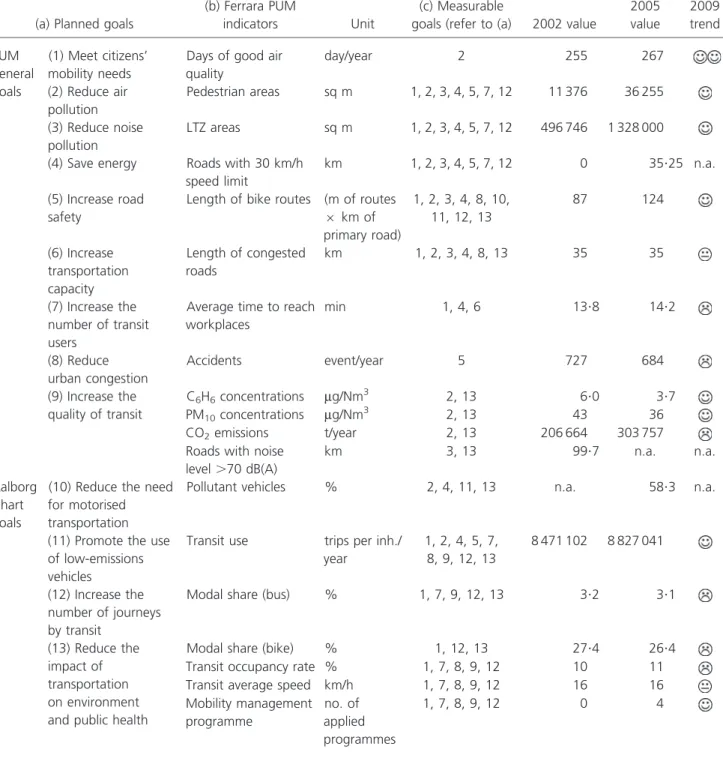
Planners selected indicators to assess the measures from among those already in use by the municipality, within the so-called ‘integrated environmental balance’, a document in which the indicators used to assess the 10 Aalborg commitments of the city are calculated. In this way, the plan’s results can be assessed twice: first, as outcomes of a new mobility strategy and then as part of a more comprehensive vision of the city in which urban development is evaluated according to the social and environ-mental progress made in the city towards the accomplishment of
the goals of the 1994 Aalborg chart of European cities and towns towards sustainability. Indicators selected for the integrated environmental balance and useful for the Ferrara PUM are listed in Table 3 (Comune di Ferrara, 2008).
The 2009 trend in the ‘do-nothing’ cases shows a partial improvement of the city, especially as far as the environmental conditions are concerned, but the negative values for transit and safety stress that effective actions are still needed to rebalance the share towards cycling, walking and transit.
Compared with the two previous case studies, the major role played by indicators in this case, acting as ‘measure indicators’, is quite clear. As a matter of fact, the success of the PUM is based on the ‘before and after’ comparison of the indicator values, whereas in the French and the British cases the plan is accomplished only when the targets are centred.
Unlike Chambe´ry and Peterborough, the Ferrara PUM is still ‘green’ and no consolidated results are available yet. However, the Ferrara PUM has already become an opportunity to revise the city lifestyle in terms of urban functions and spatial planning. For the former, the plan’s key concepts (disin-centivising the use of private cars and attracting more customers to transit) require many urban activities to be reconsidered. This prompted the local administrators to study the so-called ‘times and schedules plan’, in which the opening and closing times of public and private facilities are rescheduled to accommodate a less intensively car-based lifestyle and to encourage typical habits such as the local preference for bikes. Spatial planning in a city with such a small, but premium-value built environment like the city centre, calls for a micro-scale rehabilitation process, due to the infrastructure changes the PUM measures require. A typical example is the LTZ scheme and the related enforce-ment of a traffic ban on a link to one of the main streets of the city centre, which will allow the design not only of a pedestrianised area, but also of a micro car-free environment coherent with the original Renaissance period urban pattern.
In the case of revisions of both urban functions and spatial planning, and in general throughout all the phases of the PUM, from plan to design to implementation, the citizens’ participation has been crucial. A consolidated process of public presentations supports every decision, to avoid conflicts and consequent red tape delays, with the awareness that only a relative optimum can be reached.
3.4 Pinto, Spain
walking (30%), bikes and other modes (2%). On the other hand, the vehicle ownership rate is 401 (number of vehicles/number of inhabitants61000), far below the national average of 543.
The city launched its PMUS in 2008 (Ayuntamiento de Pinto, 2009) to tackle the unfavourable mobility trends, according to
a strategy based on 10 programmes that could be summarised as follows:
& improve public transportation
& control private cars and freight distribution & promote non-motorised modes
(a) Planned goals
(b) Ferrara PUM
indicators Unit
(c) Measurable
goals (refer to (a) 2002 value
2005 value
2009 trend
PUM general goals
(1) Meet citizens’ mobility needs
Days of good air quality
day/year 2 255 267
(2) Reduce air pollution
Pedestrian areas sq m 1, 2, 3, 4, 5, 7, 12 11 376 36 255
(3) Reduce noise pollution
LTZ areas sq m 1, 2, 3, 4, 5, 7, 12 496 746 1 328 000
(4) Save energy Roads with 30 km/h speed limit
km 1, 2, 3, 4, 5, 7, 12 0 35?25 n.a.
(5) Increase road safety
Length of bike routes (m of routes
6km of primary road)
1, 2, 3, 4, 8, 10, 11, 12, 13
87 124
(6) Increase transportation capacity
Length of congested roads
km 1, 2, 3, 4, 8, 13 35 35
(7) Increase the number of transit users
Average time to reach workplaces
min 1, 4, 6 13?8 14?2
(8) Reduce urban congestion
Accidents event/year 5 727 684
(9) Increase the quality of transit
C6H6concentrations mg/Nm3 2, 13 6?0 3?7
PM10concentrations mg/Nm3 2, 13 43 36
CO2emissions t/year 2, 13 206 664 303 757
Roads with noise level.70 dB(A)
km 3, 13 99?7 n.a. n.a.
Aalborg Chart goals
(10) Reduce the need for motorised transportation
Pollutant vehicles % 2, 4, 11, 13 n.a. 58?3 n.a.
(11) Promote the use of low-emissions vehicles
Transit use trips per inh./ year
1, 2, 4, 5, 7, 8, 9, 12, 13
8 471 102 8 827 041
(12) Increase the number of journeys by transit
Modal share (bus) % 1, 7, 9, 12, 13 3?2 3?1
(13) Reduce the impact of transportation on environment and public health
Modal share (bike) % 1, 12, 13 27?4 26?4
Transit occupancy rate % 1, 7, 8, 9, 12 10 11
Transit average speed km/h 1, 7, 8, 9, 12 16 16
Mobility management programme
no. of applied programmes
1, 7, 8, 9, 12 0 4
& integrate land use and mobility & manage mobility demand & improve road safety.
This strategy corresponds to a wide palette of measures meant to improve both transit and non-motorised modes and to disincentive the use of private cars, according to a ‘push and pull’ approach.
The push part of the strategy involves the restriction of access to the city centre for private cars and parking management (namely the introduction of parking charges, new park and ride facilities and regulated parking allotments in newly developed areas). Restrictions also affect the circulation of heavy and pollutant commercial vehicles, for which new delivery rules have been enforced, including specific regulations for loading and unloading operations, a night delivery programme and a freight information centre, which allows operators to optimise routes, reserved parking areas, etc.
The pull aspect is based on the creation of city-wide pedestrian and bike networks, connected to the transit interchange points and car parking areas; traffic calming measures and the enforcement of zone 30 schemes support this part of the strategy from a safety viewpoint. As for transit, the provision of new interchange points and routes should result in improved overall service quality; moreover, the enforcement of trans-portation plans for home-to-work trips, along with other measures such as shuttle services, car pooling/van pooling and car sharing should strengthen the role of collective modes.
As the aim of each PMUS is to integrate urban planning with mobility management, the urban development in Pinto has been mainly oriented towards non-motorised modes and transit (in compulsory coordination with the neighbouring municipalities and Madrid regional authority), resulting in new building permissions being granted for those areas where transit supplies are already operating or are soon to begin to do so.
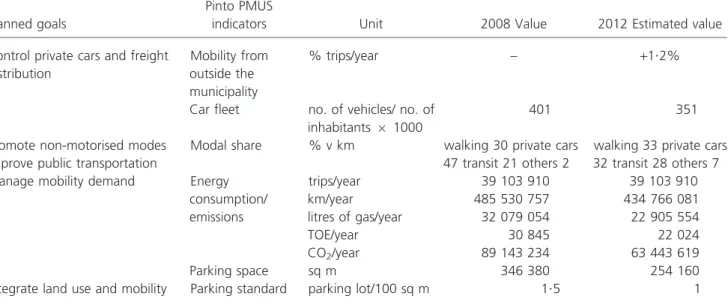
A relatively small cluster of indicators has been selected to assess the efficacy of the plan; some of them are very general as they are aimed at describing the urban development as a consequence of the PMUS (population, car fleet), while others are more targeted to describe specific aspects the plan addresses (territorial mobility share, parking space).
The plan is currently (2011) in standby due to the lack of municipal funding because, like all Spanish cases, the plan was launched within the framework of a national funding pro-gramme and, when funds disappeared, so did the plan. On the other hand, the absence of a real public participation process has prevented the citizens from being involved in the design and implementation of the plan. However, a do-something scenario
for 2012 (which refers to the 2008 baseline) sets some targets, as reported in Table 4.
4. Goals and indicators: targets against measures
‘Would you tell me please, which way I ought to go from here?’ said Alice. ‘That depends a good deal on where you want to get to’, said the cat. ‘I don’t much care where’, said Alice. ‘Then it doesn’t matter which way you go’, said the cat. This little piece of apparently nonsensical dialogue perfectly illustrates the need to assess properly which objectives are to be addressed in SUTP, but a successful plan must also be able to measure the degree to which those objectives have been achieved.
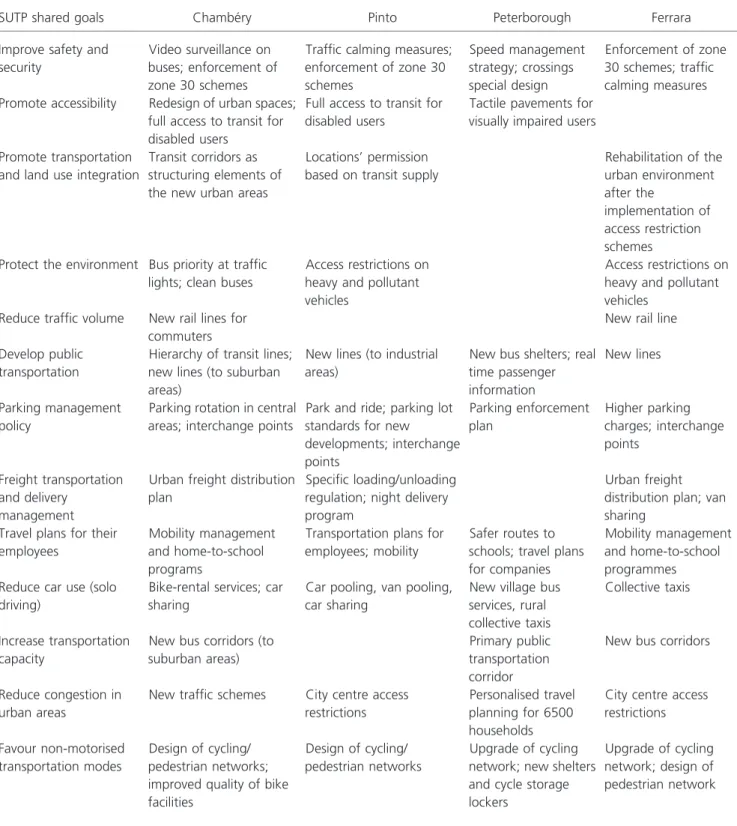
However, the lessons learned from the analysis of the different structures of the national SUTP and of the case studies demonstrate a homogeneity among the goals that corresponds with the implementation of very similar measures, as reported in Table 5; however, the same cannot be said for the indicators.
It is clear that every local context calls for its own set of indicators and that the most common ones are very general, such as modal share or the usual safety indices; but differences can be found in how indicators are used in the planning process. According to the case studies in hand, there are two different visions for developing a SUTP: the preparation of goals mainly based on forecast data, as a result of do-nothing/ do-something comparisons (Pinto and Peterborough), or the definition of goals according to a given political will, supported by indications coming from forecast scenarios (Ferrara and Chambe´ry). Indicators can become either ‘target indicators’ or ‘measures indicators’.
In the former situation, the process seems to be inflexible because target indicators help to assess the length of time needed to accomplish a given goal, without interfering with the general plan directions. On the other hand, the latter process seems to be too flexible because indicators simply ‘measure’ a given phenomenon and decision-makers may make variations or amendments, readjusting the plan’s aims whenever deemed necessary.
5. Recurring problems in assessing the relationship between SUMP and spatial planning
SUMP are deemed to affect typical land use matters such as accessibility and livability through a more balanced intermodal transportation system, but this may be difficult to ascertain, because of several factors.
The first is the nature of the plan itself. If, as in the case of LTP, the regulatory tool is strictly ‘transportation focused’, it is very difficult for changes in land use or directions in spatial planning to be detected within this context, the selected indicators being designed mainly to measure traffic flow and transit operation performances. Consequently, possible changes in land use must be assessed elsewhere, through planning tools and indicators of a different nature (typically master plans and urban planning indicators) so that the whole evaluation occurs, so to speak, through a different lens. On the contrary, if SUMP are part of more comprehensive planning concepts – as in the case of PDU, which must be compatible with typical land use and spatial planning tools, such as the aforementioned territorial coherence schemes and Solidarite´ et au Renouvellement Urbains, they are naturally subject to a broader assessment and mutual influences among the different mobility and land use policies can be detected. The need to plan new housing projects along urban corridors in Chambe´ry serves as a case in point.
A second factor is the discrepancy between the time horizons of mobility and land use policies. Mobility policies and tools, such as SUMP, usually consist of a mix of measures and
interventions, which, unless relevant infrastructure changes are needed, requires a relatively short time to be enforced. Land use regulatory tools, such as master plans, forecast changes that entail slower physical alterations of the local built or natural environments (new housing programmes, district rehabilitations, revegetation processes, etc.). Needless to say, it becomes very difficult to assess how much and in what ways these ‘quick’ mobility measures (above all those that are purely regulatory), which evolve and change according to each SUMP edition, contribute to the ‘slower’ process of reshaping and changing a given environment. With regard to these issues, the Ferrara PUM provides an innovative perspective: changes due to mobility are assessed not in terms of mere spatial planning modifications, but according to the social and environmental progress they contribute to. This is rather sensitive for a tool with a 10-year enforcement life and biennial revisions, as it is for a high-value built environment that calls for preservation rather than modification.
Another factor is the scale of implementation: PUM or PMUS, for instance, often rely on regulatory measures that can be enforced on a very small scale – the city centre, a part of a given district, even a single street – and diverge from the typical directions of master plans that encompass wider areas. Mobility indicators make such differences clear, as mobility plans at times provide parameters that need modelling to be upscaled to a city level, while master plans or other general spatial planning tools seldom downscale to the level of mobility plans. The comparison then becomes a kind of hybrid assessment between modelled, upscaled mobility scenarios Planned goals
Pinto PMUS
indicators Unit 2008 Value 2012 Estimated value
Control private cars and freight distribution
Mobility from outside the municipality
% trips/year – +1?2%
Car fleet no. of vehicles/ no. of inhabitants61000
401 351
Promote non-motorised modes Modal share % v km walking 30 private cars 47 transit 21 others 2
walking 33 private cars 32 transit 28 others 7 Improve public transportation
Manage mobility demand Energy consumption/ emissions
trips/year 39 103 910 39 103 910
km/year 485 530 757 434 766 081
litres of gas/year 32 079 054 22 905 554
TOE/year 30 845 22 024
CO2/year 89 143 234 63 443 619
Parking space sq m 346 380 254 160
Integrate land use and mobility Parking standard parking lot/100 sq m 1?5 1
and general land use or spatial plans, the former based on a series of on-the-spot data and measurements and the latter on data and outcomes at a city level.
All this leads to the consideration of a final but not minor issue, that of whether generating urban mobility plans in this manner will bring about any radical change in current SUTP shared goals
Strategies/measures to achieve goals
Chambe´ry Pinto Peterborough Ferrara
Improve safety and security
Video surveillance on buses; enforcement of zone 30 schemes
Traffic calming measures; enforcement of zone 30 schemes
Speed management strategy; crossings special design
Enforcement of zone 30 schemes; traffic calming measures Promote accessibility Redesign of urban spaces;
full access to transit for disabled users
Full access to transit for disabled users
Tactile pavements for visually impaired users
Promote transportation and land use integration
Transit corridors as structuring elements of the new urban areas
Locations’ permission based on transit supply
Rehabilitation of the urban environment after the
implementation of access restriction schemes Protect the environment Bus priority at traffic
lights; clean buses
Access restrictions on heavy and pollutant vehicles
Access restrictions on heavy and pollutant vehicles
Reduce traffic volume New rail lines for commuters
New rail line
Develop public transportation
Hierarchy of transit lines; new lines (to suburban areas)
New lines (to industrial areas)
New bus shelters; real time passenger information
New lines
Parking management policy
Parking rotation in central areas; interchange points
Park and ride; parking lot standards for new
developments; interchange points
Parking enforcement plan
Higher parking charges; interchange points
Freight transportation and delivery
management
Urban freight distribution plan
Specific loading/unloading regulation; night delivery program
Urban freight distribution plan; van sharing
Travel plans for their employees
Mobility management and home-to-school programs
Transportation plans for employees; mobility
Safer routes to schools; travel plans for companies
Mobility management and home-to-school programmes Reduce car use (solo
driving)
Bike-rental services; car sharing
Car pooling, van pooling, car sharing
New village bus services, rural collective taxis
Collective taxis
Increase transportation capacity
New bus corridors (to suburban areas)
Primary public transportation corridor
New bus corridors
Reduce congestion in urban areas
New traffic schemes City centre access restrictions
Personalised travel planning for 6500 households
City centre access restrictions
Favour non-motorised transportation modes
Design of cycling/ pedestrian networks; improved quality of bike facilities
Design of cycling/ pedestrian networks
Upgrade of cycling network; new shelters and cycle storage lockers
Upgrade of cycling network; design of pedestrian network
transportation planning activities. The lessons learned from the four case studies lead one to believe that a paradigm shift is underway: transportation planning is no longer simply the technical planning and design of transportation systems and their assessment in terms of operational or economic perfor-mance, and it is now possible for such planning directions to meet local spatial planning requirements. The goals reported in Table 5 bring to light the complexity of urban environments and the need to enlarge planning visions accordingly, as already theoretically stated (Banister, 2008; Litman, 2009; Williams, 2005). SUMP objectives, indicators and measures not only comply with decision-makers’ technical visions of efficient transportation systems but, most importantly, they meet the different requirements of the citizens, as environ-mental safeguards, public health, safety, security, equity and heritage preservation have become as important for transpor-tation and mobility planning as operational efficiency or economic affordability. These ‘new’ planning and evaluation categories can be expected, then, to play an ever-increasing role in the overall transportation planning vision, given the trend initiated by SUMP and supported by the successful outcomes achieved in many EC-funded projects in this field (Lautso, 2004; May et al., 2001; PILOT Project, 2010).
6. Conclusions
From the analysed framework, some general lessons can be learned. The lack of a binding scheme at the national or even regional level (for instance in Italy and Spain where SUTP are not compulsory) acts as an important barrier or impediment to the implementation of SUTP. A main consequence of the lack of an existing reference framework to support and foster the needed relationship between SUTP and the local urban development and planning instruments is that the results may show a lack of coordination that prevents the success of the plan, which, adopted hurriedly, suffers from improvisation. In fact, as Hendricks (2008) points out, ‘It is recommended that transport demand management be represented in all phases of the land development process, including comprehensive planning and land development regulations.’ Otherwise, the objectives of reducing the need to travel and the length of journeys, making it safer and easier for people to access jobs, shopping, services, etc., by transit and non-motorised modes, will not be addressed, and congestion and pollution will continue to increase.
In practice, the lack of a stable funding scheme also proves to be one of the main barriers to the implementation of the plan, especially in countries such as Italy and Spain, where local administrators feel responsible to implement the SUTP only when the funding is really available, which, in spite of what has been established by law, does not happen regularly.
Nevertheless, this issue is closely linked to the previous one: if the funding of a given plan does not depend on compliance
with given regional or national regulations, every municipality could implement, broadly speaking, any measure they want in whatever way they like, with no regard for the major planning instruments.
The Pinto case study is a good example of how the lack of stable funding may lead to the failure of the plan, thus the need for sound financial planning and appropriate financing mechanisms. The European Commission’s White Paper provides a new framework for funding because, while admitting that its task is not to develop urban mobility plans, it can nevertheless encourage the ‘necessary coordination by providing forums for discussion, continuing to facilitate the exchange of best practices’ and also provide ‘EU funding under the new principles promoted by the 5th Cohesion Report on regional and policy instruments’ (European Commission, 2011). The goal is to examine the possibilities for regional and cohesion funds to be linked to cities and regions that have submitted urban mobility plans.
However, as stated by Filion (2010) government investment capacity can work both as a force of inertia and of change: depending on political priorities, the availability of financial resources can lead to the creation of alternative infrastructure networks and thus to the transformation of journey patterns and land use.
On the other hand, the evaluation methodology should be flexible enough to allow decision-makers to make readjust-ments when necessary. This involves the use of a mix of ‘target indicators’ and ‘measures indicators’.
Very promising is the White Paper’s statement to set up a European urban mobility scoreboard based on common targets. The objective is to examine the possibility of a mandatory approach for cities of a certain size, according to national standards and based on EU guidelines (European Commission, 2011).
One barrier to the pursuit of many demand-side measures is the lack of information on their performance, often aggravated by misinformation regarding their possible impacts (Filion, 2010). Therefore, the production of a common and homo-geneous set of indicators that allow consistent monitoring of the plans, using common methods, is of great importance, as is the development of appropriate benchmarking techniques that will permit authorities to learn from each other’s experiences.
Therefore, as already done in other fields, the EU, local and national authorities should play a decisive role in encouraging consistency in the indicators used by its member nations, paving the way for more and more accomplished SUTP, although if there is something to learn from the past of relevance to the economic contemporary context it is that any major urban structure transformation will have to wait until the recovery (May and Crass, 2011).
REFERENCES
Ayuntamiento de Pinto(2009)Plan de Movilidad Urbana Sostenible del municipio de Pinto. See http://
almenaradepinto.wordpress.com/2009/02/25/presentado-el-futuro-plan-de-movilidad-urbana-sostenible-de-pinto/ (accessed 15/05/2009).
Banister D(2008) The sustainable mobility paradigm.Transport
Policy15(2): 73–80.
Chambe´ry Me´tropole(2009)Plan de de´placement urbains – PDU. See http://www.chambery-metropole.fr/3343-pdu. htm (accessed 18/05/2009).
Chambe´ry Me´tropole(2011)Observatoire des de´placements de l’agglome´ration chambe´rienne. See http://www.chambery-metropole.fr/TPL_CODE/TPL_PUBLICATION/ PAR_TPL_IDENTIFIANT/109/420-publications.htm (accessed 30/09/2011).
Comune di Ferrara(2008)Relazione generale PUM 2008. See http://servizi.comune.fe.it/index.phtml?id53214 (accessed 21/05/2012).
DfT (Department for Transport)(2004)Full Guidance on Local
Transport Plans.Dft, London, UK, 2nd edn. See http://
www.dft.gov.uk/consultations/archive/2004/tpsedc/ transportplanssecondeditionf2008?page57 (accessed 10/06/ 2009).
European Commission(2007a)Green Paper: Towards a new culture for urban mobility. COM 551. See http://eur-lex. europa.eu/LexUriServ/LexUriServ.do?uri5CELEX:52007 DC0551:EN:HTML:NOT (accessed 04/06/2009).
European Commission(2007b)Sustainable Urban Transport Plans. Preparatory document in relation to the follow-up of the Thematic Strategy on the Urban Environment. Technical report 2007/08, 25 September 2007. See http://www.mana genergy.net/products/R2260.htm (accessed 15/06/2009).
European Commission(2011)White Paper: Roadmap to a Single European Transport Area – Towards a competitive and resource efficient transport system. European Commission, Brussels, COM/2011/0144 final.
Filion P(2010) Reorienting urban development? structural obstructions to new urban forms.International Journal of
Urban and Regional Research34.1(March): 1–19.
Hendricks SJ(2008) Four challenges to incorporating transportation demand management into the land development process. InTransportation Research Record:
Journal of the Transportation Research Board,No. 2046.
pp. 30–36. Transportation Research Board of the National Academies, Washington, DC, USA.
IDAE (Instituto para la Diversificacio´n y Ahorro de la Energı´a)
(2006)Guia Pra´ctica PMUS. IDAE, Madrid, Spain.
Lautso K(2004)Propolis Project, Final report. See http://www. ltcon.fi/propolis/ (accessed 18/03/2012).
Ley(2011) 2/2011, de Economı´a Sostenible. Boletı´n Oficial del Estado, Madrid, Spain. No. 55, 04/03/2011.
Litman T(2009)Well Measured: Developing Indicators for Comprehensive and Sustainable Transport Planning. Victoria Transport Policy Institute, Victoria. See www.vtpi. org/wellmeas.pdf (accessed 28/05/2010).
May T and Crass M(2011) Sustainability in transportation: implications for policy makers. InTransportation Research
Record: Journal of the Transportation Research Board,No.
2017, pp. 1–9. Transportation Research Board of the National Academies, Washington, DC, USA.
May T, Jarvi-Nykanen T, Minken H,et al. (2001)Cities’ Decision-Making Requirements. PROSPECT Project. Del.1.1. See http://www.ivv.tuwien.ac.at/forschung/projekte/interna tional-projects/prospects-2000 (accessed 18/05/2009).
Ministero delle Infrastrutture(2005)Piani Urbani della Mobilita`, Linee Guida. See http://www.regione.fvg.it/rafvg/ export/sites/default/RAFVG/AT10/ARG1/allegati/ 12_linee_guida_PUM.pdf (accessed 15/09/2005).
Peterborough City Council(2007)Local Transport Plan, 2001/ 2002 to 2005/2006 and Local Transport Plan 2 Progress Report July 2007. See http://www.peterborough.gov.uk/ traffic,_travel_and_parking/strategies,_policies_and_plans/ transport_policy_and_new_works/transport_planning.aspx (accessed 12/05/009).
PILOT Project(2010)Sustainable Urban Transport Planning Policy Recommendations to the European Union and Member States. See http://www.pilot-transport.org/index. php?id515 (accessed 28/05/2010).
Williams K(ed) (2005)Spatial Planning, Urban Form and Sustainable Transport. Ashgate, Burlington, VT, USA.
WHAT DO YOU THINK?
To discuss this paper, please email up to 500 words to the editor at [email protected]. Your contribution will be forwarded to the author(s) for a reply and, if considered appropriate by the editorial panel, will be published as discussion in a future issue of the journal.
Proceedingsjournals rely entirely on contributions sent in