FACULTAD DE FILOSOFÍA Y LETRAS
DEPARTAMENTO DE FILOLOGÍA INGLESA
TESIS DOCTORAL:
Teaching to Learn ~ Learning to Teach
Classroom Research Tools for Second Language Learning
A Case Study Based on English as a Foreign Language (EFL)
and Spanish as a Foreign Language (SFL)
in a Secondary School and a University in Ontario, Canada.
Presentada por D
aMaría Pilar Alderete Diez
para optar al grado de
doctora por la Universidad de Valladolid
Dirigida por:
I hereby declare that this thesis is my own, unaided work and that recognition has been given to all references used. It has not been submitted for any degree or examination at any other university.
Declaro que está tesis está basada en mi investigación propia y que ninguna otra persona ha realizado los trabajos de investigación y redacción de la misma, que se han referenciado adecuadamente los trabajos citados y consultados para la realización de esta tesis y que no se ha presentado en ninguna otra universidad para cualquier otra certificación.
……… ………
María del Pilar Alderete Diez Date
The author hereby grants permission to the University of Valladolid to reproduce and distribute publicly paper and electronic copies of this thesis in whole or in part for educational purposes.
Teaching to Learn, Learning to Teach:
Classroom Research (CR) Tools
for Second Language Learning (SLL)
A Case Study based on English as a Foreign Language (EFL) and Spanish as a
Foreign Language (SFL) in a secondary school
and a university in Ontario, Canada.
María del Pilar Alderete Diez
Presented to fulfil the requirements for Ph.D. in Modern Philology
English Philology Department, Arts Faculty, University of Valladolid
Thesis Supervisor: Dra. D
aElena González-Cascos Jiménez
Enseñar a aprender, aprender a enseñar
Las herramientas de investigación de aula (IC)
para el aprendizaje de segundas lenguas (ASL)
Un estudio de caso basado en la enseñanza del inglés como lengua extranjera
(ILE) y del español como lengua extranjera (ELE) en un instituto y en una
universidad de Ontario, Canadá.
Memoria de tesis para optar al grado de doctor presentada por:
María del Pilar Alderete Diez
Bajo la dirección de Dra. D
aElena González-Cascos Jiménez
Universidad de Valladolid
Facultad de Filosofía y Letras
Departamento de Filología Inglesa
I want to share the ownership of this work with the student assistants who helped me to carry out the L.S.U.C. case study.
This thesis is a tribute to Christina Dahl, Eric Gilbert, Emily Lonie, Sara McRae, Julie Lazenby, Julia Elizabeth Anderson & Anne Stevenson
and the many student volunteers
who helped us in this project by writing journals and participating in interviews. Hopefully, it will reflect the struggle and the anxieties
that language learning entailed for them
as well as the excitement of engaging in an innovative activity.
Para todos mis estudiantes que han sido mis mejores profesores de educación, Porque me enseñaron a enseñarles y aprender de ellos al mismo tiempo.
Quiero compartir la autoría de este trabajo con los estudiantes asistentes Que me ayudaron a llevar a cabo el estudio de caso AEAU
Esta tesis es un homenaje a Christina Dahl, Eric Gilbert, Emily Lonie, Sara McRae, Julie Lazenby, Julia Elizabeth Anderson & Anne Stevenson
y a los otros muchos estudiantes voluntarios
Que nos ayudaron escribiendo diarios y contestando entrevistas. Espero que esta tesis refleje el esfuerzo y las ansiedades
Que el aprendizaje de la lengua supuso para ellos
I have to acknowledge much help and contributions to this thesis and study. First and foremost, Dr. Elena González Cascos Jiménez, Ph.D., advisor and foul-weather friend, without whose personal support and persistent trust, I would not have finished this project. Dr. Marta Sofía López Rodríguez was the spark that ignited my curiosity in order to start this Ph.D. program, and to finish it when motivation was running low. Dr Niamh McNamara rekindled the flame of education inside me in the final stage of this research. My family and friends have played a key role in the completion of this project, with their utmost faith in my work and enlightening discussions on teaching practice. Dr. Rubén Jarazo pushed me ahead in the direction of research, provided the guiding light that facilitated the completion of this thesis and stimulated a fruitful dialogue towards further research.
I feel an immense gratitude to the teachers and students in all the institutions involved who collaborated with me for this project. I keep their names anonymous here for ethical reasons. They not only welcomed me into their classrooms but also taught me so much about teaching and learning. I would like to acknowledge the guidelines so generously provided by Dr. Warren Olivo and Michelle Ramhadie, former director of the New Canadian Centre. I also want to acknowledge the information so willingly provided in their interview by Susan Lawrence and Fausta Capogna, both of them ESL instructors in Canada. Prof. Iain McLachainn improved my understanding of educational frameworks in Higher education and inspired the reflections that gave shape to this thesis. The Academic Innovation Fund of the Interactive Learning Centre at the university involved in this project provided generous funding for this project. I also would like to acknowledge the support of all my colleagues at the National University of Ireland, Galway in the completion of this dissertation.
Tengo que reconocer mucha ayuda y contribuciones a esta tesis. Primero y ante todo, la Dra. Da Elena
González Cascos Jiménez, directora de tesis y compañera incondicional, sin cuyo apoyo y confianza persistente no hubiera sido capaz de terminar este proyecto. La Dra. Da Marta Sofía López Rodríguez fue
la chispa que encendió mi curiosidad a la hora de comenzar este programa de doctorado y para terminarlo en los momentos de desánimo. La Dra. Niamh McNamara avivó la llama de la aptitud pedagógica en la última etapa de esta investigación. Mi familia y amigos también han jugado un papel esencial a la hora de completar este proyecto por su total fe en mi trabajo y las conversaciones ilustrativas que han surgido en cuanto a la práctica de la enseñanza. El Dr. Rubén Jarazo me empujo en la dirección de la investigación dándome las guías necesarias para facilitar llevar a término esta tesis y estimuló un diálogo que conducirá a próximas líneas de investigación.
Siento una gratitud inmensa hacia los profesores y estudiantes que colaboraron en este trabajo desde las instituciones diversas involucradas. Mantendré sus nombres en el anonimato por motivos éticos. No solo me dieron la bienvenida en sus aulas sino que también me enseñaron muchísimo sobre la enseñanza y el aprendizaje. Me gustaría agradecer las guías que me prestaron tan generosamente tanto el Dr. D0 Warren
Olivo como Da Michelle Ramhadie, directora entonces del Centro de Nuevos Canadienses. Quiero
reconocer la ayuda de las profesoras Susan Lawrence y Fausta Capogna. El Catedrático Do Iain
McLachainn contribuyó inmensamente a mi comprensión de los marcos educacionales en el sistema educativo terciario e inspiraron una reflexión constante que dio forma a esta tesis. El Fondo de Innovación Académica del Centro de Aprendizaje Interactivo de la universidad donde se llevó a cabo este estudio concedió un generoso apoyo económico a este proyecto. También me gustaría reconocer el apoyo de todos mis colegas en la Universidad Nacional de Galway, Irlanda, para la finalización de esta disertación.
Teaching to Learn, Learning to Teach:
Classroom Research (CR) Tools
for Second Language Learning (SLA)
A Case Study based on English as a Foreign Language (EFL) and
Spanish as a Foreign Language (SFL) in a secondary school and a
Enseñar a aprender, aprender a enseñar
Las herramientas de Investigación de Aula (IA)
para el Aprendizaje de Segundas Lenguas (ASL)
Un estudio de caso basado en la enseñanza del inglés como lengua
extranjera (ILE) y del español como lengua extranjera (ELE) en un
Title Pages in English and Spanish Dedication
Acknowledgments Table of Contents
List of tables, abbreviations and CD- ROM contents
Abstract in English i
Abstract in Spanish ii
CHAPTER 1. Introduction iii – xix
I.1 Rationale of this Dissertation iii
1.2 Structure of the thesis in English xiii 1.3 Structure of the thesis in Spanish xvi CHAPTER 2. Language Teaching and Learning Foundations 1 – 70
2. 1 Second Language Acquisition 1 – 45
2.1.1. Second Language Acquisition Theories 1
2.1.1.1. Language and language learning 9
2.1.1.2. Student 23
2.1.1.3. Teacher 31
2.1.1.4. Classroom 36
2.1.1.5. Research 43
2.1.2. Second Language Learning Methodologies 45 - 61 2.2. Current Learning Theories and Concepts 61 - 70
CHAPTER 3. Research Methodology 71 – 127
3.1 Classroom Research and Ethnographic Tools 71 – 96 3.1.1 Class observation and recording 82 3.1.2 Teaching and Learning Journals 88 3.1.3 Interviews and questionnaires 91 3.2 Methodology: Description of the Project and its Phases 96 – 126 3.2.1 From October, 2002 to April, 2003. ESL Class observation and aiding 104 3.2.2 From January to April, 2003. Learning Spanish in the University
Classroom (L.S.U.C. Case Study) – Academic Innovative Practices 111 3.2.3 Language Teaching and Learning in Higher education reconsidered:
Reflective Teaching and Learning Journal. 117 3.3 Organization of the data collected 126 CHAPTER 4. Methodology for Data Analysis and Quadrangulation 128 – 146
4.0 Transcribing the data 128 – 129
4. 1 Methods of data analysis 129- 146
4.1.1 The Use and Function of Grounded Theory Methodologies 134 4.1.1.1 Research Problem and Research Question 136
4.1.1.2 Microanalytic Coding 137
4.1.1.3 The constant comparative method 141
4.1.1.4 Literature Inc. 143
4.1.1.5 Criteria for Evaluation 144
4. I. 2 Exemplary Qualitative Study 146 CHAPTER 5. Student Journals in the L.S.U.C. Project 147– 248
5. 1 Focus: L.S.U.C. Project 147 - 151
5.2 Results from student journals 151 - 248
5.2.1 Student Awareness 153
5.2.2 Student Affect 176
5.2.3 Classroom Dynamics 193
6.1 Questionnaires 250 - 271 6.1.1 QUESTIONNAIRE 0: Personal variables in the Spanish classroom 251 6.1.2 FIRST PRELIMINARY QUESTIONNAIRE 257
6.1.3 SECOND QUESTIONNAIRE 267
6.2 Interviews 271- 277
6.2.1 First Interview 271
6.2.2 Second Interview 275
6.3 Analysis of the Questionnaires and Interviews 277 - 320
6.3.1 Student Awareness 278
6.3.2 Student Affect 284
6.3.3 Classroom Dynamics 294
6.3.4 Teaching Methods 301
6.3.5 Student Strategies 307
6.3.6 Space 315
CHAPTER 7. Observations in the L.S.U.C. Project and ESL Classroom in a Secondary
School 321– 368
7.1 Student Informal Observations: Carried out by students themselves in a quick
retrospective glance on a single incident 322 - 323 7.2 Teacher’s Aid Informal Observations: Carried out by the teacher/researcher
working as a teacher’s aide in a secondary school environment 323 - 337 7.3 Student Research Assistant Observations: Carried out by the project’s
student-assistants 337 - 361
7.3.1 Type A: Free-style report 342
7.3.2 Type B: Sticking to a protocol 356
7.4 Recording with a camcorder 361 - 368
CHAPTER 8. Student and Assistant Evaluations of the L.S.U.C. Project 369 – 391
8.1 Feedback forms 371 - 386
8.1.1 Student Research Assistant Feedback 372
8.1.2 Volunteer Student Feedback 376
8.1.2.1 First Year Spanish – Beginners 100 377 8.1.2.2 First Year Spanish – Improvers 200 381 8.1.2.3 Second Year Spanish. 250 384 8.2 Evaluation of Feedback and Final Questionnaire 386 -391 CHAPTER 9. Language Teaching and Learning Horizons 392 – 445 9.1 Researcher’s Interpretation of Results and Recommendations 392 - 433 9.1.1 Language Competence Revisited 392 9.1.2 Researcher’s Assessment of the Project and Further Research 401
9.1.3 Probability Statements from the Students’ Perspective 415 9.2 Theoretical Insights and Further Research 433 - 445 9.2.1 Language and Language Learning 434
9.2.2 Student 435
9.2.3 Teacher and Teacher Training 437
9.2.4 Classroom 440
9.2.5 Further Issues on Research 443
CHAPTER 10. Conclusions 446 – 471
10.1 Introduction 446 - 451
10.2 Interdisciplinarity in Foreign Language Teaching and Learning 451 - 459 10.3 Towards the Creation of Pedagogies of Possibility in Language Teaching and
Learning 459 - 462
10.2 Interdisciplinariedad en el aprendizaje y la enseñanza de lenguas extranjeras 478 - 486 10.3 Hacia la creación de pedagogías de posibilidad en el aprendizaje y enseñanza de lenguas 486 - 488 10.4 La reflexión de los estudiantes como evaluación continua de la práctica docente 489 - 492 10.5 Sugerencias para otras líneas de innovación en la práctica docente e investigación acción 492 - 499
Título en inglés y en español Dedicatoria
Reconocimientos Índice
Lista de tablas, abreviaturas y contenidos del CD-ROM
Resumen en inglés i
Resumen en español ii
Capítulo 1. Introducción iii – xix
I.1 Justificación de la tesis iii 1.2 Estructura de la tesis en inglés xiii 1.3 Estructura de la tesis en español xvi
Capítulo 2. Fundamentos de la enseñanza y el aprendizaje de lenguas. 1 – 70
2.1. Adquisición de Segundas Lenguas 1 – 45
2.1.1. Teorías de Adquisición de Segundas Lenguas 1
2.1.1.1. La lengua y su aprendizaje 9
2.1.1.2. Estudiante 23
2.1.1.3. Profesor 31
2.1.1.4. Clase 36
2.1.1.5. Investigación 43
2.1.2. Metodologías de aprendizaje de lenguas 45 - 61 2.2. Teorías y Conceptos actuales de la enseñanza 61 - 70 Capítulo 3. Metodología de la investigación 71 – 127 3. 1 Investigación de aula y herramientas etnográficas 71 – 96 3.1.1 La observación de clase y la grabación 82 3.1.2 Diarios de enseñanza y aprendizaje 88 3.1.3 Entrevistas y cuestionarios 91 3.2 Metodología: Descripción del proyecto y sus fases 96 – 126 3.2.1 De octubre, 2002 a abril, 2003. Observación y voluntariado en la clase de inglés
como segunda lengua 104
3.2.2 De enero a abril, 2003. Aprender Español en el Aula Universitaria (AEAU – un
estudio de caso) – Practica de innovación académica 111 3.2.3 Reconsideración del aprendizaje y la enseñanza de lenguas en la Educación
Universitaria: Diario reflexivo de aprendizaje y enseñanza 117
3.3 Organización de los datos recogidos 126
Capítulo 4. Metodología del análisis de los datos y cuadrangulación 128 – 146
4.0 Transcripción de los datos 128 – 129
4. 1 Métodos de análisis de datos 129- 146
4.1.1 El uso y la función de las metodologías de muestreo teórico 134 4.1.1.1 La pregunta y el tema de la investigación 136 4.1.1.2 Codificación microanalítica 137 4.1.1.3 El método de la comparación constante 141
4.1.1.4 Bibliografía incorporada 143
4.1.1.5 Criterios de evaluación 144
4. I. 2 Estudio cualitativo ejemplar 146 Capítulo 5. Los diarios en el proyecto AEAU 147– 248
5. 1 Foco: Proyecto AEAU 147 - 151
5.2 Resultados de los diarios de los estudiantes 151 - 248
5.2.1 Consciencia de estudiante 153
5.2.2 Afectividad en los estudiantes 176
Capítulo 6. Las entrevistas en el proyecto AEAU 249 – 320
6.1 Cuestionarios 250 - 271
6.1.1 Cuestionario 0: Variables personales en el aula de español 251 6.1.2 Primer cuestionario preliminar 257
6.1.3 Segundo cuestionario 267
6.2 Entrevistas 271- 277
6.2.1 Primera entrevista 271
6.2.2 Segunda entrevista 275
6.3 Análisis de los cuestionarios y las entrevistas 277 - 320
6.3.1 Consciencia de estudiante 278
6.3.2 Afectividad en los estudiantes 284
6.3.3 Dinámicas de poder 294
6.3.4 Métodos de enseñanza 301
6.3.5 Estrategias de los estudiantes 307
6.3.6 Espacio 315
Capítulo 7. Las observaciones en el proyecto AEAU y en la clase de ISL en el instituto 321– 368 7.1 Observaciones informales de estudiantes: Desarrolladlas por los estudiantes de
manera retrospectiva sobre una sola clase 322 - 323 7.2 Observaciones informales por la profesora voluntaria: Desarrolladas por la
profesora/investigadora de voluntaria en el instituto de secundaria 323 - 337 7.3 Observaciones de los estudiantes asistentes de la investigadora: Desarrolladas por
los asistentes en el proyecto 337 - 361
7.3.1 Tipo A: Informe libre 342
7.3.2 Tipo B: Adjuntos a un protocolo de observación 356 7.4 Grabación con una cámara de video 361 - 368 Capítulo 8. Las evaluaciones de los estudiantes y asistentes en el proyecto AEUA 369 – 391
8.1 Formularios de evaluación 371 - 386
8.1.1 Evaluación de los asistentes de investigación 372 8.1.2 Evaluación de los estudiantes voluntarios 376 8.1.2.1 Primero de Español – Principiantes 100 377 8.1.2.2 Primero de Español – Intermedio 200 381 8.1.2.3 Segundo de Español. 250 384 8.2 Evaluación de las respuestas y cuestionario final 386 -391 Capítulo 9. Horizontes del aprendizaje y enseñanza de lenguas 392 – 445 9.1 Interpretación de los resultados y recomendaciones de la investigadora 392 - 433 9.1.1 Competencia lingüística revisada 392 9.1.2 Evaluación del proyecto por la investigadora e líneas de investigación futura 401
9.1.3 Afirmaciones probables desde el punto de vista de los estudiantes 415 9.2 Nuevas percepciones teóricas e investigación por hacer 433 - 445
9.2.1 La lengua y su aprendizaje 434
9.2.2 Estudiante 435
9.2.3 Profesor y formación de profesorado 437
9.2.4 Clase 440
9.2.5 Otros temas de investigación 443
CHAPTER 10. Conclusions (en inglés) 446 – 471
10.1 Introduction 446 - 451
10.2 Interdisciplinarity in Foreign Language Teaching and Learning 451 - 459 10.3 Towards the Creation of Pedagogies of Possibility in Language Teaching and
Learning 459 - 462
10.2 Interdisciplinariedad en el aprendizaje y la enseñanza de lenguas extranjeras 478 - 486 10.3 Hacia la creación de pedagogías de posibilidad en el aprendizaje y enseñanza de lenguas 486 - 488 10.4 La reflexión de los estudiantes como evaluación continua de la práctica docente 489 - 492 10.5 Sugerencias para otras líneas de innovación en la práctica docente e investigación acción 492 - 499
Table 1: Blaming the victim in minority-language education Table 2. Spolsky’s Scope of SLA
Table 3 – Baker’s Bilingualism Model
Table 4 - Dunkin and Biddle’s Bilingual Education Model Table 5 – BICs and CALPs
Table 6 – Stern’s Chart For Language Learning Table 7 - Gardner’s socioeducational model. Table 8 – Bialystok’s Model
Table 9 – Characteristics of the Qualitative – Quantitative Research Continuum in Education Table 10 – Physical Distribution of the Class
Table 11. – Preliminary Conclusions from Data Gathered Through Ethnographic Tools. Table 12 – Questionnaire 0 – HSST250
Table 13 – Questionnaire 0 – HSST200 Table 14 – Questionnaire 0 – HSST100 Table 15 – Learning Approaches Table 16 – Time availability
Table 17 – Student Experience Writing Journals
Table 18 – Student Perceptions Regarding Difficulty of the Subject Table 19 – Student Perception of Critical Skills
Table 20 – Student Definitions of Best and Worst Teachers Table 21 – Ideas of Student/Teacher Friendship
Table 22 – Questionnaire 2
Table 23 – First Interview – Motivation Table 24 – First Interview – Class
Table 25 – First Interview – Social Environment Table 26 – Summary of Results of Second Interview Table 27 – FOCUS
Table 28 – Self-Reflective Competence Table 29 – Language Competence
Table 30 – Language Learning Competence Table 32 – Digital Competence
Table 33 – Open Codes Table 34 – Categorized Codes
Table 35 – Forms of Research-Led Teaching Table 36 – Model of Teaching/Learning System
ACT - Adaptive Control of Through
AEAU – Aprendizaje de Español en el Aula Universitaria AECI – Agencia Española de Cooperación Internacional ALE – Aprendizaje de Lenguas Extranjeras
B.C – British Columbia
B.U.P. – Bachillerato Unificado Polivalente BIC - Basic Interpersonal Communicative C.A.P – Certificado de Aptitud Pedagógica CALL - Computer-Assisted Language Learning
CALLA - Cognitive Academic Language Learning Approach CALP - Cognitive Academic Language Proficiency
CAQDAs - computer-aided qualitative data analysis CCLB - Centre for Canadian Language Benchmarks CEF - Common European Framework
CEFL - Common European Framework for Languages CELT – Centre for Excellence in Learning and Teaching CIC - Citizenship and Immigration Canada
CLASS - The Classroom Assessment Scoring System CLIL - Content and language integrated learning CLT – Communicative Language Teaching CoE - Council of Europe
COLT - Communication Orientation Language Teaching COLT – Communicative Orientation of Language Teaching CoP – Community of Practice
E.G.B – Educación General Básica
ECTS – European Credit Transfer and Accumulation System EEC - European Communities Council
EFL – English as a Foreign Language ELD - English Literacy Development ELE – Español como Lengua Extranjera ELF - European Language Framework ELP – European Language Portfolio ELP – European Language Portfolio
EQAO – Education Quality and Accountability Office ESL- English as a Second Language
FIAC - Flanders’ Interaction Analysis Categories FLA – First Language Acquisition
FLInt – Foreign Language Interaction
FLINT - Foreign Language Interaction Analysis FLL – Foreign Language Learning
FOCUS - Foci for Observing Communications Used in Settings FOCUS - Focus for Observing Communications Used in Settings FSL - French Second Language
GT – Grounded Theory
HCP - Humanities Curriculum Project
HOLA – Hispanic Organization for Latin Awareness
HSST100 – Hispanic Studies 100 (First Year Ab Initio Course) HSST200 – Hispanic Studies 200 (First Year Course)
HSST250 – Hispanic Studies 250 (Second Year Course) ICR – Internal Consistency Reliability
ICT - Information and Communication Technologies ILE – Inglés como Lengua Extranjera
IQ – Intelligence Quotient L 1 – First Language L 2 – Second Language
LEP - Limited English Proficiency
L.S.U.C. – Learning Spanish in the University Classroom M!QI - The Mathematical Quality of Instruction MA - Metalinguistic awareness
MCRE - Marco Común de Referencia Europeo MET - Measures of Effective Teaching MMO - Massive Multiplayer Online
MOLT - Motivation Orientation in Language Teaching NCLC - Niveaux de compétence linguistiques canadiens NDLR - National Digital Learning Resources
NSL – Native Second Language
NWGLB - National Working Group on Language Benchmarks OISE - Ontario Institute of Studies in Education
OSAP – Ontario Student Assistance Program PDP - Parallel Distributed Processing
SDAIE - Specially Designed Academic Instruction in English SFL – Spanish as a Foreign Language
SLA – Second Language Acquisition SLL – Second Language Learning
SWOT - strengths, weaknesses, opportunities and threats TESOL – Teaching English to Speakers of Other Languages TL – Target Language
1. Primary Sources
a. Journals – Diarios. Chapter 5 – Capítulo 5. i. HSST100 – 22 journals ii. HSST200 - 23 journals iii. HSST250 - 7 journals
b. Interviews - Entrevistas. Chapter 6 - Capítulo 61
i. HSST100 – EG – 5 files
. ii. HSST100 – JL – 5 files
iii. HSST100 – SMR – 2 files
iv. HSST200 – CD – 8 files – interviews with teachers v. HSST200 – EL – 11 files
vi. HSST250 – AS – 8 files vii. Questionnaires 2
c. Observations - Observaciones. Chapter 7 - Capítulo 7. i. Focus Protocol
ii. HSST100 – 8 reports iii. HSST200 – 6 reports iv. HSST250 – 1 reports
d. Project Evaluations - Evaluaciones del Proyecto. Chapter 8 - Capítulo 8
i. Student Assistant – Project Evaluations (including a summary of results of these evaluations) ii. HSST100
iii. HSST200 iv. HSST250
e. Note on the primary sources - Nota sobre las fuentes primarias 2. APPENDICES
a) Class Preliminary Questionnaires (student names including – note that only a few of these students participated in the project)
b) Finalissimo Questionnaires c) Observation Protocols. d) Tool 1 – Class Summaries e) ESL Journal with notes
f) Ratio of Participation in the Project g) Transcription Conventions
1 The abbreviation stand for the names of the student research assistants as follows: EG – Eric Gilbert; JL – Julie Lazenby;
i realities at play in the instructional setting through the practice of classroom ethnography. It began with an aim to clarify the language learning process in adults as opposed to the natural acquisition process, characteristic of the work placement immersion programs. During the 20th century, the predominant theories and case studies had based their results on the considerations of ethnographers, educational experts and linguists. While the current educational tendencies focus on the promotion of learner-centred teaching, this thesis aims to contribute to the general teaching practice from the learner point of view. The Spanish Language in the University Classroom (L.S.U.C.) project embarked on a learner-centred research, with two main objectives in mind: to understand the learner’s point of view in regards to language learning in the classroom environment and in so doing to provide learners with tools for their understanding and critical examination of the learning system.
The reflective journal from the teacher observations made in an EFL secondary school classroom provided an invaluable tool that promoted a productive comparison between both classroom settings. The results of both kinds of student and teacher observations, interviews, journals and recordings guided the choice of current educational and linguistic theories of language learning against which they were measured in order to reach specific conclusions.
This case study highlights three elements of the classroom language learning process: the relationships between the participants in the classroom, the physical context and the languages involved. The students focused on the individual variables involved. They voiced their concerns about the distribution of power and the creation of identity within the classroom as reflected in the interaction between participants. Hence, this research reviews the role of the learner, of the teacher and of the researcher, in favour of a more collaborative language teaching/learning/researching environment. It also reconsiders the influence of the physical context of the classroom on learning, which is normally taken for granted at university level. It reassesses the assumptions made about code-switching and its influence on language learning.
From a meta-cognitive perspective, this thesis examines the advantages and disadvantages of the ethnographic tools employed in this study for research and learning. It contextualizes the value of these tools within the Common European Framework for Languages (CEFL) with a proposal for responsible teaching, which in turn tends to foster responsible autonomous learning, which in turn will foster realistic, constructive research outcomes, and suggestions for further research based on the educational reform currently taking place in the European University System.
ii
educación a la par que se examinan las realidades que entran en juego en el contexto institucional a través de la práctica de la investigación etnográfica del aula. Este proyecto de tesis comenzó con el objeto de clarificar el proceso de aprendizaje de lenguas en adultos en contraste con el proceso de adquisición natural, típico de los programas de colocación profesional en el extranjero. Las teorías y estudios predominantes habían basado sus resultados en las consideraciones de etnógrafos, expertos de la educación y lingüistas en el siglo XX. Mientras las corrientes educativas se concentran en nuestros días en la promoción de una enseñanza centrada en el estudiante, esta tesis intenta contribuir a la práctica de la enseñanza general desde el punto de vista del estudiante. El proyecto del Español en la Clase Universitaria (AEAU) se embarcó en una investigación centrada en el estudiante, con dos objetivos principales en mente: comprender el punto de vista del estudiante con respecto al aprendizaje de lenguas en el aula y de este modo, dotar a los estudiantes de herramientas para la comprensión y examen crítico del sistema de aprendizaje. El diario reflexivo que surgió de las observaciones hechas en el aula de ILE del instituto además constituyó un instrumento inestimable que generó una comparación constructiva entre los dos ámbitos educativos. Los resultados de ambas observaciones, entrevistas, diarios y grabaciones por parte de estudiantes y profesora guiaron la elección de teorías de la educación y corrientes lingüísticas actuales a la luz de las cuales los comprobamos para alcanzar una serie de conclusiones específicas.
Así, esta investigación enfatiza tres elementos principales del proceso de aprendizaje de lengua dentro del aula: las relaciones entre los participantes en el aula, el contexto físico y las lenguas involucradas. Los estudiantes se concentraron en las variables individuales. Expresaron su preocupación en cuanto a la distribución de poder y la creación de la identidad dentro de las aulas tal y como se refleja en la interacción entre los participantes. Por esto, esta investigación revisa el papel del estudiante, del profesor y del investigador, a favor de un contexto de enseñanza/aprendizaje/investigación más colaborador. También reconsidera la influencia del contexto físico del aula en el aprendizaje, contexto frecuentemente ignorado a nivel universitario. A su vez reevalúa las habituales creencias en lo que respecta al “cambio de código” y su influencia en el aprendizaje de lenguas.
1 2.1 Second Language Acquisition.
One of the most challenging tasks of writing a doctoral dissertation is to narrow down the field of study in which it takes place. In an interdisciplinary case study like this one, the task is complicated by the fact that each discipline acquires a different function within the overlapping theoretical frameworks. The length of this project has granted this dissertation an unusual wealth and variety of theories and approaches as well as conclusions enriched with a prolonged reflective practice. This initial complexity deemed a chapter of this kind necessary in order to present the theoretical scaffolding of the case study. As a consequence, this chapter revolves around the three disciplines from which the two main questions in this thesis originated; what happens inside a language classroom and how can it be improved. These disciplines are:
1. Second Language Acquisition Theories (SLA), 2. Second Language Learning Methodologies, 3. Educational Theories.
Before the Learning Spanish in the University Classroom (L.S.U.C.) project - on which the empirical side of this research is mainly based - was conceived, planned and designed, it was necessary to carry out a
THIS CHAPTER …
• Summarizes the history of the main concepts in our research question from the point of view of Second Language Acquisition theories.
• Summarizes the history of Second Language Acquisition methodologies, exploring the shift in paradigm in the first part of the 21st century.
2 bibliographical research based on these three main branches of knowledge. This revision did not stop at the earlier stages of our project but became the fuel for this dissertation. Thus, this chapter focuses on the paradigm shifts of five key concepts, concentrating on their evolution during the second half of the 20th
century. These five key concepts are: student, classroom, language, teacher and researcher.
The purpose of this chapter is to achieve a deeper understanding of the state of the question and to show the unavoidable relationships between general educational theories and language learning theories and methods. I will establish the point of departure for the L.S.U.C. case study and English-language classroom informal observations that constitute the body of the empirical study described in this dissertation in order to develop a series of methodological strategies and tools to understand and improve what happens in the language classroom.
This chapter, on the one hand, shows the benefits of a theoretical – quite often discontinuous - time line that serves as a reference for the development of more fluid notions of the underlying concepts in any given linguistic educational research: the nature of language and communication, language learning and learners (Candlin & Mercer, 2000, p. 8). On the other hand, this bibliographical research has provided my teaching practice with a more precise language and terminology in order to explain the process and organization of language learning in a more systematic manner. At the same time, this terminology plays a vital role in the description of success and failure in language teaching and learning.
In the following three subchapters, contemporary, traditional lines of thought are outlined and a description is offered of the main obstacles and vacuums that these currents have encountered as well as the lines of research that they have ignored. In chapter nine of this thesis, we will come back to some of the hypotheses developed by these authors in light of the results of the case study as well as new theories that have been developed in the last ten years. For the time being, we will establish a time limit for this chapter towards the end of the 20th century in order to explore the preliminary definitions of the five key concepts (underlined as follows) in our initial research: language teaching and learning in the classroom.
2.1.1 Second Language Acquisition Theories.
3 ‘foreign’, since it would not apply in bilingual situations in which two languages are learned as first languages. Some authors prefer the term additional languages. The same confusion or disagreement have arisen from the term acquisition and learning. We opted for the term acquisition for the title of this subchapter because it is more widespread in the literature, but let us clarify the differences between these four terms.
Spangenberg-Urbschat and Pritchard (1994) consider the term ESL (English as a Second Language) as highly inappropriate because it does not bear in mind the diverse background of the students at their arrival in the language classroom (p. 1). That is to say, it does not take into account the individual characteristics of learners in the definition of the discipline that investigates their learning. Towards the end of the 1980s, SLA theory started to consider the need to pay more attention to the participants in the language classroom, both students and teachers, in an attempt to understand the variety of individuals who participate in the classroom.
For this relatively small case study, diversity was a very remarkable feature, given that the location of our study was the small city of Ontario, Canada. In the Spanish classrooms in which this case study took place, there was a student, for instance, who used the target language as a home language, due to the fact that one of his parents spoke Spanish as a mother tongue. Some students had learned it in a bilingual context since childhood, others had had previous contact with Spanish in formalized instruction settings; some others had already – at least – one other second language (French), so Spanish became their third or fourth language (given the presence of native languages in the area such as Ojibwa and Mohawk).
4 Let us now turn to the object of study of this discipline: Foreign Language Acquisition and Teaching and Learning. Altman and Alatis (1981) depart from the teaching side of this discipline in their definition: Second language teaching consists of any activity on the part of one person intended to facilitate the learning by another person of a language which is not his or her native one (…) Methodologies, curriculum materials, performance objectives, audio-visual equipment are a convention of second language teaching which may vary from one educational setting to the next. (p. 5)
They enumerate the tools that the different traditions have used in order to facilitate language learning. They use the verb ‘facilitate’ (from Latin facilis, that can be done without effort) as a synonym of teaching (in English from Old English taecan and in Spanish from Latin insignare, to point or to give instruction). This shift in the meaning of what it is to teach is a key turning point in the evolution of educational theory which is currently revolutionizing teaching practices at all levels and is clearly impacting third level education in the English-speaking world as well as in the broader European context. It seems necessary to question what role teaching has in the language learning process. The experience of thousands of immigrants who circulate freely through our European borders nowadays and who have achieved fluency in the official languages of the territories to which they migrate, is the living proof that in order to acquire a language, instruction is not a necessary and sufficient condition. There is a side to language acquisition, then, that is not tied to language learning inside the classroom or conscious learning. SLA theories have focused on the explanation of Second Language Acquisition outside the classroom but also on language learning inside the classroom. This dichotomy has traditionally been called immersion vs. instruction. In fact, the frontier outlined by Krashen (1981) - between learning and acquisition - has been claimed by many authors, before and since. This dichotomy of formal learning / natural acquisition was originally put forward by Cazden (1968) in his study of first language acquisition (FLA). Currently, some authors consider this binary opposition inadequate because there is no concluding evidence about their disassociation in terms of cognitive processes involved. The truth is that neither learning nor acquisition has received enough attention and therefore we have not reached a clear definition that enables us to establish precise and systematic differences between both processes (Larsen-Freeman & Long, 1991, p. 6).
5 general term that comprises all linguistic contact situations that derive in a certain command of the language.
This thesis focuses on classroom learning, but this subchapter explores SLA theories in order to understand the shifts in the concepts of the nature of language and language learning, as well as the notions of teacher and learner. Chronologically speaking, McLaughlin considers that there have been three main phases in SLA theory and he classifies them as linguistic, psycholinguistic and sociolinguistic (Ellis, 2004, p. 4). We could further argue that a fourth phase can be added at the turn of the 21st century: the ethnographic phase. Since history is not the most direct route from the past to the future, these perspectives are still present among academics, researchers, language teachers and students. Ellis (1994) concludes that
there is no simple answer to the question ‘What is second language acquisition?’. It can take place in either a naturalistic or an instructional setting, but may not necessarily differ according to the setting. The goal of SLA is the description and explanation of the learner’s linguistic or communicative competence. (…) Second language acquisition is a complex, multifaceted phenomenon and it is not surprising that it has come to mean different things to different people. (p. 15)
To sum up, the depth and breadth of this discipline indicate that SLA research must take into account a variety of subjects that speak a variety of languages, who are in the process of learning a variety of foreign languages in a variety of contexts for a variety of reasons (Larsen Freeman, 1991, p. 7). Hence, each study must identify the variables at play in order to define sub-disciplines or even interdisciplines, in order to successfully share the relevant results of their research.
6 provided the practical side of this discipline. In this way, teachers only focused on an eminently economic goal, the search for the method that worked quickly and efficiently in teaching a target language. Linguistics, on the other hand, dedicated its studies to research and created models that illustrated perfectly the nature of language and its manifestations. The development of SLA theories has traditionally been explained as arising from the intersection between the academic discipline and professional practice. However, SLA theory has redefined and deepened its relationship with linguistics, to an extent that Ellis (1994) defines as symbiotic (p. 2).
For this subchapter, the amount of bibliography consulted has been enormous. Amongst others, Rod Ellis’s work is significant in his review of the history and evolution of concepts throughout the 20th century. According to Ellis, SLA theories have stopped being a uniform and predictable phenomenon (Ellis, 2004, p. 5). Since the 1960s, SLA theories have claimed their autonomy from the language teaching business and from linguistic departments, establishing their own field of study. Current SLA comprises a wide range of topics and approaches. All of them study the process of language learning and acquisition, the characteristics of the participants and the results of this process. This broad field of study deals with the way in which students develop a new linguistic system, departing from a limited exposure to a second language (Gass & Selinker, 1994, p. 1) as well as with the development of theories about the effects of communicative interaction in language learning. Its aim is to explain what can be learned and what cannot, and the reasons why some students reach a better fluency than others. It tries to recognize and isolate the features of the ‘black box’, or in other words, the neurolinguistic data related to language learning.
As we will explore in the next subchapter, throughout history, SLA theory has worked on disparate topics. Even so, Ellis (1994) offers a reference framework for the areas that SLA has dealt with (p. 17).
7 these perspectives has an important part to play in an understanding of the complex nature of second language acquisition. (Peirce, 1993, p. 1)
The first main concern has been the description of the target language produced by the student as a system in its own right, or, what has been termed since 1972, ‘interlanguage’. Errors, acquisition sequences and developments, variability and towards the last part of the 20th century, pragmatic aspects related to the way in which the language is used for communicative purposes have been studied. In the 1980s SLA started to pay attention to the external aspects of language learning as well, to the social context in which the students were located and how this influenced learning or acquisition of a foreign language. On the other hand, internal or intrinsic aspects have not been left aside either. In this regard, it is quite challenging to clarify how language acquisition happens and how the resources at hand are being used for this purpose, since the majority of these processes take place in the brain, albeit not totally automatically. This branch of SLA has focused on the transfer of knowledge between the first language or other second or third languages to the target language; universal mechanisms triggered in order to convert input into a particular interlanguage; and the use of a supposed set of linguistic universals in order to transform this input into ‘performance’. Finally, SLA has also approached the issue of individual differences between the participants in the language learning situation. Language students – and teachers (who have not managed to attract enough attention of academic research) – show marked differences in terms of motivation, language aptitude and the use of different strategies (Ellis, 1994, pp. 17-18).
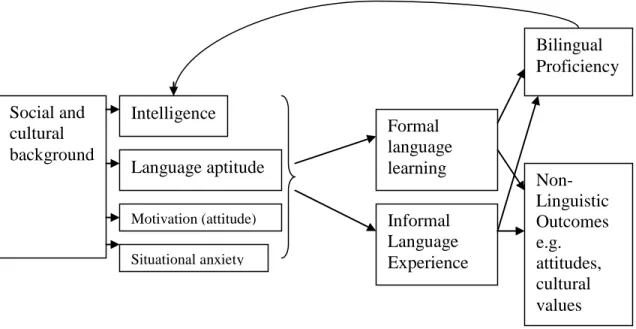
8 Table 2. Spolsky’s Scope of SLA (Mitchell & Myles, 1998, p. 4)
This chart ignores the figure of the ‘teacher’. When Spolsky refers to personal aspects such as attitudes, age and so on, he is focusing on the student. Thus, the model could be criticized for the partial dehumanization of the context of learning and a total dehumanization of the teacher; a legacy of an institutionalized tradition in which the teacher is a neutral figure and the ‘bearer’ of all knowledge. It is worth noting here that our case study is concerned with language teaching and learning in the classroom but in the same way, language acquisition in an open informal context requires significant input from the native speakers whom the student interacts with. B. N. Peirce studies the role and the impact of these native speakers, their attitudes and other individual factors when it comes to creating language learning opportunities. In spite of the lack of human aspects in Spolsky’s chart, the variety of topics and overlapping issues is remarkable. This variety has ended in the inevitable interdisciplinarity of this field of knowledge. SLA has influenced and has been influenced by disciplines such as sociology, linguistics, psychology,
Social context
Attitudes (of various kinds)
Motivation
Age Personality Capabilities Previous knowledge
Learning opportunities (formal or informal)
Linguistic and non-linguistic outcomes for the learner
provides
leads to
9 discourse analysis, ethnography and finally education. This multidisciplinary scaffolding is nourished by the results in language teaching practice and other applied branches of learning in general, although it also tends to undermine the status of this discipline as a field of study in its own right as well as the establishment of its boundaries and the systematization of its findings.
Nevertheless, this case study is not concerned with the examination of boundaries and testing the truth behind old concepts and procedures. Instead, one of our main concerns is to track the changes in the paradigm among the five axis of our initial question and understand the impact of theory on the student’s set of beliefs about language learning. Hence, let us now turn to look at the shifts that have taken place in the five main concepts in our case study in the last forty years.
2.1.1.1 Language and language learning.
Ellis (1994) claims that we cannot agree on an exact date for the birth of the research on SLA, but that traditionally the 1970s have been quoted as the era of autonomous research on language acquisition (1). During the first phase, SLA research focused on the general aspects of language learning that sought similarities between students of different ages, different origins and different first languages. This linguistic focus coincides with the initial interest of our case study.
10 revolutionized the young discipline and it acquired its well-deserved academic status. Since then, from the 1920s to the 1960s, there has been a rapid growth in linguistics. It has branched out into different schools of thought, such as American Structuralism led by Bloomfield; Halliday and Firth’s theories – also known as functional structuralism – and Generative-Transformational Grammar by Chomsky (p. 145). Together, these schools contributed to the origin of the different approaches in SLA.
First, behaviourism based on the models by Skinner (1924) and Watson (1957) considers that language learning is a process of habit formation encouraged by imitation and reinforcement. In the 1940s Lado, founder of contrastive analysis, and Brooks developed this approach to language learning that came into fashion again in the 1960s (Ellis, 2004, p. 23). From their perspective, language is a series of habits developed in society, leaving little room for linguistic creativity. Social changes in this decade did not leave linguistics aside and the second and third most important approaches to SLA came about: mentalism or cognitivism and sociolinguistics.
For a long time, foreign language acquisition has been equated with first language acquisition. Even though theories are nowhere near a full description of these two modes of learning, both processes have been looked at sufficiently to understand their main differences, and some of their similarities. However, popular methods and student beliefs still equate first language acquisition (FLA) and second language learning (SLL), favouring the first process over the second one. Traditionally, it has been assumed that all humans have a natural predisposition towards language (Mitchells and Myles, 1998, p. 8). Therefore, behaviourists thought that if we remove the possible obstacles that this natural ‘gift’ encounters, we would have a clear route towards language learning. The first obstacle was believed to be the learner’s first language (Ellis, 2004, p. 39). Learner errors were explained as a result of ‘interference’ or ‘language transfer’ from the first language of the learner. In order to predict and ‘cure’ the effect of these interferences, they used ‘Contrastive Linguistic Analysis’1 (p. 22). Sooner rather than later, these ‘error’ studies showed examples
11 The question remains to understand how learners use the L1 in order to foster their learning. Traditional contrastive analysis assumed L1 influence was a negative effect. More studies on contrastive analysis and language transfer (Fisiak, 1981; Gass & Selinker, 1983) maintained that the clarification of the understanding of the relationship between L1 and TL would be valuable to language learning.
Mentalist researchers tackled the other 97 per cent of errors in order to elucidate their origin. There was an "explosion in what is called morpheme studies. These studies showed a fixed order of acquisition, regardless of the learning context. There is evidence that learners go through “a number of developmental stages, from very primitive and deviant version of the TL, to progressively more target-like versions” (Mitchell & Myles, 1998, p. 10). However, learner language -or interlanguage, as coined by Selinker in 19722- is also characterized by variability (Ellis, 1984, p. 2). Selinker suggested five stages:
- Language transfer
- Overgeneralization of internalized rules. - Transfer of training.
- Strategies of TL learning
- Strategies of TL communication with native speakers
(Ellis, 2004, p. 48).
A learner’s interlanguage then seems to freeze and learners undergo fossilization (Mitchell & Myles, 1998, p. 13). Fossilized errors seem to have been the most problematic. At the same time, cognitive research found similar acquisition sequences in FLA so they engaged in language processing in order to ascertain if foreign language learners use this linguistic mental device as well (Ellis, 2004, p. 35). These theorists failed to include in their research bilingual accounts of language learning, which are now shedding some light on how first and additional languages relate internally and externally.
12 217). From this perspective, language is a mental faculty governed by principles and parameters. Their most controversial aspect, though, is that based on the principles of Universal Grammar, this approach assumes the existence of an innate language learning device regulated by the principle of structural dependence and which focuses on the language in use (Ellis, 2004, p. 71). The hypotheses about the existence or inexistent of this innate device and the moment or the conditions that trigger its operation or render it inoperative, constitute the basis for the dichotomy between the approach called innatism and the approach for the development of the language acquisition device. Cognitive models include the competition model by Bates and MacWhinney (1982). It looks at the internal interpretation of meaning by comparing a number of linguistic cues in a single sentence that aid in language learning through the competition of mental mechanisms. It accounts for different psycholinguistic processes such as fields, cues, storage, parsing, codes and resonance. McClelland and Rumelhart developed the Parallel Distributed Processing (PDP) model, which develops a complicated mentalist model of language learning based on connectionism and networking between different cognitive areas and external realities. Also worth mentioning is the Adaptive Control of Through (ACT) model developed by Anderson along the same lines. Another cognitivist model focusing on interlanguage development and variation would be the multidimensional model developed by the ZISA group.
13 At the same time, another movement developed as a response to behaviourism, bringing about a more humanistic and constructivist concept of language learning. From the 1960s, traditional linguistics started to consider languages not only as linguistic codes or vehicles for thought but in their relationship with external social realities and internal human characteristics. Sociolinguistics, pragmatics and linguistic ethnography called for an emphasis on external aspects while psycholinguistics and neurolinguistics focused on internal aspects (Ellis, 2004, p. 146). Language learning, then, needs to take into account these external and internal aspects.
One of the most interesting internal aspects of language use is variation (Ellis, 1984, p. 81). For cognitivists, led by Chomsky, all variability is non-systematic. The homogeneous competence model disregards stylistic variability as a less relevant aspect of performance (p. 77), but Labov (1970) proposed within a heterogeneous competence model. According to sociolinguists, there are five principles that any discipline dealing with language use needs to take into account:
1. All speakers possess several styles.
2. Styles can be ranged along a single dimension, measured by the amount of attention paid to speech.
3. The vernacular is the style in which minimum attention is given to monitoring speech. It is not possible to tap the vernacular style of the user by systematic observation of how he performs in a formal context.
5. The only way to obtain good data on the speech of a language user is through systematic observation.
(Ellis, 2004, p. 77)
14 One of the most controversial models of language learning was put forward by Stephen Krashen in the 1980s: the monitor model. Krashen claims that language acquisition and learning are separate processes. The contrast between these setting is not based on their physical differences but it is of a procedural nature. Meaningful communication is a prerequisite of acquisition and Krashen equates this aspect of communication with a natural immersion environment (Ellis, 2004, p. 36). The monitor hypothesis claims that the sole purpose of learning is to monitor or edit TL utterances produced by the acquired language compartment (Ellis, 1983, p. 261). The sequence of foreign language production would be first to initiate an utterance and then to monitor it to finally utter it (Ellis, 2004, p. 36). He also put forward an input hypothesis, which claims that “input at the appropriate level of difficulty was sufficient for TL acquisition to happen” (p. 14) and he called it comprehensible input. Krashen situated the level of ‘appropriate difficulty’ along the lines of this formula: “Should a learner’s current competence be i, comprehensible input would be i+1” (p. 38). This model has attracted a lot of attention and criticism, particularly from Merrill Swain and her colleagues. The main issue they have with Krashen’s theory is that it lacks systematic description and empirical evidence. Swain considers that the weakest point of his theories is the little consideration given to language production. Krashen does not include any interactive negotiation of meaning of comprehensible input. One of Krashen’s strongest points though, is the hypothesis of an affective filter. Affective variables had not yet received considerable attention (p. 263).
15 the learner for the success or failure of this model without taking into account the interactional circumstances that s/he is subjected to and the different access to the target language, which is regulated by more than individual variables (Norton Peirce & Toohey, 2004, p. 283). Another model based on an emphasis on the cultural external aspects of language learning, which was developed by Giles, Lambert and Gardner, was the accommodation model. From this model rose the concepts of in-group (the learner’s community of origin) and out-group (or target language community) (Ellis, 1984, p. 256). They analyze the relationship between the two communities in terms of perceived social distance as well, but they acknowledge the role of interaction in this perception. They also focus a specific layer of the concept on motivation, explaining that it will impact on how learners define themselves in cultural terms.
Finally, interactionist approaches have prevailed throughout the 80s and 90s, proving that the study of the circumstances that surround language interaction between people cannot be left aside (Norton Peirce & Toohey, 2004, p. 283). Based on Leo Van Lier (1988) and Spolsky (1989), and developed by Michael H. Long (1990), this approach focuses on the need for interaction in order to learn a language, something already highlighted by behaviourism and sociolinguistics; and studies the optimal conditions for these interactions through the speech acts involved (Van Lier, 1994, p. 71). They highlight the dynamic aspect of the nature of language and how it develops and shifts through interaction.
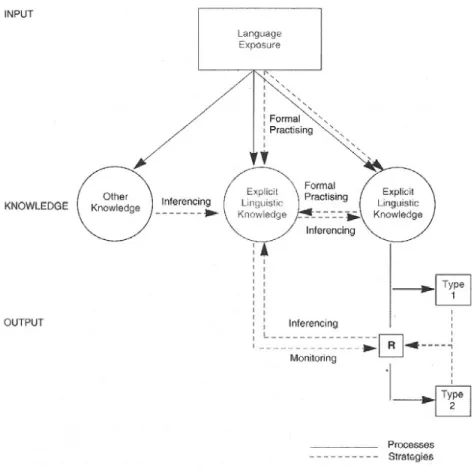
Gass and Selinker’s model of language learning (1994) maintains that foreign language learning models need to take into account the multifaceted behaviour of language and integrate linguistic, sociolinguistic and psycholinguistic perspectives. Their model is mainly an interactionist one. They focus on how learners transform input into output, differentiating between ‘apperceived input’, ‘comprehended input’ and ‘intake’. These terms had started to be examined by Corder as early as the 1970s and became clarified with research on interaction. Intake needs to go through a process of integration in order to become outtake (Gass and Selinker, 1994, p. 297). They took into their framework external and internal conditions affecting this process, namely: 1. Frequency, 2. Affect, 3. Prior knowledge and 4. Attention (p. 300). Negotiation of meaning becomes an essential tool in the stages of comprehended input, intake and integration, highlighting the necessity of interaction beyond behaviourist models of language learning.
16 comes about in an attempt to reconcile and synthesize the concepts put forward by previous approaches and the differences between them, acknowledging their validity and incorporating them all into a multidimensional view of language. The multifunctional perspective comprises cognitivist and sociointeractionist theories. Due to this reconciling spirit, this new line of thought agglutinates theorists from very far-away approaches such as Vivian Cook or B. N. Peirce.
Before finishing up this section, I would like to look at the concept of bilingualism. Since our case study took place in Canada, this concept was very relevant to us, and the fact that SLA theories have failed to account for bilingual models of language learning and theories of bilingualism in general made it more pressing to include a summary of the paradigm shift along this idea.
Studies on bilingualism clarified that first language/s are an indisputable benefit not only for language learning but for other cognitive activities as well. These studies also discovered that the assumed goal of foreign language teaching has been bilingualism (or its multilingual equivalent), without bearing in mind individual differences and strategic modes of learning. Baker points out the difficulties of defining bilingualism:
Who is or is not bilingual is difficult to define and measure. In practice, arbitrary cut-off points are set to define a group of bilingual for research purposes. Much of the research restricts its sample to balanced bilinguals. This may be a special group of bilingual, thus restricting the generalization of results. (Baker, 1988, p. 8)
17 Baker distinguishes several periods in the history of bilingualism theory:
- From the 19th century to the 1960s - The period of detrimental effects (Baker, 1988, p. 9).
Research on intelligence during this period showed the superiority of monolinguals on both sides of the Atlantic. Studies showed that ethnic minorities (Jewish, Spanish, Mexican, Italian, German, Polish, Chinese, Japanese and Bohemian bilinguals) had lower verbal IQ scores than English-only Americans (Darcy 1953; Jensen, 1962; Pearl and Lambert, 1962). In Wales, D.J. Saer (1922, 1923). Frank Smith (1923), Ethel Barke (1933), Barke and Parry-Williams (1938) and W.R. Jones (1959) corroborated the results with similar studies in Europe (Baker, 1988, p. 10). They failed to account for a methodological problem since this IQ tests relied on cultural or pragmatic issues. IQ tests are usually designed from the point of view of the middle class and white definition of intelligence (Baker, 1988, p. 9). Cummins shows in his 1981 book how these ‘scientific’ approaches were supported by an Anglicization endeavour from the governments and society in general.
- 1960s – ‘The period of neutral effects’ (Baker, 1988, p. 9). Research on the 1960s3
of intelligence once individual differences (gender, age, economic, social and educational background) were taken into account (Cummins, 1981, p.16).
tended to show that that bilingualism actually made no difference in terms
- 1960 – 1970s – ‘The shift’.
Pearl and Lambert (1962) turned the history of research with their scientific study in Canada, which laid the foundations in the search for positive outcomes of bilingualism.4 On the other side of the
Atlantic, the British Bullock Report, A Language for Life (1975), illustrated a shift in institutional perspectives of minority languages (Baker, 1988, p. 61). Finally, in the same year, a Draft Directive from the Council of European Communities (EEC) called for member states to teach the language and culture of the country of origin of EEC migrant workers within the school curriculum (Baker, 1988, p. 61).
- 1970s – 1980s – ‘The period of positive effects’
The Lambert experiment (Baker, 1988, p. 94) conducted by Lambert and Tucker (1972)
18 and the language of immersion had an impact on these benefits (Baker, 1988, p. 107). Attitude towards bilingualism itself seemed to be relevant. Katz (1960) had isolated four types of individual attitudes:
1. Utilitarian or instrumental. 2. Ego-defensive.
3. Value expressive. 4. Knowledge.
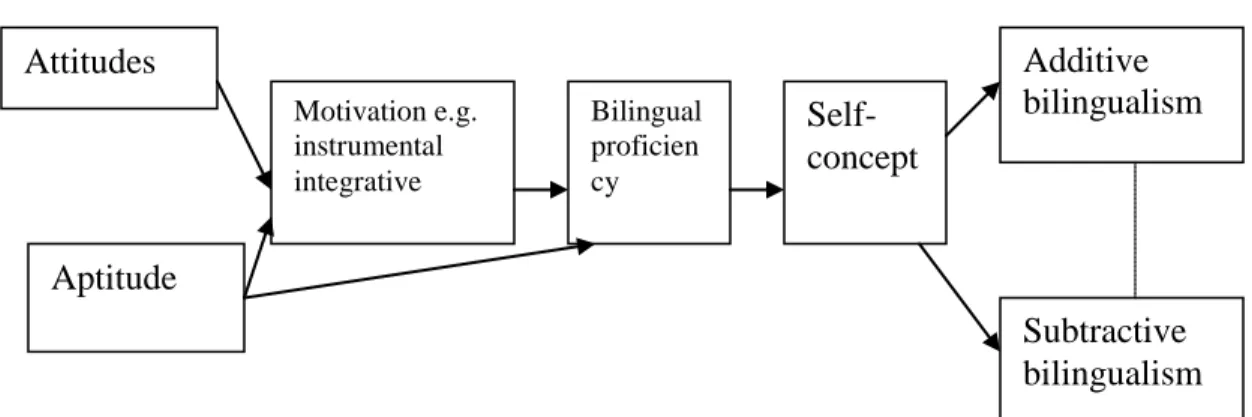
The attitude towards the foreign culture has also been considered a key issue in bilingualism and Baker proposes the following model to account for all these aspects:
Table 3 – Baker’s Bilingualism Model (Baker, 1988, p. 183)
Dunkin and Biddle (1974) attempted to include the school context in their model of bilingual education. General foreign teaching at the time had not produced such a complex model to account for the reality of language learning.
Attitudes
Aptitude
Motivation e.g. instrumental integrative
Bilingual proficien cy
Self-concept
Additive bilingualism
19 Table 4 - Dunkin and Biddle’s Bilingual Education Model (Baker, 1988, p. 189)
- 1980s – ‘The period of additive effects’ (Baker, 1988, p. 12)
Another British document, Education for all (1985), or Swann Report, rejected traditional policies of assimilation and school segregation, encouraging the inclusion of minority languages in school curricula (p. 63).
Jim Cummins’s research brought about the groundbreaking view that education in Canada had been “a means of Canadianizing foreign students” (Cummins, 1981, p. 3). This harsh critique of the country
INPUT VARIABLES
A) TEACHER CHARACTERISTICS - language proficiency - linguistic knowledge - cultural knowledge - teacher competencies and attitudes
B) PUPIL
CHARACTERISTICS - ability in languages - aptitude, attitude and motivation for languages
- language and cultural background
PROCESS VARIABLES
A) PUPIL-TEACHER INTERACTION
(e.g. % use of 2 languages) B) PUPIL-PUPIL
INTERACTION c) USE OF CURRICULUM MATERIALS (e.g. interpretation given in use of materials by teachers and pupils)
CONTEXT VARIABLES
A) NATURE OF COMMUNITY re LANGUAGE AND CULTURE
B) NATURE AND AIMS OF THE SCHOOL C) NATURE OF THE CLASSROOM (e.g. linguistic
balance)
D) NATURE OF CURRICULUM (e.g. use of programs and projects)
OUTPUT VARIABLES
- ATTAINMENT IN LANGUAGES - ATTITUDE TO LANGUAGES
- SOCIAL & CULTURAL INTEGRATION
- PREFERENCE FOR STUDYING EITHER OR BOTH LANGUAGES
20 provides evidence that the school system had assimilated the period of detrimental effects, spreading it through Canadian educational institutions. He offered brain models in order to understand the prevalent attitudes during the different periods of bilingualism. During the period of detrimental effects, he used the Balance Effect Theory, according to which the brain has a limited linguistic capacity (p. 27). This view of the brain does not encourage the development of two languages as they will have to compete for mental space and they will most likely generate psychological problems. The following model he identified was the Think Tank Model, which assumes that languages act as filters of thought (pp. 29-30). The think tank activates several controls of the input and output. Namely, these controls are a monitoring control, a switch control and a motivational control or value control (p. 31). This model shows a “greater mental flexibility, the ability to think more abstractly (…), resulting in superiority in concept formation, a more enriched bicultural environment which benefits IQ, positive transfer between languages benefiting verbal IQ” (p. 17).
Another advantage of bilingualism stemmed from Vygotskian theories. Bilingual children understand their first language as a system among many other systems. This relativity leads to an awareness of the linguistic mechanisms behind the process of communication (Cummins, 1988, p.12). Elsewhere, Cummins suggests three main benefits between bilingualism and general thinking. First, many bilinguals are more aware of the cultural aspects of meaning because of their experience of two cultures. Second, they have acquired a switching habit that allows them to shift between languages. This activity of code-switching may encourage flexibility of thought. Third, bilingual people may use the strategy of contrastive analysis more often than monolinguals (Baker, 1988, p. 38). These analytical strategies impact overall academic language skills and have showed beneficial results in reading and writing, creative thinking and sensitivity (Cummins, 1981, p. 22).
21 Table 5 – BICs and CALPs (Cummins, 1990, p. 41)
Cognitively Undemanding
Context Embedded Context Reduced
Outside class
Interpersonal and Rhetoric
Inside Class Rhetoric
Cognitively Demanding
This model has been criticized for ignoring contextual and individual factors. According to Baker, the theory has not taken into account individual socio-cultural differences and their influence in language results. Concepts like BICS and CALP tend to be ambiguously defined, subjective and binary, and can lead to oversimplification and fixed taxonomies of student levels of performance (Baker, 1988, p. 180-1).
In the history of research on bilingualism, the paradigm shift started with the Balance Effect theory, considering our brain as a static container in which two languages struggle for space (Cummins, 1981, p. 22); the Think Tank Model, still considers our brain as a container but language this time is not the content but a filter. From existing research, there is lack of conclusive evidence as to the specific positive effects of bilingualism but it has been acknowledged that it does not have negative effects, and most political movements promote and support bilingual education today.